EP1117708B1 - Verfahren zur herstellung von halogenfreiem, reaktivem polyisobuten - Google Patents
Verfahren zur herstellung von halogenfreiem, reaktivem polyisobuten Download PDFInfo
- Publication number
- EP1117708B1 EP1117708B1 EP99938254A EP99938254A EP1117708B1 EP 1117708 B1 EP1117708 B1 EP 1117708B1 EP 99938254 A EP99938254 A EP 99938254A EP 99938254 A EP99938254 A EP 99938254A EP 1117708 B1 EP1117708 B1 EP 1117708B1
- Authority
- EP
- European Patent Office
- Prior art keywords
- isobutene
- elements
- polymerization
- periodic table
- catalyst
- Prior art date
- Legal status (The legal status is an assumption and is not a legal conclusion. Google has not performed a legal analysis and makes no representation as to the accuracy of the status listed.)
- Expired - Lifetime
Links
- 229920002367 Polyisobutene Polymers 0.000 title claims abstract description 60
- 238000004519 manufacturing process Methods 0.000 title claims abstract description 14
- VQTUBCCKSQIDNK-UHFFFAOYSA-N Isobutene Chemical compound CC(C)=C VQTUBCCKSQIDNK-UHFFFAOYSA-N 0.000 claims abstract description 176
- 238000006116 polymerization reaction Methods 0.000 claims abstract description 41
- 239000000203 mixture Substances 0.000 claims abstract description 39
- 229930195733 hydrocarbon Natural products 0.000 claims abstract description 19
- 238000006243 chemical reaction Methods 0.000 claims abstract description 18
- 150000002430 hydrocarbons Chemical class 0.000 claims abstract description 17
- 239000004215 Carbon black (E152) Substances 0.000 claims abstract description 15
- 239000002638 heterogeneous catalyst Substances 0.000 claims abstract description 13
- 239000007858 starting material Substances 0.000 claims abstract description 10
- 238000000926 separation method Methods 0.000 claims abstract description 6
- 230000002378 acidificating effect Effects 0.000 claims abstract description 4
- 238000010538 cationic polymerization reaction Methods 0.000 claims abstract description 4
- 239000007791 liquid phase Substances 0.000 claims abstract description 4
- 239000003054 catalyst Substances 0.000 claims description 69
- NNPPMTNAJDCUHE-UHFFFAOYSA-N isobutane Chemical compound CC(C)C NNPPMTNAJDCUHE-UHFFFAOYSA-N 0.000 claims description 57
- 238000000034 method Methods 0.000 claims description 31
- 239000001282 iso-butane Substances 0.000 claims description 25
- 230000000737 periodic effect Effects 0.000 claims description 18
- 239000001301 oxygen Substances 0.000 claims description 13
- 229910052760 oxygen Inorganic materials 0.000 claims description 13
- 150000001875 compounds Chemical class 0.000 claims description 12
- 238000004821 distillation Methods 0.000 claims description 9
- 150000003839 salts Chemical class 0.000 claims description 7
- QVGXLLKOCUKJST-UHFFFAOYSA-N atomic oxygen Chemical compound [O] QVGXLLKOCUKJST-UHFFFAOYSA-N 0.000 claims description 6
- 238000002360 preparation method Methods 0.000 claims description 5
- QCWXUUIWCKQGHC-UHFFFAOYSA-N Zirconium Chemical compound [Zr] QCWXUUIWCKQGHC-UHFFFAOYSA-N 0.000 claims description 4
- 239000000463 material Substances 0.000 claims description 4
- 229910052726 zirconium Inorganic materials 0.000 claims description 4
- 238000006356 dehydrogenation reaction Methods 0.000 claims description 3
- 230000007704 transition Effects 0.000 claims 9
- 229910052736 halogen Inorganic materials 0.000 claims 6
- 150000002367 halogens Chemical class 0.000 claims 6
- 150000002926 oxygen Chemical class 0.000 claims 6
- 230000001737 promoting effect Effects 0.000 claims 3
- 150000003755 zirconium compounds Chemical class 0.000 claims 3
- BZLVMXJERCGZMT-UHFFFAOYSA-N Methyl tert-butyl ether Chemical compound COC(C)(C)C BZLVMXJERCGZMT-UHFFFAOYSA-N 0.000 claims 2
- 230000000379 polymerizing effect Effects 0.000 claims 1
- VLKZOEOYAKHREP-UHFFFAOYSA-N n-Hexane Chemical class CCCCCC VLKZOEOYAKHREP-UHFFFAOYSA-N 0.000 description 23
- 239000000047 product Substances 0.000 description 13
- 229910052750 molybdenum Inorganic materials 0.000 description 12
- XLYOFNOQVPJJNP-UHFFFAOYSA-N water Substances O XLYOFNOQVPJJNP-UHFFFAOYSA-N 0.000 description 11
- 229910052742 iron Inorganic materials 0.000 description 10
- 229910001868 water Inorganic materials 0.000 description 10
- -1 Lewis acids aluminum chloride Chemical class 0.000 description 9
- VXNZUUAINFGPBY-UHFFFAOYSA-N 1-Butene Chemical compound CCC=C VXNZUUAINFGPBY-UHFFFAOYSA-N 0.000 description 8
- MCMNRKCIXSYSNV-UHFFFAOYSA-N ZrO2 Inorganic materials O=[Zr]=O MCMNRKCIXSYSNV-UHFFFAOYSA-N 0.000 description 8
- WTEOIRVLGSZEPR-UHFFFAOYSA-N boron trifluoride Chemical compound FB(F)F WTEOIRVLGSZEPR-UHFFFAOYSA-N 0.000 description 8
- 229910052748 manganese Inorganic materials 0.000 description 8
- IJDNQMDRQITEOD-UHFFFAOYSA-N n-butane Chemical compound CCCC IJDNQMDRQITEOD-UHFFFAOYSA-N 0.000 description 8
- 239000002904 solvent Substances 0.000 description 8
- 229910052721 tungsten Inorganic materials 0.000 description 8
- 239000004711 α-olefin Substances 0.000 description 8
- ZOKXTWBITQBERF-UHFFFAOYSA-N Molybdenum Chemical compound [Mo] ZOKXTWBITQBERF-UHFFFAOYSA-N 0.000 description 7
- VYPSYNLAJGMNEJ-UHFFFAOYSA-N Silicium dioxide Chemical compound O=[Si]=O VYPSYNLAJGMNEJ-UHFFFAOYSA-N 0.000 description 6
- 239000002253 acid Substances 0.000 description 6
- OKTJSMMVPCPJKN-UHFFFAOYSA-N activated carbon Substances [C] OKTJSMMVPCPJKN-UHFFFAOYSA-N 0.000 description 6
- 229910052782 aluminium Inorganic materials 0.000 description 6
- IAQRGUVFOMOMEM-UHFFFAOYSA-N but-2-ene Chemical class CC=CC IAQRGUVFOMOMEM-UHFFFAOYSA-N 0.000 description 6
- 239000011733 molybdenum Substances 0.000 description 6
- 229910052710 silicon Inorganic materials 0.000 description 6
- 238000009826 distribution Methods 0.000 description 5
- 125000002573 ethenylidene group Chemical group [*]=C=C([H])[H] 0.000 description 5
- RVTZCBVAJQQJTK-UHFFFAOYSA-N oxygen(2-);zirconium(4+) Chemical compound [O-2].[O-2].[Zr+4] RVTZCBVAJQQJTK-UHFFFAOYSA-N 0.000 description 5
- 229920000642 polymer Polymers 0.000 description 5
- 239000000725 suspension Substances 0.000 description 5
- 229910052720 vanadium Inorganic materials 0.000 description 5
- XKRFYHLGVUSROY-UHFFFAOYSA-N Argon Chemical compound [Ar] XKRFYHLGVUSROY-UHFFFAOYSA-N 0.000 description 4
- 229910015900 BF3 Inorganic materials 0.000 description 4
- 229910004298 SiO 2 Inorganic materials 0.000 description 4
- GWEVSGVZZGPLCZ-UHFFFAOYSA-N Titan oxide Chemical compound O=[Ti]=O GWEVSGVZZGPLCZ-UHFFFAOYSA-N 0.000 description 4
- VSCWAEJMTAWNJL-UHFFFAOYSA-K aluminum chloride Substances Cl[Al](Cl)Cl VSCWAEJMTAWNJL-UHFFFAOYSA-K 0.000 description 4
- 229910052796 boron Inorganic materials 0.000 description 4
- 229910052791 calcium Inorganic materials 0.000 description 4
- 239000012876 carrier material Substances 0.000 description 4
- 230000000052 comparative effect Effects 0.000 description 4
- 229910052802 copper Inorganic materials 0.000 description 4
- 229910052746 lanthanum Inorganic materials 0.000 description 4
- 229910052749 magnesium Inorganic materials 0.000 description 4
- 239000000843 powder Substances 0.000 description 4
- 229910052709 silver Inorganic materials 0.000 description 4
- 238000003786 synthesis reaction Methods 0.000 description 4
- WFKWXMTUELFFGS-UHFFFAOYSA-N tungsten Chemical compound [W] WFKWXMTUELFFGS-UHFFFAOYSA-N 0.000 description 4
- 229910052725 zinc Inorganic materials 0.000 description 4
- KAKZBPTYRLMSJV-UHFFFAOYSA-N Butadiene Chemical compound C=CC=C KAKZBPTYRLMSJV-UHFFFAOYSA-N 0.000 description 3
- ZAMOUSCENKQFHK-UHFFFAOYSA-N Chlorine atom Chemical compound [Cl] ZAMOUSCENKQFHK-UHFFFAOYSA-N 0.000 description 3
- 239000000654 additive Substances 0.000 description 3
- 230000015572 biosynthetic process Effects 0.000 description 3
- 235000013844 butane Nutrition 0.000 description 3
- 125000004432 carbon atom Chemical group C* 0.000 description 3
- 239000000460 chlorine Substances 0.000 description 3
- 229910052801 chlorine Inorganic materials 0.000 description 3
- 230000000694 effects Effects 0.000 description 3
- 238000005227 gel permeation chromatography Methods 0.000 description 3
- 229910052759 nickel Inorganic materials 0.000 description 3
- 239000000377 silicon dioxide Substances 0.000 description 3
- 239000000243 solution Substances 0.000 description 3
- 239000000126 substance Substances 0.000 description 3
- 239000010937 tungsten Substances 0.000 description 3
- PNEYBMLMFCGWSK-UHFFFAOYSA-N Alumina Chemical class [O-2].[O-2].[O-2].[Al+3].[Al+3] PNEYBMLMFCGWSK-UHFFFAOYSA-N 0.000 description 2
- 229910052684 Cerium Inorganic materials 0.000 description 2
- 239000002841 Lewis acid Substances 0.000 description 2
- IMNFDUFMRHMDMM-UHFFFAOYSA-N N-Heptane Chemical class CCCCCCC IMNFDUFMRHMDMM-UHFFFAOYSA-N 0.000 description 2
- 229910052779 Neodymium Inorganic materials 0.000 description 2
- OFBQJSOFQDEBGM-UHFFFAOYSA-N Pentane Chemical class CCCCC OFBQJSOFQDEBGM-UHFFFAOYSA-N 0.000 description 2
- OAICVXFJPJFONN-UHFFFAOYSA-N Phosphorus Chemical compound [P] OAICVXFJPJFONN-UHFFFAOYSA-N 0.000 description 2
- XUIMIQQOPSSXEZ-UHFFFAOYSA-N Silicon Chemical compound [Si] XUIMIQQOPSSXEZ-UHFFFAOYSA-N 0.000 description 2
- 229910010413 TiO 2 Inorganic materials 0.000 description 2
- GEIAQOFPUVMAGM-UHFFFAOYSA-N ZrO Inorganic materials [Zr]=O GEIAQOFPUVMAGM-UHFFFAOYSA-N 0.000 description 2
- 150000001336 alkenes Chemical class 0.000 description 2
- 239000007864 aqueous solution Substances 0.000 description 2
- 229910052786 argon Inorganic materials 0.000 description 2
- 229910052797 bismuth Inorganic materials 0.000 description 2
- 239000006227 byproduct Substances 0.000 description 2
- 229910052792 caesium Inorganic materials 0.000 description 2
- 238000001460 carbon-13 nuclear magnetic resonance spectrum Methods 0.000 description 2
- 229910052804 chromium Inorganic materials 0.000 description 2
- 229910052681 coesite Inorganic materials 0.000 description 2
- 229910052906 cristobalite Inorganic materials 0.000 description 2
- 230000018044 dehydration Effects 0.000 description 2
- 238000006297 dehydration reaction Methods 0.000 description 2
- XNMQEEKYCVKGBD-UHFFFAOYSA-N dimethylacetylene Natural products CC#CC XNMQEEKYCVKGBD-UHFFFAOYSA-N 0.000 description 2
- 239000002816 fuel additive Substances 0.000 description 2
- 229910052733 gallium Inorganic materials 0.000 description 2
- 229910052735 hafnium Inorganic materials 0.000 description 2
- 238000007037 hydroformylation reaction Methods 0.000 description 2
- 150000002500 ions Chemical class 0.000 description 2
- 238000006317 isomerization reaction Methods 0.000 description 2
- 229910052745 lead Inorganic materials 0.000 description 2
- 239000007788 liquid Substances 0.000 description 2
- 239000002808 molecular sieve Substances 0.000 description 2
- 229910052758 niobium Inorganic materials 0.000 description 2
- 229910052698 phosphorus Inorganic materials 0.000 description 2
- 229910052700 potassium Inorganic materials 0.000 description 2
- 238000010791 quenching Methods 0.000 description 2
- 239000012429 reaction media Substances 0.000 description 2
- 239000011541 reaction mixture Substances 0.000 description 2
- 230000002829 reductive effect Effects 0.000 description 2
- 238000010992 reflux Methods 0.000 description 2
- 229910052702 rhenium Inorganic materials 0.000 description 2
- 229910052706 scandium Inorganic materials 0.000 description 2
- 229910052708 sodium Inorganic materials 0.000 description 2
- URGAHOPLAPQHLN-UHFFFAOYSA-N sodium aluminosilicate Chemical compound [Na+].[Al+3].[O-][Si]([O-])=O.[O-][Si]([O-])=O URGAHOPLAPQHLN-UHFFFAOYSA-N 0.000 description 2
- 241000894007 species Species 0.000 description 2
- 229910052682 stishovite Inorganic materials 0.000 description 2
- 229910052717 sulfur Inorganic materials 0.000 description 2
- 229910052715 tantalum Inorganic materials 0.000 description 2
- VZGDMQKNWNREIO-UHFFFAOYSA-N tetrachloromethane Chemical compound ClC(Cl)(Cl)Cl VZGDMQKNWNREIO-UHFFFAOYSA-N 0.000 description 2
- 229910052905 tridymite Inorganic materials 0.000 description 2
- 229910052727 yttrium Inorganic materials 0.000 description 2
- 238000001644 13C nuclear magnetic resonance spectroscopy Methods 0.000 description 1
- IRPGOXJVTQTAAN-UHFFFAOYSA-N 2,2,3,3,3-pentafluoropropanal Chemical compound FC(F)(F)C(F)(F)C=O IRPGOXJVTQTAAN-UHFFFAOYSA-N 0.000 description 1
- KLZUFWVZNOTSEM-UHFFFAOYSA-K Aluminum fluoride Inorganic materials F[Al](F)F KLZUFWVZNOTSEM-UHFFFAOYSA-K 0.000 description 1
- QGZKDVFQNNGYKY-UHFFFAOYSA-N Ammonia Chemical compound N QGZKDVFQNNGYKY-UHFFFAOYSA-N 0.000 description 1
- NLXLAEXVIDQMFP-UHFFFAOYSA-N Ammonium chloride Substances [NH4+].[Cl-] NLXLAEXVIDQMFP-UHFFFAOYSA-N 0.000 description 1
- 241000282326 Felis catus Species 0.000 description 1
- VEXZGXHMUGYJMC-UHFFFAOYSA-N Hydrochloric acid Chemical compound Cl VEXZGXHMUGYJMC-UHFFFAOYSA-N 0.000 description 1
- SECXISVLQFMRJM-UHFFFAOYSA-N N-Methylpyrrolidone Chemical compound CN1CCCC1=O SECXISVLQFMRJM-UHFFFAOYSA-N 0.000 description 1
- 229910020881 PMo12O40 Inorganic materials 0.000 description 1
- 229910020628 SiW12O40 Inorganic materials 0.000 description 1
- 241001168730 Simo Species 0.000 description 1
- HEDRZPFGACZZDS-MICDWDOJSA-N Trichloro(2H)methane Chemical class [2H]C(Cl)(Cl)Cl HEDRZPFGACZZDS-MICDWDOJSA-N 0.000 description 1
- 238000005299 abrasion Methods 0.000 description 1
- 150000007513 acids Chemical class 0.000 description 1
- 150000001298 alcohols Chemical class 0.000 description 1
- 125000005234 alkyl aluminium group Chemical group 0.000 description 1
- 150000001350 alkyl halides Chemical class 0.000 description 1
- 150000001412 amines Chemical class 0.000 description 1
- 235000011114 ammonium hydroxide Nutrition 0.000 description 1
- 238000004458 analytical method Methods 0.000 description 1
- 125000004429 atom Chemical group 0.000 description 1
- CBHOOMGKXCMKIR-UHFFFAOYSA-N azane;methanol Chemical compound N.OC CBHOOMGKXCMKIR-UHFFFAOYSA-N 0.000 description 1
- 238000009835 boiling Methods 0.000 description 1
- 229910052799 carbon Inorganic materials 0.000 description 1
- 238000004523 catalytic cracking Methods 0.000 description 1
- 230000003197 catalytic effect Effects 0.000 description 1
- 238000005119 centrifugation Methods 0.000 description 1
- 159000000006 cesium salts Chemical class 0.000 description 1
- 239000003795 chemical substances by application Substances 0.000 description 1
- 239000012320 chlorinating reagent Substances 0.000 description 1
- 229910017052 cobalt Inorganic materials 0.000 description 1
- 239000010941 cobalt Substances 0.000 description 1
- GUTLYIVDDKVIGB-UHFFFAOYSA-N cobalt atom Chemical compound [Co] GUTLYIVDDKVIGB-UHFFFAOYSA-N 0.000 description 1
- 239000000470 constituent Substances 0.000 description 1
- 238000010924 continuous production Methods 0.000 description 1
- 238000001816 cooling Methods 0.000 description 1
- 229920001577 copolymer Polymers 0.000 description 1
- 238000005336 cracking Methods 0.000 description 1
- 239000008367 deionised water Substances 0.000 description 1
- 229910021641 deionized water Inorganic materials 0.000 description 1
- 238000012674 dispersion polymerization Methods 0.000 description 1
- 238000001035 drying Methods 0.000 description 1
- 238000001914 filtration Methods 0.000 description 1
- 238000004231 fluid catalytic cracking Methods 0.000 description 1
- 239000011521 glass Substances 0.000 description 1
- 150000004820 halides Chemical class 0.000 description 1
- 230000002140 halogenating effect Effects 0.000 description 1
- 239000011964 heteropoly acid Substances 0.000 description 1
- 239000002815 homogeneous catalyst Substances 0.000 description 1
- 239000001257 hydrogen Substances 0.000 description 1
- 229910052739 hydrogen Inorganic materials 0.000 description 1
- IXCSERBJSXMMFS-UHFFFAOYSA-N hydrogen chloride Substances Cl.Cl IXCSERBJSXMMFS-UHFFFAOYSA-N 0.000 description 1
- 229910000041 hydrogen chloride Inorganic materials 0.000 description 1
- 239000000543 intermediate Substances 0.000 description 1
- 238000002955 isolation Methods 0.000 description 1
- 239000011968 lewis acid catalyst Substances 0.000 description 1
- 150000007517 lewis acids Chemical class 0.000 description 1
- 239000003879 lubricant additive Substances 0.000 description 1
- 229920002521 macromolecule Polymers 0.000 description 1
- 238000003760 magnetic stirring Methods 0.000 description 1
- 238000012423 maintenance Methods 0.000 description 1
- FPYJFEHAWHCUMM-UHFFFAOYSA-N maleic anhydride Chemical compound O=C1OC(=O)C=C1 FPYJFEHAWHCUMM-UHFFFAOYSA-N 0.000 description 1
- 229910001510 metal chloride Inorganic materials 0.000 description 1
- 229910021645 metal ion Inorganic materials 0.000 description 1
- 229910000476 molybdenum oxide Inorganic materials 0.000 description 1
- 150000002823 nitrates Chemical class 0.000 description 1
- 239000012038 nucleophile Substances 0.000 description 1
- JRZJOMJEPLMPRA-UHFFFAOYSA-N olefin Natural products CCCCCCCC=C JRZJOMJEPLMPRA-UHFFFAOYSA-N 0.000 description 1
- TWNQGVIAIRXVLR-UHFFFAOYSA-N oxo(oxoalumanyloxy)alumane Chemical compound O=[Al]O[Al]=O TWNQGVIAIRXVLR-UHFFFAOYSA-N 0.000 description 1
- PQQKPALAQIIWST-UHFFFAOYSA-N oxomolybdenum Chemical compound [Mo]=O PQQKPALAQIIWST-UHFFFAOYSA-N 0.000 description 1
- VLTRZXGMWDSKGL-UHFFFAOYSA-N perchloric acid Chemical class OCl(=O)(=O)=O VLTRZXGMWDSKGL-UHFFFAOYSA-N 0.000 description 1
- 239000011574 phosphorus Substances 0.000 description 1
- 229920002959 polymer blend Polymers 0.000 description 1
- 239000002685 polymerization catalyst Substances 0.000 description 1
- 150000003138 primary alcohols Chemical class 0.000 description 1
- 230000000171 quenching effect Effects 0.000 description 1
- 230000035484 reaction time Effects 0.000 description 1
- 238000004064 recycling Methods 0.000 description 1
- 238000006268 reductive amination reaction Methods 0.000 description 1
- 230000002040 relaxant effect Effects 0.000 description 1
- 150000003333 secondary alcohols Chemical class 0.000 description 1
- 239000010703 silicon Substances 0.000 description 1
- 235000012239 silicon dioxide Nutrition 0.000 description 1
- 239000007787 solid Substances 0.000 description 1
- 239000007921 spray Substances 0.000 description 1
- 238000003756 stirring Methods 0.000 description 1
- 150000003467 sulfuric acid derivatives Chemical class 0.000 description 1
- 125000000383 tetramethylene group Chemical group [H]C([H])([*:1])C([H])([H])C([H])([H])C([H])([H])[*:2] 0.000 description 1
- CZDYPVPMEAXLPK-UHFFFAOYSA-N tetramethylsilane Chemical compound C[Si](C)(C)C CZDYPVPMEAXLPK-UHFFFAOYSA-N 0.000 description 1
- 238000004227 thermal cracking Methods 0.000 description 1
- 229910052718 tin Inorganic materials 0.000 description 1
- 229910052719 titanium Inorganic materials 0.000 description 1
- IAQRGUVFOMOMEM-ONEGZZNKSA-N trans-but-2-ene Chemical compound C\C=C\C IAQRGUVFOMOMEM-ONEGZZNKSA-N 0.000 description 1
- 229910052723 transition metal Inorganic materials 0.000 description 1
- 150000003624 transition metals Chemical class 0.000 description 1
- 125000002827 triflate group Chemical class FC(S(=O)(=O)O*)(F)F 0.000 description 1
- GPPXJZIENCGNKB-UHFFFAOYSA-N vanadium Chemical compound [V]#[V] GPPXJZIENCGNKB-UHFFFAOYSA-N 0.000 description 1
- 238000010626 work up procedure Methods 0.000 description 1
- 229910001928 zirconium oxide Inorganic materials 0.000 description 1
Classifications
-
- C—CHEMISTRY; METALLURGY
- C08—ORGANIC MACROMOLECULAR COMPOUNDS; THEIR PREPARATION OR CHEMICAL WORKING-UP; COMPOSITIONS BASED THEREON
- C08F—MACROMOLECULAR COMPOUNDS OBTAINED BY REACTIONS ONLY INVOLVING CARBON-TO-CARBON UNSATURATED BONDS
- C08F110/00—Homopolymers of unsaturated aliphatic hydrocarbons having only one carbon-to-carbon double bond
- C08F110/04—Monomers containing three or four carbon atoms
- C08F110/08—Butenes
- C08F110/10—Isobutene
Definitions
- the present invention relates to an improved process for the preparation of halogen-free, reactive polyisobutene with a content of terminal double bonds of more than 60 mol% and an average molecular weight M n of 800 to 3000 daltons by cationic polymerization of isobutene in the liquid phase on an acid, essentially halogen-free heterogeneous catalyst, the content of terminal double bonds being increased by partial conversion.
- Isobutene polymerization forms an inseparable mixture of polyisobutenes with different positions of the double bond in the individual polyisobutenes.
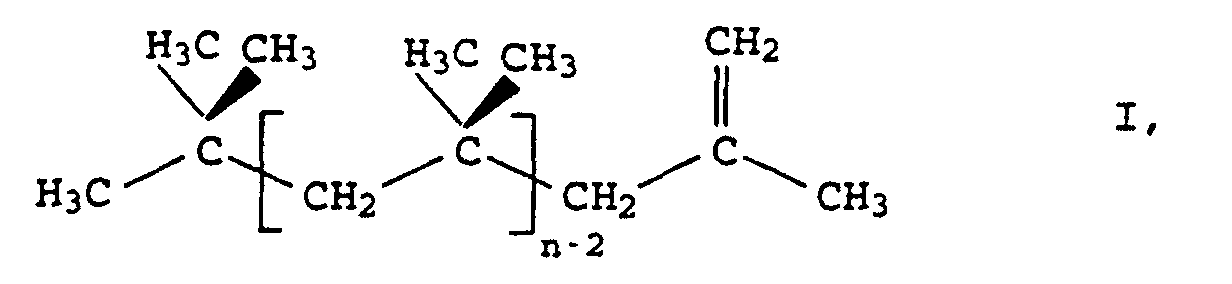
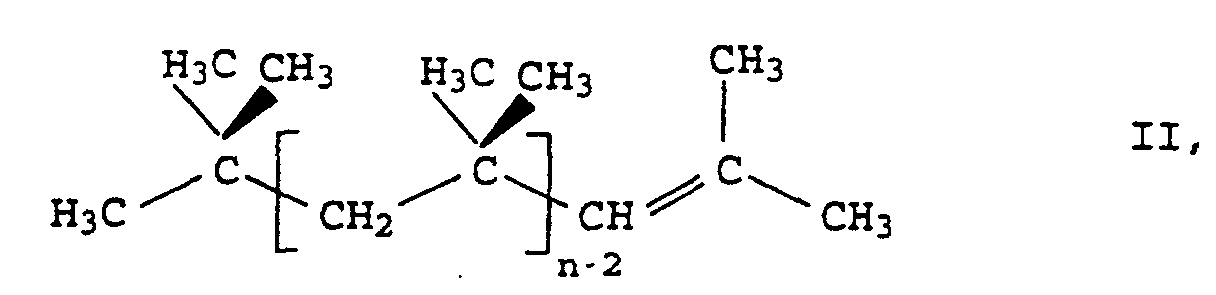
- Polyisobutenes of the formula I. in which n indicates the degree of polymerization, which in turn results from the average molecular weight M n of the polyisobutene produced contain terminal CC double bonds of the vinylidene type, which are also referred to as ⁇ -olefinic double bonds due to their position in the polyisobutene molecule. Accordingly, the double bonds in polyisobutenes of the formula II referred to as ⁇ -olefinic.
- polyisobutenes The production of the polyisobutenes is described, for example, in H. Schurbock, Polyisobutylenes and copolymers, pp. 77-104, Springer-Verlag, Berlin, 1959. It is usually done by Lewis acid catalyzed isobutene polymerization, where as Lewis acids aluminum chloride, alkyl aluminum chloride or boron trifluoride be used.
- Lewis acids aluminum chloride, alkyl aluminum chloride or boron trifluoride be used.
- the polymers obtained here have however, with less than 10 mol% a relatively low content of terminal C-C double bonds of the vinylidene type.
- reactive polyisobutene has molecular weights from usually 500 to 5000 daltons a high content of terminal vinylidene groups, preferably of more than 50 mol%.
- These reactive polyisobutenes are used as intermediates Manufacture of lubricant and fuel additives like these are described, for example, in DE-A 27 02 604.
- polyisobutene is first used Maleic anhydride implemented. The terminal ones react preferentially Double bonds of the vinylidene type, whereas double bonds, that are further inside the macromolecule depending on the position in the molecule to a lesser extent or not at all react.
- polyisobutene-maleic anhydride adducts formed are then reacted with certain amines converted into the corresponding additives.
- a high percentage of terminal double bonds is therefore for polyisobutenes that as Starting materials are used for the additives mentioned above, absolutely necessary.
- polyisobutene with a high content of terminal Double bonds are preferably used, but are used in the hydroformylation with cobalt catalysts, due to their double bond isomerization activity, also ⁇ -olefinic polyisobutenes hydroformylated to the desired product.
- reactive polyisobutene is mostly in shape known the homogeneous catalytic polymerization of isobutene.
- DE-A 27 02 604 by reacting isobutene receive a polyisobutene product in the presence of boron trifluoride, which has a content of terminal double bonds of up to 88%.
- EP-A 145 235 teaches the polymerization of Isobutene in the presence of a complex of boron trifluoride and one primary alcohol in a temperature range from -100 ° C to + 50 ° C, with products with similarly high vinylidene double bond contents be preserved.
- complexes of boron trifluoride and secondary Alcohols as catalysts can also be used according to US Pat. No. 5,286,823 highly reactive polyisobutene can be produced.
- the homogeneously catalyzed processes mentioned have the disadvantage that the Lewis acid catalysts used are corrosive and there is a risk that in addition to the desired reactive polyisobutene halogenated, polymeric by-products are formed, that are practically inseparable from the PIB and themselves disadvantageous on the product and processing properties impact of the PIB.
- the homogeneous catalyst is separated off in these processes usually by quenching with a nucleophile, which destroys the catalyst, and subsequent extractive separation of the PIB from the quench mixture.
- WO 94/28036 also describes the production of polyisobutene Known with the help of heterogeneous Lewis acid-like catalysts. As such become salts of elements insoluble in the reaction medium from III., IV., V. and VI. Subgroup of the periodic table of the elements used, preferably their halides, sulfates, Perchlorates, trifluoromethanesulfonates, nitrates and fluorosulfonates. To terminate the polymerization, the reaction medium is added added added methanolic ammonia solution, causing the concerned Catalysts destroyed or at least inactivated to a considerable extent become.
- the polymerization of a mixture of n-butane, isobutane and isobutene over a chlorinated aluminum oxide catalyst prepared in this way leads to a polyisobutene product with a chlorine content of 46 ppm after a reaction time of 2 hours.
- US Pat. No. 5,326,920 relates to a process for isobutene polymerization in which an oxidic support material, preferably silicon dioxide, which has been activated with a metal chloride, preferably an aluminum chloride, bonded to it, is used as the heterogeneous catalyst.
- an oxidic support material preferably silicon dioxide
- a metal chloride preferably an aluminum chloride
- the polyisobutene products obtained have the disadvantage of an extremely broad molecular weight distribution D of 8 to 14, a low content of terminal double bonds and a chlorine content in the ppm range.
- heterogeneous catalysts containing zirconium dioxide and molybdenum oxide are used for the production of isobutene oligomers having a molecular weight of less than 300 daltons.
- aluminum fluoride can also be added to these catalysts.
- isobutene-containing C 4 cut composition: 46% isobutene, 28% 1-butene, 8% 2-butenes, 12% n-butane, 5% isobutane, 1% 1.3 -Butadiene
- EP-A 825 205 describes, inter alia, continuous polymerization of pure isobutene on heterogeneous catalysts (heteropolyacids) described, but without information about a specific Reaction control to achieve polyisobutene with a high Proportion of terminal double bonds, although its manufacture is a goal of this European patent application. It has however, it has been shown that the choice of heteropolyacids as Catalysts are not sufficient to achieve this goal.
- EP-A 825 205 describes a process for the polymerization of Olefins known in the presence of heteropolyacids. To the products also counts polyisobutene with a high proportion of terminal Vinylidene units.
- Zirconium dioxide systems which contain PO 4 and / or SO 4 and are also doped with oxides of transition metals such as Mn, Fe (DE-A 19 52 8942) or salts of dehydrated Cs-containing Mo or W heteropolyacids are particularly preferred.
- the catalysts to be used according to the invention are expedient prior to use in a manner known per se Shaped bodies, such as tablets, balls, cylinders, rings or Spirals, deformed or crushed into chippings and in this form preferably used in a fixed bed arrangement in the reactor or they are ground to powder and in this form, e.g. as Suspension catalysts used.
- the catalysts to be used according to the invention can be practical stored unrestricted, especially in the absence of moisture become. Catalysts that have become moist become advantageous before use at atmospheric pressure or under reduced pressure Pressure dried, at atmospheric pressure at 180 to 250 ° C, at reduced pressure even at lower temperatures.
- Hydrocarbon mixtures containing essentially C 4 hydrocarbons which are obtained in large quantities, for example when cracking hydrocarbons, are generally used as starting material.
- thermal cracking processes steam crackers
- isobutene-containing C 4 cuts which, in order to largely remove the butadiene, are additionally selectively hydrogenated or distilled extractively with N-methylpyrrolidone.
- raffinate I produced in this way is well suited for PIB synthesis and typically has essentially the following composition: 44 to 49% isobutene, 24 to 28% 1-butene, 19 to 21% 2-butene, 6 to 8% n -Butane, 2 to 3% i-butane (Weissermel, Arpe, "Industrial Organic Chemistry", Verlag Chemie, Weinheim, 1994, p. 76).
- isobutene-containing C 4 streams can be used, which are obtained by catalytic cracking in refinery processes.
- This so-called C 4 -FCC cut Flud Catalytic Cracking
- isobutene / isobutane mixtures are particularly preferred used which is obtained from n-butane by isomerization e.g. after this Butamer® process (UOP) and then e.g. after the Catofin® process can be obtained by dehydration (Weissermel, Arpe, "Industrial Organic Chemistry", Verlag Chemie, Weinheim, 1994, pp. 79, 80).
- isobutane dehydration after the Catofin® process is typical an isobutene selectivity of 92 to 93 mol% with 65% isobutane conversion receive.
- the polymerization is carried out continuously at temperatures of generally -30 to 0 ° C, preferably -25 to -10 ° C, below Atmospheric pressure or increased pressure, especially below that Autogenous pressure of the reaction system, so that the Hydrocarbon mixture containing isobutene remains liquid.
- Catalysts are there, preferably when using Loop reactors or tubular reactors, conveniently in a fixed bed arranged or suspended in the form of powder in the reactor medium.
- Typical catalyst loads are 10 kg isobutene / kg Cat. * H to 0.1 kg / kg * h, preferably 7 kg to 0.2 kg / kg * h, particularly preferably 5 to 0.32 kg / kg * h.
- Typical residence times depending on Embodiment, 0.05 to 1 h, preferably 0.1 to 0.9 h, are special preferably 0.2 to 0.8 h.
- the isobutene polymerization can take place in the presence or absence of preferably non-polar, halogen-free solvents, preferably Hydrocarbons.
- preferably non-polar, halogen-free solvents preferably Hydrocarbons.
- Butanes, pentanes, hexanes, heptanes and octanes, which are linear or branched can be called. Butanes are particularly preferred, Pentanes and hexanes. Since the isobutene polymerization is exothermic, it may be advantageous to use the reactors with devices to be equipped for internal or external cooling.
- the desired average molecular weight M n of the polyisobutene can be set by varying the reaction parameters, in particular by varying the temperature, residence time, amount of solvent and catalyst load.
- the residence time is generally 0.01 to 1 hour, preferably 0.1 to 0.8 hours.
- Isolation of the polyisobutene from the polymerization mixture generally has no special procedural features and can, after using a suspended catalyst its separation, for example by filtration, centrifugation or decanting, done by distillation, expediently initially volatile constituents of the polymerization mixture, like unreacted isobutene, in the starting material hydrocarbons contained or added as solvents, distilled off and then higher-boiling by-products, for example low molecular weight isobutene oligomers, from Polyisobutene are separated by distillation.
- the process according to the invention enables the production of reactive, halogen-free polyisobutene with an average molecular weight M n of generally 800 to 3000 daltons and a content of terminal double bonds of more than 60 mol% in a particularly economical manner.
- ZrO 2 paste (175 g, corresponds to approx. 140 g ZrO 2 ) was suspended in an aqueous solution (500 ml) of (NH 4 ) 2 NO 3 (20.6 g) and stirred for 30 minutes at room temperature. After removal of the solvent, the residue was dried at 180 ° C. under normal pressure for 16 hours. The solid was then suspended in an aqueous solution (500 ml) of Mn (NO 3 ) 2 * 4H 2 O (6.6 g) and stirred at room temperature for 30 minutes. After the excess water had been drawn off, the residue (242 g) was shaped into strands with a diameter of 2 mm, which were then dried at 110 ° C. overnight and calcined at 700 ° C. in an air atmosphere for 16 hours. 110 g of catalyst B with the following composition were obtained: Zr 69% by weight Mn 1.0% by weight S 0.9% by weight
- the number average molecular weight M n was determined by means of gel permeation chromatography (GPC), using standardized polyisobutenes as calibration substances.
- the ⁇ and ⁇ content was determined by 13 C-NMR spectroscopy.
- the C atoms of the terminal double bond of the ⁇ -olefins I show signals in the 13 C-NMR spectrum with a chemical shift of 114.4 ppm (CH 2 ) and 143.6 ppm (C).
- the ⁇ and ⁇ olefin content can be determined by evaluating the signal areas and comparing them with the signal areas of the other olefinic carbon atoms.
- Deuterated chloroform (CDCl 3 ) was used as the solvent and tetramethylsilane as the internal standard.
- a 25 ml tubular reactor was filled under argon with 25 g of catalyst B, which had previously been dried again at 180 ° C./0.3 mbar, in the form of 2 mm strands.
- a "raffinate I" / n-hexane mixture (weight ratio 1: 1, "raffinate I"), which had been dried over 3 ⁇ molecular sieve, was then continuously passed through the reactor at -25 ° C./6 bar (60 g / h).
- the catalyst load was 0.5 g isobutene / g cat * h, the average residence time about 0.1 h.
- the reactor was operated in the bottom mode with product return (4 kg / h).
- the reaction mixture was worked up by distillation, unreacted isobutene and the other C 4 hydrocarbons being evaporated off at room temperature and the added solvent being distilled off at room temperature and slowly reducing the pressure to 0.3 mbar.
- the isobutene conversion was 44%.
- Low molecular weight isobutene oligomers were separated from the polyisobutene obtained by bulb tube distillation at 120 ° C./3 bar.
- the ⁇ + ⁇ -olefin content was 99 mol%.
- Example 2 and Comparative Examples 3 and 4 were carried out as described in Example 1, but with different residence times and / or temperatures (Tab. 1).
- Cat.-Bel . catalyst load VWZ: dwell time ⁇ : proportion of ⁇ -olefin ⁇ + ⁇ : proportion of ⁇ -olefin + ⁇ -olefin
- Example 5 Continuous Isobutene Polymerization in Suspension; Isobutene / isobutane as feed
- Low molecular weight isobutene oligomers were separated from the polyisobutene obtained by bulb tube distillation at 120 ° C./0.3 bar.
- the PIB yield was 12%.
- the ⁇ + ⁇ -olefin content was 90 mol%.
- a 250 ml tubular reactor was charged with 250 g of catalyst C under argon filled, the previously split (1.6-2.5 mm) and again at 180 ° C / 0.3 mbar had been dried. Subsequently, at -30 ° C / 5 bar 520 g / h of an isobutene / isobutane / n-hexane mixture (Weight ratio approx. 1: 1: 2, n-hexane serves as the solvent), that dried over a drying tower with 3 ⁇ molecular sieve had been driven continuously through the reactor.
- the catalyst load was 0.52 g isobutene / g cat. * h, the average residence time approx. 0.1 h.
- the reactor was in trickle mode operated with product return (approx. 35 kg / h).
- reaction discharges were warmed to room temperature and passed into a packed column (with 25 theoretical plates), where isobutane was separated from unreacted isobutene from hexane and polymers (conditions: 5 bar, bottom temperature 131 ° C, top temperature 39 ° C, reflux ratio 1.1 ).
- This C 4 stream was passed on to a second column (80 theoretical plates) in which the isobutane was taken at the top at 60 ° C. bottom and 57 ° C.
- the bottom from the first column was collected.
- the added solvent n-hexane was distilled off while slowly reducing the pressure to 0.3 mbar at 50 ° C.
- the isobutene conversion was 55%.
- Low molecular weight isobutene oligomers were separated from the polyisobutene obtained by distillation with a Sambay evaporator at 220 ° C./5 mbar.
- the ⁇ + ⁇ -olefin content was 92 mol%.
Landscapes
- Chemical & Material Sciences (AREA)
- Health & Medical Sciences (AREA)
- Chemical Kinetics & Catalysis (AREA)
- Medicinal Chemistry (AREA)
- Polymers & Plastics (AREA)
- Organic Chemistry (AREA)
- Addition Polymer Or Copolymer, Post-Treatments, Or Chemical Modifications (AREA)
Description
- Destillative Trennung des Rest-C4-Stroms (Isobutan (Sdp.
- 12°C)/Isobuten (Sdp. -7°C)) in Isobutan (Kopfprodukt, muß nicht Isobuten-frei sein) und Isobutan/Isobuten-Gemisch (Sumpf) entsprechend der Feed-Zusammensetzung und anschließende Rückführung des Sumpfprodukts in die Polymerisation und Rückführung des Isobutans in die Dehydrierung (bevorzugte Ausführungsform).
- Rückführung des Rest-C4-Stroms in die Dehydrierung.
- Verwendung des Rest-C4-Stroms für die Synthese von Methyltert.-butylester (MTBE).
| Zr | 69 Gew.-% |
| Mn | 0,7 Gew.-% |
| S | 1,3 Gew.-% |
| Zr | 69 Gew.-% |
| Mn | 1,0 Gew.-% |
| S | 0,9 Gew.-% |
| Zr | 65,5 Gew.-% |
| Mn | 1,3 Gew.-% |
| S | 1,8 Gew.-% |
| Kontinuierlich Isobutenpolymerisation an ZrO2-Katalysator B mit "Raffinat I"/n-Hexan (1:1) (Festbettfahrweise) | ||||||||
| T [°C] | Kat.-Bel. [g Isobuten/g*h] | VWZ [h] | Umsatz [%] | α [mol-%] | α+β [mol-%] | Mn | D | |
| Bsp. 2 | -25 | 0,4 | 0,15 | 54 | 68 | 97 | 1860 | 2,1 |
| Vgl.-Bsp. 3 | -25 | 0,3 | 0,20 | 84 | 47 | 83 | 2000 | 2,3 |
| Vgl.-Bsp. 4 | -20 | 0,2 | 0,20 | 94 | 23 | 64 | 1330 | 2,2 |
| Kat.-Bel.: Katalysatorbelastung | ||||||||
| VWZ: Verweilzeit | ||||||||
| α: Anteil an α-Olefin | ||||||||
| α + β: Anteil an α-Olefin + β-Olefin |
| Kontinuierliche Isobutenpolymerisation an ZrO2-katalysator A mit Isobuten/Isobutan als Feed (Suspensionsfahrweise) | |||||||||
| Isobuten/Isobutan Gew.-Verh. | T [°C] | Kat.-Bel. [g Isobuten/ g*h] | VWZ [h] | Umsatz [%] | α [mol-%] | α β+ [mol-%] | Mn | D | |
| Vgl.-Bsp. 6 | 1:1 | -10 | 6,5 | 1,4 | 91 | 12 | 38 | 830 | 2,9 |
| Vgl.-Bsp. 7 | 1:1 | -10 | 5 | 1,8 | 99 | 22 | 65 | 990 | 2,9 |
| Gew.-Verh.: Gewichtsverhältnis | |||||||||
| Kat.-Bel.: Katalysatorbelastung | |||||||||
| VWZ: Verweilzeit | |||||||||
| α: Anteil an α-Olefin |
Claims (10)
- Verfahren zur Herstellung von halogenfreiem, reaktivem Polyisobuten mit einem Gehalt an endständigen Doppelbindungen von mehr als 60 mol-% und einem mittleren Molekulargewicht Mn von 800 bis 3000 Dalton durch kationische Polymerisation von Isobuten in flüssiger Phase an einem sauren, im wesentlichen halogenfreien heterogenen Katalysator, dadurch gekennzeichnet, daß mana) ein Isobuten enthaltendes Kohlenwasserstoffgemisch von im wesentlichen C4-Kohlenwasserstoffen mit einem Isobutengehalt von 10 bis 80 Gew.-% als Edukt verwendet undb) eine kontinuierliche Polymerisation bei -30 bis 0°C und bei mittleren Verweilzeiten des Edukts von höchstens einer Stunde durchführt, wobei man
Temperatur und Verweilzeit so wählt, daß der Umsatz des Isobutens weniger als 60 % beträgt und wobei man nach Trennung von dem entstandenen Polyisobuten in dem abreagierten Kohlenwasserstoffgemisch das Isobuten entweder anreichert und in die Polymerisation zurückführt oder einer mit der Polymerisation gekoppelten anderen Isobuten-Umsetzung zuführt. - Verfahren gemäß Anspruch 1, dadurch gekennzeichnet, daß man als Edukt vorwiegend Isobuten und Isobutan enthaltende Kohlenwasserstoffgemische von im wesentlichen C4-Kohlenwasserstoffen mit einem Gehalt von 10 bis 60 Gew.-% Isobuten verwendet.
- Verfahren gemäß Anspruch 2, dadurch gekennzeichnet, daß man in dem abreagierten Kohlenwasserstoffgemisch das Isobuten einer mit der Polymerisation gekoppelten Herstellung von Methyl-tert.-butylether zuführt.
- Verfahren gemäß Anspruch 2, dadurch gekennzeichnet, daß man das abreagierte, nicht-umgesetztes Isobuten und Isobutan enthaltende Kohlenwasserstoffgemisch von im wesentlichen C4-Kohlenwasserstoffen destillativ aufarbeitet und Isobuten oder eine an Isobuten angereicherte Fraktion in die Polymerisationsstufe (b) gemäß Anspruch 1 zurückführt.
- Verfahren gemäß Anspruch 2, dadurch gekennzeichnet, daß man das abreagierte, nicht-umgesetztes Isobuten und Isobutan enthaltende Kohlenwasserstoffgemisch einer Dehydrierung unterwirft und danach in die Polymerisationsstufe zurückführt.
- Verfahren gemäß Anspruch 1, dadurch gekennzeichnet, daß man heterogene Katalysatoren verwendet, ausgewählt aus der Gruppe bestehend ausa) Katalysatoren, die mindestens ein als Promotor wirksames Element der I., II., III., IV., V., VI., VII. oder VIII. Nebengruppe des Periodensystems der Elemente oder der II., III., IV., V. oder VI. Hauptgruppe des Periodensystems der Elemente oder mehrere dieser Elemente jeweils in Form einer sauerstoffhaltigen Verbindung und Zirkonium in Form einer sauerstoffhaltigen Verbindung enthalten und wobei der Katalysator keine technisch wirksamen Mengen an Halogen enthält,b) Katalysatoren aus einem oder mehreren der Oxide der Elemente der V. und VI. Nebengruppe des Periodensystems der Elemente oder Katalysatoren, die eine oder mehrere oxidische Verbindungen eines oder mehrerer der Elemente der V. und VI. Nebengruppe des Periodensystems der Elemente auf einem von einer sauerstoffhaltigen Zirkoniumverbindung verschiedenen, nicht-zeolithischen oxidischen Trägermaterial enthalten, wobei der Katalysator keine technisch wirksamen Mengen an Halogen enthält undc) Heteropolysäuren oder deren Salze.
- Verfahren gemäß Anspruch 1, dadurch gekennzeichnet, daß man heterogene Katalysatoren verwendet, ausgewählt aus der Gruppe bestehend ausa) Katalysatoren, die mindestens ein als Promotor wirksames Element der I., II., III., IV., V., VI., VII. oder VIII. Nebengruppe des Periodensystems der Elemente oder der II., III., IV., V. oder VI. Hauptgruppe des Periodensystems der Elemente oder mehrere dieser Elemente jeweils in Form einer sauerstoffhaltigen Verbindung und Zirkonium in Form einer sauerstoffhaltigen Verbindung enthalten und wobei der Katalysator keine technisch wirksamen Mengen an Halogen enthält undb) Katalysatoren aus einem oder mehreren der Oxide der Elemente der V. und VI. Nebengruppe den Periodensystems der Elemente oder Katalysatoren, die eine oder mehrere oxidische Verbindungen eines oder mehrerer der Elemente der V. und VI. Nebengruppe den Periodensystems der Elemente auf einem von einer sauerstoffhaltigen Zirkoniumverbindung verschiedenen, nicht-zeolithischen oxidischen Trägermaterial enthalten, wobei der Katalysator keine technisch wirksamen Mengen an Halogen enthält.
- Verfahren gemäß Anspruch 1, dadurch gekennzeichnet, daß man als heterogene Katalysatoren solche Katalysatoren verwendet, die mindestens ein als Promotor wirksames Element der I., II., III., IV., V., VI., VII. oder VIII. Nebengruppe des Periodensystems der Elemente oder der II., III., IV., V. oder VI. Hauptgruppe des Periodensystems der Elemente oder mehrere dieser Elemente jeweils in Form einer sauerstoffhaltigen Verbindung und Zirkonium in Form einer sauerstoffhaltigen Verbindung enthalten und wobei der Katalysator keine technisch wirksamen Mengen an Halogen enthält.
- Verfahren gemäß Anspruch 1, dadurch gekennzeichnet, daß man als heterogene Katalysatoren solche Katalysatoren verwendet aus einem oder mehreren der Oxide der Elemente der V. und VI. Nebengruppe des Periodensystems der Elemente oder Katalysatoren, die eine oder mehrere oxidische Verbindungen eines oder mehrerer der Elemente der V. und VI. Nebengruppe des Periodensystems der Elemente auf einem von einer sauerstoffhaltigen Zirkoniumverbindung verschiedenen, nicht-zeolithischen oxidischen Trägermaterial enthalten, wobei der Katalysator keine technisch wirksamen Mengen an Halogen enthält.
- Verfahren gemäß Anspruch 1, dadurch gekennzeichnet, daß man als heterogene Katalysatoren Katalysatoren aus der Gruppe der Heteropolysäuren und deren Salze verwendet.
Applications Claiming Priority (3)
| Application Number | Priority Date | Filing Date | Title |
|---|---|---|---|
| DE19834593A DE19834593A1 (de) | 1998-07-31 | 1998-07-31 | Verfahren zur Herstellung von halogenfreiem, reaktivem Polyisobuten |
| DE19834593 | 1998-07-31 | ||
| PCT/EP1999/005013 WO2000008075A1 (de) | 1998-07-31 | 1999-07-15 | Verfahren zur herstellung von halogenfreiem, reaktivem polyisobuten |
Publications (2)
| Publication Number | Publication Date |
|---|---|
| EP1117708A1 EP1117708A1 (de) | 2001-07-25 |
| EP1117708B1 true EP1117708B1 (de) | 2004-10-13 |
Family
ID=7876009
Family Applications (1)
| Application Number | Title | Priority Date | Filing Date |
|---|---|---|---|
| EP99938254A Expired - Lifetime EP1117708B1 (de) | 1998-07-31 | 1999-07-15 | Verfahren zur herstellung von halogenfreiem, reaktivem polyisobuten |
Country Status (7)
| Country | Link |
|---|---|
| US (1) | US6384154B1 (de) |
| EP (1) | EP1117708B1 (de) |
| AT (1) | ATE279454T1 (de) |
| AU (1) | AU5282699A (de) |
| DE (2) | DE19834593A1 (de) |
| MY (1) | MY120371A (de) |
| WO (1) | WO2000008075A1 (de) |
Families Citing this family (12)
| Publication number | Priority date | Publication date | Assignee | Title |
|---|---|---|---|---|
| US6562913B1 (en) | 1999-09-16 | 2003-05-13 | Texas Petrochemicals Lp | Process for producing high vinylidene polyisobutylene |
| US6992152B2 (en) * | 1999-10-19 | 2006-01-31 | Texas Petrochemicals Lp | Apparatus and method for controlling olefin polymerization process |
| US7037999B2 (en) * | 2001-03-28 | 2006-05-02 | Texas Petrochemicals Lp | Mid-range vinylidene content polyisobutylene polymer product and process for producing the same |
| US6858188B2 (en) | 2003-05-09 | 2005-02-22 | Texas Petrochemicals, Lp | Apparatus for preparing polyolefin products and methodology for using the same |
| WO2002100153A2 (en) * | 2001-06-08 | 2002-12-19 | Texas Petrochemicals Lp | Improved cling film with enhanced polyisobutylene tackifier |
| DE10132337A1 (de) * | 2001-07-04 | 2003-01-16 | Basf Ag | Polyisobuten-Zusammensetzung |
| KR100851639B1 (ko) | 2007-03-22 | 2008-08-13 | 대림산업 주식회사 | 고농도 이소부텐을 이용한 고반응성 폴리이소부텐의제조방법 |
| US20100298507A1 (en) | 2009-05-19 | 2010-11-25 | Menschig Klaus R | Polyisobutylene Production Process With Improved Efficiencies And/Or For Forming Products Having Improved Characteristics And Polyisobutylene Products Produced Thereby |
| US9040645B2 (en) | 2010-03-11 | 2015-05-26 | Petrochemical Supply, Inc. | Catalyst system for heterogenous catalysis of an isobutylene polymerization reaction |
| MX2012010346A (es) | 2010-03-11 | 2012-12-17 | Petrochemical Supply Inc | Oxidos de metales inorganicos activados. |
| EP3585822B1 (de) | 2017-02-21 | 2025-05-07 | NTP Tec, LLC | Verfahren zur herstellung von polyisobutylenzusammensetzungen |
| WO2024242906A1 (en) | 2023-05-19 | 2024-11-28 | Ntp Tec, Llc | Processes for converting c4 feeds to isobutylene, polyisobutylene, or derivatives thereof |
Family Cites Families (16)
| Publication number | Priority date | Publication date | Assignee | Title |
|---|---|---|---|---|
| DE2702604C2 (de) | 1977-01-22 | 1984-08-30 | Basf Ag, 6700 Ludwigshafen | Polyisobutene |
| US4288649A (en) | 1979-08-23 | 1981-09-08 | Standard Oil Company (Indiana) | Isobutylene polymerization process |
| JPS56139429A (en) | 1980-04-01 | 1981-10-30 | Nippon Oil & Fats Co Ltd | Preparation of isobutylene low polymer |
| GB8329082D0 (en) | 1983-11-01 | 1983-12-07 | Bp Chem Int Ltd | Low molecular weight polymers of 1-olefins |
| DE3611230A1 (de) | 1986-04-04 | 1987-10-08 | Basf Ag | Polybutyl- und polyisobutylamine, verfahren zu deren herstellung und diese enthaltende kraft- und schmierstoffzusammensetzungen |
| US5326920A (en) | 1992-12-23 | 1994-07-05 | Mobil Oil Corporation | Isobutylene oligomerization using supported acid catalysts |
| WO1994028036A1 (en) | 1993-05-20 | 1994-12-08 | Exxon Chemical Patents Inc. | Heterogeneous lewis acid-type catalysts |
| EP0752913B1 (de) | 1994-03-31 | 1999-04-21 | Exxon Chemical Patents Inc. | Lewissäure enthaltende trägerkatalysatoren für umwandlungsreaktionen von kohlenwasserstoffen |
| US5561095A (en) | 1994-03-31 | 1996-10-01 | Exxon Chemical Patents Inc. | Supported lewis acid catalysts for hydrocarbon conversion reactions |
| ES2139197T3 (es) | 1994-03-31 | 2000-02-01 | Infineum Usa Lp | Reacciones de polimerizacion con catalizadores de acidos de lewis soportados. |
| AU2131095A (en) | 1994-03-31 | 1995-10-23 | Exxon Chemical Patents Inc. | Supported lewis acid catalysts derived from superacids useful for hydrocarbon conversion reactions |
| DE19520078A1 (de) | 1995-06-07 | 1996-12-12 | Basf Ag | Verfahren zur Herstellung von niedermolekularem, hochreaktivem Polyisobuten |
| DE19528942A1 (de) * | 1995-08-07 | 1997-02-13 | Basf Ag | Verfahren zur Herstellung von halogenfreiem, reaktivem Polyisobuten |
| US5710225A (en) | 1996-08-23 | 1998-01-20 | The Lubrizol Corporation | Heteropolyacid catalyzed polymerization of olefins |
| DE19704482A1 (de) | 1997-02-06 | 1998-08-13 | Basf Ag | Verfahren zur Herstellung von halogenfreiem, reaktivem Polyisobuten |
| DE19734176A1 (de) | 1997-08-07 | 1999-02-11 | Basf Ag | Verfahren zur Herstellung von halogenfreiem, reaktivem Polyisobuten |
-
1998
- 1998-07-31 DE DE19834593A patent/DE19834593A1/de not_active Withdrawn
-
1999
- 1999-07-15 AT AT99938254T patent/ATE279454T1/de not_active IP Right Cessation
- 1999-07-15 US US09/744,256 patent/US6384154B1/en not_active Expired - Fee Related
- 1999-07-15 EP EP99938254A patent/EP1117708B1/de not_active Expired - Lifetime
- 1999-07-15 DE DE1999510856 patent/DE59910856D1/de not_active Expired - Fee Related
- 1999-07-15 WO PCT/EP1999/005013 patent/WO2000008075A1/de not_active Ceased
- 1999-07-15 AU AU52826/99A patent/AU5282699A/en not_active Abandoned
- 1999-07-30 MY MYPI99003275A patent/MY120371A/en unknown
Also Published As
| Publication number | Publication date |
|---|---|
| ATE279454T1 (de) | 2004-10-15 |
| US6384154B1 (en) | 2002-05-07 |
| DE19834593A1 (de) | 2000-02-03 |
| WO2000008075A1 (de) | 2000-02-17 |
| MY120371A (en) | 2005-10-31 |
| AU5282699A (en) | 2000-02-28 |
| DE59910856D1 (de) | 2004-11-18 |
| EP1117708A1 (de) | 2001-07-25 |
Similar Documents
| Publication | Publication Date | Title |
|---|---|---|
| EP0628575B1 (de) | Verfahren zur Herstellung hochreaktiver Polyisobutene | |
| EP0958312B1 (de) | Verfahren zur herstellung von halogenfreiem, reaktivem polyisobuten | |
| EP1095070B1 (de) | Verfahren zur herstellung hochreaktiver polyisobutene | |
| AU724930B2 (en) | Heteropolyacid catalyzed polymerization of olefins | |
| EP0830397B1 (de) | Verfahren zur herstellung von niedermolekularem, hochreaktivem polyisobuten | |
| EP2029638A1 (de) | Herstellung reaktiver, im wesentlichen halogenfreier polyisobutene aus isobuten-armen c4-kohlenwasserstoff-gemischen | |
| EP1117708A1 (de) | Verfahren zur herstellung von halogenfreiem, reaktivem polyisobuten | |
| DE19619267A1 (de) | Verfahren zur Herstellung von mittelmolekularem, hochreaktivem Polyisobuten | |
| EP0843688B1 (de) | Verfahren zur herstellung von halogenfreiem, reaktivem polyisobuten | |
| EP0585680B1 (de) | Verfahren zur katalytischen Isomerisierung von alpha-Alkenolen unter Verwendung von organischen Derivaten von Rheniumoxiden | |
| EP0213401B1 (de) | Verfahren zur Polymerisation von Isobutylen | |
| DE19734176A1 (de) | Verfahren zur Herstellung von halogenfreiem, reaktivem Polyisobuten | |
| EP1224230A1 (de) | Verfahren zur herstellung hochreaktiver polyisobutene | |
| EP2814852B1 (de) | Bortrifluorid-katalysatorkomplex und verfahren zur herstellung von hochreaktiven isobutenho-mopolymeren | |
| US6346585B1 (en) | Ammonium heteropolyacid catalized polymerization of olefins | |
| WO2002088053A1 (de) | Verfahren zur aufarbeitung eines flüssigen reaktionsaustrages der kationischen polymerisation von isobuten | |
| DE102005049236A1 (de) | Verfahren zur Herstellung von Polyisobuten | |
| WO2001096421A1 (de) | Verfahren zur herstellung von polyisobutenen | |
| WO2005066222A1 (de) | Herstellung hochreaktiver polyisobutene mit niedrigem fluorgehalt unter verwendung eines moderators | |
| DE10361638A1 (de) | Herstellung hochreaktiver Polyisobutene mit niedrigem Fluorgehalt unter Verwendung eines Moderators | |
| DE10243444A1 (de) | Verfahren zur Oligomerisierung von Butenen unter Rückgewinnung von linearen Butenen aus n-Butan-haltigen Restströmen | |
| WO2005044766A1 (de) | Substituierte cycloalkane und ihre verwendung als initiatoren zur kationischen polymerisation | |
| DE1135436B (de) | Verfahren zur Herstellung von tri- und hexasubstituierten Benzolen aus substituierten Acetylenkohlenwasser-stoffen mittels Titan und Aluminium enthaltender Katalysatoren | |
| DE1568763C3 (de) | Verfahren zur gleichzeitigen Herstellung von Isopren und eines Epoxyds oder eines Acrylate oder eines Oxims | |
| DD148057A1 (de) | Verfahren zur herstellung von homooligomerisaten und -polymerisaten und von maleinsaeureanhydrid |
Legal Events
| Date | Code | Title | Description |
|---|---|---|---|
| PUAI | Public reference made under article 153(3) epc to a published international application that has entered the european phase |
Free format text: ORIGINAL CODE: 0009012 |
|
| 17P | Request for examination filed |
Effective date: 20010104 |
|
| AK | Designated contracting states |
Kind code of ref document: A1 Designated state(s): AT BE CH CY DE DK ES FI FR GB GR IE IT LI LU MC NL PT SE |
|
| AX | Request for extension of the european patent |
Free format text: AL;LT;LV;MK;RO;SI |
|
| GRAP | Despatch of communication of intention to grant a patent |
Free format text: ORIGINAL CODE: EPIDOSNIGR1 |
|
| GRAS | Grant fee paid |
Free format text: ORIGINAL CODE: EPIDOSNIGR3 |
|
| GRAA | (expected) grant |
Free format text: ORIGINAL CODE: 0009210 |
|
| AK | Designated contracting states |
Kind code of ref document: B1 Designated state(s): AT BE CH CY DE DK ES FI FR GB GR IE IT LI LU MC NL PT SE |
|
| AX | Request for extension of the european patent |
Extension state: AL LT LV MK RO SI |
|
| PG25 | Lapsed in a contracting state [announced via postgrant information from national office to epo] |
Ref country code: NL Free format text: LAPSE BECAUSE OF FAILURE TO SUBMIT A TRANSLATION OF THE DESCRIPTION OR TO PAY THE FEE WITHIN THE PRESCRIBED TIME-LIMIT Effective date: 20041013 Ref country code: IE Free format text: LAPSE BECAUSE OF FAILURE TO SUBMIT A TRANSLATION OF THE DESCRIPTION OR TO PAY THE FEE WITHIN THE PRESCRIBED TIME-LIMIT Effective date: 20041013 Ref country code: FI Free format text: LAPSE BECAUSE OF FAILURE TO SUBMIT A TRANSLATION OF THE DESCRIPTION OR TO PAY THE FEE WITHIN THE PRESCRIBED TIME-LIMIT Effective date: 20041013 |
|
| REG | Reference to a national code |
Ref country code: GB Ref legal event code: FG4D Free format text: NOT ENGLISH |
|
| REG | Reference to a national code |
Ref country code: CH Ref legal event code: EP |
|
| REG | Reference to a national code |
Ref country code: IE Ref legal event code: FG4D Free format text: GERMAN |
|
| REF | Corresponds to: |
Ref document number: 59910856 Country of ref document: DE Date of ref document: 20041118 Kind code of ref document: P |
|
| GBT | Gb: translation of ep patent filed (gb section 77(6)(a)/1977) |
Effective date: 20041116 |
|
| PG25 | Lapsed in a contracting state [announced via postgrant information from national office to epo] |
Ref country code: SE Free format text: LAPSE BECAUSE OF FAILURE TO SUBMIT A TRANSLATION OF THE DESCRIPTION OR TO PAY THE FEE WITHIN THE PRESCRIBED TIME-LIMIT Effective date: 20050113 Ref country code: GR Free format text: LAPSE BECAUSE OF FAILURE TO SUBMIT A TRANSLATION OF THE DESCRIPTION OR TO PAY THE FEE WITHIN THE PRESCRIBED TIME-LIMIT Effective date: 20050113 Ref country code: DK Free format text: LAPSE BECAUSE OF FAILURE TO SUBMIT A TRANSLATION OF THE DESCRIPTION OR TO PAY THE FEE WITHIN THE PRESCRIBED TIME-LIMIT Effective date: 20050113 |
|
| PG25 | Lapsed in a contracting state [announced via postgrant information from national office to epo] |
Ref country code: ES Free format text: LAPSE BECAUSE OF FAILURE TO SUBMIT A TRANSLATION OF THE DESCRIPTION OR TO PAY THE FEE WITHIN THE PRESCRIBED TIME-LIMIT Effective date: 20050124 |
|
| LTIE | Lt: invalidation of european patent or patent extension |
Effective date: 20041013 |
|
| NLV1 | Nl: lapsed or annulled due to failure to fulfill the requirements of art. 29p and 29m of the patents act | ||
| REG | Reference to a national code |
Ref country code: IE Ref legal event code: FD4D |
|
| PG25 | Lapsed in a contracting state [announced via postgrant information from national office to epo] |
Ref country code: LU Free format text: LAPSE BECAUSE OF NON-PAYMENT OF DUE FEES Effective date: 20050715 Ref country code: CY Free format text: LAPSE BECAUSE OF FAILURE TO SUBMIT A TRANSLATION OF THE DESCRIPTION OR TO PAY THE FEE WITHIN THE PRESCRIBED TIME-LIMIT Effective date: 20050715 Ref country code: AT Free format text: LAPSE BECAUSE OF NON-PAYMENT OF DUE FEES Effective date: 20050715 |
|
| PG25 | Lapsed in a contracting state [announced via postgrant information from national office to epo] |
Ref country code: MC Free format text: LAPSE BECAUSE OF NON-PAYMENT OF DUE FEES Effective date: 20050731 Ref country code: LI Free format text: LAPSE BECAUSE OF NON-PAYMENT OF DUE FEES Effective date: 20050731 Ref country code: CH Free format text: LAPSE BECAUSE OF NON-PAYMENT OF DUE FEES Effective date: 20050731 |
|
| PLBE | No opposition filed within time limit |
Free format text: ORIGINAL CODE: 0009261 |
|
| STAA | Information on the status of an ep patent application or granted ep patent |
Free format text: STATUS: NO OPPOSITION FILED WITHIN TIME LIMIT |
|
| ET | Fr: translation filed | ||
| 26N | No opposition filed |
Effective date: 20050714 |
|
| REG | Reference to a national code |
Ref country code: CH Ref legal event code: PL |
|
| PGFP | Annual fee paid to national office [announced via postgrant information from national office to epo] |
Ref country code: GB Payment date: 20060712 Year of fee payment: 8 |
|
| PGFP | Annual fee paid to national office [announced via postgrant information from national office to epo] |
Ref country code: DE Payment date: 20060713 Year of fee payment: 8 |
|
| PGFP | Annual fee paid to national office [announced via postgrant information from national office to epo] |
Ref country code: FR Payment date: 20060719 Year of fee payment: 8 |
|
| PGFP | Annual fee paid to national office [announced via postgrant information from national office to epo] |
Ref country code: IT Payment date: 20060731 Year of fee payment: 8 |
|
| PGFP | Annual fee paid to national office [announced via postgrant information from national office to epo] |
Ref country code: BE Payment date: 20060912 Year of fee payment: 8 |
|
| PG25 | Lapsed in a contracting state [announced via postgrant information from national office to epo] |
Ref country code: PT Free format text: LAPSE BECAUSE OF NON-PAYMENT OF DUE FEES Effective date: 20050313 |
|
| BERE | Be: lapsed |
Owner name: *BASF A.G. Effective date: 20070731 |
|
| GBPC | Gb: european patent ceased through non-payment of renewal fee |
Effective date: 20070715 |
|
| PG25 | Lapsed in a contracting state [announced via postgrant information from national office to epo] |
Ref country code: DE Free format text: LAPSE BECAUSE OF NON-PAYMENT OF DUE FEES Effective date: 20080201 |
|
| PG25 | Lapsed in a contracting state [announced via postgrant information from national office to epo] |
Ref country code: GB Free format text: LAPSE BECAUSE OF NON-PAYMENT OF DUE FEES Effective date: 20070715 |
|
| REG | Reference to a national code |
Ref country code: FR Ref legal event code: ST Effective date: 20080331 |
|
| PG25 | Lapsed in a contracting state [announced via postgrant information from national office to epo] |
Ref country code: BE Free format text: LAPSE BECAUSE OF NON-PAYMENT OF DUE FEES Effective date: 20070731 |
|
| PG25 | Lapsed in a contracting state [announced via postgrant information from national office to epo] |
Ref country code: FR Free format text: LAPSE BECAUSE OF NON-PAYMENT OF DUE FEES Effective date: 20070731 |
|
| PG25 | Lapsed in a contracting state [announced via postgrant information from national office to epo] |
Ref country code: IT Free format text: LAPSE BECAUSE OF NON-PAYMENT OF DUE FEES Effective date: 20070715 |