EP1119934B1 - Vorrichtung und verfahren zur übertragung von punktierten oder wiederholten daten - Google Patents
Vorrichtung und verfahren zur übertragung von punktierten oder wiederholten daten Download PDFInfo
- Publication number
- EP1119934B1 EP1119934B1 EP99950601A EP99950601A EP1119934B1 EP 1119934 B1 EP1119934 B1 EP 1119934B1 EP 99950601 A EP99950601 A EP 99950601A EP 99950601 A EP99950601 A EP 99950601A EP 1119934 B1 EP1119934 B1 EP 1119934B1
- Authority
- EP
- European Patent Office
- Prior art keywords
- data
- algorithm
- puncturing
- bits
- data frames
- Prior art date
- Legal status (The legal status is an assumption and is not a legal conclusion. Google has not performed a legal analysis and makes no representation as to the accuracy of the status listed.)
- Expired - Lifetime
Links
Images


Classifications
-
- H—ELECTRICITY
- H04—ELECTRIC COMMUNICATION TECHNIQUE
- H04L—TRANSMISSION OF DIGITAL INFORMATION, e.g. TELEGRAPHIC COMMUNICATION
- H04L1/00—Arrangements for detecting or preventing errors in the information received
-
- H—ELECTRICITY
- H04—ELECTRIC COMMUNICATION TECHNIQUE
- H04L—TRANSMISSION OF DIGITAL INFORMATION, e.g. TELEGRAPHIC COMMUNICATION
- H04L1/00—Arrangements for detecting or preventing errors in the information received
- H04L1/004—Arrangements for detecting or preventing errors in the information received by using forward error control
- H04L1/0056—Systems characterized by the type of code used
- H04L1/0067—Rate matching
- H04L1/0068—Rate matching by puncturing
- H04L1/0069—Puncturing patterns
-
- H—ELECTRICITY
- H04—ELECTRIC COMMUNICATION TECHNIQUE
- H04L—TRANSMISSION OF DIGITAL INFORMATION, e.g. TELEGRAPHIC COMMUNICATION
- H04L1/00—Arrangements for detecting or preventing errors in the information received
- H04L1/004—Arrangements for detecting or preventing errors in the information received by using forward error control
-
- H—ELECTRICITY
- H04—ELECTRIC COMMUNICATION TECHNIQUE
- H04L—TRANSMISSION OF DIGITAL INFORMATION, e.g. TELEGRAPHIC COMMUNICATION
- H04L1/00—Arrangements for detecting or preventing errors in the information received
- H04L1/08—Arrangements for detecting or preventing errors in the information received by repeating transmission, e.g. Verdan system
Definitions
- the present invention relates to data communications apparatus and methods for communicating data. More specifically, the present invention relates to data communications apparatus and methods of communicating data in which data is punctured or repeated.
- Digital communications systems are arranged to communicate data by representing the data in a form which facilitates transmission of the data via a medium through which communication is effected.
- the data is represented as radio signals and transmitted between transmitters and receivers of the communications system via the ether.
- the data may be represented as light and communicated via, for example, a fibre optic network between transmitters and receivers of the system.
- the data communications systems often include means for mitigating the corruption of the data which occurs during transmission.
- One of these means is to provide transmitters of the system with encoders, which encode the data prior to transmission, in accordance with an error control code.
- the error control code is arranged to add redundancy to the data in a controlled way.
- errors occurring during transmission may be corrected by decoding the error control code, thereby recovering the original data.
- the decoding is effected using an error decoding algorithm corresponding to the error control code, which is known to the receiver.
- Puncturing refers to a process of cancelling or deleting bits from an encoded data block to the effect that the punctured bits are not transmitted with that data block. Puncturing might be required because, for example, a multiple access scheme, which serves to effect communication of the data via the data bearing media, requires the data to be formatted into blocks having a pre-determined size, which does not correspond to the size of the encoded data frame.
- data bits from the encoded data frame are either punctured, to decrease the size of the encoded data block, in a case where the encoded data frame is larger than the size of the transport block, or repeat bits of the encoded data frame in a case where the encoded data frame is smaller than the pre-determined size of the transport block.
- the data frames may be transmitted un-encoded in the transport data block.
- a plurality of transport data blocks must be used to convey the data frame.
- the data frame is smaller than the transport data block, then the data bits or symbols are repeated to an extent necessary to fill the remainder of the transport data block.
- an effect of puncturing an encoded data frame is that a probability of correctly recovering the original data is reduced.
- the performance of known error control codes and decoders for these error control codes is best when the errors occurring during transmission of the data are caused by Gaussian noise, with an effect that the errors are independently distributed throughout the transport data block.
- the positions within the encoded data frame at which bits are punctured should be separated from each other as far as possible. As such, the puncturing positions should be evenly distributed throughout the frame.
- positions within an encoded or an un-encoded data frame, at which data bits are to be repeated should be arranged to be evenly separated throughout the frame.
- Known methods of selecting the positions of bits or symbols to be punctured or repeated within an encoded data frame include dividing the number of bits or symbols within a frame, by the number of bits or symbols to be punctured and selecting positions at integer values corresponding to the division.
- the number of bits to be punctured is not an integer division of the frame, an equi-distant separation of punctured or repeated positions does not result, providing the disadvantage that some positions may be closer than this integer, and in some cases even adjacent one another.
- US Patent 4,908,827 is directed to a method and apparatus for puncturing excessive bits of convolutional data. By way of example, every third bit is removed. First and second puncturing is performed to get the data stream properly formatted.
- PCT published application WO 97/16899 sets out a method and apparatus for combining frames to facilitate data transmission.
- the combination includes puncturing of excessive data bits.
- the selection method is left to one skilled in the art.
- PCT published application WO 96/24993 is concerned with the smooth insertion of null data within a data stream.
- the application is not concerned with removal or puncturing of any data bits. Rather, the application "smoothly" fills in the empty spaces about occupied bytes such that the data carrying bytes can be effectively communicated in fixed frames.
- the application makes use of Bresenham's algorithm in the selection of an smooth placement of null bytes. The placement is intended to effect buffer and latency savings.
- the present invention resides generally in a data communication apparatus in which frames of data are converted into blocks for transmission by puncturing or repeating bits or symbols from the frame at positions determined in accordance with a selection algorithm, the positions being equally distributed throughout the data frame.
- a data communications apparatus which operates to communicate data frames, the apparatus comprising means for converting the data frames into data blocks for transmission, which data blocks are of a size which is different to that of the data frames, the means for converting the data frames including means for puncturing or repeating bits or symbols at positions within the data frame determined in accordance with a selection strategy, wherein the selection strategy is arranged to provide a substantially equal distribution of the positions throughout the data frame.
- a converter means serves to convert the data frames into data transport blocks having a different size to that of the data frames, and includes means for puncturing or repeating the data frame at positions within the data frame determined in accordance with a selection strategy.
- the selection strategy may be effected by a selection algorithm which operates in accordance with the size of said data frame, in combination with the number bits or symbols to be punctured or repeated.
- the selection algorithm may be a digital differential analyser-type algorithm, or the like.
- the Digital Differential Analyser algorithm is known per se in the field of computer graphics for graphically representing lines in two dimensions for use in computer generated images.
- the Digital Differential Analyser is disclosed in a publication entitled “Computergrafik:One - Algorithmen - Programmitati”, by Jürgen Plate, pages 55 to page 65, ISBN Number 3-7723-5006-2 and is further described in an article in association with drawing lines, entilted “Bresenham's Line Algorithm by Sunir Shah, 15 January 1997, in a publication "WASTE - Warfare by Artificial Strategic and Tactical Engines", published on the Internet at address "http://intranet.on.ca/-sshah/waste/art7.html”.
- the data communications apparatus may further include an encoder which operates to encode the data frame in accordance with an encoding algorithm.
- the encoding algorithm may be an error control encoding algorithm.
- the encoding algorithm may operate in accordance with a block code such as a B-C-H, Reed-Solomon or Hamming code.
- the encoding algorithm could be a convolutional code, a turbo code or a product code.
- a method of communicating data frames comprising the step of converting said data frames into data blocks for transmission, which data blocks are of a different size to that of the data frames, the step of converting the data frames including puncturing or repeating bits or symbols at positions within the data frame determined in accordance with a selection strategy, wherein the selection strategy is arranged to provide an equal distribution of the positions throughout the data frame.
- Mobile radio communications systems are provided with multiple access systems which operate, for example, in accordance with Time Division Multiple Access (TDMA) such as that used in the Global System for Mobiles (GSM), which is a mobile radio telephone standard administered by the European Telecommunications Standards Institute.
- TDMA Time Division Multiple Access
- GSM Global System for Mobiles
- CDMA Code Division Multiple Access
- any data communications system could be used to illustrate an example embodiment of the present invention, such as a Local Area Network, or a Broadband Telecommunications Network operating in accordance with Asynchronous Transfer Mode.
- three base stations BS are shown to communicate radio signals with mobile stations MS, within a radio coverage area formed by cells 1 defined by broken lines 2.
- the base stations BS are coupled together using a network inter-working unit NET.
- the mobile stations MS, and the base stations BS communicate data by transmitting radio signals designated 4, between antennas 6, coupled to the mobile stations MS and the base stations BS.
- the data is communicated between the mobile stations MS and the base stations BS using a data communications apparatus in which the data is transformed. into the radio signals 4, which are communicated to the receive antenna 6, which detects the radio signals.
- the data is recovered by the receiver from the radio signals.
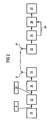
- FIG. 2 An illustrative example of a data communications apparatus forming a radio communications link between one of the mobile stations MS, and one of the base stations BS, is shown in Figure 2, where parts also appearing in Figure 1 bear identical numerical designations.
- a source of data 10 generates data frames 8, at a rate determined by a type of data which the source is generating.
- the data frames 8, generated by the source 10 are fed to a rate converter 12, which operates to convert the data frames 8, into transport data blocks 14.
- the transport data blocks 14, are arranged to be substantially equal in size, to a pre-determined size of an amount of data which can be carried by bursts of data bearing radio signals via which data is communicated by a radio interface formed by a transmitter 18, and receiver 22, pair.
- the data transport block 14 is fed to a radio access processor 16, which operates to schedule transmission of the transport data block 14, over the radio access interface.
- the transport data block 14 is fed by the radio access processor 16, to a transmitter 18 which operates to convert the transport data block into the burst of data bearing radio signals which are transmitted in a time period allocated for the transmitter to effect communication of the radio signals.
- an antenna 6" of the receiver detects the radio signals and down converts and recovers the data frame which is fed to a radio access de-scheduler 24.
- the radio access de-scheduler 24 feeds the received data transport block to a rate de-converter 26, under control of the multiple access de-scheduler 24, effected via a conductor 28.
- the rate de-converter 26, thereafter feeds a representation of the regenerated data frame 8, to a destination or sink for the data frame 8 which is represented by the block 30.
- the rate converter 12, and rate de-converter 26, are arranged to make, as far as possible, optimum use of the data bearing capacity available within the transport data block 14. This is effected in accordance with the illustrative embodiment of the present invention by the rate matching converter 12, which operates to encoded the data frame, and then puncture or repeat data bits or symbols selected from the encoded data frame, to the effect of generating a transport data block, which fits with the size of the data blocks 14.
- a block diagram of the rate converter 12, is shown in Figure 3, where parts also appearing in Figure 2, bear identical numerical designations.
- the rate converter 12 is shown to have an encoder EN, and a puncturer PR.
- the data frame 8 fed to the encoder EN is encoded to generate an encoded data frame EF, which is fed to the puncturer PR.
- the encoded data frame is then punctured by the puncturer PR, to generate the data transport block 14.
- an encoded data frame DF is shown with bit positions BP1, selected for puncturing.
- the selection of the positions of the bits to be punctured, illustrated in Figure 4, has been made in accordance with a known selection strategy described in section 6.2.3.3 of the "Universal Terrestrial Radio Access Frequency Division Duplex, multiplexing, channel coding and interleaving" description (xx.04) of the "Special Mobile Group 2" UMTS-L1 Tdoc 396/98, as current before the data of filing of the present patent application.
- This prior art selection algorithm attempts to select the positions for puncturing or repetition so that the positions are equi-distant from one another. Unfortunately, it is not possible to find an integer value for the puncturing rate in the general case.
- the prior art selection algorithm has several drawbacks. With the known selection algorithm, it is possible that two or more adjacent bits are selected for puncturing. Furthermore, for most puncturing ratios the punctured bits are not equally distributed, and an unknown number of puncturing iterations over the data frame is necessary, complicating a hardware implementation.
- a selection algorithm which operates in accordance with an illustrative embodiment of the present invention, operates in accordance with an adapted version of the Digital Differential Analyser algorithm as herein before described.
- a result of selecting bit positions for puncturing using this selection algorithm is shown in Figure 5, where once again, sixteen bit positions have been selected for puncturing out of ninety eight bits.
- the separation between puncturing positions BP' is always 6 or 7 bits.
- the selected positions BP', for puncturing are equally distributed over the whole data frame, and this is effected in a one-pass selection process according to the algorithm.
- the data frame may or may not be encoded, and the bits or symbols selected in accordance with the selection algorithm may be punctured or repeated or a combination of puncturing and repeating.
Landscapes
- Engineering & Computer Science (AREA)
- Computer Networks & Wireless Communication (AREA)
- Signal Processing (AREA)
- Detection And Prevention Of Errors In Transmission (AREA)
- Error Detection And Correction (AREA)
- Mobile Radio Communication Systems (AREA)
- Time-Division Multiplex Systems (AREA)
- Detection And Correction Of Errors (AREA)
- Communication Control (AREA)
Claims (10)
- Datenübertragungseinrichtung, welche so beschaffen ist, dass sie bewirkt, dass Datenrahmen (8) übertragen werden, wobei die besagte Einrichtung umfasst:dadurch gekennzeichnet, dass der besagte Auswahlalgorithmus ein Algorithmus vom Typ des Digital-Differential-Analysers ist.Mittel (12) zum Umsetzen der besagten Datenrahmen in Datenblöcke (14) für die Übertragung, wobei diese Datenblöcke eine Größe haben, welche von der der besagten Datenrahmen verschieden ist, wobei die besagten Mittel zum Umsetzen der besagten Datenrahmen beinhaltenMittel (PR) zum Punktieren oder Wiederholen von Bits oder Zeichen an Positionen innerhalb des Datenrahmens, die entsprechend einem Auswahlalgorithmus bestimmt werden,
- Datenübertragungseinrichtung nach Anspruch 1, wobei der Auswahlalgorithmus zum Punktieren von Bits oder Zeichen verwendet wird.
- Datenübertragungseinrichtung nach Anspruch 1 oder 2, wobei der Auswahlalgorithmus der Bresenham-Algorithmus ist.
- Datenübertragungseinrichtung nach einem der vorhergehenden Ansprüche, welche ferner einen Codierer umfasst, welcher so beschaffen ist, dass er bewirkt, dass der besagte Datenrahmen entsprechend einem Codieralgorithmus codiert wird.
- Datenübertragungseinrichtung nach Anspruch 4, wobei der Codieralgorithmus ein Codieralgorithmus für einen Fehlererkennungs- und Korrekturcode (error control code) ist.
- Verfahren zum Übertragen von Datenrahmen, welches den Schritt umfasstdes Umsetzens der besagten Datenrahmen in Datenblöcke für die Übertragung, wobei diese Datenblöcke eine Größe haben, die von der der besagten Datenrahmen verschieden ist, wobei der Schritt des Umsetzens der Datenrahmen beinhaltet:dadurch gekennzeichnet, dass der Auswahlalgorithmus ein Algorithmus vom Typ des Digital-Differential-Analysers ist.das Punktieren oder Wiederholen von Bits oder Zeichen an Positionen innerhalb des Datenrahmens, die entsprechend einem Auswahlalgorithmus bestimmt werden,
- Verfahren zum Übertragen von Datenrahmen nach Anspruch 6, wobei der Auswahlalgorithmus zum Punktieren von Bits oder Zeichen verwendet wird.
- Verfahren zum Übertragen von Datenrahmen nach Anspruch 6 oder 7, wobei der besagte Auswahlalgorithmus der Bresenham-Algorithmus ist.
- Verfahren zum Übertragen von Datenrahmen nach Anspruch 8, welches ferner vor oder nach dem Schritt des Umsetzens den Schritt umfasstdes Codierens des besagten Datenrahmens entsprechend einem Codieralgorithmus.
- Verfahren zum Übertragen von Datenrahmen nach Anspruch 9, wobei der Codieralgorithmus ein Codieralgorithmus für einen Fehlererkennungs- und Korrekturcode (error control code) ist.
Priority Applications (1)
| Application Number | Priority Date | Filing Date | Title |
|---|---|---|---|
| EP99950601A EP1119934B1 (de) | 1998-10-07 | 1999-10-01 | Vorrichtung und verfahren zur übertragung von punktierten oder wiederholten daten |
Applications Claiming Priority (4)
| Application Number | Priority Date | Filing Date | Title |
|---|---|---|---|
| EP98118934 | 1998-10-07 | ||
| EP98118934 | 1998-10-07 | ||
| EP99950601A EP1119934B1 (de) | 1998-10-07 | 1999-10-01 | Vorrichtung und verfahren zur übertragung von punktierten oder wiederholten daten |
| PCT/EP1999/007312 WO2000021234A1 (en) | 1998-10-07 | 1999-10-01 | Apparatus and method for transmitting punctured or repeated data |
Publications (2)
| Publication Number | Publication Date |
|---|---|
| EP1119934A1 EP1119934A1 (de) | 2001-08-01 |
| EP1119934B1 true EP1119934B1 (de) | 2004-05-12 |
Family
ID=8232760
Family Applications (1)
| Application Number | Title | Priority Date | Filing Date |
|---|---|---|---|
| EP99950601A Expired - Lifetime EP1119934B1 (de) | 1998-10-07 | 1999-10-01 | Vorrichtung und verfahren zur übertragung von punktierten oder wiederholten daten |
Country Status (11)
| Country | Link |
|---|---|
| US (1) | US6819718B1 (de) |
| EP (1) | EP1119934B1 (de) |
| JP (1) | JP4248149B2 (de) |
| KR (1) | KR100641461B1 (de) |
| CN (1) | CN1192537C (de) |
| AU (1) | AU763882B2 (de) |
| BR (1) | BR9914353B1 (de) |
| DE (1) | DE69917307T2 (de) |
| ES (1) | ES2221446T3 (de) |
| RU (1) | RU2211539C2 (de) |
| WO (1) | WO2000021234A1 (de) |
Families Citing this family (22)
| Publication number | Priority date | Publication date | Assignee | Title |
|---|---|---|---|---|
| EP1119934B1 (de) | 1998-10-07 | 2004-05-12 | Siemens Aktiengesellschaft | Vorrichtung und verfahren zur übertragung von punktierten oder wiederholten daten |
| IL141800A0 (en) | 1999-07-06 | 2002-03-10 | Samsung Electronics Co Ltd | Rate matching device and method for a data communication system |
| DE50013701D1 (de) * | 1999-11-25 | 2006-12-14 | Siemens Ag | Verfahren und vorrichtung zur bitratenanpassung mittels punktierung und/oder vervielfachung von bits |
| CN1426633A (zh) * | 2000-04-21 | 2003-06-25 | 三星电子株式会社 | 数据通信系统中的柔性数据率匹配装置和方法 |
| EP1301995B1 (de) * | 2000-06-02 | 2013-04-10 | Qualcomm Incorporated | Verfahren und vorrichtung zum punktieren von codesymbolen in einem kommunikationssystem |
| US6690734B1 (en) | 2000-06-02 | 2004-02-10 | Qualcomm, Incorporated | Method and apparatus for puncturing code symbols in a communications system |
| US6614850B1 (en) | 2000-07-07 | 2003-09-02 | Qualcomm, Incorporated | Method and apparatus for puncturing code symbols in a communications system |
| KR100710348B1 (ko) | 2000-06-26 | 2007-04-23 | 엘지전자 주식회사 | 적응 레이트 펑쳐링 방법 |
| EP1176725B1 (de) | 2000-07-05 | 2013-03-13 | LG Electronics Inc. | Verfahren zur Übertragungskonfiguration in einem mobilen Kommunikationssystem |
| US7145917B1 (en) * | 2000-07-19 | 2006-12-05 | Via Telecom Co., Ltd. | Frame matching method and apparatus for use in a communication system |
| US6675347B1 (en) * | 2000-07-19 | 2004-01-06 | Qualcomm, Incorporated | Method and apparatus for combined puncturing and repeating of code symbols in a communications system |
| US7437654B2 (en) * | 2000-11-29 | 2008-10-14 | Lucent Technologies Inc. | Sub-packet adaptation in a wireless communication system |
| US7188300B2 (en) * | 2001-05-01 | 2007-03-06 | Telefonaktiebolaget Lm Ericsson (Publ) | Flexible layer one for radio interface to PLMN |
| WO2003085873A2 (de) * | 2002-04-08 | 2003-10-16 | Siemens Aktiengesellschaft | Verfahren und kommunikationsvorrichtung zur anpassung der datenrate in einer kommunikationsvorrichtung |
| JP4847679B2 (ja) * | 2002-04-08 | 2011-12-28 | シーメンス アクチエンゲゼルシヤフト | 通信装置においてデータレートをマッチングするための方法及び通信装置 |
| DK1929826T3 (en) * | 2005-09-29 | 2017-01-23 | Nokia Technologies Oy | DEVICE, PROCEDURE AND COMPUTER PROGRAM PRODUCT TO REQUEST A INCREASE OF DATA SPEED BASED ON THE TRANSMISSION OF AT LEAST ONE MORE SELECTED DATA UNIT |
| KR101502623B1 (ko) | 2008-02-11 | 2015-03-16 | 삼성전자주식회사 | 저밀도 패리티 검사 부호를 사용하는 통신 시스템에서 채널부호/복호 방법 및 장치 |
| JP5521965B2 (ja) * | 2010-10-07 | 2014-06-18 | 富士通株式会社 | レート調整装置およびレート調整方法 |
| RU2012109385A (ru) * | 2012-03-12 | 2013-09-20 | ЭлЭсАй Корпорейшн | Оптимизация процессоров данных с использованием нерегулярных комбинаций |
| US9713453B2 (en) * | 2014-07-16 | 2017-07-25 | Neocoil, Llc | Method and apparatus for high reliability wireless communications |
| MX368265B (es) * | 2015-02-27 | 2019-09-26 | Panasonic Ip Corp America | Metodo generador de señal, dispositivo generador de señal, y programa. |
| WO2018129695A1 (en) | 2017-01-12 | 2018-07-19 | Qualcomm Incorporated | Puncturing and repetition for data encoding |
Family Cites Families (9)
| Publication number | Priority date | Publication date | Assignee | Title |
|---|---|---|---|---|
| US4908827A (en) * | 1987-07-27 | 1990-03-13 | Tiw Systems, Inc. | Forward error correction system |
| RU2036512C1 (ru) * | 1993-03-03 | 1995-05-27 | Виталий Кириллович Шмат | Устройство декодирования каскадного кода рида-соломона |
| WO1996024993A1 (en) * | 1995-02-10 | 1996-08-15 | National Semiconductor Corporation | Method and apparatus for transmitting data isochronously at a rate less than the isochronous data rate |
| GB2305830B (en) * | 1995-09-30 | 1999-09-22 | Ibm | Voice processing system and method |
| FI955206L (fi) * | 1995-10-31 | 1997-05-01 | Nokia Telecommunications Oy | Tiedonsiirtomenetelmä |
| US6111912A (en) * | 1995-11-09 | 2000-08-29 | Lucent Technologies Inc. | Method and apparatus for detecting the sub-rate of a punctured data packet for a multi-rate transmission scheme |
| US5909434A (en) * | 1996-05-31 | 1999-06-01 | Qualcomm Incorporated | Bright and burst mode signaling data transmission in an adjustable rate wireless communication system |
| EP1119934B1 (de) | 1998-10-07 | 2004-05-12 | Siemens Aktiengesellschaft | Vorrichtung und verfahren zur übertragung von punktierten oder wiederholten daten |
| DE19846721B4 (de) * | 1998-10-12 | 2009-09-10 | Ipcom Gmbh & Co. Kg | Verfahren zur Kodierung und Dekodierung und Vorrichtung zum Kodieren oder Dekodieren |
-
1999
- 1999-10-01 EP EP99950601A patent/EP1119934B1/de not_active Expired - Lifetime
- 1999-10-01 BR BRPI9914353-4A patent/BR9914353B1/pt not_active IP Right Cessation
- 1999-10-01 DE DE69917307T patent/DE69917307T2/de not_active Expired - Lifetime
- 1999-10-01 ES ES99950601T patent/ES2221446T3/es not_active Expired - Lifetime
- 1999-10-01 US US09/807,040 patent/US6819718B1/en not_active Expired - Lifetime
- 1999-10-01 JP JP2000575251A patent/JP4248149B2/ja not_active Expired - Lifetime
- 1999-10-01 WO PCT/EP1999/007312 patent/WO2000021234A1/en not_active Ceased
- 1999-10-01 AU AU63326/99A patent/AU763882B2/en not_active Expired
- 1999-10-01 KR KR1020017004437A patent/KR100641461B1/ko not_active Expired - Lifetime
- 1999-10-01 RU RU2001112106/09A patent/RU2211539C2/ru active
- 1999-10-01 CN CNB998138924A patent/CN1192537C/zh not_active Expired - Lifetime
Also Published As
| Publication number | Publication date |
|---|---|
| ES2221446T3 (es) | 2004-12-16 |
| WO2000021234A1 (en) | 2000-04-13 |
| KR100641461B1 (ko) | 2006-10-31 |
| JP2002527937A (ja) | 2002-08-27 |
| CN1192537C (zh) | 2005-03-09 |
| AU763882B2 (en) | 2003-07-31 |
| KR20010080052A (ko) | 2001-08-22 |
| JP4248149B2 (ja) | 2009-04-02 |
| US6819718B1 (en) | 2004-11-16 |
| EP1119934A1 (de) | 2001-08-01 |
| RU2211539C2 (ru) | 2003-08-27 |
| DE69917307T2 (de) | 2004-09-30 |
| DE69917307D1 (de) | 2004-06-17 |
| BR9914353A (pt) | 2001-06-26 |
| CN1328731A (zh) | 2001-12-26 |
| BR9914353B1 (pt) | 2012-12-11 |
| AU6332699A (en) | 2000-04-26 |
Similar Documents
| Publication | Publication Date | Title |
|---|---|---|
| EP1119934B1 (de) | Vorrichtung und verfahren zur übertragung von punktierten oder wiederholten daten | |
| US6868520B1 (en) | Method and apparatus for providing high quality transmissions in a telecommunications system | |
| CN1245601A (zh) | 在语言传输中控制信号的非顺序传输的系统和方法 | |
| US6490260B1 (en) | Transmitter with increased traffic throughput in digital mobile telecommunication system and method for operating the same | |
| EP1183811B1 (de) | Ungleicher fehlerschutz für paketvermittlungsnetzwerke | |
| EP1059754A1 (de) | Kodierung eines gemeinsamen Kopfes für Packetvermittlungsnetzwerke | |
| EP1183796B1 (de) | Zeitschlitz aufteilung in einem tdma system | |
| EP1091517A1 (de) | Verfahren und System zur Übertragung von punktierten oder wiederholten Daten | |
| EP1188259B1 (de) | Zeitschlitze für mehrere benutzer für tdma | |
| EP0993133B1 (de) | Datenkommunikationsverfahren und Vorrichtung | |
| JPH04233840A (ja) | データ通信システム、データ信号処理方法及び移動体無線電話トランシーバ | |
| EP1059756A1 (de) | Sprachübertragung über Paketvermittlungsnetzwerke | |
| EP0993158B1 (de) | Anordnung und Verfahren zur Umsetzung einer Datenrate | |
| EP1059775A1 (de) | Fehlerkorrektion basiert auf Vorsätzen | |
| EP1059776A1 (de) | Sprachübertragung in einem Edge-Netz | |
| HK1019373B (en) | Transmission of signaling data in an adjustable rate wireless communication system | |
| HK1019373A1 (en) | Transmission of signaling data in an adjustable rate wireless communication system |
Legal Events
| Date | Code | Title | Description |
|---|---|---|---|
| PUAI | Public reference made under article 153(3) epc to a published international application that has entered the european phase |
Free format text: ORIGINAL CODE: 0009012 |
|
| 17P | Request for examination filed |
Effective date: 20010322 |
|
| AK | Designated contracting states |
Kind code of ref document: A1 Designated state(s): AT BE CH CY DE DK ES FI FR GB GR IE IT LI LU MC NL PT SE |
|
| GRAP | Despatch of communication of intention to grant a patent |
Free format text: ORIGINAL CODE: EPIDOSNIGR1 |
|
| GRAS | Grant fee paid |
Free format text: ORIGINAL CODE: EPIDOSNIGR3 |
|
| GRAA | (expected) grant |
Free format text: ORIGINAL CODE: 0009210 |
|
| AK | Designated contracting states |
Kind code of ref document: B1 Designated state(s): DE ES FR GB IT |
|
| REG | Reference to a national code |
Ref country code: GB Ref legal event code: FG4D |
|
| REG | Reference to a national code |
Ref country code: IE Ref legal event code: FG4D |
|
| REF | Corresponds to: |
Ref document number: 69917307 Country of ref document: DE Date of ref document: 20040617 Kind code of ref document: P |
|
| REG | Reference to a national code |
Ref country code: ES Ref legal event code: FG2A Ref document number: 2221446 Country of ref document: ES Kind code of ref document: T3 |
|
| ET | Fr: translation filed | ||
| PLBE | No opposition filed within time limit |
Free format text: ORIGINAL CODE: 0009261 |
|
| STAA | Information on the status of an ep patent application or granted ep patent |
Free format text: STATUS: NO OPPOSITION FILED WITHIN TIME LIMIT |
|
| 26N | No opposition filed |
Effective date: 20050215 |
|
| REG | Reference to a national code |
Ref country code: IE Ref legal event code: MM4A |
|
| REG | Reference to a national code |
Ref country code: FR Ref legal event code: PLFP Year of fee payment: 17 |
|
| REG | Reference to a national code |
Ref country code: FR Ref legal event code: PLFP Year of fee payment: 18 |
|
| REG | Reference to a national code |
Ref country code: FR Ref legal event code: PLFP Year of fee payment: 19 |
|
| REG | Reference to a national code |
Ref country code: FR Ref legal event code: PLFP Year of fee payment: 20 |
|
| PGFP | Annual fee paid to national office [announced via postgrant information from national office to epo] |
Ref country code: DE Payment date: 20181217 Year of fee payment: 20 |
|
| PGFP | Annual fee paid to national office [announced via postgrant information from national office to epo] |
Ref country code: GB Payment date: 20181005 Year of fee payment: 20 Ref country code: FR Payment date: 20181018 Year of fee payment: 20 Ref country code: IT Payment date: 20181029 Year of fee payment: 20 |
|
| PGFP | Annual fee paid to national office [announced via postgrant information from national office to epo] |
Ref country code: ES Payment date: 20190125 Year of fee payment: 20 |
|
| REG | Reference to a national code |
Ref country code: DE Ref legal event code: R071 Ref document number: 69917307 Country of ref document: DE |
|
| REG | Reference to a national code |
Ref country code: GB Ref legal event code: PE20 Expiry date: 20190930 |
|
| PG25 | Lapsed in a contracting state [announced via postgrant information from national office to epo] |
Ref country code: GB Free format text: LAPSE BECAUSE OF EXPIRATION OF PROTECTION Effective date: 20190930 |
|
| REG | Reference to a national code |
Ref country code: ES Ref legal event code: FD2A Effective date: 20220128 |
|
| PG25 | Lapsed in a contracting state [announced via postgrant information from national office to epo] |
Ref country code: ES Free format text: LAPSE BECAUSE OF EXPIRATION OF PROTECTION Effective date: 20191002 |