EP1120104B1 - Kosmetische Reinigungszusammensetzungen, die eine besondere amphotere Stärke enthalten, und deren Verwendung - Google Patents
Kosmetische Reinigungszusammensetzungen, die eine besondere amphotere Stärke enthalten, und deren Verwendung Download PDFInfo
- Publication number
- EP1120104B1 EP1120104B1 EP00403530A EP00403530A EP1120104B1 EP 1120104 B1 EP1120104 B1 EP 1120104B1 EP 00403530 A EP00403530 A EP 00403530A EP 00403530 A EP00403530 A EP 00403530A EP 1120104 B1 EP1120104 B1 EP 1120104B1
- Authority
- EP
- European Patent Office
- Prior art keywords
- chosen
- composition
- weight
- composition according
- hydrogen atom
- Prior art date
- Legal status (The legal status is an assumption and is not a legal conclusion. Google has not performed a legal analysis and makes no representation as to the accuracy of the status listed.)
- Expired - Lifetime
Links
- 0 CCC1CC(C*C)CC1 Chemical compound CCC1CC(C*C)CC1 0.000 description 5
Classifications
-
- A—HUMAN NECESSITIES
- A61—MEDICAL OR VETERINARY SCIENCE; HYGIENE
- A61K—PREPARATIONS FOR MEDICAL, DENTAL OR TOILETRY PURPOSES
- A61K8/00—Cosmetics or similar toiletry preparations
- A61K8/18—Cosmetics or similar toiletry preparations characterised by the composition
- A61K8/72—Cosmetics or similar toiletry preparations characterised by the composition containing organic macromolecular compounds
- A61K8/73—Polysaccharides
-
- A—HUMAN NECESSITIES
- A61—MEDICAL OR VETERINARY SCIENCE; HYGIENE
- A61Q—SPECIFIC USE OF COSMETICS OR SIMILAR TOILETRY PREPARATIONS
- A61Q5/00—Preparations for care of the hair
- A61Q5/12—Preparations containing hair conditioners
-
- A—HUMAN NECESSITIES
- A61—MEDICAL OR VETERINARY SCIENCE; HYGIENE
- A61K—PREPARATIONS FOR MEDICAL, DENTAL OR TOILETRY PURPOSES
- A61K8/00—Cosmetics or similar toiletry preparations
- A61K8/18—Cosmetics or similar toiletry preparations characterised by the composition
- A61K8/72—Cosmetics or similar toiletry preparations characterised by the composition containing organic macromolecular compounds
- A61K8/73—Polysaccharides
- A61K8/732—Starch; Amylose; Amylopectin; Derivatives thereof
-
- A—HUMAN NECESSITIES
- A61—MEDICAL OR VETERINARY SCIENCE; HYGIENE
- A61Q—SPECIFIC USE OF COSMETICS OR SIMILAR TOILETRY PREPARATIONS
- A61Q5/00—Preparations for care of the hair
- A61Q5/02—Preparations for cleaning the hair
-
- A—HUMAN NECESSITIES
- A61—MEDICAL OR VETERINARY SCIENCE; HYGIENE
- A61K—PREPARATIONS FOR MEDICAL, DENTAL OR TOILETRY PURPOSES
- A61K2800/00—Properties of cosmetic compositions or active ingredients thereof or formulation aids used therein and process related aspects
- A61K2800/40—Chemical, physico-chemical or functional or structural properties of particular ingredients
- A61K2800/54—Polymers characterized by specific structures/properties
- A61K2800/542—Polymers characterized by specific structures/properties characterized by the charge
- A61K2800/5428—Polymers characterized by specific structures/properties characterized by the charge amphoteric or zwitterionic
Definitions
- the present invention relates to new cosmetic compositions with properties materials intended simultaneously for cleaning and conditioning materials keratin such as the hair, and comprising, in an aqueous support cosmetically acceptable, a cleansing base consisting of surfactants with power detergent and a specific amphoteric starch.
- a cleansing base consisting of surfactants with power detergent and a specific amphoteric starch.
- the invention also relates to the use said compositions in the above-mentioned cosmetic application.
- detergent compositions such as shampoos
- anionic type not ionic and / or amphoteric, but more particularly of the anionic type
- these compositions are applied to wet hair and the foam generated by massage or rubbing with the hands allows, after rinsing with water, the elimination of the various soiling initially present on the hair.
- compositions certainly have good washing power, but the properties intrinsic cosmetics attached to them, however, remain quite weak, in particular due to the fact that the relatively aggressive nature of such treatment of cleaning can lead to more or less damage to the hair fiber in the long run marked linked in particular to the progressive elimination of the lipids or proteins contained in or on the surface of the latter.
- conditioning agents primarily intended to repair or limit the harmful or undesirable effects induced by the different treatments or assaults that they undergo, more or less repeated, hair fibers.
- conditioning agents can of course also improve the cosmetic behavior of natural hair.
- J05132410 and J05132695 describe compositions containing starches amphoterics with phosphobetaine groups.
- WO0033806 (opposable according to the article 54 (3) EPC) describes non-detergent compositions containing amphoteric starches with a carboxylate group.
- compositions according to the invention give the hair, after rinsing, a remarkable treatment effect which is manifested in particular by a contribution of lightness, discipline and flexibility.
- a subject of the invention is also the use in cosmetics of the above compositions for cleaning and / or removing makeup and / or packaging materials keratin such as hair and skin.
- the invention also relates to a use of the composition according to the invention as a shampoo for materials keratin.
- fatty acid soaps a salt of an alkali or alkaline earth metal or of a fatty amine and of a C10-C18 fatty acid.
- concentration of fatty acid soaps is less than or equal to 1% by weight, preferably less than 0.1% by weight.
- the compositions in accordance with the invention necessarily comprise a washing base, generally aqueous.
- the surfactant (s) forming the washing base can be chosen indifferently, only or in mixtures, within anionic, amphoteric detergent surfactants, not Ionic.
- the washing base preferably comprises at least one or several anionic surfactants or mixtures of at least one or more anionic surfactants and at least one or more amphoteric surfactants or at least at least one or more nonionic surfactants.
- the washing base can represent from 4% to 50% by weight, of. preferably from 6% to 35% by weight, and even more preferably from 8% to 25% by weight, the total weight of the final composition.
- the surfactants which are suitable for carrying out the present invention are in particular The following :
- anionic surfactants which can be used, alone or in mixtures, in the context of the present invention, mention may be made in particular (non-limiting list) of the salts (in particular alkali salts, in particular sodium salts, ammonium salts , amine salts, amino alcohol salts or alkaline earth (magnesium) salts of the following compounds: alkylsulfates, alkylethersulfates, alkylamidoethersulfates, alkylarylpolyethersulfates, monoglycerides sulfates; alkylsulfonates, alkylphosphates, alkylamidesulfonates, alkylarylsulfonates, ⁇ -olefins , paraffin-sulfonates; alkylsulfosuccinates, alkylethersulfosuccinates, alkylamidesulfosuccinates; alkylsulfosuccinamates; alkylsulfos
- anionic surfactants which can still be used, mention may also be made of the salts of fatty acids such as the salts of oleic, ricinoleic, palmitic, stearic acids, coconut oil or hydrogenated coconut oil acids; acyl-lactylates whose acyl radical contains 8 to 20 carbon atoms.
- Weakly anionic surfactants can also be used, such as alkyl D galactoside uronic acids and their salts as well as polyoxyalkylenated (C 6 -C 24 ) alkyl ether acids, (C 6 -C 24 ) aryl ether carboxylic acids. polyoxyalkylenated, (C 6 -C 24 ) alkyl amido ether polyoxyalkylenated carboxylic acids and their salts, in particular those comprising from 2 to 50 ethylene oxide groups, and their mixtures.
- anionic surfactants it is preferred to use, according to the invention, the salts of alkyl sulfates and alkyl ether sulfates and mixtures thereof.
- Nonionic surfactants are also well known compounds per se (see in particular in this regard "Handbook of Surfactants” by MR PORTER, Blackie & Son editions (Glasgow and London), 1991, pp 116-178) and their nature is not, in the context of the present invention, of a critical nature.
- alcohols can in particular be chosen from (nonlimiting list) alcohols, alpha-diols, alkylphenols or polyethoxylated, polypropoxylated or polyglycerolated fatty acids, having a fatty chain comprising for example 8 to 18 carbon atoms, the number of ethylene oxide or propylene oxide groups which can range in particular from 2 to 50 and the number of glycerol groups which can range in particular from 2 to 30.
- Amphoteric surfactants may in particular be (non-limiting list) derivatives of aliphatic secondary or tertiary amines, in which the aliphatic radical is a linear chain or branched having 8 to 22 carbon atoms and containing at least one water-soluble anionic group (for example carboxylate, sulfonate, sulfate, phosphate or phosphonate); Mention may also be made of (C 8 -C 20 ) alkyl betaines, sulfobetaines, (C 8 -C 20 ) alkyl amidoalkyl (C 1 -C 6 ) betaines or (C 8 -C 20 ) alkyl amidoalkyl (C 1 -C 6 ) sulfobetaines.
- mixtures are preferably used surfactants and in particular mixtures of anionic surfactants and amphoteric or nonionic surfactants.
- a particularly preferred mixture is a mixture consisting of at least one anionic surfactant and at least one amphoteric surfactant.
- Starch molecules can come from all plant sources of starch such as in particular corn, potato, oats, rice, tapioca, sorghum, barley or wheat. It is also possible to use the hydrolysates of the starches mentioned above.
- the starch is preferably obtained from the potato.
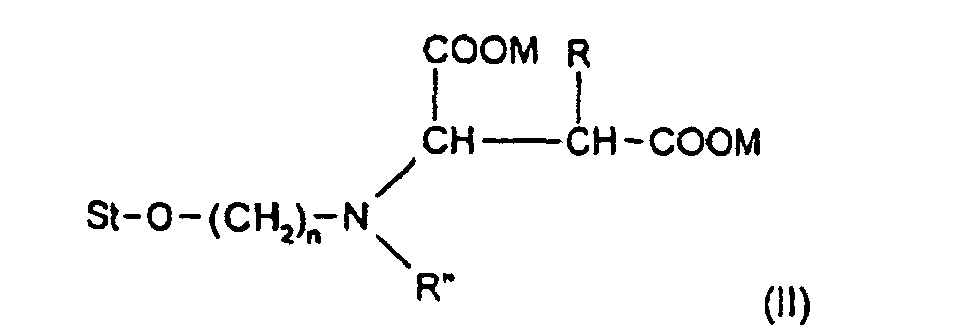
- starches of formulas (I) or (II) are used in particular. We no longer use particularly starches modified with 2-chloroethyl aminodipropionic acid, that is to say the starches of formula (I) or (II) in which R, R ', R "represent a hydrogen atom and n is 2.
- amphoteric starches according to the invention can be used in the compositions in accordance with the invention in concentrations generally between 0.01 and 10%, and preferably between 0.1 and 5% by weight relative to the total weight of the composition.
- the composition also comprises at least one cationic polymer.
- cationic polymer means any polymer containing cationic groups and / or groups which can be ionized into cationic groups.
- the cationic polymers which can be used in accordance with the present invention can be chosen among all those already known per se as improving the properties hair cosmetics treated with detergent compositions, namely in particular those described in patent application EP-A- 0 337 354 and in the applications for French patents FR-A- 2,270,846, 2,383,660, 2,598,611, 2,470,596 and 2,519,863.
- the preferred cationic polymers are chosen from those which contain units having primary, secondary, tertiary and / or quaternary amine groups can either be part of the main polymer chain, or be carried by a lateral substituent directly connected to it.
- the cationic polymers used generally have a number average molecular mass of between 500 and 5.10 6 approximately, and preferably between 10 3 and 3.10 6 approximately.
- cationic polymers mention may be made more particularly of the polymers of polyamine, polyaminoamide and quaternary polyammonium type. These are products known.
- Polymers of the polyamine, polyaminoamide, quaternary polyammonium type, usable in accordance with the present invention, which may be mentioned in particular, are those described in French patents 2,505,348 or 2,542,997. Among these polymers, there may be mentioned:
- the copolymers of family (1) may also contain one or more units derived from comonomers which can be chosen from the family of acrylamides, methacrylamides, acrylamide diacetones, substituted acrylamides and methacrylamides on nitrogen with lower alkyls (C1-C4), acrylic or methacrylic acids or their esters, vinyllactams such as vinylpyrrolidone or vinylcaprolactam, vinyl esters.
- comonomers which can be chosen from the family of acrylamides, methacrylamides, acrylamide diacetones, substituted acrylamides and methacrylamides on nitrogen with lower alkyls (C1-C4), acrylic or methacrylic acids or their esters, vinyllactams such as vinylpyrrolidone or vinylcaprolactam, vinyl esters.
- Cationic cellulose derivatives such as cellulose copolymers or cellulose derivatives grafted with a water-soluble quaternary ammonium monomer, and described in particular in US Pat. No. 4,131,576, such as hydroxyalkyl celluloses, such as hydroxymethyl-, hydroxyethyl- or hydroxypropyl celluloses grafted in particular with a methacryloylethyl trimethylammonium salt, methacrylmidopropyl trimethylammonium, dimethyl-diallylammonium.
- Such products are marketed in particular under the trade names of JAGUAR C13 S, JAGUAR C 15, JAGUAR C 17 or JAGUAR C162 by the company MEYHALL.
- polymers consisting of piperazinyl units and divalent alkylene radicals or hydroxyalkylene with straight or branched chains, possibly interrupted by oxygen, sulfur, nitrogen atoms or by aromatic or heterocyclic rings, as well as the oxidation and / or quaternization products of these polymers.
- Such polymers are described in particular in French patents 2,162,025 and 2,280,361;
- water-soluble polyaminoamides prepared in particular by polycondensation of an acidic compound with a polyamine; these polyaminoamides can be crosslinked with an epihalohydrin, a diepoxide, a dianhydride, a unsaturated dianhydride, a bis-unsaturated derivative, a bis-halohydrin, a bis-azetidinium, a bis-haloacyldiamine, an alkyl bis-halide or also by a resulting oligomer of the reaction of a reactive bifunctional compound with respect to a bis-halohydrin, of a bis-azetidinium, of a bis-haloacyldiamine, of an alkyl bis-halide, of a epilhalohydrin, a diepoxide or a bisunsaturated derivative; the crosslinking agent being used in proportions ranging from 0.025 to 0.35 mol per amine group of the polymaoamide; these polyamino
- polyaminoamide derivatives resulting from the condensation of polyalkylenes polyamines with polycarboxylic acids followed by alkylation by agents bifunctional Mention may be made, for example, of the adipic acid-diacoylaminohydroxyalkoyldialoylene polymers. triamine in which the alkyl radical contains from 1 to 4 carbon atoms and preferably denotes methyl, ethyl, propyl. Such polymers are described in particular in French patent 1,583,363.
- the molar ratio between the polyalkylene polylamine and dicarboxylic acid being between 0.8: 1 and 1.4: 1; the resulting polyaminoamide being reacted with epichlorohydrin in a ratio epichlorohydrin molar relative to the secondary amine group of polyaminoamide between 0.5: 1 and 1.8: 1.
- Such polymers are in particular described in US Patents 3,227,615 and 2,961,347.
- Polymers of this type are in particular sold under the name "Hercosett 57” by the company Hercules Inc. or under the name of "PD 170” or “Delsette 101” by the company Hercules in the case of the acid copolymer adipic / epoxypropyl / diethylenetriamine.
- cyclopolymers of alkyl diallyl amine or dialkyl diallyl ammonium such as homopolymers or copolymers comprising, as main constituent of the chain, units corresponding to formulas (Va) or (Vb): formulas in which k and t are equal to 0 or 1, the sum k + t being equal to 1;
- R 12 denotes a hydrogen atom or a methyl radical;
- R 10 and R 11 independently of one another, denote an alkyl group having from 1 to 22 carbon atoms, a hydroxyalkyl group in which the alkyl group preferably has 1 to 5 carbon atoms, a lower amidoalkyl group (C1-C4) or R 10 and R 11 may denote, together with the nitrogen atom to which they are attached, heterocyclic groups, such as piperidinyl or morpholinyl;
- Y - is an anion such as bromide, chloride, acetate, borate, citrate, tartrate, bisul
- X is an anion such as chloride or bromide.
- These polymers generally have a number-average molecular mass between 1000 and 100,000.
- R 1 , R 2 , R 3 and R 4 identical or different, denote an alkyl or hydroxyalkyl radical having from 1 to 4 carbon atoms approximately, n and p are whole numbers varying from 2 to approximately 20 and, X - is an anion derived from a mineral or organic acid.
- Quaternary polymers of vinylpyrrolidone and of vinylimidazole such as by example the products marketed under the names Luviquat® FC 905, FC 550 and FC 370 by B.A.S.F.
- Crosslinked polymers of methacryloyloxyalkyl (C 1 -C 4 ) trialkyl (C 1 -C 4 ) ammonium salts such as the polymers obtained by homopolymerization of dimethylaminoethylmethacrylate quaternized with methyl chloride, or by copolymerization of acrylamide with dimethylaminoethyl methacrylate quaternized by methyl chloride, homo or copolymerization being followed by crosslinking with an olefinically unsaturated compound, in particular methylene bis acrylamide.
- a crosslinked acrylamide / methacryloyloxyethyltrimethylammonium chloride copolymer (20/80 by weight) may more particularly be used in the form of a dispersion containing 50% by weight of said copolymer in mineral oil.
- This dispersion is marketed under the name of “SALCARE® SC 92” by the company ALLIED COLLOIDS.
- These dispersions are marketed under the names of “SALCARE® SC 95” and “SALCARE® SC 96” by the company ALLIED COLLOIDS.
- cationic polymers which can be used in the context of the invention are proteins cationic or cationic protein hydrolysates, polyalkyleneimines, in particularly polyethyleneimines, polymers containing vinylpyridine units or vinylpyridinium, polyamine and epichlorohydrin condensates, polyureylenes quaternaries and chitin derivatives.
- cationic polymers capable of being used in the context of present invention, it is preferred to use cellulose ether derivatives quaternaries such as the products sold under the name “JR 400” by the Company UNION CARBIDE CORPORATION, cationic cyclopolymers, especially homopolymers or copolymers of dimethyldiallylammonium chloride, sold under the names "MERQUAT 100", “MERQUAT 550” and “MERQUAT S” by the CALGON company, cationic polysaccharides such as guar gums modified with a 2,3-epoxypropyltrimethylammonium salt, quaternary polymers vinylpyrrolidone and vinylimidazole and mixtures thereof.
- cellulose ether derivatives quaternaries such as the products sold under the name “JR 400” by the Company UNION CARBIDE CORPORATION
- cationic cyclopolymers especially homopolymers or copolymers of dimethyldiallylammonium chloride, sold under the names "MER
- the cationic polymer (s) can represent from 0.001% to 10 % by weight, preferably from 0.005% to 5% by weight and more particularly from 0.01 to 3% by weight relative to the total weight of the final composition.
- compositions according to the invention further comprise at least one silicone.
- the silicones which can be used in accordance with the invention may be soluble or insoluble in the composition and in particular be polyorganosiloxanes insoluble in the composition; they can be in the form of oils, waxes, resins or gums.
- Organopolysiloxanes are defined in more detail in the work of Walter NOLL “Chemistry and Technology of Silicones” (1968) Academy Press. They can be volatile or non-volatile.
- non-volatile silicones are used and more particularly polyalkylsiloxanes, polyarylsiloxanes, polyalkylarylsiloxanes, gums and silicone resins, polyorganosiloxanes modified by groups organofunctional and their mixtures.
- silicones are more particularly chosen from polyalkylsiloxanes among which mention may mainly be made of polydimethylsiloxanes with trimethylsilyl end groups having a viscosity of 5.10 -6 to 2.5 m 2 / s at 25 ° C and preferably 1.10 -5 to 1 m 2 / s.
- the viscosity of the silicones is for example measured at 25 ° C. according to standard ASTM 445 Appendix C.
- the polyalkylarylsiloxanes are particularly chosen from polydimethyl methylphenylsiloxanes, linear and / or branched polydimethyl diphenylsiloxanes with a viscosity of 1.10 -5 to 5.10 -2 m 2 / s at 25 ° C.
- the silicone gums which can be used in accordance with the invention are in particular polydiorganosiloxanes having high number average molecular weights between 200,000 and 1,000,000 used alone or as a mixture in a solvent.
- This solvent can be chosen from volatile silicones, polydimethylsiloxane oils (PDMS), polyphenylmethylsiloxane oils (PPMS), isoparaffins, polyisobutylenes, methylene chloride, pentane, dodecane, tridecanes or their mixtures.
- the organopolysiloxane resins which can be used in accordance with the invention are crosslinked siloxane systems containing the units: R 2 SiO 2/2 , R 3 SiO 1/2 , RSiO 3/2 and SiO 4/2 in which R represents a hydrocarbon group having 1 to 16 carbon atoms or a phenyl group.
- R represents a hydrocarbon group having 1 to 16 carbon atoms or a phenyl group.
- R denotes a lower C 1 -C 4 alkyl radical, more particularly methyl, or a phenyl radical.
- organo-modified silicones which can be used in accordance with the invention are silicones as defined above and comprising in their structure one or more organofunctional groups attached via a hydrocarbon radical.
- grafted silicone polymers are in particular polydimethylsiloxanes (PDMS) to which are grafted, via a chain connection type thiopropylene, mixed polymer units of the acid type poly (meth) acrylic and poly (meth) acrylate and polydimethylsiloxanes (PDMS) on which are grafted, via a connection chain of thiopropylene type, polymer units of the isobutyl poly (meth) acrylate type.
- PDMS polydimethylsiloxanes
- PDMS polydimethylsiloxanes
- silicones can also be used in the form emulsions, nanoemulsions or micremulsions.
- the silicone (s) may represent from 0.001% to 20% by weight, from preferably from 0.01% to 10% by weight and more particularly from 0.1 to 3% by weight per relative to the total weight of the final composition.
- the cosmetically acceptable aqueous medium may consist solely of water or of a mixture of water and a cosmetically acceptable solvent such as a lower C 1 -C 4 alcohol, such as ethanol, isopropanol, tertiobutanol, n-butanol; alkylene glycols such as propylene glycol, glycol ethers.
- a cosmetically acceptable solvent such as a lower C 1 -C 4 alcohol, such as ethanol, isopropanol, tertiobutanol, n-butanol
- alkylene glycols such as propylene glycol, glycol ethers.
- the detergent compositions according to the invention generally have a final pH between 3 and 10. Preferably, this pH is between 4 and 8. Adjusting the pH at the desired value can be done conventionally by adding a base (organic or mineral) in the composition, for example ammonia or a (poly) amine primary, secondary or tertiary such as monoethanolamine, diethanolamine, triethanolamine, isopropanolamine or 1,3-propane diamine, or by adding a acid, preferably a carboxylic acid such as for example citric acid.
- a base organic or mineral
- a (poly) amine primary, secondary or tertiary such as monoethanolamine, diethanolamine, triethanolamine, isopropanolamine or 1,3-propane diamine
- a acid preferably a carboxylic acid such as for example citric acid.
- compositions in accordance with the invention may contain, in addition to the combination defined above, viscosity regulating agents such as electrolytes, or thickening agents (associative or non-associative). Mention may in particular be made of sodium chloride, sodium xylene sulfonate, scleroglucans, xanthan gums, fatty acid alkanolamides, alkyl ether carboxylic acid alkanolamides optionally oxyethylenated with up to 5 moles of oxide ethylene such as the product sold under the name "AMINOL A15" by the company CHEM Y, crosslinked polyacrylic acids and copolymers of acrylic acid / crosslinked C 10 -C 30 alkyl acrylates. These viscosity regulating agents are used in the compositions according to the invention in proportions which can range up to 10% by weight relative to the total weight of the composition.
- viscosity regulating agents such as electrolytes, or thickening agents (associative or non-
- compositions in accordance with the invention may also preferably contain up to 5% of pearlescent or opacifying agents well known in the state of the art such than for example fatty alcohols higher than C16, fatty chain acylated derivatives such as ethylene glycol or polyethylene glycol monostearates or distearates, fatty chain ethers such as, for example, distearyl ether or 1- (hexadecyloxy) -2-octadecanol.
- pearlescent or opacifying agents well known in the state of the art such than for example fatty alcohols higher than C16, fatty chain acylated derivatives such as ethylene glycol or polyethylene glycol monostearates or distearates, fatty chain ethers such as, for example, distearyl ether or 1- (hexadecyloxy) -2-octadecanol.
- compositions in accordance with the invention may optionally also contain at least one additive chosen from foam synergists such as C 10 -C 18 1,2-alkanediols or fatty alkanolamides derived from mono or diethanolamine, sun filters silicone or not, cationic surfactants, anionic or nonionic or amphoteric polymers, proteins, protein hydrolysates, ceramides, pseudoceramides, fatty acids with linear or branched C 12 -C 40 chains such as 18-methyl-eicosanoic acid, hydroxy acids, vitamins, provitamins such as panthenol, vegetable, animal, mineral or synthetic oils and any other additive conventionally used in the cosmetic field which does not affect the properties of the compositions according to the invention. 'invention.
- foam synergists such as C 10 -C 18 1,2-alkanediols or fatty alkanolamides derived from mono or diethanolamine, sun filters silicone or not, cationic surfactants, anionic or non
- additives are present in the composition according to the invention in proportions possibly ranging from 0 to 20% by weight relative to the total weight of the composition.
- the precise quantity of each additive is easily determined by a person skilled in the art according to its nature and function.
- compositions can be in the form of more or less thickened liquids, creams or gels and they are mainly suitable for washing, caring for keratin materials especially hair and skin and even more especially hair.
- compositions in accordance with the invention are used as classic shampoos, they are simply applied to wet hair and the foam generated by massage or friction with the hands is then eliminated, after a possible pause time, by rinsing with water, the operation can be repeated once or several times.
- the subject of the invention is also a method of washing and conditioning keratin materials such as in particular the hair consisting in applying to said wetted materials an effective amount of a composition as defined above, then rinse with water after a possible pause time.
- compositions according to the invention are preferably used as shampoos for washing and conditioning the hair and they are applied in this case on wet hair in amounts effective for washing it, this application being followed by a water rinse.
- compositions according to the invention can also be used as shower gels for washing and conditioning the hair and / or skin, in which case it is applied to damp skin and / or hair and rinsed off after application.
- composition A Composition Invention A Sodium lauryl ether sulfate (C12 / C14 to 70/30) with 2.2 moles of ethylene oxide in aqueous solution containing 28% of MA 15 g MA Potato starch modified with 2-chloroethyl aminodipropionic acid neutralized by soda, (Solanace structure from NATIONAL STARCH) 0.5 g Hydroxyethylcellulose crosslinked by epichlorohydrin and quaternized by trimethylamine (JR 400 by the company UNION CARBIDE) 0.4g hydroxyethyl 0.4g Citric acid qs pH 7 Demineralized water qs 100g
- Shampooing is carried out by applying approximately 12 g of composition A to hair previously wet. We lather the shampoo and then rinse plenty of water.
- composition according to the invention provides, on hair wet a significant root lift and a lot of lightness.
- Example 2 Example 3 Sodium lauryl ether sulfate (C12 / C14 to 70/30) with 2.2 moles of ethylene oxide 16 g MA 16 g MA Cocoyl amidopropyl betaine in an aqueous solution at 38% M.A.
- Shampooing is carried out by applying approximately 12 g of the composition to hair previously wet. We lather the shampoo and then rinse plenty of water.
- the hair treated with the composition of Example 2 or of Example 3 is soft, light and easily detangled.
- a shampoo in accordance with the invention of the following composition was produced: Sodium lauryl ether sulfate (C12 / C14 to 70/30) with 2.2 moles of ethylene oxide 15.5 g MA Cocoyl betaine in 32% MA aqueous solution 3 g MA Hydroxypropyl guar trimethyl ammonium chloride, sold under the name Jaguar C13S by the company RHODIA 0.1g Potato starch modified with 2-chloroethyl aminodipropionic acid neutralized by 0.3 g soda (Solanace structure from NATIONAL STARCH) Polydimethylsiloxane with a viscosity of 60,000 cSt 2.7g Amodimethicone in cationic emulsion at 35% MA (DC939 from DOW CORNING) 1.05 gMA Mixture 1- (hexadecyloxy) 2-octadecanol / cetyl alcohol 2.5g Copra monoisopropanolamide 0.5 g Preservatives,
- Shampooing is carried out by applying approximately 12 g of the composition to hair previously wet.
- the shampoo is lathered and then rinsed thoroughly with water.
- Hair treated with this composition is soft, light and is disentangled easily.
Landscapes
- Health & Medical Sciences (AREA)
- Life Sciences & Earth Sciences (AREA)
- Animal Behavior & Ethology (AREA)
- General Health & Medical Sciences (AREA)
- Public Health (AREA)
- Veterinary Medicine (AREA)
- Birds (AREA)
- Epidemiology (AREA)
- Dermatology (AREA)
- Cosmetics (AREA)
- Detergent Compositions (AREA)
- Polysaccharides And Polysaccharide Derivatives (AREA)
- Compositions Of Macromolecular Compounds (AREA)
- Organic Low-Molecular-Weight Compounds And Preparation Thereof (AREA)
Claims (22)
- Reinigende und konditionierende kosmetische Zusammensetzung, dadurch gekennzeichnet, dass sie in einem kosmetisch akzeptablen wässerigen Medium enthält:
4 bis 50 Gew.-%, bezogen auf das Gesamtgewicht der Zusammensetzung, einer Waschbasis, die einen oder mehrere reinigende grenzflächenaktive Stoffe enthält, die unter den anionischen, amphoteren und nichtionischen grenzflächenaktiven Stoffen sowie ihren Gemischen ausgewählt sind,
und mindestens eine amphotere Stärke, die ausgewählt ist unter den Verbindungen der Formeln (I) bis (IV):
 worin bedeuten:
 wobei die Konzentration an Salzen eines Alkalimetalls oder Erdalkalimetalls oder eines Fettamins mit einer C10-18-Fettsäure in der Zusammensetzung kleiner als oder gleich 1 Gew.-% ist,St-O ein Stärkemolekül,R, gleich oder verschieden, ein Wasserstoffatom oder eine Methylgruppe,R', gleich oder verschieden, ein Wasserstoffatom, eine Methylgruppe oder eine Gruppe -COOH,n eine ganze Zahl gleich 2 oder 3,M, gleich oder verschieden, ein Wasserstoffatom, einAlkalimetall oder ein Erdalkalimetall, NH4, ein quaternäres Ammonium oder ein organisches Amin,R" ein Wasserstoffatom oder eine Alkylgruppe mit 1 bis 18 Kohlenstoffatomen,
wobei die nachstehende Shampoo-Zusammensetzung ausgenommen ist:BESTANDTEIL INCI-BEZEICHNUNG Standapol A Ammonium lauryl sulfate 7,50 Standapol EA-3 Ammonium laureth sulfate 17,50 Tegobetain L-7 Cocamidopropyl betaine 5,0 Monamid 1113 Coamide DEA 3,0 Solance® Modified Starch 0,26 Tween 20 Polysorbate 20 1,00 Natriumchlorid Sodium Chloride 0,75 Glydant DMDM hydantoin 0,20 Citronensäure Citric acid q.s. pH 6 Wasser, entionisiert Water q.s. 100 q.s. (quantum satis) bedeutet ausreichende Menge - Reinigende und konditionierende kosmetische Zusammensetzung; dadurch gekennzeichnet, dass sie in einem kosmetisch akzeptablen wässerigen Medium enthält:worin bedeuten:4 bis 50 Gew.-%, bezogen auf das Gesamtgewicht der Zusammensetzung, einer Waschbasis, die einen oder mehrere reinigende grenzflächenaktive Stoffe enthält, die unter anionischen, amphoteren und nichtionischen grenzflächenaktiven Stoffen sowie ihren Gemischen ausgewählt sind,mindestens ein kationisches Polymer undmindestens eine amphotere Stärke, die ausgewählt ist unter den Verbindungen der Formeln (I) bis (IV):


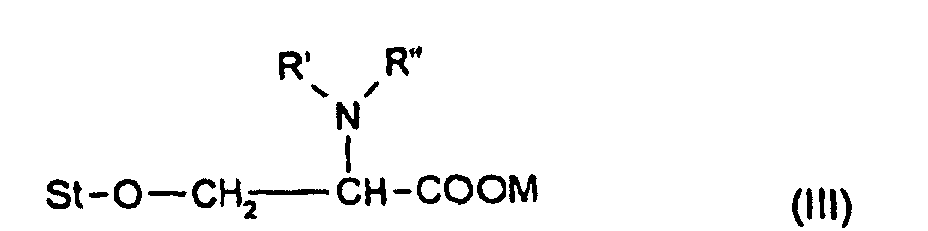
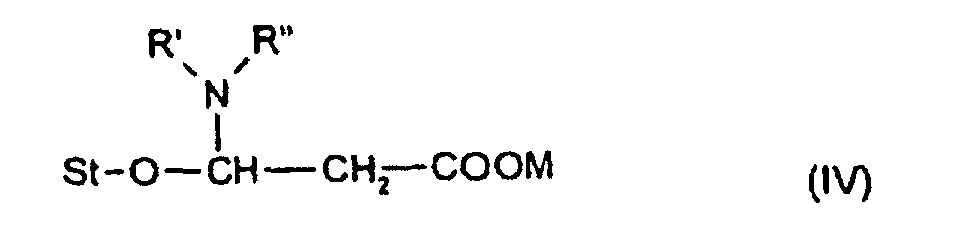 wobei die Konzentration an Salzen eines Alkalimetalls oder Erdalkalimetalls oder eines Fettamins mit einer C10-18-Fettsäure in der Zusammensetzung kleiner als oder gleich 1 Gew.-% ist.St-O ein Stärkemolekül,R, gleich oder verschieden, ein Wasserstoffatom oder eine Methylgruppe,R', gleich oder verschieden, ein Wasserstoffatom, eine Methylgruppe oder eine Gruppe -COOH,n eine ganze Zahl gleich 2 oder 3,M, gleich oder verschieden, ein Wasserstoffatom, ein Alkalimetall oder ein Erdalkalimetall, NH4, ein quaternäres Ammonium oder ein organisches Amin,R" ein Wasserstoffatom oder eine Alkylgruppe mit 1 bis 18 Kohlenstoffatomen,
 - Zusammensetzung nach Anspruch 1 oder 2, dadurch gekennzeichnet, dass die Stärken die Formel (I) oder die Formel (II) besitzen.
- Zusammensetzung nach einem der Ansprüche 1 bis 3, dadurch gekennzeichnet, dass R, R', R" ein Wasserstoffatom bedeuten und n gleich 2 ist.
- Zusammensetzung nach einem der Ansprüche 1 bis 4, dadurch gekennzeichnet, dass die Waschbasis mindestens einen oder mehrere anionische grenzflächenaktive Stoffe enthält.
- Zusammensetzung nach einem der Ansprüche 1 bis 5, dadurch gekennzeichnet, dass die Waschbasis in einem Gewichtsanteil von 6 bis 35 Gew.-%, bezogen auf das Gesamtgewicht der Zusammensetzung, und vorzugsweise in einem Gewichtsanteil von 8 bis 25 Gew.-% vorliegt.
- Zusammensetzung nach einem der Ansprüche 1 bis 6, dadurch gekennzeichnet, dass die amphotere Stärke in Konzentrationen von 0,01 bis 10 Gew.-% und vorzugsweise 0,1 bis 5 Gew.-%, bezogen auf das Gesamtgewicht der Zusammensetzung, vorliegt.
- Zusammensetzung nach einem der Ansprüche 1 und 3 bis 7, dadurch gekennzeichnet, dass sie ferner mindestens ein kationisches Polymer enthält.
- Zusammensetzung nach einem der Ansprüche 2 bis 8, dadurch gekennzeichnet, dass das kationische Polymer ausgewählt ist unter quaternären Celluloseetherderivaten, kationischen Cyclopolymeren, kationischen Polysacchariden, quaternären Polymeren von Vinylpyrrolidon und Vinylimidazol sowie ihren Gemischen.
- Zusammensetzung nach Anspruch 9, dadurch gekennzeichnet, dass das Cyclopolymer ausgewählt ist unter Homopolymeren von Diallyldimethylammoniumchlorid und Copolymeren von Diallyldimethylammoniumchlorid und Acrylamid.
- Zusammensetzung nach Anspruch 9, dadurch gekennzeichnet, dass die quaternären Celluloseetherderivate ausgewählt sind unter Hydroxyethylcellulosen, die mit einem mit einer Trimethylammoniumgruppe substituierten Epoxid umgesetzt wurden.
- Zusammensetzung nach Anspruch 9, dadurch gekennzeichnet, dass die kationischen Polysaccharide ausgewählt sind unter Guargummen, die mit einem 2,3-Epoxypropyltrimethylammoniumsalz modifiziert wurden.
- Zusammensetzung nach einem der Ansprüche 2 bis 12, dadurch gekennzeichnet, dass das kationische Polymer 0,001 bis 10 Gew.-%, vorzugsweise 0,005 bis 5 Gew.-% und noch bevorzugter 0,01 bis 3 Gew.-% des Gesamtgewichts der Zusammensetzung ausmacht.
- Zusammensetzung nach einem der Ansprüche 1 bis 13, dadurch gekennzeichnet, dass sie ferner mindestens ein Silicon enthält.
- Zusammensetzung nach Anspruch 14, dadurch gekennzeichnet, dass die Silicone nichtflüchtige Polyorganosiloxane sind, die ausgewählt sind unter Polyalkylsiloxanen, Polyarylsiloxanen, Polyalkylarylsiloxanen, Siliconkautschuken und Siliconharzen und mit organofunktionellen Gruppen modifizierten Polyorganosiloxanen sowie ihren Gemischen.
- Zusammensetzung nach Anspruch 15, dadurch gekennzeichnet, dass(a) die Polyalkylsiloxane ausgewählt sind unterPolydimethylsiloxanen mit Trimethylsilyl-Endgruppen;Polydimethylsiloxanen mit Dimethylsilanol-Endgruppen;Polyalkyl(C1-20)siloxanen;(b) die Polyalkylarylsiloxane ausgewählt sind untergeradkettigen und/oder verzweigten Polydimethylmethylphenylsiloxanen und Polydimethyldiphenylsiloxanen einer Viskosität von 1·105 bis 5·102 m2/s bei 25 °C;(c) die Siliconkautschuke ausgewählt sind unter Polydiorganosiloxanen mit Zahlenmitteln der Molekülmasse im Bereich von 200000 bis 1000000 und allein oder in Form von Gemischen mit einem Lösungsmittel verwendet werden;(d) die Harze ausgewählt sind unter Harzen, die bestehen aus Einheiten R3SiO1/2, R2SiO2/2, RSiO3/2, SiO4/2, wobei R eine Kohlenwasserstoffgruppe mit 1 bis 16 Kohlenstoffatomen oder eine Phenylgruppe bedeutet;(e) die organomodifizierten Silicone ausgewählt sind unter Siliconen, die in ihrer Struktur eine oder mehrere organofunktionelle Gruppen enthalten, die über eine Kohlenwasserstoffgruppe gebunden sind.
- Zusammensetzung nach einem der Ansprüche 14 bis 16, dadurch gekennzeichnet, dass die Silicone ausgewählt sind unter Polyalkylsiloxanen mit Trimethylsilyl-Endgruppen, Polyalkylsiloxanen mit Dimethylsilanol-Endgruppen, Polyalkylarylsiloxanen, Gemischen von 2 PDMS, die aus einem Kautschuk und einem Öl bestehen, die unterschiedliche Viskosität besitzen, Gemischen von Organosiloxanen und cyclischen Siliconen und Organopolysiloxanharzen.
- Zusammensetzung nach einem der Ansprüche 14 bis 17, dadurch gekennzeichnet, dass das Silicon in einer Konzentration von 0,001 bis 20 Gew.-%, bezogen auf das Gesamtgewicht der Zusammensetzung, und vorzugsweise von 0,01 bis 10 Gew.-% vorliegt.
- Zusammensetzung nach einem der Ansprüche 1 bis 18, dadurch gekennzeichnet, dass sie ferner mindestens ein Additiv enthält, das ausgewählt ist unter Schaumsynergisten wie C10-18-Alkandiolen oder von Mono- oder Diethanolamin abgeleiteten Alkanolamiden, gegebenenfalls Silicon enthaltenden Sonnenfiltern, kationischen grenzflächenaktiven Mitteln, anionischen oder nichtionischen oder amphoteren Polymeren, Proteinen, Proteinhydrolysaten, Ceramiden, Pseudoceramiden, geradkettigen oder verzweigten C12-40-Fettsäuren, wie 18-Methyleicosansäure, Hydroxysäuren, Vitaminen, Provitaminen wie Panthenol, Pflanzenölen, tierischen Ölen, Mineralölen oder synthetischen Ölen sowie beliebigen anderen Additiven, die herkömmlicherweise auf dem Gebiet der Kosmetik verwendet werden.
- Verwendung einer Zusammensetzung wie in einem der Ansprüche 1 bis 19 definiert zur Reinigung und/oder zum Abnehmen von Schminke und/oder zur Konditionierung von Keratinmaterialien.
- Verwendung einer Zusammensetzung wie in einem der Ansprüche 1 bis 19 definiert als Shampoo für Keratinmaterialien.
- Verfahren zum Waschen und zur Konditionierung von Keratinmaterialien wie Haaren, das darin besteht, auf die feuchten Keratinmaterialien eine wirksame Menge einer Zusammensetzung wie in einem der Ansprüche 1 bis 19 definiert aufzubringen und dann nach einer eventuellen Wartezeit ein Spülen mit Wasser vorzunehmen.
Applications Claiming Priority (2)
| Application Number | Priority Date | Filing Date | Title |
|---|---|---|---|
| FR0000411 | 2000-01-13 | ||
| FR0000411A FR2803744B1 (fr) | 2000-01-13 | 2000-01-13 | Compositions cosmetiques detergentes contenant un amidon amphotere particulier et leurs utilisations |
Publications (2)
| Publication Number | Publication Date |
|---|---|
| EP1120104A1 EP1120104A1 (de) | 2001-08-01 |
| EP1120104B1 true EP1120104B1 (de) | 2004-10-06 |
Family
ID=8845882
Family Applications (1)
| Application Number | Title | Priority Date | Filing Date |
|---|---|---|---|
| EP00403530A Expired - Lifetime EP1120104B1 (de) | 2000-01-13 | 2000-12-14 | Kosmetische Reinigungszusammensetzungen, die eine besondere amphotere Stärke enthalten, und deren Verwendung |
Country Status (20)
| Country | Link |
|---|---|
| US (1) | US20020034487A1 (de) |
| EP (1) | EP1120104B1 (de) |
| JP (2) | JP2001233744A (de) |
| KR (1) | KR100444624B1 (de) |
| CN (1) | CN1192763C (de) |
| AR (1) | AR027920A1 (de) |
| AT (1) | ATE278375T1 (de) |
| AU (1) | AU746456B2 (de) |
| BR (1) | BRPI0100265B1 (de) |
| CA (1) | CA2330462C (de) |
| CZ (1) | CZ20004816A3 (de) |
| DE (1) | DE60014574T2 (de) |
| ES (1) | ES2230043T3 (de) |
| FR (1) | FR2803744B1 (de) |
| HU (1) | HUP0100127A3 (de) |
| MX (1) | MXPA01000262A (de) |
| PL (1) | PL345085A1 (de) |
| PT (1) | PT1120104E (de) |
| RU (1) | RU2193389C2 (de) |
| ZA (1) | ZA200007629B (de) |
Families Citing this family (36)
| Publication number | Priority date | Publication date | Assignee | Title |
|---|---|---|---|---|
| FR2819403B1 (fr) | 2001-01-12 | 2004-10-15 | Oreal | Compositions cosmetiques contenant un fructane, un polysaccharide et un agent benefique et leurs utilisations |
| US7037513B1 (en) | 2005-01-31 | 2006-05-02 | Aquea Scientific Corporation | Bodywash additives |
| US6998113B1 (en) * | 2005-01-31 | 2006-02-14 | Aquea Scientific Corporation | Bodywashes containing additives |
| US20060173709A1 (en) * | 2005-01-31 | 2006-08-03 | Traynor Daniel H | Bodywash additive business methods |
| US7025952B1 (en) | 2005-01-31 | 2006-04-11 | Aquea Scientific Corporation | Methods of preparation and use of bodywashes containing additives |
| US8623341B2 (en) * | 2004-07-02 | 2014-01-07 | The Procter & Gamble Company | Personal care compositions containing cationically modified starch and an anionic surfactant system |
| US7001592B1 (en) | 2005-01-31 | 2006-02-21 | Aquea Scientific Corporation | Sunscreen compositions and methods of use |
| US20080112904A1 (en) * | 2005-03-08 | 2008-05-15 | Daniel Henry Traynor | Sunscreen Compositions And Methods Of Use |
| US7666963B2 (en) * | 2005-07-21 | 2010-02-23 | Akzo Nobel N.V. | Hybrid copolymers |
| US8277788B2 (en) * | 2005-08-03 | 2012-10-02 | Conopco, Inc. | Quick dispersing hair conditioning composition |
| US20070160555A1 (en) * | 2006-01-09 | 2007-07-12 | Staudigel James A | Personal care compositions containing cationically modified starch and an anionic surfactant system |
| US20080020961A1 (en) * | 2006-07-21 | 2008-01-24 | Rodrigues Klin A | Low Molecular Weight Graft Copolymers |
| US8674021B2 (en) * | 2006-07-21 | 2014-03-18 | Akzo Nobel N.V. | Sulfonated graft copolymers |
| AU2008254646A1 (en) * | 2007-05-21 | 2008-11-27 | Aquea Scientific Corporation | Highly charged microcapsules |
| MX2011003034A (es) * | 2008-09-19 | 2011-04-12 | Procter & Gamble | Composicion detergente que contiene intensificador de espuma y biopolimero modificado estabilizante de espuma. |
| FR2938436B1 (fr) | 2008-11-18 | 2011-08-26 | Natura Cosmeticos Sa | Composition cosmetique pour le nettoyage de la peau |
| MX341475B (es) | 2009-07-31 | 2016-08-19 | Akzo Nobel N V * | Composiciones de copolimero hibrido para aplicaciones de cuidado personal. |
| FR2976483B1 (fr) * | 2011-06-17 | 2013-07-26 | Oreal | Composition cosmetique comprenant un tensioactif anionique, un tensioactif non ionique ou amphotere et un alcool gras solide et procede de traitement cosmetique |
| US8636918B2 (en) | 2011-08-05 | 2014-01-28 | Ecolab Usa Inc. | Cleaning composition containing a polysaccharide hybrid polymer composition and methods of controlling hard water scale |
| US8853144B2 (en) | 2011-08-05 | 2014-10-07 | Ecolab Usa Inc. | Cleaning composition containing a polysaccharide graft polymer composition and methods of improving drainage |
| US8841246B2 (en) | 2011-08-05 | 2014-09-23 | Ecolab Usa Inc. | Cleaning composition containing a polysaccharide hybrid polymer composition and methods of improving drainage |
| US8679366B2 (en) | 2011-08-05 | 2014-03-25 | Ecolab Usa Inc. | Cleaning composition containing a polysaccharide graft polymer composition and methods of controlling hard water scale |
| MX2014005094A (es) | 2011-11-04 | 2014-08-08 | Akzo Nobel Chemicals Int Bv | Copolimeros de dendrita hibridos, composiciones de los mismos y metodos para producirlos. |
| EP2773321B1 (de) | 2011-11-04 | 2015-09-09 | Akzo Nobel Chemicals International B.V. | Dendrit-pfropfcopolymere und verfahren zu ihrer herstellung |
| US8945314B2 (en) | 2012-07-30 | 2015-02-03 | Ecolab Usa Inc. | Biodegradable stability binding agent for a solid detergent |
| US11707421B2 (en) | 2012-11-06 | 2023-07-25 | Colabs Int'l Corp. | Compositions containing a flexible derived capsule with an active agent |
| US11690793B2 (en) | 2012-11-06 | 2023-07-04 | Colabs Int'l Corp. | Composition containing a cellulose derived capsule with a sunscreen |
| EP2916814B1 (de) | 2012-11-06 | 2020-02-12 | Colabs International Corporation | Zusammensetzung mit einer aus cellulose abgeleiteten kapsel mit einem sonnenschutzmittel |
| US11724134B2 (en) | 2012-11-06 | 2023-08-15 | CoLabs International Corporation | Compositions containing a cellulose derived capsule with a sunscreen active agent |
| US10322301B2 (en) | 2012-11-06 | 2019-06-18 | CoLabs International Corporation | Compositions containing a cellulose derived capsule with a sunscreen active agent |
| US11491088B2 (en) | 2012-11-06 | 2022-11-08 | CoLabs International Corporation | Compositions containing a capsule with a moisturizing agent |
| US9365805B2 (en) | 2014-05-15 | 2016-06-14 | Ecolab Usa Inc. | Bio-based pot and pan pre-soak |
| DE102016222636A1 (de) * | 2016-11-17 | 2018-05-17 | Henkel Ag & Co. Kgaa | Haarreinigungsspülung |
| WO2020006322A1 (en) | 2018-06-27 | 2020-01-02 | CoLabs International Corporation | Compositions comprising silicon dioxide-based particles including one or more agents |
| DE102019213571A1 (de) * | 2019-09-06 | 2021-03-11 | Henkel Ag & Co. Kgaa | Stylingzusammensetzung zum temporären Verformen keratinischer Fasern und deren Verwendung |
| WO2025251067A1 (en) * | 2024-05-31 | 2025-12-04 | L'oreal | Compositions and methods for cleansing keratin materials |
Citations (1)
| Publication number | Priority date | Publication date | Assignee | Title |
|---|---|---|---|---|
| WO2001039721A2 (en) * | 1999-12-03 | 2001-06-07 | Calgon Corporation | Modified starch solutions and their use in personal care |
Family Cites Families (10)
| Publication number | Priority date | Publication date | Assignee | Title |
|---|---|---|---|---|
| GB1540384A (en) * | 1975-06-12 | 1979-02-14 | Beecham Inc | Shampoo |
| JPS5791910A (en) * | 1980-11-28 | 1982-06-08 | Kao Corp | Preshampoo-type hair treatment composition |
| LU84894A1 (fr) * | 1983-07-01 | 1985-04-17 | Oreal | Composition capillaire et procede de traitement des cheveux |
| JPH05132410A (ja) * | 1991-11-11 | 1993-05-28 | Kao Corp | 化粧料 |
| JPH05132695A (ja) * | 1991-11-11 | 1993-05-28 | Kao Corp | 洗浄剤組成物 |
| US5482704A (en) * | 1994-06-28 | 1996-01-09 | National Starch And Chemical Investment Holding Corporation | Cosmetic compositions containing amino-multicarboxylate modified starch |
| FR2747036B1 (fr) * | 1996-04-05 | 1998-05-15 | Oreal | Composition cosmetique comprenant un polymere fixant et un amidon amphotere |
| CA2268464A1 (en) * | 1998-04-09 | 1999-10-09 | National Starch And Chemical Investment Holding Corporation | Nonionically derivatized starches and their use in non-aerosol, low voc hair cosmetic compositions |
| DE19816665A1 (de) * | 1998-04-15 | 1999-10-21 | Henkel Kgaa | Glycolipid-Cremes |
| EP1137396B1 (de) * | 1998-12-05 | 2004-09-29 | Imperial Chemical Industries PLC | Emulgiersystem und emulsionen |
-
2000
- 2000-01-13 FR FR0000411A patent/FR2803744B1/fr not_active Expired - Fee Related
- 2000-12-14 DE DE60014574T patent/DE60014574T2/de not_active Expired - Lifetime
- 2000-12-14 ES ES00403530T patent/ES2230043T3/es not_active Expired - Lifetime
- 2000-12-14 PT PT00403530T patent/PT1120104E/pt unknown
- 2000-12-14 AT AT00403530T patent/ATE278375T1/de active
- 2000-12-14 EP EP00403530A patent/EP1120104B1/de not_active Expired - Lifetime
- 2000-12-19 ZA ZA200007629A patent/ZA200007629B/xx unknown
- 2000-12-20 AU AU72397/00A patent/AU746456B2/en not_active Ceased
- 2000-12-20 CZ CZ20004816A patent/CZ20004816A3/cs unknown
-
2001
- 2001-01-09 MX MXPA01000262A patent/MXPA01000262A/es active IP Right Grant
- 2001-01-10 BR BRPI0100265-1A patent/BRPI0100265B1/pt not_active IP Right Cessation
- 2001-01-10 CA CA002330462A patent/CA2330462C/fr not_active Expired - Fee Related
- 2001-01-11 KR KR10-2001-0001653A patent/KR100444624B1/ko not_active Expired - Fee Related
- 2001-01-11 AR ARP010100105A patent/AR027920A1/es not_active Application Discontinuation
- 2001-01-12 CN CNB011033770A patent/CN1192763C/zh not_active Expired - Fee Related
- 2001-01-12 RU RU2001101415/14A patent/RU2193389C2/ru not_active IP Right Cessation
- 2001-01-12 PL PL01345085A patent/PL345085A1/xx not_active Application Discontinuation
- 2001-01-12 HU HU0100127A patent/HUP0100127A3/hu unknown
- 2001-01-15 JP JP2001007087A patent/JP2001233744A/ja not_active Withdrawn
- 2001-01-16 US US09/759,530 patent/US20020034487A1/en not_active Abandoned
-
2005
- 2005-06-15 JP JP2005175774A patent/JP2005336197A/ja active Pending
Patent Citations (1)
| Publication number | Priority date | Publication date | Assignee | Title |
|---|---|---|---|---|
| WO2001039721A2 (en) * | 1999-12-03 | 2001-06-07 | Calgon Corporation | Modified starch solutions and their use in personal care |
Also Published As
| Publication number | Publication date |
|---|---|
| CZ20004816A3 (cs) | 2001-10-17 |
| AU7239700A (en) | 2001-07-19 |
| CN1192763C (zh) | 2005-03-16 |
| AR027920A1 (es) | 2003-04-16 |
| BRPI0100265B1 (pt) | 2015-04-22 |
| HUP0100127A3 (en) | 2002-02-28 |
| EP1120104A1 (de) | 2001-08-01 |
| CA2330462C (fr) | 2007-05-22 |
| KR20010076245A (ko) | 2001-08-11 |
| DE60014574D1 (de) | 2004-11-11 |
| KR100444624B1 (ko) | 2004-08-18 |
| BR0100265A (pt) | 2001-08-21 |
| FR2803744A1 (fr) | 2001-07-20 |
| CN1307860A (zh) | 2001-08-15 |
| RU2193389C2 (ru) | 2002-11-27 |
| PL345085A1 (en) | 2001-07-16 |
| JP2005336197A (ja) | 2005-12-08 |
| PT1120104E (pt) | 2005-02-28 |
| HU0100127D0 (en) | 2001-03-28 |
| JP2001233744A (ja) | 2001-08-28 |
| ZA200007629B (en) | 2001-06-20 |
| AU746456B2 (en) | 2002-05-02 |
| DE60014574T2 (de) | 2005-10-20 |
| MXPA01000262A (es) | 2002-10-23 |
| US20020034487A1 (en) | 2002-03-21 |
| HUP0100127A2 (hu) | 2001-11-28 |
| CA2330462A1 (fr) | 2001-07-13 |
| FR2803744B1 (fr) | 2003-12-19 |
| ES2230043T3 (es) | 2005-05-01 |
| ATE278375T1 (de) | 2004-10-15 |
Similar Documents
| Publication | Publication Date | Title |
|---|---|---|
| CA2330462C (fr) | Compositions cosmetiques detergentes contenant un amidon amphotere particulier et leurs utilisations | |
| EP0918506B1 (de) | Konditionierende und waschende mittel auf basis von silikon und dialkylether | |
| EP1291003A2 (de) | Ein Copolymer aus Methacrylsäure, ein Silikon und ein kationisches Polymer enthaltende kosmetische Zusammensetzungen und deren Verwendungen | |
| EP1380284B1 (de) | Kosmetische Reinigungszusammensetzungen, die ein anionisches, ein amphoterisches oder nichtionischesTensid und ein Polysaccharid enthalten, und deren Verwendung | |
| EP1379215B1 (de) | Kosmetische zusammensetzungen enthaltend ein stärkephosphat und ein kationisches polymer sowie ihre verwendungen | |
| EP1353634B1 (de) | Kosmetische zusammensetzungen die ein fructan und ein kationisches polymer enthalten und deren verwendung | |
| FR2795953A1 (fr) | Compositions cosmetiques contenant un fructane cationique et un agent conditionneur et leurs utilisations | |
| FR2802086A1 (fr) | Compositions cosmetiques contenant une silicone quaternisee et un polymere cationique et leurs utilisations | |
| EP1004291A1 (de) | Konditionierungs- und Reinigungsmittelzusammensetzung, deren Verwendung | |
| EP1502585B1 (de) | Kosmetische Zusammensetzung enthaltend verschiedene Tenside, verschiedene kationische Polymere und ein Silikon | |
| EP1588696A1 (de) | Keratinfasern Reinigungs- und Pflegemittel, enthaltend eine Carboxyalkylstärke | |
| EP1378226A1 (de) | Kosmetische Zusammensetzung die ein quaternäres Silikon und ein flüssiger Fettalkohol enthält, sowie kosmetisches Behandlungsverfahren | |
| FR2802085A1 (fr) | Compositions cosmetiques contenant une silicone quaternisee et une silicone non aminee et leurs utilisations | |
| WO2005092275A1 (fr) | Composition cosmetique comprenant un dendrimere a chaînes grasses peripheriques, un tensioactif et un agent cosmetique, et ses utilisations | |
| EP0878186B1 (de) | Kosmetische Tensid Zusammensetzung sowie ihre Verwendung | |
| EP1776983B1 (de) | Keratinfasern Reinigungs- und Pflegemittel enthaltend eine Carboxyalkylstärke, Verwendung und Verfahren | |
| EP1726294B1 (de) | Kosmetische Waschmittelzusammensetzungen enthaltend ein Amino Piperidin-Silikon und ein kationisches Polymer und ihre Verwendung | |
| EP1430885A1 (de) | Kosmetische Zusammensetzungen enthaltend ein amphoterischesTensid und ein Perlglanzmittel, und ihre Verwendungen | |
| FR2802087A1 (fr) | Compositions cosmetiques contenant une silicone quaternisee et un agent nacrant et leurs utilisations | |
| FR2874176A1 (fr) | Compositions cosmetiques detergentes contenant un tensioactif anionique, un tensioactif amphotere ou non ionique et un amidon cationique et utilisation | |
| FR2788971A1 (fr) | Compositions cosmetiques contenant une huile cationique et un agent conditionneur et leurs utilisations | |
| FR2848848A1 (fr) | Composition de lavage des matieres keratiniques a base de tensioactif amphotere et de peg modifie par un groupe hydrophobe | |
| FR2892631A1 (fr) | Composition de lavage des matieres keratiniques et procede de traitement cosmetique mettant en oeuvre ladite compositon |
Legal Events
| Date | Code | Title | Description |
|---|---|---|---|
| PUAI | Public reference made under article 153(3) epc to a published international application that has entered the european phase |
Free format text: ORIGINAL CODE: 0009012 |
|
| AK | Designated contracting states |
Kind code of ref document: A1 Designated state(s): AT BE CH CY DE DK ES FI FR GB GR IE IT LI LU MC NL PT SE TR |
|
| AX | Request for extension of the european patent |
Free format text: AL;LT;LV;MK;RO;SI |
|
| 17P | Request for examination filed |
Effective date: 20020201 |
|
| AKX | Designation fees paid |
Free format text: AT BE CH CY DE DK ES FI FR GB GR IE IT LI LU MC NL PT SE TR |
|
| 17Q | First examination report despatched |
Effective date: 20031204 |
|
| GRAP | Despatch of communication of intention to grant a patent |
Free format text: ORIGINAL CODE: EPIDOSNIGR1 |
|
| GRAS | Grant fee paid |
Free format text: ORIGINAL CODE: EPIDOSNIGR3 |
|
| GRAA | (expected) grant |
Free format text: ORIGINAL CODE: 0009210 |
|
| AK | Designated contracting states |
Kind code of ref document: B1 Designated state(s): AT BE CH CY DE DK ES FI FR GB GR IE IT LI LU MC NL PT SE TR |
|
| PG25 | Lapsed in a contracting state [announced via postgrant information from national office to epo] |
Ref country code: TR Free format text: LAPSE BECAUSE OF FAILURE TO SUBMIT A TRANSLATION OF THE DESCRIPTION OR TO PAY THE FEE WITHIN THE PRESCRIBED TIME-LIMIT Effective date: 20041006 Ref country code: CY Free format text: LAPSE BECAUSE OF FAILURE TO SUBMIT A TRANSLATION OF THE DESCRIPTION OR TO PAY THE FEE WITHIN THE PRESCRIBED TIME-LIMIT Effective date: 20041006 Ref country code: FI Free format text: LAPSE BECAUSE OF FAILURE TO SUBMIT A TRANSLATION OF THE DESCRIPTION OR TO PAY THE FEE WITHIN THE PRESCRIBED TIME-LIMIT Effective date: 20041006 Ref country code: IE Free format text: LAPSE BECAUSE OF FAILURE TO SUBMIT A TRANSLATION OF THE DESCRIPTION OR TO PAY THE FEE WITHIN THE PRESCRIBED TIME-LIMIT Effective date: 20041006 |
|
| REG | Reference to a national code |
Ref country code: GB Ref legal event code: FG4D Free format text: NOT ENGLISH |
|
| REG | Reference to a national code |
Ref country code: CH Ref legal event code: EP |
|
| REG | Reference to a national code |
Ref country code: IE Ref legal event code: FG4D Free format text: FRENCH |
|
| REF | Corresponds to: |
Ref document number: 60014574 Country of ref document: DE Date of ref document: 20041111 Kind code of ref document: P |
|
| PG25 | Lapsed in a contracting state [announced via postgrant information from national office to epo] |
Ref country code: LU Free format text: LAPSE BECAUSE OF NON-PAYMENT OF DUE FEES Effective date: 20041214 |
|
| REG | Reference to a national code |
Ref country code: SE Ref legal event code: TRGR |
|
| PG25 | Lapsed in a contracting state [announced via postgrant information from national office to epo] |
Ref country code: MC Free format text: LAPSE BECAUSE OF NON-PAYMENT OF DUE FEES Effective date: 20041231 |
|
| PG25 | Lapsed in a contracting state [announced via postgrant information from national office to epo] |
Ref country code: DK Free format text: LAPSE BECAUSE OF FAILURE TO SUBMIT A TRANSLATION OF THE DESCRIPTION OR TO PAY THE FEE WITHIN THE PRESCRIBED TIME-LIMIT Effective date: 20050106 |
|
| REG | Reference to a national code |
Ref country code: GR Ref legal event code: EP Ref document number: 20040404104 Country of ref document: GR |
|
| GBT | Gb: translation of ep patent filed (gb section 77(6)(a)/1977) |
Effective date: 20050116 |
|
| REG | Reference to a national code |
Ref country code: PT Ref legal event code: SC4A Free format text: AVAILABILITY OF NATIONAL TRANSLATION Effective date: 20050103 |
|
| REG | Reference to a national code |
Ref country code: ES Ref legal event code: FG2A Ref document number: 2230043 Country of ref document: ES Kind code of ref document: T3 |
|
| REG | Reference to a national code |
Ref country code: IE Ref legal event code: FD4D |
|
| RIN2 | Information on inventor provided after grant (corrected) |
Inventor name: DOUIN, VERONIQUE Inventor name: DECOSTER, SANDRINE Inventor name: MAUBRU, MIREILLE Inventor name: BEAUQUEY, BERNARD |
|
| PLBE | No opposition filed within time limit |
Free format text: ORIGINAL CODE: 0009261 |
|
| STAA | Information on the status of an ep patent application or granted ep patent |
Free format text: STATUS: NO OPPOSITION FILED WITHIN TIME LIMIT |
|
| 26N | No opposition filed |
Effective date: 20050707 |
|
| PGFP | Annual fee paid to national office [announced via postgrant information from national office to epo] |
Ref country code: CH Payment date: 20071213 Year of fee payment: 8 |
|
| PGFP | Annual fee paid to national office [announced via postgrant information from national office to epo] |
Ref country code: SE Payment date: 20071205 Year of fee payment: 8 |
|
| REG | Reference to a national code |
Ref country code: CH Ref legal event code: PL |
|
| EUG | Se: european patent has lapsed | ||
| PG25 | Lapsed in a contracting state [announced via postgrant information from national office to epo] |
Ref country code: LI Free format text: LAPSE BECAUSE OF NON-PAYMENT OF DUE FEES Effective date: 20081231 Ref country code: CH Free format text: LAPSE BECAUSE OF NON-PAYMENT OF DUE FEES Effective date: 20081231 |
|
| PG25 | Lapsed in a contracting state [announced via postgrant information from national office to epo] |
Ref country code: SE Free format text: LAPSE BECAUSE OF NON-PAYMENT OF DUE FEES Effective date: 20081215 |
|
| PGFP | Annual fee paid to national office [announced via postgrant information from national office to epo] |
Ref country code: AT Payment date: 20101129 Year of fee payment: 11 |
|
| PGFP | Annual fee paid to national office [announced via postgrant information from national office to epo] |
Ref country code: PT Payment date: 20101203 Year of fee payment: 11 |
|
| PGFP | Annual fee paid to national office [announced via postgrant information from national office to epo] |
Ref country code: GR Payment date: 20101115 Year of fee payment: 11 Ref country code: NL Payment date: 20101210 Year of fee payment: 11 |
|
| PGFP | Annual fee paid to national office [announced via postgrant information from national office to epo] |
Ref country code: BE Payment date: 20110222 Year of fee payment: 11 |
|
| REG | Reference to a national code |
Ref country code: PT Ref legal event code: MM4A Free format text: LAPSE DUE TO NON-PAYMENT OF FEES Effective date: 20120614 |
|
| BERE | Be: lapsed |
Owner name: L'*OREAL Effective date: 20111231 |
|
| REG | Reference to a national code |
Ref country code: NL Ref legal event code: V1 Effective date: 20120701 |
|
| PG25 | Lapsed in a contracting state [announced via postgrant information from national office to epo] |
Ref country code: PT Free format text: LAPSE BECAUSE OF NON-PAYMENT OF DUE FEES Effective date: 20120614 |
|
| REG | Reference to a national code |
Ref country code: GR Ref legal event code: ML Ref document number: 20040404104 Country of ref document: GR Effective date: 20120704 |
|
| PG25 | Lapsed in a contracting state [announced via postgrant information from national office to epo] |
Ref country code: BE Free format text: LAPSE BECAUSE OF NON-PAYMENT OF DUE FEES Effective date: 20111231 |
|
| PG25 | Lapsed in a contracting state [announced via postgrant information from national office to epo] |
Ref country code: GR Free format text: LAPSE BECAUSE OF NON-PAYMENT OF DUE FEES Effective date: 20120704 |
|
| REG | Reference to a national code |
Ref country code: AT Ref legal event code: MM01 Ref document number: 278375 Country of ref document: AT Kind code of ref document: T Effective date: 20111214 |
|
| PG25 | Lapsed in a contracting state [announced via postgrant information from national office to epo] |
Ref country code: AT Free format text: LAPSE BECAUSE OF NON-PAYMENT OF DUE FEES Effective date: 20111214 Ref country code: NL Free format text: LAPSE BECAUSE OF NON-PAYMENT OF DUE FEES Effective date: 20120701 |
|
| REG | Reference to a national code |
Ref country code: FR Ref legal event code: PLFP Year of fee payment: 16 |
|
| REG | Reference to a national code |
Ref country code: FR Ref legal event code: PLFP Year of fee payment: 17 |
|
| REG | Reference to a national code |
Ref country code: FR Ref legal event code: PLFP Year of fee payment: 18 |
|
| PGFP | Annual fee paid to national office [announced via postgrant information from national office to epo] |
Ref country code: DE Payment date: 20191203 Year of fee payment: 20 |
|
| PGFP | Annual fee paid to national office [announced via postgrant information from national office to epo] |
Ref country code: FR Payment date: 20191115 Year of fee payment: 20 Ref country code: IT Payment date: 20191209 Year of fee payment: 20 |
|
| PGFP | Annual fee paid to national office [announced via postgrant information from national office to epo] |
Ref country code: ES Payment date: 20200102 Year of fee payment: 20 Ref country code: GB Payment date: 20191213 Year of fee payment: 20 |
|
| REG | Reference to a national code |
Ref country code: DE Ref legal event code: R071 Ref document number: 60014574 Country of ref document: DE |
|
| REG | Reference to a national code |
Ref country code: GB Ref legal event code: PE20 Expiry date: 20201213 |
|
| PG25 | Lapsed in a contracting state [announced via postgrant information from national office to epo] |
Ref country code: GB Free format text: LAPSE BECAUSE OF EXPIRATION OF PROTECTION Effective date: 20201213 |
|
| REG | Reference to a national code |
Ref country code: ES Ref legal event code: FD2A Effective date: 20210805 |
|
| PG25 | Lapsed in a contracting state [announced via postgrant information from national office to epo] |
Ref country code: ES Free format text: LAPSE BECAUSE OF EXPIRATION OF PROTECTION Effective date: 20201215 |