EP1120960A2 - Fernsehdekodierer und Verfahren zur Dekodierung von Signalen eines Stromes - Google Patents
Fernsehdekodierer und Verfahren zur Dekodierung von Signalen eines Stromes Download PDFInfo
- Publication number
- EP1120960A2 EP1120960A2 EP01400206A EP01400206A EP1120960A2 EP 1120960 A2 EP1120960 A2 EP 1120960A2 EP 01400206 A EP01400206 A EP 01400206A EP 01400206 A EP01400206 A EP 01400206A EP 1120960 A2 EP1120960 A2 EP 1120960A2
- Authority
- EP
- European Patent Office
- Prior art keywords
- signals
- dvb
- decoder
- display device
- received
- Prior art date
- Legal status (The legal status is an assumption and is not a legal conclusion. Google has not performed a legal analysis and makes no representation as to the accuracy of the status listed.)
- Withdrawn
Links
Images

Classifications
-
- H—ELECTRICITY
- H04—ELECTRIC COMMUNICATION TECHNIQUE
- H04N—PICTORIAL COMMUNICATION, e.g. TELEVISION
- H04N21/00—Selective content distribution, e.g. interactive television or video on demand [VOD]
- H04N21/40—Client devices specifically adapted for the reception of or interaction with content, e.g. set-top-box [STB]; Operations thereof
- H04N21/47—End-user applications
- H04N21/482—End-user interface for programme selection
- H04N21/4823—End-user interface for programme selection using a channel name
-
- H—ELECTRICITY
- H04—ELECTRIC COMMUNICATION TECHNIQUE
- H04N—PICTORIAL COMMUNICATION, e.g. TELEVISION
- H04N21/00—Selective content distribution, e.g. interactive television or video on demand [VOD]
- H04N21/40—Client devices specifically adapted for the reception of or interaction with content, e.g. set-top-box [STB]; Operations thereof
- H04N21/41—Structure of client; Structure of client peripherals
- H04N21/426—Internal components of the client ; Characteristics thereof
-
- H—ELECTRICITY
- H04—ELECTRIC COMMUNICATION TECHNIQUE
- H04N—PICTORIAL COMMUNICATION, e.g. TELEVISION
- H04N21/00—Selective content distribution, e.g. interactive television or video on demand [VOD]
- H04N21/40—Client devices specifically adapted for the reception of or interaction with content, e.g. set-top-box [STB]; Operations thereof
- H04N21/43—Processing of content or additional data, e.g. demultiplexing additional data from a digital video stream; Elementary client operations, e.g. monitoring of home network or synchronising decoder's clock; Client middleware
- H04N21/434—Disassembling of a multiplex stream, e.g. demultiplexing audio and video streams, extraction of additional data from a video stream; Remultiplexing of multiplex streams; Extraction or processing of SI; Disassembling of packetised elementary stream
- H04N21/4345—Extraction or processing of SI, e.g. extracting service information from an MPEG stream
-
- H—ELECTRICITY
- H04—ELECTRIC COMMUNICATION TECHNIQUE
- H04N—PICTORIAL COMMUNICATION, e.g. TELEVISION
- H04N21/00—Selective content distribution, e.g. interactive television or video on demand [VOD]
- H04N21/40—Client devices specifically adapted for the reception of or interaction with content, e.g. set-top-box [STB]; Operations thereof
- H04N21/43—Processing of content or additional data, e.g. demultiplexing additional data from a digital video stream; Elementary client operations, e.g. monitoring of home network or synchronising decoder's clock; Client middleware
- H04N21/435—Processing of additional data, e.g. decrypting of additional data, reconstructing software from modules extracted from the transport stream
- H04N21/4351—Processing of additional data, e.g. decrypting of additional data, reconstructing software from modules extracted from the transport stream involving reassembling additional data, e.g. rebuilding an executable program from recovered modules
-
- H—ELECTRICITY
- H04—ELECTRIC COMMUNICATION TECHNIQUE
- H04N—PICTORIAL COMMUNICATION, e.g. TELEVISION
- H04N21/00—Selective content distribution, e.g. interactive television or video on demand [VOD]
- H04N21/40—Client devices specifically adapted for the reception of or interaction with content, e.g. set-top-box [STB]; Operations thereof
- H04N21/45—Management operations performed by the client for facilitating the reception of or the interaction with the content or administrating data related to the end-user or to the client device itself, e.g. learning user preferences for recommending movies, resolving scheduling conflicts
- H04N21/462—Content or additional data management e.g. creating a master electronic programme guide from data received from the Internet and a Head-end or controlling the complexity of a video stream by scaling the resolution or bit-rate based on the client capabilities
- H04N21/4622—Retrieving content or additional data from different sources, e.g. from a broadcast channel and the Internet
Definitions
- the subject of the present invention is a television decoder and a method of decoding signals of a stream, in order to allow the adjustment of the selected reception of several services in this television decoder.
- She aims to simplify the identification of television services.
- the invention is more particularly intended for so-called digital television, that signals for these are transmitted by a cable (in frequency bands from 170 to 862 MHz), by satellite (in frequency bands from 10.3 to 12.8 GHz), or by land (in bands 17 to 862 MHz).
- the goal of the invention is to simplify the use of a decoder by an end user, without special skills.
- a digital television receiver has a decoder also connected to a display device.
- the decoder includes reception means for receiving the signals transmitted in a stream and formatting means for transforming the received signals into signals applicable directly on the control devices of the visualization.
- these are for example commands applied to the scanning elements and to the various electron guns producing colored pixels on the screen.
- SI System Information - System Information - which in the DVB standard can represent a title of a broadcast program, a start time, a time of end, as well as other features.
- the content of the SI tables is of interest particularly the user because they lead to the display of information which allow the user to choose the program he wants to view.
- Others PSI tables, Program Specific Information Program, described in the MPEG standard are functional tables audio or data video packet identification. They represent in definitive transmission protocol and architecture of digital packets transmitted as well as their meaning. PSI tables are used to display the images of a program viewed.
- the parameter signals are transmitted in the stream (i.e. with the video signal itself) in data packets.
- the transmitted data packets are arranged in sections, the sections conventionally comprising 1024 bytes and in certain case 4096 bytes.
- Packages from the same table are not necessarily grouped in the same section. They can be divided into sections successive, intertwined with information packets relating to other tables or video signal, audio signal or data signal.
- identifiers are used to assign the data packets to each section at particular tables among others.
- a decoder does not know a priori how the data packets are distributed, but he knows the cutting sections. The decoder must therefore read the identifier in each section and rearrange the data to assign it to the correct tables. All the tables are edited by television operators or managers transport media, are incorporated into the flow of this operator, and are routed to users through different media.
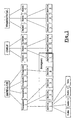
- Figure 1 shows a representation of the different media of transmission. It also allows you to freeze the vocabulary used in the field.
- Transmission and reception means comprising satellites, cables or terrestrial repeaters constitute networks of transmission.
- NIT table Network Information Table - Network Information Table, which indicates the name of the network, the network number, and for each of the network multiplexes, transponders when it comes to satellite links, information like as modulation frequency, orbital position of bits, polarization etc ..... comparable information is contained in the NIT media tables of cable or terrestrial transmission.
- the information contained in the NIT tables are parameters physical essentially allowing a decoder to stall in frequency to receive each multiplex.
- Each NIT table has, for one designated transponder, a list of services carried by the transponder. This list is normally limited, sometimes to 8 services, due to the bandwidth limitation reserved for a transponder.
- the services can be audio only services or data or other services, including interactive.
- Each service is thus identified in the NIT table by a triplet containing information known as Original Network Id - Network identification origin, ontwk_id.
- a service is still identified by Transport information Stream Id - Identification of the multiplex, ts_id, typically this information designates one of the transponders in relation to the satellite.
- Transport information Stream Id - Identification of the multiplex, ts_id typically this information designates one of the transponders in relation to the satellite.
- svc_id Service Id - Service Identification
- the decoder essentially retrieves the triple ontwk_id, ts_id, svc_id according to the DVB standard as well as the physical parameters (PSI) of the transponder.
- Each transponder transmits an SDT table which includes sub-tables.
- Each sub-table describes each of the services that are conveyed by the transponder. These services can be part of the services distributed by a transponder or by another transponder. This is identified from the NIT table.
- each one also diffuses a table called PAT, Program Association Table - Table of associated programs, table which itself gives the list of PMT tables, Program Map Table - Table des components of the programs, which are associated with each of the services.
- EIT tables are refer to each service, from its identification triplet according to the standard DVB, and indicate for this service the start time, the duration or the end time, the status, as well as other information relating to a broadcast program.
- the EIT tables are also split into ElTp and ElTf to represent a table corresponding to the present moment (p), as well as another table corresponding to a next instant (f, following).
- the two tables ElTp and ElTf are of the same structure but each have an identifier providing information on their quality.
- the NIT, SDT and EIT follow each other over time according to the standards. They have identifiers in the stream equal to 0x0010, 0x0011, and 0x0012 respectively. They are supplemented by the ts_id information.
- the MPEG2 standard makes it possible to multiplex several programs in one same Transport Stream (TS) or channel.
- This standard is supplemented by the DVB standard which allows constitution and zapping on several transponders within a single network.
- the programs are identified by the triplet (ontwk_id, ts_id, and svc_id). Each operator therefore broadcasts a more or less complete signaling allowing the constitution of a list of services accessible from a single connection on a transponder.
- the connection parameters are either entered by the user, at the screen, either frozen in the decoder.
- a scanning also called scanning or other processes have been implemented. They result in a succession of transponder visits allowing you to recover services from several networks, and no longer by an installation unique.
- the principle of scanning is as follows. We analyze a range of frequency with the various associated parameters (flow, symbol, etc.) for find all accessible frequency peaks. On each of the peaks we retrieves the list of services broadcast by operators. We then analyze the SI tables supposed to describe a list of services using descriptors according to the DVB standard. We then analyze the PSI tables which allow the development of service lists without the operator needing to describe them in the tables IF.
- the invention provides to provide the user with a simpler way of identifying a service.
- This simpler means amounts to match a service a simple and understandable mechanism identification.
- This mechanism then allows not only to recognize a service, but still to zap it.
- this simple means involves the creation of a correspondence table between the ontwk_id triples, ts_id, incomprehensible svc_id and a recognizable logic element.
- this recognizable logical element is a service name which clearly, for a common user, better identifies the service.
- This name will in principle a trade name conveyed by the company managing the service to make themselves known to its viewers or listeners. Otherwise this logical element will be a logo that the television channel or radio broadcasting will have taken care to disseminate to the public and through which it can be done recognize. Possibly by logo we will understand a musical phrase identifying a service. Finally, the logical element could be a number, this number being a number distributed by the service provider itself for be incorporated into free fields of the tables transmitted in the flow. Of preferably, the three logical elements above will be presented together to viewers, in a menu, in correspondence of DVB triplets (themselves displayed or not) to which they correspond. It will result from such display that the user can compose his preferred nomenclature, or immediately and directly access a chosen service, knowing cause, and no longer in practice by scrolling through the images of the different services until finding the one that interests him.
- the subject of the invention is therefore a television decoder comprising signal reception circuits of a stream comprising video signals and signaling signals relating to these video signals, circuits for decoding these signals from the received stream and to produce video signals and signals from DVB triples, in order to display these video signals on a display device, and adjustment circuits of the display device as a function of the signals of signaling received and decoded, characterized in that it includes a memory to contain records of logical elements corresponding to logical numbers, and or to service names and or to logos, and a circuit match to match DVB triples to items logic and to display a logic element on the display designate a DVB triplet.
- FIG. 2 shows a schematic representation of a decoder 1 according to the invention.
- This decoder 1 comprises reception circuits 2 for receive the signals of a stream 3 transmitted by one of the media according to FIG. 1.
- Stream 3 includes video signals 4 and relative signaling signals video signals.
- the signaling signals are contained in representative sections of NIT, BAT, SDT, EIT, TOT, TDT and PAT tables or others according to the aforementioned standard.
- the receiving means 2 are means of transmission reception in the case where with the decoder 1 the user can act interactively.
- the reception circuits 2 are connected by a bus 5 to a microprocessor 6, to a program memory 7 and to a data memory 8.
- Bus 5 can moreover serve to connect a display device 9 to the decoder 1.
- the microprocessor 6 in application of a program 10, entitled here symbolically MPEG-DVB, and capable of producing the recorded tables in memory 8 from stream 3 received.
- Flow signaling signals 3 the microprocessor 6 is thus capable of extracting DVB triplets, representing the information ontwk_id, ts_id, svc_id for each service. AT each DVB triplet thus decoded also corresponds in the tables to set 11 of adjustment parameters.
- the principle of adjustment of the display device 9 is as follows.
- a user is viewing on device 9 the ontwk_id, ts_id and svc_id triplets relating to each of the services that it can receive through stream 3. It selects, in particular with a remote control 12 and according to a known remote control use protocol, one of these triples displayed. This selection, this designation, can then be followed by a direct visualization of the service corresponding to a triplet selected.
- the microprocessor 6 takes the parameters 11 corresponding to the selected triplet, applies them as a parameter input to the display device 9, and as a decoding parameter of the video signals received, and this display device is then able to display the images and broadcast the sounds corresponding to the selected service.
- the match will be made by the fact that in this memory the triplet dvb has the same recording address as the LOGO logo to which it corresponds. Simply these two pieces of information correspond to different fields in these records. Or a correspondence program 15, implemented by the microprocessor 6 may provide that the LOGO record is in memory 13 at one address whose value is precisely equal to the value of the dvb triplet to which this logo matches.
- the program memory 7 also comprises a subroutine display 16 to display on the display device 9, instead and place of the dvb triplet, or juxtaposed to it, the LOGO logic element taken in memory 13 and which corresponds to the triplet to be selected.
- the user will see on the display device 9 the LOGO logic element to which he can more easily identify the service, because it is known commercially under this identification.
- the selection of the logical element thus identified, by the correspondence subroutine 15 allows the microprocessor 6 to select in practice a DVB triplet to which this logical element matches. As a result all the actions performed by the user, direct visualization or constitution of a nomenclature will take into account the DVB triplet thus selected without that the user has to know the meaning.
- the memory 13 will possibly include instead of a logo a service name.
- the identification of the different services on the display device 9 results in the display of a list of known channels under their trade names.
- a selection menu offers on the display device 9 lists the names.
- identifying a service can be done by a numbering: the logical element then being a number. This numbering can be done in different ways. This numbering is otherwise different from the svc_id information which is not properly speaking a number.
- the DVB standard allows the use of private descriptor, for each service, for each DVB triplet, can correspond then a logical number, predefined in the signaling by the transmitter of the flow. This logical number can be incorporated into any table (for example SDT or other) corresponding to the service broadcast.
- This numbering can nevertheless lead to a difficulty. Indeed several services can assign the same number (in particular the number one because it would correspond to the number one button on the remote) to their service. We can then proceed to a different numbering. This different numbering is also carried out in the case where the services have not no private number associated in the stream. In this case, you can number the services in the order of arrival of the programs in the stream. This numbering is then carried out from 1 to N, whatever the type of service, the services which can be video or audio services (depending on a language, or several languages) or application services, with the possibility of reaction from the user. This default order can simply be the order of appearance services in each of the NIT, BAT, SDT or PAT tables depending on the numbering strategy.
- the remote control number one will correspond to the service whose numbering logic, assigned sequentially according to the process defined above, will be the number one.
- the number two key can be assigned to the service whose logo is LOGO.
- the number three key can be assigned to the department whose name is NAME.
- microprocessor 6 will use the DVB triplets to identify and select, according to the DVB standard, the programs to view, while the user can make his choices by function of much more understandable information represented by names, logos or logical numbers.
- How to fill memory 13 and or memory 18 may consist in providing each decoder with all the possibilities to associate an ontwk_id, ts_id, svc_id triplet with one and / or others logical elements. So, if a service is distributed by several transponders or even several networks, memory 13 may include all the occurrences of the ontwk_id, ts_id and svc_id triples of this service and, in correspondence of each of them, the same logical elements to display. Yes the elements to be displayed are logos, of course the program 16 will include the instructions necessary to display a corresponding image to the logo.
- Correspondence program 15 may then include decoding of all received ontwk_id, ts_id, and svc_id triples by flow 3, receipt of this specific service, and direct debit in a mosaic of logos received from this specific service of logos, even records, corresponding to the triplets received by the stream, and their memorization in memory 13 or 18.
- this specific service can be incorporated into all streams, or be accessible by a modem (not represented and contained in the decoder) on a website.
- the memory 13 is not carried out in the decoder, but memory 18 (associating buttons on the remote control with selected services) can be created during reception of a mosaic received from a channel specific.
- the content of the memory 13 can be pre stored in the decoder.
- the remote control 12 will include, with command 19, the display of a prior menu identifier - head of household - children - that of these nomenclatures which will be used. If necessary, these nomenclatures will only be numbered, from 1 to M, if there are M possible.
- composition of a nomenclature will then include, the designation of the nomenclature to be composed (preferably), then the service designations (identified by their logos, names and or numbers) and the association with each service of a key (or combination of keys) of the remote control.
- the memory 18 is then formed. Reading from memory 18, in connection with memory 13, then makes it possible to select a service with the remote control 12.
Landscapes
- Engineering & Computer Science (AREA)
- Multimedia (AREA)
- Signal Processing (AREA)
- Databases & Information Systems (AREA)
- Human Computer Interaction (AREA)
- Two-Way Televisions, Distribution Of Moving Picture Or The Like (AREA)
- Television Systems (AREA)
- Circuits Of Receivers In General (AREA)
Applications Claiming Priority (2)
| Application Number | Priority Date | Filing Date | Title |
|---|---|---|---|
| FR0001077 | 2000-01-25 | ||
| FR0001077A FR2804275B1 (fr) | 2000-01-25 | 2000-01-25 | Decodeur de television et procede de decodage de signaux d'un flux |
Publications (2)
| Publication Number | Publication Date |
|---|---|
| EP1120960A2 true EP1120960A2 (de) | 2001-08-01 |
| EP1120960A3 EP1120960A3 (de) | 2002-02-20 |
Family
ID=8846394
Family Applications (1)
| Application Number | Title | Priority Date | Filing Date |
|---|---|---|---|
| EP01400206A Withdrawn EP1120960A3 (de) | 2000-01-25 | 2001-01-25 | Fernsehdekodierer und Verfahren zur Dekodierung von Signalen eines Stromes |
Country Status (2)
| Country | Link |
|---|---|
| EP (1) | EP1120960A3 (de) |
| FR (1) | FR2804275B1 (de) |
Cited By (2)
| Publication number | Priority date | Publication date | Assignee | Title |
|---|---|---|---|---|
| EP1761061A2 (de) | 2005-08-29 | 2007-03-07 | LG Electronics Inc. | Digitales Fernsehsignal, Verfahren zur Verarbeitung desselben in einer Übertragungsvorrichtung und in einem Empfänger, digitaler Rundfunkempfänger und digitale Rundfunkübertragungsvorichtung |
| EP2768217A1 (de) * | 2013-02-13 | 2014-08-20 | Samsung Electronics Co., Ltd | Anzeigevorrichtung, Server und Ansteuerungsverfahren dafür |
Family Cites Families (8)
| Publication number | Priority date | Publication date | Assignee | Title |
|---|---|---|---|---|
| US5418782A (en) * | 1992-10-30 | 1995-05-23 | Scientific-Atlanta, Inc. | Methods and apparatus for providing virtual service selection in a multi-service communications system |
| CA2271555C (en) * | 1992-12-09 | 2003-11-11 | Discovery Communications, Inc. | Remote control for cable television delivery system |
| US6215530B1 (en) * | 1995-05-22 | 2001-04-10 | Scientific-Atlanta, Inc. | Logical and composite channel mapping in an MPEG network |
| US6757911B1 (en) * | 1996-08-30 | 2004-06-29 | Matsushita Electric Industrial Co., Ltd. | Digital broadcasting system, digital broadcasting apparatus, and a reception apparatus for digital broadcasts |
| FI964640A7 (fi) * | 1996-11-21 | 1998-07-28 | Nokia Multimedia Network Terminals Oy | Menetelmä osoitetietojen välittämiseksi |
| EP0854650A3 (de) * | 1997-01-17 | 2001-05-02 | NOKIA TECHNOLOGY GmbH | Verfahren zur Adressierung eines Dienstes in einem digitalen Videorundfunksystem |
| US6557171B1 (en) * | 1998-02-02 | 2003-04-29 | Matsushita Electric Industrial Co., Ltd. | Digital tv broadcast sending apparatus, digital tv broadcast receiving apparatus, and digital tv broadcast sending / receiving system which facilitate preselection of tv programs, and computer readable recording medium storing a program for achieving a function of the digital tv broadcast receiving apparatus |
| GB2377846B (en) * | 1998-06-12 | 2003-03-05 | British Sky Broadcasting Ltd | Improvements in receivers for television signals |
-
2000
- 2000-01-25 FR FR0001077A patent/FR2804275B1/fr not_active Expired - Lifetime
-
2001
- 2001-01-25 EP EP01400206A patent/EP1120960A3/de not_active Withdrawn
Cited By (3)
| Publication number | Priority date | Publication date | Assignee | Title |
|---|---|---|---|---|
| EP1761061A2 (de) | 2005-08-29 | 2007-03-07 | LG Electronics Inc. | Digitales Fernsehsignal, Verfahren zur Verarbeitung desselben in einer Übertragungsvorrichtung und in einem Empfänger, digitaler Rundfunkempfänger und digitale Rundfunkübertragungsvorichtung |
| EP1761061A3 (de) * | 2005-08-29 | 2009-01-07 | LG Electronics Inc. | Digitales Fernsehsignal, Verfahren zur Verarbeitung desselben in einer Übertragungsvorrichtung und in einem Empfänger, digitaler Rundfunkempfänger und digitale Rundfunkübertragungsvorichtung |
| EP2768217A1 (de) * | 2013-02-13 | 2014-08-20 | Samsung Electronics Co., Ltd | Anzeigevorrichtung, Server und Ansteuerungsverfahren dafür |
Also Published As
| Publication number | Publication date |
|---|---|
| EP1120960A3 (de) | 2002-02-20 |
| FR2804275B1 (fr) | 2002-10-31 |
| FR2804275A1 (fr) | 2001-07-27 |
Similar Documents
| Publication | Publication Date | Title |
|---|---|---|
| EP0694242B1 (de) | Verfahren und vorrichtung zur auswahl von videoprogrammen | |
| US20030023970A1 (en) | Interactive television schema | |
| EP2380173A2 (de) | Verfahren zur verwaltung von detektion von werbung in einer elektronischen vorrichtung, wie etwa einem digitalfernsehdecoder | |
| EP1994751A1 (de) | Verfahren zum bereitstellen eines multimediadienstes nach bedarf, dienstplattform, programm und decoder zur implementierung des verfahrens | |
| EP1295472B1 (de) | Empfangsverfahren und anzeige von sequenzen mit audiovisuellen themesendungen, und empfänger zur durchführung des verfahrens | |
| US20090300185A1 (en) | Reception of Audio-Visual Content Addressed to Several Devices | |
| EP1120960A2 (de) | Fernsehdekodierer und Verfahren zur Dekodierung von Signalen eines Stromes | |
| EP1128664B1 (de) | Verfahren zur Steuerung eines Fernsehdekodierers | |
| EP1409096B8 (de) | Interaktives fernsehverfahren- und gerät | |
| FR2818074A1 (fr) | Procede de constitution d'une liste de programmes de services de television | |
| FR2818484A1 (fr) | Procede de mesure d'audience d'applications interactives telediffusees ou embarquees sur un decodeur de recepteur de television | |
| EP1798999B1 (de) | Verfahren zur Verwaltung des Verhaltens einer interaktiven Anwendung während der Übertragung einer Sendung gemäss den DVB-H Standard | |
| FR2812160A1 (fr) | Decodeur avec fonction de creation d'images mosaiques de services de television | |
| US20070250875A1 (en) | Methods, apparatuses, and computer program products for delivering one or more television programs for viewing during a specified viewing interval | |
| EP2232431A2 (de) | Verfahren zur Funkübertragung von kundenspezifischer Information über ein AN-IPTV-Netzwerk und Vorrichtung für die Umsetzung dieses Verfahrens | |
| EP2801216A1 (de) | Steuerung von im rundfunkmodus übermittelten on-demand-diensten | |
| FR2812161A1 (fr) | Dispositif de television avec fonction de creation de listes favorites | |
| EP1119201A2 (de) | Verfahren und Vorrichtung zur Übertragung von Regelungsparametersignalen zu einem Dekodierer | |
| FR2910215A1 (fr) | Procede de reproduction de documents audiovisuels par un appareil possedant une caracteristique particuliere, appareil et serveur pour la mise en oeuvre du procede | |
| FR2834416A1 (fr) | Procede de diffusion de services audiovisuels, central de diffusion et support d'enregistrement, procede de visualisation d'emissions audiovisuelles et dispositif associes | |
| FR2860677A1 (fr) | Procede de controle d'un parc de decodeurs | |
| FR2816158A1 (fr) | Decodeur de television numerique et procede d'edition d'une liste de programmes de television au moyen d'un tel decodeur | |
| FR2828976A1 (fr) | Terminal de reception et centre de diffusion de programmes interactifs, signal contenant de tels programmes et procede de surveillance de programmes interactifs recus dans un tel terminal | |
| FR2909247A1 (fr) | Methode de reproduction d'un document audiovisuel avec insertion d'un contenu, par exemple publicitaire, procede et appareils associe a un tel procede. | |
| EP1531621A1 (de) | Verfahren zum Steuern eines Audio/Video-Wiedergabegerätes über eine eingeschränkte Schnittstelle |
Legal Events
| Date | Code | Title | Description |
|---|---|---|---|
| PUAI | Public reference made under article 153(3) epc to a published international application that has entered the european phase |
Free format text: ORIGINAL CODE: 0009012 |
|
| AK | Designated contracting states |
Kind code of ref document: A2 Designated state(s): AT BE CH CY DE DK ES FI FR GB GR IE IT LI LU MC NL PT SE TR Kind code of ref document: A2 Designated state(s): DE ES FR GB IT |
|
| AX | Request for extension of the european patent |
Free format text: AL;LT;LV;MK;RO;SI |
|
| RAP1 | Party data changed (applicant data changed or rights of an application transferred) |
Owner name: SAGEM S.A. |
|
| PUAL | Search report despatched |
Free format text: ORIGINAL CODE: 0009013 |
|
| AK | Designated contracting states |
Kind code of ref document: A3 Designated state(s): AT BE CH CY DE DK ES FI FR GB GR IE IT LI LU MC NL PT SE TR |
|
| AX | Request for extension of the european patent |
Free format text: AL;LT;LV;MK;RO;SI |
|
| RIC1 | Information provided on ipc code assigned before grant |
Free format text: 7H 04N 5/00 A |
|
| 17P | Request for examination filed |
Effective date: 20020221 |
|
| 17Q | First examination report despatched |
Effective date: 20020604 |
|
| AKX | Designation fees paid |
Free format text: DE ES FR GB IT |
|
| STAA | Information on the status of an ep patent application or granted ep patent |
Free format text: STATUS: THE APPLICATION IS DEEMED TO BE WITHDRAWN |
|
| 18D | Application deemed to be withdrawn |
Effective date: 20021217 |