EP1120976A1 - Verfahren zur bewegungsvektordetektion - Google Patents
Verfahren zur bewegungsvektordetektion Download PDFInfo
- Publication number
- EP1120976A1 EP1120976A1 EP99933147A EP99933147A EP1120976A1 EP 1120976 A1 EP1120976 A1 EP 1120976A1 EP 99933147 A EP99933147 A EP 99933147A EP 99933147 A EP99933147 A EP 99933147A EP 1120976 A1 EP1120976 A1 EP 1120976A1
- Authority
- EP
- European Patent Office
- Prior art keywords
- motion vector
- block
- predicted
- search range
- detection system
- Prior art date
- Legal status (The legal status is an assumption and is not a legal conclusion. Google has not performed a legal analysis and makes no representation as to the accuracy of the status listed.)
- Withdrawn
Links
Images


Classifications
-
- H—ELECTRICITY
- H04—ELECTRIC COMMUNICATION TECHNIQUE
- H04N—PICTORIAL COMMUNICATION, e.g. TELEVISION
- H04N19/00—Methods or arrangements for coding, decoding, compressing or decompressing digital video signals
- H04N19/50—Methods or arrangements for coding, decoding, compressing or decompressing digital video signals using predictive coding
- H04N19/503—Methods or arrangements for coding, decoding, compressing or decompressing digital video signals using predictive coding involving temporal prediction
- H04N19/51—Motion estimation or motion compensation
-
- H—ELECTRICITY
- H04—ELECTRIC COMMUNICATION TECHNIQUE
- H04N—PICTORIAL COMMUNICATION, e.g. TELEVISION
- H04N19/00—Methods or arrangements for coding, decoding, compressing or decompressing digital video signals
- H04N19/50—Methods or arrangements for coding, decoding, compressing or decompressing digital video signals using predictive coding
- H04N19/503—Methods or arrangements for coding, decoding, compressing or decompressing digital video signals using predictive coding involving temporal prediction
- H04N19/51—Motion estimation or motion compensation
- H04N19/533—Motion estimation using multistep search, e.g. two-dimensional [2D]-log search or one-at-a-time search [OTS]
-
- H—ELECTRICITY
- H04—ELECTRIC COMMUNICATION TECHNIQUE
- H04N—PICTORIAL COMMUNICATION, e.g. TELEVISION
- H04N19/00—Methods or arrangements for coding, decoding, compressing or decompressing digital video signals
- H04N19/50—Methods or arrangements for coding, decoding, compressing or decompressing digital video signals using predictive coding
- H04N19/503—Methods or arrangements for coding, decoding, compressing or decompressing digital video signals using predictive coding involving temporal prediction
- H04N19/51—Motion estimation or motion compensation
- H04N19/56—Motion estimation with initialisation of the vector search, e.g. estimating a good candidate to initiate a search
-
- H—ELECTRICITY
- H04—ELECTRIC COMMUNICATION TECHNIQUE
- H04N—PICTORIAL COMMUNICATION, e.g. TELEVISION
- H04N19/00—Methods or arrangements for coding, decoding, compressing or decompressing digital video signals
- H04N19/50—Methods or arrangements for coding, decoding, compressing or decompressing digital video signals using predictive coding
- H04N19/503—Methods or arrangements for coding, decoding, compressing or decompressing digital video signals using predictive coding involving temporal prediction
- H04N19/51—Motion estimation or motion compensation
- H04N19/57—Motion estimation characterised by a search window with variable size or shape
-
- H—ELECTRICITY
- H04—ELECTRIC COMMUNICATION TECHNIQUE
- H04N—PICTORIAL COMMUNICATION, e.g. TELEVISION
- H04N5/00—Details of television systems
- H04N5/14—Picture signal circuitry for video frequency region
- H04N5/144—Movement detection
- H04N5/145—Movement estimation
Definitions
- This system relates to a motion vector detection system which reduces the amount of operations for detecting a motion vector for motion compensation in moving picture compression with the quality of an image being maintained.
- a picture frame is divided into mesh-type blocks to be subjected to a block based motion compensation, orthogonal transform such as Discrete Cosine Transform (hereinafter referred to as DCT), quantization and variable-length encodation.
- DCT Discrete Cosine Transform
- the above mentioned method is employed in such international standards as H.261 dealing with a camera-input signal of an existing television, MPEG-1 (Motion Picture Image Coding Experts Group) as an improvement of H.261 designed for dealing with storage media such as CD-ROM, MPEG-2 designed for dealing with communication/broadcasting media, and MPEG-4 designed for dealing with low bit rate data and multi-media data.
- Motion compensation employed in this method is designed for high image quality compression and encodation, so that motion vector detection is needed to be involved. A typical motion vector detection method is now discussed.
- Fig. 6 shows a full-matching method for detecting a motion vector 607 of a block 605 to be predicted in a current frame 601 through block matching based upon the information of a previous frame 602 having been encoded.
- the motion vector of the block 605 to be predicted is detected through matching of the block 605 to be predicted and individual blocks within a search range 603 fixed surrounding a block 608 in the previous frame 602 located at an equivalent position to that of the block 605 to be predicted.
- the motion vector 606 is only allowed to express itself within a range of ⁇ 15 pixels, which provides, in a general sense, a range of 30+M pixels vertically (in length) and 30+N pixels horizontally (in breadth) with the block to be predicted at the center for searching the block, where M designates the vertical pixel size of the block and N designates the horizontal pixel size of the block.
- M designates the vertical pixel size of the block
- N designates the horizontal pixel size of the block.
- Each pixel based error of all or some of blocks within the search range for the block to be predicted from the block to be predicted is calculated sequentially to detect a block having a minimal error within the search range as a reference block 604 of the block to be predicted. Based upon the positions of the reference block 604 and the block to be predicted, the motion vector 607 of the block to be predicted is obtained.
- the aforementioned method having all the blocks within the search range subjected to pixel based error calculation to determine the reference block is called the full-matching method, which is the most efficient approach of detecting a precise reference block.
- a pixel based error between the block to be predicted and the reference block is minimized, which contributes to the prediction of the block to be predicted with a small amount of information.
- the full-matching method involving a large amount of operations for detecting a motion vector, requires a large amount of processing time for motion compensation.
- the full-matching method with the search range being fixed, performs an inefficient searching in an unnecessarily large area for a block to be predicted whose motion is static. This may result in a failure in detecting an appropriate motion vector, which may degrade the quality of the image or increase in the amount of bits for encoding.
- some approaches employ the same fixed search range as that of the full-matching method and reduce the amount of operations for motion vector detection more than that of the full-matching method through thinning the pixels of the reference frame and the block to be predicted at the same ratio, sub-sampling or the like. Those approaches achieving the amount of operations reduced still fail to detect an appropriate motion vector due to the fixed search range, which then causes to degrade the quality of an image or increase the amount of bits for encoding.
- the vertical and horizontal sides of an initially set area of the search range is extended by the average of the absolute values of the motion vectors of blocks adjacent to the block to be predicted.
- This system as the search range is allowed to be set in accordance with the magnitude of the motion of a block, the search range is extended by the same distance from the block to be predicted on all sides vertically and horizontally, so that the directional property of the motion is neglected. Consequently, in the case of the average of the absolute values of motion vectors being large, the amount of operations for detecting a motion vector becomes no less than that of the full-matching method, which makes the detection of an appropriate motion vector difficult.
- the search range is set to a fixed large area, then the amount of operations for detection becomes large. In particular, with a static moving picture, this is rather a waste of searching, and may result even, on the contrary, in a failure to detect an appropriate motion vector.
- the search range is extended by the same distance on all sides vertically and horizontally based upon the average, maximum value or the like of the absolute values of adjacent motion vectors. Consequently, if the average or maximum value is large, then the extension margin becomes large, thereby posing the same problem as that of the full-matching method.
- Fig. 1 shows a block diagram of a motion vector detection system of the present invention.
- a method for detecting the motion vector of a block to be predicted is now discussed.
- a predicted motion vector detector 102 receives the motion vectors of blocks adjacent to the block to be predicted from a motion vector memory 101 and outputs the errors of the motion vectors and the predicted motion vector of the block to be predicted.
- the predicted motion vector predicts the motion vector of the block to be predicted.
- a search range determiner 103 receiving the predicted motion vector determines and outputs a search range for the motion vector of the block to be predicted.
- a search range extension unit 104 receiving the search range and the errors of the motion vectors extends the search range inputted and outputs an extended search range.
- a motion vector detector 105 receiving the expanded search range obtains a motion vector through block matching based upon the pixel data of the block to be predicted and the pixel data of a reference frame and outputs an obtained motion vector.
- a block matching range in the reference frame is the search range inputted.
- a motion vector storage unit 106 stores the motion vector in an appropriate memory map. Individual blocks to be predicted are subject to the foregoing operating flow.
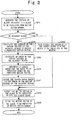
- Fig. 2 shows a flow chart illustrating a whole course of operation for detecting the motion vector of the block to be predicted.
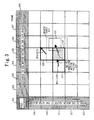
- Fig. 3 shows a frame exemplifying a predicted motion vector 319 and a motion vector error calculated by the predicted motion vector calculator.
- already detected motion vectors 317 and 318, respectively, of blocks 320 and 321 adjacent to a block 316 to be predicted are obtained from the motion vector memory.
- blocks are selected sequentially to be predicted each from the top left of the frame to the right.
- a block whose motion vector has been obtained is allowed to be used as a reference block.
- blocks at the left side and at the upper side of the block to be predicted are used as the reference blocks.
- blocks at the upper left and the upper right may also be used as the reference blocks.
- Fig. 3 shows a frame exemplifying a predicted motion vector 319 and a motion vector error calculated by the predicted motion vector calculator.
- a predicted motion vector PMV of the block to be predicted is the average of MV1 and MV2.
- a function involving the directional property of the motion vector of the reference block for obtaining the predicted motion vector. It is particularly desirable to have an approach of obtaining the predicted motion vector based upon the tendency of the directional property of the motion vector. For example, various kinds of average such as the geometric mean and the harmonic mean may be utilized on an element basis.
- the search range determiner utilizes the full-matching method.
- blocks 302 through 308 in the first row of the frame of Fig. 3 are to be predicted, the respective blocks have their single adjacent blocks whose motion vectors have been detected only at the left side.
- blocks 309 through 313 in the first column are to be predicted, the respective blocks have their single adjacent blocks whose motion vectors have been detected only at the upper side. In those cases, the motion vector of the single adjacent block is designated as the predicted motion vector of the block to be predicted.
- the motion vector of the block to be predicted is obtained based upon the tendency of the motion vectors of adjacent blocks. Further, in use of this predicted motion vector, the area of the search range and the directional property can be predicted in an accurate manner. Consequently, the block based accurate determination of the search range allows a reduced amount of operations for motion vector detection.
- the motion vector of the reference block can conventionally be used, it is possible and effective to consider the motion vector a zero vector or no motion vector.
- the intra-block it is indicated that the quality of an image appeared poor through prediction after detecting a motion vector or an amount of bits for encoding became too large as a result of prediction. Accordingly, it can be assumed that the motion vector of the intra-block has weak correlation with the block to be predicted. Hence, treating the motion vector of the intra-block as a zero vector or a detection failure may avoid wasteful efforts to detect a motion vector or detecting an inappropriate motion vector.
- the errors of the motion vectors of the respective reference blocks are calculated.
- the X-axis error of the motion vector is represented by X1-X2 and the Y-axis error of the motion vector is represented by Y1-Y2 .
- the X-axis error of the motion vector is MIN (X1, X2, ..., XN)-MAX (X1, X2, ..., XN) and the Y-axis error of the motion vector is MIN (Y1, Y2, ..., YN)-MAX (Y1, Y2, ..., YN) , where MIN denotes a minimal value of arguments and MAX denotes a maximal value of arguments.
- the predicted motion vector is outputted to the search range determiner 103.
- An error between the motion vectors of adjacent blocks is outputted to the search range extension unit 104.
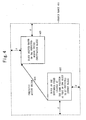
- Fig. 4 shows an example of the search range determined by the search range determiner.
- the search range determiner receiving a predicted motion vector 404 detected by the predicted motion vector detector 102, determines a search range 401 for the motion vector of the block to be predicted to be an area obtained by extending a rectangle including a block 402 locating at the same position as that of the block to be predicted and a block 403 obtained by shifting the block 402 based upon the predicted motion vector in the reference frame on every side by d vertically and horizontally.
- Some encoding systems such as MPEG, in pursuit of an efficient transmission of a motion-less picture, employ a system where information identifying the type of motion, static or dynamic, is transmitted on a block basis for transmitting a motion vector only with a dynamic block.
- this type of encoding system requires a zero-vector prioritized motion vector detection. It is effective, therefore, for detecting a zero vector prioritized to include the neighborhood of the position of the block to be predicted as well as the neighborhood of the predicted motion vector in the search range in the search range determiner 103.
- the amount of operations for detecting a motion vector can be reduced by extending the search range in the direction of the predicted motion vector rather than on all sides vertically and horizontally by the same length from the block to be predicted, which at the same time contributes to preventing an erroneous and inappropriate motion vector from being detected.
- the length of d is to be controlled so that the horizontal or vertical length of the search range does not exceed 15+L where L designates the horizontal or vertical length of a block.
- the search range is an area obtained by extending 15 vertically and horizontally from the block to be predicted. The search range is outputted to the search range extension unit.
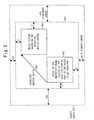
- Fig. 5 shows an example of the search range extended by the search range extension unit.
- a search range 501 determined by the search range determiner is extended by edx on the X-axis and edy on the Y-axis.
- the length of edx or edy has to be controlled so that the horizontal or vertical length, respectively, of an extended search range 505 does not exceed 15+L. It is also effective to multiply edx and edy by a given value (e.g. a decimal value over zero) each to obtain an X-axis extension margin and a Y-axis extension margin.
- the given value for multiplication may be different from each other.
- the value of an error between the motion vectors of adjacent blocks can show the correlation between the adjacent blocks. Specifically, it can be said that in the case that an error between the motion vectors of adjacent blocks is large, then the adjacent blocks have weak correlation with each other, and in the case that an error between the motion vectors of adjacent blocks is small, then the adjacent blocks have strong correlation with each other. In addition to that, it can be assumed that in the case that a block has weak correlation with an adjacent block, then the block has weak correlation with a block to be predicted as well, and in the case that a block has strong correlation with an adjacent block, then the block has strong correlation with a block to be predicted as well.
- the search range may be extended. This allows for ease in detecting an appropriate motion vector.
- the motion vector detector 102 determines a block having a minimal sum of pixel based errors with the block to be predicted through block matching within the search range determined by the search range extension unit 104.
- the motion vector of the block to be predicted is detected based upon the position of the block determined and the position of the block to be predicted.
- the motion vector storage unit 106 stores the motion vector detected by the motion vector detector in the motion vector memory 101. Any storable medium may be employed as the motion vector memory.
- the motion memory may be so small in size as to store the motion vectors of a row of blocks.
- the motion vector detection is performed on a row basis from the top left block in the frame. Accordingly, having at least only one motion vector stored of a block among blocks in each column, the motion vector of a block adjacent to the block to be predicted can be obtained.
- a motion vector is detected through a multi-step approach involving various pixel units such as a sub-sampling-pixel unit, an integer-pixel unit and a half-pixel unit, or that the motion vectors of a sequence of blocks are detected in an asynchronous manner
- the various pixel units are to be unified for storage to update a memory area allocated to the block with a current motion vector. Consequently, the size of the memory can be minimized so as to store the motion vectors of a row of blocks.
- An effect of the motion vector detection system of this invention is the precise prediction of the area of the search range and the directional property for obtaining the motion vector of the block to be predicted made possible through calculating the predicted motion vector based upon the motion vector of a block adjacent to the block to be predicted.
- the block based accurate determination of the search range produces the advantage of reducing the amount of operations for detecting a motion vector.
- the employment of the average of the respective motion vectors of the embodiment achieves the accurate prediction based upon the tendency of the respective motion vectors.
- the search range determiner determining that the search range includes the neighborhood of the position of the block to be predicted as well as the neighborhood of the predicted motion vector of the embodiment achieves an effective processing of the zero-vector prioritized detection.
- search range extension unit extending the search range in the case of the correlation assumedly weak between the block to be predicted and the reference block of the embodiment contributes to detecting an appropriate motion vector.
Landscapes
- Engineering & Computer Science (AREA)
- Multimedia (AREA)
- Signal Processing (AREA)
- Compression Or Coding Systems Of Tv Signals (AREA)
Applications Claiming Priority (1)
| Application Number | Priority Date | Filing Date | Title |
|---|---|---|---|
| PCT/JP1999/004063 WO2001010135A1 (fr) | 1999-07-29 | 1999-07-29 | Procede de detection de vecteur de mouvement |
Publications (2)
| Publication Number | Publication Date |
|---|---|
| EP1120976A1 true EP1120976A1 (de) | 2001-08-01 |
| EP1120976A4 EP1120976A4 (de) | 2006-03-29 |
Family
ID=14236329
Family Applications (1)
| Application Number | Title | Priority Date | Filing Date |
|---|---|---|---|
| EP99933147A Withdrawn EP1120976A4 (de) | 1999-07-29 | 1999-07-29 | Verfahren zur bewegungsvektordetektion |
Country Status (3)
| Country | Link |
|---|---|
| US (1) | US6414995B2 (de) |
| EP (1) | EP1120976A4 (de) |
| WO (1) | WO2001010135A1 (de) |
Cited By (7)
| Publication number | Priority date | Publication date | Assignee | Title |
|---|---|---|---|---|
| GB2386019A (en) * | 2002-01-26 | 2003-09-03 | Lg Electronics Inc | Adaptively defining a motion vector search range using vector values of adjacent blocks |
| EP2124455A4 (de) * | 2007-03-14 | 2010-08-11 | Nippon Telegraph & Telephone | Verfahren und vorrichtung zur bewegungsvektorsuche, programm dafür sowie aufzeichnungsmedium mit diesem programm |
| US7970050B2 (en) | 2004-09-30 | 2011-06-28 | Samsung Electronics Co., Ltd. | Method and apparatus for encoding and decoding data in intra mode based on multiple scanning |
| US7978919B2 (en) | 2004-09-30 | 2011-07-12 | Samsung Electronics Co., Ltd. | Method and apparatus for encoding and decoding in inter mode based on multiple scanning |
| US8265142B2 (en) | 2007-03-14 | 2012-09-11 | Nippon Telegraph And Telephone Corporation | Encoding bit-rate control method and apparatus, program therefor, and storage medium which stores the program |
| US9161042B2 (en) | 2007-03-14 | 2015-10-13 | Nippon Telegraph And Telephone Corporation | Quantization control method and apparatus, program therefor, and storage medium which stores the program |
| US9455739B2 (en) | 2007-03-14 | 2016-09-27 | Nippon Telegraph And Telephone Corporation | Code amount estimating method and apparatus, and program and storage medium therefor |
Families Citing this family (51)
| Publication number | Priority date | Publication date | Assignee | Title |
|---|---|---|---|---|
| JP4496595B2 (ja) * | 1999-03-29 | 2010-07-07 | ソニー株式会社 | 画像処理装置および画像処理方法、並びに記録媒体 |
| AU2002250278A1 (en) * | 2001-03-07 | 2002-09-19 | Pts Corporation | Local constraints for motion estimation |
| KR100438572B1 (ko) * | 2001-09-28 | 2004-07-02 | 엘지전자 주식회사 | 움직임 벡터 영역의 적응적 결정 방법 |
| KR100865034B1 (ko) | 2002-07-18 | 2008-10-23 | 엘지전자 주식회사 | 모션 벡터 예측 방법 |
| CN101141651B (zh) | 2002-11-25 | 2010-11-10 | 松下电器产业株式会社 | 动态补偿方法、图像编码方法及图像解码方法 |
| NO318167B1 (no) * | 2002-11-27 | 2005-02-14 | Tandberg Telecom As | Vektorprediksjon |
| KR100560843B1 (ko) * | 2003-04-10 | 2006-03-13 | 에스케이 텔레콤주식회사 | 비디오 부호기에서 적응 움직임 벡터의 탐색 영역을결정하는 방법 및 장치 |
| US8824553B2 (en) | 2003-05-12 | 2014-09-02 | Google Inc. | Video compression method |
| US7860326B2 (en) * | 2003-09-22 | 2010-12-28 | Kddi Corporation | Adaptable shape image encoding apparatus and decoding apparatus |
| JP4511842B2 (ja) * | 2004-01-26 | 2010-07-28 | パナソニック株式会社 | 動きベクトル検出装置及び動画撮影装置 |
| CN100385957C (zh) * | 2004-05-21 | 2008-04-30 | 中国科学院计算技术研究所 | 一种运动矢量预测的方法 |
| US7953152B1 (en) | 2004-06-28 | 2011-05-31 | Google Inc. | Video compression and encoding method |
| CN100433835C (zh) * | 2005-03-01 | 2008-11-12 | 凌阳科技股份有限公司 | 动态调整运动估计的方法及系统 |
| US8005308B2 (en) * | 2005-09-16 | 2011-08-23 | Sony Corporation | Adaptive motion estimation for temporal prediction filter over irregular motion vector samples |
| US8107748B2 (en) * | 2005-09-16 | 2012-01-31 | Sony Corporation | Adaptive motion search range |
| US8036428B2 (en) * | 2006-04-28 | 2011-10-11 | Pixart Imaging Inc. | Method and apparatus for detecting motion of image in optical navigator |
| KR100912429B1 (ko) * | 2006-11-09 | 2009-08-14 | 삼성전자주식회사 | 고속 움직임 추정을 위한 영상 검색 방법 |
| KR100860690B1 (ko) * | 2007-01-26 | 2008-09-26 | 삼성전자주식회사 | 외부 메모리 액세스를 최소화하는 움직임 탐색 방법 및장치 |
| KR101427115B1 (ko) | 2007-11-28 | 2014-08-08 | 삼성전자 주식회사 | 영상처리장치 및 영상처리방법 |
| KR101517768B1 (ko) | 2008-07-02 | 2015-05-06 | 삼성전자주식회사 | 영상의 부호화 방법 및 장치, 그 복호화 방법 및 장치 |
| US8325796B2 (en) * | 2008-09-11 | 2012-12-04 | Google Inc. | System and method for video coding using adaptive segmentation |
| US8326075B2 (en) | 2008-09-11 | 2012-12-04 | Google Inc. | System and method for video encoding using adaptive loop filter |
| US8311111B2 (en) * | 2008-09-11 | 2012-11-13 | Google Inc. | System and method for decoding using parallel processing |
| JPWO2010035735A1 (ja) * | 2008-09-24 | 2012-02-23 | ソニー株式会社 | 画像処理装置および方法 |
| US20110228851A1 (en) * | 2010-03-18 | 2011-09-22 | Amir Nusboim | Adaptive search area in motion estimation processes |
| MX2013003557A (es) | 2010-10-05 | 2013-05-01 | Gen Instrument Corp | Codificacion y decodificacion utilizando seleccion de modelo adaptativo al contexto con escaneo en zigzag. |
| US8938001B1 (en) | 2011-04-05 | 2015-01-20 | Google Inc. | Apparatus and method for coding using combinations |
| US8780971B1 (en) | 2011-04-07 | 2014-07-15 | Google, Inc. | System and method of encoding using selectable loop filters |
| US8781004B1 (en) | 2011-04-07 | 2014-07-15 | Google Inc. | System and method for encoding video using variable loop filter |
| US9154799B2 (en) | 2011-04-07 | 2015-10-06 | Google Inc. | Encoding and decoding motion via image segmentation |
| US8780996B2 (en) | 2011-04-07 | 2014-07-15 | Google, Inc. | System and method for encoding and decoding video data |
| US8891616B1 (en) | 2011-07-27 | 2014-11-18 | Google Inc. | Method and apparatus for entropy encoding based on encoding cost |
| US8885706B2 (en) | 2011-09-16 | 2014-11-11 | Google Inc. | Apparatus and methodology for a video codec system with noise reduction capability |
| US9247257B1 (en) | 2011-11-30 | 2016-01-26 | Google Inc. | Segmentation based entropy encoding and decoding |
| JP2013165340A (ja) * | 2012-02-09 | 2013-08-22 | Sony Corp | 画像処理装置と画像処理方法 |
| US9262670B2 (en) | 2012-02-10 | 2016-02-16 | Google Inc. | Adaptive region of interest |
| JP5938935B2 (ja) * | 2012-02-21 | 2016-06-22 | 富士通株式会社 | 動画像符号化装置及び動画像符号化方法 |
| US9131073B1 (en) | 2012-03-02 | 2015-09-08 | Google Inc. | Motion estimation aided noise reduction |
| US11039138B1 (en) | 2012-03-08 | 2021-06-15 | Google Llc | Adaptive coding of prediction modes using probability distributions |
| US9019340B2 (en) * | 2012-03-28 | 2015-04-28 | Intel Corporation | Content aware selective adjusting of motion estimation |
| US9774856B1 (en) | 2012-07-02 | 2017-09-26 | Google Inc. | Adaptive stochastic entropy coding |
| US9344729B1 (en) | 2012-07-11 | 2016-05-17 | Google Inc. | Selective prediction signal filtering |
| US9406143B2 (en) * | 2013-02-21 | 2016-08-02 | Samsung Electronics Co., Ltd. | Electronic device and method of operating electronic device |
| US9509998B1 (en) | 2013-04-04 | 2016-11-29 | Google Inc. | Conditional predictive multi-symbol run-length coding |
| US11425395B2 (en) | 2013-08-20 | 2022-08-23 | Google Llc | Encoding and decoding using tiling |
| US9392288B2 (en) | 2013-10-17 | 2016-07-12 | Google Inc. | Video coding using scatter-based scan tables |
| US9179151B2 (en) | 2013-10-18 | 2015-11-03 | Google Inc. | Spatial proximity context entropy coding |
| JP6394876B2 (ja) * | 2014-09-17 | 2018-09-26 | 株式会社ソシオネクスト | 符号化回路、符号化方法 |
| US10102613B2 (en) | 2014-09-25 | 2018-10-16 | Google Llc | Frequency-domain denoising |
| WO2016185598A1 (ja) * | 2015-05-21 | 2016-11-24 | オリンパス株式会社 | 撮像装置、画像処理装置、画像処理方法、画像処理プログラムおよび記憶媒体 |
| US11461919B2 (en) * | 2016-04-21 | 2022-10-04 | Ramot At Tel Aviv University Ltd. | Cascaded neural network |
Family Cites Families (14)
| Publication number | Priority date | Publication date | Assignee | Title |
|---|---|---|---|---|
| JPH04150284A (ja) * | 1990-10-09 | 1992-05-22 | Olympus Optical Co Ltd | 動ベクトル検出方法およびその装置 |
| JP2950633B2 (ja) * | 1991-03-27 | 1999-09-20 | 沖電気工業株式会社 | 動きベクトル検出装置 |
| CA2079434A1 (en) * | 1991-09-30 | 1993-03-31 | Derek Andrew | Motion vector estimation, motion picture encoding and storage |
| JPH05328333A (ja) * | 1992-05-15 | 1993-12-10 | Toshiba Corp | 動きベクトル検出装置 |
| JPH07107484A (ja) | 1993-10-01 | 1995-04-21 | Mitsubishi Electric Corp | 画像伝送装置 |
| US6091460A (en) * | 1994-03-31 | 2000-07-18 | Mitsubishi Denki Kabushiki Kaisha | Video signal encoding method and system |
| US5537155A (en) * | 1994-04-29 | 1996-07-16 | Motorola, Inc. | Method for estimating motion in a video sequence |
| JPH089379A (ja) | 1994-06-15 | 1996-01-12 | Sanyo Electric Co Ltd | 動きベクトル検出方法 |
| JPH0832969A (ja) | 1994-07-12 | 1996-02-02 | Canon Inc | 動きベクトル検出装置 |
| JPH0955941A (ja) | 1995-08-16 | 1997-02-25 | Sony Corp | 画像符号化方法、画像符号化装置、及び画像符号化データの記録装置 |
| JPH0965339A (ja) | 1995-08-18 | 1997-03-07 | Mitsubishi Electric Corp | 画像ブロック動き検出装置 |
| JPH0970046A (ja) | 1995-08-31 | 1997-03-11 | Victor Co Of Japan Ltd | 動きベクトル検出装置 |
| JPH104554A (ja) | 1996-06-14 | 1998-01-06 | Oki Electric Ind Co Ltd | 動きベクトル検出装置 |
| US6195389B1 (en) * | 1998-04-16 | 2001-02-27 | Scientific-Atlanta, Inc. | Motion estimation system and methods |
-
1999
- 1999-07-29 EP EP99933147A patent/EP1120976A4/de not_active Withdrawn
- 1999-07-29 WO PCT/JP1999/004063 patent/WO2001010135A1/ja not_active Ceased
-
2001
- 2001-01-30 US US09/771,550 patent/US6414995B2/en not_active Expired - Fee Related
Cited By (10)
| Publication number | Priority date | Publication date | Assignee | Title |
|---|---|---|---|---|
| GB2386019A (en) * | 2002-01-26 | 2003-09-03 | Lg Electronics Inc | Adaptively defining a motion vector search range using vector values of adjacent blocks |
| GB2386019B (en) * | 2002-01-26 | 2004-04-07 | Lg Electronics Inc | Adaptive decision method |
| US7970050B2 (en) | 2004-09-30 | 2011-06-28 | Samsung Electronics Co., Ltd. | Method and apparatus for encoding and decoding data in intra mode based on multiple scanning |
| US7978919B2 (en) | 2004-09-30 | 2011-07-12 | Samsung Electronics Co., Ltd. | Method and apparatus for encoding and decoding in inter mode based on multiple scanning |
| EP2124455A4 (de) * | 2007-03-14 | 2010-08-11 | Nippon Telegraph & Telephone | Verfahren und vorrichtung zur bewegungsvektorsuche, programm dafür sowie aufzeichnungsmedium mit diesem programm |
| RU2420913C1 (ru) * | 2007-03-14 | 2011-06-10 | Ниппон Телеграф Энд Телефон Корпорейшн | Способ и устройство нахождения вектора движения, программа и носитель записи для хранения программы |
| US8265142B2 (en) | 2007-03-14 | 2012-09-11 | Nippon Telegraph And Telephone Corporation | Encoding bit-rate control method and apparatus, program therefor, and storage medium which stores the program |
| US8396130B2 (en) | 2007-03-14 | 2013-03-12 | Nippon Telegraph And Telephone Corporation | Motion vector search method and apparatus, program therefor, and storage medium which stores the program |
| US9161042B2 (en) | 2007-03-14 | 2015-10-13 | Nippon Telegraph And Telephone Corporation | Quantization control method and apparatus, program therefor, and storage medium which stores the program |
| US9455739B2 (en) | 2007-03-14 | 2016-09-27 | Nippon Telegraph And Telephone Corporation | Code amount estimating method and apparatus, and program and storage medium therefor |
Also Published As
| Publication number | Publication date |
|---|---|
| WO2001010135A1 (fr) | 2001-02-08 |
| US6414995B2 (en) | 2002-07-02 |
| US20010004385A1 (en) | 2001-06-21 |
| EP1120976A4 (de) | 2006-03-29 |
Similar Documents
| Publication | Publication Date | Title |
|---|---|---|
| US6414995B2 (en) | Motion vector detection system | |
| JP3277418B2 (ja) | 動きベクトル検出装置および方法 | |
| US8705611B2 (en) | Image prediction encoding device, image prediction encoding method, image prediction encoding program, image prediction decoding device, image prediction decoding method, and image prediction decoding program | |
| KR100752530B1 (ko) | 모션 추정 알고리즘 | |
| CN100502506C (zh) | 视频编码/解码方法和设备 | |
| KR950009699B1 (ko) | 움직임벡터 검출방법 및 장치 | |
| US8009923B2 (en) | Method and system for motion estimation with multiple vector candidates | |
| JPH09179987A (ja) | 動きベクトル検出方法及び動きベクトル検出装置 | |
| JPH07193823A (ja) | 映像データ・ブロック変換システム | |
| US8130835B2 (en) | Method and apparatus for generating motion vector in hierarchical motion estimation | |
| US20060008008A1 (en) | Method of multi-resolution based motion estimation and recording medium storing program to implement the method | |
| US6438254B1 (en) | Motion vector detection method, motion vector detection apparatus, and data storage media | |
| US6370195B1 (en) | Method and apparatus for detecting motion | |
| US5627591A (en) | Image processing system using a pixel-by-pixel motion estimation based on feature points | |
| KR0154921B1 (ko) | 동영상 부호화 장치에 이용하기 위한 움직임 추정기 | |
| US9225994B2 (en) | Global motion estimation using reduced frame lines | |
| KR100843418B1 (ko) | 화상 부호화 장치 및 화상 부호화 방법 | |
| US20050105620A1 (en) | Motion vector detecting device and motion vector detecting program | |
| EP0577418B1 (de) | Vorrichtung zur Kodierung von digitalen Bildsignalen mit Bewegungskompensation | |
| JP2000333184A (ja) | 動きベクトル検出方法,動きベクトル検出装置,及びデータ記録媒体 | |
| KR20010030652A (ko) | 화상 부호화 시스템 | |
| KR100286818B1 (ko) | 실시간 영상압축을 위한 고속 움직임 예측방법 | |
| US20020168008A1 (en) | Method and apparatus for coding moving pictures | |
| JPH06133299A (ja) | 動きベクトル検出方法 | |
| JPH0262178A (ja) | 画像処理装置の動き検出方式 |
Legal Events
| Date | Code | Title | Description |
|---|---|---|---|
| PUAI | Public reference made under article 153(3) epc to a published international application that has entered the european phase |
Free format text: ORIGINAL CODE: 0009012 |
|
| 17P | Request for examination filed |
Effective date: 20010205 |
|
| AK | Designated contracting states |
Kind code of ref document: A1 Designated state(s): AT BE CH CY DE DK ES FI FR GB GR IE IT LI LU MC NL PT SE |
|
| RBV | Designated contracting states (corrected) |
Designated state(s): DE FR GB |
|
| A4 | Supplementary search report drawn up and despatched |
Effective date: 20060209 |
|
| STAA | Information on the status of an ep patent application or granted ep patent |
Free format text: STATUS: THE APPLICATION HAS BEEN WITHDRAWN |
|
| RAP1 | Party data changed (applicant data changed or rights of an application transferred) |
Owner name: MITSUBISHI DENKI KABUSHIKI KAISHA |
|
| 18W | Application withdrawn |
Effective date: 20060329 |