EP1121408B1 - Compositions detergentes pour lessives comportant une combinaison d'oligomeres a base d'amines cycliques et de cellulose a hydrophobie modifiee - Google Patents
Compositions detergentes pour lessives comportant une combinaison d'oligomeres a base d'amines cycliques et de cellulose a hydrophobie modifiee Download PDFInfo
- Publication number
- EP1121408B1 EP1121408B1 EP99954739A EP99954739A EP1121408B1 EP 1121408 B1 EP1121408 B1 EP 1121408B1 EP 99954739 A EP99954739 A EP 99954739A EP 99954739 A EP99954739 A EP 99954739A EP 1121408 B1 EP1121408 B1 EP 1121408B1
- Authority
- EP
- European Patent Office
- Prior art keywords
- group
- alkyl
- hydroxyalkyl
- oligomers
- independently
- Prior art date
- Legal status (The legal status is an assumption and is not a legal conclusion. Google has not performed a legal analysis and makes no representation as to the accuracy of the status listed.)
- Expired - Lifetime
Links
- 0 CC(*NC)C(*)C** Chemical compound CC(*NC)C(*)C** 0.000 description 7
- GDOPTJXRTPNYNR-UHFFFAOYSA-N CC1CCCC1 Chemical compound CC1CCCC1 GDOPTJXRTPNYNR-UHFFFAOYSA-N 0.000 description 1
- WFFORRREWUAYIL-UHFFFAOYSA-N CCC(C)(CC)C1CCCC1 Chemical compound CCC(C)(CC)C1CCCC1 WFFORRREWUAYIL-UHFFFAOYSA-N 0.000 description 1
Classifications
-
- C—CHEMISTRY; METALLURGY
- C11—ANIMAL OR VEGETABLE OILS, FATS, FATTY SUBSTANCES OR WAXES; FATTY ACIDS THEREFROM; DETERGENTS; CANDLES
- C11D—DETERGENT COMPOSITIONS; USE OF SINGLE SUBSTANCES AS DETERGENTS; SOAP OR SOAP-MAKING; RESIN SOAPS; RECOVERY OF GLYCEROL
- C11D3/00—Other compounding ingredients of detergent compositions covered in group C11D1/00
- C11D3/16—Organic compounds
- C11D3/38—Products with no well-defined composition, e.g. natural products
- C11D3/386—Preparations containing enzymes, e.g. protease or amylase
- C11D3/38645—Preparations containing enzymes, e.g. protease or amylase containing cellulase
-
- C—CHEMISTRY; METALLURGY
- C11—ANIMAL OR VEGETABLE OILS, FATS, FATTY SUBSTANCES OR WAXES; FATTY ACIDS THEREFROM; DETERGENTS; CANDLES
- C11D—DETERGENT COMPOSITIONS; USE OF SINGLE SUBSTANCES AS DETERGENTS; SOAP OR SOAP-MAKING; RESIN SOAPS; RECOVERY OF GLYCEROL
- C11D1/00—Detergent compositions based essentially on surface-active compounds; Use of these compounds as a detergent
- C11D1/02—Anionic compounds
- C11D1/12—Sulfonic acids or sulfuric acid esters; Salts thereof
- C11D1/14—Sulfonic acids or sulfuric acid esters; Salts thereof derived from aliphatic hydrocarbons or mono-alcohols
-
- C—CHEMISTRY; METALLURGY
- C11—ANIMAL OR VEGETABLE OILS, FATS, FATTY SUBSTANCES OR WAXES; FATTY ACIDS THEREFROM; DETERGENTS; CANDLES
- C11D—DETERGENT COMPOSITIONS; USE OF SINGLE SUBSTANCES AS DETERGENTS; SOAP OR SOAP-MAKING; RESIN SOAPS; RECOVERY OF GLYCEROL
- C11D1/00—Detergent compositions based essentially on surface-active compounds; Use of these compounds as a detergent
- C11D1/38—Cationic compounds
- C11D1/62—Quaternary ammonium compounds
-
- C—CHEMISTRY; METALLURGY
- C11—ANIMAL OR VEGETABLE OILS, FATS, FATTY SUBSTANCES OR WAXES; FATTY ACIDS THEREFROM; DETERGENTS; CANDLES
- C11D—DETERGENT COMPOSITIONS; USE OF SINGLE SUBSTANCES AS DETERGENTS; SOAP OR SOAP-MAKING; RESIN SOAPS; RECOVERY OF GLYCEROL
- C11D3/00—Other compounding ingredients of detergent compositions covered in group C11D1/00
- C11D3/0005—Other compounding ingredients characterised by their effect
- C11D3/001—Softening compositions
-
- C—CHEMISTRY; METALLURGY
- C11—ANIMAL OR VEGETABLE OILS, FATS, FATTY SUBSTANCES OR WAXES; FATTY ACIDS THEREFROM; DETERGENTS; CANDLES
- C11D—DETERGENT COMPOSITIONS; USE OF SINGLE SUBSTANCES AS DETERGENTS; SOAP OR SOAP-MAKING; RESIN SOAPS; RECOVERY OF GLYCEROL
- C11D3/00—Other compounding ingredients of detergent compositions covered in group C11D1/00
- C11D3/16—Organic compounds
- C11D3/20—Organic compounds containing oxygen
- C11D3/22—Carbohydrates or derivatives thereof
- C11D3/222—Natural or synthetic polysaccharides, e.g. cellulose, starch, gum, alginic acid or cyclodextrin
- C11D3/225—Natural or synthetic polysaccharides, e.g. cellulose, starch, gum, alginic acid or cyclodextrin etherified, e.g. CMC
-
- C—CHEMISTRY; METALLURGY
- C11—ANIMAL OR VEGETABLE OILS, FATS, FATTY SUBSTANCES OR WAXES; FATTY ACIDS THEREFROM; DETERGENTS; CANDLES
- C11D—DETERGENT COMPOSITIONS; USE OF SINGLE SUBSTANCES AS DETERGENTS; SOAP OR SOAP-MAKING; RESIN SOAPS; RECOVERY OF GLYCEROL
- C11D3/00—Other compounding ingredients of detergent compositions covered in group C11D1/00
- C11D3/16—Organic compounds
- C11D3/20—Organic compounds containing oxygen
- C11D3/22—Carbohydrates or derivatives thereof
- C11D3/222—Natural or synthetic polysaccharides, e.g. cellulose, starch, gum, alginic acid or cyclodextrin
- C11D3/227—Natural or synthetic polysaccharides, e.g. cellulose, starch, gum, alginic acid or cyclodextrin with nitrogen-containing groups
-
- C—CHEMISTRY; METALLURGY
- C11—ANIMAL OR VEGETABLE OILS, FATS, FATTY SUBSTANCES OR WAXES; FATTY ACIDS THEREFROM; DETERGENTS; CANDLES
- C11D—DETERGENT COMPOSITIONS; USE OF SINGLE SUBSTANCES AS DETERGENTS; SOAP OR SOAP-MAKING; RESIN SOAPS; RECOVERY OF GLYCEROL
- C11D3/00—Other compounding ingredients of detergent compositions covered in group C11D1/00
- C11D3/16—Organic compounds
- C11D3/37—Polymers
- C11D3/3703—Macromolecular compounds obtained otherwise than by reactions only involving carbon-to-carbon unsaturated bonds
- C11D3/3723—Polyamines or polyalkyleneimines
-
- C—CHEMISTRY; METALLURGY
- C11—ANIMAL OR VEGETABLE OILS, FATS, FATTY SUBSTANCES OR WAXES; FATTY ACIDS THEREFROM; DETERGENTS; CANDLES
- C11D—DETERGENT COMPOSITIONS; USE OF SINGLE SUBSTANCES AS DETERGENTS; SOAP OR SOAP-MAKING; RESIN SOAPS; RECOVERY OF GLYCEROL
- C11D3/00—Other compounding ingredients of detergent compositions covered in group C11D1/00
- C11D3/16—Organic compounds
- C11D3/37—Polymers
- C11D3/3746—Macromolecular compounds obtained by reactions only involving carbon-to-carbon unsaturated bonds
- C11D3/3769—(Co)polymerised monomers containing nitrogen, e.g. carbonamides, nitriles or amines
- C11D3/3776—Heterocyclic compounds, e.g. lactam
-
- C—CHEMISTRY; METALLURGY
- C11—ANIMAL OR VEGETABLE OILS, FATS, FATTY SUBSTANCES OR WAXES; FATTY ACIDS THEREFROM; DETERGENTS; CANDLES
- C11D—DETERGENT COMPOSITIONS; USE OF SINGLE SUBSTANCES AS DETERGENTS; SOAP OR SOAP-MAKING; RESIN SOAPS; RECOVERY OF GLYCEROL
- C11D3/00—Other compounding ingredients of detergent compositions covered in group C11D1/00
- C11D3/39—Organic or inorganic per-compounds
- C11D3/3902—Organic or inorganic per-compounds combined with specific additives
- C11D3/3905—Bleach activators or bleach catalysts
- C11D3/3907—Organic compounds
- C11D3/3915—Sulfur-containing compounds
-
- C—CHEMISTRY; METALLURGY
- C11—ANIMAL OR VEGETABLE OILS, FATS, FATTY SUBSTANCES OR WAXES; FATTY ACIDS THEREFROM; DETERGENTS; CANDLES
- C11D—DETERGENT COMPOSITIONS; USE OF SINGLE SUBSTANCES AS DETERGENTS; SOAP OR SOAP-MAKING; RESIN SOAPS; RECOVERY OF GLYCEROL
- C11D3/00—Other compounding ingredients of detergent compositions covered in group C11D1/00
- C11D3/40—Dyes ; Pigments
Definitions
- the present invention relates to compositions, in either liquid or granular form, for use in laundry applications, wherein the compositions comprise certain cyclic amine based polymer, oligomer or copolymer materials in combination with hydrophobically modified carboxy methyl cellulose. This combination imparts appearance and integrity benefits to fabrics and textiles laundered in washing solutions formed from such compositions.
- Short fibers are dislodged from woven and knit fabric/textile structures by the mechanical action of laundering. These dislodged fibers may form lint, fuzz or "pills" which are visible on the surface of fabrics and diminish the appearance of newness of the fabric. Further, repeated laundering of fabrics and textiles, especially with bleach-containing laundry products, can remove dye from fabrics and textiles and impart a faded, worn out appearance as a result of diminished color intensity, and in many cases, as a result of changes in hues or shades of color.
- the present invention is directed to a detergent composition
- a detergent composition comprising:
- each T is independently selected from the group consisting of H, C 1 -C 12 alkyl, substituted alkyl, C 7 -C 12 alkylaryl, -(CH 2 ) h COOM, -(CH 2 ) h SO 3 M, CH 2 CH(OH)SO 3 M, -(CH 2 ) h OSO 3 M, , and -R 2 Q;
- Cellulosic based polymer or oligomer materials which are suitable for use in laundry operations and provide the desired fabric appearance and integrity benefits can be characterized by the following general formula: wherein each R is selected from the group consisting of R 2 , R C , and wherein:
- the cyclic amine based polymer, oligomer or copolymer materials defined above can be used, along with the hydrophobically modified cellulosic based polymers or oligomers, as a washing solution additive in either granular or liquid form. Alternatively, they can be admixed to granular detergents, dissolved in liquid detergent compositions or added to a fabric softening composition.
- the ratio of the hydrophobically modified cellulosic to cyclic amine based polymer, oligomer or copolymer materials is within the range of 1000:1 to 1:1000 and is preferably between 100:1 to 50:1, more preferably between 50:1 to 1:1, even more preferably between 10:1 to 1:1.
- the laundry detergent compositions herein comprise from 1% to 80% by weight of a detersive surfactant, from 0.01% to 80% by weight of an organic or inorganic detergency builder and from 0.01% to 5% by weight of the mixture of cyclic amine based polymers, oligomers or copolymers and hydrophobically modified cellulosic based polymers or oligomers based fabric treatment materials of the present invention.
- the detersive surfactant and detergency builder materials can be any of those useful in conventional laundry detergent products.
- Aqueous solutions of the mixture of cyclic amine based polymers, oligomers or copolymers and hydrophobically modified cellulosic based polymers or oligomers of the subject invention comprise from 0.01% to 80% by weight of the mixture of cyclic amine based polymers, oligomers or copolymers and hydrophobically modified cellulosic based polymers or oligomers fabric treatment materials dissolved in water and other ingredients such as stabilizers and pH adjusters.
- the present invention relates to the laundering or treating of fabrics and textiles in aqueous washing or treating solutions formed from effective amounts of the detergent compositions described herein, or formed from the individual components of such compositions.
- Laundering of fabrics and textiles in such washing solutions, followed by rinsing and drying, imparts fabric appearance benefits to the fabric and textile articles so treated.
- Such benefits can include improved overall appearance, pill/fuzz reduction, antifading, improved abrasion resistance, and/or enhanced softness.
- the a mixture of cyclic amine based polymers, oligomers or copolymers and hydrophobically modified cellulosic based polymers or oligomers according to this invention imparts fabric appearance and integrity benefits that are greater than the benefits achieved by a corresponding amount of either component by itself.
- wash solutions which comprise the mixture of cyclic amine based polymers, oligomers or copolymers and hydrophobically modified cellulosic based polymers or oligomers of the present invention fabric appearance and integrity are enhanced.
- the mixture of cyclic amine based polymers, oligomers or copolymers and hydrophobically modified cellulosic based polymers or oligomers can be added to wash buttons by incorporating them into a detergent composition, a fabric softener or by adding them separately to the washing solution.
- the mixture of cyclic amine based polymers, oligomers or copolymers and hydrophobically modified cellulosic based polymers or oligomers are described herein primarily as liquid or granular detergent additives but the present invention is not meant to be so limited.
- the mixture of cyclic amine based polymers, oligomers or copolymers and hydrophobically modified cellulosic based polymers or oligomers, detergent composition components, optional ingredients for such compositions and methods of using such compositions, are described in detail below. All percentages are by weight unless other specified.
- An essential component of the compositions of the present invention comprises one or more cyclic amine based polymer, oligomer or copolymer.
- Such materials have been found to impart a number of appearance benefits to fabrics and textiles laundered in aqueous washing solutions formed from detergent compositions which contain a mixture of cyclic amine based polymers, oligomers or copolymers and hydrophobically modified cellulosic based polymers or oligomers fabric treatment materials.
- Such fabric appearance benefits can include, for example, improved overall appearance of the laundered fabrics, reduction of the formation of pills and fuzz, protection against color fading, improved abrasion resistance, etc.
- the cyclic amine based fabric treatment materials used in the compositions and methods herein can provide such fabric appearance benefits with acceptably little or no loss in cleaning performance provided by the laundry detergent compositions into which such materials are incorporated.
- the cyclic amine based polymer, oligomer or copolymer component of the compositions herein may comprise combinations of these cyclic amine based materials.
- a mixture of piperadine and epihalohydrin condensates can be combined with a mixture of morpholine and epihalohydrin condensates to achieve the desired fabric treatment results
- the molecular weight of cyclic amine based fabric treatment materials can vary within the mixture as is illustrated in the Examples below.
- an oligomer is a molecule consisting of only a few monomer units while polymers comprise considerably more monomer units.
- oligomers are defined as molecules having an average molecular weight below about 1,000 and polymers are molecules having an average molecular weight of greater than about 1,000.
- Copolymers are polymers or oligomers wherein two or more dissimilar monomer have been simultaneously or sequentially polymerized.
- Copolymers of the present invention can include, for example, polymers or oligomers polymerized from a mixture of a primary cyclic amine based monomer, e.g., piperadine, and a secondary cyclic amine monomer, e.g., morpholine.
- the mixture of cyclic amine based polymers, oligomers or copolymers and hydrophobically modified cellulosic based polymers or oligomers of the detergent compositions herein will generally comprise from about 0.01% to 5% by the weight of the detergent composition. More preferably, the mixture of cyclic amine based polymers, oligomers or copolymers and hydrophobically modified cellulosic based polymers or oligomers will comprise from 0.1% to 4% by weight of the detergent compositions, most preferably from 0.75% to 3%.
- a washing solution additive i.e.
- the concentration of mixture of cyclic amine based polymers, oligomers or copolymers and hydrophobically modified cellulosic based polymers or oligomers can comprise from 0.01% to 5,0% by weight of the additive material.
- the laundry additive will also comprise from 1% to 80 % by weight of water.
- Cyclic amine based polymer, oligomer or copolymer materials which are suitable for use in laundry operations and provide the desired fabric appearance and integrity benefits can be characterized by the general formula given in the Summary of the Invention.
- Preferred compounds that fall within this general structure include compounds:
- Preferred compounds to be used as the linking group R 2 include, but are not limited to: polyepoxides, ethylenecarbonate, propylenecarbonate, urea, ⁇ , ⁇ -unsaturated carboxylic acids, esters of ⁇ , ⁇ -unsaturated carboxylic acids, amides of ⁇ , ⁇ -unsaturated carboxylic acids, anhydrides of ⁇ , ⁇ -unsaturated carboxylic acids, di- or polycarboxylic acids, esters of di- or polycarboxylic acids, amides of di- or polycarboxylic acids, anhydrides of di- or polycarboxylic acids, glycidylhalogens, chloroformic esters, chloroacetic esters, derivatives of chloroformic esters, derivatives of chloroacetic esters, epihalohydrins, glycerol dichlorohydrins, bis-(halohydrins), polyetherdihalo-compounds, phosgene, poly
- R 2 can also comprise a reaction product formed by reacting one or more of polyetherdiamines, alkylenediamines, polyalkylenepolyamines, alcohols, alkyleneglycols and polyalkyleneglycols with ⁇ , ⁇ -unsaturated carboxylic acids, esters of ⁇ , ⁇ -unsaturated carboxylic acids, amides of ⁇ , ⁇ -unsaturated carboxylic acids and anhydrides of ⁇ , ⁇ -unsaturated carboxylic acids provided that the reaction products contain at least two double bonds, two carboxylic groups, two amide groups or two ester groups.
- cyclic amine based polymer, oligomer or copolymer materials for use herein include adducts of two or more compositions selected from the group consisting of piperazine, piperadine, epichlorohydrin, epichlorohydrin benzyl quat, epichlorohydrin methyl quat, morpholine and mixtures thereof.
- cyclic amine based polymers can be linear or branched.
- One specific type of branching can be intorduced using a polyfunctional crosslinking agent.
- An example of such such polymer is exemplified below.
- the essential component of the compositions of the present invention comprises one or more cellulosic based polymer or oligomer.
- Such materials have been found to impart a number of appearance benefits to fabrics and textiles laundered in aqueous washing solutions formed from detergent compositions which contain such cellulosic based fabric treatment materials.
- Such fabric appearance benefits can include, for example, improved overall appearance of the laundered fabrics, reduction of the formation of pills and fuzz, protection against color fading, improved abrasion resistance, etc.
- the cellulosic based fabric treatment materials used in the compositions and methods herein can provide such fabric appearance benefits with acceptably little or no loss in cleaning performance provided by the laundry detergent compositions into which such materials are incorporated.
- an oligomer is a molecule consisting of only a few monomer units while polymers comprise considerably more monomer units.
- oligomers are defined as molecules having an average molecular weight below about 1,000 and polymers are molecules having an average molecular weight of greater than about 1,000.
- One suitable type of cellulosic based polymer or oligomer fabric treatment material for use herein has an average molecular weight of from 5,000 to 2,000,000, preferably from 50,000 to 1,000,000.
- the cellulosic based fabric treatment component of the detergent compositions herein will generally comprise from 0.1% to 5% by the weight of the detergent composition. More preferably, such cellulosic based fabric treatment materials will comprise from 0.5% to 4% by weight of the detergent compositions, most preferably from 0.75% to 3%. However, as discussed above, when used as a washing solution additive, i.e. when the cellulosic based fabric treatment component is not incorporated into a detergent composition, the concentration of the cellulosic based component can comprise from 0.1% to 80% by weight of the additive material.
- the "Degree of Substitution” for group R H which is sometimes abbreviated herein “DS RH ", means the number of moles of group R H components that are substituted per anhydrous glucose unit, wherein an anhydrous glucose unit is a six membered ring as shown in the repeating unit of the general structure above.
- the "Degree of Substitution" for group R C which is sometimes abbreviated herein "DS RC '' means the number of moles of group R C components, wherein Z is H or M, that are substituted per anhydrous glucose unit, wherein an anhydrous glucose unit is a six membered ring as shown in the repeating unit of the general structure above.
- the requirement that Z be H or M is necessary to insure that there are a sufficient number of carboxy methyl groups such that the resulting polymer is soluble. It is understood that in addition to the required number of R C components wherein Z is H or M, there can be, and most preferably are, additional R C components wherein Z is a group other than H or M.
- the detergent compositions herein comprise from 1% to 80% by weight of a detersive surfactant. Preferably such compositions comprise from 5% to 50% by weight of surfactant.
- Detersive surfactants utilized can be of the anionic, nonionic, zwitterionic, ampholytic or cationic type or can comprise compatible mixtures of these types.
- Detergent surfactants useful herein are described in U.S. Patent 3,664,961, Norris, issued May 23, 1972, U.S. Patent 3,919,678, Laughlin et al., issued December 30, 1975, U.S. Patent 4,222,905, Cockrell, issued September 16, 1980, and in U.S. Patent 4,239,659, Murphy, issued December 16, 1980. Of all the surfactants, anionics and nonionics are preferred.
- Useful anionic surfactants can themselves be of several different types.
- water-soluble salts of the higher fatty acids i.e., "soaps”
- alkali metal soaps such as the sodium, potassium, ammonium, and alkylolammonium salts of higher fatty acids containing from about 8 to about 24 carbon atoms, and preferably from 12 to 18 carbon atoms.
- non-soap anionic surfactants which are suitable for use herein include the water-soluble salts, preferably the alkali metal, and ammonium salts, of organic sulfuric reaction products having in their molecular structure an alkyl group containing from about 10 to about 20 carbon atoms and a sulfonic acid or sulfuric acid ester group.
- alkyl is the alkyl portion of acyl groups.
- Especially valuable are linear straight chain alkylbenzene sulfonates in which the average number of carbon atoms in the alkyl group is from 11 to 13, abbreviated as C 11-13 LAS.
- Preferred nonionic surfactants are those of the formula R 1 (OC 2 H 4 ) n OH, wherein R 1 is a C 10- C 16 alkyl group or a C 8 -C 12 alkyl phenyl group, and n is from 3 to 80.
- Particularly preferred are condensation products of C 12 -C 15 alcohols with from 5 to 20 moles of ethylene oxide per mole of alcohol, e.g., C 12 -C 13 alcohol condensed with 6.5 moles of ethylene oxide per mole of alcohol.
- the detergent compositions herein may also comprise from 0.1 % to 80% by weight of a detergent builder.
- a detergent builder Preferably such compositions in liquid form will comprise from 1% to 10% by weight of the builder component.
- compositions in granular form will comprise from 1% to 50% by weight of the builder component
- Detergent builders are well known in the art and can comprise, for example, phosphate salts as well as various organic and inorganic nonphosphorus builders.
- Water-soluble, nonphosphorus organic builders useful herein include the various alkali metal, ammonium and substituted ammonium polyacetates, carboxylates, polycarboxylates and polyhydroxy sulfonates.
- Suitable polycarboxylates for use herein are the polyacetal carboxylates described in U.S. Patent 4,144,226, issued March 13, 1979 to Crutchfield et al., and U.S. Patent 4,246,495, issued March 27,1979 to Crutchfield et al.
- Particularly preferred polycarboxylate builders are the oxydisuccinates and the ether carboxylate builder compositions comprising a combination of tartrate monosuccinate and tartrate disuccinate described in U.S. Patent 4,663,071, Bush et al., issued May 5, 1987.
- nonphosphorus, inorganic builders include the silicates, aluminosilicates, berates and carbonates. Particularly preferred are sodium and potassium carbonate, bicarbonate, sesquicarbonate, tetraborate decahydrate, and silicates having a weight ratio of SiO 2 to alkali metal oxide of from 0.5 to 4.0, preferably from 1.0 to 2.4. Also preferred are aluminosilicates including zeolites. Such materials and their use as detergent builders are more fully discussed in Corkill et al., U. S. Patent No. 4,605,509. Also discussed in U. S. Patent No. 4,605,509 are crystalline layered silicates which are suitable for use in the detergent compositions of this invention.
- the detergent compositions of the present invention can also include any number of additional optional ingredients.
- additional optional ingredients include conventional detergent composition components such as enzymes and enzyme stabilizing agents, suds boosters or suds suppressers, anti-tarnish and anticorrosion agents, bleaching agents, soil suspending agents, soil release agents, germicides, pH adjusting agents, non-builder alkalinity sources, chelating agents, organic and inorganic fillers, solvents, hydrotropes, optical brighteners, dyes and perfumes.
- a preferred optional ingredients for incorporation into the detergent compositions herein comprises a bleaching agent, e.g., a peroxygen bleach.
- a bleaching agent e.g., a peroxygen bleach.
- peroxygen bleaching agents may be organic or inorganic in nature. Inorganic peroxygen bleaching agents are frequently utilized in combination with a bleach activator.
- Useful organic peroxygen bleaching agents include percarboxylic acid bleaching agents and salts thereof. Suitable examples of this class of agents include magnesium monoperoxyphthalate hexahydrate, the magnesium salt of metachloro perbenzoic acid, 4-nonylamino-4-oxoperoxybutyric acid and diperoxydodecanedioic acid.
- Such bleaching agents are disclosed in U.S. Patent 4,483,781, Hartman, Issued November 20, 1984; European Patent Application EP-A-133,354, Banks et al., Published February 20, 1985; and U.S. Patent 4,412,934, Chung et al., Issued November 1, 1983.
- Highly preferred bleaching agents also include 6-nonylamino-6-oxoperoxycaproic acid (NAPAA) as described in U.S. Patent 4,634,551, Issued January 6, 1987 to Burns et al.
- NAPAA 6-nonylamino-6-oxoperoxycaproic acid
- Inorganic peroxygen bleaching agents may also be used, generally in particulate form, in the detergent compositions herein.
- Inorganic bleaching agents are in fact preferred.
- Such inorganic peroxygen compounds include alkali metal perborate and percarbonate materials.
- sodium perborate e.g. mono- or tetra-hydrate
- Suitable inorganic bleaching agents can also include sodium or potassium carbonate peroxyhydrate and equivalent "percarbonate" bleaches, sodium pyrophosphate peroxyhydrate, urea peroxyhydrate, and sodium peroxide.
- Persulfate bleach e.g., OXONE, manufactured commercially by DuPont
- OXONE manufactured commercially by DuPont
- inorganic peroxygen bleaches will be coated with silicate, borate, sulfate or water-soluble surfactants.
- coated percarbonate particles are available from various commercial sources such as FMC, Solvay Interox. Tokai Denka and Degussa.
- Inorganic peroxygen bleaching agents e.g., the perborates, the percarbonates, etc.
- bleach activators which lead to the in situ production in aqueous solution (i.e., during use of the compositions herein for fabric laundering/bleaching) of the peroxy acid corresponding to the bleach activator.
- Various non-limiting examples of activators are disclosed in U.S. Patent 4,915,854. Issued April 10, 1990 to Mao et al.; and U.S. Patent 4,412,934 Issued November 1, 1983 to Chung et al.
- NOBS nonanoyloxybenzene sulfonate
- TAED tetraacetyl ethylene diamine
- R 1 N(R 5 )C(O)R 2 C(O)L or R 1 C(O)N(R 5 )R 2 C(O)L wherein R 1 is an alkyl group containing from about 6 to about 12 carbon atoms, R 2 is an alkylene containing from 1 to 6 carbon atoms, R 5 is H or alkyl, aryl, or alkaryl containing from about 1 to 10 carbon atoms, and L is any suitable leaving group.
- a leaving group is any group that is displaced from the bleach activator as a consequence of the nucleophilic attack on the bleach activator by the perhydrolysis anion.
- a preferred leaving group is phenol sulfonate.
- bleach activators of the above formulae include (6-octanamidocaproyl)oxybenzenesulfonate, (6-nonanamidocaproyl) oxybenzene-sul-fonate, (6-decanamidocaproyl)oxybenzenesulfonate and mixtures thereof as described in the hereinbefore referenced U.S. Patent 4,634,551.
- Another class of useful bleach activators comprises the benzoxazin-type activators disclosed by Hodge et al. in U.S. Patent 4,966, 723, Issued October 30, 1990, incorporated herein by reference. See also U.S. Patent 4,545,784, Issued to Sanderson, October 8, 1985, incorporated herein by reference, which discloses acyl caprolactams, including benzoyl caprolactam, adsorbed into sodium perborate.
- peroxygen bleaching agent will generally comprise from about 2% to 30% by weight of the detergent compositions herein. More preferably, peroxygen bleaching agent will comprise from 2% to 20% by weight of the compositions. Most preferably, peroxygen bleaching agent will be present to the extent of from 3% to 15% by weight of the Compositions herein. If utilized, bleach activators can comprise from 2% to 10% by weight of the detergent compositions herein. Frequently, activators are employed such that the molar ratio of bleaching agent to activator ranges from 1: 1 to 10:1, more preferably from 1.5:1 to 5:1.
- a detersive enzyme component Another highly preferred optional ingredient in the detergent compositions herein is a detersive enzyme component.
- Enzymes can be included in the present detergent compositions for a variety of purposes, including removal of protein-based, carbohydrate-based, or triglyceride-based stains from substrates, for the prevention of refugee dye transfer in fabric laundering, and for fabric restoration.
- Suitable enzymes include proteases, amylases, lipases, cellulases, peroxidases, and mixtures thereof of any suitable origin, such as vegetable, animal, bacterial, fungal and yeast origin. Preferred selections are influenced by factors such as pH-activity and/or stability, optimal thermostability, and stability to active detergents, builders and the like.
- bacterial or fungal enzymes are preferred, such as bacterial amylases and proteases, and fungal cellulases.
- Detersive enzyme means any enzyme having a cleaning, stain removing or otherwise beneficial effect in a laundry detergent composition.
- Preferred enzymes for laundry purposes include, but are not limited to, proteases, cellulases, lipases, amylases and peroxidases.
- Enzymes are normally incorporated into detergent compositions at levels sufficient to provide a "cleaning-effective amount".
- cleaning-effective amount refers to any amount capable of producing a cleaning, stain removal, soil removal, whitening, deodorizing, or freshness improving effect on substrates such as fabrics.
- typical amounts are up to about 5 mg by weight, more typically 0.01 mg to 3 mg, of active enzyme per gram of the detergent composition.
- the compositions herein will typically comprise from 0.001% to 5%, preferably 0.01%-1% by weight of a commercial enzyme preparation.
- Protease enzymes are usually present in such commercial preparations at levels sufficient to provide from 0.005 to 0.1 Anson units (AU) of activity per gram of composition. Higher active levels may be desirable in highly concentrates detergent formulations.
- Cellulases usable herein include those disclosed in U.S. Patent No. 4,435,307, Barbesgoard et al., March 6, 1984, and GB-A-2.075.028; GB-A-2.095.275 and DE-OS-2.247.832. CAREZYME® and CELLUZYME® (Novo) are especially useful. See also WO 9117243 to Novo.
- the enzyme-containing compositions herein may optionally also comprise from 0.001% to about 10%, preferably from 0.005% to 8%, most preferably from 0.01% to 6%, by weight of an enzyme stabilizing system.
- the enzyme stabilizing system can be any stabilizing system which is compatible with the detersive enzyme. Such a system may be inherently provided by other formulation actives, or be added separately, e.g., by the formulator or by a manufacturer of detergent-ready enzymes.
- Such stabilizing systems can, for example, comprise calcium ion, boric acid, propylene glycol, short chain carboxylic acids, boronic acids, and mixtures thereof, and are designed to address different stabilization problems depending on the type and physical form of the detergent composition.
- compositions of the present invention may also include dye transfer inhibiting agents such as polyvinyl pyrrolidone polymers, polyamine N-oxide polymers, copolymers of N-vinylpyrrolidone and N-vinylimidazole, manganese phthalocyanine, peroxidases, and mixtures thereof.
- dye transfer inhibiting agents such as polyvinyl pyrrolidone polymers, polyamine N-oxide polymers, copolymers of N-vinylpyrrolidone and N-vinylimidazole, manganese phthalocyanine, peroxidases, and mixtures thereof.
- dye transfer inhibiting agents such as polyvinyl pyrrolidone polymers, polyamine N-oxide polymers, copolymers of N-vinylpyrrolidone and N-vinylimidazole, manganese phthalocyanine, peroxidases, and mixtures thereof.
- These agents typically comprise from 0.01% to 10% by weight of the composition,
- polyamine N-oxides are those wherein R is a heterocyclic group such as pyridine, pyrrole, imidazole, pyrrolidine, piperidine and derivatives thereof.
- the N-O group can be represented by the following general structures: wherein R 1 , R 2 , R 3 are aliphatic, aromatic, heterocyclic or alicyclic groups or combinations thereof; x, y and z are 0 or 1; and the nitrogen of the N-O group can be attached or form part of any of the aforementioned groups.
- the amine oxide unit of the polyamine N-oxides has a pKa ⁇ 10, preferably pKa ⁇ 7, more preferred pKa ⁇ 6.
- any polymer backbone can be used as long as the amine oxide polymer formed Is water-soluble and has dye transfer inhibiting properties.
- suitable polymeric backbones are polyvinyls, polyalkylenes, polyesters, polyethers, polyamide, polyimides, polyacrylates and mixtures thereof. These polymers include random or block copolymers where one monomer type is an amine N-oxide and the other monomer type is an N-oxide.
- the amine N-oxide polymers typically have a ratio of amine to the amine N-oxide of 10:1 to 1:1,000,000. However, the number of amine oxide groups present in the polyamine oxide polymer can be varied by appropriate copolymerization or by an appropriate degree of N-oxidation.
- the polyamine oxides can be obtained in almost any degree of polymerization. Typically, the average molecular weight is within the range of 500 to 1,000,000; more preferred 1,000 to 500,000; most preferred 5,000 to 100,000.
- poly(4-vinyipyridine-N-oxide) which as an average molecular weight of about 50,000 and an amine to amine N-oxide ratio of 1:4.
- PVNO poly(4-vinyipyridine-N-oxide)
- the detergent compositions according to the present invention can be in liquid, paste or granular form. Such compositions can be prepared by combining the essential and optional components in the requisite concentrations in any suitable order and by any conventional means.
- the forgoing description of uses for the mixture of cyclic amine based polymers, oligomers or copolymers and hydrophobically modified cellulosic based polymers or oligomers defined herein are intended to be exemplary and other uses will be apparent to those skilled in the art and are intended to be within the scope of the present invention.
- Granular compositions are generally made by combining base granule ingredients, e.g., surfactants, builders, water, etc., as a slurry, and spray drying the resulting slurry, to a low level of residual moisture (5-12%).
- base granule ingredients e.g., surfactants, builders, water, etc.
- the remaining dry ingredients e.g., granules of the essential mixture of cyclic amine based polymers, oligomers or copolymers and hydrophobically modified cellulosic based polymers or oligomers, can be admixed in granular powder form with the spray dried granules in a rotary mixing drum.
- liquid ingredients e.g., solutions of the essential mixture of cyclic amine based polymers, oligomers or copolymers and hydrophobically modified cellulosic based polymers or oligomers, enzymes, binders and perfumes
- Granular compositions according to the present invention can also be in "compact form", i.e. they may have a relatively higher density than conventional granular detergents, i.e. from 550 to 950 g/l.
- the granular detergent compositions according to the present invention will contain a lower amount of "inorganic filler salt", compared to conventional granular detergents; typical filler salts are alkaline earth metal salts of sulphates and chlorides, typically sodium sulphate; "compact" detergents typically comprise not more than 10% filler salt.
- Liquid detergent compositions can be prepared by admixing the essential and optional ingredients thereof in any desired order to provide compositions containing components in the requisite concentrations.
- Liquid compositions according to the present invention can also be in "compact form", in such case, the liquid detergent compositions according to the present invention will contain a lower amount of water, compared to conventional liquid detergents.
- Addition of the mixture of cyclic amine based polymers, oligomers or copolymers and hydrophobically modified cellulosic based polymers or oligomers to liquid detergent or other aqueous compositions of this invention may be accomplished by simply mixing into the liquid solutions the desired mixture of cyclic amine based polymers, oligomers or copolymers and hydrophobically modified cellulosic based polymers or oligomers
- compositions heretofore disclosed may also be applied towards the production of particles that may be used as one of the component detergent granules in a granular detergent composition.
- the present invention also provides a method for laundering fabrics in a manner which imparts fabric appearance benefits provided by the mixture of cyclic amine based polymers, oligomers or copolymers and hydrophobically modified cellulosic based polymers or oligomers used herein.
- Such a method employs contacting these fabrics with an aqueous washing solution formed from an effective amount of the detergent compositions hereinbefore described or formed from the individual components of such compositions.
- Contacting of fabrics with washing solution will generally occur under conditions of agitation although the compositions of the present invention may also be used to form aqueous unagitated soaking solutions for fabnc cleaning and treatment.
- Agitation is preferably provided in a washing machine for good cleaning. Washing is preferably followed by drying the wet fabric in a conventional clothes dryer.
- An effective amount of a high density liquid or granular detergent composition in the aqueous wash solution in the washing machine is preferably from 500 to 7000 ppm, more preferably from 1000 to 3000 ppm.
- the mixture of cyclic amine based polymers, oligomers or copolymers and hydrophobically modified cellulosic based polymers or oligomers hereinbefore described as components of the laundry detergent compositions herein may also be used to treat and condition fabrics and textiles in the absence of the surfactant and builder components of the detergent composition embodiments of this invention.
- a fabric conditioning composition comprising only the mixture of cyclic amine based polymers, oligomers or copolymers and hydrophobically modified cellulosic based polymers or oligomers themselves, or comprising an aqueous solution of the mixture of cyclic amine based polymers, oligomers or copolymers and hydrophobically modified cellulosic based polymers or oligomers, may be added during the rinse cycle of a conventional home laundering operation in order to impart the desired fabric appearance and integrity benefits hereinbefore described.
- compositions of the present invention can comprise at least 1%, preferably from 10%, more preferably from 20% to 80%, more preferably to 60% by weight, of the composition of one or more fabric softener actives.
- the polycationic condensate is prepared by reacting imidazole and epichlorohydrin. To a round bottomed flask equipped with a magnatic stirrer, condenser and a thermometer are added imidazole (0.68 moles) and 95 mL water. The solution is heated to 50°C followed by dropwise addition of epichlorohydrin (0.68 moles). After all the epichlorohydrin is added, the temperature is raised to 80°C until all the alkylating agent is consumed. The condensate produced had molecular weight of 12,500.
- the reaction product is characterized as follows: water content 58% pH 5.6 chloride content 1.593 mmole/g
- the reaction product is characterized as follows: water content 58.6% pH 2.86 chloride content 3.694 mmole/g Mn (GPC) 340 Mw (GPC) 940 Mn/Mw 2.8+/0.1
- the carboxylation of cellulose to produce CMC is a procedure that is well known to those skilled in the art.
- One method of producing the modified CMC materials is to add during the CMC making process the material, or materials, to be substituted.
- An example of such as procedure is given below.
- This same procedure can be utilized with the other substituent materials described herein by replacing the hexylchloride with the substituent material, or materials, of interest, for example, cetylchloride.
- the amount of material that should be added to the CMC making process to achieve the desired degree of substitution will be easily calculated by those skilled in the art in light of the following Examples.
- This example illustrates the preparation of a hydrophobically modified carboxymethyl cellulose and is representative of preparation of all of the cellulose ether derivatives.
- Heavy duty granular detergent compositions are prepared containing a mixture of cyclic amine based polymers, oligomers or copolymers and hydrophobically modified cellulosic based polymers or oligomers. These granular detergent compositions all have the following basic formula: Component Wt.
- liquid detergent compositions are prepared a mixture of cyclic amine based polymers, oligomers or copolymers and hydrophobically modified cellulosic based polymers or oligomers. These liquid detergent compositions all have the following basic formula: Component Wt.
- granular detergent compositions are prepared containing a mixture of cyclic amine based polymers, oligomers or copolymers and hydrophobically modified cellulosic based polymers or oligomers.
- Such granular detergent compositions all have the following basic formula:
- a detergent agglomerate which may be used as a particulate component in a detergent composition is prepared according to the following formulas and ranges.
- the granule may be manufactured by agglomeration methods known to those skilled in the art; some of which are described in the present application.
- Ex. 15A Ex. 15B Component Wt % Wt % Cyclic Amine Based Polymers or Oligomers 2-7 8-10 Hydrophobically Modified Cellulosic Based Polymers or Oligomers 20-70 80-90 Zeolite Builder 0-70 0 Dispersant/Binder 2-6 0 Water and Misc. Balance Balance 100% 100%
Landscapes
- Chemical & Material Sciences (AREA)
- Life Sciences & Earth Sciences (AREA)
- Organic Chemistry (AREA)
- Chemical Kinetics & Catalysis (AREA)
- Oil, Petroleum & Natural Gas (AREA)
- Wood Science & Technology (AREA)
- Engineering & Computer Science (AREA)
- Health & Medical Sciences (AREA)
- Molecular Biology (AREA)
- Emergency Medicine (AREA)
- Inorganic Chemistry (AREA)
- Detergent Compositions (AREA)
- Treatments For Attaching Organic Compounds To Fibrous Goods (AREA)
- Macromolecular Compounds Obtained By Forming Nitrogen-Containing Linkages In General (AREA)
Claims (10)
- Composition détergente caractérisée par:a) de 1 % à 80 % en poids d'agents tensioactifs choisis dans le groupe constitué par des agents tensioactifs non ioniques, anioniques, cationiques, amphotères, zwittérioniques et leurs mélanges; etb) au moins 0,01 %, de préférence au moins 0,1 %, le plus préférablement au moins 0,5 % et pas plus de 50 %, de préférence pas plus de 25,0 %, le plus préférablement pas plus de 5,0 %, en poids, d'un mélange de polymères, oligomères ou copolymères à base d'amine cyclique et de polymères ou oligomères à base de cellulose modifiée de manière hydrophobe, dans lequel le rapport de la cellulose modifiée de manière hydrophobe sur le polymère, oligomère ou copolymère à base d'amine cyclique est compris dans la gamme de 1.000/1 à 1/1.000.
- Composition détergente selon la revendication 1, dams laquelle les polymères ou les oligomères à base de cellulose modifiée de manière hydrophobe sont de formule générale:dans laquelle chaque R est choisi dans le groupe constitué par R2, Rc, et
 dans laquelle:
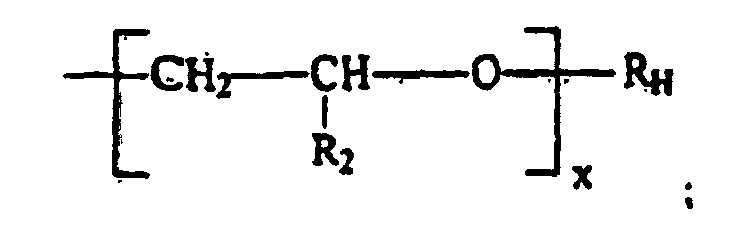 où chaque Z est indépendamment choisi dans le groupe constitué par M, R2, Rc, et RH;chaque R2 est indépendamment choisi dans le groupe constitué par H et un groupe alkyle en C1 à C4;chaque Rc est
 dans laquelle:chaque RH est indépendamment choisi dans le groupe constitué par les groupes alkyle en C5 à C20, cycloalkyle en C5 à C7, alkylaryle en C7 à C20, arylalkyle en C7 à C20, alkyle substitué, hydroxyalkyle, alkoxy-2-hydroxyalkyle en C1 à C20, alkylaryloxy-2-hydroxyalkyle en C7 à C20-(R4)2N+-alkyle, (R4)2N+-2-hydroxyalkyle, aryloxy-2-hydroxyalkyle en C6 à C12,et
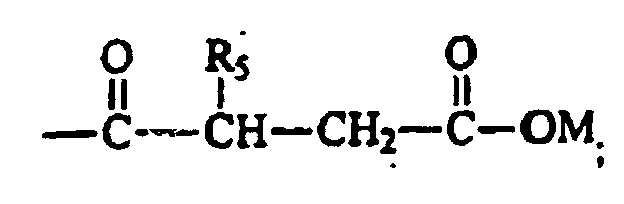 chaque R4 est indépendamment choisi dans le groupe constitué par H, les groupes alkyle en C1 à C20, cycloalkyle en C5 à C7, alkylaryle en C7 à C20, arylalkyle en C7 à C20, aminoalkyle, alkylaminoalkyle, dialkylaminoalkyle, pipéridinoalkyle, morpholinoalkyle, cycloalkylaminoalkyle et hydroxyalkyle;chaque R5 est indépendamment choisi dans le groupe constitué par H, les groupes alkyle en C1 à C20, cycloalkyle en C5 à C7, alkylaryle en C7 à C20, arylalkyle en C7 à C20, alkyle substitué, hydroxyalkyle, et (R4)2N+-alkyle;à condition que:M est un cation approprié choisi dans le groupe constitué par Na, K, 1/2Ca, et 1/2Mg;chaque x va de 0 à 5;chaque y va de 1 à 5; etle degré de substitution du groupe RH est entre 0,0005 et 0,1, plus préférablement entre 0,005 et 0,05, et le plus préférablement entre 0,01 et 0,05;le degré de substitution du groupe RC dans lequel Z est H ou M est entre 0,2 et 2,0, plus préférablement entre 0,3 et 1,0, et le plus préférablement entre 0,4 et 0,7;si n'importe quel RH porte une charge positive, elle est équilibrée par un anion approprié; et deux groupes R4 sur le même azote peuvent former ensemble une structure cyclique choisie dans le groupe constitué par la pipéridine et la morpholine.
 - Composition détergente selon l'une quelconque des revendications 1 à 2, dans laquelle les polymères, oligomères ou copolymères à base d'amine cyclique sont de formule générale:dans laquelle;
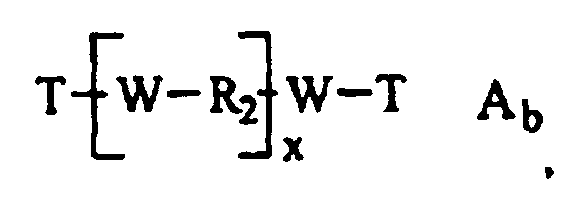
chaque T est indépendamment choisi dans le groupe constitué par H, des groupes alkyle en C1 à C 12, alkyle substitué,
alkylaryle en C7 à C12,
-(CH2)hCOOM, -(CH2)hSO3M, CH2CH(OH)SO3M, -(CH2)hOSO3M,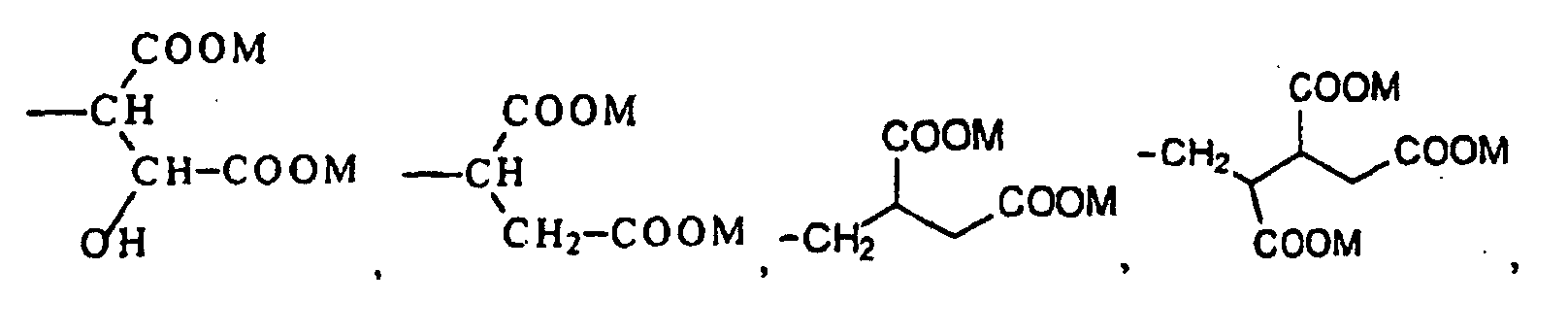 et -R2Q;
 dans laquelle W est caractérisé par au moins un constituant cyclique choisi dans le groupe constitué par:
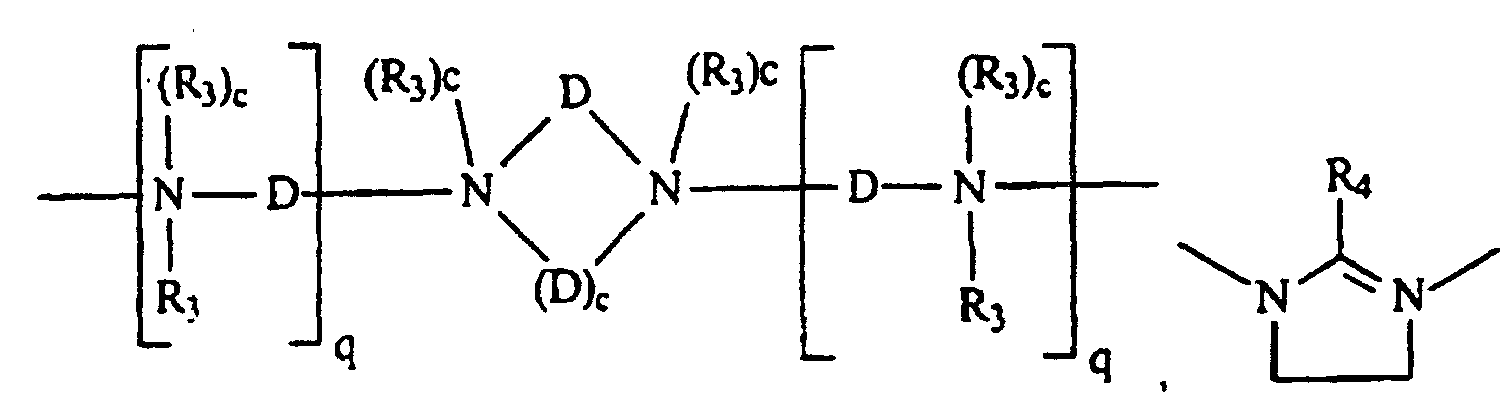 en plus d'au moins un constituant cyclique, W peut aussi comprendre un fragment aliphatique ou aliphatique substitué de structure générale;
 chaque B est indépendamment un groupe alkylène en C1 à C12, alkylène substitué en C1 à C12, alkénylène en C3 à C12, dialkylarylène en C8 à C12, dialkylarylènediyl en C8 à C12, et -(R5O)nR5-;chaque D est indépendamment un groupe alkylène en C2 à C6;chaque Q est indépendamment choisi dans le groupe constitué par des groupes hydroxy, alkoxy en C1 à C18, hydroxyalkyoxy en C2 à C18, amino, alkylamino en C1 à C18, dialkylamino, les groupes trialkylamino , les groupes hétérocycliques monoamino et les groupes diamino;chaque R1 est indépendamment choisi dans le groupe constitué par H, des groupes alkyle en C1 à C8 et hydroxyalkyle en C1 à C8;chaque R2 est indépendamment choisi dans le groupe constitué par des groupes alkylène en C1 à C12, alkénylène en C1 à C12, -CH2-CH(OR1)-CH2, alkarylène en C8 à C12, dihydroxyalkylène en C4 à C12, poly(alkylèneoxy en C2 à C4)alkylène, H2CH(OH)CH2OR2OCH2CH(OH)CH2- et les fragments hydrocarbyle en C3 à C12;
à condition que lorsque R2 est un fragment hydrocarbyle en C3 à C12, le fragment hydrocarbyle peut comprendre de 2 à 4 fragments latéraux de structure générale: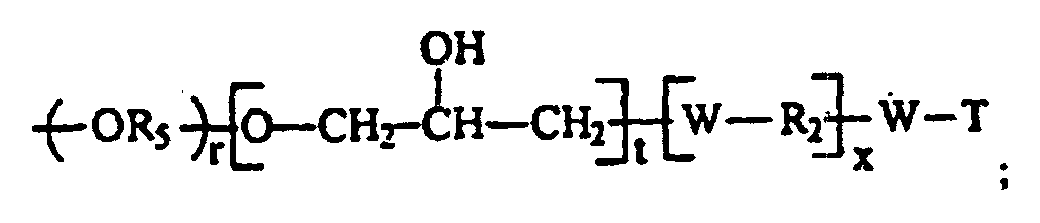 chaque R3 est indépendamment choisi dans le groupe constitué par H, O, R2, les groupes hydroxyalkyle en C1 à C20, alkyle en C1 à C20, alkyle substitué, aryle en C6 à C11, aryle substitué, alkylaryle en C7 à C11, aminoalkyle en C1 à C20,(CH2)hCOOM, -(CH2)hSO3M, CH2CH(OH)SO3M, -(CH2)hOSO3M,
 chaque R4 est indépendamment choisi dans le groupe constitué par H, des groupes alkyle en C1 à C22, hydroxyalkyle en C1 à C22, aryle et alkylaryle en C7 à C22;chaque R5 est indépendamment choisi dans le groupe constitué par des groupes alkylène en C2 à C8, alkyle en C2 à C8, alkylène substitué; etA est un anion compatible mono-, di- ou polyvalent;M est un cation compatible;b= nombre nécessaire pour équilibrer la charge;chaque x va indépendamment de 3 à 1000;chaque c est indépendamment 0 ou 1;chaque h va indépendamment de 1 à 8;chaque q va indépendamment de 0 à 6;chaque n va indépendamment de 1 à 20;chaque r va indépendamment de 0 à 20; etchaque t va indépendamment de 0 à 1.
 - Composition détergente selon la revendication 3, dans laquelle chaque R1 est H et au moins un W est choisi dans le groupe constitué par:
 et
et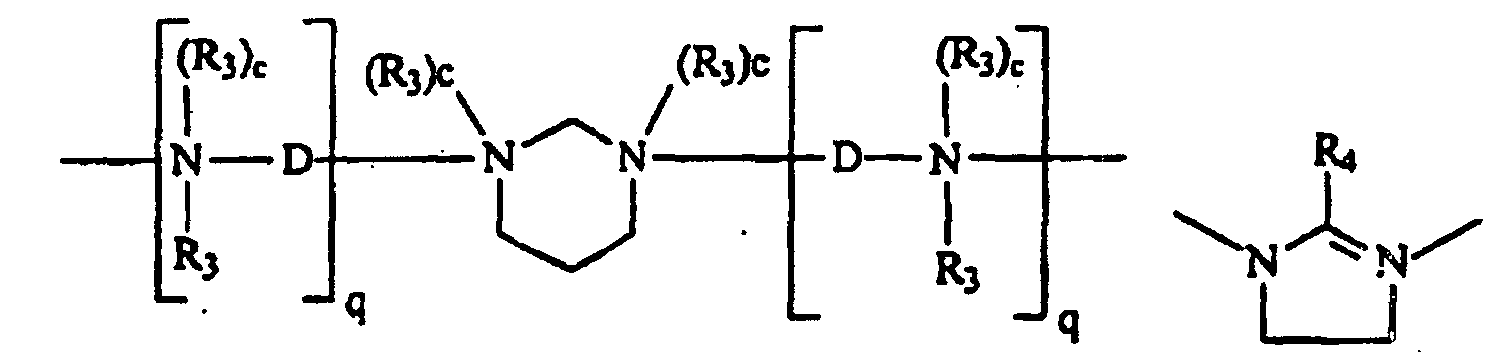

- Composition détergente selon l'une quelconque des revendications 3-4, dans laquelle chaque R1 est H et au moins un W est choisi dans le groupe constitué par:et
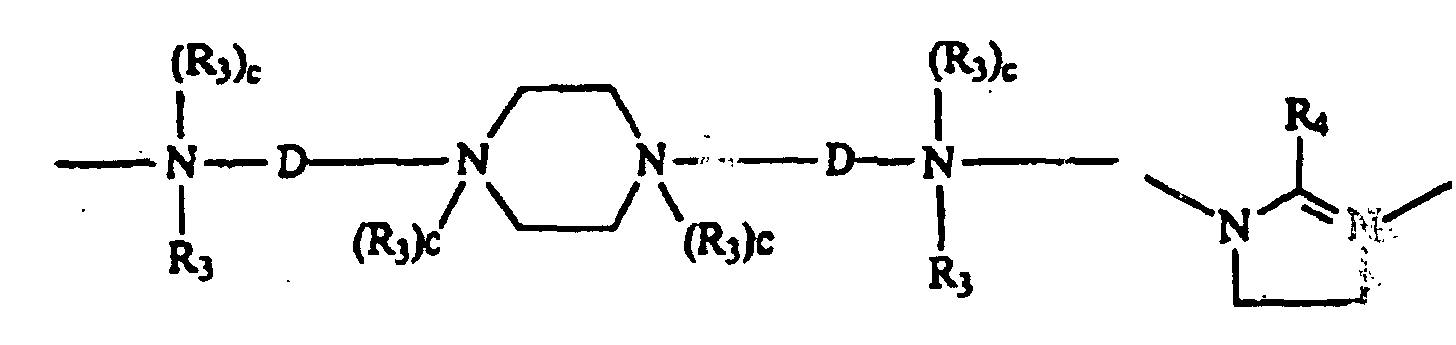
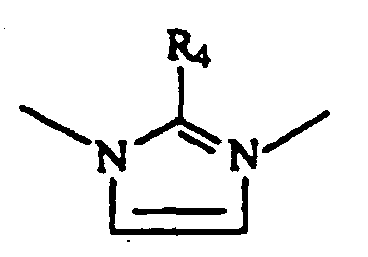
- Composition détergente selon l'une quelconque des revendications 3 à 5, dans laquelle chaque R1 est H et au moins un W est choisi dans le groupe constitué par:

- Composition détergente selon l'une quelconque des revendications 1 à 6, dans laquelle chaque RH est indépendamment choisi dans le groupe constitué par les groupes alkyle en C5 à C20, cycloalkyle en C5 à C7, alkylaryle en C7 à C20, arylalkyle en C7 à C20, alkyle substitué, hydroxyalkyle, alkoxy-2-hydroxyalkyle en C1 à C20, alkylaryloxy-2-hydroxyalkyle en C7 à C20, (R4)2N-alkyle, (R4)2N-2-hydroxyalkyle, (R4)3N-2-hydroxyalkyle, et aryloxy-2-hydroxyalkyle en C6 à C12.
- Composition additive de lavage caractérisée par:a) de 1 % à 80% en poids d'eau; etb) de 0,01 % à 5,0 %, de préférence de 0,1 % à 4,0 %, en poids d'un mélange de polymères, oligomères ou copolymères à base d'amine cyclique, et de polymères ou oligomères à base de cellulose modifiée de manière hydrophobe.
- Composition détergente selon l'une quelconque des revendications 1 à 7, dans laquelle la composition est en outre caractérisée par un composé de blanchiment péroxygène inorganique, qui est de préférence choisi dans le groupe constitué par les sels de métaux alcalins du perborate, percarbonate et de leurs mélanges, et d'un activateur de blanchiment, qui est de préférence le sulfonate de nonanolyloxybenzène.
- Composition détergente selon l'une quelconque des revendications 1 à 7, dans laquelle la composition est en outre caractérisée par une enzyme cellulase.
Applications Claiming Priority (5)
| Application Number | Priority Date | Filing Date | Title |
|---|---|---|---|
| US10397898P | 1998-10-13 | 1998-10-13 | |
| US103978P | 1998-10-13 | ||
| US14805399P | 1999-08-10 | 1999-08-10 | |
| US148053P | 1999-08-10 | ||
| PCT/US1999/023146 WO2000022078A1 (fr) | 1998-10-13 | 1999-10-06 | Compositions detergentes pour lessives comportant une combinaison d'oligomeres a base d'amines cycliques et de carboxy methyl cellulose a hydrophobie modifiee |
Publications (2)
| Publication Number | Publication Date |
|---|---|
| EP1121408A1 EP1121408A1 (fr) | 2001-08-08 |
| EP1121408B1 true EP1121408B1 (fr) | 2005-02-23 |
Family
ID=26801057
Family Applications (1)
| Application Number | Title | Priority Date | Filing Date |
|---|---|---|---|
| EP99954739A Expired - Lifetime EP1121408B1 (fr) | 1998-10-13 | 1999-10-06 | Compositions detergentes pour lessives comportant une combinaison d'oligomeres a base d'amines cycliques et de cellulose a hydrophobie modifiee |
Country Status (11)
| Country | Link |
|---|---|
| EP (1) | EP1121408B1 (fr) |
| JP (1) | JP2002527576A (fr) |
| CN (1) | CN1163576C (fr) |
| AR (1) | AR020794A1 (fr) |
| AT (1) | ATE289627T1 (fr) |
| AU (1) | AU1101700A (fr) |
| BR (1) | BR9914520B1 (fr) |
| CA (1) | CA2346293C (fr) |
| DE (1) | DE69923855T2 (fr) |
| ES (1) | ES2238854T3 (fr) |
| WO (1) | WO2000022078A1 (fr) |
Families Citing this family (10)
| Publication number | Priority date | Publication date | Assignee | Title |
|---|---|---|---|---|
| US6833347B1 (en) | 1997-12-23 | 2004-12-21 | The Proctor & Gamble Company | Laundry detergent compositions with cellulosic polymers to provide appearance and integrity benefits to fabrics laundered therewith |
| US6835707B1 (en) * | 1998-10-13 | 2004-12-28 | The Procter & Gamble Company | Laundry detergent compositions with a combination of cyclic amine based polymers and hydrophobically modified carboxy methyl cellulose |
| EP1141194B1 (fr) | 1999-01-13 | 2007-12-26 | The Procter & Gamble Company | Compositions detergentes contenant un polymere de cellulose |
| US6803355B1 (en) | 1999-02-10 | 2004-10-12 | The Procter & Gamble Company | Laundry detergent compositions with fabric enhancing component |
| AU3360200A (en) * | 1999-02-10 | 2000-08-29 | Procter & Gamble Company, The | Laundry detergent compositions with fabric enhancing component |
| CN101189323B (zh) * | 2005-05-31 | 2011-09-21 | 宝洁公司 | 洗涤剂组合物 |
| EP1888734A2 (fr) * | 2005-05-31 | 2008-02-20 | The Procter and Gamble Company | Compositions detergentes renfermant un polymere et leur utilisation |
| CN106478948B (zh) * | 2010-02-24 | 2019-05-07 | 瑞立普萨公司 | 用作胆汁酸螯合剂的聚咪唑 |
| BR112013029567B1 (pt) * | 2011-05-20 | 2021-03-30 | Dow Global Technologies Llc | Mistura para promover desprendimento de sujeira de pano, método para promover desprendimento de sujeira de pano sujo e formulação de detergente para lavagem de roupa |
| WO2019111937A1 (fr) * | 2017-12-06 | 2019-06-13 | 花王株式会社 | Composition détergente pour produit textile |
Family Cites Families (3)
| Publication number | Priority date | Publication date | Assignee | Title |
|---|---|---|---|---|
| DE19643281A1 (de) * | 1996-10-21 | 1998-04-23 | Basf Ag | Verwendung von polykationischen Kondensationsprodukten als farbfixierenden Zusatz zu Waschmitteln und Wäschenachbehandlungsmitteln |
| JP4267075B2 (ja) * | 1996-12-26 | 2009-05-27 | ザ、プロクター、エンド、ギャンブル、カンパニー | 外観および完全性の利益をそれで洗濯された布帛に与えるためにセルロース系重合体を有する洗濯洗剤組成物 |
| CN1289649C (zh) * | 1997-09-15 | 2006-12-13 | 普罗格特-甘布尔公司 | 具有提供所洗织物外观和整体性益处的基于环胺聚合物的洗衣用洗涤剂组合物 |
-
1999
- 1999-10-06 AU AU11017/00A patent/AU1101700A/en not_active Abandoned
- 1999-10-06 JP JP2000575972A patent/JP2002527576A/ja active Pending
- 1999-10-06 WO PCT/US1999/023146 patent/WO2000022078A1/fr not_active Ceased
- 1999-10-06 CA CA002346293A patent/CA2346293C/fr not_active Expired - Fee Related
- 1999-10-06 ES ES99954739T patent/ES2238854T3/es not_active Expired - Lifetime
- 1999-10-06 BR BRPI9914520-0A patent/BR9914520B1/pt not_active IP Right Cessation
- 1999-10-06 AT AT99954739T patent/ATE289627T1/de not_active IP Right Cessation
- 1999-10-06 EP EP99954739A patent/EP1121408B1/fr not_active Expired - Lifetime
- 1999-10-06 CN CNB998143030A patent/CN1163576C/zh not_active Expired - Fee Related
- 1999-10-06 DE DE69923855T patent/DE69923855T2/de not_active Expired - Lifetime
- 1999-10-13 AR ARP990105171A patent/AR020794A1/es active IP Right Grant
Also Published As
| Publication number | Publication date |
|---|---|
| BR9914520A (pt) | 2001-06-26 |
| JP2002527576A (ja) | 2002-08-27 |
| CA2346293C (fr) | 2009-01-06 |
| DE69923855T2 (de) | 2005-12-29 |
| WO2000022078A1 (fr) | 2000-04-20 |
| CN1330704A (zh) | 2002-01-09 |
| CN1163576C (zh) | 2004-08-25 |
| DE69923855D1 (de) | 2005-03-31 |
| BR9914520B1 (pt) | 2008-11-18 |
| AR020794A1 (es) | 2002-05-29 |
| CA2346293A1 (fr) | 2000-04-20 |
| ATE289627T1 (de) | 2005-03-15 |
| ES2238854T3 (es) | 2005-09-01 |
| EP1121408A1 (fr) | 2001-08-08 |
| AU1101700A (en) | 2000-05-01 |
Similar Documents
| Publication | Publication Date | Title |
|---|---|---|
| USRE39557E1 (en) | Laundry detergent compositions with cellulosic based polymers to provide appearance and integrity benefits to fabrics laundered therewith | |
| EP1015543B1 (fr) | Compositions de detergent a lessive comportant des polymeres d'amines cycliques, qui conferent un aspect et une integrite avantageux aux tissus laves a l'aide de celles-ci | |
| CA2365303C (fr) | Compositions de detergent a lessive contenant certains polymeres charges cationiquement d'entretien des tissus | |
| US6369024B1 (en) | Laundry detergent compositions with linear amine based polymers to provide appearance and integrity benefits to fabrics laundered therewith | |
| US6833347B1 (en) | Laundry detergent compositions with cellulosic polymers to provide appearance and integrity benefits to fabrics laundered therewith | |
| EP0960186A2 (fr) | Compositions de detergent de lessive contenant des polyamide-polyamines pour conferer des qualites esthetiques a des tissus laves avec lesdites compositions | |
| US6384011B1 (en) | Laundry detergent compositions with cellulosic based polymers to provide appearance and integrity benefits to fabrics laundered therewith | |
| CA2346293C (fr) | Compositions detergentes pour lessives comportant une combinaison d'oligomeres a base d'amines cycliques et de carboxy methyl cellulose a hydrophobie modifiee | |
| US6733538B1 (en) | Laundry detergent compositions with certain cationically charged dye maintenance polymers | |
| US6251846B1 (en) | Laundry detergent compositions with cyclic amine based polymers to provide appearance and integrity benefits to fabrics laundered therewith | |
| US6228828B1 (en) | Laundry detergent compositions with anionically modified, cyclic amine based polymers | |
| US6803355B1 (en) | Laundry detergent compositions with fabric enhancing component | |
| WO2001059054A1 (fr) | Compositions de detergents a lessive possedant une combinaison d'un polymere d'amine cyclique et d'un inhibiteur de transfert de couleurs | |
| US6835707B1 (en) | Laundry detergent compositions with a combination of cyclic amine based polymers and hydrophobically modified carboxy methyl cellulose | |
| CA2359808A1 (fr) | Compositions de detergent a lessive avec un constituant preservant l'apparence des tissus | |
| MXPA00002646A (en) | Laundry detergent compositions with cellulosic based polymers to provide appearance and integrity benefits to fabrics laundered therewith |
Legal Events
| Date | Code | Title | Description |
|---|---|---|---|
| PUAI | Public reference made under article 153(3) epc to a published international application that has entered the european phase |
Free format text: ORIGINAL CODE: 0009012 |
|
| 17P | Request for examination filed |
Effective date: 20010427 |
|
| AK | Designated contracting states |
Kind code of ref document: A1 Designated state(s): AT BE CH CY DE DK ES FI FR GB GR IE IT LI LU MC NL |
|
| AX | Request for extension of the european patent |
Free format text: AL;LT;LV;MK;RO;SI |
|
| 17Q | First examination report despatched |
Effective date: 20030617 |
|
| GRAP | Despatch of communication of intention to grant a patent |
Free format text: ORIGINAL CODE: EPIDOSNIGR1 |
|
| RTI1 | Title (correction) |
Free format text: LAUNDRY DETERGENT COMPOSITIONS WITH A COMBINATION OF CYCLIC AMINE BASED COPOLYMERS AND HYDROPHOBICALLY MODIFIED CELLULOS |
|
| GRAS | Grant fee paid |
Free format text: ORIGINAL CODE: EPIDOSNIGR3 |
|
| GRAA | (expected) grant |
Free format text: ORIGINAL CODE: 0009210 |
|
| AK | Designated contracting states |
Kind code of ref document: B1 Designated state(s): AT BE CH CY DE DK ES FI FR GB GR IE IT LI LU NL PT SE |
|
| PG25 | Lapsed in a contracting state [announced via postgrant information from national office to epo] |
Ref country code: LI Free format text: LAPSE BECAUSE OF FAILURE TO SUBMIT A TRANSLATION OF THE DESCRIPTION OR TO PAY THE FEE WITHIN THE PRESCRIBED TIME-LIMIT Effective date: 20050223 Ref country code: FI Free format text: LAPSE BECAUSE OF FAILURE TO SUBMIT A TRANSLATION OF THE DESCRIPTION OR TO PAY THE FEE WITHIN THE PRESCRIBED TIME-LIMIT Effective date: 20050223 Ref country code: CH Free format text: LAPSE BECAUSE OF FAILURE TO SUBMIT A TRANSLATION OF THE DESCRIPTION OR TO PAY THE FEE WITHIN THE PRESCRIBED TIME-LIMIT Effective date: 20050223 Ref country code: BE Free format text: LAPSE BECAUSE OF FAILURE TO SUBMIT A TRANSLATION OF THE DESCRIPTION OR TO PAY THE FEE WITHIN THE PRESCRIBED TIME-LIMIT Effective date: 20050223 Ref country code: AT Free format text: LAPSE BECAUSE OF FAILURE TO SUBMIT A TRANSLATION OF THE DESCRIPTION OR TO PAY THE FEE WITHIN THE PRESCRIBED TIME-LIMIT Effective date: 20050223 |
|
| RBV | Designated contracting states (corrected) |
Designated state(s): AT BE CH CY DE DK ES FI FR GB GR IE IT LI LU NL PT SE |
|
| REG | Reference to a national code |
Ref country code: GB Ref legal event code: FG4D |
|
| REG | Reference to a national code |
Ref country code: CH Ref legal event code: EP |
|
| REG | Reference to a national code |
Ref country code: IE Ref legal event code: FG4D |
|
| REF | Corresponds to: |
Ref document number: 69923855 Country of ref document: DE Date of ref document: 20050331 Kind code of ref document: P |
|
| PG25 | Lapsed in a contracting state [announced via postgrant information from national office to epo] |
Ref country code: SE Free format text: LAPSE BECAUSE OF FAILURE TO SUBMIT A TRANSLATION OF THE DESCRIPTION OR TO PAY THE FEE WITHIN THE PRESCRIBED TIME-LIMIT Effective date: 20050523 Ref country code: GR Free format text: LAPSE BECAUSE OF FAILURE TO SUBMIT A TRANSLATION OF THE DESCRIPTION OR TO PAY THE FEE WITHIN THE PRESCRIBED TIME-LIMIT Effective date: 20050523 Ref country code: DK Free format text: LAPSE BECAUSE OF FAILURE TO SUBMIT A TRANSLATION OF THE DESCRIPTION OR TO PAY THE FEE WITHIN THE PRESCRIBED TIME-LIMIT Effective date: 20050523 |
|
| PG25 | Lapsed in a contracting state [announced via postgrant information from national office to epo] |
Ref country code: PT Free format text: LAPSE BECAUSE OF FAILURE TO SUBMIT A TRANSLATION OF THE DESCRIPTION OR TO PAY THE FEE WITHIN THE PRESCRIBED TIME-LIMIT Effective date: 20050816 |
|
| REG | Reference to a national code |
Ref country code: CH Ref legal event code: PL |
|
| REG | Reference to a national code |
Ref country code: ES Ref legal event code: FG2A Ref document number: 2238854 Country of ref document: ES Kind code of ref document: T3 |
|
| PG25 | Lapsed in a contracting state [announced via postgrant information from national office to epo] |
Ref country code: IE Free format text: LAPSE BECAUSE OF NON-PAYMENT OF DUE FEES Effective date: 20051006 Ref country code: CY Free format text: LAPSE BECAUSE OF FAILURE TO SUBMIT A TRANSLATION OF THE DESCRIPTION OR TO PAY THE FEE WITHIN THE PRESCRIBED TIME-LIMIT Effective date: 20051006 |
|
| PG25 | Lapsed in a contracting state [announced via postgrant information from national office to epo] |
Ref country code: LU Free format text: LAPSE BECAUSE OF NON-PAYMENT OF DUE FEES Effective date: 20051031 |
|
| PLBE | No opposition filed within time limit |
Free format text: ORIGINAL CODE: 0009261 |
|
| STAA | Information on the status of an ep patent application or granted ep patent |
Free format text: STATUS: NO OPPOSITION FILED WITHIN TIME LIMIT |
|
| 26N | No opposition filed |
Effective date: 20051124 |
|
| ET | Fr: translation filed | ||
| REG | Reference to a national code |
Ref country code: IE Ref legal event code: MM4A |
|
| PGFP | Annual fee paid to national office [announced via postgrant information from national office to epo] |
Ref country code: NL Payment date: 20080915 Year of fee payment: 10 |
|
| PGFP | Annual fee paid to national office [announced via postgrant information from national office to epo] |
Ref country code: ES Payment date: 20081023 Year of fee payment: 10 |
|
| PGFP | Annual fee paid to national office [announced via postgrant information from national office to epo] |
Ref country code: IT Payment date: 20081018 Year of fee payment: 10 |
|
| REG | Reference to a national code |
Ref country code: NL Ref legal event code: V1 Effective date: 20100501 |
|
| PG25 | Lapsed in a contracting state [announced via postgrant information from national office to epo] |
Ref country code: NL Free format text: LAPSE BECAUSE OF NON-PAYMENT OF DUE FEES Effective date: 20100501 |
|
| REG | Reference to a national code |
Ref country code: ES Ref legal event code: FD2A Effective date: 20110309 |
|
| PG25 | Lapsed in a contracting state [announced via postgrant information from national office to epo] |
Ref country code: IT Free format text: LAPSE BECAUSE OF NON-PAYMENT OF DUE FEES Effective date: 20091006 |
|
| PG25 | Lapsed in a contracting state [announced via postgrant information from national office to epo] |
Ref country code: ES Free format text: LAPSE BECAUSE OF NON-PAYMENT OF DUE FEES Effective date: 20110308 |
|
| PG25 | Lapsed in a contracting state [announced via postgrant information from national office to epo] |
Ref country code: ES Free format text: LAPSE BECAUSE OF NON-PAYMENT OF DUE FEES Effective date: 20091007 |
|
| PGFP | Annual fee paid to national office [announced via postgrant information from national office to epo] |
Ref country code: FR Payment date: 20111005 Year of fee payment: 13 |
|
| REG | Reference to a national code |
Ref country code: FR Ref legal event code: ST Effective date: 20130628 |
|
| PG25 | Lapsed in a contracting state [announced via postgrant information from national office to epo] |
Ref country code: FR Free format text: LAPSE BECAUSE OF NON-PAYMENT OF DUE FEES Effective date: 20121031 |
|
| PGFP | Annual fee paid to national office [announced via postgrant information from national office to epo] |
Ref country code: GB Payment date: 20140925 Year of fee payment: 16 |
|
| PGFP | Annual fee paid to national office [announced via postgrant information from national office to epo] |
Ref country code: DE Payment date: 20141028 Year of fee payment: 16 |
|
| REG | Reference to a national code |
Ref country code: DE Ref legal event code: R119 Ref document number: 69923855 Country of ref document: DE |
|
| GBPC | Gb: european patent ceased through non-payment of renewal fee |
Effective date: 20151006 |
|
| PG25 | Lapsed in a contracting state [announced via postgrant information from national office to epo] |
Ref country code: GB Free format text: LAPSE BECAUSE OF NON-PAYMENT OF DUE FEES Effective date: 20151006 Ref country code: DE Free format text: LAPSE BECAUSE OF NON-PAYMENT OF DUE FEES Effective date: 20160503 |