EP1121773B1 - Systeme radiotelephonique mobile et station mobile fonctionnant en mode duplex et en mode semi-duplex - Google Patents
Systeme radiotelephonique mobile et station mobile fonctionnant en mode duplex et en mode semi-duplex Download PDFInfo
- Publication number
- EP1121773B1 EP1121773B1 EP99970808A EP99970808A EP1121773B1 EP 1121773 B1 EP1121773 B1 EP 1121773B1 EP 99970808 A EP99970808 A EP 99970808A EP 99970808 A EP99970808 A EP 99970808A EP 1121773 B1 EP1121773 B1 EP 1121773B1
- Authority
- EP
- European Patent Office
- Prior art keywords
- mobile station
- duplex mode
- mobile
- semi
- duplex
- Prior art date
- Legal status (The legal status is an assumption and is not a legal conclusion. Google has not performed a legal analysis and makes no representation as to the accuracy of the status listed.)
- Expired - Lifetime
Links
- 230000005540 biological transmission Effects 0.000 claims description 20
- 230000008054 signal transmission Effects 0.000 claims description 7
- 238000004519 manufacturing process Methods 0.000 description 2
- 238000000034 method Methods 0.000 description 2
- 230000001413 cellular effect Effects 0.000 description 1
- 230000008878 coupling Effects 0.000 description 1
- 238000010168 coupling process Methods 0.000 description 1
- 238000005859 coupling reaction Methods 0.000 description 1
- 230000001360 synchronised effect Effects 0.000 description 1
Images


Classifications
-
- H—ELECTRICITY
- H04—ELECTRIC COMMUNICATION TECHNIQUE
- H04B—TRANSMISSION
- H04B7/00—Radio transmission systems, i.e. using radiation field
- H04B7/24—Radio transmission systems, i.e. using radiation field for communication between two or more posts
- H04B7/26—Radio transmission systems, i.e. using radiation field for communication between two or more posts at least one of which is mobile
- H04B7/2615—Radio transmission systems, i.e. using radiation field for communication between two or more posts at least one of which is mobile using hybrid frequency-time division multiple access [FDMA-TDMA]
-
- H—ELECTRICITY
- H04—ELECTRIC COMMUNICATION TECHNIQUE
- H04B—TRANSMISSION
- H04B7/00—Radio transmission systems, i.e. using radiation field
- H04B7/24—Radio transmission systems, i.e. using radiation field for communication between two or more posts
- H04B7/26—Radio transmission systems, i.e. using radiation field for communication between two or more posts at least one of which is mobile
-
- H—ELECTRICITY
- H04—ELECTRIC COMMUNICATION TECHNIQUE
- H04B—TRANSMISSION
- H04B7/00—Radio transmission systems, i.e. using radiation field
- H04B7/24—Radio transmission systems, i.e. using radiation field for communication between two or more posts
- H04B7/26—Radio transmission systems, i.e. using radiation field for communication between two or more posts at least one of which is mobile
- H04B7/2603—Arrangements for wireless physical layer control
- H04B7/2606—Arrangements for base station coverage control, e.g. by using relays in tunnels
Definitions
- the present invention relates to a mobile radio system and a mobile station which is used to carry out a Send / receive operation in duplex and semi-duplex operation are suitable.
- each mobile station have a direct connection to a base station got to.
- the signal transmission between two mobile stations does not take place directly from one mobile station to another, but depending on the location of the mobile stations via one or more base stations.
- Has a the mobile stations have no connection to a base station cannot connect to another mobile station become.
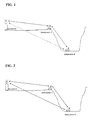
- Fig. 4 shows such a situation. 4, the mobile station A can establish a connection to the base station, but not the mobile station B as it is out of range of the base station lies (e.g. in a valley or a bridge).
- a Connection between mobile stations A and B not established even if, for example, a line of sight between them.
- a dual-mode mobile station is known from WO 98/10483 A, which contains a GSM and a DECT transceiver part.
- the object of the present invention is therefore a mobile radio system and to create a mobile station which besides a transmit / receive operation in duplex operation to one Send / receive operation in non-duplex mode are suitable.
- a mobile radio system with a plurality of mobile stations created, in which the mobile stations means for performing a send / receive operation in duplex mode and have in semi-duplex mode.
- the mobile stations are thus suitable for communication with one or several mobile stations in duplex and / or semi-duplex mode manufacture.
- a first mobile station means for carrying out a Transmitting / receiving mode with a base station in duplex mode and a second mobile station in semiduplex mode, whereby simultaneous communication from the first mobile station in duplex mode to the base station and to one second mobile station in semi-duplex mode can, even if the second mobile station is not connected the base station has.
- means for carrying out a Send / receive operation with the base station in duplex mode and the second mobile station in semiduplex mode are provided in such a way that the transmit / receive operation cyclically in time slots is performed and the time slots for the duplex and the semiduplex operation run synchronously to each other.
- the first mobile station is provided with means for implementation a transmit / receive operation with the base station in the Duplex operation and the second mobile station in semi-duplex operation such that signals from the base station through the first Mobile station to the second mobile station and vice versa communication between the base station and second mobile station with the interposition of the first Mobile station can also be manufactured as a "repeater” if the second mobile station has no direct connection to the base station has.
- the first contains Mobile station means for carrying out a Transmitting / receiving operation with the second and a third mobile station in semi-duplex mode, whereby a simultaneous Communication from the first mobile station to the second and third mobile station in semiduplex mode without connection to a base station can be manufactured directly.
- the first mobile station is provided with means for implementation a transmission / reception mode with the second and third mobile station in semiduplex mode such that signals from the second mobile station to the one mobile station the third mobile station and vice versa, can communication between the second and third mobile station with the interposition of a mobile station as "Repeaters" can also be produced when the second and third mobile station no connection to a base station to have.
- the first mobile station is not to burden uncontrollably with means for manual or automatic entry and exit Turn off the transmission of signals from the second mobile station via the first mobile station to the base station or to the third mobile station and vice versa.
- the function of the first mobile station as a "repeater” or be deactivated.
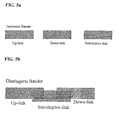
- an additional tape is used Semiduplex band required.
- FIG. 5a such a Band in a different frequency range or equivalent Fig. 5b superimposed with the uplink and downlink frequencies be arranged.
- Fig. 6 shows a transmission / reception process within a Send / receive cycle, which is divided into eight time slots (0 to 7) is divided.
- the semi-duplex band (see FIG. 6a) enables that sent and received on the same frequency can be sent, each in different time slots and is received.
- Reference symbol RXs denotes the reception and TXs the transmission of signals in the semiduplex band.
- the time slots of the semiduplex band are with the time slots the duplex band (see FIG. 6b) as in the GSM system synchronized, but they can differ in the type of broadcast as well as differ in length.
- Reference symbol RX denotes the reception and TX the transmission of signals in the duplex band.
- a mobile station A communicates with the Base station in duplex mode.
- the mobile station A with the mobile station B communication in semiduplex mode produce.
- Between the mobile station B and the Base station is not connected. It is therefore possible that the mobile station A simultaneously with the base station and the mobile station B communicates
- FIG. 2 shows a case in which the mobile station A is used as a "repeater".
- the mobile station A carries out an implementation of the information transmission in semi-duplex operation in an information transmission in duplex operation and vice versa, so that a Communication between the base station and the mobile station B is produced. That Data is from the mobile station B transmitted in the semi-duplex mode of the mobile station A, in the Mobile station A processed and in duplex mode of the base station forwarded or in the opposite direction from the base station transmitted in duplex mode of mobile station A, in the mobile station A is processed and in semiduplex mode Mobile station B forwarded.
- the mobile station A simultaneously with the mobile station B and the mobile station C communicates in semi-duplex mode or as "Repeater” information in semi-duplex mode from the mobile station B receives and semi-duplexes them Mobile station C forwards (or vice versa).
- a direct one Coupling between mobile stations B and C would not be possible since the mobile station B with respect to the mobile station C located in a shaded area (valley).
- a chain consisting of one is also possible larger number of mobile stations.
- the mobile stations have a control device which between an operation with one or two further stations or choose a company as a "repeater”.
- the control device can, if necessary, operate automatically as a "repeater” choose.
- To the voltage supply device one However, not to burden the mobile station in an uncontrolled manner block operation as a "repeater”.
- the advantage of the mobile radio system of the present invention at which mobile stations are operated as "repeaters” , as described above, is that mobile stations, which is not directly connected to shadowing a base station have a communication to other mobile stations or to the base station.
- a mobile station is also can be operated from an airplane.
- the mobile radio system of the present invention be self-organizing. It can be done through novel Transmission processes like JD-CMDA have very high transmission capacities provide. With such a combination system it is possible to almost all occurring radio and Cellular requirements with limited range and where appropriate work at high traffic densities, integrate: Wireless LAN, DSSR digital short range radio, LPD low power devices, TETRA trunked radio and BOS, train radio, cordless phones, Mobile phones, aviation radio, maritime radio, emergency call systems as well as cordless buses (for control functions)
- FDD Frequency Division Duplex Frequency Division Duplex
- semi-duplex operation a time division duplex operation.
- FDD Frequency Division Duplex
- UTRA Universal Mobile Telephony System
- -FDD mode for the uplink (mobile station to base station)
- other Frequency bands can be provided as for the downlink (Base station to mobile station)
- TDD time division Duplex
- DECT Digital Enhanced Cordless Telecommunications
- UTA Universal Mobile Telephony System
- UTDD mode different time periods for the uplink or downlink be provided.
Landscapes
- Engineering & Computer Science (AREA)
- Computer Networks & Wireless Communication (AREA)
- Signal Processing (AREA)
- Mobile Radio Communication Systems (AREA)
Claims (15)
- Système radiotéléphonique mobile ayant une pluralité de stations mobiles (A, B, C)
les stations mobiles présentant des moyens pour la réalisation d'un mode d'émission/réception en mode duplex et en mode semi-duplex,
caractérisé en ce que
une première station mobile (A) présente des moyens pour la réalisation simultanée d'un mode d'émission/réception avec une station de base en mode duplex et avec une deuxième station mobile (B) en mode semi-duplex, et
en ce que le mode duplex est réalisé comme mode duplex de fréquence et le mode semi-duplex comme mode duplex dans le temps. - Système radiotéléphonique mobile selon la revendication 1,
caractérisé en ce que la première station mobile (A) présente des moyens pour la réalisation d'un mode d'émission/réception avec la station de base en mode duplex et avec la deuxième station mobile (B) en mode semi-duplex, de telle manière que le mode d'émission/réception est réalisé de manière cyclique en créneaux temporels et que les créneaux temporels se déroulent de manière synchrone les uns par rapport aux autres pour le mode duplex et le mode semi-duplex. - Système radiotéléphonique mobile selon l'une quelconque des revendications précédentes,
caractérisé en ce que la première station mobile (A) présente des moyens pour la réalisation d'un mode d'émission/réception avec la station de base en mode duplex et avec la deuxième station mobile (B) en mode semi-duplex, de telle manière que les signaux sont transmis de la deuxième station mobile vers la station de base par l'intermédiaire de la première station mobile, et vice versa. - Système radiotéléphonique mobile selon l'une quelconque des revendications précédentes,
caractérisé en ce que la première station mobile (A) présente des moyens pour la réalisation d'un mode d'émission/réception avec la deuxième station mobile (B) et une troisième station mobile (C) en mode semi-duplex. - Système radiotéléphonique mobile selon l'une quelconque des revendications précédentes,
caractérisé en ce que la première station mobile (A) présente des moyens pour la réalisation d'un mode d'émission/réception avec la deuxième station mobile (B) et la troisième station mobile (C) en mode semi-duplex, de telle manière que les signaux sont transmis de la deuxième station mobile à la troisième station mobile par l'intermédiaire de la première station mobile, et vice versa. - Système radiotéléphonique mobile selon l'une quelconque des revendications précédentes,
caractérisé en ce que les stations mobiles présentes en nombre multiple sont couplées entre elles de telle manière qu'une chaíne de communication ou qu'un réseau de communication est formé. - Système radiotéléphonique mobile selon l'une quelconque des revendications précédentes,
caractérisé en ce que la première station mobile (A) présente des moyens pour la mise en circuit et la mise hors circuit manuelles ou automatiques de la transmission de signaux de la deuxième station mobile (B) à la station de base ou à la troisième station mobile (C) par l'intermédiaire de la première station mobile (A), et vice versa. - Station mobile (A)
munie de moyens pour la réalisation simultanée d'un mode d'émission/réception avec une station de base en mode duplex et avec une deuxième station mobile (B) en mode semi-duplex,
le mode duplex étant réalisé comme mode duplex de fréquence et le mode semi-duplex comme mode duplex dans le temps. - Station mobile (A) selon la revendication 8,
munie de moyens pour la réalisation d'un mode d'émission/réception avec la station de base en mode duplex et avec la deuxième station mobile (B) en mode semi-duplex, de telle manière que le mode d'émission/réception est réalisé de manière cyclique en créneaux temporels et que les créneaux temporels se déroulent de manière synchrone les uns par rapport aux autres pour le mode duplex et le mode semi-duplex. - Station mobile (A) selon l'une quelconque des revendications 8 à 9,
munie de moyens pour la réalisation d'un mode d'émission/réception avec la station de base en mode duplex et avec la deuxième station mobile (B) en mode semi-duplex, de telle manière que les signaux sont transmis de la deuxième station mobile à la station de base par l'intermédiaire de la première station mobile, et vice versa. - Station mobile (A) selon l'une quelconque des revendications 8 à 10,
munie de moyens pour la réalisation d'un mode d'émission/réception avec la deuxième station mobile (B) et une troisième station mobile (C) en mode semi-duplex. - Station mobile (A) selon l'une quelconque des revendications 8 à 11,
munie de moyens pour la réalisation d'un mode d'émission/réception avec la deuxième station mobile (B) et la troisième station mobile (C) en mode semi-duplex, de telle manière que les signaux sont transmis de la deuxième station mobile à la troisième station mobile par l'intermédiaire de la première station mobile, et vice versa. - Station mobile (A) selon l'une quelconque des revendications 8 à 12,
munie de moyens pour la mise en circuit et la mise hors circuit manuelles ou automatiques de la transmission de signaux de la deuxième station mobile (B) à la station de base ou à la troisième station mobile (C) par l'intermédiaire de la première station mobile (A), et vice versa. - Station mobile (A) selon l'une quelconque des revendications 9 à 13,
munie de moyens pour la réalisation d'un mode d'émission/réception avec la deuxième station mobile (B) et la troisième station mobile (C) en mode semi-duplex, de telle manière que les signaux sont transmis de la deuxième station mobile à la troisième station mobile par l'intermédiaire de la première station mobile, et vice versa. - Station mobile (A) selon l'une quelconque des revendications 9 à 14,
munie de moyens pour la mise en circuit et la mise hors circuit manuelles ou automatiques de la transmission de signaux de la deuxième station mobile (B) à la station de base ou à la troisième station mobile (C) par l'intermédiaire de la première station mobile (A), et vice versa.
Applications Claiming Priority (3)
| Application Number | Priority Date | Filing Date | Title |
|---|---|---|---|
| DE19847661 | 1998-10-15 | ||
| DE19847661 | 1998-10-15 | ||
| PCT/DE1999/003166 WO2000024141A2 (fr) | 1998-10-15 | 1999-10-01 | Systeme radiotelephonique mobile et station mobile fonctionnant en mode duplex et en mode semi-duplex |
Publications (2)
| Publication Number | Publication Date |
|---|---|
| EP1121773A2 EP1121773A2 (fr) | 2001-08-08 |
| EP1121773B1 true EP1121773B1 (fr) | 2004-09-22 |
Family
ID=7884633
Family Applications (1)
| Application Number | Title | Priority Date | Filing Date |
|---|---|---|---|
| EP99970808A Expired - Lifetime EP1121773B1 (fr) | 1998-10-15 | 1999-10-01 | Systeme radiotelephonique mobile et station mobile fonctionnant en mode duplex et en mode semi-duplex |
Country Status (7)
| Country | Link |
|---|---|
| EP (1) | EP1121773B1 (fr) |
| JP (1) | JP2002528953A (fr) |
| KR (1) | KR20010082230A (fr) |
| CN (1) | CN1153381C (fr) |
| AU (1) | AU1373700A (fr) |
| DE (1) | DE59910598D1 (fr) |
| WO (1) | WO2000024141A2 (fr) |
Families Citing this family (8)
| Publication number | Priority date | Publication date | Assignee | Title |
|---|---|---|---|---|
| JP3936834B2 (ja) * | 2000-09-11 | 2007-06-27 | 株式会社日立製作所 | 加入者系無線アクセスシステム及びそれに用いる装置 |
| US6965773B2 (en) * | 2001-04-05 | 2005-11-15 | International Business Machines Corporation | Virtual cooperative network formed by local clients in zones without cellular services |
| US7583619B2 (en) | 2002-12-16 | 2009-09-01 | Nortel Networks Limited | Wireless access communications network |
| CN100517985C (zh) * | 2002-12-20 | 2009-07-22 | 株式会社瑞萨科技 | 发送电路和使用了该电路的收发机 |
| DE102004008711A1 (de) * | 2004-02-23 | 2005-09-29 | Vodafone Holding Gmbh | Verfahren zur Herstellung einer Kommunikationsverbindung in einem Kommunikationsnetz |
| DE102005010826A1 (de) * | 2005-03-07 | 2006-09-21 | Vodafone Holding Gmbh | Mobilfunksystem für Kommunikationsanwendungen |
| DE102008007497B4 (de) * | 2008-02-05 | 2011-05-26 | Fraunhofer-Gesellschaft zur Förderung der angewandten Forschung e.V. | Verfahren und Vorrichtung zur Datenübertragung |
| CN109683179A (zh) * | 2019-01-18 | 2019-04-26 | 北京未来导航科技有限公司 | 基于低轨卫星导航增强平台的同频带收发方法及系统 |
Family Cites Families (3)
| Publication number | Priority date | Publication date | Assignee | Title |
|---|---|---|---|---|
| EP0689303A1 (fr) * | 1994-05-25 | 1995-12-27 | Alcatel Bell-Sdt S.A. | Système de communication mobile TDMA avec communication simultanée entre base et mobiles à une première fréquence et entre mobiles à une seconde |
| US5481539A (en) * | 1994-06-29 | 1996-01-02 | General Electric Company | Datagram communication service over a cellular telephone network |
| GB2291564B (en) * | 1994-07-13 | 1999-02-10 | Nec Corp | Mobile communication for a mobile station near the boundary of or outside a service area of a base station |
-
1999
- 1999-10-01 DE DE59910598T patent/DE59910598D1/de not_active Expired - Fee Related
- 1999-10-01 CN CNB998122394A patent/CN1153381C/zh not_active Expired - Fee Related
- 1999-10-01 EP EP99970808A patent/EP1121773B1/fr not_active Expired - Lifetime
- 1999-10-01 AU AU13737/00A patent/AU1373700A/en not_active Abandoned
- 1999-10-01 KR KR1020017004734A patent/KR20010082230A/ko not_active Ceased
- 1999-10-01 JP JP2000577783A patent/JP2002528953A/ja not_active Withdrawn
- 1999-10-01 WO PCT/DE1999/003166 patent/WO2000024141A2/fr not_active Ceased
Also Published As
| Publication number | Publication date |
|---|---|
| EP1121773A2 (fr) | 2001-08-08 |
| AU1373700A (en) | 2000-05-08 |
| DE59910598D1 (de) | 2004-10-28 |
| JP2002528953A (ja) | 2002-09-03 |
| KR20010082230A (ko) | 2001-08-29 |
| CN1153381C (zh) | 2004-06-09 |
| WO2000024141A3 (fr) | 2000-08-24 |
| WO2000024141A2 (fr) | 2000-04-27 |
| CN1323471A (zh) | 2001-11-21 |
Similar Documents
| Publication | Publication Date | Title |
|---|---|---|
| DE69923951T2 (de) | Tdma-tdd/fdd-funkkommunikationssystem sowie kanalselektionsverfahren für eine derartige anordnung | |
| DE69120204T2 (de) | Mobiles Funkkommunikationssystem mit mobiler Basisstation und tragbares Gerät als Mobilstation | |
| DE69113251T3 (de) | Funksendeempfänger. | |
| DE69734928T2 (de) | Einrichtung und Verfahren zur Frequenzband-Abtastung in einem mobilen Übertragungssystem | |
| DE102010016405B4 (de) | System für eine Koexistenz zwischen einer Vielzahl von kabellosen Kommunikationsmodulen die sich eine gemeinsame Antenne teilen | |
| DE69600082T3 (de) | Zeitschlitzanordnung in mobilem kommunikationssystem | |
| DE60313813T2 (de) | Verbessertes verfahren und anordnungen zur drahtlosen kommunikation zwischen einem fahrzeug und einem terrestrischen kommunikationssystem | |
| DE69838971T2 (de) | Verfahren und Einrichtung zum Zuordnen von Zeitschlitzen in einem TDD-System | |
| DE69117424T2 (de) | Antennenumschaltanordnung für einen Sende-Empfänger mit zwei Betriebsarten | |
| DE69421364T2 (de) | Verfahren zum Prüfen eines Sender-Empfängers und Basisstation einer Zeitmultiplexfunkkommunikationsanlage | |
| DE69833954T2 (de) | Verfahren zur frequenzregelung eines zellularen repeaters | |
| DE69729943T2 (de) | Schaltung und verfahren für zeitmultiplex-vielfachzugriffsystem | |
| DE19549148A1 (de) | Verfahren und Anordnung zur Funkübertragung von digitalen Signalen | |
| EP1566980A1 (fr) | Procédé pour transférer des données dans une station de base d'un système radiotéléphonique mobile et station de base correspondante | |
| EP1719367B1 (fr) | Utilisation multiple d'une interface standardisee dans un dispositif | |
| EP1121773B1 (fr) | Systeme radiotelephonique mobile et station mobile fonctionnant en mode duplex et en mode semi-duplex | |
| EP1188261B1 (fr) | Transitions alternantes de liaison montante/descendante lors de l'attribution de canaux dans une trame de transmission drt avec plusieurs instants de commutation | |
| DE69409535T2 (de) | Basisstationsanlage unter verwendung von diversityempfang | |
| DE69018318T2 (de) | Übertragungs-Basisstation für eine Einrichtung für Funktelefonkommunikation. | |
| DE69813003T2 (de) | Flexibles frequenz-zeitduplex in funkübertragungssystemen | |
| DE60003296T2 (de) | Datenübertragungsverfahren und funkverbindungssystem | |
| EP0827295A2 (fr) | Procédé pour occuper plusieurs tranches de temps successives dans des réseaux de communication sans fil | |
| DE69836916T2 (de) | Verfahren zur verbesserung der funkverbindungsqualität in einem funksystem | |
| EP1039650A2 (fr) | Circuit pour compenser de l'attenuation | |
| EP0901242B1 (fr) | Système de télécommunication numérique TDMA |
Legal Events
| Date | Code | Title | Description |
|---|---|---|---|
| PUAI | Public reference made under article 153(3) epc to a published international application that has entered the european phase |
Free format text: ORIGINAL CODE: 0009012 |
|
| 17P | Request for examination filed |
Effective date: 20010207 |
|
| AK | Designated contracting states |
Kind code of ref document: A2 Designated state(s): AT BE CH CY DE DK ES FI FR GB GR IE IT LI LU MC NL PT SE |
|
| GRAP | Despatch of communication of intention to grant a patent |
Free format text: ORIGINAL CODE: EPIDOSNIGR1 |
|
| RBV | Designated contracting states (corrected) |
Designated state(s): DE FR GB IT |
|
| GRAS | Grant fee paid |
Free format text: ORIGINAL CODE: EPIDOSNIGR3 |
|
| GRAA | (expected) grant |
Free format text: ORIGINAL CODE: 0009210 |
|
| AK | Designated contracting states |
Kind code of ref document: B1 Designated state(s): DE FR GB IT |
|
| REG | Reference to a national code |
Ref country code: GB Ref legal event code: FG4D Free format text: NOT ENGLISH |
|
| REG | Reference to a national code |
Ref country code: IE Ref legal event code: FG4D Free format text: GERMAN |
|
| REF | Corresponds to: |
Ref document number: 59910598 Country of ref document: DE Date of ref document: 20041028 Kind code of ref document: P |
|
| GBT | Gb: translation of ep patent filed (gb section 77(6)(a)/1977) |
Effective date: 20050116 |
|
| REG | Reference to a national code |
Ref country code: IE Ref legal event code: FD4D |
|
| ET | Fr: translation filed | ||
| PLBE | No opposition filed within time limit |
Free format text: ORIGINAL CODE: 0009261 |
|
| STAA | Information on the status of an ep patent application or granted ep patent |
Free format text: STATUS: NO OPPOSITION FILED WITHIN TIME LIMIT |
|
| 26N | No opposition filed |
Effective date: 20050623 |
|
| PGFP | Annual fee paid to national office [announced via postgrant information from national office to epo] |
Ref country code: GB Payment date: 20051013 Year of fee payment: 7 |
|
| PGFP | Annual fee paid to national office [announced via postgrant information from national office to epo] |
Ref country code: FR Payment date: 20051025 Year of fee payment: 7 |
|
| PGFP | Annual fee paid to national office [announced via postgrant information from national office to epo] |
Ref country code: DE Payment date: 20051219 Year of fee payment: 7 |
|
| PGFP | Annual fee paid to national office [announced via postgrant information from national office to epo] |
Ref country code: IT Payment date: 20061031 Year of fee payment: 8 |
|
| PG25 | Lapsed in a contracting state [announced via postgrant information from national office to epo] |
Ref country code: DE Free format text: LAPSE BECAUSE OF NON-PAYMENT OF DUE FEES Effective date: 20070501 |
|
| GBPC | Gb: european patent ceased through non-payment of renewal fee |
Effective date: 20061001 |
|
| REG | Reference to a national code |
Ref country code: FR Ref legal event code: ST Effective date: 20070629 |
|
| PG25 | Lapsed in a contracting state [announced via postgrant information from national office to epo] |
Ref country code: GB Free format text: LAPSE BECAUSE OF NON-PAYMENT OF DUE FEES Effective date: 20061001 |
|
| PG25 | Lapsed in a contracting state [announced via postgrant information from national office to epo] |
Ref country code: FR Free format text: LAPSE BECAUSE OF NON-PAYMENT OF DUE FEES Effective date: 20061031 |
|
| PG25 | Lapsed in a contracting state [announced via postgrant information from national office to epo] |
Ref country code: IT Free format text: LAPSE BECAUSE OF NON-PAYMENT OF DUE FEES Effective date: 20071001 |