EP1121809B1 - Verfahren und anordnung zur codierung eines digitalisierten bildes, verfahren und anordnung zur decodierung eines digitalisierten bildes - Google Patents
Verfahren und anordnung zur codierung eines digitalisierten bildes, verfahren und anordnung zur decodierung eines digitalisierten bildes Download PDFInfo
- Publication number
- EP1121809B1 EP1121809B1 EP99970823A EP99970823A EP1121809B1 EP 1121809 B1 EP1121809 B1 EP 1121809B1 EP 99970823 A EP99970823 A EP 99970823A EP 99970823 A EP99970823 A EP 99970823A EP 1121809 B1 EP1121809 B1 EP 1121809B1
- Authority
- EP
- European Patent Office
- Prior art keywords
- picture
- image
- coding
- block
- pixels
- Prior art date
- Legal status (The legal status is an assumption and is not a legal conclusion. Google has not performed a legal analysis and makes no representation as to the accuracy of the status listed.)
- Expired - Lifetime
Links
- 238000000034 method Methods 0.000 title claims description 56
- 230000005540 biological transmission Effects 0.000 claims description 10
- 238000012545 processing Methods 0.000 claims description 4
- 230000009466 transformation Effects 0.000 description 36
- 230000033001 locomotion Effects 0.000 description 16
- 230000011218 segmentation Effects 0.000 description 11
- 230000003595 spectral effect Effects 0.000 description 10
- 239000011159 matrix material Substances 0.000 description 5
- 238000013139 quantization Methods 0.000 description 5
- 230000002123 temporal effect Effects 0.000 description 4
- 238000012546 transfer Methods 0.000 description 3
- 230000001131 transforming effect Effects 0.000 description 3
- 238000011161 development Methods 0.000 description 2
- 230000018109 developmental process Effects 0.000 description 2
- 238000013459 approach Methods 0.000 description 1
- 238000010276 construction Methods 0.000 description 1
- 230000001419 dependent effect Effects 0.000 description 1
- 238000010586 diagram Methods 0.000 description 1
- 230000000694 effects Effects 0.000 description 1
- 238000013213 extrapolation Methods 0.000 description 1
Images


Classifications
-
- H—ELECTRICITY
- H04—ELECTRIC COMMUNICATION TECHNIQUE
- H04N—PICTORIAL COMMUNICATION, e.g. TELEVISION
- H04N19/00—Methods or arrangements for coding, decoding, compressing or decompressing digital video signals
- H04N19/20—Methods or arrangements for coding, decoding, compressing or decompressing digital video signals using video object coding
-
- H—ELECTRICITY
- H04—ELECTRIC COMMUNICATION TECHNIQUE
- H04N—PICTORIAL COMMUNICATION, e.g. TELEVISION
- H04N19/00—Methods or arrangements for coding, decoding, compressing or decompressing digital video signals
- H04N19/60—Methods or arrangements for coding, decoding, compressing or decompressing digital video signals using transform coding
- H04N19/649—Methods or arrangements for coding, decoding, compressing or decompressing digital video signals using transform coding the transform being applied to non rectangular image segments
-
- H—ELECTRICITY
- H04—ELECTRIC COMMUNICATION TECHNIQUE
- H04N—PICTORIAL COMMUNICATION, e.g. TELEVISION
- H04N19/00—Methods or arrangements for coding, decoding, compressing or decompressing digital video signals
- H04N19/10—Methods or arrangements for coding, decoding, compressing or decompressing digital video signals using adaptive coding
- H04N19/102—Methods or arrangements for coding, decoding, compressing or decompressing digital video signals using adaptive coding characterised by the element, parameter or selection affected or controlled by the adaptive coding
- H04N19/103—Selection of coding mode or of prediction mode
- H04N19/107—Selection of coding mode or of prediction mode between spatial and temporal predictive coding, e.g. picture refresh
-
- H—ELECTRICITY
- H04—ELECTRIC COMMUNICATION TECHNIQUE
- H04N—PICTORIAL COMMUNICATION, e.g. TELEVISION
- H04N19/00—Methods or arrangements for coding, decoding, compressing or decompressing digital video signals
- H04N19/10—Methods or arrangements for coding, decoding, compressing or decompressing digital video signals using adaptive coding
- H04N19/169—Methods or arrangements for coding, decoding, compressing or decompressing digital video signals using adaptive coding characterised by the coding unit, i.e. the structural portion or semantic portion of the video signal being the object or the subject of the adaptive coding
- H04N19/17—Methods or arrangements for coding, decoding, compressing or decompressing digital video signals using adaptive coding characterised by the coding unit, i.e. the structural portion or semantic portion of the video signal being the object or the subject of the adaptive coding the unit being an image region, e.g. an object
-
- H—ELECTRICITY
- H04—ELECTRIC COMMUNICATION TECHNIQUE
- H04N—PICTORIAL COMMUNICATION, e.g. TELEVISION
- H04N19/00—Methods or arrangements for coding, decoding, compressing or decompressing digital video signals
- H04N19/60—Methods or arrangements for coding, decoding, compressing or decompressing digital video signals using transform coding
- H04N19/61—Methods or arrangements for coding, decoding, compressing or decompressing digital video signals using transform coding in combination with predictive coding
Definitions
- the invention relates to an arrangement and a method to encode a digitized image and to a Arrangement and a method for decoding a digitized Image.
- Such methods and arrangements for coding and decoding a digitized image corresponding to one of the Image coding standards H.261 [1], H.263 [2] or MPEG2 [3] are based on the principle of block-based image coding.
- block-based image coding is used is the method of a block-based discrete cosine Transformation (DCT) used.
- DCT discrete cosine Transformation
- Another approach to image coding according to the image coding standard MPEG4 is the so-called principle of object-based Image coding [3].
- object-based Image coding involves segmenting an image into Image blocks or image areas correspondingly occurring in a scene Objects and a separate coding of these objects.
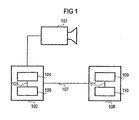
- FIG. 1 Components of a common arrangement for image coding and an image decoding are shown in FIG. 1.
- a camera 101 is shown with the pictures be included.
- the camera 101 can, for example, be a can be any analog camera 101, the images of a scene records and the images are either digitized in the camera 101 and the digitized images to a first computer 102, which is coupled to the camera 101, transmits or also the images in analog form to the first computer 102 transfers.
- the first computer 102 either the digitized Processed images or the analog images in digitized images converted and the digitized Images processed.
- the camera 101 can also be a digital camera 101 with the directly digitized pictures taken and the first Computers 102 are fed for further processing.
- the first computer 102 can also be used as an independent arrangement be designed with which those described below Process steps are carried out, for example as a stand-alone computer card in a computer is installed.
- the first computer 102 has a processor 104 with which the method steps of image coding described below and image decoding.
- the processor 104 is coupled to a memory 106 via a bus 105, in which image information is stored.
- the second computer 108 can have the same structure as the first Have calculator 101.
- the second computer 108 thus also points a processor 109 connected to a bus 111 with a Memory 110 is coupled.
- FIG. 2 shows a possible arrangement in the form of a basic circuit diagram shown for image coding or image decoding.
- the arrangement shown can be part of a block-based and in part, as explained in more detail below, can be used in the context of object-based image coding.
- Block-based image coding involves digitizing Picture 201 in usually square picture blocks 220 of the Size 8x8 pixels 202 or 16x16 pixels 202 divided and the arrangement 203 for image coding.
- a pixel 202 is usually coding information clearly assigned, for example brightness information (Luminance values) or color information (chrominance values).
- this is always digitized image 201 with the pixels 202 of the digitized Coding information associated with image 201 and transfer (I-picture).
- inter-picture coding only a difference image information of two successive in time digitized images 201 coded and transmitted (P-picture, B-picture).
- Block matching method For motion estimation and motion compensation, such as they are known from [3], there are different methods.
- Block-based image coding a so-called “Block matching method” used. It is based that an image block to be coded with reference image blocks of the same size a reference image is compared. As a criterion for a match quality between the one to be encoded Block and one reference picture block each is common the sum of the absolute differences of coding information, which is assigned to each pixel. In this way, movement information for determines the image block, for example a motion vector, which is transmitted with the difference information.
- a subtraction unit is used to carry out the inter-picture coding 205 provided in which the difference in image information two successive digitized Images 201 is formed.
- the image coding is done via a Image encoding control unit 206 controlled.
- the ones to be encoded Image blocks 220 or difference image blocks are each to a transformation coding unit 207.
- the Transformation coding unit 207 applies to the pixels 202 associated coding information a transformation coding, for example a discrete cosine transformation (DCT).
- DCT discrete cosine transformation
- any transformation coding for example a discrete sine Transformation or a discrete Fourier transformation, be applied.
- the transformation coding makes spectral coefficients educated.
- the spectral coefficients are in a quantization unit 208 quantized and an image coding multiplexer 221 for example for a channel coding and / or fed to entropy coding.
- an internal Reconstruction loop becomes the quantized spectral coefficients in an inverse quantization unit 209 inverse quantized and in an inverse transformation coding unit 210 an inverse transformation coding subjected.
- a loop filter (loop filter) 214 is also provided, that with the memory 212 and the subtraction unit 205 connected is.
- the image coding multiplexer 221 is added to one a mode index supplied with the image information transmitted, with which indicates whether intra-picture coding or Inter-picture coding was made.
- the image coding multiplexer 221 receives quantization indices supplied for the spectral coefficients.
- a motion vector becomes an image block 220 and / or a macro block 223, for example four image blocks 220 , assigned and the image coding multiplexer 221 fed.
- the loop filter 214 There is also information to be activated or deactivated of the loop filter 214 is provided. After transmission the image information via a transmission medium 218 in an arrangement 219 for decoding, for example a computer can be decoding the transmitted information respectively. This is done in the arrangement 219 for decoding an image decoding unit 225 is provided, for example the construction of a reconstruction loop of the in the arrangement shown in Figure 1.
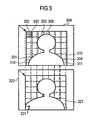
- an image object 301 of an image 304 as shown in FIG. 3, initially in Image blocks 302 of a fixed size, for example 8x8 pixels 303, decomposed, with the pixels 303, which lead to the Image object 301 belong, referred to as object pixels 309 become.
- the image blocks 302, which are at least one object pixel 309 included are referred to as object image blocks 310.
- part of the object image blocks is located 310 completely within the image object 301, which borders with an object edge 305 of the image object 301 becomes.
- the object image blocks 310, which are at least a part of the object edge 305 are also referred to below as Border image blocks 306.
- the object image blocks 310 which are located after segmentation completely within the picture object 301 can, an above-mentioned block-based transform coding with a block-based D iskreten- C osinus- ransformation T (DCT) are encoded accordingly.
- the image information is within the edge image block 306 by a suitable extrapolation method the area of the complete border image block 306 is supplemented. This The procedure is called "padding".
- the added Surface is then made with a two-dimensional discrete Coded cosine transformation (DCT).
- DCT discrete Coded cosine transformation
- Another method of encoding a frame block is a shape-adapted transformation coding.
- the procedure for object-based image coding has the consequence that even with only a slight shift of the relative position of an object edge of the object to be coded 301 with respect to the respectively assigned image 302 or 320 in the two successive images 304 and 320 the relative position of the object image blocks 310 and 321 with respect of the respectively assigned image 304 or 320 changes. This has the consequence that with a motion estimation and a Motion compensation an object image block to be coded 310 and 321 are no longer found in the previous image 320 since the object image block 310 is timed previous picture lies on a block edge 311.
- the invention is therefore based on the problem of a method for image coding and a method for image decoding and an arrangement for image coding and an arrangement for image decoding specify with which a regarding a necessary Residual error image coding and one to be transmitted Data rate improved image coding is achieved.
- the image is encoded using the following procedure:
- the image is at least partially divided into image blocks and the image object is determined in the image. Furthermore Object image blocks determined, the object image blocks the Are image blocks that have at least one object pixel.
- the object image blocks are determined in such a way that that at least one relative position of an edge of a Object image blocks of the image with respect to the image with a relative position of an edge of an object image block of the temporal previous picture with respect to the previous one Image matches.
- the coding is using of the object image blocks.
- the decoding using one to the coding performed inverse procedure.
- a processor In the arrangement for coding a digitized image, for which there is a previous image with pixels, the at least one image object with associated object image points having, the object pixels in the object lie, a processor is provided, which is such the following steps can be carried out:
- the image is at least partially divided into image blocks and the image object is determined in the image. Furthermore Object image blocks determined, the object image blocks the Are image blocks that have at least one object pixel.
- the object image blocks are determined in such a way that that at least one relative position of an edge of a Object image blocks of the image with respect to the image with a relative position of an edge of an object image block of the temporal previous picture with respect to the previous one Image matches.
- the coding is using of the object image blocks.
- the image is encoded using the following procedure:
- the image is at least partially divided into image blocks and the image object is determined in the image. Furthermore Object image blocks determined, the object image blocks the Are image blocks that have at least one object pixel.
- the object image blocks are determined in such a way that that at least one relative position of an edge of a Object image blocks of the image with respect to the image with a relative position of an edge of an object image block of the temporal previous picture with respect to the previous one Image matches.
- the coding is using of the object image blocks.
- a hybrid is used for the coding Transformation coding and / or for decoding a inverse transformation coding used.
- a preferred method for transform coding or inverse transformation coding is used, is a discrete cosine transformation (DCT) or an inverse Discrete Cosine Transformation (IDCT).
- DCT discrete cosine transformation
- IDCT inverse Discrete Cosine Transformation
- a camera 101 is shown with the pictures be included.
- the camera 101 is an analog camera 101, which takes pictures of a scene, and the pictures in analog Transfers form to a first computer 102.
- the first Computer 102 digitizes the analog images Images 103 converted and the digitized images 103 processed.
- the first computer 102 is shown in FIG Form of an independent computer card, which in the first Computer 102 is installed, configured with which computer card the process steps described below be performed.
- the first computer 102 has a processor 104 with which the method steps of image coding described below be performed.
- the processor unit 104 is coupled via a bus 105 to a memory 106 in which image information is stored.
- the method for image coding described below is implemented in software. It is stored in the memory 106 and is executed by processor 104.
- the second computer 108 has the same structure as the first Computer 101.
- the second computer 108 also has a processor 109 on which processor with a bus 111 with a Memory 110 is coupled.
- the method described below for image decoding is implemented in software. It is stored in the memory 110 and is executed by processor 109.
- the images of a temporal image sequence are subdivided (segmentation) of a digitized Picture generally corresponding to that in a Scene occurring picture objects as well as a separate coding of the picture objects.
- This type of segmentation is used for the first picture the image sequence.
- the image coding of the temporally first frame is after the intra-frame coding mode.
- Each image object 301 of an image 304 is first divided into image blocks 302 of a fixed size, for example 8x8 pixels 303, decomposed, with the pixels 303 leading to the image object 301 belong to, are referred to as object pixels 309.
- the Image blocks 302 containing at least one object pixel 309, are referred to as object image blocks 310.
- After this Segmentation is part of the object image blocks 310 completely within the image object 301, which with an object edge 305 of the image object 301 is bordered.
- the Object image blocks 310 that are at least a portion of the object edge 305 included, are also referred to below as image blocks Designated 306.
- the object image blocks 310 which are located after segmentation completely within the image object 301 are coded in accordance with the above-mentioned block-based transform coding with a block-based D iskreten- C osinus- ransformation T (DCT).
- DCT D iskreten- C osinus- ransformation T
- edge image blocks 306 only partially contain one Image information and must be encoded using a special procedure become.
- the procedure for coding an edge image block as it is from [5] is known, is a form-adapted transformation coding.
- the shape-adaptive D iskrete- C osinus- ransformation T (DCT) is used.
- the segmentation of these images is exemplary in Figure 4 are shown on two images 401 and 402 which follow one another in time is done in such a way that the relative position one object image block 403 of the previous one Image 401 with respect to temporally preceding image 401 with the relative position of a corresponding object image block 404 of the image 402 currently to be transmitted with respect to the current one image 402 to be transmitted is identical. So that results there is at least partially fixed segmentation in the two successive images, the relative Position of the object image blocks 404 currently to be transmitted 402 with respect to the associated image 402 with the relative Location of the object image blocks 403 of the previous one Image 401 with respect to the associated image 401 at least is partially identical.
- Image 402 further image blocks 406 and object image blocks 404 determines or in the current image 402 the divided Image blocks 406 and object image blocks 404 are adapted in such a way, see above that both the picture object 405 is complete by object picture blocks 404 is covered as well as all divided image blocks 406 and object image blocks 404 of the image currently to be transmitted 402 describe a rectangular surface 407.
- Object image blocks 404 that are at least a portion of the object edge 408 included, are also referred to below as image blocks Designated 409.
- the object image blocks 404 which are located after segmentation completely within the image object 405 are coded in accordance with the above-mentioned block-based transform coding with a block-based D iskreten- C osinus- ransformation T (DCT).
- DCT D iskreten- C osinus- ransformation T
- Edge image blocks 409 are only partially one Image information is filled and must be processed using a special procedure be encoded.
- the method of encoding a frame block 409 as it is is known from [5] is a shape-adapted transformation coding.
- the shape-adaptive D iskrete- C osinus- ransformation T (DCT) is used.
- the spectral coefficients c j are fed to the inverse shape-adapted transformation coding (IDCT).
- IDCT inverse shape-adapted transformation coding
- the decoded image is determined using the determined object pixels x j .
- a transformation coding unit can (DCT) for conformal transformation of the object pixels are provided, the transformation coding unit (DCT) is designed such that the Process steps shown as part of the method for image coding in the transformation coding unit (DCT) are realized.
- an inverse Transformation coding unit (IDCT) for the inverse shape-matched Transformation of the object pixels are provided where the inverse transform coding unit (IDCT) is designed in such a way that in the context of the method Process steps shown for image decoding in the inverse transformation coding unit (IDCT) realized are.
Landscapes
- Engineering & Computer Science (AREA)
- Multimedia (AREA)
- Signal Processing (AREA)
- Compression Or Coding Systems Of Tv Signals (AREA)
- Compression, Expansion, Code Conversion, And Decoders (AREA)
Description
- N eine Größe des zu transformierenden Bildvektors bezeichnet wird, in dem die transformierenden Bildpunkte enthalten sind;
- [DCT-N(p,k)] eine Transformationsmatrix der Größe NxN bezeichnet wird;
- p,k Indizes bezeichnet werden mit p,k ∈ [0, N-1].
- Figur 1
- Anordnung zur Bildcodierung bzw. Bilddecodierung mit einer Kamera, zwei Rechnern und einem Übertragungsmedium
- Figur 2
- Skizze einer Anordnung zur blockbasierten Bildcodierung und Bilddecodierung
- Figur 3
- symbolhafte Darstellung zweier zeitlich aufeinanderfolgender Bilder mit jeweils einem Bildobjekt, mit Bildpunkten, mit Objektbildpunkten, mit Bildblöcken, mit Objektbildblöcken und mit Randbildblöcken
- Figur 4
- symbolhafte Darstellung zweier zeitlich aufeinanderfolgender Bilder mit einer "festen Segmentierung" von Objektbildblöcken und Bildblöcken
- N eine Größe des zu transformierenden Bildvektors bezeichnet wird, in dem die transformierenden Bildpunkte enthalten sind;
- [DCT-N(p,k)] eine Transformationsmatrix der Größe NxN bezeichnet wird;
- p,k Indizes bezeichnet werden mit p,k ∈ [0, N-1].
- N eine Größe des zu transformierenden Bildvektors bezeichnet wird, in dem die transformierenden Bildpunkte enthalten sind;
- [DCT-N(p,k)] eine Transformationsmatrix der Größe NxN bezeichnet wird;
- p,k Indizes bezeichnet werden mit p,k ∈ [0, N-1];
- mit ()-1 eine Inversion einer Matrix bezeichnet wird.
Claims (18)
- Verfahren zur Codierung eines digitalisierten Bildes, zu dem es ein zeitlich vorangehendes Bild gibt, mit Bildpunkten, das mindestens ein Bildobjekt mit zugehörigen Objektbildpunkten aufweist, wobei die Objektbildpunkte in dem Objekt liegen,a) bei dem das Bild zumindest teilweise in Bildblöcke aufgeteilt wird;b) bei dem in dem Bild das Bildobjekt ermittelt wird;c) bei dem mindestens ein Objektbildblock ermittelt wird, wobei der Objektbildblock ein Bildblock ist, der zumindest einen Objektbildpunkt aufweist;d) bei dem die Ermittlung des Objektbildblocks derart durchgeführt wird, dass eine relative Lage eines Randes eines Objektbildblocks des Bildes bezüglich des Bildes mit einer relativen Lage eines Randes eines Objektbildblocks des zeitlich vorangehenden Bildes bezüglich des zeitlich vorangehenden Bildes übereinstimmt;e) bei dem die Codierung unter Verwendung des Objektbildblocks durchgeführt wird.
- Verfahren nach Anspruch 1,
bei dem das Bild mehrere Bildobjekte aufweist. - Verfahren nach Anspruch 1 oder 2,
bei dem mehrere relative Lagen eines Randes eines Objektbildblocks des Bildes bezüglich des Bildes mit jeweils einer relativen Lage eines Randes eines Objektbildblocks des zeitlich vorangehenden Bildes bezüglich des zeitlich vorangehenden Bildes übereinstimmen. - Verfahren nach einem der Ansprüche 1 bis 3,
bei dem zu der Codierung eine hybride Transformationscodierung eingesetzt wird. - Verfahren zur Codierung und zur Decodierung eines digitalisierten Bildes, zu dem es ein zeitlich vorangehendes Bild gibt, mit Bildpunkten, das mindestens ein Bildobjekt mit zugehörigen Objektbildpunkten aufweist, wobei die Objektbildpunkte in dem Objekt liegen, bei dem das Bild gemäß Anspruch 1 codiert wird,
und bei dem die Decodierung unter Verwendung eines zu der Codierung inversen Verfahrens durchgeführt wird. - Verfahren nach Anspruch 5,
bei dem das Bild mehrere Bildobjekte aufweist. - Verfahren nach Anspruch 5 oder 6,
bei dem mehrere relative Lagen eines Randes eines Objektbildblocks des Bildes bezüglich des Bildes mit jeweils einer relativen Lage eines Randes eines Objektbildblocks des zeitlich vorangehenden Bildes bezüglich des zeitlich vorangehenden Bildes übereinstimmen. - Verfahren nach einem der Ansprüche 5 bis 7,
bei dem zur Decodierung eine inverse Transformationscodierung eingesetzt wird. - Anordnung zur Durchführung des Verfahrens nach Anspruch 1.
- Anordnung nach Anspruch 9,
bei der das Bild mehrere Bildobjekte aufweist. - Anordnung nach Anspruch 9 oder 10,
bei dem mehrere relative Lagen eines Randes eines Objektbildblocks des Bildes bezüglich des Bildes mit jeweils einer relativen Lage eines Randes eines Objektbildblocks des zeitlich vorangehenden Bildes bezüglich des zeitlich vorangehenden Bildes übereinstimmen. - Anordnung zur Durchführung des Verfahrens nach Anspruch 5.
- Anordnung nach Anspruch 12,
bei der das Bild mehrere Bildobjekte aufweist. - Anordnung nach Anspruch 12 oder 13,
bei dem mehrere relative Lagen eines Randes eines Objektbildblocks des Bildes bezüglich des Bildes mit jeweils einer relativen Lage eines Randes eines Objektbildblocks des zeitlich vorangehenden Bildes bezüglich des zeitlich vorangehenden Bildes übereinstimmen. - Codiertes digitalisiertes Bild mit Bildpunkten, das mindestens ein Bildobjekt mit zugehörigen Objektbildpunkten aufweist, wobei die Objektbildpunkte in dem Objekt liegen, welches codierte digitalisierte Bild durch Codierung eines zu codierenden digitalisierten Bildes erzeugt wurde, zu welchem zu codierenden digitalisierten Bild es ein zeitlich vorangehendes Bild gibt, und welches codierte digitalisierte Bild derart codiert wurde, dassa) das zu codierende Bild zumindest teilweise in Bildblöcke aufgeteilt wird;b) in dem zu codierenden Bild das Bildobjekt ermittelt wird;c) mindestens ein Objektbildblock ermittelt wird, wobei der Objektbildblock ein Bildblock ist, der zumindest einen Objektbildpunkt aufweist;d) bei dem die Ermittlung des Objektbildblocks derart durchgeführt wird, dass eine relative Lage eines Randes eines Objektbildblocks des zu codierenden Bildes bezüglich des Bildes mit einer relativen Lage eines Randes eines Objektbildblocks des zeitlich vorangehenden Bildes bezüglich des zeitlich vorangehenden Bildes übereinstimmt;e) bei dem die Codierung unter Verwendung des Objektbildblocks durchgeführt wird.
- Verwendung des codierten digitalisierten Bildes nach Anspruch 15 zu einer Bearbeitung.
- Verwendung des codierten digitalisierten Bildes nach Anspruch 15 zu einer Decodierung.
- Verwendung des codierten digitalisierten Bildes nach Anspruch 15 zu einer Übertragung.
Applications Claiming Priority (3)
| Application Number | Priority Date | Filing Date | Title |
|---|---|---|---|
| DE19847840 | 1998-10-16 | ||
| DE19847840 | 1998-10-16 | ||
| PCT/DE1999/003172 WO2000024201A1 (de) | 1998-10-16 | 1999-10-01 | Verfahren und anordnung zur cordierung eines digitalisierten bildes, verfahren und anordnung zur decodierung eines digitalisierten bildes |
Publications (2)
| Publication Number | Publication Date |
|---|---|
| EP1121809A1 EP1121809A1 (de) | 2001-08-08 |
| EP1121809B1 true EP1121809B1 (de) | 2002-12-18 |
Family
ID=7884749
Family Applications (1)
| Application Number | Title | Priority Date | Filing Date |
|---|---|---|---|
| EP99970823A Expired - Lifetime EP1121809B1 (de) | 1998-10-16 | 1999-10-01 | Verfahren und anordnung zur codierung eines digitalisierten bildes, verfahren und anordnung zur decodierung eines digitalisierten bildes |
Country Status (7)
| Country | Link |
|---|---|
| US (1) | US20010053185A1 (de) |
| EP (1) | EP1121809B1 (de) |
| JP (1) | JP2002528973A (de) |
| KR (1) | KR20010080193A (de) |
| CN (1) | CN1330837A (de) |
| DE (1) | DE59903871D1 (de) |
| WO (1) | WO2000024201A1 (de) |
Families Citing this family (2)
| Publication number | Priority date | Publication date | Assignee | Title |
|---|---|---|---|---|
| US6987866B2 (en) * | 2001-06-05 | 2006-01-17 | Micron Technology, Inc. | Multi-modal motion estimation for video sequences |
| CN113676728A (zh) * | 2021-08-25 | 2021-11-19 | 国网吉林省电力有限公司长春供电公司 | 一种数字化台区非结构化数据压缩方法 |
-
1999
- 1999-10-01 DE DE59903871T patent/DE59903871D1/de not_active Expired - Fee Related
- 1999-10-01 CN CN99814614A patent/CN1330837A/zh active Pending
- 1999-10-01 WO PCT/DE1999/003172 patent/WO2000024201A1/de not_active Ceased
- 1999-10-01 EP EP99970823A patent/EP1121809B1/de not_active Expired - Lifetime
- 1999-10-01 KR KR1020017004792A patent/KR20010080193A/ko not_active Withdrawn
- 1999-10-01 JP JP2000577838A patent/JP2002528973A/ja not_active Withdrawn
-
2001
- 2001-04-16 US US09/835,347 patent/US20010053185A1/en not_active Abandoned
Also Published As
| Publication number | Publication date |
|---|---|
| JP2002528973A (ja) | 2002-09-03 |
| KR20010080193A (ko) | 2001-08-22 |
| DE59903871D1 (de) | 2003-01-30 |
| US20010053185A1 (en) | 2001-12-20 |
| CN1330837A (zh) | 2002-01-09 |
| EP1121809A1 (de) | 2001-08-08 |
| WO2000024201A1 (de) | 2000-04-27 |
Similar Documents
| Publication | Publication Date | Title |
|---|---|---|
| EP0817496B1 (de) | Verfahren und Anordnung zur Reduktion von Blockartefakten in codierten Bildern | |
| DE69223560T2 (de) | Einrichtung zur Verminderung von Quantisierungsstörungen in einem Zwischenbild-Hybrid-Kodierungssystem mit Bewegungskompensation | |
| EP0956539B1 (de) | Verfahren und anordnung zur codierung und decodierung eines digitalisierten bildes | |
| DE602004001993T2 (de) | Transformations basiertes restbewegungsrahmen kodierungsverfahren mit übervollständiger basis und zugehörige vorrichtung zur videokompression | |
| DE69915843T2 (de) | Teilbandkodierung/-dekodierung | |
| DE19541457C1 (de) | Verfahren zur Codierung eines Videodatenstroms einer aus Bildblöcken bestehenden Videosequenz | |
| EP0956703B1 (de) | Verfahren und anordnung zur codierung und decodierung eines digitalisierten bildes | |
| EP0941613B1 (de) | Verfahren zur bildcodierung eines digitalisierten bildes | |
| DE10218541A1 (de) | Verfahren zur Videocodierung und Computerprogrammprodukt | |
| DE60036585T2 (de) | Videodatencoder und Verfahren zur Codierung von Videodaten | |
| EP1285537B1 (de) | Verfahren und eine anordnung zur codierung bzw. decodierung einer folge von bildern | |
| EP1110407B1 (de) | Verfahren und anordnung zur codierung und decodierung eines digitalisierten bildes mit anwendung eines gesamtbewegungsvektors | |
| EP0981910B1 (de) | Verfahren und vorrichtung zur codierung eines digitalisierten bildes | |
| EP1121809A1 (de) | Verfahren und anordnung zur cordierung eines digitalisierten bildes, verfahren und anordnung zur decodierung eines digitalisierten bildes | |
| EP1941744B1 (de) | Verfahren und vorrichtungen zur bestimmung und rekonstruktion eines prädizierten bildbereichs | |
| EP0981909B1 (de) | Verfahren und vorrichtung zur codierung und decodierung eines digitalisierten bildes | |
| WO2001062009A1 (de) | Verfahren und anordnung zur kodierung bzw. zur kodierung und dekodierung einer zahlenfolge | |
| WO2001049038A1 (de) | Verfahren, anordnung und computerprogrammerzeugnis zur prädiktion bei der codierung eines in bildblöcke unterteilten bildes | |
| WO2000046998A1 (de) | Verfahren und anordnung zur transformation eines bildbereichs | |
| EP1085761A1 (de) | Bewegungsschätzung in einem objektorientierten Videokodierer | |
| EP1189452A2 (de) | Verfahren und Vorrichtung zum Codieren und Dekodieren eines digitalisierten Bildes | |
| WO2000049525A1 (de) | Verfahren und anordnung zum abspeichern von mindestens einem bild mit zugehöriger relationalen information | |
| DE19957685A1 (de) | Verfahren und Anordnung zur Codierung bzw. Decodierung einer Zahlenfolge | |
| WO2000025520A1 (de) | Verfahren und anordnung zur bearbeitung eines digitalisierten bildes | |
| WO2001033827A2 (de) | Verfahren und anordnung zur transformation eines bildblocks aus bildblockpunkten |
Legal Events
| Date | Code | Title | Description |
|---|---|---|---|
| PUAI | Public reference made under article 153(3) epc to a published international application that has entered the european phase |
Free format text: ORIGINAL CODE: 0009012 |
|
| 17P | Request for examination filed |
Effective date: 20010322 |
|
| AK | Designated contracting states |
Kind code of ref document: A1 Designated state(s): AT BE CH CY DE DK ES FI FR GB GR IE IT LI LU MC NL PT SE Kind code of ref document: A1 Designated state(s): DE FR GB IT NL SE |
|
| GRAG | Despatch of communication of intention to grant |
Free format text: ORIGINAL CODE: EPIDOS AGRA |
|
| GRAG | Despatch of communication of intention to grant |
Free format text: ORIGINAL CODE: EPIDOS AGRA |
|
| GRAH | Despatch of communication of intention to grant a patent |
Free format text: ORIGINAL CODE: EPIDOS IGRA |
|
| 17Q | First examination report despatched |
Effective date: 20020624 |
|
| GRAH | Despatch of communication of intention to grant a patent |
Free format text: ORIGINAL CODE: EPIDOS IGRA |
|
| GRAA | (expected) grant |
Free format text: ORIGINAL CODE: 0009210 |
|
| AK | Designated contracting states |
Kind code of ref document: B1 Designated state(s): DE FR GB IT NL SE |
|
| REG | Reference to a national code |
Ref country code: GB Ref legal event code: FG4D Free format text: NOT ENGLISH |
|
| REF | Corresponds to: |
Ref document number: 59903871 Country of ref document: DE Date of ref document: 20030130 Kind code of ref document: P Ref document number: 59903871 Country of ref document: DE Date of ref document: 20030130 |
|
| REG | Reference to a national code |
Ref country code: SE Ref legal event code: TRGR |
|
| GBT | Gb: translation of ep patent filed (gb section 77(6)(a)/1977) |
Effective date: 20030326 |
|
| ET | Fr: translation filed | ||
| PGFP | Annual fee paid to national office [announced via postgrant information from national office to epo] |
Ref country code: SE Payment date: 20031009 Year of fee payment: 5 Ref country code: NL Payment date: 20031009 Year of fee payment: 5 Ref country code: GB Payment date: 20031009 Year of fee payment: 5 |
|
| PLBE | No opposition filed within time limit |
Free format text: ORIGINAL CODE: 0009261 |
|
| STAA | Information on the status of an ep patent application or granted ep patent |
Free format text: STATUS: NO OPPOSITION FILED WITHIN TIME LIMIT |
|
| PGFP | Annual fee paid to national office [announced via postgrant information from national office to epo] |
Ref country code: FR Payment date: 20031029 Year of fee payment: 5 |
|
| 26N | No opposition filed |
Effective date: 20030919 |
|
| PGFP | Annual fee paid to national office [announced via postgrant information from national office to epo] |
Ref country code: DE Payment date: 20031217 Year of fee payment: 5 |
|
| PG25 | Lapsed in a contracting state [announced via postgrant information from national office to epo] |
Ref country code: GB Free format text: LAPSE BECAUSE OF NON-PAYMENT OF DUE FEES Effective date: 20041001 |
|
| PG25 | Lapsed in a contracting state [announced via postgrant information from national office to epo] |
Ref country code: SE Free format text: LAPSE BECAUSE OF NON-PAYMENT OF DUE FEES Effective date: 20041002 |
|
| PG25 | Lapsed in a contracting state [announced via postgrant information from national office to epo] |
Ref country code: NL Free format text: LAPSE BECAUSE OF NON-PAYMENT OF DUE FEES Effective date: 20050501 |
|
| PG25 | Lapsed in a contracting state [announced via postgrant information from national office to epo] |
Ref country code: DE Free format text: LAPSE BECAUSE OF NON-PAYMENT OF DUE FEES Effective date: 20050503 |
|
| GBPC | Gb: european patent ceased through non-payment of renewal fee |
Effective date: 20041001 |
|
| EUG | Se: european patent has lapsed | ||
| PG25 | Lapsed in a contracting state [announced via postgrant information from national office to epo] |
Ref country code: FR Free format text: LAPSE BECAUSE OF NON-PAYMENT OF DUE FEES Effective date: 20050630 |
|
| NLV4 | Nl: lapsed or anulled due to non-payment of the annual fee |
Effective date: 20050501 |
|
| REG | Reference to a national code |
Ref country code: FR Ref legal event code: ST |
|
| PG25 | Lapsed in a contracting state [announced via postgrant information from national office to epo] |
Ref country code: IT Free format text: LAPSE BECAUSE OF NON-PAYMENT OF DUE FEES Effective date: 20051001 |