EP1121915B1 - Tampon hygiènique avec de fibres courtes agglomérées - Google Patents
Tampon hygiènique avec de fibres courtes agglomérées Download PDFInfo
- Publication number
- EP1121915B1 EP1121915B1 EP01300819A EP01300819A EP1121915B1 EP 1121915 B1 EP1121915 B1 EP 1121915B1 EP 01300819 A EP01300819 A EP 01300819A EP 01300819 A EP01300819 A EP 01300819A EP 1121915 B1 EP1121915 B1 EP 1121915B1
- Authority
- EP
- European Patent Office
- Prior art keywords
- fibers
- absorbent
- small fiber
- agglomerations
- fiber agglomerations
- Prior art date
- Legal status (The legal status is an assumption and is not a legal conclusion. Google has not performed a legal analysis and makes no representation as to the accuracy of the status listed.)
- Expired - Lifetime
Links
- 239000000835 fiber Substances 0.000 title claims description 236
- 238000005054 agglomeration Methods 0.000 title claims description 131
- 230000002776 aggregation Effects 0.000 title claims description 131
- 230000002745 absorbent Effects 0.000 claims description 71
- 239000002250 absorbent Substances 0.000 claims description 71
- 230000002093 peripheral effect Effects 0.000 claims description 28
- 229910052739 hydrogen Inorganic materials 0.000 claims description 24
- 239000001257 hydrogen Substances 0.000 claims description 24
- 239000000203 mixture Substances 0.000 claims description 7
- 238000004804 winding Methods 0.000 claims description 7
- 210000001215 vagina Anatomy 0.000 description 30
- 230000002175 menstrual effect Effects 0.000 description 22
- 238000011084 recovery Methods 0.000 description 11
- 229920000297 Rayon Polymers 0.000 description 5
- -1 polypropylene Polymers 0.000 description 5
- 239000002964 rayon Substances 0.000 description 5
- 229920000728 polyester Polymers 0.000 description 4
- 229920000742 Cotton Polymers 0.000 description 3
- 230000006835 compression Effects 0.000 description 3
- 238000007906 compression Methods 0.000 description 3
- 239000004745 nonwoven fabric Substances 0.000 description 3
- 239000004743 Polypropylene Substances 0.000 description 2
- 238000010521 absorption reaction Methods 0.000 description 2
- 230000002209 hydrophobic effect Effects 0.000 description 2
- 239000005020 polyethylene terephthalate Substances 0.000 description 2
- 229920000139 polyethylene terephthalate Polymers 0.000 description 2
- 229920001155 polypropylene Polymers 0.000 description 2
- 239000004698 Polyethylene Substances 0.000 description 1
- 239000008280 blood Substances 0.000 description 1
- 210000004369 blood Anatomy 0.000 description 1
- 210000001124 body fluid Anatomy 0.000 description 1
- 239000010839 body fluid Substances 0.000 description 1
- 239000000470 constituent Substances 0.000 description 1
- 239000002657 fibrous material Substances 0.000 description 1
- 239000012530 fluid Substances 0.000 description 1
- 239000000463 material Substances 0.000 description 1
- 239000002985 plastic film Substances 0.000 description 1
- 229920000573 polyethylene Polymers 0.000 description 1
- 229920002994 synthetic fiber Polymers 0.000 description 1
- 239000012209 synthetic fiber Substances 0.000 description 1
- XLYOFNOQVPJJNP-UHFFFAOYSA-N water Substances O XLYOFNOQVPJJNP-UHFFFAOYSA-N 0.000 description 1
Images

Classifications
-
- A—HUMAN NECESSITIES
- A61—MEDICAL OR VETERINARY SCIENCE; HYGIENE
- A61F—FILTERS IMPLANTABLE INTO BLOOD VESSELS; PROSTHESES; DEVICES PROVIDING PATENCY TO, OR PREVENTING COLLAPSING OF, TUBULAR STRUCTURES OF THE BODY, e.g. STENTS; ORTHOPAEDIC, NURSING OR CONTRACEPTIVE DEVICES; FOMENTATION; TREATMENT OR PROTECTION OF EYES OR EARS; BANDAGES, DRESSINGS OR ABSORBENT PADS; FIRST-AID KITS
- A61F13/00—Bandages or dressings; Absorbent pads
- A61F13/15—Absorbent pads, e.g. sanitary towels, swabs or tampons for external or internal application to the body; Supporting or fastening means therefor; Tampon applicators
- A61F13/20—Tampons, e.g. catamenial tampons; Accessories therefor
-
- A—HUMAN NECESSITIES
- A61—MEDICAL OR VETERINARY SCIENCE; HYGIENE
- A61L—METHODS OR APPARATUS FOR STERILISING MATERIALS OR OBJECTS IN GENERAL; DISINFECTION, STERILISATION OR DEODORISATION OF AIR; CHEMICAL ASPECTS OF BANDAGES, DRESSINGS, ABSORBENT PADS OR SURGICAL ARTICLES; MATERIALS FOR BANDAGES, DRESSINGS, ABSORBENT PADS OR SURGICAL ARTICLES
- A61L15/00—Chemical aspects of, or use of materials for, bandages, dressings or absorbent pads
- A61L15/16—Bandages, dressings or absorbent pads for physiological fluids such as urine or blood, e.g. sanitary towels, tampons
- A61L15/42—Use of materials characterised by their function or physical properties
-
- A—HUMAN NECESSITIES
- A61—MEDICAL OR VETERINARY SCIENCE; HYGIENE
- A61F—FILTERS IMPLANTABLE INTO BLOOD VESSELS; PROSTHESES; DEVICES PROVIDING PATENCY TO, OR PREVENTING COLLAPSING OF, TUBULAR STRUCTURES OF THE BODY, e.g. STENTS; ORTHOPAEDIC, NURSING OR CONTRACEPTIVE DEVICES; FOMENTATION; TREATMENT OR PROTECTION OF EYES OR EARS; BANDAGES, DRESSINGS OR ABSORBENT PADS; FIRST-AID KITS
- A61F13/00—Bandages or dressings; Absorbent pads
- A61F13/15—Absorbent pads, e.g. sanitary towels, swabs or tampons for external or internal application to the body; Supporting or fastening means therefor; Tampon applicators
- A61F13/20—Tampons, e.g. catamenial tampons; Accessories therefor
- A61F13/2051—Tampons, e.g. catamenial tampons; Accessories therefor characterised by the material or the structure of the inner absorbing core
-
- Y—GENERAL TAGGING OF NEW TECHNOLOGICAL DEVELOPMENTS; GENERAL TAGGING OF CROSS-SECTIONAL TECHNOLOGIES SPANNING OVER SEVERAL SECTIONS OF THE IPC; TECHNICAL SUBJECTS COVERED BY FORMER USPC CROSS-REFERENCE ART COLLECTIONS [XRACs] AND DIGESTS
- Y10—TECHNICAL SUBJECTS COVERED BY FORMER USPC
- Y10S—TECHNICAL SUBJECTS COVERED BY FORMER USPC CROSS-REFERENCE ART COLLECTIONS [XRACs] AND DIGESTS
- Y10S604/00—Surgery
- Y10S604/904—Tampons
Definitions
- the present invention relates to a sanitary tampon which is inserted into a body cavity such as a woman' s vagina to absorb menstrual fluid, blood and other kinds of body fluid.
- Japanese Unexamined Patent Publication (Kokai) No. Heisei 1-146548 discloses a sanitary tampon that comprises an absorbent of hydrophilic fibers and an outer layer of a hydrophobic sheet mixed with hydrophilic fibers.
- Japanese Unexamined Patent Publication (Kokai) No. Heisei 3-146058 (EP-A-0422660) discloses a tampon that comprises a columnar, highly-compressed core and an outer envelope.
- Heisei 5-68695 discloses a tampon which comprises a combination of sheets having a higher fiber density and sheets having a lower fiber density and is so constructed that, when formed into a columnar structure, the sheets having a lower fiber density are partly exposed outside the surface of the structure.
- These tampons have columnar structures of compressed absorbent fiber materials. While used, they absorb menstrual discharges, and are then uncompressed. As a result, the thus-uncompressed tampons expand to block the vaginal cavity, and can further absorb the menstrual discharges.
- Japanese Unexamined Patent Publication (Kokai) No. Showa 62-236547 discloses a tampon comprising a plurality of small fiber agglomerations.
- the constituent fiber agglomerations have some space between them. Therefore, the tampon could be easily deformed, and could well fit into the vagina.
- the fiber agglomerations constituting the tampon have some space between them, the fiber content of the tampon will reduce if the density of the fiber agglomerations is lowered so as to increase the absorption rate into the fiber agglomerations. If so, the absorbability of the tampon as a whole is thereby reduced.
- the tampon itself is not rigid enough to easily insert the tampon into the vagina.
- An object of the present invention is to provide a tampon which has high absorbability, and hardly forms a space between the tampon and an inner wall of the vagina.
- a sanitary tampon may comprise an absorbent wrapped by a liquid-pervious sheet, wherein; the absorbent is a mass of a plurality of compressed, small fiber agglomerations, at least the small fiber agglomerations located in the peripheral region of the absorbent are bonded to each other via hydrogen bonding therebetween.
- the absorbent of the sanitary tampon of the invention is formed of a plurality of small fiber agglomerations bonded to each other.
- the hydrogen bonding between the small fiber agglomerations constituting the absorbent is broken and, as a result, the thus-broken fiber agglomerations exhibit their individual behavior.
- the compressed fiber agglomerations are restored to their original, non-compressed size. Accordingly, the tampon in the vagina well fits to the inner wall of the vagina with no space between the tampon and the inner wall of the vagina.
- the tampon is rigid by itself and is easy to insert into the vagina.
- the density of the small fiber agglomerations located in the center region of the absorbent of the tampon may be higher than that of the small fiber agglomerations located in the peripheral region thereof.
- the small fiber agglomerations located in the peripheral region of the absorbent is lower than that of the others, the small fiber agglomerations located in the peripheral region can rapidly absorb discharges to break the hydrogen bonding between them, whereby the absorbent shall have a freedom of behavior as a whole.
- the small fiber agglomerations having a higher density and located in the center region of the absorbent can behave relatively freely.
- the small fiber agglomeration having a higher density can expand to a higher degree when having absorbed discharges, and, as a result, the absorbent well expands to facilitate fitting in the vagina.
- the small fiber agglomerations located in the center region of the absorbent may be formed of noncellulosic fibers alone or of a combination of cellulosic fibers and noncellulosic fibers, and those located in the peripheral region thereof may be formed of cellulosic fibers alone or of a combination of cellulosic fibers and noncellulosic fibers; and the small fiber agglomerations located in the center region of the absorbent may contain a larger quantity of noncellulosic fibers than those located in the peripheral region thereof.
- the small fiber agglomerations located in the center region of the absorbent are essentially formed of noncellulosic fibers. Therefore, the elastic recovery of this tampon is high.
- the absorbent When the small fiber agglomerations essentially formed of cellulosic fibers in the peripheral region of the absorbent of the tampon have absorbed discharges to break the hydrogen bonding between them, the absorbent is rapidly expanded owing to the expansion force of the small fiber agglomerations located in the center region of the absorbent.
- the respective small fiber agglomerations may be of a core/shell structure, and the density of the core of each fiber agglomeration is higher than that of the shell.
- the core of the small fiber agglomeration is formed of noncellulosic fibers alone or of a combination of cellulosic fibers and noncellulosic fibers; and the shell thereof is formed of cellulosic fibers alone or of a combination of cellulosic fibers and noncellulosic fibers, and the core contains a larger quantity of noncellulosic fibers than the shell.
- the small fiber agglomerations constituting the absorbent may contain both cellulosic fibers and noncellulosic fibers in a blend ratio of cellulosic fibers to noncellulosic fibers falling between 0.5:1 and 4:1.
- the mean fiber density of the absorbent falls between 0.2 and 0.9 g/cm 3 .
- the small fiber agglomerations are formed by winding up fibers. More preferably, the small fiber agglomerations of high-density fibers or those of noncellulosic fibers therein are formed by winding up the fibers, so that their expansion recovery becomes large when they have absorbed discharges.
- Fig. 1 is a perspective view of one embodiment of a tampon according to the invention
- Fig. 2 is a partial cross-sectional view of the tampon of Fig. 1.
- a tampon 1 shown in Fig. 1 is so constructed that a columnar, compression-shaped absorbent 2 as shown in Fig. 2 is covered with a liquid-pervious sheet 3. At a rear end le of the tampon 1, the liquid-pervious sheet 3 is heat-sealed or sewed on a machine.
- the tampon 1 is provided with a string 5 extending from the rear end le of the tampon 1 for taking the tampon out of the vagina by pulling the string 5 after used.
- the liquid-pervious sheet 3 may be made of a spun-lace, point-bonded, spun-bonded or thermal-bonded non-woven fabric of hydrophilicated hydrophobic fibers of polyester, polypropylene or polyethylene terephthalate, etc., or of such a non-woven fabric having been perforated to have a number of perforations therethrough, or even of a porous plastic sheet or the like.
- One preferred example of the sheet is a spun-bonded non-woven fabric of polyester having a unit weight (Metsuke) of 12 g/m 2 or so.
- the string 5 may be made of any materials. For example, it may be a cotton yarn (of 16 cotton fibers of count # 20) having been processed for water repellency.
- the absorbent 2 is made of a mass of a plurality of small fiber agglomerations 8, and the mass is shaped under compression into a columnar structure having, for example, a diameter of from 8 to 20 mm or so and a length of from 4 to 7 cm or so.
- the small fiber agglomerations 8 are tightly bonded to each other.
- At least the small fiber agglomerations located in the peripheral region of the absorbent 2 contain cellulosic fibers, and the neighboring fiber agglomerations located at least in the peripheral region are bonded to each other via hydrogen bonding therebetween.
- all the small fiber agglomerations as shown in Fig. 2 may be bonded to each other via hydrogen bonding therebetween.
- the respective small fiber agglomerations 8 are formed by winding up fibers having a length of from 10 to 40 mm or so into spirals or balls, followed by compressing them.
- the thus-formed fiber agglomerations 8 are enveloped in the liquid-pervious sheet 3. Having been thus enveloped in the sheet, the columnar mass of the fiber agglomerations has a size capable of well fitting in the vagina.
- the small fiber agglomerations 8 thus enveloped in the liquid-pervious sheet 3 are then compressed under heat to form a columnar structure having a diameter of from 8 to 20 mm or so and a length of from 4 to 7 cm or so.
- the small fiber agglomerations 8 located in the peripheral region of the columnar structure are bonded to each other via hydrogen bonding therebetween.
- the weight of one fiber agglomeration 8 falls between 1 and 3 g or so.
- the absorbent 2 composed of them becomes rigid and its self-retention becomes high. Accordingly, the tampon is easily inserted into the vagina. Even when it is inserted into the vagina by use of a tampon applicator, it can be readily pushed out of the tampon applicator with retaining the shape thereof.
- the hydrogen bonding of the neighboring fiber agglomerations 8 that constitute the tampon is broken, and, as a result, the individual fiber agglomerations can exhibit its free behavior. In that condition, therefore, the tampon can more readily fit in the vagina.
- the individual fiber agglomerations 8 having absorbed menstrual discharges are restored to their original, non-compressed condition, and, as a result, the absorbent 2 well expands as a whole to have little space from an inner wall of the vagina, and therefore prevents the leakage of menstrual discharges through it.
- the absorbent 2 After shaped under compression, the absorbent 2 preferably has a mean density of from 0.2 to 0.9 g/m 3 .
- the small fiber agglomerations 8 constituting the absorbent 2 are wound up into spirals or balls, since the force of the fibers being unwound and restored could enhance the restoration of the fiber agglomerations to their original condition (i.e., the restoration referred to herein means both the rate and the force of restoration).
- the fibers to form the small fiber agglomerations 8 may be absorbent natural fibers alone, such as cellulosic rayon fibers, pulp fibers, cotton fibers or the like, or may be such cellulosic fibers combined with noncellulosic synthetic fibers such as polyethylene fibers, polypropylene fibers, polyethylene terephthalate fibers, etc. Essentially comprising such cellulosic fibers, the small fiber agglomerations 8 can be readily bonded to each other via hydrogen bonding therebetween.
- the small fiber agglomerations 8 contain noncellulosic fibers having a high modulus of elasticity (elastic recovery), the individual fiber agglomerations 8 could ensure higher restorative expansion after having been released from the hydrogen bonding between them and having become relatively free for their individual behavior.
- the blend ratio (by mass) of the cellulosic fibers to the noncellulosic fibers to form the columnar absorbent 2 falls between 0.5:1 and 4:1.
- the cellulosic fibers and the noncellulosic fibers are uniformly mixed to form the small fiber agglomerations. If desired, the noncellulosic fibers constituting the small fiber agglomerations 8 may be processed for hydrophilication.
- Preferred examples of the small fiber agglomerations 8 are those formed by winding up 3.3 dtex rayon fibers having, for example, a length of 32 mm into small balls each having an outer diameter of 5 mm and a weight of 2g; and those formed by mixing 80 % by mass of 3.3 dtex rayon fibers having, for example, a length of 32 mm with 20 % by mass of 6.6 dtex polyester fibers having, for example, a length of 38 mm, followed by winding up the resulting fiber mixture into small balls each having an outer diameter of 5 mm.
- the plurality of small fiber agglomerations 8 constituting the absorbent 2 all have nearly the same density; but in the illustrated embodiment of Fig. 3, small fiber agglomerations 11 located in the center region of an absorbent 2A (these are hatched as shown in Fig. 3) have a higher density than the small fiber agglomerations 10 located in the peripheral region of the absorbent 2A.
- the small agglomerations 10 and 11 constituting the absorbent 2A are formed of cellulosic fibers, or are formed of a combination of cellulosic fibers and noncellulosic fibers.
- the absorbent 2A of Fig. 3 differs from the absorbent 2 of Fig. 2 in that the density of the fiber agglomerations 10 differs from that of the fiber agglomerations 11.
- the low-density fiber agglomerations 10 constituting the peripheral region immediately absorb menstrual discharges, and the thus-absorbed discharges are then led to the high-density center region. Therefore, the absorbent 2A can more rapidly absorb menstrual discharges. After the fiber agglomerations 10 and 11 have thus absorbed menstrual discharges, their hydrogen bonding is broken, and, as a result, the agglomerations 10 and 11 can be relatively free for their individual behavior.
- the absorbent 2A can well expand as a whole, and, as a result, the discharge absorbability of the tampon 1 itself increases and the tampon 1 can well fit in the vagina.
- All the small fiber agglomerations 10 in the peripheral region of the absorbent 2A and the small fiber agglomerations 11 in the center region thereof may be formed of a combination of cellulosic fibers and noncellulosic fibers; and the noncellulosic fiber content of the small fiber agglomerations 11 in the center region may be larger than that of the small fiber agglomerations 10 in the peripheral region.
- the small fiber agglomerations 10 in the peripheral region may be formed of cellulosic fibers alone, and the small fiber agglomerations 11 in the center region may be formed of a combination of cellulosic fibers and noncellulosic fibers; or the small fiber agglomerations 10 in the peripheral region may be formed of cellulosic fibers alone, and the small fiber agglomerations 11 in the center region may be formed of noncellulosic fibers alone.
- the small fiber agglomerations 10 in the peripheral region are essentially bonded to each other via hydrogen bonding therebetween.
- the density of the agglomerations 11 is not always required to be higher than that of the agglomerations 10.
- the small fiber agglomerations 10 of essentially cellulosic fibers in the peripheral region can rapidly absorb menstrual discharges.
- the agglomerations 11 of essentially noncellulosic fibers having high elastic recovery in the center region well expand owing to their high elastic recovery. Accordingly, when having absorbed menstrual discharges, the tampon well expands as a whole and ensures smooth bulk recovery.
- Cellulosic fibers can be readily bonded to each other via hydrogen bonding therebetween.
- the absorbent 2A can readily retain the shape thereof as shown in Fig. 1. Accordingly, the absorbent 2A is rigid and is hardly deformed. As a result, the absorbent 2A is easy to insert into the vagina. When the applicator is used for it, the absorbent 2A is readily pushed out of the applicator.
- the small fiber agglomerations 11 to be located in the center region of the absorbent is prepare by mixing 3.3 dtex rayon fibers having a length of 32 mm with 6.6 dtex polyester fibers having a length of 38 mm in a ratio of 50 % to 50 %, followed by forming the resulting fiber mixture into agglomerations each having an outer diameter of 5 mm.
- the small fiber agglomerations 10 to be located in the peripheral region of the absorbent may be formed of 3.3 dtex rayon fibers having a length of 32 mm, alone, and each has an outer diameter of 5 mm.
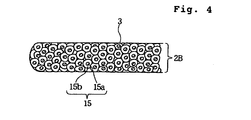
- Fig. 4 is a partial cross-sectional view of still another embodiment of the tampon of the invention.
- the respective small fiber agglomerations 15 constituting the absorbent 2B are composed of a core 15a (hatched portion) and a shell 15b that surrounds the core 15a (i.e., the small fiber agglomeration is of a core/shell structure).
- the core 15a and the shell 15b are both formed of cellulosic fibers alone, or may be formed of a combination of cellulosic fibers and noncellulosic fibers uniformly mixed in a ratio by mass falling between 0.5:1 and 4:1. In this embodiment, however, the fiber density of the core 15a is higher than that of the shell 15b.
- the individual small fiber agglomerations 15 in this embodiment rapidly absorb menstrual discharges at the shell 15b, and the thus-absorbed discharges are then immediately led to the core 15a.
- the shells 15b have absorbed menstrual discharges, the hydrogen bonding between the fiber agglomerations 15 is broken, and, as a result, the thus-released fiber agglomerations could be relatively free for their individual behavior.
- the cores 15a having a higher density are well restored to their original condition. Therefore, when having absorbed menstrual discharges, the individual fiber agglomerations 15 ensures good bulk recovery and, as a result, the absorbent 2B well expands as a whole to thereby surely block the space between the inner wall of the vagina.
- Both the core 15a and the shell 15b constituting each small fiber agglomeration 15 may be formed of a mixture of cellulosic fibers and noncellulosic fibers; and the noncellulosic fiber content of the core 15a may be larger than that of the shell 15b.
- the shell 15b may be formed of cellulosic fibers alone, and the core 15a may be formed of noncellulosic fibers alone, or of a mixture of noncellulosic fibers and cellulosic fibers.
- the fiber density of the core 15a is not always required to be higher than that of the shell 15b. For these, it is desirable that the core 15a and the shell 15b are formed by winding up the fibers.
- each small fiber agglomeration 15 since the shell 15b of each small fiber agglomeration 15 is essentially formed of cellulosic fibers, the individual fiber agglomerations 15 can rapidly absorb menstrual discharges. After the hydrogen bonding between the fiber agglomerations 15 having thus absorbed discharges has been broken and the thus-released agglomerations 15 have become relatively free for their individual behavior, the noncellulosic fibers essentially constituting the core 15a and having high elastic recovery could be readily unwound, and the individual fiber agglomerations 15 will well restore to their original, noncompressed condition. In that condition, the absorbent 2B well expands to fit in the vagina.
- the agglomerations 10, 11 and 15 may be combined in any desired manner.
- the fiber agglomerations 15 of Fig. 4 may be used for the fiber agglomerations in the peripheral region of the absorbent 2A of Fig. 3 or for those in the center region of the absorbent 2A of Fig. 3.
- the density of the small fiber agglomerations in the center region may be made higher than that of the small fiber agglomerations in the peripheral region; or the noncellulosic fiber content of the cores 15a of the small fiber agglomerations in the center region may be made higher than that of the cores 15a of the small fiber agglomerations in the peripheral region.
- the tampon of the invention is so constituted that the hydrogen bonding of the small fiber agglomerations constituting it is broken when the tampon has absorbed the menstrual discharges, and the thus-released fiber agglomerations can exhibit their individual behavior. Therefore, when inserted into the vagina, the tampon well fits therein, not forming space from the inner wall of the vagina, and the menstrual discharges do not leak out therethrough.
- the tampon of the illustrated embodiment can rapidly absorb the menstrual discharges, and can rapidly expand to fit in the vagina.
- the center region of the tampon is formed of small fiber agglomerations containing a large quantity of noncellulosic fibers, the bulk recovery of the tampon having absorbed the menstrual discharges is increased. Therefore, the tampon of the illustrated embodiment facilitates fitting in the vagina, not forming a space from the inner wall of the vagina.
- the tampon facilitates fitting in the vagina, not forming a space from the inner wall of the vagina.
Landscapes
- Health & Medical Sciences (AREA)
- Public Health (AREA)
- General Health & Medical Sciences (AREA)
- Veterinary Medicine (AREA)
- Epidemiology (AREA)
- Engineering & Computer Science (AREA)
- Life Sciences & Earth Sciences (AREA)
- Animal Behavior & Ethology (AREA)
- Vascular Medicine (AREA)
- Heart & Thoracic Surgery (AREA)
- Biomedical Technology (AREA)
- Hematology (AREA)
- Chemical & Material Sciences (AREA)
- Materials Engineering (AREA)
- Absorbent Articles And Supports Therefor (AREA)
Claims (8)
- Tampon hygiénique (1) comprenant un absorbant enveloppé par une feuille perméable aux liquides (3), dans lequel
l'absorbant (2) est une masse d'une pluralité de petites agglomérations de fibres compressées (8), au moins les petites agglomérations de fibres situées dans la région périphérique de l'absorbant étant liées les unes aux autres par l'intermédiaire d'une liaison hydrogène entre celles-ci. - Tampon hygiénique selon la revendication 1, dans lequel la densité des petites agglomérations de fibres (11) situées dans la région centrale de l'absorbant est supérieure à celle des petites agglomérations de fibres (10) situées dans sa région périphérique.
- Tampon hygiénique selon la revendication 2, dans lequel les petites agglomérations de fibres situées dans la région centrale de l'absorbant sont formées de fibres non cellulosiques seules, ou d'une combinaison de fibres cellulosiques et de fibres non cellulosiques, tandis que les petites agglomérations de fibres situées dans la région périphérique de l'absorbant sont formées de fibres cellulosiques seules, ou d'une combinaison de fibres cellulosiques et de fibres non cellulosiques, et les petites agglomérations de fibres situées dans la région centrale de l'absorbant contiennent une quantité plus importante de fibres non cellulosiques que celles situées dans sa région périphérique.
- Tampon hygiénique selon l'une quelconque des revendications précédentes, dans lequel chacune des petites agglomérations de fibres (15) a une structure à noyau/enveloppe, la densité du noyau (15a) d'une petite agglomération de fibres étant supérieure à celle de l'enveloppe (15b) de celle-ci.
- Tampon hygiénique selon la revendication 4, dans lequel le noyau d'une petite agglomération de fibres est formé de fibres non cellulosiques seules, ou d'une combinaison de fibres cellulosiques et de fibres non cellulosiques, tandis que son enveloppe est formée de fibres cellulosiques seules, ou d'une combinaison de fibres cellulosiques et de fibres non cellulosiques, et le noyau contient une quantité plus importante de fibres non cellulosiques que l'enveloppe.
- Tampon hygiénique selon la revendication 5, dans lequel les petites agglomérations de fibres contiennent à la fois des fibres cellulosiques et des fibres non cellulosiques, suivant un rapport de mélange de fibres cellulosiques sur les fibres non cellulosiques s'inscrivant entre 0,5:1 et 4:1.
- Tampon hygiénique selon l'une quelconque des revendications précédentes, dans lequel la densité moyenne de fibres de l'absorbant s'inscrit entre 0,2 et 0,9 g/cm3.
- Tampon hygiénique selon l'une quelconque des revendications précédentes, dans lequel les petites agglomérations de fibres sont formées en enroulant les fibres.
Priority Applications (1)
| Application Number | Priority Date | Filing Date | Title |
|---|---|---|---|
| EP05017726A EP1649844A3 (fr) | 2000-02-02 | 2001-01-30 | Tampon hygiénique avec des fibres courtes agglomérées |
Applications Claiming Priority (2)
| Application Number | Priority Date | Filing Date | Title |
|---|---|---|---|
| JP2000024663A JP3725388B2 (ja) | 2000-02-02 | 2000-02-02 | 繊維塊を有する生理用タンポン |
| JP2000024663 | 2000-02-02 |
Related Child Applications (1)
| Application Number | Title | Priority Date | Filing Date |
|---|---|---|---|
| EP05017726A Division EP1649844A3 (fr) | 2000-02-02 | 2001-01-30 | Tampon hygiénique avec des fibres courtes agglomérées |
Publications (3)
| Publication Number | Publication Date |
|---|---|
| EP1121915A2 EP1121915A2 (fr) | 2001-08-08 |
| EP1121915A3 EP1121915A3 (fr) | 2003-03-19 |
| EP1121915B1 true EP1121915B1 (fr) | 2006-08-23 |
Family
ID=18550612
Family Applications (2)
| Application Number | Title | Priority Date | Filing Date |
|---|---|---|---|
| EP01300819A Expired - Lifetime EP1121915B1 (fr) | 2000-02-02 | 2001-01-30 | Tampon hygiènique avec de fibres courtes agglomérées |
| EP05017726A Withdrawn EP1649844A3 (fr) | 2000-02-02 | 2001-01-30 | Tampon hygiénique avec des fibres courtes agglomérées |
Family Applications After (1)
| Application Number | Title | Priority Date | Filing Date |
|---|---|---|---|
| EP05017726A Withdrawn EP1649844A3 (fr) | 2000-02-02 | 2001-01-30 | Tampon hygiénique avec des fibres courtes agglomérées |
Country Status (13)
| Country | Link |
|---|---|
| US (1) | US6533771B2 (fr) |
| EP (2) | EP1121915B1 (fr) |
| JP (1) | JP3725388B2 (fr) |
| KR (1) | KR100695701B1 (fr) |
| CN (1) | CN1160032C (fr) |
| AU (1) | AU776490B2 (fr) |
| BR (1) | BR0100319B1 (fr) |
| CA (1) | CA2332741C (fr) |
| DE (1) | DE60122399T2 (fr) |
| ID (1) | ID29119A (fr) |
| MY (1) | MY126106A (fr) |
| SG (1) | SG101952A1 (fr) |
| TW (1) | TW497412U (fr) |
Families Citing this family (19)
| Publication number | Priority date | Publication date | Assignee | Title |
|---|---|---|---|---|
| US6814722B2 (en) * | 2000-03-06 | 2004-11-09 | Playtex Products, Inc. | Pre-expanded tampon pledget |
| US20020120246A1 (en) * | 2000-12-20 | 2002-08-29 | Herve Buzot | Bag-type tampon containing compressed fibrous material |
| US20020143303A1 (en) * | 2001-03-30 | 2002-10-03 | Antoinette Intravartolo | Removal string attachment for intravaginal devices |
| DE10163114B4 (de) * | 2001-12-24 | 2005-03-31 | Johnson & Johnson Gmbh | Tampon, insbesondere für die Frauenhygiene |
| JP4520780B2 (ja) * | 2004-07-09 | 2010-08-11 | クリエーティブカミヤ株式会社 | 吸収帯 |
| US7713253B2 (en) * | 2004-07-28 | 2010-05-11 | The Procter & Gamble Company | Deformable tampon comprising an inner wrap and outer wrap |
| US7517321B2 (en) * | 2005-01-31 | 2009-04-14 | C. R. Bard, Inc. | Quick cycle biopsy system |
| BRPI0520364B1 (pt) * | 2005-06-28 | 2016-02-10 | Sca Hygiene Prod Ab | tampão compreendendo fibras de viscose multi-ramificadas |
| DE102005042012B4 (de) * | 2005-09-02 | 2010-06-10 | Drescher, Rüdiger | Tampon |
| DE102007050750B4 (de) * | 2007-10-22 | 2009-11-19 | Schlote, Manfred F. | Körper zum Spreizen von Körperabschnitten und Aufnehmen von Ausscheidungen |
| US20090281474A1 (en) * | 2008-05-07 | 2009-11-12 | Playtex Products, Inc. | Tampon pledget having improved expansion and process for producing same |
| DE102008061536A1 (de) | 2008-12-03 | 2010-06-10 | Aesculap Ag | Medizintechnischer Saugkörper, insbesondere zur Entfernung von Wundflüssigkeiten aus menschlichen und/oder tierischen Körperhöhlen |
| US20190099303A1 (en) * | 2017-09-11 | 2019-04-04 | The Procter & Gamble Company | Disposable Absorbent Article |
| WO2019069881A1 (fr) * | 2017-10-03 | 2019-04-11 | 花王株式会社 | Absorbant et article absorbant |
| JP6524189B2 (ja) * | 2017-10-03 | 2019-06-05 | 花王株式会社 | 吸収体及び吸収性物品 |
| JP6990095B2 (ja) * | 2017-11-28 | 2022-01-12 | 花王株式会社 | 吸収体及び吸収性物品 |
| CN107802407A (zh) * | 2017-11-30 | 2018-03-16 | 大连欧派科技有限公司 | 卫生棉条 |
| CN112955101B (zh) * | 2018-10-29 | 2022-06-24 | 尤妮佳股份有限公司 | 卫生棉条 |
| CN114246734A (zh) * | 2020-09-24 | 2022-03-29 | 祯佶祥实业股份有限公司 | 具有泡绵吸收体的垫体及卫生棉条 |
Family Cites Families (15)
| Publication number | Priority date | Publication date | Assignee | Title |
|---|---|---|---|---|
| US3900378A (en) * | 1971-11-01 | 1975-08-19 | Union Carbide Corp | Hydrogels from radiation crosslinked blends of hydrophilic polymers and fillers |
| US3815601A (en) * | 1972-05-17 | 1974-06-11 | Procter & Gamble | Catamenial aggregate absorbent body |
| DE2503276C2 (de) * | 1975-01-28 | 1978-08-31 | Vereinigte Papierwerke Schickedanz & Co, 8500 Nuernberg | Beuteltampon |
| US4239043A (en) * | 1978-11-29 | 1980-12-16 | The Procter & Gamble Company | Absorbent means for catamenial devices |
| US4278088A (en) * | 1979-10-22 | 1981-07-14 | Kimberly-Clark Corporation | Bag tampon containing discrete pieces of absorbent |
| US4341215A (en) * | 1980-09-04 | 1982-07-27 | Tampax Incorporated | Absorbent device |
| US4475911A (en) | 1981-04-13 | 1984-10-09 | The Procter & Gamble Company | Absorbent devices |
| US4543098A (en) * | 1982-12-23 | 1985-09-24 | Kimberly-Clark Corporation | Tampon with resilient component and microfiber insert |
| NZ209483A (en) | 1983-09-23 | 1987-08-31 | Personal Products Co | Compressed absorbent aggregate; superabsorbent material with hydrophilic filler |
| JPS62236547A (ja) | 1986-04-09 | 1987-10-16 | 花王株式会社 | タンポン |
| JPH01146548A (ja) | 1987-12-02 | 1989-06-08 | Kao Corp | タンポン |
| DE3934153A1 (de) * | 1989-10-12 | 1991-04-18 | Johnson & Johnson Gmbh | Tampon, insbesondere fuer die frauenhygiene, sowie verfahren und vorrichtung zur herstellung desselben |
| JP3146058B2 (ja) | 1991-04-05 | 2001-03-12 | 株式会社東芝 | 並列処理型プロセッサシステムおよび並列処理型プロセッサシステムの制御方法 |
| JP3112726B2 (ja) | 1991-09-12 | 2000-11-27 | ユニ・チャーム株式会社 | 生理用タンポン |
| SE508626C2 (sv) * | 1994-12-30 | 1998-10-19 | Sca Hygiene Prod Ab | Ett material med hög absorptionskapacitet samt en absorberande struktur och ett absorberande alster innefattande materialet ifråga |
-
2000
- 2000-02-02 JP JP2000024663A patent/JP3725388B2/ja not_active Expired - Fee Related
-
2001
- 2001-01-26 US US09/770,557 patent/US6533771B2/en not_active Expired - Lifetime
- 2001-01-30 DE DE60122399T patent/DE60122399T2/de not_active Expired - Lifetime
- 2001-01-30 EP EP01300819A patent/EP1121915B1/fr not_active Expired - Lifetime
- 2001-01-30 MY MYPI20010382A patent/MY126106A/en unknown
- 2001-01-30 SG SG200100452A patent/SG101952A1/en unknown
- 2001-01-30 EP EP05017726A patent/EP1649844A3/fr not_active Withdrawn
- 2001-01-30 CA CA002332741A patent/CA2332741C/fr not_active Expired - Fee Related
- 2001-02-01 KR KR1020010004790A patent/KR100695701B1/ko not_active Expired - Fee Related
- 2001-02-01 TW TW090201636U patent/TW497412U/zh not_active IP Right Cessation
- 2001-02-01 AU AU16775/01A patent/AU776490B2/en not_active Ceased
- 2001-02-02 ID IDP20010105D patent/ID29119A/id unknown
- 2001-02-02 BR BRPI0100319-4A patent/BR0100319B1/pt not_active IP Right Cessation
- 2001-02-02 CN CNB011168722A patent/CN1160032C/zh not_active Expired - Fee Related
Also Published As
| Publication number | Publication date |
|---|---|
| KR100695701B1 (ko) | 2007-03-19 |
| TW497412U (en) | 2002-08-01 |
| BR0100319A (pt) | 2001-10-09 |
| EP1121915A3 (fr) | 2003-03-19 |
| US6533771B2 (en) | 2003-03-18 |
| DE60122399D1 (de) | 2006-10-05 |
| JP3725388B2 (ja) | 2005-12-07 |
| EP1649844A2 (fr) | 2006-04-26 |
| AU776490B2 (en) | 2004-09-09 |
| EP1649844A3 (fr) | 2010-03-03 |
| KR20010078232A (ko) | 2001-08-20 |
| CN1160032C (zh) | 2004-08-04 |
| CA2332741C (fr) | 2008-07-29 |
| DE60122399T2 (de) | 2007-08-23 |
| CN1313073A (zh) | 2001-09-19 |
| CA2332741A1 (fr) | 2001-08-02 |
| JP2001212173A (ja) | 2001-08-07 |
| AU1677501A (en) | 2001-08-09 |
| US20010012929A1 (en) | 2001-08-09 |
| ID29119A (id) | 2001-08-02 |
| BR0100319B1 (pt) | 2009-05-05 |
| EP1121915A2 (fr) | 2001-08-08 |
| MY126106A (en) | 2006-09-29 |
| SG101952A1 (en) | 2004-02-27 |
Similar Documents
| Publication | Publication Date | Title |
|---|---|---|
| EP1121915B1 (fr) | Tampon hygiènique avec de fibres courtes agglomérées | |
| US3986511A (en) | Intravaginal sanitary device | |
| EP1171072B1 (fr) | Tampon avec protection amelioree contre les fuites | |
| US3981305A (en) | Low density tampon of intermeshed deformable strip material and inserter therefor | |
| JP4532049B2 (ja) | 乾燥膨張性タンポン材とその製造方法 | |
| EP0062948A1 (fr) | Structures absorbantes | |
| US20080154174A1 (en) | Absorbent tampon having outer petals | |
| US6186994B1 (en) | Layered tampon | |
| JP2007537022A (ja) | 柔軟性パネルを備えたタンポン | |
| WO2005077312A1 (fr) | Tampon hygienique a rainures decalees | |
| WO2005112863A1 (fr) | Tampon dote d'une partie surelevee large et d'une partie surelevee etroite adjacentes | |
| WO2005051257A2 (fr) | Tampon comportant des parties renfoncees | |
| WO2005051266A2 (fr) | Tampon comportant des parties surelevees | |
| JP2010057928A (ja) | 予め膨張されたタンポンプレジット | |
| KR20030093293A (ko) | 질강내 삽입용 흡수 기구 | |
| MXPA03005746A (es) | Tampon tipo bolsa que contiene un material fibroso comprimido. | |
| US20050090794A1 (en) | Tampon with enhanced leakage protection | |
| CA1040353A (fr) | Tampon a faible densite fait de bandes d'un materiau entremaille deformable | |
| MXPA01001086A (en) | Layered tampon | |
| AU2002245147A1 (en) | Bag-type tampon containing compressed fibrous material |
Legal Events
| Date | Code | Title | Description |
|---|---|---|---|
| PUAI | Public reference made under article 153(3) epc to a published international application that has entered the european phase |
Free format text: ORIGINAL CODE: 0009012 |
|
| AK | Designated contracting states |
Kind code of ref document: A2 Designated state(s): AT BE CH CY DE DK ES FI FR GB GR IE IT LI LU MC NL PT SE TR |
|
| AX | Request for extension of the european patent |
Free format text: AL;LT;LV;MK;RO;SI |
|
| PUAL | Search report despatched |
Free format text: ORIGINAL CODE: 0009013 |
|
| AK | Designated contracting states |
Kind code of ref document: A3 Designated state(s): AT BE CH CY DE DK ES FI FR GB GR IE IT LI LU MC NL PT SE TR |
|
| AX | Request for extension of the european patent |
Extension state: AL LT LV MK RO SI |
|
| 17P | Request for examination filed |
Effective date: 20030626 |
|
| AKX | Designation fees paid |
Designated state(s): DE FR GB IT NL SE |
|
| RAP1 | Party data changed (applicant data changed or rights of an application transferred) |
Owner name: UNI-CHARM CORPORATION |
|
| 17Q | First examination report despatched |
Effective date: 20050415 |
|
| GRAP | Despatch of communication of intention to grant a patent |
Free format text: ORIGINAL CODE: EPIDOSNIGR1 |
|
| GRAS | Grant fee paid |
Free format text: ORIGINAL CODE: EPIDOSNIGR3 |
|
| GRAA | (expected) grant |
Free format text: ORIGINAL CODE: 0009210 |
|
| AK | Designated contracting states |
Kind code of ref document: B1 Designated state(s): DE FR GB IT NL SE |
|
| PG25 | Lapsed in a contracting state [announced via postgrant information from national office to epo] |
Ref country code: IT Free format text: LAPSE BECAUSE OF FAILURE TO SUBMIT A TRANSLATION OF THE DESCRIPTION OR TO PAY THE FEE WITHIN THE PRESCRIBED TIME-LIMIT;WARNING: LAPSES OF ITALIAN PATENTS WITH EFFECTIVE DATE BEFORE 2007 MAY HAVE OCCURRED AT ANY TIME BEFORE 2007. THE CORRECT EFFECTIVE DATE MAY BE DIFFERENT FROM THE ONE RECORDED. Effective date: 20060823 |
|
| REG | Reference to a national code |
Ref country code: GB Ref legal event code: FG4D |
|
| REF | Corresponds to: |
Ref document number: 60122399 Country of ref document: DE Date of ref document: 20061005 Kind code of ref document: P |
|
| REG | Reference to a national code |
Ref country code: SE Ref legal event code: TRGR |
|
| ET | Fr: translation filed | ||
| PLBE | No opposition filed within time limit |
Free format text: ORIGINAL CODE: 0009261 |
|
| STAA | Information on the status of an ep patent application or granted ep patent |
Free format text: STATUS: NO OPPOSITION FILED WITHIN TIME LIMIT |
|
| 26N | No opposition filed |
Effective date: 20070524 |
|
| PGFP | Annual fee paid to national office [announced via postgrant information from national office to epo] |
Ref country code: IT Payment date: 20120117 Year of fee payment: 12 |
|
| PGFP | Annual fee paid to national office [announced via postgrant information from national office to epo] |
Ref country code: GB Payment date: 20130130 Year of fee payment: 13 Ref country code: FR Payment date: 20130204 Year of fee payment: 13 Ref country code: DE Payment date: 20130123 Year of fee payment: 13 Ref country code: SE Payment date: 20130114 Year of fee payment: 13 |
|
| PGFP | Annual fee paid to national office [announced via postgrant information from national office to epo] |
Ref country code: NL Payment date: 20130116 Year of fee payment: 13 |
|
| REG | Reference to a national code |
Ref country code: DE Ref legal event code: R119 Ref document number: 60122399 Country of ref document: DE |
|
| REG | Reference to a national code |
Ref country code: NL Ref legal event code: V1 Effective date: 20140801 |
|
| REG | Reference to a national code |
Ref country code: SE Ref legal event code: EUG |
|
| GBPC | Gb: european patent ceased through non-payment of renewal fee |
Effective date: 20140130 |
|
| REG | Reference to a national code |
Ref country code: DE Ref legal event code: R119 Ref document number: 60122399 Country of ref document: DE Effective date: 20140801 |
|
| PG25 | Lapsed in a contracting state [announced via postgrant information from national office to epo] |
Ref country code: NL Free format text: LAPSE BECAUSE OF NON-PAYMENT OF DUE FEES Effective date: 20140801 Ref country code: DE Free format text: LAPSE BECAUSE OF NON-PAYMENT OF DUE FEES Effective date: 20140801 |
|
| REG | Reference to a national code |
Ref country code: FR Ref legal event code: ST Effective date: 20140930 |
|
| PG25 | Lapsed in a contracting state [announced via postgrant information from national office to epo] |
Ref country code: SE Free format text: LAPSE BECAUSE OF NON-PAYMENT OF DUE FEES Effective date: 20140131 Ref country code: GB Free format text: LAPSE BECAUSE OF NON-PAYMENT OF DUE FEES Effective date: 20140130 Ref country code: FR Free format text: LAPSE BECAUSE OF NON-PAYMENT OF DUE FEES Effective date: 20140131 |
|
| PG25 | Lapsed in a contracting state [announced via postgrant information from national office to epo] |
Ref country code: IT Free format text: LAPSE BECAUSE OF NON-PAYMENT OF DUE FEES Effective date: 20140130 |