EP1121973B1 - Mesure intelligente de la qualité et système pour la surveillance - Google Patents
Mesure intelligente de la qualité et système pour la surveillance Download PDFInfo
- Publication number
- EP1121973B1 EP1121973B1 EP00101646A EP00101646A EP1121973B1 EP 1121973 B1 EP1121973 B1 EP 1121973B1 EP 00101646 A EP00101646 A EP 00101646A EP 00101646 A EP00101646 A EP 00101646A EP 1121973 B1 EP1121973 B1 EP 1121973B1
- Authority
- EP
- European Patent Office
- Prior art keywords
- dispersion
- measurement
- unit
- measurement sensor
- degree
- Prior art date
- Legal status (The legal status is an assumption and is not a legal conclusion. Google has not performed a legal analysis and makes no representation as to the accuracy of the status listed.)
- Expired - Lifetime
Links
- 238000005259 measurement Methods 0.000 title claims description 86
- 239000006185 dispersion Substances 0.000 claims description 87
- 238000011156 evaluation Methods 0.000 claims description 38
- 238000013507 mapping Methods 0.000 claims description 19
- 238000000034 method Methods 0.000 claims description 15
- 238000009826 distribution Methods 0.000 claims description 7
- 239000000084 colloidal system Substances 0.000 claims description 5
- 238000010521 absorption reaction Methods 0.000 claims description 3
- 238000000691 measurement method Methods 0.000 claims description 3
- 238000000265 homogenisation Methods 0.000 description 26
- 238000012545 processing Methods 0.000 description 18
- 238000004519 manufacturing process Methods 0.000 description 12
- 239000002245 particle Substances 0.000 description 8
- 230000008878 coupling Effects 0.000 description 6
- 238000010168 coupling process Methods 0.000 description 6
- 238000005859 coupling reaction Methods 0.000 description 6
- 230000000694 effects Effects 0.000 description 5
- 239000008267 milk Substances 0.000 description 5
- 235000013336 milk Nutrition 0.000 description 5
- 210000004080 milk Anatomy 0.000 description 5
- 238000012360 testing method Methods 0.000 description 5
- 238000013459 approach Methods 0.000 description 4
- 239000000839 emulsion Substances 0.000 description 4
- XLYOFNOQVPJJNP-UHFFFAOYSA-N water Substances O XLYOFNOQVPJJNP-UHFFFAOYSA-N 0.000 description 4
- 230000008901 benefit Effects 0.000 description 3
- 238000010790 dilution Methods 0.000 description 3
- 239000012895 dilution Substances 0.000 description 3
- 235000019625 fat content Nutrition 0.000 description 3
- 230000008569 process Effects 0.000 description 3
- 238000009795 derivation Methods 0.000 description 2
- 238000010586 diagram Methods 0.000 description 2
- 235000012041 food component Nutrition 0.000 description 2
- 239000007788 liquid Substances 0.000 description 2
- 238000002156 mixing Methods 0.000 description 2
- 239000000203 mixture Substances 0.000 description 2
- 238000012986 modification Methods 0.000 description 2
- 230000004048 modification Effects 0.000 description 2
- 238000004611 spectroscopical analysis Methods 0.000 description 2
- 238000004458 analytical method Methods 0.000 description 1
- 238000000149 argon plasma sintering Methods 0.000 description 1
- 238000004140 cleaning Methods 0.000 description 1
- 238000004581 coalescence Methods 0.000 description 1
- 238000012937 correction Methods 0.000 description 1
- 239000002537 cosmetic Substances 0.000 description 1
- 235000013365 dairy product Nutrition 0.000 description 1
- 230000004069 differentiation Effects 0.000 description 1
- 239000002270 dispersing agent Substances 0.000 description 1
- 238000011143 downstream manufacturing Methods 0.000 description 1
- 239000003814 drug Substances 0.000 description 1
- 238000005516 engineering process Methods 0.000 description 1
- 230000008713 feedback mechanism Effects 0.000 description 1
- 235000013305 food Nutrition 0.000 description 1
- 239000005417 food ingredient Substances 0.000 description 1
- 230000006872 improvement Effects 0.000 description 1
- 238000012625 in-situ measurement Methods 0.000 description 1
- 239000004615 ingredient Substances 0.000 description 1
- 230000010354 integration Effects 0.000 description 1
- 235000021581 juice product Nutrition 0.000 description 1
- 239000000463 material Substances 0.000 description 1
- 238000005191 phase separation Methods 0.000 description 1
- 230000002028 premature Effects 0.000 description 1
- 238000004886 process control Methods 0.000 description 1
- 238000004062 sedimentation Methods 0.000 description 1
- 238000000926 separation method Methods 0.000 description 1
- 238000010008 shearing Methods 0.000 description 1
- 239000000243 solution Substances 0.000 description 1
- 239000003381 stabilizer Substances 0.000 description 1
- 238000003860 storage Methods 0.000 description 1
- 239000000725 suspension Substances 0.000 description 1
- -1 sweeties Substances 0.000 description 1
- 238000011144 upstream manufacturing Methods 0.000 description 1
Images

Classifications
-
- G—PHYSICS
- G01—MEASURING; TESTING
- G01N—INVESTIGATING OR ANALYSING MATERIALS BY DETERMINING THEIR CHEMICAL OR PHYSICAL PROPERTIES
- G01N15/00—Investigating characteristics of particles; Investigating permeability, pore-volume or surface-area of porous materials
- G01N15/02—Investigating particle size or size distribution
- G01N15/0205—Investigating particle size or size distribution by optical means
-
- B—PERFORMING OPERATIONS; TRANSPORTING
- B01—PHYSICAL OR CHEMICAL PROCESSES OR APPARATUS IN GENERAL
- B01F—MIXING, e.g. DISSOLVING, EMULSIFYING OR DISPERSING
- B01F23/00—Mixing according to the phases to be mixed, e.g. dispersing or emulsifying
- B01F23/50—Mixing liquids with solids
- B01F23/56—Mixing liquids with solids by introducing solids in liquids, e.g. dispersing or dissolving
-
- B—PERFORMING OPERATIONS; TRANSPORTING
- B01—PHYSICAL OR CHEMICAL PROCESSES OR APPARATUS IN GENERAL
- B01F—MIXING, e.g. DISSOLVING, EMULSIFYING OR DISPERSING
- B01F35/00—Accessories for mixers; Auxiliary operations or auxiliary devices; Parts or details of general application
- B01F35/20—Measuring; Control or regulation
- B01F35/21—Measuring
- B01F35/213—Measuring of the properties of the mixtures, e.g. temperature, density or colour
-
- G—PHYSICS
- G01—MEASURING; TESTING
- G01N—INVESTIGATING OR ANALYSING MATERIALS BY DETERMINING THEIR CHEMICAL OR PHYSICAL PROPERTIES
- G01N29/00—Investigating or analysing materials by the use of ultrasonic, sonic or infrasonic waves; Visualisation of the interior of objects by transmitting ultrasonic or sonic waves through the object
- G01N29/02—Analysing fluids
- G01N29/032—Analysing fluids by measuring attenuation of acoustic waves
-
- B—PERFORMING OPERATIONS; TRANSPORTING
- B01—PHYSICAL OR CHEMICAL PROCESSES OR APPARATUS IN GENERAL
- B01F—MIXING, e.g. DISSOLVING, EMULSIFYING OR DISPERSING
- B01F23/00—Mixing according to the phases to be mixed, e.g. dispersing or emulsifying
- B01F23/40—Mixing liquids with liquids; Emulsifying
- B01F23/41—Emulsifying
-
- G—PHYSICS
- G01—MEASURING; TESTING
- G01N—INVESTIGATING OR ANALYSING MATERIALS BY DETERMINING THEIR CHEMICAL OR PHYSICAL PROPERTIES
- G01N2291/00—Indexing codes associated with group G01N29/00
- G01N2291/02—Indexing codes associated with the analysed material
- G01N2291/022—Liquids
- G01N2291/0222—Binary liquids
-
- G—PHYSICS
- G01—MEASURING; TESTING
- G01N—INVESTIGATING OR ANALYSING MATERIALS BY DETERMINING THEIR CHEMICAL OR PHYSICAL PROPERTIES
- G01N2291/00—Indexing codes associated with group G01N29/00
- G01N2291/02—Indexing codes associated with the analysed material
- G01N2291/024—Mixtures
- G01N2291/02416—Solids in liquids
Definitions
- the present invention relates to an intelligent quality measurement and supervision system, and in particular to the measurement of an homogenizing degree for a dispersion in an online manner according to the preamble of claim 1.
- dispersion is a general term covering emulsions - i.e. a mixture of different liquids - and suspensions - i.e. a mixture of particles into at least one liquid.
- Dispersions are, e.g., used in the field of production of dairy products, delicatessen, basic materials, sweeties, pharmaceuticals, cosmetics, nurse products, juice products, further food ingredients.
- dispersions are produced in a homogenizer using the principle of high-pressure expansion.
- the homogenizer comprises a high-pressure reciprocating pump with an expansion unit attached to the output thereof.
- the reciprocating pump the dispersion is compressed to high pressure and subsequent thereto the product is again expanded, e.g., in a homogenizing valve comprising two parts to define an adjustable precision gap.
- a homogenizing valve comprising two parts to define an adjustable precision gap.
- the flowing dispersion is accelerated and subjected to a strong turbulence. This leads to high shearing strength and thus to a dispersion of the particle in a sub-microscopic range and further to an intense mixing process.
- dispersions may be produced using a colloid mill where the size or particles in dispersion is reduced using a frictional effect, e.g., between two surfaces carrying out a relative movement with respect to each other.
- a homogenizing process improves the characteristic of a dispersion.
- Typical effects are a homogeneous distribution, the avoidance of creaming or sedimentation of the dispersed phase during a long period of time and thus the increase of the physical storage stability.
- homogenization serves to suppress premature coalescence and phase separation, further to desintegrate desagglomerate, to achieve fibrillate fibrous components, to improve the colour of the product, to improve the mixing and dilution capability and further to optimize the rheological characteristics.
- the related product quality e.g., may be measured only indirectly via the homogenization degree.
- this determination of the homogenizing degree is carried out offline. This means that at defined places in the production line samples are taken at predetermined times and then examined in a laboratory. Therefore, the results are only available with a high time delay. Eventual deviations or disturbances in the product quality - in particular of the physical stability - may only be detected and compensated for with a long delay.
- DE-A-33 19 922 there is disclosed a system for the supervision of the quality of a dispersion having at least one measurement sensor adapted to measure the homogenizing degree of the dispersion, wherein the measurement sensor is connected with a dispersing unit.
- the object of the invention is to provide a system for the real time supervision of a homogenizing degree.
- this object is achieved with the supervision system for the quality of a dispersion having the features of claim 1.
- the use of the measurement sensor for online measurement being connected to the dispersion unit allows for an improved quality measurement and supervision functionality.
- the online measurement avoids a delay between identification of problems and the correction of the underlying fault, and thus the production of dispersion in the dispersion unit that does not fulfil predetermined quality standards.
- the measurement sensor may be realized in a cost-effective manner so that the inventive coupling of such a measurement sensor to the dispersion unit allows to achieve the improved measurement quality at reduced costs.
- Another important advantage of the present invention is the decoupling of the actual measurement step and the evaluation of the measured quantity.
- the evaluation unit is provided separately it is possible to achieve a more flexible evaluation of the measured quantity, i.e., through configuration according to characteristic parameters of the dispersion, e.g. fat content of milk as one typical example for a dispersion to be processed.
- the measurement sensor is not restricted to the output of only a single measured quantity but it may also be adapted to output a plurality of measured quantities, e.g., defining a characteristic distribution for the dispersion flowing in the dispersion unit. In this case it is possible to achieve an improved measurement of the homogenizing degree since additional measured data and thus additional information is available for subsequent processing.
- a configurable mapping means adapted to map the characteristic value output through the evaluation unit to characteristic data defining the homogenizing degree of the dispersion in the dispersing unit.
- the mapping means is configured according to the characteristics of the dispersion.
- this mapping unit allows to further process the at least one characteristic value output by the evaluation unit to achieve the desired homogenizing degree.
- This differentiation between the actual processing of the measured quantity and the mapping thereof into the characteristic value and the subsequent mapping of the characteristic value into characteristic data defining the homogenizing degree allows for increased modularity of the overall system for the supervision of the quality of the dispersion in the dispersing unit.
- the determined homogenizing degree is not related to reasonable values, e.g., when processing a test dispersion of which the characteristics are known this may be used as a basis for tuning the evaluation unit before the actual practical application of the supervision system.
- This feedback mechanism may also be used to tune the sensibility of the evaluation unit according to a modified characteristic of the dispersion, e.g., a changed contents of milk or particles size distribution thereof.
- the measurement sensor is arranged in an outlet conduit of a dispersion unit.
- This arrangement allows for an in sito measurement where the measurement sensor is surrounded by the product of which the homogenizing degree is to be measured. Also, another important advantage of this arrangement is that the homogenizing degree may be measured without any modification of the dispersion, i.e., without any dilution thereof. Therefore, the measurement accuracy is further improved.
- a further measurement sensor is arranged in an inlet conduit of the dispersing unit.
- this aspect allows to identify up/downstream processing problems, i.e. problems with respect to the handling of the product upstream or downstream the dispersing unit.
- one aspect underlying the present invention is the use of a measurement sensor outputting a signal in correlation to a homogenization degree of a dispersion flowing in a dispersing unit.
- the measurement sensor is used such that it outputs measurement signals online continuously for immediate subsequent processing.
- the mentioned inventors have found that the direct coupling of a measurement sensor is responsive to a homogenization degree flowing through a dispersion unit. This direct coupling to the dispersion unit allows for an online measurement of the homogenization degree.
- Fig. 1 shows the in-line measurement of the homogenization degree according to the present invention.
- the homogenization degree shown at the ordinate is expressed according to the NIZO method mentioned above.
- the abscissa illustrates the processing time for the dispersing unit processing the dispersion to be measured.
- the dispersion is a 3.5% oil-in-water test emulsion.
- a 3.5% oil-in-water test emulsion is supplied to the dispersion unit and then after a certain time the pressure is set at 100 bar. Therefore, after a certain time the homogenization degree is increased starting from 30% to approximately 70%.
- a further increase of the homogenization degree may be achieved by setting the pressure to 200 bar after approximately 200 sec. and to 300 bar after approximately 350 sec. and further from 300 to 400 bar after approximately 620 sec.
- a further increase e.g., in 100 bar steps, only achieves a reduced improvement in the homogenization degree leading to a maximum homogenization degree of approximately 95%.
- the homogenization degree sharply declines.
- a further degree of the homogenization degree may be observed in case an air alarm is detected, e.g., at approximately 970 sec. of processing time.
- the homogenizing degree further declines in case a cleaning of the dispersing unit is carried out with water.
- a direct coupling of a measurement sensor being responsive to the homogenization degree of the dispersion flowing over the dispersion unit leads to an output signal that immediately follows the different operative conditions in the dispersion unit.
- the direct coupling allows to achieve an indication of the homogenization degree of the dispersion flowing in the dispersion unit.
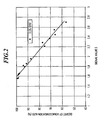
- Fig. 2 shows a correlation between the measure of homogenization degree, e.g., according to the NIZO method and the signal value output by the measurement sensor to be used according to the present invention.
- the ordinate again shows the homogenization degree
- the abscissa shows the signal value S output by the measurement sensor.
- the measurement results shown in Fig. 2 are related to a 3.5% oil-in-water test emulsion.
- the higher the homogenization degree the lower the signal value output by the measurement sensor. Also, there exists a consistent relation between the decrease of the homogenization degree and the increase of the signal value that may be used as a basis for the further processing of the output signal of the measurement sensor.
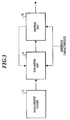
- Fig. 3 shows a schematic diagram of the system for the supervision of the quality of a dispersion flowing over a dispering unit according to the present invention.
- the supervision system 10 comprises the measurement sensor 12 providing an output signal, an evaluation unit 14 connected to the output of the measurement sensor and a mapping unit 16 connected to the output of the evaluation unit 14.
- the measurement sensor 12 is adapted to an online measurement of the homogenization degree of the dispersion and therefore directly connected to a dispersing unit. Therefore, the measurement sensor 12 outputs a measured quantity being related to this homogenization degree in online manner.
- the measurement sensor may be realized, e.g., by using an ultrasonic absorption sensor.
- Another option to realize the measurement sensor is to use laser scattering, laser diffraction or a laser scanning method.
- the measurement sensor may be adapted to either output only a single measured quantity being related to the homogenization degree or even a plurality of measured quantities where each single measured quantity is determined by the homogenizing degree.
- a typical example for the latter case would be a particle size distribution of the dispersion flowing in the dispersing unit. Therefore, the more information is gained by the measurement sensor 12, the better the homogenization degree may be determined.
- the at least one measured quantity output by the measurement sensor 12 is supplied to an evaluation unit 14 where the output of the measurement sensor 12 is converted into at least one characteristic value defining the homogenizing degree.
- the stand-alone evaluation unit 14 allows for a decoupling between the actual measurement and the evaluation of the measurement results, in particular through a configuration of this evaluation unit 14 according to characteristic parameters of the dispersion.
- the output of the configurable evaluation unit 14 is connected to the input of the configurable mapping unit 16 adapted to map the characteristic value output by the evaluation unit 14 into characteristic data finally defining the homogenizing degree of the dispersion unit.
- this mapping unit is configured according to the characteristics of the dispersion.
- the overall system architecture shown in Fig. 3 allows for a decoupling of the processing of the measurement raw data in the evaluation unit 14 and the subsequent handling of a processed measurement signal in the mapping unit 16.
- This decoupling of measurement related evaluation and product specific derivation of the homogenizing degree allows for increased flexibility of the supervision system. This is particular the case since both the evaluation unit 14 and the mapping unit 16 are configurable according to the characteristic values of the dispersion flowing in the dispersing unit.
- this indication may be used to tune the evaluation unit 14 before the actual practical application of the supervision system. Feeding back the result output by the mapping unit 16 to the evaluation unit 14 allows to achieve optimized measurement results, e.g., to tune the sensibility of the evaluation unit 14 to a modified characteristic of the dispersion such as changed fat contents of milk or changed particle size distribution of the dispersion.
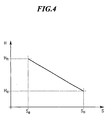
- Fig. 4 shows a characteristic curve for the mapping of the output of the evaluation unit 14 into a homogenizing degree according to the present invention.
- the abscissa shows the homogenizing degree output by the mapping unit 16 and the ordinate shows the characteristic value as processed measurement result output by the evaluation unit 14.
- the upper and lower limit values for the output signal of the evaluation unit 14 are determined in compliance with the characteristic value of the dispersion flowing in the dispersion unit, e.g., fat contents or ingredient such as stabilizers.
- the parameters defining the linear relationship between the homogenizing degree and the output signal of the evaluation unit 14 are determined in compliance with the dispersion and then calibrated using the, e.g., offline measurement method.
- the present invention is not related to a linear relationship for the processing of the output signal of the evaluation unit 14.
- any non-linear or linear relation between the output signal of the measurement sensor 12 and the homogenization degree may be specified as model and applied in a product-specific way.
- Such an extraordinary situation may occur if, e.g., an average value or a standard deviation of a particle size distribution exceeds a related threshold value.
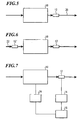
- the dispersion shown in Figs. 5 to 7 may be, e.g., realized as a high pressure homogenizer or a colloid mill.
- the actual selection of the dispersing unit depends on particular constrains for the production of dispersions.
- one basic approach for the coupling of the measurement sensor 12 to the dispersing unit 18 is to provide the measurement sensor in an outlet conduit 20 of the dispersing unit 18.
- the homogenizing degree of the dispersion is detected after processing in the dispersing unit 18.
- the arrangement with the provision of the measurement sensor at the outlet of the dispersing unit allows for an in situ measurement of the dispersion without a modification thereof thus leading to increased measurement accuracy.
- FIG. 6 another option is to provide a further measurement sensor 12' in an inlet conduit 22 of the dispersing unit 18.
- the approach shown in Fig. 6 may be generalized such that a plurality of measurement sensors are provided at different stages in the overall production system (not shown) to receive additional information on the homogenizing degree at different stages in the production line for an overall process control.
- Fig. 7 shows the control of the dispersing unit 18 on the basis of the supervision system according to the present invention.
- the output signal of this mapping unit 16 is applied to an actuator 24 shown in Fig. 7 which then, e.g., modifies the gap in a high pressure homogenizer or the gap and/or revolution number in a colloid mill.
- the different embodiments of the present invention outlined above with respect to Figs. 1 to 7 not only allow to achieve an online measurement of the homogenizing degree of a dispersion in a dispersing unit but also use the measurement result for an inverse or negative feedback control to achieve improved quality of the dispersion finally produced and to avoid any production of a faulty dispersion.
Landscapes
- Chemical & Material Sciences (AREA)
- Physics & Mathematics (AREA)
- Biochemistry (AREA)
- Life Sciences & Earth Sciences (AREA)
- Health & Medical Sciences (AREA)
- Analytical Chemistry (AREA)
- General Health & Medical Sciences (AREA)
- General Physics & Mathematics (AREA)
- Immunology (AREA)
- Pathology (AREA)
- Chemical Kinetics & Catalysis (AREA)
- Dispersion Chemistry (AREA)
- Acoustics & Sound (AREA)
- Investigating Or Analysing Materials By Optical Means (AREA)
Claims (14)
- Système pour la surveillance de la qualité d'une dispersion comprenant :caractérisé en ce queau moins un capteur de mesure (12, 12') conçu pour une mesure en ligne du degré d'homogénéisation de la dispersion, relié à une unité de dispersion (18), oùle capteur de mesure (12, 12') fournit au moins une quantité mesurée à une unité d'évaluation de quantité mesurée configurable (14) convertissant la quantité mesurée en au moins une valeur caractéristique,oùà la sortie de l'unité d'évaluation de quantité mesurée configurable (14), il est prévu un moyen (16) conçu pour le mappage configurable de la valeur caractéristique S en une donnée caractéristique suivant les degrés d'homogénéisation conformément à
 Hu est une valeur limite supérieure pour le degré d'homogénéisation,Hl est une valeur limite inférieure pour le degré d'homogénéisation,Su est une valeur limite supérieure pour le signal de sortie de l'unité d'évaluation (14), etSl est une valeur limite inférieure pour le signal de sortie de l'unité d'évaluation (14).
 - Système selon la revendication 1,
caractérisé en ce que le capteur de mesure (12) est disposé dans un conduit de sortie de l'unité de dispersion. - Système selon la revendication 1 ou 2,
caractérisé en ce qu'un autre capteur de mesure (12') est disposé dans un conduit d'entrée de l'unité de dispersion. - Système selon l'une des revendications 1 à 3,
caractérisé en ce que l'unité de dispersion (18) est un homogénéisateur à haute pression ou un moulin colloïdal. - Système selon la revendication 1, caractérisé en ce que le capteur de mesure (12, 12') détermine la quantité mesurée de l'absorption par ultrasons dans la dispersion.
- Système selon la revendication 1,
caractérisé en ce que le capteur de mesure (12, 12') détermine la quantité mesurée par diffusion laser, diffraction laser ou un procédé de balayage laser. - Système selon les revendications 1, 5 ou 6,
caractérisé en ce que le capteur de mesure (12, 12') fournit en sortie une pluralité de quantités mesurées conformément à une distribution de caractéristiques de la dispersion. - Système selon la revendication 1,
caractérisé en ce que l'unité d'évaluation de valeur mesurée configurable (14) est configurable conformément aux caractéristiques de la dispersion. - Système selon la revendication 4,
caractérisé en ce que la largeur d'espacement de l'homogénéisateur est commandée conformément aux données caractéristiques de la dispersion. - Système selon la revendication 4,
caractérisé en ce que la largeur d'espacement et/ou le nombre de tours du moulin colloïdal est commandé conformément aux données caractéristiques de la dispersion. - Procédé de surveillance de la qualité de la dispersion générée dans une unité de dispersion (18), comprenant l'étape consistant à :caractérisé en ce queexécuter une mesure en ligne du degré d'homogénéisation de la dispersion en utilisant un capteur de mesure (12, 12') disposé dans l'écoulement de dispersion (20, 22),oùil comprend en outre l'étape consistant à mapper la au moins une valeur caractéristique S en des données caractéristiques pour le degré d'homogénéisation en utilisant une courbe de caractéristiques configurable modifiée conformément à la dispersion s'écoulant dans l'unité de dispersion (18) conformément à
 Hu est une valeur limite supérieure pour le degré d'homogénéisation,Hl est une valeur limite inférieure pour le degré d'homogénéisation,Su est une valeur limite supérieure pour la valeur de caractéristique, etSl est une valeur limite inférieure pour la valeur de caractéristique.
 - Procédé selon la revendication 11,
caractérisé en ce que la mesure du degré d'homogénéisation est exécutée en mesurant l'absorption par ultrasons, la diffusion laser, la diffraction laser de la dispersion ou en utilisant un procédé de balayage laser. - Procédé selon la revendication 11 ou 12,
caractérisé en ce que les caractéristiques de dispersion de l'unité de dispersion (18) sont commandées sur la base du degré d'homogénéisation déterminé. - Procédé selon l'une des revendications 11 à 13,
caractérisé en ce qu'il comprend en outre l'étape consistant à vérifier la mesure du degré d'homogénéisation en utilisant un procédé de mesure hors ligne.
Priority Applications (2)
| Application Number | Priority Date | Filing Date | Title |
|---|---|---|---|
| EP00101646A EP1121973B1 (fr) | 2000-02-01 | 2000-02-01 | Mesure intelligente de la qualité et système pour la surveillance |
| DE60015287T DE60015287T2 (de) | 2000-02-01 | 2000-02-01 | Intelligente Qualitätsmessung und System zur Überwachung |
Applications Claiming Priority (1)
| Application Number | Priority Date | Filing Date | Title |
|---|---|---|---|
| EP00101646A EP1121973B1 (fr) | 2000-02-01 | 2000-02-01 | Mesure intelligente de la qualité et système pour la surveillance |
Publications (2)
| Publication Number | Publication Date |
|---|---|
| EP1121973A1 EP1121973A1 (fr) | 2001-08-08 |
| EP1121973B1 true EP1121973B1 (fr) | 2004-10-27 |
Family
ID=8167709
Family Applications (1)
| Application Number | Title | Priority Date | Filing Date |
|---|---|---|---|
| EP00101646A Expired - Lifetime EP1121973B1 (fr) | 2000-02-01 | 2000-02-01 | Mesure intelligente de la qualité et système pour la surveillance |
Country Status (2)
| Country | Link |
|---|---|
| EP (1) | EP1121973B1 (fr) |
| DE (1) | DE60015287T2 (fr) |
Families Citing this family (4)
| Publication number | Priority date | Publication date | Assignee | Title |
|---|---|---|---|---|
| US8070303B2 (en) | 2002-08-08 | 2011-12-06 | Reflexite Corporation | Optical structures including polyurea |
| JP2008100182A (ja) * | 2006-10-20 | 2008-05-01 | Hitachi Plant Technologies Ltd | 乳化装置および微粒子製造装置 |
| IT202300003195A1 (it) | 2023-02-23 | 2024-08-23 | Gea Mech Equipment Italia S P A | Un apparato di misura per misurare in linea il grado di omogeneizzazione di un prodotto fluido in una unita' di dispersione |
| EP4617652A1 (fr) | 2024-03-15 | 2025-09-17 | GEA Mechanical Equipment Italia S.p.A. | Procede et appareil de mesure de la vitesse du son dans un produit fluide contenu dans un tuyau |
Family Cites Families (7)
| Publication number | Priority date | Publication date | Assignee | Title |
|---|---|---|---|---|
| DE3221476A1 (de) * | 1982-06-07 | 1983-12-08 | Probst & Class Gmbh & Co Kg, 7550 Rastatt | Kolloidmuehle |
| DE3319922A1 (de) * | 1983-06-01 | 1984-12-06 | Bayer Ag, 5090 Leverkusen | Verfahren und vorrichtung zur regelung von prozessen, an denen eine disperse phase beteiligt ist |
| US5104670A (en) * | 1990-08-09 | 1992-04-14 | Felix Endico | Method of making a seasoning delivery system |
| DK165391D0 (da) * | 1991-09-27 | 1991-09-27 | Foss Electric As | Ir-maalesystem |
| JP2720340B2 (ja) * | 1992-10-11 | 1998-03-04 | 株式会社堀場製作所 | レーザ回折式粒度分布測定方法 |
| US5403088A (en) * | 1993-06-18 | 1995-04-04 | The Dow Chemical Company | Apparatus and method for the dispersion of minute bubbles in liquid materials for the production of polymer foams |
| NL1003595C2 (nl) * | 1996-04-10 | 1997-10-14 | Tno | Werkwijze en inrichting voor het karakteriseren van suspensies. |
-
2000
- 2000-02-01 DE DE60015287T patent/DE60015287T2/de not_active Expired - Lifetime
- 2000-02-01 EP EP00101646A patent/EP1121973B1/fr not_active Expired - Lifetime
Also Published As
| Publication number | Publication date |
|---|---|
| DE60015287T2 (de) | 2006-02-02 |
| DE60015287D1 (de) | 2004-12-02 |
| EP1121973A1 (fr) | 2001-08-08 |
Similar Documents
| Publication | Publication Date | Title |
|---|---|---|
| Gaiani et al. | Use of a turbidity sensor to characterize micellar casein powder rehydration: Influence of some technological effects | |
| Aernouts et al. | Effect of ultrasonic homogenization on the Vis/NIR bulk optical properties of milk | |
| DE69130592T2 (de) | Integriertes Prozess-Regelventil | |
| Crowley et al. | Rehydration and solubility characteristics of high-protein dairy powders | |
| US5403552A (en) | Module for automatically controlling a polymer processing system | |
| Ransmark et al. | Measurement of homogenisation efficiency of milk by laser diffraction and centrifugation | |
| US10299497B2 (en) | Method for discharge control of a separator | |
| EP1121973B1 (fr) | Mesure intelligente de la qualité et système pour la surveillance | |
| US5561520A (en) | Measuring properties of a slurry | |
| Sauer et al. | Steady shear rheological properties of micellar casein concentrates obtained by membrane filtration as a function of shear rate, concentration, and temperature | |
| Xin et al. | The rapid determination of fat and protein content in fresh raw milk using the laser light scattering technology | |
| US20050214419A1 (en) | Method and apparatus for providing instantaneous, real-time data for extrusion process control | |
| DE602004004688T2 (de) | Aktive Steuerung der Temperatur eines Filters | |
| US6600559B2 (en) | On-line method for detecting particle size during a milling process | |
| US5388604A (en) | Method for adjusting the density of a liquid | |
| US4017643A (en) | Process for standardizing milk by monitoring the fat content of the blended milk product | |
| US6375996B1 (en) | Method and system for processing pulp and juice in a juice finisher | |
| EP0735447B1 (fr) | Procédé et système pour contrôler les diamètres des particules des microcapsules | |
| US5853786A (en) | Process for continuous production of processed cheese | |
| ávan de Voort | Determination of protein and fat in meat by transmission Fourier transform infrared spectrometry | |
| Hillbrick et al. | Electrical impedance particle size method (Coulter Counter) detects the large fat globules in poorly homogenised UHT processed milk | |
| EP3319453B1 (fr) | Procédé et dispositif de standardisation en ligne de la teneur en graisses d'un produit laitier | |
| EP0440208B1 (fr) | Méthode et dispositif pour améliorer la séparation continue du lait fermenté en petit lait et caillé | |
| Van der Meeren et al. | Particle size analysis | |
| Glover et al. | Acoustic attenuation spectroscopy and helium ion microscopy study of rehydration of dairy powder |
Legal Events
| Date | Code | Title | Description |
|---|---|---|---|
| PUAI | Public reference made under article 153(3) epc to a published international application that has entered the european phase |
Free format text: ORIGINAL CODE: 0009012 |
|
| AK | Designated contracting states |
Kind code of ref document: A1 Designated state(s): DE |
|
| AX | Request for extension of the european patent |
Free format text: AL;LT;LV;MK;RO;SI |
|
| 17P | Request for examination filed |
Effective date: 20020110 |
|
| AKX | Designation fees paid |
Free format text: DE |
|
| 17Q | First examination report despatched |
Effective date: 20030205 |
|
| GRAP | Despatch of communication of intention to grant a patent |
Free format text: ORIGINAL CODE: EPIDOSNIGR1 |
|
| GRAS | Grant fee paid |
Free format text: ORIGINAL CODE: EPIDOSNIGR3 |
|
| GRAA | (expected) grant |
Free format text: ORIGINAL CODE: 0009210 |
|
| AK | Designated contracting states |
Kind code of ref document: B1 Designated state(s): DE |
|
| REF | Corresponds to: |
Ref document number: 60015287 Country of ref document: DE Date of ref document: 20041202 Kind code of ref document: P |
|
| PLBE | No opposition filed within time limit |
Free format text: ORIGINAL CODE: 0009261 |
|
| STAA | Information on the status of an ep patent application or granted ep patent |
Free format text: STATUS: NO OPPOSITION FILED WITHIN TIME LIMIT |
|
| 26N | No opposition filed |
Effective date: 20050728 |
|
| PGFP | Annual fee paid to national office [announced via postgrant information from national office to epo] |
Ref country code: DE Payment date: 20110225 Year of fee payment: 12 |
|
| REG | Reference to a national code |
Ref country code: DE Ref legal event code: R119 Ref document number: 60015287 Country of ref document: DE Effective date: 20120901 |
|
| PG25 | Lapsed in a contracting state [announced via postgrant information from national office to epo] |
Ref country code: DE Free format text: LAPSE BECAUSE OF NON-PAYMENT OF DUE FEES Effective date: 20120901 |