EP1121978A2 - Adsorption of aldehyde with adsorbent containing zeolite - Google Patents
Adsorption of aldehyde with adsorbent containing zeolite Download PDFInfo
- Publication number
- EP1121978A2 EP1121978A2 EP01102252A EP01102252A EP1121978A2 EP 1121978 A2 EP1121978 A2 EP 1121978A2 EP 01102252 A EP01102252 A EP 01102252A EP 01102252 A EP01102252 A EP 01102252A EP 1121978 A2 EP1121978 A2 EP 1121978A2
- Authority
- EP
- European Patent Office
- Prior art keywords
- zeolite
- adsorbent
- aldehyde
- acetaldehyde
- ammonium salt
- Prior art date
- Legal status (The legal status is an assumption and is not a legal conclusion. Google has not performed a legal analysis and makes no representation as to the accuracy of the status listed.)
- Withdrawn
Links
Images


Classifications
-
- B—PERFORMING OPERATIONS; TRANSPORTING
- B01—PHYSICAL OR CHEMICAL PROCESSES OR APPARATUS IN GENERAL
- B01J—CHEMICAL OR PHYSICAL PROCESSES, e.g. CATALYSIS OR COLLOID CHEMISTRY; THEIR RELEVANT APPARATUS
- B01J20/00—Solid sorbent compositions or filter aid compositions; Sorbents for chromatography; Processes for preparing, regenerating or reactivating thereof
- B01J20/02—Solid sorbent compositions or filter aid compositions; Sorbents for chromatography; Processes for preparing, regenerating or reactivating thereof comprising inorganic material
- B01J20/10—Solid sorbent compositions or filter aid compositions; Sorbents for chromatography; Processes for preparing, regenerating or reactivating thereof comprising inorganic material comprising silica or silicate
- B01J20/16—Alumino-silicates
- B01J20/18—Synthetic zeolitic molecular sieves
-
- B—PERFORMING OPERATIONS; TRANSPORTING
- B01—PHYSICAL OR CHEMICAL PROCESSES OR APPARATUS IN GENERAL
- B01D—SEPARATION
- B01D53/00—Separation of gases or vapours; Recovering vapours of volatile solvents from gases; Chemical or biological purification of waste gases, e.g. engine exhaust gases, smoke, fumes, flue gases, aerosols
- B01D53/02—Separation of gases or vapours; Recovering vapours of volatile solvents from gases; Chemical or biological purification of waste gases, e.g. engine exhaust gases, smoke, fumes, flue gases, aerosols by adsorption, e.g. preparative gas chromatography
-
- B—PERFORMING OPERATIONS; TRANSPORTING
- B01—PHYSICAL OR CHEMICAL PROCESSES OR APPARATUS IN GENERAL
- B01J—CHEMICAL OR PHYSICAL PROCESSES, e.g. CATALYSIS OR COLLOID CHEMISTRY; THEIR RELEVANT APPARATUS
- B01J20/00—Solid sorbent compositions or filter aid compositions; Sorbents for chromatography; Processes for preparing, regenerating or reactivating thereof
- B01J20/02—Solid sorbent compositions or filter aid compositions; Sorbents for chromatography; Processes for preparing, regenerating or reactivating thereof comprising inorganic material
- B01J20/10—Solid sorbent compositions or filter aid compositions; Sorbents for chromatography; Processes for preparing, regenerating or reactivating thereof comprising inorganic material comprising silica or silicate
- B01J20/16—Alumino-silicates
- B01J20/18—Synthetic zeolitic molecular sieves
- B01J20/186—Chemical treatments in view of modifying the properties of the sieve, e.g. increasing the stability or the activity, also decreasing the activity
-
- B—PERFORMING OPERATIONS; TRANSPORTING
- B01—PHYSICAL OR CHEMICAL PROCESSES OR APPARATUS IN GENERAL
- B01D—SEPARATION
- B01D2253/00—Adsorbents used in seperation treatment of gases and vapours
- B01D2253/10—Inorganic adsorbents
- B01D2253/106—Silica or silicates
- B01D2253/108—Zeolites
-
- B—PERFORMING OPERATIONS; TRANSPORTING
- B01—PHYSICAL OR CHEMICAL PROCESSES OR APPARATUS IN GENERAL
- B01D—SEPARATION
- B01D2257/00—Components to be removed
- B01D2257/70—Organic compounds not provided for in groups B01D2257/00 - B01D2257/602
-
- B—PERFORMING OPERATIONS; TRANSPORTING
- B01—PHYSICAL OR CHEMICAL PROCESSES OR APPARATUS IN GENERAL
- B01D—SEPARATION
- B01D2259/00—Type of treatment
- B01D2259/45—Gas separation or purification devices adapted for specific applications
- B01D2259/4508—Gas separation or purification devices adapted for specific applications for cleaning air in buildings
-
- B—PERFORMING OPERATIONS; TRANSPORTING
- B01—PHYSICAL OR CHEMICAL PROCESSES OR APPARATUS IN GENERAL
- B01D—SEPARATION
- B01D2259/00—Type of treatment
- B01D2259/45—Gas separation or purification devices adapted for specific applications
- B01D2259/4541—Gas separation or purification devices adapted for specific applications for portable use, e.g. gas masks
-
- B—PERFORMING OPERATIONS; TRANSPORTING
- B01—PHYSICAL OR CHEMICAL PROCESSES OR APPARATUS IN GENERAL
- B01D—SEPARATION
- B01D2259/00—Type of treatment
- B01D2259/45—Gas separation or purification devices adapted for specific applications
- B01D2259/4566—Gas separation or purification devices adapted for specific applications for use in transportation means
Definitions
- the present invention relates to an adsorbent which removes aldehyde as a component to be adsorbed for a long period, an adsorption device, other articles and an adsorbing method using the same.
- the invention can be applied for adsorbing the aldehyde efficiently, especially the aldehyde existing in a room of an automobile, a house or a residence.
- a sprinkler cleaning device As a method of removing components to be adsorbed in a gas, a sprinkler cleaning device is used at a large plant such as a sewage treatment plant and a trash burning plant in urban areas by using cleaning water which is prepared by dissolving an agent reactive with the component to be adsorbed.
- a deodorizing method in a closed and narrow space such as a lavatory, a room in a house or an automobile
- a conventional physical adsorbent such as an activated charcoal is used because it is impossible to install a large-scale sprinkler cleaning system therein.
- aldehydes such as formaldehyde, acetaldehyde and benzaldehyde and the like come from decomposed gases of fuels and oils, smoke of cigarettes, an adhesive used for laminating interior boards with interior members and heat insulating foamed resins, and remain in, for example, a room of an automobile.
- the aldehydes also come from heat insulating member, plywood, smoke of cigarettes, an adhesive and the like and remain in a house or a residence. Since these aldehydes are harmful, these components should be removed from the gas containing the aldehydes.
- an air cleaner which is filled with an activated charcoal adsorbent As a method of removing the components to be adsorbed such as the aldehydes by adsorption, for example, an air cleaner which is filled with an activated charcoal adsorbent is known.
- the present inventors have found that little aldehyde was removed by the adsorbent such as an activated charcoal, although the components to be highly adsorbed can be removed to some extent.
- a physical adsorbent such as an activated charcoal removes a component to be adsorbed by adsorption-capturing in adsorption site, the physical adsorbent cannot adsorb the component any more when the adsorption site is once filled with the component.
- the physical adsorbent also adsorbs moisture(water) contained in a gas to be treated, thus does not serves as an adsorbent when the adsorption site is filled with the moisture. Therefore, the physical adsorbent tends to lose the adsorption performance in a short time due to the adsorption of the moisture which a gas contains in a considerable amount in a house or an automobile.
- the disadvantage of the physical adsorbent such as an activated charcoal is that the activated charcoal releases an adsorbate which the activated charcoal once adsorbed when the activated charcoal is used at the high temperature.
- Japanese Examined Patent Publication No.5-16299 discloses a crystalline aluminosilicate as a deodorant for an automobile and that H zeolite is preferably used as the aluminosilicate.
- H zeolite exhibits the desired performance as shown in examples of that specification when H zeolite is subjected to deodorizing the components to be adsorbed which is contained in a closed space like a sealed vessel.
- the adsorption ability is saturated soon due to the large amount of the components to be adsorbed, thus the deodorization effect is lost in a very short period such as several ten minutes.
- the present invention have been accomplished to overcome the above problems. It is an object of the invention to develop and provide an adsorbent which adsorbs the aldehydes efficiently for a long period. It is another object to provide an adsorption device and other articles using the same. It is further another object to provide a method for adsorbing the aldehydes using the same.
- the adsorbent contains a zeolite, wherein a component to be adsorbed is aldehyde; the zeolite contains NH 4 + as ionic species.
- the adsorption device, other articles and an adsorbing method of the invention is characterized in using the above adsorbent.
- the adsorbent of the invention containing a zeolite comprises; a component to be adsorbed is aldehyde; the zeolite has NH 4 + as ionic species; the zeolite has a crystal structure of ZSM-5 or ferrierite; the zeolite has a molar ratio of SiO 2 /Al 2 O 3 of 30 to 190; and the zeolite retains a quaternary ammonium salt which adsorbs the aldehyde with the reaction of the aldehyde.
- the adsorbent of the invention is described in detail below.
- the component to be adsorbed in the invention includes, for example, aldehydes such as formaldehyde, acetaldehyde and benzaldehyde.
- aldehydes such as formaldehyde, acetaldehyde and benzaldehyde.
- the zeolite must retain a quarternary ammonium salt to adsorb the acetaldehyde efficiently.
- the quarternary ammonium salt is retained in an acid-site, especially an acid site existing at the surface of the zeolite crystal.
- the acetaldehyde reacts with a neighboring quarternary ammonium salt to generate an alkylaminoalcohol which does not smell of aldehyde.
- FIG.1 shows an example of tetra-n-propyl ammonium bromide being retained in the zeolite as a quarternary ammonium salt compound.
- the tetra-n-propyl ammonium bromide separates into tri-propylamine and propyl bromide.
- the tri-propyl amine reacts with the acetaldehyde to produce propylaminoalcohol, which is captured in the zeolite.
- FIG. 2 shows the quarternary alkylammonium ion being retained in the zeolite. In this case, the quarternary alkylammonium ion reacts with acetaldehyde to produce alkylaminoalcohol.
- the zeolite contains NH 4 + as ionic species( hereinafter referred as NH 4 zeolite).
- NH 4 zeolite contains other ionic species than NH 4 + , for example Na + .
- the performance of adsorbing the aldehyde becomes low. This is because the zeolite does not retain the quarternary ammonium salt in an amount enough to react with the acetaldehyde in the case of other ionic species than NH 4 + . It becomes difficult to retain the quarternary ammonium salt in the zeolite depending on the difference of the acid-site of the zeolite, resulting in the poor adsorption of the aldehyde.
- the acid-site of the NH 4 zeolite contributes to retain the quarternary ammonium salt which reacts with the aldehyde and tends to enhance the adsorption of the aldehyde. Therefore, NH 4 zeolite is used in the invention.
- the acid-site usually exists both inside the crystal( inside the pore of the crystal) and at the surface of the crystal.
- the quarternary ammonium salt tends to be retained at the acid-site at the surface of the zeolite crystal because the quarternary ammonium salt has too large molecular size to enter inside the zeolite crystal.
- the zeolite ZSM-5 has many acid-sites at the surface of the crystal to thereby ensure the quarternary ammonium salt in an amount enough to react with the aldehyde, thus the performance of the zeolite ZSM-5 to adsorb the aldehyde is improved.
- the above described adsorption mechanism is explained based on post-retaining the quarternary ammonium salt into the zeolite.
- the quarternary ammonium salt which is used as a mineralizer( crystallizing adjustor) at the synthesis of the zeolite may be left in the zeolite without being removed to exhibit the same performance and the same mechanism as described above.
- the ionic species of the zeolite is exchanged from NH 4 + to other ionic species, the NH 4 + derived from a mineralizer must be removed completely by heating and then other ionic species must be introduced into the zeolite. After introducing other ionic species, the quarternary ammonium salt must be retained in the zeolite again.
- the disadvantage of the above process is that the quarternary ammonium salt is not retained in the zeolite which has other ionic species than NH 4 + in an amount enough to adsorb the aldehyde sufficiently as described above.
- a quarternary alkylammomium salt is preferably used, more preferably, a tetraalkylammonium salt is used as a quarternary ammonium salt because it is easily available as a commercial product.
- a quarternary alkylammonium salt are, tetra-n-propylammonium bromide, tetramethylammonium bromide, tetraethylammonium bromide and tetra-n-butylammonium bromide.
- the quarternary ammonium salt may be used individually or in combination of at least two.
- the tetra-n-propylammonium bromide and the tetraethylammonium bromide are most preferable because of removing the acetaldehyde efficiently for a longer period.
- the process of retaining the quarternary ammonium salt in the zeolite includes a process where the quarternary ammonium salt which is used as a mineralizer( crystallizing adjustor ) at the synthesis of the zeolite is left in the zeolite by adjusting a heat treatment condition to leave the mineralizer therein and a process where the zeolite is immersed with the aqueous solution of the quarternary ammonium salt.
- the quarternary ammonium salt is retained in the zeolite preferably in an amount of at least 0. 5 mass % with respect to the zeolite.
- the molar ratio of SiO 2 /Al 2 O 3 of NH 4 zeolite affects the adsorption of the acetaldehyde.
- the quarternary ammonium salt is retained in the zeolite, especially at the acid-site existing at the surface of the zeolite crystal.
- the total amount of the quarternary ammonium salt retained in the zeolite is affected by both total number of the acid-sites and the intensity of each acid-site which are respectively related to the molar ratio of SiO 2 /Al 2 O 3 . Therefore, the molar ratio of SiO 2 /Al 2 O 3 affect the adsorption of the aldehyde.
- the total intensity of the acid-sites all over the zeolite is almost constant even if the molar ratio of SiO 2 /Al 2 O 3 has changed, thus the intensity of each acid-site is determined by the number of the acid-sites all over the zeolite.
- the number of the acid-sites is inversely proportional to the molar ratio of SiO 2 /Al 2 O 3 and is proportional to the number of A1 atoms contained in the zeolite.
- the number of the acid-sites increases as the molar ratio of SiO 2 /Al 2 O 3 decreases and the number of the acid-sites decreases as the molar ratio increase.
- the intensity of each acid-site becomes weaker as the total number of the acid-sites increase, and becomes stronger as the total number of the acid-sites decrease.
- the NH 4 zeolite ZSM-5 has the preferable molar ratio of SiO 2 /Al 2 O 3 from 30 to 190, more preferably 55 to 90, to exhibit the sufficient adsorption of the acetaldehyde.
- the acetaldehyde is captured in the pore of the zeolite, and then reacts with a neighboring quarternary ammonium salt.
- the molecular size of the acetaldehyde is approximately 3 ⁇ . Therefore, the zeolite has the preferable pore size( the average diameter of the pore at the surface of the zeolite) larger than 3 ⁇ to adsorb the acetaldehyde. From the above view point, the zeolite has preferably the crystal structure of ZSM-5( pore size:5.5 ⁇ ) or ferrierite( pore size:4.3 ⁇ / 3.4 ⁇ ). On the other hand, the pore size which is larger than 6 ⁇ like zeolite ⁇ is not preferable because the pore size is too large to capture the acetaldehyde certainly.
- FIG. 3 shows the mechanism of the adsorption of the formaldehyde with NH 4 zeolite.
- NH 4 + ion contained in the zeolite reacts with the formaldehyde to produce a product which does not smell of aldehyde at the same time that NH 4 zeolite changes into H zeolite.
- NH 4 + ion contained in NH 4 zeolite reacts with the formaldehyde(gas) to form H zeolite and ⁇ -aminomethylalcohol( solid ), thereby capturing the gaseous formaldehyde in the form of the solid ⁇ -aminomethylalcohol.
- the zeolite which has other ionic species than NH 4 + it is considered that the zeolite cannot capture the formaldehyde because ⁇ -aminomethylalcohol( solid ) is not produced by the reaction of the other ionic species than NH 4 + with the formaldehyde.
- the zeolite Since the reaction with the formaldehyde is carried out in a captured state in the pore of the zeolite in the same way of the acetaldehyde as a component to be adsorbed, the zeolite has preferable pore size of at least 2 ⁇ to adsorb the formaldehyde whose molecular size is approximately 2 ⁇ .
- the NH 4 zeolite has preferably the crystal structure of ZSM-5, Y, ⁇ , mordenite, or ferrierite to ensure the sufficient adsorption in the case that a component to be adsorbed is the formaldehyde. More preferably, the NH 4 zeolite has the crystal structure of ZSM-5 in view of exhibiting the excellent adsorption of the acetaldehyde as well as formaldehyde. And, it is confirmed that the NH 4 zeolite ZSM-5 preferably has the molar ratio of SiO 2 /Al 2 O 3 from 30 to 190 to exhibit the excellent adsorption.
- NH 4 zeolite used in the invention is available as a commercial product, and NH 4 zeolite may have the form of granule, honeycomb, porous plate or porous block, and preferably have the form of granule for the gas to pass through easily.
- the process to produce NH 4 zeolite in the form of granule includes, without limitation, a well known process such as extrusion molding and high speed mixing granulation.
- a well known binder also may be used for the granulation and the preferable binder is an aqueous binder such as a polyvinyl alcohol.
- the binder is preferably added in an amount of at least 1 mass %, more preferably at least 2 mass % to 50 mass %, more preferably to 20 mass% with respect to the zeolite. If less than 1 mass % of the binder is used, the granulation becomes difficult. If greater than 50 mass % of the binder is used, the adsorbing performance becomes low.
- the present invention also includes an adsorption device comprising an adsorbing member which is filled with the adsorbent of the invention.
- the adsorbent of the invention is excellent in adsorbing the aldehyde. If a gas to be treated is allowed to pass through the adsorbing member filled with the adsorbent of the invention, the aldehyde component contained in the gas to be treated is adsorbed and removed efficiently.
- An example of the adsorbing member is, without limitation, a proper vessel filled with the adsorbent of the invention.
- the adsorption device may further comprise a fan which introduce the gas to be treated into the adsorbing member.
- the fan may be placed at the proper position of the adsorption device , for example in front of or in the rear of the adsorbing member, thus the gas to be treated is smoothly introduced into the adsorbing member.
- the adsorption device with a fan may be mounted on a ceiling or a rear package tray behind the rear seat in a car for adsorption by circulating the air in the car.
- the adsorption device may further comprise a filter which removes dust.
- the filter removing dust may be combined with the adsorbing member to obtain one unit of the filter by laminating them, or the filter removing dust may be placed in line with the adsorbing member to adsorb the aldehyde and remove the dust at the same time.
- FIG.4 is a conceptual view of an example of the adsorption device for circulating treatment system.
- the adsorption device 1 includes a fan 2 for feeding a gas to be treated, and also includes a dust removal filter 3 and the adsorbing member 4 on the downstream side of the fan 2 in order to conduct a adsorption and a dust removal treatment of the gas.
- the fan 2 begins to work automatically when the pollution degree of the gas which is detected by a detector 5 comes to the predetermined value.
- FIG.5 shows an example of the adsorption device 1 used in an automobile.
- the adsorption device 1 may be mounted at the proper position, for example, on the ceiling, or the rear package tray behind the rear seat in the car to keep the air clean at any time.
- FIG.6 is a conceptual view of the adsorption device of the invention combined with an air-conditioner 6 of the automobile.
- the air-conditioner 6 further includes a heater 8 and dampers D1 and D2 which control the gas flow.
- the air-conditioner 6 may be placed in front of the car room as schematically shown in FIG.5.
- the adsorbing member may be attached to the adsorption device detachably.
- the adsorbing member loses the adsorbing performance gradually as the adsorbent of the invention is consumed by the chemical reaction with the component to be adsorbed. Therefore, after the adsorbent is consumed, it is preferable to exchange the adsorbing member after use with the adsorbing member filled with the new adsorbent of the invention.
- a process for producing a filter including the adsorbent of the invention includes, without limitation, a process where the adsorbent is put between support members such as non-woven fabric and antistatic paper, or a process where a support member such as non-woven fabric is dipped into the mixture of the binder and the adsorbent, and then dried directly to retain the adsorbent.
- the adsorbent of the invention in combination with the conventional physical adsorbent such as an activated charcoal as shown in FIG. 7A.
- the mixture of the activated charcoal 11 and the adsorbent 12 of the invention may be placed between the support members 10 such as non-woven fabric and anti static paper as shown in FIG. 7A, or the activated charcoal 11 and the adsorbent 12 may be put between the support members 10, respectively, to form the activated charcoal 11 layer and the adsorbent 12 layer separately as shown in FIG. 7B.
- the present invention also includes an article which comprises the adsorbent of the invention.
- the adsorbent of the invention may be used for an article which adsorbs a component to be adsorbed from the surface of the article (contact-adsorption type), in addition to an adsorption device and a filter through which a gas to be adsorbed is subjected to passing for the adsorption treatment( pass-adsorption type).
- the article of the invention may further comprises a physical adsorbent and other chemical adsorbents which adsorbs ammonia, hydrogen chloride and hydrogen sulfide efficiently in addition to the adsorbent of the invention.
- adsorbents preferable for adsorbing ammonia are an acidic deodorant such as a fumaric acid, a betaine (amphoteric)compound, and a complex formation type deodorant such as anico (a ferrous compound).
- Examples of adsorbents preferable for adsorbing hydrogen chloride and hydrogen sulfide are a basic deodorant such as a sodium carbonate and an amine compound, a carboxylic acid metal salt, and a betaine (amphoteric) compound.
- Ammonia, hydrogen chloride, and hydrogen sulfide are components which an activated charcoal releases as well as the aldehyde at the high temperature, even if these components are once adsorbed by the activated charcoal. Therefore, it is preferable to use the above chemical adsorbent together with the activated charcoal in addition to the adsorbent of the invention.
- the article of the invention includes, without limitation, a combustion heater, a combustion equipment(except a combustion heater), a building material, wear, baggage, furnishings, and housewares and the like.
- a combustion heater and a combustion equipment are an oil stove, an oil fan heater, a boiler, a burner, a gas cooking stove and a gas water heater for home use.
- a building material are a door, a window, a shutter, a wall paper, interior decoration and a tile.
- wear are clothing, a hat, a mask and a footgear.
- baggage are a bag and a handbag.
- Examples of furnishings are a table, a desk, an office furniture, a cabinet, a chest of drawers, a chair, a sofa, a bed, an illuminator, a ventilator, a kitchen equipment.
- Examples of housewares are decorative goods for deodorant, a smoking pipe, a dust collector (for office use and industrial use as well as domestic use), an ash tray, a vacuum cleaner, an air cleaner, a dehumidifier, a humidifier, a carpet, a mat, a tatami, a curtain, a blind, a wall paper, a shoji, a fusuma, a tent, other decorative goods, an article which is placed in a ventilation system or a ventilation duct in a house, and an article which is placed in a hood above the gas cooking stove.
- These articles are just examples and not construed to limit the article of the invention.
- the adsorbent of the invention may be used in combination with an insecticide, a paint, an adhesive,
- FIG.8 shows a sectional view of an oil fan heater 20 of a combustion hot-air heating as a preferred example of the article of the invention.
- the oil fan heater 20 comprises a burner 22 which burns an oil fuel in a combustion chamber 24 placed in the center of a casing 23.
- the oil fan heater 20 comprises an air intake 26 equipped with a fan 25 at the rear of the casing 23, an air exit 27 in front of the casing 23, an air path 28 communicating with the combustion chamber 24 between the air intake 26 and the air exit 27.
- a filter 21 which comprises the adsorbent of the invention to clean an air is placed at the rear of the fan 25 in the air intake 26.
- the filter 21 comprises the physical adsorbent and the other chemical adsorbents as well as the adsorbent of the invention and is placed on the upstream side of the fan 25.
- the filter 21 may be placed on the downstream side of the fan 25 at the side of the air intake 26 (namely, between the fan 25 and the combustion chamber 24).
- the adsorbent of the invention and the filter 21 for removing dust may be placed separately. In this case, the adsorbent of the invention can be placed at the proper position in and near the air-path 28.
- the physical adsorbent and the other chemical adsorbents are used in combination with the adsorbent of the invention, the following consideration should be taken.
- the physical adsorbent tends to release the adsorbed components at the high temperature, and the other chemical adsorbents are affected by heat, thus it is preferable that the adsorbents are placed on the upstream side of the combustion chamber 24, namely at the side of the air intake 26. It is also possible that the filter 21 may only contain the adsorbent of the invention, or the other chemical adsorbents in addition to the adsorbent of the invention.
- the article of the invention also includes a cigarette which comprises a filter portion and a combustion portion.
- the filter portion contains the adsorbent of the invention.
- FIG.9 to FIG.11 show the cigarette which is not wrapped with the paper for wrapping tobacco leaves.
- the adsorbents of the invention in addition to the physical adsorbent and the other chemical adsorbents, is placed in a filter in different arrangements, respectively from FIG.9 to FIG.11.
- a cigarette 31 shown in FIG.9A has a filter 32 in the form of sponge.
- the filter 32 includes a physical adsorbent portion 33 comprising an activated charcoal at the one end of the filter 32 connected to the combustion portion, and a chemical adsorbent portion 34 comprising the chemical adsorbent of the invention in the middle of the filter 32.
- the chemical adsorbent portion 34 may further comprise the other chemical adsorbents if necessary.
- the filter 32 comprises the physical adsorbent portion 33 connected to the combustion portion and the chemical adsorbent portion 34 next to the portion 33.
- the chemical adsorbent portion 34 may be formed into the shape of tablet having permeability, or the granules of the chemical adsorbent may be put into a permeable sheet having a discoid shape with the same diameter as that of the cigarette 31, as shown in FIG.9C. If the chemical adsorbent portion 34 having a shape shown in FIG.9C is prepared prior to the production of cigarettes, the productivity of a cigarette 31 is never lowered.
- the filter 32 comprises the physical adsorbent portion 33 in the middle of the filter 32, and the chemical adsorbent portion 34 connected to the combustion portion.
- the filter 32 comprises the chemical adsorbent portion 34 connected to the combustion portion and the physical adsorbent portion 33 next to the chemical adsorbent portion 33.
- the chemical adsorbent and the activated charcoal are contained in the same portion 34(33) which is placed in the middle of the filter 32.
- the chemical adsorbent and the activated charcoal are contained in the same portion 34(33) which is placed at the end of the filter 32 and connected to the combustion portion.
- the filter 32 comprises the chemical adsorbent portion 34 which contains the chemical adsorbent of the invention, the cigarette 31 does not cause the odors and corrosions because the aldehyde is removed efficiently while passing through the chemical adsorbent portion 34.
- FIG.9 to FIG.11 show the various arrangements of the chemical adsorbent portion 34 and the physical adsorbent portion 33.
- the structure shown in FIG.9 where the physical adsorbent portion 33 comprising the activated charcoal is placed on the upstream side of the chemical adsorbent portion 34 comprising the adsorbent of the invention, or the structure shown in FIG.11 where the adsorbent of the invention and the activated charcoal are contained in the same portion 34(33).
- the chemical adsorbent portion 34 may be placed on the upstream side, and the physical adsorbent portion 33 may be placed on the downstream side.
- a building material 41 equipped with the adsorbent of the invention will be shown in FIG.12.
- the building material 41 has a five-layered structure including a base material 42, a glass fiber mat 43, an adsorbent sheet 44, a glass fiber mat 43, and a permeable member 45 arranged in this order from top to bottom as shown in FIG.12.
- the building material 41 is used, for example, for a ceiling of a room.
- the bottom surface of the building material 41 (that is, the permeable member 45) faces the room.
- the base material 42 includes, for example, a plate prepared by hardening wood chips with an adhesive, and a plywood prepared by laminating thin panels with each other.
- the adsorbent sheet 44 contains the adsorbent of the invention in the form of granule which are the same types as those described. Specifically, the adsorbent sheet 44 is prepared by laminating two permeable sheets such as non-woven fabrics to each other, and scattering the adsorbents between the sheets. The adsorbent sheet 44 may contain the other chemical adsorbents and the physical adsorbent in addition to the adsorbent of the invention.
- the glass fiber mat 43 is used as a reinforcement material.
- a decorative sheet made of a porous material may be used as the permeable member 45.
- the adsorbent sheet 44 By attaching the building material 41 shown in FIG.12 to the ceiling of a room in a house and a building, the adsorbent sheet 44 adsorbs the aldehyde released from the adhesive used in the base material 42. Therefore, the aldehyde is never allowed to escape from the building material 41 into the room.
- the aldehyde generated therefrom upon contact with the adsorbent sheet 44 through the permeable member 45 and the glass fiber mats 43, is adsorbed by the adsorbent sheet 44. Therefore, it is possible to avoid the increase of the aldehyde concentration in the room.
- FIG.13 shows a modified example of a building material 41 shown in FIG.12.
- a plurality of recesses 42a are formed on one side of the base material 42 (on the bottom surface of the base material 42).
- the adsorbent 46 in the form of granule is charged.
- the bottom surface of the base material 42 is covered with the permeable member 45 so that the recesses 42a are closed.
- the base material 42 includes, for example, a plate prepared by hardening wood chips with an adhesive, or a plywood prepared by laminating thin panels with each other, and the permeable member 45 includes a decorative sheet made of a porous material.
- the permeable member 45 may be formed with a plurality of pores (not shown) for permeability.
- each pore is required to have a diameter smaller than the granules of the adsorbent 46 to prevent the granules from dropping through the pores.
- This problem can be overcome by forming the adsorbent 46 into a solid form which is similar to the shape of the recess 42a and stuffing the adsorbent 46 in the solid form into each recess 42a prior to laminating the permeable member 45.
- the aldehyde released from the adhesive contained in the base material 42, and the aldehyde generated from a combustion heater and a cigarette in the room are adsorbed by the adsorbent 46 by the same mechanism as described above.
- the use of the building material 41 enables to avoid the increase of the aldehyde concentration in the room.
- FIG.14A shows another modified example of a building material 41
- FIG.14B is a partially enlarged view of FIG.14A
- the building material 41 is a plywood constituted by laminating a plurality of thin plates 47 which are bonded each other with the adhesive layers 48a, 48b, and 48c.
- the adhesive layer 48c at the lowest position contains the adsorbent of the invention.
- the adhesive layers tend to generate the aldehyde. Especially, the aldehyde generated from the adhesive layers 48a and 48b passes through the thin plates 47 and reach the adhesive layer 48c. In such a manner, the adsorbent contained in the adhesive layer 48c adsorbs the aldehyde generated from the adhesive layers 48a and 48b located above the adhesive layer 48c as well as the aldehyde generated from the adhesive layer 48c. Thus, it is possible to prevent the aldehyde from escaping from the building material 41 and dispersing into the room.
- the adhesive layer 48c at the lowest position contains the adsorbent.
- the adhesive layers 48a and 48b may or may not contain the adsorbent, as far as the adhesive layer 48c contains the adsorbent. If all the adhesive layers 48a to 48c contain the adsorbent, the efficiency of the adsorption is improved, because each adhesive layer 48a to 48c adsorbs the aldehydes generated from their own adhesives. It is also possible to contain the adsorbent in the adhesive layers of the building material 41 shown in FIG.12.
- the adsorbent is contained only in the lowest adhesive layer between the glass fiber mat 43 and the permeable member 45, or in each adhesive layer among the base substrate 42, the glass fiber mat 43 and the permeable member 45.
- the base material 42 can also contain the adsorbent.
- FIG. 15 and FIG. 16 show examples of the articles with the adsorbent of the invention other than those described above.
- the articles are wear, baggage, furnishings, and housewares.
- the applications of the adsorbent are not limited to these articles, but the adsorbent of the invention can be used for other various articles.
- An article 51 shown in FIG. 15 comprises a base substrate 52, an adsorbing sheet 54 dispersing many adsorbents in the form of granule between two fiber mats 53, and a permeable surfacing member 55 laminated to the lower surface of the lower fiber mat 53.
- the fiber mat 53 includes, for example, a weaving and a non-woven fabric.
- the physical adsorbent 57 and the chemical adsorbent 58 comprising the adsorbent of the invention are used as the adsorbent in the adsorbing sheet 54.
- the layer of the physical adsorbent 57 and the layer of the chemical adsorbent 58 are arranged to be close to each other, and the layer of the physical adsorbent 57 is arranged on the side of the base substrate 52.
- the adsorbents 57 and 58 are interposed between the two fiber mats 53 which constitute the upper and lower surfaces of the adsorbing sheet 54.
- the arrangement of the physical adsorbent 57 and the chemical adsorbent 58 is not limited to the above arrangement, but other arrangements may be employed.
- the chemical adsorbent 58 may be arranged on the side of the base substrate 52, or the physical adsorbent 57 and the chemical adsorbent 58 may be mixed between the two fiber mats 53.
- a hot melt adhesive (not shown) is applied over the inside surface of the respective fiber mats 53 to adhere both adsorbent 57 and 58 with the fiber mats 53 by pressurizing the fiber mats 53 interposing the absorbents 57 and 58 at high temperature.
- the article includes the adsorbing sheet 54 as described above, the article adsorbs the aldehyde effectively in the place where it is used.
- the adsorbent when the adsorbent is applied to wear such as clothing, the clothing adsorbs the aldehyde around a person wearing the clothing. Taking this advantage into consideration, working wear are the preferable example of the article with the adsorbent of the invention.
- the chemical adsorbent 58 is used and no physical adsorbent is used.
- the chemical adsorbent 58 is interposed between a base material 52 and a permeable surfacing member 55, and no fiber mats are used.
- a hot melt adhesive 52a is applied, and then the chemical adsorbent 58 is provided thereon.
- a hot melt adhesive 55a is also applied on one side of the permeable surfacing member 55.
- the permeable surfacing member 55 is placed on the base material 52 in such a manner that their sides coated with the hot melt adhesive are brought into contact with each other, and they are pressurized at high temperature to be attached each other.
- the chemical adsorbent 58 is interposed between the base material 52 and the permeable surfacing member 55, and at the same time, the base material 52 and the permeable surfacing member 55 are adhered each other at specific positions of their peripheral areas and intermediate areas.
- the adhesive 55a may be applied to the chemical adsorbent 58 scattered on the permeable surfacing member 55 to adhere them.
- the permeable surfacing member 55 with the chemical adsorbent 58 is laminated to the base material 52 with the adhesive layer 52a and pressurized at a high temperature so that the chemical adsorbent 58 is interposed between the base material 52 and the permeable surfacing member 55.
- the adhesive is applied to both the base material 52 and the permeable surfacing member 55.
- the adhesive can be applied to either of the base material 52 and the permeable surfacing member 55.
- only the chemical adsorbent 58 is used as the adsorbent in the above methods, however, the physical adsorbent 57 as an activated charcoal may also be used, as is the case shown in FIG.15.
- the adsorbent is covered with the permeable surfacing member 55.
- the permeable surfacing member 55 may not be used when the adsorbent is placed inside the article 51( for example, when the adsorbent is placed at the place where the adsorbent is not seen from the outside, or the untouchable place of the article 51).
- the use of the adsorbent of the invention in combination of the physical adsorbent and the individual use of the chemical adsorbent are explained in accordance with the examples of the article of the invention in both FIG. 15 and FIG. 16, whichever may be selected depending on the component to be adsorbed.
- the adsorbent may be placed at anywhere as it is required in the article 51, and not limited to being placed at the arrangement of the foregoing drawings.
- the adsorbent contained in a vessel may be used as the article 51.
- the present invention is constituted as mentioned above.
- the present inventors have succeeded in developing the adsorbent which can adsorb and remove aldehydes to be adsorbed for a long period. Taking advantage of this adsorbent, the present invention further provide an adsorption device and an article which can remove aldehydes briefly in a small scale, and a method using the adsorbent.
- the adsorbent of the invention exhibits the excellent and constant adsorbing performance even if the adsorbent is used for a compact device, thus the adsorbent of the invention can be applied to adsorb the aldehydes, especially existing in an automobile, a house, or a residence efficiently.
- H zeolite ZSM-5 An activated charcoal, H zeolite with the crystal structure of ZSM-5( hereinafter referred as H zeolite ZSM-5), and NH 4 zeolite with the crystal structure of ZSM-5( hereinafter referred as NH 4 zeolite ZSM-5) are used for preparing the adsorbent.
- NH 4 zeolite ZSM-5 was prepared by the process where the quarternary ammonium salt was not removed completely and left in the zeolite.
- the activated charcoal, H zeolite ZSM-5 and NH 4 zeolite ZSM-5 in a powder form were added to a polyvinyl alcohol aqueous solution to obtain four kinds of the adsorbent in a granule form.
- 0.2g of the obtained adsorbents were charged into narrow glass tubes, respectively to obtain absorbing members.
- the adsorbing members were used to determine the removing ability of acetaldehyde by allowing a gas containing acetaldehyde to pass through the adsorbing member one time and measuring the concentration of acetaldehyde at the downstream of the adsorbing member with time.
- a gas which contains 10ppm of acetaldehyde was allowed to flow into the adsorbing members at the flow rate of 0.6m/s. The result was shown in FIG.17.
- the adsorbent of the invention which uses NH 4 zeolite exhibited the more excellent adsorbing performance( removing ratio of acetaldehyde) for a longer period than the adsorbents using the conventional activated charcoal and H zeolite.
- NH 4 zeolite with various crystal structures and molar ratios of SiO 2 /Al 2 O 3 , Na zeolite and a natural zeolite, which did not retain the quarternary ammonium salt, were added to a polyvinyl alcohol aqueous solution to obtain the adsorbent in a granule form.
- the quarternary ammonium salt which is used as a mineralizer at the synthesis of the zeolite is contained in the zeolite ZSM-5 which has a molar ratio of SiO 2 /Al 2 O 3 of 70. 0.2g of the adsorbent was charged into narrow glass tubes, respectively to obtain adsorbing members.
- a gas which contains 35ppm of formaldehyde and 10ppm of acetaldehyde was allowed to flow into the adsorbing member at the flow rate of 1 litter /min. to determine the removing ratio of formaldehyde after an elapse of 30 mins.
- the saturated adsorption amount of acetaldehyde was also determined.
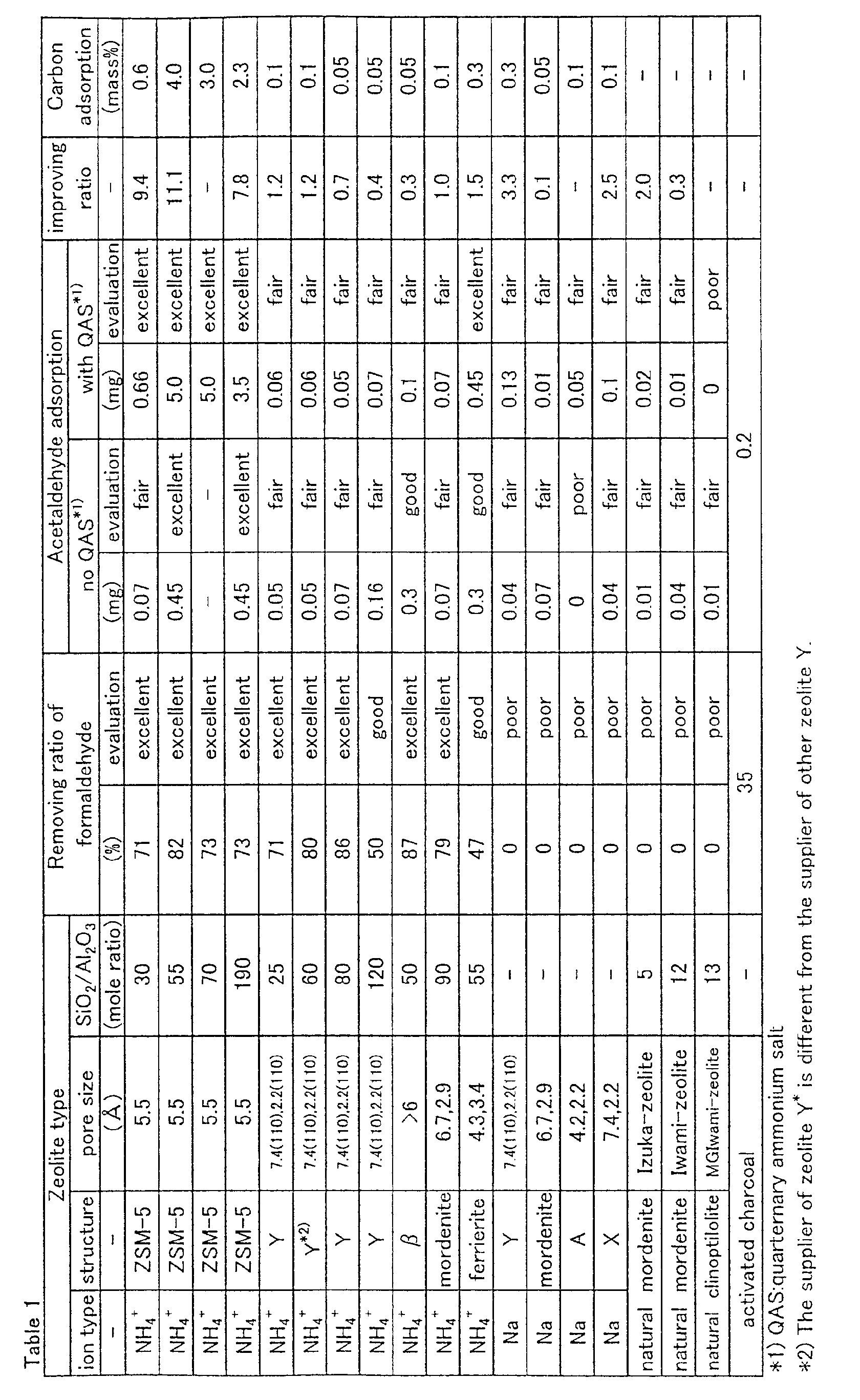
- the saturated adsorption amount of acetaldehyde was shown in Table 1 in terms of the zeolite before retaining the quarternary ammonium salt.
- Tetra-n-propylammonium bromide was used as the quarternary ammonium salt compound.
- the above zeolite without the quarternary ammonium salt was immersed in tetra-n-propylammonium bromide aqueous solution to obtain a zeolite retaining tetra-n-propylammonium bromide.
- the adsorbing member were prepared in the same way as described above.
- the saturated amount of the acetaldehyde was measured in terms of the zeolite after retaining the quarternary ammonium salt, in the same way as the zeolite before retaining the quarternary ammonium salt.
- Improving ratio the adsorption amount(mg) of the acetaldehyde after retaining the quarternary ammonium salt / the adsorption amount(mg) of the acetaldehyde before retaining the quarternary ammonium salt.
- the amount of carbon(carbon adsorption) was also determined.
- This value means a degree of the amount of the quarternary ammonium salt retained in the zeolite as described later.
- the result of removing ratio of formaldehyde, the saturated adsorption amount of acetaldehyde(acetaldehyde adsorption), the evaluation of the saturated adsorption amount , improving ratio, and carbon adsorption compared with an activated charcoal were shown in Table 1.
- NH 4 zeolite exhibited an excellent removing ability of formaldehyde, in particular, the NH 4 zeolite with the crystal structure of ZSM-5, Y, ⁇ and mordenite exhibited more excellent removing ability of formaldehyde. It was also confirmed that the excellent removing ability of formaldehyde was also obtained by the zeolite ZSM-5 which has a molar ratio of SiO 2 /Al 2 O 3 from 30 to 190. On the other hand, Na zeolite and a natural zeolite did not adsorb formaldehyde.
- each of the zeolite before retaining the quarternary ammonium salt adsorbed acetaldehyde in a small amount has a superior removing ability to the activated charcoal and the other zeolite.
- the absorption amount of acetaldehyde of the zeolite ZSM-5 after retaining the quarternary ammonium salt was 7.8 to 11.1 times as much as that of the zeolite before retaining the quarternary ammonium salt.
- the carbon adsorption amount of the zeolite ZSM-5 was 0.6 to 4.0 mass %, in particular, 2.3 to 4.0 mass % when the ZSM-5 zeolite has a molar ratio of SiO 2 /Al 2 O 3 from 55 to 190, and the carbon adsorption amount of the ferrierite zeolite was 0.3 mass %.
- the zeolite ZSM-5 retained the quarternary ammonium salt in a highest amount and the ferrierite zeolite retained the quarternary ammonium salt in a higher amount, respectively, than other zeolites, thereby exhibiting the excellent adsorption performance with the enhanced reaction of the quarternary ammonium salt with acetaldehyde.
- the removing ability of formaldehyde after an elapse of 30 min. was also determined in the same manner as described above in terms of the NH 4 zeolite ZSM-5 which retained tetra-n-propylammonium bromide as the quarternary ammonium salt.
- the removing ability of formaldehyde was 62%, 70% and 67% in terms of the NH 4 zeolite ZSM-5 having a molar ratio of SiO 2 /Al 2 O 3 of 30, 55 and 190, respectively.
- the effect of the kinds of the quarternary ammonium salts on the adsorption performance was studied.
- the NH 4 zeolite ZSM-5 with the molar ratio of SiO 2 /Al 2 O 3 of 55 is used as a zeolite.
- a polyvinyl alcohol as a binder was mixed with the NH 4 zeolite in an amount of 2.5 mass % with respect to the zeolite.
- Tetramethylammonium bromide, tetraethylammonium bromide, tetra-n-propylammonium bromide and tetra-n-butylammonium bromide were used as the quarternary ammonium salt.
- the removing ability of acetaldehyde of the zeolites after retaining the quarternary ammonium salt did not decrease with time as much as that of the zeolite without retaining the quaternary ammonium salt.
- the zeolites after retaining the tetraethylammonium bromide and the tetra-n-propylammonium bromide exhibited 100% of the removing ability of acetaldehyde after an elapse of 30 mins.
- the adsorbent of the invention was compared with the activated charcoal in terms of the acetaldehyde-releasing test.
- the NH 4 zeolite ZSM-5 with a molar ratio of SiO 2 /Al 2 O 3 of 70 which retains the quarternary ammonium salt and the activated charcoal were used in an amount of 0.2g, respectively for the adsorbing member.
- a gas containing 10ppm of acetaldehyde was allowed to flow into the adsorbing member at the flow rate of 0.6m / sec. for 30 mins so that the acetaldehyde was once adsorbed by the adsorbing member.
- the adsorbing member was sealed in 20 ml of a vessel and heated at 80°C for 10 mins. to determine the amount of the acetaldehyde released from the adsorbing member. The result was shown in FIG.19. It was confirmed that the adsorbent of the invention released less than 5ppm of acetaldehyde while the activated charcoal released approximately 50ppm of acetaldehyde.
Landscapes
- Chemical & Material Sciences (AREA)
- Analytical Chemistry (AREA)
- Chemical Kinetics & Catalysis (AREA)
- Inorganic Chemistry (AREA)
- Organic Chemistry (AREA)
- Engineering & Computer Science (AREA)
- General Chemical & Material Sciences (AREA)
- Oil, Petroleum & Natural Gas (AREA)
- Solid-Sorbent Or Filter-Aiding Compositions (AREA)
- Disinfection, Sterilisation Or Deodorisation Of Air (AREA)
- Separation Of Gases By Adsorption (AREA)
Abstract
Description
The result of removing ratio of formaldehyde, the saturated adsorption amount of acetaldehyde(acetaldehyde adsorption), the evaluation of the saturated adsorption amount , improving ratio, and carbon adsorption compared with an activated charcoal were shown in Table 1.
Claims (31)
- An adsorbent comprising a zeolite, whereina component to be adsorbed is aldehyde; andthe zeolite has NH4 + as ionic species.
- The adsorbent according to claim 1, wherein the zeolite further hasa crystal structure of ZSM-5 or ferrierite;a molar ratio of SiO2/Al2O3 from 30 to 190; andthe zeolite retains a quarternary ammonium salt which adsorbs the aldehyde with the reaction of the aldehyde.
- The adsorbent according to claim 2, wherein the component to be adsorbed is acetaldehyde.
- The adsorbent according to claim 2, wherein the zeolite has a crystal structure of ZSM-5.
- The adsorbent according to claim 2, wherein the quarternary ammonium salt is tetraethylammonium salt or tetra-n-propylammonium salt.
- The adsorbent according to claim 2, whereinthe component to be adsorbed is acetaldehyde;the zeolite has the crystal structure of ZSM-5;the zeolite has the molar ratio of SiO2/Al2O3 from 55 to 190; andthe zeolite retains the quarternary ammonium salt which adsorbs the acetaldehyde with the reaction of the acetaldehyde.
- The adsorbent according to claim 6, wherein the quarternary ammonium salt is tetraethylammonium salt or tetra-n-propylammonium salt.
- The adsorbent according to claim 1, wherein the component to be adsorbed is formaldehyde.
- The adsorbent according to claim 8, wherein the zeolite further has a crystal structure of at least one selected from the group consisting of ZSM-5, Y, β, mordenite, and ferrierite.
- The adsorbent according to claim 9, the zeolite has the crystal structure of ZSM-5.
- The adsorbent according to claim 10, wherein the zeolite further has a molar ratio of SiO2/Al2O3 from 30 to 190.
- An adsorption device comprising an adsorbing member filled with the adsorbent of any one of claim 1 to claim 11.
- The adsorption device according to claim 12, further comprising a fan to feed a gas to be treated into the adsorbing member.
- The adsorption device according to claim 12, wherein the adsorption device is incorporated in an air-conditioner.
- The adsorption device according to claim 12, wherein the adsorbing member is detachable from the adsorption device.
- An article comprising the adsorbent of any one of claim 1 to claim 11.
- The article according to claim 16, wherein the article is at least one selected from the group consisting of a filter for an air cleaner, a building material, wear, baggage, furnishings, housewares, a combustion heater and a cigarette.
- An method for adsorbing aldehyde, comprising;
allowing a gas containing the aldehyde to flow into an adsorbing member filled with an adsorbent comprising a zeolite, thereby adsorbing the aldehyde contained in the gas, wherein the zeolite has NH4 + as ionic species. - The method according to claim 18, wherein the zeolite further hasa crystal structure of ZSM-5 or ferrierite;a molar ratio of SiO2/Al2O3 from 30 to 190; andthe zeolite retains a quarternary ammonium salt which adsorbs the aldehyde with the reaction of the aldehyde.
- The method according to claim 19, wherein the aldehyde is acetaldehyde.
- The method according to claim 19, wherein the zeolite has the crystal structure of ZSM-5.
- The method according to claim 19, wherein the quarternary ammonium salt is tetraethylammonium salt or tetra-n-propylammonium salt.
- The method according to claim 19, whereinthe aldehyde is an acetaldehyde;the zeolite has the crystal structure of ZSM-5;the zeolite has the molar ratio of SiO2/Al2O3 from 55 to 190; andthe zeolite retains the quarternary ammonium salt which adsorbs the acetaldehyde with the reaction of the acetaldehyde.
- The method according to claim 23, wherein the quarternary ammonium salt is tetraethylammonium salt or tetra-n-propylammonium salt.
- The method according to any one of claim 19 to claim 24, wherein the aldehyde is acetaldehyde, and an alkylaminoalcohol is produced by the reaction of the quarternary ammonium salt with the acetaldehyde.
- The method according to claim 18, wherein the aldehyde is formaldehyde.
- The method according to claim 26, wherein the zeolite further has a crystal structure of at least one selected from the group consisting of ZSM-5, Y, β, mordenite and ferrierite.
- The method according to claim 27, wherein the zeolite has the crystal structure of ZSM-5.
- The method according to claim 28, wherein the zeolite further has a molar ratio of SiO2/Al2O3 from 30 to 190.
- The method according to any one of claim 26 to claim 29, wherein the formaldehyde reacts with a cationic ion contained in the zeolite to produce a heat stable compound, thereby adsorbing the formaldehyde.
- The method for adsorbing the formaldehyde according to claim 30, wherein an α-aminomethylalcohol is produced by the reaction of the formaldehyde with the cationic ion contained in the zeolite.
Applications Claiming Priority (4)
| Application Number | Priority Date | Filing Date | Title |
|---|---|---|---|
| JP2000022781 | 2000-01-31 | ||
| JP2000022781 | 2000-01-31 | ||
| JP2000246769A JP3829600B2 (en) | 2000-01-31 | 2000-08-16 | Adsorbent, adsorption apparatus using the same, other articles, and adsorption method |
| JP2000246769 | 2000-08-16 |
Publications (2)
| Publication Number | Publication Date |
|---|---|
| EP1121978A2 true EP1121978A2 (en) | 2001-08-08 |
| EP1121978A3 EP1121978A3 (en) | 2002-04-24 |
Family
ID=26584549
Family Applications (1)
| Application Number | Title | Priority Date | Filing Date |
|---|---|---|---|
| EP01102252A Withdrawn EP1121978A3 (en) | 2000-01-31 | 2001-01-31 | Adsorption of aldehyde with adsorbent containing zeolite |
Country Status (4)
| Country | Link |
|---|---|
| US (1) | US6596909B2 (en) |
| EP (1) | EP1121978A3 (en) |
| JP (1) | JP3829600B2 (en) |
| KR (1) | KR20010078018A (en) |
Cited By (7)
| Publication number | Priority date | Publication date | Assignee | Title |
|---|---|---|---|---|
| WO2011064371A1 (en) * | 2009-11-27 | 2011-06-03 | Institut Regional Des Materiaux Avances (Irma) | Hydrophobic zeolite exchanged with a transition metal as an aldehyde adsorbent |
| FR2953152A1 (en) * | 2009-11-27 | 2011-06-03 | Valeo Systemes Thermiques | COMPOSITION COMPRISING ACTIVE CARBON, ZEOLITE AND FE IONS FOR VEHICLE ROAD AIR FILTER |
| CN103894154A (en) * | 2014-04-02 | 2014-07-02 | 上海烟草集团有限责任公司 | Adsorbent for selectively reducing gas phase ammonia in main stream smoke of cigarette |
| FR3026020A1 (en) * | 2014-09-24 | 2016-03-25 | Seb Sa | FILTRATION DEVICE FOR AIR PURIFICATION APPARATUS |
| CN102725062B (en) * | 2009-11-27 | 2016-11-30 | 法雷奥热系统公司 | Activated carbon, zeolite and the compositions of Fe ion is included for vehicle ride room air filter |
| CN109233417A (en) * | 2017-05-22 | 2019-01-18 | 常州塑金高分子科技有限公司 | A kind of free radical quenchant and preparation method thereof |
| EP2210498B1 (en) * | 2005-11-01 | 2019-04-24 | Anglo Platinum Marketing Limited | Adsorption of volatile organic compounds derived from organic matter |
Families Citing this family (31)
| Publication number | Priority date | Publication date | Assignee | Title |
|---|---|---|---|---|
| JP2001149777A (en) * | 1999-11-29 | 2001-06-05 | Daikin Ind Ltd | Suction element and method for manufacturing the same |
| US20040146674A1 (en) * | 2003-01-29 | 2004-07-29 | Howell Earl Edmondson | Acetaldehyde scavenging by addition of active scavengers to bottle closures |
| US20050133053A1 (en) * | 2003-12-22 | 2005-06-23 | Philip Morris Usa Inc. | Smoking articles comprising copper-exchanged molecular sieves |
| US7827996B2 (en) * | 2003-12-22 | 2010-11-09 | Philip Morris Usa Inc. | Amphiphile-modified sorbents in smoking articles and filters |
| US7448392B2 (en) * | 2003-12-22 | 2008-11-11 | Philip Morris Usa Inc. | Smoking articles and filters with carbon-coated molecular sieve sorbent |
| US7610920B2 (en) * | 2003-12-22 | 2009-11-03 | Philip Morris Usa Inc. | Thiol-functionalized sorbent for smoking articles and filters for the removal of heavy metals from mainstream smoke |
| JP4628767B2 (en) * | 2004-12-09 | 2011-02-09 | 特種東海製紙株式会社 | Contaminated gas removal paper |
| US20060153747A1 (en) * | 2005-01-13 | 2006-07-13 | Carrier Corporation | Gas treatment adsorption-oxidation system |
| US7594935B2 (en) * | 2005-02-15 | 2009-09-29 | Warila Jeffery W | Prosthetic device contouring and alignment method and apparatus |
| US8568687B2 (en) * | 2006-06-27 | 2013-10-29 | Teruo Henmi | Method of manufacturing solid acid catalyst |
| US8652437B2 (en) * | 2006-06-27 | 2014-02-18 | Prometron Technics Corp. | Method of manufacturing artificial zeolite |
| KR101322050B1 (en) * | 2009-02-25 | 2013-10-25 | 포항공과대학교 산학협력단 | Catalystic structures and formaldehyde-eliminating method using the same |
| DE102009023643B4 (en) * | 2009-05-28 | 2016-08-18 | Fraunhofer-Gesellschaft zur Förderung der angewandten Forschung e.V. | Wood-based product and process for its preparation |
| CN102190316B (en) * | 2010-03-03 | 2013-01-09 | 中国石油化工股份有限公司 | Method for synthesizing mesoporous mordenite |
| CN101898149A (en) * | 2010-07-31 | 2010-12-01 | 大连理工大学 | A supported nano-metallic silver catalyst with dual functions of adsorption and low-temperature catalysis, preparation method and application thereof |
| EP2621965B1 (en) * | 2010-10-01 | 2018-03-07 | ARLANXEO Deutschland GmbH | Polymers of isobutene from renewable sources |
| JP6372743B2 (en) * | 2014-06-11 | 2018-08-15 | いすゞ自動車株式会社 | Aldehyde reduction device for passenger compartment air |
| WO2016067839A1 (en) * | 2014-10-31 | 2016-05-06 | 東亞合成株式会社 | Deodorizer, deodorizing processed product produced using same, method for producing deodorizer, and method for producing deodorizing processed product |
| JP6393591B2 (en) * | 2014-11-12 | 2018-09-19 | 日立造船株式会社 | Aldehyde decomposition catalyst, exhaust gas treatment facility, and exhaust gas treatment method |
| CN104720103B (en) * | 2015-02-11 | 2018-01-30 | 浙江中烟工业有限责任公司 | A kind of cigarette filter-tip additive agent and its preparation method and application |
| JP6555933B2 (en) * | 2015-06-04 | 2019-08-07 | 共同印刷株式会社 | Laminate for sulfide gas adsorption |
| CN106166441A (en) * | 2016-04-28 | 2016-11-30 | 山东宝梵环保科技有限公司 | There is solid air purification smell removal agent and the preparation method of degradation property |
| US10464044B1 (en) | 2016-05-27 | 2019-11-05 | Precision Combustion, Inc. | High capacity regenerable graphene-based sorbent |
| US10647594B2 (en) * | 2016-12-21 | 2020-05-12 | Hamilton Sundstrand Corporation | Condensation catalyst systems and methods |
| JP7053096B2 (en) * | 2017-06-16 | 2022-04-12 | スリーエム イノベイティブ プロパティズ カンパニー | Polymer adsorbent for aldehydes |
| US10994241B1 (en) | 2017-07-10 | 2021-05-04 | Precision Combustion, Inc. | Sorbent system for removing ammonia and organic compounds from a gaseous environment |
| CN111818995B (en) | 2018-03-01 | 2024-01-26 | 3M创新有限公司 | Urea impregnated zeolite adsorbent and preparation method thereof |
| BR112021004155B1 (en) | 2018-09-10 | 2024-02-15 | Heineken Supply Chain B.V. | PROCESS FOR PRODUCING A NON-ALCOHOLIC FERMENTED BEER AND NON-ALCOHOLIC FERMENTED BEER |
| DE102019105734B4 (en) * | 2019-03-07 | 2025-10-30 | digitanalog Hard- und Software GmbH | Method and arrangement for removing ammonia |
| CN118302242A (en) * | 2021-12-14 | 2024-07-05 | 陶氏环球技术有限责任公司 | Purification of organic solvents |
| CN115920589B (en) * | 2022-12-21 | 2023-08-11 | 可迪尔空气技术(北京)有限公司 | Treatment method of low-concentration sewage pool waste gas |
Family Cites Families (7)
| Publication number | Priority date | Publication date | Assignee | Title |
|---|---|---|---|---|
| US3469959A (en) * | 1966-09-08 | 1969-09-30 | Carborundum Co | Aluminosilicate zeolite in a synthetic resin bonded abrasive article |
| US4534775A (en) | 1982-03-02 | 1985-08-13 | General Time Corp. | Air treatment filter element and air treatment filter |
| JP3043846B2 (en) | 1991-07-08 | 2000-05-22 | 昭和電工株式会社 | Anti-fog multilayer laminate |
| US5833739A (en) | 1992-11-13 | 1998-11-10 | Klatte; Fred | Chemically coated zeolite and method for chemically coating zeolite and using coated zeolite |
| JPH09313828A (en) * | 1996-05-31 | 1997-12-09 | Matsushita Electric Works Ltd | Filter |
| US5846298A (en) | 1997-05-09 | 1998-12-08 | Air Products And Chemicals, Inc. | Ozone recovery by zeolite adsorbents |
| JP2998800B2 (en) * | 1998-03-10 | 2000-01-11 | マツダ株式会社 | Deodorizing composition, deodorizing apparatus and filter using the same, and deodorizing method |
-
2000
- 2000-08-16 JP JP2000246769A patent/JP3829600B2/en not_active Expired - Fee Related
-
2001
- 2001-01-19 KR KR1020010003156A patent/KR20010078018A/en not_active Withdrawn
- 2001-01-26 US US09/769,370 patent/US6596909B2/en not_active Expired - Fee Related
- 2001-01-31 EP EP01102252A patent/EP1121978A3/en not_active Withdrawn
Cited By (14)
| Publication number | Priority date | Publication date | Assignee | Title |
|---|---|---|---|---|
| EP2210498B1 (en) * | 2005-11-01 | 2019-04-24 | Anglo Platinum Marketing Limited | Adsorption of volatile organic compounds derived from organic matter |
| CN102725062B (en) * | 2009-11-27 | 2016-11-30 | 法雷奥热系统公司 | Activated carbon, zeolite and the compositions of Fe ion is included for vehicle ride room air filter |
| FR2953152A1 (en) * | 2009-11-27 | 2011-06-03 | Valeo Systemes Thermiques | COMPOSITION COMPRISING ACTIVE CARBON, ZEOLITE AND FE IONS FOR VEHICLE ROAD AIR FILTER |
| WO2011064346A1 (en) | 2009-11-27 | 2011-06-03 | Valeo Systemes Thermiques | Composition including an activated carbon, a zeolite and fe ions, for a vehicle passenger compartment air filter |
| CN102725062A (en) * | 2009-11-27 | 2012-10-10 | 法雷奥热系统公司 | Composition including an activated carbon, a zeolite and Fe ions, for a vehicle passenger compartment air filter |
| WO2011064371A1 (en) * | 2009-11-27 | 2011-06-03 | Institut Regional Des Materiaux Avances (Irma) | Hydrophobic zeolite exchanged with a transition metal as an aldehyde adsorbent |
| US9968908B2 (en) | 2009-11-27 | 2018-05-15 | Valeo Systemes Thermiques | Composition comprising an activated carbon, a zeolite, and Fe ions for a vehicle passenger compartment air filter |
| FR2953153A1 (en) * | 2009-11-27 | 2011-06-03 | Irma | HYDROPHOBIC ZEOLITHE EXCHANGED WITH A TRANSITION METAL AS ALDEHYDESE ADSORBENT |
| CN103894154A (en) * | 2014-04-02 | 2014-07-02 | 上海烟草集团有限责任公司 | Adsorbent for selectively reducing gas phase ammonia in main stream smoke of cigarette |
| CN103894154B (en) * | 2014-04-02 | 2016-04-27 | 上海烟草集团有限责任公司 | The adsorbent of vapor phase ammonia in a kind of selectivity reducing cigarette main flume |
| FR3026020A1 (en) * | 2014-09-24 | 2016-03-25 | Seb Sa | FILTRATION DEVICE FOR AIR PURIFICATION APPARATUS |
| WO2016046498A1 (en) * | 2014-09-24 | 2016-03-31 | Seb S.A. | Filtration device for air purification appliance |
| US10561983B2 (en) | 2014-09-24 | 2020-02-18 | Seb S.A. | Filtration device for air purification appliance |
| CN109233417A (en) * | 2017-05-22 | 2019-01-18 | 常州塑金高分子科技有限公司 | A kind of free radical quenchant and preparation method thereof |
Also Published As
| Publication number | Publication date |
|---|---|
| KR20010078018A (en) | 2001-08-20 |
| JP3829600B2 (en) | 2006-10-04 |
| JP2001286752A (en) | 2001-10-16 |
| US6596909B2 (en) | 2003-07-22 |
| EP1121978A3 (en) | 2002-04-24 |
| US20010012820A1 (en) | 2001-08-09 |
Similar Documents
| Publication | Publication Date | Title |
|---|---|---|
| US6596909B2 (en) | Adsorption of aldehyde with adsorbent containing zeolite | |
| US6432872B1 (en) | Composition for use in adsorption treatment, products formed with the same, and a method for producing adsorbent using the same | |
| EP3377197A1 (en) | Heat recovery adsorber as ventilation system in buildings | |
| US6911189B1 (en) | Filter for selective removal of a gaseous component | |
| KR100336309B1 (en) | Deodorant composition, deodorizer and filter each containing the same, and method of deodorization | |
| JP2002219324A (en) | Method and apparatus for treating or heating carbonaceous substance | |
| IE843336L (en) | Hydrophobic microporous tectosilicate | |
| WO2020203508A1 (en) | Gas adsorbent | |
| JP2000246095A (en) | Articles with adsorption treatment agent | |
| KR20240066244A (en) | Gas adsorbents and gas adsorption sheets, filter media, and air filters using the same | |
| JP3221657B2 (en) | Regeneration method of composite adsorbent | |
| KR101812636B1 (en) | A deodorization filter for air cleaning | |
| JP2950683B2 (en) | Air purifier and air purifier | |
| WO2002090070A1 (en) | Gas absorbing material | |
| JP2002239326A (en) | Air cleaner | |
| JPS6048138A (en) | Adsorbent of aldehydes in gaseous phase | |
| JP2021142481A (en) | Gas adsorbent | |
| JP2004353216A (en) | Residential ventilation system | |
| JPH119671A (en) | Composite deodorizing filter and composite deodorizing filter device including the same | |
| JP2009007826A (en) | Functional nonwoven fabric sheet, and method of manufacturing functional nonwoven fabric sheet | |
| JP2000274055A (en) | Tatami | |
| WO2024090205A1 (en) | Gas adsorbent and gas adsorption sheet, filter material, and air filter using same | |
| JPH07204259A (en) | Air cleaning agent containing metal carboxylic acid salt | |
| JP2006075312A (en) | Deodorant composition having superior heat resistance and molding using the same | |
| JPH07116234A (en) | Air purifying agent and air purifying device |
Legal Events
| Date | Code | Title | Description |
|---|---|---|---|
| PUAI | Public reference made under article 153(3) epc to a published international application that has entered the european phase |
Free format text: ORIGINAL CODE: 0009012 |
|
| AK | Designated contracting states |
Kind code of ref document: A2 Designated state(s): DE ES FR GB IT Kind code of ref document: A2 Designated state(s): AT BE CH CY DE DK ES FI FR GB GR IE IT LI LU MC NL PT SE TR |
|
| AX | Request for extension of the european patent |
Free format text: AL;LT;LV;MK;RO;SI |
|
| PUAL | Search report despatched |
Free format text: ORIGINAL CODE: 0009013 |
|
| RIC1 | Information provided on ipc code assigned before grant |
Free format text: 7B 01J 20/18 A, 7B 01D 53/04 B, 7A 24D 3/16 B |
|
| AK | Designated contracting states |
Kind code of ref document: A3 Designated state(s): AT BE CH CY DE DK ES FI FR GB GR IE IT LI LU MC NL PT SE TR |
|
| AX | Request for extension of the european patent |
Free format text: AL;LT;LV;MK;RO;SI |
|
| 17P | Request for examination filed |
Effective date: 20021011 |
|
| AKX | Designation fees paid |
Free format text: DE ES FR GB IT |
|
| 17Q | First examination report despatched |
Effective date: 20041126 |
|
| STAA | Information on the status of an ep patent application or granted ep patent |
Free format text: STATUS: THE APPLICATION IS DEEMED TO BE WITHDRAWN |
|
| 18D | Application deemed to be withdrawn |
Effective date: 20100629 |