EP1122174A2 - System for producing labels from a web - Google Patents
System for producing labels from a web Download PDFInfo
- Publication number
- EP1122174A2 EP1122174A2 EP01107792A EP01107792A EP1122174A2 EP 1122174 A2 EP1122174 A2 EP 1122174A2 EP 01107792 A EP01107792 A EP 01107792A EP 01107792 A EP01107792 A EP 01107792A EP 1122174 A2 EP1122174 A2 EP 1122174A2
- Authority
- EP
- European Patent Office
- Prior art keywords
- web
- label
- labels
- laser
- laser beam
- Prior art date
- Legal status (The legal status is an assumption and is not a legal conclusion. Google has not performed a legal analysis and makes no representation as to the accuracy of the status listed.)
- Withdrawn
Links
Images



Classifications
-
- G—PHYSICS
- G09—EDUCATION; CRYPTOGRAPHY; DISPLAY; ADVERTISING; SEALS
- G09F—DISPLAYING; ADVERTISING; SIGNS; LABELS OR NAME-PLATES; SEALS
- G09F3/00—Labels, tag tickets, or similar identification or indication means; Seals; Postage or like stamps
- G09F3/08—Fastening or securing by means not forming part of the material of the label itself
- G09F3/10—Fastening or securing by means not forming part of the material of the label itself by an adhesive layer
-
- B—PERFORMING OPERATIONS; TRANSPORTING
- B23—MACHINE TOOLS; METAL-WORKING NOT OTHERWISE PROVIDED FOR
- B23K—SOLDERING OR UNSOLDERING; WELDING; CLADDING OR PLATING BY SOLDERING OR WELDING; CUTTING BY APPLYING HEAT LOCALLY, e.g. FLAME CUTTING; WORKING BY LASER BEAM
- B23K26/00—Working by laser beam, e.g. welding, cutting or boring
- B23K26/08—Devices involving relative movement between laser beam and workpiece
- B23K26/083—Devices involving movement of the workpiece in at least one axial direction
- B23K26/0838—Devices involving movement of the workpiece in at least one axial direction by using an endless conveyor belt
- B23K26/0846—Devices involving movement of the workpiece in at least one axial direction by using an endless conveyor belt for moving elongated workpieces longitudinally, e.g. wire or strip material
-
- B—PERFORMING OPERATIONS; TRANSPORTING
- B23—MACHINE TOOLS; METAL-WORKING NOT OTHERWISE PROVIDED FOR
- B23K—SOLDERING OR UNSOLDERING; WELDING; CLADDING OR PLATING BY SOLDERING OR WELDING; CUTTING BY APPLYING HEAT LOCALLY, e.g. FLAME CUTTING; WORKING BY LASER BEAM
- B23K26/00—Working by laser beam, e.g. welding, cutting or boring
- B23K26/36—Removing material
- B23K26/40—Removing material taking account of the properties of the material involved
-
- B—PERFORMING OPERATIONS; TRANSPORTING
- B32—LAYERED PRODUCTS
- B32B—LAYERED PRODUCTS, i.e. PRODUCTS BUILT-UP OF STRATA OF FLAT OR NON-FLAT, e.g. CELLULAR OR HONEYCOMB, FORM
- B32B27/00—Layered products comprising a layer of synthetic resin
- B32B27/06—Layered products comprising a layer of synthetic resin as the main or only constituent of a layer, which is next to another layer of the same or of a different material
- B32B27/08—Layered products comprising a layer of synthetic resin as the main or only constituent of a layer, which is next to another layer of the same or of a different material of synthetic resin
-
- B—PERFORMING OPERATIONS; TRANSPORTING
- B32—LAYERED PRODUCTS
- B32B—LAYERED PRODUCTS, i.e. PRODUCTS BUILT-UP OF STRATA OF FLAT OR NON-FLAT, e.g. CELLULAR OR HONEYCOMB, FORM
- B32B7/00—Layered products characterised by the relation between layers; Layered products characterised by the relative orientation of features between layers, or by the relative values of a measurable parameter between layers, i.e. products comprising layers having different physical, chemical or physicochemical properties; Layered products characterised by the interconnection of layers
- B32B7/04—Interconnection of layers
- B32B7/12—Interconnection of layers using interposed adhesives or interposed materials with bonding properties
-
- B—PERFORMING OPERATIONS; TRANSPORTING
- B65—CONVEYING; PACKING; STORING; HANDLING THIN OR FILAMENTARY MATERIAL
- B65C—LABELLING OR TAGGING MACHINES, APPARATUS, OR PROCESSES
- B65C9/00—Details of labelling machines or apparatus
- B65C9/08—Label feeding
- B65C9/18—Label feeding from strips, e.g. from rolls
- B65C9/1803—Label feeding from strips, e.g. from rolls the labels being cut from a strip
-
- B—PERFORMING OPERATIONS; TRANSPORTING
- B65—CONVEYING; PACKING; STORING; HANDLING THIN OR FILAMENTARY MATERIAL
- B65C—LABELLING OR TAGGING MACHINES, APPARATUS, OR PROCESSES
- B65C9/00—Details of labelling machines or apparatus
- B65C9/08—Label feeding
- B65C9/18—Label feeding from strips, e.g. from rolls
- B65C9/1803—Label feeding from strips, e.g. from rolls the labels being cut from a strip
- B65C9/1815—Label feeding from strips, e.g. from rolls the labels being cut from a strip and transferred by suction means
-
- B—PERFORMING OPERATIONS; TRANSPORTING
- B65—CONVEYING; PACKING; STORING; HANDLING THIN OR FILAMENTARY MATERIAL
- B65C—LABELLING OR TAGGING MACHINES, APPARATUS, OR PROCESSES
- B65C9/00—Details of labelling machines or apparatus
- B65C9/08—Label feeding
- B65C9/18—Label feeding from strips, e.g. from rolls
- B65C9/1865—Label feeding from strips, e.g. from rolls the labels adhering on a backing strip
-
- B—PERFORMING OPERATIONS; TRANSPORTING
- B65—CONVEYING; PACKING; STORING; HANDLING THIN OR FILAMENTARY MATERIAL
- B65C—LABELLING OR TAGGING MACHINES, APPARATUS, OR PROCESSES
- B65C9/00—Details of labelling machines or apparatus
- B65C9/26—Devices for applying labels
- B65C9/34—Flexible bands
-
- B—PERFORMING OPERATIONS; TRANSPORTING
- B23—MACHINE TOOLS; METAL-WORKING NOT OTHERWISE PROVIDED FOR
- B23K—SOLDERING OR UNSOLDERING; WELDING; CLADDING OR PLATING BY SOLDERING OR WELDING; CUTTING BY APPLYING HEAT LOCALLY, e.g. FLAME CUTTING; WORKING BY LASER BEAM
- B23K2103/00—Materials to be soldered, welded or cut
- B23K2103/16—Composite materials
- B23K2103/166—Multilayered materials
- B23K2103/172—Multilayered materials wherein at least one of the layers is non-metallic
-
- B—PERFORMING OPERATIONS; TRANSPORTING
- B65—CONVEYING; PACKING; STORING; HANDLING THIN OR FILAMENTARY MATERIAL
- B65C—LABELLING OR TAGGING MACHINES, APPARATUS, OR PROCESSES
- B65C9/00—Details of labelling machines or apparatus
- B65C9/0015—Preparing the labels or articles, e.g. smoothing, removing air bubbles
- B65C2009/0018—Preparing the labels
- B65C2009/0028—Preparing the labels for activating the glue
- B65C2009/0031—Preparing the labels for activating the glue by radiation
- B65C2009/0034—IR
-
- B—PERFORMING OPERATIONS; TRANSPORTING
- B65—CONVEYING; PACKING; STORING; HANDLING THIN OR FILAMENTARY MATERIAL
- B65C—LABELLING OR TAGGING MACHINES, APPARATUS, OR PROCESSES
- B65C9/00—Details of labelling machines or apparatus
- B65C9/0015—Preparing the labels or articles, e.g. smoothing, removing air bubbles
- B65C2009/0018—Preparing the labels
- B65C2009/0028—Preparing the labels for activating the glue
- B65C2009/0031—Preparing the labels for activating the glue by radiation
- B65C2009/0037—UV
-
- B—PERFORMING OPERATIONS; TRANSPORTING
- B65—CONVEYING; PACKING; STORING; HANDLING THIN OR FILAMENTARY MATERIAL
- B65C—LABELLING OR TAGGING MACHINES, APPARATUS, OR PROCESSES
- B65C9/00—Details of labelling machines or apparatus
- B65C9/0015—Preparing the labels or articles, e.g. smoothing, removing air bubbles
- B65C2009/0018—Preparing the labels
- B65C2009/0028—Preparing the labels for activating the glue
- B65C2009/0031—Preparing the labels for activating the glue by radiation
- B65C2009/0043—Preparing the labels for activating the glue by radiation laser
-
- B—PERFORMING OPERATIONS; TRANSPORTING
- B65—CONVEYING; PACKING; STORING; HANDLING THIN OR FILAMENTARY MATERIAL
- B65C—LABELLING OR TAGGING MACHINES, APPARATUS, OR PROCESSES
- B65C9/00—Details of labelling machines or apparatus
- B65C9/08—Label feeding
- B65C9/18—Label feeding from strips, e.g. from rolls
- B65C9/1803—Label feeding from strips, e.g. from rolls the labels being cut from a strip
- B65C2009/1834—Details of cutting means
- B65C2009/1846—Laser
-
- Y—GENERAL TAGGING OF NEW TECHNOLOGICAL DEVELOPMENTS; GENERAL TAGGING OF CROSS-SECTIONAL TECHNOLOGIES SPANNING OVER SEVERAL SECTIONS OF THE IPC; TECHNICAL SUBJECTS COVERED BY FORMER USPC CROSS-REFERENCE ART COLLECTIONS [XRACs] AND DIGESTS
- Y10—TECHNICAL SUBJECTS COVERED BY FORMER USPC
- Y10T—TECHNICAL SUBJECTS COVERED BY FORMER US CLASSIFICATION
- Y10T156/00—Adhesive bonding and miscellaneous chemical manufacture
- Y10T156/10—Methods of surface bonding and/or assembly therefor
- Y10T156/1052—Methods of surface bonding and/or assembly therefor with cutting, punching, tearing or severing
- Y10T156/1059—Splitting sheet lamina in plane intermediate of faces
-
- Y—GENERAL TAGGING OF NEW TECHNOLOGICAL DEVELOPMENTS; GENERAL TAGGING OF CROSS-SECTIONAL TECHNOLOGIES SPANNING OVER SEVERAL SECTIONS OF THE IPC; TECHNICAL SUBJECTS COVERED BY FORMER USPC CROSS-REFERENCE ART COLLECTIONS [XRACs] AND DIGESTS
- Y10—TECHNICAL SUBJECTS COVERED BY FORMER USPC
- Y10T—TECHNICAL SUBJECTS COVERED BY FORMER US CLASSIFICATION
- Y10T156/00—Adhesive bonding and miscellaneous chemical manufacture
- Y10T156/10—Methods of surface bonding and/or assembly therefor
- Y10T156/1052—Methods of surface bonding and/or assembly therefor with cutting, punching, tearing or severing
- Y10T156/1062—Prior to assembly
-
- Y—GENERAL TAGGING OF NEW TECHNOLOGICAL DEVELOPMENTS; GENERAL TAGGING OF CROSS-SECTIONAL TECHNOLOGIES SPANNING OVER SEVERAL SECTIONS OF THE IPC; TECHNICAL SUBJECTS COVERED BY FORMER USPC CROSS-REFERENCE ART COLLECTIONS [XRACs] AND DIGESTS
- Y10—TECHNICAL SUBJECTS COVERED BY FORMER USPC
- Y10T—TECHNICAL SUBJECTS COVERED BY FORMER US CLASSIFICATION
- Y10T156/00—Adhesive bonding and miscellaneous chemical manufacture
- Y10T156/10—Methods of surface bonding and/or assembly therefor
- Y10T156/1052—Methods of surface bonding and/or assembly therefor with cutting, punching, tearing or severing
- Y10T156/1062—Prior to assembly
- Y10T156/1074—Separate cutting of separate sheets or webs
-
- Y—GENERAL TAGGING OF NEW TECHNOLOGICAL DEVELOPMENTS; GENERAL TAGGING OF CROSS-SECTIONAL TECHNOLOGIES SPANNING OVER SEVERAL SECTIONS OF THE IPC; TECHNICAL SUBJECTS COVERED BY FORMER USPC CROSS-REFERENCE ART COLLECTIONS [XRACs] AND DIGESTS
- Y10—TECHNICAL SUBJECTS COVERED BY FORMER USPC
- Y10T—TECHNICAL SUBJECTS COVERED BY FORMER US CLASSIFICATION
- Y10T156/00—Adhesive bonding and miscellaneous chemical manufacture
- Y10T156/10—Methods of surface bonding and/or assembly therefor
- Y10T156/1052—Methods of surface bonding and/or assembly therefor with cutting, punching, tearing or severing
- Y10T156/1062—Prior to assembly
- Y10T156/1075—Prior to assembly of plural laminae from single stock and assembling to each other or to additional lamina
-
- Y—GENERAL TAGGING OF NEW TECHNOLOGICAL DEVELOPMENTS; GENERAL TAGGING OF CROSS-SECTIONAL TECHNOLOGIES SPANNING OVER SEVERAL SECTIONS OF THE IPC; TECHNICAL SUBJECTS COVERED BY FORMER USPC CROSS-REFERENCE ART COLLECTIONS [XRACs] AND DIGESTS
- Y10—TECHNICAL SUBJECTS COVERED BY FORMER USPC
- Y10T—TECHNICAL SUBJECTS COVERED BY FORMER US CLASSIFICATION
- Y10T156/00—Adhesive bonding and miscellaneous chemical manufacture
- Y10T156/10—Methods of surface bonding and/or assembly therefor
- Y10T156/1089—Methods of surface bonding and/or assembly therefor of discrete laminae to single face of additional lamina
- Y10T156/1092—All laminae planar and face to face
-
- Y—GENERAL TAGGING OF NEW TECHNOLOGICAL DEVELOPMENTS; GENERAL TAGGING OF CROSS-SECTIONAL TECHNOLOGIES SPANNING OVER SEVERAL SECTIONS OF THE IPC; TECHNICAL SUBJECTS COVERED BY FORMER USPC CROSS-REFERENCE ART COLLECTIONS [XRACs] AND DIGESTS
- Y10—TECHNICAL SUBJECTS COVERED BY FORMER USPC
- Y10T—TECHNICAL SUBJECTS COVERED BY FORMER US CLASSIFICATION
- Y10T156/00—Adhesive bonding and miscellaneous chemical manufacture
- Y10T156/12—Surface bonding means and/or assembly means with cutting, punching, piercing, severing or tearing
- Y10T156/125—Plural severing means each acting on a different work piece
-
- Y—GENERAL TAGGING OF NEW TECHNOLOGICAL DEVELOPMENTS; GENERAL TAGGING OF CROSS-SECTIONAL TECHNOLOGIES SPANNING OVER SEVERAL SECTIONS OF THE IPC; TECHNICAL SUBJECTS COVERED BY FORMER USPC CROSS-REFERENCE ART COLLECTIONS [XRACs] AND DIGESTS
- Y10—TECHNICAL SUBJECTS COVERED BY FORMER USPC
- Y10T—TECHNICAL SUBJECTS COVERED BY FORMER US CLASSIFICATION
- Y10T156/00—Adhesive bonding and miscellaneous chemical manufacture
- Y10T156/12—Surface bonding means and/or assembly means with cutting, punching, piercing, severing or tearing
- Y10T156/1317—Means feeding plural workpieces to be joined
- Y10T156/1322—Severing before bonding or assembling of parts
- Y10T156/1339—Delivering cut part in sequence to serially conveyed articles
-
- Y—GENERAL TAGGING OF NEW TECHNOLOGICAL DEVELOPMENTS; GENERAL TAGGING OF CROSS-SECTIONAL TECHNOLOGIES SPANNING OVER SEVERAL SECTIONS OF THE IPC; TECHNICAL SUBJECTS COVERED BY FORMER USPC CROSS-REFERENCE ART COLLECTIONS [XRACs] AND DIGESTS
- Y10—TECHNICAL SUBJECTS COVERED BY FORMER USPC
- Y10T—TECHNICAL SUBJECTS COVERED BY FORMER US CLASSIFICATION
- Y10T156/00—Adhesive bonding and miscellaneous chemical manufacture
- Y10T156/12—Surface bonding means and/or assembly means with cutting, punching, piercing, severing or tearing
- Y10T156/1348—Work traversing type
-
- Y—GENERAL TAGGING OF NEW TECHNOLOGICAL DEVELOPMENTS; GENERAL TAGGING OF CROSS-SECTIONAL TECHNOLOGIES SPANNING OVER SEVERAL SECTIONS OF THE IPC; TECHNICAL SUBJECTS COVERED BY FORMER USPC CROSS-REFERENCE ART COLLECTIONS [XRACs] AND DIGESTS
- Y10—TECHNICAL SUBJECTS COVERED BY FORMER USPC
- Y10T—TECHNICAL SUBJECTS COVERED BY FORMER US CLASSIFICATION
- Y10T428/00—Stock material or miscellaneous articles
- Y10T428/28—Web or sheet containing structurally defined element or component and having an adhesive outermost layer
-
- Y—GENERAL TAGGING OF NEW TECHNOLOGICAL DEVELOPMENTS; GENERAL TAGGING OF CROSS-SECTIONAL TECHNOLOGIES SPANNING OVER SEVERAL SECTIONS OF THE IPC; TECHNICAL SUBJECTS COVERED BY FORMER USPC CROSS-REFERENCE ART COLLECTIONS [XRACs] AND DIGESTS
- Y10—TECHNICAL SUBJECTS COVERED BY FORMER USPC
- Y10T—TECHNICAL SUBJECTS COVERED BY FORMER US CLASSIFICATION
- Y10T428/00—Stock material or miscellaneous articles
- Y10T428/28—Web or sheet containing structurally defined element or component and having an adhesive outermost layer
- Y10T428/2813—Heat or solvent activated or sealable
Definitions
- the present invention relates to the field of label manufacture. More particularly, the invention concerns a labelling system that dispenses a web of label material having a coating of non-tacky adhesive, subsequently activates the adhesive, cuts the web using a laser beam to produce labels therefrom, and then applies the labels to respective packages.
- a carrier sheet is separated from an adhered web whereupon the web is then cut using a laser beam to form labels and a waste matrix. The labels are then rejoined to the carrier sheet.
- pressure sensitive labels are produced by using a die to cut a printed web releasably adhered to a carrier sheet in order to form a label and a waste matrix. The matrix is then removed leaving the labels spaced on the carrier sheet that is then formed into a roll.
- a label dispenser strips the labels from the carrier sheet and applies them to respective packages. The carrier sheet is then discarded as waste.
- this prior art system of labeling packages presents a number of problems.
- the carrier sheet typically represents nearly one-half the material cost of label production. This is a tremendous waste of financial and natural resources, and the spent carrier sheet presents an on-going trash disposal burden.
- a die must be custom manufactured for each type of label and additional dies provided as replacements for worn-out dies. Furthermore, these dies must be stored between production runs.
- US-A-4,922,775 discloses an apparatus for cutting labels from a ribbon on which the labels are printed. There are vertically spaced apart knives adjacent the ribbon for cutting the upper and lower contours of the labels from the ribbon. The knives are caused to pivot toward the ribbon and to rise and fall under the influence of a cam that is shaped correspondingly with the desired contours.
- the object of the invention is to provide for a label production system that solves the prior art problems discussed above and provides a distinct advance in the state of the art. More particularly, the invention hereof eliminates the need for a carrier sheet in the production and application of labels to packages, and eliminates the need for custom manufactured dies for cutting labels from a web.
- the preferred label production system is used at the site of package production.
- a web of non-tacky label material having a coating of activatable adhesive thereon is dispensed from a supply, preferably in the form of a roll.
- the adhesive is subsequently activated.
- a laser beam cuts through the web along a continuous, predetermined path in order to produce a label from the web.
- the label, with the adhesive already activated, is then applied to a package.
- the adhesive coating is heat activatable and is preferably activated by a laser beam. Additionally, the preferred system simultaneously uses two laser beams to cut along divergent paths of the web. A preferred vacuum belt arrangement conveys the cut label body from the web matrix to the package.
- a carrier sheet and adhered web are dispensed from a supply and then separated.
- a laser beam cuts the web while separated in order to produce spaced apart labels and a waste matrix.
- the web is then rejoined to the carrier sheet and the matrix removed in order to produce a carrier sheet with spaced, pressure sensitive labels thereon.
- preferred label production apparatus 10 broadly includes web dispensing mechanism 12, laser unit 14, and label application assembly 16 for applying labels to packages 18.
- web dispensing mechanism 12 includes dispensing reel 20, in-feed tension dancer 22 having rollers 24a and 24b, web feed input roller 26, web spacing rollers 28, out-feed drive rollers 30a and 30b, web take-up reel 32, and photoelectric web registration sensor 34 with web 36 routed through mechanism 12 as illustrated.
- Reel 20 dispenses web 36 from a supply in the form of a roll 38.
- Web 36 presents front face 40 with spaced label indicia including registration marks printed thereon, and presents rear face 42 having a coating 43 of non-tacky, heat activatable adhesive. It should also be understood that a wide range of heat activated adhesive materials can be used activatable by infrared or ultraviolet, for example, solvent activated adhesives, or the adhesive could be applied at the site of application. In this way, web 36 is non-tacky as dispensed from supply roll 38 until the adhesive is activated in activation zone 44 as discussed further hereinbelow.
- Laser unit 14 includes laser 46, mirrors 48a and 48b and controller 50.
- Laser 46 is operable to produce upper and lower, continuous, narrow laser beams 52a and 52b, and to produce pulsed, broad laser beam 54 that is routed by mirrors 48a,b to impinge upon web rear face 42 at zone 44 in order to activate adhesive coating 43.
- Laser 46 is a conventional industrial unit well known to those skilled in the art.
- the preferred laser unit includes two, 80 watt, carbon dioxide lasers for producing respective beams 52a,b available from Laser Machining, Inc., of Somerset, Wisconsin.
- Upper and lower laser beams 52a,b are shiftable in the Y axes in the orientation of Fig. 4 in order to cut through web 36 as it moves past laser 46. These movements are controlled by a beam positioner operated by controller 50, both available from General Scanning, Inc., of Water-town, Massachusetts. Controller 50 is programmed to control the movements of beams 52a,b in coordination with the movement of web 36 and the operation of application assembly 16. More particularly, controller 50 is connected with the electrical components of dispensing mechanism 12, laser unit 14, and application assembly 16 for control thereof, and includes label data stored in memory used to control the movement of laser beams 52a,b as required for a specific label.
- Label application assembly 16 includes arcuate vacuum shoe 56, belt drive roller 58, tensioning idler roller 60, porous endless belt 62 extending around forward surface 64 of shoe 56 and around rollers 58,60 as illustrated, photoelectric label sensor 66, photoelectric reflection mirror 68, and photoelectric package sensor 70.
- Vacuum shoe 56 is preferably composed of aluminum with forward surface 64 polished to present minimal resistance to the movement of belt 62 thereover.
- the walls of shoe 56 define an interior vacuum chamber 72 coupled with a conventional vacuum source 74. Additionally, a plurality of vacuum openings 74 interconnect chamber 72 and forward surface 64 in order to draw a vacuum through porous belt 62 for holding a label against the outboard surface 76 thereof.
- controller 50 activates laser 46 to pulse beam 54 in order to activate adhesive coating 43 on the label portion of web face 42 opposite the corresponding label indicia printed on web face 40.
- laser beams 52a,b cut through web 36 along a predetermined path defined by the label data stored in controller 50. As illustrated in Fig. 4, laser beams 52a,b move up and down to cut through web 36 as it moves past the beams in order to produce a label 80 and a web matrix 82.
- leading edge 84 of label 80 is no longer constrained by web 36 and bridges the gap between dispensing mechanism 12 and application assembly 16 so that belt 62 engages leading edge 84.
- the vacuum being drawn on shoe 56 causes label 80 to be held against outboard surface 76 of belt 62. This engagement begins before laser beams 52a,b completes the cutting of label 80.
- leading edge 84, and thereby label 80 as a whole is supported on belt 62 before the cutting of label 80 is complete.
- the speed of belt 62 is matched to the movement of web 36.
- the movement of belt 62 carries labels 80 with the front indicia face 40 against belt outboard surface 76 with activated adhesive coating 43 exposed outwardly.
- Sensor 66 detects when leading edge 84 of label 80 interrupts the photoelectric beam as reflected by mirror 68. As label leading edge 84 approaches the trailing end 86 of shoe 56, it moves beyond the area of vacuum openings 74. This releases the hold on label edge 84 and allows edge 84 to extend beyond the shoe 56 toward an approaching package 18.
- Package sensor 70 detects the leading edge of a package 18 so that the movement of package 18 is coordinated with the presentation of label 80, and so that the face of package 18 engages the adhesive activated face of label 80 at the same speed at which the label 80 is dispensed from application assembly 16.
- leading label edge 84 engages the face of package 18, it adheres thereto as does subsequent portions of label 80 until the label is fully engaged and adhered to package 18.
- FIG. 6 illustrates apparatus 90, which is a second embodiment of the present invention.
- Apparatus 90 includes a conventional label manufacturing machine and further includes laser unit 46 operable to produce laser beams 52a,b, controller 50, carrier sheet detachment shoe 92, roller 94, attachment shoe 96, pinch roller 98, and matrix roller 100.
- Web 102 and carrier sheet 104 are threaded through apparatus 90 as illustrated.
- Web 102 includes a coating of conventional pressure adhesive on lower surface 106
- carrier sheet 104 includes a conventional release coat on upper surface 108.
- Apparatus 90 eliminates the need for a cutting die by using laser unit 46 to cut web 102 according to label data stored in the memory of controller 50.
- carrier sheet 104 is stripped from web 102 at detachment shoe 92, extends around roller 94, and is rejoined with web 102 between attachment shoe 96 and pinch roller 98.
- Laser beams 52a,b cut through web 102 in the manner described above in connection with apparatus 10 as web 102 moves through cutting zone 110 extending between shoes 92 and 96. With this configuration, the need for a precisely controlled depth of cut is eliminated because of the separation of web 102 and carrier sheet 104 in cutting zone'110. In this way, more powerful laser beams can be used for higher production speeds.
- Figs. 7-12 illustrate laminate assembly 120 of the present invention for use in connection with apparatus 10 when it is desired to produce a laminated label.
- assembly 120 includes separation roller 122 (Fig. 8), reversing roller 124, laminating roller 126 and pinch rollers 128a and 128b.
- rollers 122 and 126 are each positioned at about 45 degrees relative to the direction of travel of web 36a, but are oriented at about 90 degrees relative to one another.
- assembly 120 is used with web 36a including base sheet 130 and laminate sheet 132.
- Base sheet 130 is preferably composed of Mobil Label Lyte synthetic resin film and presents top face 134, bottom face 136 with a coating 138 of pressure sensitive adhesive (Union Carbide Polyacrylate) applied to bottom face 136.
- Laminate sheet 132 is preferably composed of Mobil Label Mate synthetic resin film and presents upper surface 140 and lower surface 142 with a coating 144 of pressure sensitive adhesive thereon. As viewed in Fig. 11, adhesive coatings 138 and 144 are releasably engaged to superpose- base sheet 130 and laminate sheet 132. In other words, as dispensed, base sheet bottom face 136 is engaged adjacent laminate sheet lower surface 142.
- separation roller 122 engages and separates laminate sheet 132 from base sheet 130.
- the separated portion of laminate sheet 132 is then oriented at right angles to the direction of travel of web 36a.
- Reversing roller 124 reverses the direction of the separated portion of laminate sheet 132 whereupon laminating roller 126 repositions laminate sheet 132 relative to base sheet 130.
- laminate sheet lower surface 142 engages top face 134 of base sheet 130 and is adhered thereto by adhesive coating 138.
- laminate web 36b is formed with laminate sheet 132 now on top of base sheet 130.
- base sheet top face 134 bears label indicia thereon but does not include any release coating.
- laminate sheet adhesive coating 144 permanently adheres laminate sheet 132 to base sheet 130 to present web 36b with a clear protective lamination. Web 36b then proceeds through apparatus 10 where laser beams 52a and 52b form the desired labels.
- Figs. 13-16 illustrate blocked web embodiment 150 of the present invention for forming a laminated web.
- web 152 includes base sheet 154 and laminate sheet 156.
- Base sheet 154 is preferably conventional pressure sensitive stock with reduced caliper for cost savings such as opaque or transparent Mobil Label Lyte film.
- Sheet 154 presents top face 158 and bottom face 160 having a coating 162 thereon preferably composed of Union Carbide polyacrylate.
- label indicia are printed on base sheet top face 158.
- Laminate sheet 156 is preferably composed of Mobil Label Mate film and presents upper surface 164 and lower surface 166 with release coating 168 on upper surface 164.
- Blocked web embodiment 150 further includes conventional adhesive applicator 170 and compression roller 172.
- web 152 passes over applicator 170 which applies adhesive coating 174 to laminate sheet lower surface 166.
- Coating 174 is preferably a thermal activated adhesive such as Exxon polyisobutylene.
- Web 152 then passes under compression roller 172 where web 152 is formed into roll 176.
- adhesive coating 174 permanently bonds laminate sheet lower surface 166 to the underlying base sheet top face 158.
- This process forms laminated web 178 (Fig. 16) in which laminate sheet 156 is permanently bonded to top face 158 of base sheet 154.
- laminated web 158 when laminated web 158 is dispensed from roll 176, base sheet bottom face 160 and pressure sensitive release coating 162 releases from the underlying upper surface 164 of laminate sheet 156 because of the presence of release coating 168 thereon.
- laminated web 178 presents base sheet 154 with transparent laminate sheet 156 thereon and can be used as the supply for apparatus 10.
- Figs. 17-19 illustrate the dual layer embodiment 180 of the present invention.
- Web 182 includes first printed web 186, tri-adhesive layer 188 and second printed web 190.
- Tri-adhesive layer 188 is composed of non-tacky activatable adhesive layer 192 on the inboard face of first web 186, a second layer 194 of non-tacky activatable adhesive on the inboard face of web 190, and a relatively thin layer 196 of pressure sensitive adhesive between layers 192 and 194.
- Adhesive layer 196 maintains webs 186 and 190 in the face-to-face relationship illustrated in Figs. 17-19.
- Fig. 19 illustrates embodiment 180 using dual web 182 and includes roll 184, separation rollers 198a and 198b, direction rollers 200a and 200b, matrix removal rollers 202a and 202b, and two of laser units 46 designated as units 204a and 204b, each with a dual beam output as described above for cutting labels from the associated webs.
- dual web 182 is dispensed from roll 184 and travels between separation rollers 198a,b where webs 186 and 190 separate at adhesive layer 196. More particularly, web 186 with activatable adhesive layer 192 separates from web 190 carrying its layer 194 of activatable adhesive. Web 186 then travels around roller 200a to the vicinity of laser unit 204a which cuts labels 80 therefrom as described above in connection with apparatus 10. Waste matrix 206a is then removed. Subsequently, adhesive layer 192 is activated and labels 80 applied to the package.
- dual web embodiment 180 provides a convenient way to double the label production rate of labels dispensed from a single roll.
- the production of the dual web also presents economies of manufacture.
- Dual web 182 can also be configured with adhesive layer 188 to include two layers of adhesive instead of three.
- one of the web adhesive layers is a conventional pressure sensitive adhesive and the other is a non-tacky activatable adhesive.
- the pressure sensitive adhesive portion maintains the dual web in the face-to-face relationship until separated. With this arrangement, only one stream of labels would need to have the adhesive activated.
Landscapes
- Engineering & Computer Science (AREA)
- Physics & Mathematics (AREA)
- Optics & Photonics (AREA)
- Plasma & Fusion (AREA)
- Mechanical Engineering (AREA)
- General Physics & Mathematics (AREA)
- Theoretical Computer Science (AREA)
- Making Paper Articles (AREA)
- Labeling Devices (AREA)
Abstract
Description
- The present invention relates to the field of label manufacture. More particularly, the invention concerns a labelling system that dispenses a web of label material having a coating of non-tacky adhesive, subsequently activates the adhesive, cuts the web using a laser beam to produce labels therefrom, and then applies the labels to respective packages. In another embodiment, a carrier sheet is separated from an adhered web whereupon the web is then cut using a laser beam to form labels and a waste matrix. The labels are then rejoined to the carrier sheet.
- In the prior art, pressure sensitive labels are produced by using a die to cut a printed web releasably adhered to a carrier sheet in order to form a label and a waste matrix. The matrix is then removed leaving the labels spaced on the carrier sheet that is then formed into a roll. In order to apply the labels to the package, a label dispenser strips the labels from the carrier sheet and applies them to respective packages. The carrier sheet is then discarded as waste.
- As those skilled in the art will appreciate, this prior art system of labeling packages presents a number of problems. For example, the carrier sheet typically represents nearly one-half the material cost of label production. This is a tremendous waste of financial and natural resources, and the spent carrier sheet presents an on-going trash disposal burden.
- Additionally, a die must be custom manufactured for each type of label and additional dies provided as replacements for worn-out dies. Furthermore, these dies must be stored between production runs.
- US-A-4,922,775 discloses an apparatus for cutting labels from a ribbon on which the labels are printed. There are vertically spaced apart knives adjacent the ribbon for cutting the upper and lower contours of the labels from the ribbon. The knives are caused to pivot toward the ribbon and to rise and fall under the influence of a cam that is shaped correspondingly with the desired contours.
- The object of the invention is to provide for a label production system that solves the prior art problems discussed above and provides a distinct advance in the state of the art. More particularly, the invention hereof eliminates the need for a carrier sheet in the production and application of labels to packages, and eliminates the need for custom manufactured dies for cutting labels from a web.
- This object is achieved by an apparatus as claimed in
claim 1. - The preferred label production system is used at the site of package production. A web of non-tacky label material having a coating of activatable adhesive thereon is dispensed from a supply, preferably in the form of a roll. The adhesive is subsequently activated. A laser beam cuts through the web along a continuous, predetermined path in order to produce a label from the web. The label, with the adhesive already activated, is then applied to a package.
- In preferred forms, the adhesive coating is heat activatable and is preferably activated by a laser beam. Additionally, the preferred system simultaneously uses two laser beams to cut along divergent paths of the web. A preferred vacuum belt arrangement conveys the cut label body from the web matrix to the package.
- Another embodiment is concerned with the production of pressure sensitive labels. A carrier sheet and adhered web are dispensed from a supply and then separated. A laser beam cuts the web while separated in order to produce spaced apart labels and a waste matrix. The web is then rejoined to the carrier sheet and the matrix removed in order to produce a carrier sheet with spaced, pressure sensitive labels thereon.
-
- Figure 1 is a front view of a schematic representation of the preferred label production apparatus;
- Fig. 2 is a rear perspective view of the apparatus of Fig. 1;
- Fig. 3 is a plan view of the apparatus of Fig. 1 showing additional detail;
- Fig. 4 is a partial perspective view of the apparatus of Fig. 1 showing the laser and web cutting;
- Fig. 5 is a sectional view taken along line 5-5 of Fig. 3;
- Fig. 6 is a partial elevational view of a schematic representation of a label production apparatus in accordance with a second embodiment of the present invention;
- Fig. 7 is a partial, top view of a schematic representation of the laminate embodiment of the label production apparatus of the present invention;
- Fig. 8 is a partial bottom view of the apparatus of Fig. 7;
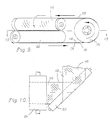
- Fig. 9 is an elevational view taken along line 9-9 of Fig. 7;
- Fig. 10 is a plan view taken along line 10-10 of Fig. 9;
- Fig. 11 is a cross-sectional view taken along line 11-11 of Fig. 7;
- Fig. 12 is a cross-sectional view taken along line 12-12 of Fig. 7;
- Fig. 13 is a schematic representation of blocked web embodiment of the present invention showing the roll formation process;
- Fig. 14 is a partial sectional view taken along line 14-14 of Fig. 13;
- Fig. 15 is a schematic representation of the embodiment of Fig. 13 showing the dispensing process;
- Fig. 16 is a partial sectional view taken along line 16-16 of Fig. 14;
- Fig. 17 is a schematic representation of the wound roll of the dual web embodiment of the present invention;
- Fig. 18 is a partial sectional view taken along line 18-18 of Fig. 17; and
- Fig. 19 is a schematic representation of the dual web embodiment of the present invention.
-
- Referring to the drawing figures, and in particular to Figs. 1-3, preferred
label production apparatus 10 broadly includesweb dispensing mechanism 12,laser unit 14, andlabel application assembly 16 for applying labels topackages 18. In more detail,web dispensing mechanism 12 includes dispensingreel 20, in-feed tension dancer 22 havingrollers feed input roller 26, web spacing rollers 28, out-feed drive rollers up reel 32, and photoelectricweb registration sensor 34 withweb 36 routed throughmechanism 12 as illustrated.
Reel 20 dispensesweb 36 from a supply in the form of aroll 38. -
Web 36 presentsfront face 40 with spaced label indicia including registration marks printed thereon, and presentsrear face 42 having acoating 43 of non-tacky, heat activatable adhesive. It should also be understood that a wide range of heat activated adhesive materials can be used activatable by infrared or ultraviolet, for example, solvent activated adhesives, or the adhesive could be applied at the site of application. In this way,web 36 is non-tacky as dispensed fromsupply roll 38 until the adhesive is activated inactivation zone 44 as discussed further hereinbelow. -
Laser unit 14 includeslaser 46,mirrors controller 50.Laser 46 is operable to produce upper and lower, continuous,narrow laser beams broad laser beam 54 that is routed bymirrors 48a,b to impinge upon webrear face 42 atzone 44 in order to activateadhesive coating 43.Laser 46 is a conventional industrial unit well known to those skilled in the art. The preferred laser unit includes two, 80 watt, carbon dioxide lasers for producingrespective beams 52a,b available from Laser Machining, Inc., of Somerset, Wisconsin. - Upper and
lower laser beams 52a,b are shiftable in the Y axes in the orientation of Fig. 4 in order to cut throughweb 36 as it movespast laser 46. These movements are controlled by a beam positioner operated bycontroller 50, both available from General Scanning, Inc., of Water-town, Massachusetts.Controller 50 is programmed to control the movements ofbeams 52a,b in coordination with the movement ofweb 36 and the operation ofapplication assembly 16. More particularly,controller 50 is connected with the electrical components of dispensingmechanism 12,laser unit 14, andapplication assembly 16 for control thereof, and includes label data stored in memory used to control the movement oflaser beams 52a,b as required for a specific label. -
Label application assembly 16 includesarcuate vacuum shoe 56,belt drive roller 58, tensioningidler roller 60, porousendless belt 62 extending around forward surface 64 ofshoe 56 and aroundrollers photoelectric label sensor 66,photoelectric reflection mirror 68, andphotoelectric package sensor 70.Vacuum shoe 56 is preferably composed of aluminum withforward surface 64 polished to present minimal resistance to the movement ofbelt 62 thereover. The walls ofshoe 56 define aninterior vacuum chamber 72 coupled with aconventional vacuum source 74. Additionally, a plurality ofvacuum openings 74interconnect chamber 72 and forward surface 64 in order to draw a vacuum throughporous belt 62 for holding a label against theoutboard surface 76 thereof. - To operate
apparatus 10, the appropriate label cutting data is loaded into the memory ofcontroller 50.Roll 38 is placed onreel 20 and the leading edge ofweb 36 threaded through components 22-30 and onto take-up reel 32. In operation, movement ofweb 36 is continuous. In response to the detection of a registration mark detected byregistration sensor 34,controller 50 activateslaser 46 topulse beam 54 in order to activateadhesive coating 43 on the label portion ofweb face 42 opposite the corresponding label indicia printed onweb face 40. - As the label portion moves through cutting
zone 78 defined betweenrollers 28a,b,laser beams 52a,b cut throughweb 36 along a predetermined path defined by the label data stored incontroller 50. As illustrated in Fig. 4,laser beams 52a,b move up and down to cut throughweb 36 as it moves past the beams in order to produce alabel 80 and aweb matrix 82. - As the label portion of
web 36exits cutting zone 78,matrix 82 moves aroundroller 28b. The leadingedge 84 oflabel 80, however, is no longer constrained byweb 36 and bridges the gap between dispensingmechanism 12 andapplication assembly 16 so thatbelt 62 engages leadingedge 84. The vacuum being drawn onshoe 56 causes label 80 to be held againstoutboard surface 76 ofbelt 62. This engagement begins beforelaser beams 52a,b completes the cutting oflabel 80. In this way, leadingedge 84, and thereby label 80 as a whole, is supported onbelt 62 before the cutting oflabel 80 is complete. As those skilled in the art will appreciate, the speed ofbelt 62 is matched to the movement ofweb 36. - The movement of
belt 62 carrieslabels 80 with the front indicia face 40 against beltoutboard surface 76 with activatedadhesive coating 43 exposed outwardly.Sensor 66 detects when leadingedge 84 oflabel 80 interrupts the photoelectric beam as reflected bymirror 68. Aslabel leading edge 84 approaches the trailingend 86 ofshoe 56, it moves beyond the area ofvacuum openings 74. This releases the hold onlabel edge 84 and allowsedge 84 to extend beyond theshoe 56 toward an approachingpackage 18. -
Package sensor 70 detects the leading edge of apackage 18 so that the movement ofpackage 18 is coordinated with the presentation oflabel 80, and so that the face ofpackage 18 engages the adhesive activated face oflabel 80 at the same speed at which thelabel 80 is dispensed fromapplication assembly 16. When leadinglabel edge 84 engages the face ofpackage 18, it adheres thereto as does subsequent portions oflabel 80 until the label is fully engaged and adhered to package 18. - Figure 6 illustrates
apparatus 90, which is a second embodiment of the present invention.Apparatus 90 includes a conventional label manufacturing machine and further includeslaser unit 46 operable to producelaser beams 52a,b,controller 50, carriersheet detachment shoe 92, roller 94,attachment shoe 96,pinch roller 98, andmatrix roller 100.Web 102 and carrier sheet 104 are threaded throughapparatus 90 as illustrated.Web 102 includes a coating of conventional pressure adhesive onlower surface 106, and carrier sheet 104 includes a conventional release coat onupper surface 108. - In a conventional label manufacturing machine, a continuous roller die is used to cut through web 104 while leaving the carrier sheet intact. As those skilled in the art will appreciate, dies are expensive to manufacture and a custom die must be produced for each type of label.
Apparatus 90 eliminates the need for a cutting die by usinglaser unit 46 to cutweb 102 according to label data stored in the memory ofcontroller 50. - In operation, carrier sheet 104 is stripped from
web 102 atdetachment shoe 92, extends around roller 94, and is rejoined withweb 102 betweenattachment shoe 96 andpinch roller 98.Laser beams 52a,b cut throughweb 102 in the manner described above in connection withapparatus 10 asweb 102 moves through cuttingzone 110 extending betweenshoes web 102 and carrier sheet 104 in cutting zone'110. In this way, more powerful laser beams can be used for higher production speeds. - The cutting of
web 102 bybeams 52a,b produceslabels 112 andmatrix 114. The leading edge of alabel 112 engages carrier sheet 104 before the trailing edge is cut fromweb 102. Compression betweenpinch roller 98 andshoe 96 ensures secure reattachment.Matrix 114 is then stripped from sheet 104 atmatrix roller 100 leaving sheet 104 with a plurality ofspace labels 112 releasably adhered thereto as illustrated. - Figs. 7-12 illustrate
laminate assembly 120 of the present invention for use in connection withapparatus 10 when it is desired to produce a laminated label. Turning initially to Fig. 7,assembly 120 includes separation roller 122 (Fig. 8), reversingroller 124, laminatingroller 126 andpinch rollers 128a and 128b. As illustrated,rollers assembly 120 is used with web 36a includingbase sheet 130 andlaminate sheet 132.Base sheet 130 is preferably composed of Mobil Label Lyte synthetic resin film and presentstop face 134,bottom face 136 with acoating 138 of pressure sensitive adhesive (Union Carbide Polyacrylate) applied tobottom face 136.Laminate sheet 132 is preferably composed of Mobil Label Mate synthetic resin film and presentsupper surface 140 andlower surface 142 with acoating 144 of pressure sensitive adhesive thereon. As viewed in Fig. 11,adhesive coatings base sheet 130 andlaminate sheet 132. In other words, as dispensed, base sheetbottom face 136 is engaged adjacent laminate sheetlower surface 142. - In operation,
separation roller 122 engages and separateslaminate sheet 132 frombase sheet 130. The separated portion oflaminate sheet 132 is then oriented at right angles to the direction of travel of web 36a. Reversingroller 124 reverses the direction of the separated portion oflaminate sheet 132 whereuponlaminating roller 126 repositionslaminate sheet 132 relative tobase sheet 130. - As dispensed from laminating
roller 126, laminate sheetlower surface 142 engagestop face 134 ofbase sheet 130 and is adhered thereto byadhesive coating 138. In so doing,laminate web 36b is formed withlaminate sheet 132 now on top ofbase sheet 130. In the preferred embodiment, base sheettop face 134 bears label indicia thereon but does not include any release coating. Because of this, laminate sheetadhesive coating 144 permanently adhereslaminate sheet 132 tobase sheet 130 to presentweb 36b with a clear protective lamination.Web 36b then proceeds throughapparatus 10 wherelaser beams - Figs. 13-16 illustrate blocked
web embodiment 150 of the present invention for forming a laminated web. As illustrated in Figs. 13 and 15,web 152 includesbase sheet 154 andlaminate sheet 156.Base sheet 154 is preferably conventional pressure sensitive stock with reduced caliper for cost savings such as opaque or transparent Mobil Label Lyte film.Sheet 154 presentstop face 158 andbottom face 160 having acoating 162 thereon preferably composed of Union Carbide polyacrylate. In the preferred embodiment, label indicia are printed on base sheettop face 158. -
Laminate sheet 156 is preferably composed of Mobil Label Mate film and presentsupper surface 164 andlower surface 166 withrelease coating 168 onupper surface 164. Blockedweb embodiment 150 further includes conventionaladhesive applicator 170 andcompression roller 172. - In operation,
web 152 passes overapplicator 170 which appliesadhesive coating 174 to laminate sheetlower surface 166. Coating 174 is preferably a thermal activated adhesive such as Exxon polyisobutylene.Web 152 then passes undercompression roller 172 whereweb 152 is formed intoroll 176. Asweb 152 is formed intoroll 176,adhesive coating 174 permanently bonds laminate sheetlower surface 166 to the underlying base sheettop face 158. This process forms laminated web 178 (Fig. 16) in which laminatesheet 156 is permanently bonded totop face 158 ofbase sheet 154. - Referring now to Figs. 14 and 16, when
laminated web 158 is dispensed fromroll 176, base sheetbottom face 160 and pressuresensitive release coating 162 releases from the underlyingupper surface 164 oflaminate sheet 156 because of the presence ofrelease coating 168 thereon. As dispensed fromroll 176,laminated web 178 presentsbase sheet 154 withtransparent laminate sheet 156 thereon and can be used as the supply forapparatus 10. - Figs. 17-19 illustrate the dual layer embodiment 180 of the present invention. Referring initially to Fig. 17 and 18, dual web 182 is formed and then dispensed from roll 184. Web 182 includes first printed web 186, tri-adhesive layer 188 and second printed web 190. Tri-adhesive layer 188 is composed of non-tacky activatable adhesive layer 192 on the inboard face of first web 186, a second layer 194 of non-tacky activatable adhesive on the inboard face of web 190, and a relatively thin layer 196 of pressure sensitive adhesive between layers 192 and 194. Adhesive layer 196 maintains webs 186 and 190 in the face-to-face relationship illustrated in Figs. 17-19.
- Fig. 19 illustrates embodiment 180 using dual web 182 and includes roll 184, separation rollers 198a and 198b, direction rollers 200a and 200b, matrix removal rollers 202a and 202b, and two of
laser units 46 designated as units 204a and 204b, each with a dual beam output as described above for cutting labels from the associated webs. - In operation, dual web 182 is dispensed from roll 184 and travels between separation rollers 198a,b where webs 186 and 190 separate at adhesive layer 196. More particularly, web 186 with activatable adhesive layer 192 separates from web 190 carrying its layer 194 of activatable adhesive. Web 186 then travels around roller 200a to the vicinity of laser unit 204a which cuts labels 80 therefrom as described above in connection with
apparatus 10. Waste matrix 206a is then removed. Subsequently, adhesive layer 192 is activated and labels 80 applied to the package. - Similarly, web 190 with activatable adhesive 194 thereon separated at roller 198 and travels around roller 200b to the vicinity of laser unit 204b which cuts labels 80 from web 190. Waste matrix 206b is then removed by way of roller 202b.
- As those skilled in the art will appreciate, dual web embodiment 180 provides a convenient way to double the label production rate of labels dispensed from a single roll. The production of the dual web also presents economies of manufacture.
- Dual web 182 can also be configured with adhesive layer 188 to include two layers of adhesive instead of three. In this bi-adhesive embodiment one of the web adhesive layers is a conventional pressure sensitive adhesive and the other is a non-tacky activatable adhesive. The pressure sensitive adhesive portion maintains the dual web in the face-to-face relationship until separated. With this arrangement, only one stream of labels would need to have the adhesive activated.
- Having thus described the preferred embodiments of the present invention, the following is claimed as new and desired to be secured by Letters Patent:
Claims (9)
- Apparatus for producing labels, comprising:a laser unit (14) capable of producing a laser beam;a dispenser (12) operable to continuously dispense an elongated web (36) of label material past said laser beam, said web at the region of said laser beam (52a) being without a carrier sheet and presenting a plurality of labels (80) surrounded by respective label boundaries; anda laser controller (50) coupled with said laser unit (14) in order to control the laser beam to successively cut each of the label boundaries as the web passes the laser beam, whereby each of the labels is successively separated from the web,said controller (50) having an electronic memory which stores information about said label boundaries and operable to retrieve and use said information to cause the laser unit (14) to cut completely around each label (80) along its boundary before cutting the boundary of a successive label.
- The apparatus of claim 1, said web (36) having no carrier sheet associated therewith.
- The apparatus of claim 1, said web (102) having a carrier sheet (104) there being a separator (122) for separating the carrier sheet from the web in the region of said laser beam.
- The apparatus of claim 1, said laser unit (14) operable for generating at least two laser beams (52a, 52b) which simultaneously cut each of the respective label boundaries.
- The apparatus of claim 4, said laser beams (51a, 52b) generated from a single laser unit (14).
- The apparatus of claim 1, said dispenser (12) including an assembly for handling and shifting said label material from a roll thereof.
- The apparatus of claim 1 comprising:a label application assembly (16) located to receive said labels (80) as they are separated from the web (36) and including a labelling station where a label (80) is applied to a respective object (18).
- The apparatus of claim 7, said label application assembly (16) comprising a vacuum shoe (56) equipped with a continuous, porous, label pickup belt (62), said labelling station adjacent the end of said shoe (56) remote from said laser unit (14)
- The apparatus of claim 7, said labels (80) presenting front and rear faces with a nontacky adhesive heat activatable to become tacky on the rear faces of the labels, said laser unit (14) capable of generating a laser beam focusable upon said rear faces to create heat for activating said adhesive.
Applications Claiming Priority (5)
| Application Number | Priority Date | Filing Date | Title |
|---|---|---|---|
| US07/996,089 US5421933A (en) | 1992-12-23 | 1992-12-23 | System for producing labels from a web |
| US996089 | 1992-12-23 | ||
| US17070693A | 1993-12-21 | 1993-12-21 | |
| US170706 | 1993-12-21 | ||
| EP94904521A EP0675802A4 (en) | 1992-12-23 | 1993-12-22 | System for producing labels from a web. |
Related Parent Applications (1)
| Application Number | Title | Priority Date | Filing Date |
|---|---|---|---|
| EP94904521A Division EP0675802A4 (en) | 1992-12-23 | 1993-12-22 | System for producing labels from a web. |
Publications (2)
| Publication Number | Publication Date |
|---|---|
| EP1122174A2 true EP1122174A2 (en) | 2001-08-08 |
| EP1122174A3 EP1122174A3 (en) | 2001-09-12 |
Family
ID=26866368
Family Applications (1)
| Application Number | Title | Priority Date | Filing Date |
|---|---|---|---|
| EP01107792A Withdrawn EP1122174A3 (en) | 1992-12-23 | 1993-12-22 | System for producing labels from a web |
Country Status (2)
| Country | Link |
|---|---|
| US (4) | US5624520A (en) |
| EP (1) | EP1122174A3 (en) |
Cited By (3)
| Publication number | Priority date | Publication date | Assignee | Title |
|---|---|---|---|---|
| WO2003043890A1 (en) * | 2001-11-15 | 2003-05-30 | Advanced Label Systems, Inc. | Apparatus and method for applying linerless labels |
| EP1400454A1 (en) * | 2002-09-20 | 2004-03-24 | KHS Maschinen- und Anlagenbau Aktiengesellschaft | Labelling machine for handling single labels which are coated with a thermally activatable glue |
| DE102008061976A1 (en) * | 2008-12-12 | 2010-06-17 | Krones Ag | Apparatus and method for attaching labels provided as roll material to containers |
Families Citing this family (59)
| Publication number | Priority date | Publication date | Assignee | Title |
|---|---|---|---|---|
| EP1122174A3 (en) * | 1992-12-23 | 2001-09-12 | Greydon Wesley Nedblake, Jr. | System for producing labels from a web |
| US6095218A (en) * | 1997-07-16 | 2000-08-01 | New Jersey Machine, Inc. | Transfer system for transporting articles cut from a blank of material |
| GB2332637B (en) * | 1997-12-25 | 2000-03-08 | Matsushita Electric Industrial Co Ltd | Apparatus and method for processing |
| US6187128B1 (en) * | 1998-01-21 | 2001-02-13 | Ccl Label Inc. | Apparatus and method for converting and applying labels |
| US6103989A (en) * | 1998-02-09 | 2000-08-15 | Lasercraft, Inc. | System and method for forming discrete laser-etched labels from continuous label stock |
| US6257294B1 (en) * | 1998-03-10 | 2001-07-10 | Agri-Tech, Ltd. | High speed produce label applicator |
| US6191382B1 (en) | 1998-04-02 | 2001-02-20 | Avery Dennison Corporation | Dynamic laser cutting apparatus |
| US6355322B1 (en) | 1998-12-08 | 2002-03-12 | 3M Innovative Properties Company | Release liner incorporating a metal layer |
| FR2789972B1 (en) | 1999-02-18 | 2001-06-01 | Oreal | METHOD FOR SUPPLYING A LABELING STATION AND LABEL HOLDER |
| FR2789971B1 (en) * | 1999-02-18 | 2001-06-01 | Oreal | METHOD FOR SUPPLYING A LABELING STATION AND LABEL HOLDER |
| DE10010487A1 (en) * | 2000-03-03 | 2001-09-06 | Schreiner Gmbh & Co Kg | Production of label, cutting coded indent on side or into middle of label to be painted over to leave invisible or invisible marking if label is removed from item |
| TR200402651T4 (en) * | 2000-05-18 | 2004-11-22 | Steinemann Technology Ag | Method and apparatus for cutting a laminate. |
| US6551439B1 (en) | 2000-06-06 | 2003-04-22 | Applied Extrusion Technologies, Inc. | Ultraviolet labeling apparatus and method |
| US7074295B2 (en) * | 2000-06-06 | 2006-07-11 | Applied Extrusion Technologies, Inc. | Labelling apparatus and method for correcting visual adhesive defects |
| US7229517B2 (en) * | 2000-06-06 | 2007-06-12 | Applied Extrusion Technologies, Inc. | Labeling apparatus and method employing radiation curable adhesive |
| EP1289839B1 (en) * | 2000-06-06 | 2004-05-06 | Applied Extrusion Technologies, Inc. | Labeling apparatus and method employing radiation curable adhesive |
| US6592693B1 (en) | 2000-08-11 | 2003-07-15 | Greydon Wesley Nedblake | Method and apparatus for laser cutting of adhesive-bearing webs separate from liner webs |
| US6598531B2 (en) | 2001-05-09 | 2003-07-29 | Lasersoft Management, L.L.C. | Method and apparatus for on-demand production of digitally imaged webs |
| US20020168212A1 (en) * | 2001-05-09 | 2002-11-14 | Nedblake Greydon W. | On-demand label applicator system |
| US7964228B2 (en) * | 2001-07-24 | 2011-06-21 | Ecolab Usa Inc. | Method for enhancing food safety |
| US20030020274A1 (en) * | 2001-07-24 | 2003-01-30 | Milliorn J. Michael | Adhesive label having nonadhesive tab portion |
| US7083699B2 (en) * | 2001-11-02 | 2006-08-01 | Cardinal Ig Company | Masking glass shapes |
| US7556708B2 (en) * | 2003-06-13 | 2009-07-07 | Advanced Label Systems, Inc. | Apparatus and method for applying labels |
| JP2003158358A (en) * | 2001-11-26 | 2003-05-30 | Hitachi Via Mechanics Ltd | Laser drilling method and apparatus |
| US20030150148A1 (en) * | 2002-02-12 | 2003-08-14 | Spear U.S.A., L.L.C. | Cellulose film label with tactile feel |
| US6818271B2 (en) * | 2002-02-12 | 2004-11-16 | Spear Usa, Llc | Adhesive coated thin film label |
| US6905269B2 (en) * | 2002-07-03 | 2005-06-14 | Oki Data Americas, Inc. | System and method for continuous label printing |
| US6852191B2 (en) * | 2002-08-01 | 2005-02-08 | Equipements De Transformation Imac | Method and apparatus for manufacturing pressure sensitive adhesive label stocks with printing under adhesive and product produced thereby |
| US7077928B2 (en) * | 2002-11-14 | 2006-07-18 | L'oreal | Process for the manufacture of a label stock carrier |
| EA007830B1 (en) * | 2002-12-13 | 2007-02-27 | СПИАР Ю.Эс.Эй., Эл.Эл.Си. | Label |
| US6794604B2 (en) * | 2003-02-19 | 2004-09-21 | Preco Laser Systems, Llc | Web securing system for laser processing |
| DE10357525B3 (en) * | 2003-12-08 | 2005-02-24 | Lpkf Laser & Electronics Ag | Applying cover layer to moving structured base layer involves determining base layer structure position, triggering signal from control unit, making aperture in cover layer by laser to synchronize |
| US7227470B2 (en) * | 2004-04-06 | 2007-06-05 | Lasersoft Americas Limited Partnership | RFID label application system |
| WO2006041924A2 (en) * | 2004-10-04 | 2006-04-20 | Cardinal Cg Company | Thin film coating and temporary protection technology, insulating glazing units, and associated methods |
| DE102005002670B4 (en) * | 2005-01-14 | 2009-07-30 | Fraunhofer-Gesellschaft zur Förderung der angewandten Forschung e.V. | Method for machining workpieces by means of laser radiation |
| US20060207144A1 (en) * | 2005-03-21 | 2006-09-21 | Daydots Holdings, Inc. | Adhesive labels and indicia for use in food rotation to enhance methods of food safety in the food industry |
| ITMO20060096A1 (en) * | 2006-03-24 | 2007-09-25 | Sacmi Labelling S P A | APPARATUS AND METHOD TO OBTAIN LABELS |
| JP4822520B2 (en) * | 2006-07-10 | 2011-11-24 | 大阪シーリング印刷株式会社 | Labeling device |
| US9029731B2 (en) * | 2007-01-26 | 2015-05-12 | Electro Scientific Industries, Inc. | Methods and systems for laser processing continuously moving sheet material |
| US20090188613A1 (en) * | 2008-01-28 | 2009-07-30 | Spear Usa, Llc | Method and apparatus for applying pressure sensitive adhesive labels to containers |
| KR100871151B1 (en) * | 2008-02-20 | 2008-12-05 | (주)제이엔피 | Outboard pull device of branch pipe |
| KR100871150B1 (en) | 2008-02-20 | 2008-12-05 | (주)제이엔피 | External pulling device of branch tube |
| US8544519B2 (en) * | 2008-03-04 | 2013-10-01 | Fuji Seal International, Inc. | Tack labeler |
| EP2323821B1 (en) | 2008-07-14 | 2017-04-26 | Avery Dennison Corporation | Apparatus and process for cutting adhesive labels |
| US8986803B2 (en) * | 2009-09-01 | 2015-03-24 | Fuji Seal International, Inc. | Label formation base material pair and tack labeler |
| CN101937115B (en) * | 2010-07-13 | 2013-11-20 | 苏州苏大维格光电科技股份有限公司 | Device for manufacturing light guide film |
| US9090383B2 (en) | 2011-12-01 | 2015-07-28 | Sealstrip Corporation | Tape sealed reclosable bag |
| GB201222961D0 (en) * | 2012-12-19 | 2013-01-30 | Innovia Films Ltd | Label |
| ITMI20131087A1 (en) * | 2013-06-28 | 2014-12-29 | Ritrama Spa | LINERLESS SELF-ADHESIVE MATERIAL |
| DE102013107841A1 (en) | 2013-07-23 | 2015-01-29 | Khs Gmbh | Label feeding device and labeling device |
| GB201500746D0 (en) * | 2015-01-16 | 2015-03-04 | Catchpoint Ltd | Improvements to labelling apparatus and method |
| US9533813B1 (en) * | 2015-09-27 | 2017-01-03 | Sealstrip Corporation | Re-closable, tamper-resistant, stand-up package |
| ITUB20153944A1 (en) * | 2015-09-28 | 2017-03-28 | Cartes S R L | Apparatus and method for producing discrete portions. |
| JP6682843B2 (en) * | 2015-12-18 | 2020-04-15 | 富士ゼロックス株式会社 | Winding device and label printing device |
| GB202001133D0 (en) * | 2020-01-27 | 2020-03-11 | Ishida Europe Ltd | Container sealing apparatus and method of sealing |
| JP7600754B2 (en) * | 2021-02-26 | 2024-12-17 | 株式会社リコー | Laser irradiation device and laser irradiation method |
| US12252293B2 (en) * | 2021-03-22 | 2025-03-18 | Zebra Technologies Corporation | Adhesive label application system for a robotic device |
| JPWO2023017821A1 (en) * | 2021-08-11 | 2023-02-16 | ||
| US11969981B2 (en) * | 2022-06-08 | 2024-04-30 | Createme Technologies Inc. | Single and dual parallel webline assembly |
Citations (1)
| Publication number | Priority date | Publication date | Assignee | Title |
|---|---|---|---|---|
| US4922775A (en) | 1987-05-02 | 1990-05-08 | Krones Ag Hermann Kronseder Maschinenfabrik | Device for cutting contoured labels |
Family Cites Families (14)
| Publication number | Priority date | Publication date | Assignee | Title |
|---|---|---|---|---|
| US3574026A (en) * | 1966-08-23 | 1971-04-06 | Compac Corp | Method and apparatus for fabricating label stock |
| FR1517905A (en) * | 1967-02-06 | 1968-03-22 | Novacel Sa | Manufacturing process of transfer adhesive articles and resulting products |
| US3542621A (en) * | 1968-07-26 | 1970-11-24 | Reynolds Metals Co | Method and apparatus for continuously laminating a sheet of material to each side of another sheet of material |
| US4475969A (en) * | 1978-01-19 | 1984-10-09 | Avery International Corporation | Label roll manufacture |
| US4537809A (en) * | 1979-04-09 | 1985-08-27 | Avery International Corporation | Van label having non-linear discontinuous score lines in the backing |
| US4513039A (en) * | 1982-11-04 | 1985-04-23 | Minnesota Mining And Manufacturing Company | Composite of separable pressure-sensitive adhesive tapes |
| GB8309033D0 (en) * | 1983-03-31 | 1983-05-11 | Brewer W D | Manufacturing laminated plastics materials |
| US4713518A (en) * | 1984-06-08 | 1987-12-15 | Semiconductor Energy Laboratory Co., Ltd. | Electronic device manufacturing methods |
| EP0220707A3 (en) * | 1985-10-29 | 1988-07-27 | John Waddington PLC | Method of and apparatus for applying labels to articles |
| US4851061A (en) * | 1987-03-16 | 1989-07-25 | Sorkoram Paul O | Method and apparatus for patterned cut of thermoplastics |
| US4986868A (en) * | 1988-08-31 | 1991-01-22 | Wallace Computer Services, Inc. | Method of making an intermediate blank for identification card or the like |
| US5201976A (en) * | 1991-05-06 | 1993-04-13 | Morgan Adhesives Company | Method of producing a continuous label web |
| US5421933A (en) * | 1992-12-23 | 1995-06-06 | Graydon Wesley Nedblake | System for producing labels from a web |
| EP1122174A3 (en) * | 1992-12-23 | 2001-09-12 | Greydon Wesley Nedblake, Jr. | System for producing labels from a web |
-
1993
- 1993-12-22 EP EP01107792A patent/EP1122174A3/en not_active Withdrawn
-
1994
- 1994-12-15 US US08/170,706 patent/US5624520A/en not_active Expired - Lifetime
-
1996
- 1996-10-10 US US08/729,000 patent/US5679199A/en not_active Expired - Lifetime
- 1996-10-10 US US08/729,014 patent/US5681412A/en not_active Expired - Lifetime
-
1998
- 1998-06-29 US US09/107,552 patent/US6024830A/en not_active Expired - Fee Related
Patent Citations (1)
| Publication number | Priority date | Publication date | Assignee | Title |
|---|---|---|---|---|
| US4922775A (en) | 1987-05-02 | 1990-05-08 | Krones Ag Hermann Kronseder Maschinenfabrik | Device for cutting contoured labels |
Cited By (4)
| Publication number | Priority date | Publication date | Assignee | Title |
|---|---|---|---|---|
| WO2003043890A1 (en) * | 2001-11-15 | 2003-05-30 | Advanced Label Systems, Inc. | Apparatus and method for applying linerless labels |
| EP1400454A1 (en) * | 2002-09-20 | 2004-03-24 | KHS Maschinen- und Anlagenbau Aktiengesellschaft | Labelling machine for handling single labels which are coated with a thermally activatable glue |
| DE102008061976A1 (en) * | 2008-12-12 | 2010-06-17 | Krones Ag | Apparatus and method for attaching labels provided as roll material to containers |
| US8192573B2 (en) | 2008-12-12 | 2012-06-05 | Krones Ag | Apparatus and method for applying labels supplied from a roll to containers |
Also Published As
| Publication number | Publication date |
|---|---|
| EP1122174A3 (en) | 2001-09-12 |
| US5624520A (en) | 1997-04-29 |
| US6024830A (en) | 2000-02-15 |
| US5681412A (en) | 1997-10-28 |
| US5679199A (en) | 1997-10-21 |
Similar Documents
| Publication | Publication Date | Title |
|---|---|---|
| US6024830A (en) | Apparatus for producing labels from a web and for applying such labels to objects | |
| CA2152606C (en) | System for producing labels from a web | |
| CA1276830C (en) | Labels and manufacture thereof | |
| CA1337103C (en) | Method of producing blocks of self-adhesive labels or the like and of applying the labels to a body | |
| US5827389A (en) | Printed label, method and apparatus for manufacturing printed labels, and method and apparatus for attaching printed labels | |
| US5639332A (en) | Method and apparatus for producing labels | |
| US4675062A (en) | Method and apparatus for making labels | |
| US4680080A (en) | Apparatus for producing labels | |
| US6123796A (en) | Method of making and applying combination article security target and printed label | |
| US5867102A (en) | Electronic article surveillance label assembly and method of manufacture | |
| US8371354B2 (en) | Apparatus and method for applying labels | |
| CZ290904B6 (en) | Self-adhesive label a process for producing such self-adhesive label | |
| US6350342B1 (en) | Method of making integrated label products | |
| JP2000247319A (en) | Label row supply method and label support used for the method | |
| PL208879B1 (en) | Web with pockets, method and device for making web with pockets | |
| US4690720A (en) | Method of manufacturing multilayer labels and apparatus therefor | |
| WO1995017304A1 (en) | System for producing labels from a web | |
| US5725713A (en) | Paper sheets or webs with separable self-adhesive labels | |
| JPH09217042A (en) | Multilayer pressure-sensitive adhesive tape roll and multilayer pressure-sensitive adhesive tape for display | |
| EP0431825A2 (en) | Adhesive laminate label array and method for making same | |
| JP3813198B2 (en) | Printed label manufacturing apparatus and manufacturing method thereof | |
| JPS5816217A (en) | Sticking device for polarizing plate | |
| EP0515167A2 (en) | Laminating process and apparatus and use thereof | |
| CA1285413C (en) | Method and apparatus for manufacturing discrete elements, the discrete elements and a method and apparatus for applying the discrete elements | |
| JP2006058848A (en) | Support with two types of labels |
Legal Events
| Date | Code | Title | Description |
|---|---|---|---|
| PUAI | Public reference made under article 153(3) epc to a published international application that has entered the european phase |
Free format text: ORIGINAL CODE: 0009012 |
|
| PUAL | Search report despatched |
Free format text: ORIGINAL CODE: 0009013 |
|
| 17P | Request for examination filed |
Effective date: 20010426 |
|
| AC | Divisional application: reference to earlier application |
Ref document number: 675802 Country of ref document: EP |
|
| AK | Designated contracting states |
Kind code of ref document: A2 Designated state(s): AT BE CH DE DK ES FR GB GR IE IT LI LU MC NL PT SE |
|
| AK | Designated contracting states |
Kind code of ref document: A3 Designated state(s): AT BE CH DE DK ES FR GB GR IE IT LI LU MC NL PT SE |
|
| AKX | Designation fees paid |
Free format text: AT BE CH DE DK ES FR GB GR IE IT LI LU MC NL PT SE |
|
| 17Q | First examination report despatched |
Effective date: 20021001 |
|
| STAA | Information on the status of an ep patent application or granted ep patent |
Free format text: STATUS: THE APPLICATION IS DEEMED TO BE WITHDRAWN |
|
| 18D | Application deemed to be withdrawn |
Effective date: 20030729 |