EP1122281A1 - Pneumatiques pour lourdes charges, et utilisation d'une composition de caoutchouc pour retarder l'usure irrégulière sur ces pneumatiques. - Google Patents
Pneumatiques pour lourdes charges, et utilisation d'une composition de caoutchouc pour retarder l'usure irrégulière sur ces pneumatiques. Download PDFInfo
- Publication number
- EP1122281A1 EP1122281A1 EP01101179A EP01101179A EP1122281A1 EP 1122281 A1 EP1122281 A1 EP 1122281A1 EP 01101179 A EP01101179 A EP 01101179A EP 01101179 A EP01101179 A EP 01101179A EP 1122281 A1 EP1122281 A1 EP 1122281A1
- Authority
- EP
- European Patent Office
- Prior art keywords
- reinforcing
- filler
- rubber composition
- elastomer
- white
- Prior art date
- Legal status (The legal status is an assumption and is not a legal conclusion. Google has not performed a legal analysis and makes no representation as to the accuracy of the status listed.)
- Granted
Links
- 239000000203 mixture Substances 0.000 title claims abstract description 154
- 229920001971 elastomer Polymers 0.000 title claims abstract description 59
- 239000005060 rubber Substances 0.000 title claims abstract description 28
- 230000001788 irregular Effects 0.000 title claims abstract description 25
- 230000000979 retarding effect Effects 0.000 title 1
- 230000003014 reinforcing effect Effects 0.000 claims abstract description 42
- 239000000945 filler Substances 0.000 claims abstract description 36
- 239000012763 reinforcing filler Substances 0.000 claims abstract description 32
- 239000000806 elastomer Substances 0.000 claims abstract description 31
- 229920003244 diene elastomer Polymers 0.000 claims abstract description 28
- 230000008878 coupling Effects 0.000 claims abstract description 22
- 238000010168 coupling process Methods 0.000 claims abstract description 22
- 238000005859 coupling reaction Methods 0.000 claims abstract description 22
- 125000000524 functional group Chemical group 0.000 claims abstract description 20
- 239000011159 matrix material Substances 0.000 claims abstract description 18
- 238000005096 rolling process Methods 0.000 claims abstract description 18
- 239000007767 bonding agent Substances 0.000 claims abstract description 12
- VYPSYNLAJGMNEJ-UHFFFAOYSA-N Silicium dioxide Chemical compound O=[Si]=O VYPSYNLAJGMNEJ-UHFFFAOYSA-N 0.000 claims description 80
- 239000000377 silicon dioxide Substances 0.000 claims description 39
- 239000003795 chemical substances by application Substances 0.000 claims description 29
- 229920001577 copolymer Polymers 0.000 claims description 20
- 150000001993 dienes Chemical class 0.000 claims description 19
- -1 polysiloxane Polymers 0.000 claims description 15
- 239000000178 monomer Substances 0.000 claims description 12
- 229920002554 vinyl polymer Polymers 0.000 claims description 9
- LZZYPRNAOMGNLH-UHFFFAOYSA-M Cetrimonium bromide Chemical compound [Br-].CCCCCCCCCCCCCCCC[N+](C)(C)C LZZYPRNAOMGNLH-UHFFFAOYSA-M 0.000 claims description 8
- 229920001296 polysiloxane Polymers 0.000 claims description 6
- SCPYDCQAZCOKTP-UHFFFAOYSA-N silanol Chemical compound [SiH3]O SCPYDCQAZCOKTP-UHFFFAOYSA-N 0.000 claims description 5
- 230000009477 glass transition Effects 0.000 claims description 3
- 125000005372 silanol group Chemical group 0.000 claims description 3
- 229920003048 styrene butadiene rubber Polymers 0.000 description 32
- 241000447437 Gerreidae Species 0.000 description 27
- 239000006229 carbon black Substances 0.000 description 20
- 235000019241 carbon black Nutrition 0.000 description 20
- RRHGJUQNOFWUDK-UHFFFAOYSA-N Isoprene Chemical compound CC(=C)C=C RRHGJUQNOFWUDK-UHFFFAOYSA-N 0.000 description 17
- 208000016261 weight loss Diseases 0.000 description 17
- 230000004580 weight loss Effects 0.000 description 17
- 229920001195 polyisoprene Polymers 0.000 description 14
- PPBRXRYQALVLMV-UHFFFAOYSA-N Styrene Chemical compound C=CC1=CC=CC=C1 PPBRXRYQALVLMV-UHFFFAOYSA-N 0.000 description 12
- KAKZBPTYRLMSJV-UHFFFAOYSA-N Butadiene Chemical compound C=CC=C KAKZBPTYRLMSJV-UHFFFAOYSA-N 0.000 description 9
- 244000043261 Hevea brasiliensis Species 0.000 description 9
- NINIDFKCEFEMDL-UHFFFAOYSA-N Sulfur Chemical compound [S] NINIDFKCEFEMDL-UHFFFAOYSA-N 0.000 description 9
- 229920003052 natural elastomer Polymers 0.000 description 9
- 229920001194 natural rubber Polymers 0.000 description 9
- 239000003921 oil Substances 0.000 description 8
- 238000004073 vulcanization Methods 0.000 description 8
- 229910052717 sulfur Inorganic materials 0.000 description 7
- OKTJSMMVPCPJKN-UHFFFAOYSA-N Carbon Chemical compound [C] OKTJSMMVPCPJKN-UHFFFAOYSA-N 0.000 description 6
- 239000003963 antioxidant agent Substances 0.000 description 6
- 229940082150 encore Drugs 0.000 description 6
- 239000011593 sulfur Substances 0.000 description 6
- 239000005062 Polybutadiene Substances 0.000 description 5
- 241001080024 Telles Species 0.000 description 5
- 150000001875 compounds Chemical class 0.000 description 5
- 230000003078 antioxidant effect Effects 0.000 description 4
- 125000003710 aryl alkyl group Chemical group 0.000 description 4
- 230000015572 biosynthetic process Effects 0.000 description 4
- 239000007822 coupling agent Substances 0.000 description 4
- 238000005520 cutting process Methods 0.000 description 4
- 239000006185 dispersion Substances 0.000 description 4
- 238000004519 manufacturing process Methods 0.000 description 4
- 238000000034 method Methods 0.000 description 4
- 229920000642 polymer Polymers 0.000 description 4
- 229920005989 resin Polymers 0.000 description 4
- 239000011347 resin Substances 0.000 description 4
- MYRTYDVEIRVNKP-UHFFFAOYSA-N 1,2-Divinylbenzene Chemical compound C=CC1=CC=CC=C1C=C MYRTYDVEIRVNKP-UHFFFAOYSA-N 0.000 description 3
- OVSKIKFHRZPJSS-UHFFFAOYSA-N 2,4-D Chemical compound OC(=O)COC1=CC=C(Cl)C=C1Cl OVSKIKFHRZPJSS-UHFFFAOYSA-N 0.000 description 3
- 125000003545 alkoxy group Chemical group 0.000 description 3
- 229910052782 aluminium Inorganic materials 0.000 description 3
- XAGFODPZIPBFFR-UHFFFAOYSA-N aluminium Chemical compound [Al] XAGFODPZIPBFFR-UHFFFAOYSA-N 0.000 description 3
- OVXZVDMCQPLHIY-QXGOIDDHSA-L calcium;4-[[(2r)-2,4-dihydroxy-3,3-dimethylbutanoyl]amino]butanoate Chemical compound [Ca+2].OCC(C)(C)[C@@H](O)C(=O)NCCCC([O-])=O.OCC(C)(C)[C@@H](O)C(=O)NCCCC([O-])=O OVXZVDMCQPLHIY-QXGOIDDHSA-L 0.000 description 3
- 125000004432 carbon atom Chemical group C* 0.000 description 3
- 125000000113 cyclohexyl group Chemical group [H]C1([H])C([H])([H])C([H])([H])C([H])(*)C([H])([H])C1([H])[H] 0.000 description 3
- 238000007306 functionalization reaction Methods 0.000 description 3
- 239000010690 paraffinic oil Substances 0.000 description 3
- 239000000126 substance Substances 0.000 description 3
- OWRCNXZUPFZXOS-UHFFFAOYSA-N 1,3-diphenylguanidine Chemical compound C=1C=CC=CC=1NC(=N)NC1=CC=CC=C1 OWRCNXZUPFZXOS-UHFFFAOYSA-N 0.000 description 2
- HMWCQCYUKQZPRA-UHFFFAOYSA-N 2,4-dimethyl-3-methylidenepent-1-ene Chemical compound CC(C)C(=C)C(C)=C HMWCQCYUKQZPRA-UHFFFAOYSA-N 0.000 description 2
- PDELBHCVXBSVPJ-UHFFFAOYSA-N 2-ethenyl-1,3,5-trimethylbenzene Chemical compound CC1=CC(C)=C(C=C)C(C)=C1 PDELBHCVXBSVPJ-UHFFFAOYSA-N 0.000 description 2
- PJXJBPMWCKMWLS-UHFFFAOYSA-N 2-methyl-3-methylidenepent-1-ene Chemical compound CCC(=C)C(C)=C PJXJBPMWCKMWLS-UHFFFAOYSA-N 0.000 description 2
- 239000004215 Carbon black (E152) Substances 0.000 description 2
- 208000035126 Facies Diseases 0.000 description 2
- 239000006237 Intermediate SAF Substances 0.000 description 2
- XUIMIQQOPSSXEZ-UHFFFAOYSA-N Silicon Chemical compound [Si] XUIMIQQOPSSXEZ-UHFFFAOYSA-N 0.000 description 2
- 235000021355 Stearic acid Nutrition 0.000 description 2
- 125000000217 alkyl group Chemical group 0.000 description 2
- 125000002947 alkylene group Chemical group 0.000 description 2
- 239000004411 aluminium Substances 0.000 description 2
- 239000010692 aromatic oil Substances 0.000 description 2
- 125000003118 aryl group Chemical group 0.000 description 2
- 125000004429 atom Chemical group 0.000 description 2
- 239000011230 binding agent Substances 0.000 description 2
- 239000000470 constituent Substances 0.000 description 2
- 230000003111 delayed effect Effects 0.000 description 2
- KPUWHANPEXNPJT-UHFFFAOYSA-N disiloxane Chemical class [SiH3]O[SiH3] KPUWHANPEXNPJT-UHFFFAOYSA-N 0.000 description 2
- 230000000694 effects Effects 0.000 description 2
- 238000000605 extraction Methods 0.000 description 2
- 238000009472 formulation Methods 0.000 description 2
- HTDJPCNNEPUOOQ-UHFFFAOYSA-N hexamethylcyclotrisiloxane Chemical compound C[Si]1(C)O[Si](C)(C)O[Si](C)(C)O1 HTDJPCNNEPUOOQ-UHFFFAOYSA-N 0.000 description 2
- 229920001519 homopolymer Polymers 0.000 description 2
- 229930195733 hydrocarbon Natural products 0.000 description 2
- 230000006872 improvement Effects 0.000 description 2
- 208000020442 loss of weight Diseases 0.000 description 2
- QIQXTHQIDYTFRH-UHFFFAOYSA-N octadecanoic acid Chemical compound CCCCCCCCCCCCCCCCCC(O)=O QIQXTHQIDYTFRH-UHFFFAOYSA-N 0.000 description 2
- OQCDKBAXFALNLD-UHFFFAOYSA-N octadecanoic acid Natural products CCCCCCCC(C)CCCCCCCCC(O)=O OQCDKBAXFALNLD-UHFFFAOYSA-N 0.000 description 2
- 239000012188 paraffin wax Substances 0.000 description 2
- PMJHHCWVYXUKFD-UHFFFAOYSA-N penta-1,3-diene Chemical compound CC=CC=C PMJHHCWVYXUKFD-UHFFFAOYSA-N 0.000 description 2
- 238000006116 polymerization reaction Methods 0.000 description 2
- 229920001451 polypropylene glycol Polymers 0.000 description 2
- 229920001021 polysulfide Polymers 0.000 description 2
- 150000004819 silanols Chemical class 0.000 description 2
- 239000008117 stearic acid Substances 0.000 description 2
- 230000000930 thermomechanical effect Effects 0.000 description 2
- APPOKADJQUIAHP-GGWOSOGESA-N (2e,4e)-hexa-2,4-diene Chemical compound C\C=C\C=C\C APPOKADJQUIAHP-GGWOSOGESA-N 0.000 description 1
- 125000004178 (C1-C4) alkyl group Chemical group 0.000 description 1
- 125000006527 (C1-C5) alkyl group Chemical group 0.000 description 1
- 125000004169 (C1-C6) alkyl group Chemical group 0.000 description 1
- PMJHHCWVYXUKFD-SNAWJCMRSA-N (E)-1,3-pentadiene Chemical compound C\C=C\C=C PMJHHCWVYXUKFD-SNAWJCMRSA-N 0.000 description 1
- FJLUATLTXUNBOT-UHFFFAOYSA-N 1-Hexadecylamine Chemical compound CCCCCCCCCCCCCCCCN FJLUATLTXUNBOT-UHFFFAOYSA-N 0.000 description 1
- IGGDKDTUCAWDAN-UHFFFAOYSA-N 1-vinylnaphthalene Chemical compound C1=CC=C2C(C=C)=CC=CC2=C1 IGGDKDTUCAWDAN-UHFFFAOYSA-N 0.000 description 1
- VBCFHWSPNHEYGE-UHFFFAOYSA-N 2,3,4-trimethylquinoline Chemical compound C1=CC=C2C(C)=C(C)C(C)=NC2=C1 VBCFHWSPNHEYGE-UHFFFAOYSA-N 0.000 description 1
- SDJHPPZKZZWAKF-UHFFFAOYSA-N 2,3-dimethylbuta-1,3-diene Chemical compound CC(=C)C(C)=C SDJHPPZKZZWAKF-UHFFFAOYSA-N 0.000 description 1
- SBYMUDUGTIKLCR-UHFFFAOYSA-N 2-chloroethenylbenzene Chemical class ClC=CC1=CC=CC=C1 SBYMUDUGTIKLCR-UHFFFAOYSA-N 0.000 description 1
- CTHJQRHPNQEPAB-UHFFFAOYSA-N 2-methoxyethenylbenzene Chemical class COC=CC1=CC=CC=C1 CTHJQRHPNQEPAB-UHFFFAOYSA-N 0.000 description 1
- JLBJTVDPSNHSKJ-UHFFFAOYSA-N 4-Methylstyrene Chemical compound CC1=CC=C(C=C)C=C1 JLBJTVDPSNHSKJ-UHFFFAOYSA-N 0.000 description 1
- ZZMVLMVFYMGSMY-UHFFFAOYSA-N 4-n-(4-methylpentan-2-yl)-1-n-phenylbenzene-1,4-diamine Chemical compound C1=CC(NC(C)CC(C)C)=CC=C1NC1=CC=CC=C1 ZZMVLMVFYMGSMY-UHFFFAOYSA-N 0.000 description 1
- 241000238876 Acari Species 0.000 description 1
- 229910018072 Al 2 O 3 Inorganic materials 0.000 description 1
- WSFSSNUMVMOOMR-UHFFFAOYSA-N Formaldehyde Chemical compound O=C WSFSSNUMVMOOMR-UHFFFAOYSA-N 0.000 description 1
- 241000872198 Serjania polyphylla Species 0.000 description 1
- 241000897276 Termes Species 0.000 description 1
- XTXRWKRVRITETP-UHFFFAOYSA-N Vinyl acetate Chemical compound CC(=O)OC=C XTXRWKRVRITETP-UHFFFAOYSA-N 0.000 description 1
- 240000008042 Zea mays Species 0.000 description 1
- HCHKCACWOHOZIP-UHFFFAOYSA-N Zinc Chemical compound [Zn] HCHKCACWOHOZIP-UHFFFAOYSA-N 0.000 description 1
- 239000000654 additive Substances 0.000 description 1
- 230000016571 aggressive behavior Effects 0.000 description 1
- 125000005370 alkoxysilyl group Chemical group 0.000 description 1
- WNROFYMDJYEPJX-UHFFFAOYSA-K aluminium hydroxide Chemical class [OH-].[OH-].[OH-].[Al+3] WNROFYMDJYEPJX-UHFFFAOYSA-K 0.000 description 1
- PNEYBMLMFCGWSK-UHFFFAOYSA-N aluminium oxide Inorganic materials [O-2].[O-2].[O-2].[Al+3].[Al+3] PNEYBMLMFCGWSK-UHFFFAOYSA-N 0.000 description 1
- 150000001408 amides Chemical class 0.000 description 1
- 150000001412 amines Chemical class 0.000 description 1
- 125000000732 arylene group Chemical group 0.000 description 1
- 239000011324 bead Substances 0.000 description 1
- KVBYPTUGEKVEIJ-UHFFFAOYSA-N benzene-1,3-diol;formaldehyde Chemical compound O=C.OC1=CC=CC(O)=C1 KVBYPTUGEKVEIJ-UHFFFAOYSA-N 0.000 description 1
- 230000001588 bifunctional effect Effects 0.000 description 1
- 239000003738 black carbon Substances 0.000 description 1
- 229910052799 carbon Inorganic materials 0.000 description 1
- 239000011203 carbon fibre reinforced carbon Substances 0.000 description 1
- 230000008859 change Effects 0.000 description 1
- 229910052681 coesite Inorganic materials 0.000 description 1
- 238000007334 copolymerization reaction Methods 0.000 description 1
- 229910052593 corundum Inorganic materials 0.000 description 1
- 229910052906 cristobalite Inorganic materials 0.000 description 1
- 125000004122 cyclic group Chemical group 0.000 description 1
- 125000000753 cycloalkyl group Chemical group 0.000 description 1
- 230000007423 decrease Effects 0.000 description 1
- PCERBVBQNKZCFS-UHFFFAOYSA-N dibenzylcarbamodithioic acid Chemical compound C=1C=CC=CC=1CN(C(=S)S)CC1=CC=CC=C1 PCERBVBQNKZCFS-UHFFFAOYSA-N 0.000 description 1
- 125000002897 diene group Chemical group 0.000 description 1
- 238000001493 electron microscopy Methods 0.000 description 1
- 125000001495 ethyl group Chemical group [H]C([H])([H])C([H])([H])* 0.000 description 1
- 230000001747 exhibiting effect Effects 0.000 description 1
- 229960004279 formaldehyde Drugs 0.000 description 1
- 235000019256 formaldehyde Nutrition 0.000 description 1
- 229910021485 fumed silica Inorganic materials 0.000 description 1
- 239000008187 granular material Substances 0.000 description 1
- 238000010438 heat treatment Methods 0.000 description 1
- APPOKADJQUIAHP-UHFFFAOYSA-N hexa-2,4-diene Chemical compound CC=CC=CC APPOKADJQUIAHP-UHFFFAOYSA-N 0.000 description 1
- RSKGMYDENCAJEN-UHFFFAOYSA-N hexadecyl(trimethoxy)silane Chemical compound CCCCCCCCCCCCCCCC[Si](OC)(OC)OC RSKGMYDENCAJEN-UHFFFAOYSA-N 0.000 description 1
- 150000002430 hydrocarbons Chemical group 0.000 description 1
- 125000002887 hydroxy group Chemical group [H]O* 0.000 description 1
- LWIGVRDDANOFTD-UHFFFAOYSA-N hydroxy(dimethyl)silane Chemical group C[SiH](C)O LWIGVRDDANOFTD-UHFFFAOYSA-N 0.000 description 1
- 229910052738 indium Inorganic materials 0.000 description 1
- 229910052500 inorganic mineral Inorganic materials 0.000 description 1
- 125000002496 methyl group Chemical group [H]C([H])([H])* 0.000 description 1
- GRVDJDISBSALJP-UHFFFAOYSA-N methyloxidanyl Chemical group [O]C GRVDJDISBSALJP-UHFFFAOYSA-N 0.000 description 1
- 239000011325 microbead Substances 0.000 description 1
- 239000011707 mineral Substances 0.000 description 1
- 238000002156 mixing Methods 0.000 description 1
- 238000000399 optical microscopy Methods 0.000 description 1
- 150000001282 organosilanes Chemical class 0.000 description 1
- 150000002978 peroxides Chemical class 0.000 description 1
- 125000001997 phenyl group Chemical group [H]C1=C([H])C([H])=C(*)C([H])=C1[H] 0.000 description 1
- 230000000704 physical effect Effects 0.000 description 1
- 239000000049 pigment Substances 0.000 description 1
- 239000004014 plasticizer Substances 0.000 description 1
- 229920003192 poly(bis maleimide) Polymers 0.000 description 1
- 229920002857 polybutadiene Polymers 0.000 description 1
- 229920005862 polyol Polymers 0.000 description 1
- 150000003077 polyols Chemical class 0.000 description 1
- 239000000843 powder Substances 0.000 description 1
- 238000002360 preparation method Methods 0.000 description 1
- 230000008569 process Effects 0.000 description 1
- QQONPFPTGQHPMA-UHFFFAOYSA-N propylene Natural products CC=C QQONPFPTGQHPMA-UHFFFAOYSA-N 0.000 description 1
- 125000004805 propylene group Chemical group [H]C([H])([H])C([H])([*:1])C([H])([H])[*:2] 0.000 description 1
- 230000001681 protective effect Effects 0.000 description 1
- 239000012429 reaction media Substances 0.000 description 1
- 230000009467 reduction Effects 0.000 description 1
- 230000002787 reinforcement Effects 0.000 description 1
- 229920006395 saturated elastomer Polymers 0.000 description 1
- 229910052710 silicon Inorganic materials 0.000 description 1
- 239000002904 solvent Substances 0.000 description 1
- 229910052682 stishovite Inorganic materials 0.000 description 1
- TXDNPSYEJHXKMK-UHFFFAOYSA-N sulfanylsilane Chemical class S[SiH3] TXDNPSYEJHXKMK-UHFFFAOYSA-N 0.000 description 1
- QAZLUNIWYYOJPC-UHFFFAOYSA-M sulfenamide Chemical compound [Cl-].COC1=C(C)C=[N+]2C3=NC4=CC=C(OC)C=C4N3SCC2=C1C QAZLUNIWYYOJPC-UHFFFAOYSA-M 0.000 description 1
- 125000004434 sulfur atom Chemical group 0.000 description 1
- 238000003786 synthesis reaction Methods 0.000 description 1
- 229920003051 synthetic elastomer Polymers 0.000 description 1
- 229920001059 synthetic polymer Polymers 0.000 description 1
- YXFVVABEGXRONW-UHFFFAOYSA-N toluene Substances CC1=CC=CC=C1 YXFVVABEGXRONW-UHFFFAOYSA-N 0.000 description 1
- 230000007704 transition Effects 0.000 description 1
- 229910052905 tridymite Inorganic materials 0.000 description 1
- VTHOKNTVYKTUPI-UHFFFAOYSA-N triethoxy-[3-(3-triethoxysilylpropyltetrasulfanyl)propyl]silane Chemical compound CCO[Si](OCC)(OCC)CCCSSSSCCC[Si](OCC)(OCC)OCC VTHOKNTVYKTUPI-UHFFFAOYSA-N 0.000 description 1
- 239000001993 wax Substances 0.000 description 1
- 229910001845 yogo sapphire Inorganic materials 0.000 description 1
- 239000011701 zinc Substances 0.000 description 1
- 229910052725 zinc Inorganic materials 0.000 description 1
- AUMBZPPBWALQRO-UHFFFAOYSA-L zinc;n,n-dibenzylcarbamodithioate Chemical compound [Zn+2].C=1C=CC=CC=1CN(C(=S)[S-])CC1=CC=CC=C1.C=1C=CC=CC=1CN(C(=S)[S-])CC1=CC=CC=C1 AUMBZPPBWALQRO-UHFFFAOYSA-L 0.000 description 1
Classifications
-
- B—PERFORMING OPERATIONS; TRANSPORTING
- B60—VEHICLES IN GENERAL
- B60C—VEHICLE TYRES; TYRE INFLATION; TYRE CHANGING; CONNECTING VALVES TO INFLATABLE ELASTIC BODIES IN GENERAL; DEVICES OR ARRANGEMENTS RELATED TO TYRES
- B60C1/00—Tyres characterised by the chemical composition or the physical arrangement or mixture of the composition
- B60C1/0016—Compositions of the tread
-
- C—CHEMISTRY; METALLURGY
- C08—ORGANIC MACROMOLECULAR COMPOUNDS; THEIR PREPARATION OR CHEMICAL WORKING-UP; COMPOSITIONS BASED THEREON
- C08L—COMPOSITIONS OF MACROMOLECULAR COMPOUNDS
- C08L19/00—Compositions of rubbers not provided for in groups C08L7/00 - C08L17/00
- C08L19/006—Rubber characterised by functional groups, e.g. telechelic diene polymers
Definitions
- the present invention relates to tires suitable for carrying heavy loads, and a use of a rubber composition for delaying during rolling the appearance of irregular wear on the treads of such tires.
- the invention applies to tires for motor vehicles, such as heavy goods vehicles, civil engineering or aircraft.
- the wear resistance of a tire is evaluated intended to carry heavy loads by measuring the weight loss of this envelope, by compared to a control envelope and following a run over the same distance which is sufficient to cause significant weight loss.
- This facies of irregular wear can be characterized, on the one hand, by a rate of loss of very high weight at the location of the edges of the central ribs which are located nearby of the median circumferential plane of the tread and, on the other hand, by a rate of loss of weight at the location of the ribs of the “shoulder” zone of said strip which is much higher than that which relates to said central ribs.
- a first way consisted in acting on the shapes of the tread sculptures, as for example described in patent documents JP-A-99/105 513, JP-A-97/175 120, or EP-A-705,721.
- a radially external part (i.e. intended to be in contact with the ground) is made up of a rubber composition, the elastomer matrix of which mainly comprises a copolymer of styrene and butadiene, and which comprises a reinforcing filler consisting of carbon black.
- This radially outer part provides the corresponding tread irregular wear which is satisfactorily delayed and, in addition, resistance satisfactory to attacks caused by rolling.
- an intrinsic characteristic of the composition which constitutes this external part is that it presents hysteretic losses high.
- This part radially internal consists of a composition intrinsically characterized by losses relatively reduced hysteretics, which has the effect of limiting the internal heating of the rolling tread and therefore the rolling resistance of the tire corresponding.
- a third way consisted in using a tread which is characterized by the particular formulation of the unique rubber composition which constitutes it.
- compositions comprising an elastomer matrix based on natural rubber, due to the reduced hysteretic losses that the latter presents, and a reinforcing filler made up of black of carbon.
- a disadvantage of these compositions lies in the relatively reduced adhesion that they give to the corresponding treads.
- compositions by combining carbon black with a elastomer matrix based on a copolymer of a conjugated diene monomer and of a monomer vinyl aromatic, such as a copolymer of styrene and butadiene.
- a elastomer matrix based on a copolymer of a conjugated diene monomer and of a monomer vinyl aromatic, such as a copolymer of styrene and butadiene.
- the resulting compositions give the corresponding treads satisfactory results in terms of wear resistance and retard irregular wear, and they also give them a good resistance to attack due to rolling.
- these compositions exhibit very high hysteretic losses.
- black carbon / silica cutting as a filler reinforcing involves the same aforementioned drawbacks, in relation to a charge based on carbon black or silica black depending on the relative mass fractions which are used.
- the coupling agent preferably used in rubber compositions in accordance with the invention is a polysulphurized alkoxysilane, carrying in a known manner two functions noted here "Y” and “X”, graftable on the one hand on the white charge by means of the "Y” function (alkoxysilyl function) and on the other hand on the elastomer by means of the "X" function (sulfur function).
- polysulphurized alkoxysilanes are used, as described for example in patent documents US-A-3,842,111, US-A-3,873,489, US-A-3,978,103, US-A-3,997,581 already cited, or in more recent patent documents US-A-5,580,919, US-A- 5,583,245, US-A- 5,663,396, US-A- 5,684,171, US-A- 5,684,172, US-A- 5,696,197 which describe in detail such known compounds.
- n is preferably an integer from 3 to 5.
- n is a fractional number, preferably between 3 and 5, more preferably close to 4.
- the radical A substituted or unsubstituted, is preferably a divalent hydrocarbon radical, saturated or unsaturated, containing from 1 to 18 carbon atoms.
- Particularly suitable are C 1 -C 18 alkylene groups or C 6 -C 12 arylene groups, more particularly C 1 -C 10 , especially C 2 -C 4 , alkylene groups, in particular propylene.
- the radicals R 1 are preferably C 1 -C 6 alkyl, cyclohexyl or phenyl groups, in particular C 1 -C 4 alkyl groups, more particularly methyl and / or ethyl.
- the radicals R 2 are preferably C 1 -C 8 alkoxyl or C 5 -C 8 cycloalkoxyl groups, more particularly methoxyl and / or ethoxyl.
- the polysulphurized alkoxysilane used in the invention is a polysulphide, in particular a tetrasulphide, of bis (C 1 -C 4 ) silylpropyl), more preferably of bis (trialkoxyl (C 1 -C 4 ) silylpropyl ), especially bis (3-triethoxysilylpropyl) or bis (3-trimethoxysilylpropyl).
- TESPT bis (triethoxysilylpropyl) tetrasulfide
- Si69 or X50S when supported at 50% by weight on carbon black
- Silquest A1289 in both cases commercial mixture of polysulphides with an average value for n which is close to 4
- the alkoxysilane content polysulphurized can be in a range of 1% to 15% relative to the weight of filler reinforcing white.
- the polysulphurized alkoxysilane could be grafted beforehand (via the function "X") on the diene elastomer of the composition of the invention, the elastomer thus functionalized or "precoupled” then including the free "Y” function for the white charge reinforcing.
- the polysulphurized alkoxysilane could also be grafted beforehand (via the "Y” function) on the reinforcing white charge, the charge thus "precoupled” can then be linked to the diene elastomer via the free function "X".
- compositions in the raw state use the coupling agent, or grafted onto the white filler reinforcing, either in the free state (i.e., not grafted).
- compositions in accordance with the invention contain, in addition to said elastomer matrix, said reinforcing filler and the reinforcing white filler / elastomer bonding agent (s), any or part of the other constituents and additives usually used in mixtures of rubber, such as plasticizers, pigments, antioxidants, anti-ozone waxes, a system of vulcanization based on either sulfur and / or peroxide and / or bismaleimides, accelerators of vulcanization, extension oils, white filler (s) reinforcing, such as alkylalkoxysilanes, polyols, amines, amides, etc.
- compositions are given in weight, and the properties of the rubber compositions are evaluated as follows:
- Shore A hardness is measured according to ASTM D 2240-91.
- the elongation modules are measured at 100% (MA100) and 300% (MA300) according to the ISO37-1977 standard.
- Hysteretic losses are measured by rebound at 60 ° C according to ISO standard R17667 and are expressed in%.
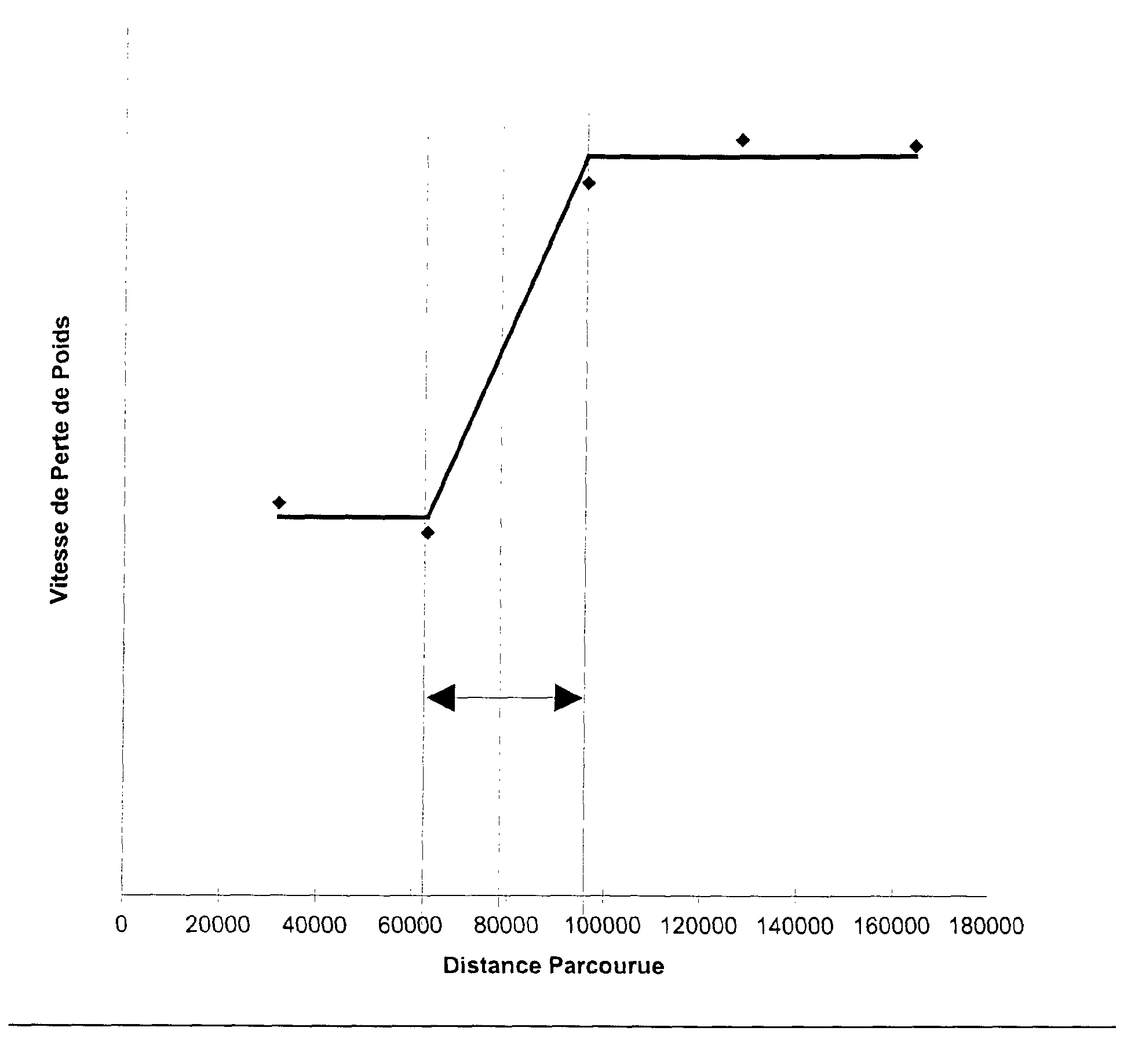
- This value represents the relative difference (in%) between a weight loss rate initial (at the start of taxiing, between 0 and 50,000 km) and a final weight loss speed (in end of life, i.e. after 100,000 km of driving). More specifically, this increased loss of weight is defined by the ratio "(final weight loss - initial weight loss) / (weight loss initial) ".
- a weight loss increase value of less than 100% indicates a improvement over the "control" tire.
- This value generally represents the distance traveled at which appears changing the speed of weight loss.
- tire tread compositions of truck type which are intended to be mounted on a driving axle of a truck vehicle.
- compositions 2 to 6 the SBRs used (A, B, C, D) are all prepared in solution and continuously. More specifically, their viscosity and microstructure characteristics are listed in Table 1 below. SBR Mooney ML (1 + 4) rate (%) of -1.2 rate (%) of styrene SBR A 54 24 25 SBR B 54 24 40 SBR C 48 24 33 SBR D 48 24 30
- silica used in these compositions 2 to 6 it is a highly silica dispersible whose name is “Zeosil 1165 MP" and which is marketed by the company Rhodia.
- compositions 3 to 6 according to the invention are an SBR functionalized with hexamethylcyclotrisiloxane, so that it comprises at the end of chain a dimethylsilanol group.
- composition 4 differs from composition 3 by the nature of the extension oil it contains (paraffinic oil instead of an oil aromatic).
- composition 5 differs from composition 4, in that that it comprises a covering agent "Si 116" (hexadecyltrimethoxysilane) of silica.
- composition 6 differs from compositions 3 and 4, in that its elastomeric matrix consists of a blend of 70 parts by weight of said SBR C functionalized with 30 parts by weight of an SBR D not comprising active function for coupling to silica (SBR D is a star SBR with SnCl 4 ).
- compositions comp. 1 comp. 2 comp. 3 comp. 4 comp. 5 comp. 6 Shore A 64 65 66 64 62 67 MA100 2.00 2.05 2.20 2.13 2.03 2.20 MA300 / MA100 1.16 1.15 1.45 1.45 1.525 1,425 PH (%) 28 23.5 19.9 18.3 16.1 20.8 Dynamic properties Maximum modulus (MPa) 6.26 3.87 3.05 2.65 2.01 3.48 maximum delta tangent 0.193 0.180 0.125 0.116 0.096 0.142 Driving results Rolling resistance (%) 100 104 113 114 118 111 Wear resistance (%) 100 52 104 112 104 107 Weight loss increase (%) 100 89 87 91 86 Start of irregular wear (10 3 km) 48 80 80 80 80 80 80 80 80 80 80 80 80 80 80 80 80 80 80 80 80 80 80 80 80 80 80
- This table 3 shows that for the tread compositions 3, 4, 5 and 6 in accordance with the invention, the rolling resistance is significantly reduced, the wear resistance increased and the delay in the appearance of irregular wear is significantly increased, part, vis-à-vis composition 1 "control” based on the NR / BR blend and carbon black and, on the other hand, vis-à-vis composition 2 “non-conforming” based on non-functionalized SBR and silica.
- compositions 3 to 6 According to the invention, this appearance corresponding to a driving distance which is substantially doubled compared to that relating to the appearance of this phenomenon for compositions 1 and 2.
- tire tread compositions of truck type which are intended to be mounted on a steering axle of a truck vehicle.
- composition 7 "control” comprises an RF resin aralkyl and an oil with a different extension from that included in compositions 2, 4 and 5 and, in plus the antioxidant agent “6PPD” present in said compositions 2, 4 and 5, another agent antioxidant known by the abbreviation "TMQ" (trimethylquinoline consisting of a 1,2-dihydro-2,2,4-trimethylquinone polymerized).
- TMQ trimethylquinoline consisting of a 1,2-dihydro-2,2,4-trimethylquinone polymerized
- composition comp. 7 comp. 2 Comp. 4 comp. 5 NR 100 - - - SBR A - 50 - - SBR B - 68.75 - - SBR C - - 100 100 N375 47.5 - - - Zeosil 1165 - 57.5 65 65 X50S - 9 10.2 10.2 Paraffinic oil - - 18.75 18.75 Aralkyl RF resin 1 - - - Hexa 2.5 Oil 0.5 - - - Paraffin 1 1 1 1 ZnO 3.0 2.5 2.5 2.5 2.5 2.5 Stearic acid 2.5 2.0 2.0 2.0 2.0 Diphenylguanidine - 1.1 1.25 1.25 Antioxidant (6PPD) 2 2 2 2 TMQ 1 - - - Si116 - - - 1.5 Soluble sulfur 1.5 1.2 1.2 1.2
- This table 5 shows that for the tread compositions 4 and 5 conforming to invention, rolling resistance is significantly reduced, wear resistance substantially equal and the delay in the appearance of irregular wear is increased, on the one hand, vis-à-vis of composition 7 "control” based on NR and carbon black and, on the other hand, vis-à-vis of composition 2 “non-conforming” based on non-functionalized SBR and silica.
Landscapes
- Chemical & Material Sciences (AREA)
- Engineering & Computer Science (AREA)
- Mechanical Engineering (AREA)
- Health & Medical Sciences (AREA)
- Chemical Kinetics & Catalysis (AREA)
- Medicinal Chemistry (AREA)
- Polymers & Plastics (AREA)
- Organic Chemistry (AREA)
- Compositions Of Macromolecular Compounds (AREA)
- Tires In General (AREA)
- Addition Polymer Or Copolymer, Post-Treatments, Or Chemical Modifications (AREA)
- Processes Of Treating Macromolecular Substances (AREA)
Abstract
Description
- une matrice élastomère comprenant à titre majoritaire au moins un élastomère diénique essentiellement insaturé, qui comprend à l'une au moins de ses extrémités de chaíne un groupe fonctionnel actif pour un couplage à une charge blanche renforçante,
- une charge renforçante comprenant à titre majoritaire une charge blanche renforçante (i.e selon une fraction massique supérieure à 50 %), et
- un agent de liaison charge blanche renforçante/ élastomère diénique fonctionnalisé,
- Par élastomère ou caoutchouc "diénique", on entend de manière connue un élastomère
issu au moins en partie (i.e. un homopolymère ou un copolymère) de monomères diènes
(monomères porteurs de deux doubles liaisons carbone-carbone, conjuguées ou non).
De manière générale, on entend ici par élastomère diénique "essentiellement insaturé" un
élastomère diénique issu au moins en partie de monomères diènes conjugués, ayant un taux de
motifs ou unités d'origine diénique (diènes conjugués) qui est supérieur à 15 % (% en moles).Dans la catégorie des élastomères diéniques "essentiellement insaturés", on entend en
particulier par élastomère diénique "fortement insaturé" un élastomère diénique ayant un taux de
motifs d'origine diénique (diènes conjugués) qui est supérieur à 50 %.Ces définitions étant données, on entend en particulier par élastomère diénique
essentiellement insaturé qui est susceptible d'être mis en oeuvre dans les compositions conformes
à l'invention:
- tout homopolymère obtenu par polymérisation d'un monomère diène conjugué ayant de 4 à 12 atomes de carbone;
- tout copolymère obtenu par copolymérisation d'un ou plusieurs diènes conjugués entre eux ou avec un ou plusieurs composés vinyle aromatique ayant de 8 à 20 atomes de carbone;
- un groupe silanol ou un bloc polysiloxane ayant une extrémité silanol, comme cela est décrit dans le document de brevet français FR-A-2 740 778 au nom de la demanderesse. Plus précisément, ce document enseigne l'utilisation d'un agent de fonctionnalisation d'un polymère vivant obtenu par voie anionique, en vue d'obtenir une fonction active pour un couplage à de la silice. Cet agent de fonctionnalisation est constitué d'un polysiloxane cyclique, tel qu'un polyméthylcyclo -tri, -tétra ou -déca siloxane, ledit agent étant, à titre préférentiel, l'hexaméthylcyclotrisiloxane. Les polymères fonctionnalisés ainsi obtenus peuvent être séparés du milieu réactionnel conduisant à leur formation par extraction à la vapeur d'eau du solvant, sans que leur macrostructure et, par conséquent, leurs propriétés physiques n'évoluent.
- un groupe alkoxysilane.
- La charge blanche renforçante qui est utilisée à titre de charge renforçante peut
constituer la totalité ou une partie majoritaire de la charge renforçante totale, dans ce dernier cas
associée par exemple à du noir de carbone.
De préférence, dans les compositions de caoutchouc conformes à l'invention, la charge
blanche renforçante constitue la majorité, i.e. plus de 50 % en poids de la charge renforçante
totale, plus préférentiellement plus de 80 % en poids de cette charge renforçante totale. En effet,
l'expérience montre que les propriétés précitées de la composition selon l'invention sont d'autant
plus améliorées, que la charge renforçante qu'elle comprend contient une fraction massique plus
élévée en charge blanche renforçante, et que lesdites propriétés sont optimales lorsque ladite
composition contient uniquement une charge blanche renforçante, par exemple de la silice, à titre
de charge renforçante. Ce dernier cas constitue donc un exemple préférentiel de composition de
caoutchouc selon l'invention.De plus, ladite charge blanche renforçante est présente dans ladite composition selon une
quantité allant de 20 à 80 pce (parties en poids pour cent parties de ladite matrice élastomère).Dans la présente demande, on entend par "charge blanche renforçante" une charge
"blanche" (i.e., inorganique, en particulier minérale), parfois aussi appelée charge "claire",
capable de renforcer à elle seule, sans autre moyen qu'un système de couplage intermédiaire, une
composition de caoutchouc destinée à la fabrication de pneumatiques, en d'autres termes capable
de remplacer dans sa fonction de renforcement une charge conventionnelle de noir de carbone de
grade pneumatique.Préférentiellement, la charge blanche renforçante est, en totalité ou tout du moins
majoritairement, de la silice (SiO2). La silice utilisée peut être toute silice renforçante connue de
l'homme du métier, notamment toute silice précipitée ou pyrogénée présentant une surface BET
ainsi qu'une surface spécifique CTAB toutes deux inférieures à 450 m2/g, même si les silices
précipitées hautement dispersibles sont préférées.A titre encore plus préférentiel, ladite silice présentant des surfaces spécifiques BET ou
CTAB qui vont toutes deux de 80 m2/g à 260 m2/g.Dans le présent exposé, la surface spécifique BET est déterminée de manière connue,
selon la méthode de Brunauer-Emmet-Teller décrite dans "The Journal of the American
Chemical Society" Vol. 60, page 309, février 1938 et correspondant à la norme AFNOR-NFT-45007
(novembre 1987) ; la surface spécifique CTAB est la surface externe déterminée selon la
même norme AFNOR-NFT-45007 de novembre 1987. Par silice hautement dispersible, on entend toute silice ayant une aptitude très importante
à la désagglomération et à la dispersion dans une matrice élastomérique, observable de manière
connue par microscopie électronique ou optique, sur coupes fines. Comme exemples non
limitatifs de telles silices hautement dispersibles préférentielles, on peut citer la silice Perkasil
KS 430 de la société Akzo, la silice BV 3380 de la société Degussa, les silices Zeosil 1165 MP et
1115 MP de la société Rhodia, la silice Hi-Sil 2000 de la société PPG, les silices Zeopol 8741 ou
8745 de la Société Huber, des silices précipitées traitées telles que par exemple les silices
"dopées" à l'aluminium décrites dans la demande EP-A-0 735 088.L'état physique sous lequel se présente la charge blanche renforçante est indifférent, que
ce soit sous forme de poudre, de microperles, de granulés, ou encore de billes. Bien entendu on
entend également par charge blanche renforçante des mélanges de différentes charges blanches
renforçantes, en particulier de silices hautement dispersibles telles que décrites ci-dessus.La charge blanche renforçante peut être également utilisée en coupage (mélange) avec du
noir de carbone. Comme noirs de carbone conviennent tous les noirs de carbone, notamment les
noirs du type HAF, ISAF, SAF, conventionnellement utilisés dans les pneumatiques et
particulièrement dans les bandes de roulement des pneumatiques. A titre d'exemples non
limitatifs de tels noirs, on peut citer les noirs N115, N134, N234, N339, N347, N375. La quantité
de noir de carbone présente dans la charge renforçante totale peut varier dans de larges limites,
cette quantité étant préférentiellement inférieure à la quantité de charge blanche renforçante
présente dans la composition de caoutchouc.Par exemple, les coupages noir/ silice ou les noirs partiellement ou intégralement
recouverts de silice conviennent pour constituer la charge renforçante. Conviennent également
les noirs de carbone modifiés par de la silice tels que, à titre non limitatif, les charges qui sont
commercialisées par la société CABOT sous la dénomination « CRX 2000 », et qui sont décrites
dans le document de brevet international WO-A-96/37547.A titre de charge blanche renforçante, on peut également utiliser, à titre non limitatif,
- des alumines (de formule Al2O3), telles que les alumines à dispersibilité élevée qui sont décrites dans le document de brevet européen EP-A-810 258, ou encore
- des hydroxydes d'aluminium, tels que ceux décrits dans le document de brevet international WO-A-99/28376.
- La composition de caoutchouc selon l'invention comprend en outre de manière
classique un agent de liaison charge blanche renforçante / matrice élastomère (encore appelé
agent de couplage), qui a pour fonction d'assurer une liaison (ou couplage) suffisante, de nature
chimique et/ou physique, entre ladite charge blanche et la matrice, tout en facilitant la dispersion
de cette charge blanche au sein de ladite matrice.
Un tel agent de liaison, au moins bifonctionnel, a par exemple comme formule générale
simplifiée « Y-T-X », dans laquelle:
- Y représente un groupe fonctionnel (fonction « Y ») qui est capable de se lier physiquement et/ou chimiquement à la charge blanche, une telle liaison pouvant être établie, par exemple, entre un atome de silicium de l'agent de couplage et les groupes hydroxyle (OH) de surface de la charge (par exemple les silanols de surface lorsqu'il s'agit de silice);
- X représente un groupe fonctionnel (« fonction X ») qui est capable de se lier physiquement et/ou chimiquement à l'élastomère, par exemple par l'intermédiaire d'un atome de soufre;
- T représente un groupe hydrocarboné permettant de relier Y et X.
- n est un entier de 2 à 8;
- A est un radical hydrocarboné divalent;
- Z répond à l'une des formules ci-après:
dans lesquelles:

- les radicaux R1, substitués ou non substitués, identiques ou différents entre eux, représentent un groupe alkyle en C1-C18, cycloalkyle en C5-C18 ou aryle en C6-C18;
- les radicaux R2, substitués ou non substitués, identiques ou différents entre eux, représentent un groupe alkoxyle en C1-C18 ou cycloalkoxyle en C5-C18.
- la matrice élastomère précitée comprenant à titre majoritaire au moins un élastomère diénique, qui comprend à l'une au moins de ses extrémités de chaíne un groupe fonctionnel actif pour un couplage à la charge blanche renforçante précitée,
- la charge renforçante comprenant à titre majoritaire ladite charge blanche renforçante, et
- ledit agent de liaison charge blanche renforçante/ élastomère diénique fonctionnalisé.
- un premier tronçon de pente sensiblement nulle correspondant à une usure normale du pneumatique (non irrégulière),
- un second tronçon sensiblement linéaire et de pente relativement élevée correspondant au début de l'usure irrégulière, et
- un troisième tronçon de pente sensiblement nulle correspondant à la fin de vie du pneumatique.
- une composition « témoin » (composition 1) qui est représentative de l'état de la technique connu pour un pneu poids-lourd monté sur un essieu moteur. Cette composition est à base d'un coupage de caoutchouc naturel (il s'agit d'un caoutchouc naturel peptisé, de Mooney ML(1+4) à 100° C égal à 60) et d'un polybutadiène à fort taux de cis (BR cis), et d'une charge renforçante constituée de noir de carbone, et
- une composition non conforme à l'invention (composition 2) qui est à base d'un coupage de deux SBR A et B non fonctionnalisés (SBR A est non étendu à l'huile, alors que SBR B est étendu avec 35,5 parties en poids d'huile aromatique) et d'une charge renforçante constituée de silice.
| SBR | Mooney ML(1+4) | taux (%) de -1,2 | taux (%) de styrène |
| SBR A | 54 | 24 | 25 |
| SBR B | 54 | 24 | 40 |
| SBR C | 48 | 24 | 33 |
| SBR D | 48 | 24 | 30 |
| Composition | comp. 1 | comp. 2 | comp. 3 | comp. 4 | comp. 5 | comp. 6 |
| NR | 60 | - | - | - | - | - |
| BR cis | 40 | - | - | - | - | - |
| SBR A | - | 50 | - | - | - | - |
| SBR B | - | 68,75 | - | - | - | - |
| SBR C | - | - | 100 | 100 | 100 | 70 |
| SBR D | - | - | - | - | - | 30 |
| N234 | 54 | - | - | - | - | - |
| Zeosil 1165 MP | - | 57,5 | 65 | 65 | 65 | 65 |
| X50S | - | 9 | 10,2 | 10,2 | 10,2 | 10,2 |
| Huile aromatique | - | - | 18,75 | - | - | - |
| Huile paraffinique | - | - | - | 18,75 | 18,75 | 18,75 |
| Paraffine | 1 | 1 | 1 | 1 | 1 | 1 |
| ZnO | 3,0 | 2,5 | 2,5 | 2,5 | 2,5 | 2,5 |
| Acide stéarique | 1,5 | 2,0 | 2,0 | 2,0 | 2,0 | 2,0 |
| Diphénylguanidine | - | 1,1 | 1,25 | 1,25 | 1,25 | 1,25 |
| Antioxydant | 2 | 2 | 2 | 2 | 2 | 2 |
| Si116 | - | - | - | - | 1,5 | - |
| Soufre soluble | 1,1 | 1,2 | 1,2 | 1,2 | 1,2 | 1,2 |
| CBS | 1,1 | 2 | 1,2 | 1,2 | 1,2 | 1,2 |
| ZBEC | - | - | 0,2 | 0,2 | 0,2 | 0,2 |
- « X50S » est la dénomination d'un agent de liaison silice/ élastomère, commercialisé par la société Degussa, et constitué de l'association de l'agent de liaison de dénomination « Si69 » (bis-3-(triéthoxysilylpropyl) tétrasulfure) et d'un noir de carbone N330 dans un rapport pondéral 50/50;
- l'antioxydant utilisé est la N-(1,3-diméthyl butyl) N'-phényl p-phénylène diamine (6PPD en abrégé);
- « CBS » et « ZBEC » sont les dénominations d'accélérateurs de vulcanisation (respectivement cyclohexyl benzothiazyl sulfénamide et dibenzyldithiocarbamate de zinc).
| Compositions | comp. 1 | comp. 2 | comp. 3 | comp. 4 | comp. 5 | comp. 6 |
| Shore A | 64 | 65 | 66 | 64 | 62 | 67 |
| MA100 | 2,00 | 2,05 | 2,20 | 2,13 | 2,03 | 2,20 |
| MA300 / MA100 | 1,16 | 1,15 | 1,45 | 1,45 | 1,525 | 1,425 |
| PH(%) | 28 | 23,5 | 19,9 | 18,3 | 16,1 | 20,8 |
| Propriétés dynamiques | ||||||
| Module maximum (MPa) | 6,26 | 3,87 | 3,05 | 2,65 | 2,01 | 3,48 |
| tangente delta maximum | 0,193 | 0,180 | 0,125 | 0,116 | 0,096 | 0,142 |
| Résultats en roulage | ||||||
| Résistance au roulement (%) | 100 | 104 | 113 | 114 | 118 | 111 |
| Résistance à l'usure (%) | 100 | 52 | 104 | 112 | 104 | 107 |
| Augmentation de perte de poids (%) | 100 | 89 | 87 | 91 | 86 | |
| Début usure irrégulière (103 km) | 48 | 80 | 80 | 80 | 80 |
- une nouvelle composition « témoin » (composition 7) dont la matrice élastomère est constituée de caoutchouc naturel (il s'agit dudit caoutchouc naturel peptisé, de Mooney ML(1+4) à 100° C égal à 60), et d'une charge renforçante constituée de noir de carbone, et
- ladite composition non conforme à l'invention de l'exemple 1 (composition 2).
| Composition | comp. 7 | comp. 2 | Comp. 4 | comp. 5 |
| NR | 100 | - | - | - |
| SBR A | - | 50 | - | - |
| SBR B | - | 68,75 | - | - |
| SBR C | - | - | 100 | 100 |
| N375 | 47.5 | - | - | - |
| Zeosil 1165 | - | 57,5 | 65 | 65 |
| X50S | - | 9 | 10,2 | 10,2 |
| Huile paraffinique | - | - | 18,75 | 18,75 |
| Resine RF Aralkyl | 1 | - | - | - |
| Huile Hexa 2.5 | 0,5 | - | - | - |
| Paraffine | 1 | 1 | 1 | 1 |
| ZnO | 3,0 | 2,5 | 2,5 | 2,5 |
| Acide stéarique | 2,5 | 2,0 | 2,0 | 2,0 |
| Diphénylguanidine | - | 1,1 | 1,25 | 1,25 |
| Antioxydant (6PPD) | 2 | 2 | 2 | 2 |
| TMQ | 1 | - | - | - |
| Si116 | - | - | - | 1,5 |
| Soufre soluble | 1,5 | 1,2 | 1,2 | 1,2 |
| CBS | 0,6 | 2 | 1,2 | 1,2 |
| ZBEC | - | - | 0,2 | 0,2 |
- la résine « RF Aralkyl » est une résine résorcinol formol et
- l'huile Hexa 2.5 est une huile à base d'hexadécylamine.
| Compositions | comp. 7 | comp. 2 | comp. 4 | comp. 5 |
| Shore A | 64 | 65 | 64 | 62 |
| MA100 | 2,10 | 2,05 | 2,13 | 2,03 |
| MA300 / MA100 | 1,247 | 1,15 | 1,45 | 1,525 |
| PH (%) | 23 | 23,5 | 18,3 | 16,1 |
| Propriétés dynamiques | ||||
| Module maximum (MPa) | 4,61 | 3,87 | 2,65 | 2,01 |
| tangente delta maximum | 0,144 | 0,180 | 0,116 | 0,096 |
| Résultats en roulage | ||||
| Résistance au roulement (%) | 100 | 79 | 107 | 109 |
| Résistance à l'usure (%) | 100 | 94 | 100 | 97 |
| Augmentation de perte de poids (%) | 100 | 28 | 64 | |
| Début usure irrégulière (103 km) | 79 | 95 | 95 |
Claims (18)
- Pneumatique poids-lourd comportant une bande de roulement constituée d'une composition de caoutchouc réticulée, caractérisée en ce que ladite composition comprend :une matrice élastomère comprenant à titre majoritaire au moins un élastomère diénique, qui comprend à l'une au moins de ses extrémités de chaíne un groupe fonctionnel actif pour un couplage à une charge blanche renforçante,une charge renforçante comprenant à titre majoritaire une charge blanche renforçante, etun agent de liaison charge blanche renforçante/ élastomère diénique fonctionnalisé.
- Pneumatique poids-lourd selon la revendication 1, caractérisée en ce que l'élastomère diénique est constitué d'un copolymère d'un monomère diène conjugué et d'un monomère vinylaromatique.
- Pneumatique poids-lourd selon la revendication 2, caractérisée en ce que ledit copolymère présente une température de transition vitreuse comprise entre -70° C et -20° C et un taux massique d'unités vinylaromatiques allant de 10 % à 50 %.
- Pneumatique poids-lourd selon une des revendications 1 à 3, caractérisée en ce que ledit ou chaque groupe fonctionnel actif pour un couplage à une charge blanche renforçante est constitué d'un groupe silanol ou d'un bloc polysiloxane ayant une extrémité silanol.
- Pneumatique poids-lourd selon une des revendications 1 à 3, caractérisée en ce que ledit ou chaque groupe fonctionnel actif pour un couplage à une charge blanche renforçante est constitué d'un groupe alkoxysilane.
- Pneumatique poids-lourd selon une des revendications précédentes, caractérisée en ce que ladite charge blanche renforçante est constituée de silice présente dans ladite composition selon une quantité allant de 20 à 80 pce (parties en poids pour cent parties de ladite matrice élastomère).
- Pneumatique poids-lourd selon la revendication 6, caractérisée en ce que ladite silice présente une surface spécifique CTAB allant de 80 m2/g à 260 m2/g.
- Pneumatique poids-lourd selon une des revendications précédentes, caractérisé en ce que ledit agent de liaison charge blanche renforçante/ élastomère diénique fonctionnalisé est constitué d'un alkoxysilane polysulfuré.
- Pneumatique poids-lourd selon une des revendications précédentes, caractérisée en ce que ladite composition comprend également un agent de recouvrement de ladite charge blanche renforçante qui est constitué d'un alkylalkoxysilane.
- Utilisation d'une composition de caoutchouc réticulable pour retarder lors du roulage l'apparition de l'usure irrégulière pour une bande de roulement d'un pneumatique adapté pour porter de lourdes charges, tel qu'un pneumatique poids-lourd, ladite bande de roulement étant constituée de ladite composition qui comprend:une matrice élastomère comprenant à titre majoritaire au moins un élastomère diénique, qui comprend à l'une au moins de ses extrémités de chaíne un groupe fonctionnel actif pour un couplage à une charge blanche renforçante,une charge renforçante comprenant à titre majoritaire une charge blanche renforçante, etun agent de liaison charge blanche renforçante/ élastomère diénique fonctionnalisé.
- Utilisation d'une composition de caoutchouc selon la revendication 10, caractérisée en ce que l'élastomère diénique est constitué d'un copolymère d'un monomère diène conjugué et d'un monomère vinylaromatique.
- Utilisation d'une composition de caoutchouc selon la revendication 11, caractérisée en ce que ledit copolymère présente une température de transition vitreuse comprise entre -70° C et -20° C et un taux massique d'unités vinylaromatiques allant de 10 % à 50 %.
- Utilisation d'une composition de caoutchouc selon une des revendications 10 à 12, caractérisée en ce que ledit ou chaque groupe fonctionnel actif pour un couplage à une charge blanche renforçante est constitué d'un groupe silanol ou d'un bloc polysiloxane ayant une extrémité silanol.
- Utilisation d'une composition de caoutchouc selon une des revendications 10 à 12, caractérisée en ce que ledit ou chaque groupe fonctionnel actif pour un couplage à une charge blanche renforçante est constitué d'un groupe alkoxysilane.
- Utilisation d'une composition de caoutchouc selon une des revendications précédentes, caractérisée en ce que ladite charge blanche renforçante est constituée de silice présente dans ladite composition selon une quantité allant de 20 à 80 pce (parties en poids pour cent parties de ladite matrice élastomère).
- Utilisation d'une composition de caoutchouc selon la revendication 15, caractérisée en ce que ladite silice présente une surface spécifique CTAB allant de 80 m2/g à 260 m2/g.
- Utilisation d'une composition de caoutchouc selon une des revendications précédentes, caractérisé en ce que ledit agent de liaison charge blanche renforçante/ élastomère diénique fonctionnalisé est constitué d'un alkoxysilane polysulfuré.
- Utilisation d'une composition de caoutchouc selon une des revendications précédentes, caractérisée en ce que ladite composition comprend également un agent de recouvrement de ladite charge blanche renforçante qui est constitué d'un alkylalkoxysilane.
Applications Claiming Priority (2)
| Application Number | Priority Date | Filing Date | Title |
|---|---|---|---|
| FR0001513A FR2804688B1 (fr) | 2000-02-07 | 2000-02-07 | Utilisation d'une composition de caoutchouc pour retarder lors du roulage l'apparition de l'usure irreguliere sur une bande de roulement de pneumatique destinee a porter de lourdes charges |
| FR0001513 | 2000-02-07 |
Publications (2)
| Publication Number | Publication Date |
|---|---|
| EP1122281A1 true EP1122281A1 (fr) | 2001-08-08 |
| EP1122281B1 EP1122281B1 (fr) | 2006-06-07 |
Family
ID=8846739
Family Applications (1)
| Application Number | Title | Priority Date | Filing Date |
|---|---|---|---|
| EP01101179A Expired - Lifetime EP1122281B1 (fr) | 2000-02-07 | 2001-01-24 | Pneumatiques pour lourdes charges, et utilisation d'une composition de caoutchouc pour retarder l'usure irrégulière sur ces pneumatiques. |
Country Status (9)
| Country | Link |
|---|---|
| US (2) | US6903155B2 (fr) |
| EP (1) | EP1122281B1 (fr) |
| JP (1) | JP4796702B2 (fr) |
| AT (1) | ATE328957T1 (fr) |
| BR (1) | BR0100377B1 (fr) |
| CA (1) | CA2334310A1 (fr) |
| DE (1) | DE60120244T2 (fr) |
| ES (1) | ES2264427T3 (fr) |
| FR (1) | FR2804688B1 (fr) |
Cited By (3)
| Publication number | Priority date | Publication date | Assignee | Title |
|---|---|---|---|---|
| FR2857972A1 (fr) * | 2003-07-21 | 2005-01-28 | Michelin Soc Tech | Bande de roulement pour pneumatique. |
| WO2011042507A1 (fr) * | 2009-10-08 | 2011-04-14 | Societe De Technologie Michelin | Elastomere dienique fonctionnalise et composition de caoutchouc le contenant. |
| WO2016001372A1 (fr) * | 2014-07-03 | 2016-01-07 | Compagnie Generale Des Etablissements Michelin | Elastomère diénique à ip réduit possédant une fonction silanol en extrémité de chaîne et composition le contenant |
Families Citing this family (14)
| Publication number | Priority date | Publication date | Assignee | Title |
|---|---|---|---|---|
| DE50114999D1 (de) * | 2001-11-05 | 2009-09-03 | Continental Ag | Fahrzeugluftreifen |
| JP2004143244A (ja) * | 2002-10-23 | 2004-05-20 | Bridgestone Corp | 重荷重用タイヤ |
| CN101090914B (zh) * | 2004-10-26 | 2011-02-09 | 株式会社普利司通 | 具有连接基团的官能化聚合物 |
| RU2501816C2 (ru) * | 2008-04-30 | 2013-12-20 | Стирон Юроп Гмбх | Стирол-бутадиеновые полимеры со стирольным градиентом и способы изготовления таковых |
| US8648141B2 (en) | 2009-03-19 | 2014-02-11 | Styron Europe Gmbh | Styrene butadiene rubber with novel styrene incorporation |
| WO2011162771A1 (fr) * | 2010-06-25 | 2011-12-29 | Michelin Recherche Et Technique S.A. | Bande de roulement à faible résistance au roulement pour voitures et utilitaires légers |
| CN103282409B (zh) | 2010-12-31 | 2015-08-05 | 株式会社普利司通 | 偶联的聚合物及其制备方法 |
| US8680210B2 (en) | 2011-05-02 | 2014-03-25 | Bridgestone Corporation | Method for making functionalized polymer |
| US8580886B2 (en) | 2011-09-20 | 2013-11-12 | Dow Corning Corporation | Method for the preparation and use of bis (alkoxysilylorgano)-dicarboxylates |
| JP6143773B2 (ja) | 2011-12-02 | 2017-06-07 | ダウ コーニング コーポレーションDow Corning Corporation | エステル官能性シラン並びにその製造法及び使用、並びにイミニウム化合物の相間移動触媒としての使用 |
| US9758639B2 (en) | 2014-04-30 | 2017-09-12 | Bridgestone Corporation | Rubber composition with imidazole-based silica shielding agent |
| US9951208B2 (en) | 2014-11-06 | 2018-04-24 | Bridgestone Corporation | Silica shielding agents and related methods |
| US10179479B2 (en) | 2015-05-19 | 2019-01-15 | Bridgestone Americas Tire Operations, Llc | Plant oil-containing rubber compositions, tread thereof and race tires containing the tread |
| CN118900884A (zh) * | 2022-03-30 | 2024-11-05 | 瑞住合成橡胶株式会社 | 重负荷轮胎用橡胶组合物 |
Citations (2)
| Publication number | Priority date | Publication date | Assignee | Title |
|---|---|---|---|---|
| FR2740778A1 (fr) * | 1995-11-07 | 1997-05-09 | Michelin & Cie | Composition de caoutchouc a base de silice et de polymere dienique fonctionalise ayant une fonction silanol terminale |
| FR2765882A1 (fr) * | 1997-07-11 | 1999-01-15 | Michelin & Cie | Composition de caoutchouc a base de noir de carbone ayant de la silice fixee a sa surface et de polymere dienique fonctionnalise alcoxysilane |
Family Cites Families (37)
| Publication number | Priority date | Publication date | Assignee | Title |
|---|---|---|---|---|
| US3978103A (en) | 1971-08-17 | 1976-08-31 | Deutsche Gold- Und Silber-Scheideanstalt Vormals Roessler | Sulfur containing organosilicon compounds |
| US3873489A (en) | 1971-08-17 | 1975-03-25 | Degussa | Rubber compositions containing silica and an organosilane |
| SU580840A3 (ru) | 1974-02-07 | 1977-11-15 | Дегусса (Фирма) | Способ получени серосодержащих кремнийорганических соединений |
| US4002594A (en) | 1975-07-08 | 1977-01-11 | Ppg Industries, Inc. | Scorch retardants for rubber reinforced with siliceous pigment and mercapto-type coupling agent |
| JPS56126214A (en) | 1980-03-10 | 1981-10-03 | Asahi Malleable Iron Co Ltd | Abnormal tension suppressing tool |
| EP0299074B1 (fr) | 1987-01-14 | 1992-01-29 | Bridgestone Corporation | Pneu |
| FR2673187B1 (fr) * | 1991-02-25 | 1994-07-01 | Michelin & Cie | Composition de caoutchouc et enveloppes de pneumatiques a base de ladite composition. |
| JP3415217B2 (ja) * | 1992-09-29 | 2003-06-09 | 株式会社ブリヂストン | 重車両用空気入りタイヤ |
| JPH08104111A (ja) | 1994-10-06 | 1996-04-23 | Bridgestone Corp | 空気入りタイヤ |
| FR2729671B1 (fr) * | 1995-01-20 | 1997-04-18 | Michelin & Cie | Enveloppe de pneumatique a base de silice precipitee presentant une resistance au roulement amelioree |
| US5580919A (en) | 1995-03-14 | 1996-12-03 | The Goodyear Tire & Rubber Company | Silica reinforced rubber composition and use in tires |
| US5674932A (en) * | 1995-03-14 | 1997-10-07 | The Goodyear Tire & Rubber Company | Silica reinforced rubber composition and use in tires |
| FR2732351B1 (fr) | 1995-03-29 | 1998-08-21 | Michelin & Cie | Composition de caoutchouc pour enveloppe de pneumatique renfermant de la silice dopee aluminium a titre de charge renforcante |
| EP1637556A1 (fr) | 1995-05-22 | 2006-03-22 | Cabot Corporation | Composes elastomeres incorporant des noirs de carbone traites au silicium |
| US6028137A (en) * | 1995-05-22 | 2000-02-22 | Cabot Corporation | Elastomeric compounds incorporating silicon-treated carbon blacks |
| JP3459316B2 (ja) * | 1995-06-13 | 2003-10-20 | 住友ゴム工業株式会社 | トレッド用ゴム組成物 |
| EP0767206B1 (fr) * | 1995-10-04 | 2002-07-10 | Compagnie Generale Des Etablissements Michelin-Michelin & Cie | Composition de caoutchouc à base d'un polymère diénique comprenant un dérivé organosilane, utilisable pour la fabrication de bandes de roulement de pneumatiques |
| JPH09175120A (ja) | 1995-12-28 | 1997-07-08 | Bridgestone Corp | 空気入りラジアルタイヤ |
| FR2743564A1 (fr) * | 1996-01-11 | 1997-07-18 | Michelin & Cie | Compositions de caoutchouc pour enveloppes de pneumatiques a base de silices contenant un additif de renforcement a base d'un polyorganosiloxane fonctionnalise et d'un compose organosilane . |
| FR2744127A1 (fr) * | 1996-01-26 | 1997-08-01 | Michelin & Cie | Composition de caoutchouc a base d'un polymere dienique ayant une fonction silanol et comprenant un derive organosilane |
| US5583245A (en) | 1996-03-06 | 1996-12-10 | The Goodyear Tire & Rubber Company | Preparation of sulfur-containing organosilicon compounds |
| FR2749313A1 (fr) | 1996-05-28 | 1997-12-05 | Michelin & Cie | Composition de caoutchouc dienique a base d'alumine en tant que charge renforcante et son utilisation pour la fabrication d'enveloppes de pneumatiques |
| US5696197A (en) | 1996-06-21 | 1997-12-09 | The Goodyear Tire & Rubber Company | Heterogeneous silica carbon black-filled rubber compound |
| US5663396A (en) | 1996-10-31 | 1997-09-02 | The Goodyear Tire & Rubber Company | Preparation of sulfur-containing organosilicon compounds |
| WO1997048266A2 (fr) * | 1996-12-16 | 1997-12-24 | Bridgestone Corporation | Composition caoutchouteuse et pneumatiques produits a partir de cette derniere |
| US5684171A (en) | 1997-02-11 | 1997-11-04 | The Goodyear Tire & Rubber Company | Process for the preparation of organosilicon polysulfide compounds |
| US5684172A (en) | 1997-02-11 | 1997-11-04 | The Goodyear Tire & Rubber Company | Process for the preparation of organosilicon polysulfide compounds |
| FR2763074B1 (fr) * | 1997-05-07 | 1999-06-25 | Michelin & Cie | Composition de caoutchouc a base de noir de carbone ayant de la silice fixee a sa surface et de polymere dyenique fonctionalise ou modifie par des fonctions silanols |
| FR2763593B1 (fr) * | 1997-05-26 | 1999-07-09 | Michelin & Cie | Composition de caoutchouc a base de silice destinee a la fabrication d'enveloppes de pneumatiques routiers ayant une resistance au roulement amelioree |
| FR2765881B1 (fr) * | 1997-07-09 | 1999-08-13 | Michelin & Cie | Composition de caoutchouc vulcanisable au soufre contenant de la silice |
| JP3849997B2 (ja) | 1997-10-06 | 2006-11-22 | 株式会社ブリヂストン | 重荷重用空気入りタイヤ |
| FR2770849B1 (fr) * | 1997-11-10 | 1999-12-03 | Michelin & Cie | Composition de caoutchouc destinee a la fabrication d'enveloppes de pneumatiques a base d'elastomere comportant des fonctions oxygenees et de charge de type silice |
| DE69841286D1 (de) | 1997-11-28 | 2009-12-24 | Michelin & Cie | Aluminiumhaltiger, verstärkender Füllstoff und diesen enthaltende Kautschukzusammensetzung |
| JP3445484B2 (ja) * | 1997-12-22 | 2003-09-08 | 株式会社ブリヂストン | ゴム組成物およびそれを用いた空気入りタイヤ |
| JP3895446B2 (ja) * | 1997-12-26 | 2007-03-22 | 株式会社ブリヂストン | 重合体の製造方法、得られた重合体、及びそれを用いたゴム組成物 |
| US5989719A (en) * | 1998-10-13 | 1999-11-23 | Dow Corning Corporation | Oil resistant liquid silicone rubber compositions |
| US6156822A (en) * | 1998-11-12 | 2000-12-05 | The Goodyear Tire & Rubber Company | Prepared reinforced elastomer, elastomer composite and tire having component thereof |
-
2000
- 2000-02-07 FR FR0001513A patent/FR2804688B1/fr not_active Expired - Fee Related
-
2001
- 2001-01-24 DE DE60120244T patent/DE60120244T2/de not_active Expired - Lifetime
- 2001-01-24 EP EP01101179A patent/EP1122281B1/fr not_active Expired - Lifetime
- 2001-01-24 AT AT01101179T patent/ATE328957T1/de not_active IP Right Cessation
- 2001-01-24 ES ES01101179T patent/ES2264427T3/es not_active Expired - Lifetime
- 2001-02-06 CA CA002334310A patent/CA2334310A1/fr not_active Abandoned
- 2001-02-06 BR BRPI0100377-1A patent/BR0100377B1/pt not_active IP Right Cessation
- 2001-02-07 US US09/778,144 patent/US6903155B2/en not_active Expired - Lifetime
- 2001-02-07 JP JP2001073107A patent/JP4796702B2/ja not_active Expired - Fee Related
-
2002
- 2002-07-21 US US10/201,439 patent/US6900263B2/en not_active Expired - Fee Related
Patent Citations (3)
| Publication number | Priority date | Publication date | Assignee | Title |
|---|---|---|---|---|
| FR2740778A1 (fr) * | 1995-11-07 | 1997-05-09 | Michelin & Cie | Composition de caoutchouc a base de silice et de polymere dienique fonctionalise ayant une fonction silanol terminale |
| US6013718A (en) * | 1995-11-07 | 2000-01-11 | Michelin & Cie | Rubber composition based on silica and on functionalized diene polymer which has a silanol end functional group |
| FR2765882A1 (fr) * | 1997-07-11 | 1999-01-15 | Michelin & Cie | Composition de caoutchouc a base de noir de carbone ayant de la silice fixee a sa surface et de polymere dienique fonctionnalise alcoxysilane |
Cited By (8)
| Publication number | Priority date | Publication date | Assignee | Title |
|---|---|---|---|---|
| FR2857972A1 (fr) * | 2003-07-21 | 2005-01-28 | Michelin Soc Tech | Bande de roulement pour pneumatique. |
| WO2005019331A1 (fr) * | 2003-07-21 | 2005-03-03 | Societe De Technologie Michelin | Bande de roulement pour pneumatique |
| US7629408B2 (en) | 2003-07-21 | 2009-12-08 | Michelin Recherche Et Technique S.A. | Tire tread |
| WO2011042507A1 (fr) * | 2009-10-08 | 2011-04-14 | Societe De Technologie Michelin | Elastomere dienique fonctionnalise et composition de caoutchouc le contenant. |
| RU2565706C2 (ru) * | 2009-10-08 | 2015-10-20 | Компани Женераль Дез Этаблиссман Мишлен | Эластомер на основе функционализированного диена и композиция каучука, содержащая его |
| US9670291B2 (en) | 2009-10-08 | 2017-06-06 | Compagnie Generale Des Etablissements Michelin | Functionalized diene elastomer, and rubber composition containing same |
| WO2016001372A1 (fr) * | 2014-07-03 | 2016-01-07 | Compagnie Generale Des Etablissements Michelin | Elastomère diénique à ip réduit possédant une fonction silanol en extrémité de chaîne et composition le contenant |
| FR3023293A1 (fr) * | 2014-07-03 | 2016-01-08 | Michelin & Cie | Elastomere dienique a ip reduit possedant une fonction silanol en extremite de chaine et composition le contenant |
Also Published As
| Publication number | Publication date |
|---|---|
| US6903155B2 (en) | 2005-06-07 |
| ES2264427T3 (es) | 2007-01-01 |
| US20010031795A1 (en) | 2001-10-18 |
| FR2804688A1 (fr) | 2001-08-10 |
| ATE328957T1 (de) | 2006-06-15 |
| US6900263B2 (en) | 2005-05-31 |
| BR0100377B1 (pt) | 2011-06-14 |
| BR0100377A (pt) | 2001-10-02 |
| US20030055140A1 (en) | 2003-03-20 |
| EP1122281B1 (fr) | 2006-06-07 |
| JP4796702B2 (ja) | 2011-10-19 |
| CA2334310A1 (fr) | 2001-08-07 |
| DE60120244D1 (de) | 2006-07-20 |
| DE60120244T2 (de) | 2007-04-12 |
| FR2804688B1 (fr) | 2006-08-11 |
| JP2002036811A (ja) | 2002-02-06 |
Similar Documents
| Publication | Publication Date | Title |
|---|---|---|
| EP1379586B1 (fr) | Composition de caoutchouc pour bande de roulement de pneumatique | |
| EP1127909B1 (fr) | Composition de caoutchouc vulcanisable, utilisable pour fabriquer un pneumatique, et pneumatique comprenant cette composition | |
| EP2488373B1 (fr) | Composition de caoutchouc a base de glycerol et d'un elastomere fonctionnalise et bande de roulement pour pneumatique | |
| EP0915132B1 (fr) | Composition de caoutchouc destinée à la fabrication d'articles à base d'élastomère comportant des fonctions oxygénées et de charge de type silice | |
| EP2931529B1 (fr) | Pneumatique comportant une composition de caoutchouc comprenant un elastomere epoxyde reticule par un poly-acide carboxylique | |
| FR2821848A1 (fr) | Composition de caoutchouc pour bande de roulement de pneumatique et enveloppe de pneumatique l'incorporant | |
| EP1122281B1 (fr) | Pneumatiques pour lourdes charges, et utilisation d'une composition de caoutchouc pour retarder l'usure irrégulière sur ces pneumatiques. | |
| EP2331618B1 (fr) | Flanc pour pneumatique | |
| EP1110998A1 (fr) | Composition de caoutchouc vulcanisable pour la fabrication d'un pneumatique et pneumatique dont la bande de roulement comprend une telle composition | |
| EP1311600A2 (fr) | Bande de roulement pour pneumatique | |
| FR2821849A1 (fr) | Composition de caoutchouc pour bande de roulement de pneumatique et enveloppe de pneumatique l'incorporant | |
| WO2014095585A1 (fr) | Pneumatique comportant une composition de caoutchouc comprenant un elastomere epoxyde reticule par un poly-acide carboxylique | |
| FR2857972A1 (fr) | Bande de roulement pour pneumatique. | |
| FR2861736A1 (fr) | Bande de roulement pour pneumatique | |
| EP1278789B1 (fr) | Copolymeres a blocs pour des compositions de caoutchouc utilisables pour des pneumatiques | |
| WO2004024813A1 (fr) | Composition de caoutchouc pour bande de roulement de pneumatique | |
| WO2011045307A1 (fr) | Composition de caoutchouc a base d'un caoutchouc synthetique epoxyde, bande de roulement pour pneumatique la contenant | |
| WO2003066722A1 (fr) | Bande de roulement pour pneumatique | |
| CA2368003A1 (fr) | Bande de roulement de pneumatique comprenant un copolymere styrene/butadiene prepare en emulsion | |
| FR3015505A1 (fr) | Composition de caoutchouc comprenant une resine de polyphenylene ether comme plastifiant | |
| WO2009083428A1 (fr) | Composition de caoutchouc pour pneumatique a base de polyvinylpyrrolidone, son utilisation pour la fabrication de bande de roulement et pneumatique | |
| EP2852636B1 (fr) | Composition de caoutchouc | |
| EP4076980B1 (fr) | Composition de caoutchouc comprenant une resine de polyphenylene ether |
Legal Events
| Date | Code | Title | Description |
|---|---|---|---|
| PUAI | Public reference made under article 153(3) epc to a published international application that has entered the european phase |
Free format text: ORIGINAL CODE: 0009012 |
|
| AK | Designated contracting states |
Kind code of ref document: A1 Designated state(s): AT BE CH CY DE DK ES FI FR GB GR IE IT LI LU MC NL PT SE TR |
|
| AX | Request for extension of the european patent |
Free format text: AL;LT;LV;MK;RO;SI |
|
| 17P | Request for examination filed |
Effective date: 20020208 |
|
| AKX | Designation fees paid |
Free format text: AT BE CH CY DE DK ES FI FR GB GR IE IT LI LU MC NL PT SE TR |
|
| 17Q | First examination report despatched |
Effective date: 20040401 |
|
| GRAP | Despatch of communication of intention to grant a patent |
Free format text: ORIGINAL CODE: EPIDOSNIGR1 |
|
| GRAS | Grant fee paid |
Free format text: ORIGINAL CODE: EPIDOSNIGR3 |
|
| GRAA | (expected) grant |
Free format text: ORIGINAL CODE: 0009210 |
|
| AK | Designated contracting states |
Kind code of ref document: B1 Designated state(s): AT BE CH CY DE DK ES FI FR GB GR IE IT LI LU MC NL PT SE TR |
|
| PG25 | Lapsed in a contracting state [announced via postgrant information from national office to epo] |
Ref country code: IT Free format text: LAPSE BECAUSE OF FAILURE TO SUBMIT A TRANSLATION OF THE DESCRIPTION OR TO PAY THE FEE WITHIN THE PRESCRIBED TIME-LIMIT;WARNING: LAPSES OF ITALIAN PATENTS WITH EFFECTIVE DATE BEFORE 2007 MAY HAVE OCCURRED AT ANY TIME BEFORE 2007. THE CORRECT EFFECTIVE DATE MAY BE DIFFERENT FROM THE ONE RECORDED. Effective date: 20060607 Ref country code: FI Free format text: LAPSE BECAUSE OF FAILURE TO SUBMIT A TRANSLATION OF THE DESCRIPTION OR TO PAY THE FEE WITHIN THE PRESCRIBED TIME-LIMIT Effective date: 20060607 Ref country code: NL Free format text: LAPSE BECAUSE OF FAILURE TO SUBMIT A TRANSLATION OF THE DESCRIPTION OR TO PAY THE FEE WITHIN THE PRESCRIBED TIME-LIMIT Effective date: 20060607 Ref country code: AT Free format text: LAPSE BECAUSE OF FAILURE TO SUBMIT A TRANSLATION OF THE DESCRIPTION OR TO PAY THE FEE WITHIN THE PRESCRIBED TIME-LIMIT Effective date: 20060607 Ref country code: IE Free format text: LAPSE BECAUSE OF FAILURE TO SUBMIT A TRANSLATION OF THE DESCRIPTION OR TO PAY THE FEE WITHIN THE PRESCRIBED TIME-LIMIT Effective date: 20060607 |
|
| REG | Reference to a national code |
Ref country code: GB Ref legal event code: FG4D Free format text: NOT ENGLISH |
|
| REG | Reference to a national code |
Ref country code: CH Ref legal event code: EP |
|
| REG | Reference to a national code |
Ref country code: IE Ref legal event code: FG4D Free format text: LANGUAGE OF EP DOCUMENT: FRENCH |
|
| REF | Corresponds to: |
Ref document number: 60120244 Country of ref document: DE Date of ref document: 20060720 Kind code of ref document: P |
|
| PG25 | Lapsed in a contracting state [announced via postgrant information from national office to epo] |
Ref country code: DK Free format text: LAPSE BECAUSE OF FAILURE TO SUBMIT A TRANSLATION OF THE DESCRIPTION OR TO PAY THE FEE WITHIN THE PRESCRIBED TIME-LIMIT Effective date: 20060907 Ref country code: SE Free format text: LAPSE BECAUSE OF FAILURE TO SUBMIT A TRANSLATION OF THE DESCRIPTION OR TO PAY THE FEE WITHIN THE PRESCRIBED TIME-LIMIT Effective date: 20060907 |
|
| GBT | Gb: translation of ep patent filed (gb section 77(6)(a)/1977) |
Effective date: 20060920 |
|
| PG25 | Lapsed in a contracting state [announced via postgrant information from national office to epo] |
Ref country code: PT Free format text: LAPSE BECAUSE OF FAILURE TO SUBMIT A TRANSLATION OF THE DESCRIPTION OR TO PAY THE FEE WITHIN THE PRESCRIBED TIME-LIMIT Effective date: 20061107 |
|
| NLV1 | Nl: lapsed or annulled due to failure to fulfill the requirements of art. 29p and 29m of the patents act | ||
| REG | Reference to a national code |
Ref country code: ES Ref legal event code: FG2A Ref document number: 2264427 Country of ref document: ES Kind code of ref document: T3 |
|
| PG25 | Lapsed in a contracting state [announced via postgrant information from national office to epo] |
Ref country code: CH Free format text: LAPSE BECAUSE OF NON-PAYMENT OF DUE FEES Effective date: 20070131 Ref country code: MC Free format text: LAPSE BECAUSE OF NON-PAYMENT OF DUE FEES Effective date: 20070131 Ref country code: LI Free format text: LAPSE BECAUSE OF NON-PAYMENT OF DUE FEES Effective date: 20070131 |
|
| REG | Reference to a national code |
Ref country code: IE Ref legal event code: FD4D |
|
| PLBE | No opposition filed within time limit |
Free format text: ORIGINAL CODE: 0009261 |
|
| STAA | Information on the status of an ep patent application or granted ep patent |
Free format text: STATUS: NO OPPOSITION FILED WITHIN TIME LIMIT |
|
| 26N | No opposition filed |
Effective date: 20070308 |
|
| REG | Reference to a national code |
Ref country code: CH Ref legal event code: PL |
|
| BERE | Be: lapsed |
Owner name: MICHELIN RECHERCHE ET TECHNIQUE S.A. Effective date: 20070131 Owner name: SOC. DE TECHNOLOGIE MICHELIN Effective date: 20070131 |
|
| PG25 | Lapsed in a contracting state [announced via postgrant information from national office to epo] |
Ref country code: BE Free format text: LAPSE BECAUSE OF NON-PAYMENT OF DUE FEES Effective date: 20070131 |
|
| PG25 | Lapsed in a contracting state [announced via postgrant information from national office to epo] |
Ref country code: GR Free format text: LAPSE BECAUSE OF FAILURE TO SUBMIT A TRANSLATION OF THE DESCRIPTION OR TO PAY THE FEE WITHIN THE PRESCRIBED TIME-LIMIT Effective date: 20060908 |
|
| PGFP | Annual fee paid to national office [announced via postgrant information from national office to epo] |
Ref country code: GB Payment date: 20080124 Year of fee payment: 8 Ref country code: LU Payment date: 20080115 Year of fee payment: 8 |
|
| PG25 | Lapsed in a contracting state [announced via postgrant information from national office to epo] |
Ref country code: CY Free format text: LAPSE BECAUSE OF FAILURE TO SUBMIT A TRANSLATION OF THE DESCRIPTION OR TO PAY THE FEE WITHIN THE PRESCRIBED TIME-LIMIT Effective date: 20060607 |
|
| GBPC | Gb: european patent ceased through non-payment of renewal fee |
Effective date: 20090124 |
|
| PG25 | Lapsed in a contracting state [announced via postgrant information from national office to epo] |
Ref country code: TR Free format text: LAPSE BECAUSE OF FAILURE TO SUBMIT A TRANSLATION OF THE DESCRIPTION OR TO PAY THE FEE WITHIN THE PRESCRIBED TIME-LIMIT Effective date: 20060607 |
|
| PG25 | Lapsed in a contracting state [announced via postgrant information from national office to epo] |
Ref country code: GB Free format text: LAPSE BECAUSE OF NON-PAYMENT OF DUE FEES Effective date: 20090124 |
|
| PGFP | Annual fee paid to national office [announced via postgrant information from national office to epo] |
Ref country code: ES Payment date: 20100125 Year of fee payment: 10 |
|
| PGFP | Annual fee paid to national office [announced via postgrant information from national office to epo] |
Ref country code: IT Payment date: 20100125 Year of fee payment: 10 |
|
| PG25 | Lapsed in a contracting state [announced via postgrant information from national office to epo] |
Ref country code: LU Free format text: LAPSE BECAUSE OF NON-PAYMENT OF DUE FEES Effective date: 20090124 |
|
| PG25 | Lapsed in a contracting state [announced via postgrant information from national office to epo] |
Ref country code: IT Free format text: LAPSE BECAUSE OF NON-PAYMENT OF DUE FEES Effective date: 20110124 |
|
| REG | Reference to a national code |
Ref country code: ES Ref legal event code: FD2A Effective date: 20120220 |
|
| PG25 | Lapsed in a contracting state [announced via postgrant information from national office to epo] |
Ref country code: ES Free format text: LAPSE BECAUSE OF NON-PAYMENT OF DUE FEES Effective date: 20110125 |
|
| REG | Reference to a national code |
Ref country code: FR Ref legal event code: PLFP Year of fee payment: 16 |
|
| REG | Reference to a national code |
Ref country code: FR Ref legal event code: PLFP Year of fee payment: 17 |
|
| REG | Reference to a national code |
Ref country code: FR Ref legal event code: PLFP Year of fee payment: 18 |
|
| PGFP | Annual fee paid to national office [announced via postgrant information from national office to epo] |
Ref country code: DE Payment date: 20180122 Year of fee payment: 18 |
|
| PGFP | Annual fee paid to national office [announced via postgrant information from national office to epo] |
Ref country code: FR Payment date: 20180119 Year of fee payment: 18 |
|
| REG | Reference to a national code |
Ref country code: DE Ref legal event code: R119 Ref document number: 60120244 Country of ref document: DE |
|
| PG25 | Lapsed in a contracting state [announced via postgrant information from national office to epo] |
Ref country code: DE Free format text: LAPSE BECAUSE OF NON-PAYMENT OF DUE FEES Effective date: 20190801 Ref country code: FR Free format text: LAPSE BECAUSE OF NON-PAYMENT OF DUE FEES Effective date: 20190131 |