EP1122405A2 - Gas turbine bucket cooling circuit - Google Patents
Gas turbine bucket cooling circuit Download PDFInfo
- Publication number
- EP1122405A2 EP1122405A2 EP00308612A EP00308612A EP1122405A2 EP 1122405 A2 EP1122405 A2 EP 1122405A2 EP 00308612 A EP00308612 A EP 00308612A EP 00308612 A EP00308612 A EP 00308612A EP 1122405 A2 EP1122405 A2 EP 1122405A2
- Authority
- EP
- European Patent Office
- Prior art keywords
- passage
- cooling
- platform
- bucket
- crossover
- Prior art date
- Legal status (The legal status is an assumption and is not a legal conclusion. Google has not performed a legal analysis and makes no representation as to the accuracy of the status listed.)
- Granted
Links
- 238000001816 cooling Methods 0.000 title claims abstract description 66
- 239000002826 coolant Substances 0.000 claims abstract description 19
- 238000004891 communication Methods 0.000 claims abstract description 5
- 239000012530 fluid Substances 0.000 claims abstract description 4
- 238000000034 method Methods 0.000 claims description 7
- 238000004519 manufacturing process Methods 0.000 description 6
- 230000035882 stress Effects 0.000 description 5
- 241000725175 Caladium bicolor Species 0.000 description 2
- 235000015966 Pleurocybella porrigens Nutrition 0.000 description 2
- 238000005266 casting Methods 0.000 description 2
- 239000000919 ceramic Substances 0.000 description 2
- 230000007246 mechanism Effects 0.000 description 2
- 239000002184 metal Substances 0.000 description 2
- 241000879887 Cyrtopleura costata Species 0.000 description 1
- 230000003466 anti-cipated effect Effects 0.000 description 1
- 238000005452 bending Methods 0.000 description 1
- 230000008901 benefit Effects 0.000 description 1
- 230000008859 change Effects 0.000 description 1
- 238000010276 construction Methods 0.000 description 1
- 125000004122 cyclic group Chemical group 0.000 description 1
- 230000001419 dependent effect Effects 0.000 description 1
- 238000005553 drilling Methods 0.000 description 1
- 238000005516 engineering process Methods 0.000 description 1
- 238000010304 firing Methods 0.000 description 1
- 230000000977 initiatory effect Effects 0.000 description 1
- 239000000463 material Substances 0.000 description 1
- 239000012720 thermal barrier coating Substances 0.000 description 1
- 230000008646 thermal stress Effects 0.000 description 1
Images


Classifications
-
- F—MECHANICAL ENGINEERING; LIGHTING; HEATING; WEAPONS; BLASTING
- F02—COMBUSTION ENGINES; HOT-GAS OR COMBUSTION-PRODUCT ENGINE PLANTS
- F02C—GAS-TURBINE PLANTS; AIR INTAKES FOR JET-PROPULSION PLANTS; CONTROLLING FUEL SUPPLY IN AIR-BREATHING JET-PROPULSION PLANTS
- F02C7/00—Features, components parts, details or accessories, not provided for in, or of interest apart form groups F02C1/00 - F02C6/00; Air intakes for jet-propulsion plants
- F02C7/12—Cooling of plants
-
- F—MECHANICAL ENGINEERING; LIGHTING; HEATING; WEAPONS; BLASTING
- F01—MACHINES OR ENGINES IN GENERAL; ENGINE PLANTS IN GENERAL; STEAM ENGINES
- F01D—NON-POSITIVE DISPLACEMENT MACHINES OR ENGINES, e.g. STEAM TURBINES
- F01D5/00—Blades; Blade-carrying members; Heating, heat-insulating, cooling or antivibration means on the blades or the members
- F01D5/12—Blades
- F01D5/14—Form or construction
- F01D5/18—Hollow blades, i.e. blades with cooling or heating channels or cavities; Heating, heat-insulating or cooling means on blades
- F01D5/187—Convection cooling
-
- B—PERFORMING OPERATIONS; TRANSPORTING
- B22—CASTING; POWDER METALLURGY
- B22C—FOUNDRY MOULDING
- B22C21/00—Flasks; Accessories therefor
- B22C21/12—Accessories
- B22C21/14—Accessories for reinforcing or securing moulding materials or cores, e.g. gaggers, chaplets, pins, bars
-
- B—PERFORMING OPERATIONS; TRANSPORTING
- B22—CASTING; POWDER METALLURGY
- B22C—FOUNDRY MOULDING
- B22C9/00—Moulds or cores; Moulding processes
- B22C9/10—Cores; Manufacture or installation of cores
-
- F—MECHANICAL ENGINEERING; LIGHTING; HEATING; WEAPONS; BLASTING
- F05—INDEXING SCHEMES RELATING TO ENGINES OR PUMPS IN VARIOUS SUBCLASSES OF CLASSES F01-F04
- F05D—INDEXING SCHEME FOR ASPECTS RELATING TO NON-POSITIVE-DISPLACEMENT MACHINES OR ENGINES, GAS-TURBINES OR JET-PROPULSION PLANTS
- F05D2240/00—Components
- F05D2240/80—Platforms for stationary or moving blades
- F05D2240/81—Cooled platforms
-
- F—MECHANICAL ENGINEERING; LIGHTING; HEATING; WEAPONS; BLASTING
- F05—INDEXING SCHEMES RELATING TO ENGINES OR PUMPS IN VARIOUS SUBCLASSES OF CLASSES F01-F04
- F05D—INDEXING SCHEME FOR ASPECTS RELATING TO NON-POSITIVE-DISPLACEMENT MACHINES OR ENGINES, GAS-TURBINES OR JET-PROPULSION PLANTS
- F05D2260/00—Function
- F05D2260/20—Heat transfer, e.g. cooling
- F05D2260/205—Cooling fluid recirculation, i.e. after cooling one or more components is the cooling fluid recovered and used elsewhere for other purposes
-
- F—MECHANICAL ENGINEERING; LIGHTING; HEATING; WEAPONS; BLASTING
- F05—INDEXING SCHEMES RELATING TO ENGINES OR PUMPS IN VARIOUS SUBCLASSES OF CLASSES F01-F04
- F05D—INDEXING SCHEME FOR ASPECTS RELATING TO NON-POSITIVE-DISPLACEMENT MACHINES OR ENGINES, GAS-TURBINES OR JET-PROPULSION PLANTS
- F05D2260/00—Function
- F05D2260/20—Heat transfer, e.g. cooling
- F05D2260/232—Heat transfer, e.g. cooling characterized by the cooling medium
- F05D2260/2322—Heat transfer, e.g. cooling characterized by the cooling medium steam
Definitions
- This invention relates to a closed loop, convection cooled gas turbine bucket and to a method for cooling the platform and airfoil fillet region of the bucket.
- Low cycle fatigue is a failure mechanism common to all gas turbine buckets. It is defined as damage incurred by the cyclic reversed plastic flow of metal in a component exposed to fewer than 10,000 load cycles.
- Low cycle fatigue stress is a function of both the stress within the section as well as the temperature. The stress may come from mechanical loads such as pressure, gas bending, or centrifugal force, or the stress may be thermally induced, created by the difference in metal temperatures between various regions and the geometric constraints between these regions. Minimizing thermal gradients within a structure is key to reducing LCF damage.
- the airfoil bulk temperature tends to run cooler than the platform at the base of the airfoil, creating a thermal stress in the platform and airfoil fillet region on the pressure side of the airfoil (where the airfoil portion joins the platform). Adequate cooling of this region is necessary to reduce the stress and to improve the low cycle fatigue life.
- the crossover core that generates the hollow cavity through which coolant is delivered to the machined trailing edge holes is locked into the shell system at the root of the bucket.
- the crossover core is also held by the shell at two mid-span locations (reference crossover core supports denoted in Figure 1), and again at another location near the top of the crossover core.
- This invention seeks to improve the low cycle fatigue capability of turbine buckets through use of an improved cooling system that is also more producible and cost effective.
- a closed circuit steam cooling for a gas turbine bucket having an airfoil portion joined to a platform along a fillet region comprising a steam cooling supply passage adapted to supply cooling steam to the airfoil portion of the bucket and a crossover passage adjacent and substantially parallel to said platform.
- the airfoil portion may include a trailing edge cooling hole extending radially along the trailing edge and communicating with the crossover passage.
- the trailing edge cooling hole may intersect a portion of the crossover passage at a substantially 90° angle.
- the crossover passage may include one or more turbulators.
- Means may be provided for metering coolant flow into the crossover passage.
- the crossover passage may follow a contour of a pressure side of the said airfoil portion along a fillet region.
- the crossover passage may be formed with a serpentine path within the platform.
- the crossover passage may have a radial leg and a horizontal leg.
- a turbine bucket comprising an airfoil portion having leading and trailing edges; a radially extending cooling passage within the airfoil portion, the airfoil portion being joined to a platform at a radially inner end of the airfoil portion; a dovetail mounting portion enclosing a cooling medium supply passage; and, a crossover passage in fluid communication with the cooling medium supply passage and with the radially extending cooling passage, the crossover passage having a portion extending along and substantially parallel to an underside surface of said platform.
- the crossover passage may include one or more turbulators.
- Means may be provided for metering coolant flow into the crossover passage.
- the crossover passage may follow a contour of a pressure side of the airfoil portion along a fillet region.
- a turbine bucket platform in a turbine bucket having an internal cooling circuit that includes a radially extending cooling passage comprising:
- the crossover passage may follow a contour of a pressure side of the airfoil portion along a fillet region.
- the crossover passage may be formed with a serpentine path within said platform.
- the crossover passage is opened to the cooling passage in the shank portion of the bucket at a location close to the underside of the platform, and then runs along the underside of the platform towards the trailing edge of the airfoil.
- This arrangement cools both the platform and the airfoil fillet region.
- the flow direction can run from the aft portion of the bucket toward the leading edge where the flow enters a radially extending cooling passage in the airfoil portion of the bucket.
- This design change means that the total height of the core used in the manufacture of the bucket can be shortened to reduce the amount of thermal mismatch.
- the redesigned crossover core can be locked in the shell at the forward or radially outercore end, thus eliminating the prior core end location problem. Since the crossover core will bump against the main body core, there is also no concern with respect to relative radial movement of the two cores.
- the crossover core will be allowed to float at the aft or radially inner core location. Since the core will be completely encapsulated by shell, however, and in close proximity to the platform, it is anticipated that relative movement between the core and the platform will be reduced, and thus dimensional control improved.
- a further benefit of this design will be lighter weight, chiefly due to the reduced size of the central rib in the shank portion of the bucket.
- the design concept may also be implemented as a post cast fabrication rather than cast.
- the manufacturing process employed to produce the new bucket platform cooling circuit is not regarded as part of the invention per se.
- the internal heat transfer coefficients of the new crossover passage design may be optimized either through tuning the cross sectional area or wetted perimeter, thus controlling flow velocity and heat transfer coefficient. Further, the passage may be locally turbulated to increase the local heat transfer coefficients without unnecessarily increasing pressure loss and heat pickup throughout the passage.
- the present invention relates to a closed circuit steam cooling arrangement in a gas turbine bucket having an airfoil portion joined to a platform along a fillet region and where a steam cooling supply passage is adapted to supply cooling steam to the airfoil portion of the bucket, and which also includes a crossover passage extending adjacent and substantially parallel to the platform.
- the invention in another aspect, relates to a turbine bucket comprising an airfoil portion having leading and trailing edges; at least one radially extending cooling passage within the airfoil portion, the airfoil portion joined to a platform at a radially inner end of the airfoil portion; a dovetail mounting portion enclosing a cooling medium supply passage; and, a crossover passage in fluid communication with the cooling medium supply passage and with at least one radially extending cooling passage, the crossover passage having a portion extending along and substantially parallel to an underside surface of the platform.
- FIG. 1 illustrates a prior bucket trailing edge cooling circuit, which is part of a closed loop, serpentine circuit extending radially within the bucket. Only part of the bucket cooling circuit is shown.
- the bucket 10 includes an airfoil 12 having a leading edge 14 and a trailing edge 16.
- the airfoil is joined to a horizontal platform 18 along an airfoil fillet 19.
- So called "angel wings" 20, 22 and 24, 26 extend laterally away from the respective front and rear sides of the shank portion 27 of the bucket, and a dovetail portion 28 is employed to mount the bucket on a turbine wheel (not shown) in a conventional manner.
- Trailing edge cooling holes 30, 32 extend internally along and adjacent the trailing edge 14 of the airfoil, while an internal crossover passage 34 extends from the lower end of holes 30, 32 to a coolant supply passage 36 in the dovetail portion of the bucket. Cooling steam (or other medium) will flow via passages 36 and 34 into the trailing edge cooling holes 30, 32. The cooling steam reverses direction (indicated by a flow arrow at the tip of the airfoil) and travels radially inwardly via a passage (not shown) flowing eventually into the cooling steam return passage 38.
- the bucket 110 includes an airfoil 112 having a leading edge 114 and a trailing edge 116.
- the airfoil joins the platform 118 along an airfoil fillet 119.
- the bucket 110 also has angel wings 120, 122 and 124, 126 as well as dovetail portion 128.
- Radially extending trailing edge cooling passages, in the form of drilled holes 130, 132 extend internally along and adjacent the trailing edge 116. In this construction, however, the cooling supply passage 136 (see Fig.
- a new crossover inlet 142 extends horizontally between the chamber 140 and a new crossover cooling passage 144 which has a radial (or vertical, as viewed in Figures 3 and 6) leg 146 and a horizontal leg 148 which extends along the underside of the platform 118 from the forward or leading side of the bucket to the rearward or trailing side of the bucket (as best seen in Figures 5) where the passage intersects the trailing edge cooling holes 130, 132.
- the cooling steam flows radially outwardly along the trailing edge and then reverses direction, flowing radially inwardly, dumping into chamber 150 which, in turn, connects to the cooling return passage 138.
- FIG 4 some of the radial passages for the internal bucket cooling circuit are shown in Figure 4, one such passage indicated at 152.
- Figure 5 it can be seen how the new core will provide a better target for the drilled trailing edge cooling holes 130, 132.
- Figure 6 also illustrates the manner in which the airfoil is drilled through the main body so as to connect the passage 146 with the inlet 142 leading to the interior chamber 140. The hole is then plugged at 154.
- FIG. 7 illustrates an alternative arrangement where a plug 156 is inserted into the drilled hole providing the communication between chamber 140 and passage 146 via inlet 142.
- the plug 156 is formed with metering holes 158 and 160 which meter air from the chamber 140 into the passage 146.
- This arrangement is particularly suitable where there are no trailing edge holes to meter the flow as, for example, in second stage buckets where the cooling flow is toward the leading edge of the bucket, and then in a radially extending passage in the airfoil portion of the bucket.
- the manner in which the crossover passage are formed and the manner in which access is provided to form interior passages for metering is dependent upon the manufacturing process used to produce the bucket. Where no separate metering mechanism is provided, the trailing edge holes 130, 132 are sized to meter the cooling air.
- Figure 8 discloses an alternative crossover passage 254 which is of serpentine configuration, permitting more of the platform 218 to be cooled. It will be appreciated that various design configurations can be implemented to cool the platform and/or fillet region as desired.
Landscapes
- Engineering & Computer Science (AREA)
- Mechanical Engineering (AREA)
- General Engineering & Computer Science (AREA)
- Chemical & Material Sciences (AREA)
- Combustion & Propulsion (AREA)
- Turbine Rotor Nozzle Sealing (AREA)
Abstract
Description
- This invention relates to a closed loop, convection cooled gas turbine bucket and to a method for cooling the platform and airfoil fillet region of the bucket.
- The technology of gas turbine bucket design is continually improving. Current state-of-the-art designs employ advanced closed loop cooling systems, higher firing temperatures and new materials to achieve higher thermal efficiency. Coincident with these advances, there is an ever increasing need to design components to avoid crack initiation and subsequent coolant loss due to low cycle fatigue.
- Low cycle fatigue (LCF) is a failure mechanism common to all gas turbine buckets. It is defined as damage incurred by the cyclic reversed plastic flow of metal in a component exposed to fewer than 10,000 load cycles. Low cycle fatigue stress is a function of both the stress within the section as well as the temperature. The stress may come from mechanical loads such as pressure, gas bending, or centrifugal force, or the stress may be thermally induced, created by the difference in metal temperatures between various regions and the geometric constraints between these regions. Minimizing thermal gradients within a structure is key to reducing LCF damage.
- In advanced gas turbine cooled bucket designs, particularly those with thermal barrier coatings, the airfoil bulk temperature tends to run cooler than the platform at the base of the airfoil, creating a thermal stress in the platform and airfoil fillet region on the pressure side of the airfoil (where the airfoil portion joins the platform). Adequate cooling of this region is necessary to reduce the stress and to improve the low cycle fatigue life.
- During the production of the present bucket casting, the crossover core that generates the hollow cavity through which coolant is delivered to the machined trailing edge holes is locked into the shell system at the root of the bucket. The crossover core is also held by the shell at two mid-span locations (reference crossover core supports denoted in Figure 1), and again at another location near the top of the crossover core.
- It is critical to control the location of the top of the core since it is this location that forms a "target" for drilling the trailing edge cooling holes in the airfoil portion of the bucket. These machined trailing edge cooling holes must intersect the top of this core in order for coolant to flow through these holes and provide cooling to the airfoil trailing edge. One of the root causes of poor position control is inherent in the design. Specifically, since there is a difference in thermal expansion between the ceramic shell and ceramic core used in the casting process, and due to the relatively long length of the crossover core (approximately 12 inches) the crossover core is "pulled" by its root end where it is locked in the shell. Attempts to lock this design at the tip have failed due to the fragility of the core.
- This invention seeks to improve the low cycle fatigue capability of turbine buckets through use of an improved cooling system that is also more producible and cost effective.
- According to a first aspect of the invention, there is provided a closed circuit steam cooling for a gas turbine bucket having an airfoil portion joined to a platform along a fillet region comprising a steam cooling supply passage adapted to supply cooling steam to the airfoil portion of the bucket and a crossover passage adjacent and substantially parallel to said platform.
- The airfoil portion may include a trailing edge cooling hole extending radially along the trailing edge and communicating with the crossover passage.
- The trailing edge cooling hole may intersect a portion of the crossover passage at a substantially 90° angle.
- The crossover passage may include one or more turbulators.
- Means may be provided for metering coolant flow into the crossover passage.
- The crossover passage may follow a contour of a pressure side of the said airfoil portion along a fillet region.
- The crossover passage may be formed with a serpentine path within the platform.
- The crossover passage may have a radial leg and a horizontal leg.
- According to a second aspect of the invention, there is provided a turbine bucket comprising an airfoil portion having leading and trailing edges; a radially extending cooling passage within the airfoil portion, the airfoil portion being joined to a platform at a radially inner end of the airfoil portion; a dovetail mounting portion enclosing a cooling medium supply passage; and, a crossover passage in fluid communication with the cooling medium supply passage and with the radially extending cooling passage, the crossover passage having a portion extending along and substantially parallel to an underside surface of said platform.
- The crossover passage may include one or more turbulators.
- Means may be provided for metering coolant flow into the crossover passage.
- The crossover passage may follow a contour of a pressure side of the airfoil portion along a fillet region.
- According to a third aspect of the invention, there is provided a method of cooling a turbine bucket platform in a turbine bucket having an internal cooling circuit that includes a radially extending cooling passage, the method comprising:
- a) providing a coolant supply passage in a dovetail mounting portion of the bucket;
- b) providing a crossover passage connecting the coolant supply passage and the radially extending cooling passage; and
- c) arranging the crossover passage to extend along and substantially parallel to an underside of the platform in an area to be cooled.
-
- The crossover passage may follow a contour of a pressure side of the airfoil portion along a fillet region.
- The crossover passage may be formed with a serpentine path within said platform.
- Thus, in terms of design, the crossover passage is opened to the cooling passage in the shank portion of the bucket at a location close to the underside of the platform, and then runs along the underside of the platform towards the trailing edge of the airfoil. This arrangement cools both the platform and the airfoil fillet region. For a second stage bucket, the flow direction can run from the aft portion of the bucket toward the leading edge where the flow enters a radially extending cooling passage in the airfoil portion of the bucket.
- This design change means that the total height of the core used in the manufacture of the bucket can be shortened to reduce the amount of thermal mismatch. The redesigned crossover core can be locked in the shell at the forward or radially outercore end, thus eliminating the prior core end location problem. Since the crossover core will bump against the main body core, there is also no concern with respect to relative radial movement of the two cores. The crossover core will be allowed to float at the aft or radially inner core location. Since the core will be completely encapsulated by shell, however, and in close proximity to the platform, it is anticipated that relative movement between the core and the platform will be reduced, and thus dimensional control improved. A further benefit of this design will be lighter weight, chiefly due to the reduced size of the central rib in the shank portion of the bucket.
- The design concept may also be implemented as a post cast fabrication rather than cast. In any event, the manufacturing process employed to produce the new bucket platform cooling circuit is not regarded as part of the invention per se.
- The internal heat transfer coefficients of the new crossover passage design may be optimized either through tuning the cross sectional area or wetted perimeter, thus controlling flow velocity and heat transfer coefficient. Further, the passage may be locally turbulated to increase the local heat transfer coefficients without unnecessarily increasing pressure loss and heat pickup throughout the passage.
- Alternative designs within the scope of the invention permit the cooling of virtually any region of the platform by simply re-routing the crossover passage along the underside of the platform. It is also contemplated that cooling steam be metered into the trailing edge holes by the cooling holes themselves. In applications where there are no trailing edge holes to meter the cooling flow, the amount of flow that would bypass the main cooling circuit would be too great given the size limitations that would be placed on the minimum cross sectional area of the crossover passage in order to achieve adequate core producibility. Accordingly, for such applications, a separate means for metering the flow into the trailing edge holes is provided.
- In its broader aspects, therefore, the present invention relates to a closed circuit steam cooling arrangement in a gas turbine bucket having an airfoil portion joined to a platform along a fillet region and where a steam cooling supply passage is adapted to supply cooling steam to the airfoil portion of the bucket, and which also includes a crossover passage extending adjacent and substantially parallel to the platform.
- In another aspect, the invention relates to a turbine bucket comprising an airfoil portion having leading and trailing edges; at least one radially extending cooling passage within the airfoil portion, the airfoil portion joined to a platform at a radially inner end of the airfoil portion; a dovetail mounting portion enclosing a cooling medium supply passage; and, a crossover passage in fluid communication with the cooling medium supply passage and with at least one radially extending cooling passage, the crossover passage having a portion extending along and substantially parallel to an underside surface of the platform.
- The invention will now be described in greater detail, by way of example, with reference to the drawings, in which:-
- Figure 1 is a partially cut away perspective view of a prior gas turbine bucket;
- Figure 2 is a partial plan view of the bucket shown in Figure 1;
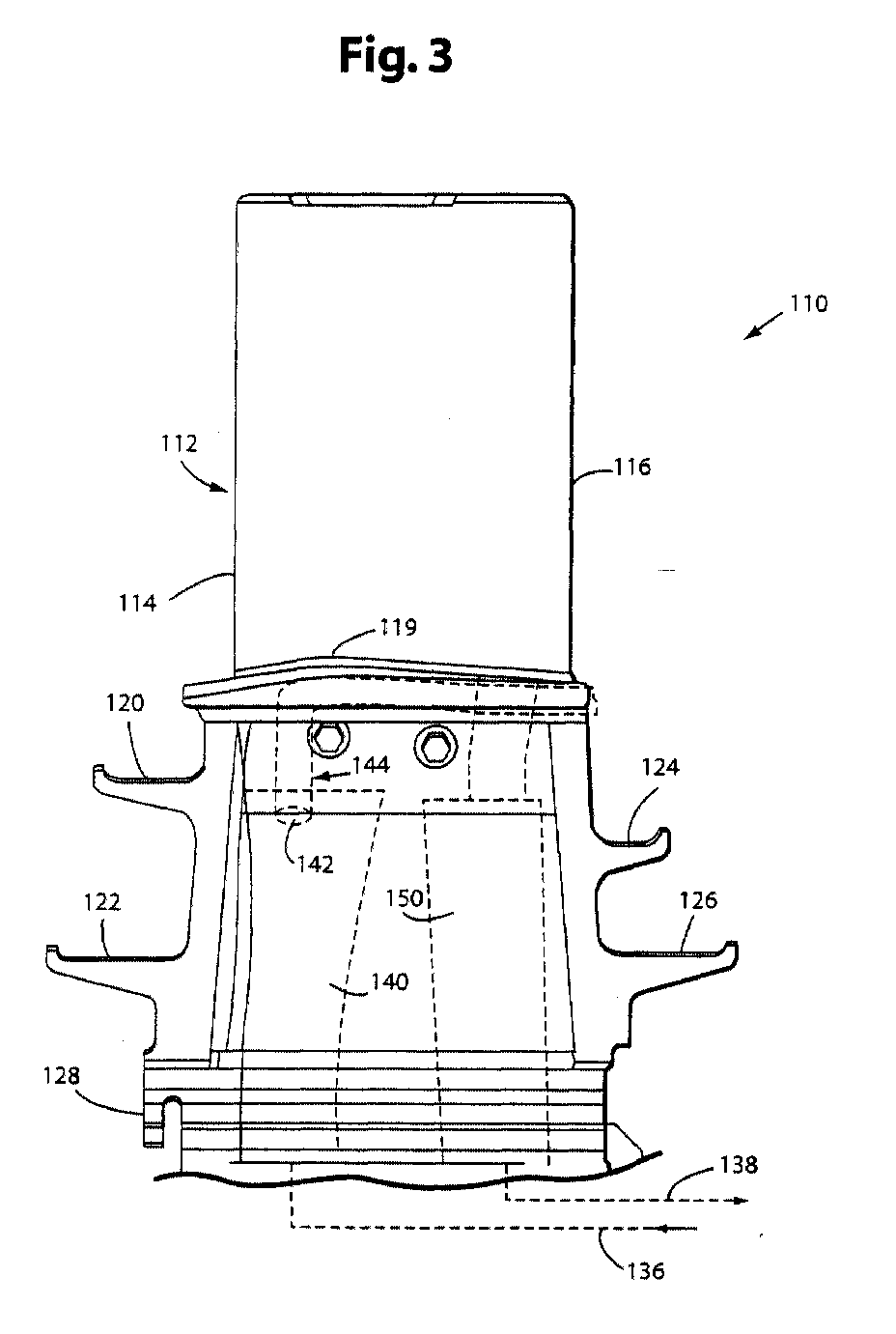
- Figure 3 is a partial side elevation of a gas turbine bucket in accordance with this invention, illustrating part of an internal cooling circuit;
- Figure 4 is a plan view of a gas turbine bucket in accordance with the invention, with the airfoil tip cap removed;
- Figure 5 is a partial section of the gas turbine bucket shown in Figure 4, taken at a location in radial proximity to the bucket platform;
- Figure 6 is a cross section of the gas turbine bucket shown in Figure 4, taken along the line 6-6;
- Figure 7 is an enlarged detail taken from Figure 6, but with a modified metering plug;
- Figure 8 is a partial perspective view of an alternative embodiment of the invention.
-
- Figure 1 illustrates a prior bucket trailing edge cooling circuit, which is part of a closed loop, serpentine circuit extending radially within the bucket. Only part of the bucket cooling circuit is shown. The
bucket 10 includes anairfoil 12 having a leadingedge 14 and a trailingedge 16. The airfoil is joined to ahorizontal platform 18 along anairfoil fillet 19. So called "angel wings" 20, 22 and 24, 26 extend laterally away from the respective front and rear sides of theshank portion 27 of the bucket, and adovetail portion 28 is employed to mount the bucket on a turbine wheel (not shown) in a conventional manner. - Trailing edge cooling holes 30, 32 (see also Figure 2) extend internally along and adjacent the trailing
edge 14 of the airfoil, while aninternal crossover passage 34 extends from the lower end ofholes coolant supply passage 36 in the dovetail portion of the bucket. Cooling steam (or other medium) will flow viapassages steam return passage 38. - It is apparent from Figure 2 that it is critical to control the location of the top of the core that forms the
passage 34 during manufacture, since the trailing edge cooling holes 30, 32. Note also the relatively large distance between the top of thepassage 34 and the location of acore support plug 39, a fact which makes accurate location of the top of the crossover core problematic. - Turning now to Figures 3-8, the manner in which the present invention alleviates these problems will now be discussed in detail.
- In Figures 3 and 4, similar reference numerals are employed to indicate components corresponding to those in Figures 1 and 2, but with the prefix "1" added. Thus, the
bucket 110 includes anairfoil 112 having aleading edge 114 and a trailingedge 116. The airfoil joins theplatform 118 along anairfoil fillet 119. Thebucket 110 also hasangel wings dovetail portion 128. Radially extending trailing edge cooling passages, in the form of drilledholes edge 116. In this construction, however, the cooling supply passage 136 (see Fig. 6) supplies cooling steam to an enlargedinterior chamber 140 which extends radially outwardly to a location generally adjacent theangel wing 120. Anew crossover inlet 142 extends horizontally between thechamber 140 and a newcrossover cooling passage 144 which has a radial (or vertical, as viewed in Figures 3 and 6)leg 146 and ahorizontal leg 148 which extends along the underside of theplatform 118 from the forward or leading side of the bucket to the rearward or trailing side of the bucket (as best seen in Figures 5) where the passage intersects the trailing edge cooling holes 130, 132. The cooling steam flows radially outwardly along the trailing edge and then reverses direction, flowing radially inwardly, dumping intochamber 150 which, in turn, connects to thecooling return passage 138. Note that some of the radial passages for the internal bucket cooling circuit are shown in Figure 4, one such passage indicated at 152. In Figure 5, it can be seen how the new core will provide a better target for the drilled trailing edge cooling holes 130, 132. - In Figures 3-6, it is apparent how the
crossover passage 144 follows the contour of the pressure side of the airfoil, along thefillet 119, thereby providing needed cooling along the underside of theplatform 118 as well as alongfillet 119. It is also readily apparent from Figure 2 that the height of the crossover passage is considerably reduced as compared to the prior arrangement. - Figure 6 also illustrates the manner in which the airfoil is drilled through the main body so as to connect the
passage 146 with theinlet 142 leading to theinterior chamber 140. The hole is then plugged at 154. - Figure 7 illustrates an alternative arrangement where a
plug 156 is inserted into the drilled hole providing the communication betweenchamber 140 andpassage 146 viainlet 142. Here, theplug 156 is formed withmetering holes chamber 140 into thepassage 146. This arrangement is particularly suitable where there are no trailing edge holes to meter the flow as, for example, in second stage buckets where the cooling flow is toward the leading edge of the bucket, and then in a radially extending passage in the airfoil portion of the bucket. It will be understood that the manner in which the crossover passage are formed and the manner in which access is provided to form interior passages for metering is dependent upon the manufacturing process used to produce the bucket. Where no separate metering mechanism is provided, the trailing edge holes 130, 132 are sized to meter the cooling air. - Figure 8 discloses an
alternative crossover passage 254 which is of serpentine configuration, permitting more of theplatform 218 to be cooled. It will be appreciated that various design configurations can be implemented to cool the platform and/or fillet region as desired.
Claims (10)
- A closed circuit steam cooling arrangement for a gas turbine bucket having an airfoil portion (114) joined to a platform (118) along a fillet region comprising a steam cooling supply passage (136) adapted to supply cooling steam to the airfoil portion (114) of the bucket and a crossover passage (144, 145) adjacent and substantially parallel to said platform (118).
- The arrangement of claim 1 wherein said airfoil portion (118) includes a trailing edge cooling hole (113) extending radially along said trailing edge and communicating with said crossover passage (144, 145).
- The arrangement of claim 2 wherein said trailing edge cooling hole (113) intersects a portion (148) of said crossover passage (144, 145) at a substantially 90° angle.
- The arrangement of claim 1, 2 or 3 wherein said crossover passage (144) includes one or more turbulators.
- A turbine bucket (110) comprising an airfoil portion (112) having leading and trailing edges (114, 116); at least one radially extending cooling passage (130) within the airfoil portion (112), the airfoil portion (112) being joined to a platform (118) at a radially inner end of the airfoil portion (112); a dovetail mounting portion (128) enclosing a cooling medium supply passage (136); and, a crossover passage (144) in fluid communication with said cooling medium supply passage (136) and with a radially extending cooling passage (130), said crossover passage (144) having a portion (148) extending along and substantially parallel to an underside surface of said platform (118).
- The bucket of claim 5 wherein said crossover passage (144) includes one or more turbulators.
- The bucket of claim 5 or 6 including means (156, 158, 160) for metering coolant flow into said crossover passage (144).
- A method of cooling a turbine bucket platform (118) in a turbine bucket (110) having an internal cooling circuit that includes at least one radially extending cooling passage (130), the method comprising:a) providing a coolant supply passage (136) in a dovetail mounting portion of the bucket (110);b) providing a crossover passage (144) connecting said coolant supply passage (136) and said at least one radially extending cooling passage (130); andc) arranging said crossover passage (144) to extend along and substantially parallel to an underside of said platform (118) in an area to be cooled.
- The method of claim 8 wherein said crossover passage (144) follows a contour of a pressure side of said airfoil portion (144) along a fillet region (119).
- The method of claim 8 wherein said crossover passage (254) is formed with a serpentine path within said platform (218).
Applications Claiming Priority (2)
| Application Number | Priority Date | Filing Date | Title |
|---|---|---|---|
| US09/496,715 US6390774B1 (en) | 2000-02-02 | 2000-02-02 | Gas turbine bucket cooling circuit and related process |
| US496715 | 2000-02-02 |
Publications (3)
| Publication Number | Publication Date |
|---|---|
| EP1122405A2 true EP1122405A2 (en) | 2001-08-08 |
| EP1122405A3 EP1122405A3 (en) | 2004-01-07 |
| EP1122405B1 EP1122405B1 (en) | 2010-12-08 |
Family
ID=23973815
Family Applications (1)
| Application Number | Title | Priority Date | Filing Date |
|---|---|---|---|
| EP00308612A Expired - Lifetime EP1122405B1 (en) | 2000-02-02 | 2000-09-29 | Gas turbine bucket cooling circuit |
Country Status (7)
| Country | Link |
|---|---|
| US (1) | US6390774B1 (en) |
| EP (1) | EP1122405B1 (en) |
| JP (1) | JP4731001B2 (en) |
| KR (1) | KR20010077887A (en) |
| AT (1) | ATE491080T1 (en) |
| CZ (1) | CZ20003307A3 (en) |
| DE (1) | DE60045333D1 (en) |
Cited By (5)
| Publication number | Priority date | Publication date | Assignee | Title |
|---|---|---|---|---|
| WO2004038179A1 (en) * | 2002-10-24 | 2004-05-06 | Pratt & Whitney Canada Corp. | Passively cooled blade platform |
| EP1653047A2 (en) | 2004-10-27 | 2006-05-03 | Snecma | Gas turbine rotor blade |
| EP1813776A3 (en) * | 2006-01-31 | 2011-04-06 | United Technologies Corporation | Microcircuits for cooling of small turbine engine blades |
| EP2597261A1 (en) * | 2011-11-04 | 2013-05-29 | General Electric Company | Bucket Assembly for Turbine System |
| EP2634369A1 (en) * | 2012-03-01 | 2013-09-04 | General Electric Company | Turbine buckets and corresponding cooling method |
Families Citing this family (39)
| Publication number | Priority date | Publication date | Assignee | Title |
|---|---|---|---|---|
| US6932570B2 (en) * | 2002-05-23 | 2005-08-23 | General Electric Company | Methods and apparatus for extending gas turbine engine airfoils useful life |
| US20040169013A1 (en) * | 2003-02-28 | 2004-09-02 | General Electric Company | Method for chemically removing aluminum-containing materials from a substrate |
| US6773229B1 (en) | 2003-03-14 | 2004-08-10 | General Electric Company | Turbine nozzle having angel wing seal lands and associated welding method |
| US20050000674A1 (en) * | 2003-07-01 | 2005-01-06 | Beddard Thomas Bradley | Perimeter-cooled stage 1 bucket core stabilizing device and related method |
| US6966756B2 (en) * | 2004-01-09 | 2005-11-22 | General Electric Company | Turbine bucket cooling passages and internal core for producing the passages |
| US7097424B2 (en) | 2004-02-03 | 2006-08-29 | United Technologies Corporation | Micro-circuit platform |
| US7097417B2 (en) * | 2004-02-09 | 2006-08-29 | Siemens Westinghouse Power Corporation | Cooling system for an airfoil vane |
| US7207775B2 (en) * | 2004-06-03 | 2007-04-24 | General Electric Company | Turbine bucket with optimized cooling circuit |
| US7147439B2 (en) * | 2004-09-15 | 2006-12-12 | General Electric Company | Apparatus and methods for cooling turbine bucket platforms |
| US7255535B2 (en) * | 2004-12-02 | 2007-08-14 | Albrecht Harry A | Cooling systems for stacked laminate CMC vane |
| US7153096B2 (en) * | 2004-12-02 | 2006-12-26 | Siemens Power Generation, Inc. | Stacked laminate CMC turbine vane |
| US7198458B2 (en) | 2004-12-02 | 2007-04-03 | Siemens Power Generation, Inc. | Fail safe cooling system for turbine vanes |
| US7255536B2 (en) | 2005-05-23 | 2007-08-14 | United Technologies Corporation | Turbine airfoil platform cooling circuit |
| US7465152B2 (en) * | 2005-09-16 | 2008-12-16 | General Electric Company | Angel wing seals for turbine blades and methods for selecting stator, rotor and wing seal profiles |
| US7309212B2 (en) * | 2005-11-21 | 2007-12-18 | General Electric Company | Gas turbine bucket with cooled platform leading edge and method of cooling platform leading edge |
| US7416391B2 (en) * | 2006-02-24 | 2008-08-26 | General Electric Company | Bucket platform cooling circuit and method |
| US7766606B2 (en) * | 2006-08-17 | 2010-08-03 | Siemens Energy, Inc. | Turbine airfoil cooling system with platform cooling channels with diffusion slots |
| US20100034662A1 (en) * | 2006-12-26 | 2010-02-11 | General Electric Company | Cooled airfoil and method for making an airfoil having reduced trail edge slot flow |
| US8052395B2 (en) * | 2007-09-28 | 2011-11-08 | General Electric Company | Air cooled bucket for a turbine |
| US8147188B2 (en) * | 2007-09-28 | 2012-04-03 | General Electric Company | Air cooled bucket for a turbine |
| US8511990B2 (en) * | 2009-06-24 | 2013-08-20 | General Electric Company | Cooling hole exits for a turbine bucket tip shroud |
| US8523527B2 (en) * | 2010-03-10 | 2013-09-03 | General Electric Company | Apparatus for cooling a platform of a turbine component |
| US8647064B2 (en) | 2010-08-09 | 2014-02-11 | General Electric Company | Bucket assembly cooling apparatus and method for forming the bucket assembly |
| US9416666B2 (en) | 2010-09-09 | 2016-08-16 | General Electric Company | Turbine blade platform cooling systems |
| US8814518B2 (en) * | 2010-10-29 | 2014-08-26 | General Electric Company | Apparatus and methods for cooling platform regions of turbine rotor blades |
| US8636471B2 (en) | 2010-12-20 | 2014-01-28 | General Electric Company | Apparatus and methods for cooling platform regions of turbine rotor blades |
| US8628300B2 (en) * | 2010-12-30 | 2014-01-14 | General Electric Company | Apparatus and methods for cooling platform regions of turbine rotor blades |
| US8753083B2 (en) | 2011-01-14 | 2014-06-17 | General Electric Company | Curved cooling passages for a turbine component |
| US9447691B2 (en) * | 2011-08-22 | 2016-09-20 | General Electric Company | Bucket assembly treating apparatus and method for treating bucket assembly |
| US9022735B2 (en) * | 2011-11-08 | 2015-05-05 | General Electric Company | Turbomachine component and method of connecting cooling circuits of a turbomachine component |
| US8974182B2 (en) | 2012-03-01 | 2015-03-10 | General Electric Company | Turbine bucket with a core cavity having a contoured turn |
| US9127561B2 (en) | 2012-03-01 | 2015-09-08 | General Electric Company | Turbine bucket with contoured internal rib |
| US9638051B2 (en) | 2013-09-04 | 2017-05-02 | General Electric Company | Turbomachine bucket having angel wing for differently sized discouragers and related methods |
| US9810072B2 (en) | 2014-05-28 | 2017-11-07 | General Electric Company | Rotor blade cooling |
| US10697306B2 (en) | 2014-09-18 | 2020-06-30 | Siemens Aktiengesellschaft | Gas turbine airfoil including integrated leading edge and tip cooling fluid passage and core structure used for forming such an airfoil |
| US20190085706A1 (en) * | 2017-09-18 | 2019-03-21 | General Electric Company | Turbine engine airfoil assembly |
| US10731475B2 (en) | 2018-04-20 | 2020-08-04 | Raytheon Technologies Corporation | Blade with inlet orifice on aft face of root |
| JP7129277B2 (en) * | 2018-08-24 | 2022-09-01 | 三菱重工業株式会社 | airfoil and gas turbine |
| CN118339363A (en) * | 2021-12-28 | 2024-07-12 | 三菱重工业株式会社 | Rotating blade and gas turbine equipped with the same |
Citations (7)
| Publication number | Priority date | Publication date | Assignee | Title |
|---|---|---|---|---|
| GB754217A (en) | 1953-01-30 | 1956-08-08 | Gen Motors Corp | Improvements relating to turbine blades |
| US3844679A (en) | 1973-03-28 | 1974-10-29 | Gen Electric | Pressurized serpentine cooling channel construction for open-circuit liquid cooled turbine buckets |
| GB2082257A (en) | 1980-08-08 | 1982-03-03 | Gen Electric | Liquid coolant distribution systems for gas turbines |
| JPH09280002A (en) | 1996-04-15 | 1997-10-28 | Mitsubishi Heavy Ind Ltd | Gas turbine moving blade |
| EP0940561A1 (en) | 1998-03-03 | 1999-09-08 | Mitsubishi Heavy Industries, Ltd. | Gas turbine moving blade platform |
| EP0955449A1 (en) | 1998-03-12 | 1999-11-10 | Mitsubishi Heavy Industries, Ltd. | Gas turbine blade |
| US5993155A (en) | 1997-03-29 | 1999-11-30 | Asea Brown Boveri Ag | Cooled gas-turbine blade |
Family Cites Families (15)
| Publication number | Priority date | Publication date | Assignee | Title |
|---|---|---|---|---|
| US4212587A (en) * | 1978-05-30 | 1980-07-15 | General Electric Company | Cooling system for a gas turbine using V-shaped notch weirs |
| US4244676A (en) * | 1979-06-01 | 1981-01-13 | General Electric Company | Cooling system for a gas turbine using a cylindrical insert having V-shaped notch weirs |
| US4242045A (en) * | 1979-06-01 | 1980-12-30 | General Electric Company | Trap seal for open circuit liquid cooled turbines |
| US4775296A (en) * | 1981-12-28 | 1988-10-04 | United Technologies Corporation | Coolable airfoil for a rotary machine |
| JPS61205301A (en) * | 1985-03-06 | 1986-09-11 | Hitachi Ltd | Gas turbine blade |
| US5340278A (en) * | 1992-11-24 | 1994-08-23 | United Technologies Corporation | Rotor blade with integral platform and a fillet cooling passage |
| JPH07119405A (en) * | 1993-10-26 | 1995-05-09 | Hitachi Ltd | Gas turbine cooling blades |
| US5491971A (en) | 1993-12-23 | 1996-02-20 | General Electric Co. | Closed circuit air cooled gas turbine combined cycle |
| US5591002A (en) | 1994-08-23 | 1997-01-07 | General Electric Co. | Closed or open air cooling circuits for nozzle segments with wheelspace purge |
| US5536143A (en) | 1995-03-31 | 1996-07-16 | General Electric Co. | Closed circuit steam cooled bucket |
| JP2851578B2 (en) * | 1996-03-12 | 1999-01-27 | 三菱重工業株式会社 | Gas turbine blades |
| US5823741A (en) | 1996-09-25 | 1998-10-20 | General Electric Co. | Cooling joint connection for abutting segments in a gas turbine engine |
| US5915923A (en) * | 1997-05-22 | 1999-06-29 | Mitsubishi Heavy Industries, Ltd. | Gas turbine moving blade |
| US6065931A (en) * | 1998-03-05 | 2000-05-23 | Mitsubishi Heavy Industries, Ltd. | Gas turbine moving blade |
| US6092991A (en) * | 1998-03-05 | 2000-07-25 | Mitsubishi Heavy Industries, Ltd. | Gas turbine blade |
-
2000
- 2000-02-02 US US09/496,715 patent/US6390774B1/en not_active Expired - Lifetime
- 2000-09-11 CZ CZ20003307A patent/CZ20003307A3/en unknown
- 2000-09-29 AT AT00308612T patent/ATE491080T1/en not_active IP Right Cessation
- 2000-09-29 KR KR1020000057411A patent/KR20010077887A/en not_active Ceased
- 2000-09-29 EP EP00308612A patent/EP1122405B1/en not_active Expired - Lifetime
- 2000-09-29 JP JP2000297789A patent/JP4731001B2/en not_active Expired - Lifetime
- 2000-09-29 DE DE60045333T patent/DE60045333D1/en not_active Expired - Lifetime
Patent Citations (7)
| Publication number | Priority date | Publication date | Assignee | Title |
|---|---|---|---|---|
| GB754217A (en) | 1953-01-30 | 1956-08-08 | Gen Motors Corp | Improvements relating to turbine blades |
| US3844679A (en) | 1973-03-28 | 1974-10-29 | Gen Electric | Pressurized serpentine cooling channel construction for open-circuit liquid cooled turbine buckets |
| GB2082257A (en) | 1980-08-08 | 1982-03-03 | Gen Electric | Liquid coolant distribution systems for gas turbines |
| JPH09280002A (en) | 1996-04-15 | 1997-10-28 | Mitsubishi Heavy Ind Ltd | Gas turbine moving blade |
| US5993155A (en) | 1997-03-29 | 1999-11-30 | Asea Brown Boveri Ag | Cooled gas-turbine blade |
| EP0940561A1 (en) | 1998-03-03 | 1999-09-08 | Mitsubishi Heavy Industries, Ltd. | Gas turbine moving blade platform |
| EP0955449A1 (en) | 1998-03-12 | 1999-11-10 | Mitsubishi Heavy Industries, Ltd. | Gas turbine blade |
Cited By (11)
| Publication number | Priority date | Publication date | Assignee | Title |
|---|---|---|---|---|
| WO2004038179A1 (en) * | 2002-10-24 | 2004-05-06 | Pratt & Whitney Canada Corp. | Passively cooled blade platform |
| US6832893B2 (en) | 2002-10-24 | 2004-12-21 | Pratt & Whitney Canada Corp. | Blade passive cooling feature |
| EP1653047A2 (en) | 2004-10-27 | 2006-05-03 | Snecma | Gas turbine rotor blade |
| EP1653047A3 (en) * | 2004-10-27 | 2011-09-07 | Snecma | Gas turbine rotor blade |
| EP1813776A3 (en) * | 2006-01-31 | 2011-04-06 | United Technologies Corporation | Microcircuits for cooling of small turbine engine blades |
| EP2597261A1 (en) * | 2011-11-04 | 2013-05-29 | General Electric Company | Bucket Assembly for Turbine System |
| US8858160B2 (en) | 2011-11-04 | 2014-10-14 | General Electric Company | Bucket assembly for turbine system |
| EP2634369A1 (en) * | 2012-03-01 | 2013-09-04 | General Electric Company | Turbine buckets and corresponding cooling method |
| CN103291374A (en) * | 2012-03-01 | 2013-09-11 | 通用电气公司 | Turbine bucket with pressure side cooling |
| US9109454B2 (en) | 2012-03-01 | 2015-08-18 | General Electric Company | Turbine bucket with pressure side cooling |
| CN103291374B (en) * | 2012-03-01 | 2016-12-28 | 通用电气公司 | For the turbine blade of gas-turbine unit and method that platform is cooled down |
Also Published As
| Publication number | Publication date |
|---|---|
| DE60045333D1 (en) | 2011-01-20 |
| US6390774B1 (en) | 2002-05-21 |
| CZ20003307A3 (en) | 2001-09-12 |
| JP4731001B2 (en) | 2011-07-20 |
| ATE491080T1 (en) | 2010-12-15 |
| KR20010077887A (en) | 2001-08-20 |
| EP1122405B1 (en) | 2010-12-08 |
| JP2001214703A (en) | 2001-08-10 |
| EP1122405A3 (en) | 2004-01-07 |
Similar Documents
| Publication | Publication Date | Title |
|---|---|---|
| US6390774B1 (en) | Gas turbine bucket cooling circuit and related process | |
| EP1936118B1 (en) | Turbine blade main core modifications for peripheral serpentine microcircuits | |
| US5348446A (en) | Bimetallic turbine airfoil | |
| EP1900904B1 (en) | Multi-peripheral serpentine microcircuits for high aspect ratio blades | |
| US7033136B2 (en) | Cooling circuits for a gas turbine blade | |
| EP1267037B1 (en) | Cooled hollow tip shroud of a turbine blade | |
| US6991430B2 (en) | Turbine blade with recessed squealer tip and shelf | |
| US8231354B2 (en) | Turbine engine airfoil and platform assembly | |
| US7597536B1 (en) | Turbine airfoil with de-coupled platform | |
| EP2246133B1 (en) | RMC-defined tip blowing slots for turbine blades | |
| EP1085171B1 (en) | Thermal barrier coated squealer tip cavity | |
| US5387086A (en) | Gas turbine blade with improved cooling | |
| US7028747B2 (en) | Closed loop steam cooled airfoil | |
| US6916155B2 (en) | Cooling circuits for a gas turbine blade | |
| US8454301B1 (en) | Turbine blade with serpentine cooling | |
| JP2001065301A (en) | Internal cooling airfoil parts and cooling method | |
| CA2467188A1 (en) | Internal cooled gas turbine vane or blade | |
| US8186953B1 (en) | Multiple piece turbine blade | |
| EP1884621A2 (en) | Serpentine microciruit cooling with pressure side features | |
| US7661930B2 (en) | Central cooling circuit for a moving blade of a turbomachine | |
| EP1593812B1 (en) | Cooled turbine airfoil | |
| US7686582B2 (en) | Radial split serpentine microcircuits | |
| US20080008599A1 (en) | Integral main body-tip microcircuits for blades | |
| EP1881157B1 (en) | Serpentine microcircuits for local heat removal | |
| JPH09133001A (en) | Gas turbine air cooling blades |
Legal Events
| Date | Code | Title | Description |
|---|---|---|---|
| PUAI | Public reference made under article 153(3) epc to a published international application that has entered the european phase |
Free format text: ORIGINAL CODE: 0009012 |
|
| AK | Designated contracting states |
Kind code of ref document: A2 Designated state(s): AT BE CH CY DE DK ES FI FR GB GR IE IT LI LU MC NL PT SE |
|
| AX | Request for extension of the european patent |
Free format text: AL;LT;LV;MK;RO;SI |
|
| PUAL | Search report despatched |
Free format text: ORIGINAL CODE: 0009013 |
|
| AK | Designated contracting states |
Kind code of ref document: A3 Designated state(s): AT BE CH CY DE DK ES FI FR GB GR IE IT LI LU MC NL PT SE |
|
| AX | Request for extension of the european patent |
Extension state: AL LT LV MK RO SI |
|
| 17P | Request for examination filed |
Effective date: 20040707 |
|
| AKX | Designation fees paid |
Designated state(s): AT BE CH CY DE DK ES FI FR GB GR IE IT LI LU MC NL PT SE |
|
| GRAP | Despatch of communication of intention to grant a patent |
Free format text: ORIGINAL CODE: EPIDOSNIGR1 |
|
| GRAS | Grant fee paid |
Free format text: ORIGINAL CODE: EPIDOSNIGR3 |
|
| GRAA | (expected) grant |
Free format text: ORIGINAL CODE: 0009210 |
|
| AK | Designated contracting states |
Kind code of ref document: B1 Designated state(s): AT BE CH CY DE DK ES FI FR GB GR IE IT LI LU MC NL PT SE |
|
| REG | Reference to a national code |
Ref country code: GB Ref legal event code: FG4D |
|
| REG | Reference to a national code |
Ref country code: CH Ref legal event code: EP |
|
| REG | Reference to a national code |
Ref country code: IE Ref legal event code: FG4D |
|
| REG | Reference to a national code |
Ref country code: CH Ref legal event code: NV Representative=s name: SERVOPATENT GMBH |
|
| REF | Corresponds to: |
Ref document number: 60045333 Country of ref document: DE Date of ref document: 20110120 Kind code of ref document: P |
|
| REG | Reference to a national code |
Ref country code: NL Ref legal event code: VDEP Effective date: 20101208 |
|
| PG25 | Lapsed in a contracting state [announced via postgrant information from national office to epo] |
Ref country code: SE Free format text: LAPSE BECAUSE OF FAILURE TO SUBMIT A TRANSLATION OF THE DESCRIPTION OR TO PAY THE FEE WITHIN THE PRESCRIBED TIME-LIMIT Effective date: 20101208 Ref country code: CY Free format text: LAPSE BECAUSE OF FAILURE TO SUBMIT A TRANSLATION OF THE DESCRIPTION OR TO PAY THE FEE WITHIN THE PRESCRIBED TIME-LIMIT Effective date: 20101208 Ref country code: FI Free format text: LAPSE BECAUSE OF FAILURE TO SUBMIT A TRANSLATION OF THE DESCRIPTION OR TO PAY THE FEE WITHIN THE PRESCRIBED TIME-LIMIT Effective date: 20101208 Ref country code: AT Free format text: LAPSE BECAUSE OF FAILURE TO SUBMIT A TRANSLATION OF THE DESCRIPTION OR TO PAY THE FEE WITHIN THE PRESCRIBED TIME-LIMIT Effective date: 20101208 Ref country code: NL Free format text: LAPSE BECAUSE OF FAILURE TO SUBMIT A TRANSLATION OF THE DESCRIPTION OR TO PAY THE FEE WITHIN THE PRESCRIBED TIME-LIMIT Effective date: 20101208 |
|
| PG25 | Lapsed in a contracting state [announced via postgrant information from national office to epo] |
Ref country code: BE Free format text: LAPSE BECAUSE OF FAILURE TO SUBMIT A TRANSLATION OF THE DESCRIPTION OR TO PAY THE FEE WITHIN THE PRESCRIBED TIME-LIMIT Effective date: 20101208 Ref country code: PT Free format text: LAPSE BECAUSE OF FAILURE TO SUBMIT A TRANSLATION OF THE DESCRIPTION OR TO PAY THE FEE WITHIN THE PRESCRIBED TIME-LIMIT Effective date: 20110408 Ref country code: GR Free format text: LAPSE BECAUSE OF FAILURE TO SUBMIT A TRANSLATION OF THE DESCRIPTION OR TO PAY THE FEE WITHIN THE PRESCRIBED TIME-LIMIT Effective date: 20110309 Ref country code: ES Free format text: LAPSE BECAUSE OF FAILURE TO SUBMIT A TRANSLATION OF THE DESCRIPTION OR TO PAY THE FEE WITHIN THE PRESCRIBED TIME-LIMIT Effective date: 20110319 |
|
| PLBE | No opposition filed within time limit |
Free format text: ORIGINAL CODE: 0009261 |
|
| STAA | Information on the status of an ep patent application or granted ep patent |
Free format text: STATUS: NO OPPOSITION FILED WITHIN TIME LIMIT |
|
| PG25 | Lapsed in a contracting state [announced via postgrant information from national office to epo] |
Ref country code: DK Free format text: LAPSE BECAUSE OF FAILURE TO SUBMIT A TRANSLATION OF THE DESCRIPTION OR TO PAY THE FEE WITHIN THE PRESCRIBED TIME-LIMIT Effective date: 20101208 |
|
| 26N | No opposition filed |
Effective date: 20110909 |
|
| PG25 | Lapsed in a contracting state [announced via postgrant information from national office to epo] |
Ref country code: IT Free format text: LAPSE BECAUSE OF FAILURE TO SUBMIT A TRANSLATION OF THE DESCRIPTION OR TO PAY THE FEE WITHIN THE PRESCRIBED TIME-LIMIT Effective date: 20101208 |
|
| REG | Reference to a national code |
Ref country code: DE Ref legal event code: R097 Ref document number: 60045333 Country of ref document: DE Effective date: 20110909 |
|
| PG25 | Lapsed in a contracting state [announced via postgrant information from national office to epo] |
Ref country code: MC Free format text: LAPSE BECAUSE OF NON-PAYMENT OF DUE FEES Effective date: 20110930 |
|
| REG | Reference to a national code |
Ref country code: IE Ref legal event code: MM4A |
|
| PG25 | Lapsed in a contracting state [announced via postgrant information from national office to epo] |
Ref country code: IE Free format text: LAPSE BECAUSE OF NON-PAYMENT OF DUE FEES Effective date: 20110929 |
|
| PG25 | Lapsed in a contracting state [announced via postgrant information from national office to epo] |
Ref country code: LU Free format text: LAPSE BECAUSE OF NON-PAYMENT OF DUE FEES Effective date: 20110929 |
|
| REG | Reference to a national code |
Ref country code: FR Ref legal event code: PLFP Year of fee payment: 17 |
|
| REG | Reference to a national code |
Ref country code: FR Ref legal event code: PLFP Year of fee payment: 18 |
|
| REG | Reference to a national code |
Ref country code: FR Ref legal event code: PLFP Year of fee payment: 19 |
|
| PGFP | Annual fee paid to national office [announced via postgrant information from national office to epo] |
Ref country code: FR Payment date: 20190820 Year of fee payment: 20 Ref country code: DE Payment date: 20190820 Year of fee payment: 20 |
|
| PGFP | Annual fee paid to national office [announced via postgrant information from national office to epo] |
Ref country code: GB Payment date: 20190820 Year of fee payment: 20 |
|
| PGFP | Annual fee paid to national office [announced via postgrant information from national office to epo] |
Ref country code: CH Payment date: 20190820 Year of fee payment: 20 |
|
| REG | Reference to a national code |
Ref country code: CH Ref legal event code: PCAR Free format text: NEW ADDRESS: WANNERSTRASSE 9/1, 8045 ZUERICH (CH) |
|
| REG | Reference to a national code |
Ref country code: DE Ref legal event code: R071 Ref document number: 60045333 Country of ref document: DE |
|
| REG | Reference to a national code |
Ref country code: CH Ref legal event code: PL |
|
| REG | Reference to a national code |
Ref country code: GB Ref legal event code: PE20 Expiry date: 20200928 |
|
| PG25 | Lapsed in a contracting state [announced via postgrant information from national office to epo] |
Ref country code: GB Free format text: LAPSE BECAUSE OF EXPIRATION OF PROTECTION Effective date: 20200928 |