EP1122671A2 - System für die sichere Verteilung und Wiedergabe von digitalen Daten - Google Patents
System für die sichere Verteilung und Wiedergabe von digitalen Daten Download PDFInfo
- Publication number
- EP1122671A2 EP1122671A2 EP01200222A EP01200222A EP1122671A2 EP 1122671 A2 EP1122671 A2 EP 1122671A2 EP 01200222 A EP01200222 A EP 01200222A EP 01200222 A EP01200222 A EP 01200222A EP 1122671 A2 EP1122671 A2 EP 1122671A2
- Authority
- EP
- European Patent Office
- Prior art keywords
- data
- identifiers
- unique
- identifier
- correspondence
- Prior art date
- Legal status (The legal status is an assumption and is not a legal conclusion. Google has not performed a legal analysis and makes no representation as to the accuracy of the status listed.)
- Withdrawn
Links
Images


Classifications
-
- G—PHYSICS
- G06—COMPUTING OR CALCULATING; COUNTING
- G06Q—INFORMATION AND COMMUNICATION TECHNOLOGY [ICT] SPECIALLY ADAPTED FOR ADMINISTRATIVE, COMMERCIAL, FINANCIAL, MANAGERIAL OR SUPERVISORY PURPOSES; SYSTEMS OR METHODS SPECIALLY ADAPTED FOR ADMINISTRATIVE, COMMERCIAL, FINANCIAL, MANAGERIAL OR SUPERVISORY PURPOSES, NOT OTHERWISE PROVIDED FOR
- G06Q30/00—Commerce
- G06Q30/06—Buying, selling or leasing transactions
-
- G—PHYSICS
- G06—COMPUTING OR CALCULATING; COUNTING
- G06F—ELECTRIC DIGITAL DATA PROCESSING
- G06F21/00—Security arrangements for protecting computers, components thereof, programs or data against unauthorised activity
- G06F21/10—Protecting distributed programs or content, e.g. vending or licensing of copyrighted material ; Digital rights management [DRM]
Definitions
- the present invention relates to systems for the mass production and distribution of data, with or without encryption, and its decryption and playback by specially enabled machines utilizing a digital medium. More particularly, the present invention relates to digital playback devices and storage media with embedded identifiers which provide control of copying and playback.
- Digital data is extremely convenient and well-adapted to distribution and copying without loss of quality. These valuable features, however, are also a threat to those who own the digital data. In some businesses it is necessary to maintain strict control over the reproduction and playback of valuable data. For example, databases, imagery, music, and personal information are all highly valuable digital commodities to which the owners might wish to restrict access.
- encryption techniques are known in the art which address these issues to a limited extent. For example, encryption techniques for rendering digital information unreadable without first decrypting the information with the use of keys is well-known. Generally, techniques use either the same key to encrypt and decrypt or use one key to encrypt and a second to decrypt. It is possible to do this without the encrypter or decrypter knowing what the key of the other is. Regardless of the encryption technique, maintaining the security of the keys themselves is problematic as is their distribution.
- U. S. Patent 5,745,568, issued April 28, 1998 to O'Connor et al., entitled “Method of Securing CD-ROM Data for Retrieval by One Machine,” discloses a method for securing CD-ROM data for retrieval by a specified computer system.
- the data is encrypted with a hardware identifier as an encryption key. This identifier is associated with playback hardware and is used by the hardware to decrypt the data for playback.
- This technique has several drawbacks for data having a large distribution. If a common encryption key for all instances of the data is used, access cannot be restricted to a sub-set of the hardware. If unique encryption for each data instance is used, a separate encryption step must be carried out on the data for each hardware playback device (or group of hardware devices with a common identifier). This encryption is tedious and costly; moreover, the management of the hardware identifiers at the data encryption site (i.e. key management) is problematic and a security risk. Secondly, this technique does not prevent unauthorized copying or playback of the information. Hence, an unscrupulous owner of two playback devices with a common identifier might copy the data and play it back in both machines while only having paid for the data once.
- this technique provides no control over the playback equipment. It may be desirable to limit access to the data to a particular set of playback machines to further enhance security. Finally, the technique makes no provision for encryption of the data and its subsequent decryption in a convenient way. Thus, someone who illegally obtains a data identifier and creates or modifies their own playback equipment may have unlimited access to the data and its playback.
- a method and system for secure distribution and access to digital data that includes providing a plurality of system components; associating a plurality of unique identifiers with different components of the system; and controlling access by the system to the digital data based on a correspondence between the unique identifiers.
- these identifiers can be complemented with encryption/decryption capabilities by encrypting data with a common key but decrypting with a multi-part key embedded in the medium, playback device, and any other pertinent system components.
- the medium When the medium is placed within a playback device, the device will access the medium, data, and playback identifiers and only proceed with data playback if the identifiers correspond. Decryption and playback can proceed if all pieces of the multi-part decryption key are correct.
- the present invention has the advantage of providing a mechanism for the secure distribution of mass-produced digital data in a secure and cost-effective way. Low-cost data replication is readily used while an extremely fine control of playback is possible. The approach is also resistant to theft and illegal playback.
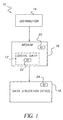
- a generalized system 10 for distribution of digital data 12 includes a distributor 14, a distribution medium 16, and a data utilization device 18.
- a plurality of unique identifiers are associated with a corresponding plurality of system components.
- the medium is a physical medium, such as an optical disc
- a unique medium identifier 20 is carried on the medium.
- a unique data identifier 22 is embedded within the digital data, and a unique device identifier 24 is associated within the data utilization device.
- Encryption can be employed to further enhance the security of the system.
- the identifiers are validated by a transferring a validation program or instructions from the media to the playback device.
- the system operates as follows.
- the digital data is written or otherwise fixed into the read-only digital medium.
- the unique medium identifier medium which can be a sub-code or other fixed identifier uniquely specifying the medium and is generally not copied when the medium contents are copied.
- a unique data identifier is then embedded in the digital data, using any well known data embedding process, and the data including the embedded identifier is written onto each disc.
- the medium identifier may be known only to the manufacturer of the medium whereas the data identifier may be known only to the data owner.
- the disc is then sent to the purchaser who may own a number of playback devices.
- Each playback device has within it a unique playback device identifier (the playback device identifier may be unique to the owner who may have several of the playback devices, each containing the owner's unique device identifier).
- This identifier may be known only to the owner of the playback devices or, since the identifier can be buried within the hardware of the device, may be transparent to the owner. Since the playback devices are likely to be moved, sold, or exchanged, it is preferable that the identifier be capable of modification (with difficulty) and not be directly hardwired into the components and unalterable.
- the playback device accesses the medium and identifiers.
- the playback device first establishes that the medium, data, and playback identifiers correspond in a predetermined fashion and then proceeds to playback the data. Note that to enhance security, the unique identifiers should correspond in some fashion but not be identical. If the medium, data, and devices identifiers do not correspond in the predetermined fashion, the playback device will be incapable of correctly reading and outputting the data.
- This technique obviates the need to separately communicate an identifier to the owner along with the data. Indeed, the owner need not be aware of the unique data identifier or its construction, thus enhancing security. If a copy of the data bearing medium is created (without a copy of the medium identifier), the data cannot be played back. Moreover, if either the data or medium identifiers are illegally obtained, the security of the system is maintained if a playback device having a non-corresponding device identifier is used. If all identifiers and the hardware playback device are compromised, future security may be re-established by changing the identifiers attached to new data or media.
- Fig. 2 illustrates a system 40 wherein digitized film 42 that is scanned 44 by a computer 46 and written with a disk writer 48 upon an optical disk 50.
- a coded data identifier which can be extracted without harming the integrity of the data.
- Stored within the sub-codes of the optical disk is a medium identifier.
- the disk with its content are then sent via a distribution channel 52 to a purchaser who owns a digital projector 54 or other playback device.
- Within the projector is a device identifier.
- the projector has the capability to read all three identifiers, determine if they correspond, and to access and playback the data if they do or to return a suitable error if they do not. The determination of correspondence is a matter of preference for each system.
- each identifier could be the same arbitrary string of alphanumeric characters.
- the playback device merely need compare them and proceed if they are identical. As noted above, however, this technique does not provide much security. If only one identifier is obtained, the others are also found.
- a more complex approach is to make two of the identifiers very large prime numbers. The third number can be the product of the first two. The playback device must multiply the two prime numbers together and establish that their product matches the third number. (As is well known, factoring large numbers is difficult. Hence, this approach provides a greater degree of security. Moreover, this approach can be readily extended by using more large prime numbers.) In this case, if two of the identifiers are obtained, the third can be found.
- Yet another approach is to incorporate a table as one of the identifiers (or, as described below, part of a transferred instruction), the second is the entry number, and the third is the table entry.
- the playback device performs the lookup and tests whether the numbers correspond. While this is less secure, it is a practical way to support a large number of customers.
- Storage devices can include optical disks (CD-ROMS, DVD, etc.) as well as magnetic tapes, disks, or other magnetic media.
- Distribution can include physical shipment of the media or, indeed, utilize broadcast mechanisms such as telecommunications, satellite, local area networks, corporate networks, land-lines, the Internet, etc.
- Access devices can include traditional computers, CD players, video players, DVD players, digital projectors, etc. Note that if electronic distribution is used, an identifier suitable to the medium may not be available and the system will rely upon only the remaining data and device identifiers. This may also be the case for read/write media in which an identifier cannot be conveniently placed. Some media may utilize medium identifiers not subject to copying, others may not. The extent to which these are used is dependent on the desired attributes of the entire system.
- the digital data can contain instructions or a transferred program 56 (Fig. 2) for matching the identifiers. These instructions, executed by the access device, then provide an additional layer of security in that if a particular set of identifiers, media, and playback devices are compromised, the instructions can be altered to inhibit use of the compromised devices.
- the instructions themselves can also be used to provide or prevent compatibility with existing data standards. For example, recognized data format identifiers (such as headers and file names) can be suppressed, or masked, so that only the transferred program can recognize them. Alternatively, the program can be instructed to allow direct access to the data. Note that this does not inhibit copying the medium, only its playback via the transferred program.
- an access device that does not rely on the transferred program is created or ignores the identifiers, it can access the data if the data is stored in a recognized format. Alternatively, if a physical replica of the medium is created (including the identifier), the transferred program will not be able to detect the medium as a replica.
- the security of the system can be enhanced with the application of encryption using a multi-part decryption key conceptually similar to the multiple identifiers described above.
- the keys can be the same information as the identifiers, but need not be. It is important to note that the efficient manufacture of the medium together with the digital data requires that the same data be written on every disk.
- FIG. 3 illustrates the operation of the system 60.
- an encryption key set 62 is chosen such that one or more complementary decryption keys can exist, each of which can be divided into multiple parts or identifiers.
- the digital data 64 is then encrypted 66 using the encryption key 68 to produce an encrypted data file 70 with an embedded identifier (or partial decryption key) called the data key 72.
- the encrypted data 70 is then written or otherwise fixed into all copies of the medium 74 on which the data is to be distributed. Onto each copy of the medium 74 on which the data is to be distributed is then written an identifier including one part of the decryption key (the medium key) 76.
- Another part can be encoded into the medium (the medium key) 76 and yet a third (the playback key) 78 is fixed in the playback device 80, either at manufacture or set-up. Each key set is associated with a customer. The data is then distributed 52 to the customers. The medium 74 is inserted into the playback device 80 by the customer. The playback device accesses the partial keys, combines them, decrypts the data, and plays it.
- the system as described can actually include more (or fewer) partial keys.
- Each component in the system for which security is required can be associated with a partial key as long as there is a communication mechanism transferring the partial key information to the playback device.
- the accessing playback device then combines all relevant keys to enforce a secure access to the data.
- a projectionist might be supplied with an identifier which must be entered into the system. The identifier is evaluated with the other component identifiers and playback continues only if the identifiers correspond.
- fewer key portions or identifiers can be used thereby simplifying the system but reducing the security.
- the keys or identifiers themselves can be hidden within the data, medium, or playback device by further encrypting them, distributing them among other data elements, dividing them into pieces and storing them in multiple locations, etc.
- the identifiers associated with the various system components can encode more information than simply the partial decryption key and this additional information can be used to further circumscribe the use of the data. For example, an expiration or start date can be encoded such that the playback device is incapable of reading or decrypting the data after or before a certain date has passed. Other limitations can also be encoded, such as number of times played, etc.
- additional security can be integrated into the system by including a transferred program or instructions 82 (Fig. 3) in the digital data which is accessed and executed by the playback device.
- a transferred program or instructions 82 (Fig. 3) in the digital data which is accessed and executed by the playback device.
- This allows future changes to be made to the security arrangements and also increases security by keeping the validation mechanism separate from the actual playback hardware. It is a matter of preference whether the instructions are actually included in the digital data itself or simply separately resident on the medium. Hiding the instructions in the data or encrypting it may improve security but limits the scope of the instructions.
- the use of multi-part keys or identifiers reduces the risk of compromising the data. If any of the identifiers or keys is stolen, the system will still not support playback. Only in the case in which a playback device and the corresponding data storage medium are stolen, will the data playback be compromised. In this case, the invention also supports future security, in that the data storage device manufacturer can simply stop producing storage media with the key portion that corresponds to the stolen playback device. Hence, future media will not be compromised. An alternative key portion can be used that will then not work with a transferred program, that is, the transferred program can be instructed to ignore a certain, compromised data key.
- this technique can inhibit playback of the data using conventional devices by inhibiting access to the content. Copying the media is inhibited by requiring the recognition of media and data identifiers that are not readily transferred from one medium to another. Control over access is established by requiring corresponding data, medium, and playback device identifiers.
- Data security is established by encryption. Manufacturing efficiency is obtained by using a common encryption key.
- Decryption key security is established by dividing the key into multiple parts, each embedded into a different device (for example, the medium itself and the playback device).
- the device identifier does not necessarily have to be embedded within a playback device but could be distributed to it via a network either by a central computer controlled by the owner of the playback device or by the manufacturer of the media. Distribution via the Internet is also feasible. Controlling mechanisms within the playback device or transferred program could be time dependent or based on other external factors, allowing an even finer control of the playback of the data. Thus the technique is not only useful for preventing piracy but for controlling and enforcing legitimate use.
Landscapes
- Engineering & Computer Science (AREA)
- Business, Economics & Management (AREA)
- Theoretical Computer Science (AREA)
- General Physics & Mathematics (AREA)
- Finance (AREA)
- Software Systems (AREA)
- Accounting & Taxation (AREA)
- Physics & Mathematics (AREA)
- Computer Security & Cryptography (AREA)
- Marketing (AREA)
- Computer Hardware Design (AREA)
- Technology Law (AREA)
- Multimedia (AREA)
- Development Economics (AREA)
- Economics (AREA)
- General Engineering & Computer Science (AREA)
- Strategic Management (AREA)
- General Business, Economics & Management (AREA)
- Signal Processing For Digital Recording And Reproducing (AREA)
- Storage Device Security (AREA)
- Two-Way Televisions, Distribution Of Moving Picture Or The Like (AREA)
- Reverberation, Karaoke And Other Acoustics (AREA)
Applications Claiming Priority (2)
| Application Number | Priority Date | Filing Date | Title |
|---|---|---|---|
| US498379 | 2000-02-03 | ||
| US09/498,379 US6865550B1 (en) | 2000-02-03 | 2000-02-03 | System for secure distribution and playback of digital data |
Publications (2)
| Publication Number | Publication Date |
|---|---|
| EP1122671A2 true EP1122671A2 (de) | 2001-08-08 |
| EP1122671A3 EP1122671A3 (de) | 2002-05-15 |
Family
ID=23980839
Family Applications (1)
| Application Number | Title | Priority Date | Filing Date |
|---|---|---|---|
| EP01200222A Withdrawn EP1122671A3 (de) | 2000-02-03 | 2001-01-22 | System für die sichere Verteilung und Wiedergabe von digitalen Daten |
Country Status (4)
| Country | Link |
|---|---|
| US (1) | US6865550B1 (de) |
| EP (1) | EP1122671A3 (de) |
| JP (1) | JP2001273713A (de) |
| CN (1) | CN1222855C (de) |
Families Citing this family (51)
| Publication number | Priority date | Publication date | Assignee | Title |
|---|---|---|---|---|
| WO2000055962A2 (en) | 1999-03-15 | 2000-09-21 | Sony Electronics, Inc. | Electronic media system, method and device |
| US6920565B2 (en) * | 2000-06-05 | 2005-07-19 | Iomega Corporation | Method and system for providing secure digital music duplication |
| US6718446B1 (en) | 2000-02-11 | 2004-04-06 | Iomega Corporation | Storage media with benchmark representative of data originally stored thereon |
| US7325043B1 (en) | 2000-03-08 | 2008-01-29 | Music Choice | System and method for providing a personalized media service |
| US7028082B1 (en) | 2001-03-08 | 2006-04-11 | Music Choice | Personalized audio system and method |
| US8463780B1 (en) | 2000-03-08 | 2013-06-11 | Music Choice | System and method for providing a personalized media service |
| US7275256B1 (en) | 2001-08-28 | 2007-09-25 | Music Choice | System and method for providing an interactive, visual complement to an audio program |
| US7783722B1 (en) | 2000-03-08 | 2010-08-24 | Music Choice | Personalized audio system and method |
| US7320025B1 (en) | 2002-03-18 | 2008-01-15 | Music Choice | Systems and methods for providing a broadcast entertainment service and an on-demand entertainment service |
| US7856485B2 (en) | 2000-03-08 | 2010-12-21 | Music Choice | Systems and methods for providing customized media channels |
| US7133924B1 (en) * | 2000-03-08 | 2006-11-07 | Music Choice | Personalized audio system and method |
| US20020059620A1 (en) * | 2000-05-31 | 2002-05-16 | Hoang Khoi Nhu | Selective inactivation and copy-protection |
| US20020042754A1 (en) | 2000-10-10 | 2002-04-11 | Del Beccaro David J. | System and method for receiving broadcast audio/video works and for enabling a consumer to purchase the received audio/video works |
| US6839692B2 (en) * | 2000-12-01 | 2005-01-04 | Benedor Corporation | Method and apparatus to provide secure purchase transactions over a computer network |
| US20070288394A1 (en) * | 2000-12-01 | 2007-12-13 | Carrott Richard F | Transactional security over a network |
| US8260723B2 (en) | 2000-12-01 | 2012-09-04 | Carrott Richard F | Transactional security over a network |
| JP4019303B2 (ja) * | 2001-02-02 | 2007-12-12 | 日本電気株式会社 | 電子透かしに含めた暗号鍵を用いた暗号化装置及び復号化装置並びにそれらの方法 |
| KR100413682B1 (ko) * | 2001-03-26 | 2003-12-31 | 삼성전자주식회사 | 암호화된 데이터를 포함한 데이터의 전송 및 수신 제어 방법 |
| EP2267626B8 (de) * | 2001-03-28 | 2016-11-30 | NDS Limited | Verfahren und vorrichtung zur verwaltung digitaler berechtigungen |
| US7516324B2 (en) * | 2001-07-05 | 2009-04-07 | Sony Corporation | Information processing system, information management apparatus, and information processing apparatus |
| US8515773B2 (en) | 2001-08-01 | 2013-08-20 | Sony Corporation | System and method for enabling distribution and brokering of content information |
| DE60202568T8 (de) * | 2001-08-08 | 2005-10-20 | Matsushita Electric Industrial Co., Ltd., Kadoma | Urheberrechtschutzsystem, Aufzeichungsvorrichtung, und Wiedergabevorrichtung |
| US20070277037A1 (en) * | 2001-09-06 | 2007-11-29 | Randy Langer | Software component authentication via encrypted embedded self-signatures |
| US20030084332A1 (en) * | 2001-10-26 | 2003-05-01 | Koninklijke Philips Electronics N.V. | Method for binding a software data domain to specific hardware |
| JP2003195759A (ja) * | 2001-12-25 | 2003-07-09 | Hitachi Ltd | 暗号化データの生成方法、記録装置、記録媒体、復号方法、記録媒体再生装置、伝送装置、および、受信装置 |
| US7617295B1 (en) | 2002-03-18 | 2009-11-10 | Music Choice | Systems and methods for providing a broadcast entertainment service and an on-demand entertainment service |
| JP2004046327A (ja) * | 2002-07-09 | 2004-02-12 | Sony Corp | データ記録媒体、プログラム起動方法およびプログラム |
| US7693795B2 (en) * | 2002-09-05 | 2010-04-06 | Panasonic Corporation | Digital work protection system |
| US7626609B1 (en) | 2003-03-07 | 2009-12-01 | Music Choice | Method and system for displaying content while reducing burn-in of a display |
| US7158169B1 (en) | 2003-03-07 | 2007-01-02 | Music Choice | Method and system for displaying content while reducing burn-in of a display |
| US8181022B2 (en) * | 2003-06-24 | 2012-05-15 | Realnetworks, Inc. | Method and apparatus for controlling access restrictions for media playback |
| US20040264702A1 (en) * | 2003-06-30 | 2004-12-30 | Eastlake Donald E. | Method and apparatus for producing cryptographic keys |
| JP2005038234A (ja) * | 2003-07-16 | 2005-02-10 | Sony Corp | 記録装置および方法、再生装置および方法、プログラム、並びに記憶媒体 |
| JP4176603B2 (ja) * | 2003-09-24 | 2008-11-05 | 株式会社東芝 | 画像表示装置、画像表示システム、画像表示装置選択方法及びプログラム |
| DE102004016289A1 (de) * | 2004-04-02 | 2005-11-10 | Daimlerchrysler Ag | Verfahren zur Datensicherung in Fahrzeugbauteilen und zugehöriges Fahrzeugbauteil |
| US20060075441A1 (en) * | 2004-10-06 | 2006-04-06 | Sony Corporation | Method and system for a personal video recorder comprising multiple removable storage/tuner units |
| US8768844B2 (en) * | 2004-10-06 | 2014-07-01 | Sony Corporation | Method and system for content sharing and authentication between multiple devices |
| US7668538B2 (en) | 2005-06-15 | 2010-02-23 | Music Choice | Systems and methods for facilitating the acquisition of content |
| FR2896076A1 (fr) * | 2006-01-06 | 2007-07-13 | Thomson Licensing Sa | Methode de mise a disposition, de distribution et de gravure donnees numeriques et serveur de distribution associe. |
| JP2007243703A (ja) * | 2006-03-09 | 2007-09-20 | Toshiba Corp | 携帯端末 |
| US8452988B2 (en) * | 2006-07-24 | 2013-05-28 | Michael Sujue Wang | Secure data storage for protecting digital content |
| US20090080658A1 (en) * | 2007-07-13 | 2009-03-26 | Brent Waters | Method and apparatus for encrypting data for fine-grained access control |
| US8761402B2 (en) * | 2007-09-28 | 2014-06-24 | Sandisk Technologies Inc. | System and methods for digital content distribution |
| US20100310076A1 (en) * | 2009-06-04 | 2010-12-09 | Ron Barzilai | Method for Performing Double Domain Encryption in a Memory Device |
| US9083685B2 (en) * | 2009-06-04 | 2015-07-14 | Sandisk Technologies Inc. | Method and system for content replication control |
| CN101923616A (zh) * | 2010-08-03 | 2010-12-22 | 鸿富锦精密工业(深圳)有限公司 | 版权保护中的服务提供装置、用户终端及版权保护方法 |
| US9197937B1 (en) | 2012-04-26 | 2015-11-24 | Music Choice | Automatic on-demand navigation based on meta-data broadcast with media content |
| US8924730B2 (en) * | 2012-07-12 | 2014-12-30 | Xsette Technology, Inc. | Digital watermarking for secure transmission between a source component and a node device |
| US20140337985A1 (en) * | 2013-05-08 | 2014-11-13 | Jorge Enrique Muyshondt | Security in Digital Manufacturing Systems |
| JP5870163B2 (ja) * | 2014-06-30 | 2016-02-24 | 達男 眞子 | コンテンツ閲覧制限システム、コンテンツ閲覧制限方法及びコンテンツ閲覧制限プログラム並びにリムーバブルメディア読取装置 |
| US10219027B1 (en) | 2014-10-24 | 2019-02-26 | Music Choice | System for providing music content to a user |
Family Cites Families (18)
| Publication number | Priority date | Publication date | Assignee | Title |
|---|---|---|---|---|
| CA1244090A (en) | 1984-10-26 | 1988-11-01 | General Instrument Corporation | Cryptographic system for direct broadcast satellite network |
| US4866769A (en) * | 1987-08-05 | 1989-09-12 | Ibm Corporation | Hardware assist for protecting PC software |
| FR2651347A1 (fr) * | 1989-08-22 | 1991-03-01 | Trt Telecom Radio Electr | Procede de generation de nombre unique pour carte a microcircuit et application a la cooperation de la carte avec un systeme hote. |
| JP3145116B2 (ja) * | 1991-01-18 | 2001-03-12 | トムソン マルチメデイア ソシエテ アノニム | アクセスコントロールおよび/または識別方法および装置 |
| JP3729421B2 (ja) * | 1994-03-18 | 2005-12-21 | 富士通株式会社 | 不正使用防止方法及び不正使用防止システム |
| US5838792A (en) * | 1994-07-18 | 1998-11-17 | Bell Atlantic Network Services, Inc. | Computer system for centralized session key distribution, privacy enhanced messaging and information distribution using a split private key public cryptosystem |
| DE69534757T2 (de) | 1994-09-15 | 2006-08-31 | International Business Machines Corp. | System und Verfahren zur sicheren Speicherung und Verteilung von Daten unter Verwendung digitaler Unterschriften |
| US5715403A (en) * | 1994-11-23 | 1998-02-03 | Xerox Corporation | System for controlling the distribution and use of digital works having attached usage rights where the usage rights are defined by a usage rights grammar |
| US5978482A (en) * | 1995-08-21 | 1999-11-02 | International Business Machines Corporation | Method and system for protection of digital information |
| US5745568A (en) | 1995-09-15 | 1998-04-28 | Dell Usa, L.P. | Method of securing CD-ROM data for retrieval by one machine |
| US5870470A (en) * | 1996-02-20 | 1999-02-09 | International Business Machines Corporation | Method and apparatus for encrypting long blocks using a short-block encryption procedure |
| US6072876A (en) * | 1996-07-26 | 2000-06-06 | Nippon Telegraph And Telephone Corporation | Method and system for depositing private key used in RSA cryptosystem |
| US5926624A (en) * | 1996-09-12 | 1999-07-20 | Audible, Inc. | Digital information library and delivery system with logic for generating files targeted to the playback device |
| US5937066A (en) * | 1996-10-02 | 1999-08-10 | International Business Machines Corporation | Two-phase cryptographic key recovery system |
| US6005943A (en) * | 1996-10-29 | 1999-12-21 | Lucent Technologies Inc. | Electronic identifiers for network terminal devices |
| US5995624A (en) * | 1997-03-10 | 1999-11-30 | The Pacid Group | Bilateral authentication and information encryption token system and method |
| US6170060B1 (en) * | 1997-10-03 | 2001-01-02 | Audible, Inc. | Method and apparatus for targeting a digital information playback device |
| US6384893B1 (en) * | 1998-12-11 | 2002-05-07 | Sony Corporation | Cinema networking system |
-
2000
- 2000-02-03 US US09/498,379 patent/US6865550B1/en not_active Expired - Lifetime
-
2001
- 2001-01-22 EP EP01200222A patent/EP1122671A3/de not_active Withdrawn
- 2001-02-01 JP JP2001025763A patent/JP2001273713A/ja active Pending
- 2001-02-03 CN CN01116225.2A patent/CN1222855C/zh not_active Expired - Fee Related
Also Published As
| Publication number | Publication date |
|---|---|
| EP1122671A3 (de) | 2002-05-15 |
| US6865550B1 (en) | 2005-03-08 |
| CN1222855C (zh) | 2005-10-12 |
| CN1321975A (zh) | 2001-11-14 |
| JP2001273713A (ja) | 2001-10-05 |
Similar Documents
| Publication | Publication Date | Title |
|---|---|---|
| US6865550B1 (en) | System for secure distribution and playback of digital data | |
| US7756792B2 (en) | System and method for controlling the use and duplication of digital content distributed on removable media | |
| US7065216B1 (en) | Methods and systems of protecting digital content | |
| US7549063B2 (en) | Methods and systems of protecting digital content | |
| US7130426B1 (en) | Digital data file encryption apparatus and method and recording medium for recording digital data file encryption program thereon | |
| US7281273B2 (en) | Protecting content on medium from unfettered distribution | |
| KR100580572B1 (ko) | 매체에 저장된 컨텐츠의 비인증 사본의 재생을 방지하기위해 판독-전용 매체의 검증 영역을 이용한 키 재료의검증 방법 및 장치 | |
| US20090210724A1 (en) | Content management method and content management apparatus | |
| CN101615231A (zh) | 记录媒体、许可管理装置、和记录及回放装置 | |
| KR20040053170A (ko) | 안전한 단일 구동 복제 방법 및 장치 | |
| KR20020042868A (ko) | 디지털 저작물의 배포 및 사용을 규제하는 방법 및 장치 | |
| JP2000347946A (ja) | マルチメディアコンテンツの不正な使用を防止する方法及び装置 | |
| JP2002132457A (ja) | 情報記録装置及び情報再生装置並びに情報記録再生装置 | |
| JP2002541754A (ja) | メモリ装置による鍵配布 | |
| US20030091187A1 (en) | Apparatus and method for reading or writing user data | |
| US20020146121A1 (en) | Method and system for protecting data | |
| JP2003509881A (ja) | 記録された電子出版資料からのマスター鍵の復元方法 | |
| US7685646B1 (en) | System and method for distributing protected audio content on optical media | |
| EP1652024A1 (de) | Zu einer autorisierten domäne gehörender datenträger | |
| KR101270712B1 (ko) | 메모리 카드 암호화 및 복호화를 사용하여 디지털 컨텐츠를보호하는 방법 | |
| JP4473556B2 (ja) | 記録再生装置 | |
| WO2001031923A1 (en) | Method and apparatus for ensuring secure distribution and receipt, and secure authorized exhibition of digital audiovisual data | |
| US20070118765A1 (en) | Method and system of decrypting disc | |
| MXPA00003641A (en) | Method and apparatus for preventing illegal use of multimedia content | |
| JP2006163959A (ja) | 記憶媒体複製方法、記憶媒体複製機の制御プログラム、および記憶媒体複製機 |
Legal Events
| Date | Code | Title | Description |
|---|---|---|---|
| PUAI | Public reference made under article 153(3) epc to a published international application that has entered the european phase |
Free format text: ORIGINAL CODE: 0009012 |
|
| AK | Designated contracting states |
Kind code of ref document: A2 Designated state(s): AT BE CH CY DE DK ES FI FR GB GR IE IT LI LU MC NL PT SE TR |
|
| AX | Request for extension of the european patent |
Free format text: AL;LT;LV;MK;RO;SI |
|
| PUAL | Search report despatched |
Free format text: ORIGINAL CODE: 0009013 |
|
| AK | Designated contracting states |
Kind code of ref document: A3 Designated state(s): AT BE CH CY DE DK ES FI FR GB GR IE IT LI LU MC NL PT SE TR |
|
| AX | Request for extension of the european patent |
Free format text: AL;LT;LV;MK;RO;SI |
|
| 17P | Request for examination filed |
Effective date: 20021021 |
|
| AKX | Designation fees paid |
Designated state(s): DE FR GB |
|
| 17Q | First examination report despatched |
Effective date: 20030206 |
|
| STAA | Information on the status of an ep patent application or granted ep patent |
Free format text: STATUS: THE APPLICATION IS DEEMED TO BE WITHDRAWN |
|
| 18D | Application deemed to be withdrawn |
Effective date: 20030617 |