EP1122714A2 - Tragbares luftgetriebenes Musikinstrument mit Tastatur - Google Patents
Tragbares luftgetriebenes Musikinstrument mit Tastatur Download PDFInfo
- Publication number
- EP1122714A2 EP1122714A2 EP01830061A EP01830061A EP1122714A2 EP 1122714 A2 EP1122714 A2 EP 1122714A2 EP 01830061 A EP01830061 A EP 01830061A EP 01830061 A EP01830061 A EP 01830061A EP 1122714 A2 EP1122714 A2 EP 1122714A2
- Authority
- EP
- European Patent Office
- Prior art keywords
- pressurised air
- cells
- fact
- air
- outlets
- Prior art date
- Legal status (The legal status is an assumption and is not a legal conclusion. Google has not performed a legal analysis and makes no representation as to the accuracy of the status listed.)
- Withdrawn
Links
Images


Classifications
-
- G—PHYSICS
- G10—MUSICAL INSTRUMENTS; ACOUSTICS
- G10B—ORGANS, HARMONIUMS OR SIMILAR WIND MUSICAL INSTRUMENTS WITH ASSOCIATED BLOWING APPARATUS
- G10B1/00—General design of organs, harmoniums or similar wind musical instruments with associated blowing apparatus
- G10B1/08—General design of organs, harmoniums or similar wind musical instruments with associated blowing apparatus of harmoniums, i.e. reed organs
-
- G—PHYSICS
- G10—MUSICAL INSTRUMENTS; ACOUSTICS
- G10D—STRINGED MUSICAL INSTRUMENTS; WIND MUSICAL INSTRUMENTS; ACCORDIONS OR CONCERTINAS; PERCUSSION MUSICAL INSTRUMENTS; AEOLIAN HARPS; SINGING-FLAME MUSICAL INSTRUMENTS; MUSICAL INSTRUMENTS NOT OTHERWISE PROVIDED FOR
- G10D11/00—Accordions, concertinas or the like; Keyboards therefor
-
- G—PHYSICS
- G10—MUSICAL INSTRUMENTS; ACOUSTICS
- G10D—STRINGED MUSICAL INSTRUMENTS; WIND MUSICAL INSTRUMENTS; ACCORDIONS OR CONCERTINAS; PERCUSSION MUSICAL INSTRUMENTS; AEOLIAN HARPS; SINGING-FLAME MUSICAL INSTRUMENTS; MUSICAL INSTRUMENTS NOT OTHERWISE PROVIDED FOR
- G10D7/00—General design of wind musical instruments
- G10D7/12—Free-reed wind instruments
-
- G—PHYSICS
- G10—MUSICAL INSTRUMENTS; ACOUSTICS
- G10D—STRINGED MUSICAL INSTRUMENTS; WIND MUSICAL INSTRUMENTS; ACCORDIONS OR CONCERTINAS; PERCUSSION MUSICAL INSTRUMENTS; AEOLIAN HARPS; SINGING-FLAME MUSICAL INSTRUMENTS; MUSICAL INSTRUMENTS NOT OTHERWISE PROVIDED FOR
- G10D9/00—Details of, or accessories for, wind musical instruments
- G10D9/10—Resonating bodies, e.g. tubes
Definitions
- the present invention relates to a portable air musical instrument provided with keyboard.
- the accordion is the most commonly used among the portable air musical instrument provided with keyboard.
- the typical notes of the accordion are generated by the vibration of a series of reeds with different seizes and shapes, caused by a flow of pressurised air that intercepts them according to a sequence determined by the musician by means of multiple external keys.
- the accordion keys are distributed in two lateral sections separated by a bellows and divided into melody keys and accompaniment keys.
- the bellows delimits a variable volume, whose expansion results in the aspiration of air from the outside and whose reduction determines the compression of the air accumulated inside it so as to generate and maintain the flow of pressurised air constant, channelling it in suitable cells in order to intercept the reeds and cause their vibration.
- the accordion is held on the two sides, with one hand that reaches the keyboard for the composition of the melody and the other hand that reaches the keyboard for the accompaniment.
- the musician continuously changes the volume of the bellows in order to maintain the pressurised air flow constant and guarantee the uniformity and continuity of the sound. To do this, the musician alternatively moves close and away the two lateral portions, thus causing the extension and the reduction of the bellows, respectively.
- the musician uses his hands independently, one hand to create the melody and the other hand to create the accompaniment and at the same time co-ordinates the movements of his arms to operate the bellows and make the instrument play.
- the main purpose of the present invention is to provide for a portable air musical instrument that can be connected to an external source of pressurised air so that the volume is constant, resulting in more comfortable use.
- Another purpose of the present invention is to provide for a wind instrument.
- Another purpose of the present invention is to provide for a musical instrument with handle that can be comfortably played with one hand.
- another purpose of the present invention is to provide for a musical instrument capable of creating a melody, with the typical sound of the accordion, mixed with tonalities that can be reproduced with wind instruments, such as the harmonica.
- a portable air musical instrument with keyboard comprising a box-shaped body including a portion configured as resonance box with ventilation openings and a portion configured as keyboard, a compartment for the accumulation of pressurised air inside the resonance box that communicates with it by means of multiple cells provided with at least an inlet intercepted by a reed that vibrates due to the passage of pressurised air from the air accumulation compartment to the cell and at least one outlet for the passage of pressurised air from the cell to the resonance box and a sequence of external keys located in the portion with keyboard configuration and cinematically connected by means of a small arm elastically hinged in the resonance box to a pad designed to open or close the outlet for pressurised air, characterised by the fact that it comprises adduction means of pressurised air towards the accumulation compartment that can be connected to at least one external source of pressurised air to cause the vibration of one or more reeds at a time, each of them generating a different musical note when the corresponding key is pressed.
- the adduction means advantageously comprise a tubular duct provided with an opening for the musician's lips at one end.
- the adduction means suitably include at least one adjustment valve for the pressurised air flow in order to intercept the air flow and a register device capable of controlling from the outside the opening and closing of the adjustment valve in order to modulate the sound emitted by the musician.
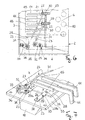
- the musical instrument (1) comprises a box-shaped body (2) made up of a base (3) and a cover (4) delimiting a portion (5) shown in Figs. 4 and 5 that acts as resonance box and a portion (6) with keyboard configuration.
- the instrument (1) can be provided with a curved tubular duct (7) that connects a suitable source of pressurised air to the body (2).
- the tubular duct (7) connected with an attachment (9) to the base (3) of the body (2) at one end (8) features an opening (10) at the free end, where the musician puts his lips to play the instrument.
- the tubular duct (7) is preferably composed of three sections (12, 13 and 14) connected and placed in such a way that the opening (10) delimiting the free end of the section (14) can be easily reached by the musician's mouth, while comfortably holding the instrument (1).
- the end (8) of the tubular duct (7) ends inside the body (2) in the accumulation compartment (15) of pressurised air, as shown in Figs. 4 and 5, partially delimited by the base (3), by an internal vertical separator (16) and by a sequence of cells (18) that can be aligned and arranged in two rows along the entire length of the instrument (1).
- Each cell (18) is provided with a pressurised air inlet (19), through which it communicates with the accumulation compartment (15), intercepted by a vibrant reed (20) of suitable shape and size according to the desired note.
- Each opening (19) of the cell (18) is combined with a different (20) reed in order to obtain a relatively wide selection of sounds.
- each cell (18) features a pressurised air outlet (21), which allows the air previously accumulated in the cells (18) to move towards the portion (5) of the body (2), which acts as resonance box of the instrument (1) diffusing and amplifying the vibrations generated by the reeds (20).
- the outlets (21) Being located next to a cell (18), the outlets (21) are preferably aligned and arranged in two rows.
- the outlets (21) in the same row can be simultaneously opened and/or closed by means of a selector register (22) of sound timbre, as shown in Figs. 5, 6 and 7, which includes a cursor (23) provided with through holes (24) placed at a distance (P) equal to the distance between two adjacent outlets (21).
- the holes (24) allow for intercepting the outlets (21) of the cells (18) to be used when playing the instrument (1).
- the cursors (23) are designed to make short rectilinear travels as shown in Fig. 7 with the arrows X, being forced to slide into two parallel guides (25a and 25b) delimited by a central portion (26) and two lateral portions (27 and 28) in relief with respect to a reference plane (33).
- the movement of the cursors (23) may be actuated from the outside of the body (2) by means of a knob (29) that can be manually moved inside a groove (30), also shown in Figs. 2 and 3, located in the portion (6) with keyboard configuration in front position in order to move the cursor (23) by means of a lever system.
- the lever system is composed of a small arm (31), with one end joined to the knob (29) and the other end hinged to the upper part (32) of a C-shaped crank (34) that turns around a fixed pin (35).
- the lower element (36) of the crank (34) features a groove (37) inside which a pin (38) fixed to one end of each cursor (23) slides.
- the grooves (30), the cursors (23) and the lever system that moves them are preferably dimensioned in such a way that, when the knob (29) is positioned on one end of the groove (30), the through holes (24) of the cursor (23) are placed over the outlets (21) of the cells (18), and in a way that, when the knob (29) is positioned on the opposite end of the groove (30) the cursor (23) closes the outlets (21) thus preventing the passage of air from the cells (18) to the sound-box (5).
- the instrument (1) allows for opening or closing the outlets (21) that correspond to the cells (18) used by means of a keyboard (39) provided with keys (40), whose number is half of the number of the cells (18).
- a keyboard (39) provided with keys (40), whose number is half of the number of the cells (18).
- each key (40) which is hinged at one end of the curved arm (41), controls a pad (45) fixed at the opposite end of the curved arm (41) and designed to cover or uncover two outlets (21) of two corresponding cells (18) simultaneously.
- Fig. 4 shows the pad (45) in two different positions.
- the continuous line shows the key (40) in raised position with the pad (45) that closes the outlets (21), while the dotted line shows the key (40) pressed downwards with the pad (45) in raised position in order to free the outlets (21).
- the musician blows pressurised air through the tubular duct (7) to fill the accumulation compartment (15). No air passes through the cells (18) if the keys (40) are not pressed and therefore no sound is emitted.
- the musician presses one of the keys (40) to allow for the passage of air from the accumulation compartment (15) to the sound-box (5) passing through the usable cells (18).
- the pressurised air flow that goes through the usable cells (18) causes the vibration of the reeds (20) that intercept the inlets (19) generating a predefined sound that propagates towards the sound-box (5) where it is amplified.
- the pressurised air flow finally exits through the multiple through holes (47) located on the cover (4) of the body (2), through which the pressurised air introduced into the tubular duct (7) is ejected, diffusing sound outside.
Landscapes
- Physics & Mathematics (AREA)
- Engineering & Computer Science (AREA)
- Acoustics & Sound (AREA)
- Multimedia (AREA)
- Auxiliary Devices For Music (AREA)
- Mattresses And Other Support Structures For Chairs And Beds (AREA)
- Electrophonic Musical Instruments (AREA)
- Push-Button Switches (AREA)
Applications Claiming Priority (2)
| Application Number | Priority Date | Filing Date | Title |
|---|---|---|---|
| ITVR000009 | 2000-02-03 | ||
| IT2000VR000009A IT1314379B1 (it) | 2000-02-03 | 2000-02-03 | Strumento musicale portatile ad aria con tastiera |
Publications (2)
| Publication Number | Publication Date |
|---|---|
| EP1122714A2 true EP1122714A2 (de) | 2001-08-08 |
| EP1122714A3 EP1122714A3 (de) | 2006-06-14 |
Family
ID=11461763
Family Applications (1)
| Application Number | Title | Priority Date | Filing Date |
|---|---|---|---|
| EP01830061A Withdrawn EP1122714A3 (de) | 2000-02-03 | 2001-01-31 | Tragbares luftgetriebenes Musikinstrument mit Tastatur |
Country Status (2)
| Country | Link |
|---|---|
| EP (1) | EP1122714A3 (de) |
| IT (1) | IT1314379B1 (de) |
Cited By (2)
| Publication number | Priority date | Publication date | Assignee | Title |
|---|---|---|---|---|
| ITRM20130031A1 (it) * | 2013-01-18 | 2014-07-19 | Tonino Mancini | Fisarmonica con alimentazioni separate dell'aria ai somieri |
| FR3054919A1 (fr) * | 2016-08-03 | 2018-02-09 | Philippe Tchumak | Instrument de musique a vent a anches libres et a hauteur de son modulable |
Family Cites Families (2)
| Publication number | Priority date | Publication date | Assignee | Title |
|---|---|---|---|---|
| DE204092C (de) * | ||||
| FR1373637A (fr) * | 1963-11-09 | 1964-09-25 | Alimentation en air comprimé pour accordéons |
-
2000
- 2000-02-03 IT IT2000VR000009A patent/IT1314379B1/it active
-
2001
- 2001-01-31 EP EP01830061A patent/EP1122714A3/de not_active Withdrawn
Cited By (4)
| Publication number | Priority date | Publication date | Assignee | Title |
|---|---|---|---|---|
| ITRM20130031A1 (it) * | 2013-01-18 | 2014-07-19 | Tonino Mancini | Fisarmonica con alimentazioni separate dell'aria ai somieri |
| WO2014111964A1 (en) * | 2013-01-18 | 2014-07-24 | Mancini Tonino | Accordion with separate air supplies to reed blocks |
| FR3054919A1 (fr) * | 2016-08-03 | 2018-02-09 | Philippe Tchumak | Instrument de musique a vent a anches libres et a hauteur de son modulable |
| WO2018024976A3 (fr) * | 2016-08-03 | 2018-07-12 | Tchumak Philippe | Instrument de musique a vent a anches libres et a hauteur de son modulable |
Also Published As
| Publication number | Publication date |
|---|---|
| IT1314379B1 (it) | 2002-12-13 |
| ITVR20000009A1 (it) | 2001-08-03 |
| EP1122714A3 (de) | 2006-06-14 |
Similar Documents
| Publication | Publication Date | Title |
|---|---|---|
| US7667119B1 (en) | Portable keyboard system | |
| US6501011B2 (en) | Sensor array MIDI controller | |
| CZ20012626A3 (cs) | Hudební intonace v dvoukomorovém rozsahu a nahrávky z nich | |
| US3674910A (en) | Chromatic harmonica | |
| US5739446A (en) | Harmonica and method of playing same | |
| EP0992033A1 (de) | Zungeninstrument mit tasten | |
| EP1122714A2 (de) | Tragbares luftgetriebenes Musikinstrument mit Tastatur | |
| US5065661A (en) | Hand held electronic keyboard instrument | |
| US4148242A (en) | Saxophone key | |
| RU2730411C2 (ru) | Ручной музыкальный инструмент | |
| US5367937A (en) | Harmonica | |
| JP4052946B2 (ja) | ハーモニカコーム | |
| US20110214553A1 (en) | Pipe structure of wind instrument | |
| US7122729B2 (en) | Harmonica | |
| US2340333A (en) | Harmonica | |
| US20030154844A1 (en) | Hands-free chromatic harmonica | |
| JPH0916163A (ja) | 鍵盤吹奏楽器 | |
| US894778A (en) | Mouth-accordion. | |
| US3015980A (en) | Wind instrument | |
| JP2545159Y2 (ja) | ソプラノサクソフォン | |
| RU2111551C1 (ru) | Электромузыкальный инструмент | |
| WO2014111964A1 (en) | Accordion with separate air supplies to reed blocks | |
| US2252236A (en) | Harmonica | |
| CN115104149B (zh) | 改进的口琴 | |
| US3986427A (en) | Apparatus and method for producing chordal music |
Legal Events
| Date | Code | Title | Description |
|---|---|---|---|
| PUAI | Public reference made under article 153(3) epc to a published international application that has entered the european phase |
Free format text: ORIGINAL CODE: 0009012 |
|
| AK | Designated contracting states |
Kind code of ref document: A2 Designated state(s): AT BE CH CY DE DK ES FI FR GB GR IE IT LI LU MC NL PT SE TR |
|
| AX | Request for extension of the european patent |
Free format text: AL;LT;LV;MK;RO;SI |
|
| PUAL | Search report despatched |
Free format text: ORIGINAL CODE: 0009013 |
|
| AK | Designated contracting states |
Kind code of ref document: A3 Designated state(s): AT BE CH CY DE DK ES FI FR GB GR IE IT LI LU MC NL PT SE TR |
|
| AX | Request for extension of the european patent |
Extension state: AL LT LV MK RO SI |
|
| STAA | Information on the status of an ep patent application or granted ep patent |
Free format text: STATUS: THE APPLICATION IS DEEMED TO BE WITHDRAWN |
|
| 18D | Application deemed to be withdrawn |
Effective date: 20060203 |
|
| AKX | Designation fees paid | ||
| REG | Reference to a national code |
Ref country code: DE Ref legal event code: 8566 |