EP1122890A2 - Décodage MAP avec traitement par fenêtre glissante parallèlisé - Google Patents
Décodage MAP avec traitement par fenêtre glissante parallèlisé Download PDFInfo
- Publication number
- EP1122890A2 EP1122890A2 EP01200355A EP01200355A EP1122890A2 EP 1122890 A2 EP1122890 A2 EP 1122890A2 EP 01200355 A EP01200355 A EP 01200355A EP 01200355 A EP01200355 A EP 01200355A EP 1122890 A2 EP1122890 A2 EP 1122890A2
- Authority
- EP
- European Patent Office
- Prior art keywords
- data
- processing
- sliding window
- block
- alpha
- Prior art date
- Legal status (The legal status is an assumption and is not a legal conclusion. Google has not performed a legal analysis and makes no representation as to the accuracy of the status listed.)
- Withdrawn
Links
- 238000012545 processing Methods 0.000 title claims description 37
- 238000000034 method Methods 0.000 claims description 35
- 230000008569 process Effects 0.000 claims description 13
- 241001442055 Vipera berus Species 0.000 claims description 11
- 238000010606 normalization Methods 0.000 claims description 7
- 238000012163 sequencing technique Methods 0.000 claims 5
- 239000013598 vector Substances 0.000 description 11
- 238000010586 diagram Methods 0.000 description 9
- 230000007704 transition Effects 0.000 description 5
- 235000019800 disodium phosphate Nutrition 0.000 description 4
- 238000004891 communication Methods 0.000 description 3
- 238000012937 correction Methods 0.000 description 3
- 230000006870 function Effects 0.000 description 3
- 230000009897 systematic effect Effects 0.000 description 3
- 238000007476 Maximum Likelihood Methods 0.000 description 1
- 230000004075 alteration Effects 0.000 description 1
- 238000013459 approach Methods 0.000 description 1
- 230000010267 cellular communication Effects 0.000 description 1
- 238000013500 data storage Methods 0.000 description 1
- 238000001514 detection method Methods 0.000 description 1
- 238000009472 formulation Methods 0.000 description 1
- 230000006872 improvement Effects 0.000 description 1
- 239000000463 material Substances 0.000 description 1
- 239000000203 mixture Substances 0.000 description 1
- 238000012986 modification Methods 0.000 description 1
- 230000004048 modification Effects 0.000 description 1
- 230000003362 replicative effect Effects 0.000 description 1
- 230000001360 synchronised effect Effects 0.000 description 1
- 230000009466 transformation Effects 0.000 description 1
- 230000001755 vocal effect Effects 0.000 description 1
Images


Classifications
-
- H—ELECTRICITY
- H03—ELECTRONIC CIRCUITRY
- H03M—CODING; DECODING; CODE CONVERSION IN GENERAL
- H03M13/00—Coding, decoding or code conversion, for error detection or error correction; Coding theory basic assumptions; Coding bounds; Error probability evaluation methods; Channel models; Simulation or testing of codes
- H03M13/37—Decoding methods or techniques, not specific to the particular type of coding provided for in groups H03M13/03 - H03M13/35
- H03M13/39—Sequence estimation, i.e. using statistical methods for the reconstruction of the original codes
- H03M13/3905—Maximum a posteriori probability [MAP] decoding or approximations thereof based on trellis or lattice decoding, e.g. forward-backward algorithm, log-MAP decoding, max-log-MAP decoding
-
- H—ELECTRICITY
- H03—ELECTRONIC CIRCUITRY
- H03M—CODING; DECODING; CODE CONVERSION IN GENERAL
- H03M13/00—Coding, decoding or code conversion, for error detection or error correction; Coding theory basic assumptions; Coding bounds; Error probability evaluation methods; Channel models; Simulation or testing of codes
- H03M13/29—Coding, decoding or code conversion, for error detection or error correction; Coding theory basic assumptions; Coding bounds; Error probability evaluation methods; Channel models; Simulation or testing of codes combining two or more codes or code structures, e.g. product codes, generalised product codes, concatenated codes, inner and outer codes
- H03M13/2957—Turbo codes and decoding
-
- H—ELECTRICITY
- H03—ELECTRONIC CIRCUITRY
- H03M—CODING; DECODING; CODE CONVERSION IN GENERAL
- H03M13/00—Coding, decoding or code conversion, for error detection or error correction; Coding theory basic assumptions; Coding bounds; Error probability evaluation methods; Channel models; Simulation or testing of codes
- H03M13/37—Decoding methods or techniques, not specific to the particular type of coding provided for in groups H03M13/03 - H03M13/35
- H03M13/39—Sequence estimation, i.e. using statistical methods for the reconstruction of the original codes
- H03M13/3905—Maximum a posteriori probability [MAP] decoding or approximations thereof based on trellis or lattice decoding, e.g. forward-backward algorithm, log-MAP decoding, max-log-MAP decoding
- H03M13/3927—Log-Likelihood Ratio [LLR] computation by combination of forward and backward metrics into LLRs
-
- H—ELECTRICITY
- H03—ELECTRONIC CIRCUITRY
- H03M—CODING; DECODING; CODE CONVERSION IN GENERAL
- H03M13/00—Coding, decoding or code conversion, for error detection or error correction; Coding theory basic assumptions; Coding bounds; Error probability evaluation methods; Channel models; Simulation or testing of codes
- H03M13/37—Decoding methods or techniques, not specific to the particular type of coding provided for in groups H03M13/03 - H03M13/35
- H03M13/39—Sequence estimation, i.e. using statistical methods for the reconstruction of the original codes
- H03M13/3972—Sequence estimation, i.e. using statistical methods for the reconstruction of the original codes using sliding window techniques or parallel windows
-
- H—ELECTRICITY
- H03—ELECTRONIC CIRCUITRY
- H03M—CODING; DECODING; CODE CONVERSION IN GENERAL
- H03M13/00—Coding, decoding or code conversion, for error detection or error correction; Coding theory basic assumptions; Coding bounds; Error probability evaluation methods; Channel models; Simulation or testing of codes
- H03M13/65—Purpose and implementation aspects
- H03M13/6561—Parallelized implementations
Definitions
- the present application relates to wireless communication, and more particularly to turbo decoding and the like.
- Coded digital communication systems use error control codes to improve data reliability at a given signal-to-noise ratio (SNR).
- SNR signal-to-noise ratio
- an extremely simple form (used in data storage applications) is to generate and transmit a parity bit with every eight bits of data; by checking parity on each block of nine bits, single-bit errors can be detected. (By adding three error-correction bits to each block, single-bit errors can be detected and corrected.)
- error control coding includes a large variety of techniques for generating extra bits to accompany a data stream, allowing errors in the data stream to be detected and possibly corrected.
- trellis coding One of the important techniques for error control is trellis coding.
- some constraints are imposed on the sequence of symbols, so that certain symbols cannot be directly followed by others.
- the constraints are often defined by a geometrical pattern (or "trellis") of allowed and disallowed transitions.
- the existence of constraints on the sequence of symbols provides some structure to the data sequence: by analyzing whether the constraints have been violated, multiple errors can be corrected.
- This is a very powerful class of coding techniques; the constraint geometry can be higher dimensional, or algebraic formulations can be used to express the constraints, and many variations can be used.
- the encoder side of a turbo coding architecture typically uses two encoders, one operating on the raw data stream and one on a shuffled copy of the base data stream, to generate two parity bits for each bit of the raw data stream.
- the encoder output thus contains three times as many bits as the incoming data stream.
- This "parallel concatenated encoder" (or “PCE”) configuration is described in detail below.
- turbo coding The most surprising part of turbo coding was its decoding architecture.
- the decoder side invokes a process which (if the channel were noiseless) would merely reverse the transformation performed on the encoder side, to reproduce the original data.
- the decoder side is configured to operate on soft estimates of the information bits and refines the estimates through an iterative reestimation process.
- the decoder does not have to reach a decision on its first pass, but is generally allowed to iteratively improve the estimates of the information bits until convergence is achieved.
- MAP decoding is a computationally intensive technique, which has turned out to be very important for turbo decoding and for trellis-coded modulation.
- "MAP” stands for "maximum a posteriori”: a MAP decoder outputs the most likely estimate for each symbol in view of earlier AND LATER received symbols. This is particularly important where trellis coding is used, since the estimate for each symbol is related to the estimates for following symbols.
- ML maximum-likelihood
- MAP decoding normally combines forward- and back-propagated estimates: a sequence of received symbols is stored, and then processed in one direction (e.g. forward in time) to produce a sequence of forward transition probabilities, and then processed in the opposite direction (backward in time) to produce a sequence of backward transition probabilities.
- the net estimate for each symbol is generated by combining the forward and backward transition probabilities with the data for the signal actually received.
- each block of data may be divided into many smaller blocks (e.g. 40 blocks of 128 symbols) for MAP decoding.
- the trellis encoding is done on a complete block of data, so that starting and ending states are known for the complete block. However, the starting and ending states are not know for the intermediate blocks. This presents a problem for accurate process of these smaller blocks, but it has been found that simply iterating the forward estimation process for a few symbols before the start of each block will ensure that processing of the first symbol in the block starts from a good set of initial values.
- the present: application discloses a technique for sub-block processing, in a MAP decoding, which uses pipelining. Processing of alphas is begun, in parallel with processing of betas. Preferably each stage of processing is further internally parallelized; but the pipelining of forward-propagated processing with back-propagated processing provides an additional degree of net improvement in throughput.
- Concurrent operation of system hardware allows simultaneous processing of more than one basic operation.
- Concurrent processing is often implemented with two well known techniques: parallelism and pipelining.
- Parallelism includes replicating a hardware structure in a system. Performance is improved by having multiple structures execute simultaneously on different parts of a problem to be solved.
- Pipelining splits the function to be performed into smaller pieces and allocates separate hardware to each piece. More information on parallelism and pipelining can be found in the "The Architecture of Pipelined Computers," by Kogge, which is hereby incorporated by reference.
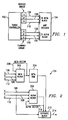
- FIG. 2 shows a block diagram of a MAP decoder 104 that uses parallel sliding window processing.
- a MAP decoder 104 receives the scaled systematic data signal 106, the scaled parity data signal 108, and the A PRIORI signal 110 as its input.
- There are N number of X signals 106 where N is the size of the interleaver.
- N X signals 106 are applied for each beta 208 and alpha 210 state vector, which are the respective outputs of the beta 202 and alpha 206 blocks.
- beta generation X 106 is applied in reverse order, and during alpha generation, X 106 is applied in forward order.
- N P signals 108 are applied for each alpha 210 and beta 208 vector.
- a PRIORI 110 is either the interleaved or deinterleaved extrinsic data from the previous MAP decoder operation. There are N A PRIORI signals 110, and one A PRIORI 110 is applied for each beta 208 and alpha 210 vector. A PRIORI 110 is applied the same directions as X 106 and P 108 for beta and alpha generation.
- the beta generation section 202 receives inputs X 106, P 108, and A 110. It generates the beta state vector 208, which is stored in beta RAM 204.
- the alpha generation section 206 receives inputs X 106, P 108, and A 110 (but in reverse order relative to the beta input).
- the alpha generation block 206 shown in greater detail in Figure 4, generates the alpha state vector 210.
- the outputs 208, 210 of the alpha and beta generation sections serve as inputs for the extrinsic generation section 212, shown in Figure 5. These data streams must be properly sequenced with the parity stream P 108 before being input to the extrinsic section 212.
- Figure 3 shows the beta generation stages.
- the registers are set to their initial conditions for the beta state vector 208.
- the beta signal 208, X 106, P 108, and A 110 are summed together by the adder tree 302 according to the trellis used to encode the data. (In the preferred embodiment, an 8 state trellis is used).
- the results are stored in registers 310.
- the results of the adder 302 are applied to the 8 MAX * blocks 304, and are then stored in the MAX * registers 312.
- the unnormalized outputs advance to two separate normalization stages 306, 308, each of which has a register 314, 316 to store its results.
- the total process has 4 stages within the feedback loop of the beta generation block 202, which require 4 clock cycles to complete. This latency (the 4 clock cycles) determines the level of pipelining available.
- the alpha generation section 206 is shown in Figure 4. First, the registers are set to their initial conditions. Then the data inputs are summed together by the adder 402, and the results are stored in registers 412. These are then input to the MAX * blocks 406 and stored in MAX * registers 414.
- the alpha generation section 206 also has two normalization stages 408, 410, each with their own registers 416, 418. The latency of the alpha generation stage 206 is thus 4, allowing 4 levels of pipelining to be implemented.
- the extrinsic generation section 212 Operating in parallel with the alpha generation section is the extrinsic generation section 212, shown in Figure 5.
- Alpha 210, beta 208, and P 108 are summed together by the adders 502 according to the trellis used, and the results are stored in registers 510.
- these results are applied to the MAX * blocks 504, and then stored in the MAX * registers 512.
- These results are again applied to MAX * blocks 504 and then stored in registers 508.
- the result is summed and stored in another register 514, and the output is the extrinsic signal 214.
- a sliding window approach basically consists of dividing the N sized block of incoming data into several smaller blocks. Each of these smaller blocks is called a sliding window block. These sliding window blocks are MAP decoded each independently, with a prolog for both the alpha and beta vectors. The decoding for the individual alpha and beta sliding window blocks is done in parallel. Since the initial conditions are not known for the individual sliding window blocks, the prologs are used to reach a good set of initial values.
- the decoder can "forget" the initial conditions and converge before it begins operating on the actual data.
- the prolog section size used is generally 3 or 4 times the number of states in the trellis.
- the first alpha and last beta sliding block will originate from a known state, and the size of their respective prolog sections will be 3 for an 8 state trellis (for example).
- the innovative alpha prolog allows parallel processing of both the alpha and beta sliding window blocks of data.
- each update of alpha or beta takes a few clock cycles to run (4 clock cycles in the above embodiment).
- This latency determines the degree of pipelining possible in the system.
- there are four levels of pipelining within each alpha and beta block meaning the data within each of the alpha and beta generation stages is pipelined, or broken into separate sets of data and independently operated on by successive stages within the beta generation section).
- the alpha and beta vector generation processes are divided into multiple stages, as shown above. These stages are within the iteration loops of the alpha and beta vector generation, shown in Figures 3 and 4. The number of stages would be equal to the latency for a particular architecture. In the preferred embodiment, these stages are the Adder, the MAX * , and two Normalization stages. The latency of these stages dictates the degree of parallel processing possible. For example, in the preferred embodiment this latency is 4, meaning 4 sliding-window blocks can be processed in parallel. Thus, 4 sliding-window blocks make up one sub-block.
- beta0 (the first sliding block) enters the adder stage.
- beta0 enters the MAX * stage, and betal enters the adder stage.
- beta0 enters the first normalization stage (the third stage of beta generation), betal enters the MAX * stage, and beta2 enters the adder stage.
- beta0 enters the second normalization stage, betal enters the first normalization stage, beta2 enters the MAX * stage, and beta3 enters the adder stage.
- the intermediate values for each stage are stored in registers, as shown above.
- beta processing begins one sub-block before alpha processing (Note that this staggering could be eliminated by adding another RAM block to store the alpha outputs.)
- This staggering is shown in Figure 7.
- the first sub-block (which is a number of sliding blocks equal to the latency of the architecture--4 in the preferred embodiment) of the beta section can be processed while the alpha section is idle.
- the second set of sliding blocks of the beta section i.e., the second sub-block
- the extrinsic sections are processed in parallel with the alpha section.
- the alpha outputs can be directly applied to the extrinsic as they are generated. Since the extrinsic generates output (and requires input) one sub-block at a time, the beta RAM only needs to store one sub-block of data at a time. (Note that the alpha and beta processing could be reversed. This would require the alpha outputs to be stored in memory, and beta and the extrinsic blocks would run in parallel.)
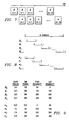
- Figure 8 shows the correspondence between alpha and beta sliding-window blocks.
- the entire data block consists of N symbols plus a number of tail bits. This block is broken into sub-blocks, which are further divided into sliding-window blocks.
- One sliding-window block is processed per clock cycle.
- Each sliding-window block includes a prolog.
- the beta prologs consist of several symbols to the right of the sliding window.
- the alpha prolog consists of the several bits to the left of the sliding window. This is shown by the overlap between successive sliding blocks in the figure.
- Each beta sliding window is processed in reverse relative to the alpha sliding blocks.
- Figure 9 shows an example of the order in which beta and alpha bits are processed. This example assumes a sliding window size of 100, a prolog length of 24, and 4 sliding windows per sub-block.
- the sliding block beta0 begins at the start of the prolog at bit 123. Next, the prolog ends at bit 100.
- the reliability data begins at bit 99, and ends at bit zero.
- the alpha sliding blocks are similarly divided. (Note the first two entries for alpha do not exist, because there is no prolog for the beginning of the block since the start and end points are known.)
- the extrinsic cannot be processed in parallel with both the alpha and beta generation processes, because the extrinsic input data, which requires data from alpha, beta, and the parity data, must be input in a certain order.
- the following shows the indexing of the extrinsic input.
- E0 (corresponding to alpha0 and beta0) goes from bit 0 to 99.
- E1 goes from 100 to 199, and so on, given a sliding window size of 100.
- the input required by this example would be as follows. In the first clock cycle, the soft estimate data relating to bit 0 from alpha, beta, and P are input to the extrinsic. In the second clock cycle, data associated with bit 100 from the three inputs is required. In the third clock cycle, the data associated with bit 200 is required.
- a lookup table is usually used for this value, which makes the above expression an approximation. If the expression ln [1+e -
- MAP decoder Maximum A-Posteriori.
- MAP decoders use a detection criterion that leads to the selection of x that maximizes the probability p(x/r) of a symbol x given the received information r.
- Extrinsic Outputs of decoders that estimate the value of a decoded bit. Extrinsics are usually soft estimates.
- the definitions of inputs used in the present application may be generalized to cover a broader range of applications. For instance, these inputs may differ in such applications as MAP equalization or turbo trellis decoding. In some applications, the inputs may not be soft estimates of bits, but rather they may be soft estimates of other variables. The disclosed innovations are intended to cover all such variations in implementation.
- MAP equalization is the process of describing the channel function as the data input to the channel constrained on a trellis to produce the observed output. The input to the channel can then be estimated in a maximum a priori sense by applying a MAP decode to the trellis diagram and the observed channel output.
- MAP finds use in any situation where the data observed is known to have been generated by input to a linear trellis.
- MAP architectures with software, as well as hardware, implementations is within the contemplation of the invention.
- DSPs very high processing rates are achieved by using deep pipelining of the data path. This means the DSP cannot be efficiently used in a feedback process such as beta and alpha updates.
- Using the present invention allows several blocks to be simultaneously processed by the DSP in a pipelined fashion, which considerably speeds up the operation in a deeply pipelined DSP architecture.
Landscapes
- Physics & Mathematics (AREA)
- Probability & Statistics with Applications (AREA)
- Engineering & Computer Science (AREA)
- Theoretical Computer Science (AREA)
- Computing Systems (AREA)
- Error Detection And Correction (AREA)
- Detection And Correction Of Errors (AREA)
- Train Traffic Observation, Control, And Security (AREA)
- Compression, Expansion, Code Conversion, And Decoders (AREA)
- Image Analysis (AREA)
Applications Claiming Priority (2)
| Application Number | Priority Date | Filing Date | Title |
|---|---|---|---|
| US17905500P | 2000-01-31 | 2000-01-31 | |
| US179055 | 2008-07-24 |
Publications (2)
| Publication Number | Publication Date |
|---|---|
| EP1122890A2 true EP1122890A2 (fr) | 2001-08-08 |
| EP1122890A3 EP1122890A3 (fr) | 2004-09-29 |
Family
ID=22655041
Family Applications (1)
| Application Number | Title | Priority Date | Filing Date |
|---|---|---|---|
| EP01200355A Withdrawn EP1122890A3 (fr) | 2000-01-31 | 2001-01-31 | Décodage MAP avec traitement par fenêtre glissante parallèlisé |
Country Status (3)
| Country | Link |
|---|---|
| US (1) | US6980605B2 (fr) |
| EP (1) | EP1122890A3 (fr) |
| JP (1) | JP2001267938A (fr) |
Cited By (14)
| Publication number | Priority date | Publication date | Assignee | Title |
|---|---|---|---|---|
| GB2365727A (en) * | 2000-06-19 | 2002-02-20 | Mitsubishi Electric Corp | Turbo-code decoding unit and turbo-code encoding/decoding unit |
| GB2365290B (en) * | 2000-02-10 | 2002-11-20 | Motorola Inc | Soft output decoder for convolutional codes |
| GB2365291B (en) * | 2000-02-10 | 2002-11-20 | Motorola Inc | Soft output decoder for convolutional codes |
| WO2004013975A1 (fr) * | 2002-08-06 | 2004-02-12 | Samsung Electronics Co., Ltd. | Procede et dispositif de decodage de turbo-code |
| WO2004038929A1 (fr) * | 2002-10-23 | 2004-05-06 | Koninklijke Philips Electronics N.V. | Decodeur de fenetre glissante dotes de fenetres prolog presentant des tailles variables |
| US6856657B1 (en) | 2000-02-10 | 2005-02-15 | Motorola, Inc. | Soft output decoder for convolutional codes |
| SG113431A1 (en) * | 2002-08-30 | 2005-08-29 | Oki Techno Ct Singapore Pte | Improved turbo decoder |
| KR100617822B1 (ko) | 2004-07-29 | 2006-08-28 | 삼성전자주식회사 | 터보 복호기를 위한 고속 입력 장치 및 방법 |
| US7526711B2 (en) | 2004-10-14 | 2009-04-28 | Nec Electronics Corporation | Decoding method and device for repeatedly decoding first and second encoded data |
| US7530011B2 (en) | 2002-06-05 | 2009-05-05 | Fujitsu Limited | Turbo decoding method and turbo decoding apparatus |
| CN100488060C (zh) * | 2001-12-28 | 2009-05-13 | Nxp股份有限公司 | 用于使用数据窗口译码数据的方法 |
| US7562004B2 (en) | 2006-05-31 | 2009-07-14 | International Business Machines Corporation | Determining better configuration for computerized system |
| EP2704330A4 (fr) * | 2011-04-26 | 2014-12-17 | Zte Corp | Procédé et dispositif de décodage turbo |
| US9252920B2 (en) | 2009-06-17 | 2016-02-02 | Coherent Logix, Incorporated | Parallel processing of overlapping subsequences to generate soft estimates |
Families Citing this family (17)
| Publication number | Priority date | Publication date | Assignee | Title |
|---|---|---|---|---|
| US20010044919A1 (en) * | 2000-05-05 | 2001-11-22 | Edmonston Brian S. | Method and apparatus for improved perormance sliding window decoding |
| JP3613134B2 (ja) | 2000-05-12 | 2005-01-26 | 日本電気株式会社 | 高速ターボデコーダ |
| KR100724921B1 (ko) * | 2001-02-16 | 2007-06-04 | 삼성전자주식회사 | 통신시스템에서 부호 생성 및 복호 장치 및 방법 |
| US7055102B2 (en) * | 2002-12-06 | 2006-05-30 | Sandbridge Technologies, Inc. | Turbo decoder using parallel processing |
| EP1471677A1 (fr) * | 2003-04-23 | 2004-10-27 | STMicroelectronics N.V. | Méthode de détection aveugle du format de transport d'un signal incident encodé par code convolutionnel, et décodeur de code convolutionnel correspondant |
| JP4227481B2 (ja) * | 2003-07-11 | 2009-02-18 | パナソニック株式会社 | 復号装置および復号方法 |
| JP2005167513A (ja) * | 2003-12-01 | 2005-06-23 | Matsushita Electric Ind Co Ltd | 復号装置及び復号方法 |
| KR100606023B1 (ko) * | 2004-05-24 | 2006-07-26 | 삼성전자주식회사 | 고속 터보 복호화 장치 |
| US8634477B2 (en) * | 2004-06-05 | 2014-01-21 | Samsung Electronics Co., Ltd. | Digital broadcasting transmission/reception system utilizing SRS and TRS code to improve receiving performance and signal processing method thereof |
| FR2878385A1 (fr) * | 2004-11-19 | 2006-05-26 | Turboconcept Soc Par Actions S | Procedes et dispositifs de multiplexage de sections de treillis pour decodage par l'algorithme de viterbi ou aller-retour |
| US7698624B2 (en) * | 2006-03-31 | 2010-04-13 | Trellisware Technologies, Inc. | Scheduling pipelined state update for high-speed trellis processing |
| US8775147B1 (en) | 2006-05-31 | 2014-07-08 | The Mathworks, Inc. | Algorithm and architecture for multi-argument associative operations that minimizes the number of components using a latency of the components |
| US7895497B2 (en) * | 2006-06-26 | 2011-02-22 | Samsung Electronics Co., Ltd. | Apparatus and method using reduced memory for channel decoding in a software-defined radio system |
| US8073083B2 (en) * | 2007-04-30 | 2011-12-06 | Broadcom Corporation | Sliding block traceback decoding of block codes |
| KR101225016B1 (ko) * | 2009-06-18 | 2013-01-22 | 지티이 코포레이션 | Lte에서 병렬 터보 디코딩의 방법 및 장치 |
| RU2011118108A (ru) | 2011-05-06 | 2012-11-20 | ЭлЭсАй Корпорейшн (US) | Устройство (варианты) и способ параллельного декодирования для нескольких стандартов связи |
| CN103916141B (zh) * | 2012-12-31 | 2017-04-05 | 华为技术有限公司 | Turbo码译码方法及装置 |
Family Cites Families (4)
| Publication number | Priority date | Publication date | Assignee | Title |
|---|---|---|---|---|
| US5933462A (en) * | 1996-11-06 | 1999-08-03 | Qualcomm Incorporated | Soft decision output decoder for decoding convolutionally encoded codewords |
| US6563877B1 (en) * | 1998-04-01 | 2003-05-13 | L-3 Communications Corporation | Simplified block sliding window implementation of a map decoder |
| US6304996B1 (en) * | 1999-03-08 | 2001-10-16 | General Electric Company | High-speed turbo decoder |
| US6754290B1 (en) * | 1999-03-31 | 2004-06-22 | Qualcomm Incorporated | Highly parallel map decoder |
-
2001
- 2001-01-29 US US09/772,499 patent/US6980605B2/en not_active Expired - Lifetime
- 2001-01-31 EP EP01200355A patent/EP1122890A3/fr not_active Withdrawn
- 2001-01-31 JP JP2001024226A patent/JP2001267938A/ja not_active Abandoned
Non-Patent Citations (3)
| Title |
|---|
| HALTER S ET AL.: "Reconfigurable signal processor for channel coding and decoding in low SNR wireless communications", SIGNAL PROCESSING SYSTEMS, 1998, 8 October 1998 (1998-10-08) |
| IEEE US, 8 October 1998 (1998-10-08), pages 260 - 274 |
| JAH-MING HSU ET AL: "A parallel decoding scheme for turbo codes", CIRCUITS AND SYSTEMS, 1998. ISCAS '98. PROCEEDINGS OF THE 1998 IEEE IN TERNATIONAL SYMPOSIUM ON MONTEREY, CA, USA 31 MAY-3 JUNE 1998, NEW YORK, NY, USA,IEEE, US, vol. 4, 31 May 1998 (1998-05-31), pages 445 - 448, XP010289456, ISBN: 978-0-7803-4455-6, DOI: 10.1109/ISCAS.1998.698923 * |
Cited By (18)
| Publication number | Priority date | Publication date | Assignee | Title |
|---|---|---|---|---|
| GB2365290B (en) * | 2000-02-10 | 2002-11-20 | Motorola Inc | Soft output decoder for convolutional codes |
| GB2365291B (en) * | 2000-02-10 | 2002-11-20 | Motorola Inc | Soft output decoder for convolutional codes |
| US6856657B1 (en) | 2000-02-10 | 2005-02-15 | Motorola, Inc. | Soft output decoder for convolutional codes |
| US6901117B1 (en) | 2000-02-10 | 2005-05-31 | Motorola, Inc. | Soft output decoder for convolutional codes |
| GB2365727A (en) * | 2000-06-19 | 2002-02-20 | Mitsubishi Electric Corp | Turbo-code decoding unit and turbo-code encoding/decoding unit |
| CN100488060C (zh) * | 2001-12-28 | 2009-05-13 | Nxp股份有限公司 | 用于使用数据窗口译码数据的方法 |
| US7530011B2 (en) | 2002-06-05 | 2009-05-05 | Fujitsu Limited | Turbo decoding method and turbo decoding apparatus |
| WO2004013975A1 (fr) * | 2002-08-06 | 2004-02-12 | Samsung Electronics Co., Ltd. | Procede et dispositif de decodage de turbo-code |
| US7584389B2 (en) | 2002-08-06 | 2009-09-01 | Samsung Electronics Co., Ltd | Turbo decoding apparatus and method |
| SG113431A1 (en) * | 2002-08-30 | 2005-08-29 | Oki Techno Ct Singapore Pte | Improved turbo decoder |
| US7120851B2 (en) | 2002-08-30 | 2006-10-10 | Oki Techno Centre (Singapore) Pte Ltd | Recursive decoder for switching between normalized and non-normalized probability estimates |
| WO2004038929A1 (fr) * | 2002-10-23 | 2004-05-06 | Koninklijke Philips Electronics N.V. | Decodeur de fenetre glissante dotes de fenetres prolog presentant des tailles variables |
| KR100617822B1 (ko) | 2004-07-29 | 2006-08-28 | 삼성전자주식회사 | 터보 복호기를 위한 고속 입력 장치 및 방법 |
| US7526711B2 (en) | 2004-10-14 | 2009-04-28 | Nec Electronics Corporation | Decoding method and device for repeatedly decoding first and second encoded data |
| US7584409B2 (en) | 2004-10-14 | 2009-09-01 | Nec Electronics Corporation | Method and device for alternately decoding data in forward and reverse directions |
| US7562004B2 (en) | 2006-05-31 | 2009-07-14 | International Business Machines Corporation | Determining better configuration for computerized system |
| US9252920B2 (en) | 2009-06-17 | 2016-02-02 | Coherent Logix, Incorporated | Parallel processing of overlapping subsequences to generate soft estimates |
| EP2704330A4 (fr) * | 2011-04-26 | 2014-12-17 | Zte Corp | Procédé et dispositif de décodage turbo |
Also Published As
| Publication number | Publication date |
|---|---|
| US20010046269A1 (en) | 2001-11-29 |
| JP2001267938A (ja) | 2001-09-28 |
| US6980605B2 (en) | 2005-12-27 |
| EP1122890A3 (fr) | 2004-09-29 |
Similar Documents
| Publication | Publication Date | Title |
|---|---|---|
| US6980605B2 (en) | MAP decoding with parallelized sliding window processing | |
| US7200799B2 (en) | Area efficient parallel turbo decoding | |
| US9337866B2 (en) | Apparatus for processing signals carrying modulation-encoded parity bits | |
| US7343530B2 (en) | Turbo decoder and turbo interleaver | |
| JP2004080508A (ja) | 誤り訂正符号の復号方法、そのプログラム及びその装置 | |
| JP2000216689A (ja) | 反復式ターボ符号復号装置及び該装置の性能を最適化する方法 | |
| JPWO2000052833A1 (ja) | 最大事後確率復号方法及び装置 | |
| EP1471677A1 (fr) | Méthode de détection aveugle du format de transport d'un signal incident encodé par code convolutionnel, et décodeur de code convolutionnel correspondant | |
| US7657819B2 (en) | Method and apparatus for termination of iterative turbo decoding | |
| US20130007568A1 (en) | Error correcting code decoding device, error correcting code decoding method and error correcting code decoding program | |
| EP1128560B1 (fr) | Dispositif et méthode de décodage SISO | |
| US7266757B1 (en) | Pipelined architecture implementing recursion processes for forward error correction | |
| KR101051933B1 (ko) | 트렐리스의 버터플라이 구조를 이용한 맵 디코딩을 위한메트릭 계산 | |
| US7178090B2 (en) | Error correction code decoding device | |
| US20020094038A1 (en) | Error-correcting code decoding method and error-correcting code decoding apparatus | |
| CN116979974B (zh) | Turbo码译码方法及Turbo码译码器 | |
| JP2007194684A (ja) | 復号装置、復号方法、及び受信装置 | |
| Lakovic et al. | Robust joint Huffman and convolutional decoding | |
| US7120851B2 (en) | Recursive decoder for switching between normalized and non-normalized probability estimates | |
| JP3892471B2 (ja) | 復号方法 | |
| US20030110438A1 (en) | Turbo decoder, and a MAP decoder component of the turbo decoder | |
| CN119853710B (zh) | 采用新架构的Turbo码解码器、解码方法及北斗接收机 | |
| TWI565246B (zh) | 迴旋編碼的解碼方法 | |
| CN103973319B (zh) | 全整数Turbo码迭代译码的方法和系统 | |
| US20030101403A1 (en) | Turbo decoder and its calculation methods having a state metric |
Legal Events
| Date | Code | Title | Description |
|---|---|---|---|
| PUAI | Public reference made under article 153(3) epc to a published international application that has entered the european phase |
Free format text: ORIGINAL CODE: 0009012 |
|
| AK | Designated contracting states |
Kind code of ref document: A2 Designated state(s): AT BE CH CY DE DK ES FI FR GB GR IE IT LI LU MC NL PT SE TR |
|
| AX | Request for extension of the european patent |
Free format text: AL;LT;LV;MK;RO;SI |
|
| PUAL | Search report despatched |
Free format text: ORIGINAL CODE: 0009013 |
|
| AK | Designated contracting states |
Kind code of ref document: A3 Designated state(s): AT BE CH CY DE DK ES FI FR GB GR IE IT LI LU MC NL PT SE TR |
|
| AX | Request for extension of the european patent |
Extension state: AL LT LV MK RO SI |
|
| 17P | Request for examination filed |
Effective date: 20050329 |
|
| AKX | Designation fees paid |
Designated state(s): DE FR GB |
|
| 17Q | First examination report despatched |
Effective date: 20070612 |
|
| STAA | Information on the status of an ep patent application or granted ep patent |
Free format text: STATUS: THE APPLICATION IS DEEMED TO BE WITHDRAWN |
|
| 18D | Application deemed to be withdrawn |
Effective date: 20171024 |