EP1123301B1 - Agents chelatants pour radioimmunotherapie - Google Patents
Agents chelatants pour radioimmunotherapie Download PDFInfo
- Publication number
- EP1123301B1 EP1123301B1 EP99953923A EP99953923A EP1123301B1 EP 1123301 B1 EP1123301 B1 EP 1123301B1 EP 99953923 A EP99953923 A EP 99953923A EP 99953923 A EP99953923 A EP 99953923A EP 1123301 B1 EP1123301 B1 EP 1123301B1
- Authority
- EP
- European Patent Office
- Prior art keywords
- group
- compound
- cooh
- compounds
- anyone
- Prior art date
- Legal status (The legal status is an assumption and is not a legal conclusion. Google has not performed a legal analysis and makes no representation as to the accuracy of the status listed.)
- Expired - Lifetime
Links
- 238000011363 radioimmunotherapy Methods 0.000 title claims description 4
- 239000002738 chelating agent Substances 0.000 title description 15
- 150000001875 compounds Chemical class 0.000 claims abstract description 121
- 238000000034 method Methods 0.000 claims abstract description 34
- 125000003178 carboxy group Chemical group [H]OC(*)=O 0.000 claims abstract description 23
- 238000003745 diagnosis Methods 0.000 claims abstract description 18
- 230000008569 process Effects 0.000 claims abstract description 13
- 239000008194 pharmaceutical composition Substances 0.000 claims abstract description 6
- 230000006870 function Effects 0.000 claims description 17
- 230000015572 biosynthetic process Effects 0.000 claims description 14
- 239000007787 solid Substances 0.000 claims description 14
- 206010028980 Neoplasm Diseases 0.000 claims description 11
- 238000011282 treatment Methods 0.000 claims description 11
- 238000004519 manufacturing process Methods 0.000 claims description 9
- 230000007170 pathology Effects 0.000 claims description 8
- 108090000765 processed proteins & peptides Proteins 0.000 claims description 8
- 238000000746 purification Methods 0.000 claims description 7
- 239000000126 substance Substances 0.000 claims description 7
- 238000005859 coupling reaction Methods 0.000 claims description 6
- 230000008878 coupling Effects 0.000 claims description 5
- 238000010168 coupling process Methods 0.000 claims description 5
- 239000003814 drug Substances 0.000 claims description 5
- 230000002285 radioactive effect Effects 0.000 claims description 5
- 206010005949 Bone cancer Diseases 0.000 claims description 4
- 208000018084 Bone neoplasm Diseases 0.000 claims description 4
- 150000001413 amino acids Chemical class 0.000 claims description 4
- 230000002163 immunogen Effects 0.000 claims description 4
- 230000001939 inductive effect Effects 0.000 claims description 4
- 102000004196 processed proteins & peptides Human genes 0.000 claims description 4
- 238000007469 bone scintigraphy Methods 0.000 claims description 3
- 206010027476 Metastases Diseases 0.000 claims description 2
- 239000003937 drug carrier Substances 0.000 claims description 2
- 239000007791 liquid phase Substances 0.000 claims description 2
- 229910052751 metal Inorganic materials 0.000 claims description 2
- 239000002184 metal Substances 0.000 claims description 2
- 150000002739 metals Chemical class 0.000 claims description 2
- 230000035755 proliferation Effects 0.000 claims description 2
- 239000007790 solid phase Substances 0.000 claims description 2
- 125000000896 monocarboxylic acid group Chemical group 0.000 claims 4
- 230000000146 antalgic effect Effects 0.000 claims 1
- 238000002360 preparation method Methods 0.000 abstract description 12
- HEDRZPFGACZZDS-MICDWDOJSA-N Trichloro(2H)methane Chemical compound [2H]C(Cl)(Cl)Cl HEDRZPFGACZZDS-MICDWDOJSA-N 0.000 description 36
- 229910052757 nitrogen Inorganic materials 0.000 description 31
- VEXZGXHMUGYJMC-UHFFFAOYSA-N Hydrochloric acid Chemical compound Cl VEXZGXHMUGYJMC-UHFFFAOYSA-N 0.000 description 23
- 210000004027 cell Anatomy 0.000 description 19
- 238000005160 1H NMR spectroscopy Methods 0.000 description 15
- XLYOFNOQVPJJNP-ZSJDYOACSA-N Heavy water Chemical compound [2H]O[2H] XLYOFNOQVPJJNP-ZSJDYOACSA-N 0.000 description 14
- 238000010992 reflux Methods 0.000 description 14
- 239000003921 oil Substances 0.000 description 13
- KZUNJOHGWZRPMI-AKLPVKDBSA-N samarium-153 Chemical compound [153Sm] KZUNJOHGWZRPMI-AKLPVKDBSA-N 0.000 description 13
- HEDRZPFGACZZDS-UHFFFAOYSA-N Chloroform Chemical compound ClC(Cl)Cl HEDRZPFGACZZDS-UHFFFAOYSA-N 0.000 description 12
- OKKJLVBELUTLKV-UHFFFAOYSA-N Methanol Chemical compound OC OKKJLVBELUTLKV-UHFFFAOYSA-N 0.000 description 12
- VYPSYNLAJGMNEJ-UHFFFAOYSA-N Silicium dioxide Chemical compound O=[Si]=O VYPSYNLAJGMNEJ-UHFFFAOYSA-N 0.000 description 12
- 238000003756 stirring Methods 0.000 description 12
- 238000003786 synthesis reaction Methods 0.000 description 12
- SSJXIUAHEKJCMH-PHDIDXHHSA-N (1r,2r)-cyclohexane-1,2-diamine Chemical class N[C@@H]1CCCC[C@H]1N SSJXIUAHEKJCMH-PHDIDXHHSA-N 0.000 description 11
- 238000001644 13C nuclear magnetic resonance spectroscopy Methods 0.000 description 11
- CDBYLPFSWZWCQE-UHFFFAOYSA-L Sodium Carbonate Chemical compound [Na+].[Na+].[O-]C([O-])=O CDBYLPFSWZWCQE-UHFFFAOYSA-L 0.000 description 10
- 239000002253 acid Substances 0.000 description 10
- -1 cyclohexyl EDTA Chemical compound 0.000 description 10
- 239000011541 reaction mixture Substances 0.000 description 9
- WEVYAHXRMPXWCK-UHFFFAOYSA-N Acetonitrile Chemical compound CC#N WEVYAHXRMPXWCK-UHFFFAOYSA-N 0.000 description 8
- IJGRMHOSHXDMSA-UHFFFAOYSA-N Atomic nitrogen Chemical compound N#N IJGRMHOSHXDMSA-UHFFFAOYSA-N 0.000 description 8
- LFQSCWFLJHTTHZ-UHFFFAOYSA-N Ethanol Chemical compound CCO LFQSCWFLJHTTHZ-UHFFFAOYSA-N 0.000 description 8
- 206010058467 Lung neoplasm malignant Diseases 0.000 description 8
- 150000002148 esters Chemical class 0.000 description 8
- 201000005202 lung cancer Diseases 0.000 description 8
- 208000020816 lung neoplasm Diseases 0.000 description 8
- XLYOFNOQVPJJNP-UHFFFAOYSA-N water Substances O XLYOFNOQVPJJNP-UHFFFAOYSA-N 0.000 description 7
- XEKOWRVHYACXOJ-UHFFFAOYSA-N Ethyl acetate Natural products CCOC(C)=O XEKOWRVHYACXOJ-UHFFFAOYSA-N 0.000 description 6
- 238000006243 chemical reaction Methods 0.000 description 6
- PQJJJMRNHATNKG-UHFFFAOYSA-N ethyl bromoacetate Chemical compound CCOC(=O)CBr PQJJJMRNHATNKG-UHFFFAOYSA-N 0.000 description 6
- 125000005843 halogen group Chemical group 0.000 description 6
- 239000000203 mixture Substances 0.000 description 6
- 239000012044 organic layer Substances 0.000 description 6
- 239000000741 silica gel Substances 0.000 description 6
- 229910002027 silica gel Inorganic materials 0.000 description 6
- 239000000243 solution Substances 0.000 description 6
- RTZKZFJDLAIYFH-UHFFFAOYSA-N Diethyl ether Chemical compound CCOCC RTZKZFJDLAIYFH-UHFFFAOYSA-N 0.000 description 5
- 150000001412 amines Chemical class 0.000 description 5
- 238000004440 column chromatography Methods 0.000 description 5
- 238000010668 complexation reaction Methods 0.000 description 5
- 238000001914 filtration Methods 0.000 description 5
- 230000007062 hydrolysis Effects 0.000 description 5
- 238000006460 hydrolysis reaction Methods 0.000 description 5
- 239000000047 product Substances 0.000 description 5
- 229910000029 sodium carbonate Inorganic materials 0.000 description 5
- 239000002904 solvent Substances 0.000 description 5
- CPELXLSAUQHCOX-UHFFFAOYSA-M Bromide Chemical compound [Br-] CPELXLSAUQHCOX-UHFFFAOYSA-M 0.000 description 4
- 239000007832 Na2SO4 Substances 0.000 description 4
- 206010035226 Plasma cell myeloma Diseases 0.000 description 4
- PMZURENOXWZQFD-UHFFFAOYSA-L Sodium Sulfate Chemical compound [Na+].[Na+].[O-]S([O-])(=O)=O PMZURENOXWZQFD-UHFFFAOYSA-L 0.000 description 4
- 239000000427 antigen Substances 0.000 description 4
- 102000036639 antigens Human genes 0.000 description 4
- 108091007433 antigens Proteins 0.000 description 4
- 201000011510 cancer Diseases 0.000 description 4
- 125000003754 ethoxycarbonyl group Chemical group C(=O)(OCC)* 0.000 description 4
- 239000003446 ligand Substances 0.000 description 4
- 230000004048 modification Effects 0.000 description 4
- 238000012986 modification Methods 0.000 description 4
- 201000000050 myeloid neoplasm Diseases 0.000 description 4
- 229910052938 sodium sulfate Inorganic materials 0.000 description 4
- ISIJQEHRDSCQIU-UHFFFAOYSA-N tert-butyl 2,7-diazaspiro[4.5]decane-7-carboxylate Chemical compound C1N(C(=O)OC(C)(C)C)CCCC11CNCC1 ISIJQEHRDSCQIU-UHFFFAOYSA-N 0.000 description 4
- WUAPFZMCVAUBPE-NJFSPNSNSA-N 188Re Chemical compound [188Re] WUAPFZMCVAUBPE-NJFSPNSNSA-N 0.000 description 3
- 229940122361 Bisphosphonate Drugs 0.000 description 3
- 0 C1C2C1CC*2 Chemical compound C1C2C1CC*2 0.000 description 3
- 241001481828 Glyptocephalus cynoglossus Species 0.000 description 3
- 229930040373 Paraformaldehyde Natural products 0.000 description 3
- NBIIXXVUZAFLBC-UHFFFAOYSA-N Phosphoric acid Chemical compound OP(O)(O)=O NBIIXXVUZAFLBC-UHFFFAOYSA-N 0.000 description 3
- YXFVVABEGXRONW-UHFFFAOYSA-N Toluene Chemical compound CC1=CC=CC=C1 YXFVVABEGXRONW-UHFFFAOYSA-N 0.000 description 3
- VWQVUPCCIRVNHF-OUBTZVSYSA-N Yttrium-90 Chemical compound [90Y] VWQVUPCCIRVNHF-OUBTZVSYSA-N 0.000 description 3
- 150000007513 acids Chemical class 0.000 description 3
- 230000002494 anti-cea effect Effects 0.000 description 3
- 150000004663 bisphosphonates Chemical class 0.000 description 3
- 239000013522 chelant Substances 0.000 description 3
- 238000004587 chromatography analysis Methods 0.000 description 3
- 229910052681 coesite Inorganic materials 0.000 description 3
- 229910052906 cristobalite Inorganic materials 0.000 description 3
- FHHZOYXKOICLGH-UHFFFAOYSA-N dichloromethane;ethanol Chemical compound CCO.ClCCl FHHZOYXKOICLGH-UHFFFAOYSA-N 0.000 description 3
- LXCYSACZTOKNNS-UHFFFAOYSA-N diethoxy(oxo)phosphanium Chemical compound CCO[P+](=O)OCC LXCYSACZTOKNNS-UHFFFAOYSA-N 0.000 description 3
- 230000000694 effects Effects 0.000 description 3
- 229940093499 ethyl acetate Drugs 0.000 description 3
- 235000019439 ethyl acetate Nutrition 0.000 description 3
- 239000000706 filtrate Substances 0.000 description 3
- 239000012046 mixed solvent Substances 0.000 description 3
- 229920002866 paraformaldehyde Polymers 0.000 description 3
- 239000000377 silicon dioxide Substances 0.000 description 3
- 229910052682 stishovite Inorganic materials 0.000 description 3
- 238000002560 therapeutic procedure Methods 0.000 description 3
- 238000004809 thin layer chromatography Methods 0.000 description 3
- 229910052905 tridymite Inorganic materials 0.000 description 3
- VIMMECPCYZXUCI-MIMFYIINSA-N (4s,6r)-6-[(1e)-4,4-bis(4-fluorophenyl)-3-(1-methyltetrazol-5-yl)buta-1,3-dienyl]-4-hydroxyoxan-2-one Chemical compound CN1N=NN=C1C(\C=C\[C@@H]1OC(=O)C[C@@H](O)C1)=C(C=1C=CC(F)=CC=1)C1=CC=C(F)C=C1 VIMMECPCYZXUCI-MIMFYIINSA-N 0.000 description 2
- DREPONDJUKIQLX-UHFFFAOYSA-N 1-[ethenyl(ethoxy)phosphoryl]oxyethane Chemical compound CCOP(=O)(C=C)OCC DREPONDJUKIQLX-UHFFFAOYSA-N 0.000 description 2
- HZAXFHJVJLSVMW-UHFFFAOYSA-N 2-Aminoethan-1-ol Chemical compound NCCO HZAXFHJVJLSVMW-UHFFFAOYSA-N 0.000 description 2
- QLVGHFBUSGYCCG-UHFFFAOYSA-N 2-amino-n-(1-cyano-2-phenylethyl)acetamide Chemical compound NCC(=O)NC(C#N)CC1=CC=CC=C1 QLVGHFBUSGYCCG-UHFFFAOYSA-N 0.000 description 2
- CSCPPACGZOOCGX-UHFFFAOYSA-N Acetone Chemical compound CC(C)=O CSCPPACGZOOCGX-UHFFFAOYSA-N 0.000 description 2
- 206010005003 Bladder cancer Diseases 0.000 description 2
- KXDHJXZQYSOELW-UHFFFAOYSA-N Carbamic acid Chemical compound NC(O)=O KXDHJXZQYSOELW-UHFFFAOYSA-N 0.000 description 2
- 206010009944 Colon cancer Diseases 0.000 description 2
- 208000001333 Colorectal Neoplasms Diseases 0.000 description 2
- YMWUJEATGCHHMB-UHFFFAOYSA-N Dichloromethane Chemical compound ClCCl YMWUJEATGCHHMB-UHFFFAOYSA-N 0.000 description 2
- KCXVZYZYPLLWCC-UHFFFAOYSA-N EDTA Chemical class OC(=O)CN(CC(O)=O)CCN(CC(O)=O)CC(O)=O KCXVZYZYPLLWCC-UHFFFAOYSA-N 0.000 description 2
- 206010025323 Lymphomas Diseases 0.000 description 2
- 238000007126 N-alkylation reaction Methods 0.000 description 2
- 206010033128 Ovarian cancer Diseases 0.000 description 2
- 206010061535 Ovarian neoplasm Diseases 0.000 description 2
- 206010061902 Pancreatic neoplasm Diseases 0.000 description 2
- 229940125907 SJ995973 Drugs 0.000 description 2
- 208000007097 Urinary Bladder Neoplasms Diseases 0.000 description 2
- 230000002378 acidificating effect Effects 0.000 description 2
- 238000013459 approach Methods 0.000 description 2
- 239000012472 biological sample Substances 0.000 description 2
- JCXGWMGPZLAOME-RNFDNDRNSA-N bismuth-213 Chemical compound [213Bi] JCXGWMGPZLAOME-RNFDNDRNSA-N 0.000 description 2
- 229910052794 bromium Inorganic materials 0.000 description 2
- 150000001720 carbohydrates Chemical class 0.000 description 2
- 235000014633 carbohydrates Nutrition 0.000 description 2
- 229910052801 chlorine Inorganic materials 0.000 description 2
- 150000001805 chlorine compounds Chemical class 0.000 description 2
- 229940125796 compound 3d Drugs 0.000 description 2
- 239000012043 crude product Substances 0.000 description 2
- WGLUMOCWFMKWIL-UHFFFAOYSA-N dichloromethane;methanol Chemical compound OC.ClCCl WGLUMOCWFMKWIL-UHFFFAOYSA-N 0.000 description 2
- BNIILDVGGAEEIG-UHFFFAOYSA-L disodium hydrogen phosphate Chemical compound [Na+].[Na+].OP([O-])([O-])=O BNIILDVGGAEEIG-UHFFFAOYSA-L 0.000 description 2
- 229910000397 disodium phosphate Inorganic materials 0.000 description 2
- 150000002169 ethanolamines Chemical class 0.000 description 2
- UIWXSTHGICQLQT-UHFFFAOYSA-N ethenyl propanoate Chemical compound CCC(=O)OC=C UIWXSTHGICQLQT-UHFFFAOYSA-N 0.000 description 2
- 150000002395 hexacarboxylic acids Chemical class 0.000 description 2
- 229910052747 lanthanoid Inorganic materials 0.000 description 2
- 150000002602 lanthanoids Chemical class 0.000 description 2
- 239000007788 liquid Substances 0.000 description 2
- 210000004185 liver Anatomy 0.000 description 2
- 208000014018 liver neoplasm Diseases 0.000 description 2
- 210000004698 lymphocyte Anatomy 0.000 description 2
- 238000004949 mass spectrometry Methods 0.000 description 2
- XZMHJYWMCRQSSI-UHFFFAOYSA-N n-[5-[2-(3-acetylanilino)-1,3-thiazol-4-yl]-4-methyl-1,3-thiazol-2-yl]benzamide Chemical compound CC(=O)C1=CC=CC(NC=2SC=C(N=2)C2=C(N=C(NC(=O)C=3C=CC=CC=3)S2)C)=C1 XZMHJYWMCRQSSI-UHFFFAOYSA-N 0.000 description 2
- WRUUGTRCQOWXEG-UHFFFAOYSA-N pamidronate Chemical compound NCCC(O)(P(O)(O)=O)P(O)(O)=O WRUUGTRCQOWXEG-UHFFFAOYSA-N 0.000 description 2
- FAIAAWCVCHQXDN-UHFFFAOYSA-N phosphorus trichloride Chemical compound ClP(Cl)Cl FAIAAWCVCHQXDN-UHFFFAOYSA-N 0.000 description 2
- 125000002924 primary amino group Chemical group [H]N([H])* 0.000 description 2
- 125000006239 protecting group Chemical class 0.000 description 2
- RWWYLEGWBNMMLJ-YSOARWBDSA-N remdesivir Chemical compound NC1=NC=NN2C1=CC=C2[C@]1([C@@H]([C@@H]([C@H](O1)CO[P@](=O)(OC1=CC=CC=C1)N[C@H](C(=O)OCC(CC)CC)C)O)O)C#N RWWYLEGWBNMMLJ-YSOARWBDSA-N 0.000 description 2
- WUAPFZMCVAUBPE-IGMARMGPSA-N rhenium-186 Chemical compound [186Re] WUAPFZMCVAUBPE-IGMARMGPSA-N 0.000 description 2
- 238000002390 rotary evaporation Methods 0.000 description 2
- 210000002966 serum Anatomy 0.000 description 2
- 239000007858 starting material Substances 0.000 description 2
- 210000001685 thyroid gland Anatomy 0.000 description 2
- 201000005112 urinary bladder cancer Diseases 0.000 description 2
- FANCTJAFZSYTIS-IQUVVAJASA-N (1r,3s,5z)-5-[(2e)-2-[(1r,3as,7ar)-7a-methyl-1-[(2r)-4-(phenylsulfonimidoyl)butan-2-yl]-2,3,3a,5,6,7-hexahydro-1h-inden-4-ylidene]ethylidene]-4-methylidenecyclohexane-1,3-diol Chemical compound C([C@@H](C)[C@@H]1[C@]2(CCCC(/[C@@H]2CC1)=C\C=C\1C([C@@H](O)C[C@H](O)C/1)=C)C)CS(=N)(=O)C1=CC=CC=C1 FANCTJAFZSYTIS-IQUVVAJASA-N 0.000 description 1
- PNHBRYIAJCYNDA-VQCQRNETSA-N (4r)-6-[2-[2-ethyl-4-(4-fluorophenyl)-6-phenylpyridin-3-yl]ethyl]-4-hydroxyoxan-2-one Chemical compound C([C@H](O)C1)C(=O)OC1CCC=1C(CC)=NC(C=2C=CC=CC=2)=CC=1C1=CC=C(F)C=C1 PNHBRYIAJCYNDA-VQCQRNETSA-N 0.000 description 1
- UNILWMWFPHPYOR-KXEYIPSPSA-M 1-[6-[2-[3-[3-[3-[2-[2-[3-[[2-[2-[[(2r)-1-[[2-[[(2r)-1-[3-[2-[2-[3-[[2-(2-amino-2-oxoethoxy)acetyl]amino]propoxy]ethoxy]ethoxy]propylamino]-3-hydroxy-1-oxopropan-2-yl]amino]-2-oxoethyl]amino]-3-[(2r)-2,3-di(hexadecanoyloxy)propyl]sulfanyl-1-oxopropan-2-yl Chemical compound O=C1C(SCCC(=O)NCCCOCCOCCOCCCNC(=O)COCC(=O)N[C@@H](CSC[C@@H](COC(=O)CCCCCCCCCCCCCCC)OC(=O)CCCCCCCCCCCCCCC)C(=O)NCC(=O)N[C@H](CO)C(=O)NCCCOCCOCCOCCCNC(=O)COCC(N)=O)CC(=O)N1CCNC(=O)CCCCCN\1C2=CC=C(S([O-])(=O)=O)C=C2CC/1=C/C=C/C=C/C1=[N+](CC)C2=CC=C(S([O-])(=O)=O)C=C2C1 UNILWMWFPHPYOR-KXEYIPSPSA-M 0.000 description 1
- PNDPGZBMCMUPRI-HVTJNCQCSA-N 10043-66-0 Chemical compound [131I][131I] PNDPGZBMCMUPRI-HVTJNCQCSA-N 0.000 description 1
- IZQAUUVBKYXMET-UHFFFAOYSA-N 2-bromoethanamine Chemical class NCCBr IZQAUUVBKYXMET-UHFFFAOYSA-N 0.000 description 1
- ZCYVEMRRCGMTRW-UHFFFAOYSA-N 7553-56-2 Chemical compound [I] ZCYVEMRRCGMTRW-UHFFFAOYSA-N 0.000 description 1
- NLHHRLWOUZZQLW-UHFFFAOYSA-N Acrylonitrile Chemical compound C=CC#N NLHHRLWOUZZQLW-UHFFFAOYSA-N 0.000 description 1
- 102100024222 B-lymphocyte antigen CD19 Human genes 0.000 description 1
- 208000024172 Cardiovascular disease Diseases 0.000 description 1
- 208000018152 Cerebral disease Diseases 0.000 description 1
- XDTMQSROBMDMFD-UHFFFAOYSA-N Cyclohexane Chemical compound C1CCCCC1 XDTMQSROBMDMFD-UHFFFAOYSA-N 0.000 description 1
- 206010063044 Ectopic kidney Diseases 0.000 description 1
- 206010014523 Embolism and thrombosis Diseases 0.000 description 1
- 239000005977 Ethylene Substances 0.000 description 1
- PIICEJLVQHRZGT-UHFFFAOYSA-N Ethylenediamine Chemical compound NCCN PIICEJLVQHRZGT-UHFFFAOYSA-N 0.000 description 1
- 102000009123 Fibrin Human genes 0.000 description 1
- 108010073385 Fibrin Proteins 0.000 description 1
- BWGVNKXGVNDBDI-UHFFFAOYSA-N Fibrin monomer Chemical compound CNC(=O)CNC(=O)CN BWGVNKXGVNDBDI-UHFFFAOYSA-N 0.000 description 1
- 101000980825 Homo sapiens B-lymphocyte antigen CD19 Proteins 0.000 description 1
- 101000777628 Homo sapiens Leukocyte antigen CD37 Proteins 0.000 description 1
- 206010061216 Infarction Diseases 0.000 description 1
- 102100031586 Leukocyte antigen CD37 Human genes 0.000 description 1
- 238000005481 NMR spectroscopy Methods 0.000 description 1
- XBDQKXXYIPTUBI-UHFFFAOYSA-N Propionic acid Substances CCC(O)=O XBDQKXXYIPTUBI-UHFFFAOYSA-N 0.000 description 1
- 229910006069 SO3H Inorganic materials 0.000 description 1
- 206010052779 Transplant rejections Diseases 0.000 description 1
- FKCBLVCOSCZFHV-UHFFFAOYSA-N acetonitrile;ethanol Chemical compound CCO.CC#N FKCBLVCOSCZFHV-UHFFFAOYSA-N 0.000 description 1
- PBCJIPOGFJYBJE-UHFFFAOYSA-N acetonitrile;hydrate Chemical compound O.CC#N PBCJIPOGFJYBJE-UHFFFAOYSA-N 0.000 description 1
- 229910052768 actinide Inorganic materials 0.000 description 1
- 150000001255 actinides Chemical class 0.000 description 1
- QQINRWTZWGJFDB-YPZZEJLDSA-N actinium-225 Chemical compound [225Ac] QQINRWTZWGJFDB-YPZZEJLDSA-N 0.000 description 1
- 229940125666 actinium-225 Drugs 0.000 description 1
- 125000003158 alcohol group Chemical group 0.000 description 1
- 125000003172 aldehyde group Chemical group 0.000 description 1
- 230000029936 alkylation Effects 0.000 description 1
- 238000005804 alkylation reaction Methods 0.000 description 1
- SRVFFFJZQVENJC-IHRRRGAJSA-N aloxistatin Chemical compound CCOC(=O)[C@H]1O[C@@H]1C(=O)N[C@@H](CC(C)C)C(=O)NCCC(C)C SRVFFFJZQVENJC-IHRRRGAJSA-N 0.000 description 1
- 229910000147 aluminium phosphate Inorganic materials 0.000 description 1
- 125000003277 amino group Chemical group 0.000 description 1
- 150000008064 anhydrides Chemical group 0.000 description 1
- 230000000702 anti-platelet effect Effects 0.000 description 1
- 230000001588 bifunctional effect Effects 0.000 description 1
- JDIBGQFKXXXXPN-UHFFFAOYSA-N bismuth(3+) Chemical class [Bi+3] JDIBGQFKXXXXPN-UHFFFAOYSA-N 0.000 description 1
- 239000012267 brine Substances 0.000 description 1
- OSVHLUXLWQLPIY-KBAYOESNSA-N butyl 2-[(6aR,9R,10aR)-1-hydroxy-9-(hydroxymethyl)-6,6-dimethyl-6a,7,8,9,10,10a-hexahydrobenzo[c]chromen-3-yl]-2-methylpropanoate Chemical compound C(CCC)OC(C(C)(C)C1=CC(=C2[C@H]3[C@H](C(OC2=C1)(C)C)CC[C@H](C3)CO)O)=O OSVHLUXLWQLPIY-KBAYOESNSA-N 0.000 description 1
- 238000001460 carbon-13 nuclear magnetic resonance spectrum Methods 0.000 description 1
- 238000012512 characterization method Methods 0.000 description 1
- 230000009920 chelation Effects 0.000 description 1
- NEHMKBQYUWJMIP-UHFFFAOYSA-N chloromethane Chemical compound ClC NEHMKBQYUWJMIP-UHFFFAOYSA-N 0.000 description 1
- 239000013065 commercial product Substances 0.000 description 1
- 229940125904 compound 1 Drugs 0.000 description 1
- 239000012141 concentrate Substances 0.000 description 1
- 239000000356 contaminant Substances 0.000 description 1
- 238000001816 cooling Methods 0.000 description 1
- 239000010779 crude oil Substances 0.000 description 1
- 125000004093 cyano group Chemical group *C#N 0.000 description 1
- YMHQVDAATAEZLO-UHFFFAOYSA-N cyclohexane-1,1-diamine Chemical compound NC1(N)CCCCC1 YMHQVDAATAEZLO-UHFFFAOYSA-N 0.000 description 1
- 125000000113 cyclohexyl group Chemical group [H]C1([H])C([H])([H])C([H])([H])C([H])(*)C([H])([H])C1([H])[H] 0.000 description 1
- 238000013461 design Methods 0.000 description 1
- 238000011161 development Methods 0.000 description 1
- 150000004985 diamines Chemical class 0.000 description 1
- 239000012954 diazonium Substances 0.000 description 1
- 229960004132 diethyl ether Drugs 0.000 description 1
- 125000004494 ethyl ester group Chemical group 0.000 description 1
- 125000001495 ethyl group Chemical group [H]C([H])([H])C([H])([H])* 0.000 description 1
- 238000001704 evaporation Methods 0.000 description 1
- 230000008020 evaporation Effects 0.000 description 1
- 238000002474 experimental method Methods 0.000 description 1
- 229950003499 fibrin Drugs 0.000 description 1
- 238000007306 functionalization reaction Methods 0.000 description 1
- MNWFXJYAOYHMED-UHFFFAOYSA-N hexane carboxylic acid Natural products CCCCCCC(O)=O MNWFXJYAOYHMED-UHFFFAOYSA-N 0.000 description 1
- 229910052739 hydrogen Inorganic materials 0.000 description 1
- 239000001257 hydrogen Substances 0.000 description 1
- 125000004435 hydrogen atom Chemical class [H]* 0.000 description 1
- 238000009169 immunotherapy Methods 0.000 description 1
- 238000000338 in vitro Methods 0.000 description 1
- 238000001727 in vivo Methods 0.000 description 1
- 230000007574 infarction Effects 0.000 description 1
- 238000011835 investigation Methods 0.000 description 1
- 229910052740 iodine Inorganic materials 0.000 description 1
- 239000011630 iodine Substances 0.000 description 1
- 238000005040 ion trap Methods 0.000 description 1
- GKOZUEZYRPOHIO-NJFSPNSNSA-N iridium-194 Chemical compound [194Ir] GKOZUEZYRPOHIO-NJFSPNSNSA-N 0.000 description 1
- 239000012948 isocyanate Substances 0.000 description 1
- 150000002513 isocyanates Chemical class 0.000 description 1
- 208000017169 kidney disease Diseases 0.000 description 1
- 230000003907 kidney function Effects 0.000 description 1
- 239000010410 layer Substances 0.000 description 1
- 238000004811 liquid chromatography Methods 0.000 description 1
- 201000007270 liver cancer Diseases 0.000 description 1
- 208000015486 malignant pancreatic neoplasm Diseases 0.000 description 1
- 125000000325 methylidene group Chemical group [H]C([H])=* 0.000 description 1
- QAPTWHXHEYAIKG-RCOXNQKVSA-N n-[(1r,2s,5r)-5-(tert-butylamino)-2-[(3s)-2-oxo-3-[[6-(trifluoromethyl)quinazolin-4-yl]amino]pyrrolidin-1-yl]cyclohexyl]acetamide Chemical compound CC(=O)N[C@@H]1C[C@H](NC(C)(C)C)CC[C@@H]1N1C(=O)[C@@H](NC=2C3=CC(=CC=C3N=CN=2)C(F)(F)F)CC1 QAPTWHXHEYAIKG-RCOXNQKVSA-N 0.000 description 1
- 150000002825 nitriles Chemical class 0.000 description 1
- 125000004433 nitrogen atom Chemical group N* 0.000 description 1
- 201000002528 pancreatic cancer Diseases 0.000 description 1
- 208000008443 pancreatic carcinoma Diseases 0.000 description 1
- 239000002245 particle Substances 0.000 description 1
- 230000037361 pathway Effects 0.000 description 1
- PTMHPRAIXMAOOB-UHFFFAOYSA-L phosphoramidate Chemical compound NP([O-])([O-])=O PTMHPRAIXMAOOB-UHFFFAOYSA-L 0.000 description 1
- PTMHPRAIXMAOOB-UHFFFAOYSA-N phosphoramidic acid Chemical group NP(O)(O)=O PTMHPRAIXMAOOB-UHFFFAOYSA-N 0.000 description 1
- OJMIONKXNSYLSR-UHFFFAOYSA-N phosphorous acid Chemical compound OP(O)O OJMIONKXNSYLSR-UHFFFAOYSA-N 0.000 description 1
- 230000000704 physical effect Effects 0.000 description 1
- 230000004962 physiological condition Effects 0.000 description 1
- PUDIUYLPXJFUGB-OUBTZVSYSA-N praseodymium-142 Chemical compound [142Pr] PUDIUYLPXJFUGB-OUBTZVSYSA-N 0.000 description 1
- 239000002244 precipitate Substances 0.000 description 1
- 238000001556 precipitation Methods 0.000 description 1
- 150000003141 primary amines Chemical class 0.000 description 1
- 238000000425 proton nuclear magnetic resonance spectrum Methods 0.000 description 1
- 230000005855 radiation Effects 0.000 description 1
- 239000012217 radiopharmaceutical Substances 0.000 description 1
- 229940121896 radiopharmaceutical Drugs 0.000 description 1
- 230000002799 radiopharmaceutical effect Effects 0.000 description 1
- 239000003507 refrigerant Substances 0.000 description 1
- 230000013878 renal filtration Effects 0.000 description 1
- 239000000523 sample Substances 0.000 description 1
- 230000028327 secretion Effects 0.000 description 1
- HPALAKNZSZLMCH-UHFFFAOYSA-M sodium;chloride;hydrate Chemical compound O.[Na+].[Cl-] HPALAKNZSZLMCH-UHFFFAOYSA-M 0.000 description 1
- 238000001228 spectrum Methods 0.000 description 1
- 125000000020 sulfo group Chemical group O=S(=O)([*])O[H] 0.000 description 1
- 238000010189 synthetic method Methods 0.000 description 1
- 230000008685 targeting Effects 0.000 description 1
- 150000000000 tetracarboxylic acids Chemical class 0.000 description 1
- 230000001225 therapeutic effect Effects 0.000 description 1
- ZMZDMBWJUHKJPS-UHFFFAOYSA-M thiocyanate group Chemical group [S-]C#N ZMZDMBWJUHKJPS-UHFFFAOYSA-M 0.000 description 1
- 125000003396 thiol group Chemical group [H]S* 0.000 description 1
- ZWZVWGITAAIFPS-UHFFFAOYSA-N thiophosgene Chemical compound ClC(Cl)=S ZWZVWGITAAIFPS-UHFFFAOYSA-N 0.000 description 1
- RIOQSEWOXXDEQQ-UHFFFAOYSA-N triphenylphosphine Chemical compound C1=CC=CC=C1P(C=1C=CC=CC=1)C1=CC=CC=C1 RIOQSEWOXXDEQQ-UHFFFAOYSA-N 0.000 description 1
- 210000002700 urine Anatomy 0.000 description 1
- 208000019553 vascular disease Diseases 0.000 description 1
- 125000002348 vinylic group Chemical group 0.000 description 1
Classifications
-
- C—CHEMISTRY; METALLURGY
- C07—ORGANIC CHEMISTRY
- C07C—ACYCLIC OR CARBOCYCLIC COMPOUNDS
- C07C229/00—Compounds containing amino and carboxyl groups bound to the same carbon skeleton
- C07C229/02—Compounds containing amino and carboxyl groups bound to the same carbon skeleton having amino and carboxyl groups bound to acyclic carbon atoms of the same carbon skeleton
- C07C229/04—Compounds containing amino and carboxyl groups bound to the same carbon skeleton having amino and carboxyl groups bound to acyclic carbon atoms of the same carbon skeleton the carbon skeleton being acyclic and saturated
- C07C229/06—Compounds containing amino and carboxyl groups bound to the same carbon skeleton having amino and carboxyl groups bound to acyclic carbon atoms of the same carbon skeleton the carbon skeleton being acyclic and saturated having only one amino and one carboxyl group bound to the carbon skeleton
- C07C229/10—Compounds containing amino and carboxyl groups bound to the same carbon skeleton having amino and carboxyl groups bound to acyclic carbon atoms of the same carbon skeleton the carbon skeleton being acyclic and saturated having only one amino and one carboxyl group bound to the carbon skeleton the nitrogen atom of the amino group being further bound to acyclic carbon atoms or to carbon atoms of rings other than six-membered aromatic rings
- C07C229/16—Compounds containing amino and carboxyl groups bound to the same carbon skeleton having amino and carboxyl groups bound to acyclic carbon atoms of the same carbon skeleton the carbon skeleton being acyclic and saturated having only one amino and one carboxyl group bound to the carbon skeleton the nitrogen atom of the amino group being further bound to acyclic carbon atoms or to carbon atoms of rings other than six-membered aromatic rings to carbon atoms of hydrocarbon radicals substituted by amino or carboxyl groups, e.g. ethylenediamine-tetra-acetic acid, iminodiacetic acids
-
- A—HUMAN NECESSITIES
- A61—MEDICAL OR VETERINARY SCIENCE; HYGIENE
- A61K—PREPARATIONS FOR MEDICAL, DENTAL OR TOILETRY PURPOSES
- A61K47/00—Medicinal preparations characterised by the non-active ingredients used, e.g. carriers or inert additives; Targeting or modifying agents chemically bound to the active ingredient
- A61K47/50—Medicinal preparations characterised by the non-active ingredients used, e.g. carriers or inert additives; Targeting or modifying agents chemically bound to the active ingredient the non-active ingredient being chemically bound to the active ingredient, e.g. polymer-drug conjugates
- A61K47/51—Medicinal preparations characterised by the non-active ingredients used, e.g. carriers or inert additives; Targeting or modifying agents chemically bound to the active ingredient the non-active ingredient being chemically bound to the active ingredient, e.g. polymer-drug conjugates the non-active ingredient being a modifying agent
- A61K47/68—Medicinal preparations characterised by the non-active ingredients used, e.g. carriers or inert additives; Targeting or modifying agents chemically bound to the active ingredient the non-active ingredient being chemically bound to the active ingredient, e.g. polymer-drug conjugates the non-active ingredient being a modifying agent the modifying agent being an antibody, an immunoglobulin or a fragment thereof, e.g. an Fc-fragment
- A61K47/6835—Medicinal preparations characterised by the non-active ingredients used, e.g. carriers or inert additives; Targeting or modifying agents chemically bound to the active ingredient the non-active ingredient being chemically bound to the active ingredient, e.g. polymer-drug conjugates the non-active ingredient being a modifying agent the modifying agent being an antibody, an immunoglobulin or a fragment thereof, e.g. an Fc-fragment the modifying agent being an antibody or an immunoglobulin bearing at least one antigen-binding site
- A61K47/6887—Antibody-chelate conjugates using chelates for therapeutic purposes
-
- A—HUMAN NECESSITIES
- A61—MEDICAL OR VETERINARY SCIENCE; HYGIENE
- A61P—SPECIFIC THERAPEUTIC ACTIVITY OF CHEMICAL COMPOUNDS OR MEDICINAL PREPARATIONS
- A61P35/00—Antineoplastic agents
-
- C—CHEMISTRY; METALLURGY
- C07—ORGANIC CHEMISTRY
- C07F—ACYCLIC, CARBOCYCLIC OR HETEROCYCLIC COMPOUNDS CONTAINING ELEMENTS OTHER THAN CARBON, HYDROGEN, HALOGEN, OXYGEN, NITROGEN, SULFUR, SELENIUM OR TELLURIUM
- C07F9/00—Compounds containing elements of Groups 5 or 15 of the Periodic Table
- C07F9/02—Phosphorus compounds
- C07F9/28—Phosphorus compounds with one or more P—C bonds
- C07F9/38—Phosphonic acids [RP(=O)(OH)2]; Thiophosphonic acids ; [RP(=X1)(X2H)2(X1, X2 are each independently O, S or Se)]
- C07F9/3804—Phosphonic acids [RP(=O)(OH)2]; Thiophosphonic acids ; [RP(=X1)(X2H)2(X1, X2 are each independently O, S or Se)] not used, see subgroups
- C07F9/3808—Acyclic saturated acids which can have further substituents on alkyl
-
- C—CHEMISTRY; METALLURGY
- C07—ORGANIC CHEMISTRY
- C07C—ACYCLIC OR CARBOCYCLIC COMPOUNDS
- C07C2601/00—Systems containing only non-condensed rings
- C07C2601/12—Systems containing only non-condensed rings with a six-membered ring
- C07C2601/16—Systems containing only non-condensed rings with a six-membered ring the ring being unsaturated
Definitions
- the invention relates to compounds useful as chelating agents, complexes between said compounds and radioelements, and to their uses, in particular in pharmaceutical compositions and compositions for the diagnosis of pathologies such as cancers.
- Immunotherapy with radiolabeled antibodies should allow fairly specific targeting of certain cancers (Schubiger et al., 1996; Parker, 1990). However, iodine-131 (Bardies et al., 1992; Stein et al., 1995) may not be the best isotope for tumor therapy because of its limited specific activity, low beta-energy, relatively long half-life and strong gamma emission.
- one of the aims of the invention is to provide chelating agents forming stable complexes in vivo with the numerous potential candidates for such applications.
- the stability of a non-macrocyclic ligand can be favourably influenced by the preorganization of the open chain.
- a semi-rigid structure such as that of trans 1-2 diaminocyclohexane limits the rotation of the ethylene bridge, so that the purpose of the cyclohexane design is to preorient the four pendent arms in a skew position.
- the Inventors have developed a new simple and efficient synthesis pathway from trans -1,2- diaminocyclohexane to provide access to a new class of semi-rigid chelating agents.
- This same reactional scheme applies to the reactional intermediary, (1 R *, 2 R *, 4 S *)-4-acetamido-1,2-diaminocyclohexane dihydrochloride, which allows the synthesis of these same chelating agents, though functionalized back of the cycle by a termination allowed coupling to an antibody or any other biological substance such as a hapten.
- the present invention relates to compounds of the following formula (I) : in which :
- the invention relates more particularly to compounds of formula (I) such as defined above, characterized in that :
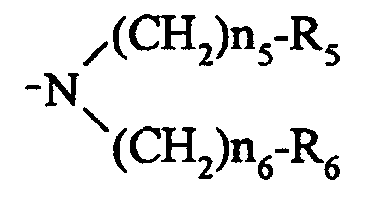
- the invention also relates more particularly to compounds of formula (I) such as defined above, characterized in that at least one, and more preferably two of R 1 , R 2 , R 3 and R 4 , represent a group wherein n 5 , n 6 , R 5 and R 6 are defined above.
- Preferred compounds of formula (I) such as defined above, wherein R is different from hydrogen are compounds of the following formula (II) : wherein n 1 , n 2 , n 3 , n 4 , R 1 , R 2 , R 3 , R 4 and R are such as defined above.
- the invention relates more particularly to compounds of formula (I) or (II) such as defined above, characterized in that R represents a group carrying a function liable to bind, if necessary via a binding site, to molecules, such as antibodies, haptens or peptides, as defined above, and in particular R represents a group chosen among all the coupling functions for vector or solid support binding, such as the following groups :
- the invention also concerns compounds of formula (I) or (II) such as defined above, characterized in that R represents a group carrying a function linked, if necessary via a binding site, to molecules, such as antibodies, haptens or peptides, as defined above, and more particularly R represents a group chosen among the following groups :
- the invention concerns more specifically compounds such as described above of the following formula (III) : in which R 1 , R 2 , R 3 , R 5 and R 6 independently from each other represent - COOH or -PO(OH) 2 , and R is a group as defined above.
- Preferred compounds of formula (III) are such that :
- the invention also concerns more specifically compounds such as described above, of the following formula (IV) : wherein R 2 , R 5 and R 6 , independently from each other, represent -COOH or -PO(OH) 2 , and R is a group as defined above.
- Preferred compounds of formula (IV) are such that :
- the invention also relates to complexes between a compound such as described above, and a radioactive element, said complexes resulting from the association of said radioelement with the -COOH and/or -PO(OH) 2 groups of said compound (the bonds between said radioelement and said compound being ionic bonds).
- radioelements are more particularly ⁇ , ⁇ or ⁇ emitter radiometals, and preferably from the groups of actinides or lanthanides.
- the invention relates more particularly to complexes such as described above, characterized in that said radioelements are ⁇ or ⁇ emitter radiometals (susceptible to be used in therapy, and more particularly in radioimmunotherapy in the frame of cancer treatments).
- ⁇ emitter radiometals are chosen among the following : Actinium 225, Bismuth 213.
- ⁇ emitter radiometals are chosen among the followings : 33 P, 199 Au, 121 Sn, 177 Lu, 67 Cu, 105 Rh, 47 Sc, 77 As, 153 Sm, 159 Gd, 143 Pr, 186 Re, 111 Ag, 149 Pm, 109 Pd, 166 Ho, 32 P, 188 Re, 194 Ir, 142 Pr, 90 Y.
- Preferred complexes with radiometals used in therapy are such that the compound is chosen among those wherein R represents a group carrying a function linked, if necessary via a binding site, to molecules as defined above, and more particularly among those compounds wherein the group R comprises :
- the invention also concerns the use of a complex such as described above, for the manufacture of a medicament for radioimmunotherapy (also called radiopharmaceutical), in particular for the treatment of cancers, or for the treatment against metastase proliferation.
- radioimmunotherapy also called radiopharmaceutical
- the invention relates to the use of a complex such as defined above, for the manufacture of a medicament for the treatment of :
- compositions characterized in that they comprise an effective amount of a complex such as described above, in association with a suitable pharmaceutical carrier.
- compositions according to the invention are more particularly characterized in that they are in a form suitable for an IV or IP administration in located areas.
- Preferred pharmaceutical compositions according to the invention are characterized in that the daily dosage is comprised between 1 and 100MBq /kg, e.g. between 3,7 and 74MBq/kg.
- the invention also relates to complexes, as defined above, between a compound such as described above, and a radioactive element, characterized in that the radioelements are ⁇ emitter radiometals (i.e. radiometals susceptible to be used in diagnosis methods, such as radioimmunoscintigraphy).
- ⁇ emitter radiometals i.e. radiometals susceptible to be used in diagnosis methods, such as radioimmunoscintigraphy.
- said radiometals are chosen among 111 In, 99m Tc, 64 Cu.
- Preferred complexes with radiometals used in diagnosis are such that the compound is chosen among those wherein R represents a group carrying a function linked, if necessary via a binding site, to molecules as defined above, and more particularly among those compounds wherein the group R comprises :
- the invention also concerns the use of a complex such as described above, for carrying out diagnosis methods such as radioimmunoscintigraphy.
- the invention concerns the use of a complex such as defined above, for carrying out the following diagnosis methods by radioimmunoscintigraphy :
- the invention also concerns the use of the complexes defined above for carrying out bone scintigraphy, in particular in the frame of the diagnosis of osteoarticular pathology, particularly in bone cancer extension balance.
- the invention also relates to methods for the in vitro diagnosis of pathologies listed above, characterized in that it comprises the steps of incubating a biological sample, such as serum, plasma urines, with a complex as described above, the components of the biological sample being fixed to a solid carrier, rinsing the solid carrier and detecting the ⁇ emission of the complex bound to the components of the sample on the solid carrier.
- a biological sample such as serum, plasma urines
- the invention also concerns the kits for carrying out said diagnosis methods, said kits comprising complexes as described above according to the invention.
- the invention also relates to the use of a compound of formula (I) defined above, included compounds CDTPA and CTTHA, for the manufacture of a medicament for the treatment of pathologies where ionic imbalances occur, or against the formation of stones in the organism.
- the invention also relates to the use of a compound of formula (I) defined above, included compounds CDTPA and CTTHA, for carrying out a process for the detoxication of polluted medium, such as liquid phases polluted by bivalent or trivalent metals radioactives or not.
- the invention also concerns a process for the detoxication of a polluted medium comprising the steps of contacting said medium with a compound as defined above, advantageously itself bound to a solid carrier, and recovering said medium substantially free of contaminants which are bound to said compound on the solid carrier.
- the invention also relates to the use of a compound of formula (I) defined above, included compounds CDTPA and CTTHA, for carrying out a process for the radionuclides purification, said compound of the invention being bound to a solid phase.
- the invention also relates to the use of a complex between of formula (I) defined above, included compounds CDTPA and CTTHA, for carrying out a bone scintigraphy, in particular in the frame of the diagnosis of osteoarticular pathology, particularly in bone cancer extension balance.
- the invention also relates to processes for preparing compounds and complexes as described above.
- a process for the preparation of compounds according to the invention comprises the following steps :
- the invention also relates to processes for preparing compounds and complexes as described above.
- a process for the preparation of compounds according to the invention comprises the following steps :
- Another process for the preparation of compounds according to the invention comprises the following steps :
- Another process for the preparation of compounds according to the invention comprises the following steps :
- Compound of formula a can be obtained according to the method described in Gestin et al., 1997, and Loussouam et al., 1998.
- the monoalkylation or the dialkylation (see scheme IV), depending on the stoechiometry of the reaction gave respectively compounds 8 and 12.
- the mixed acid 13 was obtained after hydrolysis of 12 in 6M hydrochloric acid and the hexaphosphonic acid 14 was prepared according to the method of Bauer and Kruger as described above.
- the synthesis of chelating agents 10 and 11 required an additional step which was the alkylation of 8 by ethyl bromoacetate to give the mixed ester 9.
- Acid-catalysed hydrolysis gave 10 and 11 after reaction of conversion described all above.
- MS spectra were recorded on a Mat Finnigan LCQ Ion Trap mass apparatus using the electrospray method in negative or positive mode.
- the bisphosphonate 6 was prepared in our laboratory according the synthesis procedure of Baily and Burgada with minor modifications.
- N,N' -[(2-diethylphosphono)eth-1-yl]- trans -cyclohexane-1,2-diamine 2b To freshly distilled trans -1,2-diaminocyclohexane 1 (1 ml, 8.33 mmol) in 50 ml of ethanol was added diethyl vinyl phosphonate (2.80 ml, 18.21 mmol). The reaction mixture was allowed to stir at reflux during 15 hours. After removal the solvent under reduced pressure, the resulting oil was purified by column chromatography (silica gel, CH 2 Cl 2 -EtOH 1:1) to give 2.9 g of a limpid oil (6.65 mmol, 80%).
- N,N' -[(2-cyano)eth-1-yl]- trans -cyclohexane-1,2-diamine 2d To freshly distilled trans -1,2-diaminocyclohexane 1 (1 ml, 8.33 mmol) in 50 ml of ethanol was added acrylonitryle (1.20 ml, 18.32 mmol).
- N,N' -[(2-ethoxycarbonyl)eth-1-yl]- N,N' -(ethylacetate)- trans -cyclohexane-1,2-diamine 3a To a solution of 2a (1 g; 3,.18 mmol) in 50 ml of freshly distilled CH3CN under nitrogen were added Na 2 CO 3 (0.50 g; 3.01 mmol) and KI ( g; mmol). After stirring for 1 hour at 60°C, BrCH 2 COOEt (1.80 ml; 7.15 mmol) was added dropwise. The reaction mixture was kept at this temperature over a period of 24 hours prior to cooling to room temperature, filtration and concentration under reduced pressure.
- N,N' -(ethylacetate)- N,N' -[(2-diethylphosphono)eth-1-yl]- trans -cyclohexane-1,2-diamine 3b The tetraester has been prepared as described above for compound from 1 g of compound 2b, Na 2 CO 3 (0.70g, 6.60 mmol), KI (0.40, 2.40 mmol) and ethylbromoacetate (1.80 ml; 7.15 mmol). Purification by chromatography (SiO 2 (CH 2 Cl 2 -MeOH 99 : 1) gave 0.58 g of a pale yellow oil (0.94 mmol; 41%).
- trans -cyclohexane-1,2-diamine- N,N' -ethylphosphonic- N,N' -methylphosphonic acid 4c A mixture of compound 4c (0.5 g; 1.12 mmol) and phosphorous acid (0.202 g; 2.46 mmol) in 10 ml of dry toluene was heated to 80°C and stirred for 30 min. PCl 3 ( 0.22 ml; 2.46 mmol) was then added dropwise, and the reaction mixture was kept at this temperature for 20 hours before being cooled to room temperature. The solvent was discarded and the residual product dissolved in a small volume of water.
- N,N-Bis (ethylacetate)-2-bromoethyl-amine 5 Bromide 5 was synthesised in our laboratory according the synthesis procedure of Williams and Rapoport with minor modifications concerning the bis N-alkylated ethanolamine synthesis. To a 4°C solution of ethanolamine (6ml; 0.1 mol) in 100 ml of dried acetonitrile was added dropwise ethylbromoacetate (7.4 ml; 66 mmol) over a period of 20 min during which time a large quantity of precipitate formed. The mixture was allowed to stir for 2 hours at this temperature. The white solid was removed by filtration and washed with a small quantity of acetonitrile.
- trans -cyclohexane-1,2-diamine- N,N' -propionic- N,N' -[ N",N" - bis -(2-aminoethyl)]-tetra-acetic acid 4d this hexaacid has been prepared as described above for compounds 4a & 4b from 1 g of the ester 3d and two volumes of 20 ml HCl (6N).
- N,N' -(diethylphosphono-methyl)- trans -cyclohexane-1,2-diamine 7 was synthesised in our laboratory according the synthesis procedure of Baily and Burgada with minor modifications. Freshly distilled trans -1,2-diaminocyclohexane 1 (3.6 ml, 30 mmol) and diethyl phosphite (7.24 ml, 60 mmol) were dissolved in THF (40ml). The mixture was stirred at reflux and paraformaldehyde (2.8 g, 93 mmol) was added over a 30-min period and the reaction mixture was stirred at reflux for 4 hours.
- N,N' -(diethylphosphono-methyl)- N -[ N",N"-bis -(ethylacetate-2-aminoethyl)]- trans -cyclohexane-1,2-diamine 8 The mixed ester has been prepared in a mixed solvent system (CH 3 CN-H 2 O, 1:1) as described above for compound 3d from bisphosphonate 6 (1 g, 2.41 mmol), Na 2 HPO 4 (0.5 g; 3.50 mmol) and 1 equivalent of bromide 5 (0.71 g; 2.41 mmol). After stirring for 2 days at 70°C, the reaction mixture was filtered and concentrated under reduced pressure.
- N,N' -(diethylphosphono-methyl)- N' -(ethylacetate)- N -[ N",N"-bis -(ethylacetate-2-aminoethyl)]- trans -cyclohexane-1,2-diamine 9 The tetraester is prepared as described above for compounds 3a & 3b from compound 8, Na 2 CO 3 , KI and ethylbromoacetate (1 equivalent). Purification by chromatography (SiO 2 ) gave a oil.
- N,N' -(diethylphosphono-methyl)- N,N' -[ N",N"-bis -(ethylacetate-2-aminoethyl)]- trans -cyclohexane-1,2-diamine 12 The mixed ester is prepared as described above for compound 3d from bisphosphonate 7 (1g, 2.41 mmol), Na 2 HPO 4 (1 g, 7.04 mmol) and 2 equivalents of bromide 5 1.80 g, 6.08 mmol). Purification by chromatography (SiO 2 (CH 2 Cl 2 -MeOH 95 : 5) gave a pale yellow oil (0.59 g, 0.70 mmol, 29%).
- Radiochemistry purity was measured on ITLC-SG chromatographic profiles. Radioactivity was quantified using a Phosphorimager 445SI apparatus.
- Samarium 153 was furnished under 153SmCl 3 form in HCl 0,04N with a 5,2 GBq/ml volumic activity and a 40 GBq/mg specific activity.
Landscapes
- Health & Medical Sciences (AREA)
- Chemical & Material Sciences (AREA)
- Organic Chemistry (AREA)
- General Health & Medical Sciences (AREA)
- Life Sciences & Earth Sciences (AREA)
- Animal Behavior & Ethology (AREA)
- Engineering & Computer Science (AREA)
- Veterinary Medicine (AREA)
- Nuclear Medicine, Radiotherapy & Molecular Imaging (AREA)
- Public Health (AREA)
- Medicinal Chemistry (AREA)
- Pharmacology & Pharmacy (AREA)
- Immunology (AREA)
- Molecular Biology (AREA)
- Bioinformatics & Cheminformatics (AREA)
- Biomedical Technology (AREA)
- Chemical Kinetics & Catalysis (AREA)
- General Chemical & Material Sciences (AREA)
- Biochemistry (AREA)
- Epidemiology (AREA)
- Medicines That Contain Protein Lipid Enzymes And Other Medicines (AREA)
- Medicines Containing Antibodies Or Antigens For Use As Internal Diagnostic Agents (AREA)
- Peptides Or Proteins (AREA)
- Investigating Or Analysing Biological Materials (AREA)
- Organic Low-Molecular-Weight Compounds And Preparation Thereof (AREA)
- Measuring Or Testing Involving Enzymes Or Micro-Organisms (AREA)
- Transceivers (AREA)
Claims (24)
- Composés de formule (I) suivante :dans laquelle :
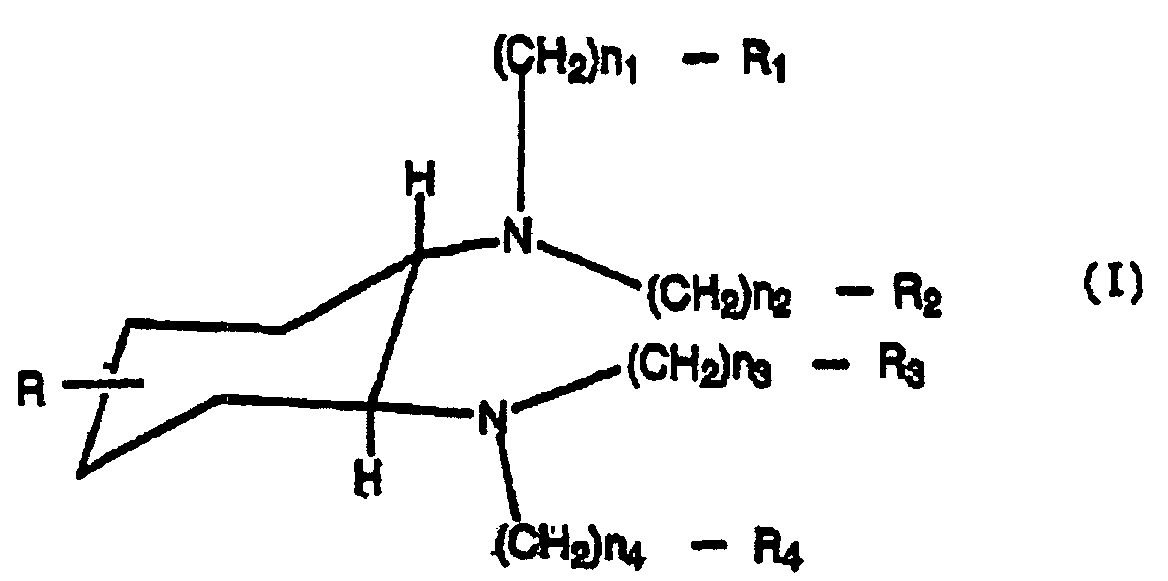 n1, n2, n3 et n4, indépendamment les uns des autres, représentent un nombre entier de 1 à 5,R1, R2, R3 et R4, indépendamment les uns des autres, représentent :dans lequel n5 représente un nombre entier de 1 à 5, R5 représente -COOH ou - PO(OH)2, et Y représente H ou un groupe -(CH2)n6-R6 dans lequel n6 représente un nombre entier de 1 à 5, et R6 représente -COOH ou -PO(OH)2,-COOH,-PO(OH)2,
sous réserve qu'au moins un de R1, R2, R3 ou R4 représente un groupetel que défini ci-dessus, les deux composés suivants, CDTPA et CTTHA, étant exclus :R représente :H, ou -NHCOCH3, ouun groupe portant une fonction susceptible de se lier, si nécessaire via un site de liaison, à des molécules qui sont capable de se lier de manière spécifique à des épitopes situés à la surface des cellules de l'organisme, ou à des composés chimiques ou biologiques situés à la surface d'un support solide, ouun groupe portant une fonction liée, si nécessaire via un site de liaison, à des molécules telles que définies ci-dessus,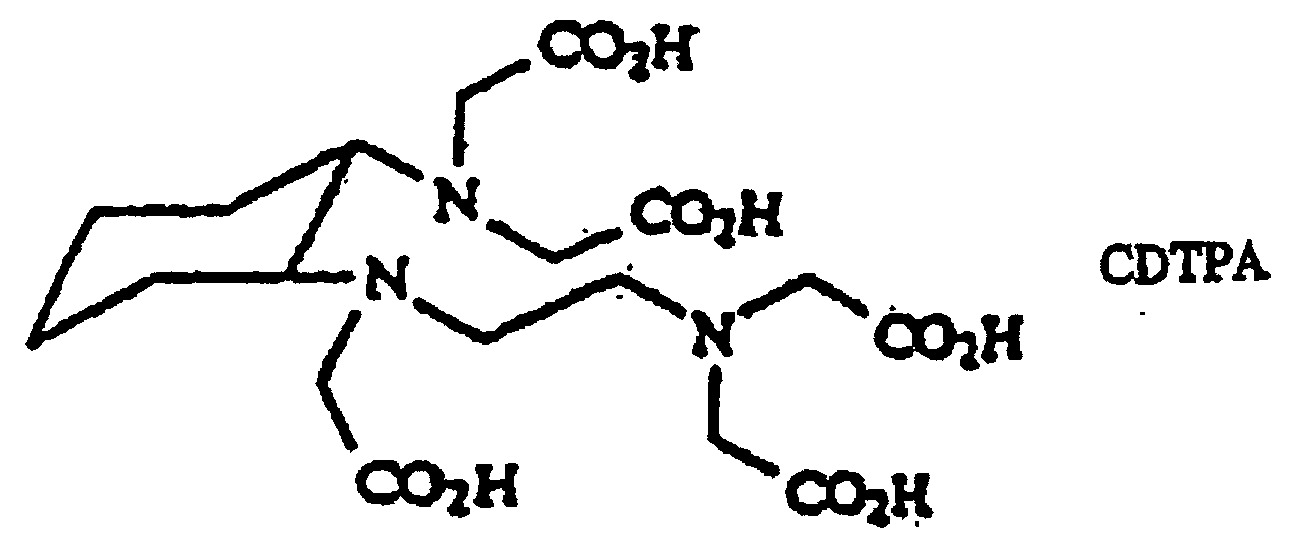

- Composés selon la revendication 1, caractérisés en ce que :n1, n2, n3, n4, n5, et n6, indépendamment les uns des autres, représentent un nombre entier de 1 à 3,les molécules qui sont capables de se lier de manière spécifique à des épitopes situés à la surface des cellules de l'organisme, ou à des composés chimiques ou biologiques situés à la surface d'un support solide, sont des anticorps, des haptènes ou des peptides.
- Composés selon la revendication 1 ou 2, caractérisés en ce que :lorsque R1, R2, R3 ou R4 représente -COOH ou -PO(OH)2, alors n1, n2, n3 ou n4 représente 1 respectivement,lorsque R1, R2, R3 ou R4 représente un groupealors n1, n2, n3 ou n4 représente 2 ou 3 respectivement,
 n5, et éventuellement n6, représente 1.
 - Composés selon l'une des revendications 1 à 3, caractérisés en ce qu'au moins un de R1, R2, R3 et R4, représente un groupedans lequel n5, n6, R5 et R6 sont définis dans les revendications 1 à 3.

- Composés selon la revendication 4, caractérisés en ce qu'au moins deux de R1, R2, R3 et R4, représentent un groupedans lequel n5, n6, R5 et R6 sont définis dans les revendications 1 à 3.
- Composés selon l'une des revendications 1 à 5, caractérisés en ce que R représente un groupe portant une fonction susceptible de se lier, si nécessaire via un site de liaison, à des molécules telles que définies dans la revendication 1 ou 2, R étant un groupe choisi parmi l'ensemble des fonctions de couplage pour la liaison à un vecteur ou à un support solide.
- Composés selon l'une des revendications 1 à 5, caractérisés en ce que R représente un groupe portant une fonction liée, si nécessaire via un site de liaison, à des molécules telles que définies dans les revendications 1 ou 2.
- Composés selon l'une des revendications 1 à 7 de formule (III) suivante :dans laquelle R1, R2, R3, R5 et R6 indépendamment les uns des autres représentent -COOH ou -PO(OH)2, et R est un groupe tel que défini dans les revendications 1 à 7.

- Composés selon la revendication 8, de formule (III) dans laquelle :R1 = R5 = R6 = COOH, et R2 = R3 = PO(OH)2, ouR1 = R2 = R3 = R5 = R6 = COOH, ouR1 = R2 = R3 = R5 = R6 = PO(OH)2.
- Composés selon l'une des revendications 1 à 7, de formule (IV) suivante :dans laquelle R2, R5 et R6, indépendamment les uns des autres, représentent -COOH ou -PO(OH)2, et R est un groupe tel que défini dans les revendications 1 à 7.
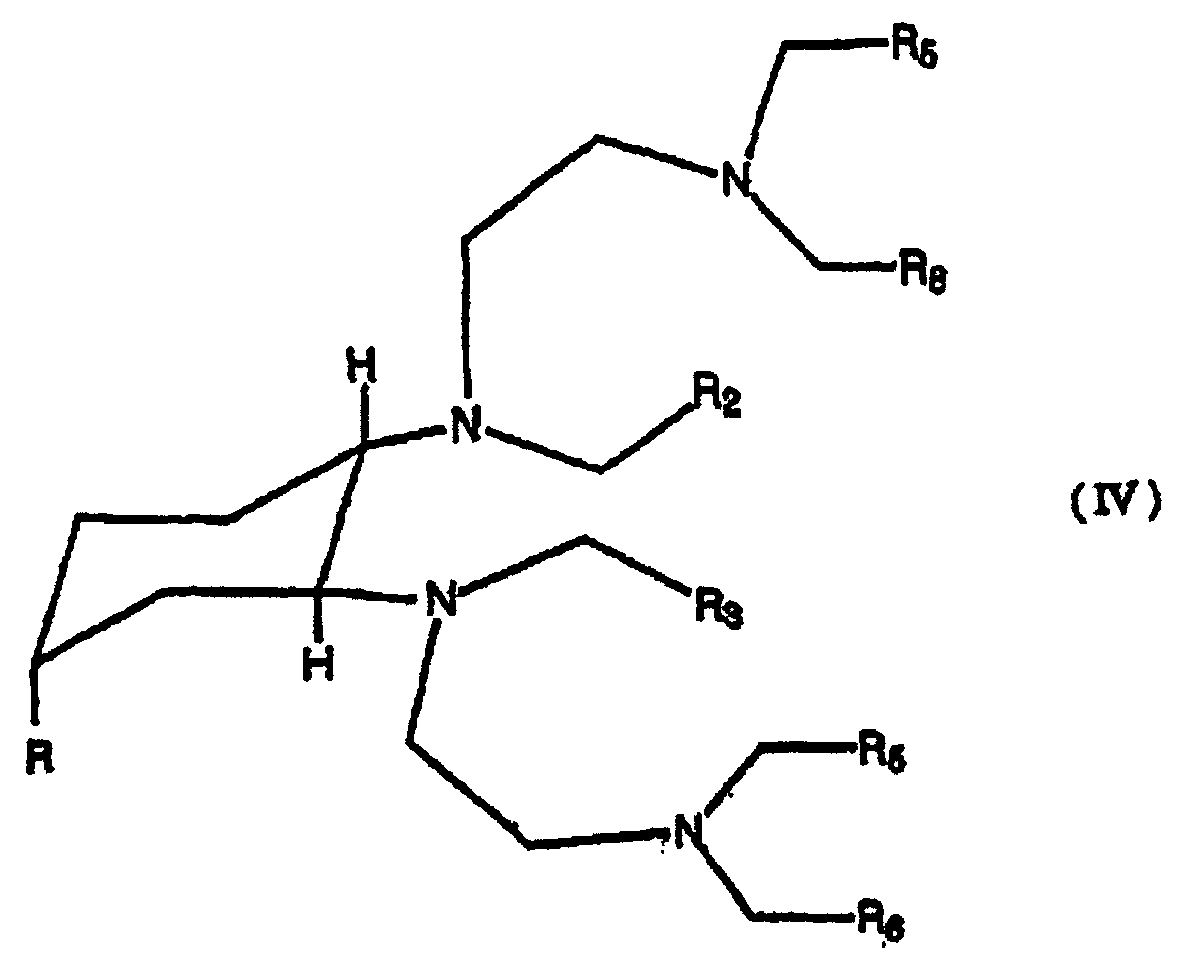
- Composés selon la revendication 10 de formule (IV) dans laquelle :R2 = R3 = PO(OH)2, et R5 = R6 = COOH, ouR2 = R3 = R5 = R6 = COOH, ouR2 = R3 = R5 = R6 = PO(OH)2.
- Complexes entre un composé selon l'une des revendications 1 à 11, et un élément radioactif.
- Complexes selon la revendication 12, caractérisés en ce que lesdits radioéléments sont des radiométaux émetteurs α ou β.
- Complexes selon la revendication 13, caractérisés en ce que le composé est choisi parmi ceux définis dans l'une des revendications 7 à 11.
- Complexes selon la revendication 13 ou 14, dans lesquels le groupe R comprend :un anticorps (polyclonal ou monoclonal) susceptible de reconnaítre et de se lier à des épitopes spécifiques à la surface de cellules spécifiques de l'organisme,ou un haptène, c'est-à-dire une molécule non immunogène de faible PM capable d'induire la production d'anticorps dirigés contre elle-même, ledit haptène étant susceptible de reconnaítre et de se lier à une ou plusieurs molécules déjà liées, dans une première étape du traitement, à des épitopes à la surface de cellules spécifiques dans l'organisme,ou un peptide résultant de l'association de différents acides aminés et susceptibles de reconnaítre et de se lier à des épitopes spécifiques à la surface de cellules spécifiques de l'organisme.
- Compositions pharmaceutiques caractérisées en ce qu'elles contiennent une quantité efficace d'un composé selon l'une des revendications 1 à 11, ou un complexe selon l'une des revendications 13 à 15, en association avec un véhicule pharmaceutiquement acceptable.
- Utilisation d'un complexe selon l'une des revendications 13 à 15, pour la préparation d'un médicament destiné à la radioimmunothérapie, tel que le traitement des cancers, et plus particulièrement destiné au traitement contre la prolifération des métastases.
- Complexes selon la revendication 12, caractérisés en ce que les radioéléments sont des radiométaux émetteurs γ.
- Complexes selon la revendication 18, caractérisés en ce que le composé est choisi parmi ceux définis dans l'une des revendications 7 à 11, et dans lesquels le groupe R comprend :un anticorps polyclonal ou monoclonal susceptible de reconnaítre et de se lier à des épitopes spécifiques à la surface de cellules spécifiques de l'organisme,ou un haptène, c'est-à-dire une molécule non immunogène de faible PM capable d'induire la production d'anticorps dirigés contre elle-même, ledit haptène étant susceptible de reconnaítre et de se lier à une ou plusieurs molécules déjà liées, dans une première étape de la méthode de diagnostic, à des épitopes à la surface de cellules spécifiques dans l'organisme,ou un peptide résultant de l'association de différents acides aminés et susceptible de reconnaítre et de se lier à des épitopes spécifiques à la surface de cellules spécifiques de l'organisme.
- Complexes selon la revendication 17 ou 18, pour la mise en oeuvre de méthodes de diagnostic telles que la radioimmunoscintigraphie.
- Utilisation d'un composé de formule (I) tel que défini dans les revendications 1 à 11, incluant CDTPA et CTTHA, pour la fabrication d'un médicament utile en tant qu'antalgique, ou destiné au traitement des pathologies dans lesquelles des déséquilibres ioniques se produisent, ou contre la formation de calculs dans l'organisme.
- Utilisation d'un composé de formule (I) tel que défini dans les revendications 1 à 11, incluant CDTPA et CTTHA, pour la mise en oeuvre d'un procédé de détoxification de milieux pollués, tels que des phases liquides polluées par des métaux bivalents ou trivalents, radioactifs ou non.
- Utilisation d'un composé de formule (I) tel que défini dans les revendications 1 à 11, incluant CDTPA et CTTHA, pour la mise en oeuvre d'un procédé de purification des radionucléides, ledit composé étant lié à une phase solide.
- Utilisation d'un composé de formule (I) tel que défini dans les revendications 1 à 11, incluant CDTPA et CTTHA, pour la mise en oeuvre d'une scintigraphie de l'os, en particulier dans le cadre du diagnostic de pathologie ostéoarticulaire, notamment dans l'équilibre de l'extension du cancer de l'os.
Priority Applications (1)
| Application Number | Priority Date | Filing Date | Title |
|---|---|---|---|
| EP99953923A EP1123301B1 (fr) | 1998-10-23 | 1999-10-22 | Agents chelatants pour radioimmunotherapie |
Applications Claiming Priority (4)
| Application Number | Priority Date | Filing Date | Title |
|---|---|---|---|
| EP98402648 | 1998-10-23 | ||
| EP98402648 | 1998-10-23 | ||
| EP99953923A EP1123301B1 (fr) | 1998-10-23 | 1999-10-22 | Agents chelatants pour radioimmunotherapie |
| PCT/EP1999/008031 WO2000024751A1 (fr) | 1998-10-23 | 1999-10-22 | Agents chelatants pour radioimmunotherapie |
Publications (2)
| Publication Number | Publication Date |
|---|---|
| EP1123301A1 EP1123301A1 (fr) | 2001-08-16 |
| EP1123301B1 true EP1123301B1 (fr) | 2003-12-03 |
Family
ID=8235539
Family Applications (1)
| Application Number | Title | Priority Date | Filing Date |
|---|---|---|---|
| EP99953923A Expired - Lifetime EP1123301B1 (fr) | 1998-10-23 | 1999-10-22 | Agents chelatants pour radioimmunotherapie |
Country Status (7)
| Country | Link |
|---|---|
| EP (1) | EP1123301B1 (fr) |
| JP (1) | JP2002528458A (fr) |
| AT (1) | ATE255586T1 (fr) |
| AU (1) | AU1043000A (fr) |
| CA (1) | CA2346976A1 (fr) |
| DE (1) | DE69913368T2 (fr) |
| WO (1) | WO2000024751A1 (fr) |
Families Citing this family (3)
| Publication number | Priority date | Publication date | Assignee | Title |
|---|---|---|---|---|
| DE10238114A1 (de) * | 2002-08-21 | 2004-03-04 | Bayer Ag | Optisch aktive Diamine und deren Anwendung in katalytischen Prozessen |
| MX378821B (es) * | 2015-05-19 | 2025-03-10 | Akamara Therapeutics Inc | Proceso para preparar compuestos basados en platino supramoleculares. |
| CN113372384B (zh) * | 2020-02-25 | 2022-10-11 | 广州平澜医疗科技有限公司 | 磁共振造影剂及其制备方法和应用 |
Family Cites Families (2)
| Publication number | Priority date | Publication date | Assignee | Title |
|---|---|---|---|---|
| US5089663A (en) * | 1989-06-29 | 1992-02-18 | Associated Universities, Inc. | Cyclohexyl-triethylenetetraamine hexacetic acid |
| US5292938A (en) * | 1992-04-13 | 1994-03-08 | Associated Universities, Inc. | Synthesis of 4-substituted-trans-1, 2-diaminocyclohexyl polyaminocarboxylate metal chelating agents for the preparation of stable radiometal antibody immunoconjugates for therapy and spect and pet imaging |
-
1999
- 1999-10-22 DE DE69913368T patent/DE69913368T2/de not_active Expired - Lifetime
- 1999-10-22 AT AT99953923T patent/ATE255586T1/de not_active IP Right Cessation
- 1999-10-22 AU AU10430/00A patent/AU1043000A/en not_active Abandoned
- 1999-10-22 JP JP2000578321A patent/JP2002528458A/ja active Pending
- 1999-10-22 EP EP99953923A patent/EP1123301B1/fr not_active Expired - Lifetime
- 1999-10-22 CA CA002346976A patent/CA2346976A1/fr not_active Abandoned
- 1999-10-22 WO PCT/EP1999/008031 patent/WO2000024751A1/fr not_active Ceased
Also Published As
| Publication number | Publication date |
|---|---|
| JP2002528458A (ja) | 2002-09-03 |
| DE69913368D1 (en) | 2004-01-15 |
| EP1123301A1 (fr) | 2001-08-16 |
| CA2346976A1 (fr) | 2000-05-04 |
| ATE255586T1 (de) | 2003-12-15 |
| DE69913368T2 (de) | 2004-10-28 |
| AU1043000A (en) | 2000-05-15 |
| WO2000024751A1 (fr) | 2000-05-04 |
Similar Documents
| Publication | Publication Date | Title |
|---|---|---|
| RU2118325C1 (ru) | Комплексы металлов с бициклополиазамакроциклом, способ их получения и фармацевтическая композиция для лечения рака | |
| KR102870722B1 (ko) | 진단제 및 방사성핵종 치료제로서의 전립선-특이적 막 항원 (psma) 억제제 | |
| Pulukkody et al. | Synthesis of charged and uncharged complexes of gadolinium and yttrium with cyclic polyazaphosphinic acid ligands for in vivo applications | |
| JP2831073B2 (ja) | 大環状二官能キレート剤、その錯体及びそれらの抗体接合体 | |
| KR102703312B1 (ko) | 조영제 | |
| CN107106711A (zh) | 用于诊断和治疗骨病的共轭二膦酸盐 | |
| AU2016375192A2 (en) | Macrocyclic ligands with picolinate group(s), complexes thereof and also medical uses thereof | |
| EP1123301B1 (fr) | Agents chelatants pour radioimmunotherapie | |
| JP4056088B2 (ja) | 多座イミン類およびそれらの金属錯体類 | |
| Loussouarn et al. | Synthesis of new bifunctional chelating agents:(1 R*, 2 R*, 4 S*)-4-isothiocyanatocyclohexane-1, 2-diamine-N, N, N′, N′-tetrakismethanephosphonic acid (4-ICMP) and (1 R*, 2 R*, 4 S*)-4-isothiocyanatocyclohexane-1, 2-diamine-N, N, N′, N′-tetrakisethanephosphonic acid (4-ICEP) | |
| CA2400888C (fr) | Agent chelatant bifonctionnel | |
| US5516940A (en) | Multifunctional ligand for use as a diagnostic or therapeutic pharmaceutical | |
| CA2082023A1 (fr) | Utilisation de derives de diethylene-triamine a des fins diagnostiques et therapeutiques | |
| KR0153501B1 (ko) | 오르토 결합 작용기를 갖는 킬란트 및 그의 착물 | |
| WO1994026755A1 (fr) | Complexes d'acides bicyclopolyazamacrocyclophosphoniques, conjugues de ces derniers, procede de preparation associe et d'utilisation en tant que produits radiopharmaceutiques | |
| ES2835065T3 (es) | Agentes de contraste | |
| AU2002337093B2 (en) | Bifunctional chelating agent for actinium | |
| AU2001242453A1 (en) | Bifunctional chelating agent |
Legal Events
| Date | Code | Title | Description |
|---|---|---|---|
| PUAI | Public reference made under article 153(3) epc to a published international application that has entered the european phase |
Free format text: ORIGINAL CODE: 0009012 |
|
| 17P | Request for examination filed |
Effective date: 20010402 |
|
| AK | Designated contracting states |
Kind code of ref document: A1 Designated state(s): AT BE CH CY DE DK ES FI FR GB GR IE IT LI LU MC NL PT SE |
|
| 17Q | First examination report despatched |
Effective date: 20011130 |
|
| GRAH | Despatch of communication of intention to grant a patent |
Free format text: ORIGINAL CODE: EPIDOS IGRA |
|
| GRAS | Grant fee paid |
Free format text: ORIGINAL CODE: EPIDOSNIGR3 |
|
| GRAA | (expected) grant |
Free format text: ORIGINAL CODE: 0009210 |
|
| AK | Designated contracting states |
Kind code of ref document: B1 Designated state(s): AT BE CH CY DE DK ES FI FR GB GR IE IT LI LU MC NL PT SE |
|
| PG25 | Lapsed in a contracting state [announced via postgrant information from national office to epo] |
Ref country code: NL Free format text: LAPSE BECAUSE OF FAILURE TO SUBMIT A TRANSLATION OF THE DESCRIPTION OR TO PAY THE FEE WITHIN THE PRESCRIBED TIME-LIMIT Effective date: 20031203 Ref country code: LI Free format text: LAPSE BECAUSE OF FAILURE TO SUBMIT A TRANSLATION OF THE DESCRIPTION OR TO PAY THE FEE WITHIN THE PRESCRIBED TIME-LIMIT Effective date: 20031203 Ref country code: IT Free format text: LAPSE BECAUSE OF FAILURE TO SUBMIT A TRANSLATION OF THE DESCRIPTION OR TO PAY THE FEE WITHIN THE PRESCRIBED TIME-LIMIT;WARNING: LAPSES OF ITALIAN PATENTS WITH EFFECTIVE DATE BEFORE 2007 MAY HAVE OCCURRED AT ANY TIME BEFORE 2007. THE CORRECT EFFECTIVE DATE MAY BE DIFFERENT FROM THE ONE RECORDED. Effective date: 20031203 Ref country code: FI Free format text: LAPSE BECAUSE OF FAILURE TO SUBMIT A TRANSLATION OF THE DESCRIPTION OR TO PAY THE FEE WITHIN THE PRESCRIBED TIME-LIMIT Effective date: 20031203 Ref country code: CY Free format text: LAPSE BECAUSE OF FAILURE TO SUBMIT A TRANSLATION OF THE DESCRIPTION OR TO PAY THE FEE WITHIN THE PRESCRIBED TIME-LIMIT Effective date: 20031203 Ref country code: CH Free format text: LAPSE BECAUSE OF FAILURE TO SUBMIT A TRANSLATION OF THE DESCRIPTION OR TO PAY THE FEE WITHIN THE PRESCRIBED TIME-LIMIT Effective date: 20031203 Ref country code: AT Free format text: LAPSE BECAUSE OF FAILURE TO SUBMIT A TRANSLATION OF THE DESCRIPTION OR TO PAY THE FEE WITHIN THE PRESCRIBED TIME-LIMIT Effective date: 20031203 |
|
| REG | Reference to a national code |
Ref country code: GB Ref legal event code: FG4D |
|
| REG | Reference to a national code |
Ref country code: CH Ref legal event code: EP |
|
| REG | Reference to a national code |
Ref country code: IE Ref legal event code: FG4D |
|
| REF | Corresponds to: |
Ref document number: 69913368 Country of ref document: DE Date of ref document: 20040115 Kind code of ref document: P |
|
| PG25 | Lapsed in a contracting state [announced via postgrant information from national office to epo] |
Ref country code: SE Free format text: LAPSE BECAUSE OF FAILURE TO SUBMIT A TRANSLATION OF THE DESCRIPTION OR TO PAY THE FEE WITHIN THE PRESCRIBED TIME-LIMIT Effective date: 20040303 Ref country code: GR Free format text: LAPSE BECAUSE OF FAILURE TO SUBMIT A TRANSLATION OF THE DESCRIPTION OR TO PAY THE FEE WITHIN THE PRESCRIBED TIME-LIMIT Effective date: 20040303 Ref country code: DK Free format text: LAPSE BECAUSE OF FAILURE TO SUBMIT A TRANSLATION OF THE DESCRIPTION OR TO PAY THE FEE WITHIN THE PRESCRIBED TIME-LIMIT Effective date: 20040303 |
|
| PG25 | Lapsed in a contracting state [announced via postgrant information from national office to epo] |
Ref country code: ES Free format text: LAPSE BECAUSE OF FAILURE TO SUBMIT A TRANSLATION OF THE DESCRIPTION OR TO PAY THE FEE WITHIN THE PRESCRIBED TIME-LIMIT Effective date: 20040314 |
|
| NLV1 | Nl: lapsed or annulled due to failure to fulfill the requirements of art. 29p and 29m of the patents act | ||
| REG | Reference to a national code |
Ref country code: CH Ref legal event code: PL |
|
| ET | Fr: translation filed | ||
| PLBE | No opposition filed within time limit |
Free format text: ORIGINAL CODE: 0009261 |
|
| STAA | Information on the status of an ep patent application or granted ep patent |
Free format text: STATUS: NO OPPOSITION FILED WITHIN TIME LIMIT |
|
| PG25 | Lapsed in a contracting state [announced via postgrant information from national office to epo] |
Ref country code: LU Free format text: LAPSE BECAUSE OF NON-PAYMENT OF DUE FEES Effective date: 20041022 Ref country code: IE Free format text: LAPSE BECAUSE OF NON-PAYMENT OF DUE FEES Effective date: 20041022 |
|
| PG25 | Lapsed in a contracting state [announced via postgrant information from national office to epo] |
Ref country code: MC Free format text: LAPSE BECAUSE OF NON-PAYMENT OF DUE FEES Effective date: 20041031 |
|
| 26N | No opposition filed |
Effective date: 20040906 |
|
| REG | Reference to a national code |
Ref country code: IE Ref legal event code: MM4A |
|
| PG25 | Lapsed in a contracting state [announced via postgrant information from national office to epo] |
Ref country code: PT Free format text: LAPSE BECAUSE OF NON-PAYMENT OF DUE FEES Effective date: 20040503 |
|
| PGFP | Annual fee paid to national office [announced via postgrant information from national office to epo] |
Ref country code: DE Payment date: 20121024 Year of fee payment: 14 |
|
| PGFP | Annual fee paid to national office [announced via postgrant information from national office to epo] |
Ref country code: GB Payment date: 20121017 Year of fee payment: 14 |
|
| PGFP | Annual fee paid to national office [announced via postgrant information from national office to epo] |
Ref country code: BE Payment date: 20121231 Year of fee payment: 14 |
|
| BERE | Be: lapsed |
Owner name: INSTITUT NATIONAL DE LA SANTE ET DE LA RECHERCHE M Effective date: 20131031 |
|
| GBPC | Gb: european patent ceased through non-payment of renewal fee |
Effective date: 20131022 |
|
| REG | Reference to a national code |
Ref country code: DE Ref legal event code: R119 Ref document number: 69913368 Country of ref document: DE Effective date: 20140501 |
|
| PG25 | Lapsed in a contracting state [announced via postgrant information from national office to epo] |
Ref country code: GB Free format text: LAPSE BECAUSE OF NON-PAYMENT OF DUE FEES Effective date: 20131022 |
|
| PG25 | Lapsed in a contracting state [announced via postgrant information from national office to epo] |
Ref country code: DE Free format text: LAPSE BECAUSE OF NON-PAYMENT OF DUE FEES Effective date: 20140501 |
|
| PG25 | Lapsed in a contracting state [announced via postgrant information from national office to epo] |
Ref country code: BE Free format text: LAPSE BECAUSE OF NON-PAYMENT OF DUE FEES Effective date: 20131031 |
|
| REG | Reference to a national code |
Ref country code: FR Ref legal event code: PLFP Year of fee payment: 17 |
|
| REG | Reference to a national code |
Ref country code: FR Ref legal event code: PLFP Year of fee payment: 18 |
|
| PGFP | Annual fee paid to national office [announced via postgrant information from national office to epo] |
Ref country code: FR Payment date: 20161024 Year of fee payment: 18 |
|
| REG | Reference to a national code |
Ref country code: FR Ref legal event code: ST Effective date: 20180629 |
|
| PG25 | Lapsed in a contracting state [announced via postgrant information from national office to epo] |
Ref country code: FR Free format text: LAPSE BECAUSE OF NON-PAYMENT OF DUE FEES Effective date: 20171031 |