EP1123612B1 - Datenübertragungsverfahren - Google Patents
Datenübertragungsverfahren Download PDFInfo
- Publication number
- EP1123612B1 EP1123612B1 EP99948988A EP99948988A EP1123612B1 EP 1123612 B1 EP1123612 B1 EP 1123612B1 EP 99948988 A EP99948988 A EP 99948988A EP 99948988 A EP99948988 A EP 99948988A EP 1123612 B1 EP1123612 B1 EP 1123612B1
- Authority
- EP
- European Patent Office
- Prior art keywords
- bit
- coded
- bits
- data frame
- stop
- Prior art date
- Legal status (The legal status is an assumption and is not a legal conclusion. Google has not performed a legal analysis and makes no representation as to the accuracy of the status listed.)
- Expired - Lifetime
Links
Images
Classifications
-
- H—ELECTRICITY
- H04—ELECTRIC COMMUNICATION TECHNIQUE
- H04L—TRANSMISSION OF DIGITAL INFORMATION, e.g. TELEGRAPHIC COMMUNICATION
- H04L7/00—Arrangements for synchronising receiver with transmitter
- H04L7/04—Speed or phase control by synchronisation signals
- H04L7/041—Speed or phase control by synchronisation signals using special codes as synchronising signal
-
- H—ELECTRICITY
- H04—ELECTRIC COMMUNICATION TECHNIQUE
- H04L—TRANSMISSION OF DIGITAL INFORMATION, e.g. TELEGRAPHIC COMMUNICATION
- H04L25/00—Baseband systems
- H04L25/38—Synchronous or start-stop systems, e.g. for Baudot code
-
- H—ELECTRICITY
- H04—ELECTRIC COMMUNICATION TECHNIQUE
- H04L—TRANSMISSION OF DIGITAL INFORMATION, e.g. TELEGRAPHIC COMMUNICATION
- H04L25/00—Baseband systems
- H04L25/38—Synchronous or start-stop systems, e.g. for Baudot code
- H04L25/40—Transmitting circuits; Receiving circuits
- H04L25/49—Transmitting circuits; Receiving circuits using code conversion at the transmitter; using predistortion; using insertion of idle bits for obtaining a desired frequency spectrum; using three or more amplitude levels ; Baseband coding techniques specific to data transmission systems
- H04L25/4904—Transmitting circuits; Receiving circuits using code conversion at the transmitter; using predistortion; using insertion of idle bits for obtaining a desired frequency spectrum; using three or more amplitude levels ; Baseband coding techniques specific to data transmission systems using self-synchronising codes, e.g. split-phase codes
-
- H—ELECTRICITY
- H04—ELECTRIC COMMUNICATION TECHNIQUE
- H04L—TRANSMISSION OF DIGITAL INFORMATION, e.g. TELEGRAPHIC COMMUNICATION
- H04L7/00—Arrangements for synchronising receiver with transmitter
- H04L7/04—Speed or phase control by synchronisation signals
- H04L7/041—Speed or phase control by synchronisation signals using special codes as synchronising signal
- H04L7/046—Speed or phase control by synchronisation signals using special codes as synchronising signal using a dotting sequence
Definitions
- the present invention relates to a method for asynchronous serial data transmission according to the preamble of claim 1.
- the carrier identification signals to the receiver that a message is being sent, and the synchronization serves to signal the beginning of the payload, i. to synchronize to this prefixed start bit.
- the simplest form of sender and receiver synchronization is used in asynchronous transmission.
- the transmitter and the receiver clock must have only approximately the same frequency.
- the transmitted data words have a fixed format and are additionally provided with a start bit and a stop bit.
- the receiver clock is synchronized with the negative edge of the start bit, and the other bits are sampled at the bit center.
- the asynchronous data transmission can also be done with inexpensive standard components, as they are offered in the market by various manufacturers in the form of UART's (Universal Asynchronous Receiver Transmitter). These have internal clock on whose temporal constancy no particularly large demands are made, because the clock is respectively resynchronized at the beginning of a character, so generally after the transmission of 10 bits. It is therefore only necessary that the stop bit is still scanned in the bit area.
- UART's Universal Asynchronous Receiver Transmitter
- the transmitting / receiving electronics has a constant operating point and does not experience an operating point shift as a result of longer zero or one sequences of character coding. To ensure this, one could use DC-free coding formats, which are sometimes too complicated and UART 'not evaluable.
- the document discloses this US-A-4,605,921 a method for asynchronous serial data transmission with data frames, each framed by a start and stop bit, wherein there is an equal number of 0 and 1 bits including the start and stop bits. Furthermore, the document discloses US-A-4,661,965 a three-part frame structure with an equal number of 0 and 1 bits, with start and stop bits missing in the carrier detection frame.
- the bitstream used in the transmission method is composed in a known manner from a carrier detection, a synchronization and the user data.
- Each part of this bitstream is set according to FIG. 2 composed of a 10-bit wide character, where the first bit is a start bit and the last bit is a stop bit.
- the start bit is represented by an "O” and the stop bit is represented by a "1". In between are eight information bits of the character.
- the carrier identification is coded according to the hexadecimal code 55, ie ones and zeros alternate.
- the bit rate is for example 9,600 baud, which corresponds to a frequency of 4.8 kHz.
- the internal clock in the UART also operates to sample the character bits.
- the synchronization character is coded with the hexadecimal code 33, ie two zeros are followed by two zeros, etc.
- This code is symmetrical with regard to the number of ones and zeros, so that the DC level or the operating point of the receiving electronics does not change on the average the Frequency of 2.4kHz for a radio transmission is still suitable high.
- the synchronization mark is chosen so that its bit pattern does not occur in the payload.
- the coding of the payload data is carried out according to Manchester coding (bi-phase format), in which both the zeroes and the ones are coded by pulses, but which occur within a bit frame at different times.
- a one is represented, for example, by a rectangular pulse of half the step duration, which lies in the first half of the time available for the representation of a bit.
- the same pulse is used, which lies in the second half of the time segment.
- the transmission of the clock information is thus ensured even in the case of "O" and "1" sequences, and a distinction between the transmission of a zero sequence and no transmission is possible.
- the signal is not DC-free, but has the same level averaged.
- the payload is coded in hexadecimal code 21.
Landscapes
- Engineering & Computer Science (AREA)
- Computer Networks & Wireless Communication (AREA)
- Signal Processing (AREA)
- Physics & Mathematics (AREA)
- Spectroscopy & Molecular Physics (AREA)
- Dc Digital Transmission (AREA)
- Communication Control (AREA)
- Synchronisation In Digital Transmission Systems (AREA)
Description
- Die vorliegende Erfindung bezieht sich auf ein Verfahren zur asynchronen seriellen Datenübertragung nach dem Gattungsbegriff des Patentanspruches 1.
- In diesem Zusammenhang ist es bekannt, den zwischen einem Sender und einem Empfänger übertragenen Nutzdaten, eine Trägererkennung und Synchronisation vorauszuschicken. Die Trägererkennung signalisiert dem Empfänger, daß eine Nachricht gesendet wird, und die Synchronisation dient dazu, auf den Beginn der Nutzdaten, d.h. auf das diesen vorangestellte Startbit zu synchronisieren.
- Die einfachste Form der Synchronisation von Sender- und Empfänger wird bei der asynchronen Übertragung angewendet. Der Sender- und der Empfängertakt müssen dabei nur annähernd gleiche Frequenz aufweisen. Die übertragenen Datenworte besitzen ein festes Format und werden zusätzlich mit einem Startbit und einem Stoppbit versehen. Der Empfängertakt wird mit der negativen Flanke des Startbits synchronisiert, und die weiteren Bits werden in der zeitlichen Bitmitte abgetastet.
- Die asynchrone Datenübertragung kann zudem mit preiswerten Standard-Bausteinen erfolgen, wie sie am Markt durch verschiedene Hersteller in Form von UART's (Universal Asynchronus Receiver Transmitter) angeboten werden. Diese weisen interne Taktgeber auf, an deren zeitliche Konstanz keine besonders großen Anforderungen gestellt werden, weil der Takt jeweils zu Beginn eines Zeichens, also im allgemeinen nach der Übertragung von 10 Bit neu synchronisiert wird. Es ist daher lediglich erforderlich, daß das Stoppbit noch im Bitbereich abgetastet wird.
- Bei der Datenübertragung ist es ferner von Bedeutung, daß die Sende-/Empfangselektronik einen konstanten Arbeitspunkt besitzt und nicht etwa durch längere Null- oder Eins-Folgen der Zeichenkodierung eine Arbeitspunktverschiebung erfährt. Um dies zu gewährleisten, könnte man gleichstromfreie Codierungs-Formate verwenden, die aber teilweise zu kompliziert und durch UART' nicht auswertbar sind.
- Hierzu offenbart das Dokument
US-A-4 605 921 ein Verfahren zur asynchronen seriellen Datenübertragung mit Datenrahmen, die jeweils durch ein Start- und Stoppbit eingerahmt sind, wobei einschließlich des Start- und Stopbits eine gleiche Anzahl von 0- und 1-Bits vorliegt.
Desweiteren offenbart das DokumentUS-A-4 661 965 eine dreiteilige Rahmenstruktur mit einer gleichen Anzahl von 0- und 1 Bits, wobei Start- und Stopbits im Trägererkennungsrahmen fehlen. - Es ist daher die Aufgabe der vorliegenden Erfindung, ein Datenübertragungsverfahren anzugeben, das bei einem einfachen Codierungs-Format einen konstanten Arbeitspunkt der Sende-/Empfangs-Elektronik gewährleistet.
- Die Lösung dieser Aufgabe gelingt gemäß den kennzeichnenden Merkmalen des Patentanspruches 1. Weitere vorteilhafte Ausgestaltungen des erfindungsgemäßen Verfahrens sind den abhängigen Ansprüchen entnehmbar.
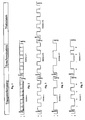
- Anhand eines in den Figuren der beiliegenden Zeichnung dargestellten Ausführungsbeispieles sei die Erfindung im folgenden näher erläutert. Es zeigen:
- Figur 1
- die Zusammensetzung des übertragenen Datenstromes;
- Figur 2
- die grundsätzliche Zeichencodierung;
- Figur 3
- die Codierung der Trägererkennung;
- Figur 4
- die Codierung des Synchronisationszeichens; und
- Figur 5
- die Codierung der Nutzdaten.
- Gemäß
Figur 1 setzt sich der bei dem Übertragungsverfahren verwendete Bitstrom in bekannter Weise aus einer Trägererkennung, einer Synchronisation und den Nutzdaten zusammen. Jeder Teil dieses Bitstromes setzt sich gemäßFigur 2 aus einem Zeichen mit einer Breite von 10 Bit zusammen, wobei das erste Bit ein Startbit und das letzte Bit ein Stoppbit ist. Das Startbit wird durch eine "O" repräsentiert und das Stoppbit wird durch eine "1" repräsentiert. Dazwischen liegen acht Informationsbit des Zeichens. - Gemäß
Figur 3 ist die Trägererkennung gemäß dem Hexadezimalcode 55 codiert, d.h. Einsen und Nullen wechseln sich gegenseitig ab. Die Bitrate beträgt z.B. 9.600 Baud, was einer Frequenz von 4,8 kHz entspricht. Mit dieser Bitrate bzw. Frequenz arbeitet auch der interne Taktgeber in dem UART bei der Abtastung der Zeichenbits. - Gemäß
Figur 4 ist das Synchronisationszeichen mit dem Hexadezimalcode 33 codiert, d.h. auf zwei Einsen folgen jeweils zwei Nullen usw. Dieser Code ist symmetrisch, was die Anzahl der Einsen und Nullen anbelangt, so daß der Gleichstrompegel bzw. der Arbeitspunkt der Empfangselektronik im Mittel keine Änderung erfährt, wobei die Frequenz von 2,4kHz für eine Funkübertragung noch geeignet hoch ist. Zudem ist das Synchronisationszeichen so gewählt, daß sein Bitmuster in den Nutzdaten nicht vorkommt. - Gemäß
Figur 5 erfolgt die Codierung der Nutzdaten gemäß einer Manchester-Codierung (Bi-Phase-Format), bei der sowohl die Nullen als auch die Einsen durch Impulse codiert sind, die jedoch innerhalb eines Bitrahmens zu unterschiedlichen Zeitpunkten auftreten. Eine Eins wird z.B. dargestellt durch einen Rechteckimpuls der halben Schrittdauer, der in der ersten Hälfte des für die Darstellung eines Bits zur Verfügung stehenden Zeitabschnitts liegt. Zur Darstellung der Null wird der gleiche Impuls verwendet, der dabei in der zweiten Hälfte des Zeitabschnitts liegt. Bei dem Manchester-Code ist somit auch bei "O"- und "1 "-Folgen die Übertragung der Taktinformation gesichert, und es ist eine Unterscheidung zwischen der Übertragung einer Nullfolge und keine Übertragung möglich. Das Signal ist zwar nicht gleichstromfrei, besitzt aber gemittelt den gleichen Pegel. - Da jede Null oder Eins durch einen Impuls mit halber Schrittweite der Trägerfrequenz von 4,8 kHz codiert ist, kann ein Byte mit 8 Bit nicht in einem Zeichen codiert werden; vielmehr werden zwei Zeichen mit jeweils vorangehendem Startbit und abschließendem Stoppbit für die Übertragung eines Bytes benötigt, was eine Besonderheit der vorliegenden Erfindung darstellt.
- Im in
Figur 5 dargestellten Beispiel ist z.B. das Nutzdatum im Hexadezimalcode 21 codiert.
Claims (4)
- Verfahren zur asynchronen, seriellen Datenübertragung zwischen einem Sender und einem Empfänger, über eine Funk-Übertragungsstrecke, wobei dem Nutz-Datenrahmen ein Synchronisations-Datenrahmen und ein Trägererkennungs-Datenrahmen vorgeordnet ist und die Datenrahmen jeweils durch ein Start- und ein Stoppbit am Anfang und Ende eingerahmt sind, gekennzeichnet durch eine Codierung aller Datenrahmen dergestalt, daß einschließlich des Start-und Stoppbits eine gleiche Anzahl von 0- und 1-Bits vorliegt, wobei die Codierung der Trägererkennung durch die Bitrate der Informationsübertragung vorgegeben ist, wobei der Synchronisations-Datenrahmen eine Codierung gemäß der halben Bitrate aufweist und wobei der Nutz-Datenrahmen gemäß einer Manchester-Codierung codiert ist.
- Verfahren nach Anspruch 1, dadurch gekennzeichnet , daß die Codierung der Nutzdaten durch jeweils zwei hintereinander übertragene Halbbytes von vier Manchester-codierten Bits erfolgt, wobei jedes Halbbyte durch ein Start- und Stoppbit eingerahmt ist
- Verfahren nach Anspruch 1 oder 2, gekennzeichnet durch eine Codierung der Trägererkennung gemäß dem Hexadezimalcode 55 und eine Codierung des Synchronisationszeichens gemäß dem Hexadezimalcode 33.
- Verfahren nach einem der vorangehenden Ansprüche, gekennzeichnet durch die Verwendung von UART's zur Verarbeitung von 10-Bit-Rahmen mit jeweils einem Startbit, acht Datenbits und einem Stoppbit, wobei die Frequenz des internen Taktgebers des UART's auf die Bitrate der Trägererkennung abgestimmt ist.
Applications Claiming Priority (3)
| Application Number | Priority Date | Filing Date | Title |
|---|---|---|---|
| DE19848211 | 1998-10-20 | ||
| DE19848211A DE19848211B4 (de) | 1998-10-20 | 1998-10-20 | Datenübertragungsverfahren |
| PCT/EP1999/007727 WO2000024172A1 (de) | 1998-10-20 | 1999-10-14 | Datenübertragungsverfahren |
Publications (2)
| Publication Number | Publication Date |
|---|---|
| EP1123612A1 EP1123612A1 (de) | 2001-08-16 |
| EP1123612B1 true EP1123612B1 (de) | 2008-03-05 |
Family
ID=7884995
Family Applications (1)
| Application Number | Title | Priority Date | Filing Date |
|---|---|---|---|
| EP99948988A Expired - Lifetime EP1123612B1 (de) | 1998-10-20 | 1999-10-14 | Datenübertragungsverfahren |
Country Status (7)
| Country | Link |
|---|---|
| US (1) | US7050518B1 (de) |
| EP (1) | EP1123612B1 (de) |
| AT (1) | ATE388562T1 (de) |
| AU (1) | AU6202599A (de) |
| CA (1) | CA2336916A1 (de) |
| DE (2) | DE19848211B4 (de) |
| WO (1) | WO2000024172A1 (de) |
Families Citing this family (6)
| Publication number | Priority date | Publication date | Assignee | Title |
|---|---|---|---|---|
| DE602004026195D1 (de) * | 2004-10-21 | 2010-05-06 | Hewlett Packard Development Co | Serielles Bussystem |
| US7440515B2 (en) * | 2004-10-25 | 2008-10-21 | Atmel Corporation | System and method for controlling modulation |
| KR100637380B1 (ko) * | 2004-12-08 | 2006-10-23 | 권영준 | 침상모가 식모된 칫솔의 제조방법 및 이에 의하여 제조된칫솔 |
| WO2010125093A1 (de) * | 2009-04-28 | 2010-11-04 | Siemens Aktiengesellschaft | Verfahren und vorrichtung zur optischen übertragung von daten |
| US20100322396A1 (en) * | 2009-06-18 | 2010-12-23 | Christopher Paul Southerland | Telephone Carrier ID |
| WO2025218991A1 (de) | 2024-04-15 | 2025-10-23 | Sew-Eurodrive Gmbh & Co Kg | Antriebssystem, umfassend eine erste komponente, eine zweite komponente und eine kommunikationsstrecke sowie verfahren zum betreiben eines solchen antriebssystems |
Family Cites Families (16)
| Publication number | Priority date | Publication date | Assignee | Title |
|---|---|---|---|---|
| US4361876A (en) * | 1978-09-05 | 1982-11-30 | Motorola, Inc. | Microcomputer with logic for selectively disabling serial communications |
| US4605921A (en) * | 1983-06-20 | 1986-08-12 | Riddle Herbert S | Digital word-framing technique and system |
| US4569062A (en) * | 1984-06-28 | 1986-02-04 | Dellande Brian W | Interface circuit for interfacing between asynchronous data in start/stop format and synchronous data |
| JPS6194429A (ja) * | 1984-10-15 | 1986-05-13 | Nec Corp | 位相同期回路 |
| GB2178627A (en) * | 1985-08-05 | 1987-02-11 | Nat Semiconductor Corp | Power line carrier communications system |
| US4876740A (en) * | 1985-08-30 | 1989-10-24 | Motorola, Inc. | Radiotelephone system employing digitized speech/data signalling |
| US5247464A (en) * | 1989-05-25 | 1993-09-21 | Digital Equipment Corporation | Node location by differential time measurements |
| JP2766941B2 (ja) * | 1990-09-28 | 1998-06-18 | 株式会社日立製作所 | クロック生成装置とデータ送受信装置及びその方法 |
| JP2771369B2 (ja) * | 1991-10-24 | 1998-07-02 | 日本電気株式会社 | 音声符号化復号化装置 |
| US5493571A (en) * | 1993-04-28 | 1996-02-20 | Allen-Bradley Company, Inc. | Apparatus and method for digital communications with improved delimiter detection |
| JPH0846648A (ja) * | 1994-07-29 | 1996-02-16 | Okuma Mach Works Ltd | 通信装置 |
| FI103549B (fi) * | 1996-09-03 | 1999-07-15 | Nokia Telecommunications Oy | Datasiirtomenetelmä ja -laitteisto |
| DE19733748C2 (de) * | 1997-08-04 | 1999-07-15 | Bosch Gmbh Robert | Datenübertragungsvorrichtung |
| US6064705A (en) * | 1997-08-20 | 2000-05-16 | Sarnoff Corporation | Manchester encoding and decoding system |
| US5974368A (en) * | 1997-08-29 | 1999-10-26 | Sarnoff Corporation | Remote vehicle data interface tag system |
| US6174170B1 (en) * | 1997-10-21 | 2001-01-16 | Sony Corporation | Display of text symbols associated with audio data reproducible from a recording disc |
-
1998
- 1998-10-20 DE DE19848211A patent/DE19848211B4/de not_active Expired - Lifetime
-
1999
- 1999-10-14 US US09/806,210 patent/US7050518B1/en not_active Expired - Lifetime
- 1999-10-14 WO PCT/EP1999/007727 patent/WO2000024172A1/de not_active Ceased
- 1999-10-14 AU AU62025/99A patent/AU6202599A/en not_active Abandoned
- 1999-10-14 DE DE59914679T patent/DE59914679D1/de not_active Expired - Lifetime
- 1999-10-14 AT AT99948988T patent/ATE388562T1/de not_active IP Right Cessation
- 1999-10-14 EP EP99948988A patent/EP1123612B1/de not_active Expired - Lifetime
- 1999-10-14 CA CA002336916A patent/CA2336916A1/en not_active Abandoned
Also Published As
| Publication number | Publication date |
|---|---|
| US7050518B1 (en) | 2006-05-23 |
| DE19848211A1 (de) | 2000-05-04 |
| DE19848211B4 (de) | 2004-02-05 |
| EP1123612A1 (de) | 2001-08-16 |
| ATE388562T1 (de) | 2008-03-15 |
| AU6202599A (en) | 2000-05-08 |
| CA2336916A1 (en) | 2000-04-27 |
| DE59914679D1 (de) | 2008-04-17 |
| WO2000024172A1 (de) | 2000-04-27 |
Similar Documents
| Publication | Publication Date | Title |
|---|---|---|
| DE69922972T2 (de) | System und verfahren zum senden und empfängen von datensignalen über eine taktsignalleitung | |
| DE10008064B4 (de) | Verfahren zum Anpassen der einem Turbo-Codierer zuzuführenden Datenblöcke und entsprechende Kommunikationsvorrichtung | |
| DE2901235A1 (de) | Digitales zweidraht-vollduplex- uebertragungssystem | |
| DE2750000A1 (de) | Asynchron-zu-synchron-datenkonzentrationssystem | |
| DE3531584A1 (de) | Verfahren zum codieren von daten fuer die uebertragung von einer ersten zu einer zweiten datenverarbeitungseinheit und schnittstelle zur durchfuehrung dieses verfahrens | |
| DE2403098A1 (de) | System zum uebertragen spaltphasenmanchesterkodierter zweiwertiger datensignale | |
| DE69128937T2 (de) | Datenübertragungsverfahren zur Übertragung eines Haupt- und eines Hilfsbitstroms mithilfe einer Mehrzahl von Codierverfahren | |
| DE69613383T2 (de) | Verfahren und einrichtung zur schnellenerzeugung und übertragung einer zeichensequenz mittels sprachfrequenzen | |
| DE19848211B4 (de) | Datenübertragungsverfahren | |
| DE4020963A1 (de) | Uebertragungseinrichtung mit einem blockcode-codiertem hauptkanal und mit einem zusatzkanal | |
| EP0344402A2 (de) | Verfahren zum Übertragen von Daten über Lichtwellenleiter | |
| DE10346229A1 (de) | Vorrichtung zur Taktsignalerzeugung und Datendecodierung und Datenwiederherstellvorrichtung | |
| DE69124242T2 (de) | Verfahren und anordnung zur beschränkung des bandpasses binärer signale | |
| EP0762699B1 (de) | Verfahren zur Auflösung der Phasenvieldeutigkeit bei trelliscodierter Modulation | |
| EP0143268A2 (de) | Verfahren und Anordnung zum Einfügen eines digitalen binären Schmalbandsignals in ein oder zum Abtrennen dieses Schmalbandsignals aus einem Zeitmultiplexsignal | |
| EP0774849B1 (de) | Verfahren zum Übertragen von binären, asynchronen Daten über einen synchronen Kanal | |
| EP0859487A2 (de) | Verfahren zur Übertragung multimedialer Daten | |
| DE69215183T2 (de) | Verfahren und Anordnung für Multiplexübertragung von DTMF-Signalen | |
| WO1999018761A2 (de) | Vorrichtung zur drahtlosen übertragung digitaler daten, insbesondere audiodaten | |
| EP0504167B1 (de) | Verfahren zur bitorientierten datenübertragung | |
| DE2648027C3 (de) | Verfahren zur Datenübertragung im Start-Stop-Betrieb | |
| DE3531078A1 (de) | Datenuebertragung ausserhalb des sprachbandes auf zweidrahtleitungen | |
| DE4020910C2 (de) | Übertragungseinrichtung mit transparenter Umcodierung | |
| EP1180317B1 (de) | Verfahren und vorrichtung zur kontinuierlichen datenübertragung | |
| EP0985303A1 (de) | Vorrichtung und verfahren zur taktrückgewinnung und datenregeneration |
Legal Events
| Date | Code | Title | Description |
|---|---|---|---|
| PUAI | Public reference made under article 153(3) epc to a published international application that has entered the european phase |
Free format text: ORIGINAL CODE: 0009012 |
|
| 17P | Request for examination filed |
Effective date: 20001227 |
|
| AK | Designated contracting states |
Kind code of ref document: A1 Designated state(s): AT BE CH CY DE DK ES FI FR GB GR IE IT LI LU MC NL PT SE |
|
| AX | Request for extension of the european patent |
Free format text: AL;LT;LV;MK;RO;SI |
|
| RAP1 | Party data changed (applicant data changed or rights of an application transferred) |
Owner name: HONEYWELL TECHNOLOGIES SARL |
|
| GRAP | Despatch of communication of intention to grant a patent |
Free format text: ORIGINAL CODE: EPIDOSNIGR1 |
|
| GRAS | Grant fee paid |
Free format text: ORIGINAL CODE: EPIDOSNIGR3 |
|
| GRAA | (expected) grant |
Free format text: ORIGINAL CODE: 0009210 |
|
| AK | Designated contracting states |
Kind code of ref document: B1 Designated state(s): AT BE CH CY DE DK ES FI FR GB GR IE IT LI LU MC NL PT SE |
|
| REG | Reference to a national code |
Ref country code: GB Ref legal event code: FG4D Free format text: NOT ENGLISH |
|
| REG | Reference to a national code |
Ref country code: CH Ref legal event code: EP |
|
| REG | Reference to a national code |
Ref country code: IE Ref legal event code: FG4D Free format text: LANGUAGE OF EP DOCUMENT: GERMAN |
|
| REF | Corresponds to: |
Ref document number: 59914679 Country of ref document: DE Date of ref document: 20080417 Kind code of ref document: P |
|
| PG25 | Lapsed in a contracting state [announced via postgrant information from national office to epo] |
Ref country code: FI Free format text: LAPSE BECAUSE OF FAILURE TO SUBMIT A TRANSLATION OF THE DESCRIPTION OR TO PAY THE FEE WITHIN THE PRESCRIBED TIME-LIMIT Effective date: 20080305 Ref country code: ES Free format text: LAPSE BECAUSE OF FAILURE TO SUBMIT A TRANSLATION OF THE DESCRIPTION OR TO PAY THE FEE WITHIN THE PRESCRIBED TIME-LIMIT Effective date: 20080616 |
|
| NLV1 | Nl: lapsed or annulled due to failure to fulfill the requirements of art. 29p and 29m of the patents act | ||
| REG | Reference to a national code |
Ref country code: IE Ref legal event code: FD4D |
|
| PG25 | Lapsed in a contracting state [announced via postgrant information from national office to epo] |
Ref country code: SE Free format text: LAPSE BECAUSE OF FAILURE TO SUBMIT A TRANSLATION OF THE DESCRIPTION OR TO PAY THE FEE WITHIN THE PRESCRIBED TIME-LIMIT Effective date: 20080605 Ref country code: PT Free format text: LAPSE BECAUSE OF FAILURE TO SUBMIT A TRANSLATION OF THE DESCRIPTION OR TO PAY THE FEE WITHIN THE PRESCRIBED TIME-LIMIT Effective date: 20080805 Ref country code: NL Free format text: LAPSE BECAUSE OF FAILURE TO SUBMIT A TRANSLATION OF THE DESCRIPTION OR TO PAY THE FEE WITHIN THE PRESCRIBED TIME-LIMIT Effective date: 20080305 |
|
| ET | Fr: translation filed | ||
| PLBE | No opposition filed within time limit |
Free format text: ORIGINAL CODE: 0009261 |
|
| STAA | Information on the status of an ep patent application or granted ep patent |
Free format text: STATUS: NO OPPOSITION FILED WITHIN TIME LIMIT |
|
| PG25 | Lapsed in a contracting state [announced via postgrant information from national office to epo] |
Ref country code: IE Free format text: LAPSE BECAUSE OF FAILURE TO SUBMIT A TRANSLATION OF THE DESCRIPTION OR TO PAY THE FEE WITHIN THE PRESCRIBED TIME-LIMIT Effective date: 20080305 Ref country code: DK Free format text: LAPSE BECAUSE OF FAILURE TO SUBMIT A TRANSLATION OF THE DESCRIPTION OR TO PAY THE FEE WITHIN THE PRESCRIBED TIME-LIMIT Effective date: 20080305 |
|
| 26N | No opposition filed |
Effective date: 20081208 |
|
| BERE | Be: lapsed |
Owner name: HONEYWELL TECHNOLOGIES SARL Effective date: 20081031 |
|
| PG25 | Lapsed in a contracting state [announced via postgrant information from national office to epo] |
Ref country code: MC Free format text: LAPSE BECAUSE OF NON-PAYMENT OF DUE FEES Effective date: 20081031 |
|
| REG | Reference to a national code |
Ref country code: CH Ref legal event code: PL |
|
| PG25 | Lapsed in a contracting state [announced via postgrant information from national office to epo] |
Ref country code: CY Free format text: LAPSE BECAUSE OF FAILURE TO SUBMIT A TRANSLATION OF THE DESCRIPTION OR TO PAY THE FEE WITHIN THE PRESCRIBED TIME-LIMIT Effective date: 20080305 Ref country code: BE Free format text: LAPSE BECAUSE OF NON-PAYMENT OF DUE FEES Effective date: 20081031 |
|
| PG25 | Lapsed in a contracting state [announced via postgrant information from national office to epo] |
Ref country code: LI Free format text: LAPSE BECAUSE OF NON-PAYMENT OF DUE FEES Effective date: 20081031 Ref country code: CH Free format text: LAPSE BECAUSE OF NON-PAYMENT OF DUE FEES Effective date: 20081031 |
|
| PG25 | Lapsed in a contracting state [announced via postgrant information from national office to epo] |
Ref country code: AT Free format text: LAPSE BECAUSE OF NON-PAYMENT OF DUE FEES Effective date: 20081014 |
|
| PG25 | Lapsed in a contracting state [announced via postgrant information from national office to epo] |
Ref country code: LU Free format text: LAPSE BECAUSE OF NON-PAYMENT OF DUE FEES Effective date: 20081014 |
|
| PG25 | Lapsed in a contracting state [announced via postgrant information from national office to epo] |
Ref country code: GR Free format text: LAPSE BECAUSE OF FAILURE TO SUBMIT A TRANSLATION OF THE DESCRIPTION OR TO PAY THE FEE WITHIN THE PRESCRIBED TIME-LIMIT Effective date: 20080606 |
|
| REG | Reference to a national code |
Ref country code: FR Ref legal event code: PLFP Year of fee payment: 18 |
|
| REG | Reference to a national code |
Ref country code: FR Ref legal event code: PLFP Year of fee payment: 19 |
|
| PGFP | Annual fee paid to national office [announced via postgrant information from national office to epo] |
Ref country code: FR Payment date: 20171031 Year of fee payment: 19 |
|
| PGFP | Annual fee paid to national office [announced via postgrant information from national office to epo] |
Ref country code: IT Payment date: 20171024 Year of fee payment: 19 |
|
| PGFP | Annual fee paid to national office [announced via postgrant information from national office to epo] |
Ref country code: DE Payment date: 20171229 Year of fee payment: 19 |
|
| PGFP | Annual fee paid to national office [announced via postgrant information from national office to epo] |
Ref country code: GB Payment date: 20181031 Year of fee payment: 20 |
|
| REG | Reference to a national code |
Ref country code: DE Ref legal event code: R119 Ref document number: 59914679 Country of ref document: DE |
|
| PG25 | Lapsed in a contracting state [announced via postgrant information from national office to epo] |
Ref country code: DE Free format text: LAPSE BECAUSE OF NON-PAYMENT OF DUE FEES Effective date: 20190501 |
|
| PG25 | Lapsed in a contracting state [announced via postgrant information from national office to epo] |
Ref country code: FR Free format text: LAPSE BECAUSE OF NON-PAYMENT OF DUE FEES Effective date: 20181031 |
|
| PG25 | Lapsed in a contracting state [announced via postgrant information from national office to epo] |
Ref country code: IT Free format text: LAPSE BECAUSE OF NON-PAYMENT OF DUE FEES Effective date: 20181014 |
|
| REG | Reference to a national code |
Ref country code: GB Ref legal event code: PE20 Expiry date: 20191013 |
|
| PG25 | Lapsed in a contracting state [announced via postgrant information from national office to epo] |
Ref country code: GB Free format text: LAPSE BECAUSE OF EXPIRATION OF PROTECTION Effective date: 20191013 |