EP1124108B1 - Kalibrierkörper - Google Patents
Kalibrierkörper Download PDFInfo
- Publication number
- EP1124108B1 EP1124108B1 EP01101435A EP01101435A EP1124108B1 EP 1124108 B1 EP1124108 B1 EP 1124108B1 EP 01101435 A EP01101435 A EP 01101435A EP 01101435 A EP01101435 A EP 01101435A EP 1124108 B1 EP1124108 B1 EP 1124108B1
- Authority
- EP
- European Patent Office
- Prior art keywords
- body according
- calibrating
- volume
- carbon
- calibrating body
- Prior art date
- Legal status (The legal status is an assumption and is not a legal conclusion. Google has not performed a legal analysis and makes no representation as to the accuracy of the status listed.)
- Expired - Lifetime
Links
Images

Classifications
-
- C—CHEMISTRY; METALLURGY
- C04—CEMENTS; CONCRETE; ARTIFICIAL STONE; CERAMICS; REFRACTORIES
- C04B—LIME, MAGNESIA; SLAG; CEMENTS; COMPOSITIONS THEREOF, e.g. MORTARS, CONCRETE OR LIKE BUILDING MATERIALS; ARTIFICIAL STONE; CERAMICS; REFRACTORIES; TREATMENT OF NATURAL STONE
- C04B35/00—Shaped ceramic products characterised by their composition; Ceramics compositions; Processing powders of inorganic compounds preparatory to the manufacturing of ceramic products
- C04B35/515—Shaped ceramic products characterised by their composition; Ceramics compositions; Processing powders of inorganic compounds preparatory to the manufacturing of ceramic products based on non-oxide ceramics
- C04B35/56—Shaped ceramic products characterised by their composition; Ceramics compositions; Processing powders of inorganic compounds preparatory to the manufacturing of ceramic products based on non-oxide ceramics based on carbides or oxycarbides
- C04B35/565—Shaped ceramic products characterised by their composition; Ceramics compositions; Processing powders of inorganic compounds preparatory to the manufacturing of ceramic products based on non-oxide ceramics based on carbides or oxycarbides based on silicon carbide
- C04B35/573—Shaped ceramic products characterised by their composition; Ceramics compositions; Processing powders of inorganic compounds preparatory to the manufacturing of ceramic products based on non-oxide ceramics based on carbides or oxycarbides based on silicon carbide obtained by reaction sintering or recrystallisation
-
- C—CHEMISTRY; METALLURGY
- C04—CEMENTS; CONCRETE; ARTIFICIAL STONE; CERAMICS; REFRACTORIES
- C04B—LIME, MAGNESIA; SLAG; CEMENTS; COMPOSITIONS THEREOF, e.g. MORTARS, CONCRETE OR LIKE BUILDING MATERIALS; ARTIFICIAL STONE; CERAMICS; REFRACTORIES; TREATMENT OF NATURAL STONE
- C04B35/00—Shaped ceramic products characterised by their composition; Ceramics compositions; Processing powders of inorganic compounds preparatory to the manufacturing of ceramic products
- C04B35/71—Ceramic products containing macroscopic reinforcing agents
- C04B35/78—Ceramic products containing macroscopic reinforcing agents containing non-metallic materials
- C04B35/80—Fibres, filaments, whiskers, platelets, or the like
-
- C—CHEMISTRY; METALLURGY
- C04—CEMENTS; CONCRETE; ARTIFICIAL STONE; CERAMICS; REFRACTORIES
- C04B—LIME, MAGNESIA; SLAG; CEMENTS; COMPOSITIONS THEREOF, e.g. MORTARS, CONCRETE OR LIKE BUILDING MATERIALS; ARTIFICIAL STONE; CERAMICS; REFRACTORIES; TREATMENT OF NATURAL STONE
- C04B35/00—Shaped ceramic products characterised by their composition; Ceramics compositions; Processing powders of inorganic compounds preparatory to the manufacturing of ceramic products
- C04B35/71—Ceramic products containing macroscopic reinforcing agents
- C04B35/78—Ceramic products containing macroscopic reinforcing agents containing non-metallic materials
- C04B35/80—Fibres, filaments, whiskers, platelets, or the like
- C04B35/83—Carbon fibres in a carbon matrix
-
- G—PHYSICS
- G01—MEASURING; TESTING
- G01B—MEASURING LENGTH, THICKNESS OR SIMILAR LINEAR DIMENSIONS; MEASURING ANGLES; MEASURING AREAS; MEASURING IRREGULARITIES OF SURFACES OR CONTOURS
- G01B1/00—Measuring instruments characterised by the selection of material therefor
-
- G—PHYSICS
- G01—MEASURING; TESTING
- G01B—MEASURING LENGTH, THICKNESS OR SIMILAR LINEAR DIMENSIONS; MEASURING ANGLES; MEASURING AREAS; MEASURING IRREGULARITIES OF SURFACES OR CONTOURS
- G01B21/00—Measuring arrangements or details thereof, where the measuring technique is not covered by the other groups of this subclass, unspecified or not relevant
- G01B21/02—Measuring arrangements or details thereof, where the measuring technique is not covered by the other groups of this subclass, unspecified or not relevant for measuring length, width, or thickness
- G01B21/04—Measuring arrangements or details thereof, where the measuring technique is not covered by the other groups of this subclass, unspecified or not relevant for measuring length, width, or thickness by measuring coordinates of points
- G01B21/042—Calibration or calibration artifacts
-
- G—PHYSICS
- G01—MEASURING; TESTING
- G01B—MEASURING LENGTH, THICKNESS OR SIMILAR LINEAR DIMENSIONS; MEASURING ANGLES; MEASURING AREAS; MEASURING IRREGULARITIES OF SURFACES OR CONTOURS
- G01B3/00—Measuring instruments characterised by the use of mechanical techniques
- G01B3/30—Bars, blocks, or strips in which the distance between a pair of faces is fixed, although it may be preadjustable, e.g. end measure, feeler strip
-
- C—CHEMISTRY; METALLURGY
- C04—CEMENTS; CONCRETE; ARTIFICIAL STONE; CERAMICS; REFRACTORIES
- C04B—LIME, MAGNESIA; SLAG; CEMENTS; COMPOSITIONS THEREOF, e.g. MORTARS, CONCRETE OR LIKE BUILDING MATERIALS; ARTIFICIAL STONE; CERAMICS; REFRACTORIES; TREATMENT OF NATURAL STONE
- C04B2235/00—Aspects relating to ceramic starting mixtures or sintered ceramic products
- C04B2235/02—Composition of constituents of the starting material or of secondary phases of the final product
- C04B2235/30—Constituents and secondary phases not being of a fibrous nature
- C04B2235/38—Non-oxide ceramic constituents or additives
- C04B2235/3817—Carbides
- C04B2235/3826—Silicon carbides
-
- C—CHEMISTRY; METALLURGY
- C04—CEMENTS; CONCRETE; ARTIFICIAL STONE; CERAMICS; REFRACTORIES
- C04B—LIME, MAGNESIA; SLAG; CEMENTS; COMPOSITIONS THEREOF, e.g. MORTARS, CONCRETE OR LIKE BUILDING MATERIALS; ARTIFICIAL STONE; CERAMICS; REFRACTORIES; TREATMENT OF NATURAL STONE
- C04B2235/00—Aspects relating to ceramic starting mixtures or sintered ceramic products
- C04B2235/02—Composition of constituents of the starting material or of secondary phases of the final product
- C04B2235/30—Constituents and secondary phases not being of a fibrous nature
- C04B2235/42—Non metallic elements added as constituents or additives, e.g. sulfur, phosphor, selenium or tellurium
- C04B2235/422—Carbon
-
- C—CHEMISTRY; METALLURGY
- C04—CEMENTS; CONCRETE; ARTIFICIAL STONE; CERAMICS; REFRACTORIES
- C04B—LIME, MAGNESIA; SLAG; CEMENTS; COMPOSITIONS THEREOF, e.g. MORTARS, CONCRETE OR LIKE BUILDING MATERIALS; ARTIFICIAL STONE; CERAMICS; REFRACTORIES; TREATMENT OF NATURAL STONE
- C04B2235/00—Aspects relating to ceramic starting mixtures or sintered ceramic products
- C04B2235/02—Composition of constituents of the starting material or of secondary phases of the final product
- C04B2235/50—Constituents or additives of the starting mixture chosen for their shape or used because of their shape or their physical appearance
- C04B2235/52—Constituents or additives characterised by their shapes
- C04B2235/5208—Fibers
- C04B2235/5216—Inorganic
- C04B2235/524—Non-oxidic, e.g. borides, carbides, silicides or nitrides
- C04B2235/5248—Carbon, e.g. graphite
-
- C—CHEMISTRY; METALLURGY
- C04—CEMENTS; CONCRETE; ARTIFICIAL STONE; CERAMICS; REFRACTORIES
- C04B—LIME, MAGNESIA; SLAG; CEMENTS; COMPOSITIONS THEREOF, e.g. MORTARS, CONCRETE OR LIKE BUILDING MATERIALS; ARTIFICIAL STONE; CERAMICS; REFRACTORIES; TREATMENT OF NATURAL STONE
- C04B2235/00—Aspects relating to ceramic starting mixtures or sintered ceramic products
- C04B2235/02—Composition of constituents of the starting material or of secondary phases of the final product
- C04B2235/50—Constituents or additives of the starting mixture chosen for their shape or used because of their shape or their physical appearance
- C04B2235/52—Constituents or additives characterised by their shapes
- C04B2235/5208—Fibers
- C04B2235/5252—Fibers having a specific pre-form
- C04B2235/5256—Two-dimensional, e.g. woven structures
-
- C—CHEMISTRY; METALLURGY
- C04—CEMENTS; CONCRETE; ARTIFICIAL STONE; CERAMICS; REFRACTORIES
- C04B—LIME, MAGNESIA; SLAG; CEMENTS; COMPOSITIONS THEREOF, e.g. MORTARS, CONCRETE OR LIKE BUILDING MATERIALS; ARTIFICIAL STONE; CERAMICS; REFRACTORIES; TREATMENT OF NATURAL STONE
- C04B2235/00—Aspects relating to ceramic starting mixtures or sintered ceramic products
- C04B2235/02—Composition of constituents of the starting material or of secondary phases of the final product
- C04B2235/50—Constituents or additives of the starting mixture chosen for their shape or used because of their shape or their physical appearance
- C04B2235/52—Constituents or additives characterised by their shapes
- C04B2235/5208—Fibers
- C04B2235/526—Fibers characterised by the length of the fibers
-
- C—CHEMISTRY; METALLURGY
- C04—CEMENTS; CONCRETE; ARTIFICIAL STONE; CERAMICS; REFRACTORIES
- C04B—LIME, MAGNESIA; SLAG; CEMENTS; COMPOSITIONS THEREOF, e.g. MORTARS, CONCRETE OR LIKE BUILDING MATERIALS; ARTIFICIAL STONE; CERAMICS; REFRACTORIES; TREATMENT OF NATURAL STONE
- C04B2235/00—Aspects relating to ceramic starting mixtures or sintered ceramic products
- C04B2235/02—Composition of constituents of the starting material or of secondary phases of the final product
- C04B2235/50—Constituents or additives of the starting mixture chosen for their shape or used because of their shape or their physical appearance
- C04B2235/52—Constituents or additives characterised by their shapes
- C04B2235/5208—Fibers
- C04B2235/5268—Orientation of the fibers
-
- C—CHEMISTRY; METALLURGY
- C04—CEMENTS; CONCRETE; ARTIFICIAL STONE; CERAMICS; REFRACTORIES
- C04B—LIME, MAGNESIA; SLAG; CEMENTS; COMPOSITIONS THEREOF, e.g. MORTARS, CONCRETE OR LIKE BUILDING MATERIALS; ARTIFICIAL STONE; CERAMICS; REFRACTORIES; TREATMENT OF NATURAL STONE
- C04B2235/00—Aspects relating to ceramic starting mixtures or sintered ceramic products
- C04B2235/65—Aspects relating to heat treatments of ceramic bodies such as green ceramics or pre-sintered ceramics, e.g. burning, sintering or melting processes
- C04B2235/658—Atmosphere during thermal treatment
- C04B2235/6581—Total pressure below 1 atmosphere, e.g. vacuum
-
- C—CHEMISTRY; METALLURGY
- C04—CEMENTS; CONCRETE; ARTIFICIAL STONE; CERAMICS; REFRACTORIES
- C04B—LIME, MAGNESIA; SLAG; CEMENTS; COMPOSITIONS THEREOF, e.g. MORTARS, CONCRETE OR LIKE BUILDING MATERIALS; ARTIFICIAL STONE; CERAMICS; REFRACTORIES; TREATMENT OF NATURAL STONE
- C04B2235/00—Aspects relating to ceramic starting mixtures or sintered ceramic products
- C04B2235/70—Aspects relating to sintered or melt-casted ceramic products
- C04B2235/72—Products characterised by the absence or the low content of specific components, e.g. alkali metal free alumina ceramics
- C04B2235/728—Silicon content
-
- C—CHEMISTRY; METALLURGY
- C04—CEMENTS; CONCRETE; ARTIFICIAL STONE; CERAMICS; REFRACTORIES
- C04B—LIME, MAGNESIA; SLAG; CEMENTS; COMPOSITIONS THEREOF, e.g. MORTARS, CONCRETE OR LIKE BUILDING MATERIALS; ARTIFICIAL STONE; CERAMICS; REFRACTORIES; TREATMENT OF NATURAL STONE
- C04B2235/00—Aspects relating to ceramic starting mixtures or sintered ceramic products
- C04B2235/70—Aspects relating to sintered or melt-casted ceramic products
- C04B2235/74—Physical characteristics
- C04B2235/77—Density
-
- C—CHEMISTRY; METALLURGY
- C04—CEMENTS; CONCRETE; ARTIFICIAL STONE; CERAMICS; REFRACTORIES
- C04B—LIME, MAGNESIA; SLAG; CEMENTS; COMPOSITIONS THEREOF, e.g. MORTARS, CONCRETE OR LIKE BUILDING MATERIALS; ARTIFICIAL STONE; CERAMICS; REFRACTORIES; TREATMENT OF NATURAL STONE
- C04B2235/00—Aspects relating to ceramic starting mixtures or sintered ceramic products
- C04B2235/70—Aspects relating to sintered or melt-casted ceramic products
- C04B2235/74—Physical characteristics
- C04B2235/78—Grain sizes and shapes, product microstructures, e.g. acicular grains, equiaxed grains, platelet-structures
- C04B2235/786—Micrometer sized grains, i.e. from 1 to 100 micron
-
- C—CHEMISTRY; METALLURGY
- C04—CEMENTS; CONCRETE; ARTIFICIAL STONE; CERAMICS; REFRACTORIES
- C04B—LIME, MAGNESIA; SLAG; CEMENTS; COMPOSITIONS THEREOF, e.g. MORTARS, CONCRETE OR LIKE BUILDING MATERIALS; ARTIFICIAL STONE; CERAMICS; REFRACTORIES; TREATMENT OF NATURAL STONE
- C04B2235/00—Aspects relating to ceramic starting mixtures or sintered ceramic products
- C04B2235/70—Aspects relating to sintered or melt-casted ceramic products
- C04B2235/94—Products characterised by their shape
-
- C—CHEMISTRY; METALLURGY
- C04—CEMENTS; CONCRETE; ARTIFICIAL STONE; CERAMICS; REFRACTORIES
- C04B—LIME, MAGNESIA; SLAG; CEMENTS; COMPOSITIONS THEREOF, e.g. MORTARS, CONCRETE OR LIKE BUILDING MATERIALS; ARTIFICIAL STONE; CERAMICS; REFRACTORIES; TREATMENT OF NATURAL STONE
- C04B2235/00—Aspects relating to ceramic starting mixtures or sintered ceramic products
- C04B2235/70—Aspects relating to sintered or melt-casted ceramic products
- C04B2235/95—Products characterised by their size, e.g. microceramics
-
- C—CHEMISTRY; METALLURGY
- C04—CEMENTS; CONCRETE; ARTIFICIAL STONE; CERAMICS; REFRACTORIES
- C04B—LIME, MAGNESIA; SLAG; CEMENTS; COMPOSITIONS THEREOF, e.g. MORTARS, CONCRETE OR LIKE BUILDING MATERIALS; ARTIFICIAL STONE; CERAMICS; REFRACTORIES; TREATMENT OF NATURAL STONE
- C04B2235/00—Aspects relating to ceramic starting mixtures or sintered ceramic products
- C04B2235/70—Aspects relating to sintered or melt-casted ceramic products
- C04B2235/96—Properties of ceramic products, e.g. mechanical properties such as strength, toughness, wear resistance
- C04B2235/9607—Thermal properties, e.g. thermal expansion coefficient
Definitions
- the present invention relates to a calibration body, which at least partially consists of a Carbon fiber composite body is made.
- DE 19 642 506 C1 which represents the closest prior art, describes the production of an object based on carbon fibers, carbides and / or di-carbides with high surface strength and high temperature resistance. It becomes a blank based on carbon in the form of graphite or carbon fibers with a mass of silicon, boron, copper and one or more meltable Metals infiltrated or soaked. There is a reaction in the absence of oxygen to form silicon carbide and then boron carbide. Under Exclusion of oxygen will increase the mass of the soaked blank to 15-150% reached a temperature of 2190 to 2220 K and a pressure of 60 to 400 Pa.
- Blank sizes and plug gauges can be made from blanks produced in this way getting produced.
- Calibrators are used in wide areas of industry and research Structures and components to be spatially measured or around measuring device and device adjust and calibrate. Such measuring devices must, after the initial installation, be recalibrated after repairs and routinely after certain time intervals.
- the calibration distance depends on the size of the system to be measured and can up to over 1000 mm. Furthermore, calibration bodies must predominantly be used Applications in three spatial directions to be dimensionally stable.
- Calibration bodies are made as two-dimensional components (e.g. plates) or as three-dimensional Body (e.g. cubes, tetrahedra) built up.
- Such a three-dimensional test specimen is known from DE-A1 197 20 883. This test specimen is used for monitoring of spatially positioning or measuring systems, especially coordinate measuring machines.
- a special tetrahedron construction made of balls and rods is described, the rods being made of carbon fiber composite with unidirectional fibers are constructed in the longitudinal direction of the rod. The respective members are at nodes connected, where the balls sit.
- Such a device is said to be great and stationary objects are measured; the structure of rods and balls is said to be one easy assembly and disassembly and thus easy transport.
- calibration bodies have repeated thermal stress Peculiarity that when the temperature exposure is withdrawn, i.e. when it is reached again the starting temperature, permanent geometric changes can occur.
- This permanent change due to temperature changes is called geometric hysteresis denotes and means that calibration bodies, for example, during their use do not have constant dimensions. This is during temperature changes during or between the calibration measurements a dimensional accuracy of these calibration bodies not given.
- Such calibration bodies must therefore be new at regular intervals be measured (self-calibration) in order to continue to be used as test specimens can.
- the present The invention has for its object to provide a calibration body in the temperature range from - 50 ° C to + 75 ° C practically no geometrically verifiable by measurement Exhibits hysteresis and thus has a high dimensional stability in the long term; thereby the necessary number of self-calibrations of such a calibration body, in comparison to known calibration bodies, can be significantly reduced.
- a calibration body which at least partially consists of a Carbon fiber composite material, wherein the composite body consists of a porous Material made of a carbon-containing matrix, in which carbon fibers are embedded are, which is constructed by means of liquid infiltration of Si and essentially through whose reaction is compressed with carbon-formed SiC, the total proportion of Si and SiC is at most 60% by volume and the carbon fibers have a minimum length of 3 mm.
- Such calibration bodies can be used in particular in the service area of measuring instrument manufacture. They meet the requirement for a coefficient of thermal expansion which meets the condition -1 x 10 -6 ⁇ ⁇ ⁇ +1 x 10 -6 [1 / K], which has a low heat capacity and which shows a high thermal conductivity, so that the time interval thereby air conditioning can be minimized until use.
- the material also shows no influence due to air humidity.
- no susceptibility to breakage due to embrittlement can be observed.
- the calibration bodies according to the invention have a high rigidity in order to exclude deformations due to their own weight. The production can be carried out inexpensively compared to conventional calibration bodies, for example from Invar.
- the proportion of free Si in the composite body should be less than 10% by volume, preferably less than 1% by volume. It is therefore important to ensure that this is done by liquid infiltration into the Carbon fiber bodies introduced Si essentially by reaction with carbon SiC is converted so that the smallest possible proportion, if possible less than 1 Vol .-% of free Si remains. With a very low proportion of free Si, the thermal Increased stability.
- the calibration body according to the invention easily in a corresponding geometric shape can be brought by first a composite body in the Geometric shape of the calibration body made of porous material made of a carbon Matrix is produced, wherein carbon fibers are embedded in the matrix. Liquid silicon is then infiltrated, which then reacts with carbon to form SiC. It This results in a highly compressed body, whereby care must be taken that the entire body The proportion of Si and SiC is at most 60% by volume.
- the carbon fibers should be one Have a minimum length of 3 mm. Because the thermal expansion of carbon fibers in the temperature range from -50 ° C to + 75 ° C in their longitudinal extent is negative, carbon fibers can expand the amount positive expansion behavior of Si and SiC compensate.
- the matrix components in the composite body have a grain size of maximum 100 ⁇ m. This dimensional limitation of the matrix components it is ensured that the matrix components are largely uniform in the composite body are distributed and no local tension can occur in the structure, which can lead to hysteresis effects or creep.
- the open porosity of the composite body it is preferable to require that it Is ⁇ 5% by volume. It follows that moisture absorption is prevented or is kept low.
- low porosity ensures the high strength of the calibration body, especially with regard to mechanical stresses that occur during use.
- additives can, preferably in powder form, introduced and evenly distributed. Tried and tested have additives in the form of carbon powder or SiC powder. Additives in the form of Carbon powder should be used when the fiber volume is lower be aimed for. On the one hand, this allows sufficient strength achieve, on the other hand, the limitation of the total proportion of Si and SiC to at most 60 vol .-% can be achieved. In contrast, additives in the form of SiC powder are then too prefer if the absorption of liquid Si at lower fiber volume contents should be kept as low as possible to avoid reaction with the fibers and thus to prevent brittle fracture behavior.
- the composite body is formed from carbon fibers built up of mats.
- the structure and strength of the composite body can be achieved through the mats and thus the calibration body can be set in a defined manner.
- the mats should be symmetrical in their structure and arrangement in the z direction be arranged to a center plane; furthermore is a mat arrangement to be preferred with an orthotropic structure, because it is simpler and therefore more economical Wise composite body made without waste of expensive carbon fibers can be.
- the fibers are aligned two-dimensionally.
- thermal aging should be in a temperature range between + 100 ° C and -100 ° C occur with a number of cycles between 1 and 5, i.e. the calibration body will first heated, then cooled (corresponds to one cycle), so that it then shows long-term stability and very low geometric hysteresis.
- the calibration bodies are usually simple two- or three-dimensional ones Geometries as shown in the figures, the exposed measuring points (Surfaces, edges, corners, holes). These measuring points have surfaces with high surface quality (ground, polished) to ensure the reproducibility of the Ensure measurement. Geometrically precise molded parts can also be used for this purpose from e.g. monolithic ceramic or metal in the calibration body, e.g. by gluing or be applied.
- individual calibration body parts can be prefabricated and be assembled in situ by joining.
- Calibration bodies are usually complex before they are used for a specific one Temperature, e.g. 20 ° C, measured and verified. After a temperature load in the mentioned temperature range and a subsequent return to calibration temperature the distance between previously defined must then be exact and simultaneous Reduce points; this corresponds to the requirement that after any number of load cycles the start point corresponds to the end point and therefore no hysteresis loop is available.
- a temperature load in the mentioned temperature range and a subsequent return to calibration temperature the distance between previously defined must then be exact and simultaneous Reduce points; this corresponds to the requirement that after any number of load cycles the start point corresponds to the end point and therefore no hysteresis loop is available.
- Calibration body made of carbon fiber reinforced composite material which with liquid silicon is penetrated, which mainly reacts with carbon to SiC these critical points are not given.
- a possible setting of the material can Be taken into account that, as already mentioned above, before use as Calibration body outsourcing takes place.
- calibration bodies were used in experiments heated up to five times in an oven to 100 ° C, each for 2 hours at this temperature held and then cooled in a cold chamber to at least -60 ° C, with a holding time of another 2 hours.
- Calibration bodies were produced for experimental purposes. These are calibration plates, corresponding to one which is shown schematically in FIG individual carbon fiber mats in woven or knitted form, extending in the x-y direction extend. The individual mats are in the required number in the z direction stacked on top of each other to achieve the required thickness of the calibration plate. Farther bores extending in the z-direction were made in the calibration plate. In these bores were made with high-precision ground metal measuring sleeves smooth and low-wear reference surfaces for the determination of the measuring points (center points of the measuring sleeves).
- a calibration body as shown by way of example in FIG. 1, is produced as follows (Embodiment 2).
- the CFRP green body produced by this autoclave process had a mass of 2787 g, a volume of 1875 cm 3 and a fiber volume content of approx. 52%.
- the parameters / values of the individual stages also result from the following table: CFK C / C C / C-SiC Fiber volume content ⁇ 52% 57.5% (evaluated on the basis of CFRP) 58.5% (evaluated on the basis of CFRP) T max 210 ° C 1650 ° C 1650 ° C P max 8 bar 1.1 bar 10 -3 bar Dimensions 2787 g 2236 g 3015 g volume 500 x 500 x 7.5 mm 3 499 x 499 x 6.7 mm 3 498 x 498 x 6.75 mm 3
Landscapes
- Chemical & Material Sciences (AREA)
- Engineering & Computer Science (AREA)
- Ceramic Engineering (AREA)
- Structural Engineering (AREA)
- Manufacturing & Machinery (AREA)
- Materials Engineering (AREA)
- Chemical Kinetics & Catalysis (AREA)
- Organic Chemistry (AREA)
- Physics & Mathematics (AREA)
- General Physics & Mathematics (AREA)
- Composite Materials (AREA)
- Ceramic Products (AREA)
- Reinforced Plastic Materials (AREA)
- Investigating Or Analysing Materials By Optical Means (AREA)
- Analysing Materials By The Use Of Radiation (AREA)
Description
-0,1 · 10-6 · K-1 < α < 0,2 · 10-6 · K-1
- Figur 1
- zeigt eine schematisch dargestellte Kalibrierplatte, die aus einzelnen Kohlenstofffasermatten in gewebter oder gewirkter Form aufgebaut ist, mit vier Messstellen in den Eckbereichen in Form von in y-Richtung verlaufenden Bohrungen;
- Figur 2
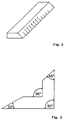
- zeigt einen Kalibrierkörper in Form eines Lineals mit abgeschrägter Seitenkante,
- Figur 3
- zeigt einen Kalibrierkörper in Form eines Winkelmaßes mit zwei Schenkeln, die unter 90° zueinander verlaufen und an ihren Enden mit einer unter 30° bzw. 45° verlaufenden Kante versehen sind,
- Figur 4
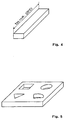
- zeigt einen Kalibrierkörper in Form eines Endmaßes mit einer Länge von 1 m,
- Figur 5
- zeigt ein Eichmaß bzw. eine Lehre mit vier Bohrungen unterschiedlicher Geometrie,
- Figur 6
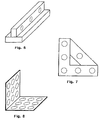
- zeigt ein eindimensionales Koordinatenmaß, das aus zwei platten- bzw. stabförmigen Kalibrierkörperteilen zusammengesetzt ist, so daß sich ein T-förmiger Querschnitt ergibt, mit drei Bohrungen in dem senkrecht stehenden Steg,
- Figur 7
- zeigt ein zweidimensionales Koordinatenmaß, das aus einem Winkel und einer die Enden des Winkels verbindenden Querstrebe aufgebaut ist, wobei sowohl in dem Winkel als auch in der Querstrebe Bohrungen ausgeführt sind, und
- Figur 8
- zeigt ein dreidimensionales Koordinatenmaß, das aus zwei unter einem Winkel von 90° zueinander verlaufenden dünnen Plattenteilen aufgebaut ist, wobei jedes Plattenteil ein Feld von 3 x 3 Bohrungen aufweist.
- Fasern: HTA, Tenax; Hersteller AKZO;
- Gewebe: ST462 (d.h.: Webart: Köper 2/2, Flächengewicht 245 g/m2, Filamentanzahl 3000)
| CFK | C/C | C/C-SiC | |
| Faservolumengehalt | ≈ 52% | 57.5% (evaluiert auf Basis CFK) | 58,5 % (evaluiert auf Basis CFK) |
| Tmax | 210°C | 1650°C | 1650°C |
| Pmax | 8 bar | 1,1 bar | 10-3 bar |
| Masse | 2787 g | 2236 g | 3015 g |
| Volumen | 500 x 500 x 7,5 mm3 | 499 x 499 x 6,7 mm3 | 498 x 498 x 6,75 mm3 |
Wärmeausdehnungskoeffizient
-0,4 10-6 · K-1 < α <- 0,1 · 10-6 · K-1 bei -60°C < T < 100°
Claims (19)
- Kalibrierkörper, der wenigstens teilweise aus einem Kohlenstofffaser-Verbundkörper besteht, wobei der Verbundkörper aus einem porösen Werkstoff aus einer kohlenstoffhaltigen Matrix, in die Kohlenstofffasern eingebettet sind, aufgebaut ist, der mittels Flüssiginfiltration von Si und im Wesentlichen durch dessen Reaktion mit Kohlenstoff gebildetes SiC verdichtet ist, wobei der Gesamtanteil an Si und SiC höchstens 60 Vol.-% beträgt und wobei die Kohlenstofffasern eine Mindestlänge von 3 mm aufweisen.
- Kalibrierkörper nach Anspruch 1, dadurch gekennzeichnet, dass im Verbundkörper der Anteil an freiem Si < 10 Vol.-% beträgt.
- Kalibrierkörper nach Anspruch 2, dadurch gekennzeichnet, dass im Verbundkörper der Anteil an freiem Si < 1 Vol.-% beträgt.
- Kalibrierkörper nach Anspruch 1, dadurch gekennzeichnet, dass im Verbundkörper die Matrixbestandteile eine Korngröße von maximal 100 µm besitzen.
- Kalibrierkörper nach Anspruch 1, dadurch gekennzeichnet, dass die offene Porosität des Verbundkörpers < 5 Vol.-% beträgt.
- Kalibrierkörper nach Anspruch 1, dadurch gekennzeichnet, dass der Verbundkörper das Ausdehnungsverhalten beeinflussende Additive gleichmäßig verteilt enthält.
- Kalibrierkörper nach Anspruch 6, dadurch gekennzeichnet, dass die Additive in Pulverform vorliegen.
- Kalibrierkörper nach Anspruch 7, dadurch gekennzeichnet, dass die Additive Kohlenstoffpulver sind.
- Kalibrierkörper nach Anspruch 7, dadurch gekennzeichnet, dass die Additive SiC-Pulver sind.
- Kalibrierkörper nach Anspruch 1, dadurch gekennzeichnet, dass im Verbundkörper die Kohlenstofffasern in Form von Matten vorliegen.
- Kalibrierkörper nach Anspruch 10, dadurch gekennzeichnet, dass die Matten in gewebter und/oder gewirkter Form vorliegen.
- Kalibrierkörper nach Anspruch 10, dadurch gekennzeichnet, dass sich die Matten in x-y-Ebenenrichtung erstrecken und in z-Richtung übereinandergestapelt sind, wobei die x-, y- und z-Richtungen ein rechtwinkliges Koordinatensystem bilden.
- Kalibrierkörper nach Anspruch 12, dadurch gekennzeichnet, dass die Matten in ihrer Struktur und Anordnung in z-Richtung symmetrisch zu einer Mittenebene angeordnet sind.
- Kalibrierkörper nach Anspruch 13, dadurch gekennzeichnet, dass die Mattenanordnung einen orthotropen Aufbau aufweist.
- Kalibrierkörper nach Anspruch 12, dadurch gekennzeichnet, dass die Matten in einem quasi-isotropen Aufbau so angeordnet sind, dass in z-Richtung die Lagen wechselnd in der x-y-Ebenen-Richtung um 45° mit ihren Faserorientierungen zu den jeweils benachbarten Lagen gedreht sind.
- Kalibrierkörper nach Anspruch 1, dadurch gekennzeichnet, dass im Verbundkörper die Fasern zweidimensional ausgerichtet sind.
- Kalibrierkörper nach Anspruch 1, dadurch gekennzeichnet, dass der Verbundkörper durch thermische Auslagerung in seinen inneren Spannungen, frei von Hysterese-Effekten, minimiert ist.
- Kalibrierkörper nach Anspruch 1, dadurch gekennzeichnet, dass der Verbundkörper einen Kohlenstoffgehalt von 76 Vol.-%, einen Gehalt an SiC von etwa 17 Vol.-%, einen Gehalt an freiem Si etwa von 5 Vol.-% und eine offene Porosität von etwa 2 Vol.-% aufweist.
- Verwendung des Kalibrierkörpers nach einem der Ansprüche 1 bis 18 als Lehre, als Endmaß, als Eichmaß, als Längenmaß, als Lineal, als Winkelmesser oder als Koordinatenmaß.
Applications Claiming Priority (2)
| Application Number | Priority Date | Filing Date | Title |
|---|---|---|---|
| DE10003176 | 2000-01-25 | ||
| DE10003176A DE10003176C2 (de) | 2000-01-25 | 2000-01-25 | Kalibrierkörper und Verwendung desselben |
Publications (2)
| Publication Number | Publication Date |
|---|---|
| EP1124108A1 EP1124108A1 (de) | 2001-08-16 |
| EP1124108B1 true EP1124108B1 (de) | 2003-10-29 |
Family
ID=7628705
Family Applications (1)
| Application Number | Title | Priority Date | Filing Date |
|---|---|---|---|
| EP01101435A Expired - Lifetime EP1124108B1 (de) | 2000-01-25 | 2001-01-23 | Kalibrierkörper |
Country Status (5)
| Country | Link |
|---|---|
| US (2) | US20010022034A1 (de) |
| EP (1) | EP1124108B1 (de) |
| AT (1) | ATE253211T1 (de) |
| DE (3) | DE10003176C2 (de) |
| ES (1) | ES2210041T3 (de) |
Families Citing this family (10)
| Publication number | Priority date | Publication date | Assignee | Title |
|---|---|---|---|---|
| DE10242566A1 (de) * | 2002-09-13 | 2004-03-25 | Sgl Carbon Ag | Faserverstärkte Verbundkeramik und Verfahren zu deren Herstellung |
| DE10315737A1 (de) * | 2003-04-04 | 2004-11-04 | Sgl Carbon Ag | Carbidkeramik-Werkstoff |
| FR2876788B1 (fr) * | 2004-10-15 | 2007-02-23 | Renault Sas | Moyen d'evaluation de performances d'outils de mesure |
| DE102004061438B3 (de) * | 2004-12-17 | 2006-04-06 | Sgl Carbon Ag | Kalibrierkörper, Lehre oder Messeinrichtung, vorzugsweise Gewindemesseinrichtung und Verfahren zur Herstellung derselben |
| DE102006026265B4 (de) * | 2006-06-02 | 2016-03-10 | Benteler Automobiltechnik Gmbh | Vorrichtung zur optischen Vermessung und/oder Überprüfung von Schweißbaugruppen |
| CN100468038C (zh) * | 2007-01-16 | 2009-03-11 | 成都飞机工业(集团)有限责任公司 | 综合检测数控铣床精度的“s”形检测试件及其检测方法 |
| DE102009045515B3 (de) * | 2009-10-09 | 2011-03-03 | Dreier Lasermesstechnik Gmbh | Vorrichtung zur Überprüfung der Genauigkeit von Werkzeugmaschinen und Messeinrichtungen |
| DE102010030552A1 (de) * | 2010-06-25 | 2011-12-29 | Sgl Carbon Se | Verfahren zum Herstellen eines Erzeugnisses und mit dem Verfahren hergestelltes Erzeugnis |
| US10845192B2 (en) * | 2017-09-13 | 2020-11-24 | Shawn Thomas Lause | Machine tool test fixture |
| JP7650597B2 (ja) * | 2021-06-15 | 2025-03-25 | 株式会社ディスコ | 測定治具、動作精度測定システム、及び動作精度測定方法 |
Family Cites Families (25)
| Publication number | Priority date | Publication date | Assignee | Title |
|---|---|---|---|---|
| CH546975A (de) * | 1971-12-23 | 1974-03-15 | ||
| FR2473037A1 (fr) * | 1980-01-02 | 1981-07-10 | Europ Propulsion | Procede de fabrication d'une structure en carbure de silicium et texture multidirectionnelle en carbure de silicium |
| FR2520352B1 (fr) * | 1982-01-22 | 1986-04-25 | Europ Propulsion | Structure composite de type refractaire-refractaire et son procede de fabrication |
| DE3503804A1 (de) * | 1985-02-05 | 1986-08-07 | Schneider & Kern GmbH & Co KG, 7119 Niedernhall | Massverkoerperung aus kohlenstoffaserlaminat |
| DE3503779A1 (de) * | 1985-02-05 | 1986-08-07 | Hochschule für Verkehrswesen "Friedrich List" Dresden, DDR-8010 Dresden | Messband aus faserverstaerktem plast |
| US4737328A (en) * | 1985-07-29 | 1988-04-12 | General Electric Company | Infiltration of material with silicon |
| FR2611198B1 (fr) * | 1987-02-25 | 1991-12-06 | Aerospatiale | Materiau composite a matrice et fibres de renforcement carbonees et son procede de fabrication |
| DD262275A1 (de) * | 1987-07-01 | 1988-11-23 | Verkehrswesen Hochschule | Massstabtraeger aus kohlenstoffaserverstaerktem plast |
| JP2722198B2 (ja) * | 1988-03-31 | 1998-03-04 | 日本石油株式会社 | 耐酸化性を有する炭素/炭素複合材料の製造法 |
| US5020357A (en) * | 1989-08-18 | 1991-06-04 | N. K. Biotechnical Engineering Company | Calibration stand for sensor |
| DE3930223A1 (de) * | 1989-09-11 | 1991-03-14 | Wild Leitz Messtechnik | Pruefkoerper fuer koordinatenmessgeraete aus stabsegmenten |
| DD290254A5 (de) * | 1989-12-05 | 1991-05-23 | Hochschule Fuer Verkehrswesen "Friedrich List" Dresden,De | Mass-, form- und lageverkoerperungen aus faserverbundwerkstoffen |
| DD290255A5 (de) * | 1989-12-05 | 1991-05-23 | Hochschule Fuer Verkehrswesen "Friedrich List" Dresden,De | Lehre, vorzugsweise fuer grosse laengen |
| US5095632A (en) * | 1990-06-15 | 1992-03-17 | Parker Hannifin Corporation | Composite structure unidirectionally stable with respect to thermal and moisture expansion |
| FR2664889B1 (fr) * | 1990-07-17 | 1992-09-25 | Lorraine Carbone | Support poreux de membrane filtrante en composite carbone-carbone a substrat en mat de fibres de carbone et son procede de fabrication. |
| FR2668479B1 (fr) * | 1990-10-24 | 1993-10-01 | Aerospatiale Ste Nationale Indle | Piece en materiau composite carbone, protegee contre l'oxydation et son procede de fabrication. |
| FR2687998A1 (fr) * | 1992-02-28 | 1993-09-03 | Aerospatiale | Procede de fabrication d'une piece en materieu composite carbone/carbone utilisant de la poudre de mesophase. |
| US5253431A (en) * | 1992-09-22 | 1993-10-19 | Smith Quintin R | Linear measurement device |
| JPH06249767A (ja) * | 1993-02-26 | 1994-09-09 | Mitsubishi Heavy Ind Ltd | 3次元複合材試験片 |
| IT1261383B (it) * | 1993-12-21 | 1996-05-20 | Antonio Critelli | Metodo di misura dimensionale e campione di riferimento per l'attuazione di tale metodo. |
| DE4409377A1 (de) * | 1994-03-18 | 1995-09-21 | Jaehrig Heinz Peter Dr Ing | Wärmebeständiges, verschleißfestes Material und Verfahren zu seiner Herstellung |
| DE19642506C1 (de) * | 1996-10-15 | 1997-10-23 | Sibco Gmbh | Erzeugnis auf der Basis von Kohlenstoff und Kohlenfaserstoffen, Karbiden und/oder Di-Karbiden und Verfahren zu seiner Herstellung sowie Verwendung des Erzeugnisses |
| DE19720883A1 (de) * | 1997-05-17 | 1998-11-19 | Eugen Dr Trapet | Demontierbarer Prüfkörper in Form eines Tetraeders |
| DE19837768A1 (de) * | 1998-08-20 | 2000-03-09 | Ecm Ingenieur Unternehmen Fuer | Verfahren zur Herstellung von hochsteifen Leichtgewichtstrukturen (Meß- u. Spanntische, Meßbänke, Führungsschienen und -bahnen, Maschinenbetten u. -tische) insb. für Meß-, Spann- u. Bearbeitungszwecke aus faservertärkter Keramik |
| US6277440B1 (en) * | 1998-11-23 | 2001-08-21 | Msnw, Inc. | Preparation of ceramic matrix composites by infiltration of fibrous preforms with fluids or slurries and subsequent pyrolysis |
-
2000
- 2000-01-25 DE DE10003176A patent/DE10003176C2/de not_active Expired - Lifetime
-
2001
- 2001-01-23 EP EP01101435A patent/EP1124108B1/de not_active Expired - Lifetime
- 2001-01-23 AT AT01101435T patent/ATE253211T1/de not_active IP Right Cessation
- 2001-01-23 ES ES01101435T patent/ES2210041T3/es not_active Expired - Lifetime
- 2001-01-23 DE DE50100848T patent/DE50100848D1/de not_active Expired - Lifetime
- 2001-01-25 US US09/769,172 patent/US20010022034A1/en not_active Abandoned
-
2003
- 2003-07-23 US US10/625,043 patent/US6833163B1/en not_active Expired - Fee Related
-
2005
- 2005-04-07 DE DE102005016139A patent/DE102005016139A1/de not_active Withdrawn
Also Published As
| Publication number | Publication date |
|---|---|
| DE10003176A1 (de) | 2001-08-09 |
| DE10003176C2 (de) | 2001-11-22 |
| DE50100848D1 (de) | 2003-12-04 |
| US6833163B1 (en) | 2004-12-21 |
| ATE253211T1 (de) | 2003-11-15 |
| ES2210041T3 (es) | 2004-07-01 |
| US20010022034A1 (en) | 2001-09-20 |
| DE102005016139A1 (de) | 2005-11-10 |
| EP1124108A1 (de) | 2001-08-16 |
Similar Documents
| Publication | Publication Date | Title |
|---|---|---|
| EP1124108B1 (de) | Kalibrierkörper | |
| DE69706587T2 (de) | Keramikmatrix-Verbundwerkstoff und Verfahren zur Herstellung desselben | |
| DE69219240T2 (de) | Faserverstärkter Verbundwerkstoff mit über der Breite der Basisschicht stufenlos veränderter Faserdichte, und Verfahren zur Herstellung | |
| DE69309109T2 (de) | Verfahren zur herstellung von gegenständen aus kohlenstoffsiliziumkarbid-verbundwerkstoff, und kohlenstoff-siliziumkarbid-verbundwerkstoff | |
| DE69602929T2 (de) | Durch selbstheilende matrix oxidationsgeschütztes verbundmaterial und verfahren zu seiner herstellung | |
| Ghazanfari et al. | Mechanical characterization of parts produced by ceramic on‐demand extrusion process | |
| DE69101397T2 (de) | Verbundartikel hergestellt aus faserverstärktem Glas-Bindemittel und Glas-keramischem Bindemittel. | |
| DE69107282T2 (de) | Verfahren zum Schutz eines Kohlenstoff enthaltenden Verbundwerkstoffes gegen Oxydation und der so geschützte Werkstoff. | |
| DE69524432T2 (de) | Faserverbundkörper auf keramikbasis | |
| EP1338583B1 (de) | Faserverbundkeramik mit hoher Wärmeleitfähigkeit | |
| EP3368304A1 (de) | Carbonfaserverstärktes carbidkeramisches verbundbauteil | |
| EP2799412B1 (de) | Monolithische keramiken mit gewebegitter-verstärkung | |
| EP0987096B1 (de) | Leichtgewichtsstruktur | |
| EP0342268A2 (de) | Langgestreckter Gegenstand hoher Formbeständigkeit und geringer Wärmeausdehnung | |
| DE19749462C1 (de) | Verfahren zur Herstellung eines mit Kohlenstoff-Fasern verstärkten, keramisierten Formkörpers und Verwendung eines solchen Formkörpers | |
| DE69806333T2 (de) | Faserverbundwerkstoff und seine Verwendung | |
| DE4012229A1 (de) | Faserverstaerktes keramisches grundmaterial-verbundstoff-bauteil und verfahren zu seiner herstellung | |
| WO1994027819A1 (de) | Verbundsysteme mit mindestens zwei anorganischen keramischen schichten und verfahren zu deren herstellung | |
| DE102015212290A1 (de) | Wärmedämmstoff | |
| DE69003656T2 (de) | Verfahren zur Herstellung eines Verbundwerkstoffteils, insbesondere mit einer Kohle- oder Feuerfestfaserstruktur und Kohle- oder Keramikmatrix. | |
| DE3620178A1 (de) | Hilfsvorrichtung zum brennen von keramik | |
| DE69408427T2 (de) | Dimensionsmessverfahren und Eichmass für dieses Verfahren | |
| DE4034915C2 (de) | ||
| DE202005005574U1 (de) | Kalibrierkörper | |
| EP1824797B1 (de) | Kalibrierkörper, lehre oder messeinrichtung, vorzugsweise gewindemesseinrichtung und verfahren zur herstellung derselben |
Legal Events
| Date | Code | Title | Description |
|---|---|---|---|
| PUAI | Public reference made under article 153(3) epc to a published international application that has entered the european phase |
Free format text: ORIGINAL CODE: 0009012 |
|
| AK | Designated contracting states |
Kind code of ref document: A1 Designated state(s): AT BE CH CY DE DK ES FI FR GB GR IE IT LI LU MC NL PT SE TR |
|
| AX | Request for extension of the european patent |
Free format text: AL;LT;LV;MK;RO;SI |
|
| 17P | Request for examination filed |
Effective date: 20020104 |
|
| AKX | Designation fees paid |
Free format text: AT BE CH CY DE DK ES FI FR GB GR IE IT LI LU MC NL PT SE TR |
|
| 17Q | First examination report despatched |
Effective date: 20020529 |
|
| GRAH | Despatch of communication of intention to grant a patent |
Free format text: ORIGINAL CODE: EPIDOS IGRA |
|
| GRAS | Grant fee paid |
Free format text: ORIGINAL CODE: EPIDOSNIGR3 |
|
| GRAA | (expected) grant |
Free format text: ORIGINAL CODE: 0009210 |
|
| AK | Designated contracting states |
Kind code of ref document: B1 Designated state(s): AT BE CH CY DE DK ES FI FR GB GR IE IT LI LU MC NL PT SE TR |
|
| PG25 | Lapsed in a contracting state [announced via postgrant information from national office to epo] |
Ref country code: CY Free format text: LAPSE BECAUSE OF FAILURE TO SUBMIT A TRANSLATION OF THE DESCRIPTION OR TO PAY THE FEE WITHIN THE PRESCRIBED TIME-LIMIT Effective date: 20031029 Ref country code: TR Free format text: LAPSE BECAUSE OF FAILURE TO SUBMIT A TRANSLATION OF THE DESCRIPTION OR TO PAY THE FEE WITHIN THE PRESCRIBED TIME-LIMIT Effective date: 20031029 Ref country code: NL Free format text: LAPSE BECAUSE OF FAILURE TO SUBMIT A TRANSLATION OF THE DESCRIPTION OR TO PAY THE FEE WITHIN THE PRESCRIBED TIME-LIMIT Effective date: 20031029 Ref country code: IE Free format text: LAPSE BECAUSE OF FAILURE TO SUBMIT A TRANSLATION OF THE DESCRIPTION OR TO PAY THE FEE WITHIN THE PRESCRIBED TIME-LIMIT Effective date: 20031029 Ref country code: FI Free format text: LAPSE BECAUSE OF FAILURE TO SUBMIT A TRANSLATION OF THE DESCRIPTION OR TO PAY THE FEE WITHIN THE PRESCRIBED TIME-LIMIT Effective date: 20031029 |
|
| REG | Reference to a national code |
Ref country code: GB Ref legal event code: FG4D Free format text: NOT ENGLISH |
|
| REG | Reference to a national code |
Ref country code: CH Ref legal event code: EP |
|
| REG | Reference to a national code |
Ref country code: IE Ref legal event code: FG4D Free format text: GERMAN |
|
| REF | Corresponds to: |
Ref document number: 50100848 Country of ref document: DE Date of ref document: 20031204 Kind code of ref document: P |
|
| PG25 | Lapsed in a contracting state [announced via postgrant information from national office to epo] |
Ref country code: LU Free format text: LAPSE BECAUSE OF NON-PAYMENT OF DUE FEES Effective date: 20040123 Ref country code: AT Free format text: LAPSE BECAUSE OF NON-PAYMENT OF DUE FEES Effective date: 20040123 |
|
| PG25 | Lapsed in a contracting state [announced via postgrant information from national office to epo] |
Ref country code: GR Free format text: LAPSE BECAUSE OF FAILURE TO SUBMIT A TRANSLATION OF THE DESCRIPTION OR TO PAY THE FEE WITHIN THE PRESCRIBED TIME-LIMIT Effective date: 20040129 Ref country code: DK Free format text: LAPSE BECAUSE OF FAILURE TO SUBMIT A TRANSLATION OF THE DESCRIPTION OR TO PAY THE FEE WITHIN THE PRESCRIBED TIME-LIMIT Effective date: 20040129 |
|
| PG25 | Lapsed in a contracting state [announced via postgrant information from national office to epo] |
Ref country code: MC Free format text: LAPSE BECAUSE OF NON-PAYMENT OF DUE FEES Effective date: 20040131 Ref country code: BE Free format text: LAPSE BECAUSE OF NON-PAYMENT OF DUE FEES Effective date: 20040131 |
|
| REG | Reference to a national code |
Ref country code: SE Ref legal event code: TRGR |
|
| REG | Reference to a national code |
Ref country code: CH Ref legal event code: NV Representative=s name: PATENTANWAELTE BREITER + WIEDMER AG |
|
| NLV1 | Nl: lapsed or annulled due to failure to fulfill the requirements of art. 29p and 29m of the patents act | ||
| GBT | Gb: translation of ep patent filed (gb section 77(6)(a)/1977) |
Effective date: 20040324 |
|
| REG | Reference to a national code |
Ref country code: IE Ref legal event code: FD4D |
|
| REG | Reference to a national code |
Ref country code: ES Ref legal event code: FG2A Ref document number: 2210041 Country of ref document: ES Kind code of ref document: T3 |
|
| ET | Fr: translation filed | ||
| BERE | Be: lapsed |
Owner name: DEUTSCHES *ZENTRUM FUR LUFT- UND RAUMFAHRT E.V. Effective date: 20040131 |
|
| PLBE | No opposition filed within time limit |
Free format text: ORIGINAL CODE: 0009261 |
|
| STAA | Information on the status of an ep patent application or granted ep patent |
Free format text: STATUS: NO OPPOSITION FILED WITHIN TIME LIMIT |
|
| 26N | No opposition filed |
Effective date: 20040730 |
|
| REG | Reference to a national code |
Ref country code: CH Ref legal event code: PFA Owner name: DEUTSCHES ZENTRUM FUER LUFT- UND RAUMFAHRT E.V Free format text: DEUTSCHES ZENTRUM FUER LUFT- UND RAUMFAHRT E.V# #53127 BONN (DE) -TRANSFER TO- DEUTSCHES ZENTRUM FUER LUFT- UND RAUMFAHRT E.V# #53127 BONN (DE) |
|
| PG25 | Lapsed in a contracting state [announced via postgrant information from national office to epo] |
Ref country code: PT Free format text: LAPSE BECAUSE OF NON-PAYMENT OF DUE FEES Effective date: 20040329 |
|
| PGFP | Annual fee paid to national office [announced via postgrant information from national office to epo] |
Ref country code: IT Payment date: 20120123 Year of fee payment: 12 |
|
| PGFP | Annual fee paid to national office [announced via postgrant information from national office to epo] |
Ref country code: GB Payment date: 20121228 Year of fee payment: 13 |
|
| PGFP | Annual fee paid to national office [announced via postgrant information from national office to epo] |
Ref country code: CH Payment date: 20130129 Year of fee payment: 13 Ref country code: ES Payment date: 20130115 Year of fee payment: 13 Ref country code: FR Payment date: 20130128 Year of fee payment: 13 Ref country code: DE Payment date: 20130131 Year of fee payment: 13 Ref country code: SE Payment date: 20130108 Year of fee payment: 13 |
|
| REG | Reference to a national code |
Ref country code: DE Ref legal event code: R119 Ref document number: 50100848 Country of ref document: DE |
|
| REG | Reference to a national code |
Ref country code: CH Ref legal event code: PL |
|
| REG | Reference to a national code |
Ref country code: SE Ref legal event code: EUG |
|
| GBPC | Gb: european patent ceased through non-payment of renewal fee |
Effective date: 20140123 |
|
| REG | Reference to a national code |
Ref country code: DE Ref legal event code: R119 Ref document number: 50100848 Country of ref document: DE Effective date: 20140801 |
|
| PG25 | Lapsed in a contracting state [announced via postgrant information from national office to epo] |
Ref country code: DE Free format text: LAPSE BECAUSE OF NON-PAYMENT OF DUE FEES Effective date: 20140801 Ref country code: CH Free format text: LAPSE BECAUSE OF NON-PAYMENT OF DUE FEES Effective date: 20140131 Ref country code: LI Free format text: LAPSE BECAUSE OF NON-PAYMENT OF DUE FEES Effective date: 20140131 |
|
| REG | Reference to a national code |
Ref country code: FR Ref legal event code: ST Effective date: 20140930 |
|
| PG25 | Lapsed in a contracting state [announced via postgrant information from national office to epo] |
Ref country code: FR Free format text: LAPSE BECAUSE OF NON-PAYMENT OF DUE FEES Effective date: 20140131 Ref country code: GB Free format text: LAPSE BECAUSE OF NON-PAYMENT OF DUE FEES Effective date: 20140123 Ref country code: SE Free format text: LAPSE BECAUSE OF NON-PAYMENT OF DUE FEES Effective date: 20140124 |
|
| REG | Reference to a national code |
Ref country code: ES Ref legal event code: FD2A Effective date: 20150731 |
|
| PG25 | Lapsed in a contracting state [announced via postgrant information from national office to epo] |
Ref country code: ES Free format text: LAPSE BECAUSE OF NON-PAYMENT OF DUE FEES Effective date: 20140124 |
|
| PG25 | Lapsed in a contracting state [announced via postgrant information from national office to epo] |
Ref country code: IT Free format text: LAPSE BECAUSE OF NON-PAYMENT OF DUE FEES Effective date: 20140123 |