EP1124137A2 - Gekühlter NMR-Probenkopf mit Vorrichtung zur Zentrierung der Messprobe - Google Patents
Gekühlter NMR-Probenkopf mit Vorrichtung zur Zentrierung der Messprobe Download PDFInfo
- Publication number
- EP1124137A2 EP1124137A2 EP01101311A EP01101311A EP1124137A2 EP 1124137 A2 EP1124137 A2 EP 1124137A2 EP 01101311 A EP01101311 A EP 01101311A EP 01101311 A EP01101311 A EP 01101311A EP 1124137 A2 EP1124137 A2 EP 1124137A2
- Authority
- EP
- European Patent Office
- Prior art keywords
- room temperature
- tube
- sample tube
- probe head
- sample
- Prior art date
- Legal status (The legal status is an assumption and is not a legal conclusion. Google has not performed a legal analysis and makes no representation as to the accuracy of the status listed.)
- Granted
Links
Images


Classifications
-
- G—PHYSICS
- G01—MEASURING; TESTING
- G01R—MEASURING ELECTRIC VARIABLES; MEASURING MAGNETIC VARIABLES
- G01R33/00—Arrangements or instruments for measuring magnetic variables
- G01R33/20—Arrangements or instruments for measuring magnetic variables involving magnetic resonance
- G01R33/28—Details of apparatus provided for in groups G01R33/44 - G01R33/64
- G01R33/30—Sample handling arrangements, e.g. sample cells, spinning mechanisms
-
- G—PHYSICS
- G01—MEASURING; TESTING
- G01R—MEASURING ELECTRIC VARIABLES; MEASURING MAGNETIC VARIABLES
- G01R33/00—Arrangements or instruments for measuring magnetic variables
- G01R33/20—Arrangements or instruments for measuring magnetic variables involving magnetic resonance
- G01R33/28—Details of apparatus provided for in groups G01R33/44 - G01R33/64
- G01R33/32—Excitation or detection systems, e.g. using radio frequency signals
- G01R33/34—Constructional details, e.g. resonators, specially adapted to MR
- G01R33/34015—Temperature-controlled RF coils
- G01R33/34023—Superconducting RF coils
Definitions
- NMR nuclear magnetic resonance
- HF high frequency
- Such a cooled NMR probe head is known, for example, from US Pat US-A 5,247,256 or US-A 5,689,187.
- the probe head is installed in a magnet to generate a highly homogeneous, static B 0 field and contains RF reception coils arranged around a z-axis, which are cooled down to temperatures of approx. 10 - 25 K during operation by means of suitable heat exchangers and heat conduction elements to improve the signal-to-noise ratio of the received NMR signal during the measurement.
- the RF receiving coils are located in an evacuated space, which is essentially formed by a generally metallic housing of the sample head, which is broken through by a room temperature tube arranged cylindrically around the z-axis for receiving a sample tube.
- the otherwise normally metallic room temperature tube in the axial area of the coils is replaced by an RF-permeable inner tube, usually a glass tube, which connects vacuum-tight to the metallic parts of the room temperature tube.
- the sample tube is inserted after insertion into the room temperature pipe from below using a warm air flow through the room temperature pipe essentially at a desired temperature (usually about 300 K).
- a desired temperature usually about 300 K.
- the problem arises that the Measurement sample the considerably cooler environment of the cooled to 10 - 25 K. NMR resonators "see” and radiate their heat there in the radial direction. This outgoing heat must continuously from the rising warm tempering air flow be fed back so that the measurement sample essentially remains at the desired temperature. This process now has the consequence that an axial and radial temperature gradient arises in the test sample, which is the NMR measurement is very disturbing.
- the object of the present invention is therefore a cooled NMR probe head with the features mentioned at the beginning, with the as simple as possible technical means the occurring temperature gradients are significantly reduced in operation without impairing the NMR measurement becomes.
- this task is as surprisingly simple as effective way solved in that a centering device for Centering of the sample tube in the measuring position around the axis of the room temperature tube is provided, the one or more between the room temperature pipe and the sample tube arranged exclusively radially to the Z-axis of the room temperature tube acting spacers.
- the NMR probe heads according to the invention include those with exchangeable sample tubes also so-called flow heads, in which the sample tube remains permanently installed and the liquid to be examined through a thin pipe on one side (below) and on the other side (above).
- Such probes can both in continuous flow as well as in flow and stop mode (for one extended measurement period) can be used.
- These probes are one hand used for a quick sample introduction, on the other hand also as one Very meaningful analysis stage, that of a liquid chromatography separation cell is connected downstream. In the former case one speaks of flow probes, in the second by LC-NMR coupling.
- Such probes are also referred to as LC heads (Liquid Chromatography, in particular also HPLC (High Pressure Liquid Chromatography).
- Such probe heads can in particular Dimensions from cryo technology and therefore from those according to the invention Modifications benefit.
- the transverse temperature gradients radial to the z-axis which occur when a cooled NMR probe head can occur and is essentially responsible for the instabilities in the spectrum as well as in the lock system result from the integration of the local axial temperature gradients from the bottom of the Sample from to the point under consideration along z.
- the local axial temperature gradients are the product of the heat loss per unit area and the local reciprocal of the mass flow of temperature control gas. This mass flow distribution depends on the asymmetry and the angular deviation the axis of the sample tube from the z-axis of the room temperature tube.
- the spacers can be located in the area of the bottom of the sample tube Measuring position and / or in the area of the filling opening of the room temperature pipe on the side of the room temperature tube facing the sample tube to be appropriate.
- the spacers can also extend over the entire axial
- the length of the RF receiving coil system thus extends as accurately as possible Centering the sample tube in the room temperature tube.
- the NMR probe head according to the invention are several, preferably between 3 and 8, in particular 6 spacers symmetrically distributed around the z-axis of the room temperature pipe arranged around. So far, the best results have been achieved.
- the spacers point in the direction the z-axis extended strips are made of resilient material that rigid at its end facing away from the sample glass in its measuring position are connected to the room temperature tube, and which on their the sample tube in its measuring position facing end one for the sample glass have bulged beads, the free leg of the room temperature pipe is present.
- the centering device is particularly simple and inexpensive to manufacture and can be easily retrofitted in already existing NMR probes can be installed.
- the spacers should be made from one transparent for the HF radiation, if possible also magnetic compensated material.
- the spacers consist of sheet metal strips with a thickness of about 100 ⁇ m and a width transverse to the z-axis of about 0.5mm to 2mm, preferably about 1mm.
- a particularly preferred embodiment of the NMR probe head according to the invention provides that between the RF receiving coil system and the room temperature pipe surrounding the room temperature pipe in the radial direction, Extended radiation shields are arranged in the z direction, which constructed from one or more materials oriented in the z direction are almost completely transparent to RF fields, or at least one Have absorption ⁇ 5%, preferably ⁇ 1% for RF fields.
- the RF coils and the room temperature radiation shield only materials that have an orientation in the z direction have.
- the axial alignment of the radiation shield material prevents that their finite susceptibility deteriorates the resolution of the NMR signals.
- the materials should have their physical properties forth in the area of high-frequency radiation as transparent as possible his. Most of the time, the latter material property has to be bought with it be that not too high a reflection of the heat loss to the test sample can be expected there.
- the former Wavelength range corresponds to heat radiation at a temperature between approx. 20 K to 300 K, which is the temperature difference between the test sample and equals the cooled NMR coils during the second wavelength range corresponds to radiation with a frequency above 3 GHz, while the RF range between some important for NMR measurements MHz is below about 1GHz.
- the radiation shields of the NMR probe head according to the invention could theoretically designed as coaxial around the room temperature pipe his.
- the pipe material is usually too thick exhibit.
- the orientation of the film along the z-axis can be, for example, by Mechanical tensile stress can be produced. Is preferred in contrast, an embodiment in which the radiation shields from one unidirectional tissues are constructed. Such unidirectional tissue suitable materials are readily available commercially.
- These fabrics preferably consist of fiber mats, in particular glass fiber mats, made of fibers with diameters of less than 10 ⁇ m are and have a total thickness of about 30 microns.
- fiber mats in particular glass fiber mats, made of fibers with diameters of less than 10 ⁇ m are and have a total thickness of about 30 microns.
- a radial one Sequence of cylindrical single radiation shields can be used of such glass fiber mats also to a helical wrapping of the room temperature pipe on its vacuum side in several layers be thought.
- the radiation shields are from aligned in the z direction, radially around the axis of the room temperature pipe arranged rods or fibers, preferably glass fibers and / or quartz fibers.
- Such fibers have diameters between 10 and 50 ⁇ m commercially available.
- glass filaments with diameters of less than 5 ⁇ m, which are difficult to process should be.
- the radiation shields are made of fiber bundles built up, the overall then a slightly higher mechanical Have stability than the individual filaments and therefore in their processing similar to how bars are easier to handle.
- the rods or fibers can be arranged loosely in space and only be attached to their ends.
- the rods or fibers can also be connected to the room temperature pipe Coaxially arranged carrier tube, preferably on the RF receiving coil system facing side of the room temperature pipe itself attached his.
- the rods or fibers are on the carrier tube or on the room temperature pipe with an adhesive that is transparent to HF radiation attached so that no attenuation of the RF radiation from the test sample the RF receiving coil is due to the gluing.
- rods or fibers are circumferential is also advantageous tightly packed around the axis of the room temperature pipe are arranged so that there is no "optical view" in the radial direction. In this way, the rods or fibers each form one in the circumferential direction coherent radiation shield.
- An embodiment of the invention is also particularly preferred NMR probe head, between the RF receiving coil system and the sample tube a surrounding the sample tube in the radial direction, Extended tempering device is arranged in the z direction, which is preferably constructed of material with high thermal conductivity and for RF fields is almost completely transparent, but at least an absorption ⁇ 5%, preferably ⁇ 1% for RF fields.
- a conventional heated airflow occurs without the inventive one Heater usually at the bottom of the sample tube into the room temperature pipe, from then on it gives off its heat to the Sample tube and cools in the axial direction when rising ever further.
- the temperature of the heated air flow in the upper area of the sample tube will therefore always be smaller than that in the lower area, which inevitably changes the temperature control in the upper area of the Sample tube reduced.
- an axial temperature gradient always arises, which increases by increasing the amount of air per unit of time can be reduced somewhat, but in principle cannot be prevented.
- there are narrow limits to the corresponding countermeasures because if the air volume is too large per unit of time, a vibration-free position or clean rotation of the sample tube can no longer be guaranteed.
- the Temperature control device a the sample tube in the axial area of the RF receiving coil system radially surrounding layer with a radial thickness ⁇ 1mm, preferably ⁇ 50 ⁇ m, which is made of material which Radiation in a wavelength range 100nm ⁇ ⁇ ⁇ 100 ⁇ m at least partially absorbed, and which for radiation in a wavelength range ⁇ > 100mm is transparent.
- a heater is preferred for uniform heating of the layer provided in the NMR probe head according to the invention.
- heating device a device for irradiating the layer with radiation from the wavelength range 100nm ⁇ ⁇ ⁇ 100 ⁇ m, especially with thermal radiation, preferably on the one facing the RF receiving coil system Side of the room temperature pipe is arranged.
- the radiation-absorbing heating layer can cover the room temperature pipe surround.
- the layer can also be around the room temperature pipe around in the axially extending, circumferentially spaced apart Strips may be arranged.
- a development in which the layer is electrically conductive is particularly preferred and can be heated by applying an electrical voltage.
- the temperature control device one or more heating loops made of thin comprises in particular layered, electrically highly conductive material, the each have a forward and a return conductor, the forward and return conductors the heating loops are electrically connected at one end and can be fed with heating current from a power source at the other end.
- the forward and return conductors of the heating loops are particularly preferably bifilar the smallest possible distance from each other to form a to keep disturbing magnetic field as low as possible when current flows.
- the forward and return conductors of the heating loops consist of two superimposed elongated strips consist of a Insulating layer or an insulating strip are electrically isolated from each other.
- the temperature control device can be constructed so that one or several heating loops arranged helically around the room temperature pipe are.
- heating loops can also be used at a distance from each other in the circumferential direction around the z-axis of the room temperature pipe are arranged around and parallel to the z-direction extend.
- the heating loops are advantageously spatially oriented so that their coupling to the RF receiving coil system is minimal.
- the heating loops from a material which is as good an electrical conductor as possible (for example Cu), the conductors having rectangular, preferably square or circular cross sections (typically of the order of magnitude of 10 ⁇ m ⁇ 10 ⁇ m or smaller ).
- the room temperature tube remains very permeable to the HF fields, and the HF losses are kept very low due to both the small surfaces of the heating conductors and the good electrical (and therefore HF) conductivity .
- a low-pass filter can be placed between the power source and the heating loops be provided in order to avoid signal carryover and residual attenuation to keep low.
- a further development is also preferred, in which between the current source and the heating loops a parallel resonant circuit is provided, the resonance frequency at the most sensitive RF frequency relevant for the NMR measurement lies.
- a blocking circuit also prevents the transmission of Interference signals to the RF receiving coil system and minimizes unwanted Coupling of the RF signals through the heating loops.
- the current source is the Heating loop fed with alternating current.
- the angular frequency is chosen so that the emerging sidebands only outside the observed NMR spectral window.
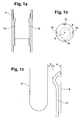
- Figures 1a to 1c show a preferred embodiment of the invention NMR probe head with a centering device shown in Embodiment four spacers distributed symmetrically about the z-axis 10 includes. Thanks to the clean centering of the sample tube 6 within the room temperature tube 4 can convection currents and thus the formation of temperature gradients within the sample substance 7 can be avoided.
- the inside diameter is clear the room temperature tube 4 in the area of the inner tube 5 at approximately 5.6 mm, while commonly used sample tubes 6 have an outer diameter of 5.0 mm.
- This results from the outer wall of the sample tube 6 to the inner wall of the inner tube 5 an average distance a + b 0.3 mm.
- the remaining distance b remains at easy insertion and rotation of the sample tube, which is as contact-free as possible 6 in the room temperature tube 4.
- a should be of the order of magnitude of 0.2 mm, b are about 0.1 mm. Using these values can already be significant Obtain improvements in radial temperature gradients become.
- Fig. 2 is a section of an NMR probe head according to the State of the art shown, in the case of a sample tube 6 radially in the direction to the RF receiving coil system 1 by radiation heat flows Q go off because the receiving coil system 1 at a cryogenic temperature of approximately 25 K is maintained, while the sample tube 6 by means of the Temperature-controlled air flow 8 supplied from below to approximately room temperature to be held. Due to the heat radiation from the sample tube 6 arises taking into account that with the tempering current 8 supplied heat a temperature curve in the axial direction within the Sample tube 6, as shown schematically on the right side of FIG. 2 is.
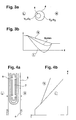
- transverse gradients can also be used occur when the sample tube 6 is not exactly in the middle of the Room temperature tube 4 is placed, as in Fig. 3a in a horizontal section shown schematically.
- the middle part 5 of the room temperature pipe 4 made of good heat-conducting material. This allows the transversal Temperature gradients (x-y direction) can be greatly reduced. It however, only materials are considered whose absorption for HF radiation is negligible and at the same time the required high thermal conductivity to have. Specifically, sapphire is a suitable material here.
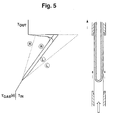
- Fig. 5 the situation is without good heat conduction (dashed) and with good Heat conduction (solid) of the room temperature tube 4, in particular the Inner tube 5 shown.
- the temperature curve along the z-axis can be (apart from averaging the two extremes) practically not influence. Only the temperature curve just before the upper clamping point the sample tube 6 can be lifted.
- a linear temperature gradient can by heat-conducting measures on the room temperature pipe 4 alone cannot be eliminated.
- FIG. 6 is a schematic vertical cross section of an NMR probe head according to the invention with a temperature control device 11 in the axial area of the inner tube 5 of a room temperature tube 4 and the associated temperature profile shown along the z-axis.
- the temperature control device 11 can for example by an electrical heater and / or by a radiant heater corresponding area on the room temperature pipe 4 in the area of the inner pipe 5 can be realized with the aid of a heating device 19.
- the one shown on the right in the picture Temperature curve along the z-axis shows in the solid line the situation without temperature control and dashed the situation with a regulated temperature control, where an almost constant temperature along the entire z-axis can be observed.
- NMR probe head has an RF receiving coil system 1, which symmetrical to a z-axis around an axially extending room temperature tube 4 is arranged, which serves to hold a sample tube 6, the one Contains sample substance 7, which are examined with the aid of NMR measurements should.
- the HF reception coil system 1 is mounted on heat conduction elements 2, which are used to cool the HF reception coil system 1 to cryogenic temperatures, generally T 1 ⁇ 25 K.
- the room temperature tube 4 is connected in its upper and lower section to a housing 3 of the NMR probe head, while in its middle section it has an inner tube 5 (usually made of glass) which is permeable to HF fields.
- the sample tube 6 projecting axially into the room temperature tube 4 is kept at the desired temperature during the measurements by means of a gas stream 8, which is approximately at room temperature T 2 ⁇ 300 K.
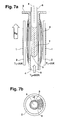
- FIGS. 7a and 7b there are between the receiving coil system 1 and the room temperature tube 4 a plurality of radiation shields 9 arranged, which surround the room temperature tube 4 in the radial direction and are extended along the z-axis.
- the radiation shields 9 are off in the z direction aligned materials, which are almost completely for HF fields are transparent.
- the radiation shields 9 are in the radial direction from one another spaced and do not touch or at least only touch each other or linear, as can be clearly seen in Fig. 7b. They have a radial thickness ⁇ 0.1 mm, preferably ⁇ 50 ⁇ m.
- As the preferred material for the radiation shields 9 glass or quartz is used.
- the radiation shields 9 from a unidirectional film unidirectional fabric, especially made of glass fiber mats or axial extending rods or fibers, preferably glass or quartz fibers or Fiber bundles should be built up.
- the radiation shields 9 can be arranged loosely in space and only at their ends attached or, as in the embodiment shown on the room temperature pipe 4 be attached.
- FIGS. 6, 7a and 7b show the invention used centering device not shown. You can according to one of the Types described above can be realized.
Landscapes
- Physics & Mathematics (AREA)
- Condensed Matter Physics & Semiconductors (AREA)
- General Physics & Mathematics (AREA)
- Investigating Or Analyzing Materials Using Thermal Means (AREA)
- Magnetic Resonance Imaging Apparatus (AREA)
Abstract
Description
- Fig. 1a
- einen schematischen Vertikalschnitt durch eine erfindungsgemäße Anordnung mit Zentriervorrichtung;
- Fig. 1b
- einen Horizontalschnitt durch eine Anordnung nach Fig.1a;
- Fig. 1c
- eine vergrößerte Detaildarstellung der Anordnung nach Fig. 1a mit Probenröhrchen in Meßposition;
- Fig. 2
- einen schematischen Vertikalschnitt durch einen gekühlten NMR-Probenkopf nach dem Stand der Technik mit zugehörigem Temperaturverlauf in Richtung der z-Achse;
- Fig. 3a
- einen schematischen Horizontalschnitt durch eine Anordnung mit asymmetrisch in das Raumtemperaturrohr eingeführtem Probenröhrchen;
- Fig. 3b
- die zur Anordnung nach Fig. 3a zugehörige Temperaturverteilung in z-Richtung;
- Fig. 4a
- einen schematischen Vertikalschnitt durch ein Raumtemperaturrohr mit asymmetrisch eingeführtem Probenröhrchen und angedeuteten Konvektionsströmungen innerhalb der Meßprobe;
- Fig. 4b
- die zugehörigen Temperaturverläufe in Richtung der z-Achse auf der linken und der rechten Seite der Anordnung von Fig. 4a;
- Fig. 5
- ein Schema des Temperaturverlaufs des Temperiergases in Richtung der z-Achse bei asymmetrisch in das Raumtemperaturrohr eingeführtem Probenröhrchen und einer gut wärmeleitenden Innenseite des Raumtemperaturrohres im Bereich der HF-Empfangsspulen;
- Fig. 6
- einen schematischen Vertikalschnitt durch eine erfindungsgemäße Anordnung mit Temperiereinrichtung und den zugehörigen Temperaturverlauf längs der z-Achse.
- Fig.7a
- einen schematischen Vertikalschnitt durch einen erfindungsgemäßen NMR-Probenkopf mit Wärmeschilden zwischen Raumtemperaturrohr und HF-Empfangsspulensystem ; und
- Fig.7b
- einen schematischen Horizontalschnitt durch eine Anordnung nach Fig. 7a im axialen Bereich des HF-Empfangsspulensystems;
Claims (12)
- NMR(= Kernspinresonanz)-Probenkopf mit einem auf kryogene Temperaturen abkühlbaren HF(= Hochfrequenz)-Empfangsspulensystem (1) und einem längs einer z-Achse verlaufenden, vorzugsweise zylindrischen Raumtemperaturrohr (4) zur Aufnahme eines Probenröhrchens (6), welches mittels NMR-Messung zu untersuchende Probensubstanz (7) enthält,
dadurch gekennzeichnet,
daß eine Zentriervorrichtung zur Zentrierung des Probenröhrchens (6) in Meßposition um die Achse des Raumtemperaturrohres (4) vorgesehen ist, und daß die Zentriervorrichtung einen oder mehrere zwischen dem Raumtemperaturrohr (4) und dem Probenröhrchen (6) angeordnete, ausschließlich radial zur z-Achse wirkende Abstandhalter (10) umfaßt. - NMR-Probenkopf nach Anspruch 1, dadurch gekennzeichnet, daß mehrere, vorzugsweise zwischen 3 und 8, insbesondere 6 Abstandhalter (10) symmetrisch verteilt um die z-Achse des Raumtemperaturrohres (4) herum angeordnet sind.
- NMR-Probenkopf nach Anspruch 1 oder 2, dadurch gekennzeichnet, daß Abstandhalter (10) im Bereich des Bodens des Probenröhrchens (6) in dessen Meßposition an der dem Probenröhrchen (6) zugewandten Seite des Raumtemperaturrohres (4) angebracht sind.
- NMR-Probenkopf nach Anspruch 1 oder 2, dadurch gekennzeichnet, daß Abstandhalter (10) über die gesamte axiale Länge des HF-Empfangsspulensystems (1) an der dem Probenröhrchen (6) zugewandten Seite des Raumtemperaturrohres (4) angebracht sind.
- NMR-Probenkopf nach einem der vorhergehenden Ansprüche, dadurch gekennzeichnet, daß Abstandhalter (10) im Bereich der Einfüllöffnung des Raumtemperaturrohres (4) für das Probenröhrchen (6) an der dem Probenröhrchen (6) zugewandten Seite des Raumtemperaturrohres (4) angebracht sind.
- NMR-Probenkopf nach einem der vorhergehenden Ansprüche, dadurch gekennzeichnet, daß die Abstandhalter (10) aus in Richtung der z-Achse ausgedehnten Streifen aus federndem Material bestehen, die an ihrem dem Probenröhrchen (6) in dessen Meßposition abgewandten Ende starr mit dem Raumtemperaturrohr (4) verbunden sind, und die an ihrem dem Probenröhrchen (6) in dessen Meßposition zugewandten Ende eine zum Probenröhrchen (6) hin ausgebauchte Sicke aufweisen, deren freier Schenkel an dem Raumtemperaturrohr (4) anliegt.
- NMR-Probenkopf nach einem der vorhergehenden Ansprüche, dadurch gekennzeichnet, daß die Abstandhalter (10) aus einem für HF-Strahlung transparenten Material aufgebaut sind.
- NMR-Probenkopf nach einem der vorhergehenden Ansprüche, dadurch gekennzeichnet, daß die Abstandhalter (10) aus magnetisch kompensiertem Material aufgebaut sind.
- NMR-Probenkopf nach Anspruch 8, dadurch gekennzeichnet, daß die Abstandhalter (10) aus Blechstreifen einer Dicke von etwa 100µm und einer Breite quer zur z-Achse von etwa 0,5mm bis 2mm, vorzugsweise etwa 1mm aufgebaut sind.
- NMR-Probenkopf nach einem der vorhergehenden Ansprüche, dadurch gekennzeichnet, daß zwischen dem HF-Empfangsspulensystem (1) und dem Raumtemperaturrohr (4) mindestens ein, vorzugsweise mehrere das Raumtemperaturrohr (4) in radialer Richtung umgebende, in z-Richtung ausgedehnte Strahlungsschilde (9) angeordnet sind, welche aus einem oder mehreren in z-Richtung ausgerichteten Materialien aufgebaut sind, die für HF-Felder nahezu vollständig transparent sind, zumindest aber eine Absorption < 5%, vorzugsweise < 1% für HF-Felder aufweisen.
- NMR-Probenkopf nach einem der vorhergehenden Ansprüche, dadurch gekennzeichnet, daß zwischen dem HF-Empfangsspulensystem (1) und dem Probenröhrchen (6) eine das Probenröhrchen (6) in radialer Richtung umgebende, in z-Richtung ausgedehnte Temperiereinrichtung (11) angeordnet ist, welche vorzugsweise aus Material hoher thermischer Leitfähigkeit aufgebaut ist und für HF-Felder nahezu vollständig transparent ist, zumindest aber eine Absorption < 5%, vorzugsweise < 1% für HF-Felder aufweist.
- NMR-Probenkopf nach Anspruch 11, dadurch gekennzeichnet, daß die Temperiereinrichtung (11) eine oder mehrere Heizschlaufen aus dünnem, insbesondere schichtförmigem, elektrisch gut leitfähigem Material umfaßt, die jeweils einen Hin- und einen Rückleiter aufweisen, wobei die Hin- und Rückleiter der Heizschlaufen jeweils einenends elektrisch miteinander verbunden sind und anderenends mit Heizstrom aus einer Stromquelle beschickt werden können.
Applications Claiming Priority (2)
| Application Number | Priority Date | Filing Date | Title |
|---|---|---|---|
| DE10006324 | 2000-02-12 | ||
| DE10006324A DE10006324C1 (de) | 2000-02-12 | 2000-02-12 | Gekühlter NMR-Probenkopf mit Vorrichtung zur Zentrierung der Meßprobe |
Publications (3)
| Publication Number | Publication Date |
|---|---|
| EP1124137A2 true EP1124137A2 (de) | 2001-08-16 |
| EP1124137A3 EP1124137A3 (de) | 2003-07-16 |
| EP1124137B1 EP1124137B1 (de) | 2008-08-06 |
Family
ID=7630737
Family Applications (1)
| Application Number | Title | Priority Date | Filing Date |
|---|---|---|---|
| EP01101311A Expired - Lifetime EP1124137B1 (de) | 2000-02-12 | 2001-01-20 | Gekühlter NMR-Probenkopf mit Vorrichtung zur Zentrierung der Messprobe |
Country Status (4)
| Country | Link |
|---|---|
| US (1) | US6466019B2 (de) |
| EP (1) | EP1124137B1 (de) |
| JP (1) | JP2001255359A (de) |
| DE (1) | DE10006324C1 (de) |
Cited By (2)
| Publication number | Priority date | Publication date | Assignee | Title |
|---|---|---|---|---|
| DE10160239A1 (de) * | 2001-12-07 | 2003-06-18 | Endress & Hauser Gmbh & Co Kg | Zentriervorrichtung für eine stab- oder seilförmige Sonde |
| DE10343405A1 (de) * | 2003-09-19 | 2005-05-04 | Bruker Biospin Ag Faellanden | NMR-Spektrometer mit Greifvorrichtung zur Handhabung einer Probenhülse mit Außennut |
Families Citing this family (18)
| Publication number | Priority date | Publication date | Assignee | Title |
|---|---|---|---|---|
| DE10111672C2 (de) | 2001-03-09 | 2003-02-06 | Bruker Biospin Ag Faellanden | Vorrichtung zur genauen Zentrierung eines NMR-Probengläschens |
| DE10157972B4 (de) * | 2001-11-27 | 2004-01-08 | Bruker Biospin Ag | NMR-Spektrometer und Betriebsverfahren mit Stabilisierung der transversalen Magnetisierung bei supraleitenden NMR-Resonatoren |
| US6768304B2 (en) * | 2002-02-22 | 2004-07-27 | Varian, Inc. | On-flow preheating in NMR measurements |
| US6838880B2 (en) * | 2002-03-15 | 2005-01-04 | Bruker Biospin Corporation | Flow-through cryogenic NMR probe |
| DE10225958B3 (de) * | 2002-06-12 | 2004-03-04 | Bruker Biospin Ag | Vorrichtung zur Positionierung eines mit einer Messsubstanz gefüllten länglichen Probenröhrchens relativ zu einem NMR-Empfangsspulensystem |
| DE10340352B4 (de) * | 2003-09-02 | 2005-10-20 | Bruker Biospin Ag Faellanden | Kryokopf mit mehreren Wärmetauschern für die Kühlung der HF-Spulen oder Resonatoren |
| GB0403377D0 (en) * | 2004-02-16 | 2004-03-17 | Univ Aberdeen | Liquified gas cryostat |
| JP4291304B2 (ja) * | 2005-07-11 | 2009-07-08 | 株式会社日立製作所 | Nmrプローブ |
| DE102005041383B4 (de) * | 2005-09-01 | 2007-09-27 | Bruker Biospin Ag | NMR-Apparatur mit gemeinsam gekühltem Probenkopf und Kryobehälter und Verfahren zum Betrieb derselben |
| DE102005058195A1 (de) * | 2005-12-06 | 2007-06-14 | Bruker Biospin Ag | Reduktion der Wirbelstromverluste in elektrisch leitenden Probensubstanzen mit Hilfe von speziellen NMR-Probengläschen |
| DE102005060447B4 (de) * | 2005-12-17 | 2012-01-05 | Bruker Biospin Mri Gmbh | NMR-Probenkopf mit beheiztem Gehäuse |
| DE102006046888B4 (de) * | 2006-10-04 | 2010-12-16 | Bruker Biospin Ag | Gekühlter Magnet-Resonanz-Probenkopf mit einem Vakuumbehälter sowie zugehörige NMR-Messapparatur |
| FR2986609B1 (fr) * | 2012-02-07 | 2017-06-02 | Commissariat Energie Atomique | Dispositif d'isolation thermique et procede de fonctionnement d'un tel dispositif |
| JP6019515B2 (ja) * | 2012-05-15 | 2016-11-02 | 日本電子株式会社 | Nmr用試料管およびnmr装置 |
| DE102013212312B4 (de) | 2013-06-26 | 2017-02-02 | Bruker Biospin Ag | NMR-Probenkopf mit verbesserter Zentrierung des Probenröhrchens |
| DE102013215918B4 (de) * | 2013-08-12 | 2017-07-27 | Siemens Healthcare Gmbh | Thermostabilisierung einer Antennenanordnung für Magnetresonanztomographie |
| DE102017208841B3 (de) | 2017-05-24 | 2018-10-04 | Bruker Biospin Ag | NMR-Probenkopf mit lösbarer HF-Dichtung |
| US11360140B1 (en) | 2020-12-18 | 2022-06-14 | Microsoft Technology Licensing, Llc | RF functional probe |
Family Cites Families (11)
| Publication number | Priority date | Publication date | Assignee | Title |
|---|---|---|---|---|
| US3525928A (en) * | 1967-11-25 | 1970-08-25 | Nippon Electron Optics Lab | Temperature variable sample apparatus for nmr analysis |
| US3764892A (en) * | 1971-01-04 | 1973-10-09 | Southwest Res Inst | Spectroscopic apparatus |
| GB1518541A (en) * | 1975-05-14 | 1978-07-19 | Perkin Elmer Ltd | Nuclear magnetic resonance |
| US4088944A (en) * | 1976-10-04 | 1978-05-09 | Varian Associates, Inc. | NMR Spectrometer employing self centering turbine |
| DE4013111C2 (de) * | 1990-04-25 | 1994-05-26 | Spectrospin Ag | HF-Empfangsspulenanordnung für NMR-Spektrometer |
| US5469061A (en) * | 1993-04-02 | 1995-11-21 | Battelle Memorial Institute | Spectrometer capillary vessel and method of making same |
| DE4424843C1 (de) * | 1994-07-14 | 1996-02-01 | Spectrospin Ag | Mischvorrichtung und Verfahren zum Durchmischen von Fluiden in einer Hochdruck-NMR-Meßeinrichtung |
| EP0738897B1 (de) * | 1995-03-25 | 2000-08-09 | Bruker AG | HF-Empfangsspulenanordnung für NMR-Spektrometer |
| EP0782005B1 (de) * | 1995-12-20 | 2002-03-27 | Bruker AG | Probenkopf für ein NMR-Spektrometer |
| DE19720677C1 (de) * | 1997-05-16 | 1998-10-22 | Spectrospin Ag | NMR-Meßvorrichtung mit gekühltem Meßkopf |
| US6198281B1 (en) * | 1997-11-12 | 2001-03-06 | The Research Foundation Of State University Of New York | NMR spectroscopy of large proteins |
-
2000
- 2000-02-12 DE DE10006324A patent/DE10006324C1/de not_active Expired - Lifetime
-
2001
- 2001-01-20 EP EP01101311A patent/EP1124137B1/de not_active Expired - Lifetime
- 2001-01-22 US US09/765,278 patent/US6466019B2/en not_active Expired - Lifetime
- 2001-02-09 JP JP2001034696A patent/JP2001255359A/ja active Pending
Cited By (3)
| Publication number | Priority date | Publication date | Assignee | Title |
|---|---|---|---|---|
| DE10160239A1 (de) * | 2001-12-07 | 2003-06-18 | Endress & Hauser Gmbh & Co Kg | Zentriervorrichtung für eine stab- oder seilförmige Sonde |
| DE10343405A1 (de) * | 2003-09-19 | 2005-05-04 | Bruker Biospin Ag Faellanden | NMR-Spektrometer mit Greifvorrichtung zur Handhabung einer Probenhülse mit Außennut |
| DE10343405B4 (de) * | 2003-09-19 | 2006-05-04 | Bruker Biospin Ag | NMR-Spektrometer mit Greifvorrichtung zur Handhabung einer Probenhülse mit Außennut |
Also Published As
| Publication number | Publication date |
|---|---|
| US6466019B2 (en) | 2002-10-15 |
| DE10006324C1 (de) | 2001-08-16 |
| EP1124137B1 (de) | 2008-08-06 |
| JP2001255359A (ja) | 2001-09-21 |
| EP1124137A3 (de) | 2003-07-16 |
| US20010020848A1 (en) | 2001-09-13 |
Similar Documents
| Publication | Publication Date | Title |
|---|---|---|
| DE10006317C1 (de) | Gekühlter NMR-Probenkopf mit thermischer Isolation der Meßprobe | |
| EP1126284B1 (de) | Gekühlter NMR-Probenkopf mit gleichmässiger Temperierung der Messprobe | |
| EP1124137B1 (de) | Gekühlter NMR-Probenkopf mit Vorrichtung zur Zentrierung der Messprobe | |
| DE69633417T2 (de) | Dünnfilmkondensator zur Verwendung mit einer Induktivität in einer Sondenspule für die kernmagnetische Resonanz | |
| DE19680973B4 (de) | Verwendung eines Probenrohrs in der NMR-Spektroskopie | |
| DE102009048636B4 (de) | Doppelresonanzstruktur und Verfahren zur Untersuchung von Proben mit mehreren leitfähigen Streifen | |
| EP1909111B1 (de) | Vakuumbehälter für gekühlten Magnet-Resonanz-Probenkopf | |
| DE3839046C2 (de) | ||
| EP0738897B1 (de) | HF-Empfangsspulenanordnung für NMR-Spektrometer | |
| DE602004006913T2 (de) | Supraleitende RF-Spule für NMR-Apparatur | |
| DE19937566C2 (de) | Hochdruckpolarisator für Edelgase und Verfahren zum Betreiben des Polarisators | |
| EP0895092A1 (de) | Supraleitender Hybrid-Resonator für dem Empfang von NMR-Signalen | |
| DE4408195C2 (de) | Resonator für die Kernspinresonanz | |
| DE4304871A1 (de) | ||
| CH708630A2 (de) | DNP-Vorrichtung. | |
| EP2414820B1 (de) | Doppelresonanzstruktur und verfahren zur untersuchung von proben mit mehreren leitfähigen streifen | |
| DE102007049701B4 (de) | NMR-Messkopf mit mehreren Resonatorsystemen zur simultanen Vermessung mehrerer Messproben in einem gekoppelten Mode | |
| DE1673268B2 (de) | Sonde fur Resonanzspektrometer | |
| DE112018000097T5 (de) | Gepulstes Elektronen-Paramagnetresonanzspektrometer | |
| DE102022212952B4 (de) | Dnp-probenkopf für hochauflösende flüssigkeits-nmr | |
| DE4125655C2 (de) | Resonatoranordnung für die Elektronenspinresonanz-Spektroskopie | |
| DE69100611T2 (de) | Kompakte Sonde für die magnetische Kernresonanz. | |
| DE102012222253A1 (de) | Magnetische kernresonanzsonde mit infrarot-reflexionsflächen | |
| DE4125653C2 (de) | Resonatoranordnung für die Elektronenspinresonanz-Spektroskopie | |
| DE102025109424B3 (de) | NMR-Probenkopf mit Temperiervorrichtung aus thermisch gut leitfähigem Material |
Legal Events
| Date | Code | Title | Description |
|---|---|---|---|
| PUAI | Public reference made under article 153(3) epc to a published international application that has entered the european phase |
Free format text: ORIGINAL CODE: 0009012 |
|
| AK | Designated contracting states |
Kind code of ref document: A2 Designated state(s): AT BE CH CY DE DK ES FI FR GB GR IE IT LI LU MC NL PT SE TR |
|
| AX | Request for extension of the european patent |
Free format text: AL;LT;LV;MK;RO;SI |
|
| RAP1 | Party data changed (applicant data changed or rights of an application transferred) |
Owner name: BRUKER BIOSPIN AG |
|
| PUAL | Search report despatched |
Free format text: ORIGINAL CODE: 0009013 |
|
| RIC1 | Information provided on ipc code assigned before grant |
Ipc: 7G 01R 33/31 B Ipc: 7G 01R 33/28 A Ipc: 7G 01R 33/30 B |
|
| AK | Designated contracting states |
Designated state(s): AT BE CH CY DE DK ES FI FR GB GR IE IT LI LU MC NL PT SE TR |
|
| AX | Request for extension of the european patent |
Extension state: AL LT LV MK RO SI |
|
| 17P | Request for examination filed |
Effective date: 20030918 |
|
| AKX | Designation fees paid |
Designated state(s): CH DE FR GB LI |
|
| 17Q | First examination report despatched |
Effective date: 20070611 |
|
| GRAP | Despatch of communication of intention to grant a patent |
Free format text: ORIGINAL CODE: EPIDOSNIGR1 |
|
| GRAS | Grant fee paid |
Free format text: ORIGINAL CODE: EPIDOSNIGR3 |
|
| GRAA | (expected) grant |
Free format text: ORIGINAL CODE: 0009210 |
|
| RBV | Designated contracting states (corrected) |
Designated state(s): CH FR GB LI |
|
| AK | Designated contracting states |
Kind code of ref document: B1 Designated state(s): CH FR GB LI |
|
| REG | Reference to a national code |
Ref country code: GB Ref legal event code: FG4D Free format text: NOT ENGLISH |
|
| REG | Reference to a national code |
Ref country code: CH Ref legal event code: EP |
|
| REG | Reference to a national code |
Ref country code: DE Ref legal event code: 8566 |
|
| PLBE | No opposition filed within time limit |
Free format text: ORIGINAL CODE: 0009261 |
|
| STAA | Information on the status of an ep patent application or granted ep patent |
Free format text: STATUS: NO OPPOSITION FILED WITHIN TIME LIMIT |
|
| 26N | No opposition filed |
Effective date: 20090507 |
|
| REG | Reference to a national code |
Ref country code: FR Ref legal event code: PLFP Year of fee payment: 16 |
|
| REG | Reference to a national code |
Ref country code: FR Ref legal event code: PLFP Year of fee payment: 17 |
|
| PGFP | Annual fee paid to national office [announced via postgrant information from national office to epo] |
Ref country code: CH Payment date: 20170125 Year of fee payment: 17 Ref country code: FR Payment date: 20170124 Year of fee payment: 17 |
|
| PGFP | Annual fee paid to national office [announced via postgrant information from national office to epo] |
Ref country code: GB Payment date: 20170125 Year of fee payment: 17 |
|
| REG | Reference to a national code |
Ref country code: CH Ref legal event code: PL |
|
| GBPC | Gb: european patent ceased through non-payment of renewal fee |
Effective date: 20180120 |
|
| PG25 | Lapsed in a contracting state [announced via postgrant information from national office to epo] |
Ref country code: FR Free format text: LAPSE BECAUSE OF NON-PAYMENT OF DUE FEES Effective date: 20180131 |
|
| REG | Reference to a national code |
Ref country code: FR Ref legal event code: ST Effective date: 20180928 |
|
| PG25 | Lapsed in a contracting state [announced via postgrant information from national office to epo] |
Ref country code: LI Free format text: LAPSE BECAUSE OF NON-PAYMENT OF DUE FEES Effective date: 20180131 Ref country code: GB Free format text: LAPSE BECAUSE OF NON-PAYMENT OF DUE FEES Effective date: 20180120 Ref country code: CH Free format text: LAPSE BECAUSE OF NON-PAYMENT OF DUE FEES Effective date: 20180131 |