EP1124173A2 - Forums de discussion en ligne a auto-controlle et a limitation - Google Patents
Forums de discussion en ligne a auto-controlle et a limitation Download PDFInfo
- Publication number
- EP1124173A2 EP1124173A2 EP01201844A EP01201844A EP1124173A2 EP 1124173 A2 EP1124173 A2 EP 1124173A2 EP 01201844 A EP01201844 A EP 01201844A EP 01201844 A EP01201844 A EP 01201844A EP 1124173 A2 EP1124173 A2 EP 1124173A2
- Authority
- EP
- European Patent Office
- Prior art keywords
- user
- computer
- based service
- rate
- access
- Prior art date
- Legal status (The legal status is an assumption and is not a legal conclusion. Google has not performed a legal analysis and makes no representation as to the accuracy of the status listed.)
- Ceased
Links
Images

Classifications
-
- H—ELECTRICITY
- H04—ELECTRIC COMMUNICATION TECHNIQUE
- H04L—TRANSMISSION OF DIGITAL INFORMATION, e.g. TELEGRAPHIC COMMUNICATION
- H04L63/00—Network architectures or network communication protocols for network security
- H04L63/10—Network architectures or network communication protocols for network security for controlling access to devices or network resources
- H04L63/102—Entity profiles
-
- G—PHYSICS
- G06—COMPUTING OR CALCULATING; COUNTING
- G06F—ELECTRIC DIGITAL DATA PROCESSING
- G06F21/00—Security arrangements for protecting computers, components thereof, programs or data against unauthorised activity
- G06F21/60—Protecting data
- G06F21/62—Protecting access to data via a platform, e.g. using keys or access control rules
- G06F21/6218—Protecting access to data via a platform, e.g. using keys or access control rules to a system of files or objects, e.g. local or distributed file system or database
-
- H—ELECTRICITY
- H04—ELECTRIC COMMUNICATION TECHNIQUE
- H04L—TRANSMISSION OF DIGITAL INFORMATION, e.g. TELEGRAPHIC COMMUNICATION
- H04L12/00—Data switching networks
- H04L12/02—Details
- H04L12/16—Arrangements for providing special services to substations
- H04L12/18—Arrangements for providing special services to substations for broadcast or conference, e.g. multicast
- H04L12/1813—Arrangements for providing special services to substations for broadcast or conference, e.g. multicast for computer conferences, e.g. chat rooms
- H04L12/1822—Conducting the conference, e.g. admission, detection, selection or grouping of participants, correlating users to one or more conference sessions, prioritising transmission
-
- H—ELECTRICITY
- H04—ELECTRIC COMMUNICATION TECHNIQUE
- H04L—TRANSMISSION OF DIGITAL INFORMATION, e.g. TELEGRAPHIC COMMUNICATION
- H04L12/00—Data switching networks
- H04L12/02—Details
- H04L12/16—Arrangements for providing special services to substations
- H04L12/18—Arrangements for providing special services to substations for broadcast or conference, e.g. multicast
- H04L12/1813—Arrangements for providing special services to substations for broadcast or conference, e.g. multicast for computer conferences, e.g. chat rooms
- H04L12/1831—Tracking arrangements for later retrieval, e.g. recording contents, participants activities or behavior, network status
-
- H—ELECTRICITY
- H04—ELECTRIC COMMUNICATION TECHNIQUE
- H04L—TRANSMISSION OF DIGITAL INFORMATION, e.g. TELEGRAPHIC COMMUNICATION
- H04L63/00—Network architectures or network communication protocols for network security
- H04L63/14—Network architectures or network communication protocols for network security for detecting or protecting against malicious traffic
- H04L63/1441—Countermeasures against malicious traffic
-
- H—ELECTRICITY
- H04—ELECTRIC COMMUNICATION TECHNIQUE
- H04L—TRANSMISSION OF DIGITAL INFORMATION, e.g. TELEGRAPHIC COMMUNICATION
- H04L12/00—Data switching networks
- H04L12/02—Details
- H04L12/16—Arrangements for providing special services to substations
- H04L12/18—Arrangements for providing special services to substations for broadcast or conference, e.g. multicast
- H04L12/185—Arrangements for providing special services to substations for broadcast or conference, e.g. multicast with management of multicast group membership
Definitions
- This invention relates to distributed computer services, particularly computer services having online forums.
- An online forum is a communications interchange in which people may communicate with others through successive electronic transmissions between respective computer systems.
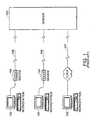
- An online forum, or any other type of distributed computer services may be implemented on a distributed computer system such as that shown in FIG. 1.
- Forum participants (equivalently, users of the computer services) typically are scattered across a large geographical area and communicate with one or more central server systems 100 through respective client systems 102 ( e.g. , a personal or laptop computer).
- client systems 102 e.g. , a personal or laptop computer
- the server system 100 typically will not be a single monolithic entity but rather will be a network of interconnected server computers, possibly physically dispersed from each other, each dedicated to its own set of duties and/or to a particular geographical region.
- the individual servers are interconnected by a network of communication links, in known fashion.
- One such server system is "America Online” from America Online Incorporated of Virginia.
- Each client system 102 runs client software that allows it to communicate in a meaningful manner with corresponding software running on the server system 100.
- the client systems 102 communicate with the server system 100 through various channels, such as a modem 104 connected to a telephone line 106 or a direct Internet connection using a transfer protocol such as TCP/IP (Transfer Control Protocol/Internet Protocol).
- the server system 100 is responsible for receiving input from the client systems 102, manipulating the collective body of input information (and possibly information from other sources) into a useful format, and retransmitting the formatted information back to one or more clients 102 for output on an output device, such as a display screen.
- one type of forum is a "chat room" 200, in which the various participants 204 (e.g., “Allens9,” “JOSHUAALEX,” etc. ) may enter text which appears in a scrolling text window 202 on each participant's computer display screen.
- the chat room 200 has 22 participants whose identities (or "screen names") are listed in a scrolling window 210.
- a participant 204 may respond to the comment of another participant 204 by entering a line of text in an edit box 206 and activating ( e.g., by clicking with a pointer device, such as a mouse) a SEND button 208.
- the text in the scrolling text window 202 scrolls upwards and the newly entered line of text is displayed at the bottom of the scrolling text window 202.
- the last participant to enter a comment was JOSHUAALEX, who typed "TEXAS.”
- the chat room 200 shown in FIG. 2 is "public", meaning that it has multiple participants who were placed in the chat room by the computer-service provider and who most likely never have met or conversed with one another before.
- a comment by a participant in a public forum may be seen by all of the participants of the chat room. If a participant desires some privacy, that participant may "open” and enter a "private” chat room (for example, by clicking on a SETUP button 212), and thereafter invite one or more other participants to enter the private chat room.
- participants may communicate with one another without fear that uninvited participants will be able to see their comments.
- a participant in a forum makes a comment that others in the forum regard as offensive, in poor taste, wildly incorrect, or otherwise objectionable, the offending participant most likely will be "flamed" by one or more of the other participants.
- a "flame” is a reprimand or other stringent response directed at the offending party.
- One purpose behind flaming another participant is to dissuade the offender, through embarrassment or intimidation, from making further objectionable comments.
- a forum may be crudely regulated or "policed" by the forum's participants. However, the offending participant may continue to behave in an objectionable manner.
- participant policing of forums does not always work well. In such cases, offended participants may drop out of "flame-filled” forums, and/or the online service must devote resources to actively police problematic participants.
- objectionable behavior includes sending one or more messages to "spoof" other users as to the sender's identity in order to try to get confidential information (e.g. , credit card numbers or passwords) sent in response (sometimes called "password fishing").
- confidential information e.g. , credit card numbers or passwords
- resource hogging Another problem that can arise in online systems is “resource hogging", where a participant uses features such as broadcast or multi-cast messaging to send a large number of messages to other users in a short period of time (sometimes called “spamming"). Such resource hogging deprives other users of server resources, and can slow an online system response time to undesirable levels.
- the present invention provides a method and means for accomplishing this goal.
- the invention provides a method and means for self-policing and automatically rate-limiting multiple-user online forums.
- the preferred embodiment of the invention includes a set of rules that permit users to censure other users.
- a censured user has one or more "privileges" (which may include access to the online computer system or the effective message rate of a communications connection) taken away or diminished; the privilege is gradually restored if the censured user behaves.
- the censuring participant and other pertinent participants are notified of the effect of the censuring on the censured user.
- the online computer system automatically tracks the rate at which a user sends certain types of messages, and can message rate limit a user who uses too many system resources by sending a large number of messages in rapid succession.
- the amount of rate limiting may be a function of the amount of censure that has been applied to the user being limited.
- Advantages of this invention may include one or more of the following.
- the techniques described here enable a multiple-user online service (e.g., a chat room or other forum) to be self-policing. Access to the computer service for a particular user is automatically regulated by the computer based on input from other users concerning the conduct of the user under consideration, or based on the message rate of a user. Users of a computer-based system have the ability to sanction a misbehaving user and thereby have the offending user's access to the system denied or curtailed.
- the policing techniques described here are based on predetermined rules and operate automatically in response to votes cast by other users of the computer system. The offending user has no choice in the matter once he or she chooses to misbehave. Because the operation of these policing techniques are automatic, the computer-based service provider need not expend personnel time and resources to police public forums, direct user communications, and the like.
- FIG. 1 shows a prior art distributed computer system of the type used for providing online computer services.
- FIG. 2 is a screen shot showing an example of a prior art online computer forum.
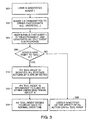
- FIG. 3 is a flowchart of a basic embodiment of the self-policing aspect of the invention.
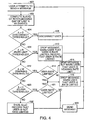
- FIG. 4 is a flowchart of a basic embodiment of the rate-limiting aspect of the invention.
- the invention provides a self-policing online environment that makes participants responsible for their behavior. That is, other participants can express an opinion about that behavior, and have that opinion affect the offending user in a negative way and be "visible" to other participants. Providing such a self-policing user feedback mechanism lowers the cost of providing online services to users and provides a more "user-friendly" environment for participants.
- the online computer system automatically tracks the rate at which a user sends certain types of messages, and can "rate limit” a user who "hogs" too many system resources by sending a large number of messages (or messages of selected types) in rapid succession.
- FIG. 3 is a flowchart of a basic embodiment of the self-policing aspect of the invention.
- user A generates an event I, such as a message (STEP 300).
- Event I is transmitted to some number of other participants, such as users B and C in a public forum on an online computer system (STEP 302).
- event I may be a direct communication between user A to user B, such as by use of the Instant MessageTM feature of the America Online computer service.
- User B may feel that event I is "objectionable” or "evil” (a subjective decision by B), and therefore generates a "vote” against the behavior of user A by sending a special type of response message - an "evil” event E (STEP 304).
- a user cannot "evil” another participant except in response to a message from the participant, or otherwise in cases where the participant's actions affect the user doing the "eviling.”
- users cannot "evil” other participants directly in response to being “eviled”.
- the online system receives event E and checks a database to see whether user B has the right to "evil” user A (STEP 306). For example, this step can limit users who themselves have been restricted from “eviling" other users.
- user B If user B does not have the right to "evil” user A, then user B is notified of the effect of user B's action on user A's "evil index" - a value of how restricted user A is with respect to use of resources on the online system (STEP 308). In this case, user B's action has no effect on user A.
- user A's "evil index” is modified by a suitable amount, which will affect further actions by user A (STEP 310), as described below.
- the amount of modification can be based on the past behavior of user A, or of users A and B.
- the amount of modification may also depend on the type of "eviling" asserted by user B. For example, user B may wish to assert an "eviling" event E anonymously rather than be identified. Anonymous “eviling" may be accorded lesser weight. That is, an anonymous “eviling” response may count as fewer evil "votes” than it would if the eviling user's identity was revealed.
- an "eviling" user may set up an automatic "eviling" response to all communications from another specific user.
- the effect of the "eviling" which is intended to discourage communication from the specific user, is given very low weight (equivalently, counts as very few evil "votes") because of its automatic invocation.
- “evil index” is “broadcast” to other users who "know about” user A (STEP 312). For example, such users might be all of the participants in a private chat room, or all visitors to a public chat room.
- a modified "evil Index” is reported to each user in a current chat room's user list and to each user who has the "eviled” users on his or her "buddy list”.
- an "eviled” user is publicly chastised.
- user A's "evil index” begins to gradually “decay” back to normal over time (STEP 314).
- Such decay may be linear, exponential, step-wise, or some other function.
- user B is notified of the effect of user B's action on user A's "evil index” (STEP 308). In this case, user B's action has had an effect on user A.
- STEPS 312, and 314, and 308 may be performed in different order.
- a basic "penalty" for having a non-normal “evil index” is denial of access to a forum or the online service until the user's “evil index” has decayed back to normal.
- a user's "evil index” affects a rate limit which governs a user's ability to send (and/or receive) messages. This feature allows other participants to "evil” a user who "flames” or “spams” them, and thus reduce the rate at which the recalcitrant user can send and/or receive messages.
- rate limit A description of rate limiting is set forth below.
- a server database (which may be centralized or distributed) stores a user's "evil index".
- a user's “evil index” can be maintained in a user-record as a global total, or by forum, or both. The value of each "evil index" can be used to control the user's ability to log on to the online computer system or access selected forums, and/or the effective rate of message or file transmissions.
- a user's “evil index” When a user's “evil index” is modified, the user is notified that privileges, such as rate of messaging, have been limited.
- a message is sent from the server that contains the user's current "evil index” to the "eviled” user, and optionally includes the current rate of decay back to normal.
- Such information allows a wide range of feedback to be presented to the user about his or her ability to interact with the online computer system. For example, a graphical "power meter” or “power bar graph” can be used to indicate the "evil index" of the user.
- a color-coded bar graph can be divided into (1) a green zone to represent that the user's "evil index” is normal; (2) a yellow zone to represent that the user's “evil index” has been modified slightly; (3) a red zone to represent that the user's “evil index” has been modified significantly; and (4) a black zone to represent that access or message privileges have been suspended for a time.
- a green zone to represent that the user's "evil index” is normal
- a yellow zone to represent that the user's “evil index” has been modified slightly
- a red zone to represent that the user's “evil index” has been modified significantly
- (4) a black zone to represent that access or message privileges have been suspended for a time.
- other methods of informing a recalcitrant user of his or her "evil index” can be used.
- a user can "rehabilitate” his or her “evil index” by visiting advertisements displayed on the online computer system; “visits” can be determined by requiring the user to "click” on an advertisement. The user is rewarded with more “power” by adjusting the value of the user's “evil index” more towards normal.
- both input and output messaging rates of a user are limited based on the behavior of the user and/or available system resources.
- rate limiting can stop malicious users and errant client computers from consuming more than a fair share of online system resources.
- the rate limiting system is weighted to tolerate brief bursts of messaging activity while penalizing unacceptably large rates of messaging.
- Rate limiting can also limit aggregate input to a server to a level at which the system is reasonably loaded under normal conditions. Rate limiting can also be combined with "eviling" by automatically adjusting a users rate limit parameters based on their "evil index.”
- input rate limiting - from user to server - is conducted on a per user connection basis, and within a user connection on a per-message type bases (that is, rate limits for different types of messages may be set to different values).
- rate limiting for a user is achieved in accordance with the following algorithm:
- FIG. 4 is a flowchart of a basic embodiment of the rate-limiting aspect of the invention, showing a slightly different order for the steps described above.
- a user attempts to send a message (STEP 400).
- Average A is computed (STEP 402). If A is less than a disconnect threshold D (STEP 404), the user is disconnected (STEP 406). Otherwise, if A is less than a rate limit threshold R (STEP 408), the message is dropped, the user is warned that the rate limited has been exceeded, and the user is flagged as "rate limited" (STEP 410).
- A is not less than the warning threshold W (STEP 412), and A is less than a clear threshold C (STEP 420), a determination is made as to whether the user is rate limited (STEP 421). If not, the message is sent (STEP 423). Otherwise, the message is dropped and the user is warned that the rate limited has been exceeded (STEP 418).
- the rate limiting algorithm supports several "tunable" parameters:
- the values for C, W, R, and D are selected such that C > W > R > D.
- the initial average rate I can be weighted to increase the algorithm's tolerance of bursts of activity, such as "chatty startups" when a user joins a forum and sends several messages in succession.
- the threshold rates can be set globally for all user's, or "tuned" for each user.
- the difference between the clear threshold C and the rate limit threshold R can be "tuned" by the online computer system to alter the interval between commencement of rate limiting for a user and the resumption of normal activity.
- the difference between C and R may be automatically increased, for example, if the user sends excessive "spamming" type messages at too great a rate.
- the threshold values C, W, R , and D can be dynamically modified by the online system as a way of limiting system resource usage if too many users are simultaneously using the system.
- a message is sent from the server to a rate limited user that contains values for each of the parameters outlined above, and another message is sent the next time that the server will accept messages from the user without restriction.
- a graphical "power meter” or “power bar graph” can be used to indicate the "health" or "power” of the user.
- a color-coded bar graph can be divided into (1) a green zone to represent that no rate limiting is in effect; (2) a yellow zone to represent that the user's message rate is near the point where rate limiting would take effect; (3) a red zone to represent that message rate limiting is in effect; and (4) a black zone to represent that access privileges have been suspended for a time.
- other methods can be used to inform a recalcitrant user of his or her message rate limit status.
- a user can "rehabilitate" his or her message rate limit status by visiting advertisements displayed on the online computer system. The user is rewarded with more "power” by adjusting the parameters.
- output rate limiting - from server to user - is performed in a similar manner, with the following differences:
- a user's ability to interact in a forum can be rate limited by modifying the values for A, C, W, R, and/or D as a function of whether the user's "evil index" has been modified, or as a function of the current value of the user's “evil index”.
- the amount of modification of a user's "evil index” can be a function of the current value of A .
- each user's user-record thus may look like the following table: Forum ID "evil index” decay rate # times "eviled” # times “eviled” others time-of-entry total-time of-access A C W R D Global value Forum 1 value Forum 2 value etc.
- a global rate table can be used which is indexed by a user's “evil index”; that is, message rate parameters are a function of the user's global or forum "evil index".
- ⁇ A represents an optional adjustment to be applied to the calculated value of A
- "evil index" value ⁇ A C W R D 0-20 21-40 41-60 61-80 81-90 91-95 96-100
- the values for A, C, W, R, and D in this table can be defined globally or by forum. If by forum, the values can be defined in absolute terms or as relative offsets to a global table. Multiple tables of this form also can be defined, indexed by message type, so that misuse of certain types of messages are punished more than misuse of other message types.
- a non-tabular implementation could be used instead of the global rate table described above.
- a user's rate parameter values ( ⁇ A , C, W, R , D) could be defined as a function describing a relation between these quantities.
- the invention may be implemented in hardware or software, or a combination of both. However, preferably, the invention is implemented in computer programs executing on programmable computers each comprising at least one processor, at least one data storage system (including volatile and non-volatile memory and/or storage elements), at least one input device, and at least one output device. Program code is applied to input data to perform the functions described herein and generate output information. The output information is applied to one or more output devices, in known fashion.
- Each program is preferably implemented in a high level procedural or object oriented programming language to communicate with a computer system.
- the programs can be implemented in assembly or machine language, if desired.
- the language may be a compiled or interpreted language.
- Each such computer program is preferably stored on a storage media or device (e.g., ROM or magnetic diskette) readable by a general or special purpose programmable computer, for configuring and operating the computer when the storage media or device is read by the computer to perform the procedures described herein.
- a storage media or device e.g., ROM or magnetic diskette
- the inventive system may also be considered to be implemented as a computer-readable storage medium, configures with a computer program, where the storage medium so configured causes a computer to operate in a specific and predefined manner to perform the functions described herein.
Landscapes
- Engineering & Computer Science (AREA)
- General Engineering & Computer Science (AREA)
- Computer Security & Cryptography (AREA)
- Computer Networks & Wireless Communication (AREA)
- Signal Processing (AREA)
- Computer Hardware Design (AREA)
- Theoretical Computer Science (AREA)
- Multimedia (AREA)
- Computing Systems (AREA)
- Databases & Information Systems (AREA)
- Bioethics (AREA)
- General Health & Medical Sciences (AREA)
- Software Systems (AREA)
- Physics & Mathematics (AREA)
- General Physics & Mathematics (AREA)
- Health & Medical Sciences (AREA)
- Information Transfer Between Computers (AREA)
- Data Exchanges In Wide-Area Networks (AREA)
Applications Claiming Priority (3)
| Application Number | Priority Date | Filing Date | Title |
|---|---|---|---|
| US4723597P | 1997-05-20 | 1997-05-20 | |
| US47235P | 1997-05-20 | ||
| EP98922326A EP0983540B8 (fr) | 1997-05-20 | 1998-05-15 | Forums de discussion en ligne a auto-controle et a limitation automatique de la frequence d'envoi |
Related Parent Applications (1)
| Application Number | Title | Priority Date | Filing Date |
|---|---|---|---|
| EP98922326A Division EP0983540B8 (fr) | 1997-05-20 | 1998-05-15 | Forums de discussion en ligne a auto-controle et a limitation automatique de la frequence d'envoi |
Publications (2)
| Publication Number | Publication Date |
|---|---|
| EP1124173A2 true EP1124173A2 (fr) | 2001-08-16 |
| EP1124173A3 EP1124173A3 (fr) | 2006-12-20 |
Family
ID=26152533
Family Applications (1)
| Application Number | Title | Priority Date | Filing Date |
|---|---|---|---|
| EP01201844A Ceased EP1124173A3 (fr) | 1997-05-20 | 1998-05-15 | Forums de discussion en ligne avec auto-contrôle et à limitation |
Country Status (1)
| Country | Link |
|---|---|
| EP (1) | EP1124173A3 (fr) |
Cited By (3)
| Publication number | Priority date | Publication date | Assignee | Title |
|---|---|---|---|---|
| US7937740B2 (en) | 2002-08-16 | 2011-05-03 | MediaIP, Inc. | Method and apparatus for interactive programming using captioning |
| US8255966B2 (en) | 2002-04-15 | 2012-08-28 | Shusman Chad W | Method and apparatus for internet-based interactive programming |
| US10856031B2 (en) | 2003-04-15 | 2020-12-01 | MedialP, Inc. | Method and apparatus for generating interactive programming in a communication network |
Citations (1)
| Publication number | Priority date | Publication date | Assignee | Title |
|---|---|---|---|---|
| US5265221A (en) * | 1989-03-20 | 1993-11-23 | Tandem Computers | Access restriction facility method and apparatus |
-
1998
- 1998-05-15 EP EP01201844A patent/EP1124173A3/fr not_active Ceased
Patent Citations (1)
| Publication number | Priority date | Publication date | Assignee | Title |
|---|---|---|---|---|
| US5265221A (en) * | 1989-03-20 | 1993-11-23 | Tandem Computers | Access restriction facility method and apparatus |
Cited By (10)
| Publication number | Priority date | Publication date | Assignee | Title |
|---|---|---|---|---|
| US8255966B2 (en) | 2002-04-15 | 2012-08-28 | Shusman Chad W | Method and apparatus for internet-based interactive programming |
| US8661490B2 (en) | 2002-04-15 | 2014-02-25 | MediaIP, Inc. | Method and apparatus for internet-based interactive programming |
| USRE48579E1 (en) | 2002-04-15 | 2021-06-01 | Media Ip, Inc. | Method and apparatus for internet-based interactive programming |
| US7937740B2 (en) | 2002-08-16 | 2011-05-03 | MediaIP, Inc. | Method and apparatus for interactive programming using captioning |
| US8402504B2 (en) | 2002-08-16 | 2013-03-19 | Media Ip, Inc. | Method and apparatus for interactive programming using captioning |
| US8826361B2 (en) | 2002-08-16 | 2014-09-02 | Media Ip, Inc. | Method and apparatus for interactive programming using captioning |
| US10856031B2 (en) | 2003-04-15 | 2020-12-01 | MedialP, Inc. | Method and apparatus for generating interactive programming in a communication network |
| US11076190B2 (en) | 2003-04-15 | 2021-07-27 | MedialP, Inc. | Method and apparatus for generating interactive programming in a communication network |
| US11477506B2 (en) | 2003-04-15 | 2022-10-18 | MediaIP, LLC | Method and apparatus for generating interactive programming in a communication network |
| US11575955B2 (en) | 2003-04-15 | 2023-02-07 | MediaIP, LLC | Providing interactive video on demand |
Also Published As
| Publication number | Publication date |
|---|---|
| EP1124173A3 (fr) | 2006-12-20 |
Similar Documents
| Publication | Publication Date | Title |
|---|---|---|
| US6339784B1 (en) | Self-policing, rate limiting online forums | |
| US8296373B2 (en) | Automatically managing objectionable behavior in a web-based social network | |
| US8713175B2 (en) | Centralized behavioral information system | |
| US7546338B2 (en) | Method and system for screening remote site connections and filtering data based on a community trust assessment | |
| US7996471B2 (en) | Electronic message distribution system | |
| CA2465662C (fr) | Techniques de filtrage destinees a gerer l'acces a des sites internet ou a d'autres applications logicielles | |
| US9143473B2 (en) | System for managing e-mail traffic | |
| KR100823003B1 (ko) | 콘텐츠 필터링 방법, 콘텐츠 필터링 장치 및 콘텐츠필터링 프로그램 | |
| EP2281262A2 (fr) | Réputation de compte centralisée | |
| EP1956777B1 (fr) | Procédé et système pour la réduction de la prolifération de messages électroniques | |
| US20070174387A1 (en) | Methods and apparatus for implementing real-time collective moderation of collaborative environments | |
| US20060253784A1 (en) | Multi-tiered safety control system and methods for online communities | |
| EP1124173A2 (fr) | Forums de discussion en ligne a auto-controlle et a limitation | |
| WO2008094161A1 (fr) | Système et procédé permettant d'empêcher un comportement inacceptable dans un réseau social basé sur le web | |
| HK1026486B (en) | Self-policing, rate limiting online forums | |
| AU1367801A (en) | Self-policing, rate limiting online forums | |
| US20090049143A1 (en) | System and method for transmitting messages for a set of communication devices | |
| Wash et al. | Security when people matter: Structuring incentives for user behavior | |
| JP2022181684A (ja) | プログラム及び情報処理装置 |
Legal Events
| Date | Code | Title | Description |
|---|---|---|---|
| PUAI | Public reference made under article 153(3) epc to a published international application that has entered the european phase |
Free format text: ORIGINAL CODE: 0009012 |
|
| 17P | Request for examination filed |
Effective date: 20010601 |
|
| AC | Divisional application: reference to earlier application |
Ref document number: 983540 Country of ref document: EP |
|
| AK | Designated contracting states |
Kind code of ref document: A2 Designated state(s): AT BE CH CY DE DK ES FI FR GB GR IE IT LI LU MC NL PT SE |
|
| RIN1 | Information on inventor provided before grant (corrected) |
Inventor name: STEELE, COLIN ANTHONY Inventor name: BOSCO, ERIC Inventor name: LIPPKE, DAVID LOWELL Inventor name: MORRIS, HARRY W. |
|
| PUAL | Search report despatched |
Free format text: ORIGINAL CODE: 0009013 |
|
| AK | Designated contracting states |
Kind code of ref document: A3 Designated state(s): AT BE CH CY DE DK ES FI FR GB GR IE IT LI LU MC NL PT SE |
|
| 17Q | First examination report despatched |
Effective date: 20070706 |
|
| AKX | Designation fees paid |
Designated state(s): AT BE CH CY DE DK ES FI FR GB GR IE IT LI LU MC NL PT SE |
|
| STAA | Information on the status of an ep patent application or granted ep patent |
Free format text: STATUS: THE APPLICATION HAS BEEN REFUSED |
|
| 18R | Application refused |
Effective date: 20101209 |