EP1124267A2 - Piezoelektrische Keramik - Google Patents
Piezoelektrische Keramik Download PDFInfo
- Publication number
- EP1124267A2 EP1124267A2 EP01102916A EP01102916A EP1124267A2 EP 1124267 A2 EP1124267 A2 EP 1124267A2 EP 01102916 A EP01102916 A EP 01102916A EP 01102916 A EP01102916 A EP 01102916A EP 1124267 A2 EP1124267 A2 EP 1124267A2
- Authority
- EP
- European Patent Office
- Prior art keywords
- oxide
- piezoelectric ceramics
- qmax
- piezoelectric
- temperature
- Prior art date
- Legal status (The legal status is an assumption and is not a legal conclusion. Google has not performed a legal analysis and makes no representation as to the accuracy of the status listed.)
- Withdrawn
Links
- 239000000919 ceramic Substances 0.000 title claims abstract description 59
- 239000013078 crystal Substances 0.000 claims abstract description 23
- 229910052797 bismuth Inorganic materials 0.000 claims abstract description 17
- 150000001875 compounds Chemical class 0.000 claims abstract description 14
- JCXGWMGPZLAOME-UHFFFAOYSA-N bismuth atom Chemical compound [Bi] JCXGWMGPZLAOME-UHFFFAOYSA-N 0.000 claims abstract description 13
- 229910052788 barium Inorganic materials 0.000 claims abstract description 9
- 229910052791 calcium Inorganic materials 0.000 claims abstract description 9
- 229910052747 lanthanoid Inorganic materials 0.000 claims abstract description 8
- 150000002602 lanthanoids Chemical class 0.000 claims abstract description 8
- 239000000203 mixture Substances 0.000 description 16
- 238000000034 method Methods 0.000 description 14
- 238000010304 firing Methods 0.000 description 13
- 239000000463 material Substances 0.000 description 11
- 230000010287 polarization Effects 0.000 description 11
- 230000000052 comparative effect Effects 0.000 description 10
- 238000001354 calcination Methods 0.000 description 8
- 230000000694 effects Effects 0.000 description 7
- GWEVSGVZZGPLCZ-UHFFFAOYSA-N Titan oxide Chemical compound O=[Ti]=O GWEVSGVZZGPLCZ-UHFFFAOYSA-N 0.000 description 6
- WMWLMWRWZQELOS-UHFFFAOYSA-N bismuth(iii) oxide Chemical compound O=[Bi]O[Bi]=O WMWLMWRWZQELOS-UHFFFAOYSA-N 0.000 description 6
- 238000001704 evaporation Methods 0.000 description 6
- 230000008020 evaporation Effects 0.000 description 6
- QVGXLLKOCUKJST-UHFFFAOYSA-N atomic oxygen Chemical compound [O] QVGXLLKOCUKJST-UHFFFAOYSA-N 0.000 description 5
- 229910052760 oxygen Inorganic materials 0.000 description 5
- 239000001301 oxygen Substances 0.000 description 5
- 239000000843 powder Substances 0.000 description 5
- 229910052772 Samarium Inorganic materials 0.000 description 4
- MCMNRKCIXSYSNV-UHFFFAOYSA-N Zirconium dioxide Chemical compound O=[Zr]=O MCMNRKCIXSYSNV-UHFFFAOYSA-N 0.000 description 4
- 239000011230 binding agent Substances 0.000 description 4
- 230000005684 electric field Effects 0.000 description 4
- 238000000227 grinding Methods 0.000 description 4
- 238000009413 insulation Methods 0.000 description 4
- 239000011656 manganese carbonate Substances 0.000 description 4
- 229910000016 manganese(II) carbonate Inorganic materials 0.000 description 4
- 229910052751 metal Inorganic materials 0.000 description 4
- YEXPOXQUZXUXJW-UHFFFAOYSA-N oxolead Chemical compound [Pb]=O YEXPOXQUZXUXJW-UHFFFAOYSA-N 0.000 description 4
- 239000000243 solution Substances 0.000 description 4
- 229910052688 Gadolinium Inorganic materials 0.000 description 3
- 239000004372 Polyvinyl alcohol Substances 0.000 description 3
- RKTYLMNFRDHKIL-UHFFFAOYSA-N copper;5,10,15,20-tetraphenylporphyrin-22,24-diide Chemical compound [Cu+2].C1=CC(C(=C2C=CC([N-]2)=C(C=2C=CC=CC=2)C=2C=CC(N=2)=C(C=2C=CC=CC=2)C2=CC=C3[N-]2)C=2C=CC=CC=2)=NC1=C3C1=CC=CC=C1 RKTYLMNFRDHKIL-UHFFFAOYSA-N 0.000 description 3
- 229910052746 lanthanum Inorganic materials 0.000 description 3
- MRELNEQAGSRDBK-UHFFFAOYSA-N lanthanum oxide Inorganic materials [O-2].[O-2].[O-2].[La+3].[La+3] MRELNEQAGSRDBK-UHFFFAOYSA-N 0.000 description 3
- 229910000464 lead oxide Inorganic materials 0.000 description 3
- 238000004519 manufacturing process Methods 0.000 description 3
- KTUFCUMIWABKDW-UHFFFAOYSA-N oxo(oxolanthaniooxy)lanthanum Chemical compound O=[La]O[La]=O KTUFCUMIWABKDW-UHFFFAOYSA-N 0.000 description 3
- 229920002451 polyvinyl alcohol Polymers 0.000 description 3
- 238000005476 soldering Methods 0.000 description 3
- 239000006104 solid solution Substances 0.000 description 3
- 239000007858 starting material Substances 0.000 description 3
- XLYOFNOQVPJJNP-UHFFFAOYSA-N water Substances O XLYOFNOQVPJJNP-UHFFFAOYSA-N 0.000 description 3
- 229910052692 Dysprosium Inorganic materials 0.000 description 2
- 229910052691 Erbium Inorganic materials 0.000 description 2
- 229910052689 Holmium Inorganic materials 0.000 description 2
- 229910021577 Iron(II) chloride Inorganic materials 0.000 description 2
- 229910052779 Neodymium Inorganic materials 0.000 description 2
- 229910003781 PbTiO3 Inorganic materials 0.000 description 2
- 238000002441 X-ray diffraction Methods 0.000 description 2
- 229910052769 Ytterbium Inorganic materials 0.000 description 2
- 230000007423 decrease Effects 0.000 description 2
- 230000007547 defect Effects 0.000 description 2
- QDOXWKRWXJOMAK-UHFFFAOYSA-N dichromium trioxide Chemical compound O=[Cr]O[Cr]=O QDOXWKRWXJOMAK-UHFFFAOYSA-N 0.000 description 2
- 238000001035 drying Methods 0.000 description 2
- 230000003628 erosive effect Effects 0.000 description 2
- 238000005469 granulation Methods 0.000 description 2
- 230000003179 granulation Effects 0.000 description 2
- NMCUIPGRVMDVDB-UHFFFAOYSA-L iron dichloride Chemical compound Cl[Fe]Cl NMCUIPGRVMDVDB-UHFFFAOYSA-L 0.000 description 2
- NUJOXMJBOLGQSY-UHFFFAOYSA-N manganese dioxide Chemical compound O=[Mn]=O NUJOXMJBOLGQSY-UHFFFAOYSA-N 0.000 description 2
- 239000002184 metal Substances 0.000 description 2
- 239000002245 particle Substances 0.000 description 2
- 238000000634 powder X-ray diffraction Methods 0.000 description 2
- 229920002545 silicone oil Polymers 0.000 description 2
- 229910000679 solder Inorganic materials 0.000 description 2
- LEDMRZGFZIAGGB-UHFFFAOYSA-L strontium carbonate Chemical compound [Sr+2].[O-]C([O-])=O LEDMRZGFZIAGGB-UHFFFAOYSA-L 0.000 description 2
- 229910000018 strontium carbonate Inorganic materials 0.000 description 2
- BVKZGUZCCUSVTD-UHFFFAOYSA-L Carbonate Chemical compound [O-]C([O-])=O BVKZGUZCCUSVTD-UHFFFAOYSA-L 0.000 description 1
- 229910052684 Cerium Inorganic materials 0.000 description 1
- MYMOFIZGZYHOMD-UHFFFAOYSA-N Dioxygen Chemical compound O=O MYMOFIZGZYHOMD-UHFFFAOYSA-N 0.000 description 1
- 229910052693 Europium Inorganic materials 0.000 description 1
- 229910052765 Lutetium Inorganic materials 0.000 description 1
- 229910002651 NO3 Inorganic materials 0.000 description 1
- NHNBFGGVMKEFGY-UHFFFAOYSA-N Nitrate Chemical compound [O-][N+]([O-])=O NHNBFGGVMKEFGY-UHFFFAOYSA-N 0.000 description 1
- MUBZPKHOEPUJKR-UHFFFAOYSA-N Oxalic acid Chemical compound OC(=O)C(O)=O MUBZPKHOEPUJKR-UHFFFAOYSA-N 0.000 description 1
- 229910052777 Praseodymium Inorganic materials 0.000 description 1
- 229910052771 Terbium Inorganic materials 0.000 description 1
- 229910052775 Thulium Inorganic materials 0.000 description 1
- 239000000654 additive Substances 0.000 description 1
- 230000000996 additive effect Effects 0.000 description 1
- 229910002113 barium titanate Inorganic materials 0.000 description 1
- 238000003486 chemical etching Methods 0.000 description 1
- 238000006243 chemical reaction Methods 0.000 description 1
- 239000002131 composite material Substances 0.000 description 1
- 238000001816 cooling Methods 0.000 description 1
- 230000006866 deterioration Effects 0.000 description 1
- 238000004090 dissolution Methods 0.000 description 1
- 238000002474 experimental method Methods 0.000 description 1
- 230000006355 external stress Effects 0.000 description 1
- CMIHHWBVHJVIGI-UHFFFAOYSA-N gadolinium(III) oxide Inorganic materials [O-2].[O-2].[O-2].[Gd+3].[Gd+3] CMIHHWBVHJVIGI-UHFFFAOYSA-N 0.000 description 1
- 238000010438 heat treatment Methods 0.000 description 1
- XLYOFNOQVPJJNP-UHFFFAOYSA-M hydroxide Chemical compound [OH-] XLYOFNOQVPJJNP-UHFFFAOYSA-M 0.000 description 1
- 239000012535 impurity Substances 0.000 description 1
- JEIPFZHSYJVQDO-UHFFFAOYSA-N iron(III) oxide Inorganic materials O=[Fe]O[Fe]=O JEIPFZHSYJVQDO-UHFFFAOYSA-N 0.000 description 1
- 238000002844 melting Methods 0.000 description 1
- 230000008018 melting Effects 0.000 description 1
- 239000004570 mortar (masonry) Substances 0.000 description 1
- 238000005498 polishing Methods 0.000 description 1
- 230000002265 prevention Effects 0.000 description 1
- 238000005204 segregation Methods 0.000 description 1
- 238000005245 sintering Methods 0.000 description 1
- 239000002002 slurry Substances 0.000 description 1
- 238000001238 wet grinding Methods 0.000 description 1
Images

Classifications
-
- C—CHEMISTRY; METALLURGY
- C04—CEMENTS; CONCRETE; ARTIFICIAL STONE; CERAMICS; REFRACTORIES
- C04B—LIME, MAGNESIA; SLAG; CEMENTS; COMPOSITIONS THEREOF, e.g. MORTARS, CONCRETE OR LIKE BUILDING MATERIALS; ARTIFICIAL STONE; CERAMICS; REFRACTORIES; TREATMENT OF NATURAL STONE
- C04B35/00—Shaped ceramic products characterised by their composition; Ceramics compositions; Processing powders of inorganic compounds preparatory to the manufacturing of ceramic products
- C04B35/01—Shaped ceramic products characterised by their composition; Ceramics compositions; Processing powders of inorganic compounds preparatory to the manufacturing of ceramic products based on oxide ceramics
- C04B35/46—Shaped ceramic products characterised by their composition; Ceramics compositions; Processing powders of inorganic compounds preparatory to the manufacturing of ceramic products based on oxide ceramics based on titanium oxides or titanates
- C04B35/462—Shaped ceramic products characterised by their composition; Ceramics compositions; Processing powders of inorganic compounds preparatory to the manufacturing of ceramic products based on oxide ceramics based on titanium oxides or titanates based on titanates
- C04B35/475—Shaped ceramic products characterised by their composition; Ceramics compositions; Processing powders of inorganic compounds preparatory to the manufacturing of ceramic products based on oxide ceramics based on titanium oxides or titanates based on titanates based on bismuth titanates
-
- H—ELECTRICITY
- H10—SEMICONDUCTOR DEVICES; ELECTRIC SOLID-STATE DEVICES NOT OTHERWISE PROVIDED FOR
- H10N—ELECTRIC SOLID-STATE DEVICES NOT OTHERWISE PROVIDED FOR
- H10N30/00—Piezoelectric or electrostrictive devices
- H10N30/80—Constructional details
- H10N30/85—Piezoelectric or electrostrictive active materials
- H10N30/853—Ceramic compositions
-
- C—CHEMISTRY; METALLURGY
- C04—CEMENTS; CONCRETE; ARTIFICIAL STONE; CERAMICS; REFRACTORIES
- C04B—LIME, MAGNESIA; SLAG; CEMENTS; COMPOSITIONS THEREOF, e.g. MORTARS, CONCRETE OR LIKE BUILDING MATERIALS; ARTIFICIAL STONE; CERAMICS; REFRACTORIES; TREATMENT OF NATURAL STONE
- C04B2235/00—Aspects relating to ceramic starting mixtures or sintered ceramic products
- C04B2235/02—Composition of constituents of the starting material or of secondary phases of the final product
- C04B2235/30—Constituents and secondary phases not being of a fibrous nature
- C04B2235/32—Metal oxides, mixed metal oxides, or oxide-forming salts thereof, e.g. carbonates, nitrates, (oxy)hydroxides, chlorides
- C04B2235/3205—Alkaline earth oxides or oxide forming salts thereof, e.g. beryllium oxide
-
- C—CHEMISTRY; METALLURGY
- C04—CEMENTS; CONCRETE; ARTIFICIAL STONE; CERAMICS; REFRACTORIES
- C04B—LIME, MAGNESIA; SLAG; CEMENTS; COMPOSITIONS THEREOF, e.g. MORTARS, CONCRETE OR LIKE BUILDING MATERIALS; ARTIFICIAL STONE; CERAMICS; REFRACTORIES; TREATMENT OF NATURAL STONE
- C04B2235/00—Aspects relating to ceramic starting mixtures or sintered ceramic products
- C04B2235/02—Composition of constituents of the starting material or of secondary phases of the final product
- C04B2235/30—Constituents and secondary phases not being of a fibrous nature
- C04B2235/32—Metal oxides, mixed metal oxides, or oxide-forming salts thereof, e.g. carbonates, nitrates, (oxy)hydroxides, chlorides
- C04B2235/3205—Alkaline earth oxides or oxide forming salts thereof, e.g. beryllium oxide
- C04B2235/3213—Strontium oxides or oxide-forming salts thereof
-
- C—CHEMISTRY; METALLURGY
- C04—CEMENTS; CONCRETE; ARTIFICIAL STONE; CERAMICS; REFRACTORIES
- C04B—LIME, MAGNESIA; SLAG; CEMENTS; COMPOSITIONS THEREOF, e.g. MORTARS, CONCRETE OR LIKE BUILDING MATERIALS; ARTIFICIAL STONE; CERAMICS; REFRACTORIES; TREATMENT OF NATURAL STONE
- C04B2235/00—Aspects relating to ceramic starting mixtures or sintered ceramic products
- C04B2235/02—Composition of constituents of the starting material or of secondary phases of the final product
- C04B2235/30—Constituents and secondary phases not being of a fibrous nature
- C04B2235/32—Metal oxides, mixed metal oxides, or oxide-forming salts thereof, e.g. carbonates, nitrates, (oxy)hydroxides, chlorides
- C04B2235/3224—Rare earth oxide or oxide forming salts thereof, e.g. scandium oxide
-
- C—CHEMISTRY; METALLURGY
- C04—CEMENTS; CONCRETE; ARTIFICIAL STONE; CERAMICS; REFRACTORIES
- C04B—LIME, MAGNESIA; SLAG; CEMENTS; COMPOSITIONS THEREOF, e.g. MORTARS, CONCRETE OR LIKE BUILDING MATERIALS; ARTIFICIAL STONE; CERAMICS; REFRACTORIES; TREATMENT OF NATURAL STONE
- C04B2235/00—Aspects relating to ceramic starting mixtures or sintered ceramic products
- C04B2235/02—Composition of constituents of the starting material or of secondary phases of the final product
- C04B2235/30—Constituents and secondary phases not being of a fibrous nature
- C04B2235/32—Metal oxides, mixed metal oxides, or oxide-forming salts thereof, e.g. carbonates, nitrates, (oxy)hydroxides, chlorides
- C04B2235/3224—Rare earth oxide or oxide forming salts thereof, e.g. scandium oxide
- C04B2235/3225—Yttrium oxide or oxide-forming salts thereof
-
- C—CHEMISTRY; METALLURGY
- C04—CEMENTS; CONCRETE; ARTIFICIAL STONE; CERAMICS; REFRACTORIES
- C04B—LIME, MAGNESIA; SLAG; CEMENTS; COMPOSITIONS THEREOF, e.g. MORTARS, CONCRETE OR LIKE BUILDING MATERIALS; ARTIFICIAL STONE; CERAMICS; REFRACTORIES; TREATMENT OF NATURAL STONE
- C04B2235/00—Aspects relating to ceramic starting mixtures or sintered ceramic products
- C04B2235/02—Composition of constituents of the starting material or of secondary phases of the final product
- C04B2235/30—Constituents and secondary phases not being of a fibrous nature
- C04B2235/32—Metal oxides, mixed metal oxides, or oxide-forming salts thereof, e.g. carbonates, nitrates, (oxy)hydroxides, chlorides
- C04B2235/3224—Rare earth oxide or oxide forming salts thereof, e.g. scandium oxide
- C04B2235/3227—Lanthanum oxide or oxide-forming salts thereof
-
- C—CHEMISTRY; METALLURGY
- C04—CEMENTS; CONCRETE; ARTIFICIAL STONE; CERAMICS; REFRACTORIES
- C04B—LIME, MAGNESIA; SLAG; CEMENTS; COMPOSITIONS THEREOF, e.g. MORTARS, CONCRETE OR LIKE BUILDING MATERIALS; ARTIFICIAL STONE; CERAMICS; REFRACTORIES; TREATMENT OF NATURAL STONE
- C04B2235/00—Aspects relating to ceramic starting mixtures or sintered ceramic products
- C04B2235/02—Composition of constituents of the starting material or of secondary phases of the final product
- C04B2235/30—Constituents and secondary phases not being of a fibrous nature
- C04B2235/32—Metal oxides, mixed metal oxides, or oxide-forming salts thereof, e.g. carbonates, nitrates, (oxy)hydroxides, chlorides
- C04B2235/3262—Manganese oxides, manganates, rhenium oxides or oxide-forming salts thereof, e.g. MnO
-
- C—CHEMISTRY; METALLURGY
- C04—CEMENTS; CONCRETE; ARTIFICIAL STONE; CERAMICS; REFRACTORIES
- C04B—LIME, MAGNESIA; SLAG; CEMENTS; COMPOSITIONS THEREOF, e.g. MORTARS, CONCRETE OR LIKE BUILDING MATERIALS; ARTIFICIAL STONE; CERAMICS; REFRACTORIES; TREATMENT OF NATURAL STONE
- C04B2235/00—Aspects relating to ceramic starting mixtures or sintered ceramic products
- C04B2235/02—Composition of constituents of the starting material or of secondary phases of the final product
- C04B2235/30—Constituents and secondary phases not being of a fibrous nature
- C04B2235/32—Metal oxides, mixed metal oxides, or oxide-forming salts thereof, e.g. carbonates, nitrates, (oxy)hydroxides, chlorides
- C04B2235/327—Iron group oxides, their mixed metal oxides, or oxide-forming salts thereof
- C04B2235/3275—Cobalt oxides, cobaltates or cobaltites or oxide forming salts thereof, e.g. bismuth cobaltate, zinc cobaltite
-
- C—CHEMISTRY; METALLURGY
- C04—CEMENTS; CONCRETE; ARTIFICIAL STONE; CERAMICS; REFRACTORIES
- C04B—LIME, MAGNESIA; SLAG; CEMENTS; COMPOSITIONS THEREOF, e.g. MORTARS, CONCRETE OR LIKE BUILDING MATERIALS; ARTIFICIAL STONE; CERAMICS; REFRACTORIES; TREATMENT OF NATURAL STONE
- C04B2235/00—Aspects relating to ceramic starting mixtures or sintered ceramic products
- C04B2235/60—Aspects relating to the preparation, properties or mechanical treatment of green bodies or pre-forms
- C04B2235/604—Pressing at temperatures other than sintering temperatures
-
- C—CHEMISTRY; METALLURGY
- C04—CEMENTS; CONCRETE; ARTIFICIAL STONE; CERAMICS; REFRACTORIES
- C04B—LIME, MAGNESIA; SLAG; CEMENTS; COMPOSITIONS THEREOF, e.g. MORTARS, CONCRETE OR LIKE BUILDING MATERIALS; ARTIFICIAL STONE; CERAMICS; REFRACTORIES; TREATMENT OF NATURAL STONE
- C04B2235/00—Aspects relating to ceramic starting mixtures or sintered ceramic products
- C04B2235/70—Aspects relating to sintered or melt-casted ceramic products
- C04B2235/72—Products characterised by the absence or the low content of specific components, e.g. alkali metal free alumina ceramics
-
- C—CHEMISTRY; METALLURGY
- C04—CEMENTS; CONCRETE; ARTIFICIAL STONE; CERAMICS; REFRACTORIES
- C04B—LIME, MAGNESIA; SLAG; CEMENTS; COMPOSITIONS THEREOF, e.g. MORTARS, CONCRETE OR LIKE BUILDING MATERIALS; ARTIFICIAL STONE; CERAMICS; REFRACTORIES; TREATMENT OF NATURAL STONE
- C04B2235/00—Aspects relating to ceramic starting mixtures or sintered ceramic products
- C04B2235/70—Aspects relating to sintered or melt-casted ceramic products
- C04B2235/74—Physical characteristics
- C04B2235/78—Grain sizes and shapes, product microstructures, e.g. acicular grains, equiaxed grains, platelet-structures
-
- C—CHEMISTRY; METALLURGY
- C04—CEMENTS; CONCRETE; ARTIFICIAL STONE; CERAMICS; REFRACTORIES
- C04B—LIME, MAGNESIA; SLAG; CEMENTS; COMPOSITIONS THEREOF, e.g. MORTARS, CONCRETE OR LIKE BUILDING MATERIALS; ARTIFICIAL STONE; CERAMICS; REFRACTORIES; TREATMENT OF NATURAL STONE
- C04B2235/00—Aspects relating to ceramic starting mixtures or sintered ceramic products
- C04B2235/70—Aspects relating to sintered or melt-casted ceramic products
- C04B2235/74—Physical characteristics
- C04B2235/78—Grain sizes and shapes, product microstructures, e.g. acicular grains, equiaxed grains, platelet-structures
- C04B2235/786—Micrometer sized grains, i.e. from 1 to 100 micron
-
- C—CHEMISTRY; METALLURGY
- C04—CEMENTS; CONCRETE; ARTIFICIAL STONE; CERAMICS; REFRACTORIES
- C04B—LIME, MAGNESIA; SLAG; CEMENTS; COMPOSITIONS THEREOF, e.g. MORTARS, CONCRETE OR LIKE BUILDING MATERIALS; ARTIFICIAL STONE; CERAMICS; REFRACTORIES; TREATMENT OF NATURAL STONE
- C04B2235/00—Aspects relating to ceramic starting mixtures or sintered ceramic products
- C04B2235/70—Aspects relating to sintered or melt-casted ceramic products
- C04B2235/80—Phases present in the sintered or melt-cast ceramic products other than the main phase
- C04B2235/81—Materials characterised by the absence of phases other than the main phase, i.e. single phase materials
-
- C—CHEMISTRY; METALLURGY
- C04—CEMENTS; CONCRETE; ARTIFICIAL STONE; CERAMICS; REFRACTORIES
- C04B—LIME, MAGNESIA; SLAG; CEMENTS; COMPOSITIONS THEREOF, e.g. MORTARS, CONCRETE OR LIKE BUILDING MATERIALS; ARTIFICIAL STONE; CERAMICS; REFRACTORIES; TREATMENT OF NATURAL STONE
- C04B2235/00—Aspects relating to ceramic starting mixtures or sintered ceramic products
- C04B2235/70—Aspects relating to sintered or melt-casted ceramic products
- C04B2235/96—Properties of ceramic products, e.g. mechanical properties such as strength, toughness, wear resistance
Definitions
- the present invention relates to a piezoelectric ceramics to be applicable widely in the field of a resonator, a pressure sensor, or the like.
- a piezoelectric element is a material having the piezoelectric effect of changing the electric polarization by the external stress, and the inverse piezoelectric effect of generating strain by the electric field application.
- the piezoelectric element is adopted in a sensor, a resonator, an actuator, or the like, for measuring the pressure or the deformation.
- piezoelectric materials practically used now are commonly ferroelectric elements having a perovskite structure based on PZT (PbZrO 3 -PbTiO 3 solid solution) of a tetragonal system or a rhombohedral system, or based on PT (PbTiO 3 ) of a tetragonal system.
- PZT PZrO 3 -PbTiO 3 solid solution
- PT PbTiO 3
- the lead-basedpiezoelectric materials contain a large content (about 60 to 70wt%) of a lead oxide (PbO) having an extremely high volatility even at a low temperature, they are not preferable from the viewpoints of ecology and pollution prevention.
- a heat treatment such as firing and melting is inevitable, and thus the lead oxide as a volatile component can be volatilized and dispersed by an extremely large amount in an industrial level.
- the lead oxide discharged in the production step can be collected, most of the lead oxide contained in the piezoelectric materials dispatched to the market as industrial merchandises cannot be collected in the present situation. Therefore, in the case where it is discharged widely in the environment, it should inevitably be the cause of pollution.
- BaTiO 3 of a perovskite structure belonging to a tetragonal system is well known. However, since it has a low Curie temperature of 120°C, it is not practical.
- JP-A-9-100156 discloses a (1-x) (Bi 1/2 Na 1/2 ) TiO 3 -xNaNbO 3 solid solution of a perovskite structure; however, those having a Curie temperature higher than 370°C are not included.
- a bismuth layer compound (a compound shaped in bismuth layer) is known. Since the bismuth layer compound has a high Curie temperature, once it is polarized, it is thermally stable and thus characteristics sufficient for a sensor for high temperature can be obtained. On the other hand, a problem is involved in that sufficient piezoelectric characteristics can be hardly obtained for difficulty of the polarization itself. Furthermore, a lead-free bismuth layer compound involves a problem in that Qmax important in the case where it is adopted in a resonator is small. Qmax is tan ⁇ max wherein ⁇ max represents the maximum value of the phase angle.
- An object of the present invention is to provide lead-free piezoelectric ceramics having a high Curie temperature, the excellent piezoelectric characteristics, and small temperature dependency of the resonant frequency.
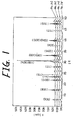
- FIG. 1 is an X ray diffraction chart of piezoelectric ceramics for the samples Nos. 102-105.
- FIG. 2 is a scanning electron microscope photograph of Sample No. 102 in TABLE 2, showing the grain structure.
- FIG. 3 is a scanning electron microscope photograph of Sample No, 103 in TABLE 2, showing the grain structure.
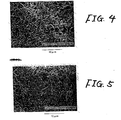
- FIG. 4 is a scanning electron microscope photograph of Sample No. 104 in TABLE 2, showing the grain structure.
- FIG. 5 is a scanning electron microscope photograph of Sample No. 105 in TABLE 2, showing the grain structure.
- Piezoelectric ceramics according to the invention comprise a bismuth layer compound containing M II , Bi, Ti, Ln and O.
- M II represents at least one element selected from the group consisting of Sr, Ba and Ca
- Ln represents at least one element selected from the group consisting of lanthanoids.
- the piezoelectric ceramics of the present invention are composite oxide containing M II Bi 4 Ti 4 O 15 typed crystals.
- the mole ratio of 4Bi/Ti is preferably 4.000 ⁇ 4Bi/Ti ⁇ 4.030.
- Qmax can be improved.
- 4Bi/Ti is more than 4.03, insulation resistance is lowered so that polarization process becomes difficult.
- Qmax is lowered on the contrary.
- the piezoelectric ceramics according to the present invention contain lanthanoid oxide.
- the lanthanoids include La, Ce, Pr, Nd, Pm, Sm, Eu, Gd, Tb, Dy, Ho, Er, Tm, Yb and Lu. Among them, at least one selected from the group consisting of La, Nd, Sm, Gd, Dy, Ho, Er and Yb is preferable, and La is most preferable.
- the mole ratio of Ln/(Ln+M II ) in the piezoelectric ceramics of the present invention is 0 ⁇ Ln/ (Ln+M II ) ⁇ 0.5, and is preferably 0.03 ⁇ Ln/ (Ln+M II ) ⁇ 0.3.
- Ln oxide-free M II Bi 4 Ti 4 O 15 based ceramics in particular, CaBi 4 Ti 4 O 15 based ceramics are hardly polarized; however, it can be improved by addition of Ln oxide.
- piezoelectric ceramics according to the present invention contain Y oxide.
- Y oxide By adding Y oxide in combination with Ln oxide, temperature characteristics of the material at the resonant frequency can be improved. Further, sufficiently large Qmax can be obtained.
- a content of Y oxide is preferably 0.5wt% or less, more preferably 0.4wt% or less in terms of Y 2 O 3 . If the content of Y oxide is too large, Qmax is lowered.
- Qmax By containing Mn oxide and/or Co oxide in the piezoelectric ceramics according to the present invention, Qmax can be further improved. In particular, by adding Mn oxide in combination with Ln oxide, Qmax can be improved remarkably.
- Mn oxide In order to sufficiently obtain the effect of adding Mn oxide, it is preferable to contain Mn oxide by 0.02wt% or more in terms of MnO. In the case where it is contained by 0.03wt% or more, the improvement in Qmax can be particularly high. However, since the insulation resistance is made lower so that the polarization process becomes difficult if the content of Mn oxide is too high, the content of Mn oxide is preferably less than 0.62wt%, more preferably 0,60wt% or less, and further preferably 0.43wt% or less in terms of MnO. In contrast, in order to sufficiently obtain the effect of adding Mn oxide, it is preferable to contain Mn oxide by 0.02wt% or more in terms of MnO. In the case where it is contained by 0.03wt% or more, improvement in Qmax can be particularly high.
- Qmax can also be improved by containing Co oxide.
- the content is 0.1wt% or more in terms of CoO.
- the content in terms of CoO is preferably less than 0.7wt%, and more preferably 0.5wt% or less.
- the piezoelectric ceramics according to the present invention contain M II Bi 4 Ti 4 O 15 typed crystals of a bismuth layer compound, and substantially comprises the crystals. However, it is also possible that they are not completely homogeneous and contain a different phase.
- Ln is considered to substitute mainly the M II site in the M II Bi 4 Ti 4 O 15 typed crystals, but it can partially substitute another site, or it can exist partially in the grain boundary.
- a ratio of (M 11 + Ln) with respect to Ti may be deviated by about ⁇ 5% from the stoichiometric composition.
- the oxygen amount can be varied depending upon the valence number of the metal element or the oxygen defect.
- the entire composition of the piezoelectric ceramics according to the present invention can be, in general, (M II 1-x Ln x )Bi 4 Ti 4 O 15 with adding Y 2 O 3 , but it can be deviated therefrom.
- the ratio of (M II + Ln) with respect to Ti and the ratio of Bi with respect to Ti may be deviated by about ⁇ 5% from the stoichiometric composition.
- the oxygen content can be varied depending upon the valence number of the metal element, the oxygen defect or the like.
- Pb oxide, Cr oxide, Fe oxide, or the like may be contained as an impurity or a minor additive. It is preferable that the content of these oxides is 0.5wt% or less with respect to the entirety in terms of an oxide of the stoichiometric composition such as Pbo, Cr 2 O 3 , and Fe 2 O 3 . Further, it is preferable that the total of these oxides is 0.5wt% or less. If the content of these oxides is too large, the effect of the present invention may be deteriorated. Although it is most preferable that Pb is not contained in the piezoelectric ceramics according to the present invention, a content of the above-mentioned range is not substantially problematic.
- Crystal grains of the piezoelectric ceramics according to the present invention are spindle-shaped or needle-shaped.
- the average size of the crystal particle is not particularly limited, but preferably 1 to 10 ⁇ m, more preferably 3 to 5 ⁇ m in the longitudinal direction.
- the Curie temperature of the piezoelectric ceramics according to the present invention is at least 380°C or more, and it can easily be 430°C or more.
- the piezoelectric ceramics according to the present invention are suitable for a resonator, a high temperature sensor, an actuator, or the like.
- a resonator For the good temperature characteristics of the resonant frequency, it is particularly. suitable for a resonator.
- the application mode of the piezoelectric ceramics according to the present invention is not particularly limited; therefore, any mode such as thickness extensional vibration mode, and thickness sliding vibration can be used.
- the thickness extensional fundamental vibration mode relatively high Qmax can be obtained.
- the spurious vibration is generated, consequently the vibration stability is slightly lowered.
- Qmax is smaller but the spurious vibration can be reduced.
- the spurious vibration is small as well as sufficiently large Qmax can be obtained.
- the temperature characteristics of the resonant frequency is relatively steep and the temperature dependency of the oscillating frequency is relatively large.
- the temperature characteristics of the resonant frequency can be flattened considerably by setting a mole ratio in M II : x/6 + 0.2 ⁇ y ⁇ 0.8. That is, by using at least Ba and/or Ca as M II and having the ratio of Ba + Ca in M II in a predetermined range.
- piezoelectric ceramics containing M 11 Bi 4 Ti 4 O 15 typed crystals have been explained so far, Qmax can be improved by deviating a ratio of contained metal elements from the stoichiometric composition also in piezoelectric ceramics containing, for example, M 11 Bi 2 Nb 2 O 9 typed crystals, M 11 Bi 2 Ta 2 O 9 typed crystal, Bi 3 TiNbO 9 typed crystals, Bi 4 Ti 3 O 12 typed crystals, Bi 1.5 M I 0.5 Ti 4 O 15 typed crystals (wherein M I is at least one selected from the group consisting of alkaline metal elements such as Na and K), or an M II 2 Bi 4 Ti 5 O 18 typed crystals.
- powders of oxide, or a compound to be converted to oxide by firing such as carbonate, hydroxide, oxalate, and nitrate, specifically, M II CO 3 , Bi 2 O 3 , TiO 2 , La 2 O 3 , MnO 2 , MnCO 3 , Y 2 O 3 , or the like are prepared so as to be wet-mixed by a ball mill or the like.
- the mixture is calcined. In general, it is temporarily formed before calcination.
- Calcining temperature is preferably 700 to 1,000°C, more preferably 750 to 850°C. If the calcining temperature is too low, the chemical reaction cannot be completed sufficiently; thus, the calcination is insufficient. In contrast, if the calcining temperature is too high, since the temporarily formed product starts to be sintered, the subsequent grinding process becomes difficult.
- the calcining time is not particularly limited, but it is preferable, in general, from 1 to 3 hours.
- the obtained calcined product is processed to be a slurry so as to be wet-ground by a ball mill, or the like.
- An average particle size of the powders obtained by grinding is not particularly limited, but in consideration of the subsequent forming convenience, it is preferably about 1 to 5 ⁇ m.
- the powders of the calcined product are dried. After adding a small amount (about 4 to 10wt%) of water, the dried product is press-formed at pressure of about 100 to 400 MPa so as to obtain a formed product. At the time, a binder such as a polyvinyl alcohol may be added.
- the firing temperature is selected preferably in the range of from 1,100 to 1,300°C, and the firing time is preferably about 1 to 5 hours.
- the firing operation may be executed in the atmosphere, in an atmosphere with an oxygen partial pressure lower than or higher than that of the atmosphere, or in a pure oxygen atmosphere.
- a polarization process is applied.
- the conditions far the polarization process may be optionally determined depending on the composition of the piezoelectric ceramics.
- the poling. temperature can be 150 to 300°C
- the poling time can be 1 to 30 minutes
- the mixture was calcined in the air for 2 hours.
- the calcining temperature was selected from the range of 800 to 1,000°C.
- the obtained calcined product was coarsely ground with a mortar, and further ground by a grinder. After grinding finely by a ball mill for 16 hours, it was dried. A 10% polyvinyl alcohol solution was added thereto as a binder by 10 wt% for granulation.
- the product was press-formed with applying a load of 300 MPa so as to obtain a formed product of 20 mm ⁇ 20 mm in planar size and 13 mm in thickness.
- the formed product was vacuum-packed, and formed with a cooling isostatic press at. pressure of 400 MPa.
- the obtained formed product was fired.
- the firing operation was executed in a sealed MgO container to prevent evaporation of Bi.
- the firing temperature was selected in the range of from 1,120 to 1,235°C, and the firing time was 4 hours.
- a plate-like element of 15 mm ⁇ 15 mm in planar size and 0,55 mm in thickness was cut out, and was subjected to lapping so as to obtain a thin plate of 440 ⁇ m in thickness.
- Cu electrodes were formed on both sides of the thin plate by evaporation so as to obtain a sample for measuring piezoelectric characteristics and a sample for measuring specific resistance.
- the sample for measuring piezoelectric characteristic was subjected to a polarization process by applying an electric field of 1,5 ⁇ Ec (MV/m) or more for 1 minute in a silicone oil bath of 250°C.
- the above-mentioned Ec denotes the coercive field of each sintered product at 250°C.
- a chip was obtained by cutting out to be 7 mm ⁇ 4.5 mm in planar size with the polarization direction oriented in the thickness direction.
- Ag electrodes for evaluating the thickness extensional vibration mode was formed on both surfaces of the chip by evaporation.
- the diameter of the Ag electrode was 1.5 mm in diameter and 1 ⁇ m in thickness.
- Impedance characteristics were measured in the third. harmonic mode of the thickness extensional vibration mode for each sample for finding Qmax, using an impedance analyzer HP4194A by Hewlett Packard Corp. Results are shown in TABLE 1.
- the Curie temperature of all of the samples of the present invention shown in TABLE 1 was 510°C or more.
- powders of SrCO 3 , Bi 2 O 3 , TiO 2 , La 2 O 3 , Gd 2 O 3 , MnCO 3 , and Y 2 O 3 were mixed so as to have final compositions as Sr 1-x Ln x Bi 4 Ti 4 O 15 + MnO + Y 2 O 3 (content of MnO and Y 2 O 3 is as shown in TABLE 2), and wet-mixed by a ball mill utilizing a zirconia ball in pure water for 15 hours. Ln and x are shown in TABLE 2.
- the mixture was calcined in the atmosphere for 2 hours.
- the calcining temperature was selected from the range of 750 to 900°C.
- the obtained calcined product was ground by a ball mill and dried.
- a 10% polyvinyl alcohol solution was added thereto as a binder by 10wt% for granulation.
- the product was press-formed by a one-axis press forming machine with applying a load of 300 MPa so as to obtain a formed product of 20 mm ⁇ 20 mm in planar size and 1.5 mm in thickness.
- the obtained formed product was heat-treated for volatilizing the binder, and fired in the atmosphere.
- the firing operation was executed in a sealed MgO container for preventing evaporation of Bi.
- the firing temperature was selected in the range of from 1,150 to 1,300°C, and the firing time was 2 to 4 hours.
- the obtained sintered product was lapped to be 0.5 mm in thickness, and cut out to be 15 mm x 15 mm in planar size so as to obtain a thin plate.
- Cu electrodes were formed on both sides of the thin plate by evaporation. Then, a polarization process was performed by applying a 5 to 15 MV/m electric field for 1 to 10 minutes in a silicone oil bath of 150 to 300°C.
- the plate was lapped to be 0.44 in thickness, and cut out to be 7 mm ⁇ 4.5 mm in planar size with the polarization direction oriented in the thickness direction so as to obtain a chip.
- Ag electrodes for evaluating the thickness extensional vibration mode was formed on both sides of the chip by evaporation.
- the diameter of Ag electrodes was 1.5 mm in diameter and 1 ⁇ m in thickness.
- resonant frequency was measured in the temperature range of from 20 to 85°C, using the impedance analyzer and a temperature chamber.
- the Curie temperature of all of the samples of the present invention shown in TABLE 2 was 450°C or more.
- Samples No. 102 to No. 105 in TABLE 2 were subjected to polishing and to chemical etching in the same conditions. Then, they are photographed by a SEM (scanning type electron microscope). SEM photographs of Samples No. 102 to No. 105 are shown in FIGS. 2 to 5. Since dissolution of grain boundaries proceeds by adding a larger content of Y in these photographs, Y possibly exists in a large quantity in the boundary parts.
- lead-free piezoelectric ceramics having a high Curie temperature, the excellent piezoelectric characteristics, and small temperature dependency of resonant frequency can be realized.
Landscapes
- Engineering & Computer Science (AREA)
- Chemical & Material Sciences (AREA)
- Ceramic Engineering (AREA)
- Manufacturing & Machinery (AREA)
- Materials Engineering (AREA)
- Structural Engineering (AREA)
- Organic Chemistry (AREA)
- Compositions Of Oxide Ceramics (AREA)
Priority Applications (1)
| Application Number | Priority Date | Filing Date | Title |
|---|---|---|---|
| EP03018037A EP1375448A3 (de) | 2000-02-08 | 2001-02-07 | Piezoelektrische Keramik |
Applications Claiming Priority (4)
| Application Number | Priority Date | Filing Date | Title |
|---|---|---|---|
| JP2000030731A JP3367929B2 (ja) | 2000-02-08 | 2000-02-08 | 圧電セラミックス |
| JP2000030731 | 2000-02-08 | ||
| JP2000043630 | 2000-02-21 | ||
| JP2000043630A JP3382200B2 (ja) | 2000-02-21 | 2000-02-21 | 圧電セラミックス |
Related Child Applications (1)
| Application Number | Title | Priority Date | Filing Date |
|---|---|---|---|
| EP03018037A Division EP1375448A3 (de) | 2000-02-08 | 2001-02-07 | Piezoelektrische Keramik |
Publications (2)
| Publication Number | Publication Date |
|---|---|
| EP1124267A2 true EP1124267A2 (de) | 2001-08-16 |
| EP1124267A3 EP1124267A3 (de) | 2003-12-17 |
Family
ID=26585049
Family Applications (2)
| Application Number | Title | Priority Date | Filing Date |
|---|---|---|---|
| EP01102916A Withdrawn EP1124267A3 (de) | 2000-02-08 | 2001-02-07 | Piezoelektrische Keramik |
| EP03018037A Withdrawn EP1375448A3 (de) | 2000-02-08 | 2001-02-07 | Piezoelektrische Keramik |
Family Applications After (1)
| Application Number | Title | Priority Date | Filing Date |
|---|---|---|---|
| EP03018037A Withdrawn EP1375448A3 (de) | 2000-02-08 | 2001-02-07 | Piezoelektrische Keramik |
Country Status (2)
| Country | Link |
|---|---|
| US (1) | US6551522B2 (de) |
| EP (2) | EP1124267A3 (de) |
Cited By (8)
| Publication number | Priority date | Publication date | Assignee | Title |
|---|---|---|---|---|
| EP1327615A4 (de) * | 2000-09-22 | 2006-05-24 | Murata Manufacturing Co | Piezoelectrische keramik und piezoelektrisches element dieses enthaltend |
| EP1612195A4 (de) * | 2003-03-28 | 2009-07-29 | Tdk Corp | Piezoelektrische keramik |
| CN102285794A (zh) * | 2011-06-16 | 2011-12-21 | 桂林电子科技大学 | B位复合钙钛矿结构化合物组成的无铅压电陶瓷 |
| CN102285793A (zh) * | 2011-06-16 | 2011-12-21 | 桂林电子科技大学 | B位复合Ba (Li1/4Me3/4)O3基无铅压电陶瓷及其制备方法 |
| CN102285792A (zh) * | 2011-06-16 | 2011-12-21 | 桂林电子科技大学 | 钙钛矿结构无铅压电陶瓷 |
| EP2138473A4 (de) * | 2007-04-19 | 2013-03-13 | Ngk Spark Plug Co | Piezoelektrische keramikzusammensetzung und piezolektrische vorrichtung |
| CN113830829A (zh) * | 2021-09-30 | 2021-12-24 | 西安交通大学 | 一种片状钛酸铋锶钡模板晶粒及其制备方法 |
| CN115368131A (zh) * | 2022-09-06 | 2022-11-22 | 南京工业大学 | 钛酸锶铋基无铅弛豫铁电薄膜、制备方法及应用 |
Families Citing this family (5)
| Publication number | Priority date | Publication date | Assignee | Title |
|---|---|---|---|---|
| DE10059280A1 (de) * | 2000-11-29 | 2002-06-20 | Forschungszentrum Juelich Gmbh | Keramischer Werkstoff sowie dessen Herstellung |
| JP4280590B2 (ja) * | 2003-09-25 | 2009-06-17 | 株式会社日立製作所 | 外転型ハイブリッドステッピングモータ |
| EP1690843A1 (de) * | 2003-12-04 | 2006-08-16 | TDK Corporation | Piezoelektrische keramik und piezoelektrische vorrichtung |
| JP5094334B2 (ja) * | 2006-12-25 | 2012-12-12 | 京セラ株式会社 | 圧電磁器および圧電素子 |
| EP2295389B1 (de) * | 2008-06-30 | 2016-07-20 | NGK Spark Plug Co., Ltd. | Piezoelektrische keramikzusammensetzung und piezoelektrisches element daraus |
Family Cites Families (13)
| Publication number | Priority date | Publication date | Assignee | Title |
|---|---|---|---|---|
| GB860019A (en) * | 1956-08-14 | 1961-02-01 | British Ceramic Res Ass | Improvements relating to titanate materials suitable for dielectrics in ceramic capac |
| US4058404A (en) * | 1973-12-10 | 1977-11-15 | Tdk Electronics Co., Ltd. | Sintered ceramic dielectric body |
| US4119554A (en) * | 1976-05-06 | 1978-10-10 | Tdk Electronics Co., Ltd. | Ceramic dielectric composition containing alkali metal oxide |
| US4900702A (en) * | 1987-10-27 | 1990-02-13 | Nippon Ferrite, Ltd. | Dielectric ceramic composition |
| JPH09100156A (ja) | 1995-10-04 | 1997-04-15 | Nikon Corp | 誘電体磁器組成物 |
| US6004474A (en) | 1997-03-28 | 1999-12-21 | Tdk Corporation | Piezoelectric ceramic composition |
| JP2942535B1 (ja) | 1998-03-06 | 1999-08-30 | ティーディーケイ株式会社 | 圧電体磁器組成物 |
| JP3020493B1 (ja) | 1999-03-19 | 2000-03-15 | ティーディーケイ株式会社 | 圧電セラミックス |
| US6241908B1 (en) * | 1998-08-21 | 2001-06-05 | Tdk Corporation | Piezoelectric ceramics |
| JP3032761B1 (ja) | 1998-09-04 | 2000-04-17 | ティーディーケイ株式会社 | 圧電セラミックス |
| JP3931513B2 (ja) * | 1999-02-08 | 2007-06-20 | 株式会社村田製作所 | 圧電磁器組成物およびそれを用いた圧電セラミック素子 |
| JP3732967B2 (ja) * | 1999-04-28 | 2006-01-11 | 京セラ株式会社 | 磁器組成物 |
| JP4369558B2 (ja) * | 1999-06-21 | 2009-11-25 | Tdk株式会社 | 圧電セラミックス |
-
2001
- 2001-02-07 US US09/778,080 patent/US6551522B2/en not_active Expired - Lifetime
- 2001-02-07 EP EP01102916A patent/EP1124267A3/de not_active Withdrawn
- 2001-02-07 EP EP03018037A patent/EP1375448A3/de not_active Withdrawn
Cited By (11)
| Publication number | Priority date | Publication date | Assignee | Title |
|---|---|---|---|---|
| EP1327615A4 (de) * | 2000-09-22 | 2006-05-24 | Murata Manufacturing Co | Piezoelectrische keramik und piezoelektrisches element dieses enthaltend |
| EP1612195A4 (de) * | 2003-03-28 | 2009-07-29 | Tdk Corp | Piezoelektrische keramik |
| EP2138473A4 (de) * | 2007-04-19 | 2013-03-13 | Ngk Spark Plug Co | Piezoelektrische keramikzusammensetzung und piezolektrische vorrichtung |
| US8502435B2 (en) | 2007-04-19 | 2013-08-06 | Ngk Spark Plug Co., Ltd. | Piezoelectric ceramic composition and piezoelectric device |
| CN102285794A (zh) * | 2011-06-16 | 2011-12-21 | 桂林电子科技大学 | B位复合钙钛矿结构化合物组成的无铅压电陶瓷 |
| CN102285793A (zh) * | 2011-06-16 | 2011-12-21 | 桂林电子科技大学 | B位复合Ba (Li1/4Me3/4)O3基无铅压电陶瓷及其制备方法 |
| CN102285792A (zh) * | 2011-06-16 | 2011-12-21 | 桂林电子科技大学 | 钙钛矿结构无铅压电陶瓷 |
| CN102285793B (zh) * | 2011-06-16 | 2013-06-05 | 桂林电子科技大学 | B位复合Ba (Li1/4Me3/4)O3基无铅压电陶瓷及其制备方法 |
| CN113830829A (zh) * | 2021-09-30 | 2021-12-24 | 西安交通大学 | 一种片状钛酸铋锶钡模板晶粒及其制备方法 |
| CN115368131A (zh) * | 2022-09-06 | 2022-11-22 | 南京工业大学 | 钛酸锶铋基无铅弛豫铁电薄膜、制备方法及应用 |
| CN115368131B (zh) * | 2022-09-06 | 2023-08-01 | 南京工业大学 | 钛酸锶铋基无铅弛豫铁电薄膜、制备方法及应用 |
Also Published As
| Publication number | Publication date |
|---|---|
| US6551522B2 (en) | 2003-04-22 |
| EP1375448A3 (de) | 2004-01-28 |
| EP1375448A2 (de) | 2004-01-02 |
| EP1124267A3 (de) | 2003-12-17 |
| US20010015420A1 (en) | 2001-08-23 |
Similar Documents
| Publication | Publication Date | Title |
|---|---|---|
| EP1178025B1 (de) | Piezoelektrisches keramisches Material | |
| JP4067298B2 (ja) | 圧電磁器 | |
| US6551522B2 (en) | Piezoelectric ceramics | |
| JP3934324B2 (ja) | 圧電セラミックス | |
| JP3367929B2 (ja) | 圧電セラミックス | |
| EP0982782B1 (de) | Piezoelektrische Keramiken | |
| JP3032761B1 (ja) | 圧電セラミックス | |
| JP3020493B1 (ja) | 圧電セラミックス | |
| US20060169946A1 (en) | Piezoelectric ceramic | |
| JP4260410B2 (ja) | 圧電セラミックス | |
| JP4291545B2 (ja) | 圧電デバイス | |
| JP4369558B2 (ja) | 圧電セラミックス | |
| JP4070967B2 (ja) | 圧電磁器 | |
| JP4108349B2 (ja) | 圧電セラミックス | |
| JP2002284574A (ja) | 圧電セラミックスの製造方法 | |
| JP2003218666A (ja) | 圧電振動子およびその製造方法 | |
| JP3382200B2 (ja) | 圧電セラミックス | |
| JP2005047746A (ja) | 圧電磁器 | |
| JP2004189507A (ja) | 圧電セラミックスおよびその製造方法 | |
| EP1690843A1 (de) | Piezoelektrische keramik und piezoelektrische vorrichtung | |
| JP2005162556A (ja) | 圧電セラミックスおよび圧電素子 | |
| JP2002284573A (ja) | 圧電セラミックスの製造方法 | |
| JP2004292241A (ja) | 圧電セラミックス | |
| CN113402274A (zh) | 压电组合物及电子部件 | |
| JP2005060123A (ja) | 圧電セラミックス |
Legal Events
| Date | Code | Title | Description |
|---|---|---|---|
| PUAI | Public reference made under article 153(3) epc to a published international application that has entered the european phase |
Free format text: ORIGINAL CODE: 0009012 |
|
| AK | Designated contracting states |
Kind code of ref document: A2 Designated state(s): AT BE CH CY DE DK ES FI FR GB GR IE IT LI LU MC NL PT SE TR |
|
| AX | Request for extension of the european patent |
Free format text: AL;LT;LV;MK;RO;SI |
|
| RIC1 | Information provided on ipc code assigned before grant |
Ipc: 7C 04B 35/475 B Ipc: 7H 01L 41/187 A |
|
| PUAL | Search report despatched |
Free format text: ORIGINAL CODE: 0009013 |
|
| AK | Designated contracting states |
Kind code of ref document: A3 Designated state(s): AT BE CH CY DE DK ES FI FR GB GR IE IT LI LU MC NL PT SE TR |
|
| AX | Request for extension of the european patent |
Extension state: AL LT LV MK RO SI |
|
| 17P | Request for examination filed |
Effective date: 20040209 |
|
| 17Q | First examination report despatched |
Effective date: 20040504 |
|
| AKX | Designation fees paid |
Designated state(s): DE FR GB |
|
| STAA | Information on the status of an ep patent application or granted ep patent |
Free format text: STATUS: THE APPLICATION IS DEEMED TO BE WITHDRAWN |
|
| 18D | Application deemed to be withdrawn |
Effective date: 20100901 |