EP1124461B1 - An der fussform anpassbare schuheinlage - Google Patents
An der fussform anpassbare schuheinlage Download PDFInfo
- Publication number
- EP1124461B1 EP1124461B1 EP99960175A EP99960175A EP1124461B1 EP 1124461 B1 EP1124461 B1 EP 1124461B1 EP 99960175 A EP99960175 A EP 99960175A EP 99960175 A EP99960175 A EP 99960175A EP 1124461 B1 EP1124461 B1 EP 1124461B1
- Authority
- EP
- European Patent Office
- Prior art keywords
- resin
- custom
- substrate layer
- shoe insert
- insert
- Prior art date
- Legal status (The legal status is an assumption and is not a legal conclusion. Google has not performed a legal analysis and makes no representation as to the accuracy of the status listed.)
- Expired - Lifetime
Links
- 229920005989 resin Polymers 0.000 claims abstract description 155
- 239000011347 resin Substances 0.000 claims abstract description 155
- 239000000758 substrate Substances 0.000 claims abstract description 78
- 239000012190 activator Substances 0.000 claims abstract description 11
- 239000006260 foam Substances 0.000 claims description 65
- XLYOFNOQVPJJNP-UHFFFAOYSA-N water Substances O XLYOFNOQVPJJNP-UHFFFAOYSA-N 0.000 claims description 18
- 239000003094 microcapsule Substances 0.000 claims description 13
- RZJRJXONCZWCBN-UHFFFAOYSA-N octadecane Chemical compound CCCCCCCCCCCCCCCCCC RZJRJXONCZWCBN-UHFFFAOYSA-N 0.000 claims description 8
- 238000001816 cooling Methods 0.000 claims description 6
- 230000000694 effects Effects 0.000 claims description 6
- 229920001807 Urea-formaldehyde Polymers 0.000 claims description 5
- ODGAOXROABLFNM-UHFFFAOYSA-N polynoxylin Chemical compound O=C.NC(N)=O ODGAOXROABLFNM-UHFFFAOYSA-N 0.000 claims description 5
- 229940038384 octadecane Drugs 0.000 claims description 4
- 229920001296 polysiloxane Polymers 0.000 claims description 4
- 229920001730 Moisture cure polyurethane Polymers 0.000 claims description 3
- 238000007373 indentation Methods 0.000 claims description 2
- 229920005862 polyol Polymers 0.000 description 27
- 150000003077 polyols Chemical class 0.000 description 27
- 239000000463 material Substances 0.000 description 19
- 239000012948 isocyanate Substances 0.000 description 15
- 150000002513 isocyanates Chemical class 0.000 description 14
- 230000006835 compression Effects 0.000 description 11
- 238000007906 compression Methods 0.000 description 11
- 239000011148 porous material Substances 0.000 description 10
- UPMLOUAZCHDJJD-UHFFFAOYSA-N 4,4'-Diphenylmethane Diisocyanate Chemical compound C1=CC(N=C=O)=CC=C1CC1=CC=C(N=C=O)C=C1 UPMLOUAZCHDJJD-UHFFFAOYSA-N 0.000 description 8
- 239000011248 coating agent Substances 0.000 description 8
- 238000000576 coating method Methods 0.000 description 8
- 238000000034 method Methods 0.000 description 8
- 229920000728 polyester Polymers 0.000 description 8
- 239000000126 substance Substances 0.000 description 8
- -1 knit Substances 0.000 description 7
- 239000000203 mixture Substances 0.000 description 7
- 229920001451 polypropylene glycol Polymers 0.000 description 7
- 239000004744 fabric Substances 0.000 description 6
- 125000002887 hydroxy group Chemical group [H]O* 0.000 description 6
- 239000004745 nonwoven fabric Substances 0.000 description 6
- 239000004014 plasticizer Substances 0.000 description 6
- 239000000523 sample Substances 0.000 description 6
- 229920001228 polyisocyanate Polymers 0.000 description 5
- 239000005056 polyisocyanate Substances 0.000 description 5
- 229920002635 polyurethane Polymers 0.000 description 5
- 239000004814 polyurethane Substances 0.000 description 5
- 239000004721 Polyphenylene oxide Substances 0.000 description 4
- 239000003054 catalyst Substances 0.000 description 4
- 238000004898 kneading Methods 0.000 description 4
- 229920000570 polyether Polymers 0.000 description 4
- 239000002904 solvent Substances 0.000 description 4
- IRIAEXORFWYRCZ-UHFFFAOYSA-N Butylbenzyl phthalate Chemical compound CCCCOC(=O)C1=CC=CC=C1C(=O)OCC1=CC=CC=C1 IRIAEXORFWYRCZ-UHFFFAOYSA-N 0.000 description 3
- YMWUJEATGCHHMB-UHFFFAOYSA-N Dichloromethane Chemical compound ClCCl YMWUJEATGCHHMB-UHFFFAOYSA-N 0.000 description 3
- JOYRKODLDBILNP-UHFFFAOYSA-N Ethyl urethane Chemical compound CCOC(N)=O JOYRKODLDBILNP-UHFFFAOYSA-N 0.000 description 3
- WSFSSNUMVMOOMR-UHFFFAOYSA-N Formaldehyde Chemical compound O=C WSFSSNUMVMOOMR-UHFFFAOYSA-N 0.000 description 3
- 229920005830 Polyurethane Foam Polymers 0.000 description 3
- 239000004772 Sontara Substances 0.000 description 3
- 230000004888 barrier function Effects 0.000 description 3
- PASDCCFISLVPSO-UHFFFAOYSA-N benzoyl chloride Chemical compound ClC(=O)C1=CC=CC=C1 PASDCCFISLVPSO-UHFFFAOYSA-N 0.000 description 3
- 238000010276 construction Methods 0.000 description 3
- 238000001723 curing Methods 0.000 description 3
- 230000001419 dependent effect Effects 0.000 description 3
- 239000000835 fiber Substances 0.000 description 3
- 238000013012 foaming technology Methods 0.000 description 3
- 239000001257 hydrogen Substances 0.000 description 3
- 229910052739 hydrogen Inorganic materials 0.000 description 3
- 238000005259 measurement Methods 0.000 description 3
- 238000002156 mixing Methods 0.000 description 3
- 239000011496 polyurethane foam Substances 0.000 description 3
- 238000012360 testing method Methods 0.000 description 3
- ZMSQJSMSLXVTKN-UHFFFAOYSA-N 4-[2-(2-morpholin-4-ylethoxy)ethyl]morpholine Chemical compound C1COCCN1CCOCCN1CCOCC1 ZMSQJSMSLXVTKN-UHFFFAOYSA-N 0.000 description 2
- PAYRUJLWNCNPSJ-UHFFFAOYSA-N Aniline Chemical compound NC1=CC=CC=C1 PAYRUJLWNCNPSJ-UHFFFAOYSA-N 0.000 description 2
- 239000004322 Butylated hydroxytoluene Substances 0.000 description 2
- NLZUEZXRPGMBCV-UHFFFAOYSA-N Butylhydroxytoluene Chemical compound CC1=CC(C(C)(C)C)=C(O)C(C(C)(C)C)=C1 NLZUEZXRPGMBCV-UHFFFAOYSA-N 0.000 description 2
- 229920001410 Microfiber Polymers 0.000 description 2
- 206010033425 Pain in extremity Diseases 0.000 description 2
- 229920002012 Pluronic® F 38 Polymers 0.000 description 2
- RVGRUAULSDPKGF-UHFFFAOYSA-N Poloxamer Chemical compound C1CO1.CC1CO1 RVGRUAULSDPKGF-UHFFFAOYSA-N 0.000 description 2
- 239000004743 Polypropylene Substances 0.000 description 2
- VYPSYNLAJGMNEJ-UHFFFAOYSA-N Silicium dioxide Chemical compound O=[Si]=O VYPSYNLAJGMNEJ-UHFFFAOYSA-N 0.000 description 2
- 238000010521 absorption reaction Methods 0.000 description 2
- 230000004913 activation Effects 0.000 description 2
- 239000000853 adhesive Substances 0.000 description 2
- 230000001070 adhesive effect Effects 0.000 description 2
- 239000002518 antifoaming agent Substances 0.000 description 2
- 239000003963 antioxidant agent Substances 0.000 description 2
- 230000003078 antioxidant effect Effects 0.000 description 2
- 229940095259 butylated hydroxytoluene Drugs 0.000 description 2
- 235000010354 butylated hydroxytoluene Nutrition 0.000 description 2
- 150000002170 ethers Chemical class 0.000 description 2
- 239000011888 foil Substances 0.000 description 2
- 239000003292 glue Substances 0.000 description 2
- 239000010985 leather Substances 0.000 description 2
- 239000000155 melt Substances 0.000 description 2
- 239000003658 microfiber Substances 0.000 description 2
- 230000007935 neutral effect Effects 0.000 description 2
- 239000002245 particle Substances 0.000 description 2
- 229920001155 polypropylene Polymers 0.000 description 2
- 229920005749 polyurethane resin Polymers 0.000 description 2
- 238000003825 pressing Methods 0.000 description 2
- 125000006850 spacer group Chemical group 0.000 description 2
- 239000003381 stabilizer Substances 0.000 description 2
- 238000003860 storage Methods 0.000 description 2
- 238000009827 uniform distribution Methods 0.000 description 2
- 239000002759 woven fabric Substances 0.000 description 2
- LFSYUSUFCBOHGU-UHFFFAOYSA-N 1-isocyanato-2-[(4-isocyanatophenyl)methyl]benzene Chemical compound C1=CC(N=C=O)=CC=C1CC1=CC=CC=C1N=C=O LFSYUSUFCBOHGU-UHFFFAOYSA-N 0.000 description 1
- WTSZPGPMXVFMCG-UHFFFAOYSA-N 4-[2-(2-morpholin-4-ylethoxy)propyl]morpholine Chemical compound C1COCCN1CCOC(C)CN1CCOCC1 WTSZPGPMXVFMCG-UHFFFAOYSA-N 0.000 description 1
- 208000008035 Back Pain Diseases 0.000 description 1
- 229920000742 Cotton Polymers 0.000 description 1
- 239000004831 Hot glue Substances 0.000 description 1
- UFHFLCQGNIYNRP-UHFFFAOYSA-N Hydrogen Chemical compound [H][H] UFHFLCQGNIYNRP-UHFFFAOYSA-N 0.000 description 1
- 208000008454 Hyperhidrosis Diseases 0.000 description 1
- 229920002176 Pluracol® Polymers 0.000 description 1
- 239000004698 Polyethylene Substances 0.000 description 1
- 229920002396 Polyurea Polymers 0.000 description 1
- 229920002359 Tetronic® Polymers 0.000 description 1
- 230000002159 abnormal effect Effects 0.000 description 1
- 125000002947 alkylene group Chemical group 0.000 description 1
- 210000003484 anatomy Anatomy 0.000 description 1
- 125000003118 aryl group Chemical group 0.000 description 1
- 230000000386 athletic effect Effects 0.000 description 1
- HIFVAOIJYDXIJG-UHFFFAOYSA-N benzylbenzene;isocyanic acid Chemical class N=C=O.N=C=O.C=1C=CC=CC=1CC1=CC=CC=C1 HIFVAOIJYDXIJG-UHFFFAOYSA-N 0.000 description 1
- 125000000484 butyl group Chemical group [H]C([*])([H])C([H])([H])C([H])([H])C([H])([H])[H] 0.000 description 1
- OSGAYBCDTDRGGQ-UHFFFAOYSA-L calcium sulfate Inorganic materials [Ca+2].[O-]S([O-])(=O)=O OSGAYBCDTDRGGQ-UHFFFAOYSA-L 0.000 description 1
- ZOMBKNNSYQHRCA-UHFFFAOYSA-J calcium sulfate hemihydrate Chemical compound O.[Ca+2].[Ca+2].[O-]S([O-])(=O)=O.[O-]S([O-])(=O)=O ZOMBKNNSYQHRCA-UHFFFAOYSA-J 0.000 description 1
- 239000002775 capsule Substances 0.000 description 1
- 239000001569 carbon dioxide Substances 0.000 description 1
- 150000001875 compounds Chemical class 0.000 description 1
- 238000009833 condensation Methods 0.000 description 1
- 230000005494 condensation Effects 0.000 description 1
- 239000007859 condensation product Substances 0.000 description 1
- 238000012937 correction Methods 0.000 description 1
- 238000004132 cross linking Methods 0.000 description 1
- 239000004148 curcumin Substances 0.000 description 1
- 230000007423 decrease Effects 0.000 description 1
- 230000003247 decreasing effect Effects 0.000 description 1
- 150000001991 dicarboxylic acids Chemical class 0.000 description 1
- 150000002009 diols Chemical class 0.000 description 1
- 238000009826 distribution Methods 0.000 description 1
- 238000005516 engineering process Methods 0.000 description 1
- 230000032050 esterification Effects 0.000 description 1
- 238000005886 esterification reaction Methods 0.000 description 1
- 238000011156 evaluation Methods 0.000 description 1
- 238000001125 extrusion Methods 0.000 description 1
- 239000011152 fibreglass Substances 0.000 description 1
- 239000002657 fibrous material Substances 0.000 description 1
- 239000012530 fluid Substances 0.000 description 1
- 239000006261 foam material Substances 0.000 description 1
- 239000007789 gas Substances 0.000 description 1
- 239000011521 glass Substances 0.000 description 1
- 239000011507 gypsum plaster Substances 0.000 description 1
- 239000012943 hotmelt Substances 0.000 description 1
- 238000005470 impregnation Methods 0.000 description 1
- 238000011065 in-situ storage Methods 0.000 description 1
- 239000004615 ingredient Substances 0.000 description 1
- 230000000977 initiatory effect Effects 0.000 description 1
- IQPQWNKOIGAROB-UHFFFAOYSA-N isocyanate group Chemical group [N-]=C=O IQPQWNKOIGAROB-UHFFFAOYSA-N 0.000 description 1
- 238000011068 loading method Methods 0.000 description 1
- 238000003754 machining Methods 0.000 description 1
- 230000014759 maintenance of location Effects 0.000 description 1
- 238000004519 manufacturing process Methods 0.000 description 1
- 230000007246 mechanism Effects 0.000 description 1
- 239000012528 membrane Substances 0.000 description 1
- 239000002184 metal Substances 0.000 description 1
- 238000013008 moisture curing Methods 0.000 description 1
- 235000019645 odor Nutrition 0.000 description 1
- 150000002894 organic compounds Chemical class 0.000 description 1
- 239000003960 organic solvent Substances 0.000 description 1
- 229920003023 plastic Polymers 0.000 description 1
- 239000004033 plastic Substances 0.000 description 1
- 229920001281 polyalkylene Polymers 0.000 description 1
- 229920000768 polyamine Polymers 0.000 description 1
- 229920001610 polycaprolactone Polymers 0.000 description 1
- 239000004632 polycaprolactone Substances 0.000 description 1
- 229920005906 polyester polyol Polymers 0.000 description 1
- 229920000573 polyethylene Polymers 0.000 description 1
- 229920000642 polymer Polymers 0.000 description 1
- 229920000909 polytetrahydrofuran Polymers 0.000 description 1
- 230000036316 preload Effects 0.000 description 1
- 230000008569 process Effects 0.000 description 1
- 239000012858 resilient material Substances 0.000 description 1
- 238000007789 sealing Methods 0.000 description 1
- 238000009958 sewing Methods 0.000 description 1
- 238000007493 shaping process Methods 0.000 description 1
- 239000007787 solid Substances 0.000 description 1
- 238000009987 spinning Methods 0.000 description 1
- 239000007858 starting material Substances 0.000 description 1
- 208000013460 sweaty Diseases 0.000 description 1
- 239000008399 tap water Substances 0.000 description 1
- 235000020679 tap water Nutrition 0.000 description 1
- 150000003512 tertiary amines Chemical class 0.000 description 1
- 239000004753 textile Substances 0.000 description 1
- 238000003856 thermoforming Methods 0.000 description 1
- 229920001169 thermoplastic Polymers 0.000 description 1
- 239000004416 thermosoftening plastic Substances 0.000 description 1
- 150000003573 thiols Chemical class 0.000 description 1
- DVKJHBMWWAPEIU-UHFFFAOYSA-N toluene 2,4-diisocyanate Chemical compound CC1=CC=C(N=C=O)C=C1N=C=O DVKJHBMWWAPEIU-UHFFFAOYSA-N 0.000 description 1
- 238000009966 trimming Methods 0.000 description 1
- 150000004072 triols Chemical class 0.000 description 1
- 239000011800 void material Substances 0.000 description 1
- 238000009736 wetting Methods 0.000 description 1
Images


Classifications
-
- A—HUMAN NECESSITIES
- A43—FOOTWEAR
- A43B—CHARACTERISTIC FEATURES OF FOOTWEAR; PARTS OF FOOTWEAR
- A43B7/00—Footwear with health or hygienic arrangements
- A43B7/14—Footwear with health or hygienic arrangements with foot-supporting parts
- A43B7/1405—Footwear with health or hygienic arrangements with foot-supporting parts with pads or holes on one or more locations, or having an anatomical or curved form
- A43B7/1415—Footwear with health or hygienic arrangements with foot-supporting parts with pads or holes on one or more locations, or having an anatomical or curved form characterised by the location under the foot
- A43B7/142—Footwear with health or hygienic arrangements with foot-supporting parts with pads or holes on one or more locations, or having an anatomical or curved form characterised by the location under the foot situated under the medial arch, i.e. under the navicular or cuneiform bones
-
- A—HUMAN NECESSITIES
- A43—FOOTWEAR
- A43B—CHARACTERISTIC FEATURES OF FOOTWEAR; PARTS OF FOOTWEAR
- A43B17/00—Insoles for insertion, e.g. footbeds or inlays, for attachment to the shoe after the upper has been joined
- A43B17/02—Insoles for insertion, e.g. footbeds or inlays, for attachment to the shoe after the upper has been joined wedge-like or resilient
- A43B17/026—Insoles for insertion, e.g. footbeds or inlays, for attachment to the shoe after the upper has been joined wedge-like or resilient filled with a non-compressible fluid, e.g. gel, water
-
- A—HUMAN NECESSITIES
- A43—FOOTWEAR
- A43B—CHARACTERISTIC FEATURES OF FOOTWEAR; PARTS OF FOOTWEAR
- A43B17/00—Insoles for insertion, e.g. footbeds or inlays, for attachment to the shoe after the upper has been joined
- A43B17/10—Insoles for insertion, e.g. footbeds or inlays, for attachment to the shoe after the upper has been joined specially adapted for sweaty feet; waterproof
-
- A—HUMAN NECESSITIES
- A43—FOOTWEAR
- A43B—CHARACTERISTIC FEATURES OF FOOTWEAR; PARTS OF FOOTWEAR
- A43B17/00—Insoles for insertion, e.g. footbeds or inlays, for attachment to the shoe after the upper has been joined
- A43B17/14—Insoles for insertion, e.g. footbeds or inlays, for attachment to the shoe after the upper has been joined made of sponge, rubber, or plastic materials
-
- A—HUMAN NECESSITIES
- A43—FOOTWEAR
- A43B—CHARACTERISTIC FEATURES OF FOOTWEAR; PARTS OF FOOTWEAR
- A43B7/00—Footwear with health or hygienic arrangements
- A43B7/14—Footwear with health or hygienic arrangements with foot-supporting parts
- A43B7/1405—Footwear with health or hygienic arrangements with foot-supporting parts with pads or holes on one or more locations, or having an anatomical or curved form
- A43B7/1415—Footwear with health or hygienic arrangements with foot-supporting parts with pads or holes on one or more locations, or having an anatomical or curved form characterised by the location under the foot
- A43B7/143—Footwear with health or hygienic arrangements with foot-supporting parts with pads or holes on one or more locations, or having an anatomical or curved form characterised by the location under the foot situated under the lateral arch, i.e. the cuboid bone
-
- A—HUMAN NECESSITIES
- A43—FOOTWEAR
- A43B—CHARACTERISTIC FEATURES OF FOOTWEAR; PARTS OF FOOTWEAR
- A43B7/00—Footwear with health or hygienic arrangements
- A43B7/14—Footwear with health or hygienic arrangements with foot-supporting parts
- A43B7/1405—Footwear with health or hygienic arrangements with foot-supporting parts with pads or holes on one or more locations, or having an anatomical or curved form
- A43B7/1415—Footwear with health or hygienic arrangements with foot-supporting parts with pads or holes on one or more locations, or having an anatomical or curved form characterised by the location under the foot
- A43B7/144—Footwear with health or hygienic arrangements with foot-supporting parts with pads or holes on one or more locations, or having an anatomical or curved form characterised by the location under the foot situated under the heel, i.e. the calcaneus bone
-
- A—HUMAN NECESSITIES
- A43—FOOTWEAR
- A43B—CHARACTERISTIC FEATURES OF FOOTWEAR; PARTS OF FOOTWEAR
- A43B7/00—Footwear with health or hygienic arrangements
- A43B7/14—Footwear with health or hygienic arrangements with foot-supporting parts
- A43B7/1405—Footwear with health or hygienic arrangements with foot-supporting parts with pads or holes on one or more locations, or having an anatomical or curved form
- A43B7/1455—Footwear with health or hygienic arrangements with foot-supporting parts with pads or holes on one or more locations, or having an anatomical or curved form with special properties
- A43B7/1464—Footwear with health or hygienic arrangements with foot-supporting parts with pads or holes on one or more locations, or having an anatomical or curved form with special properties with adjustable pads to allow custom fit
-
- A—HUMAN NECESSITIES
- A43—FOOTWEAR
- A43B—CHARACTERISTIC FEATURES OF FOOTWEAR; PARTS OF FOOTWEAR
- A43B7/00—Footwear with health or hygienic arrangements
- A43B7/14—Footwear with health or hygienic arrangements with foot-supporting parts
- A43B7/28—Adapting the inner sole or the side of the upper of the shoe to the sole of the foot
-
- C—CHEMISTRY; METALLURGY
- C08—ORGANIC MACROMOLECULAR COMPOUNDS; THEIR PREPARATION OR CHEMICAL WORKING-UP; COMPOSITIONS BASED THEREON
- C08G—MACROMOLECULAR COMPOUNDS OBTAINED OTHERWISE THAN BY REACTIONS ONLY INVOLVING UNSATURATED CARBON-TO-CARBON BONDS
- C08G18/00—Polymeric products of isocyanates or isothiocyanates
- C08G18/06—Polymeric products of isocyanates or isothiocyanates with compounds having active hydrogen
- C08G18/08—Processes
- C08G18/16—Catalysts
- C08G18/18—Catalysts containing secondary or tertiary amines or salts thereof
- C08G18/20—Heterocyclic amines; Salts thereof
- C08G18/2081—Heterocyclic amines; Salts thereof containing at least two non-condensed heterocyclic rings
-
- C—CHEMISTRY; METALLURGY
- C08—ORGANIC MACROMOLECULAR COMPOUNDS; THEIR PREPARATION OR CHEMICAL WORKING-UP; COMPOSITIONS BASED THEREON
- C08G—MACROMOLECULAR COMPOUNDS OBTAINED OTHERWISE THAN BY REACTIONS ONLY INVOLVING UNSATURATED CARBON-TO-CARBON BONDS
- C08G18/00—Polymeric products of isocyanates or isothiocyanates
- C08G18/06—Polymeric products of isocyanates or isothiocyanates with compounds having active hydrogen
- C08G18/28—Polymeric products of isocyanates or isothiocyanates with compounds having active hydrogen characterised by the compounds used containing active hydrogen
- C08G18/40—High-molecular-weight compounds
- C08G18/48—Polyethers
- C08G18/4829—Polyethers containing at least three hydroxy groups
-
- C—CHEMISTRY; METALLURGY
- C08—ORGANIC MACROMOLECULAR COMPOUNDS; THEIR PREPARATION OR CHEMICAL WORKING-UP; COMPOSITIONS BASED THEREON
- C08G—MACROMOLECULAR COMPOUNDS OBTAINED OTHERWISE THAN BY REACTIONS ONLY INVOLVING UNSATURATED CARBON-TO-CARBON BONDS
- C08G2110/00—Foam properties
- C08G2110/0008—Foam properties flexible
-
- C—CHEMISTRY; METALLURGY
- C08—ORGANIC MACROMOLECULAR COMPOUNDS; THEIR PREPARATION OR CHEMICAL WORKING-UP; COMPOSITIONS BASED THEREON
- C08G—MACROMOLECULAR COMPOUNDS OBTAINED OTHERWISE THAN BY REACTIONS ONLY INVOLVING UNSATURATED CARBON-TO-CARBON BONDS
- C08G2110/00—Foam properties
- C08G2110/0016—Foam properties semi-rigid
-
- C—CHEMISTRY; METALLURGY
- C08—ORGANIC MACROMOLECULAR COMPOUNDS; THEIR PREPARATION OR CHEMICAL WORKING-UP; COMPOSITIONS BASED THEREON
- C08G—MACROMOLECULAR COMPOUNDS OBTAINED OTHERWISE THAN BY REACTIONS ONLY INVOLVING UNSATURATED CARBON-TO-CARBON BONDS
- C08G2110/00—Foam properties
- C08G2110/0041—Foam properties having specified density
- C08G2110/005—< 50kg/m3
-
- C—CHEMISTRY; METALLURGY
- C08—ORGANIC MACROMOLECULAR COMPOUNDS; THEIR PREPARATION OR CHEMICAL WORKING-UP; COMPOSITIONS BASED THEREON
- C08G—MACROMOLECULAR COMPOUNDS OBTAINED OTHERWISE THAN BY REACTIONS ONLY INVOLVING UNSATURATED CARBON-TO-CARBON BONDS
- C08G2410/00—Soles
-
- Y—GENERAL TAGGING OF NEW TECHNOLOGICAL DEVELOPMENTS; GENERAL TAGGING OF CROSS-SECTIONAL TECHNOLOGIES SPANNING OVER SEVERAL SECTIONS OF THE IPC; TECHNICAL SUBJECTS COVERED BY FORMER USPC CROSS-REFERENCE ART COLLECTIONS [XRACs] AND DIGESTS
- Y10—TECHNICAL SUBJECTS COVERED BY FORMER USPC
- Y10T—TECHNICAL SUBJECTS COVERED BY FORMER US CLASSIFICATION
- Y10T428/00—Stock material or miscellaneous articles
- Y10T428/23—Sheet including cover or casing
- Y10T428/233—Foamed or expanded material encased
-
- Y—GENERAL TAGGING OF NEW TECHNOLOGICAL DEVELOPMENTS; GENERAL TAGGING OF CROSS-SECTIONAL TECHNOLOGIES SPANNING OVER SEVERAL SECTIONS OF THE IPC; TECHNICAL SUBJECTS COVERED BY FORMER USPC CROSS-REFERENCE ART COLLECTIONS [XRACs] AND DIGESTS
- Y10—TECHNICAL SUBJECTS COVERED BY FORMER USPC
- Y10T—TECHNICAL SUBJECTS COVERED BY FORMER US CLASSIFICATION
- Y10T428/00—Stock material or miscellaneous articles
- Y10T428/24—Structurally defined web or sheet [e.g., overall dimension, etc.]
- Y10T428/24942—Structurally defined web or sheet [e.g., overall dimension, etc.] including components having same physical characteristic in differing degree
- Y10T428/24992—Density or compression of components
Definitions
- Stock shoe inlays are currently available for helping to accommodate a number of foot conditions, or to adjust blomechanical parameters that affect foot, leg, and back pain during walking and running.
- Stock shoe inlays available in pre-made shapes and sizes, are intended to provide one or more of the following functions: heel cushioning, longitudinal arch support, take up of extra room in shoe, and absorption or odors.
- stock shoe inlays are often convenient (they can be simply placed in the shoe and used immediately) they lack a custom fit and are not always able to provide the customer's desired function.
- US-A-5,095,570 for example discloses a method and apparatus for producing an insole for a foot.
- the insole comprises a conformable substrate layer impregnated with one settable resin that sets after exposure of an activator wherein an insole housing surrounds all sides of the substrate layer.
- the activator for initiating the curing of the resin is injected into the insole via a syringe or is already contained in a container located inside the insole housing. In the latter case, at least one opening is defined in the container to release the activator. The opening may be produced or opened from outside the insole.
- a conformable device containing a conformable material substantially comprising fluid matter which forms a resilient material substantially comprising solid matter after a working time in order to enhance the conformance, comfort, fit, stability, cushioning, and shock-absorption of the article.
- the conformable material is contained within a chamber of suitable configurations.
- a foam material of select shape generally conforming to a portion of the wearer's anatomy can be used in cooperation with the conformable material, as well as a void containing a gas.
- Custom fit shoe inserts meant to fit directly to an individual's shoe, also exist
- One such insert is composed of a bladder shaped to fit into a shoe and containing a water foamable resin. When water is injected into the bladder, the resin foams, causing the bladder to become shaped to the foot
- this insert is inconvenient to form and also inherently lacks porosity. The lack of porosity can make the insert feel sweaty and uncomfortable.
- Another insert is composed of a gel contained within membrane layers. When pressure is exerted against the insert, the gel moves to accommodate the shape of the foot. Again, this insert lacks porosity.
- Yet another insert is composed of a series of bladders into which air is pumped to achieve support under a foot. Unfortunately, this insert lacks a true custom fit and also lacks porosity.
- the present invention provides an easy to use shoe insert that custom form to and permanently retains the shape of the foot that it will support and the shoe in which it will be used.
- shoe insert is meant to include inserts for all forms of footwear, including, for example, pedestrian and athletic shoes and boots of all kinds (e.g., work boot and ski boots), etc.
- the custom formed shoe insert also comprises a component that provides a cooling effect to over-come heat build up in the shoe (e.g., heat buildup caused by the R-value of the shoe and/or insert or by heat from the environment).
- the cooling effect could occur during the setting of the resin and during use of the custom shoe insert.
- Suitable substrate layers are composed of one or more conformable, preferably porous materials, which may include foams (e.g., open-celled foam), and/or fabrics (e.g., knit, woven, or nonwoven fabrics). Suitable fabrics comprise fibers of such materials as glass, polyester, polyethylene, polypropylene, polyurethane, and cotton.
- Preferred conformable porous substrate layers include open-celled foam, open celled foam that has been flame-bonded to knit fiberglass (as described in US-A-4,683,877), and three dimensional knit spacer fabric where two textile surfaces are held apart by monofilament spacer yarn.
- a number of open-celled foams are suitable for use as a substrate layer, such as polyether or polyester-based polyurethane foams.
- the porosity of the substrate layer is such that it can be resin impregnated sufficiently to provide a satisfactory custom formable shoe insert.
- the open-celled foam preferably has from about 10 to 50 pores per centimeter (i.e., about 30 to 120 pores per inch), more preferably, from about 20 to 40 pores per centimeter.
- the term "pores per centimeter” refers to the average number of pores in a linear centimeter of a foam sheet.
- the number of pores per linear centimeter may be determined in a number of methods known to those skilled in the art
- the methods include, e.g., photomicrographic means or measuring the foam's resistance to airflow or a pressure differential. Such measurements can be used to calculate the average number of pores per unit length in the foam.
- the foam When the number of pores per centimeter decreases below about 10, the foam may become too coarse or rough for use as a substrate layer. Typically, such foams do not hold enough resin thereby possibly failing (1) to provide the necessary strength for the resin impregnated substrate layer or (2) to retain the desired conformability of the user's foot.
- the maximum number of pores per centimeter value is typically determined by the ability to impregnate the foam with enough resin to provide sufficient properties for use as a substrate layer..
- the foam useful for use as the substrate layer preferably has a density in the range of about 0.02 to 0.15 g/cm 3 , and more preferably between about 0.02 to 0.07 g/cm 3 .
- Foam sheets having densities higher than about 0.15 g/cm 3 tend to preclude the ability to impregnate the foam with resin to the extent necessary so as to allow retention of the shape of the user's foot after activation and curing.
- Suitable foams for use as the substrate layer has an indentation force deflection (IFD) of between about 0.96 kPa (20 lbf./ft. 2 ) to 4.8 kPa (100 lbf./ft. 2 ), preferably between about 1.9 kPa (40 lbf./ft. 2 ) to 3.8 kPa (80 lbf./ft. 2 ).
- the IFD value can be measured by determining the force required to compress a 10.2 cm thick by 61 cm by 61 cm foam sheet to 75% of its original thickness using a plunger having a diameter of about 10 cm.
- suitable commercially available foams for use as the substrate layer include those having trade designations E-100, E-150, E-290, P-60, P-80, and P-100, all commercially available from Illbruck-USA, Minneapolis, MN.
- Other suitable foams include trade designations 17450 and 17230, both commerically available from Federal Foam Technologies, Inc., Ellsworth, WI.
- a presently preferred commercial foam for use as the substrate layer includes trade designation 8800, available from Technifoam, Inc., Minneapolis, MN.
- the dimensions of the substrate layer are dependent upon the size of shoe insert, which in turn is dependent upon the size of the user's foot. Generally, the more important dimension is the thickness of the substrate layer, i.e., the distance(s) between the major surface nearest the foot and the opposite surface thereto.
- the other dimensions of the substrate layer e.g., those determined by the surface area of the foot to be supported and/or cushioned
- the substrate layer has a thickness between about 0.2 to 3 cm, and more preferably between about 0.5 to 2.0 cm.
- the substrate layer need not be of uniform thickness, particularly in situations, e.g. where a portion of the foot, such as an arch, requires additional support or cushioning.
- the conformable porous substrate layer is impregnated with a storage-stable, settable resin.
- a storage-stable, settable resin Several resin impregnated, substrates layers may be used in combination with each other to increase or vary the compression resistance and thickness in specific areas of the custom formed shoe insert. Alternatively, the variation can be achieved by contouring or shaping an initially thick substrate layer and coating the contoured substrate layer with one or more resins capable of causing the substrate to retain the shape of the foot.
- the substrate layer can be use alone or in combination with other materials, e.g., to vary its thickness, to provide additional strength and/or durability, or to more widely vary its density, etc.
- the other materials can include, e.g.
- resin-impregnated knit fabrics or other resin-impregnated foam sheet materials, e.g., using a different foam and/or resin in order to provide such different properties.
- the other materials could also include plastics, leather, metal and the like and may be applied before, during or after setting or curing of the resin impregnated substrate layer.
- the other materials are of a type that will bond themselves to the substrate layer as it cures, by virtue of the inherent adhesive qualities of the settable resin used.
- More than one settable resin may be coated into the flexible porous substrate layer to vary the compression resistance in specific areas of the inventive custom-formed shoe insert.
- a soft, pliable (after setting) resin may be coated into a portion of the substrate layer and a semi-rigid (after setting) resin may be coated on other portions of the substrate layer.
- the compression resistance of a cured, resin impregnated (alternatively referred to as "coated") substrate layer can be determined as follows. Apply a load of about 1.05 kg/cm 2 at a rate of about 127 cm/minute to a substrate sample of known starting thickness. Measure the thickness of the substrate layer after compression. The compression resistance is the ratio of the thickness after compression to the initial thickness. The ratio is multiplied by 100 to arrive at a percentage value.
- Soft (after setting) resins allow the substrate to be compressed preferably from about 25 to 90%, more preferably from about 35 to75%.
- Semi-rigid resins (after setting) allow the substrate to be compressed preferably from about 9 to 25%, more preferably from about 10 to 15%.
- Suitable storage stable, settable resins for use in the present invention include water-curable resins, thermoplastics, or water-based resins.
- a preferred resin is a water-curable, isocyanate functional, polyurethane prepolymer resin.
- Such resins are described in U.S.-A-4,667,661; US-A-5,354,259; US-A-5,423,785, US-A-5,540,652; US-A-5,716,661; and US-A-5,744,528.
- the average hydroxyl equivalent weight of the polyol or polyol blend will preferably be between about 400 to 800 grams, more preferably between about 450 to 550 grams.
- the average hydroxyl equivalent weight of the polyol or polyol blend will preferably be between about 800 to 2400 grams, more preferably between about 1000 to 1500 grams.
- Suitable polyols for use in the prepolymer resin include polyalkylene ethers derived from the condensation of alkylene oxides (such as those commercially available from ARCO Chemical Co., Newtown Square, PA, under the tradename POLYOL PPG and those commercially available from BASF Wyandotte Corp.
- polytetramethylene ether glycols such as the POLYMEG polyols commercially available from the Quaker Oats Co.
- polycaprolactone polyols such as the NIAX PCP series of polyols available from Union Carbide
- polyester polyols hydroxyl-terminated polyesters obtained from esterification of dicarboxylic acids and diols
- RUCOFLEX polyols available from the Ruco Division of the Hooker Chemicals Company.
- polypropylene glycols such as trade designations PPG 725, PPG 1025, PPG 2025, and PPG 3025, all from ARCO Chemical Company
- polypropylene triols such as trade designations LHT 42 and LHT 28, available from Dow Chemical, Midland. MI
- tetrols such as trade designation TETRONIC 1501 available from BASF Wyandotte Corp., Parsippany, NJ.
- the polyols used are urethane grade.
- urethane grade refers to polyols having a purity grade suitable for polyurethane production, as described, e.g., in Appendix B of Polyurethanes-Chemistry and Technology, J. H. Saunders and K. C. Frisch, eds., R. E. Krieger Publishing Co., Huntington, N.Y. (1978).
- polyol also includes virtually any functional compound having active hydrogen in accordance with the well-known Zerevitinov test, as described, e.g. in Chemistry of Organic Compounds by Carl R. Noller, Chapter 6, pp. 121-122 (1957).
- thiols and polyamines could also be used as polyols in the present invention.
- the NCO to active-hydrogen ratio of the polyisocyanate to the active hydrogen compound used to form the polythiocarbamate, polyurea, or other polymer should fall within the same ranges as disclosed below for the NCO:OH ratios.
- the isocyanate equivalent weight of the prepolymer which is defined generally as the grams of prepolymer (i.e., polyol and isocyanate) per NCO group in the prepolymer.
- the isocyanate equivalent weight is preferably about 600 to 2300 grams, more preferably about 700 to 1500 grams of prepolymer per NCO group.
- the isocyanate equivalent weight is preferably about 350 to 600 grams, more preferably about 400 to 500 grams of prepolymer per NCO group.
- isocyanates used to form polyisocyanates that are suitable for purposes of the present invention are disclosed, e.g., in U.S.-A-4,376,438, US-A-4,433,680, and US-A-4,502,479.
- Isocyanates that are presently preferred include 2,4'-diphenylmethane diisocyanate, 4,4'-diphenylmethane diisocyanate, mixtures of these isomers together with possible small quantities of 2,2'-diphenylmethane diisocyanate (the latter typical of commercially available diphenylmethane diisocyanates), and aromatic polyisocyanates and their mixtures, such as are derived from phosgenation of the.
- isocyanate that has low volatility, such as diphenylmethane diisocyanate, rather than a more volatile material such as toluene diisocyanate.
- isocyanate starting materials include (1) ISONATE 2143L commercially available from Dow Chemical, LaPorte, TX, which is believed to be a mixture of isocyanate compounds containing about 73% by weight of diphenylmethane diisocyanate, (2) MONDUR MRS-10 commercially available from Mobay Chemical Corp., New Martinsville, WV, and (3) and PAPI, a polyaromatic polyisocyanate commercially available from Dow Chemical, Midland, MI.
- the NCO:OH ratio of the components of the prepolymer resin is preferably about 2:1 to 8:1, and more preferably about 2.5:1 to 4:1. It has been found that NCO:OH ratios lower than about 2:1 do not provide enough excess isocyanate groups to achieve adequate cross-linking of the resin during cure, while NCO:OH ratios greater than about 8:1 tend to produce undesirable stiffness and/or brittleness. Higher NCO:OH ratios, i.e., approaching about 8:1, would generally be useful with polyols having higher hydroxyl equivalent weights.
- Especially preferred resin components for use in the substrate layer include an isocyanate under the tradename ISONATE 2143L and a polypropylene oxide polyols under the tradenames LHT-42 and PPG-1025.
- an isocyanate under the tradename ISONATE 2143L
- a polypropylene oxide polyols under the tradenames LHT-42 and PPG-1025.
- the resin systems of the present invention preferably contain a catalyst to control the set time and cure time of the resin.
- the term "resin system” as used herein refers to the prepolymer resin itself, i.e., the combination of polyol and isocyanate, as well as any other ingredients (e.g., catalyst(s), stabilizer(s), plasticizer(s), antioxidant(s), and the like) added to the prepolymer resin, or to either the polyol or isocyanate components thereof, prior to or simultaneously with their impregnation into the foam useful as the substrate layer.
- the term "set time” as used herein refers to the time needed for an activated shoe insert to hold its conformed shape.
- the shoe insert may be removed from contact with the user's foot while it continues to cure.
- cure time refers to the time needed for the resin to cross-link to the most complete extent it is going to cross-link under the conditions chosen.
- the activated shoe insert should exhibit an exotherm compatible for use in apposition to a mammalian body part, e.g., preferably an exotherm of less than about 43° C (109° F) and more preferably less than about 40° C (104° F).
- the resin system of the present invention can be adjusted in a variety of ways to obtain suitable exotherm during cure, e.g., by decreasing the resin-loading level; increasing the isocyanate equivalent weight of the prepolymer resin; reducing the NCO:OH ratio, using microcapsules containing a material that melts at a desired maximum temperature, adjusting the amount of catalyst present in the settable resin as needed, and combinations thereof.
- a set time of less than about 10 minutes following activation of the resin by exposure to water is preferred, with the more preferable set time being less than about 5 minutes. Frequently, set times on the order of about 4 minutes or even about 3 minutes or about 2 minutes can be achieved.
- Suitable catalysts can be chosen for moisture curing water activated prepolymer resins.
- tertiary amines such as 2,2'-dimorpholinodiethyl ether (DMDEE) described in U.S.-A-4,433,680
- 2,2'-dimorpholinyldialkyl ethers such as 4-[2-[1-methyl-2-(4-morpholinyl)ethoxy]ethyl]morpholine (MEMPE) described in U.S.-A-4,705,840, in amounts ranging from about 0.5% to 7% and preferably from about 2% to about 5% by weight, based on the weight of the prepolymer resin, can be used.
- Plasticizers can be, and preferably are, incorporated into the settable resin in order to maintain resilience of the cured substrate within the shoe insert over time.
- a plasticizer such as butyl benzylphchalate, (e.g., a commercially available one under the tradename SANTICIZER 160 from Monsanto Company, St. Louis, MO) can be added to the resin system in an amount of about 1% to 20% by weight, based on the weight of the prepolymer resin. A preferred amount of this plasticizer is between about 8% to 12% by weight.
- the use of a plasticizer is particularly preferred in order to prepare resins having NCO:OH ratios approaching about 8:1. Resins NCO:OH ratio greater than about 4:1 tend to be stiff and/or brittle when used without plasticizer.
- the resin system used is impregnated into the porous substrate in a solvent-less manner, i.e., without the use of solvents such as organic solvents, e.g., methylene chloride, and the like.
- solvents such as organic solvents, e.g., methylene chloride, and the like.
- resins having a viscosity of about 100 N-S/m 2 (100,000 centipoise) or less can be impregnated into the porous substrate without the use of solvents by known methods, e.g., by manually squeezing or otherwise manipulating the resin system into the substrate.
- Resin systems having higher viscosities i.e. greater than about 100 N-S/m 2 (100,000 cps)
- Resin systems having higher viscosities can generally also be impregnated into porous substrate without the use of solvents, e.g., in the manner described in U.S.-A-4,888,225, wherein the polyol and isocyanate components of the prepolymer resin are blended immediately before impregnating into the substrate layer and allowed to react in situ in the substrate layer to form the prepolymer resin.
- the substrates layer of the present invention are impregnated with resin systems at coating weights of at least about 60% by weight of the total material, more preferably at least about 70% by weight, and most preferably at coating weights of at least about 80% by weight.
- the prepolymer resin can often be impregnated into the substrate layer of the present invention so as to comprise as much as 85%, 90% and even 95% by weight while still retaining suitable porosity, resilience and conformability. depending on the porous substrate and on the sellable resin chosen.
- the resin-impregnated substrate layer of the present invention and the custom formable shoe inserts containing the resin-impregnated substrate layer are preferably prepared in a relatively low humidity chamber and sealed within a water vapor-impermeable package. This package is opened just prior to application of the custom fonnable shoe insert.
- Suitable outer layers include materials which are impervious to the settable resin, yet at least a portion of which are pervious (e.g., permeable or accessible) to air and moisture. This provides comfort to the user by allowing moisture to escape from the foot.
- the outer layer preferably allows water to pass into the substrate layer, thereby causing the resin to cure and the substrate layer to hold the shape of the foot and shoe. Because the outer layer is impervious to the settable resin, the resin stays within the outer layer during storage and handling, preventing contact with the user's clothes and skin.
- the outer layer could act as a filter to retain the resin particles while allowing water to exit the substrate layer, thereby causing the resin particles to coalesce and set the substrate layer in the shape of the foot and shoe.
- the outer layer may act as a barrier to the settable resin by several mechanisms.
- the outer layer may have a low surface energy relative to the settable resin. This may be accomplished by coating the outer layer with a fluorochemical or silicone, or by treating the fibers used to make the outer layer with a fluorochemical or silicone (e.g., by surface coating or mixing the fluorochemical or silicone with the fiber material during extrusion or solvent spinning).
- the outer layer may act as a barrier to the settable resin by limiting the size of the openings through which the resin must travel.
- the path length of the openings can be extended by virtue of the outer layer thickness to contain the resin. Furthermore, some or all of these conditions may be used together to achieve the resin barrier effect while allowing moisture and air to flow.
- Suitable outer layer materials include spunlaced, spunbonded, blown microfiber, stitchbonded, and needle punched nonwovens. Tightly knitted and woven fabrics and open-cell foams may also be effective. When a moisture-curable resin is used in the substrate layer, fibers from which these materials are made preferably include those that can be sufficiently dried to provide good shelf stability. Preferred outer layer materials are sufficiently thin to avoid limiting space for the foot in the shoe. Examples include (1) FC-280 treated SONTARA 8000 and (2) a polyurethane, blown microfiber nonwoven, stitch bonded with a polyester yarn. The trade designation FC-280 is a fluorochemical available from 3M Company, St. Paul, MN and the trade designation SONTARA 8000 is a spunlaced non-woven polyester, available from Du Pont Company, Wilmington, DE.
- One or more optional cover layers may be added adjacent to the outer layer (on either the foot or shoe side of the insert or both) to provide increased wear resistance.
- a fully dried leather sheet could be used for this purpose.
- a durable foam layer may be used.
- urea-formaldehyde microcapsules containing octadecane to the moisture curable polyurethane resin impregnated or coated open-cell foam substrate layer kept the temperature of the shoe insert's surface in contact with the foot cooler than a shoe surface in contact with the foot without the shoe insert present or with the insert surface without microcapsules in contact with the foot.
- the polyurethane resin contains about 20 percent by weight urea-formaldehyde capsules, based on the total weight of the resin. It is expected that additional cooling effect can be achieved by distributing the microcapsules throughout the substrate layer, and by adding more microcapsules.
- Microcapsules suitable for use in the present invention are disclosed in U.S.-A-5,499,460 and US-A-5,366,801.
- the present invention provides a quick and easy forming shoe insert that conforms to the shape of the foot and shoe with which it will be used and then permanently retains that shape while providing longitudinal arch support, improved pressure distribution, and/or cooling.
- FIG. 1a is a top view of a custom-formable shoe insert 20a.
- the shoe insert 20a contains a conformable, porous substrate layer 21 (shown by cutout) (at least a portion of which is impregnated with a storage-stable, settable resin) and (ii) an outer layer 23, impervious to the settable resin, but at least a portion of which is pervious (e.g., accessible or permeable) to an activator, and surrounding all sides of the substrate layer.
- the insert may include an optional toe portion 22a (as shown) or may omit this portion of the insert.
- the shoe insert 20a is generally planar prior to being formed to a foot and shoe.
- FIG. 1b is a top view of a custom-formable shoe insert 20b of the present invention.
- the insert of this embodiment comprises a conformable, porous substrate layer having at least two different rigidity settable resins.
- a first portion of the insert 24 is impregnated with a soft settable resin.
- a second portion of the insert 26 is impregnated with a semi-rigid settable resin.
- the insert may include an optional toe portion 22b (as shown) or may omit this portion of the insert
- the shoe insert 20b is generally planar prior to being formed to a foot and shoe.
- FIG. 2a is an exploded perspective view of a custom-formable shoe insert 30 of the present invention.
- the insert comprises a generally planar piece 31 (optionally containing a toe portion 32 ) and a contoured heel piece 34.
- Planar piece 31 comprises a settable resin.
- the settable resin is a soft resin.
- Contoured heel piece 34 is preformed to generally conform to an average foot and comprises a settable resin.
- the settable resin is a semi-rigid resin.
- FIG. 2b is an assembled custom-formable shoe insert of the present invention.
- planar piece 31 is attached to contoured heelpiece 34.
- the attachment of pieces may be by any suitable bonding method, for example by glues, adhesives, thermal bonding technique, sewing, etc.
- the pieces may also be attached or held together by being surrounded together with a suitable outer layer (not shown).
- FIG. 3 is a perspective view of a pre-contoured custom-formable shoe insert 40 of the present invention.
- the insert of this embodiment comprises a contoured heel portion 44 and optionally comprises a planar toe portion 42 .
- the insert comprises a conformable, porous substrate layer having at least two different rigidity settable resins.
- a first portion of the insert 46 is impregnated with a soft settable resin.
- a second portion of the insert 48 which generally defines a region around the heel of the foot, is impregnated with a semi-rigid settable resin.
- FIG. 4 is a cross-section view of a custom-formable shoe insert 50 of the present invention.
- the insert is comprised of (i) a conformable, porous substrate layer 52 (at least a portion of which is impregnated with a storage-stable, settable resin) and (ii) an outer layer (54 and 56 ), impervious to the settable resin, but at least a portion of which is pervious (e.g., accessible or permeable) to an activator, and surrounding all sides of the substrate layer.
- the outer layer can comprise two separate layers (optionally comprising different materials) joined at the edges of the insert. Alternatively the outer layer can comprise a single material.
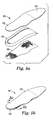
- FIG. 5a is an exploded perspective view of a custom-formable shoe insert 60 of the present invention.
- the insert comprises a top layer 62 (shown with optional toe portion 63 ); a middle pre-contoured, conformable, porous substrate layer 64 (at least a portion of which is impregnated with a storage-stable, settable resin); and a lower outer layer 66.
- Layers 62 and 66 are impervious to the settable resin, but at least a portion of layers 62 and/or 66 are pervious (e.g., accessible or permeable) to an activator.
- top layer 62 comprises a tough, leather-like layer.
- FIG. 5b is an assembled custom-formable shoe insert 60 of the present invention.
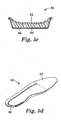
- FIG. 5c is a cross-section of the custom-formable shoe insert of FIG. 5b, taken along lines 5c-5c.
- FIG. 5d is an assembled and customized shoe insert 60 of the present invention after being formed to the foot and shoe of a user.
- the soft resin was prepared by mixing the components listed below into a Part A and a Part B mix and then combining 35 grams of A and 65 grams of B with vigorous shaking.
- Part A Part B Component Parts (w) Component Parts (w) Isonate 2143L (Dow Chemical Co.; Midland, MI) 20.60 Polyol LHT-42 (Dow Chemical Co., Midland, MI) 62.07 Benzoyl Chloride 0.06 D C Antifoam 1400 (Dow Corning Corp.; Greensboro, NC) 0.20 Butyl Benzyl Phthalate 10.00 Reactint yellow X-15 (Milliken Chemicals, Spartanburg, SC) 0.25 Pluronic F-38 (BASF Corp., Mount Olive, NJ) 4.00 MEMPE 1.50 Butylated hydroxy tolune 0.33 Cab-O-Sil TS-720 (Cabot Corp., Tuscola, IL) 1.00
- An open-cell polyether polyurethane foam as above was dimensioned to a 10 cm (3 7/8") diameter disk with a 2.54 cm (1") thickness in a 5.08 cm (2") diameter center portion tapering to 0 thickness at the outer circumference.
- the foam disk was coated with a semi-rigid resin, using the same process and coating weight as above.
- the semi-rigid resin was prepared by mixing the components listed below into a Part A and a Part B mix and then combining 49.3 grams of Part A and 50.7 grams of Part B with vigorous shaking.
- Part A Part B Component Parts (w) Component Parts (w) Isonate 2143L 44.9 Polyol PPG-1025 (ARCO Chemical Co., Newtown Square, PA) 48.5 Benzoyl Chloride 0.06
- DC Antifoam 1400 (Dow Corning Corp., Greensboro, NC) 0.20 Pluronic F-38 (BASF Corp., Mount Olive, NJ) 4.00 Reactint Blue 960 (Milliken Chemicals, Spartanburg, SC) 0.04 Butylated hydroxy toluene 0.33
- MEMPE 1.00 Cab-O-Sil TS-720 1.00
- the soft resin impregnated foam was cut to a generic foot shape, about size 10 to 11, using a rule die.
- the semi-rigid resin impregnated foam disk was cut in half, forming a half circle shape, which was combined with the soft resin impregnated foam in foot shape in its arch area forming an assembly.
- This assembly was then sandwiched between two layers of 1% FC-280 treated SONTARA 8000 spun-laced polyester nonwoven fabric.
- the nonwoven fabric layers were sealed with a hot melt adhesive to each other immediately next to the periphery of the foam assembly and trimmed, leaving an edge seal width of approximately 0.48 cm (3/16").
- the resulting custom formable shoe insert was sealed in a foil lined pouch in a dry room where the above described resin coating was done.
- a foam assembly was made as in Example 1 and then sandwiched between two layers of a fabric made by stitch bonding a melt blown polyurethane nonwoven fabric with a polyester yarn (AB-9125, Nonwoven Center designation), using the sealing, trimming and pouching method in Example 1.
- Example 1 was repeated except that 7.8 grams of dried (at 80° C in a forced air oven for at least 12 hours) urea-formaldehyde microcapsules containing octadecane were spread evenly over the surface of the soft resin coated foam and kneaded into the foam with hand pressure just before assembling the foam parts.
- a custom formable shoe insert was made as in Example 2 with the addition of 8.2 grams of dried urea-formaldehyde microcapsules containing octadecane as in Example 3.
- Example 1 A temperature comparison was made between the inserts of Example 1 and Example 3. Using a thermocouple, the temperature under a person's foot arches in shoes was measured and found to be about 27.9 and 28.5° C (82.2 and 83.3° F), respectively for left and right shoe, before any inserts had been placed therein. The cured insert of Example 1 was put in the left shoe and that of Example 3 was put in the right shoe. After putting the respective shoes on the left and right feet, the thermocouple was again put under each arches and the temperatures were found to be about 30.8 to 31.1°C (87.5 to 88° F) with the Example 1 insert and about 28.1 to 28.5° C (82.5 to 83.3° F) with the Example 3 insert. This indicated that the microcapsules in Example 3 kept the foot cooler in the presence of a custom fitting insert than without the microcapsules.
- a thermocouple the temperature under a person's foot arches in shoes was measured and found to be about 27.9 and 28.5° C (82.2 and 83.3° F), respectively
- a 0.32 cm thick, medium density, compression set resistant, partially open-celled foam (Poron® Cushion Insole Material, 4708-01-20215,I4; available from Rogers Corporation, Rogers, CT) was cut to the shape of the inlay found in a size 12 shoe.
- the preceding thicknesses were measured using a model 49-70 Testing Machines, Inc. (Amityville, L.I., NY) thickness gauge with a gap plate diameter of approximately 1.9 cm.
- the resin coated foam piece above was removed from the pouch, and placed against the dried partially open-celled foam with the arch and heel areas of the resin coated foam piece positioned to correspond with the arch and heel areas of the partially open-celled foam.
- the dried fabric was then sealed to the partially open-celled foam at the periphery of the resin coated foam piece using hot melt glue (Jet-Melt, available from 3M, St Paul, MN).
- the assembled construction was sealed in a foil-lined pouch for later evaluation.
- a lace-up, size 12 shoe was removed from a human foot, and the inlay that came with the shoe was taken out.
- the above-assembled construction was removed from the pouch, held under a stream of slightly warm water with squeezing, thoroughly wetting the resin coated foam contained within. The excess water was squeezed out, and the assembly was quickly dried by pressing between towels.
- the assembly was placed in the shoe, and a human foot was placed on the assembly in the shoe.
- the shoe was laced up, and while in a sitting position, the foot and leg were placed in a neutral position. After 3 minutes, the shoe was removed, and the custom formed shoe insert was taken out and allowed to air dry.
- the above custom formed shoe insert was placed in the shoe and worn for several hours. This was found to provide significantly more comfort and support than when the inlay that came with the shoe was used in the shoe.
- Example 1 The soft and the semi-rigid resins of Example 1 were separately coated into two sheets (about 2 cm thick by 15.2 cm by 15.2 cm) of an open celled polyether urethane foam (trade designation 17230, available from Federal Foam Technologies, Inc., Ellsworth, WL).
- the foam sheets had a density of about 0.029 g/cm 3 and an IFD value of about 2.107 kPa (44 lbf./ft. 2 ).
- the resin was applied to the foam sheets at about 86% by weight of the combined weight of the resin and foam and uniformly distributed throughout the foam by hand kneading. Each resin impregnated foam sheet was then sealed in a foil pouch for later use.
- Each of the above sheets of resin impregnated foam was removed from the pouch, dipped in room temperature water (about 22° C), squeezed several times, and then squeezed to remove excess water.
- Each activated sheet of resin impregnated foam set in about 3 minutes and was allowed to fully cure and dry in the open at room temperature for several weeks.
- the cured sheet of resin impregnated foam containing the soft resin was measured for thickness (2.01 cm, 0.79 in.) and placed on a flat base under the probe and load cell, and the cross-head was lowered so that the probe pressed against the soft (after setting) resin foam at a pre-load of about 0.25 kg.
- the distance that the probe moved into the soft (after setting) resin foam was measured.
- a total of ten measurements were taken, each measurement in a different area of the soft (after setting) resin foam sheet.
- the cured sheet of resin impregnated foam containing semi-rigid resin was measured for thickness 1.97 cm, (0.775 in.) and tested for compression resistance. A mean value of 0.234 cm (0.092 inches) was found corresponding to 11.9 % compression.
Landscapes
- Health & Medical Sciences (AREA)
- Epidemiology (AREA)
- General Health & Medical Sciences (AREA)
- Public Health (AREA)
- Chemical & Material Sciences (AREA)
- Chemical Kinetics & Catalysis (AREA)
- Medicinal Chemistry (AREA)
- Polymers & Plastics (AREA)
- Organic Chemistry (AREA)
- Footwear And Its Accessory, Manufacturing Method And Apparatuses (AREA)
- Laminated Bodies (AREA)
Claims (10)
- Kundenspezifisch formbare Schuheinlage (20b;30;40;50;60) mitdadurch gekennzeichnet, dasseiner konformierbaren Substrat-Schicht (21;52), wobei ein Teil der Substrat-Schicht (21;52) mit einem lagerbeständigen härtbaren Harz imprägniert ist, das aushärtet, wenn es einem Aktivator ausgesetzt wird, undeiner äußeren Schicht (23;54,56;62,66), die sämtliche Seiten der Substrat-Schicht (21;52) umgibt,die konformierbare Substrat-Schicht (21;52) erste und zweite Teile (26;48) aufweist, wobei der erste Teil (24;46) mit einem ersten härtbaren Harz imprägniert ist und der zweite Teil (26;48) mit einem zweiten härtbaren Harz imprägniert ist,wobei das erste härtbare Harz eine Kompression der Substrat-Schicht (21;52) um ungefähr 35% bis 75% nach dem Härten zulässt und das zweite härtbare Harz eine Kompression der Substrat-Schicht (21;52) um ungefähr 9% bis 25% nach dem Härten zulässt, unddie äußere Schicht (23;54,56;62,66) für das erste und das zweite härtbare Harz undurchlässig ist, jedoch mindestens ein Teil der äußeren Schicht für den Aktivator durchlässig ist.
- Kundenspezifisch formbare Schuheinlage (20b;30;40;50;60) nach Anspruch 1, bei der das härtbare Harz oder die härtbaren Harze ein wasserhärtbares isocyanat-funktionales Polyurethanpräpolymer-Harz aufweist bzw. aufweisen.
- Kundenspezifisch formbare Schuheinlage (20b;30;40;50;60) nach Anspruch 1 oder 2, bei der die äußere Schicht (23;54,56;62,66) eine chemisch behandelte Schicht aufweist, die aus der Gruppe gewählt ist, welche fluorchemisch behandelte Schichten und siliconbehandelte Schichten aufweist.
- Kundenspezifisch formbare Schuheinlage (20b;30;40;50;60) nach einem der Ansprüche 1 bis 3, bei der das lagerbeständige härtbare Harz Mikrokaspeln zur Erzeugung eines Kühleffekts aufweist und bei der die Mikrokapseln Octodecan enthaltendes Harnstoff-Formaldehyd aufweisen.
- Kundenspezifisch formbare Schuheinlage (20b;30;40;50;60) nach Anspruch 4, bei der das lagerbeständige härtbare Harz ungefähr 20 Gewichtsprozent an Mikrokapseln basierend auf dem Gesamtgewicht des Harzes aufweist.
- Kundenspezifisch formbare Schuheinlage (20b;30;40;50;60) nach einem der Ansprüche 1 bis 5, bei dem der Aktivator Wasser aufweist.
- Kundenspezifisch formbare Schuheinlage (20b;30;40;50;60) nach einem der Ansprüche 1 bis 6, bei dem die Substrat-Schicht (21;52) nach dem Härten des lagerbeständigen härtbaren Harzes porös ist.
- Kundenspezifisch formbare Schuheinlage (20b;30;40;50;60) nach einem der Ansprüche 1 bis 7, bei dem die konformierbare Substrat-Schicht (21;52) ein offenzelliger Schaum mit einer Eindrückkraft-Deflektion im Bereich von ungefähr 0,96 bis 4,8 kPa ist.
- Kundenspezifisch formbare Schuheinlage (20b;30;40;50;60) nach einem der Ansprüche 1 bis 8, ferner mit einer Deckschicht nahe der äußeren Schicht (23;54,56;62,66).
- Kundenspezifisch formbare Schuheinlage (20b;30;40;50;60) nach einem der Ansprüche 1 bis 9, ferner mit einem Zeh-Teil (22b;32;42;63), das an einer Schicht angeordnet ist, die aus der die konformierbare Substrat-Schicht (21;52) und die äußere Schicht (23;54,56;62,66) umfassenden Gruppe gewählt ist.
Priority Applications (1)
| Application Number | Priority Date | Filing Date | Title |
|---|---|---|---|
| EP03005862A EP1321057A3 (de) | 1998-10-30 | 1999-10-29 | An der Fussform anpassbare Schuheinlage |
Applications Claiming Priority (5)
| Application Number | Priority Date | Filing Date | Title |
|---|---|---|---|
| US10630198P | 1998-10-30 | 1998-10-30 | |
| US106301P | 1998-10-30 | ||
| US09/429,509 US6280815B1 (en) | 1998-10-30 | 1999-10-28 | Custom-formable shoe insert |
| US429509 | 1999-10-28 | ||
| PCT/US1999/025436 WO2000025616A1 (en) | 1998-10-30 | 1999-10-29 | Custom-formable shoe insert |
Related Child Applications (1)
| Application Number | Title | Priority Date | Filing Date |
|---|---|---|---|
| EP03005862A Division EP1321057A3 (de) | 1998-10-30 | 1999-10-29 | An der Fussform anpassbare Schuheinlage |
Publications (2)
| Publication Number | Publication Date |
|---|---|
| EP1124461A1 EP1124461A1 (de) | 2001-08-22 |
| EP1124461B1 true EP1124461B1 (de) | 2003-04-02 |
Family
ID=26803529
Family Applications (1)
| Application Number | Title | Priority Date | Filing Date |
|---|---|---|---|
| EP99960175A Expired - Lifetime EP1124461B1 (de) | 1998-10-30 | 1999-10-29 | An der fussform anpassbare schuheinlage |
Country Status (7)
| Country | Link |
|---|---|
| US (1) | US6280815B1 (de) |
| EP (1) | EP1124461B1 (de) |
| JP (1) | JP2002528207A (de) |
| AU (1) | AU1710200A (de) |
| CA (1) | CA2346418A1 (de) |
| DE (1) | DE69906562T2 (de) |
| WO (1) | WO2000025616A1 (de) |
Cited By (2)
| Publication number | Priority date | Publication date | Assignee | Title |
|---|---|---|---|---|
| DE102012013335A1 (de) | 2012-07-06 | 2014-01-23 | Swissies AG | Schuh mit erhöhtem Tragekomfort und dreidimensionaler Bewegungfreiheit |
| WO2018085354A1 (en) * | 2016-11-01 | 2018-05-11 | Washington University | Foot engagement device |
Families Citing this family (39)
| Publication number | Priority date | Publication date | Assignee | Title |
|---|---|---|---|---|
| US7264604B1 (en) * | 2000-10-20 | 2007-09-04 | 3M Innovative Properties Company | Curable off-loading footwear and methods |
| JP3956392B2 (ja) * | 2001-09-10 | 2007-08-08 | 株式会社ホンダアクセス | 身体サポート具 |
| US6962010B2 (en) | 2002-10-02 | 2005-11-08 | Footstar Corporation | Dress shoe with improved heel counter |
| US7119149B2 (en) * | 2003-01-03 | 2006-10-10 | Henkel Kommanditgesellschaft Auf | High expansion two-component structural foam |
| US7073277B2 (en) * | 2003-06-26 | 2006-07-11 | Taylor Made Golf Company, Inc. | Shoe having an inner sole incorporating microspheres |
| US7008386B2 (en) * | 2003-08-26 | 2006-03-07 | Acor Orthopaedic, Inc. | Foot orthotic |
| JP2007530218A (ja) * | 2004-03-31 | 2007-11-01 | ビーエスエヌ メディカル,インク. | ロール状医療用包帯製品、医療用包帯材料、その製造方法並びに包帯方法 |
| US20070032561A1 (en) * | 2005-08-05 | 2007-02-08 | I-Sioun Lin | Modified hydrophilic polyurethane memory foam, application and manufacturing method thereof |
| JP3127140U (ja) * | 2005-09-02 | 2006-11-24 | 林重仁 | 換気可能な靴中敷の構造 |
| US7900380B2 (en) * | 2005-10-13 | 2011-03-08 | Masterfit Enterprises Inc. | User moldable adjustable insert |
| US20070295751A1 (en) * | 2006-06-27 | 2007-12-27 | David Jackson Lestage | Cleaning implement |
| US20080034618A1 (en) * | 2006-08-09 | 2008-02-14 | Li-Yu Lin | Sole device fitting with a foot and method for making the same |
| USD618896S1 (en) * | 2006-10-13 | 2010-07-06 | Payless Shoesource Worldwide, Inc. | Supportive shoe insert member |
| US20080086908A1 (en) * | 2006-10-16 | 2008-04-17 | Nike, Inc. | Article of Footwear with Deforming Insert |
| US7775170B2 (en) * | 2007-01-08 | 2010-08-17 | Xymid L.L.C. | Stitchbonded fabric with a discontinuous substrate |
| US8021735B2 (en) * | 2007-01-08 | 2011-09-20 | Xymid, Llc | Stitchbonded fabric with a substrate having diverse regional properties |
| US7875334B2 (en) * | 2007-01-08 | 2011-01-25 | Xymid L.L.C. | Stitchbonded fabric with a slit substrate |
| ITPD20080008U1 (it) * | 2008-02-21 | 2009-08-22 | Geox Spa | "struttura di sottopiede per calzature" |
| IT1393928B1 (it) * | 2008-07-25 | 2012-05-17 | Alpinestars Res Srl | Calzatura per uso sportivo. |
| IT1391203B1 (it) * | 2008-08-13 | 2011-11-18 | Alpinestars Res Srl | Calzatura, in particolare stivale da motociclismo, a struttura ventilata. |
| US8845939B1 (en) | 2008-11-25 | 2014-09-30 | Remington Products Company | Foam product with an insert and its method of manufacture |
| NL2004833C2 (en) * | 2010-06-07 | 2011-12-08 | Sara Lee De Nv | Shoe insole including a knitted spacer fabric. |
| KR101356402B1 (ko) * | 2010-11-30 | 2014-01-28 | 한국타이어 주식회사 | 폴리우레탄 폼 및 이를 포함하는 공기입 타이어 |
| US20120151793A1 (en) * | 2010-12-21 | 2012-06-21 | Lin Kwang-Huo | Foamed shoe sole |
| US20130008050A1 (en) * | 2011-07-07 | 2013-01-10 | Michel Marc | Shoe Insole |
| US20130081303A1 (en) * | 2011-09-30 | 2013-04-04 | BZ3, Inc. | Orthopedic cushioning device |
| US20140182164A1 (en) * | 2013-01-03 | 2014-07-03 | Thomas Nikita Krupenkin | Apparatus For Regulating Footwear Temperature |
| US9565888B2 (en) * | 2013-03-04 | 2017-02-14 | Lfrj, Llc | Shoe insert and method for using same |
| DK3082489T3 (da) * | 2013-12-20 | 2022-07-25 | Favime Aps | Balanceøgende væskefyldt indlægssål for anvendelse inden for sygdom, genoptræning, stående og gående arbejde og sport |
| US20210000222A1 (en) * | 2014-07-07 | 2021-01-07 | Jason Guadalajara | Reformable Insole and Method of Fabricating |
| US20160000184A1 (en) * | 2014-07-07 | 2016-01-07 | Jason Guadalajara | Insole and Method of Fabricating |
| RU2698746C1 (ru) * | 2015-10-22 | 2019-08-29 | Джейсон ГВАДАЛАХАРА | Стелька и способ ее изготовления |
| EP3429742B1 (de) | 2016-03-14 | 2021-02-17 | 3M Innovative Properties Company | Verbundgranulate mit polymerem sorptionsmittel für reaktive gase |
| US10960341B2 (en) | 2016-03-14 | 2021-03-30 | 3M Innovative Properties Company | Air filters comprising polymeric sorbents for aldehydes |
| KR101703478B1 (ko) * | 2016-08-01 | 2017-02-07 | (주)에스앤에프 | 신발용 패드 |
| KR101964409B1 (ko) * | 2018-12-27 | 2019-04-01 | (주)에스앤에프 | 자가 맞춤형 수경화성 신발 인솔 |
| DE202019001061U1 (de) * | 2019-03-05 | 2019-04-08 | Clemens Tuma | Schuheinlage mit einem integrierten Saugkern aus einem Textilgewebe, welcher als Träger von Duftölen dient |
| AU2021283930B2 (en) * | 2020-06-03 | 2024-08-15 | O2 Partners, Llc | Fiber-based shoe insoles and methods of manufacturing the same |
| DE102024131923A1 (de) * | 2024-10-31 | 2026-04-30 | Martin Jaeger | Einlegesohle oder Schuheinlage für Schuhe sowie Verfahren zu deren Herstellung |
Family Cites Families (24)
| Publication number | Priority date | Publication date | Assignee | Title |
|---|---|---|---|---|
| US3516941A (en) | 1966-07-25 | 1970-06-23 | Minnesota Mining & Mfg | Microcapsules and process of making |
| US3805417A (en) * | 1973-02-12 | 1974-04-23 | G Albrecht | Shoes or overshoes |
| DE2651089C3 (de) | 1976-11-09 | 1980-06-12 | Bayer Ag, 5090 Leverkusen | Selbsthältendes Material für Stutzverbände |
| US4502479A (en) | 1979-09-04 | 1985-03-05 | Minnesota Mining And Manufacturing Company | Water-activated casting material |
| JPS5828898B2 (ja) * | 1980-08-01 | 1983-06-18 | 三菱瓦斯化学株式会社 | 発熱性積層体 |
| US4433680A (en) | 1982-02-10 | 1984-02-28 | Johnson & Johnson Products, Inc. | Polyurethane casting material |
| US4433580A (en) | 1982-07-22 | 1984-02-28 | Tward 2001 Limited | Pressure transducer |
| US4694589A (en) * | 1983-02-28 | 1987-09-22 | Sullivan James B | Elastomeric shoe innersole |
| US4667661A (en) | 1985-10-04 | 1987-05-26 | Minnesota Mining And Manufacturing Company | Curable resin coated sheet having reduced tack |
| US5002047A (en) | 1986-09-03 | 1991-03-26 | Minnesota Mining And Manufacturing Company | Orthotic pads and methods |
| US4683877A (en) | 1985-10-04 | 1987-08-04 | Minnesota Mining And Manufacturing Company | Orthopedic casting article and method |
| US4705840A (en) | 1985-10-04 | 1987-11-10 | Minnesota Mining And Manufacturing Company | Catalysts for the curing of a water-curable isocyanate-functional prepolymer |
| US5195945A (en) | 1985-10-04 | 1993-03-23 | Minnesota Mining And Manufacturing Company | Orthotic pads and methods |
| US4888225A (en) * | 1985-10-04 | 1989-12-19 | Minnesota Mining And Manufacturing Company | Resin-impregnated foam materials and methods |
| US5027803A (en) | 1988-07-22 | 1991-07-02 | Minnesota Mining & Manufacturing Company | Orthopedic splinting and casting article |
| US5203793A (en) | 1989-09-20 | 1993-04-20 | Lyden Robert M | Conformable cushioning and stability device for articles of footwear |
| US5095570A (en) | 1989-12-12 | 1992-03-17 | Orthofeet Inc. | Method for producing an insole |
| US5499460A (en) * | 1992-02-18 | 1996-03-19 | Bryant; Yvonne G. | Moldable foam insole with reversible enhanced thermal storage properties |
| US5366801A (en) | 1992-05-29 | 1994-11-22 | Triangle Research And Development Corporation | Fabric with reversible enhanced thermal properties |
| US5354259A (en) | 1993-01-25 | 1994-10-11 | Minnesota Mining And Manufacturing Company | Microfiber fillers for orthopedic casting tapes |
| US5423735A (en) | 1993-04-16 | 1995-06-13 | Minnesota Mining And Manufacturing Company | Orthopedic cast composed of an alkoxysilane terminated resin |
| US5716661A (en) | 1993-04-16 | 1998-02-10 | Minnesota Mining And Manufacturing Company | Method of making a light weight orthopedic casting tape |
| US5423785A (en) | 1993-11-30 | 1995-06-13 | Hart; F. David | Sheath retainer |
| EP1006827A4 (de) * | 1996-07-08 | 2001-07-04 | Mardix Bar Cochva | Angepasste einlegesohle |
-
1999
- 1999-10-28 US US09/429,509 patent/US6280815B1/en not_active Expired - Lifetime
- 1999-10-29 EP EP99960175A patent/EP1124461B1/de not_active Expired - Lifetime
- 1999-10-29 CA CA002346418A patent/CA2346418A1/en not_active Abandoned
- 1999-10-29 AU AU17102/00A patent/AU1710200A/en not_active Abandoned
- 1999-10-29 WO PCT/US1999/025436 patent/WO2000025616A1/en not_active Ceased
- 1999-10-29 JP JP2000579078A patent/JP2002528207A/ja active Pending
- 1999-10-29 DE DE69906562T patent/DE69906562T2/de not_active Expired - Lifetime
Cited By (4)
| Publication number | Priority date | Publication date | Assignee | Title |
|---|---|---|---|---|
| DE102012013335A1 (de) | 2012-07-06 | 2014-01-23 | Swissies AG | Schuh mit erhöhtem Tragekomfort und dreidimensionaler Bewegungfreiheit |
| WO2018085354A1 (en) * | 2016-11-01 | 2018-05-11 | Washington University | Foot engagement device |
| US11033075B2 (en) | 2016-11-01 | 2021-06-15 | Washington University | Foot device |
| US11766094B2 (en) | 2016-11-01 | 2023-09-26 | Washington University | Foot device |
Also Published As
| Publication number | Publication date |
|---|---|
| CA2346418A1 (en) | 2000-05-11 |
| EP1124461A1 (de) | 2001-08-22 |
| JP2002528207A (ja) | 2002-09-03 |
| DE69906562T2 (de) | 2004-02-05 |
| DE69906562D1 (de) | 2003-05-08 |
| US6280815B1 (en) | 2001-08-28 |
| AU1710200A (en) | 2000-05-22 |
| WO2000025616A1 (en) | 2000-05-11 |
Similar Documents
| Publication | Publication Date | Title |
|---|---|---|
| US6280815B1 (en) | Custom-formable shoe insert | |
| AU618750B2 (en) | Orthotic pads and methods | |
| US4888225A (en) | Resin-impregnated foam materials and methods | |
| US5195945A (en) | Orthotic pads and methods | |
| US5888231A (en) | Custom-molded liner for artificial limb socket | |
| US3781231A (en) | Physically reinforced hydrophilic foam and method of preparing same | |
| EP0279612B1 (de) | Orthopädische Stützverbände und Verfahren | |
| US5203764A (en) | Foam pads useful in wound management | |
| US3793241A (en) | Dimensionally stable hydrophilic foam and method of preparing same | |
| EP0907341B1 (de) | Orthopädischer steifverbandartikel mit harten und weichen bereichen | |
| EP0035517B1 (de) | Mit wasser aktiviertes gussmaterial | |
| US5228164A (en) | Last for preparing custom footwear | |
| US5334442A (en) | Orthopedic sheet-like composition | |
| US3839138A (en) | Dimensionally stable hydrophilic foam and method of preparing same | |
| US6922918B2 (en) | Method and apparatus for a shoe having an odor and moisture absorbent pad | |
| JP5244238B2 (ja) | クッションデバイス | |
| US5324252A (en) | Foam pads useful in wound management | |
| EP1321057A2 (de) | An der Fussform anpassbare Schuheinlage | |
| KR19990075640A (ko) | 정형용 부목재 | |
| MXPA01004275A (en) | Custom-formable shoe insert | |
| JP2000511952A (ja) | 吸収性靴用材料 | |
| HK1030537B (en) | Socket liner for limb prosthesis |
Legal Events
| Date | Code | Title | Description |
|---|---|---|---|
| PUAI | Public reference made under article 153(3) epc to a published international application that has entered the european phase |
Free format text: ORIGINAL CODE: 0009012 |
|
| 17P | Request for examination filed |
Effective date: 20010328 |
|
| AK | Designated contracting states |
Kind code of ref document: A1 Designated state(s): AT BE CH CY DE DK ES FI FR GB GR IE IT LI LU MC NL PT SE |
|
| 17Q | First examination report despatched |
Effective date: 20011004 |
|
| GRAH | Despatch of communication of intention to grant a patent |
Free format text: ORIGINAL CODE: EPIDOS IGRA |
|
| GRAH | Despatch of communication of intention to grant a patent |
Free format text: ORIGINAL CODE: EPIDOS IGRA |
|
| GRAA | (expected) grant |
Free format text: ORIGINAL CODE: 0009210 |
|
| AK | Designated contracting states |
Designated state(s): DE FR GB |
|
| REG | Reference to a national code |
Ref country code: GB Ref legal event code: FG4D |
|
| REG | Reference to a national code |
Ref country code: IE Ref legal event code: FG4D |
|
| REF | Corresponds to: |
Ref document number: 69906562 Country of ref document: DE Date of ref document: 20030508 Kind code of ref document: P |
|
| ET | Fr: translation filed | ||
| PLBE | No opposition filed within time limit |
Free format text: ORIGINAL CODE: 0009261 |
|
| STAA | Information on the status of an ep patent application or granted ep patent |
Free format text: STATUS: NO OPPOSITION FILED WITHIN TIME LIMIT |
|
| 26N | No opposition filed |
Effective date: 20040105 |
|
| REG | Reference to a national code |
Ref country code: IE Ref legal event code: MM4A |
|
| REG | Reference to a national code |
Ref country code: FR Ref legal event code: PLFP Year of fee payment: 17 |
|
| PGFP | Annual fee paid to national office [announced via postgrant information from national office to epo] |
Ref country code: FR Payment date: 20150908 Year of fee payment: 17 |
|
| PGFP | Annual fee paid to national office [announced via postgrant information from national office to epo] |
Ref country code: DE Payment date: 20151020 Year of fee payment: 17 Ref country code: GB Payment date: 20151028 Year of fee payment: 17 |
|
| REG | Reference to a national code |
Ref country code: DE Ref legal event code: R119 Ref document number: 69906562 Country of ref document: DE |
|
| GBPC | Gb: european patent ceased through non-payment of renewal fee |
Effective date: 20161029 |
|
| REG | Reference to a national code |
Ref country code: FR Ref legal event code: ST Effective date: 20170630 |
|
| PG25 | Lapsed in a contracting state [announced via postgrant information from national office to epo] |
Ref country code: DE Free format text: LAPSE BECAUSE OF NON-PAYMENT OF DUE FEES Effective date: 20170503 Ref country code: GB Free format text: LAPSE BECAUSE OF NON-PAYMENT OF DUE FEES Effective date: 20161029 Ref country code: FR Free format text: LAPSE BECAUSE OF NON-PAYMENT OF DUE FEES Effective date: 20161102 |