EP1124873B1 - Katalysatorsalz enthaltende polymerisierbare zusammensetzungen zur herstellung thiogruppenhaltiger harze und verfahren zur herstellung von gegenständen aus besagten harzen - Google Patents
Katalysatorsalz enthaltende polymerisierbare zusammensetzungen zur herstellung thiogruppenhaltiger harze und verfahren zur herstellung von gegenständen aus besagten harzen Download PDFInfo
- Publication number
- EP1124873B1 EP1124873B1 EP99949010A EP99949010A EP1124873B1 EP 1124873 B1 EP1124873 B1 EP 1124873B1 EP 99949010 A EP99949010 A EP 99949010A EP 99949010 A EP99949010 A EP 99949010A EP 1124873 B1 EP1124873 B1 EP 1124873B1
- Authority
- EP
- European Patent Office
- Prior art keywords
- thio
- cyanate
- composition according
- diiso
- premix
- Prior art date
- Legal status (The legal status is an assumption and is not a legal conclusion. Google has not performed a legal analysis and makes no representation as to the accuracy of the status listed.)
- Expired - Lifetime
Links
- 239000000203 mixture Substances 0.000 title claims abstract description 94
- 150000003839 salts Chemical class 0.000 title claims abstract description 23
- 239000003054 catalyst Substances 0.000 title claims abstract description 22
- 229920005989 resin Polymers 0.000 title claims abstract description 17
- 239000011347 resin Substances 0.000 title claims abstract description 17
- 125000000446 sulfanediyl group Chemical group *S* 0.000 title claims abstract description 11
- 238000000034 method Methods 0.000 title claims description 12
- -1 episulfide compound Chemical class 0.000 claims abstract description 35
- 150000001875 compounds Chemical class 0.000 claims abstract description 25
- 150000001450 anions Chemical class 0.000 claims abstract description 10
- 150000001768 cations Chemical class 0.000 claims abstract description 9
- 239000002253 acid Substances 0.000 claims abstract description 7
- 229910052751 metal Inorganic materials 0.000 claims abstract description 7
- 239000002184 metal Substances 0.000 claims abstract description 7
- QGZKDVFQNNGYKY-UHFFFAOYSA-O ammonium group Chemical group [NH4+] QGZKDVFQNNGYKY-UHFFFAOYSA-O 0.000 claims abstract description 6
- 229910052784 alkaline earth metal Inorganic materials 0.000 claims abstract description 3
- 150000001342 alkaline earth metals Chemical class 0.000 claims abstract description 3
- 239000000178 monomer Substances 0.000 claims description 52
- WQJONRMBVKFKOB-UHFFFAOYSA-N cyanatosulfanyl cyanate Chemical compound N#COSOC#N WQJONRMBVKFKOB-UHFFFAOYSA-N 0.000 claims description 40
- 229920006295 polythiol Polymers 0.000 claims description 25
- 238000006116 polymerization reaction Methods 0.000 claims description 20
- 238000002156 mixing Methods 0.000 claims description 17
- 230000003287 optical effect Effects 0.000 claims description 15
- 239000002904 solvent Substances 0.000 claims description 15
- 229920000582 polyisocyanurate Polymers 0.000 claims description 10
- 239000011495 polyisocyanurate Substances 0.000 claims description 10
- 150000003983 crown ethers Chemical class 0.000 claims description 8
- 239000006096 absorbing agent Substances 0.000 claims description 7
- 229920001228 polyisocyanate Polymers 0.000 claims description 7
- 239000005056 polyisocyanate Substances 0.000 claims description 7
- 125000002496 methyl group Chemical group [H]C([H])([H])* 0.000 claims description 6
- 239000002685 polymerization catalyst Substances 0.000 claims description 6
- 150000003553 thiiranes Chemical group 0.000 claims description 6
- 150000007960 acetonitrile Chemical class 0.000 claims description 5
- 239000006082 mold release agent Substances 0.000 claims description 5
- 229920005749 polyurethane resin Polymers 0.000 claims description 5
- 229910052717 sulfur Inorganic materials 0.000 claims description 5
- 125000006527 (C1-C5) alkyl group Chemical group 0.000 claims description 4
- UFWIBTONFRDIAS-UHFFFAOYSA-N Naphthalene Chemical compound C1=CC=CC2=CC=CC=C21 UFWIBTONFRDIAS-UHFFFAOYSA-N 0.000 claims description 4
- 125000001495 ethyl group Chemical group [H]C([H])([H])C([H])([H])* 0.000 claims description 4
- LYCAIKOWRPUZTN-UHFFFAOYSA-N ethylene glycol Natural products OCCO LYCAIKOWRPUZTN-UHFFFAOYSA-N 0.000 claims description 4
- ZMZDMBWJUHKJPS-UHFFFAOYSA-N hydrogen thiocyanate Natural products SC#N ZMZDMBWJUHKJPS-UHFFFAOYSA-N 0.000 claims description 4
- 125000002887 hydroxy group Chemical group [H]O* 0.000 claims description 4
- HJOVHMDZYOCNQW-UHFFFAOYSA-N isophorone Chemical compound CC1=CC(=O)CC(C)(C)C1 HJOVHMDZYOCNQW-UHFFFAOYSA-N 0.000 claims description 4
- 150000002739 metals Chemical class 0.000 claims description 4
- 229910052760 oxygen Inorganic materials 0.000 claims description 4
- 125000001436 propyl group Chemical group [H]C([*])([H])C([H])([H])C([H])([H])[H] 0.000 claims description 4
- 230000009257 reactivity Effects 0.000 claims description 4
- POILWHVDKZOXJZ-ARJAWSKDSA-M (z)-4-oxopent-2-en-2-olate Chemical compound C\C([O-])=C\C(C)=O POILWHVDKZOXJZ-ARJAWSKDSA-M 0.000 claims description 3
- ZMZDMBWJUHKJPS-UHFFFAOYSA-M Thiocyanate anion Chemical compound [S-]C#N ZMZDMBWJUHKJPS-UHFFFAOYSA-M 0.000 claims description 3
- 125000000484 butyl group Chemical group [H]C([*])([H])C([H])([H])C([H])([H])C([H])([H])[H] 0.000 claims description 3
- 125000001997 phenyl group Chemical group [H]C1=C([H])C([H])=C(*)C([H])=C1[H] 0.000 claims description 3
- UPMLOUAZCHDJJD-UHFFFAOYSA-N 4,4'-Diphenylmethane Diisocyanate Chemical compound C1=CC(N=C=O)=CC=C1CC1=CC=C(N=C=O)C=C1 UPMLOUAZCHDJJD-UHFFFAOYSA-N 0.000 claims description 2
- XDTMQSROBMDMFD-UHFFFAOYSA-N Cyclohexane Chemical compound C1CCCCC1 XDTMQSROBMDMFD-UHFFFAOYSA-N 0.000 claims description 2
- IYXGSMUGOJNHAZ-UHFFFAOYSA-N Ethyl malonate Chemical compound CCOC(=O)CC(=O)OCC IYXGSMUGOJNHAZ-UHFFFAOYSA-N 0.000 claims description 2
- UFHFLCQGNIYNRP-UHFFFAOYSA-N Hydrogen Chemical compound [H][H] UFHFLCQGNIYNRP-UHFFFAOYSA-N 0.000 claims description 2
- 125000001797 benzyl group Chemical group [H]C1=C([H])C([H])=C(C([H])=C1[H])C([H])([H])* 0.000 claims description 2
- 150000007942 carboxylates Chemical class 0.000 claims description 2
- XXKOQQBKBHUATC-UHFFFAOYSA-N cyclohexylmethylcyclohexane Chemical compound C1CCCCC1CC1CCCCC1 XXKOQQBKBHUATC-UHFFFAOYSA-N 0.000 claims description 2
- 125000005594 diketone group Chemical group 0.000 claims description 2
- ZIUSEGSNTOUIPT-UHFFFAOYSA-N ethyl 2-cyanoacetate Chemical compound CCOC(=O)CC#N ZIUSEGSNTOUIPT-UHFFFAOYSA-N 0.000 claims description 2
- XYIBRDXRRQCHLP-UHFFFAOYSA-N ethyl acetoacetate Chemical compound CCOC(=O)CC(C)=O XYIBRDXRRQCHLP-UHFFFAOYSA-N 0.000 claims description 2
- 229940093476 ethylene glycol Drugs 0.000 claims description 2
- 125000000524 functional group Chemical group 0.000 claims description 2
- 229910052736 halogen Inorganic materials 0.000 claims description 2
- 150000002367 halogens Chemical class 0.000 claims description 2
- 125000004836 hexamethylene group Chemical group [H]C([H])([*:2])C([H])([H])C([H])([H])C([H])([H])C([H])([H])C([H])([H])[*:1] 0.000 claims description 2
- 229910052739 hydrogen Inorganic materials 0.000 claims description 2
- 239000001257 hydrogen Substances 0.000 claims description 2
- 150000002828 nitro derivatives Chemical class 0.000 claims description 2
- 125000000962 organic group Chemical group 0.000 claims description 2
- 125000000843 phenylene group Chemical group C1(=C(C=CC=C1)*)* 0.000 claims description 2
- 239000003495 polar organic solvent Substances 0.000 claims description 2
- 125000000547 substituted alkyl group Chemical group 0.000 claims description 2
- 150000003457 sulfones Chemical class 0.000 claims description 2
- 150000003462 sulfoxides Chemical class 0.000 claims description 2
- 125000005628 tolylene group Chemical group 0.000 claims description 2
- 230000007704 transition Effects 0.000 claims description 2
- 125000006839 xylylene group Chemical group 0.000 claims description 2
- 125000004209 (C1-C8) alkyl group Chemical group 0.000 claims 1
- 230000002708 enhancing effect Effects 0.000 claims 1
- 229910052757 nitrogen Inorganic materials 0.000 claims 1
- 229910052723 transition metal Inorganic materials 0.000 abstract description 2
- 150000003624 transition metals Chemical class 0.000 abstract description 2
- WEVYAHXRMPXWCK-UHFFFAOYSA-N Acetonitrile Chemical compound CC#N WEVYAHXRMPXWCK-UHFFFAOYSA-N 0.000 description 9
- 239000003795 chemical substances by application Substances 0.000 description 6
- 230000003068 static effect Effects 0.000 description 5
- 239000000463 material Substances 0.000 description 4
- 150000003573 thiols Chemical group 0.000 description 4
- 125000004169 (C1-C6) alkyl group Chemical group 0.000 description 3
- CSCPPACGZOOCGX-UHFFFAOYSA-N Acetone Chemical compound CC(C)=O CSCPPACGZOOCGX-UHFFFAOYSA-N 0.000 description 3
- LFQSCWFLJHTTHZ-UHFFFAOYSA-N Ethanol Chemical compound CCO LFQSCWFLJHTTHZ-UHFFFAOYSA-N 0.000 description 3
- OKKJLVBELUTLKV-UHFFFAOYSA-N Methanol Chemical compound OC OKKJLVBELUTLKV-UHFFFAOYSA-N 0.000 description 3
- HEMHJVSKTPXQMS-UHFFFAOYSA-M Sodium hydroxide Chemical compound [OH-].[Na+] HEMHJVSKTPXQMS-UHFFFAOYSA-M 0.000 description 3
- ZMANZCXQSJIPKH-UHFFFAOYSA-N Triethylamine Chemical compound CCN(CC)CC ZMANZCXQSJIPKH-UHFFFAOYSA-N 0.000 description 3
- 125000000217 alkyl group Chemical group 0.000 description 3
- 239000012948 isocyanate Substances 0.000 description 3
- 150000002513 isocyanates Chemical class 0.000 description 3
- 229920003023 plastic Polymers 0.000 description 3
- 229920002578 polythiourethane polymer Polymers 0.000 description 3
- QTBSBXVTEAMEQO-UHFFFAOYSA-N Acetic acid Chemical compound CC(O)=O QTBSBXVTEAMEQO-UHFFFAOYSA-N 0.000 description 2
- MZRVEZGGRBJDDB-UHFFFAOYSA-N N-Butyllithium Chemical compound [Li]CCCC MZRVEZGGRBJDDB-UHFFFAOYSA-N 0.000 description 2
- 229910019142 PO4 Inorganic materials 0.000 description 2
- ATUOYWHBWRKTHZ-UHFFFAOYSA-N Propane Chemical compound CCC ATUOYWHBWRKTHZ-UHFFFAOYSA-N 0.000 description 2
- 239000000654 additive Substances 0.000 description 2
- 150000003863 ammonium salts Chemical class 0.000 description 2
- 230000015572 biosynthetic process Effects 0.000 description 2
- 238000000576 coating method Methods 0.000 description 2
- 239000003431 cross linking reagent Substances 0.000 description 2
- 239000000975 dye Substances 0.000 description 2
- 238000009472 formulation Methods 0.000 description 2
- 238000010438 heat treatment Methods 0.000 description 2
- 125000005842 heteroatom Chemical group 0.000 description 2
- ZBKFYXZXZJPWNQ-UHFFFAOYSA-N isothiocyanate group Chemical group [N-]=C=S ZBKFYXZXZJPWNQ-UHFFFAOYSA-N 0.000 description 2
- 150000001457 metallic cations Chemical class 0.000 description 2
- VNWKTOKETHGBQD-UHFFFAOYSA-N methane Chemical compound C VNWKTOKETHGBQD-UHFFFAOYSA-N 0.000 description 2
- INBDPOJZYZJUDA-UHFFFAOYSA-N methanedithiol Chemical compound SCS INBDPOJZYZJUDA-UHFFFAOYSA-N 0.000 description 2
- 238000000465 moulding Methods 0.000 description 2
- 239000002304 perfume Substances 0.000 description 2
- 235000021317 phosphate Nutrition 0.000 description 2
- 150000003013 phosphoric acid derivatives Chemical class 0.000 description 2
- 239000004033 plastic Substances 0.000 description 2
- 229920000642 polymer Polymers 0.000 description 2
- ZNNZYHKDIALBAK-UHFFFAOYSA-M potassium thiocyanate Chemical compound [K+].[S-]C#N ZNNZYHKDIALBAK-UHFFFAOYSA-M 0.000 description 2
- ASUAYTHWZCLXAN-UHFFFAOYSA-N prenol Chemical compound CC(C)=CCO ASUAYTHWZCLXAN-UHFFFAOYSA-N 0.000 description 2
- 238000007789 sealing Methods 0.000 description 2
- 239000000758 substrate Substances 0.000 description 2
- 150000003567 thiocyanates Chemical class 0.000 description 2
- BNJMRELGMDUDDB-UHFFFAOYSA-N $l^{1}-sulfanylbenzene Chemical compound [S]C1=CC=CC=C1 BNJMRELGMDUDDB-UHFFFAOYSA-N 0.000 description 1
- 0 *CC1(*)CC(*)(*)CC(*)C1 Chemical compound *CC1(*)CC(*)(*)CC(*)C1 0.000 description 1
- FKTHNVSLHLHISI-UHFFFAOYSA-N 1,2-bis(isocyanatomethyl)benzene Chemical compound O=C=NCC1=CC=CC=C1CN=C=O FKTHNVSLHLHISI-UHFFFAOYSA-N 0.000 description 1
- VYMPLPIFKRHAAC-UHFFFAOYSA-N 1,2-ethanedithiol Chemical compound SCCS VYMPLPIFKRHAAC-UHFFFAOYSA-N 0.000 description 1
- YGKHJWTVMIMEPQ-UHFFFAOYSA-N 1,2-propanedithiol Chemical compound CC(S)CS YGKHJWTVMIMEPQ-UHFFFAOYSA-N 0.000 description 1
- RYHBNJHYFVUHQT-UHFFFAOYSA-N 1,4-Dioxane Chemical compound C1COCCO1 RYHBNJHYFVUHQT-UHFFFAOYSA-N 0.000 description 1
- CEUQYYYUSUCFKP-UHFFFAOYSA-N 2,3-bis(2-sulfanylethylsulfanyl)propane-1-thiol Chemical compound SCCSCC(CS)SCCS CEUQYYYUSUCFKP-UHFFFAOYSA-N 0.000 description 1
- WXDDGAZCUPULGL-UHFFFAOYSA-N 2,3-bis(sulfanylmethylsulfanyl)propylsulfanylmethanethiol Chemical compound SCSCC(SCS)CSCS WXDDGAZCUPULGL-UHFFFAOYSA-N 0.000 description 1
- SITYOOWCYAYOKL-UHFFFAOYSA-N 2-[4,6-bis(2,4-dimethylphenyl)-1,3,5-triazin-2-yl]-5-(3-dodecoxy-2-hydroxypropoxy)phenol Chemical compound OC1=CC(OCC(O)COCCCCCCCCCCCC)=CC=C1C1=NC(C=2C(=CC(C)=CC=2)C)=NC(C=2C(=CC(C)=CC=2)C)=N1 SITYOOWCYAYOKL-UHFFFAOYSA-N 0.000 description 1
- UMZILNQWRJTTFW-UHFFFAOYSA-N 3-(1-sulfanylethylsulfanyl)propane-1,2-dithiol Chemical compound CC(S)SCC(S)CS UMZILNQWRJTTFW-UHFFFAOYSA-N 0.000 description 1
- TXOKWWCWTMUGBR-UHFFFAOYSA-N 3-(2-sulfanylpropylsulfanyl)propane-1,2-dithiol Chemical compound CC(S)CSCC(S)CS TXOKWWCWTMUGBR-UHFFFAOYSA-N 0.000 description 1
- XSJCFDBHQSQSKC-UHFFFAOYSA-N 3-(3-sulfanylpropylsulfanyl)propane-1,2-dithiol Chemical compound SCCCSCC(S)CS XSJCFDBHQSQSKC-UHFFFAOYSA-N 0.000 description 1
- QTHAWAOMRQVJLA-UHFFFAOYSA-N 3-(4-sulfanylbutylsulfanyl)propane-1,2-dithiol Chemical compound SCCCCSCC(S)CS QTHAWAOMRQVJLA-UHFFFAOYSA-N 0.000 description 1
- NKXLJPHXJVERDW-UHFFFAOYSA-N 3-(5-sulfanylpentylsulfanyl)propane-1,2-dithiol Chemical compound SCCCCCSCC(S)CS NKXLJPHXJVERDW-UHFFFAOYSA-N 0.000 description 1
- ZVEYUUKTASDIOR-UHFFFAOYSA-N 3-(6-sulfanylhexylsulfanyl)propane-1,2-dithiol Chemical compound SCCCCCCSCC(S)CS ZVEYUUKTASDIOR-UHFFFAOYSA-N 0.000 description 1
- DUYICINCNBSZMH-UHFFFAOYSA-N 3-[2,3-bis(3-sulfanylpropylsulfanyl)propylsulfanyl]propane-1-thiol Chemical compound SCCCSCC(SCCCS)CSCCCS DUYICINCNBSZMH-UHFFFAOYSA-N 0.000 description 1
- OAYBAJBLEJKYLA-UHFFFAOYSA-N 4-[2,3-bis(4-sulfanylbutylsulfanyl)propylsulfanyl]butane-1-thiol Chemical compound SCCCCSCC(SCCCCS)CSCCCCS OAYBAJBLEJKYLA-UHFFFAOYSA-N 0.000 description 1
- YZHRITPMSJSYSS-UHFFFAOYSA-N 4-[3-sulfanyl-2-(4-sulfanylbutylsulfanyl)propyl]sulfanylbutane-1-thiol Chemical compound SCCCCSCC(CS)SCCCCS YZHRITPMSJSYSS-UHFFFAOYSA-N 0.000 description 1
- VSWUTQPPMFJUOU-UHFFFAOYSA-N 5-[3-sulfanyl-2-(5-sulfanylpentylsulfanyl)propyl]sulfanylpentane-1-thiol Chemical compound SCCCCCSCC(CS)SCCCCCS VSWUTQPPMFJUOU-UHFFFAOYSA-N 0.000 description 1
- LYUPJRZGZIKZQQ-UHFFFAOYSA-N 6-[2,3-bis(6-sulfanylhexylsulfanyl)propylsulfanyl]hexane-1-thiol Chemical compound SCCCCCCSCC(SCCCCCCS)CSCCCCCCS LYUPJRZGZIKZQQ-UHFFFAOYSA-N 0.000 description 1
- QTBSBXVTEAMEQO-UHFFFAOYSA-M Acetate Chemical compound CC([O-])=O QTBSBXVTEAMEQO-UHFFFAOYSA-M 0.000 description 1
- 239000004215 Carbon black (E152) Substances 0.000 description 1
- BDAGIHXWWSANSR-UHFFFAOYSA-M Formate Chemical compound [O-]C=O BDAGIHXWWSANSR-UHFFFAOYSA-M 0.000 description 1
- BDAGIHXWWSANSR-UHFFFAOYSA-N Formic acid Chemical compound OC=O BDAGIHXWWSANSR-UHFFFAOYSA-N 0.000 description 1
- DGAQECJNVWCQMB-PUAWFVPOSA-M Ilexoside XXIX Chemical compound C[C@@H]1CC[C@@]2(CC[C@@]3(C(=CC[C@H]4[C@]3(CC[C@@H]5[C@@]4(CC[C@@H](C5(C)C)OS(=O)(=O)[O-])C)C)[C@@H]2[C@]1(C)O)C)C(=O)O[C@H]6[C@@H]([C@H]([C@@H]([C@H](O6)CO)O)O)O.[Na+] DGAQECJNVWCQMB-PUAWFVPOSA-M 0.000 description 1
- 239000002841 Lewis acid Substances 0.000 description 1
- WHXSMMKQMYFTQS-UHFFFAOYSA-N Lithium Chemical compound [Li] WHXSMMKQMYFTQS-UHFFFAOYSA-N 0.000 description 1
- 239000004721 Polyphenylene oxide Substances 0.000 description 1
- WYURNTSHIVDZCO-UHFFFAOYSA-N Tetrahydrofuran Chemical compound C1CCOC1 WYURNTSHIVDZCO-UHFFFAOYSA-N 0.000 description 1
- ATJFFYVFTNAWJD-UHFFFAOYSA-N Tin Chemical class [Sn] ATJFFYVFTNAWJD-UHFFFAOYSA-N 0.000 description 1
- 239000007983 Tris buffer Substances 0.000 description 1
- VLCCKNLIFIJYOQ-UHFFFAOYSA-N [3-hydroxy-2,2-bis(hydroxymethyl)propyl] 2,2,3,3-tetrakis(sulfanyl)propanoate Chemical compound OCC(CO)(CO)COC(=O)C(S)(S)C(S)S VLCCKNLIFIJYOQ-UHFFFAOYSA-N 0.000 description 1
- PQGAHNJECSVDEI-UHFFFAOYSA-N [CH2]CCCCC Chemical compound [CH2]CCCCC PQGAHNJECSVDEI-UHFFFAOYSA-N 0.000 description 1
- UKLDJPRMSDWDSL-UHFFFAOYSA-L [dibutyl(dodecanoyloxy)stannyl] dodecanoate Chemical compound CCCCCCCCCCCC(=O)O[Sn](CCCC)(CCCC)OC(=O)CCCCCCCCCCC UKLDJPRMSDWDSL-UHFFFAOYSA-L 0.000 description 1
- 230000001133 acceleration Effects 0.000 description 1
- TUCNEACPLKLKNU-UHFFFAOYSA-N acetyl Chemical compound C[C]=O TUCNEACPLKLKNU-UHFFFAOYSA-N 0.000 description 1
- YRKCREAYFQTBPV-UHFFFAOYSA-N acetylacetone Chemical compound CC(=O)CC(C)=O YRKCREAYFQTBPV-UHFFFAOYSA-N 0.000 description 1
- 125000001931 aliphatic group Chemical group 0.000 description 1
- SOIFLUNRINLCBN-UHFFFAOYSA-N ammonium thiocyanate Chemical compound [NH4+].[S-]C#N SOIFLUNRINLCBN-UHFFFAOYSA-N 0.000 description 1
- 230000003667 anti-reflective effect Effects 0.000 description 1
- 239000003963 antioxidant agent Substances 0.000 description 1
- 125000003118 aryl group Chemical group 0.000 description 1
- WPYMKLBDIGXBTP-UHFFFAOYSA-N benzoic acid Chemical compound OC(=O)C1=CC=CC=C1 WPYMKLBDIGXBTP-UHFFFAOYSA-N 0.000 description 1
- 239000004305 biphenyl Substances 0.000 description 1
- 230000005587 bubbling Effects 0.000 description 1
- 238000005266 casting Methods 0.000 description 1
- 239000012986 chain transfer agent Substances 0.000 description 1
- 238000006243 chemical reaction Methods 0.000 description 1
- 125000004122 cyclic group Chemical group 0.000 description 1
- 239000002781 deodorant agent Substances 0.000 description 1
- 239000012975 dibutyltin dilaurate Substances 0.000 description 1
- 235000014113 dietary fatty acids Nutrition 0.000 description 1
- SZXQTJUDPRGNJN-UHFFFAOYSA-N dipropylene glycol Chemical compound OCCCOCCCO SZXQTJUDPRGNJN-UHFFFAOYSA-N 0.000 description 1
- 229940113120 dipropylene glycol Drugs 0.000 description 1
- 238000004090 dissolution Methods 0.000 description 1
- PYBNTRWJKQJDRE-UHFFFAOYSA-L dodecanoate;tin(2+) Chemical compound [Sn+2].CCCCCCCCCCCC([O-])=O.CCCCCCCCCCCC([O-])=O PYBNTRWJKQJDRE-UHFFFAOYSA-L 0.000 description 1
- MCPKSFINULVDNX-UHFFFAOYSA-N drometrizole Chemical compound CC1=CC=C(O)C(N2N=C3C=CC=CC3=N2)=C1 MCPKSFINULVDNX-UHFFFAOYSA-N 0.000 description 1
- 229930195729 fatty acid Chemical class 0.000 description 1
- 239000000194 fatty acid Chemical class 0.000 description 1
- 150000004665 fatty acids Chemical class 0.000 description 1
- 235000019253 formic acid Nutrition 0.000 description 1
- 239000011521 glass Substances 0.000 description 1
- 229930195733 hydrocarbon Natural products 0.000 description 1
- 150000002430 hydrocarbons Chemical class 0.000 description 1
- 238000007654 immersion Methods 0.000 description 1
- 239000011261 inert gas Substances 0.000 description 1
- 239000004615 ingredient Substances 0.000 description 1
- 239000003112 inhibitor Substances 0.000 description 1
- IQPQWNKOIGAROB-UHFFFAOYSA-N isocyanate Chemical compound [N-]=C=O IQPQWNKOIGAROB-UHFFFAOYSA-N 0.000 description 1
- 150000007517 lewis acids Chemical class 0.000 description 1
- 239000007788 liquid Substances 0.000 description 1
- 229910052744 lithium Inorganic materials 0.000 description 1
- 229910003002 lithium salt Inorganic materials 0.000 description 1
- 159000000002 lithium salts Chemical class 0.000 description 1
- 238000004519 manufacturing process Methods 0.000 description 1
- 238000010907 mechanical stirring Methods 0.000 description 1
- 229910044991 metal oxide Inorganic materials 0.000 description 1
- 150000004706 metal oxides Chemical class 0.000 description 1
- YIMHRDBSVCPJOV-UHFFFAOYSA-N n'-(2-ethoxyphenyl)-n-(2-ethylphenyl)oxamide Chemical compound CCOC1=CC=CC=C1NC(=O)C(=O)NC1=CC=CC=C1CC YIMHRDBSVCPJOV-UHFFFAOYSA-N 0.000 description 1
- 239000013307 optical fiber Substances 0.000 description 1
- NFHFRUOZVGFOOS-UHFFFAOYSA-N palladium;triphenylphosphane Chemical compound [Pd].C1=CC=CC=C1P(C=1C=CC=CC=1)C1=CC=CC=C1.C1=CC=CC=C1P(C=1C=CC=CC=1)C1=CC=CC=C1.C1=CC=CC=C1P(C=1C=CC=CC=1)C1=CC=CC=C1.C1=CC=CC=C1P(C=1C=CC=CC=1)C1=CC=CC=C1 NFHFRUOZVGFOOS-UHFFFAOYSA-N 0.000 description 1
- WXZMFSXDPGVJKK-UHFFFAOYSA-N pentaerythritol Chemical compound OCC(CO)(CO)CO WXZMFSXDPGVJKK-UHFFFAOYSA-N 0.000 description 1
- 150000002978 peroxides Chemical class 0.000 description 1
- 229920000570 polyether Polymers 0.000 description 1
- 229920005862 polyol Polymers 0.000 description 1
- 150000003077 polyols Chemical class 0.000 description 1
- 229920001296 polysiloxane Polymers 0.000 description 1
- 150000003140 primary amides Chemical class 0.000 description 1
- 230000001737 promoting effect Effects 0.000 description 1
- 239000001294 propane Substances 0.000 description 1
- NCNISYUOWMIOPI-UHFFFAOYSA-N propane-1,1-dithiol Chemical compound CCC(S)S NCNISYUOWMIOPI-UHFFFAOYSA-N 0.000 description 1
- ZJLMKPKYJBQJNH-UHFFFAOYSA-N propane-1,3-dithiol Chemical compound SCCCS ZJLMKPKYJBQJNH-UHFFFAOYSA-N 0.000 description 1
- HMPSOEYFMTWOFC-UHFFFAOYSA-N propane-2,2-dithiol Chemical compound CC(C)(S)S HMPSOEYFMTWOFC-UHFFFAOYSA-N 0.000 description 1
- 239000000376 reactant Substances 0.000 description 1
- 150000003334 secondary amides Chemical class 0.000 description 1
- 239000011734 sodium Substances 0.000 description 1
- 229910052708 sodium Inorganic materials 0.000 description 1
- HYHCSLBZRBJJCH-UHFFFAOYSA-M sodium hydrosulfide Chemical compound [Na+].[SH-] HYHCSLBZRBJJCH-UHFFFAOYSA-M 0.000 description 1
- 159000000000 sodium salts Chemical class 0.000 description 1
- GRVFOGOEDUUMBP-UHFFFAOYSA-N sodium sulfide (anhydrous) Chemical compound [Na+].[Na+].[S-2] GRVFOGOEDUUMBP-UHFFFAOYSA-N 0.000 description 1
- VGTPCRGMBIAPIM-UHFFFAOYSA-M sodium thiocyanate Chemical compound [Na+].[S-]C#N VGTPCRGMBIAPIM-UHFFFAOYSA-M 0.000 description 1
- KSMWLICLECSXMI-UHFFFAOYSA-N sodium;benzene Chemical compound [Na+].C1=CC=[C-]C=C1 KSMWLICLECSXMI-UHFFFAOYSA-N 0.000 description 1
- 239000000243 solution Substances 0.000 description 1
- 150000003512 tertiary amines Chemical class 0.000 description 1
- 238000012719 thermal polymerization Methods 0.000 description 1
- DUYAAUVXQSMXQP-UHFFFAOYSA-M thioacetate Chemical compound CC([S-])=O DUYAAUVXQSMXQP-UHFFFAOYSA-M 0.000 description 1
- 125000003396 thiol group Chemical class [H]S* 0.000 description 1
- BDZBKCUKTQZUTL-UHFFFAOYSA-N triethyl phosphite Chemical compound CCOP(OCC)OCC BDZBKCUKTQZUTL-UHFFFAOYSA-N 0.000 description 1
- 230000000007 visual effect Effects 0.000 description 1
- XLYOFNOQVPJJNP-UHFFFAOYSA-N water Substances O XLYOFNOQVPJJNP-UHFFFAOYSA-N 0.000 description 1
Classifications
-
- C—CHEMISTRY; METALLURGY
- C08—ORGANIC MACROMOLECULAR COMPOUNDS; THEIR PREPARATION OR CHEMICAL WORKING-UP; COMPOSITIONS BASED THEREON
- C08G—MACROMOLECULAR COMPOUNDS OBTAINED OTHERWISE THAN BY REACTIONS ONLY INVOLVING UNSATURATED CARBON-TO-CARBON BONDS
- C08G75/00—Macromolecular compounds obtained by reactions forming a linkage containing sulfur with or without nitrogen, oxygen, or carbon in the main chain of the macromolecule
- C08G75/02—Polythioethers
- C08G75/06—Polythioethers from cyclic thioethers
- C08G75/08—Polythioethers from cyclic thioethers from thiiranes
-
- C—CHEMISTRY; METALLURGY
- C08—ORGANIC MACROMOLECULAR COMPOUNDS; THEIR PREPARATION OR CHEMICAL WORKING-UP; COMPOSITIONS BASED THEREON
- C08G—MACROMOLECULAR COMPOUNDS OBTAINED OTHERWISE THAN BY REACTIONS ONLY INVOLVING UNSATURATED CARBON-TO-CARBON BONDS
- C08G18/00—Polymeric products of isocyanates or isothiocyanates
- C08G18/06—Polymeric products of isocyanates or isothiocyanates with compounds having active hydrogen
- C08G18/08—Processes
- C08G18/16—Catalysts
- C08G18/22—Catalysts containing metal compounds
- C08G18/225—Catalysts containing metal compounds of alkali or alkaline earth metals
-
- C—CHEMISTRY; METALLURGY
- C08—ORGANIC MACROMOLECULAR COMPOUNDS; THEIR PREPARATION OR CHEMICAL WORKING-UP; COMPOSITIONS BASED THEREON
- C08G—MACROMOLECULAR COMPOUNDS OBTAINED OTHERWISE THAN BY REACTIONS ONLY INVOLVING UNSATURATED CARBON-TO-CARBON BONDS
- C08G18/00—Polymeric products of isocyanates or isothiocyanates
- C08G18/06—Polymeric products of isocyanates or isothiocyanates with compounds having active hydrogen
- C08G18/28—Polymeric products of isocyanates or isothiocyanates with compounds having active hydrogen characterised by the compounds used containing active hydrogen
- C08G18/30—Low-molecular-weight compounds
- C08G18/38—Low-molecular-weight compounds having heteroatoms other than oxygen
- C08G18/3855—Low-molecular-weight compounds having heteroatoms other than oxygen having sulfur
- C08G18/3876—Low-molecular-weight compounds having heteroatoms other than oxygen having sulfur containing mercapto groups
-
- G—PHYSICS
- G02—OPTICS
- G02B—OPTICAL ELEMENTS, SYSTEMS OR APPARATUS
- G02B1/00—Optical elements characterised by the material of which they are made; Optical coatings for optical elements
- G02B1/04—Optical elements characterised by the material of which they are made; Optical coatings for optical elements made of organic materials, e.g. plastics
- G02B1/041—Lenses
Definitions
- the present invention relates to polymerizable compositions for making polymerized thio containing resins, and in particular fast curing compositions at room temperature as well as to a polymerization process for making such thio containing resins and especially a room temperature polymerization process.
- the polymerizable compositions and the polymerization process of the invention are particularly useful for making optical articles such as lenses, prisms, optical fibers, filters or for making different types of substrates, such as information recording substrates.
- the polymerizable compositions and the polymerization process of the invention are also specifically suited for making various coatings and in particular coatings for optical applications.
- Plastic materials are widely used in the optical field and particularly in the opthalmic field for their lightness, high impact resistance and tintable capability by immersion in a bath containing an organic dye.
- a class of such materials is comprised of polythiourethane resins.
- polythiourethane resins for making optical lenses are described in US-A-4,775,733.
- the polythiourethane resins are polymerized from polymerizable compositions comprising a polyisocyanate and a polythiol in the presence of a polymerization catalyst.
- the catalysts are tin complexes such as dibutyl tin dilaurate and the polymerization is a thermal polymerization.
- Document JP-02166158A discloses a process for making polyurethane resin moulding which comprises adding in polyether polyol a thiocyanate salt such as ammonium thiocyanate or sodium thiocyanate, a crosslinking agent, catalysts and other additives and thereafter mixing with denatured diphenylmethane diisocyanate, filling into a reactant tank and injecting into a mould with heating.
- the catalysts are comprised of a dipropyleneglycol solution of triethylamine and dibutylene tin dilaurate.
- Another class of useful materials comprises the resins obtained by polymerization of a composition of polymerizable monomers including one or more polymerizable episulfide compounds.
- FR 1.435.307 discloses the polymerisation of monoepisulfide in the presence of a catalyst such as napthylsodium, phenylsodium, butyllithium, sodium methoxylate, anhydrous sodium sulfide, sodium hydroxide and sodium hydrosulfide and a chain transfer agent. There is obtained a liquid polymer of low molecular weight The obtained polyepisulfide polymer may be thereafter cross-linked by heating with a cross-linking agent such as a metal oxide or peroxide.
- a catalyst such as napthylsodium, phenylsodium, butyllithium, sodium methoxylate, anhydrous sodium sulfide, sodium hydroxide and sodium hydrosulfide and a chain transfer agent.
- US-A-5 693 738 discloses polymerizable compositions on the basis of iso(thio)cyanate, hydroxyl, mercapto or mercapto-hydroxyl compounds, tertiary amine and Lewis acid.
- the aim of the present invention is to provide polymerizable compositions for making thio containing resins which are thermally polymerizable and even polymerizable at room temperature in a short time cycle.
- the invention also concerns a polymerization process for making thio containing resins which necessitates shorter time cycle than the prior art processes.
- the invention further concerns optical articles such as lenses made of the thio containing resins resulting from the polymerization of the polymerizable compositions.
- compositions for making thio containing resins comprising:
- the catalyst consists solely in the salt or a mixture of these salts.
- the preferred metallic cation of the salts are Li + , Na + , K + , Rb + , Mg 2+ , Ca 2+ , Ba 2+ and Al 3+ .
- the particularly preferred metallic cations are Li + , Na + and K + due to their absence of color and solubility in the composition. Transition metals are less preferred because the salts thereof lead to coloured compositions and therefore coloured polymerized resins.
- the preferred NR + 4 groups are those in which R is a C 1 -C 8 alkyl radical and more preferably, a methyl, ethyl, propyl, butyl or hexyl radical.
- the salt shall be used in the polymerizable composition in an effective amount, i.e. an amount sufficient to promote the thermal or room temperature polymerization of the composition.
- the salt will be present in amounts ranging, based on the total weight of the polymerizable monomers, from 5 to 1000 parts per milion (ppm), preferably 10 to 500 ppm and more preferably 40 to 100 ppm.
- Y - is an anion such as the corresponding acid YH which fulfills the condition 0.5 ⁇ pKa ⁇ 10 and more preferably 0.5 ⁇ pKa ⁇ 8.
- the anion Y - is selected from the group consisting of thiocyanate, carboxylate, thiocarboxylate, acetylacetonate, diketone, acetoacetic ester, malonic ester, cyanoacetic ester, ketonitrile and anion of formula RS - wherein R is a substituted or non-substituted alkyl group or phenyl group.
- the alkyl group is a C 1 -C 6 alkyl group, such as methyl, ethyl and propyl.
- the preferred anions Y - are SCN - , acetylacetonate, acetate, thioacetate, formate and benzoate.
- the polyisocyanate or polyisothiocyanate monomers of the compositions of the invention have two or more isocyanate or isothiocyanate functions per molecule.
- the preferred polyisocyanate and polyisothiocyanate monomers are those having two or three isocyanate or isothiocyanate functions.
- polyiso(thio)cyanate monomers there may be cited tolylene diiso(fhio)cyanate, phenylene diiso(thio)cyanate, ethylphenylene diiso(thio)cyanate, isopropyl phenylene diiso(thio)cyanate, dimethylphenylene diiso(thio)cyanate, diethylphenylene diiso(thio)cyanate, diisopropylphenylene diiso(thio)cyanate, trimethylbenzyl triiso(thio)cyanate, xylylene diiso(thio)cyanate, benzyl triiso(thio)cyanate, 4,4'-diphenyl.
- methane diiso(thio)cyanate naphtalene diiso(thio)cyanate, isophorone diiso(thio)cyanate, bis(iso(thio)cyanate methyl) cyclohexane, hexamethylene diiso(thio)cyanate and dicyclohexylmethane diiso(thio)cyanate.
- the amount of polyiso(thio)cyanate present in the polymerizable compositions of the invention ranges generally from 30 to 70%, preferably between 40 and 60% by weight based on the total weight of the polymerizable monomers present in the composition.
- the polythiol monomer may be any suitable polythiol having two or more, preferably two or three, thiol functions.
- the polythiol monomers can be represented by formula: R'(SH) n' in which n' is an integer from 2 to 6 and preferably 2 to 3, and R' is an organic group of valency equal to n'.
- Useful polythiol monomers are those disclosed in EP-A-394 495 and US-A-4,775,733 and the polythiols corresponding to the following formulae: and
- polythiol monomers there may be cited aliphatic polythiols such as pentaerythritol tetrakis mercaptoproprionate, 1-(1'mercaptoethylthio)-2,3-dimercaptopropane, 1-(2'-mercaptopropylthio)-2,3-dimercaptopropane, 1-(-3' mercaptopropylthio)-2,3 dimercaptopropane, 1-(-4' mercaptobutylthio)-2,3 dimercaptopropane, 1-(5' mercaptopentylthio)-2,3 dimercapto-propane, 1-(6'-mercaptohexylthio)-2,3-dimercaptopropane, 1,2-bis(4'-mercaptobutylthio)-3-mercaptopropane, 1,2-bis (-5' mercaptopentylthio)-3-mercaptopropane, 1,
- Polythiol monomers usually represent 30 to 70%, preferably 40 to 60% of the total weight of the polymerizable monomers present in the compositions.
- the molar ratio of NCO/SH ranges between 0.8 and 1.2.
- episulfide compounds for use in these compositions of the invention are those described in the above cited European patent applications EP-A-761 665 and 785 194. These episulfide compounds have two or more moieties of formula: where X is S or O, at least one of these moities being an episulfide group.
- the polymerizable compositions of the invention may include one or more of the episulfide compounds or the polymerizable compositions may comprise one or more episulfide compounds and one or more copolymerizable monomers.
- copolymerizable monomers are the polythiol monomers described above.
- the reactivity increases with the cation size of the salt (K salts are more reactive than sodium salts which are more reactive than lithium salts).
- the polymerizable compositions of the present invention preferably comprise a solvent for promoting the dissolution of the salt catalyst within the polythiol monomer.
- Any polar organic solvent can be used such as acetonitrile, tetrahydrofurane or dioxane.
- Suitable solvents are methanol, ethanol, acetone, acetonitrile and 3-methyl-2-butene-1ol.
- the amount of solvent is generally kept below 2% by; weight, based on the total weight of the polymerizable monomers present, and preferably between 0 and 0.5% by weight, to avoid haze and bubbling.
- the polymerizable compositions according to the present invention further include at least one electro-donor compound.
- the electro-donor compounds are preferably selected from the group consisting of acetonitrile compounds, amide compounds, sulfones, sulfoxides, trialkylphosphites, triarylphosphites, nitro compounds, ethyleneglycol ethers, crown ethers and kryptates.
- acetonitrile compounds are N ⁇ C-CH 2 -C ⁇ N and in which R is an alkyl group, preferably a C 1 -C 6 alkyl group such as methyl, ethyl, propyl, butyl.
- the amide compounds may be primary, secondary or tertiary amide compounds.
- trialkylphosphites and triarylphosphites may be represented by formula: in which R, R', R"' are either an alkyl group, preferably a C 1 -C 6 alkyl group or an aryl group such as a phenyl group. Preferred are trialkylphosphites, for example (C 2 H 5 O) 3 P.
- Electro-donor compounds may also be selected from crown ethers and kryptates.
- cyclic molecules are usually chosen to exhibit a good compromise between the heteroatom or metal size and the "cage" size, i.e. between the number of heteroatoms and me size of the cycle.
- the preferred crownethers and kryptates may be represented by the following formulae: and wherein X 1 represents O, S or NH, x 1 is an integer from 3 to 6, preferably from 3 to 4, X 2 , X 3 and X 4 represent O or S, n 2 , n 3 , n 4 , y 2 , y 3 , y 4 are 2 or 3, and x 2 , x 3 , x 4 , are 2 or 3.
- the electro-donor compounds are present, based on the total, weight of the polymerizable monomers in amounts ranging from 0 to 5% by weight, preferably 0 to 1% by weight;
- Preferred electro-donor compounds are crown-ethers, kryptates, trialkylphosphites and acetonitrile compounds.
- Some acetonitrile compounds may be used both as solvant and electro-donor compound.
- electro-donor compounds stabilize the cation of the catalyst. They contribute to disociation of the anion/cation pair and thus increase the reactivity of the anion in the polymerization medium, and consequently the polymerization reaction.
- electro-donor compounds are especially effective when the polymerizable composition includes an episulfide (which has a relatively low reactivity) and lower reactive thiols such as:
- the polymerizable compositions according to the invention may also include additives which are conventionally employed in polymerizable compositions intended 'for moulding optical articles, in particular ophthalmic lenses, in conventional proportions, namely inhibitors, dyes, UV absorbers, perfumes, deodorants, antioxidants, antiyellowing agents and release agents.
- the perfumes allow the odour of the compositions to be masked, in particular during surfacing or routering operations.
- UV absorbers such as those commercialized under the tradenames UV 5411®, UV 9®, Tinuvin400®, Tinuvin P® and Tinuvin 312® may be used in amounts generally up to 0.4% by weight of the total polymerizable monomers weight.
- compositions of the invention preferably comprise a release agent in an amount up to 0.1% by weight of the total polymerizable monomers weight.
- release agents there may be cited mono and dialkyl phosphates, silicones, fluorinated hydrocarbon, fatty acids and ammonium salts.
- the preferred release agents are mono and dialkyl phosphates and mixtures thereof.
- Such release agents are disclosed inter alia in document US-A-4,662,376, US-A-4,975,328 and EP-271 839.
- polymerizable composition of the present invention is in the form of a two component polymerizable composition, i.e. a composition which is formulated as two separate components which are mixed together just before use.
- the composition comprises a first separate component or premix which contains the totality of the polyiso(thio)cyanate monomer, possibly, part or the totality of the polythiol monomer, and optionally the UV absorber and the mold release agent, and a second separate component or premix which comprises the thiocyanate salt catalyst, possibly part or the totality of the polythiol monomer, and optionally the solvent and the crown ether or kryptate.
- the first premix comprises:
- compositions of the present invention are very reactive at room temperature, and a gel can be obtained within a polymerization time of 1 to 60 minutes, but in order to obtain striation free moulded articles; it is preferable to use a short gel time between 1 to 5 minutes.
- the invention also concerns a process for making cast optical article, such as lenses, without a pot life issue, by mixing the required amounts of each of the ingredients of a composition according to the invention as described above, just before casting, and in particular in the form of a two component composition.
- the invention also concerns a process for making a cast polyurethane resin article, in particular an optical article such as a lens, which comprises:
- the weight ratio of the first premix to the second premix ranges from 2 to 10, preferably 4 to 10.
- the mixing which can be a mechanical or ultrasonic mixing, is generally effected at room temperature for a duration ranging from 10 to 180. seconds.
- Gel formation inside the mold is effected at room temperature and has a duration ranging from 1 to 60 minutes, preferably 1 minute to less than 15 minutes and is generally about 10 minutes, although shorter gel time of 1 to 5 minutes may still be preferable.
- Curing at elevated temperature in an oven is generally effected at a temperature ranging from 50 to 150°C preferably 100 to 130°C and lasts usually for 2 to 4 hours.
- premix 1 and premix 2 are filled inside two syringes.
- the syringe filing has been carried out with an electrical device or pneumatic device.
- the two premixes are then added inside a small reactor chamber and then mixed by magnetic or mechanical stirrer for less than 2 minutes.
- time of mixing usually ranges from 10 to 180 seconds.
- Static mixers, small, reactor with magnetic bar or mechanical mixers, or screw mixers may be used.
- a slight vacuum may be used for bubbles removal if necessary.
- the mold assembly is conventional and consists of a two part mold in glass, metal or plastic, with a sealing gasket and a pressure clip to maintain sealing.
- the filled mold assembly stays at room temperature until hard gel formation, generally less than 15 minutes.
- gasket is removed and filled assembly is cured in air oven at 120°C for at least 2 hours.
- a static mixer can be used instead of small reactor, however the striations are greater.
- the mixing becomes very similar to a screw system and generally the result in terms of striation is very good.
- the lenses can be tinted, coated to improve the scratch resistance, and an antireflective treatment can also be added.
- the present invention also concerns a cast polyurethane resin article and in particular an optical article such as a lens made of a composition according to the invention fully polymerized.
- compositions and lenses were evaluated by the following procedure.
- compositions of Table 1 below were prepared and their gel time and striation were measured. Results are given in Table 1.
- Premix 1 was made by mixing in the proportions indicated in table 2, xylylene diisocyanate, pentaerythrytol tetramercaptopropionate and UV 5411® in a flask.
- premix 2 was prepared by mixing the rest of the pentaerythritol tetramercaptopropionate, 3-methyl 2-butene-1-ol and lithium thyocyanate in the indicated proportions.
- the right amount of each premixes was dispensed inside a reactor.
- the mixing took one minute and by pressure, the formulation is transferred inside a mould assembly. After 10 minutes at room temperature, a gel was formed and gasket was removed. The assembly was cured at 120°C for 2 hours.
- premix formulation as in example 38 was prepared but instead of using a mechanical stirred reactor, a static mixer is used.
- the internal elements of the static mixer were connected to a motor.
- the mixing device acts like a screw mixer, the result is very good and only minor striations are obtained (note +).
- KSCN catalyst has been replaced by different salt catalysts according to the invention.
- Compositions and results are given in Table 5.
Landscapes
- Chemical & Material Sciences (AREA)
- Health & Medical Sciences (AREA)
- Chemical Kinetics & Catalysis (AREA)
- Medicinal Chemistry (AREA)
- Polymers & Plastics (AREA)
- Organic Chemistry (AREA)
- Physics & Mathematics (AREA)
- Optics & Photonics (AREA)
- General Physics & Mathematics (AREA)
- Polyurethanes Or Polyureas (AREA)
- Polymers With Sulfur, Phosphorus Or Metals In The Main Chain (AREA)
- Organic Low-Molecular-Weight Compounds And Preparation Thereof (AREA)
- Catalysts (AREA)
- Addition Polymer Or Copolymer, Post-Treatments, Or Chemical Modifications (AREA)
- Manufacture Of Macromolecular Shaped Articles (AREA)
- Adhesives Or Adhesive Processes (AREA)
- Low-Molecular Organic Synthesis Reactions Using Catalysts (AREA)
Claims (30)
- Polymerisierbare Zusammensetzung zur Herstellung von thio-enthaltenden Harzen, umfassenda) zumindest ein Polyisocyanat- oder Polyisothiocyanat-Monomer und zumindest eine Polythiol- oder zumindest eine Episulfid-Verbindung und optional eine oder mehrere Verbindungen mit zwei oder mehr funktionellen Gruppen, geeignet, mit Episulfidgruppen zu reagieren; undb) einen Polymerisationskatalysator, wobei der Polymerisationskatalysator eine effektive Menge von zumindest einem Salz der Formel
MP+ ist ein Kathion, ausgewählt aus der Gruppe bestehend aus Alkalimetallen, Erdalkalimetallen, Übergangsmetallen und Amoniumgruppen, der Formel NR + / 4, in welcher R ein Alkylradikal ist,
Y- ist ein Anion, der Art, dass die korrespondierende Säure YH einen pKa besitzt, der die Bedingung 0,5 ≤ pKa ≤ 14 erfüllt, mit der Bedingung, dass, wenn die polymerisierbaren Zusammensetzungen eine Episulfidverbindung umfassen und MP+ eine Amoniumgruppe ist, die polymerisierbare Zusammensetzung ferner eine Elektronen-Donor-Verbindung umfasst,
p ist die Valenz des Kations, und
n = mxp. - Polymerisierbare Zusammensetzung nach Anspruch 1, bei welcher die zugeordnete saure YH einen pKa besitzt, der die Bedingung 0,5 ≤ pKa ≤ 8 erfüllt.
- Polymerisierbare Zusammensetzung nach Anspruch 1, bei welcher Y- ausgewählt ist aus der Gruppe bestehend aus Thiocyanat, Carboxylat, Thiocarboxylat, RS-, wobei R eine substituierte oder unsubstituierte Alkylgruppe oder Phenylgruppe ist, Acetylacetonat, Diketon, Acetessigesther, Malonesther, Cyanoessigester und Ketonitril.
- Polymerisierbare Zusammensetzung nach Anspruch 1, bei welcher das Kation MP+ ausgewählt ist aus der Gruppe bestehend aus Li+, Na+, K+, Rb+, Mg2+, Ca2+, Ba2+ und Al3+.
- Polymerisierbare Zusammensetzung nach Anspruch 1, bei welcher bei den Amoniengruppen NR + / 4 die Alkylradikale R ausgewählt sind aus der Gruppe bestehend aus C1-C8-Alkylen.
- Polymerisierbare Zusammensetzung nach Anspruch 1, bei welcher die Alkylradikale R ausgewählt sind unter Methyl-, Ethyl-, Propyl-, Butyl- und Hexylradikalen.
- Polymerisierbare Zusammensetzung nach Anspruch 1, bei welcher der Katalysator in einer Menge von 5 bis 1000 parts per million (ppm) anwesend ist, basierend auf dem Gesamtgewicht der in der Zusammensetzung vorhandenen polymerisierbaren Monomere.
- Polymerisierbare Zusammensetzung nach Anspruch 1, ferner umfassend eine Elektronen-Donor-Verbindung, die die Reaktivität der Polymerisationsreaktion erhöht.
- Zusammensetzung nach Anspruch 8, bei welcher die Elektronen-Donor-Verbindung ausgewählt ist aus der Gruppe bestehend aus Acetonitrilverbindungen, Amidverbindungen, Sulfonen und Sulfoxiden, Trialkylphosphiten, Nitroverbindungen, Ethylenglycoläthem, Kronenäthern und Kryptaten.
- Zusammensetzung nach Anspruch 9, bei welcher der Kronenäther und das Kryptat ausgewählt sind aus den Verbindungen der Formelund
 wobei X1 O, S oder NH repräsentiert, x1 eine Ganzzahl von 3 bis 6 ist,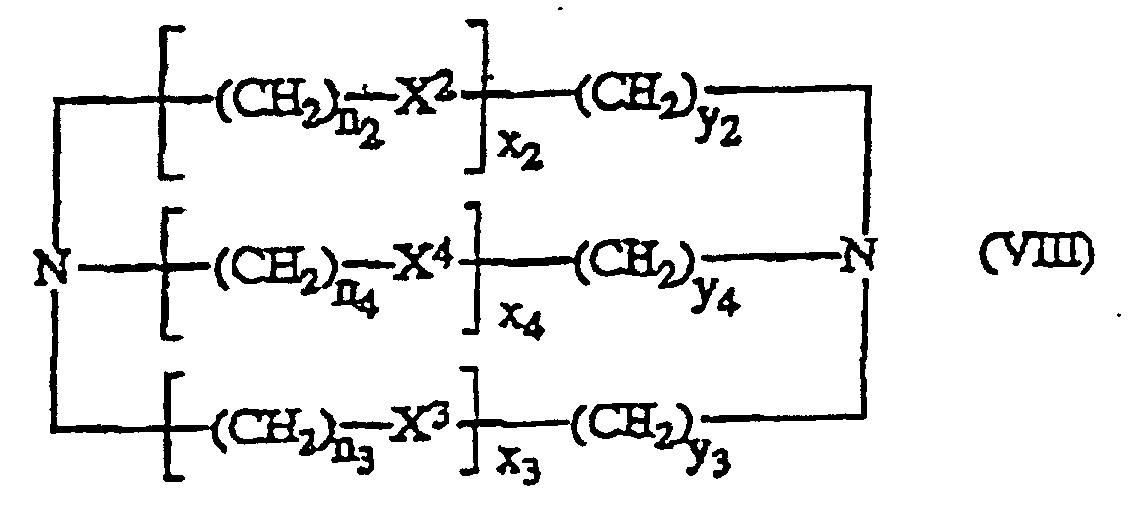
X2, X3 und X4 O oder S repräsentieren, n2, n3, n4, y2, y3, y4 2 oder 3 sind, und x2, x3, x4 2 oder 3 sind. - Zusammensetzung nach Anspruch 9, bei welcher die Elektronen-Donor-Verbindung bis zu 5 Gew.% des Gesamtgewichts der in der Zusammensetzung vorhandenen polymerisierbaren Monomere repräsentiert.
- Zusammensetzung nach Anspruch 1, ferner ein Lösungsmittel umfassend.
- Zusammensetzung nach Anspruch 12, wobei das Lösungsmittel ein polares, organisches Lösungsmittel ist.
- Zusammensetzung nach Anspruch 12, bei welcher das Lösungsmittel ein reaktives Lösungsmittel ist, das eine Hydroxylfunktion, eine Doppelbindung und eine wasserstofflabile Funktion enthält.
- Zusammensetzung nach Anspruch 12, bei welcher das Lösungsmittel bis zu 2 Gew.% repräsentiert, basierend auf dem Gesamtgewicht der polymerisierbaren Monomere.
- Zusammensetzung nach Anspruch 1, bei welcher die Polyisocyanat- und die Polyisothiocyanat-Monomere ausgewählt sind aus den Verbindungen mit der Formeln:

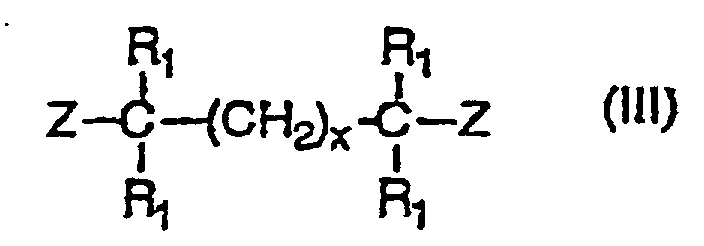 and
and wobei gilt
R1 ist unabhängig H oder eine C1-C5 Alkylgruppe;
R2 ist H, ein Halogen, oder eine C1-C5 Alkylgruppe;
Z ist -N=C=O oder -N=C=S;
a ist eine Ganzzahl, die von 1 bis 4 reicht, b ist eine Ganzzahl, die von 2 bis 4 reicht, und a+b ist ≤ 6; und
x ist eine Ganzzahl von 1 bis 10. - Zusammensetzung nach Anspruch 13, wobei die Polyiso(thio)cyanat-Monomere ausgewählt sind aus der Gruppe bestehend aus Toluendiiso(thio)cyanat, Phenylendiiso(thio)cyanat, Ethylphenylendiiso(thio)cyanat, Isopropylphenylendiiso(thio)cyanat, Dimethylphenylendiiso(thio)cyanat, Diethylphenylendiiso(thio)cyanat, Diisopropylphenylendiiso(thio)cyanat, Trimethylbenzyltriiso(thio)cyanat, Xylylendiiso(thio)cyanat, Benzyltriiso(thio)cyanat, 4,4' -Diphenylmethandiiso(thio)cyanat, Naphtalindiiso(thio)cyanat, Isophorondiiso(thio)cyanat, Bis(iso(thio)cyanatmethyl)zyklohexan, Hexamethylendiiso(thio)cyanat und Dicyclohexylmethandiiso(thio)cyanat und Mischungen davon.
- Zusammensetzung nach Anspruch 1, bei welcher das Polyiso(thio)cyanat-Monomer oder die Mischung davon 30 bis 70 Gew.% des Gesamtgewichts der in der Zusammensetzung anwesenden polymerisierbaren Monomere repräsentiert.
- Zusammensetzung nach Anspruch 1, bei welcher das Polythiol die Formel besitzt:
- Zusammensetzung nach Anspruch 1, bei welcher das Polythiol 30 bis 70 Gew.% des Gesamtgewichts der in der Zusammensetzung vorhandenen polymerisierbaren Monomere repräsentiert.
- Zusammensetzung nach Anspruch 1, bei welcher der Salzkatalysator oder eine Mischung davon der einzige in der Zusammensetzung vorhandene Polymerisationskatalysator ist.
- Zusammensetzung nach Anspruch 1, bei welcher die Zusammensetzung eine polymerisierbare Zwei-Komponenten-Zusammensetzung ist.
- Zusammensetzung nach Anspruch 22 bei welcher die polymerisierbare Zwei-Komponenten-Zusammensetzung eine erste Vormischung umfasst, enthaltend:eine zweite Vormischung, enthaltenddie Gesamtheit des Polyiso(thio)cyanatmonomers und optionaleinen Teil oder die Gesamtheit des Polythiolmonomers;einen UV-Absorber; undein Trennmittel; undden Salzkatalysator, wie in Anspruch 1 definiert; und eventuelleinen Teil oder die Gesamtheit des Polythiolmonomers;ein Lösungsmittel und/odereine Elektronen-Donor-Verbindung
- Zusammensetzung nach Anspruch 23, bei welcher die erste Vormischung in Gewichtsanteilen enthält:40-100 des Polyiso(thio)cyanatmonomers;0-60 eines Polythiolmonomers;0-0,3 eines UV-Absorbers; und0-0,2 eines internen Trennmittel; und die zweite Vormischung in Gewichtsanteilen enthält:0-100 eines Polythiolmonomers;0-1 eines Lösungsmittels;0,001-0,01 eines Salzkatalysators wie in Anspruch 1 definiert; und0-5 einer Elektronen-Donor-Verbindung.
- Gussartikel, hergestellt aus einem Polyurethanharz, hergestellt aus einer Zusammensetzung nach einem der Ansprüche 1 bis 24, das vollständig polymerisiert ist.
- Verfahren zur Herstellung eines Polyurethanharzgussartikels, dadurch gekennzeichnet, dass es folgendes umfasst:Anschätzen einer ersten Vormischung und einer zweiten Vormischung, wie in Anspruch 23 dargelegt;Mischen der ersten Vormischung und der zweiten Vormischung bei Raumtemperatur in angemessenen Mengen;Füllen einer Form mit den gemischten Mengen der ersten und zweiten Vormischung und Halten bei Raumtemperatur, bis ein hartes Gel gebildet wird; danachAushärten der gefüllten Form in einem Ofen bei einer erhöhten Temperatur bis zur vollständigen Polymerisation; undEntfernen des Gussartikels aus der Form.
- Verfahren nach Anspruch 26, bei welchem das Gewichtsverhältnis der ersten Vormischung über die zweite Vormischung von 4 bis 10 reicht.
- Verfahren nach Anspruch 26, bei welchem die Mischzeit der ersten und zweiten Vormischung von 10 bis 180 Sekunden reicht.
- Verfahren nach Anspruch 26, bei welchem das Aushärten bei einer Temperatur bewirkt wird, die von 50 bis 150°C über 2 bis 4 Stunden reicht.
- Verfahren nach Anspruch 26, bei welchem der Gussartikel ein optischer Artikel ist.
Priority Applications (1)
| Application Number | Priority Date | Filing Date | Title |
|---|---|---|---|
| EP03004410A EP1314746A3 (de) | 1998-10-29 | 1999-10-20 | Katalysatorsalz enthaltende polymerisierbare Zusammensetzungen zur Herstellung thiogruppenhaltiger Harze |
Applications Claiming Priority (5)
| Application Number | Priority Date | Filing Date | Title |
|---|---|---|---|
| US182577 | 1998-10-29 | ||
| US09/182,577 US5973098A (en) | 1998-10-29 | 1998-10-29 | Polymerizable compositions for making thio containing resins including a thiocyanate salt catalyst and process for making thio containing resin articles |
| US39508299A | 1999-09-13 | 1999-09-13 | |
| US395082 | 1999-09-13 | ||
| PCT/EP1999/007947 WO2000026272A1 (en) | 1998-10-29 | 1999-10-20 | Polymerizable compositions for making thio containing resins including a salt catalyst and process for making thio containing resin articles |
Related Child Applications (1)
| Application Number | Title | Priority Date | Filing Date |
|---|---|---|---|
| EP03004410.1 Division-Into | 2003-02-27 |
Publications (2)
| Publication Number | Publication Date |
|---|---|
| EP1124873A1 EP1124873A1 (de) | 2001-08-22 |
| EP1124873B1 true EP1124873B1 (de) | 2003-11-05 |
Family
ID=26878210
Family Applications (2)
| Application Number | Title | Priority Date | Filing Date |
|---|---|---|---|
| EP99949010A Expired - Lifetime EP1124873B1 (de) | 1998-10-29 | 1999-10-20 | Katalysatorsalz enthaltende polymerisierbare zusammensetzungen zur herstellung thiogruppenhaltiger harze und verfahren zur herstellung von gegenständen aus besagten harzen |
| EP03004410A Withdrawn EP1314746A3 (de) | 1998-10-29 | 1999-10-20 | Katalysatorsalz enthaltende polymerisierbare Zusammensetzungen zur Herstellung thiogruppenhaltiger Harze |
Family Applications After (1)
| Application Number | Title | Priority Date | Filing Date |
|---|---|---|---|
| EP03004410A Withdrawn EP1314746A3 (de) | 1998-10-29 | 1999-10-20 | Katalysatorsalz enthaltende polymerisierbare Zusammensetzungen zur Herstellung thiogruppenhaltiger Harze |
Country Status (10)
| Country | Link |
|---|---|
| EP (2) | EP1124873B1 (de) |
| JP (1) | JP2002528613A (de) |
| CN (2) | CN1576290A (de) |
| AT (1) | ATE253603T1 (de) |
| AU (1) | AU755528B2 (de) |
| CA (1) | CA2348410A1 (de) |
| DE (2) | DE69912630T2 (de) |
| ES (1) | ES2209513T3 (de) |
| PT (1) | PT1124873E (de) |
| WO (1) | WO2000026272A1 (de) |
Families Citing this family (27)
| Publication number | Priority date | Publication date | Assignee | Title |
|---|---|---|---|---|
| US6635195B1 (en) * | 2000-02-04 | 2003-10-21 | Essilor International Compagnie Generale D'optique | Cationic photopolymerization of diepisulfides and application to the manufacture of optical lenses |
| JP3706036B2 (ja) * | 2000-03-15 | 2005-10-12 | Hoya株式会社 | 眼鏡用プラスチックレンズ |
| JP4692696B2 (ja) * | 2000-09-08 | 2011-06-01 | 三菱瓦斯化学株式会社 | 光学材料用樹脂組成物 |
| US6486298B1 (en) * | 2000-12-22 | 2002-11-26 | Essilor International Compagnie Generale D'optique | Diepisulfide based prepolymers and their use in the optical field |
| US6592801B2 (en) | 2001-04-30 | 2003-07-15 | Essilor International Compagnie Generale D'optique | Photopolymerization of episulfides using metal complexes and its use for making ophthalmic lenses |
| US6891017B2 (en) | 2001-06-29 | 2005-05-10 | Essilor International Compagnie General D'optique | Fast polymerizable/curable episulfide based composition, polymerization/curing process and optical articles resulting therefrom |
| EP1987377A2 (de) * | 2006-02-24 | 2008-11-05 | ESSILOR INTERNATIONAL Compagnie Générale d'Optique | Prozess zur herstellung einer optischen polarisierten poly(thio)urethan-linse |
| JP2007246690A (ja) * | 2006-03-16 | 2007-09-27 | Seiko Epson Corp | 光学基材の製造方法 |
| EP2065414B1 (de) * | 2006-09-21 | 2014-04-30 | Mitsui Chemicals, Inc. | Polymerisationskatalysator für polythiourethanmaterial zur optischen verwendung, polymerisierbare zusammensetzung, die den katalysator enthält, aus der zusammensetzung erhaltenes polythiourethanharz und verfahren zur herstellung des harzes |
| KR20140089436A (ko) * | 2006-10-16 | 2014-07-14 | 미쓰이 가가쿠 가부시키가이샤 | 광학재료용 수지의 제조방법 |
| AU2008220347B2 (en) * | 2007-02-27 | 2012-11-15 | Mitsui Chemicals, Inc. | Polymerization catalyst for polythiourethane-based optical material, polymerizable composition containing the catalyst, optical material obtained from the composition, and method for preparing the optical material |
| EP1967258A1 (de) * | 2007-03-06 | 2008-09-10 | Interglass Technology AG | Verfahren zum Mischen einer Flüssigkeit mit mindestens einer weiteren Substanz und Entgasen des Gemisches und für die Abgabe des Gemisches |
| DE102014202609B4 (de) * | 2014-02-13 | 2020-06-04 | tooz technologies GmbH | Aminkatalysierte Thiolhärtung von Epoxidharzen |
| WO2015155367A1 (de) * | 2014-04-11 | 2015-10-15 | Bayer Materialscience Ag | Zusammensetzung enthaltend aromatische nitrile zur herstellung transparenter polythiourethankörper |
| WO2018079829A1 (ja) | 2016-10-31 | 2018-05-03 | 三井化学株式会社 | 光学材料用重合性組成物、光学材料およびその製造方法 |
| KR101996981B1 (ko) * | 2017-10-18 | 2019-07-05 | 에스케이씨 주식회사 | 플라스틱 렌즈용 중합성 조성물 |
| CN111748069B (zh) * | 2019-03-29 | 2022-04-22 | 万华化学集团股份有限公司 | 一种光学树脂组合物及其制备的光学树脂材料 |
| CN111413189B (zh) * | 2020-05-18 | 2020-10-20 | 中国科学院地质与地球物理研究所 | 一种黄铁矿中微量元素的检测方法 |
| CN113307973B (zh) * | 2021-06-10 | 2022-04-12 | 大连理工大学 | 一种具有优异光学性能的聚二硫化物材料及其制备方法 |
| EP4253019A1 (de) * | 2022-03-31 | 2023-10-04 | Essilor International | Spätstufenkatalyse von schnellen raumtemperaturpolymerisationen |
| WO2024074596A1 (en) | 2022-10-05 | 2024-04-11 | Essilor International | Method of curing a polythiourethane based substrate with a salt catalyst |
| EP4634258A1 (de) | 2022-12-15 | 2025-10-22 | Essilor International | Verfahren zur härtung eines polythiourethan-basierten wassertoleranten substrats |
| CN120418318A (zh) | 2022-12-21 | 2025-08-01 | 依视路国际公司 | 固化与微结构化薄片联接的基于聚硫氨酯的基材的方法 |
| EP4442724A1 (de) | 2023-04-04 | 2024-10-09 | Essilor International | Verfahren zur härtung eines polythiourethan-basierten substrats aus einem präpolymer |
| KR20260036280A (ko) | 2023-07-20 | 2026-03-16 | 에씰로 앙터나시오날 | 헤테로이작용성 알킨 화합물을 함유하는 중합성 조성물로부터 유래된 광학 재료 |
| CN121532441A (zh) | 2023-07-20 | 2026-02-13 | 依视路国际公司 | 衍生自由杂双官能炔烃化合物获得的预聚物的光学材料 |
| EP4747293A1 (de) | 2023-07-20 | 2026-05-27 | Essilor International | Optisches material aus einer polymerisierbaren zusammensetzung mit einer endständigen dialkinverbindung |
Family Cites Families (7)
| Publication number | Priority date | Publication date | Assignee | Title |
|---|---|---|---|---|
| FR1435307A (fr) * | 1964-04-23 | 1966-04-15 | Dunlop Rubber Co | Procédé de polymérisation d'épisulfures organiques |
| FR1488726A (fr) * | 1965-08-05 | 1967-07-13 | Thiokol Chemical Corp | Procédé de préparation d'épisulfures vicinaux |
| FR2398079A2 (fr) * | 1977-07-22 | 1979-02-16 | Poudres & Explosifs Ste Nale | Procede de polymerisation anionique a l'aide de cryptants |
| US4288587A (en) * | 1980-05-05 | 1981-09-08 | Olin Corporation | Preparation of noncellular polyurethane compositions |
| JPH0678415B2 (ja) * | 1986-11-21 | 1994-10-05 | 三井東圧化学株式会社 | 高屈折率プラスチックレンズ用樹脂 |
| US5693738A (en) * | 1994-04-08 | 1997-12-02 | Mitsui Toatsu Chemicals, Inc. | Composition for urethane-base plastic lens, urethane-base plastic lens obtained from the composition, and process for the production of the plastic lens |
| JP3465528B2 (ja) * | 1997-04-22 | 2003-11-10 | 三菱瓦斯化学株式会社 | 新規な光学材料用樹脂 |
-
1999
- 1999-10-20 WO PCT/EP1999/007947 patent/WO2000026272A1/en not_active Ceased
- 1999-10-20 DE DE69912630T patent/DE69912630T2/de not_active Expired - Fee Related
- 1999-10-20 ES ES99949010T patent/ES2209513T3/es not_active Expired - Lifetime
- 1999-10-20 AU AU62038/99A patent/AU755528B2/en not_active Ceased
- 1999-10-20 JP JP2000579655A patent/JP2002528613A/ja not_active Withdrawn
- 1999-10-20 EP EP99949010A patent/EP1124873B1/de not_active Expired - Lifetime
- 1999-10-20 DE DE1124873T patent/DE1124873T1/de active Pending
- 1999-10-20 CA CA002348410A patent/CA2348410A1/en not_active Abandoned
- 1999-10-20 CN CN200410054916.1A patent/CN1576290A/zh active Pending
- 1999-10-20 AT AT99949010T patent/ATE253603T1/de not_active IP Right Cessation
- 1999-10-20 EP EP03004410A patent/EP1314746A3/de not_active Withdrawn
- 1999-10-20 PT PT99949010T patent/PT1124873E/pt unknown
- 1999-10-20 CN CN99812875.9A patent/CN1249114C/zh not_active Expired - Fee Related
Also Published As
| Publication number | Publication date |
|---|---|
| AU6203899A (en) | 2000-05-22 |
| PT1124873E (pt) | 2004-03-31 |
| DE69912630T2 (de) | 2004-09-23 |
| CN1325414A (zh) | 2001-12-05 |
| ES2209513T3 (es) | 2004-06-16 |
| DE1124873T1 (de) | 2002-05-23 |
| ATE253603T1 (de) | 2003-11-15 |
| EP1314746A2 (de) | 2003-05-28 |
| JP2002528613A (ja) | 2002-09-03 |
| WO2000026272A1 (en) | 2000-05-11 |
| CA2348410A1 (en) | 2000-05-11 |
| EP1124873A1 (de) | 2001-08-22 |
| EP1314746A3 (de) | 2004-07-07 |
| CN1249114C (zh) | 2006-04-05 |
| CN1576290A (zh) | 2005-02-09 |
| AU755528B2 (en) | 2002-12-12 |
| DE69912630D1 (de) | 2003-12-11 |
Similar Documents
| Publication | Publication Date | Title |
|---|---|---|
| US5973098A (en) | Polymerizable compositions for making thio containing resins including a thiocyanate salt catalyst and process for making thio containing resin articles | |
| AU755528B2 (en) | Polymerizable compositions for making thio containing resins including a salt catalyst and process for making thio containing resin articles | |
| EP1448650B1 (de) | Verfahren zur herstellung von transparenten polyurethansubstraten insbesondere optischen substraten | |
| EP3539998B1 (de) | Verfahren zur herstellung eines harzes für optisches material auf urethanbasis, harzzusammensetzung dafür und hergestelltes optisches material | |
| EP0803504A2 (de) | Verfahren zur Herstellung von Polythiol-Oligomer | |
| AU2002351825A1 (en) | Method for making transparent polythiourethane substrates in particular optical substrates | |
| KR20090051090A (ko) | 광학재료용 수지의 제조방법 | |
| KR20120101304A (ko) | 고리개환을 통해 사슬연장된 폴리티올화합물과 그 제조 방법 및 이를 이용한 우레탄계 광학재료용 수지 조성물 | |
| EP1348726B1 (de) | Verfahren zur Herstellung einer Kunststofflinse, und Kunststofflinse | |
| JP2001342252A (ja) | 新規なポリチオールを含有する重合性組成物、及びそれを重合させてなる樹脂、並びにレンズ | |
| EP1404743B1 (de) | Schnell polymerisierbare/härtbare episulphid-zusammensetzung, polymerisations/härtungsverfahren und daraus hergetellte optische gegenstände | |
| KR100908367B1 (ko) | 금속 함유 화합물 및 그 용도 | |
| KR100616795B1 (ko) | 티오우레탄계 광학 재료 | |
| EP3505547A1 (de) | Polymerisierbare zusammensetzung für ein optisches material | |
| US6844415B1 (en) | Polymerizable compositions for making thio containing resins including a salt catalyst and process for making thio containing | |
| JPH10319202A (ja) | プラスチックレンズの製造方法 | |
| AU2003200461B2 (en) | Polymerizable compositions for making thio containing resins including a salt catalyst and process for making thio containing resin articles | |
| JP2788629B2 (ja) | チオカルバミン酸s−アルキルエステル系レンズ用樹脂の製造方法及びその樹脂からなるプラスチックレンズ | |
| KR101813258B1 (ko) | 광학 재료용 실록산 티올 올리고머 | |
| KR20210121873A (ko) | 티오우레탄계 광학재료용 수지 조성물과 티오우레탄계 광학재료용 수지의 제조방법 |
Legal Events
| Date | Code | Title | Description |
|---|---|---|---|
| PUAI | Public reference made under article 153(3) epc to a published international application that has entered the european phase |
Free format text: ORIGINAL CODE: 0009012 |
|
| 17P | Request for examination filed |
Effective date: 20010529 |
|
| AK | Designated contracting states |
Kind code of ref document: A1 Designated state(s): AT BE CH CY DE DK ES FI FR GB GR IE IT LI LU MC NL PT SE |
|
| 17Q | First examination report despatched |
Effective date: 20011018 |
|
| EL | Fr: translation of claims filed | ||
| DET | De: translation of patent claims | ||
| GRAH | Despatch of communication of intention to grant a patent |
Free format text: ORIGINAL CODE: EPIDOS IGRA |
|
| GRAS | Grant fee paid |
Free format text: ORIGINAL CODE: EPIDOSNIGR3 |
|
| GRAA | (expected) grant |
Free format text: ORIGINAL CODE: 0009210 |
|
| AK | Designated contracting states |
Kind code of ref document: B1 Designated state(s): AT BE CH CY DE DK ES FI FR GB GR IE IT LI LU MC NL PT SE |
|
| PG25 | Lapsed in a contracting state [announced via postgrant information from national office to epo] |
Ref country code: NL Free format text: LAPSE BECAUSE OF FAILURE TO SUBMIT A TRANSLATION OF THE DESCRIPTION OR TO PAY THE FEE WITHIN THE PRESCRIBED TIME-LIMIT Effective date: 20031105 Ref country code: LI Free format text: LAPSE BECAUSE OF FAILURE TO SUBMIT A TRANSLATION OF THE DESCRIPTION OR TO PAY THE FEE WITHIN THE PRESCRIBED TIME-LIMIT Effective date: 20031105 Ref country code: IT Free format text: LAPSE BECAUSE OF FAILURE TO SUBMIT A TRANSLATION OF THE DESCRIPTION OR TO PAY THE FEE WITHIN THE PRESCRIBED TIME-LIMIT;WARNING: LAPSES OF ITALIAN PATENTS WITH EFFECTIVE DATE BEFORE 2007 MAY HAVE OCCURRED AT ANY TIME BEFORE 2007. THE CORRECT EFFECTIVE DATE MAY BE DIFFERENT FROM THE ONE RECORDED. Effective date: 20031105 Ref country code: FI Free format text: LAPSE BECAUSE OF FAILURE TO SUBMIT A TRANSLATION OF THE DESCRIPTION OR TO PAY THE FEE WITHIN THE PRESCRIBED TIME-LIMIT Effective date: 20031105 Ref country code: CY Free format text: LAPSE BECAUSE OF FAILURE TO SUBMIT A TRANSLATION OF THE DESCRIPTION OR TO PAY THE FEE WITHIN THE PRESCRIBED TIME-LIMIT Effective date: 20031105 Ref country code: CH Free format text: LAPSE BECAUSE OF FAILURE TO SUBMIT A TRANSLATION OF THE DESCRIPTION OR TO PAY THE FEE WITHIN THE PRESCRIBED TIME-LIMIT Effective date: 20031105 Ref country code: BE Free format text: LAPSE BECAUSE OF FAILURE TO SUBMIT A TRANSLATION OF THE DESCRIPTION OR TO PAY THE FEE WITHIN THE PRESCRIBED TIME-LIMIT Effective date: 20031105 Ref country code: AT Free format text: LAPSE BECAUSE OF FAILURE TO SUBMIT A TRANSLATION OF THE DESCRIPTION OR TO PAY THE FEE WITHIN THE PRESCRIBED TIME-LIMIT Effective date: 20031105 |
|
| REG | Reference to a national code |
Ref country code: GB Ref legal event code: FG4D |
|
| REG | Reference to a national code |
Ref country code: CH Ref legal event code: EP |
|
| REF | Corresponds to: |
Ref document number: 69912630 Country of ref document: DE Date of ref document: 20031211 Kind code of ref document: P |
|
| REG | Reference to a national code |
Ref country code: IE Ref legal event code: FG4D |
|
| PG25 | Lapsed in a contracting state [announced via postgrant information from national office to epo] |
Ref country code: SE Free format text: LAPSE BECAUSE OF FAILURE TO SUBMIT A TRANSLATION OF THE DESCRIPTION OR TO PAY THE FEE WITHIN THE PRESCRIBED TIME-LIMIT Effective date: 20040205 Ref country code: GR Free format text: LAPSE BECAUSE OF FAILURE TO SUBMIT A TRANSLATION OF THE DESCRIPTION OR TO PAY THE FEE WITHIN THE PRESCRIBED TIME-LIMIT Effective date: 20040205 Ref country code: DK Free format text: LAPSE BECAUSE OF FAILURE TO SUBMIT A TRANSLATION OF THE DESCRIPTION OR TO PAY THE FEE WITHIN THE PRESCRIBED TIME-LIMIT Effective date: 20040205 |
|
| REG | Reference to a national code |
Ref country code: PT Ref legal event code: SC4A Free format text: AVAILABILITY OF NATIONAL TRANSLATION Effective date: 20040202 |
|
| NLV1 | Nl: lapsed or annulled due to failure to fulfill the requirements of art. 29p and 29m of the patents act | ||
| REG | Reference to a national code |
Ref country code: CH Ref legal event code: PL |
|
| REG | Reference to a national code |
Ref country code: ES Ref legal event code: FG2A Ref document number: 2209513 Country of ref document: ES Kind code of ref document: T3 |
|
| ET | Fr: translation filed | ||
| PLBE | No opposition filed within time limit |
Free format text: ORIGINAL CODE: 0009261 |
|
| STAA | Information on the status of an ep patent application or granted ep patent |
Free format text: STATUS: NO OPPOSITION FILED WITHIN TIME LIMIT |
|
| PG25 | Lapsed in a contracting state [announced via postgrant information from national office to epo] |
Ref country code: LU Free format text: LAPSE BECAUSE OF NON-PAYMENT OF DUE FEES Effective date: 20041020 Ref country code: IE Free format text: LAPSE BECAUSE OF NON-PAYMENT OF DUE FEES Effective date: 20041020 |
|
| 26N | No opposition filed |
Effective date: 20040806 |
|
| PG25 | Lapsed in a contracting state [announced via postgrant information from national office to epo] |
Ref country code: MC Free format text: LAPSE BECAUSE OF NON-PAYMENT OF DUE FEES Effective date: 20041031 |
|
| REG | Reference to a national code |
Ref country code: IE Ref legal event code: MM4A |
|
| PGFP | Annual fee paid to national office [announced via postgrant information from national office to epo] |
Ref country code: ES Payment date: 20070917 Year of fee payment: 9 |
|
| PGFP | Annual fee paid to national office [announced via postgrant information from national office to epo] |
Ref country code: GB Payment date: 20070920 Year of fee payment: 9 |
|
| PGFP | Annual fee paid to national office [announced via postgrant information from national office to epo] |
Ref country code: FR Payment date: 20071023 Year of fee payment: 9 |
|
| PGFP | Annual fee paid to national office [announced via postgrant information from national office to epo] |
Ref country code: DE Payment date: 20071220 Year of fee payment: 9 |
|
| REG | Reference to a national code |
Ref country code: PT Ref legal event code: MM4A Free format text: LAPSE DUE TO NON-PAYMENT OF FEES Effective date: 20090420 |
|
| GBPC | Gb: european patent ceased through non-payment of renewal fee |
Effective date: 20081020 |
|
| REG | Reference to a national code |
Ref country code: FR Ref legal event code: ST Effective date: 20090630 |
|
| PG25 | Lapsed in a contracting state [announced via postgrant information from national office to epo] |
Ref country code: PT Free format text: LAPSE BECAUSE OF NON-PAYMENT OF DUE FEES Effective date: 20090420 Ref country code: DE Free format text: LAPSE BECAUSE OF NON-PAYMENT OF DUE FEES Effective date: 20090501 |
|
| PG25 | Lapsed in a contracting state [announced via postgrant information from national office to epo] |
Ref country code: FR Free format text: LAPSE BECAUSE OF NON-PAYMENT OF DUE FEES Effective date: 20081031 |
|
| PG25 | Lapsed in a contracting state [announced via postgrant information from national office to epo] |
Ref country code: GB Free format text: LAPSE BECAUSE OF NON-PAYMENT OF DUE FEES Effective date: 20081020 |
|
| PGFP | Annual fee paid to national office [announced via postgrant information from national office to epo] |
Ref country code: PT Payment date: 20070917 Year of fee payment: 9 |
|
| REG | Reference to a national code |
Ref country code: ES Ref legal event code: FD2A Effective date: 20081021 |
|
| PG25 | Lapsed in a contracting state [announced via postgrant information from national office to epo] |
Ref country code: ES Free format text: LAPSE BECAUSE OF NON-PAYMENT OF DUE FEES Effective date: 20081021 |