EP1125852A2 - Fermeture de recipient avec un joint cassable - Google Patents
Fermeture de recipient avec un joint cassable Download PDFInfo
- Publication number
- EP1125852A2 EP1125852A2 EP00304706A EP00304706A EP1125852A2 EP 1125852 A2 EP1125852 A2 EP 1125852A2 EP 00304706 A EP00304706 A EP 00304706A EP 00304706 A EP00304706 A EP 00304706A EP 1125852 A2 EP1125852 A2 EP 1125852A2
- Authority
- EP
- European Patent Office
- Prior art keywords
- skirt
- outer periphery
- seal
- closure
- lid
- Prior art date
- Legal status (The legal status is an assumption and is not a legal conclusion. Google has not performed a legal analysis and makes no representation as to the accuracy of the status listed.)
- Withdrawn
Links
Images

Classifications
-
- B—PERFORMING OPERATIONS; TRANSPORTING
- B65—CONVEYING; PACKING; STORING; HANDLING THIN OR FILAMENTARY MATERIAL
- B65D—CONTAINERS FOR STORAGE OR TRANSPORT OF ARTICLES OR MATERIALS, e.g. BAGS, BARRELS, BOTTLES, BOXES, CANS, CARTONS, CRATES, DRUMS, JARS, TANKS, HOPPERS, FORWARDING CONTAINERS; ACCESSORIES, CLOSURES, OR FITTINGS THEREFOR; PACKAGING ELEMENTS; PACKAGES
- B65D47/00—Closures with filling and discharging, or with discharging, devices
- B65D47/04—Closures with discharging devices other than pumps
- B65D47/06—Closures with discharging devices other than pumps with pouring spouts or tubes; with discharge nozzles or passages
- B65D47/08—Closures with discharging devices other than pumps with pouring spouts or tubes; with discharge nozzles or passages having articulated or hinged closures
- B65D47/0804—Closures with discharging devices other than pumps with pouring spouts or tubes; with discharge nozzles or passages having articulated or hinged closures integrally formed with the base element provided with the spout or discharge passage
- B65D47/0833—Hinges without elastic bias
- B65D47/0838—Hinges without elastic bias located at an edge of the base element
- B65D47/0842—Hinges without elastic bias located at an edge of the base element consisting of a strap of flexible material
-
- B—PERFORMING OPERATIONS; TRANSPORTING
- B65—CONVEYING; PACKING; STORING; HANDLING THIN OR FILAMENTARY MATERIAL
- B65D—CONTAINERS FOR STORAGE OR TRANSPORT OF ARTICLES OR MATERIALS, e.g. BAGS, BARRELS, BOTTLES, BOXES, CANS, CARTONS, CRATES, DRUMS, JARS, TANKS, HOPPERS, FORWARDING CONTAINERS; ACCESSORIES, CLOSURES, OR FITTINGS THEREFOR; PACKAGING ELEMENTS; PACKAGES
- B65D17/00—Rigid or semi-rigid containers specially constructed to be opened by cutting or piercing, or by tearing of frangible members or portions
- B65D17/28—Rigid or semi-rigid containers specially constructed to be opened by cutting or piercing, or by tearing of frangible members or portions at lines or points of weakness
- B65D17/401—Rigid or semi-rigid containers specially constructed to be opened by cutting or piercing, or by tearing of frangible members or portions at lines or points of weakness characterised by having the line of weakness provided in an end wall
- B65D17/4011—Rigid or semi-rigid containers specially constructed to be opened by cutting or piercing, or by tearing of frangible members or portions at lines or points of weakness characterised by having the line of weakness provided in an end wall for opening completely by means of a tearing tab
-
- B—PERFORMING OPERATIONS; TRANSPORTING
- B65—CONVEYING; PACKING; STORING; HANDLING THIN OR FILAMENTARY MATERIAL
- B65D—CONTAINERS FOR STORAGE OR TRANSPORT OF ARTICLES OR MATERIALS, e.g. BAGS, BARRELS, BOTTLES, BOXES, CANS, CARTONS, CRATES, DRUMS, JARS, TANKS, HOPPERS, FORWARDING CONTAINERS; ACCESSORIES, CLOSURES, OR FITTINGS THEREFOR; PACKAGING ELEMENTS; PACKAGES
- B65D43/00—Lids or covers for rigid or semi-rigid containers
- B65D43/02—Removable lids or covers
- B65D43/0202—Removable lids or covers without integral tamper element
- B65D43/0214—Removable lids or covers without integral tamper element secured only by friction or gravity
- B65D43/022—Removable lids or covers without integral tamper element secured only by friction or gravity only on the inside, or a part turned to the inside, of the mouth of the container
-
- B—PERFORMING OPERATIONS; TRANSPORTING
- B65—CONVEYING; PACKING; STORING; HANDLING THIN OR FILAMENTARY MATERIAL
- B65D—CONTAINERS FOR STORAGE OR TRANSPORT OF ARTICLES OR MATERIALS, e.g. BAGS, BARRELS, BOTTLES, BOXES, CANS, CARTONS, CRATES, DRUMS, JARS, TANKS, HOPPERS, FORWARDING CONTAINERS; ACCESSORIES, CLOSURES, OR FITTINGS THEREFOR; PACKAGING ELEMENTS; PACKAGES
- B65D47/00—Closures with filling and discharging, or with discharging, devices
- B65D47/04—Closures with discharging devices other than pumps
- B65D47/06—Closures with discharging devices other than pumps with pouring spouts or tubes; with discharge nozzles or passages
- B65D47/10—Closures with discharging devices other than pumps with pouring spouts or tubes; with discharge nozzles or passages having frangible closures
- B65D47/103—Membranes with a tearing element
-
- B—PERFORMING OPERATIONS; TRANSPORTING
- B65—CONVEYING; PACKING; STORING; HANDLING THIN OR FILAMENTARY MATERIAL
- B65D—CONTAINERS FOR STORAGE OR TRANSPORT OF ARTICLES OR MATERIALS, e.g. BAGS, BARRELS, BOTTLES, BOXES, CANS, CARTONS, CRATES, DRUMS, JARS, TANKS, HOPPERS, FORWARDING CONTAINERS; ACCESSORIES, CLOSURES, OR FITTINGS THEREFOR; PACKAGING ELEMENTS; PACKAGES
- B65D2517/00—Containers specially constructed to be opened by cutting, piercing or tearing of wall portions, e.g. preserving cans or tins
- B65D2517/0001—Details
- B65D2517/0002—Location of opening
- B65D2517/0007—Location of opening in a separate cover
-
- B—PERFORMING OPERATIONS; TRANSPORTING
- B65—CONVEYING; PACKING; STORING; HANDLING THIN OR FILAMENTARY MATERIAL
- B65D—CONTAINERS FOR STORAGE OR TRANSPORT OF ARTICLES OR MATERIALS, e.g. BAGS, BARRELS, BOTTLES, BOXES, CANS, CARTONS, CRATES, DRUMS, JARS, TANKS, HOPPERS, FORWARDING CONTAINERS; ACCESSORIES, CLOSURES, OR FITTINGS THEREFOR; PACKAGING ELEMENTS; PACKAGES
- B65D2517/00—Containers specially constructed to be opened by cutting, piercing or tearing of wall portions, e.g. preserving cans or tins
- B65D2517/0001—Details
- B65D2517/001—Action for opening container
- B65D2517/0013—Action for opening container pull-out tear panel, e.g. by means of a tear-tab
-
- B—PERFORMING OPERATIONS; TRANSPORTING
- B65—CONVEYING; PACKING; STORING; HANDLING THIN OR FILAMENTARY MATERIAL
- B65D—CONTAINERS FOR STORAGE OR TRANSPORT OF ARTICLES OR MATERIALS, e.g. BAGS, BARRELS, BOTTLES, BOXES, CANS, CARTONS, CRATES, DRUMS, JARS, TANKS, HOPPERS, FORWARDING CONTAINERS; ACCESSORIES, CLOSURES, OR FITTINGS THEREFOR; PACKAGING ELEMENTS; PACKAGES
- B65D2517/00—Containers specially constructed to be opened by cutting, piercing or tearing of wall portions, e.g. preserving cans or tins
- B65D2517/0001—Details
- B65D2517/0058—Other details of container end panel
- B65D2517/008—Materials of container end panel
- B65D2517/0083—Rigid plastic
-
- B—PERFORMING OPERATIONS; TRANSPORTING
- B65—CONVEYING; PACKING; STORING; HANDLING THIN OR FILAMENTARY MATERIAL
- B65D—CONTAINERS FOR STORAGE OR TRANSPORT OF ARTICLES OR MATERIALS, e.g. BAGS, BARRELS, BOTTLES, BOXES, CANS, CARTONS, CRATES, DRUMS, JARS, TANKS, HOPPERS, FORWARDING CONTAINERS; ACCESSORIES, CLOSURES, OR FITTINGS THEREFOR; PACKAGING ELEMENTS; PACKAGES
- B65D2543/00—Lids or covers essentially for box-like containers
- B65D2543/00009—Details of lids or covers for rigid or semi-rigid containers
- B65D2543/00425—Lids or covers welded or adhered to the container
-
- B—PERFORMING OPERATIONS; TRANSPORTING
- B65—CONVEYING; PACKING; STORING; HANDLING THIN OR FILAMENTARY MATERIAL
- B65D—CONTAINERS FOR STORAGE OR TRANSPORT OF ARTICLES OR MATERIALS, e.g. BAGS, BARRELS, BOTTLES, BOXES, CANS, CARTONS, CRATES, DRUMS, JARS, TANKS, HOPPERS, FORWARDING CONTAINERS; ACCESSORIES, CLOSURES, OR FITTINGS THEREFOR; PACKAGING ELEMENTS; PACKAGES
- B65D2543/00—Lids or covers essentially for box-like containers
- B65D2543/00009—Details of lids or covers for rigid or semi-rigid containers
- B65D2543/00444—Contact between the container and the lid
- B65D2543/00481—Contact between the container and the lid on the inside or the outside of the container
- B65D2543/0049—Contact between the container and the lid on the inside or the outside of the container on the inside, or a part turned to the inside of the mouth of the container
- B65D2543/00518—Skirt
Definitions
- the present invention generally relates to closures for containers.
- the present invention relates to a container closure having frangible seals.
- Containers In the packaging of many products it is desirable to seal the containers.
- Containers particularly those for comestibles, are typically provided with frangible seals that protect the contents of the containers during shipment and storage.
- frangible seals can also act as indicators that signal a user of possible product tampering. While providing these benefits, manufacturers desire to minimize the cost that the seals add to the containers and provide seals that are easy to use.
- frangible seal is a membrane which includes a groove or score line that defines a removable portion of the seal.
- the groove provides a line of weakness along which the seal is torn when it is removed from the container.
- Some frangible seals also include a tear strip which encircles the removable portion of the seal.
- the tear strip is formed integrally with the seal and is defined by a pair of spaced-apart grooves which encircle the seal.
- An integral finger grip may be provided at one end of the tear strip to pull it away from the container.
- One type of finger grip includes a generally flat ring through which a user puts a finger to apply a pulling force.
- This type of finger grip can be uncomfortable to use because the ring often is too thin for the pulling force required.
- ring-type finger grips are frequently difficult to initially grasp because of their awkward location, which is typically flat against the outer surface of the seal.
- Another type of finger grip is generally formed as a flat, flexible tab that either projects away from the outer surface of the seal or lies flat against it.
- Flexible-type finger grip can easily slip from a user's grip because these tabs are frequently thin and narrow and have smooth gripping surfaces. To prevent slippage, serrations have sometimes been provided on one or both faces. Flexible finger grips that lay flat against the seal can be difficult to initially grip.
- Yet another type of finger grip includes a lever formed generally by a relatively large, rigid tab that acts as a lever to initially break the seal. After the seal is initially broken, the tab is used to pull the seal or the tear strip along the one or more grooves.
- Lever-type finger grips are relatively costly to manufacture because of the rigidity required to function as a lever.
- this type of finger grip is typically closely spaced from the seal and can be difficult to initially grasp.
- frangible seals are formed integrally with body portions into closure members which are separate from the containers. After the containers are filled with product, the closure members are attached to the containers, which are then sealed.
- Current methods of attaching closure members to containers result in the peripheral edges of the closures projecting beyond the outer surfaces of the containers. For example, metal closure members which close metal containers are crimped to the walls of the container. The crimped joints are then rolled outward from the containers.
- plastic and metal closures used to seal plastic or cardboard containers have flanges that engage the outer peripheries of the containers. These flanges project beyond the walls of the containers and can catch edges of similar containers or other items, making the containers inconvenient to ship, store and use.
- Some containers having frangible seals are also provided with reclosable lids which are used to reseal the containers after the frangible seal has been removed. Reclosable lids allow a user to conveniently use the container to store contents that are not emptied at one time or that may be used outside of the container and returned to the container until further use.
- An example of the first type of content is a powdered drink mix that is mixable with water to make several gallons of flavored drink. Frequently, a user desires to use only a small portion of the mix at one time and return the rest to storage.
- An example of the second type of content is tennis balls. Typically, tennis balls are packaged in resealable cans. The balls may be used more than once, and users frequently return them to the original container to store them until the next time they are needed.
- reclosable lids are often not attached to the containers and can be easily misplaced.
- most reclosable lids have peripheral flanges which provide snap fits to the rolled edges or flanges of the closures. The outer edges of these flanges can easily catch on other items which can cause the lids to open inadvertently.
- the present invention comprises a closure for a container.
- the closure includes a body having an inner periphery and an outer periphery.
- a removable seal made from a thin, tearable material engages the inner periphery of the body and covers an opening defined thereby.
- the seal has a tear strip which is at least partially defined by a pair of spaced-apart grooves in the seal and has a starting end.
- a finger grip is located adjacent the starting end and includes a pair of finger tabs which are substantially parallel to the seal and have a proximal and a distal end. The proximal ends of the finger tabs are connected to the tear strip adjacent each other and the distal ends of the finger tabs project in a direction at least partially away from each other.
- a further aspect of the invention provides a body having a flange which is engagable with the interior surface of a wall of a container.
- a skirt is located upwardly adjacent the flange and engages a removable lid.
- the lid is attached to the skirt by a tether.
- the lid also has a lifting tab located opposite the tether. When the lid is in its closed position, the lifting tab and the tether are located in notches within the upper edge of the skirt.
- the flange and the skirt are offset by the thickness of a wall of a container to which closure will be attached. The offset allows the outer periphery of the skirt to be flush with the outer periphery of the container when the closure is attached to the container.
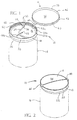
- Figures 1 and 2 illustrate a container closure which is designated generally by the numeral 10.
- the closure 10 includes a frangible seal 12 and a lid 14.
- Figure 1 shows the lid 14 in an open position
- Figure 2 shows the lid 14 in its closed position.
- the closure 10 may be used with conventional containers such as a cylindrical can 16 used to package comestibles.
- the closure may be used with any container where it is desired to have a factory-sealed container that is reclosable once the seal has been broken.
- the seal 12 preferably is airtight and designed to hold a vacuum which is applied to the container as part of a manufacturer's packaging process.
- the closure 10 is preferably made of a plastic and comprises a body 18 to which the frangible seal 12 and the lid 14 are attached.
- the body 18 includes a skirt 20 which engages and retains the lid 14 in its closed position and a flange 22 which attaches the closure 10 to the can 16.
- the outer periphery of the flange 22 is sized to snugly engage the inner surface of the can 16.
- An adhesive is typically used between the flange 22 and the can 16 to secure them together and provide an airtight joint.
- the frangible seal 12 is attached around its entire periphery to the upper end of the flange 22 and covers an opening defined by the inner periphery of the flange 22.
- the frangible seal 12 includes a tear strip 24 defined by a pair of spaced-apart grooves 26.
- the seal 12 and the tear strip 24 preferably are integrally formed and are substantially the same thickness.
- the grooves 26 define lines of weakness along which the tear strip 24 is separated from adjacent portions of the seal 12 when the seal is removed. When the tear strip 24 is completely torn along the grooves 26, the seal 12 separates from the body 14 of the closure 10.
- the tear strip 24 has a starting end 28 located at approximately the center of the seal 12.
- the outer groove 26a runs continuously around the periphery of the seal 12, and the inner groove 26b ends short of forming a complete circle.
- the end of the tear strip 24 opposite the starting end 28 is joined to the seal 12 by the full thickness of the seal 12.
- Figure 1 shows the tear strip 24 partially torn from the seal 12.
- the tear strip 24 has a finger grip 30 located adjacent its starting end 28.
- the finger grip 30 includes a pair of gripping tabs 32 and a spacer 34.
- the gripping tabs 32 and spacer 34 are preferably integrally formed with the tear strip 24.
- the gripping tabs 32 preferably are angled generally upward and outward from the spacer 34 in a V-shape.
- a user pinches the finger grip 30 between an index finger and a thumb of one hand.
- the gripping tabs 32 preferably are made of a resilient plastic and are relatively thin to allow them to flex generally upwardly and toward each other when pinched.
- the spacer 34 spaces the gripping tabs 32 far enough apart from the seal 12 that the gripping tabs 32 may be gripped comfortably and firmly.
- the lid 14 has a cover 36 which covers an opening defined by the inner periphery of the skirt 20.
- An apron 38 is attached to the cover 36 and engages the inner periphery of the skirt 20 when the lid is in its closed position.
- the lid 14 is retained in its closed position by a snap fit between a boss 40 on the outer periphery of the apron 38 and a locking rib 42 on the inner periphery of the skirt 20. Both the boss 40 and the locking rib 42 are continuous around the peripheries of the respective members. This provides a continuous interlock between the lid 14 and the body 18.
- a continuous boss and locking rib retaining means is preferred, other retaining means such an intermittent boss and locking rib, a slot and a tab, friction fit, or the like may be used.
- the lid 14 is attached to the body 18 by a flexible tether 44 which provides a hinge that allows the lid 14 to be easily moved between an open position and the closed position.
- the tether 44 is preferably formed integrally with the lid 14 and the body 18, but may be formed separately and attached to the body 18 and the lid 14 by welding, adhesive or the like.
- a lifting tab 46 is attached to the lid 14 diametrically opposite the tether 44.
- the lifting tab 46 is preferably formed integrally with the lid 14. When the lid 14 is in its closed position, the lifting tab 46 projects beyond the outer periphery of the skirt 20.
- the upper edge of the skirt 20 has a pair of notches 48. When the lid is closed, notch 48a receives the tether 44 and notch 48b receives the lifting tab 46.
- the depths of the notches 48 correspond to the respective thicknesses of the tether 44 and the lifting tab 46 such that when the lid 14 is in its closed position, the upper edge of the skirt 20 is substantially flush with the upper faces of the tether 44 and the lifting tab 46.
- the upper edge of the lid 14 also has a bevel 50 adjacent its inner periphery which guides the apron 38 into the skirt when closing the lid 14.
- the bevel 50 abuts a corresponding chamfer 52 on the periphery of the cover 36 when the lid is in its closed position.
- the factory-sealed can 16 is typically distributed and sold with the frangible seal 12 intact and with the lid 14 in its closed position.
- a consumer purchases the container he initially opens it by first opening the lid 14 and then removing the frangible seal 12.
- the consumer wishes to close the container he simply returns the lid 14 to its closed position.
- the closure 10 is designed such that the lid 14 may be opened and closed multiple times after the container is initially opened. In this manner, the contents of the container can be used in increments or re-accessed over a period of time while the contents are substantially protected from the environment, e.g. light, dust, odor and the like, between the periodic openings.
- closure 10 may be used to close smaller openings.
- the closure 10 may be mounted within a circular aperture in an upper wall of a container which has a diameter greater than that of the closure 10. It is preferred that the closure 10 be formed as a single piece. However, the closure 10 may be made from two or more pieces joined by adhesive, welding, mechanical fasteners or the like.
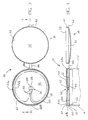
- Figure 3 is a plan view of the closure 10 and Figure 4 is a cross sectional view taken along line 4-4 of Figure 3.
- Figures 3 and 4 show the lid 14 in an open position and the frangible seal 12 and the tear strip 24 fully intact.
- the starting end 28 of the tear strip 24 is defined by a connecting groove 54 which connects adjacent ends of the spaced-apart grooves 26.
- the spaced-apart grooves 26 and the connecting groove 54 are generally V-shaped grooves in the upper surface of the seal 12. Although V-shaped grooves are shown, the grooves 26, 54 may be other shapes such as rectangular or U-shaped. Alternatively, the grooves 26, 54 may be replaced by score lines.
- the depths of the grooves 26, 54 are selected based on the material used for the seal 12 and either the force required to tear the strip 24 from the seal 12 or the pressure inside the container, whichever governs.
- the cover 36 of the lid 14 is generally dome-shaped within the inner periphery of the apron 38. However, the cover 36 may be another shape such as flat, pyramidal or the like.
- the tether 44 is attached at one end to the outer periphery of the cover 36 and at the other end to the skirt 20, opposite the seal 12. Although the tether 44 may be attached at other locations, those shown are preferred because they simplify the molding process wherein the closure 10 is cast as a single piece.
- Figure 4 illustrates the relationship between the closure 10 and the can 16.
- the outer peripheries of the skirt 20 and the flange 22 are offset by a distance substantially equal to the thickness of the wall 56 of the can 16. This allows the outer periphery of the skirt 20 to be substantially flush with the outer face of the can 16 while the outer periphery of the flange 22 contacts the inner face of the can 16.
- a shoulder 58 is formed by an offset between the skirt 20 and the flange 22 and abuts the upper edge of the wall 56 of the can 16.
- the outside diameter of the flange 22 is chosen to provide a friction fit between the flange 22 and the can 16. Alternatively, the fit may be a snap fit, a mechanical interlock using serrations on the outer surface of the flange 22 or the like.
- the contact surfaces between the flange 22 and the can 16 preferably are bonded together with an adhesive.
- the height of the flange 22 is generally selected based on the adhesive used and the bond strength required. Adhesive may also be applied between the shoulder 58 and the upper edge of the wall 56.
- Figure 5 is an enlarged fragmentary cross-sectional view showing the relationship between the body 18 of the container closure and the lid 14 in its closed position.
- the boss 48 on the outer periphery of the apron 38 is located between the locking rib 50 on the skirt 20 and a ledge 60 formed by the offset between the skirt 20 and the flange 22.
- the lower edge of the apron 38 is in contact with the ledge 60, which prevents the lid 14 from being pushed further into the body 18.
- the locking rib 50 retains the boss 40, thereby preventing the lid 14 from inadvertently opening.
- the boss 40 tapers gradually from approximately the mid-height of the apron 38 to its lower edge to aid a user in guiding the lid 14 into the body 18 and sliding the boss 40 over the locking rib 42.
- the chamfer 52 on the peripheral edge of the cover 36 generally matches the bevel 50 adjacent the upper edge of the skirt 20.
- the surfaces of the chamfer 52 and bevel 50 are as close fitting as practicable to prevent contaminants from getting into the space between the apron 38 and the skirt 20 above the locking rib 42 when the lid 14 is in its closed position.
Landscapes
- Engineering & Computer Science (AREA)
- Mechanical Engineering (AREA)
- Closures For Containers (AREA)
Applications Claiming Priority (2)
| Application Number | Priority Date | Filing Date | Title |
|---|---|---|---|
| US09/506,647 US6360909B1 (en) | 2000-02-18 | 2000-02-18 | Container closure having a frangible seal |
| US506647 | 2000-02-18 |
Publications (2)
| Publication Number | Publication Date |
|---|---|
| EP1125852A2 true EP1125852A2 (fr) | 2001-08-22 |
| EP1125852A3 EP1125852A3 (fr) | 2003-08-20 |
Family
ID=24015434
Family Applications (1)
| Application Number | Title | Priority Date | Filing Date |
|---|---|---|---|
| EP00304706A Withdrawn EP1125852A3 (fr) | 2000-02-18 | 2000-06-02 | Fermeture de recipient avec un joint cassable |
Country Status (6)
| Country | Link |
|---|---|
| US (1) | US6360909B1 (fr) |
| EP (1) | EP1125852A3 (fr) |
| BR (1) | BR0002635A (fr) |
| DE (1) | DE1125852T1 (fr) |
| MY (1) | MY133504A (fr) |
| PL (1) | PL340361A1 (fr) |
Cited By (7)
| Publication number | Priority date | Publication date | Assignee | Title |
|---|---|---|---|---|
| US6667382B1 (en) | 1998-05-14 | 2003-12-23 | Kao Corporation | Polyamine |
| FR2937959A1 (fr) * | 2008-10-31 | 2010-05-07 | Christian Guillot | Dispositif de fermeture a couvercle encliquete fixe muni d'une ouverture a charniere associe d'un opercule inviolable pour pot cosmetique ou analogue |
| WO2010070159A1 (fr) * | 2008-12-17 | 2010-06-24 | Gonzalez Sanchez Jose Francisco | Protection pour récipients |
| EP2484598A4 (fr) * | 2009-09-30 | 2013-03-06 | Sanchez Jose Francisco Gonzalez | Élément protecteur pour contenants |
| GR20170100561A (el) * | 2017-12-11 | 2019-07-08 | Spirit Innovations Ανωνymh Βιοτexniκη Εμπορικη Εταιρια Παραγωγης Και Εμποριας Ειδων Υφασματος-Νοικοκυριου Και Ειδων | Κουτι συσκευασιας κουφετων τσιχλας, καραμελας ή αλλου ειδους τροφιμο με τη μορφη κουφετου |
| IT202200002882A1 (it) * | 2022-02-16 | 2023-08-16 | F Ceredi S P A | Sottotappo, sistema di chiusura e barattolo per liquidi |
| US12473128B2 (en) | 2024-03-15 | 2025-11-18 | Cambio Roasters, LLC | Method of manufacture for a highly peelable lid with a frangible seal |
Families Citing this family (21)
| Publication number | Priority date | Publication date | Assignee | Title |
|---|---|---|---|---|
| US20090159607A1 (en) * | 2002-06-27 | 2009-06-25 | Oliver Clemens Robert Kratzer | Pouring and sealing attachment |
| US20040211693A1 (en) * | 2003-04-28 | 2004-10-28 | Dotson Bobby D. | Toilet tissue storage container |
| US20050061706A1 (en) * | 2003-09-19 | 2005-03-24 | Reynolds Jonathan K. | Sealed secure prescription vial apparatus and method |
| US20050082300A1 (en) * | 2003-10-15 | 2005-04-21 | Modrell Candace C. | Flexible lid with opposable tabs and unique cutback securing feature |
| USD543111S1 (en) * | 2004-10-05 | 2007-05-22 | Kwh Mirka Ltd | Jar |
| DE102004063280A1 (de) * | 2004-12-29 | 2006-07-13 | BSH Bosch und Siemens Hausgeräte GmbH | Behälter und Verfahren zur Öffnung eines Deckels |
| US7806292B2 (en) * | 2006-02-28 | 2010-10-05 | Joseph S Kanfer | Towelette dispenser |
| US10125899B2 (en) * | 2007-05-09 | 2018-11-13 | Builder's Best, Inc. | Modification device and vent hood having such a device |
| GB2464819B (en) * | 2008-10-28 | 2012-10-24 | Par Pak Ltd | Tamper-evident container with frangible hinge |
| USD619456S1 (en) * | 2009-05-11 | 2010-07-13 | Lynd Enterprises, Ltd. | Lid for tumbler or jar |
| KR101109886B1 (ko) * | 2009-07-06 | 2012-02-14 | (주)아이디플라텍 | 상하 승강에 의하여 인출되는 껌 추출 용기 |
| DE202010003547U1 (de) * | 2010-03-15 | 2010-07-08 | Mars Incorporated | Stapelbare Dose mit Deckel |
| US9809356B2 (en) | 2010-12-22 | 2017-11-07 | Kraft Foods Group Brands Llc | Container lid having selectively coverable access opening |
| US10968689B2 (en) * | 2011-08-26 | 2021-04-06 | Integrity Products & Supplies Inc. | Access port seal |
| US20130049309A1 (en) * | 2011-08-26 | 2013-02-28 | Graham Brigham | Access port seal |
| US9617048B2 (en) | 2011-12-02 | 2017-04-11 | The Hillshire Brands Company | Peelable and resealable packaging |
| US9321567B2 (en) | 2013-02-07 | 2016-04-26 | Weatherchem Corporation | Closure with tamper evident push-pull tether |
| US10179343B2 (en) | 2014-07-28 | 2019-01-15 | Cryovac, Inc. | Dispensing system, packaging system, package, closure system, dispensing gun system, method of making a package, and method of dispensing a product |
| CA3094061A1 (fr) | 2018-03-15 | 2019-09-19 | Bericap Inc. | Fermeture de recipient a attache |
| KR101946966B1 (ko) * | 2018-07-03 | 2019-02-12 | 위세황 | 용기 봉합체 |
| US11059633B2 (en) | 2019-10-31 | 2021-07-13 | Cheer Pack North America | Flip-top closure for container |
Family Cites Families (82)
| Publication number | Priority date | Publication date | Assignee | Title |
|---|---|---|---|---|
| US2690861A (en) * | 1950-05-08 | 1954-10-05 | Earl S Tupper | Dispensing closure |
| US2630237A (en) | 1950-12-05 | 1953-03-03 | Kenneth E Rosenlof | Sealing cap for cans and the like |
| US3117702A (en) | 1960-02-03 | 1964-01-14 | Continental Can Co | Pouring nozzle with captive cap |
| US3282477A (en) | 1961-01-19 | 1966-11-01 | Continental Can Co | Plastic dispensing nozzle with removable seal and captive cap |
| US3462048A (en) | 1961-01-19 | 1969-08-19 | Continental Can Co | Plastic dispensing nozzle with captive cap |
| US3160327A (en) | 1961-01-23 | 1964-12-08 | Polymold Plastics Inc | Dispensing spout with rupturable breathing diaphragm and closure therefor |
| US3081926A (en) | 1961-02-01 | 1963-03-19 | Harry A Newton | Containers and closures therefor |
| US3187931A (en) | 1961-02-10 | 1965-06-08 | Continental Can Co | Plastic pull tab adhesively secured to metal strip |
| US3187930A (en) | 1961-02-10 | 1965-06-08 | Continental Can Co | Plastic pull tab to metal tear strip assembly with a curled connection |
| US3184096A (en) | 1961-10-04 | 1965-05-18 | Reynolds Metals Co | Container seal and opening means |
| US3182852A (en) | 1962-03-27 | 1965-05-11 | American Can Co | Container with pull tab |
| US3208627A (en) | 1963-04-15 | 1965-09-28 | Nat Can Corp | Reclosable can |
| US3195768A (en) * | 1963-06-28 | 1965-07-20 | Continental Can Co | Easy opening pull tab can end with wide tear strip |
| US3172558A (en) | 1963-11-18 | 1965-03-09 | American Can Co | Container with improved easy-open end |
| US3251503A (en) * | 1964-01-10 | 1966-05-17 | Continental Can Co | Easy opening and lifting can-end with dead-end inside score line |
| US3239112A (en) | 1964-05-21 | 1966-03-08 | Polymold Plastics Inc | Dispensing closure with removable diaphragm |
| US3385471A (en) | 1964-11-25 | 1968-05-28 | Aluminum Co Of America | Pull-tab connection |
| US3281007A (en) | 1965-01-08 | 1966-10-25 | United Shoe Machinery Corp | Container closure devices |
| US3339790A (en) * | 1965-09-29 | 1967-09-05 | Gregory Ind Inc | Easy-open container |
| US3434620A (en) | 1966-03-10 | 1969-03-25 | American Flange & Mfg | Frangible plastic closure |
| US3469725A (en) | 1967-08-08 | 1969-09-30 | Basic Products Dev Co | Safety container closure |
| US3495746A (en) | 1967-10-30 | 1970-02-17 | American Flange & Mfg | Plastic closures for containers and combinations |
| US3419181A (en) | 1967-11-07 | 1968-12-31 | Continental Can Co | Score guard overcap for full open ends |
| US3485416A (en) | 1967-12-01 | 1969-12-23 | Seymour F Fohrman | Combination salt and pepper shaker |
| US3458080A (en) | 1968-01-31 | 1969-07-29 | American Flange & Mfg | Closure tear out panels |
| US3734333A (en) | 1971-04-02 | 1973-05-22 | Anchor Hocking Corp | Composite cap with pull-out panel |
| US3754678A (en) | 1971-07-14 | 1973-08-28 | Sonoco Products Co | Container end with protective bead |
| US3762597A (en) | 1972-02-18 | 1973-10-02 | Stolle Corp | Can with easy-open captive tear strip |
| US3850330A (en) | 1973-01-08 | 1974-11-26 | Anchor Hocking Corp | Composite closure cap |
| US3804305A (en) | 1973-08-01 | 1974-04-16 | Rieke Corp | Container closure with locking pull spout, and integral spout cap, pull ring, and outer seal |
| US3860135A (en) | 1973-08-22 | 1975-01-14 | Michael A Yung | Container and container-cap combination |
| US3961722A (en) * | 1975-01-27 | 1976-06-08 | Continental Can Co | Child resistant easy opening closure |
| US3998354A (en) | 1975-03-31 | 1976-12-21 | Song John S | Reusable sealed plastic cover |
| US4030630A (en) | 1975-06-18 | 1977-06-21 | Penland Container, Inc. | All plastic reclosable container closure |
| US4022357A (en) | 1975-09-18 | 1977-05-10 | American Flange & Manufacturing Co., Inc. | Retractable pouring spout closure |
| US4029202A (en) | 1976-05-26 | 1977-06-14 | Weatherchem Corporation | Container with plastic cap and display rack therefore |
| USD258496S (en) | 1978-04-24 | 1981-03-10 | The Drackett Company | Container closure |
| US4256239A (en) * | 1978-10-19 | 1981-03-17 | Tokan Kogyo Kabushiki Kaisha | Easily openable cover member |
| USD263799S (en) | 1979-03-02 | 1982-04-13 | Tetra Pak Developpement Sa | Cap for container or similar article |
| USD257933S (en) | 1979-08-16 | 1981-01-20 | Dart Industries Inc. | Container closure or the like |
| USD271284S (en) | 1981-06-08 | 1983-11-08 | The Continental Group, Inc. | Container closure |
| USD272323S (en) | 1981-09-21 | 1984-01-24 | The Continental Group, Inc. | Container closure |
| USD274792S (en) | 1982-01-22 | 1984-07-24 | Price Floyd J | Sealing cap for soda cans or the like |
| US4432466A (en) | 1982-02-03 | 1984-02-21 | Buckeye Molding Company | Container having closure panel including integrally formed scoop rupturable therefrom |
| US4397400A (en) | 1982-03-08 | 1983-08-09 | The Continental Group, Inc. | Nondetachable resealable closure |
| US4407423A (en) | 1982-03-15 | 1983-10-04 | The Continental Group, Inc. | Detachable resealable closure |
| USD275655S (en) | 1982-05-10 | 1984-09-25 | The Continental Group, Inc. | Container closure |
| USD286028S (en) | 1984-05-30 | 1986-10-07 | Difede John | Combined pour spout air bleeder and lid for a fluid container |
| US4738376A (en) * | 1986-01-22 | 1988-04-19 | Markus Richard N | Plastic covering cap |
| US4682702A (en) * | 1986-06-27 | 1987-07-28 | Sunbeam Plastics Corporation | Tamper indicating closure |
| US4724978A (en) | 1987-05-05 | 1988-02-16 | Acorn Technology Inc. | Plastic container with integral tamper-evident, reclosable lid |
| US4724979A (en) | 1987-05-05 | 1988-02-16 | Acorn Technology Inc. | Reclosable, tamper-evident plastic lid for a container having a circular wall |
| USD318220S (en) | 1988-02-16 | 1991-07-16 | Stina Stenberg | Pull tab closure |
| USD314338S (en) | 1988-02-16 | 1991-02-05 | Lars-Erik Piltz | Pull tab cover |
| SE469793B (sv) | 1988-02-16 | 1993-09-13 | Akerlund & Rausing Ab | Förslutningsanordning till förpackningsbehållare |
| US4895282A (en) | 1988-08-01 | 1990-01-23 | Owens-Illinois Closure Inc. | Dispensing closure with pull tab for enlarging orifice |
| US4895270A (en) | 1989-02-06 | 1990-01-23 | Main Daniel M | Sanitary cover for pop-top beverage container |
| USD322760S (en) | 1989-02-15 | 1991-12-31 | Plastican, Inc. | Container lid |
| USD319982S (en) | 1989-09-27 | 1991-09-17 | Irving Oil Limited | Removable lid |
| USD320560S (en) | 1989-09-29 | 1991-10-08 | Allen Tool Company, Inc. | Combined closure and opener for a cup lid |
| US5020686A (en) | 1989-11-29 | 1991-06-04 | Continental Plastics, Inc. | Closure for a resealable container |
| US5083671A (en) | 1989-12-13 | 1992-01-28 | Anchor Hocking Packaging Company | Closure for a wide mouth container |
| US5125528A (en) | 1989-12-18 | 1992-06-30 | Polystar Packaging, Inc. | Container closure, and method for producing same |
| US5119955A (en) | 1990-05-23 | 1992-06-09 | Granofsky Barry P | Sanitary can closure |
| USD328567S (en) | 1990-08-21 | 1992-08-11 | Berry Gilbert R | Container plug |
| US5085339A (en) | 1990-10-01 | 1992-02-04 | Polystar Packaging, Incorporated | Reclosable container closure |
| US5310081A (en) | 1990-10-22 | 1994-05-10 | Mccabe Brad M | Integral beverage container closure |
| US5121851A (en) | 1990-10-29 | 1992-06-16 | Aluminum Company Of America | Resealable container closure |
| US5139163A (en) | 1991-11-29 | 1992-08-18 | Diaz Eusebio M | Hygienic seal and cover for food and drink containers |
| US5301827A (en) | 1992-06-29 | 1994-04-12 | Pepsico, Inc. | Plastic container closure |
| USD359234S (en) | 1992-12-03 | 1995-06-13 | Alfred Amin | Container |
| USD353328S (en) | 1993-01-14 | 1994-12-13 | Richard Nuffer | Pop top can cover |
| US5273176A (en) | 1993-03-01 | 1993-12-28 | Diaz Eusebio M | Reclosable cover for a beverage can |
| US5353943A (en) | 1993-03-15 | 1994-10-11 | Sonoco Products Company | Easy-opening composite closure for hermetic sealing of a packaging container by double seaming |
| US5655706A (en) * | 1993-10-21 | 1997-08-12 | Vandiver; Barry W. | Reusable top for use with a disposable storage container |
| AU124709S (en) | 1994-12-16 | 1995-09-27 | Bayly Design Ass Pty Ltd | Closure |
| USD374401S (en) | 1995-03-13 | 1996-10-08 | Data Manufacturing, Inc. | Beverage can cap |
| US5657894A (en) * | 1995-10-05 | 1997-08-19 | Bowen; Larry J. | Closure device for a container |
| US5758793A (en) | 1996-01-31 | 1998-06-02 | Weatherchem Corporation | Reclosable top for can |
| US5875942A (en) | 1996-03-22 | 1999-03-02 | Japan Crown Cork Co., Ltd. | Hinged cap separable from bottle at the time of disposal |
| US5713484A (en) | 1996-03-26 | 1998-02-03 | Sonoco Products Company | Two-piece plastic container and removable cover |
| US5855288A (en) | 1997-07-08 | 1999-01-05 | Aptargroup, Inc. | Resealable closure |
-
2000
- 2000-02-18 US US09/506,647 patent/US6360909B1/en not_active Expired - Fee Related
- 2000-05-29 PL PL00340361A patent/PL340361A1/xx not_active IP Right Cessation
- 2000-06-02 DE DE1125852T patent/DE1125852T1/de active Pending
- 2000-06-02 EP EP00304706A patent/EP1125852A3/fr not_active Withdrawn
- 2000-06-02 MY MYPI20002484 patent/MY133504A/en unknown
- 2000-06-13 BR BR0002635-2A patent/BR0002635A/pt not_active IP Right Cessation
Cited By (9)
| Publication number | Priority date | Publication date | Assignee | Title |
|---|---|---|---|---|
| US6667382B1 (en) | 1998-05-14 | 2003-12-23 | Kao Corporation | Polyamine |
| FR2937959A1 (fr) * | 2008-10-31 | 2010-05-07 | Christian Guillot | Dispositif de fermeture a couvercle encliquete fixe muni d'une ouverture a charniere associe d'un opercule inviolable pour pot cosmetique ou analogue |
| WO2010070159A1 (fr) * | 2008-12-17 | 2010-06-24 | Gonzalez Sanchez Jose Francisco | Protection pour récipients |
| EP2484598A4 (fr) * | 2009-09-30 | 2013-03-06 | Sanchez Jose Francisco Gonzalez | Élément protecteur pour contenants |
| GR20170100561A (el) * | 2017-12-11 | 2019-07-08 | Spirit Innovations Ανωνymh Βιοτexniκη Εμπορικη Εταιρια Παραγωγης Και Εμποριας Ειδων Υφασματος-Νοικοκυριου Και Ειδων | Κουτι συσκευασιας κουφετων τσιχλας, καραμελας ή αλλου ειδους τροφιμο με τη μορφη κουφετου |
| GR1009600B (el) * | 2017-12-11 | 2019-09-20 | Spirit Innovations Ανωνymh Βιοτexniκη Εμπορικη Εταιρια Παραγωγης Και Εμποριας Ειδων Υφασματος-Νοικοκυριου Και Ειδων | Κουτι συσκευασιας κουφετων τσιχλας, καραμελας ή αλλου ειδους τροφιμο με τη μορφη κουφετου |
| IT202200002882A1 (it) * | 2022-02-16 | 2023-08-16 | F Ceredi S P A | Sottotappo, sistema di chiusura e barattolo per liquidi |
| EP4230544A1 (fr) * | 2022-02-16 | 2023-08-23 | F. Ceredi S.p.A. | Bouchon, système d'étanchéité et boîte pour liquides |
| US12473128B2 (en) | 2024-03-15 | 2025-11-18 | Cambio Roasters, LLC | Method of manufacture for a highly peelable lid with a frangible seal |
Also Published As
| Publication number | Publication date |
|---|---|
| MY133504A (en) | 2007-11-30 |
| US6360909B1 (en) | 2002-03-26 |
| BR0002635A (pt) | 2001-11-13 |
| EP1125852A3 (fr) | 2003-08-20 |
| DE1125852T1 (de) | 2002-07-04 |
| PL340361A1 (en) | 2001-08-27 |
Similar Documents
| Publication | Publication Date | Title |
|---|---|---|
| US6360909B1 (en) | Container closure having a frangible seal | |
| US6206220B1 (en) | Vacuum container with reclosable sealing closure having a vaccuum release sealing button | |
| US5460287A (en) | Blow-molded wide mouth plastic container and injection-molded lid | |
| KR100987734B1 (ko) | 캔용 플라스틱 뚜껑 | |
| US7584866B2 (en) | All plastic paint container | |
| EP1695918B1 (fr) | Récipient à ouverture facile et structure de couvercle | |
| EP0165639B1 (fr) | Récipient refermable à ouverture facile présentant une lèvre de versement | |
| US20030015542A1 (en) | Resealable closure for a container | |
| US6799692B2 (en) | Can lid | |
| JP2838518B2 (ja) | 外し蓋付きプラスチック容器 | |
| JP5430562B2 (ja) | 無煙タバコ用容器 | |
| MXPA00012256A (es) | Cierre con elemento de articulacion doble. | |
| CA2635146A1 (fr) | Fermeture a couvercle de surbouchage pression pour contenant | |
| US3662913A (en) | Rcap | |
| AU2001273746A1 (en) | Can lid | |
| US20150272358A1 (en) | Sanitary Lid Assembly For Container And Methods Of Producing And Using Same | |
| JP4303510B2 (ja) | 容器の蓋 | |
| EP2054315B1 (fr) | Support de renforcement | |
| US3244306A (en) | Lined glass slip cover container | |
| US4834252A (en) | Tamper evident closure with handle | |
| JPH08282697A (ja) | 開蓋防止機能付き密閉容器 | |
| HU176125B (en) | Lock cap | |
| GB2120642A (en) | Tamper-resistance fitments and closures | |
| EP0124669A2 (fr) | Dispositif anti-fraude pour récipient | |
| MXPA00005806A (en) | Container closure having a frangible seal |
Legal Events
| Date | Code | Title | Description |
|---|---|---|---|
| PUAI | Public reference made under article 153(3) epc to a published international application that has entered the european phase |
Free format text: ORIGINAL CODE: 0009012 |
|
| AK | Designated contracting states |
Kind code of ref document: A2 Designated state(s): AT BE CH CY DE DK ES FI FR GB GR IE IT LI LU MC NL PT SE |
|
| AX | Request for extension of the european patent |
Free format text: AL;LT;LV;MK;RO;SI |
|
| TCNL | Nl: translation of patent claims filed | ||
| DET | De: translation of patent claims | ||
| EL | Fr: translation of claims filed | ||
| RIC1 | Information provided on ipc code assigned before grant |
Ipc: 7B 65D 17/353 B Ipc: 7B 65D 17/34 A |
|
| PUAL | Search report despatched |
Free format text: ORIGINAL CODE: 0009013 |
|
| RIC1 | Information provided on ipc code assigned before grant |
Ipc: 7B 65D 47/14 B Ipc: 7B 65D 17/353 B Ipc: 7B 65D 17/34 A |
|
| AK | Designated contracting states |
Designated state(s): AT BE CH CY DE DK ES FI FR GB GR IE IT LI LU MC NL PT SE |
|
| AX | Request for extension of the european patent |
Extension state: AL LT LV MK RO SI |
|
| 17P | Request for examination filed |
Effective date: 20040127 |
|
| AKX | Designation fees paid |
Designated state(s): BE DE FR GB |
|
| 17Q | First examination report despatched |
Effective date: 20040421 |
|
| GRAP | Despatch of communication of intention to grant a patent |
Free format text: ORIGINAL CODE: EPIDOSNIGR1 |
|
| STAA | Information on the status of an ep patent application or granted ep patent |
Free format text: STATUS: THE APPLICATION IS DEEMED TO BE WITHDRAWN |
|
| 18D | Application deemed to be withdrawn |
Effective date: 20070103 |