EP1126680B1 - Procédé, serveur de configuration, serveur de signalisation et programme informatique pour la génération de modules fonctionnels de service - Google Patents
Procédé, serveur de configuration, serveur de signalisation et programme informatique pour la génération de modules fonctionnels de service Download PDFInfo
- Publication number
- EP1126680B1 EP1126680B1 EP00440279A EP00440279A EP1126680B1 EP 1126680 B1 EP1126680 B1 EP 1126680B1 EP 00440279 A EP00440279 A EP 00440279A EP 00440279 A EP00440279 A EP 00440279A EP 1126680 B1 EP1126680 B1 EP 1126680B1
- Authority
- EP
- European Patent Office
- Prior art keywords
- server
- signalling
- service function
- sser
- ser
- Prior art date
- Legal status (The legal status is an assumption and is not a legal conclusion. Google has not performed a legal analysis and makes no representation as to the accuracy of the status listed.)
- Expired - Lifetime
Links
- 230000011664 signaling Effects 0.000 title claims abstract description 95
- 238000000034 method Methods 0.000 title claims abstract description 65
- 238000004590 computer program Methods 0.000 title claims abstract description 10
- 230000006870 function Effects 0.000 claims abstract description 69
- 238000004891 communication Methods 0.000 claims abstract description 22
- 238000012545 processing Methods 0.000 claims abstract description 6
- 102100022888 KN motif and ankyrin repeat domain-containing protein 2 Human genes 0.000 claims description 3
- 230000008569 process Effects 0.000 abstract description 2
- 238000004578 scanning tunneling potentiometry Methods 0.000 description 12
- 235000019832 sodium triphosphate Nutrition 0.000 description 12
- 102100026009 NF-kappa-B inhibitor zeta Human genes 0.000 description 2
- 101710115530 NF-kappa-B inhibitor zeta Proteins 0.000 description 2
- 238000011161 development Methods 0.000 description 2
- 230000000977 initiatory effect Effects 0.000 description 2
- 230000002123 temporal effect Effects 0.000 description 2
- 238000012546 transfer Methods 0.000 description 2
- 230000008901 benefit Effects 0.000 description 1
- 230000008859 change Effects 0.000 description 1
- 230000002596 correlated effect Effects 0.000 description 1
- 230000000875 corresponding effect Effects 0.000 description 1
- 230000001419 dependent effect Effects 0.000 description 1
- 230000001404 mediated effect Effects 0.000 description 1
- 230000029305 taxis Effects 0.000 description 1
- 230000007704 transition Effects 0.000 description 1
Images
Classifications
-
- H—ELECTRICITY
- H04—ELECTRIC COMMUNICATION TECHNIQUE
- H04L—TRANSMISSION OF DIGITAL INFORMATION, e.g. TELEGRAPHIC COMMUNICATION
- H04L65/00—Network arrangements, protocols or services for supporting real-time applications in data packet communication
- H04L65/10—Architectures or entities
- H04L65/102—Gateways
- H04L65/1043—Gateway controllers, e.g. media gateway control protocol [MGCP] controllers
-
- H—ELECTRICITY
- H04—ELECTRIC COMMUNICATION TECHNIQUE
- H04L—TRANSMISSION OF DIGITAL INFORMATION, e.g. TELEGRAPHIC COMMUNICATION
- H04L65/00—Network arrangements, protocols or services for supporting real-time applications in data packet communication
- H04L65/1066—Session management
- H04L65/1096—Supplementary features, e.g. call forwarding or call holding
-
- H—ELECTRICITY
- H04—ELECTRIC COMMUNICATION TECHNIQUE
- H04L—TRANSMISSION OF DIGITAL INFORMATION, e.g. TELEGRAPHIC COMMUNICATION
- H04L65/00—Network arrangements, protocols or services for supporting real-time applications in data packet communication
- H04L65/1066—Session management
- H04L65/1101—Session protocols
- H04L65/1104—Session initiation protocol [SIP]
-
- H—ELECTRICITY
- H04—ELECTRIC COMMUNICATION TECHNIQUE
- H04M—TELEPHONIC COMMUNICATION
- H04M7/00—Arrangements for interconnection between switching centres
-
- H—ELECTRICITY
- H04—ELECTRIC COMMUNICATION TECHNIQUE
- H04Q—SELECTING
- H04Q3/00—Selecting arrangements
- H04Q3/0016—Arrangements providing connection between exchanges
- H04Q3/0029—Provisions for intelligent networking
- H04Q3/0033—Provisions for intelligent networking customer-controlled
-
- H—ELECTRICITY
- H04—ELECTRIC COMMUNICATION TECHNIQUE
- H04L—TRANSMISSION OF DIGITAL INFORMATION, e.g. TELEGRAPHIC COMMUNICATION
- H04L65/00—Network arrangements, protocols or services for supporting real-time applications in data packet communication
- H04L65/1066—Session management
- H04L65/1101—Session protocols
-
- H—ELECTRICITY
- H04—ELECTRIC COMMUNICATION TECHNIQUE
- H04M—TELEPHONIC COMMUNICATION
- H04M7/00—Arrangements for interconnection between switching centres
- H04M7/0093—Arrangements for interconnection between switching centres signalling arrangements in networks
-
- H—ELECTRICITY
- H04—ELECTRIC COMMUNICATION TECHNIQUE
- H04Q—SELECTING
- H04Q2213/00—Indexing scheme relating to selecting arrangements in general and for multiplex systems
- H04Q2213/1305—Software aspects
-
- H—ELECTRICITY
- H04—ELECTRIC COMMUNICATION TECHNIQUE
- H04Q—SELECTING
- H04Q2213/00—Indexing scheme relating to selecting arrangements in general and for multiplex systems
- H04Q2213/13093—Personal computer, PC
-
- H—ELECTRICITY
- H04—ELECTRIC COMMUNICATION TECHNIQUE
- H04Q—SELECTING
- H04Q2213/00—Indexing scheme relating to selecting arrangements in general and for multiplex systems
- H04Q2213/13103—Memory
-
- H—ELECTRICITY
- H04—ELECTRIC COMMUNICATION TECHNIQUE
- H04Q—SELECTING
- H04Q2213/00—Indexing scheme relating to selecting arrangements in general and for multiplex systems
- H04Q2213/13106—Microprocessor, CPU
-
- H—ELECTRICITY
- H04—ELECTRIC COMMUNICATION TECHNIQUE
- H04Q—SELECTING
- H04Q2213/00—Indexing scheme relating to selecting arrangements in general and for multiplex systems
- H04Q2213/13109—Initializing, personal profile
-
- H—ELECTRICITY
- H04—ELECTRIC COMMUNICATION TECHNIQUE
- H04Q—SELECTING
- H04Q2213/00—Indexing scheme relating to selecting arrangements in general and for multiplex systems
- H04Q2213/13176—Common channel signaling, CCS7
-
- H—ELECTRICITY
- H04—ELECTRIC COMMUNICATION TECHNIQUE
- H04Q—SELECTING
- H04Q2213/00—Indexing scheme relating to selecting arrangements in general and for multiplex systems
- H04Q2213/13204—Protocols
-
- H—ELECTRICITY
- H04—ELECTRIC COMMUNICATION TECHNIQUE
- H04Q—SELECTING
- H04Q2213/00—Indexing scheme relating to selecting arrangements in general and for multiplex systems
- H04Q2213/13209—ISDN
-
- H—ELECTRICITY
- H04—ELECTRIC COMMUNICATION TECHNIQUE
- H04Q—SELECTING
- H04Q2213/00—Indexing scheme relating to selecting arrangements in general and for multiplex systems
- H04Q2213/13345—Intelligent networks, SCP
-
- H—ELECTRICITY
- H04—ELECTRIC COMMUNICATION TECHNIQUE
- H04Q—SELECTING
- H04Q2213/00—Indexing scheme relating to selecting arrangements in general and for multiplex systems
- H04Q2213/13348—Channel/line reservation
-
- H—ELECTRICITY
- H04—ELECTRIC COMMUNICATION TECHNIQUE
- H04Q—SELECTING
- H04Q2213/00—Indexing scheme relating to selecting arrangements in general and for multiplex systems
- H04Q2213/13389—LAN, internet
Definitions
- the present invention relates to a method for generating service function modules according to the preamble of claim 1, as well as a configuration server according to the preamble of claim 8, a signaling server according to the preamble of claim 9 and a computer program according to the preamble of claim 10.
- the invention is based on the provision of telecommunications service functions in a packet data network, in particular on the Internet, whereby multimedia communication relationships are established between end users via the packet data network.
- Multimedia communication relationships are understood in simple cases to be purely voice connections or pure image connections, and in more complicated cases also combinations of voice and image as well as possibly additional data, e.g. Computer files, etc. Pure voice over Internet are also referred to as "Voice over Internet Protocol" (VoIP) connections.
- VoIP Voice over Internet Protocol
- WO 98/28885 a device is known which is arranged between a unit connected to the Internet and a node of an intelligent network. This device converts a signal coming from the intelligent network node into a signal that is compatible with the device connected to the Internet and vice versa.
- EP 0 847 176 A2 describes the retrieval of services by a subscriber from a public telephone network via parallel data networks. This allows a subscriber or other user of the public telephone network to set up, delete or change specific services offered by the telephone network.
- DE 198 10 869 A1 describes a method, a server and an exchange for managing telecommunications service data of a subscriber. This is done via a terminal of the subscriber by means of a connection via an on-line data network to the central office.
- Terminals provide access to a packet data network and contain at their heart a voice codec, which encodes voice signals into digital data packets and decodes digital data packets into voice signals.
- voice codec which encodes voice signals into digital data packets and decodes digital data packets into voice signals.
- Other codecs such as video codecs for image signals, may also be included in a terminal.
- gatekeepers provide connection and disconnection and connection control services to the connected terminals.
- terminals can on the one hand directly, without a gatekeeper, communicate with each other.
- terminals can be advantageously supported by a gatekeeper, for example when establishing a connection.
- a terminal reports to the gatekeeper a connection request to a communication partner terminal.
- the gatekeeper determines the necessary address of the communication partner terminal and builds using the usual in the packet data network signaling, eg a signaling according to the ITU-T Recommendation H.225, the desired connection to the communication partner terminal completely on.
- the operator may select and arrange icons in a manner that corresponds to a user-desired flow of service logic to be created.
- execution should be understood to mean in particular the sending and receiving of predetermined service signaling messages in a sequence corresponding to the service logic.
- the configuration server then acquires the user selected and arranged icons on the user interface and, in analogy to this arrangement, assembles a service function module from the respective procedure modules associated with the selected icons, which the configuration server then provides for loading into the signaling server. After loading the service function module, the signaling server can then perform the service defined by the operator, in particular sending and receiving service signaling messages in the manner thus defined, thereby providing a service configured by the operator.
- the configuration server also generates an interface module that can acquire parameter data for the service function module.
- an interface module is loaded, for example, into a network management server and makes it possible to adapt the service configured according to the invention, for example, to local, customer-specific or temporal conditions or simply to activate or deactivate it.
- the interface module can also be operated directly on the signaling server or on a personal computer that can be connected to the signaling server.
- SIP Internet Engineering Task Force
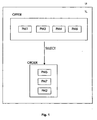
- FIG. 1 shows a very schematic arrangement for carrying out the invention.
- a graphical user interface UI which is operated on a configuration server SER according to the invention, which is explained in more detail with reference to FIG. 2, the procedure modules PM1, PM2, PM3, PM4, PM5, PM6 and PM7 are shown in the form of symbols, also called icons , Each of these symbols thus represents a procedure module for detecting, processing and forming signaling telegrams of a packet data network by a signaling server.
- FIG. 1 shows two fields OFFER and ORDER to which the procedure modules are distributed.
- the OFFER field shows the procedure modules PM1, PM3, PM4 and PM6.
- procedure modules are represented by the configuration server SER on the graphical User interface UI offered for selection and can be manipulated by an operator, for example by means of a computer mouse by a so-called “drag and drop” operation, shown in Figure 1 by an arrow SELECT.
- the operator can thus "drag” symbols from procedure modules from the field OFFER into the field ORDER and arrange them there in the desired manner.
- the procedure modules PM5, PM7 and PM2 have been selected and arranged by an operator in this way.
- the configuration server SER captures this arrangement of symbols and, by analogy, assembles the associated procedure modules, thus combines them into a service function module whose individual components interact with one another as shown in the field ORDER.
- the procedure module PM5 detects, for example, a service signaling message.
- the procedure module PM7 then processes the contents of the service signaling message by entering this content in a database and reading a correlated content from the database.
- the procedure module PM2 forms another service signaling message from the content read from the database.
- This graphical user interface UI is based on a computer program with which a service function module can be generated according to the invention and which is referred to here as a generation module TL and which is to be regarded as a computer program according to the invention.
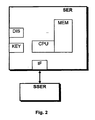
- a computer for executing this generation module TL is shown in some essential components in FIG. 2 as a configuration server SER.
- the configuration server SER may be part of a network management system or a separate computer that has a service function module generated by it can load a call server.
- the configuration server SER contains a control means CPU, for example a processor, for executing machine-readable instructions, for example and in particular for executing the generation module TL.
- the configuration server SER has a memory MEM in which the generation module TL can be stored.
- the configuration server SER has as an input means a keypad KEY and a computer mouse (not shown separately) to send data thereto during the execution of the generation module TL and as output means via a display device DIS, eg to output data during the execution of the generation module TL were generated by this.
- the configuration server SER has an interface device IF, via which the configuration server SER can provide a service function module to a signaling server SSER.
- the components of the server SER are interconnected by connections not shown in FIG.
- An operating system such as UNIX or DOS (Disc Operating System), manages the resources of the server SER and controls, among other things, the execution of the generation module TL.
- a signaling server according to the invention differs from a configuration server according to the invention in that, in a signaling server according to the invention, the functions of a conventional signaling server are combined with those of a configuration server according to the invention.
- the properties to be determined in the individual case include the specification of the respective protocols to be used. Apart from the fact that possibly a "multilingualism" or a self-adaptation can be provided, on the one hand an immutable firm specification and on the other hand a completely free changeability over parameters to be entered is conceivable.
- a configuration server according to the invention should also be able to create new or modify existing procedure modules in order to be able to offer both new services and cooperation with novel network components. An editor required for this is basically nothing new.
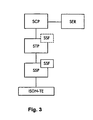
- FIG. 3 shows, above one another, a subscriber terminal ISDN-TE, an exchange SSP, a signaling network node STP and a service control computer SCP. They are also connected in this order.
- a service control computer SCP which is also referred to in the present description as a signaling server
- a configuration server SER according to the invention is shown. Service control computer SCP and configuration server SER can also be combined as an inventive signaling server.
- the subscriber terminal ISDN-TE is hereby designated by way of example as a subscriber device according to the ISDN standard. Basically, any user terminal, whether analog or digital, whether for voice or data or even for both, functions of the intelligent network trigger.
- the switching center SSP is here identified as a switching center, which can recognize a service call of the intelligent network, ie, as a so-called service switching point SSP. Subscriber terminals which are not directly connected to an exchange formed as SSP, must first on a normal route to such an exchange mediated.
- the service switching function SSF integrated in the switching center SSP recognizes IN calls and forwards the requests to the SCP.
- the call of an IN function is coupled to predefined triggers. Apart from certain numbers that represent a trigger point, for example, certain states of the connection, such as busy participants, or possibly already the lifting of the handset, interpreted as a trigger point. The further actions can already be evaluated by the IN.
- the signaling network node STP is at the same time the service transfer point STP of the intelligent network and the so-called signaling transfer point STP of the known signaling network SS7. At least as the latter he is well known; he takes over the function of a switching and a concentrator in the signaling network.
- SS7 Signaling Method Nr.7
- ISUP ISDN User Part
- INAP Intelligent Network Application Part
- the service control computer SCP which is also referred to in the present description as a signaling server, is assigned a configuration server SER according to the invention.
- Service control computer SCP and configuration server SER as already mentioned, can also be combined as an inventive signaling server.
- the configuration server according to the invention is not used in connection with a packet data network but directly on an intelligent network, it should be pointed out that in practice the described structures frequently have transitions. Thus, in practice often the SSP or the STP functions of the SCP true.
- the configuration server according to the invention in such a case is therefore not to be connected to the SCP, but to the SSP or the STP. It is precisely here that the advantage of a configuration server according to the invention also manifests itself in use in a conventional communications network. Even though the structure shown in FIG. 3 is not given physically, it nevertheless still exists as a logical structure.
Landscapes
- Engineering & Computer Science (AREA)
- Signal Processing (AREA)
- Computer Networks & Wireless Communication (AREA)
- Multimedia (AREA)
- Business, Economics & Management (AREA)
- General Business, Economics & Management (AREA)
- Data Exchanges In Wide-Area Networks (AREA)
- Stored Programmes (AREA)
- Hardware Redundancy (AREA)
Claims (10)
- Procédé pour générer des modules fonctionnels de service pour un serveur de signalisation (SSER) qui peut apporter des fonctions de signalisation pour commander des relations de communication sur un réseau de communication, caractérisé par les étapes suivantes:- Mise à disposition de modules de procédure (PM1, ..., PM7) pour détecter, traiter et former des télégrammes de signalisation d'un réseau de communication par un serveur de configuration (SER),- Représentation des modules de procédure (PM1, ..., PM7) sous la forme de symboles par une interface utilisateur (UI) sur le serveur de configuration (SER),- Détection d'une sélection prédéfinie par un utilisateur et disposition des symboles des modules de procédure (PM1, ..., PM7) sur l'interface utilisateur (UI),- Regroupement des modules de procédure (PM1, ..., PM7) en un module fonctionnel de service d'une manière prédéfinie par la sélection et la disposition des symboles respectifs des modules de procédure (PM1, ..., PM7) sur l'interface utilisateur (UI) par le serveur de configuration (SER) et- Mise à disposition du module fonctionnel de service par le serveur de configuration (SER) pour le serveur de signalisation (SSER).
- Procédé selon la revendication 1, caractérisé en ce que le module fonctionnel de service est chargé dans le serveur de signalisation (SSER).
- Procédé selon la revendication 1, caractérisé en ce qu'un module d'interface destiné à la saisie des données de paramètre pour le module fonctionnel de service est généré par le serveur de configuration (SER).
- Procédé selon la revendication 3, caractérisé en ce que le module fonctionnel de service est chargé dans un serveur de gestion de réseau pour la saisie des données de paramètre pour le module fonctionnel de service.
- Procédé selon la revendication 1, caractérisé en ce que le module fonctionnel de service est exécuté dans le serveur de signalisation (SSER) et que le module fonctionnel de service envoie et reçoit des télégrammes de signalisation conformes à la recommandation UIT-T H.323.
- Procédé selon la revendication 1, caractérisé en ce que le module fonctionnel de service est exécuté dans le serveur de signalisation (SSER) et que le module fonctionnel de service envoie et reçoit des télégrammes de signalisation SIP.
- Procédé selon la revendication 1, caractérisé en ce que le module fonctionnel de service est exécuté dans le serveur de signalisation (SSER) et que le module fonctionnel de service envoie et reçoit des télégrammes de signalisation MGCP.
- Serveur de configuration (SER) pour générer des modules fonctionnels de service pour un serveur de signalisation (SSER) qui peut apporter des fonctions de signalisation pour commander des relations de communication sur un réseau de communication, caractérisé en ce- que le serveur de configuration (SER) présente des premiers moyens de mise à disposition qui sont configurés de telle sorte que le serveur de configuration (SER) peut mettre à disposition des modules de procédure (PM1, ..., PM7) pour détecter, traiter et former des télégrammes de signalisation d'un réseau de communication,- que le serveur de configuration (SER) présente une interface utilisateur (UI) qui est configurée de telle sorte que le serveur de configuration (SER) peut représenter les modules de procédure (PM1, ..., PM7) sous la forme de symboles,- que le serveur de configuration (SER) présente des moyens de détection qui sont configurés de telle sorte que le serveur de configuration (SER) peut détecter une sélection prédéfinie par un utilisateur et une disposition des symboles des modules de procédure (PM1, ..., PM7) sur l'interface utilisateur (UI),- que le serveur de configuration (SER) présente des moyens de combinaison qui sont configurés de telle sorte que le serveur de configuration (SER) peut regrouper les modules de procédure (PM1, ..., PM7) en un module fonctionnel de service d'une manière prédéfinie par la sélection et la disposition des symboles respectifs des modules de procédure (PM1, ..., PM7) sur l'interface utilisateur (UI) et- que le serveur de configuration (SER) présente des deuxièmes moyens de mise à disposition qui sont configurés de telle sorte que le serveur de configuration (SER) peut mettre à disposition le module fonctionnel pour le serveur de signalisation (SSER).
- Serveur de signalisation (SSER) pour générer des modules fonctionnels de service avec lesquels le serveur de signalisation (SSER) peut apporter des fonctions de signalisation pour commander des relations de communication sur un réseau de communication, caractérisé en ce- que le serveur de signalisation (SSER) présente des premiers moyens de mise à disposition qui sont configurés de telle sorte que le serveur de signalisation (SSER) peut mettre à disposition des modules de procédure (PM1, ..., PM7) pour détecter, traiter et former des télégrammes de signalisation d'un réseau de communication,- que le serveur de signalisation (SSER) présente une interface utilisateur (UI) qui est configurée de telle sorte que le serveur de signalisation (SSER) peut représenter les modules de procédure (PM1, ..., PM7) sous la forme de symboles,- que le serveur de signalisation (SSER) présente des moyens de détection qui sont configurés de telle sorte que le serveur de signalisation (SSER) peut détecter une sélection prédéfinie par un utilisateur et une disposition des symboles des modules de procédure (PM1, ..., PM7) sur l'interface utilisateur (UI),- que le serveur de signalisation (SSER) présente des moyens de combinaison qui sont configurés de telle sorte que le serveur de signalisation (SSER) peut regrouper les modules de procédure (PM1, ..., PM7) en un module fonctionnel de service d'une manière prédéfinie par la sélection et la disposition des symboles respectifs des modules de procédure (PM1, ..., PM7) sur l'interface utilisateur (UI) et- que le serveur de signalisation (SSER) présente des deuxièmes moyens de mise disposition qui sont configurés de telle sorte que le serveur de signalisation (SSER) peut mettre à disposition le module fonctionnel en vue de son exécution.
- Programme informatique pour générer des modules fonctionnels de service avec lesquels le serveur de signalisation (SSER) peut apporter des fonctions de signalisation pour commander des relations de communication sur un réseau de communication, caractérisé en ce que le programme informatique contient un code avec lequel peuvent être exécutées les étapes du procédé selon la revendication 1 lorsque le programme informatique est exécuté sur un ordinateur.
Applications Claiming Priority (2)
| Application Number | Priority Date | Filing Date | Title |
|---|---|---|---|
| DE19954694A DE19954694A1 (de) | 1999-11-13 | 1999-11-13 | Verfahren, Konfigurationsserver, Signalisierungsserver, Computerprogramm und Speichermedium zur Erzeugung von Dienstfunktionsmodulen |
| DE19954694 | 1999-11-13 |
Publications (3)
| Publication Number | Publication Date |
|---|---|
| EP1126680A2 EP1126680A2 (fr) | 2001-08-22 |
| EP1126680A3 EP1126680A3 (fr) | 2004-01-07 |
| EP1126680B1 true EP1126680B1 (fr) | 2006-10-18 |
Family
ID=7928963
Family Applications (1)
| Application Number | Title | Priority Date | Filing Date |
|---|---|---|---|
| EP00440279A Expired - Lifetime EP1126680B1 (fr) | 1999-11-13 | 2000-10-18 | Procédé, serveur de configuration, serveur de signalisation et programme informatique pour la génération de modules fonctionnels de service |
Country Status (5)
| Country | Link |
|---|---|
| US (1) | US6975596B1 (fr) |
| EP (1) | EP1126680B1 (fr) |
| AT (1) | ATE343290T1 (fr) |
| AU (1) | AU7153000A (fr) |
| DE (2) | DE19954694A1 (fr) |
Families Citing this family (5)
| Publication number | Priority date | Publication date | Assignee | Title |
|---|---|---|---|---|
| EP1324581A1 (fr) * | 2001-12-28 | 2003-07-02 | Telefonaktiebolaget L M Ericsson (Publ) | CCBS utilisant un protocole d'initiation de session (SIP) |
| US6876727B2 (en) | 2002-07-24 | 2005-04-05 | Sbc Properties, Lp | Voice over IP method for developing interactive voice response system |
| US20050015499A1 (en) * | 2003-05-15 | 2005-01-20 | Georg Mayer | Method and apparatus for SIP user agent discovery of configuration server |
| EP1677502A1 (fr) * | 2004-12-28 | 2006-07-05 | Koninklijke KPN N.V. | Procédé pour fournir des informations de présence dans un réseau de télécommunication |
| CN105656915B (zh) * | 2016-01-29 | 2019-01-18 | 腾讯科技(深圳)有限公司 | 即时通话方法、装置和系统 |
Family Cites Families (17)
| Publication number | Priority date | Publication date | Assignee | Title |
|---|---|---|---|---|
| DE69228819T2 (de) * | 1992-12-17 | 1999-10-07 | International Business Machines Corp., Armonk | Konfigurations- und Betriebsverfahren eines Telekommunikationsgeräts |
| US5430719A (en) * | 1993-06-28 | 1995-07-04 | Bellsouth Corporation | Mediation of open advanced intelligent network interface by shared execution environment |
| GB9503939D0 (en) * | 1994-09-16 | 1995-04-19 | British Telecomm | An intelligent telecommunications network |
| US6735168B1 (en) * | 1996-06-25 | 2004-05-11 | Nortel Networks Limited | Method and architecture for providing telephony between data networks and PSTN |
| US5875242A (en) * | 1996-07-26 | 1999-02-23 | Glaser; Lawrence F. | Telecommunications installation and management system and method |
| US5917817A (en) * | 1996-12-06 | 1999-06-29 | International Business Machines Corporation | User invocation of services in public switched telephone network via parallel data networks |
| SE516244C2 (sv) * | 1996-12-20 | 2001-12-10 | Ericsson Telefon Ab L M | Internet-SS7 gateway |
| EP0866625A1 (fr) * | 1997-03-19 | 1998-09-23 | Siemens Aktiengesellschaft | SCP en réseau dans un réseau intelligent |
| US6041325A (en) * | 1997-10-09 | 2000-03-21 | Alcatel Usa Sourcing, L.P. | System and method for controlling access to a telephony database |
| US6002941A (en) * | 1997-12-17 | 1999-12-14 | Motorola, Inc. | Method and apparatus for implementing a service in a wireless communication system |
| DE19810869A1 (de) * | 1998-03-13 | 1999-09-16 | Cit Alcatel | Verfahren zur Verwaltung von Telekommunikationsdienst-Daten eines Teilnehmers sowie Server und Vermittlungsstelle hierzu |
| EP0948164A1 (fr) * | 1998-04-01 | 1999-10-06 | Hewlett-Packard Company | Production de registres de détail du service téléphonique |
| US6647111B1 (en) * | 1998-05-07 | 2003-11-11 | Mci Communications Corporation | System for executing advanced interactive voice response services using service-independent building blocks |
| DE19854754A1 (de) * | 1998-11-27 | 2000-06-08 | Alcatel Sa | Verfahren, Editor, Rechner, Steuermodul und Speichermittel zum Editieren von Konfigurationsdaten für Telekommunikationssysteme |
| US6603760B1 (en) * | 1998-12-08 | 2003-08-05 | Telcordia Technologies, Inc. | System and method for gradual transition of local phone services from PSTN to next generation network |
| US6661785B1 (en) * | 1999-10-12 | 2003-12-09 | Bellsouth Intellectual Property Corporation | Method and apparatus for providing internet call waiting with voice over internet protocol |
| US6735175B1 (en) * | 1999-12-16 | 2004-05-11 | Ericsson Inc. | Changing quality of service for voice over IP calls |
-
1999
- 1999-11-13 DE DE19954694A patent/DE19954694A1/de not_active Ceased
-
2000
- 2000-10-18 EP EP00440279A patent/EP1126680B1/fr not_active Expired - Lifetime
- 2000-10-18 AT AT00440279T patent/ATE343290T1/de not_active IP Right Cessation
- 2000-10-18 DE DE50013635T patent/DE50013635D1/de not_active Expired - Fee Related
- 2000-11-09 US US09/708,642 patent/US6975596B1/en not_active Expired - Fee Related
- 2000-11-10 AU AU71530/00A patent/AU7153000A/en not_active Abandoned
Also Published As
| Publication number | Publication date |
|---|---|
| US6975596B1 (en) | 2005-12-13 |
| DE50013635D1 (de) | 2006-11-30 |
| DE19954694A1 (de) | 2001-05-23 |
| EP1126680A2 (fr) | 2001-08-22 |
| EP1126680A3 (fr) | 2004-01-07 |
| ATE343290T1 (de) | 2006-11-15 |
| AU7153000A (en) | 2001-05-17 |
Similar Documents
| Publication | Publication Date | Title |
|---|---|---|
| DE60105127T2 (de) | Sitzungseintichtungsprotokoll basierend auf fortschrittlichen intelligenten netz/intelligenten netznachrichtenübertragung | |
| DE60027756T2 (de) | Verfahren und vorrichtung zur zuordnung einer identifizierung eines "ende-zu-ende" anrufes zu einer verbindung in einem multimedien paketennetz | |
| DE60130981T2 (de) | Signalisierung in einem telekommunikationsnetz | |
| DE10147494A1 (de) | Dienststeuerung im Rahmen des Intelligentes Netzwerk Konzepts für Paketnetzverbindungen | |
| DE60103170T2 (de) | Verhinderung von gesprächsumweglenkung | |
| EP1492300A1 (fr) | Procédé et arrangement pour l'accès à un premier terminal d'un premier réseau de transmissions depuis un noeud de communication d'un deuxième réseau de transmissions | |
| DE10001077A1 (de) | Verfahren, Dienst-Vermittlungsstelle, Dienst-Steuerknoten, Internet-Gateway, Programm-Modul und Internet-Endgerät zum Aufbau einer Ruf-Verbindung zwischen einem Telefonnetz-Endgerät und einem Internet-Endgerät | |
| DE60225457T2 (de) | Aufgeteilter vermittlungsknoten und verfahren zu dessen betrieb | |
| WO2008022775A1 (fr) | Réseau de communication avec commande de commutation de circuits et de paquets | |
| EP1712060B1 (fr) | Procede de negociation de proprietes supports dans un resau ip | |
| DE60026843T2 (de) | System und verfahren zur steuerung eines media-gateways | |
| EP1525756A1 (fr) | Passerelle media permettant de fournir les services pstn/isdn dans des reseaux de la prochaine generation | |
| EP1269766B1 (fr) | Systeme de telecommunication dote d'un reseau de communication a commutation de paquets et procede permettant de faire fonctionner un tel systeme | |
| EP1126680A2 (fr) | Procédé, serveur de configuration, serveur de signalisation, programme informatique et support de mémoire pour la génération de modules fonctionnels de service | |
| EP1505842A2 (fr) | -Méthode pour la redirection de porteurs pour des utilisteurs SIP/SIP-T | |
| DE69833689T2 (de) | Teilnehmerdatenbehandlung in telekommunikationsnetzwerken | |
| WO2002065787A1 (fr) | Procede pour fixer le codage d'informations utiles produites selon differentes lois de codage entre au moins deux terminaux d'abonnes | |
| EP1294166A1 (fr) | Procédé de signalisation pour la transmission des données utiles sur des reseaux à commutation de circuit et par paquets | |
| EP1521486A2 (fr) | Dispositif et méthode pour le contrôle de connexions de communications | |
| DE10145987B4 (de) | Verfahren zur Auswahl eines Leistungsmerkmals und zugehörige Einheiten | |
| WO2003088685A1 (fr) | Mise en attente/portabilite de terminal dans des reseaux h.323/isup-bicc-sip | |
| EP1661363B1 (fr) | Procede destine a supporter la caracteristique de fourniture du nom pour des reseaux tdm/architectures de communication sip centrex mixtes | |
| EP1311101A1 (fr) | Fournitures des ressources interactives à réponse vocale dans des réseaux BICC | |
| EP1292075A2 (fr) | Méthode de direction d'itinéraire de paquets | |
| EP1091597A1 (fr) | Méthode, noeuds, passerelle de réseau, logiciel et mémoire pour fournir les services d'un réseau intelligent à un utilisateur Internet |
Legal Events
| Date | Code | Title | Description |
|---|---|---|---|
| PUAI | Public reference made under article 153(3) epc to a published international application that has entered the european phase |
Free format text: ORIGINAL CODE: 0009012 |
|
| AK | Designated contracting states |
Kind code of ref document: A2 Designated state(s): AT BE CH CY DE DK ES FI FR GB GR IE IT LI LU MC NL PT SE |
|
| AX | Request for extension of the european patent |
Free format text: AL;LT;LV;MK;RO;SI |
|
| PUAL | Search report despatched |
Free format text: ORIGINAL CODE: 0009013 |
|
| AK | Designated contracting states |
Kind code of ref document: A3 Designated state(s): AT BE CH CY DE DK ES FI FR GB GR IE IT LI LU MC NL PT SE |
|
| AX | Request for extension of the european patent |
Extension state: AL LT LV MK RO SI |
|
| RIC1 | Information provided on ipc code assigned before grant |
Ipc: 7H 04Q 3/00 B Ipc: 7H 04L 29/06 A Ipc: 7H 04L 12/66 B Ipc: 7H 04M 3/42 B |
|
| 17P | Request for examination filed |
Effective date: 20040202 |
|
| 17Q | First examination report despatched |
Effective date: 20040315 |
|
| RIN1 | Information on inventor provided before grant (corrected) |
Inventor name: KAISER, BERNHARD, DR. |
|
| AKX | Designation fees paid |
Designated state(s): AT BE CH CY DE DK ES FI FR GB GR IE IT LI LU MC NL PT SE |
|
| GRAP | Despatch of communication of intention to grant a patent |
Free format text: ORIGINAL CODE: EPIDOSNIGR1 |
|
| RTI1 | Title (correction) |
Free format text: METHOD, CONFIGURATION SERVER, SIGNALLING SERVER AND COMPUTER PROGRAM FOR GENERATING SERVICE FUNCTION MODULES |
|
| GRAS | Grant fee paid |
Free format text: ORIGINAL CODE: EPIDOSNIGR3 |
|
| GRAA | (expected) grant |
Free format text: ORIGINAL CODE: 0009210 |
|
| AK | Designated contracting states |
Kind code of ref document: B1 Designated state(s): AT BE CH CY DE DK ES FI FR GB GR IE IT LI LU MC NL PT SE |
|
| PG25 | Lapsed in a contracting state [announced via postgrant information from national office to epo] |
Ref country code: NL Free format text: LAPSE BECAUSE OF FAILURE TO SUBMIT A TRANSLATION OF THE DESCRIPTION OR TO PAY THE FEE WITHIN THE PRESCRIBED TIME-LIMIT Effective date: 20061018 Ref country code: IE Free format text: LAPSE BECAUSE OF FAILURE TO SUBMIT A TRANSLATION OF THE DESCRIPTION OR TO PAY THE FEE WITHIN THE PRESCRIBED TIME-LIMIT Effective date: 20061018 Ref country code: FI Free format text: LAPSE BECAUSE OF FAILURE TO SUBMIT A TRANSLATION OF THE DESCRIPTION OR TO PAY THE FEE WITHIN THE PRESCRIBED TIME-LIMIT Effective date: 20061018 |
|
| REG | Reference to a national code |
Ref country code: GB Ref legal event code: FG4D Free format text: NOT ENGLISH |
|
| PG25 | Lapsed in a contracting state [announced via postgrant information from national office to epo] |
Ref country code: MC Free format text: LAPSE BECAUSE OF NON-PAYMENT OF DUE FEES Effective date: 20061031 Ref country code: CH Free format text: LAPSE BECAUSE OF NON-PAYMENT OF DUE FEES Effective date: 20061031 Ref country code: LI Free format text: LAPSE BECAUSE OF NON-PAYMENT OF DUE FEES Effective date: 20061031 |
|
| PGFP | Annual fee paid to national office [announced via postgrant information from national office to epo] |
Ref country code: IT Payment date: 20061031 Year of fee payment: 7 |
|
| GBT | Gb: translation of ep patent filed (gb section 77(6)(a)/1977) |
Effective date: 20061018 |
|
| PGFP | Annual fee paid to national office [announced via postgrant information from national office to epo] |
Ref country code: DE Payment date: 20061110 Year of fee payment: 7 |
|
| REG | Reference to a national code |
Ref country code: IE Ref legal event code: FG4D Free format text: LANGUAGE OF EP DOCUMENT: GERMAN Ref country code: CH Ref legal event code: EP |
|
| PGFP | Annual fee paid to national office [announced via postgrant information from national office to epo] |
Ref country code: FR Payment date: 20061124 Year of fee payment: 7 |
|
| PGFP | Annual fee paid to national office [announced via postgrant information from national office to epo] |
Ref country code: GB Payment date: 20061130 Year of fee payment: 7 |
|
| REF | Corresponds to: |
Ref document number: 50013635 Country of ref document: DE Date of ref document: 20061130 Kind code of ref document: P |
|
| PG25 | Lapsed in a contracting state [announced via postgrant information from national office to epo] |
Ref country code: SE Free format text: LAPSE BECAUSE OF FAILURE TO SUBMIT A TRANSLATION OF THE DESCRIPTION OR TO PAY THE FEE WITHIN THE PRESCRIBED TIME-LIMIT Effective date: 20070118 Ref country code: DK Free format text: LAPSE BECAUSE OF FAILURE TO SUBMIT A TRANSLATION OF THE DESCRIPTION OR TO PAY THE FEE WITHIN THE PRESCRIBED TIME-LIMIT Effective date: 20070118 |
|
| PG25 | Lapsed in a contracting state [announced via postgrant information from national office to epo] |
Ref country code: ES Free format text: LAPSE BECAUSE OF FAILURE TO SUBMIT A TRANSLATION OF THE DESCRIPTION OR TO PAY THE FEE WITHIN THE PRESCRIBED TIME-LIMIT Effective date: 20070129 |
|
| PG25 | Lapsed in a contracting state [announced via postgrant information from national office to epo] |
Ref country code: PT Free format text: LAPSE BECAUSE OF FAILURE TO SUBMIT A TRANSLATION OF THE DESCRIPTION OR TO PAY THE FEE WITHIN THE PRESCRIBED TIME-LIMIT Effective date: 20070319 |
|
| NLV1 | Nl: lapsed or annulled due to failure to fulfill the requirements of art. 29p and 29m of the patents act | ||
| RAP2 | Party data changed (patent owner data changed or rights of a patent transferred) |
Owner name: ALCATEL LUCENT |
|
| ET | Fr: translation filed | ||
| REG | Reference to a national code |
Ref country code: IE Ref legal event code: FD4D |
|
| REG | Reference to a national code |
Ref country code: CH Ref legal event code: PL |
|
| PLBE | No opposition filed within time limit |
Free format text: ORIGINAL CODE: 0009261 |
|
| STAA | Information on the status of an ep patent application or granted ep patent |
Free format text: STATUS: NO OPPOSITION FILED WITHIN TIME LIMIT |
|
| 26N | No opposition filed |
Effective date: 20070719 |
|
| BERE | Be: lapsed |
Owner name: ALCATEL Effective date: 20061031 |
|
| PG25 | Lapsed in a contracting state [announced via postgrant information from national office to epo] |
Ref country code: AT Free format text: LAPSE BECAUSE OF NON-PAYMENT OF DUE FEES Effective date: 20061018 |
|
| PG25 | Lapsed in a contracting state [announced via postgrant information from national office to epo] |
Ref country code: GR Free format text: LAPSE BECAUSE OF FAILURE TO SUBMIT A TRANSLATION OF THE DESCRIPTION OR TO PAY THE FEE WITHIN THE PRESCRIBED TIME-LIMIT Effective date: 20070119 |
|
| GBPC | Gb: european patent ceased through non-payment of renewal fee |
Effective date: 20071018 |
|
| PG25 | Lapsed in a contracting state [announced via postgrant information from national office to epo] |
Ref country code: LU Free format text: LAPSE BECAUSE OF NON-PAYMENT OF DUE FEES Effective date: 20061018 Ref country code: DE Free format text: LAPSE BECAUSE OF NON-PAYMENT OF DUE FEES Effective date: 20080501 |
|
| REG | Reference to a national code |
Ref country code: FR Ref legal event code: ST Effective date: 20080630 |
|
| PG25 | Lapsed in a contracting state [announced via postgrant information from national office to epo] |
Ref country code: CY Free format text: LAPSE BECAUSE OF FAILURE TO SUBMIT A TRANSLATION OF THE DESCRIPTION OR TO PAY THE FEE WITHIN THE PRESCRIBED TIME-LIMIT Effective date: 20061018 Ref country code: GB Free format text: LAPSE BECAUSE OF NON-PAYMENT OF DUE FEES Effective date: 20071018 |
|
| PG25 | Lapsed in a contracting state [announced via postgrant information from national office to epo] |
Ref country code: FR Free format text: LAPSE BECAUSE OF NON-PAYMENT OF DUE FEES Effective date: 20071031 |
|
| PG25 | Lapsed in a contracting state [announced via postgrant information from national office to epo] |
Ref country code: IT Free format text: LAPSE BECAUSE OF NON-PAYMENT OF DUE FEES Effective date: 20071018 Ref country code: BE Free format text: LAPSE BECAUSE OF FAILURE TO SUBMIT A TRANSLATION OF THE DESCRIPTION OR TO PAY THE FEE WITHIN THE PRESCRIBED TIME-LIMIT Effective date: 20061031 |
|
| REG | Reference to a national code |
Ref country code: FR Ref legal event code: CA Effective date: 20150521 |
|
| REG | Reference to a national code |
Ref country code: FR Ref legal event code: CA Effective date: 20150521 |