EP1126979B1 - Sicherheitsdruck - Google Patents
Sicherheitsdruck Download PDFInfo
- Publication number
- EP1126979B1 EP1126979B1 EP99954159A EP99954159A EP1126979B1 EP 1126979 B1 EP1126979 B1 EP 1126979B1 EP 99954159 A EP99954159 A EP 99954159A EP 99954159 A EP99954159 A EP 99954159A EP 1126979 B1 EP1126979 B1 EP 1126979B1
- Authority
- EP
- European Patent Office
- Prior art keywords
- dopant
- document
- security feature
- providing
- covert security
- Prior art date
- Legal status (The legal status is an assumption and is not a legal conclusion. Google has not performed a legal analysis and makes no representation as to the accuracy of the status listed.)
- Expired - Lifetime
Links
Images




Classifications
-
- B—PERFORMING OPERATIONS; TRANSPORTING
- B41—PRINTING; LINING MACHINES; TYPEWRITERS; STAMPS
- B41M—PRINTING, DUPLICATING, MARKING, OR COPYING PROCESSES; COLOUR PRINTING
- B41M3/00—Printing processes to produce particular kinds of printed work, e.g. patterns
- B41M3/14—Security printing
- B41M3/142—Security printing using chemical colour-formers or chemical reactions, e.g. leuco-dye/acid, photochromes
-
- Y—GENERAL TAGGING OF NEW TECHNOLOGICAL DEVELOPMENTS; GENERAL TAGGING OF CROSS-SECTIONAL TECHNOLOGIES SPANNING OVER SEVERAL SECTIONS OF THE IPC; TECHNICAL SUBJECTS COVERED BY FORMER USPC CROSS-REFERENCE ART COLLECTIONS [XRACs] AND DIGESTS
- Y10—TECHNICAL SUBJECTS COVERED BY FORMER USPC
- Y10S—TECHNICAL SUBJECTS COVERED BY FORMER USPC CROSS-REFERENCE ART COLLECTIONS [XRACs] AND DIGESTS
- Y10S428/00—Stock material or miscellaneous articles
- Y10S428/916—Fraud or tamper detecting
-
- Y—GENERAL TAGGING OF NEW TECHNOLOGICAL DEVELOPMENTS; GENERAL TAGGING OF CROSS-SECTIONAL TECHNOLOGIES SPANNING OVER SEVERAL SECTIONS OF THE IPC; TECHNICAL SUBJECTS COVERED BY FORMER USPC CROSS-REFERENCE ART COLLECTIONS [XRACs] AND DIGESTS
- Y10—TECHNICAL SUBJECTS COVERED BY FORMER USPC
- Y10T—TECHNICAL SUBJECTS COVERED BY FORMER US CLASSIFICATION
- Y10T428/00—Stock material or miscellaneous articles
- Y10T428/29—Coated or structually defined flake, particle, cell, strand, strand portion, rod, filament, macroscopic fiber or mass thereof
- Y10T428/2982—Particulate matter [e.g., sphere, flake, etc.]
- Y10T428/2991—Coated
- Y10T428/2993—Silicic or refractory material containing [e.g., tungsten oxide, glass, cement, etc.]
- Y10T428/2996—Glass particles or spheres
Definitions
- the invention relates to materials and techniques relating to security printing.
- the present invention in its broadest sense is concerned with the provision of security in relation to documents, vouchers, packaged goods and tokens of value. Examples of these are banknotes, cheques and drafts, bond and stock certificates, and credit and bank cards. All of these are referred to hereinafter for simplicity as "documents”.
- covert security includes NIR and IR absorber inks, magnetic threads, complex optical and electrically conductive indicia, anti-Stokes, visible-wavelength-emitting phosphors etc.
- WO-A-81 03509 concerns document security markings employing quasiresonant luminescent dopants which emit visible radiation in narrow wavelength ranges close to the wavelengths of the applied excitation light.
- the dopants may be incorporated in glass fibres or the like embedded into the documents.
- EP-A-0440554 discloses a covert security feature involving two chemical reactants, one of which is incorporated into the document but provides no security features until it is chemically activated by the external application of a second chemical reactant.
- the authentication process involves the application of the second reactant, yielding a visible inscription on the document.
- EP-A-0202902 relates to security markings that are invisible in visible light but fluoresce under UV light. It is particularly concerned with providing such markings on ceramic articles, by means of materials that will withstand ceramic firing temperatures.
- DE-A-2048853 concerns the use of photochromic compounds in order to make documents resistant to photocopying.
- a method of providing a document with a covert security feature in which the document is provided with at least one inorganic dopant, the dopant being of a material which can be identified by examination of its visible wavelength absorption spectrum, measured in either reflective or transmissive mode, in response to broad-band visible wavelength photon radiation, in which the dopant is fused with other elements and micronised into a fine powder before being applied to or otherwise incorporated into the document, thereby altering said visible wavelength absorption spectrum of the dopant, and in which the dopant exhibits no UV, visible or IR stimulated output.
- the present invention provides a range of inorganic dopants designed with absorption spectra sufficiently different in form and structure from the absorption spectra of printing inks so that the dopants can be easily identified. They thus become very covert because they exhibit no UV, visible or IR stimulated output to be observed by a counterfeiter.
- the preferred elements (or oxides or salts thereof) for our dopants are fused with other elements in order to hide the presence of the dopant element, or to alter its absorption spectrum and when micronised into a fine powder can be mixed into, for example, a printing ink or a batch composition for plastics production etc.
- the dopant is mixed with other elemental compounds and where one of its admixture compounds contains a substantial proportion by weight of a particular range of atomic number (z) elements, varying the proportion of this compound in the final mix can vary the absorption spectrum of the final inorganic mixture, thus essentially creating further dopants.
- the present invention depends on the incorporation of a synthesised inorganic dopant into or onto the document at any stage of its manufacture, including the printing stage.
- These dopants are designed to have very complex visible wavelength absorption spectra, measured in either reflective or transmissive mode. The spectra they exhibit are not found in printing inks or common marbling substrates. This results in high signal-to-noise ratio detection, and hence the ability to identify the dopant in 10msec or less using low output (c. 4W) bulbs as illuminants.
- Dopants in accordance with the present invention can be incorporated singly, mixed, or in separate areas to produce a "bar code", or to simply confuse a forger.
- the dopants, depending on composition, are either colourless or transparent, or coloured, at the choice of the user.
- Dopants made in accordance with the present invention provide high optical absorption yet give optical transparency because their absorption features are created at wavelengths to which the human eye is insensitive.
- the preferred method is to illuminate an area of at least 5mm 2 by a ring of at least 6-8 200 ⁇ m optical fibres in a concentric ring, and channel reflected light through an inner 200 ⁇ m optical fibre to the wavelength detector. It has been found that this number of optical fibres gives sufficient signal for interpretation of the spectra, however the present invention is not limited to this method of detection of the spectrum or the number or arrangement of optical fibres used in this detection method. This eliminates the optical losses due to lenses in much prior art, which in turn leads to the processing speed of our system.
- CCD based wavelength detectors, followed by A-D conversion for processing are standard technologies in public domain electronics. Our dopants are engineered to give no visible signal, such as fluorescence, upon illumination by UV, visible, or IR radiation and are hence not easily replicated as has happened with fluorescent inks, and other emitting technologies.
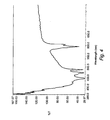
- Figure 4 shows many easily identifiable peaks, troughs and turning points in its spectrum with a shape easily distinguished from any ink or colouring dopants. It is these unique features which give the excellent signal-to-noise ratio, giving the rapid identification ability of our system, with excellent identification rates, and very low false acceptances, together with high rejection for forged copies.
- the features, and/or slopes, of the reflectance spectra can be shifted to create other dopants by incorporating the dopants into inorganic compounds of the type described later.
- Visible wavelength spectroscopy as revealed in the prior art with application to security uses lenses or mirrors and lamps to provide the illumination source.
- the dopants we have identified as working well can be added to standard offset litho printing inks in a manner known to those skilled in the art. It is added in quantities up to about 30% by volume without affecting the printing process, providing the dopants have been micronised into fine powders of the order of 1-4 ⁇ m diameter. If this step is omitted poor uniformity printing results.
- Our dopants need add no colour to the ink, so give a colourless invisible printed strip onto the object to be protected. Alternatively a colouring dopant can be selected to blend in with an existing coloured scheme.
- a major advantage of the dopants made in accordance with the present invention is that they are cheap and simple, not requiring the presence of complex expensive chemicals.
- the dopants can be applied to artefacts by any standard deposition technique - air spray, lacquering, printing, stamping.
- the dopants could also be directly incorporated into paper or plastic (for example) at time of manufacture of said paper or plastic.
- the dopants are added as a superior layer or film, although in many cases this will be the simplest and cheapest method.
- the fact that our dopant/excitation/detector technology does not require surface deposition can offer more security/covertness to the process. It arises because the excitation methods we are employing have ranges of many tens of microns in common materials such as paper and plastics. Since dopants in accordance with the present invention need not be on the surface of the document the forger is denied the opportunity to scrape off samples from repeated small surface areas and analyse them to look for "surprising" changes in composition from area to area.
- the chemical batch composition is not, for example, limited to that required to produce, say, a glass. This is because long range atomic order is not required in the solid, since homogeneity is assured by micronising the composition. Indeed in general terms we have found that the best compositions are obtained where phase separation of the melt temperature is imminent. This point is determined experimentally for each composition. Nor need the chemistry be limited to stoichometric ratios such as to arrive at crystalline compounds, e.g. as used to produce the commonplace inorganic fluorescence powders added to printing inks.
- the structure and magnitude of the absorption peaks can be controlled over a wide range by control of the gas atmosphere during the melt phase. This is established by trial and error for each composition by test melting each composition in air, in a reducing atmosphere, and in an oxidising atmosphere to determine the optimum methodology and conditions for the absorption profile required.
- the structure and magnitude of absorption peaks can be controlled by including a substantial quantity (>20% by weight) of a high atomic number Z element in the batch composition (lanthanum, bismuth, and strontium work well, as examples). Then varying the content of this high Z element only gives changes in position and magnitude of the absorption peaks, from composition to composition. Different absorption peak wavelengths and magnitudes from that exhibited by the raw dopant before being incorporated in a glass.
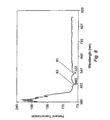
- Fig. 8 shows a plot of the percent transmission against wavelength (nm) for a raw Europium Oxide dopant powder.
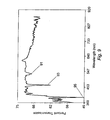
- Fig.9 shows a plot of the percent transmission against wavelength (nm) for a Europium Oxide dopant powder incorporated in a glass and ground into a fine powder.
- the substances contained in the glass are as given in Table 1 below and the glass plus dopant is made in accordance with the method given below Table 1.
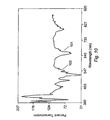
- Fig. 10 shows a plot of the percent transmission against wavelength (nm) for a raw Erbium Oxide dopant powder.
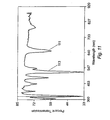
- Fig.11 shows a plot of the percent transmission against wavelength (nm) for an Erbium Oxide dopant powder incorporated in a ground fine powder glass.
- the substances contained in the glass are as given in Table 1 below and the glass plus dopant is made in accordance with the method given below Table 1.
- Fig. 10 shows, at reference numeral 101, the existence of multiple peak structure occurring from a minimum point at 654nm to approximately 700nm. It can be seen that these features are absent from the spectrum of Fig. 11 as indicated at reference numeral 111.
- Fig.10 also has multiple peak structure occurring from a minimum value at 521nm up to approximately 600nm. These features are absent from the spectrum of Fig. 11 as can be seen at reference numeral 113.
- a glass batch of a typical suitable composition is as follows. Compound Wt % SiO 2 35% B 2 O 3 40.0 Na 2 O 8.5 K 2 O 8.5 Al 2 O 3 1.0 MgO 4.0
- the natural emissions of Eu 2 O 3 may be quenched by the use of high concentrations of Eu 2 O 3 or by the inclusion of small ⁇ 1% quantities of nickel oxide, silver oxide or lead oxide as luminescence quenchers.
- compositions may also be used Compound Wt (g) Compound Wt (g) Compound Wt (g) Compound Wt (g) SiO 2 55 SiO 2 70 SiO 2 50 B 2 O 3 65 B 2 O 3 80 Be 2 CO 3 20 Na 2 CO 3 29 Na 2 CO 3 29 SrCO 3 20 K 2 CO 3 20 Na 2 CO 3 10 Li 2 CO 3 5 Li 2 CO 3 5 K 2 CO 3 10 Al 2 O 3 2 Al 2 O 3 2 Li 2 CO 3 5 MgO 8 MgO 5 Al 2 O 3 2 MgO 5 Compound Wt (g) Compound Wt (g) SiO 2 35 SiO 2 55 B 2 O 3 80 B 2 O 3 65 Be 2 CO 3 40 Na 2 CO 3 29 Na 2 CO 3 29 K 2 CO 3 20 K 2 CO 3 20 Li 2 CO 3 5 Li 2 CO 3 5 Al 2 O 3 2 Al 2 O 3 2 MgO 8 MgO 8 MgO 8 MgO 8
- Another suitable composition is of the type Compound Wt % SiO 2 51 B 2 O 3 13 Al 2 O 3 8 MgO 6 CaO 10 SrO 4 ZnO 4
- This is particularly suitable as a base for incorporating dopants for visible wavelength absorption detection because all the base elements have largely unfeatured absorption spectra.
- Dopants have also been successfully incorporated into glass matrices with the following ranges of chemical composition. 30-56wt% SiO 2 , 5-35wt%, La 2 O 3 /Bi 2 O 3 /Sr 2 O 3 , 2-33wt% Li 2 O/K 2 O/Na 2 O, 0-6% Al 2 O 3 wherein the La, Bi, Sr are examples of a suitable high Atomic number component.
- Preferred elements for dopant fabrication for visible wavelength absorption system Barium Zinc Lanthanum Samarium Lead Praesodymium Magnesium Europium Strontium Boron-10 Titanium Neodymium Chromium Holmium Iron Thulium Caesium Cadmium Molybdemum Antimony Nickel Erbium Tungsten Lutecium Cobalt Tin Sodium Potassium Terbium
Landscapes
- Chemical & Material Sciences (AREA)
- Chemical Kinetics & Catalysis (AREA)
- General Chemical & Material Sciences (AREA)
- Credit Cards Or The Like (AREA)
- Glass Compositions (AREA)
- Paper (AREA)
- Printing Plates And Materials Therefor (AREA)
- Pens And Brushes (AREA)
- Pharmaceuticals Containing Other Organic And Inorganic Compounds (AREA)
- Impact Printers (AREA)
- Inks, Pencil-Leads, Or Crayons (AREA)
- Oscillators With Electromechanical Resonators (AREA)
- Input Circuits Of Receivers And Coupling Of Receivers And Audio Equipment (AREA)
- Surgical Instruments (AREA)
- Inspection Of Paper Currency And Valuable Securities (AREA)
Claims (17)
- Ein Verfahren zur Bereitstellung eines Dokuments mit einem verborgenen Sicherheitsmerkmal, wobei das Dokument mit mindestens einem anorganischen Dotierungsmittel bereitgestellt ist, wobei das Dotierungsmittel aus einem Material ist, das durch die Untersuchung seines sichtbaren Wellenlängenabsorptionsspektrums, welches in entweder reflektivem oder übertragbarem Mode gemessen wird, als Reaktion auf breitbandige, sichtbare Wellenlängenphotonenstrahlung, identifiziert werden kann, wobei das Dotierungsmittel mit anderen Elementen verschmolzen und zu einem feinen Pulver mikronisiert wird, bevor es auf das Dokument aufgetragen oder anderweitig in dieses inkorporiert wird, wodurch das sichtbare Wellenlängenabsorptionsspektrum des Dotierungsmittels verändert wird, und wobei das Dotierungsmittel keine UV-, sichtbare oder IR stimulierte Ausgabe vorzeigt.
- Verfahren zur Bereitstellung eines Dokuments mit einem verborgenen Sicherheitsmerkmal gemäß Anspruch 1, wobei das Dotierungsmittel eine oder mehrere anorganische Verbindungen beinhaltet.
- Verfahren zur Bereitstellung eines Dokuments mit einem verborgenen Sicherheitsmerkmal gemäß Anspruch 1 oder Anspruch 2, wobei das Dotierungsmittel eines der in Tabelle 5 aufgelisteten Elemente oder eine Kombination aus diesen in elementarer Form oder als ein Oxid oder Salz beinhaltet.
- Verfahren zur Bereitstellung eines Dokuments mit einem verborgenen Sicherheitsmerkmal gemäß einem der vorhergehenden Ansprüche, wobei das Dotierungsmittel mit einer Menge eines Elements oder seinem Salz oder seinem Oxid mit einer Atomnummer, die größer als 36 ist, vermischt ist.
- Verfahren zur Bereitstellung eines Dokuments mit einem verborgenen Sicherheitsmerkmal gemäß Anspruch 4, wobei das Element oder sein Salz oder sein Oxid Strontium, Lanthan oder Bismut ist.
- Verfahren zur Bereitstellung eines Dokuments mit einem verborgenen Sicherheitsmerkmal gemäß einem der vorhergehenden Ansprüche, wobei das Dotierungsmittel mit Tinte vermischt ist und die anfallende Mischung auf das Dokument aufgetragen wird.
- Verfahren zur Bereitstellung eines Dokuments mit einem verborgenen Sicherheitsmerkmal gemäß einem der vorhergehenden Ansprüche, wobei das Dotierungsmittel in einem Glas verschmolzen ist.
- Verfahren zur Bereitstellung eines Dokuments mit einem verborgenen Sicherheitsmerkmal gemäß Anspruch 7, wobei das Glas aus Silikaten und/oder Phosphaten und/oder Boraten hergestellt ist.
- Verfahren zur Bereitstellung eines Dokuments mit einem verborgenen Sicherheitsmerkmal gemäß einem der vorhergehenden Ansprüche, wobei jedes Partikel des mikronisierten feinen Pulvers einen Durchmesser von 1 - 4 µm aufweist.
- Verfahren zur Bereitstellung eines Dokuments mit einem verborgenen Sicherheitsmerkmal gemäß einem der vorhergehenden Ansprüche, wobei das Dotierungsmittel derart ist, dass beim Beleuchten des Dokuments mit breitbandigem sichtbarem Licht zur Erzeugung eines Reflexionsspektrums mit Frequenzkomponenten, die durch das Dotierungsmittel und durch andere reflektierende in dem Dokument enthaltene Substanzen generiert werden, das Spektrum eine minimale Frequenzüberlappung zwischen den Komponenten des Spektrums, welche durch das Dotierungsmittel generiert werden, und jenem Teil des Spektrums, der durch andere in dem Dokument enthaltene Substanzen generiert wird, enthält.
- Verfahren zur Bereitstellung eines Dokuments mit einem verborgenen Sicherheitsmerkmal gemäß einem der vorhergehenden Ansprüche, wobei das Dotierungsmittel derart ist, dass beim Beleuchten des Dokuments mit breitbandigem sichtbarem Licht die Absorptionsmerkmale des sichtbaren Wellenlängenabsorptionsspektrums bei Wellenlängen kreiert werden, gegenüber denen das menschliche Auge unempfindlich ist.
- Verfahren zur Bereitstellung eines Dokuments mit einem verborgenen Sicherheitsmerkmal gemäß einem der vorhergehenden Ansprüche, wobei das sichtbare Wellenlängenabsorptionsspektrum des Dotierungsmittels auf eine höhere oder tiefere Wellenlänge verschoben werden kann.
- Verfahren zur Bereitstellung eines Dokuments mit einem verborgenen Sicherheitsmerkmal gemäß einem der vorhergehenden Ansprüche, wobei das sichtbare Wellenlängenabsorptionsspektrum des Dotierungsmittels auf eine höhere oder tiefere Wellenlänge verschoben werden kann, indem die Zusammensetzung eines Glases, in dem es verschmolzen ist, verändert wird.
- Verfahren zur Bereitstellung eines Dokuments mit einem verborgenen Sicherheitsmerkmal gemäß einem der vorhergehenden Ansprüche, wobei das Dotierungsmittel in einem Glas verschmolzen ist, und wobei das sichtbare Wellenlängenabsorptionsspektrum des Dotierungsmittels änderbar ist, indem die Reaktionstemperatur und/oder der Druck, bei dem das Glas hergestellt wird, verändert wird.
- Ein Dokument, das durch das Verfahren gemäß einem der vorhergehenden Ansprüche mit einem verborgenen Sicherheitsmerkmal bereitgestellt ist.
- Ein Dotierungsmittel zur Verwendung bei der Bereitstellung eines Dokuments mit einem verborgenen Sicherheitsmerkmal, das eines der in Tabelle 5 aufgelisteten Elemente oder eine Kombination aus diesen in elementarer Form oder als ein Oxid oder Salz, das durch die Untersuchung seines sichtbaren Wellenlängenabsorptionsspektrums, welches in entweder reflektivem oder übertragbarem Mode gemessen wird, als Reaktion auf breitbandige, sichtbare Wellenlängenphotonenstrahlung identifiziert werden kann, das mit anderen Elementen verschmolzen und zu einem feinen Pulver mikronisiert wird, wodurch das sichtbare Wellenlängenabsorptionsspektrum des Dotierungsmittels verändert wird, und wobei das Dotierungsmittel keine UV-, sichtbare oder IR stimulierte Ausgabe vorzeigt, beinhaltet.
- Ein Verfahren zur Herstellung eines Dotierungsmittels gemäß Anspruch 16, wobei das eine der in Tabelle 5 aufgelisteten Elemente oder eine Kombination aus diesen, in elementarer Form oder als ein Oxid oder Salz, in einem Glas verschmolzen und anschließend mikronisiert wird.
Applications Claiming Priority (3)
| Application Number | Priority Date | Filing Date | Title |
|---|---|---|---|
| GBGB9824246.4A GB9824246D0 (en) | 1998-11-06 | 1998-11-06 | Electronic circuit |
| GB9824246 | 1998-11-06 | ||
| PCT/GB1999/003692 WO2000027645A1 (en) | 1998-11-06 | 1999-11-08 | Security printing |
Publications (2)
| Publication Number | Publication Date |
|---|---|
| EP1126979A1 EP1126979A1 (de) | 2001-08-29 |
| EP1126979B1 true EP1126979B1 (de) | 2004-03-24 |
Family
ID=10841882
Family Applications (1)
| Application Number | Title | Priority Date | Filing Date |
|---|---|---|---|
| EP99954159A Expired - Lifetime EP1126979B1 (de) | 1998-11-06 | 1999-11-08 | Sicherheitsdruck |
Country Status (9)
| Country | Link |
|---|---|
| US (1) | US6966998B1 (de) |
| EP (1) | EP1126979B1 (de) |
| AT (1) | ATE262417T1 (de) |
| AU (1) | AU758434B2 (de) |
| DE (1) | DE69915855T2 (de) |
| ES (1) | ES2219074T3 (de) |
| GB (1) | GB9824246D0 (de) |
| PT (1) | PT1126979E (de) |
| WO (1) | WO2000027645A1 (de) |
Families Citing this family (31)
| Publication number | Priority date | Publication date | Assignee | Title |
|---|---|---|---|---|
| US8497131B2 (en) | 1999-10-06 | 2013-07-30 | Becton, Dickinson And Company | Surface enhanced spectroscopy-active composite nanoparticles comprising Raman-active reporter molecules |
| WO2002079764A1 (en) | 2001-01-26 | 2002-10-10 | Nanoplex Technologies, Inc. | Surface-enhanced spectroscopy-active sandwich nanoparticles |
| DE10111116A1 (de) † | 2001-03-08 | 2002-09-19 | Giesecke & Devrient Gmbh | Wertdokument |
| CA2438395A1 (en) * | 2001-12-20 | 2003-07-03 | Seiko Epson Corporation | Recorded article with anti-counterfeit measures |
| US20070241554A1 (en) * | 2002-10-10 | 2007-10-18 | Document Security Systems, Inc. | Survivable security features for image replacement documents |
| EP1626870B1 (de) | 2003-05-29 | 2007-03-21 | Document Security Systems, Inc. | Sicherheitsbilder enthaltendes dokument |
| US7800088B2 (en) | 2003-06-26 | 2010-09-21 | Ncr Corporation | Security markers for identifying a source of a substance |
| US20060180792A1 (en) * | 2003-06-26 | 2006-08-17 | Prime Technology Llc | Security marker having overt and covert security features |
| US20060118738A1 (en) * | 2003-06-26 | 2006-06-08 | Ncr Corporation | Security markers for ascertaining navigational information |
| US7488954B2 (en) * | 2003-06-26 | 2009-02-10 | Ncr Corporation | Security markers for marking a person or property |
| US20060118739A1 (en) * | 2003-06-26 | 2006-06-08 | Ncr Corporation | Security markers for marking pharmaceuticals |
| US7256398B2 (en) | 2003-06-26 | 2007-08-14 | Prime Technology Llc | Security markers for determining composition of a medium |
| US7378675B2 (en) * | 2003-06-26 | 2008-05-27 | Ncr Corporation | Security markers for indicating condition of an item |
| GB0314883D0 (en) | 2003-06-26 | 2003-07-30 | Ncr Int Inc | Security labelling |
| US20060219961A1 (en) * | 2003-06-26 | 2006-10-05 | Ross Gary A | Security markers for controlling access to a secure area |
| US20060131517A1 (en) * | 2003-06-26 | 2006-06-22 | Ross Gary A | Security markers for controlling operation of an item |
| US7501646B2 (en) * | 2003-06-26 | 2009-03-10 | Ncr Corporation | Security markers for reducing receipt fraud |
| WO2006086008A2 (en) * | 2004-08-05 | 2006-08-17 | Nanoplex Technologies, Inc. | Nanoparticles as covert taggants in currency, bank notes, and related documents |
| BRPI0515634A (pt) * | 2004-09-07 | 2008-07-29 | Document Security Systems Inc | documento que contém caracterìsticas de segurança que sobrevivem à varredura, método para a obtenção de um documento que compreende uma imagem de segurança latente que é visìvel quando o documento é reproduzido depois de ter sido feita a varredura por um scanner de banco comercial padrão, padrão de teste para determinar freqüências de linhas que sobrevivem e que não sobrevivem de um dispositivo de varredura e para determinar as freqüências de linhas de interferência, de interferência parcial e que não de interferência do dispositivo de varredura, método para a determinação de freqüências de linhas que sobrevivem e que não sobrevivem de um dispositivo de varredura, método para tornar um documento reproduzìvel que compreende um dispositivo de segurança |
| EP1672568A1 (de) * | 2004-12-17 | 2006-06-21 | Ncr International Inc. | Fälschungssichere Sicherheitsetiketten |
| US7845572B2 (en) * | 2005-08-01 | 2010-12-07 | Document Security Systems, Inc. | Solid-color embedded security feature |
| EP1943188A2 (de) * | 2005-10-03 | 2008-07-16 | Sun Chemical Corporation | Sicherheitspigmente und herstellungsverfahren dafür |
| US20080087189A1 (en) * | 2005-10-03 | 2008-04-17 | Sun Chemical Corporation | Security pigments and the process of making thereof |
| US8409863B2 (en) | 2005-12-14 | 2013-04-02 | Becton, Dickinson And Company | Nanoparticulate chemical sensors using SERS |
| US7723100B2 (en) | 2006-01-13 | 2010-05-25 | Becton, Dickinson And Company | Polymer coated SERS nanotag |
| DE602007008227D1 (de) * | 2006-05-05 | 2010-09-16 | Document Security Systems Inc | Sicherheitsverbesserte printmedien mit kopierschutz |
| US7633424B1 (en) * | 2006-06-08 | 2009-12-15 | Skyworks Solutions, Inc. | Wide temperature range dielectric absorber |
| WO2008016735A1 (en) * | 2006-07-31 | 2008-02-07 | Document Security Systems, Inc. | Document with linked viewer file for correlated printing |
| US20080129037A1 (en) * | 2006-12-01 | 2008-06-05 | Prime Technology Llc | Tagging items with a security feature |
| US9734442B2 (en) | 2007-10-31 | 2017-08-15 | Ncr Corporation | LumID barcode format |
| PL220030B1 (pl) | 2009-08-11 | 2015-08-31 | Nano Tech Spółka Z Ograniczoną Odpowiedzialnoscią | Kompozycja nanomarkera oraz jej zastosowanie |
Family Cites Families (16)
| Publication number | Priority date | Publication date | Assignee | Title |
|---|---|---|---|---|
| DE2048853C3 (de) | 1969-10-07 | 1978-05-11 | Xerox Corp., Rochester, N.Y. (V.St.A.) | Verfahren zur Herstellung von nicht kopierbaren Schriftstücken |
| US3951672A (en) * | 1972-10-26 | 1976-04-20 | Engelhard Minerals & Chemicals Corporation | Glass frit containing lead ruthenate or lead iridate in relatively uniform dispersion and method to produce same |
| DE2845401C2 (de) | 1978-10-18 | 1980-10-02 | Gao Gesellschaft Fuer Automation Und Organisation Mbh, 8000 Muenchen | Bedrucktes Wertpapier mit Echtheitsmerkmalen und Verfahren zur Prüfung seineT Echtheit |
| DE3013238A1 (de) | 1980-04-03 | 1981-10-08 | Agfa-Gevaert Ag, 5090 Leverkusen | Sicherheitsfaden als schutz gegen faelschungen |
| ES503112A0 (es) | 1980-05-30 | 1982-04-01 | Gao Ges Automation Org | Perfeccionamientos en la fabricacion de papel moneda y simi-lares |
| DE3308592C2 (de) | 1983-03-10 | 1986-08-07 | Max-Planck-Gesellschaft zur Förderung der Wissenschaften e.V., 3400 Göttingen | Photochemisches Verfahren zur Herstellung von Prävitamin D↓2↓ und D↓3↓ aus Ergosterin bzw.7-Dehydrocholesterin |
| FR2568191B1 (fr) | 1984-07-27 | 1988-07-08 | Oiffer Bomsel Samuel | Procede pour proteger un document contre la fraude. |
| GB8513088D0 (en) | 1985-05-23 | 1985-06-26 | Royal Doulton Uk Ltd | Marking of articles |
| FR2585987B1 (fr) | 1985-08-08 | 1989-02-03 | Petrel Sarl | Procede de marquage de securite, matieres pourvues de marques de securite |
| US5360628A (en) | 1986-04-30 | 1994-11-01 | Butland Trust Organization | Technique for labeling an object for its identification and/or verification |
| FR2662717B2 (fr) | 1990-01-31 | 1994-09-23 | Arjomari Prioux | Document authentifiable par une composition avec zone desensibilisee et procede d'authentification. |
| US5372387A (en) | 1992-12-15 | 1994-12-13 | Wajda; Tadeusz | Security device for document protection |
| US6048920A (en) * | 1994-08-15 | 2000-04-11 | Xerox Corporation | Magnetic nanocomposite compositions and processes for the preparation and use thereof |
| DE69728955T2 (de) | 1996-12-20 | 2005-04-14 | Corning Inc. | Athermalisierte codotierte optische Wellenleitervorrichtung |
| GB2324985A (en) | 1997-03-13 | 1998-11-11 | United Distillers Plc | Applying a sub-surface mark to a glassy thermoplastic polymeric material using laser radiation |
| US6114077A (en) * | 1998-07-31 | 2000-09-05 | Agfa-Gevaert, N.V. | White toner composition |
-
1998
- 1998-11-06 GB GBGB9824246.4A patent/GB9824246D0/en not_active Ceased
-
1999
- 1999-11-08 EP EP99954159A patent/EP1126979B1/de not_active Expired - Lifetime
- 1999-11-08 WO PCT/GB1999/003692 patent/WO2000027645A1/en not_active Ceased
- 1999-11-08 US US09/831,214 patent/US6966998B1/en not_active Expired - Fee Related
- 1999-11-08 ES ES99954159T patent/ES2219074T3/es not_active Expired - Lifetime
- 1999-11-08 AT AT99954159T patent/ATE262417T1/de not_active IP Right Cessation
- 1999-11-08 PT PT99954159T patent/PT1126979E/pt unknown
- 1999-11-08 AU AU10592/00A patent/AU758434B2/en not_active Ceased
- 1999-11-08 DE DE69915855T patent/DE69915855T2/de not_active Expired - Lifetime
Also Published As
| Publication number | Publication date |
|---|---|
| DE69915855T2 (de) | 2005-03-31 |
| US6966998B1 (en) | 2005-11-22 |
| PT1126979E (pt) | 2004-08-31 |
| AU1059200A (en) | 2000-05-29 |
| EP1126979A1 (de) | 2001-08-29 |
| DE69915855D1 (de) | 2004-04-29 |
| GB9824246D0 (en) | 1998-12-30 |
| ES2219074T3 (es) | 2004-11-16 |
| WO2000027645A1 (en) | 2000-05-18 |
| ATE262417T1 (de) | 2004-04-15 |
| AU758434B2 (en) | 2003-03-20 |
Similar Documents
| Publication | Publication Date | Title |
|---|---|---|
| AU758434B2 (en) | Security printing | |
| GB2258659A (en) | An anti-stokes luminescent material | |
| US4451521A (en) | Security paper with authenticity features in the form of substances luminescing only in the invisible region of the optical spectrum and process for testing the same | |
| EP1491350B1 (de) | Sicherheitsmarkierung | |
| RU2259379C2 (ru) | Пигмент, имеющий сдвиг цвета, зависящий от угла зрения, способ производства упомянутых пигментов, применение упомянутых пигментов в приложениях, связанных с защитой, композиция покрытия, содержащая упомянутые пигменты, и обнаруживающее устройство | |
| US4442170A (en) | Security document with security features in the form of luminescing substances | |
| RU2261479C2 (ru) | Аутентификация изделий | |
| CA2377548C (en) | Coating composition for security applications, method for producing a coating composition and use of glass ceramics | |
| CA2315064C (en) | Use of inorganic particles and method for marking and identifying a substrate or an article | |
| US20080274028A1 (en) | Security pigments and the process of making thereof | |
| CN101186768A (zh) | 综合防伪油墨 | |
| GB2258660A (en) | Anti-stokes luminescent material | |
| AU2005261944B2 (en) | Valuable document | |
| US20120231275A1 (en) | Mixture, luminescent composition, production process and use | |
| KR950011226B1 (ko) | 변파성 감광제(變波性 感光劑) 및 그 제조방법 | |
| CN113462392A (zh) | 一种上转换发光材料 | |
| CN108944149A (zh) | 一种有价文件及验证其真伪的方法 | |
| Officer | Alternative Strategies for Security Labelling/encoding of Paper and Plastic Products | |
| EA005901B1 (ru) | Способ идентификации и защиты акцизных марок, банкнот, ценных бумаг, документов и изделий и носитель скрытого изображения в качестве идентификационной и защитной метки |
Legal Events
| Date | Code | Title | Description |
|---|---|---|---|
| PUAI | Public reference made under article 153(3) epc to a published international application that has entered the european phase |
Free format text: ORIGINAL CODE: 0009012 |
|
| TPAD | Observations filed by third parties |
Free format text: ORIGINAL CODE: EPIDOS TIPA |
|
| 17P | Request for examination filed |
Effective date: 20010531 |
|
| AK | Designated contracting states |
Kind code of ref document: A1 Designated state(s): AT BE CH CY DE DK ES FI FR GB GR IE IT LI LU MC NL PT SE |
|
| AX | Request for extension of the european patent |
Free format text: AL;LT;LV;MK;RO;SI |
|
| TPAD | Observations filed by third parties |
Free format text: ORIGINAL CODE: EPIDOS TIPA |
|
| 17Q | First examination report despatched |
Effective date: 20020926 |
|
| GRAP | Despatch of communication of intention to grant a patent |
Free format text: ORIGINAL CODE: EPIDOSNIGR1 |
|
| GRAS | Grant fee paid |
Free format text: ORIGINAL CODE: EPIDOSNIGR3 |
|
| GRAA | (expected) grant |
Free format text: ORIGINAL CODE: 0009210 |
|
| AK | Designated contracting states |
Kind code of ref document: B1 Designated state(s): AT BE CH CY DE DK ES FI FR GB GR IE IT LI LU MC NL PT SE |
|
| PG25 | Lapsed in a contracting state [announced via postgrant information from national office to epo] |
Ref country code: FI Free format text: LAPSE BECAUSE OF FAILURE TO SUBMIT A TRANSLATION OF THE DESCRIPTION OR TO PAY THE FEE WITHIN THE PRESCRIBED TIME-LIMIT Effective date: 20040324 Ref country code: CY Free format text: LAPSE BECAUSE OF FAILURE TO SUBMIT A TRANSLATION OF THE DESCRIPTION OR TO PAY THE FEE WITHIN THE PRESCRIBED TIME-LIMIT Effective date: 20040324 Ref country code: AT Free format text: LAPSE BECAUSE OF FAILURE TO SUBMIT A TRANSLATION OF THE DESCRIPTION OR TO PAY THE FEE WITHIN THE PRESCRIBED TIME-LIMIT Effective date: 20040324 |
|
| REG | Reference to a national code |
Ref country code: GB Ref legal event code: FG4D |
|
| REG | Reference to a national code |
Ref country code: CH Ref legal event code: EP |
|
| REG | Reference to a national code |
Ref country code: IE Ref legal event code: FG4D |
|
| REF | Corresponds to: |
Ref document number: 69915855 Country of ref document: DE Date of ref document: 20040429 Kind code of ref document: P |
|
| PG25 | Lapsed in a contracting state [announced via postgrant information from national office to epo] |
Ref country code: SE Free format text: LAPSE BECAUSE OF FAILURE TO SUBMIT A TRANSLATION OF THE DESCRIPTION OR TO PAY THE FEE WITHIN THE PRESCRIBED TIME-LIMIT Effective date: 20040624 Ref country code: GR Free format text: LAPSE BECAUSE OF FAILURE TO SUBMIT A TRANSLATION OF THE DESCRIPTION OR TO PAY THE FEE WITHIN THE PRESCRIBED TIME-LIMIT Effective date: 20040624 Ref country code: DK Free format text: LAPSE BECAUSE OF FAILURE TO SUBMIT A TRANSLATION OF THE DESCRIPTION OR TO PAY THE FEE WITHIN THE PRESCRIBED TIME-LIMIT Effective date: 20040624 |
|
| REG | Reference to a national code |
Ref country code: PT Ref legal event code: SC4A Free format text: AVAILABILITY OF NATIONAL TRANSLATION Effective date: 20040623 |
|
| LTIE | Lt: invalidation of european patent or patent extension |
Effective date: 20040324 |
|
| REG | Reference to a national code |
Ref country code: ES Ref legal event code: FG2A Ref document number: 2219074 Country of ref document: ES Kind code of ref document: T3 |
|
| ET | Fr: translation filed | ||
| PLBE | No opposition filed within time limit |
Free format text: ORIGINAL CODE: 0009261 |
|
| STAA | Information on the status of an ep patent application or granted ep patent |
Free format text: STATUS: NO OPPOSITION FILED WITHIN TIME LIMIT |
|
| 26N | No opposition filed |
Effective date: 20041228 |
|
| PGFP | Annual fee paid to national office [announced via postgrant information from national office to epo] |
Ref country code: NL Payment date: 20081028 Year of fee payment: 10 Ref country code: MC Payment date: 20081029 Year of fee payment: 10 Ref country code: LU Payment date: 20081118 Year of fee payment: 10 Ref country code: IE Payment date: 20081030 Year of fee payment: 10 |
|
| PGFP | Annual fee paid to national office [announced via postgrant information from national office to epo] |
Ref country code: PT Payment date: 20081027 Year of fee payment: 10 Ref country code: ES Payment date: 20081125 Year of fee payment: 10 |
|
| PGFP | Annual fee paid to national office [announced via postgrant information from national office to epo] |
Ref country code: BE Payment date: 20081128 Year of fee payment: 10 Ref country code: IT Payment date: 20081124 Year of fee payment: 10 |
|
| REG | Reference to a national code |
Ref country code: CH Ref legal event code: NV Representative=s name: MURGITROYD & COMPANY |
|
| REG | Reference to a national code |
Ref country code: PT Ref legal event code: MM4A Free format text: LAPSE DUE TO NON-PAYMENT OF FEES Effective date: 20100510 |
|
| BERE | Be: lapsed |
Owner name: *SPOWART ALEXANDER ROLLO Effective date: 20091130 |
|
| REG | Reference to a national code |
Ref country code: NL Ref legal event code: V1 Effective date: 20100601 |
|
| PG25 | Lapsed in a contracting state [announced via postgrant information from national office to epo] |
Ref country code: MC Free format text: LAPSE BECAUSE OF NON-PAYMENT OF DUE FEES Effective date: 20091130 |
|
| PG25 | Lapsed in a contracting state [announced via postgrant information from national office to epo] |
Ref country code: PT Free format text: LAPSE BECAUSE OF NON-PAYMENT OF DUE FEES Effective date: 20100510 |
|
| REG | Reference to a national code |
Ref country code: IE Ref legal event code: MM4A |
|
| PG25 | Lapsed in a contracting state [announced via postgrant information from national office to epo] |
Ref country code: NL Free format text: LAPSE BECAUSE OF NON-PAYMENT OF DUE FEES Effective date: 20100601 Ref country code: IE Free format text: LAPSE BECAUSE OF NON-PAYMENT OF DUE FEES Effective date: 20091109 Ref country code: BE Free format text: LAPSE BECAUSE OF NON-PAYMENT OF DUE FEES Effective date: 20091130 |
|
| PGFP | Annual fee paid to national office [announced via postgrant information from national office to epo] |
Ref country code: FR Payment date: 20101103 Year of fee payment: 12 |
|
| PGFP | Annual fee paid to national office [announced via postgrant information from national office to epo] |
Ref country code: DE Payment date: 20101123 Year of fee payment: 12 Ref country code: CH Payment date: 20101119 Year of fee payment: 12 |
|
| PG25 | Lapsed in a contracting state [announced via postgrant information from national office to epo] |
Ref country code: IT Free format text: LAPSE BECAUSE OF NON-PAYMENT OF DUE FEES Effective date: 20091108 |
|
| REG | Reference to a national code |
Ref country code: ES Ref legal event code: FD2A Effective date: 20110411 |
|
| PG25 | Lapsed in a contracting state [announced via postgrant information from national office to epo] |
Ref country code: LU Free format text: LAPSE BECAUSE OF NON-PAYMENT OF DUE FEES Effective date: 20091108 |
|
| PG25 | Lapsed in a contracting state [announced via postgrant information from national office to epo] |
Ref country code: ES Free format text: LAPSE BECAUSE OF NON-PAYMENT OF DUE FEES Effective date: 20110329 |
|
| PG25 | Lapsed in a contracting state [announced via postgrant information from national office to epo] |
Ref country code: ES Free format text: LAPSE BECAUSE OF NON-PAYMENT OF DUE FEES Effective date: 20091109 |
|
| REG | Reference to a national code |
Ref country code: CH Ref legal event code: PL |
|
| PG25 | Lapsed in a contracting state [announced via postgrant information from national office to epo] |
Ref country code: LI Free format text: LAPSE BECAUSE OF NON-PAYMENT OF DUE FEES Effective date: 20111130 Ref country code: CH Free format text: LAPSE BECAUSE OF NON-PAYMENT OF DUE FEES Effective date: 20111130 |
|
| REG | Reference to a national code |
Ref country code: FR Ref legal event code: ST Effective date: 20120731 |
|
| REG | Reference to a national code |
Ref country code: DE Ref legal event code: R119 Ref document number: 69915855 Country of ref document: DE Effective date: 20120601 |
|
| PG25 | Lapsed in a contracting state [announced via postgrant information from national office to epo] |
Ref country code: FR Free format text: LAPSE BECAUSE OF NON-PAYMENT OF DUE FEES Effective date: 20111130 |
|
| PGFP | Annual fee paid to national office [announced via postgrant information from national office to epo] |
Ref country code: GB Payment date: 20121121 Year of fee payment: 14 |
|
| PG25 | Lapsed in a contracting state [announced via postgrant information from national office to epo] |
Ref country code: DE Free format text: LAPSE BECAUSE OF NON-PAYMENT OF DUE FEES Effective date: 20120601 |
|
| GBPC | Gb: european patent ceased through non-payment of renewal fee |
Effective date: 20131108 |
|
| PG25 | Lapsed in a contracting state [announced via postgrant information from national office to epo] |
Ref country code: GB Free format text: LAPSE BECAUSE OF NON-PAYMENT OF DUE FEES Effective date: 20131108 |