EP1127538B1 - Automatische Blutdrucküberwachung - Google Patents
Automatische Blutdrucküberwachung Download PDFInfo
- Publication number
- EP1127538B1 EP1127538B1 EP00301324A EP00301324A EP1127538B1 EP 1127538 B1 EP1127538 B1 EP 1127538B1 EP 00301324 A EP00301324 A EP 00301324A EP 00301324 A EP00301324 A EP 00301324A EP 1127538 B1 EP1127538 B1 EP 1127538B1
- Authority
- EP
- European Patent Office
- Prior art keywords
- blood pressure
- heart rate
- patient
- cuff
- predetermined
- Prior art date
- Legal status (The legal status is an assumption and is not a legal conclusion. Google has not performed a legal analysis and makes no representation as to the accuracy of the status listed.)
- Expired - Lifetime
Links
- 230000036772 blood pressure Effects 0.000 title claims description 77
- 238000012544 monitoring process Methods 0.000 title claims description 15
- 238000000034 method Methods 0.000 claims description 30
- 230000008859 change Effects 0.000 claims description 24
- 238000009530 blood pressure measurement Methods 0.000 claims description 15
- 230000010355 oscillation Effects 0.000 claims description 13
- 230000000977 initiatory effect Effects 0.000 claims description 7
- 230000003595 spectral effect Effects 0.000 claims description 5
- 206010005746 Blood pressure fluctuation Diseases 0.000 claims description 4
- 238000001514 detection method Methods 0.000 claims description 3
- 238000005259 measurement Methods 0.000 description 17
- 230000002596 correlated effect Effects 0.000 description 6
- 238000012545 processing Methods 0.000 description 6
- 230000035488 systolic blood pressure Effects 0.000 description 6
- 230000035487 diastolic blood pressure Effects 0.000 description 4
- 230000007246 mechanism Effects 0.000 description 4
- 230000008569 process Effects 0.000 description 4
- 230000001960 triggered effect Effects 0.000 description 4
- 230000004872 arterial blood pressure Effects 0.000 description 3
- 210000001367 artery Anatomy 0.000 description 3
- 230000000875 corresponding effect Effects 0.000 description 3
- 208000014674 injury Diseases 0.000 description 3
- 238000010183 spectrum analysis Methods 0.000 description 3
- 230000008733 trauma Effects 0.000 description 3
- 239000008280 blood Substances 0.000 description 2
- 210000004369 blood Anatomy 0.000 description 2
- 238000004364 calculation method Methods 0.000 description 2
- 230000009956 central mechanism Effects 0.000 description 2
- 230000009955 peripheral mechanism Effects 0.000 description 2
- 230000036581 peripheral resistance Effects 0.000 description 2
- 230000004962 physiological condition Effects 0.000 description 2
- 206010002091 Anaesthesia Diseases 0.000 description 1
- 208000031104 Arterial Occlusive disease Diseases 0.000 description 1
- 208000024172 Cardiovascular disease Diseases 0.000 description 1
- 206010013082 Discomfort Diseases 0.000 description 1
- 208000001145 Metabolic Syndrome Diseases 0.000 description 1
- 208000012902 Nervous system disease Diseases 0.000 description 1
- 206010049418 Sudden Cardiac Death Diseases 0.000 description 1
- 230000003321 amplification Effects 0.000 description 1
- 230000037005 anaesthesia Effects 0.000 description 1
- 238000013459 approach Methods 0.000 description 1
- 208000021328 arterial occlusion Diseases 0.000 description 1
- QVGXLLKOCUKJST-UHFFFAOYSA-N atomic oxygen Chemical compound [O] QVGXLLKOCUKJST-UHFFFAOYSA-N 0.000 description 1
- 210000003403 autonomic nervous system Anatomy 0.000 description 1
- 230000009286 beneficial effect Effects 0.000 description 1
- 230000008901 benefit Effects 0.000 description 1
- 210000002302 brachial artery Anatomy 0.000 description 1
- 230000002057 chronotropic effect Effects 0.000 description 1
- 230000001447 compensatory effect Effects 0.000 description 1
- 230000001276 controlling effect Effects 0.000 description 1
- 238000001914 filtration Methods 0.000 description 1
- 230000006870 function Effects 0.000 description 1
- 230000000004 hemodynamic effect Effects 0.000 description 1
- 230000030214 innervation Effects 0.000 description 1
- 230000000297 inotrophic effect Effects 0.000 description 1
- 238000011835 investigation Methods 0.000 description 1
- 238000012986 modification Methods 0.000 description 1
- 230000004048 modification Effects 0.000 description 1
- 230000001537 neural effect Effects 0.000 description 1
- 238000003199 nucleic acid amplification method Methods 0.000 description 1
- 229910052760 oxygen Inorganic materials 0.000 description 1
- 239000001301 oxygen Substances 0.000 description 1
- 230000001734 parasympathetic effect Effects 0.000 description 1
- 230000035479 physiological effects, processes and functions Effects 0.000 description 1
- 230000008288 physiological mechanism Effects 0.000 description 1
- 230000010349 pulsation Effects 0.000 description 1
- 238000002106 pulse oximetry Methods 0.000 description 1
- 238000000718 qrs complex Methods 0.000 description 1
- 238000011160 research Methods 0.000 description 1
- 230000004044 response Effects 0.000 description 1
- 238000001356 surgical procedure Methods 0.000 description 1
- 230000002889 sympathetic effect Effects 0.000 description 1
- 210000005166 vasculature Anatomy 0.000 description 1
Images


Classifications
-
- A—HUMAN NECESSITIES
- A61—MEDICAL OR VETERINARY SCIENCE; HYGIENE
- A61B—DIAGNOSIS; SURGERY; IDENTIFICATION
- A61B5/00—Measuring for diagnostic purposes; Identification of persons
- A61B5/02—Detecting, measuring or recording for evaluating the cardiovascular system, e.g. pulse, heart rate, blood pressure or blood flow
- A61B5/021—Measuring pressure in heart or blood vessels
- A61B5/022—Measuring pressure in heart or blood vessels by applying pressure to close blood vessels, e.g. against the skin; Ophthalmodynamometers
- A61B5/02225—Measuring pressure in heart or blood vessels by applying pressure to close blood vessels, e.g. against the skin; Ophthalmodynamometers using the oscillometric method
-
- A—HUMAN NECESSITIES
- A61—MEDICAL OR VETERINARY SCIENCE; HYGIENE
- A61B—DIAGNOSIS; SURGERY; IDENTIFICATION
- A61B5/00—Measuring for diagnostic purposes; Identification of persons
- A61B5/02—Detecting, measuring or recording for evaluating the cardiovascular system, e.g. pulse, heart rate, blood pressure or blood flow
- A61B5/021—Measuring pressure in heart or blood vessels
- A61B5/022—Measuring pressure in heart or blood vessels by applying pressure to close blood vessels, e.g. against the skin; Ophthalmodynamometers
- A61B5/0225—Measuring pressure in heart or blood vessels by applying pressure to close blood vessels, e.g. against the skin; Ophthalmodynamometers the pressure being controlled by electric signals, e.g. derived from Korotkoff sounds
- A61B5/02255—Measuring pressure in heart or blood vessels by applying pressure to close blood vessels, e.g. against the skin; Ophthalmodynamometers the pressure being controlled by electric signals, e.g. derived from Korotkoff sounds the pressure being controlled by plethysmographic signals, e.g. derived from optical sensors
-
- A—HUMAN NECESSITIES
- A61—MEDICAL OR VETERINARY SCIENCE; HYGIENE
- A61B—DIAGNOSIS; SURGERY; IDENTIFICATION
- A61B5/00—Measuring for diagnostic purposes; Identification of persons
- A61B5/72—Signal processing specially adapted for physiological signals or for diagnostic purposes
- A61B5/7271—Specific aspects of physiological measurement analysis
- A61B5/7285—Specific aspects of physiological measurement analysis for synchronizing or triggering a physiological measurement or image acquisition with a physiological event or waveform, e.g. an ECG signal
Definitions
- This invention relates to automated blood pressure monitoring, and more particularly, to automated blood pressure monitors that utilize a pneumatic cuff for accomplishing a sphygmomanometric measurement on a patient.
- the sphygmomanometric class of automated blood pressure monitors employs an inflatable cuff to exert controlled counter-pressure on the vasculature of a patient.
- One large class of such monitors exemplified by that described in U.S. Patent Nos. 4,349,034 and 4,360,029 , both to Maynard Ramsey, III and commonly assigned herewith, employs the oscillometric methodology.
- an inflatable cuff is suitably located on the limb of a patient and is pumped up to a predetermined pressure above the systolic pressure. Then, the cuff pressure is reduced in predetermined decrements, and at each level, pressure fluctuations are monitored.
- the resultant signals typically consist of a DC voltage with a small superimposed variational component caused by arterial blood pressure pulsations (referred to herein as “oscillation complexes” or just simply “oscillations”).
- oscillation complexes or just simply “oscillations”
- PPA peak pulse amplitudes
- the peak amplitudes will normally increase from a lower level to a relative maximum, and thereafter will decrease- These amplitudes thus form an oscillometric blood pressure envelope for the patient.
- the lowest cuff pressure at which the oscillations have a maximum value has been found to be representative of the mean arterial pressure ("MAP") of the patient.
- MAP mean arterial pressure
- Systolic and diastolic pressures can be derived either as predetermined fractions of MAP, or by more sophisticated methods of direct processing of the oscillation complexes.
- the step deflation technique as set forth in the Ramsey patents is the commercial standard of operation.
- a large percentage of clinically acceptable automated blood pressure monitors utilize the step deflation rationale.
- the blood pressure cuff When in use in an automatic mode, the blood pressure cuff is placed on the patient and the operator sets a time interval, typically from 1 to 90 minutes, at which blood pressure measurements are to be made.
- the noninvasive blood pressure ("NIBP") monitor automatically starts a blood pressure determination at the end of the set time interval.
- NIBP noninvasive blood pressure
- the user selects a short interval if the patient is unstable since unstable blood pressure may change to dangerous levels in a short time and selects a longer interval (typically 5-15 minutes) as the patient becomes more stable.
- the reason a short interval is not used in all cases is that the probability of trauma to the limb from the cuff inflation increases as the determination frequency increases. Similarly, the frequency of blood pressure determinations may be increased as the patient's blood pressure becomes more unstable.
- a so-called “guard mode” is used to perform spot-checks of the patient's blood pressure by inflating the patient's cuff only to diastolic pressure and comparing the oscillometric readings at diastolic pressure to those readings obtained for the last full oscillometric measurement. If the readings have changed substantially, a full oscillometric blood pressure determination is immediately conducted; otherwise, the monitor is idle until the next "guard mode” spot check or the next full oscillometric blood pressure measurement at the expiration of the set duration.
- This approach allows the duration between full oscillometric blood pressure measurements to be lengthened, thereby reducing the discomfort to the patient.
- HRV heart rate variability
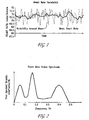
- HRV can be measured in the time domain, as in Figure 1, by taking the standard deviation or calculating the coefficient of variation of the heart rate HR(t), or in the frequency domain, as in Figure 2, by performing a spectral analysis of HR(t) using an FFT, an autoregressive method, or the like, to determine the power at each frequency to yield the power spectral density (PSD(f)) of the heart rate signal.
- PSD(f) power spectral density
- HRV heart rate and HRV provides information about the functional state of the patient's autonomic nervous system, specifically the balance between sympathetic and parasympathetic innervation. Furthermore, reduced HRV and changed blood pressure variability (BPV) are accepted as risk factors in patients with some cardiovascular diseases, metabolic syndromes or neurologic disorders.
- Central mechanisms include changing the inotropic (contractility) and chronotropic (heart rate) state of the heart.
- Peripheral mechanisms include changing the compliance and/or resistance of large arteries, small arteries and the microvasculature. These mechanisms are controlled in part by neurologic mechanisms.
- Significant blood loss during surgery will cause a decrease in blood pressure.
- the body's afore-mentioned control mechanisms will react to try to compensate for the blood loss to maintain a steady blood pressure.
- One result of these compensatory mechanisms will be an increase in peripheral resistance.
- the neural changes required to create this increase in peripheral resistance will result in a change in HRV.
- US 5,568,814 discloses an ambulatory patient monitoring system.
- HRV heart rate variability
- HRV heart rate variability
- the HRV can be measured directly from the NIBP signal or, when a multiparameter monitor is used, the HRV can be measured from the ECG signal or the NIBP signal.
- HRV is continuously monitored by monitoring the ECG signal in a multiparameter monitor and correlating the baseline HRV with baseline BP values.
- Changes in HRV are displayed continuously on a display of the multiparameter monitor so that the clinician can determine whether to initiate an NIBP measurement or, according to the invention, the NIBP measurement are triggered automatically in response to a change in HRV without any intervention by the clinician.
- the patient monitor in accordance with the invention could incorporate means for "learning" the correlation between HRV and BP changes and only alerting the clinician when a significant change had taken place.
- the system of the invention thus provides the clinician with a means for monitoring rapid changes in a patient's blood pressure or providing an early indicator of blood pressure changes and initiating a blood pressure determination without any of the possible risks or discomforts associated with frequent cuff inflations.
- the technique of the invention allows the clinician to monitor NIBP at less frequent intervals without the concern of missing physiologically significant changes in blood pressure and without the requirement of "check inflates" in a guard mode.
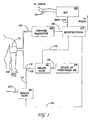
- a pressure transducer 104 is coupled by a duct 105 to the cuff 101 for sensing the pressure therein.
- pressure oscillations in the artery are sensed by changes in the counter-pressure of the cuff 101, and these pressure oscillations are converted into an electrical signal by transducer 104 and coupled over path 106 to microprocessor 107 for processing.
- a source of pressurized air 109 is connected via a duct 110 through an inflate valve 111 and a duct 112 to the pressure cuff 101.
- the inflate valve 111 is electrically controlled through a connection 113 from the microprocessor 107.
- the processing of the signals from pressure transducer 104 by the microprocessor 107 to produce blood pressure data, and optionally to reject artifact data can be conducted in accordance with the prior art teachings of the above-referenced Ramsey '029 and '034 patents.
- the blood pressure can be determined in accordance with the teachings of Medero et al. in U.S, Patent No. 4,543,962 , of Medero in U.S. Patent No. 4,546,775 , of Hood, Jr. et al. in U.S. Patent No. 4,461,266 , of Ramsey, III et al. in U.S. Patent No.
- the apparatus described above with reference to Figure 3, except for the programming of the microprocessor 107, can be substantially the same as that disclosed in the Ramsey, III et al. '029 and '034 patents. Thus, during operation of the apparatus illustrated in Figure 3, it can be assumed that air under pressure to about 8-10 p.s.i. is available in the source of pressurized air 109.
- the microprocessor 107 furnishes a signal over path 113 to open the inflate valve 111.
- the deflate valve 102 is closed.
- Prior art Figure 4 illustrates a pressure versus time graph illustrating a conventional cuff step deflation and measurement cycle for a conventional NIBP monitor.
- the cuff 101 is inflated to a pressure above the systolic pressure, and the cuff 101 is then deflated in steps of equal duration of about 8 mm Hg per step.
- a timeout duration d is provided at each step during which the signal processing circuitry searches for oscillation complexes in accordance with the techniques described in the afore-mentioned commonly assigned patents.
- the cuff pressure is decremented even if no oscillation complex is detected. This process of decrementing the pressure and searching for oscillation complexes is repeated at least until MAP and/or the oscillometric envelope 200 may be determined. The entire blood pressure determination process is repeated at predetermined set intervals, which are typically set by the user.
- the present invention relates to a technique which monitors the patient's heart rate and automatically starts the above-described oscillometric blood pressure measurement process at times other than the set time intervals when it is determined from the variation in the heart rate (HRV) that the patient's blood pressure has changed or is about to change.
- HRV heart rate
- the desired NIBP measurement interval is set prior to entering the NIBP measurement routine of FIGURE 5.
- a relatively short NIBP timing interval is set if the patient is unstable, while a progressively longer NIBP timing interval is set as the patient becomes more stable.
- the NIBP measurement routine of microprocessor 107 starts at step 300 and reads the most recent heart rate signal provided by ECG module 108 at step 302. Typically, this heart rate is displayed at step 304 to a clinician monitoring the patient.
- the baseline heart rate variability is determined and correlated with the corresponding baseline blood pressure values in a continuous manner.
- HRV is calculated and correlated with the blood pressure values determined at the most recent NIBP measurement stored in system memory.
- HRV may be calculated in one or more of a number of ways, either in the frequency domain or in the time domain.
- the HRV preferably may be calculated by determining the power spectral density (PSD) of the heart rate signal (HR(t)) using autoregressive techniques, by taking the Fast Fourier Transform (FFT) of HR(t), or using other known techniques for analyzing the frequency content of signals, and then determining the variation in the resulting power spectral density (PSD(f)) using any or all of Equations (1)-(4) below.
- PSD power spectral density
- HRV may be monitored for several frequency bands, depending upon the heart characteristics of the particular patient.
- a frequency band is chosen in which the heart rate variability is most pronounced or best correlated with changes in blood pressure.
- any or all of these calculations may be made to determine if any of the calculations results in a significant change in heart rate or HRV. Ideally, changes in the heart rate and HRV as so determined are displayed continuously to the clinician at 307 so that the clinician can empirically determine whether to initiate an NIBP measurement.
- the heart rate variability values so determined are correlated with the stored blood pressure values using known techniques so that corresponding changes in blood pressure may be predicted for measured changes in HRV.
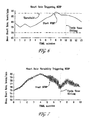
- step 308 it is determined whether the HRV has a value above the determined threshold and is thus sufficient to trigger an NIBP determination, as exhibited by way of example in Figure 7. For example, it is determined whether HRV exhibits a predetermined percentage change (e.g., 20%) from the mean heart rate sufficient to warrant initiation of an immediate NIBP determination. If a significant change in heart rate (HRV) is detected (i.e., the change is above the predetermined threshold), then an NIBP trigger signal is generated and an alarm may be optionally sounded at step 310 to alert the clinician that an NIBP measurement should be initiated at step 312.
- HRV heart rate
- An NIBP determination then may be automatically initiated at step 312 if it is determined that a significant change in HRV has occurred that correlates with a change in blood pressure.
- the clinician can initiate the NIBP determination at step 312 upon viewing a significant change in HRV on the display monitor.
- an NIBP determination as described above with respect to FIGURES 3 and 4 is performed at step 312.
- the NIBP interval timer is restarted at step 314 to reflect that an NIBP determination just occurred and that the next scheduled NIBP determination is not to occur until the expiration of the NIBP timing interval set by the clinician.
- the NIBP timing interval could continue to count so that the NIBP determination triggered by the change in HRV would be in addition to the normally scheduled NIBP determination.
- microprocessor 107 checks at step 316 to determine if it is time to initiate another NIBP determination. If so, an NIBP determination is initiated at step 312; otherwise, microprocessor 107 checks at step 318 to determine if the NIBP monitoring is to continue ( i . e ., no power off signal has been received and the cuff 101 has not been disconnected). If NIBP monitoring is to continue, the heart rate is again determined at step 302 and the process repeats. Otherwise, the NIBP monitoring routine is exited at step 320.
- a blood pressure determination is automatically triggered at step 312 if the change in HRV correlates to a change in blood pressure of greater than 20 mm Hg, and the predetermined threshold is set accordingly.
- the predetermined threshold is set accordingly.
- other thresholds may be set as desired to minimize the number of false positives and the number of false negatives.
- the set time for the conventional NIBP determinations may be extended, thereby minimizing the trauma to the patient's limb and reducing the risk and discomfort to the patient.
- the method of the invention can also be applied to blood pressure monitors using other techniques for measuring blood pressure besides the oscillometric method, such as the pulse wave velocity technique and the like.
- the heart rate is preferably detected from the QRS complexes detected by an ECG monitor of a multiparameter patient monitor
- the heart rate may also be detected using a plethysmograph, an oxygen saturation transducer, or any other suitable device which can measure variations in the heart rate. Accordingly, all such modifications are intended to be included within the scope of the appended claims.
Landscapes
- Health & Medical Sciences (AREA)
- Life Sciences & Earth Sciences (AREA)
- Vascular Medicine (AREA)
- Cardiology (AREA)
- Engineering & Computer Science (AREA)
- Medical Informatics (AREA)
- Surgery (AREA)
- Biophysics (AREA)
- Pathology (AREA)
- Physiology (AREA)
- Biomedical Technology (AREA)
- Heart & Thoracic Surgery (AREA)
- Veterinary Medicine (AREA)
- Molecular Biology (AREA)
- Physics & Mathematics (AREA)
- Animal Behavior & Ethology (AREA)
- General Health & Medical Sciences (AREA)
- Public Health (AREA)
- Ophthalmology & Optometry (AREA)
- Artificial Intelligence (AREA)
- Computer Vision & Pattern Recognition (AREA)
- Psychiatry (AREA)
- Signal Processing (AREA)
- Measuring Pulse, Heart Rate, Blood Pressure Or Blood Flow (AREA)
Claims (6)
- Automatisierte Sphygmomanometereinrichtung, zu der gehören:eine Blutdruckmesseinrichtung (104), die den Blutdruck eines Patienten misst;ein Herzfrequenzvariabilitätsmonitor (108), der Änderungen der Herzfrequenz des Patienten überwacht; undSteuerungsmittel (107) zum Einleiten einer Blutdruckmessung durch die Blutdruckmesseinrichtung, wenn der Herzfrequenzvariabilitätsmonitor anzeigt, dass die Herzfrequenz des Patienten sich über eine vorbestimmte Zeitspanne hinweg um einen vorbestimmten Betrag verändert hat, wobei das Steuerungsmittel (107) die Blutdruckmessung durch Ausgeben eines Triggersignals an die Blutdruckmesseinrichtung (104) automatisch initiiert, wenn die vorbestimmte Variationsbreite der Herzfrequenz des Patienten über die vorbestimmte Zeitspanne hinweg entdeckt wird, und wobei das Steuerungsmittel (107) die Herzfrequenzänderung mit gemessenen Blutdruckwerten korreliert und das Triggersignal ausgibt, falls die Herzfrequenzänderung mit einer vorbestimmten prozentualen Änderung des Blutdrucks korreliert.
- Einrichtung nach Anspruch 1, wobei die Blutdruckmesseinrichtung eine oszillometrische Blutdruckanzeige ist, wobei zu der Einrichtung gehören:eine aufblasbare und druckentlastbare Druckmanschette (101);Aufblasmittel, die betriebsmäßig an die Manschette angeschlossen sind, um einer Manschette ein unter Druck gesetztes Medium selektiv zuzuführen, um die Manschette aufzublasen und mit Druck zu beaufschlagen;Manschettendruckmessmittel, die mit der Manschette verbunden sind, um den Manschettendruck einschließlich darin enthaltener Blutdruckschwankungen zu erfassen; undAblassmittel (102), die betriebsmäßig an die Manschette angeschlossen sind, um selektiv Druck von der Manschette abzulassen.
- Einrichtung nach Anspruch 1, wobei der Herzfrequenzvariabilitätsmonitor (108) ein Elektrokardiogramm und einen Anzeigeschirm aufweist, auf dem die Herzfrequenz des Patienten angezeigt wird.
- Einrichtung nach Anspruch 1, wobei das Steuerungsmittel (107) über die vorbestimmte zeitspanne hinweg eine mittlere Herzfrequenz berechnet und die Variabilität der Herzfrequenz als eine Standardabweichung der mittleren Herzfrequenz über die vorbestimmte Zeitspanne hinweg ermittelt.
- Einrichtung nach Anspruch 1, wobei das Steuerungsmittel (107) eine Energiespektraldichte der Herzfrequenz über einen vorbestimmten Frequenzbereich hinweg berechnet, eine mittlere Frequenz über den vorbestimmten Frequenzbereich hinweg berechnet und die Variabilität der Herzfrequenz als eine Standardabweichung der mittleren Frequenz über den vorbestimmten Frequenzbereich hinweg ermittelt.
- Verfahren zum Überwachen des Blutdrucks eines Patienten mittels der Einrichtung nach einem beliebigen vorhergehenden Anspruch, mit den folgenden Schritten:den Blutdruck des Patienten (312) in vorbestimmten Intervallen zu ermitteln;fortlaufend die Herzfrequenz des Patienten (302) zu ermitteln und fortlaufend Veränderungen der Herzfrequenz (306) zu überwachen;Änderungen der Herzfrequenz des Patienten mit Änderungen des Blutdruck des Patienten (308) zu korrelieren;und vor dem Auslaufen eines beliebigen der vorbestimmten Intervalle eine Blutdruckmessung einzuleiten, falls festgestellt wird, dass Veränderungen der Herzfrequenz des Patienten in dem Korrelationsschritt mit einer vorbestimmten prozentualen Änderung des Blutdrucks des Patienten korrelieren.
Priority Applications (2)
| Application Number | Priority Date | Filing Date | Title |
|---|---|---|---|
| EP00301324A EP1127538B1 (de) | 2000-02-21 | 2000-02-21 | Automatische Blutdrucküberwachung |
| DE60037718T DE60037718D1 (de) | 2000-02-21 | 2000-02-21 | Automatische Blutdrucküberwachung |
Applications Claiming Priority (1)
| Application Number | Priority Date | Filing Date | Title |
|---|---|---|---|
| EP00301324A EP1127538B1 (de) | 2000-02-21 | 2000-02-21 | Automatische Blutdrucküberwachung |
Publications (2)
| Publication Number | Publication Date |
|---|---|
| EP1127538A1 EP1127538A1 (de) | 2001-08-29 |
| EP1127538B1 true EP1127538B1 (de) | 2008-01-09 |
Family
ID=8172722
Family Applications (1)
| Application Number | Title | Priority Date | Filing Date |
|---|---|---|---|
| EP00301324A Expired - Lifetime EP1127538B1 (de) | 2000-02-21 | 2000-02-21 | Automatische Blutdrucküberwachung |
Country Status (2)
| Country | Link |
|---|---|
| EP (1) | EP1127538B1 (de) |
| DE (1) | DE60037718D1 (de) |
Families Citing this family (11)
| Publication number | Priority date | Publication date | Assignee | Title |
|---|---|---|---|---|
| JP3643561B2 (ja) * | 2002-02-08 | 2005-04-27 | コーリンメディカルテクノロジー株式会社 | 下肢上肢血圧指数測定装置 |
| EP1648295A4 (de) * | 2003-06-26 | 2010-01-06 | Hoana Medical Inc | Strahlungsstress-nichtinvasive blutdruckmethode |
| JP2005237472A (ja) * | 2004-02-24 | 2005-09-08 | 七臣 ▲苅▼尾 | 血圧測定装置 |
| JP4714194B2 (ja) * | 2007-08-09 | 2011-06-29 | オムロンヘルスケア株式会社 | 血圧測定装置 |
| GB0905377D0 (en) | 2009-03-30 | 2009-05-13 | Danmedical Ltd | Medical apparatus |
| ITRM20100628A1 (it) * | 2010-12-03 | 2012-06-04 | Francesco Erba | Misuratore automatico della pressione arteriosa misurata per 24 ore posizionabile direttamente sul braccio |
| ITMI20131286A1 (it) * | 2013-07-31 | 2015-02-01 | Quasarmed S R L | Dispositivo per l'acquisizione e l'elaborazione automatica di frequenza cardiaca e dati pressori, e metodo. |
| WO2016135043A1 (en) * | 2015-02-24 | 2016-09-01 | Koninklijke Philips N.V. | Apparatus and method for providing a control signal for a blood pressure measurement device |
| EP3695779A1 (de) | 2019-02-12 | 2020-08-19 | Koninklijke Philips N.V. | Vorrichtung zur verwendung bei der messung des blutdrucks |
| CN116982949A (zh) * | 2023-09-11 | 2023-11-03 | 中普达科技股份有限公司 | 一种医疗数据的采集设备及其采集方法 |
| CN118844968B (zh) * | 2024-07-23 | 2026-03-06 | 电子科技大学 | 一种基于共形预测的血压测量系统 |
Family Cites Families (11)
| Publication number | Priority date | Publication date | Assignee | Title |
|---|---|---|---|---|
| US4360029A (en) | 1978-04-10 | 1982-11-23 | Johnson & Johnson | Automatic mean blood pressure reading device |
| US4349034A (en) | 1978-04-10 | 1982-09-14 | Johnson & Johnson | Automatic mean blood pressure reading device |
| US4461266A (en) | 1982-04-29 | 1984-07-24 | Critikon, Inc. | Adaptive incremental blood pressure monitor |
| US4546775A (en) | 1984-06-18 | 1985-10-15 | Critikon, Inc. | Detection of blood pressure complexes in automated vital signs monitors |
| US4543962A (en) | 1984-07-09 | 1985-10-01 | Critikon, Inc. | Method of automated blood pressure detection |
| US4862361A (en) * | 1985-06-05 | 1989-08-29 | Massachusetts Institute Of Technology | Methods and apparatus for monitoring cardiovascular regulation using heart rate power spectral analysis |
| US4638810A (en) | 1985-07-05 | 1987-01-27 | Critikon, Inc. | Automated diastolic blood pressure monitor with data enhancement |
| DE69015196T2 (de) | 1990-10-26 | 1995-05-18 | Hewlett Packard Gmbh | Verfahren und Vorrichtung zur automatischen Blutdrucküberwachung. |
| US5238001A (en) * | 1991-11-12 | 1993-08-24 | Stuart Medical Inc. | Ambulatory patient monitoring system having multiple monitoring units and optical communications therebetween |
| US5606977A (en) | 1995-01-04 | 1997-03-04 | Critikon, Inc. | Oscillometric blood pressure monitor which automatically determines when to take blood pressure measurements |
| JP3666987B2 (ja) * | 1996-05-02 | 2005-06-29 | コーリンメディカルテクノロジー株式会社 | 血圧監視装置 |
-
2000
- 2000-02-21 EP EP00301324A patent/EP1127538B1/de not_active Expired - Lifetime
- 2000-02-21 DE DE60037718T patent/DE60037718D1/de not_active Expired - Lifetime
Also Published As
| Publication number | Publication date |
|---|---|
| EP1127538A1 (de) | 2001-08-29 |
| DE60037718D1 (de) | 2008-02-21 |
Similar Documents
| Publication | Publication Date | Title |
|---|---|---|
| US6050951A (en) | NIBP trigger in response to detected heart rate variability | |
| US6491638B2 (en) | Circulation-condition monitoring apparatus | |
| EP0721764B1 (de) | Oszillometrisches Blutdrucküberwachungsgerät für automatische Blutdruckmessungen | |
| US6602199B2 (en) | Method and apparatus for measuring values of physiological parameters | |
| US6485429B2 (en) | Method and a device for non-invasive measurement of the blood pressure and for detection of arrhythmia | |
| US7544168B2 (en) | Measuring systolic blood pressure by photoplethysmography | |
| EP2448475B1 (de) | Systeme und verfahren zur beurteilung von messungen physiologischer überwachungsgeräte | |
| EP0997102B1 (de) | Blutdruckmessgerät | |
| US7390302B2 (en) | Method and system of determining NIBP target inflation pressure using an SpO2 plethysmograph signal | |
| EP3261526B1 (de) | Vorrichtung und verfahren zur bereitstellung eines steuersignals für eine blutdruckmessungsvorrichtung | |
| EP0482242B1 (de) | Verfahren und Vorrichtung zur automatischen Blutdrucküberwachung | |
| US20110152650A1 (en) | Adaptive pump control during non-invasive blood pressure measurement | |
| JP2001506167A (ja) | 生体の心臓血管状態を精度よく監視するシステムと方法 | |
| US7270636B2 (en) | Apparatus and method for pulse detection | |
| JP2001506166A (ja) | 異常なオシロメトリック脈波を識別し補正するシステムと方法 | |
| US7462152B2 (en) | Method and system utilizing SpO2 plethysmograph signal to reduce NIBP determination time | |
| US20160213332A1 (en) | Measuring apparatus and measuring method | |
| US10736521B2 (en) | Device and method for monitoring and diagnosing the autoregular mechanism of the blood pressure of a living being | |
| CN103156589A (zh) | 用于自动非侵入式血压测量的方法、设备和计算机程序 | |
| EP1127538A1 (de) | Automatische Blutdrucküberwachung | |
| EP0960598B1 (de) | Verfahren und Gerät zur nicht-invasiven Blutdruckmessung und Arrhythmienmessung | |
| JP3921775B2 (ja) | 血圧監視装置 | |
| JP2001299707A (ja) | 検出した心拍数細変動に対応する非観血的血圧測定の開始 | |
| US20100241014A1 (en) | Device for non-invasive measurement of blood pressure and ankle-brachial index | |
| JP2001137203A (ja) | 血圧監視装置 |
Legal Events
| Date | Code | Title | Description |
|---|---|---|---|
| PUAI | Public reference made under article 153(3) epc to a published international application that has entered the european phase |
Free format text: ORIGINAL CODE: 0009012 |
|
| AK | Designated contracting states |
Kind code of ref document: A1 Designated state(s): AT BE CH CY DE DK ES FI FR GB GR IE IT LI LU MC NL PT SE |
|
| AX | Request for extension of the european patent |
Free format text: AL;LT;LV;MK;RO;SI |
|
| RIN1 | Information on inventor provided before grant (corrected) |
Inventor name: FRIEDMAN,BRUCE Inventor name: MEDERO, RICHARD Inventor name: HERSH, LAWRENCE T. |
|
| RIN1 | Information on inventor provided before grant (corrected) |
Inventor name: MEDERO, RICHARD Inventor name: FRIEDMAN,BRUCE Inventor name: HERSH, LAWRENCE T. |
|
| 17P | Request for examination filed |
Effective date: 20020213 |
|
| AKX | Designation fees paid |
Free format text: DE FR GB |
|
| 17Q | First examination report despatched |
Effective date: 20060405 |
|
| GRAP | Despatch of communication of intention to grant a patent |
Free format text: ORIGINAL CODE: EPIDOSNIGR1 |
|
| GRAS | Grant fee paid |
Free format text: ORIGINAL CODE: EPIDOSNIGR3 |
|
| GRAA | (expected) grant |
Free format text: ORIGINAL CODE: 0009210 |
|
| AK | Designated contracting states |
Kind code of ref document: B1 Designated state(s): DE FR GB |
|
| REG | Reference to a national code |
Ref country code: GB Ref legal event code: FG4D |
|
| REF | Corresponds to: |
Ref document number: 60037718 Country of ref document: DE Date of ref document: 20080221 Kind code of ref document: P |
|
| EN | Fr: translation not filed | ||
| PG25 | Lapsed in a contracting state [announced via postgrant information from national office to epo] |
Ref country code: DE Free format text: LAPSE BECAUSE OF FAILURE TO SUBMIT A TRANSLATION OF THE DESCRIPTION OR TO PAY THE FEE WITHIN THE PRESCRIBED TIME-LIMIT Effective date: 20080410 |
|
| PLBE | No opposition filed within time limit |
Free format text: ORIGINAL CODE: 0009261 |
|
| STAA | Information on the status of an ep patent application or granted ep patent |
Free format text: STATUS: NO OPPOSITION FILED WITHIN TIME LIMIT |
|
| 26N | No opposition filed |
Effective date: 20081010 |
|
| PG25 | Lapsed in a contracting state [announced via postgrant information from national office to epo] |
Ref country code: FR Free format text: LAPSE BECAUSE OF FAILURE TO SUBMIT A TRANSLATION OF THE DESCRIPTION OR TO PAY THE FEE WITHIN THE PRESCRIBED TIME-LIMIT Effective date: 20081031 |
|
| PGFP | Annual fee paid to national office [announced via postgrant information from national office to epo] |
Ref country code: GB Payment date: 20190125 Year of fee payment: 20 |
|
| REG | Reference to a national code |
Ref country code: GB Ref legal event code: PE20 Expiry date: 20200220 |
|
| PG25 | Lapsed in a contracting state [announced via postgrant information from national office to epo] |
Ref country code: GB Free format text: LAPSE BECAUSE OF EXPIRATION OF PROTECTION Effective date: 20200220 |