EP1127540A1 - Appareil portable de surveillance de la graisse corporelle - Google Patents
Appareil portable de surveillance de la graisse corporelle Download PDFInfo
- Publication number
- EP1127540A1 EP1127540A1 EP01103685A EP01103685A EP1127540A1 EP 1127540 A1 EP1127540 A1 EP 1127540A1 EP 01103685 A EP01103685 A EP 01103685A EP 01103685 A EP01103685 A EP 01103685A EP 1127540 A1 EP1127540 A1 EP 1127540A1
- Authority
- EP
- European Patent Office
- Prior art keywords
- monitor
- electrodes
- user
- body fat
- main body
- Prior art date
- Legal status (The legal status is an assumption and is not a legal conclusion. Google has not performed a legal analysis and makes no representation as to the accuracy of the status listed.)
- Withdrawn
Links
Images

Classifications
-
- A—HUMAN NECESSITIES
- A61—MEDICAL OR VETERINARY SCIENCE; HYGIENE
- A61B—DIAGNOSIS; SURGERY; IDENTIFICATION
- A61B5/00—Measuring for diagnostic purposes; Identification of persons
- A61B5/48—Other medical applications
- A61B5/4869—Determining body composition
- A61B5/4872—Body fat
-
- A—HUMAN NECESSITIES
- A61—MEDICAL OR VETERINARY SCIENCE; HYGIENE
- A61B—DIAGNOSIS; SURGERY; IDENTIFICATION
- A61B5/00—Measuring for diagnostic purposes; Identification of persons
- A61B5/05—Detecting, measuring or recording for diagnosis by means of electric currents or magnetic fields; Measuring using microwaves or radio waves
- A61B5/053—Measuring electrical impedance or conductance of a portion of the body
- A61B5/0537—Measuring body composition by impedance, e.g. tissue hydration or fat content
-
- A—HUMAN NECESSITIES
- A61—MEDICAL OR VETERINARY SCIENCE; HYGIENE
- A61B—DIAGNOSIS; SURGERY; IDENTIFICATION
- A61B2560/00—Constructional details of operational features of apparatus; Accessories for medical measuring apparatus
- A61B2560/04—Constructional details of apparatus
- A61B2560/0462—Apparatus with built-in sensors
- A61B2560/0468—Built-in electrodes
Definitions
- the present invention relates to a portable body fat monitor, and more particularly to measuring body impedance using four electrodes and calculating body fat occupancy ratio based on the measured electric impedance.
- a conventional portable body fat monitor is disclosed in U.S. Patent 4,949,727.
- This body fat monitor has a display and an operator unit formed on the face of a main body.
- Four measurement electrodes are formed in pairs on the back of the main body. Each of the measurement electrodes is touched with one finger of the right or left hand. In operation, all four back surface electrodes are pressed simultaneously to generate a display readout on the opposite front surface.
- Namco Ltd. has put a body fat monitor, which looks like a pocket game machine, on the market. This monitor has an electrode formed on each opposing side of a main body.
- Daiwa Sieko, Ltd. has marketed portable body fat monitors named "Poke-navi” and “Poke-mini” having electrodes formed on the upper left and right parts of the face and back of a main body.
- Japanese Unexamined Patent Application Publication No. 11-700092 discloses a portable body fat monitor having electrodes formed on the top and bottom of a card.
- the body fat monitor disclosed in U.S. Patent 4,949,727 suffers from poor maneuverability.
- the four measurement electrodes are formed on the back, and each of the electrodes must be touched with one finger of the right or left hand. Disadvantageously, the spacing between each pair of electrodes is very narrow, so precision measurement is compromised and the monitor is awkward to use.
- the body fat monitor marketed by Namco Ltd. suffers from the same drawback, i.e., lack of precision, as the body fat monitor described in U.S. Patent 4,949,727.
- the monitor is small enough to be enclosed in one hand. When the monitor is held with both hands for measurement, there is a tendency for the fingers of the right and left hands to touch each other, leading to unacceptable error in measurement.
- the body fat monitor sold by Daiwa Seiko, Ltd. also suffers from poor maneuverability. An operator switch must be pressed while the electrodes are touched with the fingers, so the fingers must be largely separated from one another or the main body must be held in an awkward manner.
- the monitor disclosed in the Japanese Unexamined Patent Application Publication No. 11-70092 has the electrodes distributed at the four comers of the monitor. Consequently, lengthy connections are required between the electrodes and the monitor's circuitry. The monitor is therefore susceptible to extraneous electric noises or the like.
- An advantage of the present invention is a portable body fat monitor having electrodes arranged so that the instrument is easily operated by a user, thereby facilitating accurate measurements.
- a portable body fat monitor comprising a main body having a front face and a side surface; four electrodes spaced apart on the side surface of the main body; a display unit on the front face of the main body; and an operator unit on the front face of the main body.
- the main body is substantially parallelepiped-shaped.
- a portable body fat monitor having four electrodes disposed spaced apart from each other on a side surface of a main body, such as an upper or a lower side surface.
- a display unit such as a liquid-crystal display, and an operator unit, such as a set of switches, are formed on a front face of the main body.
- a portable body fat monitor has an insulating main body, shaped substantially like a rectangular parallelepiped.
- the four electrodes are spaced apart from one another on a side surface of the main body, and the operator unit is located below the display unit on the front face of the main body.
- a user can therefore enter numerical values representing his or her height and weight with the thumbs of their right and left hands, as if the user were manipulating a game machine.
- the distance from the operator unit to the lower side surface is so short that the monitor can be held using the thumbs, and the thumbs can be moved readily while manipulating the operator unit and holding the monitor.
- the middle and index fingers of the user's left hand are brought into contact with two of the electrodes, respectively.
- the index and middle fingers of the right hand are brought into contact with the other two electrodes, respectively, for the body fat measurement.
- any of the user's other fingers may be brought into contact with the electrodes.
- the pairs of electrodes are spaced apart, for preventing the fingers of the right and left hands from touching, and the main body is sized to allow the user to easily hold the body fat monitor.
- a Mode switch 2 such as a push button, used to switch the power supply of the monitor and select a mode, is located in the lower left portion of the front face 1a of a main body 1 of a portable body fat monitor.
- the Mode switch 2 When the Mode switch 2 is operated once, the power supply is turned on. The monitor is placed in a display mode in which data stored in a memory indicating the functions of the monitor is displayed.
- the body fat measurement mode is switched to a re-measurement mode in which a body fat occupancy ratio is measured using data stored in the memory.
- the re-measurement mode is switched to a new measurement mode in which a body fat occupancy ratio is measured anew.
- the new measurement mode is switched to an alarm setting mode in which an alarm time is set, enabling a body fat measurement to be taken, for example, at a predetermined time every day. Every time the Mode switch 2 is operated, one mode is switched to another.
- the Up switch 3 When the Up switch 3 is repeatedly operated or held on in the new measurement mode or alarm setting mode, the value of displayed data is increased.
- the Down switch 4 is used to decrease the displayed data that has been increased using the Up switch 3.
- the Enter switch 5 is used to enter the displayed data, which has'been set using the Up switch 3 and Down switch 4 in each of the foregoing modes, as a finalized value into a control unit 10 or a memory 14 shown in Fig. 2.
- a display unit 6 is disposed on the upper part of front face 1a of the main body 1 in order to display data that is set or entered using the switches, the results of measurement, prompts for the user, the time, etc.
- Electrodes B, C, and D made of the same material as the electrode A are disposed to the right of electrode A on side surface 1b and are spaced apart from each other and from electrode A. In other words, the four electrodes A-D are arranged in a row on side surface 1b.
- the middle and index fingers of the user's left hand are brought into contact with the electrodes A and B respectively.
- the index and middle fingers of the right hand are brought into contact with the electrodes C and D respectively.
- any of the user's other fingers may be brought into contact with the electrodes.
- the pairs of electrodes A,B and C,D are spaced apart, for preventing the fingers of the right and left hands from touching.
- Fig. 2 shows the electric circuitry of the portable body fat monitor shown in Fig. 1.
- a control unit 10 processes data sent from the operator unit 11 composed of the Mode switch 2, Up switch 3, Down switch 4 and Enter switch 5. The results of arithmetic operations are displayed on the display unit 6.
- a constant current generation circuit 12 for supplying a constant current to the electrodes A and D is connected to the control unit 10.
- a voltage measurement circuit 13 for measuring the voltages at the electrodes B and C is also connected to the control circuit 10.
- a memory 14 for storing data read at the operator unit 11 and data indicating the results of arithmetic operations is also connected to the control unit 10.
- a conventional clock and alarm circuit 15 for indicating a current time or an alarm time on the display unit 6 is connected to the control unit 10.
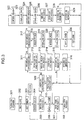
- Fig. 3 is a flowchart describing actions to be performed in an embodiment of the present invention. Using the flowchart, the actions to be performed in a portable body fat monitor according to the present invention will be described.
- the Mode switch 2 shown in Fig. 1 is operated to turn on the monitor. Electricity is then supplied to the circuits and control unit shown in Fig. 2 (step 301).
- the display unit and circuits are initialized.
- the automatic power off timer incorporated in the control unit 10 is set. When none of the switches 2, 3, 4, 5 has been pressed for a predetermined time, for example, five minutes, the timer indicates a time-out (step 307).
- the power supply is turned off in order to prevent exhaustion of the battery 16 from occurring when the instrument is neglected.
- step 304 on/off-state data sent from the switches is fetched into the control unit 10. Control is then passed to step 305. At step 305, it is judged whether data was entered using the Mode switch 2. When the power supply is turned on, control is passed to step 306. A current time is then indicated on the display unit 6 according to time data sent from the clock and alarm circuit 15, using well-known techniques. A description of the time indication processing will therefore be omitted herein. At step 307, judgment is made in the negative unless the predetermined time elapses. Control is then returned to step 304, and the current time indication is continued. Data entered using switches 2-5 is then repeatedly awaited.
- Mode switch 2 If the Mode switch 2 is operated while data entry is awaited, control is passed from step 305 to the display mode involving steps 309 and 310.
- the Mode switch 2 When the Mode switch 2 is operated once, the indication of the current time is deleted, and at step 310, data including a user's sex, age, height, and body fat occupancy ratio, which have been entered or measured previously, is read from the memory 14 and indicated on the display unit 6. This indication is displayed continuously unless the time runs out at step 307 or the Mode switch 2 is operated again.
- step 309 In the display mode, when the Mode switch 2 is operated, judgment is made in the negative at step 309. Control is then passed to the re-measurement mode involving step 311.
- the indication displayed in the display mode is deleted.
- step 312 data including the user's sex, age, height, and weight is read from the memory 14 and indicated on the display unit 6.
- a message saying that a body fat occupancy ratio will be calculated based on the data is then indicated on the display unit 6.
- step 313 a constant current flows from the constant current generation circuit 12 shown in Fig. 2 to the middle fingers of the right and left hands of a user through the electrodes A and D.
- step 314 In the above display state, if the Mode switch 2 is operated, judgment is made in the negative at step 311, and the display of step 314 is deleted. Control is passed to the new measurement mode involving step 317 to step 329 for measuring a body fat occupancy ratio.
- a sex of male or female is indicated on the display unit 6. The user's sex is designated by operating the Up switch 3 or Down switch 4.
- the Enter switch 5 When the Enter switch 5 is operated, the data is finalized (step 319).
- a message prompting the user to enter his/her age is indicated at step 320.
- an initial value of an age to be entered for example 20 years old, is indicated on the display screen used to enter the age.
- step 321 When the Enter switch 5 is operated, the data is finalized (step 321). At step 322, a message prompting the user to enter his/her height is indicated. At step 323 to step 325, similarly to steps 320 and 321, the Up switch 3 and Down switch 4 are used to enter the user's height and weight. The data of the height and weight is finalized using the Enter switch 5.
- the processing of step 326 to step 329 is identical to that of step 313 to step 316, so a description of this processing will be omitted.
- the display state established at step 327 persists as the display state for the new measurement mode.
- step 317 In the display state, when the Mode switch 2 is operated, judgment is made in the negative at step 317, the indication displayed at step 327 is deleted, and control is passed to the alarm setting mode involving step 330.
- the alarm setting mode In the alarm setting mode, a well-known alarm setting precedure, such as performed on a clock, is carried out. A description of this processing will therefore be omitted.
- step 304 The processing of step 304 to step 307 is repeated, whereby a current time is indicated.
- the alarm setting mode is established.
- the alarm setting mode is changed back to the current time display mode.
- the Mode switch 2 is operated five times or more, the modes are changed forwards sequentially.
- the inventive portable body fat monitor may be used by a plurality of users.
- a step of indicating data concerning a plurality of measurers and a step of selecting displayed data using the Up and Down switches 3, 4 and finalizing selected data using the Enter switch 5 are included as steps succeeding step 309, 311, or 317.
- a step of selecting any of the plurality of users in relation to which data is stored may be included as a step succeeding step 315 or 328.
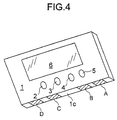
- the electrodes are formed on the upper side surface 1b of the main body 1.
- the electrodes may be formed on a lower side surface 1c thereof, as shown in Fig. 4.
- measurement can be carried out with the user's palms oriented upward.
- the index finger of the left hand is brought into contact with the electrode A, and the middle finger thereof is brought into contact with the electrode B.
- the middle finger of the right hand is brought into contact with the electrode C, and the index finger thereof is brought into contact with the electrode D.
- the fingers coming into contact with the electrodes are not limited to the above fingers but may be varied depending on how the main body is held.
- the main body is shaped nearly like a parallelepiped.
- the shape is not limited to any specific shape as long as the main body can be held with the fingers of two hands.
- the shape may be, for example, an elliptic or circular cylinder.
Landscapes
- Health & Medical Sciences (AREA)
- Life Sciences & Earth Sciences (AREA)
- Medical Informatics (AREA)
- Biophysics (AREA)
- Pathology (AREA)
- Engineering & Computer Science (AREA)
- Biomedical Technology (AREA)
- Heart & Thoracic Surgery (AREA)
- Physics & Mathematics (AREA)
- Molecular Biology (AREA)
- Surgery (AREA)
- Animal Behavior & Ethology (AREA)
- General Health & Medical Sciences (AREA)
- Public Health (AREA)
- Veterinary Medicine (AREA)
- Nuclear Medicine, Radiotherapy & Molecular Imaging (AREA)
- Radiology & Medical Imaging (AREA)
- Measurement And Recording Of Electrical Phenomena And Electrical Characteristics Of The Living Body (AREA)
- Measurement Of Resistance Or Impedance (AREA)
Applications Claiming Priority (4)
| Application Number | Priority Date | Filing Date | Title |
|---|---|---|---|
| US18517600P | 2000-02-25 | 2000-02-25 | |
| US185176P | 2000-02-25 | ||
| US09/784,026 US20010034491A1 (en) | 2000-02-25 | 2001-02-16 | Portable body fat monitor |
| US784026 | 2001-02-16 |
Publications (1)
| Publication Number | Publication Date |
|---|---|
| EP1127540A1 true EP1127540A1 (fr) | 2001-08-29 |
Family
ID=26880865
Family Applications (1)
| Application Number | Title | Priority Date | Filing Date |
|---|---|---|---|
| EP01103685A Withdrawn EP1127540A1 (fr) | 2000-02-25 | 2001-02-23 | Appareil portable de surveillance de la graisse corporelle |
Country Status (4)
| Country | Link |
|---|---|
| US (1) | US20010034491A1 (fr) |
| EP (1) | EP1127540A1 (fr) |
| JP (1) | JP2001276011A (fr) |
| CN (1) | CN1310982A (fr) |
Cited By (1)
| Publication number | Priority date | Publication date | Assignee | Title |
|---|---|---|---|---|
| EP1870036A1 (fr) | 2006-06-20 | 2007-12-26 | Kaz, Incorporated | Moniteur de pression sanguine |
Families Citing this family (15)
| Publication number | Priority date | Publication date | Assignee | Title |
|---|---|---|---|---|
| JP4840952B2 (ja) * | 2000-09-19 | 2011-12-21 | 株式会社フィジオン | 生体電気インピーダンス計測方法及び計測装置、並びに該計測装置を用いた健康指針管理アドバイス装置 |
| EP1363531B1 (fr) * | 2001-02-22 | 2010-10-20 | Kao Corporation | Dispositif de mesure de graisse corporelle |
| JP3085691U (ja) * | 2001-10-29 | 2002-05-17 | 船井電機株式会社 | 体脂肪測定機能付きテレビ/ビデオ用リモコン、及び体脂肪測定装置 |
| KR100506084B1 (ko) * | 2002-10-24 | 2005-08-05 | 삼성전자주식회사 | 경혈점 탐색 장치 및 방법 |
| US20040204658A1 (en) * | 2003-04-10 | 2004-10-14 | Dietz Phillip W. | Systems and methods for providing an enhanced bioelectric sensing surface |
| US7542796B2 (en) * | 2003-07-16 | 2009-06-02 | Biomeridian International, Inc. | Methods for obtaining quick, repeatable, and non-invasive bioelectrical signals in living organisms |
| JP2004041820A (ja) * | 2003-11-26 | 2004-02-12 | Ya Man Ltd | 体脂肪測定装置 |
| US7937139B2 (en) * | 2004-07-20 | 2011-05-03 | Biomeridian International, Inc. | Systems and methods of utilizing electrical readings in the determination of treatment |
| US9241648B2 (en) | 2009-09-08 | 2016-01-26 | Korea Institute Of Industrial Technology | Device for measurement for bionic information |
| DE112010003582T5 (de) * | 2009-09-08 | 2012-08-16 | Korea Institute Of Industrial Technology | Vorrichtung zum Messen von biometrischen Informationen mit einer Handablage |
| WO2012176371A1 (fr) * | 2011-06-24 | 2012-12-27 | 株式会社村田製作所 | Dispositif portable |
| US20140121564A1 (en) * | 2012-05-03 | 2014-05-01 | Aliphcom | Estimating body fat in a user |
| JP5526298B1 (ja) | 2012-09-10 | 2014-06-18 | パナソニック株式会社 | 電子機器、情報処理装置、情報処理方法およびプログラム |
| CN103750837A (zh) * | 2014-01-21 | 2014-04-30 | 广州市康普瑞生营养健康咨询有限公司 | 生物电阻抗测量装置 |
| CN109350056A (zh) * | 2018-12-04 | 2019-02-19 | 芯海科技(深圳)股份有限公司 | 用于体脂测量的移动终端及基于该终端的体脂测量方法 |
Citations (3)
| Publication number | Priority date | Publication date | Assignee | Title |
|---|---|---|---|---|
| US4949727A (en) | 1987-05-27 | 1990-08-21 | Ya-Man Ltd. | Portable physical checker |
| JPH1170092A (ja) | 1997-07-04 | 1999-03-16 | Yamato Scale Co Ltd | 体内脂肪計 |
| JPH11318846A (ja) * | 1998-05-19 | 1999-11-24 | Ya Man Ltd | 体脂肪分布測定装置 |
-
2001
- 2001-02-16 US US09/784,026 patent/US20010034491A1/en not_active Abandoned
- 2001-02-22 JP JP2001046691A patent/JP2001276011A/ja active Pending
- 2001-02-23 EP EP01103685A patent/EP1127540A1/fr not_active Withdrawn
- 2001-02-23 CN CN01104901.4A patent/CN1310982A/zh active Pending
Patent Citations (3)
| Publication number | Priority date | Publication date | Assignee | Title |
|---|---|---|---|---|
| US4949727A (en) | 1987-05-27 | 1990-08-21 | Ya-Man Ltd. | Portable physical checker |
| JPH1170092A (ja) | 1997-07-04 | 1999-03-16 | Yamato Scale Co Ltd | 体内脂肪計 |
| JPH11318846A (ja) * | 1998-05-19 | 1999-11-24 | Ya Man Ltd | 体脂肪分布測定装置 |
Non-Patent Citations (1)
| Title |
|---|
| PATENT ABSTRACTS OF JAPAN vol. 2000, no. 02 29 February 2000 (2000-02-29) * |
Cited By (1)
| Publication number | Priority date | Publication date | Assignee | Title |
|---|---|---|---|---|
| EP1870036A1 (fr) | 2006-06-20 | 2007-12-26 | Kaz, Incorporated | Moniteur de pression sanguine |
Also Published As
| Publication number | Publication date |
|---|---|
| US20010034491A1 (en) | 2001-10-25 |
| CN1310982A (zh) | 2001-09-05 |
| JP2001276011A (ja) | 2001-10-09 |
Similar Documents
| Publication | Publication Date | Title |
|---|---|---|
| US6526315B1 (en) | Portable bioelectrical impedance measuring instrument | |
| EP1127540A1 (fr) | Appareil portable de surveillance de la graisse corporelle | |
| KR100374890B1 (ko) | 휴대용 바이오일렉트릭 임피던스 측정장치 | |
| EP1166716B1 (fr) | Appareil de mesure d'impédance bioélectrique | |
| EP0926488B1 (fr) | Dispositif pour l'évaluation de la graisse corporelle | |
| EP1129662B1 (fr) | Appareil de type compact pour la mesure de la graisse du corps vivant | |
| JP3975000B2 (ja) | 体脂肪計 | |
| US20060129333A1 (en) | Body composition monitor | |
| JP4056626B2 (ja) | 体脂肪計及び体脂肪率測定システム | |
| JPH11285477A (ja) | 体脂肪計 | |
| JP3787420B2 (ja) | 体内脂肪計 | |
| JP4010674B2 (ja) | 体内脂肪計 | |
| JP4012302B2 (ja) | 体内脂肪計 | |
| CN223831093U (zh) | 一种可交互的体测镜 | |
| JP4512224B2 (ja) | 体重計付き体脂肪計 | |
| JP3083160U (ja) | 体脂肪計量器 | |
| JP2001120513A (ja) | 体脂肪計 |
Legal Events
| Date | Code | Title | Description |
|---|---|---|---|
| PUAI | Public reference made under article 153(3) epc to a published international application that has entered the european phase |
Free format text: ORIGINAL CODE: 0009012 |
|
| 17P | Request for examination filed |
Effective date: 20010315 |
|
| AK | Designated contracting states |
Kind code of ref document: A1 Designated state(s): AT BE CH CY DE DK ES FI FR GB GR IE IT LI LU MC NL PT SE TR Kind code of ref document: A1 Designated state(s): DE FR GB |
|
| AX | Request for extension of the european patent |
Free format text: AL;LT;LV;MK;RO;SI |
|
| AKX | Designation fees paid |
Free format text: DE FR GB |
|
| 17Q | First examination report despatched |
Effective date: 20040128 |
|
| STAA | Information on the status of an ep patent application or granted ep patent |
Free format text: STATUS: THE APPLICATION IS DEEMED TO BE WITHDRAWN |
|
| 18D | Application deemed to be withdrawn |
Effective date: 20040610 |