EP1127629A1 - Verfahren zum Ziehen von Bündeln und Verfahren zur Herstellung von metallischen Fasern - Google Patents
Verfahren zum Ziehen von Bündeln und Verfahren zur Herstellung von metallischen Fasern Download PDFInfo
- Publication number
- EP1127629A1 EP1127629A1 EP00301514A EP00301514A EP1127629A1 EP 1127629 A1 EP1127629 A1 EP 1127629A1 EP 00301514 A EP00301514 A EP 00301514A EP 00301514 A EP00301514 A EP 00301514A EP 1127629 A1 EP1127629 A1 EP 1127629A1
- Authority
- EP
- European Patent Office
- Prior art keywords
- metallic
- composite wire
- sectional area
- filaments
- composite
- Prior art date
- Legal status (The legal status is an assumption and is not a legal conclusion. Google has not performed a legal analysis and makes no representation as to the accuracy of the status listed.)
- Withdrawn
Links
Images


Classifications
-
- B—PERFORMING OPERATIONS; TRANSPORTING
- B21—MECHANICAL METAL-WORKING WITHOUT ESSENTIALLY REMOVING MATERIAL; PUNCHING METAL
- B21C—MANUFACTURE OF METAL SHEETS, WIRE, RODS, TUBES, PROFILES OR LIKE SEMI-MANUFACTURED PRODUCTS OTHERWISE THAN BY ROLLING; AUXILIARY OPERATIONS USED IN CONNECTION WITH METAL-WORKING WITHOUT ESSENTIALLY REMOVING MATERIAL
- B21C37/00—Manufacture of metal sheets, rods, wire, tubes, profiles or like semi-manufactured products, not otherwise provided for; Manufacture of tubes of special shape
- B21C37/04—Manufacture of metal sheets, rods, wire, tubes, profiles or like semi-manufactured products, not otherwise provided for; Manufacture of tubes of special shape of rods or wire
- B21C37/047—Manufacture of metal sheets, rods, wire, tubes, profiles or like semi-manufactured products, not otherwise provided for; Manufacture of tubes of special shape of rods or wire of fine wires
Definitions
- the present invention relates to a method of bundle-drawing in which a composite wire, containing a plurality of metallic filaments continuous in longitudinal direction and embedded in a matrix, is reduced in sectional area into a predetermined size, and a method for producing metallic fibers applying a method of bundle-drawing.
- the present invention relates to a method for producing fine metallic fibers having sectional area not more than 700 ⁇ m (not more than about 30 ⁇ m in equivalent diameter) by reduction in sectional area of a composite wire containing a plurality of metallic filaments continuous in longitudinal direction and embedded in a matrix into a predetermined size and removal of the matrix.
- Bundle-drawing in which a composite wire, containing a plurality of metallic filaments continuous in longitudinal direction and embedded in a matrix, is reduced in sectional area into a predetermined size, is used for production of such products as structural composite wires, super-conductive wires and fine metallic fibers.
- fine metallic fibers are used as a material of such products as filter media, anti-static materials and electromagnetic insulators, owing to their good processability for making felts, threads, textiles and the like.
- Fine metallic fibers can be produced by single-wire-drawing in which a single material wire is progressively reduced until the sectional area reaches a desired size. But this method is very low in productivity. Therefore, bundle-drawing, in which a plurality of metallic filaments are simultaneously reduced in sectional area, is widely applied.
- a composite wire which contains a plurality of metallic filaments continuously embedded in a matrix to the longitudinal direction, is firstly prepared. For example, one of following methods can be applied for forming a composite wire.
- the composite wire formed by such method is reduced in sectional area to obtain a composite filament containing many metallic filaments having desired sectional area. Further, the matrix of the composite filament is selectively removed to obtain a bundle of metallic fibers.
- dissolution in acid solution or electrolysis is used. It is advantageous for selective removal of the matrix to use a material having higher corrosion resistance as a material of metallic fibers. For example, stainless steels, nickel or nickel alloys, titanium or titanium alloys and the like are advantageously used.
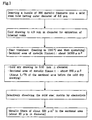
- JP-A 47-22856 a set of lead patenting and cold drawing is repeatedly applied 6 times on a composite wire formed by covering a bundle of 300 stainless steel filaments of 0.1 mm in diameter having copper plating previously formed on the surface with an armor of middle carbon steel, and then the armor and the copper plating is removed to obtain metallic fibers of 7 ⁇ m in diameter.
- the flow chart of this process is shown in Fig.6.
- the number of heat treatment in the method disclosed in JP-A 47-22356 is six times and two times in JP-A 47-26367, and reduction in sectional area by final cold drawing is small in both method.
- an objective of the present invention is to provide a method of bundle-drawing by which a composite wire containing metallic filaments having good accuracy in size and no degradation in property is produced and a method for producing metallic fibers by which metallic fibers highly strengthened by work hardening are produced.
- the inventors devoted themselves tc solving the above problems of prior arts and found followings and achieved the invention.
- a method of bundle-drawing according to the invention comprises a step of reduction in sectional area of a composite wire into a predetermined size, the composite wire being comprised of ⁇ plurality of metallic filaments continuous in longitudinal direction and a matrix made of metallic material different from that of said metallic filaments, wherein said metallic filaments are made of hard metallic material, and said step of reduction in area of a composite wire comprises a cold drawing of said composite wire in which sectional area of the metallic filaments in said composite wire is reduced into not more than 1/35 of their original sectional area without intermediate heat treatment.
- hard metallic material used for the metallic filament is defined as metallic material having Vickers hardness of not less than 100 when it is heat treated with standard condition.
- Another method for producing metallic fibers comprises a step of making a composite filament containing a plurality of steel filaments each having sectional area not more than 700 ⁇ m 2 (not more than 30 ⁇ m in equivalent diameter) by reduction in sectional area of a composite wire being comprised of a plurality of metallic filaments continuous in longitudinal direction and a matrix made of metallic material different from that of said metallic filaments, and a step of obtaining metallic fibers by removing the matrix of said composite filament, wherein, in the step of making a composite filament, at least the final stage of reduction in sectional area of said composite wire is performed by cold drawing in which sectional area of the metallic filaments in said composite wire is reduced into not more than 1/35 of their original sectional area without intermediate heat treatment, and no heat treatment is applied on the composite wire or the composite filament; when the sectional area of the metallic filaments contained in the composite wire or the composite filament has become less than 2000 ⁇ m 2 (less thin about 50 ⁇ m in equivalent diameter).
- the method for producing metallic fibers according to the present invention is suitable for production of very fine metallic filaments having sectional area of not more than 80 ⁇ m 2 (not more than 10 ⁇ m in equivalent diameter). And very fine metallic filaments of high quality can be produced with less steps owing to applying cold processing with large reduction which makes sectional area of each metallic in a composite wire not more than 80 ⁇ m 2 .
- the composite wire has no internal voids when the composite wire is provided for the cold drawing which makes the sectional area of the metallic filaments in the composite wire not more than 1/35 without intermediate heat treatment. Further, it is preferable that the cold drawing which makes the sectional area of metallic filaments in a composite wire not more than 1/35 without intermediate heat treatment is applied on a composite wire which has been heat treated or hot processed and contains metallic filaments each having sectional area of not less than 2000 ⁇ m 2 .
- the ratio of matrix in a composite wire for the processing is not more than 60vol%.
- Another method for producing metallic fibers according to the present invention is characterized by that a composite filament having predetermined size is produced by a bundle-drawing according to the present invention and the matrix is removed by dissolution to obtain metallic fibers.
- ferrous alloys containing chromium of not less than 10wt% or industrial titanium alloys as the metallic filaments, and mild steel as the matrix.
- Fig.1 is a flow chart of a method for producing metallic fibers according to the Example 1.
- Fig.2 is a flow chart of a methoc. for producing metallic fibers according to the Example 2.
- Fig.3 is a flow chart of a method of bundle-drawing and a method for producing metallic fibers according to the Example 3.
- Fig.4 is a flow chart of a method for producing metallic fibers according to the Example 4.
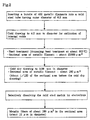
- Fig.5 is a flow chart of a method for producing metallic fibers according to the Comparative example.
- Fig.6 is a flow chart of a method of bundle-drawing and a method for producing metallic fibers according to a prior art.
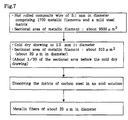
- Fig.7 is a flow chart of a method of bundle-drawing and a method for producing metallic fibers according to another prior art.
- a hard metallic filament is defined as a filament made of metallic material having Vickers hardness of not less than 100 when it is treated by standard heat treatment.
- ferrous alloys such as stainless steels, heat resisting steels or non magnetic steels, nickel alloys such as Monel, Inconel or Hastelloy, or industrial titanium alloys as ⁇ titanium alloys, ⁇ titanium alloys, ⁇ / ⁇ titanium alloys or pure titanium of JIS2 and JIS3.
- the method of bundle-drawing according to the present invention is characterized by that a composite wire containing hard metallic filaments described above is reduced by a cold drawing with large reduction and without intermediate heat treatment which makes the sectional area of the metallic filaments in the composite wire not more than 1/35, preferably not more than 1/55, more preferably 1/90-1/3000, of the original diameter.
- a composite filament containing metallic filaments of good accuracy in size and no degradation in property can be produced with less steps.
- Another method for producing metallic fibers according to the present invention is characterized by that at least the final step of reduction of a composite wire to make a composite filament is performed by a cold drawing with large reduction and without intermediate heat treatment which makes the sectional area of the metallic filaments in the composite wire not more than 1/35, preferably not more than 1/55, more preferably 1/90-1/3000, of the original diameter, and that no heat treatment is applied on a composite wire or a composite filament when the sectional area of each metallic filament has become less than 2000 ⁇ m 2 .
- the objective of above cold drawing with large reduction and without intermediate heat treatment are to decrease number of processing steps and to achieve higher strength of metallic fibers.
- drawing with hole dies As a means for cold drawing with large reduction to make the sectional area of metallic filaments in a composite wire not more than 1/35, drawing with hole dies, drawing with roller (lies or cold rolling can be applied.
- drawing with hole dies which is advantageous in uniform deformation and accuracy in size.
- the cold drawing with large reduction in the present invention is not always performed by one stage of continuous drawing and can be divided into plural stages of continuous drawing.
- the cold drawing can be divided into a stage of continuous dry drawing as the first half and continuous wet drawing as the last half. It is important to keep good lubrication during the cold drawing with large reduction, and, if necessary, formation of a lubricating film may be inserted in the way of cold drawing.
- a lubricating film for continuous dry drawing for example, borax film can be applied. And in this case, it is preferable to form a uniformly thick film of about 4-7g/mm 2 . This treatment enables cold drawing with large reduction even in one stage by one treatment for forming a lubricating film. And it is preferable to perform continuous wet drawing after formation of copper plating, brass plating and the like.
- the reason why no heat treatment is performed on a composite wire or composite filament when the sectional area of the metallic filaments has become less than 2000 ⁇ m 2 is that, if a heat treatment or hot working is performed on a composite wire containing metallic filaments of less than 2000 ⁇ m 2 in sectional area, it apt to cause such problems as decrease in yield of metallic fibers obtained after removal of the matrix due to remarkable effect of diffusion between the matrix and the metallic filaments.
- the effect of diffusion by heating between the matrix and the metallic filaments can be made negligibly small when a heat treatment or hot working is performed on the composite wire.
- limitation in heat treatment condition on a composite wire can be largely relaxed by setting the sectional area of metallic filaments in the composite wire not less than 2000 ⁇ m 2 , preferably not less than 5000 ⁇ m 2 (not less than 80 ⁇ m in equivalent diameter) when heat treatment or hot working is performed on the composite wire.
- standard solution heat treatment temperature for austenitic stainless steel is 1000°C-1100°C
- temperature in each heat treatment is less than about 950°C to control the effect of diffusion between the matrix and the metallic filaments, considering total heat quantity of the heat treatments and the sectional area of the metallic filaments on and after the second heat treatment.
- a composite wire provided for the cold drawing with large reduction in the present invention has a construction which enables the metallic filaments and the matrix processed like one body, considering uniform distribution of deformation.
- Preferable construction of a composite wire is as follows;
- the sectional area of metallic filaments is also set not less than 2000 ⁇ m 2 , preferably not less than 5000 ⁇ m 2 when heat treatment or hot working is performed on the composite wire.
- a method for producing metallic fibers it is preferable to select material of the matrix more easily dissolved by dissolution in acid or electrolysis than the material of the metallic filaments in order to obtain metallie fibers by removal of the matrix in a composite filament.
- mild steel is preferable for the material of the matrix for production of metallic fibers when the material of the metallic filament is ferrous alloys such as stainless steels containing chromium of not less than 10wt% or heat resisting steels, pure titanium, industrial titanium alloys, nickel or nickel alloys.
- a mild steel containing less than 0.12wt% of carbon is more preferable and metallic fibers of good quality can be obtained without effect of diffusion of carbon from the matrix.
- the matrix As a means for selective dissolution of the matrix, dissolution in nitric acid solution, selective dissolution by electrolysis and the like can be applied.
- the matrix in case of using mild steel as matrix, the matrix can be selectively dissolved by electrolysis using sulfuric acid solution as a electrolytic solution. This means is advantageous in view of safety or working environment.
- a method for producing metallic fibers according to the invention is particularly suitable for production of very fine metallic fibers having sectional area of not more than 80 ⁇ m 2 (not more than about 10 ⁇ m in equivalent diameter), especially not more than 20 ⁇ m 2 (not more than about 5 ⁇ m in equivalent diameter). And very fine metallic fibers of high quality can be produced by considerably decreased number of processing steps.
- a composite wire containing hard metallic filaments of good size accuracy and no degradation in property can be produced with less number of processing steps, because at least the last stage of reduction is performed by cold drawing with large reduction in which the sectional area of the metallic filament in the composite wire is reduced to not more than 1/35 of its original value without intermediate heat treatment, and in particular, no heat treatment is applied on the composite wire or composite filament when the sectional area of each metallic filament has become less than 2000 ⁇ m 2 .
- This effect is particularly remarkable in case of production of very fine metallic fibers which conventionally needs great many processing steps, and the number of processing steps necessary for the production can be remarkably decreased.
- a cladding of mild steel was formed on the surface of a austenitic stainless steel wire containing about 18wt% of chromium and about 8wt% of nickel, and, by heat treatment and cold drawing, metallic filaments having mild steel cladding of 18 ⁇ m in thickness and outer diameter of 0.23mm were formed. And a composite wire was formed by inserting a bundle of 300 metallic filaments into a mild steel tube having outer diameter of 6.0mm and thickness of 0.4mm.
- the composite wire was applied to a heat treatment of heating to about 1050°C and quenching.
- the sectional area of each metallic filament was about 24000 ⁇ m 2 (about 175 ⁇ m in equivalent diameter), and ratio of matrix was about 50vol%.
- Vickers hardness of the metallic fiber was about 160
- the composite wire was reduced to 0.50mm in diameter by cold dry drawing with 15 dies using a multi head dry drawing machine without intermediate heat treatment.
- the sectional area of each metallic filament in this composite wire was about 320 ⁇ m 2 (about 20 ⁇ m in equivalent diameter) and was about 1/75 of the sectional area before the cold dry drawing.
- uniform deformation was intended by using hole dies having approach angle of about 10 degree and setting average reduction per die about 25%.
- the cold dry drawing was performed after forming borax film of about 5g/m 2 to obtain good lubrication. As the result, no wire breakage was occurred during the cold dry drawing.
- the matrix (the part corresponding to mild steel cladding and mild steel tube) was selectively dissolved by electrolysis in sulfuric acid solution, and a bundle of stainless steel fibers of about 20 ⁇ m in diameter was obtained.
- the stainless steel fibers were continuous in the longitudinal direction and had good accuracy in size with no necking and no degradation in property by diffusion of the matrix was observed.
- the process of this Example 1 is shown in Fig.1.
- a cladding of mild steel was formed on the surface of a nickel wire, and, by heat treatment and cold drawing, metallic filaments having mild steel cladding of about 15 ⁇ m in thickness and outer diameter of 0.20mm were formed. And a composite wire was formed by inserting a bundle of 400 metallic filaments into a mild steel tube having outer diameter of 6.0mm and thickness of 0.4mm.
- the composite wire was applied to a annealing heat treatment at about 900°C.
- the sectional area of each metallic filament was about 21000 ⁇ m 2 (about 165 ⁇ m in equivalent diameter), and ratio of matrix was about 40vol%.
- the composite wire was reduced to 0.39mm in diameter by cold dry drawing with 17 dies (average reduction per die being 25%) using a multi head dry drawing machine without intermediate heat treatment.
- the sectional area of each metallic filament in this composite wire was about 180 ⁇ m 2 (about 15 ⁇ m in equivalent diameter) and was about 1/120 of the sectional area before the cold dry drawing.
- the cold dry drawing was performed in same condition as Example 1 using hole dies having approach angle of about 10 degree after forming borax film of about 5g/m 2 to obtain good lubrication. As the result, no wire breakage was occurred during the cold dry drawing.
- the matrix (the part corresponding to mild steel cladding and mild steel tube) was selectively dissolved by electrolysis in sulfuric acid solution and a bundle of nickel fibers of about 15 ⁇ m in diameter was obtained.
- the nickel fibers were continuouson the longitudinal direction and had good accuracy in size with no necking and no degradation in property by diffusion of the matrix was observed.
- the process of this Example 2 is shown in Fig.2.
- a composite billet comprising austenitic stainless steel wires containing about 16wt% of chromium, about 10wt% of nickel and about 2wt% of molybdenum embedded in a mild steel matrix, was hot rolled to prepare a composite wire of 5.5mm in diameter.
- the composite wire contained 1700 metallic filaments disposed continuously and substantially parallel to the longitudinal direction of the composite wire, Sectional area of each metallic filament was about 5700 ⁇ m 2 , and Vickers hardness of each metallic filament was about 190. And ratio of the matrix in the composite wire was about 59vol%.
- the composite wire was reduced to 0.52mm in diameter by cold dry drawing with 17 dies (average reduction per die being 25%) using a multi head dry drawing machine without intermediate heat treatment.
- the sectional area of each metallic filaments in this composite wire was about 50 ⁇ m 2 (about 8 ⁇ m in equivalent diameter) and was about 1/114 of the sectional area before the cold dry drawing.
- the cold dry drawing was performed in same condition as Example 1 using hole dies having approach angle of about 10 degree after forming borax film of about 5g/m 2 to obtain good lubrication. As the result, no wire breakage was occurred during the cold dry drawing.
- each metallic filament in this composite wire was about 3 ⁇ m 2 (about 2 ⁇ m in equivalent diameter) and was about 1/1800 of the sectional area before the cold dry drawing and the cold wet drawing.
- the cold wet drawing was performed using hole dies having approach angle of about 10 degrees, and reduction per die was set not less than 20% at some dies successively arranged in the first half of the cold wet drawing to obtain uniform deformation. As the result, no wire breakage was occurred during the cold wet drawing.
- the mild steel matrix was selectively dissolved by electrolysis in sulfuric acid solution, and a bundle of metallic fibers of about 2 ⁇ m in diameter was obtained.
- the metallic fibers were continuous in the longitudinal direction, and no degradation in property by diffusion of the matrix was observed.
- the process of this Example 3 is shown in Fig.3.
- a composite billet comprising austenitic stainless steel wires containing about 16wt% of chromium, about 10wt% of nickel and about 2wt% of molybdenum embedded in a mild steel matrix, was hot rolled to prepare a composite wire of 5.5mm in diameter.
- the composite wire contained 1700 metallic filaments disposed continuously and substantially parallel to the longitudinal direction of the composite wire. Sectional area of each metallic filament was about 5700 ⁇ m 2 , and Vickers hardness of each metallic filament was about 190. And ratio of the matrix in the composite wire was about 59vol%.
- the composite wire was reduced to 1.5mm in diameter by cold dry drawing with 9 dies (average reduction per die being 25%) using a multi head dry drawing machine without intermediate heat treatment.
- the sectional area of each metallic filaments in this composite wire was about 420 ⁇ m 2 (about 23 ⁇ m in equivalent diameter).
- the cold dry drawing was performed in same condition as Example 1 and 2 using hole dies having approach angle of about 10 degree after forming borax film of about 5g/m 2 . As the result, no wire breakage was occurred during the cold dry drawing.
- each metallic filament in this composite wire was about 3 ⁇ m 2 (about 2 ⁇ m in equivalent diameter) and was about 1/1800 of the sectional area before the cold dry drawing and the cold wet drawing.
- the cold wet drawing was performed using hole dies having approach angle of about 10 degrees, and reduction per die was set not less than 20% at some dies successively arranged in the first half of the cold wet drawing to obtain uniform deformation. As the result, no wire breakage was occurred during the cold wet drawing.
- the mild steel matrix was selectively dissolved by electrolysis in sulfuric acid solution, and a bundle of metallic fibers of about 2 ⁇ m in diameter was obtained.
- the metallic fibers were continuous in the longitudinal direction, and no degradation in property by diffusion of the matrix was observed.
- the process of this Example 4 is shown in Fig.4.
- a composite wire of 1.5mm in diameter produced by the same process as in Example 4 was applied to a heat treatment of heating to about 1050°C and quenching. At this point, sectional area of each metallic filament in the composite wire was about 420 ⁇ m 2 (about 23 ⁇ m in equivalent diameter).
Landscapes
- Engineering & Computer Science (AREA)
- Mechanical Engineering (AREA)
- Metal Extraction Processes (AREA)
Priority Applications (1)
| Application Number | Priority Date | Filing Date | Title |
|---|---|---|---|
| EP00301514A EP1127629A1 (de) | 2000-02-25 | 2000-02-25 | Verfahren zum Ziehen von Bündeln und Verfahren zur Herstellung von metallischen Fasern |
Applications Claiming Priority (1)
| Application Number | Priority Date | Filing Date | Title |
|---|---|---|---|
| EP00301514A EP1127629A1 (de) | 2000-02-25 | 2000-02-25 | Verfahren zum Ziehen von Bündeln und Verfahren zur Herstellung von metallischen Fasern |
Publications (1)
| Publication Number | Publication Date |
|---|---|
| EP1127629A1 true EP1127629A1 (de) | 2001-08-29 |
Family
ID=8172739
Family Applications (1)
| Application Number | Title | Priority Date | Filing Date |
|---|---|---|---|
| EP00301514A Withdrawn EP1127629A1 (de) | 2000-02-25 | 2000-02-25 | Verfahren zum Ziehen von Bündeln und Verfahren zur Herstellung von metallischen Fasern |
Country Status (1)
| Country | Link |
|---|---|
| EP (1) | EP1127629A1 (de) |
Cited By (1)
| Publication number | Priority date | Publication date | Assignee | Title |
|---|---|---|---|---|
| CN112427482A (zh) * | 2020-09-18 | 2021-03-02 | 法尔胜泓昇集团有限公司 | 一种不锈钢/碳钢双金属复合丝材及其加工方法 |
Citations (4)
| Publication number | Priority date | Publication date | Assignee | Title |
|---|---|---|---|---|
| US2050298A (en) * | 1934-04-25 | 1936-08-11 | Thos Firth & John Brown Ltd | Metal reducing method |
| US3505039A (en) * | 1964-03-02 | 1970-04-07 | Brunswick Corp | Fibrous metal filaments |
| US3540114A (en) * | 1967-11-21 | 1970-11-17 | Brunswick Corp | Method of forming fine filaments |
| US3807026A (en) * | 1971-07-07 | 1974-04-30 | Sumitomo Electric Industries | Method of manufacturing fine metallic filaments |
-
2000
- 2000-02-25 EP EP00301514A patent/EP1127629A1/de not_active Withdrawn
Patent Citations (4)
| Publication number | Priority date | Publication date | Assignee | Title |
|---|---|---|---|---|
| US2050298A (en) * | 1934-04-25 | 1936-08-11 | Thos Firth & John Brown Ltd | Metal reducing method |
| US3505039A (en) * | 1964-03-02 | 1970-04-07 | Brunswick Corp | Fibrous metal filaments |
| US3540114A (en) * | 1967-11-21 | 1970-11-17 | Brunswick Corp | Method of forming fine filaments |
| US3807026A (en) * | 1971-07-07 | 1974-04-30 | Sumitomo Electric Industries | Method of manufacturing fine metallic filaments |
Cited By (1)
| Publication number | Priority date | Publication date | Assignee | Title |
|---|---|---|---|---|
| CN112427482A (zh) * | 2020-09-18 | 2021-03-02 | 法尔胜泓昇集团有限公司 | 一种不锈钢/碳钢双金属复合丝材及其加工方法 |
Similar Documents
| Publication | Publication Date | Title |
|---|---|---|
| US7895870B2 (en) | Method for producing ultra thin wall metallic tube with cold working process | |
| CN112191704B (zh) | 一种从坯料到双金属复合丝材的连续混合制造方法 | |
| JP2001025813A (ja) | チタン繊維またはチタン合金繊維の製造方法 | |
| CN108637033A (zh) | 一种制备钛合金毛细管材的方法 | |
| JPS62149859A (ja) | β型チタン合金線材の製造方法 | |
| US4692978A (en) | Method for making heat exchange tubes | |
| CN111687235B (zh) | 一种提高钛合金线材成材率的方法 | |
| CN111468555B (zh) | 小规格钛及钛合金管材的制造方法及钛及钛合金管材 | |
| EP2008731B1 (de) | Verfahren zur oberflächenbehandlung einer dornstangeng zur herstellung nahtloser stahlrohre | |
| CN114769349B (zh) | 一种超宽幅大尺寸钛包铜复合型材的制备方法 | |
| JP2000061525A (ja) | 金属繊維の製造方法 | |
| CN112427482B (zh) | 一种不锈钢/碳钢双金属复合丝材的加工方法 | |
| JP3443206B2 (ja) | 超弾性NiTi合金チューブの製造方法 | |
| JPH0416246B2 (de) | ||
| JP3053292B2 (ja) | チタンクラッド鋼線 | |
| US4616391A (en) | Apparatus for making heat exchange tubes | |
| JPH05177244A (ja) | 金属繊維の製造方法 | |
| JP2776256B2 (ja) | 熱間加工用表面処理工具 | |
| JPH04111981A (ja) | 貴金属クラッドチタン線材の製造方法 | |
| CN118996201B (zh) | 一种中强度ta18无缝钛合金小口径厚壁管及其制备方法 | |
| JPH10166097A (ja) | 異形断面条の製造方法 | |
| DE69206546T2 (de) | Kolbenring aus Titan-Legierung und Verfahren zur Herstellung. | |
| JPH05253613A (ja) | 熱間押出用マンドレル | |
| RU2319559C1 (ru) | Способ изготовления проволоки | |
| US3811178A (en) | Method for the manufacture of cored wire |
Legal Events
| Date | Code | Title | Description |
|---|---|---|---|
| PUAI | Public reference made under article 153(3) epc to a published international application that has entered the european phase |
Free format text: ORIGINAL CODE: 0009012 |
|
| AK | Designated contracting states |
Kind code of ref document: A1 Designated state(s): AT BE CH CY DE DK ES FI FR GB GR IE IT LI LU MC NL PT SE |
|
| AX | Request for extension of the european patent |
Free format text: AL;LT;LV;MK;RO;SI |
|
| 17P | Request for examination filed |
Effective date: 20011015 |
|
| AKX | Designation fees paid |
Free format text: BE DE FR GB IT |
|
| 17Q | First examination report despatched |
Effective date: 20021227 |
|
| STAA | Information on the status of an ep patent application or granted ep patent |
Free format text: STATUS: THE APPLICATION IS DEEMED TO BE WITHDRAWN |
|
| 18D | Application deemed to be withdrawn |
Effective date: 20030507 |