EP1127796A2 - Wiederverschliessbare, quaderförmige Faltschachtel mit Aufhänger - Google Patents
Wiederverschliessbare, quaderförmige Faltschachtel mit Aufhänger Download PDFInfo
- Publication number
- EP1127796A2 EP1127796A2 EP01100620A EP01100620A EP1127796A2 EP 1127796 A2 EP1127796 A2 EP 1127796A2 EP 01100620 A EP01100620 A EP 01100620A EP 01100620 A EP01100620 A EP 01100620A EP 1127796 A2 EP1127796 A2 EP 1127796A2
- Authority
- EP
- European Patent Office
- Prior art keywords
- wall
- side wall
- tab
- folding box
- articulated
- Prior art date
- Legal status (The legal status is an assumption and is not a legal conclusion. Google has not performed a legal analysis and makes no representation as to the accuracy of the status listed.)
- Granted
Links
- 230000003313 weakening effect Effects 0.000 claims abstract description 14
- 239000000725 suspension Substances 0.000 claims description 36
- 239000000463 material Substances 0.000 claims description 16
- 239000000428 dust Substances 0.000 claims description 10
- 239000000853 adhesive Substances 0.000 claims description 5
- 230000001070 adhesive effect Effects 0.000 claims description 5
- 238000005192 partition Methods 0.000 claims description 5
- 239000003292 glue Substances 0.000 claims description 2
- 230000000717 retained effect Effects 0.000 abstract 1
- 238000004026 adhesive bonding Methods 0.000 description 7
- 238000000034 method Methods 0.000 description 5
- 238000004519 manufacturing process Methods 0.000 description 4
- 238000007789 sealing Methods 0.000 description 4
- 230000007613 environmental effect Effects 0.000 description 2
- 101100008044 Caenorhabditis elegans cut-1 gene Proteins 0.000 description 1
- 208000030922 Tibial Meniscus injury Diseases 0.000 description 1
- 238000005520 cutting process Methods 0.000 description 1
- 230000005484 gravity Effects 0.000 description 1
- 230000003287 optical effect Effects 0.000 description 1
- 238000004806 packaging method and process Methods 0.000 description 1
- 239000002245 particle Substances 0.000 description 1
- 239000011505 plaster Substances 0.000 description 1
- 238000004080 punching Methods 0.000 description 1
- 238000000926 separation method Methods 0.000 description 1
- 239000002699 waste material Substances 0.000 description 1
Images


Classifications
-
- B—PERFORMING OPERATIONS; TRANSPORTING
- B65—CONVEYING; PACKING; STORING; HANDLING THIN OR FILAMENTARY MATERIAL
- B65D—CONTAINERS FOR STORAGE OR TRANSPORT OF ARTICLES OR MATERIALS, e.g. BAGS, BARRELS, BOTTLES, BOXES, CANS, CARTONS, CRATES, DRUMS, JARS, TANKS, HOPPERS, FORWARDING CONTAINERS; ACCESSORIES, CLOSURES, OR FITTINGS THEREFOR; PACKAGING ELEMENTS; PACKAGES
- B65D5/00—Rigid or semi-rigid containers of polygonal cross-section, e.g. boxes, cartons or trays, formed by folding or erecting one or more blanks made of paper
- B65D5/42—Details of containers or of foldable or erectable container blanks
- B65D5/54—Lines of weakness to facilitate opening of container or dividing it into separate parts by cutting or tearing
- B65D5/5405—Lines of weakness to facilitate opening of container or dividing it into separate parts by cutting or tearing for opening containers formed by erecting a blank in tubular form
- B65D5/542—Lines of weakness to facilitate opening of container or dividing it into separate parts by cutting or tearing for opening containers formed by erecting a blank in tubular form the lines of weakness being provided in the container body
- B65D5/5425—Lines of weakness to facilitate opening of container or dividing it into separate parts by cutting or tearing for opening containers formed by erecting a blank in tubular form the lines of weakness being provided in the container body and defining after rupture a lid hinged to the upper edge of the container body
-
- B—PERFORMING OPERATIONS; TRANSPORTING
- B65—CONVEYING; PACKING; STORING; HANDLING THIN OR FILAMENTARY MATERIAL
- B65D—CONTAINERS FOR STORAGE OR TRANSPORT OF ARTICLES OR MATERIALS, e.g. BAGS, BARRELS, BOTTLES, BOXES, CANS, CARTONS, CRATES, DRUMS, JARS, TANKS, HOPPERS, FORWARDING CONTAINERS; ACCESSORIES, CLOSURES, OR FITTINGS THEREFOR; PACKAGING ELEMENTS; PACKAGES
- B65D5/00—Rigid or semi-rigid containers of polygonal cross-section, e.g. boxes, cartons or trays, formed by folding or erecting one or more blanks made of paper
- B65D5/02—Rigid or semi-rigid containers of polygonal cross-section, e.g. boxes, cartons or trays, formed by folding or erecting one or more blanks made of paper by folding or erecting a single blank to form a tubular body with or without subsequent folding operations, or the addition of separate elements, to close the ends of the body
- B65D5/0227—Rigid or semi-rigid containers of polygonal cross-section, e.g. boxes, cartons or trays, formed by folding or erecting one or more blanks made of paper by folding or erecting a single blank to form a tubular body with or without subsequent folding operations, or the addition of separate elements, to close the ends of the body with end closures formed by inward folding of flaps and securing them by heat-sealing, by applying adhesive to the flaps or by staples
-
- B—PERFORMING OPERATIONS; TRANSPORTING
- B65—CONVEYING; PACKING; STORING; HANDLING THIN OR FILAMENTARY MATERIAL
- B65D—CONTAINERS FOR STORAGE OR TRANSPORT OF ARTICLES OR MATERIALS, e.g. BAGS, BARRELS, BOTTLES, BOXES, CANS, CARTONS, CRATES, DRUMS, JARS, TANKS, HOPPERS, FORWARDING CONTAINERS; ACCESSORIES, CLOSURES, OR FITTINGS THEREFOR; PACKAGING ELEMENTS; PACKAGES
- B65D5/00—Rigid or semi-rigid containers of polygonal cross-section, e.g. boxes, cartons or trays, formed by folding or erecting one or more blanks made of paper
- B65D5/42—Details of containers or of foldable or erectable container blanks
- B65D5/4208—Means facilitating suspending, lifting, handling, or the like of containers
-
- Y—GENERAL TAGGING OF NEW TECHNOLOGICAL DEVELOPMENTS; GENERAL TAGGING OF CROSS-SECTIONAL TECHNOLOGIES SPANNING OVER SEVERAL SECTIONS OF THE IPC; TECHNICAL SUBJECTS COVERED BY FORMER USPC CROSS-REFERENCE ART COLLECTIONS [XRACs] AND DIGESTS
- Y10—TECHNICAL SUBJECTS COVERED BY FORMER USPC
- Y10S—TECHNICAL SUBJECTS COVERED BY FORMER USPC CROSS-REFERENCE ART COLLECTIONS [XRACs] AND DIGESTS
- Y10S206/00—Special receptacle or package
- Y10S206/806—Suspension
Definitions
- the invention relates to a reclosable, rectangular folding box with a front side wall, a rear side wall, one the front side wall and the right side wall connecting the rear side wall and one Tab forming section, one formed by four bottom locking tabs Bottom closure, an upper closure formed by four flaps, wherein two bottom flaps and / or two flaps can be glued together can, with a pull tab integrated in the rear side wall, the by means of a weakening or predetermined breaking line in the rear side wall is held and over a fold line with a flap of the upper Closure is connected, as well as with at least one inner rear wall, which is located on the Attaches tab forming section and on which, if necessary, an intermediate wall and, on the intermediate wall, an inner front wall is articulated.
- German patent application DE 39 32 441 discloses a reclosable Folding box consisting of a front and a rear side wall and two die front and rear side wall connecting side walls, a bottom part and an upper flap, the flap over a Fastening tab is connected to a tongue, which in turn has a Line of weakness arranged in and out of the rear or front side wall can be broken out.
- this folding box does not offer a way to put it in hanging on a hook in any way.
- German patent application DE 43 22 555 also shows a reclosable, cuboid folding box.
- This folding box consists of a rear side wall formed by an outer side wall part and an inner side wall part, a front side wall, two side walls connecting the front and the rear side wall, a bottom closure and an upper closure, the outer side wall part having a hanging flap in its upper region a correspondingly shaped suspension device, such as round or slot perforations.
- the folding box can be placed on a hook using the hanging tab.
- the hanging flap is made of only one layer and consists of the same material as the rest of the folding box, problems arise in practical use of the folding box. If the folding box is made of thin material, taking into account environmental and cost aspects, the hanging tab has insufficient stability.
- the hanging flap tears out, so that the hanging flap loses its function and the box can no longer be hung up as desired. In addition, the box becomes unsightly and can no longer be presented to the customer.
- the production of the folding box from thicker, more stable material means that the hanging flap is much more resilient to tensile forces, but at the same time an unnecessary amount of material is wasted because the other walls of the folding box are oversized.
- No. 4,344,533 describes a box which has a hanger which is composed of two individual hanging tabs.
- this box has some disadvantages in its manufacture and use.
- the cut of the disclosed box has a vertical structure, that is, the two hanging tabs and the end tab, which together form the hanger of the box, are arranged in a straight line with the four side walls, the individual parts being connected to one another by a fold line .
- This type of folding cut means that after the body of the box has been assembled, it can be filled from the side.
- the simultaneous use of the hanger as a closure lid for the box means that when the box is still sealed, especially if the box has a large structural depth, a large, bulky hanger is formed, which, for example, leads to the box being hung up on a shelf takes up a lot of floor space, so that the actual capacity of the shelf with the disclosed boxes can only be used insufficiently.
- the folding box consists of a front side wall, a rear side wall, a right side wall connecting the front and rear side walls and a left side wall.
- the box has a bottom closure formed by four bottom closure tabs and an upper closure formed by four closure tabs, two closure tabs of the top closure and two bottom closure tabs being glued together.
- a tear tab is integrated in the front side wall or in the rear side wall, which is held by means of a weakening or predetermined breaking line in the front side wall or the rear side wall and which is connected via a fold line to a closing tab of the upper closure or to a bottom closing tab of the bottom closure is.
- At least one inner rear wall is provided in the folding box, specifically when the tear tab is in the rear side wall. If it is the case that the tear-open tab is located in the front side wall, then an intermediate wall and, connected to the intermediate wall, an inner front wall are articulated.
- a first hanging tab with a hanging device, such as slotted or round perforations, is articulated to the rear side wall in its area without the pull tabs, which lies in the plane formed by the rear side wall.
- a second hanging tab with a hanging device such as slotted or round perforations, is punched out of the same area of the inner rear wall as for the rear side wall and starting from the fold line between the inner rear wall and the closing flap, the closing flap articulated on the inner rear wall being wider at the folding line has as the second hanging tab.
- DE 198 21 087 has disclosed a reclosable, cuboid folding box with a front side wall, a rear side wall, a right side wall connecting the front side wall and the rear side wall, and a left side wall, one bottom closure formed by four bottom closure tabs, one of four Closure flap formed upper closure, wherein two closure flaps of the upper closure and two bottom closure flaps can be glued to one another, with a tear tab integrated in the front or the rear side wall, which is held by means of a weakening or predetermined breaking line in the front side wall or the rear side wall and which is connected via a fold line to a closure flap of the upper closure or to a bottom closure flap of the bottom closure, and to at least one inner rear wall, on which an intermediate wall and, if applicable, on the he intermediate wall is then articulated, an inner front wall. Furthermore, a flap is integrated in the front wall or the rear side wall by means of two weakening or predetermined breaking lines and is reversibly glued by means of at least one adhesive point.
- a disadvantage of all boxes known from the prior art is that, if these have the tamper-evident seal disclosed in DE 43 22 555, the Hanger always on the side of the tamper evident closure Folding box is present, i.e. in the bottom area of the folding box if it is the above-mentioned folding boxes around folding boxes with a one-piece cut acts. A subsequent attachment of a hanger to the box is from the Always avoid the reasons given above.
- the more experienced customer opens the folding box as intended at the tamper-evident closure, removes the desired product, for example a plaster, and then closes the box again. If you hang this on the hanger on a hook, the closed lock is at the bottom. It can therefore not be ruled out that the folding box may open unintentionally and the products in it may fall out.
- the invention aims to solve the problems described.
- the invention has for its object a resealable, cuboid Folding box to create a tamper-evident closure and a hanger has, which are arranged offset by 90 °, so that after opening and again Hanging the box prevents the contents from falling out, the hanger with the least possible use of material has a high stability, which under Use of the smallest possible material can be produced inexpensively with the help can be set up, filled and closed easily and quickly by machines and whose folding cut including integrated hanger consists of a single piece.
- the invention comprises a punch blank folding box according to the invention.
- the cuboid folding box resealable according to the invention is made accordingly from a front side wall, a rear side wall, one the front side wall and the right side wall connecting the rear side wall and a tab portion.
- the folding box has one of four Bottom closure flap formed bottom closure and one of four closure flaps formed upper closure, with two bottom closure tabs and / or two Sealing flaps can be glued together.
- a tear tab which by means of a weakening or The predetermined breaking line is held in the rear side wall and with a fold line a closure flap of the upper closure is connected.
- In the folding box at least one inner rear wall is provided, on which, if necessary, an intermediate wall and, on the intermediate wall, an inner front wall is articulated.
- the inner rear wall and the rear side wall can be glued together, to increase the stability of the folding box.
- the dimensions of the first and second hanging flaps match, the hanging device in the first hanging flap advantageously has larger dimensions than the hanging device in the second hanging flap, to ensure that despite the folding process, the folding box does not to avoid inaccuracy, the requirements for the dimensions of the opening, which may be formed from the suspension devices, which may not be completely superimposed, are met.
- the proportions of the two suspension devices can also be reversed.
- the two hanging tabs can still be glued to one another the stability of the hanger formed from the two hanging brackets Increase folding box.
- the fold line can be removed easily and without destroying the box between the first tab wall and the first hanging tab as well as the fold line between the second hanging tab and the second tab wall as Separation perforation.
- the hanger can be targeted without the danger tearing of the folding box are separated.
- the first tab wall and the second tab wall 144 have the same width.
- first tab wall and / or on the second Tab wall hinged two dust flaps each, of which advantageously two dust flaps are glued together.
- Another advantageous embodiment of the folding box lies in the special design of the inner rear wall, which can largely be left out.
- a dividing wall is linked to the inside rear wall by means of a fold line, and a flap is then formed on the fold line.
- the flap is glued to the front side wall.
- there are two compartments separated from one another by the partition which can be filled with different products, for example with products that are in turn packed in boxes.
- two grips can be left in the inner rear wall.
- the flap preferably extends over the entire width of the front side wall or the rear side wall. More preferably, the flap is placed centrally on the front side wall or rear side wall.
- the invention relates to the punch blank for producing a in the Folded box marked claims.
- the advantage of this folding box is that the long side can be used as a tamper-evident opening without the hanger being able to weaken the opening when it is suspended in the shelving system.
- Hanger and lock are rotated 90 ° against each other.
- the folding box is machine-compatible; it is glued as a flat blank, erected by the cartoner and transported to the filling station, the hanging flap being already formed on the folding box.
- the front and back of the folding box offer excellent design options. After the folding box has been erected and filled, the head area and the central area can be easily glued. This bonding provides good dust protection, so that subsequent full wrapping or additional packaging of the folding box is not necessary.
- the folding box is glued, dust-protected, originally closed and resealable; it is easy to handle and variable. Trouble-free processing is possible.
- the folding box is also environmentally friendly and is made from a folding blank with a minimum consumption of material.
- a hanger is formed on the folding box, which is composed of two hanging tabs - and therefore two layers of material.
- This has the advantage that the hanger is characterized by great stability, so that it can withstand greater tensile stresses without fear of being torn out.
- the two hanging brackets are glued together, a firm bond is created, which can also be designed to be visually appealing.
- the walls of the folding box are made of one layer each except for the hanger. In this way, very little material is used overall for the design of the folding box, and yet a resilient hanger is formed.
- the punch blank 10 can be made of cardboard, cardboard or a other suitable material.
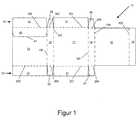
- the body of the erected folding box 1 is from the front side wall 11, the rear side wall 12, which is the front Side wall 11 and the right side wall connecting the rear side wall 12 13 and the left side wall 14 are formed.
- All side walls 11, 12, 13, 14 are rectangular, but the front side wall 11 and rear side wall 12, which preferably have the same dimensions, are somewhat wider than the other two side walls 13, 14, which also preferably have identical dimensions.
- the tab 16 is so wide that it can be securely glued to the right side wall 13, and on the other hand it is at most as wide as the two side walls 13, 14.
- the inner rear wall 15 is largely left out.
- the individual side walls 11, 12, 13, 14, the inner rear wall 15 and the tab 16 are connected to one another via corresponding fold lines 101, 102, 103, 104, 105.
- the bottom closure 20 is composed of the four bottom closure tabs 21, 22, 23, 24, which are linked by means of fold lines 201, 202, 203, 204 to the corresponding side walls 11, 12, 13, 14.
- the bottom flap 21, which is articulated on the front side wall 11, and the bottom flap 22 articulated on the rear side wall 12 via the fold line 202 preferably have a rectangular shape.
- the length or height of the two flaps 21, 22 advantageously correspond approximately to the width of the two narrower side walls 13, 14, so that when the folding box 1 is erected, the bottom flaps 21, 22 folded inward at an angle of 90 ° overlap.
- the bottom closure tabs 21, 22 are advantageously glued to one another, thus providing increased protection for the bottom closure 20 against the ingress of dust or other dirt particles.
- two further bottom locking tabs 23, 24 are articulated via the fold lines 203, 204, which taper towards their free end and which have an essentially trapezoidal design.
- the upper closure 30 is formed from the four closure tabs 31, 32, 33, 34 which over the fold lines 301, 302, 303, 304 with the side walls 11, 12, 13, 14 are linked.
- the two flaps 33, 34 preferably have the same shape and dimensions as the two bottom locking tabs 23, 24.
- the two flaps 33, 34 preferably have the same shape and Dimension like the two bottom locking tabs 23, 24.
- the flaps 33, 34 are first folded inwards at an angle of 90 °, then the Closure flap 31 also folded over by 90 °. The flap 32 will then open the flap 31 folded and glued to it.
- a substantially rectangular tear tab 40 provided by an appropriately attached weakening or Break line 41 can be easily broken out of the rear side wall 12 and which is connected to the closing flap 32 via a fold line 302.
- the tear tab 40 To the opening the upper closure 30, the tear tab 40 by separating the Line of weakness or predetermined breaking line 41 taken from the rear side wall 12 and for example 90 ° on the fold line 301 together with the flap 31 folded back.
- Tear tab 40 To reclose the folding box 1 Tear tab 40 inserted into the folding box 1, directly under the Inner rear wall 15.
- FIG. 2 shows the die cut of a particularly advantageous folding box 1, which differs significantly from the die cut 1 from FIG. 1.
- the side wall 14 has been replaced in the folding box according to the invention by the tab-forming section 14, which is composed of several individual parts.
- a first tab wall 141 which is essentially rectangular in shape, is articulated on the front side wall 11 via the fold line 101.
- a first hanging flap 142 with a hanging device 145 adjoins the folding line 106, followed by a second hanging flap 143 with a hanging device 146, which is articulated on the first hanging flap 142 via the folding line 107, then a second, also essentially rectangular shaped tab wall 144 which is articulated on the second suspension bracket 143 via a fold line 108 and which is connected to the inner rear wall 15 via the fold line 104.
- the sum of the widths of the first tab wall 141 and second tab wall 144 is not greater than the width of the right side wall 13.
- the first suspension bracket 142 which has a substantially rectangular shape, advantageously has a suspension device 145 centrally in the area's center of gravity, which preferably represents a combination of slotted and round perforations, so that the generally preferred shape for such recesses, the so-called euro hole, results. which enables a secure, but at the same time flexible placement of the filled folding box 1 on a sales shelf with correspondingly provided sales hooks.
- the second suspension bracket 143 which has the same shape and dimensions as the first suspension bracket 142, is articulated to the first suspension bracket 142, only the suspension device 146 is somewhat smaller than the suspension device 145 of the first suspension bracket 142, but is in relation to the first suspension bracket 142 in rotated by an angle of 180 °, so that when the second suspension bracket 143 bends over the fold line 107, the two suspension brackets 142, 143 lie one above the other such that the two suspension devices 145, 146 are arranged as congruently as possible.
- the two suspension brackets 142, 143 can advantageously be glued to one another, which increases the stability.
- the four free corners of the two hanging tabs 142, 143 can also each preferred for optical reasons in an identical manner be rounded in a quarter circle.
- fold line 106 between tab wall 141 and the first Hanging tab 142 and fold line 108 between the second hanging tab 143 and the tab wall 144 can be formed as a separating perforation. So is a Remove the hanger formed from the two hanging tabs 142, 143 possible without damaging the other folding box 1.
- FIG. 15 Another advantageous embodiment of the folding box 1 lies in the special design of the inner rear wall 15, which is largely left out.
- a dividing wall 151 is linked to the inner rear wall 15 via the fold line 153, and a flap 152 is then formed on the fold line 154.
- Both the partition 151 and the tab 152 are rectangular in shape and preferably extend over half the length of the inner rear wall 15.
- the tab 152 is glued to the front side wall 11.
- Figures 3, 4 and 5 show the process of assembling the two Hanging tabs 142, 143 formed hanger of the folding box 1.
- the folding box 1 is first used to form the hanger the tab forming section 14 is converted into the desired shape by the Hanging tabs 142, 143 can be folded onto each other according to the arrow, so that the two suspension brackets 142, 143 lie one above the other, one at the same time Gluing the two can be done so that the hanger of the folding box 1 through the double material wall is extremely stable.
- FIG. 5 shows the assembled hanger, which has been opened by 90 °, and the closing process of the folding box 1.
- the intermediate wall 16 is glued to the right side wall 13 connecting the front side wall 11 and the rear 12 side wall.
- the rear side wall 12 is folded through a total of 180 ° and glued to the inner rear wall 15.
- the bottom closure tabs 23, 24 located on the narrower side walls 13, 14 are folded inwards by 90 °, the bottom closure tab 22 located on the rear side wall 12 is folded onto these and then the bottom closure tab 21 located on the front side wall 11 is folded accordingly folded over, here also a gluing of the two bottom locking tabs 21, 22 takes place.
- the unfolding or gluing takes place correspondingly at the upper closure 30.
- the upper closure 30 and the bottom closure 20 of the folding box 1 are not Can be opened without using force and therefore theft-proof and dust-protected.
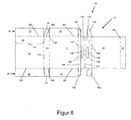
- the flat, unglued die cut is an alternative Folded box 1 shown, which has a rectangular shaped inner rear wall 15th having.
- the intermediate wall 16 is on the inner rear wall 15 via the fold line 105 hinged, which extends here over the entire length of the inner rear wall 15 and is also rectangular in shape.
Landscapes
- Engineering & Computer Science (AREA)
- Mechanical Engineering (AREA)
- Cartons (AREA)
- Load-Engaging Elements For Cranes (AREA)
Abstract
Description
Damit die beschriebene Faltschachtel an einem solchen Haken aufgehängt werden kann, muß zusätzlich ein entsprechend ausgeformter Zuschnitt mit einer Aufhängevorrichtung an der Faltschachtel angebracht werden. Zumeist erfolgt dies, indem dies Teil mit der entsprechenden Aufhängevorrichtung an der Faltschachtel an geeigneter Stelle in einem zusätzlichen Arbeitsgang angeklebt wird. Somit wird aber der Herstellungsprozeß der Faltschachtel u.a. durch das Herstellen des weiteren Zuschnitts oder das Ankleben desselben an der fertigen Schachtel verkompliziert und durch mehrere Arbeitsschritte zeitlich verlängert, darüber hinaus bedeutet dies einen sehr viel höheren apparativen Aufwand.
Mit Hilfe der Aufhängelasche ist eine Plazierung der Faltschachtel an einem Haken möglich. Da die Aufhängelasche aber lediglich einlagig ausgeführt ist und aus dem gleichen Material wie die übrige Faltschachtel besteht, treten im praktischen Gebrauch der Faltschachtel Probleme auf.
Ist die Faltschachtel unter Berücksichtigung von Umwelt- und Kostenaspekten aus dünnem Material gefertigt, weist die Aufhängelasche eine unzureichende Stabilität auf. Schon bei leichtem, unbeabsichtigtem Ziehen an der Faltschachtel reißt die Aufhängelasche aus, so daß die Aufhängelasche ihre Funktion verliert und die Schachtel nicht mehr wie gewünscht aufgehängt werden kann. Darüber hinaus wird die Schachtel unansehnlich und kann damit nicht mehr dem Kunden dargeboten werden.
Auf der anderen Seite bedeutet die Fertigung der Faltschachtel aus dickerem, stabilerem Material, daß die Aufhängelasche zwar sehr viel belastbarer für Zugkräfte ist, aber auch gleichzeitig unnötig viel Material verschwendet wird, weil die übrigen Wände der Faltschachtel überdimensioniert ausgeführt sind.
Diese Schachtel zeigt aber bei ihrer Herstellung und Verwendung einige Nachteile.
Der Zuschnitt der offenbarten Schachtel besitzt einen senkrechten Aufbau, d.h., die beiden Aufhängelaschen sowie die Endlasche, die alle zusammen den Aufhänger der Schachtel bilden, sind in einer geraden Linie mit den vier Seitenwänden angeordnet, wobei die einzelnen Teile jeweils mit einer Falzlinie miteinander verbunden sind. Diese Art des Faltzuschnitts bedingt, daß nach der Konfektionierung des Korpus der Schachtel eine Befüllung derselben seitlich möglich ist.
Weiterhin ergibt sich bei der fertig konfektionierten Schachtel im Bereich des Aufhängers ein Abschnitt, der eine dreifache Materialstärke durch drei übereinander liegende Wände aufweist und somit überdimensioniert ist, was die Schachtel in der Herstellung durch einen erhöhten Materialverbrauch verteuert, und was gleichzeitig zu einem erhöhten Gewicht der Schachtel mit den allseits bekannten Nachteilen führt.
Die Öffnung der Schachtel ist nur möglich, indem zunächst ein Streifen Material über der eigentlichen Öffnung irreversibel entfernt wird und dieser somit als aus heutigen umweltschutzrechtlichen Gesichtspunkten unerwünschter Abfall endet. Anschließend wird die Schachtel an einer Perforationslinie aufgebrochen.
Das Wiederverschließen der Schachtel kann nur dadurch erfolgen, daß der Aufhänger nach entsprechender Faltung gleichzeitig als Verschlußdeckel dient und in die Öffnung der Schachtel geschoben wird. Somit ist ausgeschlossen, daß die Schachtel nach erstmaliger Öffnung und darauffolgendem Verschließen wieder an ihrem eigentlichen Aufhänger aufgehängt werden kann. Der Aufhänger verliert damit seine ursprüngliche und eigentliche Funktion.
Darüber hinaus kann beim Verschließen der Schachtel nicht ausgeschlossen werden, daß der Verschlußdeckel, insbesondere wenn die Schachtel nicht mehr vollständig gefüllt ist, unkontrolliert zu tief in das Innere der Schachtel rutscht, so daß dieser nicht mehr greifbar ist und die Schachtel dann nur noch sehr schwierig zu öffnen ist.
Und schließlich bedingt die gleichzeitige Verwendung des Aufhängers als Verschlußdeckel für die Schachtel, daß bei noch versiegelter Schachtel, insbesondere wenn die Schachtel eine große bauliche Tiefe aufweist, ein großer, sperriger Aufhänger entsteht, der beispielsweise dazu führt, daß die Schachtel beim Aufhängen in einem Regal sehr viel Grundfläche beansprucht, so daß die eigentliche Kapazität des Regals mit den offenbarten Schachteln nur ungenügend ausgenutzt werden kann.
An die rückwärtige Seitenwand ist in ihrem aufreißlaschenfreien Bereich eine in der von der rückwärtigen Seitenwand gebildeten Ebene liegende erste Aufhängelasche mit einer Aufhängevorrichtung, wie Schlitz- oder Rundlochung, angelenkt. Gleichzeitig ist aus dem gleichen Bereich der Innenrückwand wie bei der rückwärtigen Seitenwand und ausgehend von der Falzlinie zwischen Innenrückwand und Verschlußlappen eine zweite Aufhängelasche mit einer Aufhängevorrichtung, wie Schlitz- oder Rundlochung, ausgestanzt, wobei der an der Innenrückwand angelenkte Verschlußlappen an der Falzlinie eine größere Breite aufweist als die zweite Aufhängelasche.
Der vierte Verschlußlappen setzt sich erfindungsgemäß aus mehreren Abschnitten zusammen, und zwar im einzelnen aus
- einer ersten Aufhängelasche mit einer Aufhängevorrichtung, die über eine Falzlinie an der rückwärtigen Seitenwand der Faltschachtel angelenkt ist, wobei an der ersten Aufhängelasche über eine Falzlinie
- eine zweite Aufhängelasche mit einer Aufhängevorrichtung angelenkt ist, wobei an der zweiten Aufhängelasche über eine Falzlinie
- eine Endlasche angelenkt ist,
- wobei die erste Aufhängelasche, die zweite Aufhängelasche und die Endlasche
geradlinig hintereinander angeordnet sind, wobei die drei weiteren Verschlußlappen
sowie der vierte Verschlußlappen jeweils an der selben Seite der vier Seitenwände
angelenkt sind und wobei bei der fertig konfektionierten Faltschachtel die Endlasche
mit dem an der vorderen Seitenwand angelenkten Verschlußlappen verklebt ist.
Diese Faltschachtel weist einen doppellagig ausgeführten Aufhänger auf, hat aber keinen Originalitätsverschluß, der wiederverschließbar ist.
Des weiteren ist in der Vorderwand oder der rückwärtigen Seitenwand eine Klappe mittels zweier Schwächungs- oder Sollbruchlinien integriert und mittels zumindest eines Klebepunkts reversibel verklebt.
Bei der Lösung der geschilderten Probleme will die Erfindung ansetzen.
Die Größenverhältnisse bei den beiden Aufhängevorrichtungen können aber auch umgekehrt sein.
Bei der Konfektionierung der Faltschachtel wird die Lasche mit der vorderen Seitenwand verklebt. Auf diese Weise ergeben sich in der Faltschachtel zwei durch die Trennwand voneinander abgeteilte Abteile, die mit unterschiedlichen Produkten befüllt werden können, zum Beispiel mit Produkten, die ihrerseits wieder in Kartons verpackt sind.
Zur Erleichterung der Entnahme der Produkte beziehungsweise der Kartons können in der Innenrückwand zwei Griffstücke ausgespart sein.
Weiter vorzugsweise ist die Klappe mittig auf der vorderen Seitenwand beziehungsweise rückwärtigen Seitenwand plaziert.
Die Faltschachtel ist maschinengängig; sie wird als flachliegender Zuschnitt geklebt, vom Kartonierer aufgerichtet und zur Befüllstation transportiert, wobei die Aufhängelasche bereits an der Faltschachtel mit ausgebildet ist. Vorder- und Rückseite der Faltschachtel bieten hervorragende Gestaltungsmöglichkeiten. Nach dem Aufrichten und Befüllen der Faltschachtel ist eine einfache Verklebung des Kopfbereiches und des mittigen Bereiches möglich. Durch diese Verklebung wird ein guter Staubschutz erhalten, so daß ein nachträglicher Volleinschlag oder eine zusätzliche Verpackung der Faltschachtel entfällt. Die Faltschachtel ist verklebt, staubgeschützt, originalverschlossen und wiederverschließbar; sie ist einfach handhabbar und variabel zu gestalten. Eine problemlose Verarbeitung ist möglich. Die Faltschachtel ist ferner umweltschonend und wird aus einem Faltzuschnitt unter einem Mindestmaterialverbrauch hergestellt.
Bis auf den Aufhänger sind bei der Faltschachtel die Wände, mit Ausnahme von vorgesehenen Verklebungsstellen, jeweils einlagig ausgeführt. Auf diese Weise wird insgesamt sehr wenig Material für die Gestaltung der Faltschachtel verbraucht, und dennoch ein belastbarer Aufhänger gebildet.
- Figur 1
- den flachliegenden, ungeklebten Stanzzuschnitt einer aus dem Stand der Technik bekannten Faltschachtel,
- Figur 2
- den flachliegenden, ungeklebten Stanzzuschnitt einer vorteilhaft ausgeführten Faltschachtel,
- Figur 3 bis Figur 5
- den Vorgang der Konfektionierung des Aufhängers der Faltschachtel und
- Figur 6
- den flachliegenden, ungeklebten Stanzzuschnitt einer alternativ ausgeführten Faltschachtel.
Die Innenrückwand 15 ist zu einem großen Teil ausgespart.
An den beiden schmalen Seitenwänden 13, 14 sind zwei weitere Bodenverschlußlappen 23, 24 über die Falzlinien 203, 204 angelenkt, die sich zu ihrem freien Ende hin verjüngen und die eine im wesentlichen trapezförmige Gestaltung aufweisen.
Die Seitenwand 14 ist bei der erfindungsgemäßen Faltschachtel durch den Laschenbildungsabschnitt 14 ersetzt worden, der sich aus mehreren Einzelteilen zusammensetzt.
Über die Falzlinie 101 ist an der vorderen Seitenwand 11 eine erste Laschenwand 141 angelenkt, die im wesentlichen rechteckig geformt ist. Über die Falzlinie 106 schließt sich eine ersten Aufhängelasche 142 mit einer Aufhängevorrichtung 145 an, daran eine zweiten Aufhängelasche 143 mit einer Aufhängevorrichtung 146, die über die Falzlinie 107 an der ersten Aufhängelasche 142 angelenkt ist, dann eine zweite, ebenfalls im wesentlichen rechteckig geformte Laschenwand 144, die über eine Falzlinie 108 an der zweiten Aufhängelasche 143 angelenkt ist und die über die Falzlinie 104 mit der Innenrückwand 15 verbunden ist. Erfindungsgemäß ist die Summe der Breiten der ersten Laschenwand 141 und zweiten Laschenwand 144 nicht größer ist als die Breite der rechten Seitenwand 13.
An die erste Aufhängelasche 142 ist die zweite Aufhängelasche 143 angelenkt, die die gleiche Form und Abmessung wie die erste Aufhängelasche 142 aufweist, lediglich die Aufhängevorrichtung 146 ist etwas kleiner als die Aufhängevorrichtung 145 der ersten Aufhängelasche 142, ist aber in Relation zur ersten Aufhängelasche 142 in einem Winkel von 180° gedreht, so daß beim Umknicken der zweiten Aufhängelasche 143 über die Falzlinie 107 die beiden Aufhängelaschen 142, 143 derartig übereinander liegen, daß die beiden Aufhängevorrichtungen 145, 146 möglichst deckungsgleich angeordnet sind. Vorteilhafterweise können die beiden Aufhängelaschen 142, 143 miteinander verklebt sein, was die Stabilität erhöht.
Bei der Konfektionierung der Faltschachtel 1 wird die Lasche 152 mit der vorderen Seitenwand 11 verklebt. Auf diese Weise ergeben sich in der Faltschachtel 1 zwei durch die Trennwand 151 voneinander abgeteilte Abteile, die mit unterschiedlichen Produkten befüllt werden können, zum Beispiel mit Produkten, die ihrerseits wieder in Kartons verpackt sind.
Zur Erleichterung der Entnahme der Produkte beziehungsweise der Kartons sind in der Innenrückwand zwei Griffstücke 156, 157 ausgespart.
Die rückwärtige Seitenwand 12 wird um insgesamt 180° umgelegt und mit der Innenrückwand 15 verklebt.
Beim Bodenverschlusses 20 werden die an den schmaleren Seitenwänden 13, 14 befindlichen Bodenverschlußlappen 23, 24 um 90° nach innen geklappt, auf diese wird der an der rückwärtigen Seitenwand 12 befindliche Bodenverschlußlappen 22 gefaltet und dann wird entsprechend der an der vorderen Seitenwand 11 befindliche Bodenverschlußlappen 21 umgeknickt, wobei hier ebenfalls eine Verklebung der beiden Bodenverschlußlappen 21, 22 erfolgt.
Entsprechend erfolgt die Auffaltung beziehungsweise Verklebung beim oberen Verschluß 30.
Claims (10)
- Wiederverschließbare, quaderförmige Faltschachtel 1 mit einer vorderen Seitenwand 11, einer rückwärtigen Seitenwand 12, einer die vordere Seitenwand 11 und die rückwärtige Seitenwand 12 verbindenden, rechten Seitenwand 13 sowie einem Laschenbildungsabschnitt 14, einem von vier Bodenverschlußlappen 21, 22, 23, 24 gebildeten Bodenverschluß 20, einem von vier Verschlußlappen 31, 32, 33, 34 gebildeten oberen Verschluß 30, wobei zwei Bodenverschlußlappen 21, 22 und/oder zwei Verschlußlappen 31, 32 miteinander verklebt sein können, mit einer in der rückwärtigen Seitenwand 12 integrierten Aufreißlasche 40, die vermittels einer Schwächungs- oder Sollbruchlinie 41 in der rückwärtigen Seitenwand 12 gehalten ist und die über eine Falzlinie 302 mit einem Verschlußlappen 32 des oberen Verschlusses 30 verbunden ist, sowie mit zumindest einer Innenrückwand 15, die sich an dem Laschenbildungsabschnitt 14 anfügt und an der gegebenenfalls eine Zwischenwand 16 und, an der Zwischenwand 16 anschließend, eine Innenvorderwand angelenkt ist,
wobei sich der Laschenbildungsabschnitt 14 zusammensetzt ausa) einer an der vorderen Seitenwand 11 angelenkten ersten Laschenwand 141,b) einer ersten Aufhängelasche 142 mit einer Aufhängevorrichtung 145, die über eine Falzlinie 106 an der ersten Laschenwand 141 angelenkt ist,c) einer zweiten Aufhängelasche 143 mit einer Aufhängevorrichtung 146, die über eine Falzlinie 107 an der ersten Aufhängelasche 142 angelenkt ist,d) einer zweiten Laschenwand 144, die über eine Falzlinie 108 an der zweiten Aufhängelasche 143 angelenkt ist und die über eine Falzlinie 104 mit der Innenrückwand 15 verbunden ist, wobeie) die Summe der Breiten der ersten Laschenwand 141 und zweiten Laschenwand 144 nicht größer ist als die Breite der rechten Seitenwand 13. - Wiederverschließbare, quaderförmige Faltschachtel gemäß Anspruch 1, dadurch gekennzeichnet, daß die Innenrückwand 15 und die rückwärtige Seitenwand 12 miteinander verklebt sind.
- Wiederverschließbare, quaderförmige Faltschachtel gemäß den Ansprüchen 1 und 2, dadurch gekennzeichnet, daß die Aufhängevorrichtung 145 in der ersten Aufhängelasche 142 größer ist als die Aufhängevorrichtung 146 in der zweiten Aufhängelasche 143.
- Wiederverschließbare, quaderförmige Faltschachtel gemäß den Ansprüchen 1 bis 3, dadurch gekennzeichnet, daß bei der fertig konfektionierten Faltschachtel 1 die erste Aufhängelasche 142 und die zweite Aufhängelasche 143 miteinander verklebt sind.
- Wiederverschließbare, quaderförmige Faltschachtel gemäß den Ansprüchen 1 bis 4, dadurch gekennzeichnet, daß die erste Laschenwand 141 und die zweite Laschenwand 144 die gleiche Breite aufweisen.
- Wiederverschließbare, quaderförmige Faltschachtel gemäß den Ansprüchen 1 bis 5, dadurch gekennzeichnet, daß an der ersten Laschenwand 141 und/oder an der zweiten Laschenwand 144 jeweils zwei Staublaschen 161, 162, 163, 164 angelenkt sind.
- Wiederverschließbare, quaderförmige Faltschachtel gemäß den Ansprüchen 1 bis 6, dadurch gekennzeichnet, daß jeweils zwei Staublaschen 161, 163 und 162, 164 miteinander verklebt sind.
- Wiederverschließbare, quaderförmige Faltschachtel gemäß den Ansprüchen 1 bis 7, dadurch gekennzeichnet, daß an der Kante der Innenrückwand 15, die der Aufreißlasche 40 gegenüberliegt, im Bereich der Zwischenwand 16 ein Teil der Innenrückwand 15 ausgespart beziehungsweise durch die Schnittlinie 155 abgetrennt ist, wobei über die Falzlinie 153 eine Trennwand 151 mit der Innenrückwand 15 verknüpft und über die Falzlinie 154 daran anschließend eine Lasche 152 angeformt ist., wobei bei der Konfektionierung der Faltschachtel 1 die Lasche 152 mit der vorderen Seitenwand 11 verklebt wird.
- Wiederverschließbare, quaderförmige Faltschachtel gemäß den Ansprüchen 1 bis 8, dadurch gekennzeichnet, daß in der rückwärtigen Seitenwand 12 eine Klappe mittels zweier Schwächungs- oder Sollbruchlinien integriert ist und die mittels zumindest eines Klebepunkts reversibel verklebt ist.
- Stanzzuschnitt zur Herstellung einer wiederverschließbaren, quaderförmigen Faltschachtel 1 mit einer vorderen Seitenwand 11, einer rückwärtigen Seitenwand 12, einer die vordere Seitenwand 11 und die rückwärtige Seitenwand 12 verbindenden, rechten Seitenwand 13 sowie einem Laschenbildungsabschnitt 14, einem von vier Bodenverschlußlappen 21, 22, 23, 24 gebildeten Bodenverschluß 20, einem von vier Verschlußlappen 31, 32, 33, 34 gebildeten oberen Verschluß 30, wobei zwei Bodenverschlußlappen 21, 22 und/oder zwei Verschlußlappen 31, 32 miteinander verklebt sein können, mit einer in der rückwärtigen Seitenwand 12 integrierten Aufreißlasche 40, die vermittels einer Schwächungs- oder Sollbruchlinie 41 in der rückwärtigen Seitenwand 12 gehalten ist und die über eine Falzlinie 302 mit einem Verschlußlappen 32 des oberen Verschlusses 30 verbunden ist, sowie mit zumindest einer Innenrückwand 15, die sich an dem Laschenbildungsabschnitt 14 anfügt und an der gegebenenfalls eine Zwischenwand 16 und, an der Zwischenwand 16 anschließend, eine Innenvorderwand angelenkt ist,wobeidie Faltschachtel 1 aus einem Faltzuschnitt 10 aus Pappe, Karton oder einem anderen geeigneten Werkstoff besteht,wobei die rückwärtige Seitenwand 12, die die vordere Seitenwand 11 und die rückwärtige Seitenwand 12 verbindende, rechte Seitenwand 13, die vordere Seitenwand 11, die an der vorderen Seitenwand 11 angelenkte erste Laschenwand 141, die erste Aufhängelasche 142 mit einer Aufhängevorrichtung 145, die zweite Aufhängelasche 143 mit einer Aufhängevorrichtung 146, die zweite Laschenwand 144, die Innenrückwand 15 und gegebenenfalls eine Zwischenwand 16 und, an der Zwischenwand 16 anschließend, eine Innenvorderwand jeweils über Falzlinien 101, 102, 103, 104, 105, 106, 107, 108 miteinander verknüpft in einer Reihe geradlinig hintereinander angeordnet sind, wobei die Summe der Breiten der ersten Laschenwand 141 und zweiten Laschenwand 144 nicht größer ist als die Breite der rechten Seitenwand 13,wobei an der ersten Laschenwand 141 und/oder an der zweiten Laschenwand 144 jeweils zwei Staublaschen 161, 162, 163, 164 angelenkt sind,wobei an der die vordere Seitenwand 11 und die rückwärtige Seitenwand 12 verbindenden, rechten Seitenwand 13 zum einen über eine Falzlinie 303 ein Verschlußlappen 33 und zum anderen auf der gegenüberliegenden Seite über eine Falzlinie 203 ein Bodenverschlußlappen 23 angelenkt ist,wobei an der vorderen Seitenwand 11 zum einen über eine Falzlinie 301 ein Verschlußlappen 31 und zum anderen auf der gegenüberliegenden Seite über eine Falzlinie 201 ein Bodenverschlußlappen 21 angelenkt ist,wobei an der linken Seitenwand 14 zum einen über eine Falzlinie 304 ein Verschlußlappen 34 und zum anderen auf der gegenüberliegenden Seite über eine Falzlinie 204 ein Bodenverschlußlappen 24 angelenkt ist,wobei in der rückwärtigen Seitenwand 12 eine Aufreißlasche 40, die vermittels einer Schwächungs- oder Sollbruchlinie 41 in der rückwärtigen Seitenwand 12 gehalten ist und die über eine Falzlinie 302 mit einem Verschlußlappen 32 des oberen Verschlusses 30 verbunden ist,wobei gegebenenfalls in der rückwärtigen Seitenwand 12 eine Klappe mittels zweier Schwächungs- oder Sollbruchlinien integriert ist und die mittels zumindest eines Klebepunkts reversibel verklebt ist.
Applications Claiming Priority (2)
| Application Number | Priority Date | Filing Date | Title |
|---|---|---|---|
| DE10006293 | 2000-02-14 | ||
| DE10006293A DE10006293A1 (de) | 2000-02-14 | 2000-02-14 | Wiederverschliessbare, quaderförmige Faltschachtel mit Aufhänger |
Publications (3)
| Publication Number | Publication Date |
|---|---|
| EP1127796A2 true EP1127796A2 (de) | 2001-08-29 |
| EP1127796A3 EP1127796A3 (de) | 2002-06-19 |
| EP1127796B1 EP1127796B1 (de) | 2004-04-07 |
Family
ID=7630711
Family Applications (1)
| Application Number | Title | Priority Date | Filing Date |
|---|---|---|---|
| EP01100620A Expired - Lifetime EP1127796B1 (de) | 2000-02-14 | 2001-01-11 | Wiederverschliessbare, quaderförmige Faltschachtel mit Aufhänger |
Country Status (6)
| Country | Link |
|---|---|
| US (1) | US6402018B2 (de) |
| EP (1) | EP1127796B1 (de) |
| AT (1) | ATE263711T1 (de) |
| AU (1) | AU772289B2 (de) |
| DE (2) | DE10006293A1 (de) |
| ES (1) | ES2217040T3 (de) |
Families Citing this family (11)
| Publication number | Priority date | Publication date | Assignee | Title |
|---|---|---|---|---|
| US7316343B2 (en) * | 2002-07-17 | 2008-01-08 | Schering Ag | Folding box with fold-down attachment flap |
| DE10246378A1 (de) * | 2002-10-04 | 2004-04-15 | Beiersdorf Ag | Faltschachtel mit angelängter, quer zum Faltschachtelkorpus liegender, integrierter Aufhängelasche |
| US20040256273A1 (en) * | 2002-11-13 | 2004-12-23 | Beiersdorf Ag | Relockable, rectangular-shaped folding box with lateral opening |
| USD512456S1 (en) * | 2003-07-08 | 2005-12-06 | Idt Corporation | Card |
| US20080142395A1 (en) * | 2006-12-18 | 2008-06-19 | Printex Packaging Corporation | Package with a locking sleeve |
| USD620354S1 (en) | 2009-07-21 | 2010-07-27 | The C.W. Zumbiel Company | Carton with handle |
| US20130020382A1 (en) * | 2011-07-18 | 2013-01-24 | Meadwestvaco Corporation | Paperboard accordion package |
| US20130220878A1 (en) * | 2011-08-25 | 2013-08-29 | Gift Card Impressions, LLC | Expandable box card holder |
| US9150327B2 (en) | 2012-04-25 | 2015-10-06 | Moshe Yair Begim | Folding box with removable handle |
| US9108760B2 (en) | 2012-11-19 | 2015-08-18 | Moshe Begim | Retail sealed folding box with handle |
| RU206978U1 (ru) * | 2021-06-18 | 2021-10-05 | Общество с ограниченной ответственностью "ВИМАКС" | Трансформируемая в емкость упаковка для средств по очистке подошвы утюга |
Citations (6)
| Publication number | Priority date | Publication date | Assignee | Title |
|---|---|---|---|---|
| US4344533A (en) | 1980-07-28 | 1982-08-17 | Grinnell Lithographic Co., Inc. | Fifth panel reclosable package |
| DE3932441A1 (de) | 1989-09-28 | 1991-04-11 | Beiersdorf Ag | Wiederverschliessbare, quaderfoermige faltschachtel |
| DE4322555A1 (de) | 1993-07-07 | 1995-01-12 | Beiersdorf Ag | Wiederverschließbare, quaderförmige Faltschachtel und Faltzuschnitt zu deren Herstellung |
| DE19535008A1 (de) | 1995-09-21 | 1997-03-27 | Beiersdorf Ag | Faltschachtel mit verstärktem Aufhänger |
| DE19541904A1 (de) | 1995-11-10 | 1997-05-15 | Beiersdorf Ag | Faltschachtel mit integrierter Doppellasche |
| DE19821087A1 (de) | 1998-05-12 | 1999-11-18 | Beiersdorf Ag | Faltschachtel mit angelenkter, wiederverschließbarer Klappe |
Family Cites Families (11)
| Publication number | Priority date | Publication date | Assignee | Title |
|---|---|---|---|---|
| US1522311A (en) * | 1921-09-16 | 1925-01-06 | Chicago Carton Co | Carton |
| US4062486A (en) * | 1976-11-04 | 1977-12-13 | The Procter & Gamble Company | Carton |
| FR2427955A1 (fr) * | 1978-06-08 | 1980-01-04 | Sandoz Daniel | Boite d'emballage |
| US4171763A (en) * | 1978-07-14 | 1979-10-23 | Champion International Corporation | Display carry container |
| US4201292A (en) * | 1979-01-12 | 1980-05-06 | Robertson Paper Box Co., Inc. | Dispenser carton |
| CH637589A5 (en) * | 1979-05-08 | 1983-08-15 | Winterthur Papierwaren | Carrying box with handle |
| US4291807A (en) * | 1979-11-07 | 1981-09-29 | International Folding Paper Box Co., Inc. | Folding box |
| US4331240A (en) * | 1980-06-16 | 1982-05-25 | Textron Inc. | Staple stick package |
| US5474183A (en) * | 1994-06-30 | 1995-12-12 | Eastman Kodak Company | Carton for enclosing and displaying articles |
| DE19848719A1 (de) * | 1998-10-22 | 2000-05-04 | Beiersdorf Ag | Wiederverschließbare, quaderförmige Faltschachtel mit Aufhänger |
| DE29901874U1 (de) * | 1999-02-04 | 1999-04-29 | A. Landerer GmbH & Co KG, 74172 Neckarsulm | Doppelkammer-Faltschachtel mit Tasche für Beipackzettel |
-
2000
- 2000-02-14 DE DE10006293A patent/DE10006293A1/de not_active Withdrawn
-
2001
- 2001-01-11 AT AT01100620T patent/ATE263711T1/de not_active IP Right Cessation
- 2001-01-11 ES ES01100620T patent/ES2217040T3/es not_active Expired - Lifetime
- 2001-01-11 DE DE50101879T patent/DE50101879D1/de not_active Expired - Lifetime
- 2001-01-11 EP EP01100620A patent/EP1127796B1/de not_active Expired - Lifetime
- 2001-01-18 AU AU16341/01A patent/AU772289B2/en not_active Ceased
- 2001-02-13 US US09/782,549 patent/US6402018B2/en not_active Expired - Fee Related
Patent Citations (6)
| Publication number | Priority date | Publication date | Assignee | Title |
|---|---|---|---|---|
| US4344533A (en) | 1980-07-28 | 1982-08-17 | Grinnell Lithographic Co., Inc. | Fifth panel reclosable package |
| DE3932441A1 (de) | 1989-09-28 | 1991-04-11 | Beiersdorf Ag | Wiederverschliessbare, quaderfoermige faltschachtel |
| DE4322555A1 (de) | 1993-07-07 | 1995-01-12 | Beiersdorf Ag | Wiederverschließbare, quaderförmige Faltschachtel und Faltzuschnitt zu deren Herstellung |
| DE19535008A1 (de) | 1995-09-21 | 1997-03-27 | Beiersdorf Ag | Faltschachtel mit verstärktem Aufhänger |
| DE19541904A1 (de) | 1995-11-10 | 1997-05-15 | Beiersdorf Ag | Faltschachtel mit integrierter Doppellasche |
| DE19821087A1 (de) | 1998-05-12 | 1999-11-18 | Beiersdorf Ag | Faltschachtel mit angelenkter, wiederverschließbarer Klappe |
Also Published As
| Publication number | Publication date |
|---|---|
| AU772289B2 (en) | 2004-04-22 |
| DE50101879D1 (de) | 2004-05-13 |
| ES2217040T3 (es) | 2004-11-01 |
| US20010015374A1 (en) | 2001-08-23 |
| EP1127796A3 (de) | 2002-06-19 |
| US6402018B2 (en) | 2002-06-11 |
| AU1634101A (en) | 2001-08-16 |
| EP1127796B1 (de) | 2004-04-07 |
| DE10006293A1 (de) | 2001-08-16 |
| ATE263711T1 (de) | 2004-04-15 |
Similar Documents
| Publication | Publication Date | Title |
|---|---|---|
| EP0995689B1 (de) | Wiederverschliessbare, quaderförmige Faltschachtel mit Aufhänger | |
| EP1394054B1 (de) | Wiederverschliessbare Faltschachtel mit Aufbrechsicherheitsverschluss und Aufhängelasche und Stanzzuschnitt zu ihrer Herstellung | |
| DE4322555C2 (de) | Wiederverschließbare, quaderförmige Faltschachtel und Faltzuschnitt zu deren Herstellung | |
| EP1213226A2 (de) | Wiederverschliessbare, quaderförmige Faltschachtel | |
| EP2569220A1 (de) | Faltschachteleinsatz und faltschachtel für einen faltschachteleinsatz | |
| DE19637022A1 (de) | Handfaltschachtel mit Sicherheitsverschluß | |
| DE19541904B4 (de) | Faltschachtel mit integrierter Doppellasche | |
| EP1127796B1 (de) | Wiederverschliessbare, quaderförmige Faltschachtel mit Aufhänger | |
| EP1876103A1 (de) | Originalitätsverschlossene Faltschachtel mit schachteleinwärts versetztem Deckel | |
| EP1733973A1 (de) | Faltschachtel | |
| EP0419781B1 (de) | Wiederverschliessbare, quaderförmige Faltschachtel und Faltzuschnitt zu deren Herstellung | |
| EP1357043A1 (de) | Versand- und Verkaufsverpackung und Zuschnitt hierfür | |
| DE10015053A1 (de) | Faltschachtel mit integrierter Klappe und Orginalitätsverschluß | |
| DE19535008A1 (de) | Faltschachtel mit verstärktem Aufhänger | |
| EP1638850A1 (de) | Wiederverschliessbare, quaderförmige faltschachtel mit seitlicher wieder verschliessbarer öffnung | |
| EP0896928B1 (de) | Faltschachtel mit Originalitätsverschluss | |
| EP1916192B1 (de) | Quaderförmige Faltschachtel mit einem Öffnungsabschnitt | |
| DE19821087B4 (de) | Faltschachtel mit angelenkter, wiederverschließbarer Klappe | |
| DE102004005333A1 (de) | Wiederverschließbare, quaderförmige Faltschachtel mit seitlicher wieder verschließbarer Öffnung | |
| EP1419971B1 (de) | Wiederverschliessbare, quaderförmige Faltschachtel mit seitlicher Öffnung | |
| DE102004021275A1 (de) | Faltschachtel mit schachteleinwärts versetztem Verschluss | |
| DE29515110U1 (de) | Faltschachtel mit verstärktem Aufhänger | |
| DE202005006978U1 (de) | Schachtelförmiger Behälter und dessen Zuschnitt | |
| DE8533053U1 (de) | Zuschnitt für Verpackungsbehälter mit Wegreißteil | |
| DE10246378A1 (de) | Faltschachtel mit angelängter, quer zum Faltschachtelkorpus liegender, integrierter Aufhängelasche |
Legal Events
| Date | Code | Title | Description |
|---|---|---|---|
| PUAI | Public reference made under article 153(3) epc to a published international application that has entered the european phase |
Free format text: ORIGINAL CODE: 0009012 |
|
| AK | Designated contracting states |
Kind code of ref document: A2 Designated state(s): AT BE CH CY DE DK ES FI FR GB GR IE IT LI LU MC NL PT SE TR |
|
| AX | Request for extension of the european patent |
Free format text: AL;LT;LV;MK;RO;SI |
|
| PUAL | Search report despatched |
Free format text: ORIGINAL CODE: 0009013 |
|
| AK | Designated contracting states |
Kind code of ref document: A3 Designated state(s): AT BE CH CY DE DK ES FI FR GB GR IE IT LI LU MC NL PT SE TR |
|
| AX | Request for extension of the european patent |
Free format text: AL;LT;LV;MK;RO;SI |
|
| 17P | Request for examination filed |
Effective date: 20020724 |
|
| AKX | Designation fees paid |
Designated state(s): AT BE CH CY DE DK ES FI FR GB GR IE IT LI LU MC NL PT SE TR |
|
| GRAP | Despatch of communication of intention to grant a patent |
Free format text: ORIGINAL CODE: EPIDOSNIGR1 |
|
| GRAS | Grant fee paid |
Free format text: ORIGINAL CODE: EPIDOSNIGR3 |
|
| GRAA | (expected) grant |
Free format text: ORIGINAL CODE: 0009210 |
|
| AK | Designated contracting states |
Kind code of ref document: B1 Designated state(s): AT BE CH CY DE DK ES FI FR GB GR IE IT LI LU MC NL PT SE TR |
|
| PG25 | Lapsed in a contracting state [announced via postgrant information from national office to epo] |
Ref country code: IE Free format text: LAPSE BECAUSE OF FAILURE TO SUBMIT A TRANSLATION OF THE DESCRIPTION OR TO PAY THE FEE WITHIN THE PRESCRIBED TIME-LIMIT Effective date: 20040407 Ref country code: TR Free format text: LAPSE BECAUSE OF FAILURE TO SUBMIT A TRANSLATION OF THE DESCRIPTION OR TO PAY THE FEE WITHIN THE PRESCRIBED TIME-LIMIT Effective date: 20040407 Ref country code: FI Free format text: LAPSE BECAUSE OF FAILURE TO SUBMIT A TRANSLATION OF THE DESCRIPTION OR TO PAY THE FEE WITHIN THE PRESCRIBED TIME-LIMIT Effective date: 20040407 |
|
| REG | Reference to a national code |
Ref country code: GB Ref legal event code: FG4D Free format text: NOT ENGLISH |
|
| REG | Reference to a national code |
Ref country code: CH Ref legal event code: EP |
|
| PG25 | Lapsed in a contracting state [announced via postgrant information from national office to epo] |
Ref country code: DE Free format text: LAPSE BECAUSE OF THE APPLICANT RENOUNCES Effective date: 20040422 |
|
| REF | Corresponds to: |
Ref document number: 50101879 Country of ref document: DE Date of ref document: 20040513 Kind code of ref document: P |
|
| REG | Reference to a national code |
Ref country code: IE Ref legal event code: FG4D Free format text: GERMAN |
|
| REG | Reference to a national code |
Ref country code: SE Ref legal event code: TRGR |
|
| GBT | Gb: translation of ep patent filed (gb section 77(6)(a)/1977) |
Effective date: 20040615 |
|
| PG25 | Lapsed in a contracting state [announced via postgrant information from national office to epo] |
Ref country code: GR Free format text: LAPSE BECAUSE OF FAILURE TO SUBMIT A TRANSLATION OF THE DESCRIPTION OR TO PAY THE FEE WITHIN THE PRESCRIBED TIME-LIMIT Effective date: 20040707 Ref country code: DK Free format text: LAPSE BECAUSE OF FAILURE TO SUBMIT A TRANSLATION OF THE DESCRIPTION OR TO PAY THE FEE WITHIN THE PRESCRIBED TIME-LIMIT Effective date: 20040707 |
|
| REG | Reference to a national code |
Ref country code: ES Ref legal event code: FG2A Ref document number: 2217040 Country of ref document: ES Kind code of ref document: T3 |
|
| REG | Reference to a national code |
Ref country code: IE Ref legal event code: FD4D |
|
| ET | Fr: translation filed | ||
| PG25 | Lapsed in a contracting state [announced via postgrant information from national office to epo] |
Ref country code: LU Free format text: LAPSE BECAUSE OF NON-PAYMENT OF DUE FEES Effective date: 20050111 Ref country code: CY Free format text: LAPSE BECAUSE OF FAILURE TO SUBMIT A TRANSLATION OF THE DESCRIPTION OR TO PAY THE FEE WITHIN THE PRESCRIBED TIME-LIMIT Effective date: 20050111 |
|
| PG25 | Lapsed in a contracting state [announced via postgrant information from national office to epo] |
Ref country code: MC Free format text: LAPSE BECAUSE OF NON-PAYMENT OF DUE FEES Effective date: 20050131 Ref country code: LI Free format text: LAPSE BECAUSE OF NON-PAYMENT OF DUE FEES Effective date: 20050131 Ref country code: CH Free format text: LAPSE BECAUSE OF NON-PAYMENT OF DUE FEES Effective date: 20050131 Ref country code: BE Free format text: LAPSE BECAUSE OF NON-PAYMENT OF DUE FEES Effective date: 20050131 |
|
| PLBE | No opposition filed within time limit |
Free format text: ORIGINAL CODE: 0009261 |
|
| STAA | Information on the status of an ep patent application or granted ep patent |
Free format text: STATUS: NO OPPOSITION FILED WITHIN TIME LIMIT |
|
| 26N | No opposition filed |
Effective date: 20050110 |
|
| BERE | Be: lapsed |
Owner name: *BEIERSDORF A.G. Effective date: 20050131 |
|
| REG | Reference to a national code |
Ref country code: CH Ref legal event code: PL |
|
| BERE | Be: lapsed |
Owner name: *BEIERSDORF A.G. Effective date: 20050131 |
|
| PG25 | Lapsed in a contracting state [announced via postgrant information from national office to epo] |
Ref country code: PT Free format text: LAPSE BECAUSE OF NON-PAYMENT OF DUE FEES Effective date: 20040907 |
|
| PGFP | Annual fee paid to national office [announced via postgrant information from national office to epo] |
Ref country code: ES Payment date: 20080130 Year of fee payment: 8 |
|
| PGFP | Annual fee paid to national office [announced via postgrant information from national office to epo] |
Ref country code: GB Payment date: 20080124 Year of fee payment: 8 Ref country code: IT Payment date: 20080123 Year of fee payment: 8 Ref country code: NL Payment date: 20080115 Year of fee payment: 8 Ref country code: SE Payment date: 20080114 Year of fee payment: 8 |
|
| PGFP | Annual fee paid to national office [announced via postgrant information from national office to epo] |
Ref country code: AT Payment date: 20080116 Year of fee payment: 8 |
|
| PGFP | Annual fee paid to national office [announced via postgrant information from national office to epo] |
Ref country code: FR Payment date: 20080111 Year of fee payment: 8 |
|
| EUG | Se: european patent has lapsed | ||
| GBPC | Gb: european patent ceased through non-payment of renewal fee |
Effective date: 20090111 |
|
| NLV4 | Nl: lapsed or anulled due to non-payment of the annual fee |
Effective date: 20090801 |
|
| PG25 | Lapsed in a contracting state [announced via postgrant information from national office to epo] |
Ref country code: AT Free format text: LAPSE BECAUSE OF NON-PAYMENT OF DUE FEES Effective date: 20090111 |
|
| REG | Reference to a national code |
Ref country code: FR Ref legal event code: ST Effective date: 20091030 |
|
| PG25 | Lapsed in a contracting state [announced via postgrant information from national office to epo] |
Ref country code: GB Free format text: LAPSE BECAUSE OF NON-PAYMENT OF DUE FEES Effective date: 20090111 Ref country code: NL Free format text: LAPSE BECAUSE OF NON-PAYMENT OF DUE FEES Effective date: 20090801 |
|
| REG | Reference to a national code |
Ref country code: ES Ref legal event code: FD2A Effective date: 20090112 |
|
| PG25 | Lapsed in a contracting state [announced via postgrant information from national office to epo] |
Ref country code: FR Free format text: LAPSE BECAUSE OF NON-PAYMENT OF DUE FEES Effective date: 20090202 Ref country code: ES Free format text: LAPSE BECAUSE OF NON-PAYMENT OF DUE FEES Effective date: 20090112 |
|
| PG25 | Lapsed in a contracting state [announced via postgrant information from national office to epo] |
Ref country code: IT Free format text: LAPSE BECAUSE OF NON-PAYMENT OF DUE FEES Effective date: 20090111 |
|
| PG25 | Lapsed in a contracting state [announced via postgrant information from national office to epo] |
Ref country code: SE Free format text: LAPSE BECAUSE OF NON-PAYMENT OF DUE FEES Effective date: 20090112 |