EP1127907B1 - Colle thermofusible d'acrylate thermoréticulable - Google Patents
Colle thermofusible d'acrylate thermoréticulable Download PDFInfo
- Publication number
- EP1127907B1 EP1127907B1 EP01102533A EP01102533A EP1127907B1 EP 1127907 B1 EP1127907 B1 EP 1127907B1 EP 01102533 A EP01102533 A EP 01102533A EP 01102533 A EP01102533 A EP 01102533A EP 1127907 B1 EP1127907 B1 EP 1127907B1
- Authority
- EP
- European Patent Office
- Prior art keywords
- weight
- polyacrylates
- groups
- acrylates
- methacrylates
- Prior art date
- Legal status (The legal status is an assumption and is not a legal conclusion. Google has not performed a legal analysis and makes no representation as to the accuracy of the status listed.)
- Expired - Lifetime
Links
- 239000012943 hotmelt Substances 0.000 title description 19
- NIXOWILDQLNWCW-UHFFFAOYSA-M Acrylate Chemical compound [O-]C(=O)C=C NIXOWILDQLNWCW-UHFFFAOYSA-M 0.000 title description 6
- 238000004132 cross linking Methods 0.000 claims description 39
- 229920000058 polyacrylate Polymers 0.000 claims description 31
- 239000004820 Pressure-sensitive adhesive Substances 0.000 claims description 25
- 238000000034 method Methods 0.000 claims description 24
- -1 tert-butoxycarbonyl (BOC) Chemical class 0.000 claims description 22
- 239000000178 monomer Substances 0.000 claims description 19
- 230000008569 process Effects 0.000 claims description 18
- 125000002887 hydroxy group Chemical group [H]O* 0.000 claims description 17
- 229920002959 polymer blend Polymers 0.000 claims description 17
- 239000012948 isocyanate Substances 0.000 claims description 14
- 150000002513 isocyanates Chemical class 0.000 claims description 14
- 125000005931 tert-butyloxycarbonyl group Chemical group [H]C([H])([H])C(OC(*)=O)(C([H])([H])[H])C([H])([H])[H] 0.000 claims description 14
- 150000002118 epoxides Chemical class 0.000 claims description 13
- 150000001252 acrylic acid derivatives Chemical class 0.000 claims description 11
- 150000002734 metacrylic acid derivatives Chemical class 0.000 claims description 11
- 239000000203 mixture Substances 0.000 claims description 11
- 238000004519 manufacturing process Methods 0.000 claims description 10
- 239000004971 Cross linker Substances 0.000 claims description 9
- 125000000524 functional group Chemical group 0.000 claims description 8
- NIXOWILDQLNWCW-UHFFFAOYSA-N acrylic acid group Chemical group C(C=C)(=O)O NIXOWILDQLNWCW-UHFFFAOYSA-N 0.000 claims description 7
- 238000006116 polymerization reaction Methods 0.000 claims description 7
- 125000006239 protecting group Chemical group 0.000 claims description 7
- LFQSCWFLJHTTHZ-UHFFFAOYSA-N Ethanol Chemical compound CCO LFQSCWFLJHTTHZ-UHFFFAOYSA-N 0.000 claims description 6
- 239000002390 adhesive tape Substances 0.000 claims description 6
- 125000000217 alkyl group Chemical group 0.000 claims description 6
- 125000004432 carbon atom Chemical group C* 0.000 claims description 6
- 230000005855 radiation Effects 0.000 claims description 6
- 238000007669 thermal treatment Methods 0.000 claims description 6
- 238000010511 deprotection reaction Methods 0.000 claims description 5
- 230000001588 bifunctional effect Effects 0.000 claims description 4
- 239000000126 substance Substances 0.000 claims description 3
- 230000001105 regulatory effect Effects 0.000 claims description 2
- 238000006243 chemical reaction Methods 0.000 description 43
- 230000001070 adhesive effect Effects 0.000 description 33
- 239000000853 adhesive Substances 0.000 description 30
- 229920000642 polymer Polymers 0.000 description 23
- 239000000243 solution Substances 0.000 description 14
- 239000002904 solvent Substances 0.000 description 14
- DYHSDKLCOJIUFX-UHFFFAOYSA-N tert-butoxycarbonyl anhydride Chemical compound CC(C)(C)OC(=O)OC(=O)OC(C)(C)C DYHSDKLCOJIUFX-UHFFFAOYSA-N 0.000 description 14
- 238000005516 engineering process Methods 0.000 description 10
- YXFVVABEGXRONW-UHFFFAOYSA-N Toluene Chemical compound CC1=CC=CC=C1 YXFVVABEGXRONW-UHFFFAOYSA-N 0.000 description 9
- 239000003795 chemical substances by application Substances 0.000 description 9
- CSCPPACGZOOCGX-UHFFFAOYSA-N Acetone Chemical compound CC(C)=O CSCPPACGZOOCGX-UHFFFAOYSA-N 0.000 description 8
- BAPJBEWLBFYGME-UHFFFAOYSA-N Methyl acrylate Chemical compound COC(=O)C=C BAPJBEWLBFYGME-UHFFFAOYSA-N 0.000 description 8
- IISBACLAFKSPIT-UHFFFAOYSA-N bisphenol A Chemical compound C=1C=C(O)C=CC=1C(C)(C)C1=CC=C(O)C=C1 IISBACLAFKSPIT-UHFFFAOYSA-N 0.000 description 8
- 125000005409 triarylsulfonium group Chemical group 0.000 description 7
- KFZMGEQAYNKOFK-UHFFFAOYSA-N Isopropanol Chemical compound CC(C)O KFZMGEQAYNKOFK-UHFFFAOYSA-N 0.000 description 6
- 125000003118 aryl group Chemical group 0.000 description 6
- 230000004927 fusion Effects 0.000 description 6
- 238000000265 homogenisation Methods 0.000 description 6
- 229920001228 polyisocyanate Polymers 0.000 description 6
- 239000005056 polyisocyanate Substances 0.000 description 6
- 238000002360 preparation method Methods 0.000 description 6
- 238000009281 ultraviolet germicidal irradiation Methods 0.000 description 6
- HGCGQDMQKGRJNO-UHFFFAOYSA-N xenon monochloride Chemical compound [Xe]Cl HGCGQDMQKGRJNO-UHFFFAOYSA-N 0.000 description 6
- WOBHKFSMXKNTIM-UHFFFAOYSA-N Hydroxyethyl methacrylate Chemical compound CC(=C)C(=O)OCCO WOBHKFSMXKNTIM-UHFFFAOYSA-N 0.000 description 5
- 238000012545 processing Methods 0.000 description 5
- GOXQRTZXKQZDDN-UHFFFAOYSA-N 2-Ethylhexyl acrylate Chemical compound CCCCC(CC)COC(=O)C=C GOXQRTZXKQZDDN-UHFFFAOYSA-N 0.000 description 4
- FUGYGGDSWSUORM-UHFFFAOYSA-N 4-hydroxystyrene Chemical compound OC1=CC=C(C=C)C=C1 FUGYGGDSWSUORM-UHFFFAOYSA-N 0.000 description 4
- 229920001342 Bakelite® Polymers 0.000 description 4
- 102100026735 Coagulation factor VIII Human genes 0.000 description 4
- 101000911390 Homo sapiens Coagulation factor VIII Proteins 0.000 description 4
- 239000002253 acid Substances 0.000 description 4
- 239000004637 bakelite Substances 0.000 description 4
- 230000006870 function Effects 0.000 description 4
- 239000000463 material Substances 0.000 description 4
- 238000005259 measurement Methods 0.000 description 4
- 229920002120 photoresistant polymer Polymers 0.000 description 4
- 238000010526 radical polymerization reaction Methods 0.000 description 4
- 238000003756 stirring Methods 0.000 description 4
- 229920005601 base polymer Polymers 0.000 description 3
- 239000011127 biaxially oriented polypropylene Substances 0.000 description 3
- 229920006378 biaxially oriented polypropylene Polymers 0.000 description 3
- 230000008859 change Effects 0.000 description 3
- 239000011248 coating agent Substances 0.000 description 3
- 238000000576 coating method Methods 0.000 description 3
- 230000009477 glass transition Effects 0.000 description 3
- 239000003999 initiator Substances 0.000 description 3
- 229920000728 polyester Polymers 0.000 description 3
- UJJDEOLXODWCGK-UHFFFAOYSA-N tert-butyl carbonochloridate Chemical compound CC(C)(C)OC(Cl)=O UJJDEOLXODWCGK-UHFFFAOYSA-N 0.000 description 3
- NLXLAEXVIDQMFP-UHFFFAOYSA-N Ammonia chloride Chemical compound [NH4+].[Cl-] NLXLAEXVIDQMFP-UHFFFAOYSA-N 0.000 description 2
- CURLTUGMZLYLDI-UHFFFAOYSA-N Carbon dioxide Chemical compound O=C=O CURLTUGMZLYLDI-UHFFFAOYSA-N 0.000 description 2
- VQTUBCCKSQIDNK-UHFFFAOYSA-N Isobutene Chemical compound CC(C)=C VQTUBCCKSQIDNK-UHFFFAOYSA-N 0.000 description 2
- 229910000831 Steel Inorganic materials 0.000 description 2
- 150000001768 cations Chemical class 0.000 description 2
- 150000001875 compounds Chemical class 0.000 description 2
- 238000001723 curing Methods 0.000 description 2
- 230000001419 dependent effect Effects 0.000 description 2
- 238000011161 development Methods 0.000 description 2
- 230000000694 effects Effects 0.000 description 2
- 238000010894 electron beam technology Methods 0.000 description 2
- 238000002474 experimental method Methods 0.000 description 2
- 239000004744 fabric Substances 0.000 description 2
- 239000012467 final product Substances 0.000 description 2
- 239000000047 product Substances 0.000 description 2
- 230000035484 reaction time Effects 0.000 description 2
- 238000010008 shearing Methods 0.000 description 2
- 229910000104 sodium hydride Inorganic materials 0.000 description 2
- 239000010959 steel Substances 0.000 description 2
- ISXSCDLOGDJUNJ-UHFFFAOYSA-N tert-butyl prop-2-enoate Chemical compound CC(C)(C)OC(=O)C=C ISXSCDLOGDJUNJ-UHFFFAOYSA-N 0.000 description 2
- 238000010998 test method Methods 0.000 description 2
- 238000012360 testing method Methods 0.000 description 2
- 238000012546 transfer Methods 0.000 description 2
- XLYOFNOQVPJJNP-UHFFFAOYSA-N water Chemical group O XLYOFNOQVPJJNP-UHFFFAOYSA-N 0.000 description 2
- 229920002818 (Hydroxyethyl)methacrylate Polymers 0.000 description 1
- AVTLBBWTUPQRAY-UHFFFAOYSA-N 2-(2-cyanobutan-2-yldiazenyl)-2-methylbutanenitrile Chemical compound CCC(C)(C#N)N=NC(C)(CC)C#N AVTLBBWTUPQRAY-UHFFFAOYSA-N 0.000 description 1
- OZAIFHULBGXAKX-UHFFFAOYSA-N 2-(2-cyanopropan-2-yldiazenyl)-2-methylpropanenitrile Chemical compound N#CC(C)(C)N=NC(C)(C)C#N OZAIFHULBGXAKX-UHFFFAOYSA-N 0.000 description 1
- OMIGHNLMNHATMP-UHFFFAOYSA-N 2-hydroxyethyl prop-2-enoate Chemical compound OCCOC(=O)C=C OMIGHNLMNHATMP-UHFFFAOYSA-N 0.000 description 1
- QZPSOSOOLFHYRR-UHFFFAOYSA-N 3-hydroxypropyl prop-2-enoate Chemical compound OCCCOC(=O)C=C QZPSOSOOLFHYRR-UHFFFAOYSA-N 0.000 description 1
- UPMLOUAZCHDJJD-UHFFFAOYSA-N 4,4'-Diphenylmethane Diisocyanate Chemical compound C1=CC(N=C=O)=CC=C1CC1=CC=C(N=C=O)C=C1 UPMLOUAZCHDJJD-UHFFFAOYSA-N 0.000 description 1
- OZAIFHULBGXAKX-VAWYXSNFSA-N AIBN Substances N#CC(C)(C)\N=N\C(C)(C)C#N OZAIFHULBGXAKX-VAWYXSNFSA-N 0.000 description 1
- 229910016455 AlBN Inorganic materials 0.000 description 1
- IJGRMHOSHXDMSA-UHFFFAOYSA-N Atomic nitrogen Chemical compound N#N IJGRMHOSHXDMSA-UHFFFAOYSA-N 0.000 description 1
- 125000006847 BOC protecting group Chemical group 0.000 description 1
- 239000004342 Benzoyl peroxide Substances 0.000 description 1
- OMPJBNCRMGITSC-UHFFFAOYSA-N Benzoylperoxide Chemical compound C=1C=CC=CC=1C(=O)OOC(=O)C1=CC=CC=C1 OMPJBNCRMGITSC-UHFFFAOYSA-N 0.000 description 1
- 239000004593 Epoxy Substances 0.000 description 1
- 239000005057 Hexamethylene diisocyanate Substances 0.000 description 1
- OWIKHYCFFJSOEH-UHFFFAOYSA-N Isocyanic acid Chemical compound N=C=O OWIKHYCFFJSOEH-UHFFFAOYSA-N 0.000 description 1
- CERQOIWHTDAKMF-UHFFFAOYSA-M Methacrylate Chemical compound CC(=C)C([O-])=O CERQOIWHTDAKMF-UHFFFAOYSA-M 0.000 description 1
- 239000004698 Polyethylene Substances 0.000 description 1
- 239000004743 Polypropylene Substances 0.000 description 1
- KEAYESYHFKHZAL-UHFFFAOYSA-N Sodium Chemical compound [Na] KEAYESYHFKHZAL-UHFFFAOYSA-N 0.000 description 1
- 238000007171 acid catalysis Methods 0.000 description 1
- 125000005396 acrylic acid ester group Chemical group 0.000 description 1
- 239000002318 adhesion promoter Substances 0.000 description 1
- 125000003368 amide group Chemical group 0.000 description 1
- 235000019270 ammonium chloride Nutrition 0.000 description 1
- 238000004458 analytical method Methods 0.000 description 1
- 239000007864 aqueous solution Substances 0.000 description 1
- 239000012300 argon atmosphere Substances 0.000 description 1
- 235000019400 benzoyl peroxide Nutrition 0.000 description 1
- 230000033228 biological regulation Effects 0.000 description 1
- 230000005540 biological transmission Effects 0.000 description 1
- 230000015572 biosynthetic process Effects 0.000 description 1
- 239000001569 carbon dioxide Substances 0.000 description 1
- 229910002092 carbon dioxide Inorganic materials 0.000 description 1
- 150000001732 carboxylic acid derivatives Chemical group 0.000 description 1
- 239000012876 carrier material Substances 0.000 description 1
- 230000003197 catalytic effect Effects 0.000 description 1
- 238000006555 catalytic reaction Methods 0.000 description 1
- 230000002860 competitive effect Effects 0.000 description 1
- 230000008602 contraction Effects 0.000 description 1
- 238000001816 cooling Methods 0.000 description 1
- 239000003431 cross linking reagent Substances 0.000 description 1
- 230000007423 decrease Effects 0.000 description 1
- 230000005595 deprotonation Effects 0.000 description 1
- 238000010537 deprotonation reaction Methods 0.000 description 1
- 238000010586 diagram Methods 0.000 description 1
- 125000005442 diisocyanate group Chemical group 0.000 description 1
- 229910001873 dinitrogen Inorganic materials 0.000 description 1
- 238000002845 discoloration Methods 0.000 description 1
- 238000004821 distillation Methods 0.000 description 1
- 238000001227 electron beam curing Methods 0.000 description 1
- 230000007613 environmental effect Effects 0.000 description 1
- 125000001033 ether group Chemical group 0.000 description 1
- SUPCQIBBMFXVTL-UHFFFAOYSA-N ethyl 2-methylprop-2-enoate Chemical compound CCOC(=O)C(C)=C SUPCQIBBMFXVTL-UHFFFAOYSA-N 0.000 description 1
- 239000007789 gas Substances 0.000 description 1
- 239000011521 glass Substances 0.000 description 1
- 238000010438 heat treatment Methods 0.000 description 1
- RRAMGCGOFNQTLD-UHFFFAOYSA-N hexamethylene diisocyanate Chemical compound O=C=NCCCCCCN=C=O RRAMGCGOFNQTLD-UHFFFAOYSA-N 0.000 description 1
- 239000001257 hydrogen Substances 0.000 description 1
- 229910052739 hydrogen Inorganic materials 0.000 description 1
- 238000005984 hydrogenation reaction Methods 0.000 description 1
- 238000011065 in-situ storage Methods 0.000 description 1
- 230000003993 interaction Effects 0.000 description 1
- 230000005865 ionizing radiation Effects 0.000 description 1
- 229920002521 macromolecule Polymers 0.000 description 1
- 229910052751 metal Inorganic materials 0.000 description 1
- 239000002184 metal Substances 0.000 description 1
- 125000005397 methacrylic acid ester group Chemical group 0.000 description 1
- PSHKMPUSSFXUIA-UHFFFAOYSA-N n,n-dimethylpyridin-2-amine Chemical compound CN(C)C1=CC=CC=N1 PSHKMPUSSFXUIA-UHFFFAOYSA-N 0.000 description 1
- XFHJDMUEHUHAJW-UHFFFAOYSA-N n-tert-butylprop-2-enamide Chemical compound CC(C)(C)NC(=O)C=C XFHJDMUEHUHAJW-UHFFFAOYSA-N 0.000 description 1
- 230000006855 networking Effects 0.000 description 1
- 239000004745 nonwoven fabric Substances 0.000 description 1
- 239000012074 organic phase Substances 0.000 description 1
- 230000000704 physical effect Effects 0.000 description 1
- 239000005020 polyethylene terephthalate Substances 0.000 description 1
- 239000004800 polyvinyl chloride Substances 0.000 description 1
- 230000009993 protective function Effects 0.000 description 1
- 230000000630 rising effect Effects 0.000 description 1
- 239000012312 sodium hydride Substances 0.000 description 1
- 239000007858 starting material Substances 0.000 description 1
- 239000000758 substrate Substances 0.000 description 1
- 238000012876 topography Methods 0.000 description 1
Images

Classifications
-
- C—CHEMISTRY; METALLURGY
- C08—ORGANIC MACROMOLECULAR COMPOUNDS; THEIR PREPARATION OR CHEMICAL WORKING-UP; COMPOSITIONS BASED THEREON
- C08G—MACROMOLECULAR COMPOUNDS OBTAINED OTHERWISE THAN BY REACTIONS ONLY INVOLVING UNSATURATED CARBON-TO-CARBON BONDS
- C08G18/00—Polymeric products of isocyanates or isothiocyanates
- C08G18/06—Polymeric products of isocyanates or isothiocyanates with compounds having active hydrogen
- C08G18/28—Polymeric products of isocyanates or isothiocyanates with compounds having active hydrogen characterised by the compounds used containing active hydrogen
- C08G18/40—High-molecular-weight compounds
- C08G18/62—Polymers of compounds having carbon-to-carbon double bonds
- C08G18/6216—Polymers of alpha-beta ethylenically unsaturated carboxylic acids or of derivatives thereof
- C08G18/622—Polymers of esters of alpha-beta ethylenically unsaturated carboxylic acids
- C08G18/6225—Polymers of esters of acrylic or methacrylic acid
- C08G18/6229—Polymers of hydroxy groups containing esters of acrylic or methacrylic acid with aliphatic polyalcohols
-
- C—CHEMISTRY; METALLURGY
- C08—ORGANIC MACROMOLECULAR COMPOUNDS; THEIR PREPARATION OR CHEMICAL WORKING-UP; COMPOSITIONS BASED THEREON
- C08G—MACROMOLECULAR COMPOUNDS OBTAINED OTHERWISE THAN BY REACTIONS ONLY INVOLVING UNSATURATED CARBON-TO-CARBON BONDS
- C08G2170/00—Compositions for adhesives
- C08G2170/20—Compositions for hot melt adhesives
-
- Y—GENERAL TAGGING OF NEW TECHNOLOGICAL DEVELOPMENTS; GENERAL TAGGING OF CROSS-SECTIONAL TECHNOLOGIES SPANNING OVER SEVERAL SECTIONS OF THE IPC; TECHNICAL SUBJECTS COVERED BY FORMER USPC CROSS-REFERENCE ART COLLECTIONS [XRACs] AND DIGESTS
- Y10—TECHNICAL SUBJECTS COVERED BY FORMER USPC
- Y10T—TECHNICAL SUBJECTS COVERED BY FORMER US CLASSIFICATION
- Y10T428/00—Stock material or miscellaneous articles
- Y10T428/28—Web or sheet containing structurally defined element or component and having an adhesive outermost layer
-
- Y—GENERAL TAGGING OF NEW TECHNOLOGICAL DEVELOPMENTS; GENERAL TAGGING OF CROSS-SECTIONAL TECHNOLOGIES SPANNING OVER SEVERAL SECTIONS OF THE IPC; TECHNICAL SUBJECTS COVERED BY FORMER USPC CROSS-REFERENCE ART COLLECTIONS [XRACs] AND DIGESTS
- Y10—TECHNICAL SUBJECTS COVERED BY FORMER USPC
- Y10T—TECHNICAL SUBJECTS COVERED BY FORMER US CLASSIFICATION
- Y10T428/00—Stock material or miscellaneous articles
- Y10T428/28—Web or sheet containing structurally defined element or component and having an adhesive outermost layer
- Y10T428/2809—Web or sheet containing structurally defined element or component and having an adhesive outermost layer including irradiated or wave energy treated component
-
- Y—GENERAL TAGGING OF NEW TECHNOLOGICAL DEVELOPMENTS; GENERAL TAGGING OF CROSS-SECTIONAL TECHNOLOGIES SPANNING OVER SEVERAL SECTIONS OF THE IPC; TECHNICAL SUBJECTS COVERED BY FORMER USPC CROSS-REFERENCE ART COLLECTIONS [XRACs] AND DIGESTS
- Y10—TECHNICAL SUBJECTS COVERED BY FORMER USPC
- Y10T—TECHNICAL SUBJECTS COVERED BY FORMER US CLASSIFICATION
- Y10T428/00—Stock material or miscellaneous articles
- Y10T428/28—Web or sheet containing structurally defined element or component and having an adhesive outermost layer
- Y10T428/2813—Heat or solvent activated or sealable
- Y10T428/2817—Heat sealable
- Y10T428/2826—Synthetic resin or polymer
-
- Y—GENERAL TAGGING OF NEW TECHNOLOGICAL DEVELOPMENTS; GENERAL TAGGING OF CROSS-SECTIONAL TECHNOLOGIES SPANNING OVER SEVERAL SECTIONS OF THE IPC; TECHNICAL SUBJECTS COVERED BY FORMER USPC CROSS-REFERENCE ART COLLECTIONS [XRACs] AND DIGESTS
- Y10—TECHNICAL SUBJECTS COVERED BY FORMER USPC
- Y10T—TECHNICAL SUBJECTS COVERED BY FORMER US CLASSIFICATION
- Y10T428/00—Stock material or miscellaneous articles
- Y10T428/28—Web or sheet containing structurally defined element or component and having an adhesive outermost layer
- Y10T428/2852—Adhesive compositions
- Y10T428/2861—Adhesive compositions having readily strippable combined with readily readhearable properties [e.g., stick-ons, etc.]
-
- Y—GENERAL TAGGING OF NEW TECHNOLOGICAL DEVELOPMENTS; GENERAL TAGGING OF CROSS-SECTIONAL TECHNOLOGIES SPANNING OVER SEVERAL SECTIONS OF THE IPC; TECHNICAL SUBJECTS COVERED BY FORMER USPC CROSS-REFERENCE ART COLLECTIONS [XRACs] AND DIGESTS
- Y10—TECHNICAL SUBJECTS COVERED BY FORMER USPC
- Y10T—TECHNICAL SUBJECTS COVERED BY FORMER US CLASSIFICATION
- Y10T428/00—Stock material or miscellaneous articles
- Y10T428/28—Web or sheet containing structurally defined element or component and having an adhesive outermost layer
- Y10T428/2852—Adhesive compositions
- Y10T428/2878—Adhesive compositions including addition polymer from unsaturated monomer
- Y10T428/2891—Adhesive compositions including addition polymer from unsaturated monomer including addition polymer from alpha-beta unsaturated carboxylic acid [e.g., acrylic acid, methacrylic acid, etc.] Or derivative thereof
Definitions
- the invention relates to crosslinked by thermal treatment polyacrylates, a process for their preparation and their use.
- Electron beam hardening (ES hardening or ESH) is preferred for hotmelt processes, since even larger layer thicknesses can be crosslinked. For electron beam curing, no thermal energy is needed, and the crosslinking proceeds in a relatively short time.
- the first ES-curing polyacrylate hotmelts were used in the DE 21 31 059 A1 described. Further ES-hardening hotmelts were used in the JP 05017726 developed. In the US 5,994,455 the addition of N-tert-butylacrylamide as a monomer has been described to promote ES curing.
- Example 6 a polyacrylate copolymer obtainable by thermal crosslinking at 150 ° C, containing (a) 92.3% of a polyacrylate copolymer of (a1) 88.9% by weight (160 parts by weight) of tert-butyl acrylate Acrylic ester with a C 4 alkyl radical, and (a3) 11.1% by weight (20 parts by weight) of tert-butyl acrylate, (b) 6.1% by weight of AIBN, a photoinitiator, and (c) 1, 5% by weight of hexamethylene diisocyanate. Neither tert-butoxycarbonyl groups nor other protecting groups are mentioned.
- Example 28 discloses a pressure-sensitive adhesive comprising (a) 87% (100 parts by weight) of a polyacrylate copolymer of (a1) 69% by weight ethyl methacrylate, (a2) hydroxyethyl acrylate, an olefinically unsaturated monomer with functional groups, in an amount of less than 4.3% by weight (5 parts by weight) and (a3) 17.1% by weight (20 parts by weight) of benzoyl peroxide, a photoinitiator, and (c) diphenylmethane diisocyanate , in an amount of less than 4.3% by weight. Again, this document gives no indication of the use of protecting groups.
- ESH ESH
- the carrier material or the release paper is penetrated by the electron beams. This leads to damage, which is reflected in discoloration or in high unwinding forces for the tape. Therefore, there is a need for a carrier-sparing but also efficient crosslinking method for hot melt pressure sensitive adhesives.
- the object of the invention is therefore to offer a polymer mixture which allows a corresponding gentle cross-linking, wherein the cross-linking process does not occur when using the solvent-free production technology, however, during the early stage of processing.
- the carrier should not be damaged and its use for an adhesive tape should not be restricted.
- the invention relates to a process for the preparation of crosslinked polyacrylates in which the polymers to be crosslinked, ie polyacrylate copolymers according to the above component a), in which the monomer (a3) contains hydroxy groups, are first protected by introduction of tert-butoxycarbonyl and the Crosslinking takes place only after deprotection by thermal treatment of the now deprotected polyacrylates.
- the introduction of the protective groups serves to avoid the crosslinking reaction which is only intended later, when high process temperatures are already present during early processing stages, as is the case, for example, in the hotmelt process.
- the protection applies in particular to the crosslinking reaction at this time, but also to all other competing reactions which would attack the unprotected functional groups of the polymer to be processed, in particular its hydroxide groups.
- Competitive reactions in this sense are both thermal energy initiated and / or promoted reactions and all reactions initiated and / or promoted by other forms of energy that can be avoided by introduction of the protecting group.
- crosslinking agents in this sense are difunctional or polyfunctional isocyanates or difunctional or polyfunctional epoxides.
- difunctional or polyfunctional isocyanates or difunctional or polyfunctional epoxides.
- the invention additionally relates to the use of the polyacrylate as a pressure-sensitive adhesive, in particular the use as a pressure-sensitive adhesive for an adhesive tape, the acrylate PSA being present as a one-sided or double-sided film on a carrier film.
- support material for example for adhesive tapes, in this case the familiar and customary to those skilled materials, such as films (polyester, PET, PE, PP, BOPP, PVC), nonwovens, fabrics and fabric films and optionally release paper can be used. This list should not be exhaustive.
- This reaction is also used in the photoresist technique (photoresists: photosensitive, film-forming materials (photoresists) whose solubility behavior changes by exposure or irradiation; in the case of negative-working photoresists, this is done by crosslinking or photopolymerization) for the production of chip structures.
- the acid required for this process is produced by the UV irradiation of a blended photocation initiator.
- reaction with isocyanates proceeds without acid influence at elevated temperatures.
- the base polymers must contain BOC functions.
- Hydroxyl-containing polymers which can be prepared, for example, conventionally via free-radical polymerization, are then reacted in a polymer-analogous reaction with BOC anhydride to yield the BOC-protected polymers.
- Both the base polymers and the polymers provided with the BOC groups are characterized by a low viscosity.
- the flow viscosity of the uncrosslinked BOC-containing adhesive adhesives is relatively low, since there are hardly any polar comonomers that could form pronounced hydrogen bonds. At this stage, therefore, the polymer composition has a very good processability in the hotmelt process.
- the component mixture is then as a hot melt pressure sensitive adhesive, for example via a coating on a support (for example, polyester, PVC, nonwoven, BOPP) or on release paper in Applied to a thin layer and irradiated with UV light (for example Hg low-pressure lamp or emission emitter).
- a support for example, polyester, PVC, nonwoven, BOPP
- UV light for example Hg low-pressure lamp or emission emitter.
- the reaction (1) takes place, due to the photocation generator, an acid is formed, which reacts with the BOC group to the free hydroxyl function.
- This reaction proceeds at temperatures> 100 ° C. Optimum range between 120 and 140 ° C is preferred.
- Crosslinking with isocyanates leads to the formation of amide groups, which link the polymer chains.
- the combination increases the cohesion of the adhesive and thus also the shear strength.
- crosslinking via epoxides for the ether groups formed isocyanates.
- the physical properties of the final product in particular its viscosity, adhesive power and Anfrissaklebrmaschine, can be influenced by the degree of crosslinking, so that can be optimized by appropriate choice of the reaction conditions, the final product.
- the degree of crosslinking By selective irradiation of the acrylic PSA, ie irradiation only in selected areas, or by the local variation of the irradiation intensity, it is possible to remove the BOC protective groups only at selected locations of the PSA. Accordingly, for the later crosslinking reaction, which requires the presence of polar groups, only those areas previously exposed to UV radiation are available. Therefore, in the crosslinking step, it is possible to produce highly crosslinked segments, which are not crosslinked or crosslinked.
- the selection of areas which are exposed to high radiation intensity, in addition to those in which is not irradiated or little intense, can be done by irradiation through a mask, this purpose are in particular a grid or a shadow mask, which is only locally continuous for the radiation or alternatively, an embossed film having an inhomogeneous thickness and / or density and therefore zones of different ultraviolet radiation transmission.
- FIG. 1 the irradiation of the acrylate compound (2) through a shadow mask (1) is shown, wherein the acrylate compound (2) on the support (3) is located (a).
- the first polar groups of the acrylate compound (1) are in accordance with the main claim by introducing BOC protective groups converted into apolar groups; by UV light (4) and at high temperatures (> 80 ° C), these are converted back into polar acrylic acid groups.
- the ultraviolet rays (4) can penetrate the mask (1) only in the area of the holes (11), so that after the irradiation the situation shown in part (b) of the figure results:
- Polar groups are found only in certain areas (21) of the acrylate mass (2), in addition to these other areas (22) are present in which continue to be only non-polar, protected by BOC groups functions.
- Another effect is the release of isobutene gas and carbon dioxide at the venetian sites.
- the molecular weight of the crosslinked portions (23) of the pressure-sensitive adhesive (2) decreases and a volume contraction (231) is observed.
- the layer thickness of the acrylic PSA (2) is reduced at the irradiated sites (23); As a result, the surface topography of the PSA (2) and thus also the adhesive properties change.
- the contracted regions (231) have a property comparable to suction cups, so that the adhesive force of the acrylic PSA (2) is improved due to this "suction cup" effect.
- the soft segments (24) cause an easier flow of the adhesive on the substrate and thus also increase the bond strength and the tack (Tack).
- the percentage of the irradiated area and the size of the segments produced have a major influence on the adhesive properties.
- a 13 mm wide strip of the adhesive tape was applied to a smooth steel surface which was cleaned three times with acetone and once with isopropanol. The application area was 20 mm ⁇ 13 mm (length ⁇ width). Subsequently, the adhesive tape was pressed onto the steel support four times with constant contact pressure. At 70 ° C, a 0.5 kg weight was attached to the tape, a 1 kg weight was measured at room temperature and the time to fall of the weight was measured. The measured shear times are given in minutes and correspond to the average of three measurements.
- the investigated polymers were prepared conventionally via a free-radical polymerization; the average molecular weight was about 800,000 g / mol. Hydroxyl group-containing polymers were reacted in a polymer-analogous reaction with BOC anhydride.
- a UV cation generator was added.
- the multifunctional (containing at least two isocyanate or epoxide functions) isocyanates or epoxides are added to 0.1 to 5 parts by weight.
- This component mixture is then used as hot melt pressure sensitive adhesive e.g. coated on a support (for example polyester, PVC, nonwoven, BOPP) or release paper in the form of a layer by means of a coating nozzle and irradiated with UV light (for example Hg low-pressure lamp or emission emitter).
- a 2 L glass reactor conventional for radical polymerizations was charged with 40 g of HEMA, 40 g of methyl acrylate, 320 g of 2-ethylhexyl acrylate, and 300 g of acetone / isopropanol (97: 3). After passing nitrogen gas through with stirring for 45 minutes, the reactor was heated to 58 ° C and 0.4 g of AlBN [2,2'-azobis (2-methylbutyronitrile)] was added. Subsequently, the outer heating bath was heated to 75 ° C and the reaction was carried out constantly at this external temperature. After 4 and 6 h, the mixture was diluted with 150 g of acetone / isopropanol mixture. After a reaction time of 48 hours, the polymerization was stopped and cooled to room temperature.
- the polymers 1-3 were protected in a polymer-analogous reaction.
- Suitable for the reaction are di-tert-butyl dicarbonate with catalytic amounts of N, N-dimethylaminopyridine or the reaction with tert-butyl chloroformate with prior deprotonation by sodium hydride.
- the polymers from Examples 1 to 3 were dried in vacuo and then dissolved in 500 ml of toluene. With stirring and under argon atmosphere, 1 equivalent of NaH (based on the number of hydroxy groups) was added. After a reaction time of 60 minutes, 1.5 equivalents of tert-butyl chloroformate were added dropwise and the reaction was heated to 80 ° C. for 24 h. After cooling to room temperature, aqueous ammonium chloride solution was added, the organic phase was extracted several times with aqueous solution and dried the polymer at 60 ° C for 24 h.
- the monomers HEMA, HPA or 4-HS were dissolved in THF and treated with 1.2 equivalents of di-tert-butyl dicarbonate (based on the number of hydroxyl groups) with stirring. After 24 h, the reaction was stopped and the solvent removed in vacuo. The BOC-protected products were purified by distillation.
- the reaction did not change the comonomer composition, only the hydroxy groups were BOC protected.
- the resulting protected compounds are hereinafter referred to as 1-BOC (from Example 1 and BOC), 2-BOC (from Example 2 and BOC) and 3-BOC (from Example 3 and BOC).
- Examples 1-BOC to 3-BOC can be prepared by the polymerization of the BOC-protected monomers:
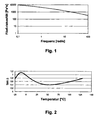
- FIG. 1 Flow viscosity at 130 ° C of 1-BOC
- FIG. 2 DMA measurement of 1-BOC, temperature sweep at 10 rad / s).
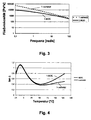
- FIG. 3 Flow viscosity at 130 ° C. Comparison of 1-BOC with 1va). This is a clear indication of a cohesion increase and thus also of a crosslinking on the support. Furthermore, the glass transition temperature of 1va was again measured by a temperature-dependent DMA measurement and compared with the uncrosslinked starting material 1-BOC ( FIG. 4 : Temperature sweep at 10 rad / s. Comparison of 1-BOC with 1va).
- Example 1vb, 2vb and 3vb an increased cohesion, based on the starting polymer, was also measured. Shear life increased significantly. For example, in Example 2vb, the shearing life increased from 75 to 2340 minutes at room temperature and from 40 to 1380 minutes at 70 ° C. Nevertheless, the patterns produced with different crosslinks diverge in shear strength. So, for example, Example 1-BOC, when thermally crosslinked with the aromatic polyisocyanate (1va), for 1940 minutes, and the diepoxide crosslinked product (1vb) only 1560 minutes. This can be explained by the different molecular weight of the crosslinkers and thus also the different network arc length of the crosslinking.
- the pressure-sensitive adhesive tapes produced can be, for example, as "transfer tapes" very good for double-sided bonding use.
- the carrier or release papers who are not changed or destroyed by ionizing radiation are not changed or destroyed by ionizing radiation.
Landscapes
- Chemical & Material Sciences (AREA)
- Health & Medical Sciences (AREA)
- Chemical Kinetics & Catalysis (AREA)
- Medicinal Chemistry (AREA)
- Polymers & Plastics (AREA)
- Organic Chemistry (AREA)
- Adhesives Or Adhesive Processes (AREA)
- Addition Polymer Or Copolymer, Post-Treatments, Or Chemical Modifications (AREA)
- Macromonomer-Based Addition Polymer (AREA)
- Adhesive Tapes (AREA)
- Polyurethanes Or Polyureas (AREA)
- Processes Of Treating Macromolecular Substances (AREA)
Claims (11)
- Mélange de polymères constitué par les composants suivants :a) un copolymère de polyacrylate constitué par les monomères suivantsa1) des esters de l'acide acrylique et/ou de l'acide méthacrylique de la formule suivante
CH2 = C(R1)(COOR2),
où R1 = H ou CH3 et R2 représente une chaîne alkyle comprenant 1 - 20 atomes de carbone,
à raison de 65 - 99% en poids, par rapport à a),a2) des monomères oléfiniquement insaturés avec des groupements fonctionnels,
à raison de 0 - 15% en poids, par rapport à a),a3) des acrylates et/ou des méthacrylates, dont le composant alcool contient des groupements tert-butoxycarbonyle (BOC),
à raison de 1 - 20% en poids, par rapport à a),
à raison de 80 - 99,8% en poids,b) un photo-initiateur régulant la polymérisation
à raison de 0,1 - 15% en poids,c) un isocyanate difonctionnel et/ou un époxyde difonctionnel
à raison de 0,1 - 5% en poids. - Mélange de polymères selon la revendication 1, caractérisé en ce que le composant b) est utilisé à raison de 0,5 - 1,5% en poids et/ou le composant c) à raison de 0,5 - 1% en poids.
- Procédé pour la préparation de polyacrylates réticulés, caractérisé en ce que les polyacrylates, constitués par les monomères suivantsa1) des esters de l'acide acrylique et/ou de l'acide méthacrylique de la formule suivante
CH2 = C(R1)(COOR2),
où R1 = H ou CH3 et R2 représente une chaîne alkyle comprenant 1 - 20 atomes de carbone,
à raison de 65 - 99% en poids,a2) des monomères oléfiniquement insaturés avec des groupements fonctionnels,
à raison de 0 - 15% en poids,a3) des acrylates et/ou des méthacrylates, dont le composant alcool contient des groupements hydroxy,
à raison de 1 - 20% en poids,
sont d'abord protégés par introduction de groupements tert-butoxycarbonyle et la réticulation n'a lieu qu'après la déprotection par traitement thermique des polyacrylates à présent déprotégés. - Procédé pour la préparation de polyacrylates réticulés, caractérisé en ce que les polyacrylates, constitués par les monomères suivantsa1) des esters de l'acide acrylique et/ou de l'acide méthacrylique de la formule suivante
CH2 = C(R1)(COOR2),
où R1 = H ou CH3 et R2 représente une chaîne alkyle comprenant 1 - 20 atomes de carbone,
à raison de 65 - 99% en poids,a2) des monomères oléfiniquement insaturés avec des groupements fonctionnels,
à raison de 0 - 15% en poids,a3) des acrylates et/ou des méthacrylates, dont le composant alcool contient des groupements hydroxy,
à raison de 1 - 20% en poids,
sont d'abord protégés par introduction de groupements tert-butoxycarbonyle et la réticulation n'a lieu qu'après la déprotection par addition de substances de réticulation et traitement thermique des polyacrylates à présent déprotégés. - Procédé pour la préparation de polyacrylates réticulés, caractérisé en ce que les polyacrylates constitués par les monomères suivantsa1) des esters de l'acide acrylique et/ou de l'acide méthacrylique de la formule suivante
CH2=C(R1)(COOR2),
où R1 = H ou CH3 et R2 représente une chaîne alkyle comprenant 1 - 20 atomes de carbone,
à raison de 65 - 99% en poids,a2) des monomères oléfiniquement insaturés avec des groupements fonctionnels,
à raison de 0 - 15% en poids,a3) des acrylates et/ou des méthacrylates, dont le composant alcool contient des groupements hydroxy,
à raison de 1 - 20% en poids,
sont d'abord protégés par introduction de groupements tert-butoxycarbonyle et la réticulation n'a lieu qu'après la déprotection par addition d'isocyanates difonctionnels ou polyfonctionnels et traitement thermique des polyacrylates à présent déprotégés. - Procédé pour la préparation de polyacrylates réticulés, caractérisé en ce que les polyacrylates constitués par les monomères suivantsa1) des esters de l'acide acrylique et/ou de l'acide méthacrylique de la formule suivante
CH2 = C(R1)(COOR2),
où R1 = H ou CH3 et R2 représente une chaîne alkyle comprenant 1 - 20 atomes de carbone,
à raison de 65 - 99% en poids,a2) des monomères oléfiniquement insaturés avec des groupements fonctionnels,
à raison de 0 - 15% en poids,a3) des acrylates et/ou des méthacrylates, dont le composant alcool contient des groupements hydroxy,
à raison de 1 - 20% en poids,
sont d'abord protégés par introduction de groupements tert-butoxycarbonyle et la réticulation n'a lieu qu'après la déprotection par addition d'époxydes difonctionnels ou polyfonctionnels et traitement thermique des polyacrylates à présent déprotégés. - Procédé selon l'une quelconque des revendications 3 à 6, caractérisé en ce que les groupements de protection sont dissociés par irradiation par de la lumière UV.
- Procédé selon l'une quelconque des revendications 3 à 7, caractérisé en ce que le mélange de polymères, pour la dissociation des groupements de protection, est irradié via un cache par de la lumière ultraviolette de telle manière que seules certaines zones du mélange de polymères sont exposées au rayonnement UV.
- Polyacrylate, pouvant être obtenu selon la revendication 8.
- Utilisation d'un mélange de polymères selon l'une quelconque des revendications 1 ou 2 ou d'un polyacrylate préparé selon la revendication 8 comme masse auto-adhésive.
- Utilisation selon la revendication 10 comme masse auto-adhésive pour une bande adhésive, la masse auto-adhésive à base d'acrylate se trouvant sous forme d'un film monoface ou double face sur un support.
Applications Claiming Priority (2)
| Application Number | Priority Date | Filing Date | Title |
|---|---|---|---|
| DE10008841 | 2000-02-25 | ||
| DE10008841A DE10008841A1 (de) | 2000-02-25 | 2000-02-25 | Thermisch vernetzte Acrylat-Hotmelts |
Publications (3)
| Publication Number | Publication Date |
|---|---|
| EP1127907A2 EP1127907A2 (fr) | 2001-08-29 |
| EP1127907A3 EP1127907A3 (fr) | 2002-04-10 |
| EP1127907B1 true EP1127907B1 (fr) | 2008-11-05 |
Family
ID=7632358
Family Applications (1)
| Application Number | Title | Priority Date | Filing Date |
|---|---|---|---|
| EP01102533A Expired - Lifetime EP1127907B1 (fr) | 2000-02-25 | 2001-02-06 | Colle thermofusible d'acrylate thermoréticulable |
Country Status (5)
| Country | Link |
|---|---|
| US (1) | US6875506B2 (fr) |
| EP (1) | EP1127907B1 (fr) |
| JP (1) | JP2001278920A (fr) |
| DE (2) | DE10008841A1 (fr) |
| ES (1) | ES2313915T3 (fr) |
Cited By (1)
| Publication number | Priority date | Publication date | Assignee | Title |
|---|---|---|---|---|
| DE102010054852A1 (de) | 2010-12-17 | 2012-06-21 | Giesecke & Devrient Gmbh | Mehrschichtiges Substrat, Verfahren zum Herstellen desselben und Wertdokument |
Families Citing this family (20)
| Publication number | Priority date | Publication date | Assignee | Title |
|---|---|---|---|---|
| DE10044374A1 (de) * | 2000-09-08 | 2002-08-08 | Tesa Ag | Verfahren zur Vernetzung von Polyacrylaten |
| DE102004044086A1 (de) * | 2004-09-09 | 2006-03-16 | Tesa Ag | Thermisch vernetzte Acrylat-Hotmelts |
| WO2006121869A2 (fr) * | 2005-05-05 | 2006-11-16 | The Board Of Trustees Of The University Of Illinois | Compositions et procedes pour traiter les troubles de l'humeur et de l'angoisse |
| EP1927871B1 (fr) * | 2005-09-20 | 2012-07-25 | Soken Chemical & Engineering Co. Ltd., | Composition adhesive sensible a la pression destinee a une plaque de polarisation et plaque de polarisation dotee d'une couche adhesive sensible a la pression |
| DE102006011113A1 (de) | 2006-03-08 | 2007-09-13 | Tesa Ag | Thermisch vernetzte Acrylat-Hotmelts mit organischen Füllstoffen |
| DE102007016950A1 (de) | 2007-04-05 | 2008-10-09 | Tesa Ag | Thermisch vernetzende Polyacrylate und Verfahren zu deren Herstellung |
| CA2708220C (fr) * | 2007-12-14 | 2016-04-12 | 3M Innovative Properties Company | Procedes de traitement de puits souterrains a l'aide d'additifs modifiables |
| WO2009079315A2 (fr) | 2007-12-14 | 2009-06-25 | 3M Innovative Properties Company | Agrégat de fibres |
| EA027037B1 (ru) * | 2007-12-14 | 2017-06-30 | Шлюмбергер Текнолоджи Б.В. | Способ обработки подземного пласта |
| WO2009079233A2 (fr) * | 2007-12-14 | 2009-06-25 | 3M Innovative Properties Company | Matières solides et utilisations |
| DE102008052625A1 (de) | 2008-10-22 | 2010-04-29 | Tesa Se | Thermisch vernetzende Polyacrylate und Verfahren zu deren Herstellung |
| DE102008059050A1 (de) | 2008-11-26 | 2010-05-27 | Tesa Se | Thermisch vernetzende Polyacrylate und Verfahren zu deren Herstellung |
| JP5696352B2 (ja) * | 2009-06-11 | 2015-04-08 | Jsr株式会社 | 感放射線性樹脂組成物、およびそれに用いる重合体 |
| JP5246101B2 (ja) | 2009-08-20 | 2013-07-24 | 信越化学工業株式会社 | 難燃ポリウレタン樹脂組成物の製造方法 |
| US10005925B2 (en) | 2011-10-19 | 2018-06-26 | 3M Innovative Properties Company | Articles with thin melt coatings and methods for making same |
| US12357828B2 (en) | 2017-12-05 | 2025-07-15 | Ecole Polytechnique Federale De Lausanne (Epfl) | System for planning and/or providing neuromodulation |
| FR3078337B1 (fr) | 2018-02-27 | 2020-08-07 | Arkema France | Utilisation de l'oxyde de magnesium pour la reticulation de polymeres |
| JP7133201B2 (ja) * | 2018-06-06 | 2022-09-08 | 公立大学法人大阪 | 易解体性アクリル系粘着剤及び一対の部材の分離方法 |
| US11718743B2 (en) * | 2019-07-12 | 2023-08-08 | 3D Systems, Inc. | Build materials for 3D printing |
| EP3827875B1 (fr) | 2019-11-27 | 2023-07-05 | ONWARD Medical N.V. | Systeme de neuromodulation |
Family Cites Families (14)
| Publication number | Priority date | Publication date | Assignee | Title |
|---|---|---|---|---|
| DE1720265C3 (de) * | 1967-02-23 | 1975-01-30 | Basf Ag, 6700 Ludwigshafen | Verfahren zur Herstellung von lichtbeständigen Überzügen |
| US3765972A (en) * | 1969-07-14 | 1973-10-16 | Monsanto Co | Process for adhering preformed resinous coverings to architectural surfaces |
| DE2131059A1 (de) | 1971-06-23 | 1972-12-28 | Ppg Industries Inc | Druckempfindliche Klebstoffe und Verfahren zu ihrer Herstellung |
| US4122248A (en) * | 1975-05-31 | 1978-10-24 | Basf Aktiengesellschaft | Manufacture of homogeneous ethylene/tert-butyl acrylate/acrylic acid terpolymers |
| US4128600A (en) * | 1977-01-14 | 1978-12-05 | General Mills Chemicals, Inc. | Interpenetrating dual cure resin compositions |
| US5340946A (en) * | 1985-12-20 | 1994-08-23 | Advanced Interconnection Technology, Inc. | Heat activatable adhesive for wire scribed circuits |
| DE3942232A1 (de) | 1989-12-21 | 1991-06-27 | Beiersdorf Ag | Schmelzhaftkleber auf acrylatbasis |
| JPH0517726A (ja) | 1991-07-09 | 1993-01-26 | Sekisui Chem Co Ltd | 粘着テープ |
| US5418288A (en) * | 1991-07-18 | 1995-05-23 | Mitsui Toatsu Chemicals, Inc. | Isocyanate resin compositions and hot melt and pressure sensitive adhesives based thereon |
| DE4316317C2 (de) * | 1993-05-15 | 1996-09-05 | Lohmann Gmbh & Co Kg | Trägerlose Haftklebebänder mit unterschiedlicher Haftung auf beiden Seiten und Verfahren zu ihrer Herstellung sowie ihre Verwendung |
| DE4414896A1 (de) * | 1994-04-28 | 1995-11-02 | Hoechst Ag | Positiv arbeitendes strahlungempfindliches Gemisch |
| US5721289A (en) * | 1994-11-04 | 1998-02-24 | Minnesota Mining And Manufacturing Company | Stable, low cure-temperature semi-structural pressure sensitive adhesive |
| JP3433017B2 (ja) * | 1995-08-31 | 2003-08-04 | 株式会社東芝 | 感光性組成物 |
| US6103316A (en) * | 1998-07-17 | 2000-08-15 | 3M Innovative Properties Company | Method of making electron beam polymerized emulsion-based acrylate pressure sensitive adhesives |
-
2000
- 2000-02-25 DE DE10008841A patent/DE10008841A1/de not_active Withdrawn
-
2001
- 2001-02-06 EP EP01102533A patent/EP1127907B1/fr not_active Expired - Lifetime
- 2001-02-06 ES ES01102533T patent/ES2313915T3/es not_active Expired - Lifetime
- 2001-02-06 DE DE50114457T patent/DE50114457D1/de not_active Expired - Lifetime
- 2001-02-07 US US09/778,165 patent/US6875506B2/en not_active Expired - Fee Related
- 2001-02-16 JP JP2001040048A patent/JP2001278920A/ja active Pending
Cited By (1)
| Publication number | Priority date | Publication date | Assignee | Title |
|---|---|---|---|---|
| DE102010054852A1 (de) | 2010-12-17 | 2012-06-21 | Giesecke & Devrient Gmbh | Mehrschichtiges Substrat, Verfahren zum Herstellen desselben und Wertdokument |
Also Published As
| Publication number | Publication date |
|---|---|
| DE50114457D1 (de) | 2008-12-18 |
| US20010024764A1 (en) | 2001-09-27 |
| DE10008841A1 (de) | 2001-09-06 |
| EP1127907A2 (fr) | 2001-08-29 |
| ES2313915T3 (es) | 2009-03-16 |
| JP2001278920A (ja) | 2001-10-10 |
| EP1127907A3 (fr) | 2002-04-10 |
| US6875506B2 (en) | 2005-04-05 |
Similar Documents
| Publication | Publication Date | Title |
|---|---|---|
| EP1127907B1 (fr) | Colle thermofusible d'acrylate thermoréticulable | |
| EP1293547B1 (fr) | Procédé de préparation d'adhesifs acryliques thermofusibles par extrusion réactive | |
| DE69914402T2 (de) | Durch Energiestrahl härtbare, hydrophile und druckempfindliche Klebstoffzusammensetzung und deren Verwendung | |
| DE2443414C2 (de) | Verfahren zur Herstellung von selbstklebend ausgerüsteten Produkten | |
| EP1130071B1 (fr) | Mélanges de polymères | |
| EP0436159B1 (fr) | Adhésive sensible à la pression thermofusible à base acrylique | |
| DE69109309T2 (de) | Gegen aktinische Strahlung empfindliche, selbstklebende Klebstoffzusammensetzung. | |
| DE69211360T2 (de) | Strahlungsvernetzte Elastomere | |
| DE60108137T2 (de) | Vernetzbare polymerzusammensetzungen und deren verwendung | |
| EP1127932B1 (fr) | Colles à chaud acryliques structurisées, sensibles à la pression et réticulées par UV | |
| DE2743979C3 (de) | Verfahren zur Herstellung von mit einer Selbstklebemasse auf Basis vernetzter Polyacrylsäure-Derivate beschichteten Produkten | |
| EP3347388B1 (fr) | Masse adhésive modifiée par une résine adhésive | |
| DE69202852T2 (de) | Druckempfindlichen Klebstoff mit ausgezeichneter Wärmebeständigkeit, Klebeband welches diesen Klebstoff verwendet, und Methoden für ihre Herstellung. | |
| EP1294783B1 (fr) | Procede de production de substances auto-adhesives d'acrylate reticulables | |
| EP1297023B1 (fr) | Procede de production de substances auto-adhesives d'acrylate reticulables | |
| EP1370590B1 (fr) | Procede de production de composes autoadhesives acrylates reticules | |
| EP1132419B1 (fr) | Adhésifs à base d' acrylates polaires | |
| WO2002034805A1 (fr) | Procede de preparation de matieres auto-adhesives acrylate | |
| DE69609170T2 (de) | Klebstoffe | |
| DE69307008T2 (de) | Druckempfindliche Klebstoffe mit guter Wärmebeständigkeit, Klebplatten daraus und Verfahren zur deren Herstellung | |
| DE3788491T2 (de) | Energiehärtbare druckempfindliche Klebstoffe und Verfahren zur Herstellung von druckempfindlichen Klebstoffen. | |
| EP1560859A2 (fr) | Adhesif de contact chimiquement inerte a adherence amelioree, son procede de production et son utilisation | |
| DE3232923A1 (de) | Haftkleber auf basis ethylenisch ungesaettigter verbindungen | |
| WO2002031076A1 (fr) | Utilisation de phosphates en tant que plastifiants pour des adhesifs thermofusibles de type acrylate |
Legal Events
| Date | Code | Title | Description |
|---|---|---|---|
| PUAI | Public reference made under article 153(3) epc to a published international application that has entered the european phase |
Free format text: ORIGINAL CODE: 0009012 |
|
| AK | Designated contracting states |
Kind code of ref document: A2 Designated state(s): DE ES FR GB IT Kind code of ref document: A2 Designated state(s): AT BE CH CY DE DK ES FI FR GB GR IE IT LI LU MC NL PT SE TR |
|
| AX | Request for extension of the european patent |
Free format text: AL;LT;LV;MK;RO;SI |
|
| RAP1 | Party data changed (applicant data changed or rights of an application transferred) |
Owner name: TESA AG |
|
| PUAL | Search report despatched |
Free format text: ORIGINAL CODE: 0009013 |
|
| AK | Designated contracting states |
Kind code of ref document: A3 Designated state(s): AT BE CH CY DE DK ES FI FR GB GR IE IT LI LU MC NL PT SE TR |
|
| AX | Request for extension of the european patent |
Free format text: AL;LT;LV;MK;RO;SI |
|
| 17P | Request for examination filed |
Effective date: 20021010 |
|
| AKX | Designation fees paid |
Free format text: DE ES FR GB IT |
|
| 17Q | First examination report despatched |
Effective date: 20030926 |
|
| RAP1 | Party data changed (applicant data changed or rights of an application transferred) |
Owner name: TESA AG |
|
| GRAP | Despatch of communication of intention to grant a patent |
Free format text: ORIGINAL CODE: EPIDOSNIGR1 |
|
| RIN1 | Information on inventor provided before grant (corrected) |
Inventor name: HUSEMANN, MARC, DR. Inventor name: ZOELLNER, STEPHAN |
|
| GRAS | Grant fee paid |
Free format text: ORIGINAL CODE: EPIDOSNIGR3 |
|
| GRAA | (expected) grant |
Free format text: ORIGINAL CODE: 0009210 |
|
| AK | Designated contracting states |
Kind code of ref document: B1 Designated state(s): DE ES FR GB IT |
|
| REG | Reference to a national code |
Ref country code: GB Ref legal event code: FG4D Free format text: NOT ENGLISH |
|
| REF | Corresponds to: |
Ref document number: 50114457 Country of ref document: DE Date of ref document: 20081218 Kind code of ref document: P |
|
| REG | Reference to a national code |
Ref country code: ES Ref legal event code: FG2A Ref document number: 2313915 Country of ref document: ES Kind code of ref document: T3 |
|
| RAP2 | Party data changed (patent owner data changed or rights of a patent transferred) |
Owner name: TESA SE |
|
| PLBE | No opposition filed within time limit |
Free format text: ORIGINAL CODE: 0009261 |
|
| STAA | Information on the status of an ep patent application or granted ep patent |
Free format text: STATUS: NO OPPOSITION FILED WITHIN TIME LIMIT |
|
| 26N | No opposition filed |
Effective date: 20090806 |
|
| REG | Reference to a national code |
Ref country code: FR Ref legal event code: CJ Ref country code: FR Ref legal event code: CD |
|
| PGFP | Annual fee paid to national office [announced via postgrant information from national office to epo] |
Ref country code: ES Payment date: 20100222 Year of fee payment: 10 |
|
| PGFP | Annual fee paid to national office [announced via postgrant information from national office to epo] |
Ref country code: IT Payment date: 20100223 Year of fee payment: 10 Ref country code: FR Payment date: 20100226 Year of fee payment: 10 |
|
| PGFP | Annual fee paid to national office [announced via postgrant information from national office to epo] |
Ref country code: GB Payment date: 20100218 Year of fee payment: 10 |
|
| REG | Reference to a national code |
Ref country code: ES Ref legal event code: PC2A Owner name: TESA SE Effective date: 20110415 |
|
| GBPC | Gb: european patent ceased through non-payment of renewal fee |
Effective date: 20110206 |
|
| REG | Reference to a national code |
Ref country code: FR Ref legal event code: ST Effective date: 20111102 |
|
| PG25 | Lapsed in a contracting state [announced via postgrant information from national office to epo] |
Ref country code: IT Free format text: LAPSE BECAUSE OF NON-PAYMENT OF DUE FEES Effective date: 20110206 |
|
| PG25 | Lapsed in a contracting state [announced via postgrant information from national office to epo] |
Ref country code: FR Free format text: LAPSE BECAUSE OF NON-PAYMENT OF DUE FEES Effective date: 20110228 |
|
| PG25 | Lapsed in a contracting state [announced via postgrant information from national office to epo] |
Ref country code: GB Free format text: LAPSE BECAUSE OF NON-PAYMENT OF DUE FEES Effective date: 20110206 |
|
| REG | Reference to a national code |
Ref country code: ES Ref legal event code: FD2A Effective date: 20120411 |
|
| PG25 | Lapsed in a contracting state [announced via postgrant information from national office to epo] |
Ref country code: ES Free format text: LAPSE BECAUSE OF NON-PAYMENT OF DUE FEES Effective date: 20110207 |
|
| REG | Reference to a national code |
Ref country code: DE Ref legal event code: R081 Ref document number: 50114457 Country of ref document: DE Owner name: TESA SE, DE Free format text: FORMER OWNER: TESA SE, 20253 HAMBURG, DE |
|
| PGFP | Annual fee paid to national office [announced via postgrant information from national office to epo] |
Ref country code: DE Payment date: 20190219 Year of fee payment: 19 |
|
| REG | Reference to a national code |
Ref country code: DE Ref legal event code: R119 Ref document number: 50114457 Country of ref document: DE |
|
| PG25 | Lapsed in a contracting state [announced via postgrant information from national office to epo] |
Ref country code: DE Free format text: LAPSE BECAUSE OF NON-PAYMENT OF DUE FEES Effective date: 20200901 |