EP1128532A2 - Gleichstrom-Gleichstromwandlerschaltung, Stromversorgungsauswahlschaltung und Gerät - Google Patents
Gleichstrom-Gleichstromwandlerschaltung, Stromversorgungsauswahlschaltung und Gerät Download PDFInfo
- Publication number
- EP1128532A2 EP1128532A2 EP00310022A EP00310022A EP1128532A2 EP 1128532 A2 EP1128532 A2 EP 1128532A2 EP 00310022 A EP00310022 A EP 00310022A EP 00310022 A EP00310022 A EP 00310022A EP 1128532 A2 EP1128532 A2 EP 1128532A2
- Authority
- EP
- European Patent Office
- Prior art keywords
- power supply
- voltage
- circuit
- section
- converter
- Prior art date
- Legal status (The legal status is an assumption and is not a legal conclusion. Google has not performed a legal analysis and makes no representation as to the accuracy of the status listed.)
- Granted
Links
Images




Classifications
-
- H—ELECTRICITY
- H02—GENERATION; CONVERSION OR DISTRIBUTION OF ELECTRIC POWER
- H02M—APPARATUS FOR CONVERSION BETWEEN AC AND AC, BETWEEN AC AND DC, OR BETWEEN DC AND DC, AND FOR USE WITH MAINS OR SIMILAR POWER SUPPLY SYSTEMS; CONVERSION OF DC OR AC INPUT POWER INTO SURGE OUTPUT POWER; CONTROL OR REGULATION THEREOF
- H02M1/00—Details of apparatus for conversion
- H02M1/10—Arrangements incorporating converting means for enabling loads to be operated at will from different kinds of power supplies, e.g. from AC or DC
Definitions
- the present invention relates to a DC-DC converter circuit for converting a DC voltage to another DC voltage, a power supply selection circuit for selecting one of a plurality of power supplies, and an apparatus provided with such a DC-DC converter circuit.
- such an apparatus incorporates therein a circuit for selecting whether electric power obtained from a commercial power supply or electric power obtained from a battery is to be used for operation of the apparatus (for example, Japanese Patent Laid Open Gazette Hei.9-182288, and Japanese Patent Laid Open Gazette Hei.9-308102).
- a circuit for selecting whether electric power obtained from a commercial power supply or electric power obtained from a battery is to be used for operation of the apparatus for example, Japanese Patent Laid Open Gazette Hei.9-182288, and Japanese Patent Laid Open Gazette Hei.9-308102.
- the power supply switching circuit As another type of the power supply switching circuit, there is also known a power supply switching circuit arranged in such a manner that in view of the fact that electric power obtained from the commercial power supply is generally higher in voltage than the battery, the supply of power is performed from the source having the highest voltage.
- an apparatus is provided with a DC-DC converter circuit for maintaining the voltage of the electric power to be used in the apparatus .
- Fig. 7 is a circuit diagram showing a first example of a linear regulator.
- the linear regulator is a sort of a DC-DC converter circuit and is generally widely used.
- a linear regulator section 10 is provided on an LSI having an input terminal IN through which electric power of an input voltage Vin is applied.
- the linear regulator section 10 converts the electric power of the input voltage Vin to an output voltage Vout (Vin > Vout) which is lower than the input voltage Vin, and outputs the electric power of the output voltage Vout through an output terminal OUT.
- an NPN transistor 11 for output voltage control is disposed, and between the input terminal IN and a base of the NPN transistor 11, a constant current source 12 is disposed.
- a current outputted from the constant current source 12 conducts through the base of the NPN transistor 11 in the form of a base current thereof, and further conducts through a collector of an additional NPN transistor 13 in the form of a collector current thereof.
- An emitter of the NPN transistor 13 is connected to a ground terminal GND which is grounded.
- the output voltage Vout of the output terminal OUT is fed to a positive input terminal of a differential amplifier 16 through a potential divider formed by two resistances 14 and 15, while a reference voltage generated by a reference voltage source 17 is fed to a negative input terminal of the differential amplifier 16.
- An output terminal of the differential amplifier 16 is connected to a base of the NPN transistor 13.
- Fig. 8 is a circuit diagram showing a second example of a linear regulator. This differs from the circuit of Fig. 7 as follows.
- a linear regulator 10' shown in Fig. 8 is provided with a PNP transistor 18 for output voltage control, instead of the NPN transistor 11 for output voltage control in the linear regulator 10 shown in Fig. 7.
- the output voltage Vout of the output terminal OUT is fed to the negative input terminal of the differential amplifier 16 through a potential divider formed by the two resistances 14 and 15, while the reference voltage generated by the reference voltage source 17 is fed to the positive input terminal of the differential amplifier 16.
- the output voltage of the differential amplifier 16 is lowered, so that the collector current of the NPN transistor 13 is decreased. That is, of the current outputted from the constant current source 12, current used as the collector current of the NPN transistor 13 is decreased, and as a result, the base current of the PNP transistor 18 is reduced and thereby the output voltage Vout of the output terminal OUT is lowered.
- Vout becomes lower than the predetermined reference output voltage
- the output voltage of the differential amplifier 16 goes up, so that the collector current of the NPN transistor 13 is increased. That is, the base current of the PNP transistor 18 is increased and thereby the output voltage Vout of the output terminal OUT is increased (restored).
- Fig. 9 is a circuit diagram showing a third example of a linear regulator.
- a main difference from the second example of the linear regulator shown in Fig. 8 is that the PNP transistor 18 is replaced by a P channel MOSFET transistor 19.
- circuit operation is the same as that of the second example shown in Fig. 8, and thus the explanation of the third example will be omitted.
- Fig. 10 is a circuit diagram showing an example of a switching regulator.
- the switching regulator 20 is also a sort of DC-DC converter circuit and is generally widely used.
- Electric power of voltage Vin is fed through an input terminal IN of the switching regulator, and electric power of output voltage Vout (here dealing with a step-down type and thus Vin > Vout) is outputted from a second output terminal OUT 2, of first and second output terminals OUT 1 and OUT 2. Between the first and second output terminals OUT 1 and OUT 2, an external coil 31 is connected. Between the second output terminals OUT 2 and the ground, an external capacitance 32 is connected.
- a P channel MOS transistor 21 is disposed between the input terminal IN and the output terminal OUT 1, a P channel MOS transistor 21 is disposed.
- An output of a PWM comparator 26 is connected to a gate of the P channel MOS transistor 21.
- An output of a differential amplifier 24 and an output of a triangle wave generator 27 are fed to the PWM comparator 26.
- the PWM comparator 26 will be described later.
- the voltage Vout of the second output terminal OUT2 is fed to a negative input terminal of the differential amplifier 24 through a potential divider formed by two resistances 22 and 23, while a reference voltage generated by a reference voltage source 25 is fed to a positive input terminal of the differential amplifier 24.
- a diode 28 is connected between the first output terminal OUT 1 and a ground terminal GND which is grounded.
- the cathode of the diode 28 is connected to the first output terminal OUT 1, and the anode of the diode 28 is connected to the ground terminal GND.
- the PWM comparator 26 compares an output voltage of the differential amplifier 24 with a triangle wave signal outputted from the triangle wave generator 27. When the output voltage of the differential amplifier 24 is lower in voltage than the triangle wave signal, the PWM comparator 26 generates a pulse signal of 'H' level. When the output voltage of the differential amplifier 24 is higher in voltage than the triangle wave signal, the PWM comparator 26 generates a pulse signal of 'L' level. Such a pulse signal is fed to the gate of the MOS transistor 21, so that the MOS transistor 21 turns on or off in accordance with a variation between 'H' level and 'L' level of the pulse signal. That is, the MOS transistor 21 switches the input voltage Vin at the same repetitive frequency as that of the triangle wave signal.
- the diode 28, the coil 31 and the capacitance 32 smoothes the input voltage Vin after the switching and generates the output voltage Vout.
- the switching regulator 20 controls the electric power to he outputted at a constant voltage Vout.
- an electronic apparatus for example, a personal computer
- a plurality of circuit units which are operative with mutually different DC voltages, exist in the apparatus .
- Such an apparatus is provided with a plurality of DC-DC converter circuits which output electric power of individual voltages, respectively.
- Disadvantages of DC-DC converter circuits are that a great deal of electric power is consumed for conversion of DC voltages. Therefore, power is wasted, the consumption of battery power is hastened, and the temperature of the apparatus rises.
- the conversion efficiency is 20%, and the remaining 80% is a power loss.
- the conversion efficiency is 20%, and the remaining 80% is a power loss.
- a DC-DC converter circuit having a plurality of input terminals each for connection to one of a plurality of DC power supplies, and an output terminal, said first DC-DC converter circuit comprising:
- the conversion efficiency is 20% for a conversion of 16V to 3.3V.
- the conversion efficiency is 66% for the same conversion. In this manner, when an output voltage is obtained from an input voltage which is as close to the output voltage as possible, it is possible to greatly improve the conversion efficiency. This is applicable also to the switching regulator scheme as well as the linear regulator scheme.
- the first aspect DC-DC converter circuit according to the present invention utilizes this principle as mentioned above.
- the power supply selection section selects a DC power supply of the lowest voltage from among a plurality of DC power supplies, and inputs the selected input voltage to the regulator section.
- the regulator section converts the voltage of the DC power supply thus selected to a DC voltage lower than the voltage of the selected DC power supply.
- a DC-DC converter circuit having a first input terminal connected to a predetermined first DC power supply, and a second input terminal connected to a predetermined second DC power supply which has a voltage lower than a voltage of said first DC power supply, and an output terminal, said DC-DC converter circuit comprising:
- the voltage of the second DC power supply entered through the second input terminal is lower, or it is arranged that the second input terminal is connected to a DC power supply (second DC PSU) having a lower voltage, it is possible to simplify the power supply selection section in structure taking into account the idea of the first aspect DC-DC converter circuit of the present invention.
- said regulator section may comprise a linear regulator.
- said power supply selection section and said regulator section comprising the linear regulator are arranged in an integrated circuit.
- said power supply selection circuit and portions of said regulator section comprising the linear regulator are arranged in an integrated circuit (IC), with the exception of an output voltage control transistor which is located outside the IC.
- said regulator section may comprise a switching regulator.
- said power supply selection section and portions of said regulator section comprising the switching regulator are arranged in an IC, with the exception of a voltage smoothing circuit portion which is located outside the IC.
- a power supply selection circuit comprising:
- a power supply selection circuit comprising:
- the third and fourth aspect power supply selection circuits correspond to the power supply selection sections of the first and second aspect DC-DC converter circuits, respectively.
- the DC-DC converter circuits corresponding to the regulator sections of the first and second aspect DC-DC converter circuits can be connected to the later stages of the third and fourth power supply selection circuits, respectively. This feature makes it possible to perform a highly efficient DC-DC conversion for the DC-DC converter circuits.
- a DC-DC converter having a plurality of input terminals connected to respective DC power supplies, and an output terminal, said DC-DC converter circuit comprising: a power supply selection section for selecting the lowest-voltage DC power supply among those of said DC power supplies not less than a predetermined voltage; and a step-down type regulator section for converting the voltage of the selected DC power supply into a lower predetermined voltage, and outputting the lower predetermined voltage through said output terminal.
- the apparatus of the present invention as mentioned above is provided with first and second DC-DC converters.
- the second DC-DC converter which outputs the lower DC voltage, is arranged with the DC-DC converter circuit of the first or second aspect. This feature makes it possible to perform an efficient DC-DC conversion, reduce power consumption and suppress temperature rise of the apparatus.
- the DC-DC converter circuit of the second aspect of the present invention may be used as the second DC-DC converter.
- the power supply selection section of the second DC-DC converter serves to block both the path for transmitting the output of the first DC-DC converter to the regulator section and the path for transmitting the voltage of the first DC power supply to the regulator section, when the first DC power supply is less than a predetermined voltage, in the event that the output of the first DC-DC converter is less than a predetermined voltage.
- Fig. 10 is a circuit diagram showing an example of a switching regulator.
- Fig. 1 is a circuit diagram of a first embodiment of a DC-DC converter circuit according to the present invention, including a first embodiment of a power supply selection circuit according to the present invention.
- a DC-DC converter circuit 100 shown in Fig. 1 comprises an input selection circuit 110 and a linear regulator 10.
- the DC-DC converter circuit 100 is incorporated into an LSI chip 190 in its entirety.
- the input selection circuit 110 is an embodiment of a power supply selection circuit of the present invention.
- the input selection circuit 110 is provided with two input terminals IN1 and IN2 to which DC supplies are connected, respectively. Input voltages Vin1 and Vin2 are applied through the input terminals IN1 and IN2, respectively.
- the input selection circuit 110 between the input terminals (IN1 and IN2) and node TML, can be separated from the linear regulator section 10 (for example by incorporating the input selection circuit 110 into an LSI).
- the node TML is an output terminal of the input selection circuit 110 and transfers signals from the input selection circuit 110 to the linear regulator section 10, the anodes of the diodes 111 and 112 are connected to the input terminals IN1 and IN2, respectively, and the inputs of P channel transistors 113 and 114 are connected to the cathodes of the diodes 111 and 112, respectively.
- Input sides of the P channel MOS transistors 113 and 114 are also connected via resistances 115 and 116 to their gates, respectively. Between the gates of the P channel MOS transistors 113 and 114 and a ground terminal GND, N channel MOS transistors 117 and 118 are disposed, respectively. The ground terminal GND is grounded.
- the input selection circuit 110 is further provided with first, second and third comparators 121, 122 and 123, and a reference voltage source 124.
- a positive input terminal of the first comparator 121 is connected to a cathode of the diode 111, and a negative input terminal of the first comparator 121 is connected to the reference voltage source 124.
- a positive input terminal of the second comparator 122 is connected to a cathode of the diode 112, and a negative input terminal of the second comparator 122 is connected to the cathode of the diode 111.
- a positive input terminal of the third comparator 123 is connected to the reference voltage source 124, and a negative input terminal of the third comparator 123 is connected to the cathode of the diode 112.
- Outputs of the three comparators 121, 122 and 123 are transmitted via a first logical circuit 133 comprising an AND gate 131 and an OR gate 132 to the N channel MOS transistor 117, and further transmitted via a second logical circuit 136 comprising an OR gate 134 and a NAND gate 135 to another N channel MOS transistor 118.
- the first comparator 121 compares voltage Vin1 of the first input terminal IN1 with the voltage of the reference voltage source 124, and determines as to whether the voltage Vin1 of the first input terminal IN1 is higher than the voltage of the reference voltage source 124. In other words, it is determined as to whether the reference voltage source 124 is connected to the first input terminal IN1.
- the third comparator 123 compares voltage Vin2 of the second input terminal IN2 with the voltage of the reference voltage source 124, and determines as to whether the voltage Vin2 of the second input terminal IN2 is higher than the voltage of the reference voltage source 124. In other words, it is determined as to whether the reference voltage source 124 is surely connected to the second input terminal IN2.
- the second comparator 122 is different from the first comparator 121 and the third comparator 123, and compares the voltage Vin1 of the first input terminal IN1 with the voltage Vin2 of the second input terminal IN2.
- the first logical circuit 133 When the voltage Vin1 of the first input terminal IN1 exceeds the reference voltage and Vin1 ⁇ Vin2, the first logical circuit 133 generates an 'H' level signal, so that the NMOS transistor 117 conducts and whereby the gate of the PMOS transistor 113 goes down to the potential of the ground side. Thus,the PMOS transistor 113 turns on, so that the voltage Vin1 of the first input terminal IN1 is transmitted via the node TML to the linear regulator section 10. At that time, the output (the gate of the NMOS transistor 118) of the second logical circuit 136 outputs an 'L' level signal, so that the NMOS transistor 118 turns off. Thus the PMOS transistor 114 also turns off, so that the voltage Vin2 of the second input terminal IN2 is not transmitted to the linear regulator section 10.
- Vin1 5.0V
- Vin2 16.0V
- the efficiency of the linear regulator section 10 is 66%.
- the output of the first logical circuit 133 outputs an 'L' level, and the second logical circuit 136 generates a 'H' level.
- the NMOS transistor 117 and the PMOS transistor 113 turn off, so that transfer of Vin1 to the linear regulator section 10 is inhibited, and the NMOS transistor 118 and the PMOS transistor 114 turn on, so that Vin2 is transferred to the linear regulator section 10.
- Vin1 16.0V
- Vin2 5.0V
- the linear regulator section 10 outputs voltage of 3.3V
- the efficiency of the linear regulator section 10 is 66%.
- the first, second and third comparators 121, 122 and 123 provide 'H' level, 'L' level, and 'H' level signals, respectively, so that the first logical circuit 133 generates an 'H' level signal, and the second logical circuit 136 generates an 'L' level signal.
- the NMOS transistor 117 conducts and the PMOS transistor 113 also conducts.
- the NMOS transistor 118 turns off and the PMOS transistor 114 also turns off. Consequently, in this case, the voltage Vin1 entered through the first input terminal IN1 is transmitted to the linear regulator section 10.
- the first, second and third comparators 121, 122 and 123 provide 'L' level, 'H' level, and 'L' level signals, respectively, so that the first logical circuit 133 generates an 'L' level signal, and the second logical circuit 136 generates an 'H' level signal.
- the NMOS transistor 117 turns off and the PMOS transistor 113 also turns off.
- the NMOS transistor 118 turns on and the PMOS transistor 114 also turns on. Consequently, in this case, the voltage Vin2 entered through the second input terminal IN2 is transmitted to the linear regulator section 10.
- Fig. 2 is a circuit diagram of a second embodiment of a DC-DC converter circuit according to the present invention, including a second embodiment of a power supply selection circuit according to the present invention.
- a DC-DC converter circuit 200 shown in Fig. 2 comprises an input selection circuit 210 which is more simplified in structure as compared with the input selection circuit 110 according to the first embodiment shown in Fig. 1, and a linear regulator section 10 which has the same structure as the linear regulator section 10 according to the first embodiment shown in Fig. 1.
- the DC-DC converter circuit 200 is incorporated into an LSI chip 290 in its entirety.
- the DC-DC converter circuit 200 is a circuit wherein it is intended to receive input voltages Vin1 and Vin2 through the input terminals IN1 and IN2, respectively, ensuring Vin1 > Vin2.
- Assurance of Vin1 > Vin2 may be implemented by means of, for example, differentiating types of connector, or fixedly wiring the respective connectors in an apparatus beforehand.
- the input selection circuit (an example of the power supply selection circuit referred to in the present invention) is arranged in the form of a circuit separate from the linear regulator section 10 (for example, only the input selection circuit 210 is provided on one LSI chip)
- the node TML is an output terminal of the input selection circuit 210.
- the gate of the PMOS transistor 213 is connected via a resistance 215 to the diode 211.
- an NMOS transistor 217 is disposed. The ground terminal GND is grounded.
- a diode 212 of which an anode is connected to the input terminal IN2 is disposed.
- a cathode of the diode 212 is connected to a negative input terminal of a comparator 221.
- a reference voltage source 224 is connected to a positive input terminal of the comparator 221.
- An output of the comparator 221 is connected to a gate of the NMOS transistor 217.
- the comparator 221 compares the voltage Vin2 of the input terminal IN2 with a reference voltage obtained by the reference voltage source 224. This comparison is for a determination as to whether the reference voltage source 224 is surely connected to the second input terminal IN2.
- the output of the comparator 221 When the voltage Vin2 is higher than the reference voltage, the output of the comparator 221 outputs an 'L' level, so that the NMOS transistor 217 turns off. Thus, the PMOS transistor 213 also turns off. As a result, the voltage Vin1 of the first input terminal IN1 is not transmitted to the linear regulator section 10, but the voltage Vin2 of the second input terminal IN2 is transmitted to the linear regulator section 10.
- the output of the comparator 221 generates an 'H' level, so that the NMOS transistor 217 turns on.
- the PMOS transistor 213 also turns on.
- the voltage Vin1 of the first input terminal IN1 is transmitted to the linear regulator section 10.
- the input selection circuit 210 shown in Fig. 2 is effective in the event that the condition of Vin1 > Vin2 is satisfied.
- the voltage Vin2 is effective, the voltage Vin2 is transmitted to the linear regulator section 10.
- the voltage Vin2 is not effective (e.g. 0V), the voltage Vin1 is transmitted to the linear regulator section 10.
- the linear regulator section 10 is the same as the linear regulator section shown in Fig. 1 in structure, and generates the stabilized output voltage Vout lower than voltages Vin1 and Vin2 of the input terminals IN1 and IN2, and outputs the same through the output terminal OUT.
- Fig. 3 is a circuit diagram of a third embodiment of a DC-DC converter circuit according to the present invention. There will be described different points from the second embodiment shown in Fig. 2.
- DC-DC converter circuit 300 (Fig. 3) and DC-DC converter circuit 200 of the second embodiment shown in Fig. 2 is that a portion excepting an NPN transistor 11 of the output voltage control section constituting the linear regulator section 10 is incorporated into an LSI chip 290 in the DC-DC converter 200, and the NPN transistor 11 is disposed outside an LSI chip 390 in the DC-DC converter 300.
- the LSI chip 390 needs two output terminals OUT1 and OUT2 in addition to an output terminal OUT3 corresponding to the output terminal OUT in the second embodiment shown in Fig. 2.
- the operation of the circuit is the same as that of the second embodiment shown in Fig. 2, and thus its explanation will be omitted.
- the reason why the transistor 11 is disposed outside the LSI chip 390 is as follows.
- the DC-DC converter circuit 300 is of a large current capacity so that the secondary end thereof is permitted to consume a very large electric power, and thus as the transistor 11, there is a need to use a transistor which is capable of withstanding consumption of the large electric power.
- a transistor of large capacity is needed as the transistor 11, and in addition, there is a need to perform a heat radiation by installing, for example, a heat sink and the like. That is, the transistor 11 is not suitable for incorporation into the LSI chip.
- a transistor for the output voltage control is mounted outside.
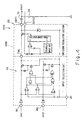
- Fig. 4 is a circuit diagram of a fourth embodiment of a DC-DC converter circuit according to the present invention.
- a DC-DC converter circuit 400 shown in Fig. 4 also comprises an input selection circuit 110, which is the first embodiment of the power supply selection circuit of the present invention also shown in Fig. 1, and a switching regulator section 20 which is the same as the switching regulator shown in Fig. 10.
- the circuit operation of the input selection circuit 110 and the switching regulator section 20 has been already explained, and thus its explanation will be omitted here.
- the DC-DC converter circuit 400 shown in Fig. 4 is incorporated into an LSI chip 490, except for a coil 31 and a capacitance 32, which are part of the switching regulator 20.
- the coil 31 and the capacitance 32 are considerably large and are not suitable for being incorporated into the LSI chip.
- the input selection circuit 110 receives two input voltages Vin1 and Vin2 (either of the input voltages Vin1 and Vin2 may be low voltages) applied through the two input terminals IN1 and IN2, respectively.
- the lower voltage is applied to a switching regulator section 20 on the condition that the lower voltage is not less than the reference voltage.
- the switching regulator section 20 is of a step-down type of regulator for generating an output voltage Vout which is lower than the voltages Vin1 and Vin2.
- the output voltage Vout is generated in accordance with the lower input voltage (of course, it is not less than the output voltage Vout).
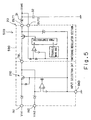
- Fig. 5 is a circuit diagram of a fifth embodiment of a DC-DC converter circuit according to the present invention.
- a DC-DC converter circuit 500 shown in Fig. 5 comprises the input selection circuit 210 corresponding to the second embodiment of the power supply selection circuit of the present invention shown in Fig. 2, and the switching regulator section 20 which is the same as the switching regulator section 20 shown in Fig. 20.
- the circuit operation of the input selection circuit 210 and the switching regulator section 20 have already been explained, and thus their explanation will be omitted here.
- the DC-DC converter circuit 500 shown in Fig. 5 is incorporated into an LSI chip 590, except for a coil 31 and a capacitance 32, which are part of the switching regulator section 20, similar to the fourth embodiment shown in Fig. 4.
- the input selection circuit 110 when the source is provided to both input terminals IN1 and IN2, it is always ensured that Vin1 > Vin2 is satisfied. As long as the requirement of Vin1 > Vin2 is satisfied, in the event that the input voltage Vin2 is not less than a predetermined reference voltage, the input voltage Vin2 is transmitted to the switching regulator section 20. On the other hand, in the event that the input voltage Vin2 is not more than the predetermined reference voltage, the input voltage Vin1 is transmitted to the switching regulator section 20. Therefore, in the switching regulator section 20, it is possible to perform a high efficiency DC-DC conversion.
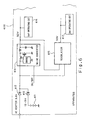
- Fig. 6 is a block diagram showing an embodiment of an apparatus according to the present invention.
- An apparatus 600 for example, a personal computer, is supplied with DC power of 16.0 V generated from a commercial power supply in the external AC adapter (not illustrated), and DC power of 12 to 9 V generated from an internal battery 611, through diodes 612 and 613, respectively.
- the DC voltage (16.0 V) from the external AC adapter is higher than the voltage (12 to 9 V) of the battery.
- the power from the battery is not supplied to the apparatus by the effect of the diode 613.
- no power is supplied from the AC adapter, and the apparatus is operative, power is supplied from the battery 611.
- the power from the AC adapter or the battery 611 is fed to a DC-DC converter 614 (an example of the first DC-DC converter referred to in the present invention) and a regulator 615 (an example of the second DC-DC converter referred to in the present invention).
- a DC-DC converter 614 an example of the first DC-DC converter referred to in the present invention
- a regulator 615 an example of the second DC-DC converter referred to in the present invention.
- the DC-DC converter 614 generates 5.0V (volts) in accordance with the input power and supplies the same to a first operating circuit 616.
- the first operating circuit 616 is driven by the 5.0V generated from the DC-DC converter 614.
- the DC-DC converter 614 receives a control signal (an on/off signal) for turning on and off the DC-DC converter, so that the DC-DC converter 614 may stop in operation for the purpose of saving power when there is no need to operate the first operating circuit 616.
- the regulator 615 receives the 5.0V generated from the DC-DC converter 614 as well as power from the AC adapter or the battery 611, and generates 3.3V in accordance with lower power of the received two types of power.
- the 3.3V generated from the regulator 615 is supplied to a second operating circuit 617.
- the second operating circuit 617 is activated by the 3.3V supplied from the regulator 615.
- the second operating circuit 617 comprises circuits and the like which are needed to be kept operating on an interruptible power supply basis.
- any one of the above-mentioned embodiments as to the DC-DC converter circuit is adopted, for example, typically, the DC-DC converter circuit shown in Fig. 2 is adopted in view of the matter that it is wired beforehand since it is incorporated into the apparatus.
- the regulator 615 When the DC-DC converter 614 is operated, and the 5.0V generated from the DC-DC converter 614 is fed to the regulator 615, the regulator 615 generates 3.3V in accordance with the 5.0V. When the DC-DC converter 614 stops the operation, the regulator 615 generates 3.3V in accordance with the 16.0V from the AC adapter or the 12 to 9V from the battery 611 when the AC adapter is not connected.
- the regulator 615 is so arranged that when the DC-DC converter 614 is operated, the 3.3V is generated from the 5.0V generated from the DC-DC converter 614.
- the power from the AC adapter or the battery is used, it is possible to save power.
- the input and the output of the DC-DC converter 614 can be connected to either one of the two input terminals of the regulator 615. This feature makes the wiring work easy, and also may prevent such a wiring error that two types of wiring are erroneously replaced.
Landscapes
- Engineering & Computer Science (AREA)
- Power Engineering (AREA)
- Dc-Dc Converters (AREA)
- Continuous-Control Power Sources That Use Transistors (AREA)
- Direct Current Feeding And Distribution (AREA)
- Control Of Voltage And Current In General (AREA)
Applications Claiming Priority (2)
| Application Number | Priority Date | Filing Date | Title |
|---|---|---|---|
| JP2000044091A JP3696470B2 (ja) | 2000-02-22 | 2000-02-22 | Dc−dc変換回路、電源選択回路、および機器装置 |
| JP2000044091 | 2000-02-22 |
Publications (3)
| Publication Number | Publication Date |
|---|---|
| EP1128532A2 true EP1128532A2 (de) | 2001-08-29 |
| EP1128532A3 EP1128532A3 (de) | 2002-11-27 |
| EP1128532B1 EP1128532B1 (de) | 2006-08-02 |
Family
ID=18566911
Family Applications (1)
| Application Number | Title | Priority Date | Filing Date |
|---|---|---|---|
| EP00310022A Expired - Lifetime EP1128532B1 (de) | 2000-02-22 | 2000-11-10 | Gleichstrom-Gleichstromwandlerschaltung, Stromversorgungsauswahlschaltung und Gerät |
Country Status (4)
| Country | Link |
|---|---|
| US (3) | US6404076B1 (de) |
| EP (1) | EP1128532B1 (de) |
| JP (1) | JP3696470B2 (de) |
| DE (1) | DE60029741T2 (de) |
Cited By (2)
| Publication number | Priority date | Publication date | Assignee | Title |
|---|---|---|---|---|
| WO2005008355A1 (en) * | 2003-07-04 | 2005-01-27 | Ricoh Company, Ltd. | Semiconductor device with high-breakdown-voltage regulator |
| DE102006054547A1 (de) * | 2006-10-10 | 2008-05-15 | Infineon Technologies Ag | Schaltungsanordnung und Verfahren zur Spannungsregelung |
Families Citing this family (59)
| Publication number | Priority date | Publication date | Assignee | Title |
|---|---|---|---|---|
| JP3696470B2 (ja) * | 2000-02-22 | 2005-09-21 | 富士通株式会社 | Dc−dc変換回路、電源選択回路、および機器装置 |
| US6646424B2 (en) * | 2001-12-21 | 2003-11-11 | Micrel, Incorporated | Apparatus for converting voltage with regulator |
| JP3686042B2 (ja) * | 2002-02-06 | 2005-08-24 | 株式会社リコー | 直流安定化電源装置 |
| US6801027B2 (en) | 2002-09-26 | 2004-10-05 | Itt Manufacturing Enterprises, Inc. | Power conversion in variable load applications |
| JP3852399B2 (ja) * | 2002-11-29 | 2006-11-29 | 株式会社リコー | 電源切替回路 |
| EP1439443B9 (de) * | 2003-01-14 | 2016-01-20 | Infineon Technologies AG | Schaltung zur Spannungsversorgung und Verfahren zur Erzeugung einer Versorgungsspannung |
| US7031463B2 (en) * | 2003-02-14 | 2006-04-18 | Arris International, Inc. | Resistive feed rail generation in a power supply |
| US6969972B2 (en) * | 2003-06-06 | 2005-11-29 | Texas Instruments Incorporated | Architecture for switching between an external and internal power source |
| TWI228859B (en) * | 2003-09-30 | 2005-03-01 | Nat Univ Chung Cheng | An integrating dc-to-dc electric energy converter with dual inputs of high and low voltage sources |
| US7064534B2 (en) * | 2003-10-27 | 2006-06-20 | Stmicroelectronics, Inc. | Regulator circuitry and method |
| JP4259999B2 (ja) * | 2003-11-18 | 2009-04-30 | 株式会社リコー | 電源切換回路 |
| JP2007523586A (ja) | 2004-02-17 | 2007-08-16 | アギア システムズ インコーポレーテッド | 給電切替えを組み込んだスイッチング電源コントローラ |
| JP3876894B2 (ja) * | 2004-05-24 | 2007-02-07 | 船井電機株式会社 | 電源装置 |
| KR100909960B1 (ko) * | 2004-12-28 | 2009-07-29 | 삼성전자주식회사 | 다중 인터페이스 카드에서의 전원전압 제어장치 및 방법 |
| JP4328290B2 (ja) * | 2004-12-28 | 2009-09-09 | 富士通マイクロエレクトロニクス株式会社 | 電源回路、半導体集積回路装置、電子機器及び電源回路の制御方法 |
| WO2006080260A1 (en) * | 2005-01-25 | 2006-08-03 | Matsushita Electric Industrial Co., Ltd. | Power source system |
| JP2006238608A (ja) * | 2005-02-25 | 2006-09-07 | Cosmo Design Co Ltd | 電源回路 |
| US7709976B2 (en) * | 2005-07-19 | 2010-05-04 | Linear Technology Corporation | Dual-input DC-DC converter with integrated ideal diode function |
| JP4556795B2 (ja) * | 2005-07-25 | 2010-10-06 | 株式会社デンソー | 電源回路 |
| JP2007097326A (ja) * | 2005-09-29 | 2007-04-12 | Fujitsu Ltd | Dc−dcコンバータ、dc−dcコンバータの制御回路及びdc−dcコンバータの制御方法 |
| CN100574067C (zh) * | 2006-03-24 | 2009-12-23 | 奇景光电股份有限公司 | 电压切换装置 |
| JP4822941B2 (ja) * | 2006-06-12 | 2011-11-24 | 株式会社東芝 | 電源電圧制御回路および半導体集積回路 |
| KR101260307B1 (ko) * | 2006-09-04 | 2013-05-03 | 삼성전자주식회사 | 전원공급장치 |
| US20080118798A1 (en) * | 2006-11-17 | 2008-05-22 | Gallagher Emerson R | Fuel cell system apparatus |
| USRE45568E1 (en) * | 2006-12-19 | 2015-06-16 | Anand Kumar Chavakula | Multi-power charger and battery backup system |
| US7893657B2 (en) * | 2006-12-19 | 2011-02-22 | Anand Kumar Chavakula | Multi-power charger and battery backup system |
| US7705557B2 (en) * | 2007-03-30 | 2010-04-27 | Broadcom Corporation | Smart battery charging and power management circuit with optional power source selection based on load current |
| TWI369848B (en) * | 2008-02-15 | 2012-08-01 | Chimei Innolux Corp | Switching power supply circuit |
| US20090212635A1 (en) * | 2008-02-21 | 2009-08-27 | Mv Circuit Design Inc. | Charge coupling and decoupling circuit |
| JP4666010B2 (ja) | 2008-06-12 | 2011-04-06 | セイコーエプソン株式会社 | 負荷駆動回路及びインクジェットプリンター |
| CN101625588B (zh) * | 2008-07-08 | 2011-03-23 | 鸿富锦精密工业(深圳)有限公司 | Pwm控制器供电电路 |
| US7808127B2 (en) * | 2008-08-04 | 2010-10-05 | Triune Ip Llc | Multile input channel power control circuit |
| US20100109440A1 (en) * | 2008-10-31 | 2010-05-06 | Honeywell International Inc. | Single fault tolerant isolated dual bus power input circuits and systems |
| JP5338387B2 (ja) * | 2009-03-05 | 2013-11-13 | ミツミ電機株式会社 | 電源切換え装置 |
| JP5110018B2 (ja) * | 2009-03-26 | 2012-12-26 | 株式会社デンソー | 電源回路 |
| JP5481926B2 (ja) * | 2009-05-18 | 2014-04-23 | 富士通セミコンダクター株式会社 | 電源制御装置、電源装置、及び電源制御方法 |
| CN101989812B (zh) * | 2009-07-31 | 2013-06-26 | 晨星软件研发(深圳)有限公司 | 直流电源转换电路及方法 |
| TWI404315B (zh) * | 2009-08-10 | 2013-08-01 | Mstar Semiconductor Inc | 直流電源轉換電路及方法 |
| US8877032B2 (en) * | 2009-11-02 | 2014-11-04 | Dan Prokop | Generation of chemical reagents for various process functions utilizing an agitated liquid and electrically conductive environment and an electro chemical cell |
| CN102081418B (zh) * | 2009-12-01 | 2014-07-09 | 鸿富锦精密工业(深圳)有限公司 | 线性稳压电路 |
| TW201121220A (en) * | 2009-12-10 | 2011-06-16 | Delta Electronics Inc | DC-to-DC converting apparatus with communication function for vehicle |
| JP2011211767A (ja) * | 2010-03-29 | 2011-10-20 | Toshiba Corp | 半導体集積回路装置 |
| CN102130492B (zh) * | 2010-07-31 | 2015-05-27 | 华为技术有限公司 | 电源选择装置和方法 |
| US8866341B2 (en) * | 2011-01-10 | 2014-10-21 | Infineon Technologies Ag | Voltage regulator |
| US9256239B2 (en) * | 2011-03-17 | 2016-02-09 | Watlow Electric Manufacturing Company | Voltage controlling circuit |
| US9329649B2 (en) * | 2012-11-21 | 2016-05-03 | Stmicroelectronics S.R.L. | Dual input single output regulator for an inertial sensor |
| US9507394B2 (en) * | 2013-03-29 | 2016-11-29 | Peregrine Semiconductor Corporation | Integrated circuit with internal supply override |
| JP2015216719A (ja) | 2014-05-08 | 2015-12-03 | 富士通株式会社 | 給電装置、給電制御方法、及び、基地局装置 |
| US9735614B2 (en) * | 2014-05-18 | 2017-08-15 | Nxp Usa, Inc. | Supply-switching system |
| JP6421624B2 (ja) * | 2015-01-29 | 2018-11-14 | 株式会社ソシオネクスト | 降圧電源回路および集積回路 |
| US10516294B2 (en) * | 2015-02-09 | 2019-12-24 | Eaton Intelligent Power Limited | Uninterruptible constant current regulator |
| JP6769130B2 (ja) * | 2016-06-22 | 2020-10-14 | セイコーエプソン株式会社 | 電源回路、回路装置、表示装置及び電子機器 |
| CN107769524A (zh) * | 2017-11-09 | 2018-03-06 | 杰华特微电子(杭州)有限公司 | 供电电路及开关电源 |
| US10671105B2 (en) * | 2018-03-06 | 2020-06-02 | Texas Instruments Incorporated | Multi-input voltage regulator |
| JP7221098B2 (ja) * | 2019-03-19 | 2023-02-13 | 株式会社ミツバ | 電源供給回路 |
| JP6838123B1 (ja) | 2019-10-29 | 2021-03-03 | レノボ・シンガポール・プライベート・リミテッド | 情報処理装置、及び電源制御方法 |
| JP7628835B2 (ja) * | 2021-02-22 | 2025-02-12 | アズビル株式会社 | 静電容量型センサ |
| CN117559797A (zh) * | 2022-08-04 | 2024-02-13 | 华为技术有限公司 | 电源电路及其控制方法、电子设备 |
| EP4575703A1 (de) * | 2023-12-19 | 2025-06-25 | NXP USA, Inc. | Spannungsregler mit schaltkreis |
Family Cites Families (16)
| Publication number | Priority date | Publication date | Assignee | Title |
|---|---|---|---|---|
| US4860188A (en) * | 1988-05-02 | 1989-08-22 | Texas Instruments Incorporated | Redundant power supply control |
| JPH0511868A (ja) | 1991-07-05 | 1993-01-22 | Sony Corp | 電源回路 |
| US5319536A (en) * | 1991-12-17 | 1994-06-07 | International Business Machines Corporation | Power system for parallel operation of AC/DC convertrs |
| US5254878A (en) * | 1991-12-31 | 1993-10-19 | Raytheon Company | Voltage regulated power supply providing a constant output voltage |
| JP3566745B2 (ja) * | 1994-01-25 | 2004-09-15 | 新日本製鐵株式会社 | 電圧変換装置 |
| FR2728407B1 (fr) * | 1994-12-16 | 1997-03-14 | Sgs Thomson Microelectronics | Circuit de selection d'une tension d'alimentation d'un regulateur de tension |
| JPH08289483A (ja) * | 1995-04-18 | 1996-11-01 | Rohm Co Ltd | 電源回路 |
| US5627416A (en) * | 1995-07-21 | 1997-05-06 | Itt Corporation | Multi-voltage IC card host |
| JPH09182288A (ja) | 1995-12-28 | 1997-07-11 | Oki Electric Ind Co Ltd | Dc−dcコンバータの入力回路 |
| JPH09188288A (ja) | 1996-01-05 | 1997-07-22 | Sumino Seisakusho:Kk | クラッチ装置及び補助動力装置付き自転車 |
| JPH09308102A (ja) | 1996-05-13 | 1997-11-28 | Nec Corp | 電源オア回路 |
| FR2755316B1 (fr) * | 1996-10-25 | 1999-01-15 | Sgs Thomson Microelectronics | Regulateur de tension a selection automatique d'une tension d'alimentation la plus elevee |
| US5805439A (en) * | 1997-03-31 | 1998-09-08 | International Business Machines Corporation | DC-to-DC auto switch circuit |
| JPH10309045A (ja) * | 1997-05-07 | 1998-11-17 | Sony Corp | 予備電源装置 |
| JPH10333759A (ja) | 1997-05-28 | 1998-12-18 | Chinon Ind Inc | 定電圧電源装置 |
| JP3696470B2 (ja) * | 2000-02-22 | 2005-09-21 | 富士通株式会社 | Dc−dc変換回路、電源選択回路、および機器装置 |
-
2000
- 2000-02-22 JP JP2000044091A patent/JP3696470B2/ja not_active Expired - Fee Related
- 2000-10-17 US US09/690,023 patent/US6404076B1/en not_active Expired - Lifetime
- 2000-11-10 DE DE60029741T patent/DE60029741T2/de not_active Expired - Fee Related
- 2000-11-10 EP EP00310022A patent/EP1128532B1/de not_active Expired - Lifetime
-
2002
- 2002-03-15 US US10/097,832 patent/US6566766B2/en not_active Expired - Lifetime
-
2003
- 2003-03-12 US US10/385,573 patent/US7148587B2/en not_active Expired - Lifetime
Cited By (4)
| Publication number | Priority date | Publication date | Assignee | Title |
|---|---|---|---|---|
| WO2005008355A1 (en) * | 2003-07-04 | 2005-01-27 | Ricoh Company, Ltd. | Semiconductor device with high-breakdown-voltage regulator |
| DE102006054547A1 (de) * | 2006-10-10 | 2008-05-15 | Infineon Technologies Ag | Schaltungsanordnung und Verfahren zur Spannungsregelung |
| US7675282B2 (en) | 2006-10-10 | 2010-03-09 | Infineon Technologies Ag | Dual mode chip card voltage regulation circuit and method |
| DE102006054547B4 (de) | 2006-10-10 | 2018-05-17 | Infineon Technologies Ag | Chip mit einer Schaltungsanordnung zur Spannungsregelung |
Also Published As
| Publication number | Publication date |
|---|---|
| US20020093317A1 (en) | 2002-07-18 |
| EP1128532A3 (de) | 2002-11-27 |
| DE60029741D1 (de) | 2006-09-14 |
| US20030168916A1 (en) | 2003-09-11 |
| US7148587B2 (en) | 2006-12-12 |
| EP1128532B1 (de) | 2006-08-02 |
| JP2001236131A (ja) | 2001-08-31 |
| JP3696470B2 (ja) | 2005-09-21 |
| US6404076B1 (en) | 2002-06-11 |
| DE60029741T2 (de) | 2006-12-28 |
| US6566766B2 (en) | 2003-05-20 |
Similar Documents
| Publication | Publication Date | Title |
|---|---|---|
| EP1128532B1 (de) | Gleichstrom-Gleichstromwandlerschaltung, Stromversorgungsauswahlschaltung und Gerät | |
| CN100454737C (zh) | 开关调节器、包括它的电源电路和辅助电池充电电路 | |
| CN101228681B (zh) | 具有集成的理想二极管功能的双输入直流-直流转换器 | |
| US6642697B2 (en) | Switching regulator with multiple power transistor driving voltages | |
| US6756772B2 (en) | Dual-output direct current voltage converter | |
| EP1484664B1 (de) | Architektur zur verbindung einer leistungsquelle an eine last in einem batteriebetriebenen system | |
| US7750504B2 (en) | Power supply apparatus to selectively output one of a plurality of input powers | |
| US20090033293A1 (en) | Voltage converter with combined capacitive voltage divider, buck converter and battery charger | |
| US20090033289A1 (en) | Voltage converter with combined buck converter and capacitive voltage divider | |
| US7781909B2 (en) | Control circuit of power supply, power supply and control method thereof | |
| CN106877428B (zh) | 电源管理电路和方法 | |
| CN104283424A (zh) | 具有依赖于负载的偏置的电压调节器 | |
| EP0851564B1 (de) | Gleichstrom-Gleichstromwandler für mobile Anwendung | |
| EP1879284B1 (de) | DC-DC-Wandler und Netzteilvorrichtung | |
| GB2416605A (en) | Dual power bus for battery powered device | |
| US8669749B2 (en) | Switching power supply unit | |
| US10581329B2 (en) | Synchronous rectification type DC/DC converter | |
| CN1185780C (zh) | 直流-直流变换电路、电源选择电路以及设备装置 | |
| US20050185431A1 (en) | DC/DC converter | |
| CN120303869A (zh) | Buck变换器和电子设备 | |
| Sporer | Reducing DC-DC power | |
| CN119362885A (zh) | 一种优化器、优化器的控制方法和光伏发电系统 |
Legal Events
| Date | Code | Title | Description |
|---|---|---|---|
| PUAI | Public reference made under article 153(3) epc to a published international application that has entered the european phase |
Free format text: ORIGINAL CODE: 0009012 |
|
| AK | Designated contracting states |
Kind code of ref document: A2 Designated state(s): AT BE CH CY DE DK ES FI FR GB GR IE IT LI LU MC NL PT SE TR |
|
| AX | Request for extension of the european patent |
Free format text: AL;LT;LV;MK;RO;SI |
|
| PUAL | Search report despatched |
Free format text: ORIGINAL CODE: 0009013 |
|
| AK | Designated contracting states |
Kind code of ref document: A3 Designated state(s): AT BE CH CY DE DK ES FI FR GB GR IE IT LI LU MC NL PT SE TR |
|
| AX | Request for extension of the european patent |
Free format text: AL;LT;LV;MK;RO;SI |
|
| 17P | Request for examination filed |
Effective date: 20030416 |
|
| AKX | Designation fees paid |
Designated state(s): DE FR GB |
|
| 17Q | First examination report despatched |
Effective date: 20050614 |
|
| GRAP | Despatch of communication of intention to grant a patent |
Free format text: ORIGINAL CODE: EPIDOSNIGR1 |
|
| GRAS | Grant fee paid |
Free format text: ORIGINAL CODE: EPIDOSNIGR3 |
|
| GRAA | (expected) grant |
Free format text: ORIGINAL CODE: 0009210 |
|
| AK | Designated contracting states |
Kind code of ref document: B1 Designated state(s): DE FR GB |
|
| REG | Reference to a national code |
Ref country code: GB Ref legal event code: FG4D |
|
| REF | Corresponds to: |
Ref document number: 60029741 Country of ref document: DE Date of ref document: 20060914 Kind code of ref document: P |
|
| ET | Fr: translation filed | ||
| PLBE | No opposition filed within time limit |
Free format text: ORIGINAL CODE: 0009261 |
|
| STAA | Information on the status of an ep patent application or granted ep patent |
Free format text: STATUS: NO OPPOSITION FILED WITHIN TIME LIMIT |
|
| 26N | No opposition filed |
Effective date: 20070503 |
|
| PGFP | Annual fee paid to national office [announced via postgrant information from national office to epo] |
Ref country code: DE Payment date: 20081107 Year of fee payment: 9 |
|
| PGFP | Annual fee paid to national office [announced via postgrant information from national office to epo] |
Ref country code: FR Payment date: 20081112 Year of fee payment: 9 |
|
| PGFP | Annual fee paid to national office [announced via postgrant information from national office to epo] |
Ref country code: GB Payment date: 20081105 Year of fee payment: 9 |
|
| GBPC | Gb: european patent ceased through non-payment of renewal fee |
Effective date: 20091110 |
|
| REG | Reference to a national code |
Ref country code: FR Ref legal event code: ST Effective date: 20100730 |
|
| PG25 | Lapsed in a contracting state [announced via postgrant information from national office to epo] |
Ref country code: FR Free format text: LAPSE BECAUSE OF NON-PAYMENT OF DUE FEES Effective date: 20091130 |
|
| PG25 | Lapsed in a contracting state [announced via postgrant information from national office to epo] |
Ref country code: DE Free format text: LAPSE BECAUSE OF NON-PAYMENT OF DUE FEES Effective date: 20100601 |
|
| PG25 | Lapsed in a contracting state [announced via postgrant information from national office to epo] |
Ref country code: GB Free format text: LAPSE BECAUSE OF NON-PAYMENT OF DUE FEES Effective date: 20091110 |