EP1128624A2 - Kodenauswahl zur Unterdrückung von Nebenkanalinterferenz bei frequenzmultiplexierten differenziellen Phasensprungmodulation - Google Patents
Kodenauswahl zur Unterdrückung von Nebenkanalinterferenz bei frequenzmultiplexierten differenziellen Phasensprungmodulation Download PDFInfo
- Publication number
- EP1128624A2 EP1128624A2 EP01103124A EP01103124A EP1128624A2 EP 1128624 A2 EP1128624 A2 EP 1128624A2 EP 01103124 A EP01103124 A EP 01103124A EP 01103124 A EP01103124 A EP 01103124A EP 1128624 A2 EP1128624 A2 EP 1128624A2
- Authority
- EP
- European Patent Office
- Prior art keywords
- signals
- code
- codes
- fdm
- communications system
- Prior art date
- Legal status (The legal status is an assumption and is not a legal conclusion. Google has not performed a legal analysis and makes no representation as to the accuracy of the status listed.)
- Withdrawn
Links
- 230000001629 suppression Effects 0.000 title 1
- 238000004891 communication Methods 0.000 claims abstract description 59
- 238000000034 method Methods 0.000 claims abstract description 34
- 238000001228 spectrum Methods 0.000 claims abstract description 18
- 230000010363 phase shift Effects 0.000 claims abstract description 14
- 238000000926 separation method Methods 0.000 claims abstract description 13
- 230000003595 spectral effect Effects 0.000 claims abstract description 13
- 230000008901 benefit Effects 0.000 description 7
- 230000005540 biological transmission Effects 0.000 description 5
- 239000011159 matrix material Substances 0.000 description 4
- 230000007704 transition Effects 0.000 description 3
- 238000012986 modification Methods 0.000 description 2
- 230000004048 modification Effects 0.000 description 2
- QVWYCTGTGHDWFQ-AWEZNQCLSA-N (2s)-2-[[4-[2-chloroethyl(2-methylsulfonyloxyethyl)amino]benzoyl]amino]pentanedioic acid Chemical compound CS(=O)(=O)OCCN(CCCl)C1=CC=C(C(=O)N[C@@H](CCC(O)=O)C(O)=O)C=C1 QVWYCTGTGHDWFQ-AWEZNQCLSA-N 0.000 description 1
- 230000015556 catabolic process Effects 0.000 description 1
- 238000005314 correlation function Methods 0.000 description 1
- 230000003247 decreasing effect Effects 0.000 description 1
- 238000006731 degradation reaction Methods 0.000 description 1
- 230000001419 dependent effect Effects 0.000 description 1
- 238000009795 derivation Methods 0.000 description 1
- 238000010586 diagram Methods 0.000 description 1
- 238000012163 sequencing technique Methods 0.000 description 1
- 230000007480 spreading Effects 0.000 description 1
- 239000013598 vector Substances 0.000 description 1
Images



Classifications
-
- H—ELECTRICITY
- H04—ELECTRIC COMMUNICATION TECHNIQUE
- H04L—TRANSMISSION OF DIGITAL INFORMATION, e.g. TELEGRAPHIC COMMUNICATION
- H04L27/00—Modulated-carrier systems
- H04L27/26—Systems using multi-frequency codes
- H04L27/2601—Multicarrier modulation systems
- H04L27/2602—Signal structure
Definitions
- This invention relates generally to the field of communication systems, especially those having multiple communication channels implementing orthogonal coding such as Walsh-Hadamard schemes, such as satellite communication systems.
- signals are transmitted over radio frequency (RF) between transmitters and receivers.
- RF radio frequency
- transmitters and receivers there are multiple transmitters and receivers providing multiple communication channels in the system, and a single terminal may have the ability to both transmit and receive signals.
- Multiple access techniques are often used to facilitate simultaneous communications for a large number of system users over a finite radio spectrum. The sharing of the radio spectrum is required to achieve high capacity by simultaneously allocating the available bandwidth, or the available amount of channels, to multiple users. For high quality communications, the multiple access techniques must be accomplished without severe degradation of the performance of the system.
- TDMA Time Division Multiple Access
- FDMA Frequency Division Multiple Access
- CDMA Code Division Multiple Access
- TDMA systems divide the radio spectrum into time slots, and in each slot only one user is allowed to either transmit or receive. Transmission occurs in bursts, and a single carrier frequency is shared with other users.
- FDMA systems assign individual channels, which are narrowband, to individual users, and transmission is continuous.
- CMDA systems multiply a narrowband data message signal by a large bandwidth signal called the spreading signal, which has a pseudo-noise code sequencing at a chip rate. The chip rate is order of magnitudes greater than the data rate of the voice or data message.
- the users in a CDMA system use the same carrier frequency and may transmit simultaneously. Each user has a unique code word, and the receiver performs a time correlation operation to detect only the codeword desired. All other codewords appear as noise, due to decorrelation.
- Hybrid spread spectrum techniques can provide advantages, such as a hybrid FDMA/CDMA system, where the available wideband spectrum is divided into a plurality of subspectras with smaller bandwidths, with each smaller subchannel becoming a narrowband CDMA system having processing gain lower than the original CDMA system.
- a problem in communication systems is a lack of time alignment, especially in satellite systems during acquisition, which is the establishing of timing information by the satellite. If the transmitted waveforms from transmitters are not time-aligned, this causes significant adjacent channel interference (ACI).
- a coding technique is needed that eliminates ACI problems of the prior art.
- the present invention achieves technical advantages as a system and method of decreasing or eliminating ACI by code selection using a frequency division multiplexing (FDM) system including transmitters that use differential phase shift keying (DPSK) modulation.
- FDM frequency division multiplexing
- DPSK differential phase shift keying
- CSO Complete SDPSK orthogonal
- CDO complete DPSK orthogonal
- an orthogonal frequency division multiplexing (FDM) communications system for exchanging radio frequency (RF) signals.
- the system includes a plurality of transmitters adapted to modulate a pair of communication signals using symmetric differential phase shift keying (SDPSK), and a code shift function adapted to shift the transmitter codes to obtain CSO codes.
- the system includes a receiver adapted to receive and demodulate the modulated signals from the transmitters, wherein adjacent channel interference (ACI) of the communications system is minimized and spectral efficiency is increased.
- ACI adjacent channel interference
- an orthogonal frequency division multiplexing (FDM) communications system for exchanging radio frequency (RF) signals, including a plurality of transmitters, with each transmitter being adapted to modulate a pair of the RF signals using symmetric differential phase shift keying (SDPSK).
- Each transmitter is assigned a unique code and a code shift function is adapted to shift the transmitter codes to obtain complete SDPSK orthogonal (CSO) codes.
- the system includes at least one receiver adapted to receive the modulated signals from the transmitters, wherein adjacent channel interference (ACI) of the communications system is minimized.
- ACI adjacent channel interference
- the method includes the steps of establishing a set of mutually complete SDPSK orthogonal (CSO) codes, establishing relative code shifts and frequency separations for each CSO code, modulating RF signals with established CSO codes, and combining a plurality of modulated RF signals into one frequency spectrum.
- CSO mutually complete SDPSK orthogonal
- an orthogonal frequency division multiplexing (FDM) communications system for exchanging radio frequency (RF) signals, including a plurality of transmitters, each having a code and adapted to generate a pair of FDM RF communication signals using differential phase shift keying (DPSK).
- a code shift function is adapted to shift the transmitter codes to obtain complete DPSK orthogonality (CDO).
- a receiver is adapted to receive and demodulate the FDM RF signals from the transmitters, wherein adjacent channel interference (ACI) of the communications system is reduced and spectral efficiency is increased.
- ACI adjacent channel interference
- Each transmitter is adapted to generate the RF signals using differential phase shift keying (DPSK).
- the method includes the steps of establishing a set of complete DPSK orthogonal (CDO) codes, establishing relative code shifts and frequency separations for each the CDO code, modulating the RF signals with the established CDO codes, and combining a plurality of the modulated RF signals into one frequency spectrum, wherein spectral efficiency of the communications system is improved.
- CDO complete DPSK orthogonal
- Advantages of the present invention include reducing or eliminating ACI in a wireless communication system.
- ACI is improved using CSO codes for a SDPSK modulated system and CDO codes for an arbitrary DPSK modulated system.
- the spectrum of frequencies is utilized more efficiently, so that more transmissions may be sent over a given bandwidth. Twice as many transmitters may transmit over a given frequency spectrum with the present invention, compared with communication systems of the prior art.
- orthogonal frequency division multiplexing In communication systems, often orthogonal frequency division multiplexing (FDM) is used for its advantages as a modulation method for multiple transmissions.
- FDM frequency division multiplexing
- orthogonal FDM works well only when all of the transmitters are time-aligned.
- transmitters are not time-aligned during acquisition of the RF signal, and significant ACI results.
- Prior art methods for reducing ACI during acquisition typically involve increasing the frequency separation of adjacent channels. This is disadvantageous because increasing the channel spacing reduces the number of transmitters from which signals may be acquired in a given bandwidth, thus resulting in an inefficient use of the frequency spectrum.
- the present invention achieves technical advantages as a communication system and method having little or no ACI, shown generally at 10 in Figure 1.
- the system comprises a plurality of transmitters 12 in communication via RF 16 with one or more receivers 14.
- a DPSK modulation format is used and each transmitter 12 in the system is assigned a unique code.
- a code shift function 18 in each transmitter 12 is adapted to shift the transmitter codes, which in conjunction with frequency spacing, reduces or eliminates ACI. This results in higher spectral efficiency within the frequency spectrum.
- CSO codes are used
- arbitrary DPSK modulated systems CDO codes are used to reduce or eliminate ACI in accordance with the present invention.
- L is equal to the number of bits in code and is equal to 16 in the figures.
- a I is the amplitude of interferer
- a SOI is the amplitude of the signal of the interest.
- the modulation format of the present system and method is symmetric differential phase shift keying (SDPSK).
- SDPSK symmetric differential phase shift keying
- Walsh-Hadamard sequences will be used for example codes herein. These sequences may be generated by starting with the order-2 Hadamard matrix:
- Equation 2 denotes the Kronecker product.
- H 16 full order-16 Hadamard
- Specific rows of H 16 are used as the time correlation sequences to reduce the ACI during acquisition, when the time transitions among the N channels are not time aligned.
- sequences of length greater than L are needed for example when shifting one sequence relative to another, the sequences are periodically extended.
- the SDPSK sequence may be represented as: where ⁇ 0 denotes the baseband carrier frequency in radians per second and b k is a NRZ bit stream, b k ⁇ ⁇ -1,1 ⁇ .
- Equation 6 should be made equal to zero.
- One way to achieve this is for both A and B to simultaneously be equal to zero. This is preferable because the cross-correlation term is zero independent of shift a ((1 ⁇ a ⁇ N - 1) and frequency difference ( ⁇ 1 - ⁇ 0 ).
- Another way of making Equation 6 be equal to zero is when the two terms in the sum of Equation 6 are both non-zero and cancel each other out. This is both a shift and frequency dependent situation, to be discussed further herein.
- SDPSK orthogonal (SO).
- SO implies orthogonality at only one relative phasing (or relative shift) of one sequence versus another and not under all relative shifts. Examples can be given where a code sequence, under different frequencies, is SO to itself under certain relative shifts.
- a more powerful, and much more useful, condition is for code sequence b k and c k to be SO over all complete shifts of the two sequences. This condition is denoted herein as complete SO (CSO).
- CSO complete SO
- Two codes b i and c i are CSO if they are zero mean and satisfy: and over all relative shifts of the codes b i and c i .
- these CSO codes are easily determined by computer search using the Equations 9 and 10.
- using CSO sequences makes the task of frequency planning, in the case of non-time aligned SDPSK channels, much easier.
- the code shifting function 18 of the transmitters 12 calculates the above codes and uses them to code the RF signal 16.
- the rough timing is within one chip time before performing timing acquisition.
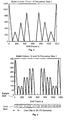
- Figure 4 shows that for an interferer separated by one frequency bin and having a code shift of 0, the peak correlation is about 380.
- This peak correlation can be reduced by altering the code shift factor.
- the peak correlation is only about 90 for code shift 1 and zero for code shifts 7 and 8. This is an example of a sequence which is SO to itself at specific code shifts.
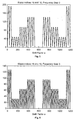
- Figures 8, 9 and 10 show cases where the transmitter and receiver use different code sequences.
- Figure 8 shows the cross correlation of H 16 (16) and H 16 (6) and indicates that this is not a very effective code pair for reducing ACI.
- the H 16 (5) and H 16 (7) of Figure 9 represent a better pair of code sequences since the code pair is SO at code shifts of 1, 2, 9, and 10.
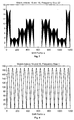
- the best pair shown is the H 16 (16) and H 16 (7) of Figure 10.
- Figure 10 was generated by waveform correlation and is thus limited by the machine precision of the computer.
- Figure 10 shows that H 16 (16) and H 16 (7) are CSO, which can be verified by computing Equations 7 and 8.
- CSO sequences can be readily determined through a computer search which evaluates Equations 7 and 8 at all relative shifts of the sequences b k and c k .
- all CSO code pairs over the length 16 Walsh-Hadamard matrix were determined and are cataloged in Table 1. Note that the CSO condition is symmetric so ( i , j ) implies ( j , i ).
- All possible code words for a given code word length L can be determined as follows. First, of the 2 L possible codes of length L only: Equation 9: L ! L 2 ! are zero mean (the zero mean condition forces L to be even). The set of zero mean vectors can be searched for all sets of 2, 3 and so on mutually CSO code words.
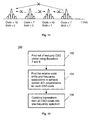
- CSO frequency in accordance with the present invention during acquisition is shown in Figure 11.
- Transmitters using CSO frequencies do not interfere with one another at any relative shifts of their codes.
- extra or additional transmitters may be added on different CSO codes.
- These additional transmitters do not add any ACI to the original transmitters on the other CSO codes. For the specific example discussed herein, this results in the doubling of the acquisition capacity of the communication system with no loss of performance or increase in complexity or interference.
- a flow chart for a first embodiment of a method of the present invention is illustrated generally at 100 in Figure 12.
- a set of mutually CSO codes is found using Equation 7 and 8 described earlier (step 102).
- the relative code shift and frequency separations are found that achieve the ACI requirements of the system (step 104).
- the code shifts should be optimized so that the frequency separation is at a minimum.
- the RF signals of the communications system 10 are modulated with the established CSO codes, and the modulated RF signals are combined into one frequency spectrum (step 106). Because the CSO codes are mutually CSO, the transmitters using different CSO codes do not interfere with one another, resulting in greater spectral efficiency during acquisition.
- a second embodiment of the present invention comprises reducing or eliminating ACI in an arbitrary DPSK modulated communications system using CDO codes.
- Two quantities: an angle and bit values, are used to represent various DPSK modulation formats. Denoting the angle as ⁇ , the bits as b k , the modulation frequency as ⁇ 0 , and the sample time as n , a general representation of DPSK modulation is given as: Examples of this representation are given in Table 2, illustrating how this representation generalizes to arbitrary DPSK formats. Table 2 shows examples of the general format used to represent various DPSK modulations. Mod.
- the correlator output may be derived assuming that the transmitter and receiver have the same frequency ⁇ 0 and code sequence b k , 1 ⁇ k ⁇ L.
- the correlation contribution of the first chip can be written: Note that without loss of generality, the above equation ignores an arbitrary phase angle of the transmitted waveform. The number a above represents the advancement of the transmitted data, in samples, relative to the late reference in the receiver. Simplifying Equation 11 gives: Equation 12: e j ⁇ oa [ e ⁇ j ⁇ b 1 ( N - a ) + a ] 1 ⁇ a ⁇ N - 1
- Equation 13 e j ⁇ 0 a [ e - j ⁇ bk ( N - a ) + a ] 1 ⁇ a ⁇ N - 1
- the total output of the correlator includes the contributions over all L bits. Summing the contributions over all L bits shown in Equation 13 gives: The phase term in the correlator output in Equation 14 can be neglected.
- the first term in the brackets in Equation 14 is an undesirable bias term that can be eliminated by choosing "zero mean" code sequences b k , where zero mean is defined herein as being:
- the code sequences are zero mean in this embodiment of the invention. It is assumed that all code sequences used for time synchronization are zero mean for the remainder of this description.
- B ( e - j ⁇ b 1 e j ⁇ c 1 + e -j ⁇ b 1 e -j ⁇ b 2 e j ⁇ c 1 e j ⁇ c 2 + e -j ⁇ b 1 e -j ⁇ b 2 e -j ⁇ b 3 e j ⁇ c 1 e j ⁇ c 2 e j ⁇ c 3 + ... + e -j ⁇ b 1 e -j ⁇ b 2 e -j ⁇ b 3 ... e -j ⁇ bL e j ⁇ c 1 e j ⁇ c 2 e j ⁇ c 3 ... e j ⁇ cL ) or:
- sequences such as SO and CSO sequences
- a computer search may be made over all zero mean sequences, as defined in Equation 15, to see where zeros simultaneously occur in Equations 20 and 21. If zeros occur at one relative shift, then those two sequences are denoted DO (to differentiate sequences corresponding to the more general DPSK modulations) at that relative shift. Sequences which are DO at all relative shifts are denoted as CDO. Equations 20 and 21 give conditions under which DO and CDO sequences exist but do not guarantee their existence. mean sequences are found (step 112), and the set of CDO codes is found (step 114).
- the relative code shift and frequency separations are found that achieve the ACI requirements of the system (step 116), with the code shifts being optimized so that the frequency separation is at a minimum.
- the RF signals of the communications system 10 are modulated with the established CDO codes, and the modulated RF signals are combined into one frequency spectrum (step 118).
- the present invention achieves technical advantage as a system and method for selecting codes for use by multiple transmitters in an orthogonal FDM system.
- the shifted codes greatly reduce or eliminate adjacent channel interference (ACI) during timing acquisition when the waveforms from each transmitter are not time-aligned.
- ACI adjacent channel interference
- An advantage of the invention is that many more transmitters can transmit in a given bandwidth thereby increasing spectral efficiency since the ACI has been reduced, thus improving the efficiency of the FDM system during acquisition.
- ACI is improved using CSO codes for a SDPSK modulated system and CDO codes for an arbitrary DPSK modulated system.
Landscapes
- Engineering & Computer Science (AREA)
- Computer Networks & Wireless Communication (AREA)
- Signal Processing (AREA)
- Digital Transmission Methods That Use Modulated Carrier Waves (AREA)
- Radio Transmission System (AREA)
Applications Claiming Priority (2)
| Application Number | Priority Date | Filing Date | Title |
|---|---|---|---|
| US51188700A | 2000-02-23 | 2000-02-23 | |
| US511887 | 2000-02-23 |
Publications (2)
| Publication Number | Publication Date |
|---|---|
| EP1128624A2 true EP1128624A2 (de) | 2001-08-29 |
| EP1128624A3 EP1128624A3 (de) | 2004-01-07 |
Family
ID=24036864
Family Applications (1)
| Application Number | Title | Priority Date | Filing Date |
|---|---|---|---|
| EP01103124A Withdrawn EP1128624A3 (de) | 2000-02-23 | 2001-02-09 | Kodenauswahl zur Unterdrückung von Nebenkanalinterferenz bei frequenzmultiplexierten differenziellen Phasensprungmodulation |
Country Status (3)
| Country | Link |
|---|---|
| EP (1) | EP1128624A3 (de) |
| JP (1) | JP2001274766A (de) |
| CA (1) | CA2336763A1 (de) |
Cited By (6)
| Publication number | Priority date | Publication date | Assignee | Title |
|---|---|---|---|---|
| WO2005057797A3 (en) * | 2003-12-03 | 2006-02-02 | Ut Battelle Llc | Multicarrier orthogonal spread-spectrum (moss) data communications |
| US7092440B1 (en) | 2000-09-27 | 2006-08-15 | Ut-Battelle Llc | Hybrid spread-spectrum technique for expanding channel capacity |
| US7340001B2 (en) | 2003-12-03 | 2008-03-04 | Ut-Battelle Llc | Multidimensional signal modulation and/or demodulation for data communications |
| US7487411B2 (en) | 2005-11-11 | 2009-02-03 | Rakesh Prasad | Multi symbol bit detection for SDPSK signals |
| US7656931B2 (en) | 2003-12-31 | 2010-02-02 | Ut-Battelle, Llc | Hybrid spread spectrum radio system |
| JP2021501502A (ja) * | 2017-10-25 | 2021-01-14 | ノースロップ グラマン システムズ コーポレイション | 適応ビームフォーミングのための記号品質推定 |
-
2001
- 2001-02-09 EP EP01103124A patent/EP1128624A3/de not_active Withdrawn
- 2001-02-15 CA CA002336763A patent/CA2336763A1/en not_active Abandoned
- 2001-02-20 JP JP2001042989A patent/JP2001274766A/ja active Pending
Non-Patent Citations (4)
| Title |
|---|
| CORREIA A M C: "Spread-spectrum to combat multipath induced intersymbol interference" PERSONAL, INDOOR AND MOBILE RADIO COMMUNICATIONS, 1995. PIMRC'95. WIRELESS: MERGING ONTO THE INFORMATION SUPERHIGHWAY., SIXTH IEEE INTERNATIONAL SYMPOSIUM ON TORONTO, ONT., CANADA 27-29 SEPT. 1995, NEW YORK, NY, USA,IEEE, US, 27 September 1995 (1995-09-27), pages 517-521, XP010150940 ISBN: 0-7803-3002-1 * |
| ENG T ET AL: "COMPARISON OF HYBRID FDMA/CDMA SYSTEMS IN FREQUENCY SELECTIVE RAYLEIGH FADING" IEEE JOURNAL ON SELECTED AREAS IN COMMUNICATIONS, IEEE INC. NEW YORK, US, vol. 12, no. 5, 1 June 1994 (1994-06-01), pages 938-951, XP000464979 ISSN: 0733-8716 * |
| LUI G L: "FDMA SYSTEM PERFORMANCE WITH SYNCHRONIZATION ERRORS" MILCOM 1996 CONFERENCE PROCEEDINGS. MCLEAN, VA., OCT. 21 - 24, 1996, ANNUAL MILITARY COMMUNICATIONS CONFERENCE, NEW YORK, IEEE, US, vol. 3 15TH, 22 October 1996 (1996-10-22), pages 811-818, XP000697383 ISBN: 0-7803-3683-6 * |
| MASOUD A A ET AL: "ROBUST, FFT-BASED, BLOCK DEMODULATION IN THE PRESENCE OF SYMBOL SYNCHRONIZATION JITTER, USING SYMMETRIC, DIFFERENTIAL, PHASE SHIFT, KEYING (SDPSK)" ICC '99. 1999 IEEE INTERNATIONAL CONFERENCE ON COMMUNICATIONS. CONFERENCE RECORD. VANCOUVER, CA, JUNE 6 - 10, 1999, IEEE INTERNATIONAL CONFERENCE ON COMMUNICATIONS, NEW YORK, NY: IEEE, US, vol. 2, 6 June 1999 (1999-06-06), pages 1278-1284, XP000898061 ISBN: 0-7803-5285-8 * |
Cited By (8)
| Publication number | Priority date | Publication date | Assignee | Title |
|---|---|---|---|---|
| US7092440B1 (en) | 2000-09-27 | 2006-08-15 | Ut-Battelle Llc | Hybrid spread-spectrum technique for expanding channel capacity |
| WO2005057797A3 (en) * | 2003-12-03 | 2006-02-02 | Ut Battelle Llc | Multicarrier orthogonal spread-spectrum (moss) data communications |
| US7315563B2 (en) | 2003-12-03 | 2008-01-01 | Ut-Battelle Llc | Multicarrier orthogonal spread-spectrum (MOSS) data communications |
| US7340001B2 (en) | 2003-12-03 | 2008-03-04 | Ut-Battelle Llc | Multidimensional signal modulation and/or demodulation for data communications |
| US7656931B2 (en) | 2003-12-31 | 2010-02-02 | Ut-Battelle, Llc | Hybrid spread spectrum radio system |
| US7660338B2 (en) | 2003-12-31 | 2010-02-09 | Ut-Battelle, Llc | Hybrid spread spectrum radio system |
| US7487411B2 (en) | 2005-11-11 | 2009-02-03 | Rakesh Prasad | Multi symbol bit detection for SDPSK signals |
| JP2021501502A (ja) * | 2017-10-25 | 2021-01-14 | ノースロップ グラマン システムズ コーポレイション | 適応ビームフォーミングのための記号品質推定 |
Also Published As
| Publication number | Publication date |
|---|---|
| CA2336763A1 (en) | 2001-08-23 |
| EP1128624A3 (de) | 2004-01-07 |
| JP2001274766A (ja) | 2001-10-05 |
Similar Documents
| Publication | Publication Date | Title |
|---|---|---|
| USRE37802E1 (en) | Multicode direct sequence spread spectrum | |
| US5555268A (en) | Multicode direct sequence spread spectrum | |
| US5729570A (en) | Orthogonal code division multiple access communication system having multicarrier modulation | |
| EP1158709B1 (de) | Signalformat in cdma-mehrträgerübertragungssystemen | |
| KR100530277B1 (ko) | 높은통신속도의확산스펙트럼트랜스시버및관련방법들 | |
| US6097712A (en) | Multi-carrier CDMA communications systems | |
| US5757766A (en) | Transmitter and receiver for orthogonal frequency division multiplexing signal | |
| US5519692A (en) | Geometric harmonic modulation (GHM)-digital implementation | |
| US5920551A (en) | Channel structure with burst pilot in reverse link | |
| US5563906A (en) | Method of geometric harmonic modulation (GHM) | |
| US8325780B2 (en) | System and method for spread spectrum communication | |
| CN1115792C (zh) | 移动通信系统发射机中的扩频信号发生装置和方法 | |
| US6331997B1 (en) | Scheme for spread spectrum multiple access coding | |
| US6674790B1 (en) | System and method employing concatenated spreading sequences to provide data modulated spread signals having increased data rates with extended multi-path delay spread | |
| US6351498B1 (en) | Robust digital modulation and demodulation scheme for radio communications involving fading | |
| EP2019495B1 (de) | Kohärente und nichtkohärente Direktsequenz-/Direktfrequenzsprung-Spreizspektrumsysteme mit hoher Leistung und Bandbreiteneffizienz und Verfahren dafür | |
| EP1128624A2 (de) | Kodenauswahl zur Unterdrückung von Nebenkanalinterferenz bei frequenzmultiplexierten differenziellen Phasensprungmodulation | |
| JP2008022567A (ja) | スペクトラム拡散通信システムに用いるチャネルの多様性を達成するための方法および装置 | |
| US5568507A (en) | Geometric harmonic modulation (GHM) - analog implementation | |
| US5568509A (en) | Dynamic code division multiple access communication system | |
| JP2002164810A (ja) | 巡回シフト形符号分割多重通信方式 | |
| US6219356B1 (en) | Method for multipath resistant waveform coding for high speed wireless data transmission | |
| AU8621998A (en) | Spread spectrum address coding | |
| US8116385B2 (en) | Method for the transmission of a data word | |
| JPH07107007A (ja) | 拡散符号生成方式 |
Legal Events
| Date | Code | Title | Description |
|---|---|---|---|
| PUAI | Public reference made under article 153(3) epc to a published international application that has entered the european phase |
Free format text: ORIGINAL CODE: 0009012 |
|
| AK | Designated contracting states |
Kind code of ref document: A2 Designated state(s): AT BE CH CY DE DK ES FI FR GB GR IE IT LI LU MC NL PT SE TR |
|
| AX | Request for extension of the european patent |
Free format text: AL;LT;LV;MK;RO;SI |
|
| RAP1 | Party data changed (applicant data changed or rights of an application transferred) |
Owner name: NORTHROP GRUMMAN CORPORATION |
|
| PUAL | Search report despatched |
Free format text: ORIGINAL CODE: 0009013 |
|
| RAP1 | Party data changed (applicant data changed or rights of an application transferred) |
Owner name: NORTHROP GRUMMAN CORPORATION |
|
| AK | Designated contracting states |
Kind code of ref document: A3 Designated state(s): AT BE CH CY DE DK ES FI FR GB GR IE IT LI LU MC NL PT SE TR |
|
| AX | Request for extension of the european patent |
Extension state: AL LT LV MK RO SI |
|
| RIC1 | Information provided on ipc code assigned before grant |
Ipc: 7H 04L 5/06 B Ipc: 7H 04L 27/26 A |
|
| 17P | Request for examination filed |
Effective date: 20040707 |
|
| AKX | Designation fees paid |
Designated state(s): DE FR GB |
|
| STAA | Information on the status of an ep patent application or granted ep patent |
Free format text: STATUS: THE APPLICATION IS DEEMED TO BE WITHDRAWN |
|
| 18D | Application deemed to be withdrawn |
Effective date: 20050830 |