EP1129366B1 - Magnetwiderstandssensor oder speicherelement mit vermindertem magnetischen schaltfeld - Google Patents
Magnetwiderstandssensor oder speicherelement mit vermindertem magnetischen schaltfeld Download PDFInfo
- Publication number
- EP1129366B1 EP1129366B1 EP00964061A EP00964061A EP1129366B1 EP 1129366 B1 EP1129366 B1 EP 1129366B1 EP 00964061 A EP00964061 A EP 00964061A EP 00964061 A EP00964061 A EP 00964061A EP 1129366 B1 EP1129366 B1 EP 1129366B1
- Authority
- EP
- European Patent Office
- Prior art keywords
- layer
- field
- magnetic
- sensitive
- ferromagnetic
- Prior art date
- Legal status (The legal status is an assumption and is not a legal conclusion. Google has not performed a legal analysis and makes no representation as to the accuracy of the status listed.)
- Expired - Lifetime
Links
- 230000005291 magnetic effect Effects 0.000 title claims description 85
- 230000015654 memory Effects 0.000 title claims description 36
- 230000003247 decreasing effect Effects 0.000 title description 4
- 230000005415 magnetization Effects 0.000 claims description 67
- 230000005294 ferromagnetic effect Effects 0.000 claims description 26
- 239000003302 ferromagnetic material Substances 0.000 claims description 13
- 230000008859 change Effects 0.000 claims description 12
- 230000008878 coupling Effects 0.000 claims description 12
- 238000010168 coupling process Methods 0.000 claims description 12
- 238000005859 coupling reaction Methods 0.000 claims description 12
- 230000005290 antiferromagnetic effect Effects 0.000 claims description 10
- VUKZWUYSEFVTRB-OSWZUBHSSA-N (4r)-4-[(3r,5r,8r,9s,10s,13r,14s,17r)-3-hydroxy-7,10,13-trimethyl-2,3,4,5,6,7,8,9,11,12,14,15,16,17-tetradecahydro-1h-cyclopenta[a]phenanthren-17-yl]pentanoic acid Chemical compound C([C@H]1CC2C)[C@H](O)CC[C@]1(C)[C@@H]1[C@@H]2[C@@H]2CC[C@H]([C@@H](CCC(O)=O)C)[C@@]2(C)CC1 VUKZWUYSEFVTRB-OSWZUBHSSA-N 0.000 claims description 8
- 125000006850 spacer group Chemical group 0.000 claims description 7
- 239000010410 layer Substances 0.000 description 189
- 230000000694 effects Effects 0.000 description 16
- 230000004907 flux Effects 0.000 description 14
- 238000000926 separation method Methods 0.000 description 10
- 239000010408 film Substances 0.000 description 7
- 239000000463 material Substances 0.000 description 7
- 230000004888 barrier function Effects 0.000 description 5
- 230000009467 reduction Effects 0.000 description 5
- 238000000034 method Methods 0.000 description 4
- 239000004020 conductor Substances 0.000 description 3
- 230000008569 process Effects 0.000 description 3
- 239000004065 semiconductor Substances 0.000 description 3
- 239000000758 substrate Substances 0.000 description 3
- 238000013500 data storage Methods 0.000 description 2
- 230000001965 increasing effect Effects 0.000 description 2
- 239000000696 magnetic material Substances 0.000 description 2
- 239000000203 mixture Substances 0.000 description 2
- 229910000889 permalloy Inorganic materials 0.000 description 2
- 230000035945 sensitivity Effects 0.000 description 2
- 239000002356 single layer Substances 0.000 description 2
- 230000005641 tunneling Effects 0.000 description 2
- 229910017061 Fe Co Inorganic materials 0.000 description 1
- 206010020751 Hypersensitivity Diseases 0.000 description 1
- 208000026935 allergic disease Diseases 0.000 description 1
- 229910045601 alloy Inorganic materials 0.000 description 1
- 239000000956 alloy Substances 0.000 description 1
- 238000004364 calculation method Methods 0.000 description 1
- 230000001419 dependent effect Effects 0.000 description 1
- 238000001514 detection method Methods 0.000 description 1
- 230000006870 function Effects 0.000 description 1
- 230000009610 hypersensitivity Effects 0.000 description 1
- 230000001939 inductive effect Effects 0.000 description 1
- 238000001459 lithography Methods 0.000 description 1
- 238000000059 patterning Methods 0.000 description 1
- 229920006395 saturated elastomer Polymers 0.000 description 1
- 229910052710 silicon Inorganic materials 0.000 description 1
- 239000010703 silicon Substances 0.000 description 1
- 239000010409 thin film Substances 0.000 description 1
- 230000007704 transition Effects 0.000 description 1
Images




Classifications
-
- B—PERFORMING OPERATIONS; TRANSPORTING
- B82—NANOTECHNOLOGY
- B82Y—SPECIFIC USES OR APPLICATIONS OF NANOSTRUCTURES; MEASUREMENT OR ANALYSIS OF NANOSTRUCTURES; MANUFACTURE OR TREATMENT OF NANOSTRUCTURES
- B82Y25/00—Nanomagnetism, e.g. magnetoimpedance, anisotropic magnetoresistance, giant magnetoresistance or tunneling magnetoresistance
-
- B—PERFORMING OPERATIONS; TRANSPORTING
- B82—NANOTECHNOLOGY
- B82Y—SPECIFIC USES OR APPLICATIONS OF NANOSTRUCTURES; MEASUREMENT OR ANALYSIS OF NANOSTRUCTURES; MANUFACTURE OR TREATMENT OF NANOSTRUCTURES
- B82Y10/00—Nanotechnology for information processing, storage or transmission, e.g. quantum computing or single electron logic
-
- G—PHYSICS
- G01—MEASURING; TESTING
- G01R—MEASURING ELECTRIC VARIABLES; MEASURING MAGNETIC VARIABLES
- G01R33/00—Arrangements or instruments for measuring magnetic variables
- G01R33/02—Measuring direction or magnitude of magnetic fields or magnetic flux
- G01R33/06—Measuring direction or magnitude of magnetic fields or magnetic flux using galvano-magnetic devices
- G01R33/09—Magnetoresistive devices
- G01R33/093—Magnetoresistive devices using multilayer structures, e.g. giant magnetoresistance sensors
-
- G—PHYSICS
- G11—INFORMATION STORAGE
- G11B—INFORMATION STORAGE BASED ON RELATIVE MOVEMENT BETWEEN RECORD CARRIER AND TRANSDUCER
- G11B5/00—Recording by magnetisation or demagnetisation of a record carrier; Reproducing by magnetic means; Record carriers therefor
- G11B5/127—Structure or manufacture of heads, e.g. inductive
- G11B5/33—Structure or manufacture of flux-sensitive heads, i.e. for reproduction only; Combination of such heads with means for recording or erasing only
- G11B5/39—Structure or manufacture of flux-sensitive heads, i.e. for reproduction only; Combination of such heads with means for recording or erasing only using magneto-resistive devices or effects
- G11B5/3903—Structure or manufacture of flux-sensitive heads, i.e. for reproduction only; Combination of such heads with means for recording or erasing only using magneto-resistive devices or effects using magnetic thin film layers or their effects, the films being part of integrated structures
-
- G—PHYSICS
- G11—INFORMATION STORAGE
- G11B—INFORMATION STORAGE BASED ON RELATIVE MOVEMENT BETWEEN RECORD CARRIER AND TRANSDUCER
- G11B5/00—Recording by magnetisation or demagnetisation of a record carrier; Reproducing by magnetic means; Record carriers therefor
- G11B5/48—Disposition or mounting of heads or head supports relative to record carriers ; arrangements of heads, e.g. for scanning the record carrier to increase the relative speed
- G11B5/58—Disposition or mounting of heads or head supports relative to record carriers ; arrangements of heads, e.g. for scanning the record carrier to increase the relative speed with provision for moving the head for the purpose of maintaining alignment of the head relative to the record carrier during transducing operation, e.g. to compensate for surface irregularities of the latter or for track following
- G11B5/596—Disposition or mounting of heads or head supports relative to record carriers ; arrangements of heads, e.g. for scanning the record carrier to increase the relative speed with provision for moving the head for the purpose of maintaining alignment of the head relative to the record carrier during transducing operation, e.g. to compensate for surface irregularities of the latter or for track following for track following on disks
- G11B5/59683—Disposition or mounting of heads or head supports relative to record carriers ; arrangements of heads, e.g. for scanning the record carrier to increase the relative speed with provision for moving the head for the purpose of maintaining alignment of the head relative to the record carrier during transducing operation, e.g. to compensate for surface irregularities of the latter or for track following for track following on disks for magnetoresistive heads
-
- G—PHYSICS
- G11—INFORMATION STORAGE
- G11C—STATIC STORES
- G11C11/00—Digital stores characterised by the use of particular electric or magnetic storage elements; Storage elements therefor
- G11C11/02—Digital stores characterised by the use of particular electric or magnetic storage elements; Storage elements therefor using magnetic elements
- G11C11/16—Digital stores characterised by the use of particular electric or magnetic storage elements; Storage elements therefor using magnetic elements using elements in which the storage effect is based on magnetic spin effect
- G11C11/161—Digital stores characterised by the use of particular electric or magnetic storage elements; Storage elements therefor using magnetic elements using elements in which the storage effect is based on magnetic spin effect details concerning the memory cell structure, e.g. the layers of the ferromagnetic memory cell
-
- G—PHYSICS
- G11—INFORMATION STORAGE
- G11C—STATIC STORES
- G11C11/00—Digital stores characterised by the use of particular electric or magnetic storage elements; Storage elements therefor
- G11C11/02—Digital stores characterised by the use of particular electric or magnetic storage elements; Storage elements therefor using magnetic elements
- G11C11/16—Digital stores characterised by the use of particular electric or magnetic storage elements; Storage elements therefor using magnetic elements using elements in which the storage effect is based on magnetic spin effect
- G11C11/165—Auxiliary circuits
- G11C11/1673—Reading or sensing circuits or methods
-
- G—PHYSICS
- G11—INFORMATION STORAGE
- G11B—INFORMATION STORAGE BASED ON RELATIVE MOVEMENT BETWEEN RECORD CARRIER AND TRANSDUCER
- G11B5/00—Recording by magnetisation or demagnetisation of a record carrier; Reproducing by magnetic means; Record carriers therefor
- G11B5/127—Structure or manufacture of heads, e.g. inductive
- G11B5/33—Structure or manufacture of flux-sensitive heads, i.e. for reproduction only; Combination of such heads with means for recording or erasing only
- G11B5/39—Structure or manufacture of flux-sensitive heads, i.e. for reproduction only; Combination of such heads with means for recording or erasing only using magneto-resistive devices or effects
- G11B2005/3996—Structure or manufacture of flux-sensitive heads, i.e. for reproduction only; Combination of such heads with means for recording or erasing only using magneto-resistive devices or effects large or giant magnetoresistive effects [GMR], e.g. as generated in spin-valve [SV] devices
Definitions
- the invention relates to a device comprising an elongated field-sensitive ferromagnetic layer of which the magnetization is sensitive to an applied magnetic field.
- elongated' means that layer has an elongated shape i.e. the dimension of the layer in a first direction (the 'length') is greater than the dimension (the 'width') in a direction perpendicular to the first direction.
- the first direction is commonly called the 'longitudinal direction'.
- the field-sensitive layer may be, for example, (part of) a flux guide or (part of) a magnetoresistive element.
- the field-sensitive layer may be the second layer of a device comprising a first and a second layer of ferromagnetic material separated by a spacer layer of non-ferromagnetic material, the first and second layer being formed such that the magnetization of the first ferromagnetic layer is maintained in a fixed or pinned direction in the presence of an applied magnetic field, while the magnetization direction of the second ferromagnetic layer is able to change in the presence of an applied magnetic field, the second layer comprising an elongated layer of magnetoresistive material, the device comprising means for directing a sensing current through the elongated layer in a current direction parallel to the longitudinal direction of the layer or perpendicular to the plane of the film.
- Such a device may be a magnetoresistive sensor or memory element, such as a TMR (Tunnel Magneto Resistance) or GMR (Giant Magneto Resistance) sensor or memory element.
- the layer of non-magnetic material which separates the first and second layer of a ferromagnetic material, is often called “spacer layer” in the case of a GMR sensor or memory element, and “barrier layer” in the case of a TMR sensor or memory element.
- spacer layer in the case of a GMR sensor or memory element
- carrier layer in the case of a TMR sensor or memory element.
- separation layer will be used in order to indicate the spacer layer or the barrier layer of a GMR or a TMR element, respectively.
- a device of the type described in the opening paragraph is known, for example, from United States Patent US 4,686,472 or US 5,465,185, wherein a sensor is shown.
- US 4,686,472 discloses a magnetic sensor which uses the magnetoresistance effect of two magneto-statically coupled flat layers of electrically conductive ferromagnetic material having an easy axis of magnetisation in a major plane of the layer.
- a thin intermediate layer separates the ferromagnetic layers resulting in a strong magnetostatic coupling so that the shape anisotropy is strongly reduced.
- the magnetisations of the ferromagnetic layers are in all cases anti-parallel.
- Each of the ferromagnetic layers produces a resistance variation under the influence of a magnetic field.
- the ferromagnetic layers convey currents flowing in the same direction and are connected in parallel to the input terminal of a detection circuit.
- US 5,465,185 discloses another example of a sensor.
- the first layer is also called the 'pinned layer' and the second the 'free layer'.
- a 'free layer' is a layer whose magnetization direction is able to change at applied fields with a strength lower than the strength of the field required for changing the magnetization direction of the 'pinned' layer.
- Such changing may be a nearly free rotation so as to follow the applied magnetic field such as, for example, in sensors or a changing between two anti-parallel states such as, for example, in memory elements.
- the elongated field-sensitive layer when used in a magnetoresistive element for GMR devices in which a sensing current is parallel to the longitudinal direction, has a relatively large ratio of the length (1) over the width (w) of the layer, and thus forming a stripe.
- the above equation (1) refers to the situation with the current in the plane of the layers.
- Recently sensor or memory element structures in which the current is directed perpendicular to the plane of the layers have attracted much attention.
- Examples are spin tunneling structures (a sandwich structure of two ferromagnetic layers with an oxidic tunneling barrier in between).
- spin tunneling structures a sandwich structure of two ferromagnetic layers with an oxidic tunneling barrier in between.
- no large l/w ratio is required from the point of view of output voltage.
- the need for a large l/w ratio may nevertheless arise in specific sensor (such as read heads) or magnetic element designs.
- a device in accordance with the invention is characterized in that the field-sensitive ferromagnetic layer comprises a sandwich structure comprising two magnetic layers, with parallel easy magnetization axes due to the magnetocrystalline anisotropy, and with opposite magnetization directions due to anti-ferromagnetic coupling by a non-magnetic layer 3 separating the two layers 1 and 2, while the magnetization directions due to the magnetocrystalline anisotropy for the two magnetic layers are directed transversely to the longitudinal axis of the field-sensitive ferromagnetic layer, the parallel easy magnetization axes being due to magnetocrystalline anisotropy and wherein opposite magnetization directions are present in the magnetic layers due to the anti-ferromagnetic coupling by the non-magnetic layer, wherein the elongated field-sensitive ferromagnetic layer forms the second layer of a first (6) and a second layer (1, 2, 3) of ferromagnetic material separated by a spacer layer of non-ferromagnetic material (L s , 7),
- the layer of non-magnetic material which separates the first and second layer of a ferromagnetic material, is often called “spacer layer” in the case of a GMR sensor or memory element, and “barrier layer” in the case of a TMR sensor or memory element.
- spacer layer in the case of a GMR sensor or memory element
- barrier layer in the case of a TMR sensor or memory element.
- separation layer will be used in order to indicate the spacer layer or the barrier layer of a GMR or a TMR element, respectively.
- Magnetocrystalline anisotropy is the dependence of the (free) energy of a ferromagnetic material on the direction of magnetization of the material, resulting from the internal structure in the material.
- the total magnetic anisotropy of a ferromagnetic body such as a layer is the result of magnetocrystalline anisotropy, plus a contribution from the shape anisotropy of the body.
- the shape anisotropy is due to the dependence of the total energy in the magnetostatic field due to the magnetization of the body.
- the external shape of the body defines preferred directions of magnetization of the body. Magnetic anisotropy creates a situation in which the total energy of the body is lowest when the magnetization direction is parallel or antiparallel to one specific direction, or to several directions which are equivalent from the point of view of the symmetry of the body. Such a direction is called an easy axis direction.
- the shape anisotropy is such that the preferred magnetization directions are confined to the plane of the layer or of a stock of layers (a film).
- This is a situation of application for a number of embodiments in this patent application i.e.: there is no contribution from magnetocrystalline anisotropy which more than counteracts the shape anisotropy).
- the magnetization within the plane of the layer can have one or more easy directions.
- the situation is considered in which the magnetocrystalline anisotropy of the magnetic free layer is uniaxial, i.e., in which there is only one preferred easy direction with the plane of the layer (film).
- This situation can be created, e.g., by growth of the layer (film) in a magnetic field parallel to the required easy axis direction, or by growth of a layer (film) on a substrate on which the magnetic layer (film) develops an internal structure which gives rise to the required uniaxial symmetry.
- shape anisotropy gives rise to a preferred magnetization direction parallel to the length direction of the stripe.
- the net effective anisotropy field is then greatly reduced.
- the different functional dependences of the shape anisotropy field and the magnetocrystalline anisotropy field on the ratio of the thicknesses t 1 /t 2 allow such conditions to be fulfilled by a proper choice of the ratio of thicknesses t 1 and t 2 or the ratio of t 1 .M sat,1 /t 2 .M sat,2 .
- FIGs 1, 2 and 3 diagrammatically show the structure, in increasing detail, of a GMR sensor device (reading head) having a magnetoresistive element (MRE).
- MRE magnetoresistive element
- the MRE comprises a 'pinned' layer 6, and a 'free' layer, i.e. a layer of which the magnetization is free to change direction, in dependence on the ambient magnetic field, and a separation layer L s .
- the 'free' layer comprises a sandwich structure with two layers 1 and 2 with parallel easy magnetization axes due to the magnetocrystalline anisotropy and with opposite magnetization directions (shown in figure 3 by means of arrows M 1 and M 2 ) anti-ferromagnetically due to anti-ferromagnetic coupling by a non-magnetic layer 3.
- the magnetization direction M p (pinned) of the pinned layer 6 is also shown in the Figure.
- a 'free' layer within the concept of the invention is understood to be a layer (which may be composed of sublayers 1,2,3) which is more 'free' than the pinned layer.
- the magnetization direction of the 'free' layer may either be nearly free to rotate such as, for example, in a sensor (as in figure 1, 2 3), or 'free' to change between two anti-parallel states, meaning that an applied magnetic field of relatively small magnitude (compared with the magnitude of a magnetic field to 'unpin' the pinned layer) may cause a change in the magnetization direction.
- a magnetic medium having a pattern of domains b representing a sequence of bits moves in a direction v in respect of the MRE.
- the ambient magnetic field changes strongly, inducing a change in the magnetization direction of the free layer (1,2,3) and thereby changing the resistance across the MRE.
- This change is recorded by means of a sensing current I sense .
- the direction of the sensing current I sense is indicated in Figures 1, 2 and 3.
- the sensing current I sense runs parallel to the longitudinal axis (1) of the strips. Indicated is the length 1 of the MRE along the direction of the sensing current and the width w and the thicknesses t 1 and t 2 of the layers 1 and 2.
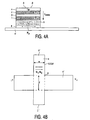
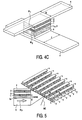
- Figures 4A, 4B and 4C show an embodiment of a magnetic memory based on the GMR effect in which the free layer (comprising a sandwich structure of layers 1,2,3) and a conducting layer 6 are vertically (i.e. transversely to the plane of the layers) separated by a separation layer L s , in the Figures also referenced 5.
- the longitudinal direction 1 of the free layer and the direction w transverse to this axis is indicated in Figure 4B.
- a conducting layer 4 is provided on top of layer 2, a conducting layer 4' is provided on the bottom.
- the latter function bottom conductor may be fulfilled by the layer 6 in other embodiments.
- the magnetization M p of the pinned ferromagnetic layer (6) is fixed, the magnetization direction of the layer at the other side of the separating layer 5, i.e. the magnetization direction of free layer 1, can be switched between two directions (i.e. parallel and anti-parallel to the fixed magnetization of layer 6) by a writing current I W through conductor 4. Due to the GMR-effect, the resistance for both configurations is different, depending on the net magnetization direction of sublayers 1-3. The state of the memory ('1' or '0') can thus be determined by measuring the resistance of the GMR system. To this end, the relation between a sensing current I s and an applied voltage can be measured.
- a sensing current I sense perpendicular to the layer is used to measure the magnetoresistance and thereby measure the status of the memory element (a '0' or a '1').
- the writing current I w needed to switch the element i.e. to write data in the element, is dependent on the net field needed to switch the magnetic state of the memory element. The larger the switching field, the more current is needed. Large currents hamper the use of such elements. Therefore, reducing the magnitude of the net anisotropy or switching field is advantageous.
- Figures 4A, 4B and 4C show a memory element based on the GMR effect. Memory elements can also be made based on the TMR (Tunnel MagnetoResistance effect). A device having a number of such memory elements is diagrammatically shown in Figure 5.
- a magnetic memory (based on the TMR effect) consists in its simplest form of two ferromagnetic layers separated by a non-magnetic non-metallic separation layer.
- Figure 5 diagrammatically shows a MRAM based on the TMR effect. It comprises electrodes x and y in between which magnetic memory elements (ME) are provided.
- Said magnetic memory element comprises a 'fixed' layer 6 with pinned magnetization M p , a separation layer L s and a 'free' layer, the latter 'free' layer comprising a sandwich structure with two layers (1,2) with parallel easy magnetization axes due to the magnetocrystalline anisotropy, separated and with opposite magnetization directions due to anti-ferromagnetic coupling by a non-magnetic non-metallic layer 3 separating the two layers 1 and 2.
- the free and fixed layer and the separation layer L s are stacked on top of each other.
- the sensing current I sense runs perpendicularly to the plane of the layers.
- a relatively large writing current I w through electrodes x generates a switching field.
- the switching field is usually decreased by means of running a current through electrodes y, such that at the cross of two electrodes a magnetic field is generated of sufficient magnitude to switch the magnetization direction of the free layer.
- the smaller the required strength of the switching field the better it is in view of the requirement of low switching currents. It is remarked that in view of data stability the required switching field needs to have a lower limit or threshold given by the strengths of fields that could arise from other sources, such as stray fields and stray currents.
- Figures 6A and 6B show a lateral memory element in which the free layer (comprising a sandwich structure of sublayers 1, 2, 3) and the fixed layer 6 are laterally separated by the separating layer 7.
- the sensing current runs through the free layer (1,2,3) and through the separating layer 3 to the pinned layer 6, for example via leads A (or B) to lead C.
- a writing current can be run through the conductor 4, via leads A and B.
- the invention is based on the insights that
- H shape,eff 5 H MCA , which is not an uncommon situation for such a configuration.
- Figure 7 should be interpreted as follows.
- Shape anisotropy promotes magnetization parallel to the longitudinal axis 1, whereas the magnetocrystalline anisotropy of the materials employed (because the easy axes due to magnetocrystalline anisotropy are perpendicular to the longitudinal axis) promotes magnetization perpendicular to the longitudinal axis 1.
- the net effective anisotropy field H a,net is given by the difference
- H shape,eff -H MCA denotes the field that is required to saturate the magnetization by means of an applied magnetic field perpendicular to the long axis, the net easy axis direction being parallel to the longitudinal axis 1.
- H shape,eff - H MCA denotes the field that is required to saturate the magnetization by means of an applied magnetic field parallel to the longitudinal axis, the net easy axis direction being perpendicular to the longitudinal axis 1.
- 0 or alternatively to choose the net effective anisotropy field by selecting the proper thickness of the second magnetic layer 2 for a given thickness of layer 1.
- Zero (or near zero) net anisotropy may be advantageous for certain embodiments in which extremely sensitive sensors are needed.
- the thicknesses and properties of the layers are chosen such that the net effective anisotropy field H a,net is not precisely zero but, for example, between approximately 50 and 5 % of the magnetocrystalline anisotropy field of a single layer.
- H a,net the net effective anisotropy field
- the ease of switching is greatly improved (by for example a factor 2 to 20) while the switching field is not reduced to such a small field that any field will switch the element.
- Such a 'hypersensitivity' in memory elements can lead to an unwanted change of data.
- a very substantial reduction of the net anisotropy is obtained when 0.25 ⁇ t 1 M sat,1 /t 2 M sat,2 ⁇ 0.70.
- the effect of adding a second layer on the magnetoresistance depends on the type of system.
- the second layer will give rise to current shunting, thereby decreasing the GMR ratio.
- This effect can be strongly limited by choosing the second layer thinner than layer 1, and by using a highly resistive layer composition.
- the addition of a second metallic layer is of no consequence to the MR ratio and to the voltage output of the sensor or memory element.
- flux guides such as, for example those used in magnetic recording heads.
- These flux guides are often of elongated shape.
- the easy magnetization direction for the two magnetic layers due to magnetocrystalline anisotropy being directed transverse to the longitudinal axis of the layers, the net anisotropy field of the flux guide can be reduced or even be made zero, which greatly improves the flux guiding properties of the flux guide.
- FIG 8 diagrammatically shows a magnetoresistive element (MRE) (81) connected to two flux guides (82, 83).
- MRE magnetoresistive element
- Each of these elongated flux guides comprises a sandwich structure with two ferromagnetic layers (84, 85) separated by a layer 86, and having an easy magnetization direction due to magnetocrystalline anisotropy (M 84 , M 85 ) transverse to the longitudinal axis I of the flux guides.
- This structure may form part of a so-called yoke-type read head which also contains a second flux guide structure which together with the structure formed by elements 81-85 forms a yoke. The flux enters the yoke at the read gap and via the flux guides and the MRE it returns to the medium.
- embodiments of the invention can be described by a device or a sensor (MRE) or memory element (ME) having a free (1,2,3) and a fixed or pinned (M p , 6) magnetic layer separated by a separation layer (L s , 5).
- MRE sensor
- ME memory element
- the free layer comprises a sandwich structure having a sandwich structure comprising two magnetic layers (1,2), coupled anti-ferromagneticallly by a preferably thin non-magnetic layer (3), with parallel easy magnetization axes due to the magnetocrystalline anisotropy, and with opposite magnetization directions due to anti-ferromagnetic coupling by the layer 3 separating the two layers 1 and 2, while the easy magnetization direction for the two magnetic layers (1, 2) due to magnetocrystalline anisotropy is directed transversely to the longitudinal axis (1) of the stripe.
- the invention in another embodiment, relates to a flux guide which comprises a sandwich structure having a sandwich structure comprising two magnetic layers (1,2), coupled anti-ferromagneticallly by a preferably thin non-magnetic layer (3), the easy magnetization direction for the two magnetic layers (1, 2) due to magnetocrystalline anisotropy being directed transversely to the longitudinal axis (1) of the stripe.
- the device of the invention may be implemented as a sensor system for automotive applications according to techniques known to the person skilled in the art. Also other implementations such as, for example , sensor systems for domestic application may be made.
- the sensor system can be a magnetic sensor device or a magnetic read-head such as a GMR thin film head for hard disks or any such system including or not including signal processing electronics for processing the signal of the magnetic characteristic or a measure or derivate thereof.
- the device of the invention can be made at least partly in a multilayer configuration. It is possible in an embodiment of the invention to integrate the whole sensing system on one semiconductor (silicon) chip with the multilayer configuration being grown or deposited on the chip.
- the multilayer configuration can be grown or deposited on the chip in the front-end or in the back-end of the process for making the chip. In the back-end process a part of the chip is planarized and the multilayer configuration is deposited or grown thereon.
- the sensor system of the invention can also be an integrated circuit with a memory functionality and an integrated sensing system or an ASIC with an embedded non-volatile magnetic memory element and a sensor system or a chipcard with a sensor system or any such sensor system.
- the device of the invention may also be implemented as a data storage system such as a MRAM memory element or a chipcard.
- the device of the invention can be a magnetic memory element or a magnetic memory device and can also be a computer or an integrated circuit with a memory functionality such as a MRAM, or an ASIC with an embedded non-volatile magnetic memory element, or a chipcard or any such data storage system.
- the device of the invention can be made at least partly in a multilayer configuration. As such it can be a MRAM structure being integrated on a semiconductor substrate. It can also be non-volatile magnetic memory structure being integrated on a semiconductor substrate.
Landscapes
- Engineering & Computer Science (AREA)
- Nanotechnology (AREA)
- Chemical & Material Sciences (AREA)
- Physics & Mathematics (AREA)
- Crystallography & Structural Chemistry (AREA)
- Computer Hardware Design (AREA)
- Condensed Matter Physics & Semiconductors (AREA)
- Manufacturing & Machinery (AREA)
- General Physics & Mathematics (AREA)
- Theoretical Computer Science (AREA)
- Mathematical Physics (AREA)
- Hall/Mr Elements (AREA)
- Semiconductor Memories (AREA)
- Mram Or Spin Memory Techniques (AREA)
- Magnetic Heads (AREA)
- Thin Magnetic Films (AREA)
Claims (8)
- Anordnung mit einer länglichen, feldempfindlichen ferromagnetischen Schicht (1,2,3), deren Magnetisierung empfindlich gegenüber einem angelegten Feld ist, wobei die genannte feldempfindliche ferromagnetische Schicht eine Sandwich-Struktur aus zwei magnetischen Schichten (1, 2) umfasst, wobei die zwei magnetischen Schichten parallele leichte Magnetisierungsachsen haben und antiferromagnetisch durch eine nichtmagnetische Schicht (3) gekoppelt sind, welche die zwei magnetischen Schichten (1 und 2) trennt, wobei die leichten Magnetisierungsrichtungen (M1, M2) für die zwei magnetischen Schichten (1, 2) im Wesentlichen quer zu der Längsachse (1) der feldempfindlichen ferromagnetischen Schicht (1, 2, 3) gerichtet sind, die parallelen leichten Magnetisierungsrichtungen auf die magnetokristalline Anisotropie zurückzuführen sind und in den magnetischen Schichten aufgrund der antiferromagnetischen Kopplung durch die nichtmagnetische Schicht entgegengesetzte Magnetisierungsrichtungen vorhanden sind, dadurch gekennzeichnet, dass die längliche feldempfindliche ferromagnetische Schicht die zweite Schicht von einer ersten (6) und einer zweiten Schicht (1, 2, 3) aus ferromagnetischem Material, die durch eine Abstandsschicht aus nicht ferromagnetischem Material (Ls, 7) getrennt werden, bildet, wobei die erste und zweite Schicht aus ferromagnetischem Material so geformt sind, dass die Magnetisierung (Mp) der ersten Schicht (6) aus ferromagnetischem Material bei der Anwesenheit eines angelegten Magnetfelds in einer festen Richtung gehalten wird, während die Magnetisierungsrichtung der zweiten Schicht (1, 2, 3) aus ferromagnetischem Material in der Lage ist, sich bei der Anwesenheit eines angelegten Magnetfeldes zu ändern, wobei die Anordnung Mittel zum Lenken eines Abtaststroms (Isense) durch die längliche feldempfindliche ferromagnetische Schicht (1, 2, 3) in einer Stromrichtung parallel zu der Längsachse (1) oder senkrecht zu der Ebene der Schichten umfasst.
- Anordnung nach Anspruch 1, in der die leichte Netto-Magnetisierungsachse der feldempfindlichen Schicht senkrecht zu der Längsachse 1 verläuft.
- Anordnung nach Anspruch 1, in der die leichte Netto-Achse der feldempfindlichen Schicht parallel zu der Längsachse 1 verläuft.
- Anordnung nach Anspruch 1, in der das Verhältnis des Form-Anisotropiefeldes Hshape,eff zu dem magnetokristallinen Feld HMCA zwischen 0,5 und 1,5 liegt.
- Anordnung nach Anspruch 1, in dem die genannte längliche feldempfindliche Schicht die freie Schicht einer Riesenmagnetowiderstandsstruktur ist.
- Anordnung nach Anspruch 1, in dem die genannte längliche feldempfindliche Schicht die freie Schicht einer Tunnelmagnetowiderstandsstruktur ist.
- Anordnung nach Anspruch 1, in der die Anordnung ein magnetoresistives Sensor-Element bildet.
- Anordnung nach Anspruch 1, in der die Anordnung ein magnetoresistives Speicher-Element bildet.
Priority Applications (1)
| Application Number | Priority Date | Filing Date | Title |
|---|---|---|---|
| EP00964061A EP1129366B1 (de) | 1999-09-10 | 2000-08-30 | Magnetwiderstandssensor oder speicherelement mit vermindertem magnetischen schaltfeld |
Applications Claiming Priority (4)
| Application Number | Priority Date | Filing Date | Title |
|---|---|---|---|
| EP99202945 | 1999-09-10 | ||
| EP99202945 | 1999-09-10 | ||
| PCT/EP2000/008442 WO2001020356A1 (en) | 1999-09-10 | 2000-08-30 | Magnetoresistive sensor or memory elements with decreased magnetic switch field |
| EP00964061A EP1129366B1 (de) | 1999-09-10 | 2000-08-30 | Magnetwiderstandssensor oder speicherelement mit vermindertem magnetischen schaltfeld |
Publications (2)
| Publication Number | Publication Date |
|---|---|
| EP1129366A1 EP1129366A1 (de) | 2001-09-05 |
| EP1129366B1 true EP1129366B1 (de) | 2005-11-09 |
Family
ID=8240625
Family Applications (1)
| Application Number | Title | Priority Date | Filing Date |
|---|---|---|---|
| EP00964061A Expired - Lifetime EP1129366B1 (de) | 1999-09-10 | 2000-08-30 | Magnetwiderstandssensor oder speicherelement mit vermindertem magnetischen schaltfeld |
Country Status (6)
| Country | Link |
|---|---|
| US (1) | US6580270B1 (de) |
| EP (1) | EP1129366B1 (de) |
| JP (1) | JP5254514B2 (de) |
| KR (1) | KR20010075693A (de) |
| DE (1) | DE60023835T2 (de) |
| WO (1) | WO2001020356A1 (de) |
Cited By (1)
| Publication number | Priority date | Publication date | Assignee | Title |
|---|---|---|---|---|
| EP4310442A4 (de) * | 2021-03-19 | 2025-03-19 | MultiDimension Technology Co., Ltd. | Magnetoresistiver winkelsensor mit niedrigem magnetfeld |
Families Citing this family (13)
| Publication number | Priority date | Publication date | Assignee | Title |
|---|---|---|---|---|
| DE10196646T1 (de) * | 2000-09-19 | 2003-08-21 | Seagate Technology Llc | Riesenmagnetowiderstand- bzw. GMR-Sensor mit selbstkonsistenten Entmagnetisierungsfeldern |
| US6833975B2 (en) * | 2001-08-08 | 2004-12-21 | Matsushita Electric Industrial Co., Ltd. | Perpendicular magnetic recording medium and apparatus including a soft magnetic layer, an at least 20 nm thick non-magnetic layer, and a 50-90 nm gap length |
| JP4132835B2 (ja) * | 2002-01-23 | 2008-08-13 | 株式会社デンソー | 回転数検出装置 |
| WO2003071300A1 (en) * | 2002-02-25 | 2003-08-28 | Fujitsu Limited | Magnetoresistive spin-valve sensor and magnetic storage apparatus |
| US6879512B2 (en) * | 2002-05-24 | 2005-04-12 | International Business Machines Corporation | Nonvolatile memory device utilizing spin-valve-type designs and current pulses |
| US6881993B2 (en) * | 2002-08-28 | 2005-04-19 | Micron Technology, Inc. | Device having reduced diffusion through ferromagnetic materials |
| US7199435B2 (en) * | 2002-10-09 | 2007-04-03 | Fairchild Semiconductor Corporation | Semiconductor devices containing on-chip current sensor and methods for making such devices |
| CN100541222C (zh) * | 2004-02-19 | 2009-09-16 | 三菱电机株式会社 | 磁场检测器以及使用该磁场检测器的检测器件 |
| US7608538B2 (en) * | 2007-01-05 | 2009-10-27 | International Business Machines Corporation | Formation of vertical devices by electroplating |
| WO2009054180A1 (ja) * | 2007-10-25 | 2009-04-30 | Nec Corporation | 磁気抵抗効果素子及び磁気ランダムアクセスメモリ |
| EP2124228B1 (de) * | 2008-05-20 | 2014-03-05 | Crocus Technology | Magnetischer Direktzugriffsspeicher mit einem elliptischen Tunnelübergang |
| US7915885B2 (en) * | 2008-08-04 | 2011-03-29 | Infineon Technologies Ag | Sensor system and method |
| US10534047B2 (en) * | 2017-03-30 | 2020-01-14 | Qualcomm Incorporated | Tunnel magneto-resistive (TMR) sensors employing TMR devices with different magnetic field sensitivities for increased detection sensitivity |
Family Cites Families (12)
| Publication number | Priority date | Publication date | Assignee | Title |
|---|---|---|---|---|
| US4356523A (en) * | 1980-06-09 | 1982-10-26 | Ampex Corporation | Narrow track magnetoresistive transducer assembly |
| NL8101962A (nl) * | 1981-04-22 | 1982-11-16 | Philips Nv | Magnetische sensor. |
| JPH07307501A (ja) * | 1992-10-19 | 1995-11-21 | Philips Electron Nv | 磁界センサ |
| DE4243357A1 (de) * | 1992-12-21 | 1994-06-23 | Siemens Ag | Magnetowiderstands-Sensor mit verkürzten Meßschichten |
| JP3190193B2 (ja) * | 1993-03-15 | 2001-07-23 | 株式会社東芝 | 薄膜磁気ヘッドの使用方法 |
| JP2629583B2 (ja) * | 1993-05-13 | 1997-07-09 | 日本電気株式会社 | 磁気抵抗効果膜およびその製造方法 |
| US5465185A (en) | 1993-10-15 | 1995-11-07 | International Business Machines Corporation | Magnetoresistive spin valve sensor with improved pinned ferromagnetic layer and magnetic recording system using the sensor |
| CN1095153C (zh) * | 1994-03-10 | 2002-11-27 | 国际商业机器公司 | 磁电阻传感元件及磁电阻传感器 |
| US5841611A (en) * | 1994-05-02 | 1998-11-24 | Matsushita Electric Industrial Co., Ltd. | Magnetoresistance effect device and magnetoresistance effect type head, memory device, and amplifying device using the same |
| JPH09270548A (ja) * | 1996-03-29 | 1997-10-14 | Sony Corp | 磁気抵抗効果素子及びこれを用いた磁気抵抗効果型磁気ヘッド |
| JPH1041562A (ja) * | 1996-07-26 | 1998-02-13 | Sony Corp | 磁気抵抗効果素子 |
| US6340886B1 (en) * | 1997-08-08 | 2002-01-22 | Nonvolatile Electronics, Incorporated | Magnetic field sensor with a plurality of magnetoresistive thin-film layers having an end at a common surface |
-
2000
- 2000-08-30 KR KR1020017005862A patent/KR20010075693A/ko not_active Ceased
- 2000-08-30 WO PCT/EP2000/008442 patent/WO2001020356A1/en not_active Ceased
- 2000-08-30 EP EP00964061A patent/EP1129366B1/de not_active Expired - Lifetime
- 2000-08-30 DE DE60023835T patent/DE60023835T2/de not_active Expired - Lifetime
- 2000-08-30 JP JP2001523887A patent/JP5254514B2/ja not_active Expired - Fee Related
- 2000-09-07 US US09/656,989 patent/US6580270B1/en not_active Expired - Lifetime
Cited By (1)
| Publication number | Priority date | Publication date | Assignee | Title |
|---|---|---|---|---|
| EP4310442A4 (de) * | 2021-03-19 | 2025-03-19 | MultiDimension Technology Co., Ltd. | Magnetoresistiver winkelsensor mit niedrigem magnetfeld |
Also Published As
| Publication number | Publication date |
|---|---|
| DE60023835T2 (de) | 2006-07-20 |
| WO2001020356A1 (en) | 2001-03-22 |
| JP2003509858A (ja) | 2003-03-11 |
| KR20010075693A (ko) | 2001-08-09 |
| US6580270B1 (en) | 2003-06-17 |
| EP1129366A1 (de) | 2001-09-05 |
| JP5254514B2 (ja) | 2013-08-07 |
| DE60023835D1 (de) | 2005-12-15 |
Similar Documents
| Publication | Publication Date | Title |
|---|---|---|
| US5159513A (en) | Magnetoresistive sensor based on the spin valve effect | |
| EP1046049B1 (de) | Anordnung mit einer ersten und einer zweiten ferromagnetischen schicht getrennt durch eine nicht-magnetische abstandschicht | |
| US6469879B1 (en) | Magneto-resistive tunnel junction head with biasing elements abutting free layer extended portions | |
| US6418000B1 (en) | Dual, synthetic spin valve sensor using current pinning | |
| US6438026B2 (en) | Magnetic field element having a biasing magnetic layer structure | |
| US7035062B1 (en) | Structure to achieve sensitivity and linear density in tunneling GMR heads using orthogonal magnetic alignments | |
| US5668473A (en) | Magnetoresistive sensor including shortened measuring layers | |
| US20020154455A1 (en) | Magnetic device with a coupling layer and method of manufacturing and operation of such device | |
| US6462641B1 (en) | Magnetoresistor with tunnel effect and magnetic sensor using same | |
| US7602591B2 (en) | Exchange-coupled free layer with out-of-plane magnetization | |
| US6879475B2 (en) | Magnetoresistive effect element having a ferromagnetic tunneling junction, magnetic memory, and magnetic head | |
| US20060114620A1 (en) | Granular type free layer and magnetic head | |
| JP2000276720A (ja) | 反強磁性ピン止め層を有さないデュアル・ストライプ・スピン・バルブ・センサ | |
| US6580270B1 (en) | Magnetoresistive sensor or memory elements with decreased magnetic switch field | |
| US8520344B2 (en) | Magnetoresistive device with enhanced pinned layer | |
| US6542341B1 (en) | Magnetic sensors having an antiferromagnetic layer exchange-coupled to a free layer | |
| US20060119356A1 (en) | Magnetoresistive layer system and sensor element with said layer system | |
| US20060067116A1 (en) | Low power consumption magnetic memory and magnetic information recording device | |
| EP1589594A1 (de) | Gross-manetowiderstandseffektelement des ccp-typs und magnetische komponente und magnetische einrichtung damit | |
| KR100295355B1 (ko) | 박막자기헤드 | |
| KR100284779B1 (ko) | 스핀밸브 자기저항효과형 자기헤드 및 자기 디스크 장치 | |
| JPH0877519A (ja) | 磁気抵抗効果型トランスジューサ | |
| JP2018181996A (ja) | 磁気抵抗効果素子 | |
| US7053430B2 (en) | Antiferromagnetic stabilized storage layers in GMRAM storage devices | |
| EP0755048B1 (de) | Magnetoresistiver Aufnahmekopf |
Legal Events
| Date | Code | Title | Description |
|---|---|---|---|
| PUAI | Public reference made under article 153(3) epc to a published international application that has entered the european phase |
Free format text: ORIGINAL CODE: 0009012 |
|
| AK | Designated contracting states |
Kind code of ref document: A1 Designated state(s): AT BE CH CY DE DK ES FI FR GB GR IE IT LI LU MC NL PT SE |
|
| 17P | Request for examination filed |
Effective date: 20010924 |
|
| RBV | Designated contracting states (corrected) |
Designated state(s): DE FR GB |
|
| 17Q | First examination report despatched |
Effective date: 20040708 |
|
| GRAP | Despatch of communication of intention to grant a patent |
Free format text: ORIGINAL CODE: EPIDOSNIGR1 |
|
| GRAS | Grant fee paid |
Free format text: ORIGINAL CODE: EPIDOSNIGR3 |
|
| GRAA | (expected) grant |
Free format text: ORIGINAL CODE: 0009210 |
|
| AK | Designated contracting states |
Kind code of ref document: B1 Designated state(s): DE FR GB |
|
| REG | Reference to a national code |
Ref country code: GB Ref legal event code: FG4D |
|
| REF | Corresponds to: |
Ref document number: 60023835 Country of ref document: DE Date of ref document: 20051215 Kind code of ref document: P |
|
| ET | Fr: translation filed | ||
| PLBE | No opposition filed within time limit |
Free format text: ORIGINAL CODE: 0009261 |
|
| STAA | Information on the status of an ep patent application or granted ep patent |
Free format text: STATUS: NO OPPOSITION FILED WITHIN TIME LIMIT |
|
| 26N | No opposition filed |
Effective date: 20060810 |
|
| REG | Reference to a national code |
Ref country code: DE Ref legal event code: R082 Ref document number: 60023835 Country of ref document: DE Representative=s name: VOLMER, GEORG, DIPL.-ING., DE |
|
| REG | Reference to a national code |
Ref country code: DE Ref legal event code: R082 Ref document number: 60023835 Country of ref document: DE Representative=s name: VOLMER, GEORG, DIPL.-ING., DE Effective date: 20140331 Ref country code: DE Ref legal event code: R081 Ref document number: 60023835 Country of ref document: DE Owner name: KONINKLIJKE PHILIPS N.V., NL Free format text: FORMER OWNER: KONINKLIJKE PHILIPS ELECTRONICS N.V., EINDHOVEN, NL Effective date: 20140331 Ref country code: DE Ref legal event code: R082 Ref document number: 60023835 Country of ref document: DE Representative=s name: MEISSNER BOLTE PATENTANWAELTE RECHTSANWAELTE P, DE Effective date: 20140331 |
|
| REG | Reference to a national code |
Ref country code: FR Ref legal event code: CA Effective date: 20141126 Ref country code: FR Ref legal event code: CD Owner name: KONINKLIJKE PHILIPS N.V., NL Effective date: 20141126 |
|
| REG | Reference to a national code |
Ref country code: FR Ref legal event code: PLFP Year of fee payment: 17 |
|
| PGFP | Annual fee paid to national office [announced via postgrant information from national office to epo] |
Ref country code: GB Payment date: 20160831 Year of fee payment: 17 |
|
| PGFP | Annual fee paid to national office [announced via postgrant information from national office to epo] |
Ref country code: FR Payment date: 20160825 Year of fee payment: 17 |
|
| PGFP | Annual fee paid to national office [announced via postgrant information from national office to epo] |
Ref country code: DE Payment date: 20161031 Year of fee payment: 17 |
|
| REG | Reference to a national code |
Ref country code: DE Ref legal event code: R082 Ref document number: 60023835 Country of ref document: DE Representative=s name: MEISSNER BOLTE PATENTANWAELTE RECHTSANWAELTE P, DE |
|
| REG | Reference to a national code |
Ref country code: DE Ref legal event code: R119 Ref document number: 60023835 Country of ref document: DE |
|
| GBPC | Gb: european patent ceased through non-payment of renewal fee |
Effective date: 20170830 |
|
| REG | Reference to a national code |
Ref country code: FR Ref legal event code: ST Effective date: 20180430 |
|
| PG25 | Lapsed in a contracting state [announced via postgrant information from national office to epo] |
Ref country code: GB Free format text: LAPSE BECAUSE OF NON-PAYMENT OF DUE FEES Effective date: 20170830 Ref country code: DE Free format text: LAPSE BECAUSE OF NON-PAYMENT OF DUE FEES Effective date: 20180301 |
|
| PG25 | Lapsed in a contracting state [announced via postgrant information from national office to epo] |
Ref country code: FR Free format text: LAPSE BECAUSE OF NON-PAYMENT OF DUE FEES Effective date: 20170831 |