EP1129526B1 - Procédés et appareil de suppression d'echo au moyen du traitement non linéaire de domaine fréquentiel - Google Patents
Procédés et appareil de suppression d'echo au moyen du traitement non linéaire de domaine fréquentiel Download PDFInfo
- Publication number
- EP1129526B1 EP1129526B1 EP99971168A EP99971168A EP1129526B1 EP 1129526 B1 EP1129526 B1 EP 1129526B1 EP 99971168 A EP99971168 A EP 99971168A EP 99971168 A EP99971168 A EP 99971168A EP 1129526 B1 EP1129526 B1 EP 1129526B1
- Authority
- EP
- European Patent Office
- Prior art keywords
- echo
- power spectrum
- estimate
- residual
- communications signal
- Prior art date
- Legal status (The legal status is an assumption and is not a legal conclusion. Google has not performed a legal analysis and makes no representation as to the accuracy of the status listed.)
- Expired - Lifetime
Links
- 238000000034 method Methods 0.000 title claims description 35
- 230000001629 suppression Effects 0.000 title description 14
- 238000012545 processing Methods 0.000 title description 8
- 238000001228 spectrum Methods 0.000 claims description 78
- 230000006854 communication Effects 0.000 claims description 40
- 238000001914 filtration Methods 0.000 claims description 29
- 230000003044 adaptive effect Effects 0.000 claims description 19
- 241000219498 Alnus glutinosa Species 0.000 claims 5
- 230000003595 spectral effect Effects 0.000 description 14
- 230000005236 sound signal Effects 0.000 description 5
- 239000000654 additive Substances 0.000 description 4
- 230000000996 additive effect Effects 0.000 description 4
- 230000006870 function Effects 0.000 description 4
- 230000009467 reduction Effects 0.000 description 4
- 238000003058 natural language processing Methods 0.000 description 3
- 238000012546 transfer Methods 0.000 description 3
- 230000007175 bidirectional communication Effects 0.000 description 2
- 238000010586 diagram Methods 0.000 description 2
- 230000000694 effects Effects 0.000 description 2
- 230000008569 process Effects 0.000 description 2
- 239000013598 vector Substances 0.000 description 2
- 230000001419 dependent effect Effects 0.000 description 1
- 238000009795 derivation Methods 0.000 description 1
- 238000005259 measurement Methods 0.000 description 1
- 230000008450 motivation Effects 0.000 description 1
- 230000008447 perception Effects 0.000 description 1
- 230000004044 response Effects 0.000 description 1
- 238000009738 saturating Methods 0.000 description 1
- 230000007704 transition Effects 0.000 description 1
Images


Classifications
-
- H—ELECTRICITY
- H04—ELECTRIC COMMUNICATION TECHNIQUE
- H04B—TRANSMISSION
- H04B3/00—Line transmission systems
- H04B3/02—Details
- H04B3/20—Reducing echo effects or singing; Opening or closing transmitting path; Conditioning for transmission in one direction or the other
- H04B3/21—Reducing echo effects or singing; Opening or closing transmitting path; Conditioning for transmission in one direction or the other using a set of bandfilters
-
- H—ELECTRICITY
- H04—ELECTRIC COMMUNICATION TECHNIQUE
- H04M—TELEPHONIC COMMUNICATION
- H04M9/00—Arrangements for interconnection not involving centralised switching
- H04M9/08—Two-way loud-speaking telephone systems with means for conditioning the signal, e.g. for suppressing echoes for one or both directions of traffic
- H04M9/082—Two-way loud-speaking telephone systems with means for conditioning the signal, e.g. for suppressing echoes for one or both directions of traffic using echo cancellers
Definitions
- the present invention relates to communications systems, and more particularly, to echo suppression in a bi-directional communications link.
- voice signals are often transmitted between two system users via a bi-directional communications link.
- speech of a near-end user is typically detected by a near-end microphone at one end of the communications link and then transmitted over the link to a far-end loudspeaker for reproduction and presentation to a far-end user.
- speech of the far-end user is detected by a far-end microphone and then transmitted via the communications link to a near-end loudspeaker for reproduction and presentation to the near-end user.
- loudspeaker output detected by a proximate microphone may be inadvertently transmitted back over the communications link, resulting in what may be unacceptably disruptive feedback, or echo, from a user perspective.
- This problem is particularly prevalent in the context of hands-free telephony, where the user's body does not effectively isolate microphone from loudspeaker.
- impedance mismatches at hybrid junctions in a landline network can result in similarly disruptive echo.
- NLP Non-Linear Processor
- the patent EP0854626 discloses a system for filtering residual echo after echo cancellation.
- the power spectrum of an input signal to the echo canceller and the power spectrum of the estimate of the echo signal used in the echo canceller are compared and the filtering characteristic is adjusted based upon a result of the comparison.
- the present invention fulfills the above-described and other needs by providing improved frequency domain nonlinear processing techniques.
- a method for suppressing residual echo in a communications signal comprising the steps of: computing a power spectrum of the communications signal; estimating a power spectrum of the residual echo; comparing the computed power spectrum of the communications signal and the estimated power spectrum of the residual echo; adjusting a filtering characteristic based upon a result of said step of comparing; and filtering the communications signal, using the adjusted filtering characteristic, to suppress the residual echo, wherein the communications signal is output by an adaptive echo canceler based on an input signal and based on an estimate of an echo component of the input signal, and characterized in that said step of estimating the power spectrum of the residual echo comprises the steps of: computing a power spectrum of the echo component estimate; and scaling the power spectrum of the echo component estimate, based on operation of the adaptive echo canceler, to provide the estimate of the power spectrum of the residual echo.
- a device for suppressing residual echo in a communications signal comprising: means for computing a power spectrum of the communications signal; means for estimating a power spectrum of the residual echo; means for comparing the computed power spectrum of the communications signal and the estimated power spectrum of the residual echo; means for adjusting a filtering characteristic based upon the output of said means for comparing; and means for filtering the communications signal, using the adjusted filtering characteristic, to suppress the residual echo, and characterized by: an adaptive echo canceler for output of the communications signal based on an input signal and based on an estimate of an echo component of the input signal, and wherein said means for estimating the power spectrum of the residual echo comprises: means for computing a power spectrum of the echo component estimate, and means for scaling the power spectrum of the echo component estimate, based on operation of the adaptive echo canceler, to provide the estimate of the power spectrum of the residual echo.
- Scaling of the power spectrum of the echo component estimate can include the steps of determining an echo return loss enhancement of the adaptive echo canceler, and multiplying the power spectrum of the echo component estimate by the echo return loss enhancement to provide the estimate of the power spectrum of the residual echo.
- scaling of the power spectrum of the echo component estimate can include the steps of determining the echo return loss enhancement of the adaptive echo canceler, computing an average value for the power spectrum of the echo component estimate, multiplying the average value by the echo return loss enhancement to provide a saturation value, multiplying the power spectrum of the echo component estimate by the echo return loss enhancement to provide a scaled spectrum, and clipping the scaled spectrum at the saturation value to thereby provide the estimate of the power spectrum of the residual echo.
- the present invention also provides methods and apparatus for adding suitable comfort noise to the filtered (i.e., echo suppressed) communications signal.
- a power spectrum of a noise component of the communications signal is estimated, and the comfort noise is created based upon the estimated power spectrum of the noise component and on the prevailing echo-suppression filtering characteristic.
- the comfort noise adds energy at suppressed frequencies (i.e., at frequencies where the filtering characteristic is removing energy and thereby suppressing echo) so that the total energy at those frequencies is equal that of the prevailing noise.
- Figures 1 and 2 depict, respectively, exemplary acoustic and network echo suppression systems 100, 200 in which the teachings of the present invention can be implemented.
- the exemplary acoustic echo suppression system 100 includes a microphone 110, a loudspeaker 120, a linear echo canceler 130, a nonlinear processor 140, a comfort noise generator 150, and first and second summing devices 160, 170.
- the exemplary network echo suppression system 200 includes the echo canceler130, the nonlinear processor 140, the comfort noise generator 150, and the summing devices 160, 170 of Figure 1 , as well as a hybrid junction 210 and a third summing device 220.
- Those skilled in the art will appreciate that the below described functionality of the various elements of Figures 1 and 2 can be implemented, for example, using known digital signal processing components, one or more application specific integrated circuits (ASICs), or a general purpose digital computer.
- ASICs application specific integrated circuits
- the loudspeaker 120 of Figure 1 receives a far-end audio signal x ( t ) and outputs a corresponding acoustic signal to a near-end system user (not shown).
- the microphone 110 receives an acoustic signal including a near-end speech component v 1 ( t ), a near-end noise component v 2 ( t ) and an echo component s ( t ) resulting from reflection of the loudspeaker output.
- the microphone 110 converts the received acoustic signal to a corresponding audio signal y ( t ) which is coupled to an additive input of the first summing device 160.
- the linear echo canceler 130 processes the far-end audio signal x ( t ) using known adaptive filtering techniques to provide an estimate ⁇ ( t ) of the echo component s ( t ) of the microphone signal y ( t ).
- the resulting echo estimate ⁇ (t) is coupled to a subtractive input of the first summing device 160 and thus subtracted from the microphone signal y ( t ) to provide an echo-canceled, or error signal e(t).
- the error signal e ( t ) is fed back to the linear echo canceler 130 for use in providing the echo estimate ⁇ ( t ) and is also coupled to an input of the nonlinear processor 140.
- the nonlinear processor 140 filters the error signal e ( t ), based on the echo estimate ⁇ ( t ), to provide an echo-suppressed output signal e NLP ( t ) which is coupled to an additive input of the second summing device 170.
- the comfort noise generator 150 provides a comfort noise signal c ( t ) based on the error signal e ( t ) and on the prevailing filtering characteristic of the nonlinear processor 140.
- the comfort noise signal c ( t ) is coupled to a second additive input of the second summing device 170 and thereby added to the echo suppressed output e NLP ( t ) of the nonlinear processor 140 to provide an echo suppressed and comfort noise enhanced output signal e NLP+CN ( t ).
- the hybrid junction 210 receives a far-end audio signal x ( t ) and provides a corresponding network signal to a near-end system user (not shown). Additionally, impedance mismatches at the hybrid 210 cause an echo s ( t ) of the far-end signal x ( t ) to be additively coupled with received near-end voice and noise signals v 1 ( t ). v 2 ( t ) (shown conceptually via the third summing device 220) and passed back to the additive input of the first summing device 160.
- the linear echo canceler 130 processes the far-end audio signal x ( t ) using known adaptive filtering techniques to provide an estimate ⁇ ( t ) of the echo component s ( t ) of the near-end signal signal y(t).
- the resulting echo estimate ⁇ ( t ) is coupled to the subtractive input of the first summing device 160 and thus subtracted from the near-end signal y ( t ) to provide the echo-canceled, or error signal e ( t ).
- the nonlinear processor 140 and the comfort noise generator 150 operate on the error signal e ( t ) as described with respect to Figure 1 (and as described in detail below) to provide the echo suppressed and comfort noise enhanced output signal e NLP+CN ( t ).
- the filtering characteristic of the nonlinear processor 140 is dynamically computed based on the error signal e ( n ) and the residual echo s ⁇ ( n ). Specifically, the spectral content of the error signal e ( n ) is compared to an estimate of the spectral content of the residual echo ⁇ ( n ), and the filtering characteristic of the nonlinear processor 140 is adjusted to pass only those frequencies for which the residual echo ⁇ ( n ) is, in a sense, the dominant component of the error signal e ( n ).
- the error signal e ( n ) and the echo estimate ⁇ ( n ) are first converted to the frequency domain.
- M -point Fast Fourier Transforms (FFTs) can be used to compute the corresponding frequency domain signals E ( k ), ⁇ ( k ) directly from the time domain samples (where k represents the discrete frequencies ranging from 0 to 0.5 in steps of 2/ M ).
- auto-regressive (AR) models of order p can first be computed for the error signal e and the echo estimate ⁇ based on, for example, a set of N time domain data samples for each signal.
- M -point FFTs of the zero padded AR( p ) sequences then provide the discrete frequency domain variables E(k) and ⁇ ( k ) as desired.
- suitable values for the variables p, N and M are 10, 160 and 256, respectively.
- the order p used for modeling the error signal e can be different than that used for modeling the echo estimate ⁇ .
- the power spectral density of the residual echo, ⁇ s ⁇ can be estimated from the power spectral density of the estimated echo, ⁇ ⁇ .
- a first approximation can be obtained using the Echo Return Loss Enhancement (ERLE) provided by the echo canceler.
- the ERLE of an echo canceler provides an indication of the level of echo suppression achieved by the echo canceler, and methods for computing the ERLE of an echo canceler are well known.
- the power spectral density of the residual echo can be estimated at ERLE dB below the power spectral density of the estimated echo as follows: ⁇ ⁇ s ⁇ k ⁇ ERLE ⁇ s ⁇ k
- the ERLE measurement can be made frequency dependent. However, doing so requires a stationary distribution (when in fact the ERLE is often varying in time as well as frequency) and, in instances in which significant near-end energy exists in the higher frequency bands, an undesirable degree of near-end signal clipping could be introduced.
- a more practical solution can be achieved by saturating the estimate of the power spectral density of the residual echo at ERLE dB below the mean level of the power spectral density of the estimated echo, as follows: ⁇ s k ⁇ Max ERLE ⁇ s k , ERLE ⁇ ⁇ ⁇ s
- the estimate of the power spectral density of the residual echo can then be used to derive an appropriate filtering characteristic, or transfer function H( k ) for the nonlinear processor.
- H( k ) for the nonlinear processor.
- ⁇ 1 is the subtraction factor.
- the filter H ( k ) directly from the above equation can be overly complex (i.e., computing a square root using standard digital signal processing components is often undesirable), and furthermore, the level of echo attenuation may not be satisfactory due to estimation errors.
- a simpler and harder-clipping solution can be achieved by removing all power from frequency bins in which the residual echo is in some sense dominant, while passing all power from frequency bins in which the residual echo is not dominant (and is therefore perceptually masked already).
- H av ( k ) H k ⁇ 1 - ⁇ ⁇ 1 - H av k
- a suitable value for ⁇ is, e.g., 0.6.
- the frequency domain version of the error signal E ( k ) (derived by taking an M -point FFT of the time domain error signal e ( n )) is then filtered using the smoothened NLP transfer function H a v ( k ), and the result is finally transformed back to the time domain using an Inverse Fast Fourier Transform (IFFT).
- IFFT Inverse Fast Fourier Transform
- the frequency domain vectors H av and E could first be transformed to the time domain and then convolved to provide the NLP output.
- the NLP output given by the previous equation will effectively suppress residual echo as desired
- the removed frequencies will also result in a varying background level from a receiving user's perspective.
- this effect can be lessened by strategically replacing the removed energy.
- the output signal can be smoothened by adding energy at the suppressed frequencies so that the total energy at those frequencies is equal to the prevailing background noise level.
- a Voice Activity Detector can be used to determine whether speech (either source or echo) is present in the input to the NLP.
- the present invention provides frequency domain, nonlinear processing techniques for, e.g., echo suppression.
- a nonlinear processor constructed in accordance with the present invention removes energy at frequencies where, e.g., residual echo in a communications signal is dominating (e.g., where the residual echo power constitutes more than a certain percentage of the overall power in the communications signal).
- the present invention further teaches methods for replacing the removed energy to thereby smoothen the resulting signal, e.g., to improve a receiving user's perception of the echo suppressed signal.
- a nonlinear processor according to the invention can suppress residual echo during the entirety of a conversation.
- a particularly useful algorithm 400 according to the invention is depicted by way of a flowchart in Figure 4 .
- an auto-regressive model of order p is computed from the time domain estimate (e.g., using the well known Levinson-Durbin algorithm), and at step 420, the resulting time domain model is converted to the frequency domain (e.g., by way of an FFT).
- a time domain error signal is modeled (using an auto-regressive model of order q ) and converted to the frequency domain.
- the resulting frequency domain sequences are then compared at step 430 to provide a filter transfer function H for a nonlinear processor. For example, each tap of the NLP filter H can be set to 1 or 0 depending upon whether, for the corresponding tap frequency, the power of the estimated echo is greater than a predefined fraction of the power of the error signal.
- an FFT of the error signal is computed, and at step 450 the resulting frequency domain error sequence is filtered (i.e., element-wise multiplied) by the NLP filter H to provide an echo suppressed output signal in the frequency domain.
- the filter function H is scaled at step 460, and randomized comfort noise having a magnitude equal to a prevailing level of error signal background noise is generated at step 470.
- the comfort noise generation is based on estimates of the prevailing background noise, the noise estimates being updated only when no speech is present in the error signal (shown via the VAD at step 445 in the figure).
- steps 460 and 470 are combined at step 480 to provide comfort noise specifically tailored to appropriately replace energy removed from the error signal by the NLP filter H.
- the resulting comfort noise is element-wise added to the echo suppressed output signal to provide an echo suppressed and comfort noise enhanced output signal in the frequency domain.
- an IFFT is used to convert the echo suppressed and comfort noise enhanced output signal to the time domain.
- NLP embodiments have been described with reference to systems including a leading echo canceler, these same NLP embodiments can also be used as stand alone devices to provide solutions superior to those provided by conventional on/off switching.
- the derivation syntax provided above with respect to a leading echo canceler and a trailing NLP can be readily applied to a stand alone NLP by everywhere replacing the echo estimate ⁇ the echo causing signal x ( t ).
- the residual echo can be estimated at some fixed or dynamically adjusted level below the echo-causing (e.g., loudspeaker) signal, based on the expected or measured echo return path.
- the scope of the invention is therefore defined by the claims appended hereto, rather than the foregoing description.
Landscapes
- Engineering & Computer Science (AREA)
- Signal Processing (AREA)
- Computer Networks & Wireless Communication (AREA)
- Cable Transmission Systems, Equalization Of Radio And Reduction Of Echo (AREA)
- Filters That Use Time-Delay Elements (AREA)
- Noise Elimination (AREA)
Claims (18)
- Procédé de suppression de l'écho résiduel dans un signal de communication, comprenant les étapes consistant à :calculer (415, 425) une densité spectrale de puissance du signal de communication (e(n)) ;estimer (410, 420) une densité spectrale de puissance de l'écho résiduel (ŝ(n)) ;comparer (430) la densité spectrale de puissance calculée pour le signal de communication et la densité spectrale de puissance estimée pour l'écho résiduel ;ajuster une caractéristique de filtrage sur la base d'un résultat de ladite étape de comparaison ; etfiltrer (450) le signal de communication en utilisant la caractéristique de filtrage ajustée afin de supprimer l'écho résiduel ;dans lequel le signal de communication est produit en sortie par un annulateur d'écho adaptatif sur la base d'un signal d'entrée et sur la base de l'estimation d'une composante d'écho dans le signal d'entrée ; et caractérisé en ce que ladite étape d'estimation (410, 420) de la densité spectrale de puissance de l'écho résiduel comprend les étapes consistant à :calculer une densité spectrale de puissance de l'estimation de la composante d'écho ; etrecadrer la densité spectrale de puissance de l'estimation de la composante d'écho, sur la base du fonctionnement de l'annulateur d'écho adaptatif, afin de fournir l'estimation de la densité spectrale de puissance de l'écho résiduel.
- Procédé selon la revendication 1, dans lequel ladite étape de calcul d'une densité spectrale de puissance de l'estimation de la composante d'écho comprend les étapes consistant à :convertir un certain nombre d'échantillons dans le domaine temporel de l'estimation de la composante d'écho en un nombre correspondant d'échantillons complexes dans le domaine fréquentiel de l'estimation de la composante d'écho ; etmultiplier chaque échantillon complexe dans le domaine fréquentiel de l'estimation de la composante d'écho par son conjugué complexe, afin de fournir des échantillons de densité spectrale de puissance de l'estimation de la composante d'écho.
- Procédé selon la revendication 2, dans lequel ladite étape de conversion d'un certain nombre d'échantillons dans le domaine temporel de l'estimation de la composante d'écho en un nombre correspondant d'échantillons complexes dans le domaine fréquentiel de l'estimation de la composante d'écho comprend l'étape consistant à calculer une transformation de Fourier rapide du certain nombre d'échantillons dans le domaine temporel de l'estimation de la composante d'écho.
- Procédé selon la revendication 3, dans lequel ladite étape de conversion d'un certain nombre d'échantillons dans le domaine temporel de l'estimation de la composante d'écho en un nombre correspondant d'échantillons complexes dans le domaine fréquentiel de l'estimation de la composante d'écho comprend également l'étape consistant à calculer un modèle autorégressif pour les échantillons dans le domaine temporel avant de calculer la transformation de Fourier rapide.
- Procédé selon la revendication 1, dans lequel ladite étape de recadrage de la densité spectrale de puissance de l'estimation de la composante d'écho comprend les étapes consistant à :déterminer une amélioration de l'atténuation de l'écho par l'annulateur d'écho adaptatif ; etmultiplier la densité spectrale de puissance de l'estimation de la composante d'écho par l'amélioration de l'atténuation de l'écho afin de donner l'estimation de la densité spectrale de puissance de l'écho résiduel.
- Procédé selon la revendication 1, dans lequel ladite étape de recadrage de la densité spectrale de puissance de l'estimation de la composante d'écho comprend les étapes consistant à :déterminer une amélioration de l'atténuation de l'écho par l'annulateur d'écho adaptatif ;calculer une valeur moyenne de la densité spectrale de puissance de l'estimation de la composante d'écho ;multiplier la valeur moyenne par l'amélioration de l'atténuation de l'écho afin de donner une valeur de saturation ;multiplier la densité spectrale de puissance de l'estimation de la composante d'écho par l'amélioration de l'atténuation de l'écho afin de donner une densité spectrale recadrée ; etécrêter le spectre recadré à la valeur de saturation afin de donner l'estimation de la densité spectrale de puissance de l'écho résiduel.
- Procédé selon la revendication 1, dans lequel la densité spectrale de puissance de l'estimation de la composante d'écho est donnée par Φŝ(k), où k est un entier positif fini, dans lequel l'amélioration de l'atténuation de l'écho par l'annulateur d'écho adaptatif est exprimée par la valeur ERLE et dans lequel l'estimation de la densité spectrale de puissance de l'écho résiduel est calculée sous la forme
ERLE Φŝ(k). - Procédé selon la revendication 7, dans lequel l'amélioration de l'atténuation de l'écho peut varier en fonction de la fréquence et est exprimée par ERLE(k).
- Procédé selon la revendication 1, dans lequel la densité spectrale de puissance de l'estimation de la composante d'écho est donnée par Φŝ(k), où k est un entier positif fini, dans lequel l'amélioration de l'atténuation de l'écho par l'annulateur d'écho adaptatif est exprimée par la valeur ERLE et dans lequel l'estimation de la densité spectrale de puissance de l'écho résiduel est calculée sous la forme :max (ERLE Φŝ(k), ERLE /Φŝ).
- Procédé selon la revendication 9, dans lequel l'amélioration de l'atténuation de l'écho peut varier en fonction de la fréquence et est exprimée par ERLE(k).
- Procédé selon la revendication 1, dans lequel la caractéristique de filtrage est donnée par un certain nombre de coefficients H(k), où k est un entier positif fini, dans lequel la densité spectrale de puissance calculée du signal de communication est donnée par Φe(k), dans lequel la densité spectrale de puissance estimée de l'écho résiduel est donnée par Φs(k), δ1 est un facteur de soustraction et dans lequel la caractéristique de filtrage est calculée sous la forme :
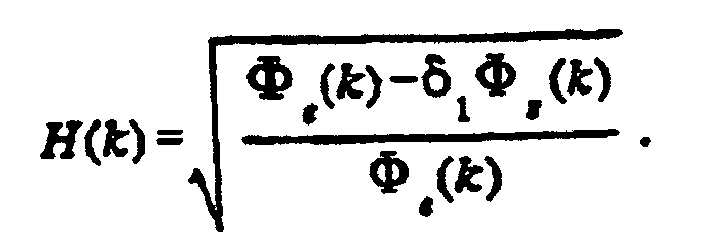
- Procédé selon la revendication 1, dans lequel la caractéristique de filtrage est donnée par un certain nombre de coefficients H(k), où k est un entier positif fini, dans lequel la densité spectrale de puissance calculée du signal de communication est donnée par Φe(k), dans lequel la densité spectrale de puissance estimée de l'écho résiduel est donnée par Φs(k), δ1 est un facteur de soustraction et dans lequel la caractéristique de filtrage est calculée sous la forme :H(k) = 0 si Φe(k) < δ1Φs(k), sinon H(k) = 1.
- Procédé selon la revendication 12, dans lequel les coefficients H(k) de la caractéristique de filtrage font l'objet d'un calcul de moyenne dans le temps.
- Procédé selon la revendication 1, comprenant en outre l'étape consistant à ajouter du bruit de confort au signal de communication filtré.
- Procédé selon la revendication 14, dans lequel ladite étape d'addition de bruit de confort au signal de communication filtré comprend les étapes consistant à :estimer une densité spectrale de puissance d'une composante de bruit du signal de communication ; etcréer le bruit de confort sur la base de la densité spectrale de puissance estimée de la composante de bruit du signal de communication.
- Procédé selon la revendication 15, dans lequel la caractéristique de filtrage est donnée par un certain nombre de coefficients H(k), où k est un entier positif fini, dans lequel la densité spectrale de puissance estimée de la composante de bruit du signal de communication est donnée par Φv2(k), dans lequel N(k) représente une transformation de Fourier d'une séquence de bruit blanc de variance unitaire et dans lequel un spectre C(k) du bruit de confort est calculé sous la forme :

- Dispositif (100) destiné à supprimer l'écho résiduel dans un signal de communication, comprenant :un moyen destiné à calculer (415, 425) une densité spectrale de puissance du signal de communication (e(n)) ;un moyen destiné à estimer (410, 420) une densité spectrale de puissance de l'écho résiduel (ŝ(n)) ;un moyen destiné à comparer (430) la densité spectrale de puissance calculée pour le signal de communication et la densité spectrale de puissance estimée pour l'écho résiduel ;un moyen destiné à ajuster une caractéristique de filtrage basée sur la sortie dudit moyen de comparaison ; etun moyen destiné à filtrer (450) le signal de communication en utilisant la caractéristique de filtrage ajustée afin de supprimer l'écho résiduel ; etcaractérisé par :un annulateur d'écho adaptatif destiné à produire en sortie le signal de communication sur la base d'un signal d'entrée et sur la base d'une estimation d'une composante d'écho du signal d'entrée (ŝ(t)) ; etdans lequel ledit moyen d'estimation de la densité spectrale de puissance (410, 420) de l'écho résiduel comprend :un moyen destiné à calculer une densité spectrale de puissance de l'estimation de la composante d'écho et un moyen destiné à recadrer la densité spectrale de puissance de l'estimation de la composante d'écho, sur la base du fonctionnement de l'annulateur d'écho adaptatif, afin de fournir l'estimation de la densité spectrale de puissance de l'écho résiduel.
- Dispositif selon la revendication 17, dans lequel la densité spectrale de puissance est dérivée d'un modèle autorégressif d'un signal dans le domaine temporel et comprenant :un moyen destiné à calculer un modèle autorégressif d'un certain nombre d'échantillons dans le domaine temporel de l'estimation de la composante d'écho ;un moyen destiné à calculer une transformation de Fourier rapide du modèle autorégressif, afin de fournir un certain nombre d'échantillons complexes dans le domaine fréquentiel de l'estimation de la composante d'écho ;un moyen destiné à multiplier chaque échantillon complexe dans le domaine fréquentiel de l'estimation de la composante d'écho par son conjugué complexe afin de fournir des échantillons de densité spectrale de puissance de l'estimation de la composante d'écho ; etun moyen destiné à recadrer les échantillons de densité spectrale de puissance de l'estimation de la composante d'écho, sur la base du fonctionnement de l'annulateur d'écho adaptatif, afin de fournir une estimation de la densité spectrale de puissance de l'écho résiduel.
Applications Claiming Priority (3)
| Application Number | Priority Date | Filing Date | Title |
|---|---|---|---|
| US177538 | 1994-01-05 | ||
| US09/177,538 US6658107B1 (en) | 1998-10-23 | 1998-10-23 | Methods and apparatus for providing echo suppression using frequency domain nonlinear processing |
| PCT/SE1999/001909 WO2000025441A1 (fr) | 1998-10-23 | 1999-10-22 | Procedes et appareil de suppression d'echo au moyen du traitement non lineaire de domaine frequentiel |
Publications (2)
| Publication Number | Publication Date |
|---|---|
| EP1129526A1 EP1129526A1 (fr) | 2001-09-05 |
| EP1129526B1 true EP1129526B1 (fr) | 2009-10-21 |
Family
ID=22648988
Family Applications (1)
| Application Number | Title | Priority Date | Filing Date |
|---|---|---|---|
| EP99971168A Expired - Lifetime EP1129526B1 (fr) | 1998-10-23 | 1999-10-22 | Procédés et appareil de suppression d'echo au moyen du traitement non linéaire de domaine fréquentiel |
Country Status (7)
| Country | Link |
|---|---|
| US (1) | US6658107B1 (fr) |
| EP (1) | EP1129526B1 (fr) |
| JP (1) | JP4638039B2 (fr) |
| CN (1) | CN1197263C (fr) |
| AU (1) | AU1429500A (fr) |
| DE (1) | DE69941578D1 (fr) |
| WO (1) | WO2000025441A1 (fr) |
Families Citing this family (34)
| Publication number | Priority date | Publication date | Assignee | Title |
|---|---|---|---|---|
| CA2390200A1 (fr) * | 1999-11-03 | 2001-05-10 | Charles W. K. Gritton | Systeme de traitement vocal integre pour reseaux a commutation par paquets |
| US6925174B2 (en) * | 1999-12-09 | 2005-08-02 | Broadcom Corporation | Interaction between echo canceller and packet voice processing |
| US6859531B1 (en) * | 2000-09-15 | 2005-02-22 | Intel Corporation | Residual echo estimation for echo cancellation |
| US7289626B2 (en) * | 2001-05-07 | 2007-10-30 | Siemens Communications, Inc. | Enhancement of sound quality for computer telephony systems |
| EP1413167A2 (fr) * | 2001-07-20 | 2004-04-28 | Koninklijke Philips Electronics N.V. | Systeme de renforcement sonore suppresseur d'echo pour plusieurs microphones sous forme de postprocesseur |
| WO2003010949A1 (fr) * | 2001-07-20 | 2003-02-06 | Koninklijke Philips Electronics N.V. | Systeme de communication possedant une ligne et un organe de suppression d'echo acoustique avec des postprocesseurs spectraux |
| KR20040030817A (ko) * | 2001-07-20 | 2004-04-09 | 코닌클리즈케 필립스 일렉트로닉스 엔.브이. | 통신 시스템, 에코 제거 수단 및 에코 제거 방법 |
| EP1413168A2 (fr) * | 2001-07-20 | 2004-04-28 | Koninklijke Philips Electronics N.V. | Systeme amplificateur de son equipe d'un dispositif de suppression d'echo et d'un dispositif de formation de faisceaux de haut-parleurs |
| JP3568922B2 (ja) | 2001-09-20 | 2004-09-22 | 三菱電機株式会社 | エコー処理装置 |
| US20030206579A1 (en) * | 2001-10-01 | 2003-11-06 | Bryant Paul Henry | Multistage nonlinear echo-canceller for digital communication systems with or without frequency division duplexing |
| US7177416B1 (en) * | 2002-04-27 | 2007-02-13 | Fortemedia, Inc. | Channel control and post filter for acoustic echo cancellation |
| US7054437B2 (en) * | 2003-06-27 | 2006-05-30 | Nokia Corporation | Statistical adaptive-filter controller |
| DE602005020662D1 (de) | 2004-10-13 | 2010-05-27 | Koninkl Philips Electronics Nv | Echolöschung |
| US8767974B1 (en) * | 2005-06-15 | 2014-07-01 | Hewlett-Packard Development Company, L.P. | System and method for generating comfort noise |
| FR2908003B1 (fr) * | 2006-10-26 | 2009-04-03 | Parrot Sa | Procede de reduction de l'echo acoustique residuel apres supression d'echo dans un dispositif"mains libres" |
| FR2908004B1 (fr) | 2006-10-26 | 2008-12-12 | Parrot Sa | Circuit de reduction de l'echo acoustique pour un dispositif "mains libres"utilisable avec un telephone portable |
| WO2009082194A1 (fr) * | 2007-12-21 | 2009-07-02 | Sitel Semiconductor B.V. | Suppression de rétroaction acoustique non linéaire dans un dispositif téléphonique |
| US8213598B2 (en) * | 2008-02-26 | 2012-07-03 | Microsoft Corporation | Harmonic distortion residual echo suppression |
| JP2009207021A (ja) * | 2008-02-29 | 2009-09-10 | Yamaha Corp | 音響エコーキャンセラ |
| US8325909B2 (en) * | 2008-06-25 | 2012-12-04 | Microsoft Corporation | Acoustic echo suppression |
| US8600038B2 (en) * | 2008-09-04 | 2013-12-03 | Qualcomm Incorporated | System and method for echo cancellation |
| US20100304679A1 (en) * | 2009-05-28 | 2010-12-02 | Hanks Zeng | Method and System For Echo Estimation and Cancellation |
| US20120237048A1 (en) * | 2011-03-14 | 2012-09-20 | Continental Automotive Systems, Inc. | Apparatus and method for echo suppression |
| US8804977B2 (en) | 2011-03-18 | 2014-08-12 | Dolby Laboratories Licensing Corporation | Nonlinear reference signal processing for echo suppression |
| EP2710787A1 (fr) * | 2011-05-17 | 2014-03-26 | Google, Inc. | Post-traitement non-linéaire pour annulation d'écho acoustique |
| EP2632141B1 (fr) * | 2012-02-22 | 2014-10-15 | Dialog Semiconductor B.V. | Post-filtre pour annuleurs d'écho dans le domaine spectral pour gérer des composants d'écho non linéaire |
| US10079023B2 (en) | 2015-09-25 | 2018-09-18 | Microsemi Semiconductor (U.S.) Inc. | Comfort noise generation apparatus and method |
| US10122863B2 (en) | 2016-09-13 | 2018-11-06 | Microsemi Semiconductor (U.S.) Inc. | Full duplex voice communication system and method |
| US10542153B2 (en) * | 2017-08-03 | 2020-01-21 | Bose Corporation | Multi-channel residual echo suppression |
| US10594869B2 (en) | 2017-08-03 | 2020-03-17 | Bose Corporation | Mitigating impact of double talk for residual echo suppressors |
| EP3692704B1 (fr) | 2017-10-03 | 2023-09-06 | Bose Corporation | Détecteur spatial de diaphonie |
| JP7043344B2 (ja) * | 2018-05-17 | 2022-03-29 | 株式会社トランストロン | エコー抑圧装置、エコー抑圧方法及びエコー抑圧プログラム |
| US10964305B2 (en) | 2019-05-20 | 2021-03-30 | Bose Corporation | Mitigating impact of double talk for residual echo suppressors |
| US11553274B2 (en) * | 2020-09-28 | 2023-01-10 | GM Global Technology Operations LLC | Autoregressive based residual echo suppression |
Citations (2)
| Publication number | Priority date | Publication date | Assignee | Title |
|---|---|---|---|---|
| WO1997045995A1 (fr) * | 1996-05-31 | 1997-12-04 | Philips Electronics N.V. | Montage utilise pour supprimer une composante parasite dans un signal d'entree |
| EP0854626A1 (fr) * | 1997-01-21 | 1998-07-22 | Matra Communication | Procédé d'annulation d'écho et annuleur d'écho mettant en oevre un tel procédé |
Family Cites Families (21)
| Publication number | Priority date | Publication date | Assignee | Title |
|---|---|---|---|---|
| US4282411A (en) | 1979-06-04 | 1981-08-04 | Tellabs, Inc. | Residual echo suppressor for echo canceller |
| EP0106640B1 (fr) | 1982-10-15 | 1986-07-16 | British Telecommunications | Circuit pour maîtriser le bruit |
| US5007047A (en) | 1988-12-02 | 1991-04-09 | Codex Corporation | Adaptive rate control for echo cancelling modem |
| US4947857A (en) * | 1989-02-01 | 1990-08-14 | Corazonix Corporation | Method and apparatus for analyzing and interpreting electrocardiograms using spectro-temporal mapping |
| US5157653A (en) | 1990-08-03 | 1992-10-20 | Coherent Communications Systems Corp. | Residual echo elimination with proportionate noise injection |
| US5305307A (en) | 1991-01-04 | 1994-04-19 | Picturetel Corporation | Adaptive acoustic echo canceller having means for reducing or eliminating echo in a plurality of signal bandwidths |
| JP2794999B2 (ja) | 1991-08-14 | 1998-09-10 | 国際電信電話株式会社 | エコーキャンセル方式 |
| US5274705A (en) | 1991-09-24 | 1993-12-28 | Tellabs Inc. | Nonlinear processor for an echo canceller and method |
| FI89756C (fi) | 1991-11-04 | 1993-11-10 | Nokia Telecommunications Oy | Foerfarande foer olineaer signalbehandling i en ekoslaeckare |
| JP2853455B2 (ja) | 1992-05-15 | 1999-02-03 | ケイディディ株式会社 | エコーキャンセラ |
| US5307405A (en) | 1992-09-25 | 1994-04-26 | Qualcomm Incorporated | Network echo canceller |
| JP2626437B2 (ja) | 1992-12-28 | 1997-07-02 | 日本電気株式会社 | 残留エコー制御装置 |
| US5537327A (en) * | 1993-10-22 | 1996-07-16 | New York State Electric & Gas Corporation | Method and apparatus for detecting high-impedance faults in electrical power systems |
| US5475731A (en) | 1994-01-07 | 1995-12-12 | Ericsson Inc. | Echo-canceling system and method using echo estimate to modify error signal |
| ZA95599B (en) | 1994-02-28 | 1996-02-06 | Qualcomm Inc | Doubletalk detection by means of spectral content |
| US5587998A (en) | 1995-03-03 | 1996-12-24 | At&T | Method and apparatus for reducing residual far-end echo in voice communication networks |
| US5561668A (en) * | 1995-07-06 | 1996-10-01 | Coherent Communications Systems Corp. | Echo canceler with subband attenuation and noise injection control |
| SE505692C2 (sv) * | 1995-12-18 | 1997-09-29 | Ericsson Telefon Ab L M | Förfarande och anordning för ekosläckning genom skattning av effekt hos residualsignal |
| US6160886A (en) * | 1996-12-31 | 2000-12-12 | Ericsson Inc. | Methods and apparatus for improved echo suppression in communications systems |
| WO1998033311A1 (fr) | 1997-01-23 | 1998-07-30 | Motorola Inc. | Appareil et procede pour le traitement non lineaire dans un systeme de communication |
| US6163608A (en) * | 1998-01-09 | 2000-12-19 | Ericsson Inc. | Methods and apparatus for providing comfort noise in communications systems |
-
1998
- 1998-10-23 US US09/177,538 patent/US6658107B1/en not_active Expired - Lifetime
-
1999
- 1999-10-22 AU AU14295/00A patent/AU1429500A/en not_active Abandoned
- 1999-10-22 WO PCT/SE1999/001909 patent/WO2000025441A1/fr not_active Ceased
- 1999-10-22 EP EP99971168A patent/EP1129526B1/fr not_active Expired - Lifetime
- 1999-10-22 CN CNB998150924A patent/CN1197263C/zh not_active Expired - Lifetime
- 1999-10-22 JP JP2000578923A patent/JP4638039B2/ja not_active Expired - Lifetime
- 1999-10-22 DE DE69941578T patent/DE69941578D1/de not_active Expired - Lifetime
Patent Citations (2)
| Publication number | Priority date | Publication date | Assignee | Title |
|---|---|---|---|---|
| WO1997045995A1 (fr) * | 1996-05-31 | 1997-12-04 | Philips Electronics N.V. | Montage utilise pour supprimer une composante parasite dans un signal d'entree |
| EP0854626A1 (fr) * | 1997-01-21 | 1998-07-22 | Matra Communication | Procédé d'annulation d'écho et annuleur d'écho mettant en oevre un tel procédé |
Also Published As
| Publication number | Publication date |
|---|---|
| AU1429500A (en) | 2000-05-15 |
| WO2000025441A1 (fr) | 2000-05-04 |
| US6658107B1 (en) | 2003-12-02 |
| CN1197263C (zh) | 2005-04-13 |
| EP1129526A1 (fr) | 2001-09-05 |
| DE69941578D1 (de) | 2009-12-03 |
| CN1332911A (zh) | 2002-01-23 |
| JP2002528995A (ja) | 2002-09-03 |
| JP4638039B2 (ja) | 2011-02-23 |
Similar Documents
| Publication | Publication Date | Title |
|---|---|---|
| US6658107B1 (en) | Methods and apparatus for providing echo suppression using frequency domain nonlinear processing | |
| US7684559B2 (en) | Acoustic echo suppressor for hands-free speech communication | |
| JP4975073B2 (ja) | デジタル適応フィルタと同フィルタを用いたアコスティックエコーキャンセラ | |
| JP5450567B2 (ja) | クリアな信号の取得のための方法及びシステム | |
| US8023641B2 (en) | Spectral domain, non-linear echo cancellation method in a hands-free device | |
| KR100594563B1 (ko) | 선형 컨벌루션 및 인과 필터링을 사용하는 스펙트럼 감산에 의한 신호 잡음 감소 | |
| US5732134A (en) | Doubletalk detection by means of spectral content | |
| US8315380B2 (en) | Echo suppression method and apparatus thereof | |
| EP1046273B1 (fr) | Procedes et appareil pour assurer un bruit de fond de confort dans des systemes de communications | |
| US5933495A (en) | Subband acoustic noise suppression | |
| EP1298815B1 (fr) | Processeur d'écho avec un générateur de pseudo-bruit de fond | |
| KR100595799B1 (ko) | 스펙트럼 종속 지수 이득 함수 평균화를 이용한 스펙트럼공제에 의한 신호 잡음 저감 | |
| EP1022866A1 (fr) | Procede de suppression d'echo, annuleur d'echo et commutateur vocal | |
| EP0789476B1 (fr) | Dispositif de réduction de bruit | |
| KR19990035995A (ko) | 입력 신호의 간섭 성분을 억제하기 위한 장치 | |
| US20120163612A1 (en) | Communication System | |
| EP1210814B1 (fr) | Procedes et appareil permettant d'ameliorer la performance d'un filtre adaptatif en incluant des informations inaudibles | |
| US6834108B1 (en) | Method for improving acoustic noise attenuation in hand-free devices | |
| KR100272131B1 (ko) | 계층적 구조의 적응반향 제거장치 | |
| Deng | Adaptive algorithms for sparse impulse response identification | |
| KR100431965B1 (ko) | 시변 적응알고리즘이 적용된 음향반향 제거장치 및 그 방법 | |
| JP2024139278A (ja) | 自動利得制御装置、エコー除去装置、自動利得制御方法及び自動利得制御プログラム |
Legal Events
| Date | Code | Title | Description |
|---|---|---|---|
| PUAI | Public reference made under article 153(3) epc to a published international application that has entered the european phase |
Free format text: ORIGINAL CODE: 0009012 |
|
| 17P | Request for examination filed |
Effective date: 20010403 |
|
| AK | Designated contracting states |
Kind code of ref document: A1 Designated state(s): AT BE CH CY DE DK ES FI FR GB GR IE IT LI LU MC NL PT SE |
|
| AX | Request for extension of the european patent |
Free format text: AL;LT;LV;MK;RO;SI |
|
| RAP1 | Party data changed (applicant data changed or rights of an application transferred) |
Owner name: TELEFONAKTIEBOLAGET LM ERICSSON (PUBL) |
|
| RBV | Designated contracting states (corrected) |
Designated state(s): DE FR GB |
|
| 17Q | First examination report despatched |
Effective date: 20060922 |
|
| GRAP | Despatch of communication of intention to grant a patent |
Free format text: ORIGINAL CODE: EPIDOSNIGR1 |
|
| RTI1 | Title (correction) |
Free format text: METHODS AND APPARATUS FOR PROVIDING ECHO SUPPRESSION USING FREQUENCY DOMAIN NONLINEAR PROCESSING |
|
| GRAS | Grant fee paid |
Free format text: ORIGINAL CODE: EPIDOSNIGR3 |
|
| GRAA | (expected) grant |
Free format text: ORIGINAL CODE: 0009210 |
|
| AK | Designated contracting states |
Kind code of ref document: B1 Designated state(s): DE FR GB |
|
| REG | Reference to a national code |
Ref country code: GB Ref legal event code: FG4D |
|
| REF | Corresponds to: |
Ref document number: 69941578 Country of ref document: DE Date of ref document: 20091203 Kind code of ref document: P |
|
| PLBE | No opposition filed within time limit |
Free format text: ORIGINAL CODE: 0009261 |
|
| STAA | Information on the status of an ep patent application or granted ep patent |
Free format text: STATUS: NO OPPOSITION FILED WITHIN TIME LIMIT |
|
| 26N | No opposition filed |
Effective date: 20100722 |
|
| PG25 | Lapsed in a contracting state [announced via postgrant information from national office to epo] |
Ref country code: FR Free format text: LAPSE BECAUSE OF NON-PAYMENT OF DUE FEES Effective date: 20101102 |
|
| REG | Reference to a national code |
Ref country code: FR Ref legal event code: ST Effective date: 20110630 |
|
| PGRI | Patent reinstated in contracting state [announced from national office to epo] |
Ref country code: FR Effective date: 20111118 |
|
| REG | Reference to a national code |
Ref country code: FR Ref legal event code: PLFP Year of fee payment: 17 |
|
| REG | Reference to a national code |
Ref country code: FR Ref legal event code: PLFP Year of fee payment: 18 |
|
| REG | Reference to a national code |
Ref country code: FR Ref legal event code: PLFP Year of fee payment: 19 |
|
| REG | Reference to a national code |
Ref country code: FR Ref legal event code: PLFP Year of fee payment: 20 |
|
| PGFP | Annual fee paid to national office [announced via postgrant information from national office to epo] |
Ref country code: DE Payment date: 20181029 Year of fee payment: 20 |
|
| PGFP | Annual fee paid to national office [announced via postgrant information from national office to epo] |
Ref country code: FR Payment date: 20181025 Year of fee payment: 20 Ref country code: GB Payment date: 20181029 Year of fee payment: 20 |
|
| REG | Reference to a national code |
Ref country code: DE Ref legal event code: R071 Ref document number: 69941578 Country of ref document: DE |
|
| REG | Reference to a national code |
Ref country code: GB Ref legal event code: PE20 Expiry date: 20191021 |
|
| PG25 | Lapsed in a contracting state [announced via postgrant information from national office to epo] |
Ref country code: GB Free format text: LAPSE BECAUSE OF EXPIRATION OF PROTECTION Effective date: 20191021 |