EP1129567B1 - Procede pour faire fonctionner avec une faible consommation de courant des terminaux de communication dans un systeme de communication notamment sans fil - Google Patents
Procede pour faire fonctionner avec une faible consommation de courant des terminaux de communication dans un systeme de communication notamment sans fil Download PDFInfo
- Publication number
- EP1129567B1 EP1129567B1 EP99972399A EP99972399A EP1129567B1 EP 1129567 B1 EP1129567 B1 EP 1129567B1 EP 99972399 A EP99972399 A EP 99972399A EP 99972399 A EP99972399 A EP 99972399A EP 1129567 B1 EP1129567 B1 EP 1129567B1
- Authority
- EP
- European Patent Office
- Prior art keywords
- terminal
- operating state
- terminals
- control centre
- sleep
- Prior art date
- Legal status (The legal status is an assumption and is not a legal conclusion. Google has not performed a legal analysis and makes no representation as to the accuracy of the status listed.)
- Expired - Lifetime
Links
- 238000000034 method Methods 0.000 title claims abstract description 58
- 230000006854 communication Effects 0.000 title claims abstract description 16
- 238000004891 communication Methods 0.000 title claims abstract description 14
- 230000007958 sleep Effects 0.000 claims abstract description 75
- 230000011664 signaling Effects 0.000 claims description 31
- 230000005540 biological transmission Effects 0.000 claims description 28
- 238000001514 detection method Methods 0.000 claims description 19
- 238000012546 transfer Methods 0.000 claims description 14
- 238000012790 confirmation Methods 0.000 claims description 8
- 230000008569 process Effects 0.000 claims description 8
- 238000012545 processing Methods 0.000 claims description 8
- 230000000694 effects Effects 0.000 claims description 6
- 230000006399 behavior Effects 0.000 claims description 5
- 230000002618 waking effect Effects 0.000 claims description 5
- 238000012937 correction Methods 0.000 claims description 4
- 238000011156 evaluation Methods 0.000 claims description 3
- 230000007420 reactivation Effects 0.000 claims description 3
- 230000002035 prolonged effect Effects 0.000 claims 2
- 230000004622 sleep time Effects 0.000 description 8
- 108700026140 MAC combination Proteins 0.000 description 7
- 230000001360 synchronised effect Effects 0.000 description 6
- 230000007704 transition Effects 0.000 description 6
- 238000010586 diagram Methods 0.000 description 5
- 230000007246 mechanism Effects 0.000 description 5
- 230000002123 temporal effect Effects 0.000 description 5
- 230000005611 electricity Effects 0.000 description 4
- 230000006870 function Effects 0.000 description 3
- 230000001960 triggered effect Effects 0.000 description 3
- 230000009286 beneficial effect Effects 0.000 description 2
- 230000008901 benefit Effects 0.000 description 2
- 230000001934 delay Effects 0.000 description 2
- 238000012935 Averaging Methods 0.000 description 1
- 230000004913 activation Effects 0.000 description 1
- 230000015556 catabolic process Effects 0.000 description 1
- 150000001875 compounds Chemical class 0.000 description 1
- 230000007423 decrease Effects 0.000 description 1
- 230000003247 decreasing effect Effects 0.000 description 1
- 238000005265 energy consumption Methods 0.000 description 1
- 239000003365 glass fiber Substances 0.000 description 1
- 238000009499 grossing Methods 0.000 description 1
- 238000010295 mobile communication Methods 0.000 description 1
- 230000003287 optical effect Effects 0.000 description 1
- 230000000737 periodic effect Effects 0.000 description 1
- 239000010453 quartz Substances 0.000 description 1
- VYPSYNLAJGMNEJ-UHFFFAOYSA-N silicon dioxide Inorganic materials O=[Si]=O VYPSYNLAJGMNEJ-UHFFFAOYSA-N 0.000 description 1
- 230000004617 sleep duration Effects 0.000 description 1
- 238000012549 training Methods 0.000 description 1
Images



Classifications
-
- H—ELECTRICITY
- H04—ELECTRIC COMMUNICATION TECHNIQUE
- H04W—WIRELESS COMMUNICATION NETWORKS
- H04W68/00—User notification, e.g. alerting and paging, for incoming communication, change of service or the like
-
- H—ELECTRICITY
- H04—ELECTRIC COMMUNICATION TECHNIQUE
- H04J—MULTIPLEX COMMUNICATION
- H04J3/00—Time-division multiplex systems
- H04J3/02—Details
- H04J3/06—Synchronising arrangements
- H04J3/0602—Systems characterised by the synchronising information used
- H04J3/0605—Special codes used as synchronising signal
- H04J3/0608—Detectors therefor, e.g. correlators, state machines
-
- Y—GENERAL TAGGING OF NEW TECHNOLOGICAL DEVELOPMENTS; GENERAL TAGGING OF CROSS-SECTIONAL TECHNOLOGIES SPANNING OVER SEVERAL SECTIONS OF THE IPC; TECHNICAL SUBJECTS COVERED BY FORMER USPC CROSS-REFERENCE ART COLLECTIONS [XRACs] AND DIGESTS
- Y02—TECHNOLOGIES OR APPLICATIONS FOR MITIGATION OR ADAPTATION AGAINST CLIMATE CHANGE
- Y02D—CLIMATE CHANGE MITIGATION TECHNOLOGIES IN INFORMATION AND COMMUNICATION TECHNOLOGIES [ICT], I.E. INFORMATION AND COMMUNICATION TECHNOLOGIES AIMING AT THE REDUCTION OF THEIR OWN ENERGY USE
- Y02D30/00—Reducing energy consumption in communication networks
- Y02D30/70—Reducing energy consumption in communication networks in wireless communication networks
Definitions
- the invention is based on a method for a energy-saving operation of communication terminals in one in particular wireless communication system with Packet switching.
- Possible media are a radio channel or a passive one optical network or cable distribution networks with coaxial cables and / or glass fibers.
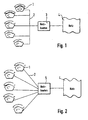
- the principle is shown in FIG.
- a terminal can also be a concentrator with multiple terminals are located (PBX in Ownership of the participant or network unit owned by the Network operator).
- PBX in Ownership of the participant or network unit owned by the Network operator.
- the following is without limitation the Generality of terminals spoken. With 1 are the Subscriber or their terminals called, with the 2 common transmission medium, with 3 the central office and with 4 the transmission network.
- circuit-switched Systems e.g. Analog telephone, ISDN
- each terminal has one own connection to a network node, where these connections be bundled on one or a few wires, see figure 2.
- ATM networks asynchronous Transfer Mode
- Such a network node 5 represents in the case of ATM is an ATM multiplexer.
- the medium to be considered here is one Radio channel. Because of the unboundness to a place it is usual that the terminals e.g. Notebooks or others portable devices that are powered by batteries can. Therefore, the power consumption is an important one Sales argument for such devices.
- IP Internet Protocol
- Ethernet Ethernet networks
- MAC Media Access Control
- GSM power saving methods are used. This procedure are very easy to use because GSM is circuit switched Providing communication. This means that it is only the States “connected” and “not connected” exist. In condition Data is continuously “connected” between the network and Participants exchanged. In the state "not connected” must the terminal at regular intervals about it inform which base station is currently best is received and whether a call for a terminal arrives. Incoming calls are received from all base stations in the Roaming Area sent out - this process is called paging - And the terminal logs in at the current best Base station to pick up the call. The terminal reports not itself until it is the so-called roaming Area leaves. In this case, it must be in the new Sign in Roaming Area.
- HIPERLAN Type 1 systems there is the procedure for Saving electricity.
- the MAC protocol is decentralized organized and each participant tries to compete with others occupy the channel much like the ethernet MAC protocol.
- the MAC is connectionless, so that always one Package can be expected.
- the address of the recipient and The length of the package will be at the beginning of each package sent so that each participant at least each of these Must listen to packet heads. If he finds out that the package not intended for him, he can stay for the duration of Packages, which he can remove from his head. This is relatively inefficient as there are no longer sleep phases possible are.
- the channel must always be monitored, even if currently no traffic occurs (at least the Power level).
- This arrangement includes a microprocessor that used to paging channel messages decode and determine if the message for the Terminal is relevant. If the message is not for the Terminal is determined, it is between the reception of the Messages on the paging channel into a power-saving mode, wherein first a timer is started, after expiration a signal is generated for a predetermined period of time, whereupon the microprocessor goes into an active operating state and receive the message on the paging channel. to Paging message detection and resynchronization becomes a synchronization sequence from the base station Posted.
- the arrangement according to EP-A-0 473 465 comprises a Decider, by means of which the temporal synchronization of the terminal in relation to that of a center received synchronous information / frame symbols is controllable.
- the decision maker has control of the terminal, if the terminal from an active first operating state in another or second or third operating state, for example, a standby or sleeping phase, passes. It is also a timer device provided, which is controllable by the decision maker and the Korfigieren.
- the present invention is concerned with methods for Saving power in systems with centrally controlled MAC can be used. She tries the properties maximum utilization of the MAC protocol and as long as possible Achieve times in which the activity of the terminals can be kept to a minimum. It is useful that different power consuming system shares are very quickly turn off and on again, while others Parts need longer to be ready for use again.
- the invention also solves the problem of synchronization between terminal and central office. Owing to Clock inaccuracy, it may happen that the time reference of a terminal is not synchronous with the control center. Therefore is a synchronization between the two necessary, not can consume a lot of electricity.
- the invention provides a very flexible method for Saving electricity, in particular the fact that the period of time after which a terminal reports again, between headquarters and terminal can be freely negotiated.
- This period of time depends on how the sum of the Traffic parameter affects all connections. If many connections with high demands on the Packet delays are open, these periods can also only be very short. If it concerns few connections with are low packet delay requirements long sleep times possible.
- Announcements for receiving and sending are only available from the Central to a terminal via a common Announcement channel given. Therefore, a terminal can already due to the basic structure of the MAC protocol only be active at very limited times to the necessary ones Receive information. Because the signal processing too In the case of reception is quite expensive, is the power consumption not to neglect in this case. This share of Power consumption is minimized in the invention in that the time intervals between the individual Reception operations are increased.
- the central controller each terminal a specific one Transmission capacity in the form of time slots for a specific time interval, called SP (signaling period), depending on the transmission resource requirements the terminals T1, T2 .. too.
- SP signaling period
- the total number of slots of one SP is variable and varies over time.
- An uplink phase consists of a number of bursts, the sent by the terminals, and an uplink signaling phase.
- the uplink signaling phase are the terminals authorized, Signaling messages to the central controller too send if they do not allocate reserved timeslots have gotten for transmission within the normal Bursts (Pgback method).
- For the uplink signaling is Polling or Random Access applicable.
- the downlink phase become the Signaling PDU (Protocol Data Unit) and all Bursts sent from the central controller to the terminals. Within a signaling PDU are all necessary Information for the next SP including the Transfer signaling slots to the terminals.
- the signaling PDU contains feedback messages for previously transmitted uplink signaling information, for example, for a Collision resolution or features like automatic Repeat request (ARQ) are necessary. With these Information the terminals know when they send bursts may and can receive. If different types of Bursts, e.g. short or long, to be used, the kind becomes the bursts from the central controller within the Signaling PDU announced.
- ARQ automatic Repeat request
- Downlink signaling is the key element here of consideration. It will be in the following announcement channel (Announcement Channel, AC). Another important Element is the uplink signaling, mostly with Requests to do from terminals to the central office Has. This element is called RC back channel in the following.
- the method of the invention works connection oriented, i. between the headquarters and the Terminal must always set up at least one connection which can then be communicated.
- the Properties of the connection become when connecting negotiated. So a connection can be a constant Data rate while other connections are "bursty" are, i. it comes a lot, then comes less or nothing at all. The periods between bursts may be right To be long.
- the power consumption is in a terminal on the one hand by the signal processing power, but also in the transmission case determined by the RF part. Signal processing drops both in the transmission as well as in the reception case, while the RF part a large part of the power consumption during transmission.
- the main part of the power consumption of the HF part is created in Power amplifier / power amplifier. This consumed for one a quiescent current, which also arises when nothing on the other hand, he has the necessary Apply transmit power. Because the quiescent current then arises, if there is nothing to send, it lends itself to the Turn off the power amplifier as often as possible.
- the transmit amplifier generally requires relatively long, until he is ready again, and can So only be turned off when the expected high Duration is long enough. This also applies to other parts of the Systems, e.g. Downclocking or hiding the clock from digital hardware, oscillators in the RF part, etc. Therefore depends on the time that a terminal takes to get back to be operational, depending on what system shares were turned off.
- the active state means that a terminal is ready to start Communication process, i. everyone hears it Announcement on the announcement channel AC, the headquarters ZE sends out, from.
- the two states readiness and Sleep represents various levels of inactivity that essentially differ in that in the state Sleep more system components of the terminal off and the wake up time gets longer because of the Reactivation of the individual components takes longer.
- the problem of time synchronization is in the State sleep more critical, as the time intervals between intercepted announcements on the announcement channel AC are larger.
- the Terminal If the terminal is active in the state and it is the Allow traffic parameters of the established connections can tell the Central ZE that it is now in the State willingness to go and every how many Announcement on the announcement channel AC it listens. After this it has received the confirmation of the central office ZE, it goes in the state readiness. When listening to the Announcement channel AC determines that there are no messages for there are, and even has no cells to transmit, it stays in this state.
- the wake-up process - transition to the state active - goes Similar to the state of readiness. If that Terminal has something to send itself, it activates the deactivated system components and accesses the return channel RC too. If the central office ZE send something to the terminal If you want to, it will inform the end device in the announcement the announcement channel AC, from which she knows that the terminal receives, with. Since the terminal in sleep state one longer time for activation especially of the transmission branch required (the reception branch must be active to the Announcement channel AC to receive) Circumstances mechanisms are provided. A possible Mechanism is the agreement of a fixed wake-up time, after the central office ZE the terminal in the Announcement channel AC simply assigns capacity. Another Possibility is that the terminal after waking up in the Return channel RC at the central office ZE reports back.
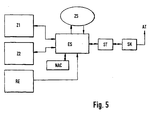
- the method according to [4] is not 100% reliable. With a low probability, on the one hand a frame symbol can be detected if none has occurred, and on the other hand it may be that a frame symbol has occurred but was not detected. These two types of errors are rare, but can significantly affect the counting process and lead to errors. Therefore, precautions must be taken to minimize these sources of error. This happens, for example, through the use of one or more proprietary timers in terminals, which together with the appearance of the frame symbol ensure near-perfect reliability. The timers are sufficiently accurate over a period of several signaling periods. A possible circuit for the terminal T1 is shown in FIG. In the middle sits the decision maker ES, who controls the entire time synchronization.
- the mechanism of the decision maker ES is a state machine, whereby its state as well as the value of some variables can be stored in the state memory ZS and read from there.
- a counter NAC is assigned to the decision maker ES.
- the decision maker ES is connected to the controller ST, which in turn is connected to the system components SK, to which an antenna AT is connected.
- the controller ST of the terminal T1 passes the control to the decision maker ES according to FIG. 5, which in turn notifies the controller ST of the terminal T1 when it has to listen to an announcement in the announcement channel AC.
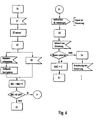
- the flow of the state diagram is shown in FIG.
- the description language used is SDL (standard Description Language).
- SDL standard Description Language
- the decision maker ES either expects one Signal from frame detection RE or from timer Z2.
- the frame detection signal RE comes, it becomes used to correct the time base of the terminal T1.
- This correction sets the actual time of the Frame signal with the expected time in relation. A higher accuracy of this correction can be achieved by a temporal averaging over the occurrence of several Frame symbols can be achieved. If the frame signal is not is detected, because the detection of the frame detection RE not absolutely reliable, the signal of the Timer Z2 evaluated and thus the clock of the timer Z2 is used as synchronous information. This ensures that each signaling period is counted.
- the counter NAC the occurrence of the Announcements in Announcement Channel AC counts up by one and checked if it matches the value to which the Terminal T1 the corresponding announcement on the Announcement channel AC must listen. A difference will be introduced to ensure that the terminal is sufficient Has time to receive the announcement channel AC activate required system components. If this value not yet reached, the decision-maker ES goes back in the state S1 over.
- the decision maker inputs ES Signal to the controller ST of the terminal T1 with the Instruction, the announcement said on the announcement channel AC to receive and evaluate. If the evaluation results in that the terminal T1 can continue to sleep, the Counter NAC for the occurrence of announcements reset, and the terminal T1 goes to state S1 above. If it does not sleep, the Decision ES in state S4 and waits for the Control gives the instruction to sleep again walk. The further actions following S4 are not detailed.
- the terminals T1, T2 and T3 are Associated with the central office ZE and communicate with it for example via a common radio channel.
- the Central ZE is in this case to a network NW connected, but this does not necessarily have to be the case.
- terminal T1 decides that it is in the State willingness to go out and every fourth Announcement of the announcement channel AC will wiretap, and informs the central office ZE, cf. Figure 8.
- the control center ZE returns the confirmation to terminal T1, and terminal T1 goes into standby mode. Now listen to terminal T1 every fourth announcement of the announcement channel AC's Central ZE down.
- terminal T1 receives the Message that a message is to be received. Terminal T1 goes into active state and communicates normally with the Central ZE.
- Terminal T1 now goes back to the state Standby, see Figure 9. This time the transition back to the State active triggered by a message, the terminal device T1 must be transmitted to the central office ZE.
- the terminal always in the sleep state at least three or more consecutive announcements in the announcement channel AC - for example the Announcement that it means to have to listen, as well as the Announcement before and the announcement afterwards. If in No notification of any of the announcements End convinceds occurs, it has been counted and must be at Report to the central office ZE, in order to reapply in time synchronize.
- Frame synchronization signal can by a simple analog circuit, for example consisting of filters, the are tuned to the respective bandwidth halves, with subsequent evaluation circuit can be detected. This saves a lot compared to digital signal processing Electricity, as a part or the whole device to digital Signal processing can be turned off.
- this signal For information transmission this signal, like FIG. 12 shows, just inverted. Any signal inversion of the Synchronous information / the frame symbol is according to the invention as a wake-up symbol in particular for all sleeping devices used, but not only for all sleeping devices but also for other devices may be of importance.
- Recognition of the frame synchronization symbol functions already in worse transmission conditions (signal-to-noise ratio), as for the demodulation of the data stream necessary. In normal operation, this is shown in FIG. 11 sent icon shown. In the event that the central ZE a message to one or more in particular sleeping Want to send devices, but not on the previously described paths over the periodic active frames will happen is another Frame synchronization symbol of FIG. 12 sent.
- wake-up icons are all sleep or off-line devices Enter standby mode and enter into active mode the following framework to find out why they were awakened.
- the central knows, when the terminals after the Wakeup symbol can appeal, the terminal at the Association, so when you log on the terminal at the Central ZE or when requesting the sleep mode after which time it is again in active mode is. This period varies greatly depending on of which components of the terminal were turned off.
- Fig. 13 shows an embodiment for this purpose.
- the terminals T2 and T3 should be in a power saving mode, while terminal T1 is active. If now the central ZE has a message for Terminal T3 that can not wait until this terminal again listens to a frame, sends the Central ZE a wake-up symbol as a synchronization symbol. Thereafter, the terminals T2 and T3 go into the active mode. This process takes less time in the terminal T2 than in the terminal T3, because in the terminal T3 more components were switched off or the wake-up time by the manufacturer-specific Implementation is longer. As for longer sleep times in particular, those components that are disabled can take a long time to be active again Time difference be significant.
- the central office ZE knows in which subsequent frame it is the information for terminal T3 must first notify which one Wake-up times, i. Reactivation times it needed.
- the central office sends a message that the terminal T2 can sleep on, since the data only concern terminal 3.
- the central office ZE sends the central office ZE the data to be transmitted.
- the Terminal T3 is now in the active state. If after some time no more data from or to the terminal There may be a new sleep request send to the central office ZE.
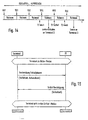
- Fig. 14 shows the Wake up symbol sequence with the different ones Frame synchronization symbols RS1 and RS2.
- RS1 sets Here, the synchronization symbol of FIG. 11 and RS2 the synchronization symbol according to FIG. 12.
- the easiest way is the wake up time during the negotiation on sleep phases (sleep request). This is shown in FIG.
- One Terminal is here called “terminal”.
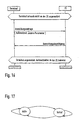
- a terminal sends the time it takes to sleep request needed to regenerate from this sleep depth (Wake-up). It is also possible a transfer of the Wake up needed time (waking time) during the Association of the terminal. This is shown in FIG. 16.
- This waking time is also possible depending on the Length of sleep phases as system parameters. Another possibility is this length of the Not to transfer sleep phases, but to determine that a terminal via a random access channel (random access channel) as soon as it is ready. If the wake-up signal is basically the only method is to wake up sleeping terminals is a transfer the length of the sleep phases not necessarily required.
- a wake up symbol is sent when data for a terminal exist.
- the terminal terminal
- the terminal can in turn via the channel with random access (uplink signaling channel) Request transmission capacity (Fig. 14). It is beneficial, not a wake-up symbol between to send the frame symbols, but the two symbols each to alternate. That First, according to FIG. 14, the Frame synchronization symbol RS1 sent, then to Wake up to the frame sync symbol RS2 changed until the next wake-up process with the Frame synchronization symbol RS1 is initiated. That has the advantage that even those terminals wake up, the a frame synchronization symbol is not or erroneous have detected.
- Fig. 17 shows only two Define operating conditions, namely an active phase and a sleep phase in which the standby and sleep phases are merged. This can be the time for the one Terminal sleeps until there is a broadcast channel again listening to be changed over time. That's it Sleep phases can be dynamically adapted to user behavior adapt or depending on user preferences adjust. A terminal can thereby each as long sleep like this because of its current parameters thinks it makes sense. These parameters are primarily the Parameters of the connections the terminal holds, e.g. the data rate, the maximum allowed delay or the Intermediate arrival time between data packets.
- the user can by manual configuration, especially in favor of longer Battery life increase the duration of sleep, But then takes longer delays in the Data transfer in purchase.
- a successive extension of the Duration of sleep phases makes sense, if that User behavior allows a conclusion, in particular if the terminal e.g. is only used sporadically or has not been used for a long time.
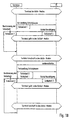
- Fig. 18 shows, In particular, there are two sleep timers for different ones Sleep phases - Sleep Time 1 and Sleep Time 2 - provided.
- a terminal sends a new sleep request (Sleep request), after the central office ZE the continuation of the Sleep mode has confirmed (Continue sleep).
- the sleep phases initially slightly reduced then increase all the more, e.g. from a duration of 10 frames first to 9 and subsequently to 30. Important in this context is that the course of sleep phases over time in total one Increase.
- the battery status can be called: longer Sleep phases, but thereby poorer quality, like longer ones Waiting times for transmission or connection establishment decreasing battery capacity.
- a terminal which is logged as in Fig. 13 at a central ZE.
- this terminal works a user, in particular WWW applications, such as. Netscape or Internet Explorer used.
- These applications have the property of one strongly bursty, i. fluctuating data stream too produce.
- the behavior of the user has one strong influence on the amount of data to be transferred: at Calling a new webpage will shortly be a lot of data Transfer, reading this page then for a long time no more.
- These applications can also, unlike for real-time applications like voice, video, the maximum permissible delay are chosen to be quite high. Thereby This terminal can often be between the activities of the User (clicking a link) in a relatively long time Go to sleep phases. If now this user that Terminal leaves a longer time, the duration of the Sleep phase to be increased slowly. This leads to more and more components of the terminal are turned off can.
- the terminal sets the duration of the sleep phases This increases the working time at the expense the transmission quality. This can happen even then when a user uses the terminal.
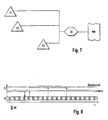
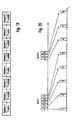
- the terminal T1 must be woken up before become. As shown in FIG. 19, the terminal T1 is timely before a frame in which a transfer takes place - in Fig. 18 in the frame 1, 4 and 7 ... - in the active mode over to receive the data and then sleeps again. Since the latter method the necessary Signaling effort greatly reduced, it can be useful Its also non-CBR traffic, as far as its Allow traffic parameters to smooth, i. a burst (large amount of data occurring in a short time) over time to distribute. This is shown in FIG. This is it makes the process possible with reduced Signaling effort for other service classes as well VBR, ABR to use. Again, the use of ATM not mandatory.
- a terminal with a slightly modified Sleep arrangement announce that it only every nth frame listening. This will reduce this for the terminal Quality of service, but it is possible, this terminal the To offer access cheaper. Also the power consumption of Terminals drops due to frequent sleep times.
- IP Internet Protocol
- IP in the current common version only supports "best-effort", i.e. Transfer as good as possible.
- These Terminals try data as fast as possible send.
- the bandwidth is severely limited is, these terminals (terminals) can be in clusters be split, which only every N frame access to receive the radio channel, e.g. Terminal 1 in frame 1, Terminal 2 in frame 2, ... This will create the resulting Smooth traffic and increase overall throughput.
Landscapes
- Engineering & Computer Science (AREA)
- Computer Networks & Wireless Communication (AREA)
- Signal Processing (AREA)
- Mobile Radio Communication Systems (AREA)
Claims (31)
- Procédé pour faire fonctionner avec une faible consommation de courant des terminaux de communication dans un système de communication notamment sans fil avec commutation de paquets, comprenant une centrale (ZE) qui peut elle-même être un terminal et qui émet dans un canal d'avertissement (AC) des messages destinés aux terminaux (T1, T2...) et qui reçoit dans un canal de retour (RC) des messages provenant des terminaux (T1, T2...), ce procédé présentant les étapes suivantes :on affecte aux terminaux (T1, T2...) au moins deux états de fonctionnement, le premier définissant une phase active au cours de laquelle un terminal (T1, T2...) écoute chaque avertissement dans le canal d'avertissement, tandis que le second état de fonctionnement définit une phase de veille au cours de laquelle le canal d'avertissement (AC) n'est écouté que par intervalles,pour synchroniser les terminaux (T1, T2...), on émet par la centrale (ZE) des informations de synchronisation, comme par exemple des symboles de trame, etles terminaux (T1, T2...), au moins à certains intervalles de temps, évaluent les informations de synchronisation ou symboles de trame, également dans l'autre ou les autres états de fonctionnement, pour corriger leur base de temps.
- Procédé selon la revendication 1,
caractérisé en ce qu'
un deuxième état de fonctionnement définit une phase d'attente dans laquelle le canal d'avertissement (AC) est écouté périodiquement à des fenêtres de temps définies à l'avance, quelques composants de système (SK) d'un terminal (T1, T2...) étant alors couplés et, dans un autre état de fonctionnement constituant le troisième état, on effectue en plus la coupure d'autres composants de système (SK) dont la réactivation est plus longue que dans le deuxième état de fonctionnement. - Procédé selon la revendication 1 ou 2,
caractérisé en ce qu'
un terminal (T1, T2...), qui pourrait passer au deuxième ou au troisième état de fonctionnement, envoie un message correspondant à la centrale (ZE) et fait savoir aussi à la centrale quand il l'informera à nouveau. - Procédé selon la revendication 3,
caractérisé en ce que
le passage du premier au deuxième ou troisième état de fonctionnement, ou du deuxième au troisième, a lieu seulement quand une confirmation a été reçue de la centrale. - Procédé selon une des revendications 1 à 4,
caractérisé en ce que
la durée pour laquelle un terminal (T1, T2...) passe à la deuxième ou à la troisième phase de fonctionnement, est négociée entre la centrale (ZE) et le terminal correspondant (T1, T2...), notamment en fonction des paramètres de trafic des liaisons. - Procédé selon une des revendications 1 à 5,
caractérisé en ce que
les temps, pendant lesquels les terminaux (T1, T2...) écoutent le canal d'avertissement (AC), sont soit prédéfinis fixement par la centrale (ZE), soit adressés par les terminaux (T1, T2...) à la centrale (ZE) qui en accuse réception. - Procédé selon une des revendications 1 à 6,
caractérisé en ce qu'
un passage du deuxième ou du troisième état de fonctionnement au premier état a lieu quand la centrale (ZE) informe le terminal correspondant (T1, T2...) qu'il détient des paquets de données pour le terminal (T1, T2...) et la centrale (ZE) indique également au terminal quand celui-ci doit recevoir ces paquets. - Procédé selon une des revendications 1 à 6,
caractérisé en ce qu'
un passage du deuxième ou troisième état de fonctionnement au premier a lieu quand un terminal (T1, T2...) doit envoyer lui-même un ou plusieurs paquets de données à la centrale (ZE), ce terminal accédant au canal de retour (RC) et informant la centrale (ZE) qu'il devrait passer au premier état de fonctionnement et qu'il a quelque chose à transmettre, la centrale (ZE) confirmant dans le canal d'avertissement le changement d'état et indiquant au terminal (T1, T2...) quand celui-ci doit effectuer son envoi. - Procédé selon une des revendications 2 à 6,
caractérisé en ce que
le passage du deuxième au troisième état de fonctionnement a lieu quand un terminal (T1, T2...) est resté assez longtemps dans le deuxième état de fonctionnement et si la caractéristique de trafic l'autorise, ce terminal informant la centrale (ZE) avec quel intervalle dans le temps il écoute le canal d'avertissement (AC), et le passage n'a lieu qu'après accusé de réception par la centrale (ZE). - Procédé selon une des revendications 1 à 9,
caractérisé en ce que
pour le passage du troisième au premier état de fonctionnement, un temps d'éveil fixe est convenu après lequel la centrale (ZE) attribue, dans le canal d'avertissement (AC), au terminal correspondant (T1, T2...) une capacité, ou bien le terminal (T1, T2...) après le temps d'éveil, informe en retour la centrale (ZE) par le canal de retour (RC). - Procédé selon une des revendications 1 à 10,
caractérisé en ce que
la détection d'un symbole de trame émis de préférence au début d'une trame, est effectuée indépendamment du reste du traitement du signal. - Procédé selon une des revendications 1 à 11,
caractérisé en ce que
le passage du deuxième ou troisième état de fonctionnement au premier est effectué par émission d'une marque, notamment une information à 1 bit analogue au canal d'avertissement (AC), cette marque se distinguant par sa forme de la marque qui appartient au canal d'avertissement (AC). - Procédé selon une des revendications 1 à 12,
caractérisé en ce que
les informations de synchronisation ou les symboles de trame sont également utilisés pour envoyer des messages aux terminaux (T1, T2...), notamment à ceux qui sont dans le deuxième ou le troisième état de fonctionnement. - Procédé selon la revendication 12 ou 13,
caractérisé en ce que
pour transmettre des messages, en particulier des informations à 1 bit, les informations de synchronisation ou les symboles de trame sont inversés. - Procédé selon la revendication 13 ou 14,
caractérisé en ce que
les messages dans les informations de synchronisation ou les symboles de trame sont constitués de symboles de réveil pour les terminaux (T1, T2...), notamment dans le deuxième et/ou le troisième état de fonctionnement, une inversion de signal ayant lieu notamment pour chaque nouvelle opération de réveil. - Procédé selon une des revendications 1 à 15,
caractérisé en ce que
les temps pendant lesquels un terminal devrait rester dans le deuxième ou le troisième état de fonctionnement, sont transmis à la centrale (ZE), ou bien il est établi qu'un terminal accède à un canal facultatif dès qu'il est prêt à fonctionner. - Procédé selon une des revendications 1 à 16,
caractérisé en ce que
les temps de réveil, c'est-à-dire les temps qui sont nécessaires à un terminal pour passer à la phase active, sont transmis à la centrale (ZE), notamment pendant la négociation de la phase de veille ou pendant l'association du terminal. - Procédé selon une des revendications 1 à 16,
caractérisé en ce que
les temps de réveil, c'est-à-dire les temps qui sont nécessaires à un terminal pour passer à la phase active, sont fixés en fonction des phases de veille, en tant que paramètres de système. - Procédé selon une des revendications 1 à 18,
caractérisé en ce que
dans le cas où des terminaux sont réactivés exclusivement par des symboles de réveil, la transmission de la durée des phases de veille est interrompue et les symboles de réveil sont envoyés quand sont présentes des données destinées à un terminal. - Procédé selon une des revendications 1 à 19,
caractérisé en ce que
les durées des phases de veille sont adaptées dynamiquement au comportement de l'utilisateur ou sont réglées en fonction de données fournies par celui-ci. - Procédé selon la revendication 20,
caractérisé en ce que
les phases de veille sont allongées successivement si un terminal n'est utilisé que de manière sporadique, ou s'il n'a pas été utilisé depuis assez longtemps, et une prolongation est notamment définie de manière que le déroulement des phases de veille présente globalement une augmentation. - Procédé selon la revendication 20 ou 21,
caractérisé en ce que
les phases de veille sont allongées au profit d'une durée de vie plus longue des batteries des terminaux. - Procédé selon une des revendications 1 à 22,
caractérisé en ce que
notamment, dans le cas d'un fonctionnement avec un taux de données à peu près constant, le passage à une phase de veille a lieu sans signalisation, et le passage à une phase active est réalisé sans évaluation préalable d'un symbole de réveil. - Procédé selon une des revendications 1 à 23,
caractérisé en ce que
pour réduire le coût de la signalisation, un trafic de données du genre rafale, est réparti dans le temps. - Procédé selon une des revendications 1 à 24,
caractérisé en ce que
les terminaux (T1, T2...) sont classés en différentes catégories et la centrale (ZE) fait savoir aux terminaux (T1, T2...) d'une catégorie, laquelle des trames de transmission doit écouter un terminal. - Procédé selon une des revendications 1 à 24,
caractérisé en ce que
les terminaux (T1, T2...) sont classés en différentes catégories et la centrale (ZE) attribue des qualités de service différentes en fonction de la catégorie. - Dispositif pour faire fonctionner, avec une faible consommation de courant, des terminaux de communication (T1, T2...) dans un système de communication, notamment sans fil, avec commutation de paquets, présentant les caractéristiques suivantes :un décideur (ES) au moyen duquel la synchronisation du terminal (T1, T2...) peut être commandée en se référant à l'information de synchronisation ou au symbole de trame reçu par une centrale (ZE) et qui reçoit la commande du terminal (T1, T2...) émise par la commande propre (ST) du terminal (T1, T2...) quand ce terminal passe d'un premier état actif de fonctionnement à un deuxième et à un troisième état de fonctionnement (par exemple une phase de préparation ou une phase de veille),une horloge (Z1, Z2) qui peut être commandée à partir du décideur (ES) et qui ouvre une fenêtre de temps pour recevoir l'information de synchronisation ou le symbole de trame, quand une telle information ou symbole doit être attendu, et en utilisant cette information reçue pour corriger la base de temps du terminal (T1, T2...),un compteur qui compte les avertissements apparaissant dans un canal (AC) auquel le terminal (T1, T2...) a accès, et en fonction de ce nombre, examine si le terminal (T1, T2...) doit écouter le canal (AC) et pour cela doit activer les composants de système (SK) nécessaires.
- Dispositif selon la revendication 27,
caractérisé en ce que
le compteur (NAC), quand les avertissements comptés ne correspondent pas à un nombre prédéfini, est ramené à zéro, avec pour effet que le terminal (T1, T2...) peut continuer à rester dans un deuxième ou troisième état de fonctionnement, et en cas d'accord entre les avertissements comptés et l'état prédéfini du compteur, un signal de commande peut être transmis du décideur (ES) à la commande propre (ST) du terminal (T1, T2...) avec pour effet que les composants de système (SK) peuvent être activés pour recevoir des avertissements sur le canal d'avertissement (AC) et les exploiter. - Dispositif selon la revendication 27 ou 28,
caractérisé en ce qu'
en cas de non détection de l'information de synchronisation ou du symbole de trame, la cadence de l'horloge (Z1, Z2) peut être évaluée elle-même dans le but de synchronisation. - Dispositif selon une des revendications 27 à 29,
caractérisé en ce que
pour corriger la base de temps d'un terminal (T1, T2...), la moyenne dans le temps de plusieurs informations de synchronisation ou symboles de trame reçus est établie, et à partir de cette moyenne on peut traiter la correction de la base de temps du terminal (T1, T2...) - Dispositif selon une des revendications 27 à 30,
caractérisé en ce que
des dispositifs de détection sont prévus pour des informations de synchronisation ou des symboles de trame normaux et également pour des informations synchrones ou des symboles de trame inversés.
Applications Claiming Priority (5)
| Application Number | Priority Date | Filing Date | Title |
|---|---|---|---|
| DE19852260 | 1998-11-13 | ||
| DE19852260 | 1998-11-13 | ||
| DE19860868 | 1998-12-30 | ||
| DE19860868A DE19860868A1 (de) | 1998-11-13 | 1998-12-30 | Verfahren für einen stromsparenenden Betrieb von Kommunikationsgeräten in einem insbesondere drahtlosen Kommunikationssystem sowie Anordnung |
| PCT/DE1999/002870 WO2000030328A1 (fr) | 1998-11-13 | 1999-09-10 | Procede pour faire fonctionner avec une faible consommation de courant des terminaux de communication dans un systeme de communication notamment sans fil |
Publications (2)
| Publication Number | Publication Date |
|---|---|
| EP1129567A1 EP1129567A1 (fr) | 2001-09-05 |
| EP1129567B1 true EP1129567B1 (fr) | 2005-11-23 |
Family
ID=26050102
Family Applications (1)
| Application Number | Title | Priority Date | Filing Date |
|---|---|---|---|
| EP99972399A Expired - Lifetime EP1129567B1 (fr) | 1998-11-13 | 1999-09-10 | Procede pour faire fonctionner avec une faible consommation de courant des terminaux de communication dans un systeme de communication notamment sans fil |
Country Status (5)
| Country | Link |
|---|---|
| US (1) | US7277737B1 (fr) |
| EP (1) | EP1129567B1 (fr) |
| JP (1) | JP4510294B2 (fr) |
| DE (1) | DE59912837D1 (fr) |
| WO (1) | WO2000030328A1 (fr) |
Cited By (1)
| Publication number | Priority date | Publication date | Assignee | Title |
|---|---|---|---|---|
| DE102008047246A1 (de) * | 2008-09-10 | 2010-04-15 | Siemens Aktiengesellschaft | Verfahren zum Aktivieren eines elektrischen Gerätes sowie elektrisches Gerät und Anordnung |
Families Citing this family (70)
| Publication number | Priority date | Publication date | Assignee | Title |
|---|---|---|---|---|
| EP1166503B1 (fr) * | 1999-04-07 | 2006-06-21 | Telefonaktiebolaget LM Ericsson (publ) | L'ordonnancement de voies de transport longues et de voies de transport courtes |
| US20050284513A1 (en) * | 2002-08-08 | 2005-12-29 | Christoph Brabec | Chip card comprising an integrated energy converter |
| SE519001C2 (sv) * | 2000-08-29 | 2002-12-17 | Volvo Teknisk Utveckling Ab | Metod och föremål för energisparande manövrering av ett kommunikationssystem |
| JP3886795B2 (ja) * | 2001-12-10 | 2007-02-28 | 株式会社エヌ・ティ・ティ・ドコモ | 移動通信システム、移動通信方法、移動端末及び通信基地局 |
| US6950684B2 (en) | 2002-05-01 | 2005-09-27 | Interdigital Technology Corporation | Method and system for optimizing power resources in wireless devices |
| KR20080046292A (ko) | 2002-05-06 | 2008-05-26 | 인터디지탈 테크날러지 코포레이션 | 배터리 수명을 연장시키기 위한 동기화 방법 |
| US20040254980A1 (en) * | 2002-06-05 | 2004-12-16 | Masayuki Motegi | Server, mobile communication system, positional information managing method, radio base station, mobile station method for calling in mobile communication system, and mobile communication method |
| CN1323567C (zh) * | 2002-06-05 | 2007-06-27 | 株式会社Ntt都科摩 | 服务器、移动通信系统、位置信息管理方法、无线基站、移动台、移动通信系统的呼叫方法以及移动通信方法 |
| US7363039B2 (en) | 2002-08-08 | 2008-04-22 | Qualcomm Incorporated | Method of creating and utilizing diversity in multiple carrier communication system |
| US6788963B2 (en) * | 2002-08-08 | 2004-09-07 | Flarion Technologies, Inc. | Methods and apparatus for operating mobile nodes in multiple a states |
| US8514692B2 (en) | 2003-02-24 | 2013-08-20 | Qualcomm Incorporated | Methods and apparatus for determining, communicating and using information which can be used for interference control purposes |
| US7218948B2 (en) | 2003-02-24 | 2007-05-15 | Qualcomm Incorporated | Method of transmitting pilot tones in a multi-sector cell, including null pilot tones, for generating channel quality indicators |
| US9661519B2 (en) | 2003-02-24 | 2017-05-23 | Qualcomm Incorporated | Efficient reporting of information in a wireless communication system |
| US9544860B2 (en) | 2003-02-24 | 2017-01-10 | Qualcomm Incorporated | Pilot signals for use in multi-sector cells |
| US8811348B2 (en) | 2003-02-24 | 2014-08-19 | Qualcomm Incorporated | Methods and apparatus for generating, communicating, and/or using information relating to self-noise |
| JP4197629B2 (ja) * | 2003-07-01 | 2008-12-17 | 株式会社エヌ・ティ・ティ・ドコモ | 移動通信システム、無線基地局および移動局 |
| WO2005086802A2 (fr) | 2004-03-08 | 2005-09-22 | Proxense, Llc | Systeme de compte lie utilisant une cle numerique personnelle |
| EP1594253B1 (fr) * | 2004-05-03 | 2008-04-09 | Freescale Semiconductor Inc. (A Delaware Corp) | Procédé et dispositf pour le réveil de noeuds dans un bus de données sériel |
| US7738432B2 (en) * | 2004-09-28 | 2010-06-15 | Intel Corporation | Dynamic network activation apparatus, systems, and methods |
| IL164576A (en) * | 2004-10-14 | 2006-10-05 | Alvarion Ltd | Method and apparatus for power saving in wireless systems |
| US8503938B2 (en) | 2004-10-14 | 2013-08-06 | Qualcomm Incorporated | Methods and apparatus for determining, communicating and using information including loading factors which can be used for interference control purposes |
| JP4735145B2 (ja) * | 2004-10-18 | 2011-07-27 | ソニー株式会社 | 無線通信システム,無線通信装置,およびコンピュータプログラム |
| AU2005319019A1 (en) | 2004-12-20 | 2006-06-29 | Proxense, Llc | Biometric personal data key (PDK) authentication |
| JP4427483B2 (ja) * | 2005-04-27 | 2010-03-10 | 株式会社東芝 | 通信装置および通信方法 |
| US8694042B2 (en) | 2005-10-14 | 2014-04-08 | Qualcomm Incorporated | Method and apparatus for determining a base station's transmission power budget |
| US9191840B2 (en) | 2005-10-14 | 2015-11-17 | Qualcomm Incorporated | Methods and apparatus for determining, communicating and using information which can be used for interference control |
| US9148795B2 (en) | 2005-12-22 | 2015-09-29 | Qualcomm Incorporated | Methods and apparatus for flexible reporting of control information |
| US9119220B2 (en) | 2005-12-22 | 2015-08-25 | Qualcomm Incorporated | Methods and apparatus for communicating backlog related information |
| US8514771B2 (en) | 2005-12-22 | 2013-08-20 | Qualcomm Incorporated | Methods and apparatus for communicating and/or using transmission power information |
| US20070149132A1 (en) | 2005-12-22 | 2007-06-28 | Junyl Li | Methods and apparatus related to selecting control channel reporting formats |
| US9137072B2 (en) | 2005-12-22 | 2015-09-15 | Qualcomm Incorporated | Methods and apparatus for communicating control information |
| US8437251B2 (en) | 2005-12-22 | 2013-05-07 | Qualcomm Incorporated | Methods and apparatus for communicating transmission backlog information |
| US9572179B2 (en) | 2005-12-22 | 2017-02-14 | Qualcomm Incorporated | Methods and apparatus for communicating transmission backlog information |
| US9125092B2 (en) | 2005-12-22 | 2015-09-01 | Qualcomm Incorporated | Methods and apparatus for reporting and/or using control information |
| US9451491B2 (en) * | 2005-12-22 | 2016-09-20 | Qualcomm Incorporated | Methods and apparatus relating to generating and transmitting initial and additional control information report sets in a wireless system |
| US9473265B2 (en) | 2005-12-22 | 2016-10-18 | Qualcomm Incorporated | Methods and apparatus for communicating information utilizing a plurality of dictionaries |
| US9125093B2 (en) | 2005-12-22 | 2015-09-01 | Qualcomm Incorporated | Methods and apparatus related to custom control channel reporting formats |
| US20070249287A1 (en) | 2005-12-22 | 2007-10-25 | Arnab Das | Methods and apparatus for selecting between a plurality of dictionaries |
| US9338767B2 (en) | 2005-12-22 | 2016-05-10 | Qualcomm Incorporated | Methods and apparatus of implementing and/or using a dedicated control channel |
| US8340672B2 (en) * | 2006-01-06 | 2012-12-25 | Proxense, Llc | Wireless network synchronization of cells and client devices on a network |
| US11206664B2 (en) | 2006-01-06 | 2021-12-21 | Proxense, Llc | Wireless network synchronization of cells and client devices on a network |
| US7751357B2 (en) * | 2006-02-06 | 2010-07-06 | Olympus Corporation | Power management |
| US20070243882A1 (en) | 2006-04-12 | 2007-10-18 | Qualcomm Incorporated | Method and apparatus for locating a wireless local area network associated with a wireless wide area network |
| US8412949B2 (en) | 2006-05-05 | 2013-04-02 | Proxense, Llc | Personal digital key initialization and registration for secure transactions |
| US9269221B2 (en) | 2006-11-13 | 2016-02-23 | John J. Gobbi | Configuration of interfaces for a location detection system and application |
| DK2515587T3 (da) | 2007-01-11 | 2020-12-14 | Qualcomm Inc | Anvendelse af dtx og drx i et trådløst kommunikationssystem |
| KR101498026B1 (ko) * | 2007-05-08 | 2015-03-04 | 엘지전자 주식회사 | 이동 통신 시스템에서 데이터를 송수신하는 방법 및 그장치 |
| GB2452733A (en) * | 2007-09-12 | 2009-03-18 | Symbian Software Ltd | Managing power under operating constraints set by system components |
| US8284706B2 (en) * | 2007-09-20 | 2012-10-09 | Qualcomm Incorporated | Semi-connected operations for wireless communications |
| US8149747B2 (en) * | 2007-09-28 | 2012-04-03 | Intel Corporation | Power saving operation of always-connected wireless roaming |
| US8659427B2 (en) | 2007-11-09 | 2014-02-25 | Proxense, Llc | Proximity-sensor supporting multiple application services |
| US8171528B1 (en) | 2007-12-06 | 2012-05-01 | Proxense, Llc | Hybrid device having a personal digital key and receiver-decoder circuit and methods of use |
| KR101417089B1 (ko) * | 2008-01-03 | 2014-07-09 | 엘지전자 주식회사 | 무선통신 시스템에서 동기 신호 획득방법 |
| WO2009079666A1 (fr) | 2007-12-19 | 2009-06-25 | Proxense, Llc | Système de sécurité et procédé de contrôle d'accès à des ressources informatiques |
| US20090163254A1 (en) * | 2007-12-20 | 2009-06-25 | Texas Instruments Incorporated | Method, system and apparatus for synchronizing multiple streams for optimizing delay and talk time |
| US8508336B2 (en) | 2008-02-14 | 2013-08-13 | Proxense, Llc | Proximity-based healthcare management system with automatic access to private information |
| US11120449B2 (en) | 2008-04-08 | 2021-09-14 | Proxense, Llc | Automated service-based order processing |
| FI20085676A0 (fi) | 2008-06-30 | 2008-06-30 | Nokia Corp | Viivesietoisen datan lähetys |
| US8515481B2 (en) * | 2008-09-05 | 2013-08-20 | Mediatek Inc. | Power management for multi-carrier transmission |
| US8447368B2 (en) * | 2008-11-13 | 2013-05-21 | Lantiq Deutschland Gmbh | Base station, method of operating a base station and wireless communication system |
| JP5089780B2 (ja) * | 2009-02-13 | 2012-12-05 | 三菱電機株式会社 | 通信装置、通信システムおよび子局装置 |
| EP2403191B1 (fr) * | 2009-02-24 | 2013-12-04 | Nippon Telegraph And Telephone Corporation | Terminal de ligne optique et procédé de contrôler un mode de sommeil |
| DE102010001358B4 (de) * | 2010-01-29 | 2015-06-18 | Lantiq Deutschland Gmbh | Verfahren und Vorrichtungen zur Datenübertragung |
| US9418205B2 (en) | 2010-03-15 | 2016-08-16 | Proxense, Llc | Proximity-based system for automatic application or data access and item tracking |
| US8918854B1 (en) | 2010-07-15 | 2014-12-23 | Proxense, Llc | Proximity-based system for automatic application initialization |
| US8857716B1 (en) | 2011-02-21 | 2014-10-14 | Proxense, Llc | Implementation of a proximity-based system for object tracking and automatic application initialization |
| US9405898B2 (en) | 2013-05-10 | 2016-08-02 | Proxense, Llc | Secure element as a digital pocket |
| US20150074195A1 (en) * | 2013-09-09 | 2015-03-12 | Qualcomm Incorporated | Increasing power savings through intelligent synchronizing of data |
| WO2016120615A1 (fr) | 2015-01-27 | 2016-08-04 | Kofinder Technologies, Inc. | Dispositif mobile, et procédé de commande de celui-ci |
| CN114430542B (zh) * | 2020-10-29 | 2025-04-08 | 华为技术有限公司 | 一种节能方法及终端设备 |
Family Cites Families (28)
| Publication number | Priority date | Publication date | Assignee | Title |
|---|---|---|---|---|
| US5224152A (en) | 1990-08-27 | 1993-06-29 | Audiovox Corporation | Power saving arrangement and method in portable cellular telephone system |
| JPH04328919A (ja) * | 1991-04-26 | 1992-11-17 | Fujitsu Ltd | 無線呼出し信号方式 |
| US5627882A (en) * | 1993-06-02 | 1997-05-06 | U.S. Philips Corporation | Enhanced power saving method for hand-held communications system and a hand-held communications system therefor |
| US5790946A (en) * | 1993-07-15 | 1998-08-04 | Rotzoll; Robert R. | Wake up device for a communications system |
| CA2135856A1 (fr) * | 1993-12-10 | 1995-06-11 | Steven Peter Allen | Dispositif de transmission de donnees adressable a faible consommation d'energie |
| US6292508B1 (en) * | 1994-03-03 | 2001-09-18 | Proxim, Inc. | Method and apparatus for managing power in a frequency hopping medium access control protocol |
| US5517504A (en) * | 1994-07-29 | 1996-05-14 | Motorola, Inc. | Method and system for providing uplink/downlink collision avoidance in a wireless communication system |
| GB2297854B (en) | 1995-02-07 | 1999-04-07 | Nokia Mobile Phones Ltd | Real time clock |
| US5794137A (en) * | 1995-07-17 | 1998-08-11 | Ericsson Inc. | Method for increasing stand-by time in portable radiotelephones |
| US5806007A (en) * | 1995-10-18 | 1998-09-08 | Telefonaktiebolaget Lm Ericsson | Activity control for a mobile station in a wireless communication system |
| US5710975A (en) * | 1995-12-26 | 1998-01-20 | Motorola, Inc. | Selective call transceiver with system approved power saving state |
| US6236674B1 (en) * | 1996-02-23 | 2001-05-22 | Teletransactions, Inc. | Transceiver control with sleep mode operation |
| JP3719287B2 (ja) * | 1996-04-16 | 2005-11-24 | ソニー株式会社 | 受信装置、受信方法および通信システム |
| GB2320398B (en) | 1996-12-12 | 2001-11-14 | Nec Technologies | Time base alignment for digital mobile phones |
| US5991635A (en) * | 1996-12-18 | 1999-11-23 | Ericsson, Inc. | Reduced power sleep modes for mobile telephones |
| DE19726120A1 (de) | 1997-06-20 | 1998-12-24 | Bosch Gmbh Robert | Verfahren zur Datenübertragung auf einem gemeinsamen Medium |
| US6072784A (en) * | 1997-07-25 | 2000-06-06 | At&T Corp. | CDMA mobile station wireless transmission power management with adaptive scheduling priorities based on battery power level |
| AUPO932297A0 (en) * | 1997-09-19 | 1997-10-09 | Commonwealth Scientific And Industrial Research Organisation | Medium access control protocol for data communications |
| US6078819A (en) * | 1997-11-01 | 2000-06-20 | Lucent Technologies Inc. | Apparatus and method for prolonging battery life in a portable telephone having first and second deactivating conditions |
| US6445730B1 (en) * | 1998-01-26 | 2002-09-03 | Aware, Inc. | Multicarrier transmission system with low power sleep mode and rapid-on capability |
| US6192026B1 (en) * | 1998-02-06 | 2001-02-20 | Cisco Systems, Inc. | Medium access control protocol for OFDM wireless networks |
| US6434119B1 (en) * | 1998-03-19 | 2002-08-13 | Texas Instruments Incorporated | Initializing communications in systems using multi-carrier modulation |
| US6356538B1 (en) * | 1998-03-30 | 2002-03-12 | Oki Telecom, Inc. | Partial sleep system for power savings in CDMA wireless telephone devices |
| US6229988B1 (en) * | 1998-05-20 | 2001-05-08 | Lojack Corporation | Method of and apparatus for battery and similar power source conservation in periodically operable portable and related radio receivers and the like |
| US6473607B1 (en) * | 1998-06-01 | 2002-10-29 | Broadcom Corporation | Communication device with a self-calibrating sleep timer |
| US6216004B1 (en) * | 1998-06-23 | 2001-04-10 | Qualcomm Incorporated | Cellular communication system with common channel soft handoff and associated method |
| US6480476B1 (en) * | 1998-10-15 | 2002-11-12 | Telefonaktiebolaget Lm Ericsson (Publ) | Variable sleep mode for mobile stations in a mobile communications |
| US6289228B1 (en) * | 1999-07-20 | 2001-09-11 | Motorola, Inc. | Method and apparatus for reducing power consumption of a communication device |
-
1999
- 1999-09-10 EP EP99972399A patent/EP1129567B1/fr not_active Expired - Lifetime
- 1999-09-10 DE DE59912837T patent/DE59912837D1/de not_active Expired - Lifetime
- 1999-09-10 US US09/831,814 patent/US7277737B1/en not_active Expired - Fee Related
- 1999-09-10 WO PCT/DE1999/002870 patent/WO2000030328A1/fr not_active Ceased
- 1999-09-10 JP JP2000583227A patent/JP4510294B2/ja not_active Expired - Fee Related
Cited By (1)
| Publication number | Priority date | Publication date | Assignee | Title |
|---|---|---|---|---|
| DE102008047246A1 (de) * | 2008-09-10 | 2010-04-15 | Siemens Aktiengesellschaft | Verfahren zum Aktivieren eines elektrischen Gerätes sowie elektrisches Gerät und Anordnung |
Also Published As
| Publication number | Publication date |
|---|---|
| DE59912837D1 (de) | 2005-12-29 |
| WO2000030328A1 (fr) | 2000-05-25 |
| JP2002530940A (ja) | 2002-09-17 |
| US7277737B1 (en) | 2007-10-02 |
| EP1129567A1 (fr) | 2001-09-05 |
| JP4510294B2 (ja) | 2010-07-21 |
Similar Documents
| Publication | Publication Date | Title |
|---|---|---|
| EP1129567A1 (fr) | Procede pour faire fonctionner avec une faible consommation de courant des terminaux de communication dans un systeme de communication notamment sans fil | |
| DE69426503T2 (de) | Drahtloses Datenübertragungssystem mit Energiesparfunktion | |
| DE112013000242B4 (de) | Betrieb mit verschiedenen Zeitgebern in einem drahtlosen Kommunikationssystem | |
| DE60030751T2 (de) | Verfahren und vorrichtung zur koordinierung des zugriffs auf gemeinsam genutzte paralele datenkanäle | |
| DE60100534T2 (de) | Vorrichtung für den Ruf-Betrieb in Mobilfunksystemen | |
| DE3785217T2 (de) | Verfahren zur uebertragung von daten in paketvermittlungsnetzen. | |
| DE602004001389T2 (de) | Verfahren zum Steuern des Schlafmodus eines Endgerätes, dazugehöriges mobiles Endgerät und Funkzugriffsknoten | |
| DE69523663T2 (de) | Datenpaketübertragungssystem für digitale, zellulare Funkschnittstelle mit Zeit-Multiplexvielfachzugriff | |
| DE102006061879B4 (de) | System und Verfahren zur Verbesserung von WiFi-Realzeit-Kommunikationen | |
| DE60314093T2 (de) | System und verfahren zur handhabung von langen asynchronen daten in einem asynchronen zeitschlitz | |
| DE69033357T2 (de) | Batteriesparschaltung für zeitmultiplexsystem | |
| DE69228156T2 (de) | Batterie-effizienter Betrieb von planmässigem Zugriffsprotokoll | |
| DE69926431T2 (de) | Drahtloses Kommunikationsverfahren und -System, Übertragungsstation, und Steuerstation | |
| DE69624628T2 (de) | Direkt-modus-relaisstation in einem mobilfunksystem | |
| DE60111153T2 (de) | Funkkommunikationssystem mit Zeitüberschreitungssteuerung und flexible Intervalleinstellung | |
| DE69938350T2 (de) | Verteilter verbindungsmechanismus für ein vhf-netzwerk | |
| DE19752697A1 (de) | Drahtloses lokales Netzwerk mit Controller und wenigstens einem als Controller einsetzbaren Terminal | |
| DE602004013190T2 (de) | Verfahren und Mobilstation zur Implementierung einer Sprachgruppenabtastfunktionalität im Direkt-Modus Betrieb | |
| EP1039766A2 (fr) | Procédé, centrale et terminal pour la transmission de messages vers terminaux dans un système de télécommunication | |
| EP2237592A2 (fr) | Procédé d'optimisation de structures de réseau dans des réseaux radio | |
| DE69401708T2 (de) | Verfahren zur fehlerverwaltung zwischen einer feststation und einem transcoder in einer datenfunkübertragungsanordnung | |
| WO2010128134A1 (fr) | Balise pour réseau en étoile, noeuds capteurs dans un réseau en étoile, procédé d'initialisation d'une passerelle dans un réseau en étoile, et procédé d'utilisation d'un réseau en étoile | |
| EP1282094B1 (fr) | Méthode de transmission hertzienne dans un système d'alarme | |
| DE602004011662T2 (de) | Netzwerk mit Überbrückenanschlüsse verbindbaren Teilnetzen | |
| WO2008113754A2 (fr) | Dispositif et procédé de commande de l'établissement d'une liaison par voie porteuse dans un système de communication et système de communication associé, support d'enregistrement numérique, produit-programme informatique et programme informatique |
Legal Events
| Date | Code | Title | Description |
|---|---|---|---|
| PUAI | Public reference made under article 153(3) epc to a published international application that has entered the european phase |
Free format text: ORIGINAL CODE: 0009012 |
|
| 17P | Request for examination filed |
Effective date: 20010613 |
|
| AK | Designated contracting states |
Kind code of ref document: A1 Designated state(s): AT BE CH CY DE DK ES FI FR GB GR IE IT LI LU MC NL PT SE |
|
| RBV | Designated contracting states (corrected) |
Designated state(s): DE FI FR GB IT SE |
|
| GRAP | Despatch of communication of intention to grant a patent |
Free format text: ORIGINAL CODE: EPIDOSNIGR1 |
|
| GRAS | Grant fee paid |
Free format text: ORIGINAL CODE: EPIDOSNIGR3 |
|
| GRAA | (expected) grant |
Free format text: ORIGINAL CODE: 0009210 |
|
| AK | Designated contracting states |
Kind code of ref document: B1 Designated state(s): DE FI FR GB IT SE |
|
| REG | Reference to a national code |
Ref country code: GB Ref legal event code: FG4D Free format text: NOT ENGLISH |
|
| REF | Corresponds to: |
Ref document number: 59912837 Country of ref document: DE Date of ref document: 20051229 Kind code of ref document: P |
|
| REG | Reference to a national code |
Ref country code: SE Ref legal event code: TRGR |
|
| GBT | Gb: translation of ep patent filed (gb section 77(6)(a)/1977) |
Effective date: 20060308 |
|
| ET | Fr: translation filed | ||
| PLBE | No opposition filed within time limit |
Free format text: ORIGINAL CODE: 0009261 |
|
| STAA | Information on the status of an ep patent application or granted ep patent |
Free format text: STATUS: NO OPPOSITION FILED WITHIN TIME LIMIT |
|
| 26N | No opposition filed |
Effective date: 20060824 |
|
| PGFP | Annual fee paid to national office [announced via postgrant information from national office to epo] |
Ref country code: GB Payment date: 20120920 Year of fee payment: 14 Ref country code: SE Payment date: 20120920 Year of fee payment: 14 Ref country code: FI Payment date: 20120919 Year of fee payment: 14 |
|
| REG | Reference to a national code |
Ref country code: SE Ref legal event code: EUG |
|
| PG25 | Lapsed in a contracting state [announced via postgrant information from national office to epo] |
Ref country code: FI Free format text: LAPSE BECAUSE OF NON-PAYMENT OF DUE FEES Effective date: 20130910 Ref country code: SE Free format text: LAPSE BECAUSE OF NON-PAYMENT OF DUE FEES Effective date: 20130911 |
|
| GBPC | Gb: european patent ceased through non-payment of renewal fee |
Effective date: 20130910 |
|
| PG25 | Lapsed in a contracting state [announced via postgrant information from national office to epo] |
Ref country code: GB Free format text: LAPSE BECAUSE OF NON-PAYMENT OF DUE FEES Effective date: 20130910 |
|
| REG | Reference to a national code |
Ref country code: FR Ref legal event code: PLFP Year of fee payment: 18 |
|
| PGFP | Annual fee paid to national office [announced via postgrant information from national office to epo] |
Ref country code: FR Payment date: 20160922 Year of fee payment: 18 |
|
| PGFP | Annual fee paid to national office [announced via postgrant information from national office to epo] |
Ref country code: DE Payment date: 20161125 Year of fee payment: 18 |
|
| PGFP | Annual fee paid to national office [announced via postgrant information from national office to epo] |
Ref country code: IT Payment date: 20160922 Year of fee payment: 18 |
|
| REG | Reference to a national code |
Ref country code: DE Ref legal event code: R119 Ref document number: 59912837 Country of ref document: DE |
|
| REG | Reference to a national code |
Ref country code: FR Ref legal event code: ST Effective date: 20180531 |
|
| PG25 | Lapsed in a contracting state [announced via postgrant information from national office to epo] |
Ref country code: DE Free format text: LAPSE BECAUSE OF NON-PAYMENT OF DUE FEES Effective date: 20180404 |
|
| PG25 | Lapsed in a contracting state [announced via postgrant information from national office to epo] |
Ref country code: FR Free format text: LAPSE BECAUSE OF NON-PAYMENT OF DUE FEES Effective date: 20171002 Ref country code: IT Free format text: LAPSE BECAUSE OF NON-PAYMENT OF DUE FEES Effective date: 20170910 |