EP1129725A2 - Oligonukleotid-Konjugate - Google Patents
Oligonukleotid-Konjugate Download PDFInfo
- Publication number
- EP1129725A2 EP1129725A2 EP01103466A EP01103466A EP1129725A2 EP 1129725 A2 EP1129725 A2 EP 1129725A2 EP 01103466 A EP01103466 A EP 01103466A EP 01103466 A EP01103466 A EP 01103466A EP 1129725 A2 EP1129725 A2 EP 1129725A2
- Authority
- EP
- European Patent Office
- Prior art keywords
- oligonucleotide
- conjugate according
- oligonucleotide conjugate
- nucleic acid
- peptide
- Prior art date
- Legal status (The legal status is an assumption and is not a legal conclusion. Google has not performed a legal analysis and makes no representation as to the accuracy of the status listed.)
- Withdrawn
Links
Images



Classifications
-
- A—HUMAN NECESSITIES
- A61—MEDICAL OR VETERINARY SCIENCE; HYGIENE
- A61K—PREPARATIONS FOR MEDICAL, DENTAL OR TOILETRY PURPOSES
- A61K47/00—Medicinal preparations characterised by the non-active ingredients used, e.g. carriers or inert additives; Targeting or modifying agents chemically bound to the active ingredient
- A61K47/50—Medicinal preparations characterised by the non-active ingredients used, e.g. carriers or inert additives; Targeting or modifying agents chemically bound to the active ingredient the non-active ingredient being chemically bound to the active ingredient, e.g. polymer-drug conjugates
- A61K47/51—Medicinal preparations characterised by the non-active ingredients used, e.g. carriers or inert additives; Targeting or modifying agents chemically bound to the active ingredient the non-active ingredient being chemically bound to the active ingredient, e.g. polymer-drug conjugates the non-active ingredient being a modifying agent
- A61K47/62—Medicinal preparations characterised by the non-active ingredients used, e.g. carriers or inert additives; Targeting or modifying agents chemically bound to the active ingredient the non-active ingredient being chemically bound to the active ingredient, e.g. polymer-drug conjugates the non-active ingredient being a modifying agent the modifying agent being a protein, peptide or polyamino acid
- A61K47/64—Drug-peptide, drug-protein or drug-polyamino acid conjugates, i.e. the modifying agent being a peptide, protein or polyamino acid which is covalently bonded or complexed to a therapeutically active agent
-
- A—HUMAN NECESSITIES
- A61—MEDICAL OR VETERINARY SCIENCE; HYGIENE
- A61K—PREPARATIONS FOR MEDICAL, DENTAL OR TOILETRY PURPOSES
- A61K47/00—Medicinal preparations characterised by the non-active ingredients used, e.g. carriers or inert additives; Targeting or modifying agents chemically bound to the active ingredient
- A61K47/50—Medicinal preparations characterised by the non-active ingredients used, e.g. carriers or inert additives; Targeting or modifying agents chemically bound to the active ingredient the non-active ingredient being chemically bound to the active ingredient, e.g. polymer-drug conjugates
- A61K47/51—Medicinal preparations characterised by the non-active ingredients used, e.g. carriers or inert additives; Targeting or modifying agents chemically bound to the active ingredient the non-active ingredient being chemically bound to the active ingredient, e.g. polymer-drug conjugates the non-active ingredient being a modifying agent
- A61K47/54—Medicinal preparations characterised by the non-active ingredients used, e.g. carriers or inert additives; Targeting or modifying agents chemically bound to the active ingredient the non-active ingredient being chemically bound to the active ingredient, e.g. polymer-drug conjugates the non-active ingredient being a modifying agent the modifying agent being an organic compound
- A61K47/549—Sugars, nucleosides, nucleotides or nucleic acids
-
- A—HUMAN NECESSITIES
- A61—MEDICAL OR VETERINARY SCIENCE; HYGIENE
- A61K—PREPARATIONS FOR MEDICAL, DENTAL OR TOILETRY PURPOSES
- A61K47/00—Medicinal preparations characterised by the non-active ingredients used, e.g. carriers or inert additives; Targeting or modifying agents chemically bound to the active ingredient
- A61K47/50—Medicinal preparations characterised by the non-active ingredients used, e.g. carriers or inert additives; Targeting or modifying agents chemically bound to the active ingredient the non-active ingredient being chemically bound to the active ingredient, e.g. polymer-drug conjugates
- A61K47/51—Medicinal preparations characterised by the non-active ingredients used, e.g. carriers or inert additives; Targeting or modifying agents chemically bound to the active ingredient the non-active ingredient being chemically bound to the active ingredient, e.g. polymer-drug conjugates the non-active ingredient being a modifying agent
- A61K47/56—Medicinal preparations characterised by the non-active ingredients used, e.g. carriers or inert additives; Targeting or modifying agents chemically bound to the active ingredient the non-active ingredient being chemically bound to the active ingredient, e.g. polymer-drug conjugates the non-active ingredient being a modifying agent the modifying agent being an organic macromolecular compound, e.g. an oligomeric, polymeric or dendrimeric molecule
- A61K47/61—Medicinal preparations characterised by the non-active ingredients used, e.g. carriers or inert additives; Targeting or modifying agents chemically bound to the active ingredient the non-active ingredient being chemically bound to the active ingredient, e.g. polymer-drug conjugates the non-active ingredient being a modifying agent the modifying agent being an organic macromolecular compound, e.g. an oligomeric, polymeric or dendrimeric molecule the organic macromolecular compound being a polysaccharide or a derivative thereof
Definitions
- the present invention relates to an oligonucleotide conjugate comprising: (a) an oligonucleotide at least part of whose sequence is complementary to an intracellular nucleic acid sequence; and (b) a somatostatin analog.
- the present invention also concerns a medicament containing this oligonucleotide conjugate, preferably for treating tissues in which the somatostatin receptor (SSTR) is overexpressed.
- SSTR somatostatin receptor
- ODNs antisense oligonucleotides
- Second-generation compounds comprised above all the phosphorothioates which distinguished themselves from the ODN derivatives tested by that time by a better in vivo stability over nucleases and an increased cell membrane permeability.
- the other modifications were carried out with the bases and the oligomeric backbone of the ODNs, which are not dealt with in more detail herein.
- the partially serious side-effects of the phosphorothioates comprised strong immune responses.
- the improvements which shall presently be obtained with the commercially favored phosphorothioates are, on the one hand, charge reduction by introducing uncharged oligo building blocks to reduce undesired side-effects and, on the other hand, sequence optimization to improve the affinity for the target mRNA.
- oligonucleotides into the cell depends on the time, temperature, energy and concentration. Physico-chemical characteristics which influence particularly the pharmacokinetics of these compounds are lipophilia, the ionization degree and the molecular structure. In this connection, a limiting effect is in particular their polyanionic charge when passing through the positively charged cell membrane.
- the membrane transport and the cellular distribution vary strongly in the case of modified oligonucleotides as a function of the modified lipophilia and charge distribution (Crooke and Lebleu, Antisense Research and Applications (1993), CRC Press, Boca Raton, FL).
- Unmodified phosphodiester oligonucleotides are internalized by receptor-controlled endocytosis in the cell. These 34 to 90 kDa receptor proteins having obviously reduced transport capacity were identified using various methods (Loke et al., Proc. Natl. Acad. Sci U.S.A. 86 (1989), 3474; Yakubov et al., Proc. Natl. Acad. Sci. U.S.A. 86 (1989), 6454). However, their real functioning has not yet been deciphered. Methylphosphonates penetrate the cell by absorptive endocytosis (pinocytosis). Other modified oligonucleotides do not rely on a diffusion through the cell membrane either and are introduced by endocytosis without special receptors.
- the problem consists in the difficult detection of the oligonucleotides in the very close cell compartments of vacuoles, cytoplasm and cell nucleus by the current measuring methods (Milligan et al., J. Med. Chem. 36 (1993), 1923). Some authors report that only up to 10 % of the oligonucleotides migrate from the extracellular space into the cell interior (Edington, Bio/Technology 10 (1992), 993). Microinjections of natural and modified oligonucleotides having fluorescence labeling showed, however, under the fluorescence microscope a concentration of the sample in the cell nucleus within seconds.
- phosphorothioates have an increased antisense activity in the presence of cationic lipids, however, they have none in the presence of anionic lipids (Colige et al., Biochemistry 32 (1993), 7). Due to their increased lipophilia phosphorothioates have an improved passing capability through the cell membrane as compared to phosphodiesters. On the other hand, they may trigger the above-mentioned undesired side-effects which because of certain ODN sequences and modifications resulted in a massive cytokine release and subsequent immunostimulation (Krieg et al., Nature 374 (1995), 546; Stein et al., Gene 72 (1988), 333).
- Phosphorothioate oligodeoxynucleotides caused complement activation, clot formation and hypertension in monkeys (Galbraith et al., Antisense Res. Dev. 4 (1994), 201). In addition, these compounds have potential binding properties with respect to proteins, such as growth factors and receptors, resulting in numerous non-antisense effects (Mateucci and Wagner, Nature 384 (1996), 20; Stein and Cheng, Science 261 (1994), 1004; Hertl et al., J. Invest. Derm 104 (1995), 813; Maltese et al., Nucleic Acids Res. 23 (1995), 1146; Chavany et al., Molec. Pharmac. 48 (1995), 738).
- antisense ODNs which do not have the drawbacks of the above described compounds used in therapy thus far, i.e. above all can be absorbed efficiently by the cell and can preferably be introduced into the desired target cells.
- Somatostatin is a cyclic tetradecapeptide which is present in the hypothalamus, comprises important regulatory functions and has inhibitory effects as regards the secretion of growth hormones.
- SSTRs are overexpressed in various tumors, e.g. in small cell lung carcinomas, breast tumors, brain tumors, and many other (predominantly endocrine) tumors.
- the membrane-associated SSTRs represent a potential molecular target for the selective incorporation of desired active substances, in particular into tumors.
- the inventors then considered that it should be possible to link substances to be transported into cells to the natural substrate of SSTRs, i.e.
- conjugates comprising (a) an oligonucleotide (ODN) at least part of whose sequence is complementary to an intracellular nucleic acid sequence; and (b) a somatostatin analog.
- ODN oligonucleotide
- the conjugates according to the invention permit e.g. the well-calculated antisense therapy, above all of tumors in which SSTRs are overexpressed.
- the antisense oligonucleotides are adapted to treat viral diseases, such as HSV-1 (herpes simplex virus) diseases, to treat inflammatory processes (e.g. target RNA: NF-KB), to treat asthmatic diseases (e.g. target RNA: adenosine-Al receptor), to treat diseases of the central nervous system (e.g. target RNA: dopamine receptors), and to treat cardio-vascular diseases (e.g. target RNA: c-myc).
- HSV-1 herpes simplex virus
- target RNA NF-KB
- oligonucleotides in consideration are both oligodeoxyribonucleotides and oligoribonucleotides, however, the latter preferably in stabilized form, e.g. 2-O-methyl-RNA. Yet due to their greater stability oligodeoxyribonucleotides are preferred.
- Octreotide, octreotate, tyrosine-3-octreotide, tyrosine-3-octreotate, lanreotide and RC-160 are preferred as somatostatin analogs.
- peptide mimetics such as PTR 3046 (Gilon et al., J. Med. Chem. 41, pages 919-929 (1998)) are suitable.
- Octreotide is a very effective analog of somastatin which is a cyclic octapeptide having an improved specificity and a half-life of about 90 min.
- octreotate the carboxylic acid derivative of octreotide
- octreotate the carboxylic acid derivative of octreotide
- the phosphodiester compounds of the oligonucleotide molecule according to the invention are partially or preferably fully replaced by phosphorothioate compounds.
- the oligonucleotide molecules have a greater half-life within the cell, since they are protected from enzymatic degradation.
- Methods of synthesizing such modified oligonucleotide molecules are known to the person skilled in the art and they comprise e.g. also the synthesis method described in Example 3 below.
- Additional modifications may be introduced to further increase the stability of the oligonucleotide molecule according to the invention.
- the protection of the 3' end of the ODN over the degradation by exonucleases using a propanediol group has to be mentioned by way of example.
- Further advantageous modifications are modifications of the internucleotide phosphodiester bridge, e.g. phosphorodithioate, methylphosphonate; modifications of the sugar residues, e.g. ⁇ -anomeric sugars, 2'-modified sugars, carbocyclic sugars; modifications of the bases, e.g.
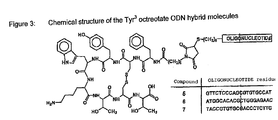
- the oligonucleotide molecule is covalently linked with Tyr 3 -octreotate, e.g. at the 5' end or 3' end, and e.g. for the synthesis of this compound the steps may be taken as indicated in the below examples.
- This permits the radioactive labeling of the whole molecule so as to be able to pursue e.g. the efficiency of the binding to the SSTR and/or the uptake into the cell.
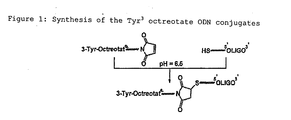
- phosphorothioate ODNs were used as a basis for the production of the conjugates according to the invention, which were covalently linked with Tyr 3 octreotate.
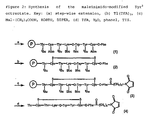
- the peptide was synthesized via solid phase synthesis, oxidized to form the cyclic disulfide and then derivatized with an N-terminal maleimido unit.
- 5'-thiol-derivatized phosphorothioate ODNs which were directed against the proto-oncogene bcl-2 were attached by conjugation to this maleimido-modified peptide.
- oligonucleotide conjugates according to the invention in which the somatostatin analog, e.g. octreotide or octreotate is covalently linked with the 5' end of the oligonucleotide molecule, e.g. via a thioether linkage or linkage via acetal, alkine, amide, amine, carbamate, ⁇ -carbonyl thioether, disulfide, ester, ether, phosphoric acid ester, sulfonic acid ester or thiourea.
- the linkage with the 5' end of the oligonucleotide via a disulfide bridge is most preferred.
- hydrocarbon groups e.g. -(CH 2 ) 1-10 -, most preferably methyl, ethyl, propyl groups, are suitable as spacers.
- the nucleic acid sequence of the oligonucleotide molecule is designed in accordance with the desired target sequence, i.e. it must be substantially complementary thereto, so that hybridization can take place and thus the biological function of the intracellular target molecule can be inhibited.
- the intracellular nucleic acid sequence is preferably an mRNA, e.g. an mRNA coding for a prooncogene or oncogene, or viral RNA, e.g. of HIV.
- Oligonucleotide molecules whose nucleic acid sequences are complementary to the coding part of an mRNA are most preferred.
- the nucleic acid sequence of the oligonucleotide molecule according to the invention shall have a length between eight and fifty nucleotides, more preferably a length between twelve and twenty nucleotides, and most preferably about 15 nucleotides.
- the oligonucleotide molecules according to the invention are particularly suitable for manipulating cells in which the SSTRs are overexpressed, e.g. in certain tumors, and thus also for a well-calculated tumor therapy.
- a further preferred embodiment of the oligonucleotide conjugates according to the invention relates to those whose nucleic acid sequence is complementary to the nucleic acid sequence of a target molecule whose presence within the cell or whose over-expression is associated with the disease, e.g. a tumor.
- target molecules comprise e.g.
- mRNAs of oncogenes or proto-oncogenes such as bcl-2, p53, N-myc, NF-KB, c-myc, Ha-ras, BCR-ALB, PKA(RI ⁇ ) and c-raf-1.
- oligonucleotide relates to a molecule whose nucleic acid sequence is partially complementary to the nucleic acid coding for the proto-oncogene bcl-2.
- the oligonucleotide molecule according to the invention comprises the nucleic acid sequence 5'-GTT CTC CCA GCG TGT GCC AT-3'.
- the present invention relates to a medicament which contains an oligonucleotide conjugate according to the invention, optionally in combination with a pharmaceutically acceptable carrier.
- suitable carriers comprise e.g. phosphate-buffered common salt solutions, water, emulsions, e.g. oil/water emulsions, wetting agents, sterile solutions, etc.
- the medicament according to the invention may be present in the form of an injection solution, tablet, ointment, suspension, emulsion, suppository, etc. It may also be administered in the form of depots (microcapsules, zinc salts, liposomes, etc.).
- the kind of administration of the medicament depends inter alia on the form in which the active substance is present, it can be effected orally or parenterally.
- the methods for the parenteral administration comprise the topical, intra-arterial (e.g. directly into a carcinoma), intramuscular, intramedullary, intrathekal, intraventricular, intravenous, intraperitoneal, transdermal or transmucosal (nasal, vaginal, rectal, sublingual) administration.
- the administration can also be effected by microinjection.
- the suitable dosage is determined by the attending physician and depends on various factors, e.g. the age, sex, patient's weight, kind and stage of the disease, kind of administration, etc.
- the oligonucleotide conjugate according to the invention is preferably used for antisense therapy, e.g. for treating viral diseases, inflammatory processes, asthmatic diseases, diseases of the CNS, cardio-vascular diseases or for cancer therapy, e.g. for treating small cell lung tumors, breast tumors and brain tumors.
- the peptides were analyzed and separated by means of HPLC on a "Gynotech P-580" system (Gynotech, Germering, Germany) which was equipped with a variable “SPD 6-A UV detector” and a “C-R5A integrator” (both devices from Shimadzu, Duisburg, Germany).
- the columns used were "Nucleosil C 18 " 5 ⁇ m, 250 x 4 mm (Machery & Nagel, Düren, Germany), LiChrosorb RP-select B 5 ⁇ m, 250 x 4 mm and "LiChrosorb RP-select B” 10 ⁇ m, 250 x 10 mm (Merck, Darmstadt, Germany).
- the ODNs were purified on a "Waters” HPLC system on "PRP-1 Material” 7 ⁇ m, 305 x 7 mm (Hamilton, Bondauz, Switzerland).
- the UV measurements and the melting point studies were carried out with a "Varian Cary 13" spectrometer for U.V. light connected to an interface using a computer (company Varian, Palo Alto, U.S.A.).
- the culture medium F12 (HAM) which contains L-glutamine, and penicillin streptomycin and fungizone/amphotericin were supplied by Gibco (Renfrewshire, U.K.).
- the reagent EDITH for the sulfurization was also supplied by PerSeptive Biosystems.
- the thiol linker phosphoroamidite was obtained from Glen Research (Sterling, Minnesota, U.S.A.).
- Anhydrous solvents were bought from Merck, PerSeptive Biosystems and SDS (Peypin, France). Tyr 3 octreotide was produced by means of SPPS.
- 125 I-Tyr 3 octreotide was produced by iodizing Tyr 3 octreotide using the chloramine-T method according to Bakker et al., J. Nucl. Med. 9 (1990), 1501-1509. The resulting product was purified over HPLC and stored for further use at -80°C.
- the radioisotope Na 125 I was obtained from Amersham Pharmacia Biotech (Freiburg, Germany).
- the complementary unmodified phosphodiester ODNs and phosphorothioate ODNs for the melting temperature analysis 5'-GTT CTC CCA GCG TGT GCC AT-3' (antisense) and 5'-ATG GCA CAC GCT GGG AGA AC-3' (sense) were synthesized according to standard methods.
- octreotate only contains eight amino acid residues, the synthesis is rendered more difficult by various structural features, in particular cyclization of the disulfide bridges cannot be harmonized with the introduction of amino-reactive and thiol-reactive groups, required for the conjugation. Therefore, a synthesis protocol was developed in the present invention which permits the solid-phase formation of the disulfide bridges and the subsequent linkage with the reactive group.
- the peptides were joined by means of Fmoc chemistry to 1 g "Fmoc-Thr( t B)-Wang" resin (0.61 mmol/g) (company of Novabiochem, Läufelingen, Switzerland) (figure 2).
- the ODNs exclusively containing phosphorothioate compounds 5'-GTT CTC CCA GCG TGT GCC AT-3' (antisense), 5'-ATG GCA CAC GCT GGG AGA AC-3' (sense) and 5'-TAC CGT GTG CGA CCC TCT TG-3' (non-sense) were synthesized by means of the ß-cyanoethyl-phosphoroamidite chemistry in the 1 ⁇ m range.
- the acetylation was carried out by means of 0.1 M acetic anhydride/tetrahydrofuran (THF) and 0.1 M imidazole/THF.
- the sulfurization was made by means of the EDITH reagents (3-ethoxy-1,2,4-dithiazoline-5-one).
- the commercially available thiol linker phosphoroamidite having a spacer of six carbon atoms (1-O-dimethoxytrityl-hexyl-disulfide-1'-[(2-cyano-ethyl)-(N,N-diisopropyl)]phosphoroamidite (Glen Research) was coupled to the 5' end. An acetonitrile wash step followed the last coupling.
- the resin was dried in an argon stream and treated at 55°C with concentrated ammonia for 12 hours, which contained 0.1 M DTT, the removal of the protecting groups of the thiol protection and the separation from the resin also taking place simultaneously (Gottschling et al., Bioconjugate Chem. 9 (1998), 831-837).
- the resin was removed by filtration and washed with concentrated ammonia. After rotation evaporation of the resulting solution a clear residue was left which was dissolved in sterile water. In order to remove excess DTT, the solution was passed over an "NAP-10" gel filtration column. The ODN-containing fractions were immediately used for conjugation with the peptide.
- the 5'-thiol ODNs were added to the maleimido peptide 4 (five times the excess) in aqueous 0.1 M TEAA, pH 6.5, which contained 20 % DMF.
- the pH value was adjusted by adding 1 M TEAA, pH 6.5.
- the mixture was incubated at room temperature for 4 hours, and it turned out that this time was sufficient for a complete conjugation according to an analytical HPLC.
- buffer A 5 % acetonitrile in 0.1 M triethylammonium acetate, pH 6.5
- buffer B 70 % acetonitrile in 0.1 M triethylammonium acetate, pH 6.5
- a linear gradient of 0 % - 100 % B (2 ml/min.) was used over a period of 30 min.
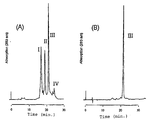
- the conjugates eluting after 22.3 min. were collected and lyophilized.
- the yields were between 34 and 42 % (based on the amount of the starting 5'-thiol ODNs).
- the conjugates were characterized by means of "MALDI-TOF" analysis.
- the chromatogram of the mixture of the crude products shows four peaks at about 16.8, 19.2, 21.1 and 24.8 min., which correspond to shortened sequences, the ODN dimer by-product, the conjugate and excess maleimido peptide (figure 4). Due to the considerable differences existing as regards the size and polarity the conjugates could easily be separated from the contaminants and excess educt 4 .
- the melting temperature analyses were used for determining the influence of the peptide portion on the hybridization efficiency of the antisense ODN peptide conjugates to the complementary strand.
- the dissociation of duplexes was determined which had been formed from the equimolar concentrations of the ODN conjugates and an unmodified 20-mer ODN target molecule.
- the measurements were carried out three times in each case in closed quartz cuvettes (1 cm path length) at 260 nm.
- the samples were produced as solutions of the two complementary oligomers in 1000 ⁇ l buffer with 0.5 OD. 50 mM Tris/HCl, pH 7.5, which contained 0.15 M NaCl, was used as the buffer.
- the melting curves were measured with a temperature gradient of 30 to 90°C with a heating and/or cooling rate of 0.5°C/min.
- the hybridization of the oligonucleotides was effected before the analysis in all samples by five minutes of heating to 90°C and subsequent slow cooling to room temperature.
- the analysis was carried out by means of the "Varian thermal" software (company Varian, Palo Alto, U.S.A.). All T m values were calculated from the first derivative of the melting curve and they represent average values obtained from various analyses (+ standard deviation). The maximum insecurity as to the T m data, based on repeated experiments, is approximately + 0.5°C.
- the T m of the unmodified 20-mer starting phosphodiester sequence was 73.1 + 0.2°C. Compared therewith T m values of conjugates 5 (65.0 + 0.0°C) and 6 (63.8 + 0.5°C) were relatively low. It is known that the T m of a phosphorothioate drops by about 0.5°C/nucleotide as compared to the corresponding phosphodiester ODN (Freier, in: Antisense Research and Applications. Editor: Crooke, S.T., Lebeu, B., CRC Press Boca Raton, FL (1993), 67-82). Thus, the T m curves were typical of those obtained with unmodified ODNs.
- rat cortex membranes were resuspended at a protein concentration of 500 ⁇ g/ml in incubation buffer (10 mM HEPES, pH 7.6 with 5 % BSA fraction V, MgCl 2 (10 mM) and bacitracin (20 ⁇ g/ml)). 100 ⁇ g protein were used per assay.
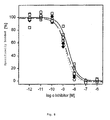
- the cell membranes 200 ⁇ l were mixed with 30 ⁇ l incubation buffer with increasing concentrations of the competitor (conjugates 5-7) (10 -5 to 10 -10 mol/l). About 20.000 cpm 125 I-Tyr 3 octreotide (about 20 pM) in 70 ⁇ l incubation buffer were added.
- Figure 6 shows the progressive displacement of 125 I-Tyr 3 octreotide of rat cortex membranes.
- the similar affinities clearly show that the sequence of the ODN does not influence markedly the receptor affinity.
- PNA peptide conjugates were synthesized by means of Boc chemistry. These conjugates were modified with tyrosine at the N terminus and then labeled radioactively with 125 I by the chloramine T method. In organ distribution studies, the uptake of these synthetic oligonucleotide conjugates into the SSTR-positive CA20948 pancreas tumors in Lewis rats was examined. A selective uptake, which could be inhibited with an excess of octreotide, into the tumor tissue could be found here.
- the peptide H-D-Phe-Cys-Phe-D-Trp-Lys-Thr-Cys-Thr-OH was coupled with a PNA sequence which is complementary to the nucleotides -3 to +12 (region of the AUG start codon) of the Bcl-2 sequence.
- the sequence used is: H-AGC GTG CGC CAT CCC-OH.
- a specific inhibition of the Bcl-2 protein synthesis was described (Mologni et al., Biochem. Biophys. Res. Commun. 264, pages 537-543 (1999)).
- the charging degree of the resin had to be reduced.
- substoichiometric amounts of an Fmoc-protected amino acid were used for the first coupling reaction.
- Capping was carried out with Ac 2 O:pyridine in DMF.
- the Fmoc protecting group of the first amino acid was used to facilitate the quantification of the charging degree.
- the peptide portion was built up at the PAM resin.
- the amino acids were protected with N-Boc.
- the protecting groups of the side chains were: Cys(Acm), Lys(2-Cl-Z), Thr(Bzl) D-Trp(For).
- the resin was swelled overnight in DCM and washed with DMF.
- a reaction cycle consisted of: a) cleavage of the N-terminal Boc group by a short wash step, followed by shaking the resin with TFA/p-cresol (95.5, v/v) for 1 min., b) pre-activation of a solution of 4 eq. of the Boc-protected monomer for 2 min. in DMSO with 3.9 eq. HATU and 10 eq.
- the PNA oligomers were built up on PAM or MBHA resin.
- the resin was swelled in DCM overnight and washed with DMF.
- the FMOC protecting group of the first amino acid was cleaved by treatment with 50 % piperidine in DMF for 2 x 5 minutes.
- the monomers were dissolved in 1:1 DMF/pyridine (A, C, T monomer) or 1:1 DMSO/pyridine (G monomer).
- a reaction cycle consisted of: a) cleavage of the N-terminal Boc group by shaking the resin with TFA/p-cresol (95:5, v/v) for 2 x 2 min. b) pre-activation of a solution of 5 eq.
- the N-terminal Boc group was cleaved with TFA/-p-cresol (95:5, v/v) and the resin was washed with DCM and dried in a nitrogen atmosphere.
- the complete PNA peptide conjugate was cleaved with TFA/TFMSA/p-cresol (40:40:10, v/v/v) at room temperature for 2 hours and deprotected.
- the resin was filtered and washed with TFA.
- the peptide was precipitated by the addition of tert.-butyl methylether at 4°C.
- the iodination was carried out with the chloramine-T method.
- Na 125 I (specific activity 0.6 TBq/mg, with a concentration of 3.7 GBq/mL) was mixed with the conjugate in phosphate buffer, pH 7.5, which contained 20 % DMF.
- the chloramine-T solution was prepared with a concentration of 2 mg/mL in phosphate buffer, pH 7.5.
- Chloramine-T was added and the reaction mixture was quenched after 30 seconds at room temperature with a saturated solution of methionine in phosphate buffer (pH 7.5).
- the entire reaction mixture was purified by means of RP-HPLC. In this connection, the iodinated product was obtained in a yield of about 50 %.
- CA 20948-tumor-bearing Lewis rats were used as animal model.
- the CA 20948-tumor cells express stably somatostatin receptors.
- the tumor cells are thawed, washed with PBS and suspended carefully.
- the cell suspension was transplanted subcutaneously into the flank of male Lewis rats (220-250 g) (about 2 x 10 6 cells in 0.1 ml).
- palpable tumors having a diameter of 0.25 - 1 cm developed in the CA 20948 tumor model.
- the animals were given an injection of about 1 MBq of the radioactively labeled somatostatin derivative into the caudal vein.
Landscapes
- Health & Medical Sciences (AREA)
- Life Sciences & Earth Sciences (AREA)
- Chemical & Material Sciences (AREA)
- Engineering & Computer Science (AREA)
- Bioinformatics & Cheminformatics (AREA)
- Public Health (AREA)
- Medicinal Chemistry (AREA)
- Pharmacology & Pharmacy (AREA)
- Epidemiology (AREA)
- Animal Behavior & Ethology (AREA)
- General Health & Medical Sciences (AREA)
- Veterinary Medicine (AREA)
- Proteomics, Peptides & Aminoacids (AREA)
- Molecular Biology (AREA)
- Biochemistry (AREA)
- Medicines That Contain Protein Lipid Enzymes And Other Medicines (AREA)
- Peptides Or Proteins (AREA)
- Pharmaceuticals Containing Other Organic And Inorganic Compounds (AREA)
Applications Claiming Priority (2)
| Application Number | Priority Date | Filing Date | Title |
|---|---|---|---|
| DE10006572 | 2000-02-14 | ||
| DE10006572A DE10006572A1 (de) | 2000-02-14 | 2000-02-14 | Oligonucleotid-Konjugate |
Publications (2)
| Publication Number | Publication Date |
|---|---|
| EP1129725A2 true EP1129725A2 (de) | 2001-09-05 |
| EP1129725A3 EP1129725A3 (de) | 2003-01-22 |
Family
ID=7630901
Family Applications (1)
| Application Number | Title | Priority Date | Filing Date |
|---|---|---|---|
| EP01103466A Withdrawn EP1129725A3 (de) | 2000-02-14 | 2001-02-14 | Oligonukleotid-Konjugate |
Country Status (3)
| Country | Link |
|---|---|
| US (1) | US20010029035A1 (de) |
| EP (1) | EP1129725A3 (de) |
| DE (1) | DE10006572A1 (de) |
Families Citing this family (8)
| Publication number | Priority date | Publication date | Assignee | Title |
|---|---|---|---|---|
| US7176187B2 (en) | 2001-02-15 | 2007-02-13 | Board Of Regents, The University Of Texas System | Fusion proteins based upon somatostatin receptors |
| WO2006096815A2 (en) * | 2005-03-09 | 2006-09-14 | Board Of Regents, The University Of Texas System | NOVEL hTMC PROMOTER AND VECTORS FOR THE TUMOR-SELECTIVE AND HIGH-EFFICIENT EXPRESSION OF CANCER THERAPEUTIC GENES |
| WO2009002944A1 (en) * | 2007-06-22 | 2008-12-31 | Isis Pharmaceuticals, Inc. | Double strand compositions comprising differentially modified strands for use in gene modulation |
| WO2012138911A2 (en) * | 2011-04-05 | 2012-10-11 | The Administrators Of The Tulane Educational Fund | Conjugates of anti-hiv drugs and somatostatin analogs |
| LT2994152T (lt) | 2013-05-07 | 2018-11-26 | Merck Patent Gmbh | Konjugatai, skirti apsaugai nuo nefrotoksinių aktyvių medžiagų |
| MX379365B (es) | 2014-06-30 | 2025-03-11 | Tarveda Therapeutics Inc | Conjugados y partículas direccionados y formulaciones de estos. |
| US11160871B2 (en) | 2015-10-28 | 2021-11-02 | Tarveda Therapeutics, Inc. | SSTR-targeted conjugates and particles and formulations thereof |
| CN113512093A (zh) * | 2020-04-10 | 2021-10-19 | 南京金斯瑞生物科技有限公司 | 一种合成含有二硫键和/或巯基修饰的多肽核酸偶联物的方法 |
-
2000
- 2000-02-14 DE DE10006572A patent/DE10006572A1/de not_active Withdrawn
-
2001
- 2001-02-14 EP EP01103466A patent/EP1129725A3/de not_active Withdrawn
- 2001-02-14 US US09/781,980 patent/US20010029035A1/en not_active Abandoned
Non-Patent Citations (4)
| Title |
|---|
| HO P T ET AL: "Antisense oligonucleotides as therapeutics for malignant diseases." SEMINARS IN ONCOLOGY. UNITED STATES APR 1997, vol. 24, no. 2, April 1997 (1997-04), pages 187-202, XP009000361 ISSN: 0093-7754 * |
| KRENNING E P ET AL: "Radiolabelled somatostatin analogue(s) for peptide receptor scintigraphy and radionuclide therapy." ANNALS OF ONCOLOGY: OFFICIAL JOURNAL OF THE EUROPEAN SOCIETY FOR MEDICAL ONCOLOGY / ESMO. NETHERLANDS 1999, vol. 10 Suppl 2, 1999, pages S23-S29, XP000978221 ISSN: 0923-7534 * |
| MIER W ET AL: "Preparation and evaluation of tumor-targeting peptide-oligonucleotide conjugates." BIOCONJUGATE CHEMISTRY. UNITED STATES 2000 NOV-DEC, vol. 11, no. 6, November 2000 (2000-11), pages 855-860, XP002220093 ISSN: 1043-1802 * |
| NAGY A ET AL: "Synthesis and biological evaluation of cytotoxic analogs of somatostatin containing doxorubicin or its intensely potent derivative, 2-pyrrolinodoxorubicin." PROCEEDINGS OF THE NATIONAL ACADEMY OF SCIENCES OF THE UNITED STATES OF AMERICA. UNITED STATES 17 FEB 1998, vol. 95, no. 4, 17 February 1998 (1998-02-17), pages 1794-1799, XP002220092 ISSN: 0027-8424 * |
Also Published As
| Publication number | Publication date |
|---|---|
| US20010029035A1 (en) | 2001-10-11 |
| DE10006572A1 (de) | 2001-08-23 |
| EP1129725A3 (de) | 2003-01-22 |
Similar Documents
| Publication | Publication Date | Title |
|---|---|---|
| US5994517A (en) | Ligands to enhance cellular uptake of biomolecules | |
| JP3121599B2 (ja) | raf遺伝子発現のアンチセンスオリゴヌクレオチド調節 | |
| KR101953074B1 (ko) | 올리고머 및 올리고머 접합체 | |
| KR100896983B1 (ko) | 펩티드-기재 화합물 | |
| WO1991004753A1 (en) | Conjugates of antisense oligonucleotides and therapeutic uses thereof | |
| WO2009143412A2 (en) | Polymeric systems containing intracellular releasable disulfide linker for the delivery of oligonucleotides | |
| CA2498772A1 (en) | Modified pna molecules | |
| SK282173B6 (sk) | Lipopolyamíny ako transfekčné činidlá, spôsob ich prípravy a farmaceutické kompozície s ich obsahom | |
| Mier et al. | Preparation and evaluation of tumor-targeting peptide− oligonucleotide conjugates | |
| BG106361A (bg) | Лиганди на нуклеинови киселини за тенасцин - с | |
| US5980861A (en) | Chelator compositions and methods of synthesis thereof | |
| JP2010510810A (ja) | ポリマー低分子干渉rna複合体 | |
| Tian et al. | Imaging oncogene expression | |
| CN114885604B (zh) | 用于靶向递送核酸的肽对接载体 | |
| CN111542606A (zh) | 硫吗啉代寡核苷酸用于治疗肌肉营养不良 | |
| AU2003213047A1 (en) | Protein carrier system for therapeutic oligonucleotides | |
| EP1129725A2 (de) | Oligonukleotid-Konjugate | |
| EP1446163A2 (de) | Multidrug-multiliganden-konjugate für die gezielte abgabe von medikamenten | |
| RS20100249A (sr) | Konjugati i postupci za njihovo dobijanje, i njihova upotreba za transport molekula kroz biološke membrane | |
| Ganguly et al. | Pharmacokinetic analysis of polyamide nucleic-acid-cell penetrating peptide conjugates targeted against HIV-1 transactivation response element | |
| DE602004008085T2 (de) | Antisense-oligonukleotid zur hemmung der melanom-inhibierenden aktivität (mia) | |
| TW202540421A (zh) | 抑制PCSK9表現的siRNA分子及其用途 | |
| des öffentlichen Rechts et al. | Office européen des brevets (11) EP 1 129 725 A2 | |
| Liu et al. | Cytosine residues influence kidney accumulations of 99mTc-labeled morpholino oligomers | |
| CA2248932A1 (en) | Oligonucleotides targeted to angiotensinogen mrna |
Legal Events
| Date | Code | Title | Description |
|---|---|---|---|
| PUAI | Public reference made under article 153(3) epc to a published international application that has entered the european phase |
Free format text: ORIGINAL CODE: 0009012 |
|
| AK | Designated contracting states |
Kind code of ref document: A2 Designated state(s): AT BE CH CY DE DK ES FI FR GB GR IE IT LI LU MC NL PT SE TR |
|
| AX | Request for extension of the european patent |
Free format text: AL;LT;LV;MK;RO;SI |
|
| PUAL | Search report despatched |
Free format text: ORIGINAL CODE: 0009013 |
|
| RIC1 | Information provided on ipc code assigned before grant |
Free format text: 7C 12N 15/11 A, 7A 61K 47/48 B |
|
| AK | Designated contracting states |
Kind code of ref document: A3 Designated state(s): AT BE CH CY DE DK ES FI FR GB GR IE IT LI LU MC NL PT SE TR |
|
| AX | Request for extension of the european patent |
Free format text: AL;LT;LV;MK;RO;SI |
|
| 17P | Request for examination filed |
Effective date: 20030722 |
|
| AKX | Designation fees paid |
Designated state(s): AT BE CH CY DE DK ES FI FR GB GR IE IT LI LU MC NL PT SE TR |
|
| 17Q | First examination report despatched |
Effective date: 20050309 |
|
| STAA | Information on the status of an ep patent application or granted ep patent |
Free format text: STATUS: THE APPLICATION IS DEEMED TO BE WITHDRAWN |
|
| 18D | Application deemed to be withdrawn |
Effective date: 20050901 |