EP1130108A1 - Procédé pour la racémisation d'acides N-acyl-aminés et pour la préparation d'acides aminés optiquement actifs - Google Patents
Procédé pour la racémisation d'acides N-acyl-aminés et pour la préparation d'acides aminés optiquement actifs Download PDFInfo
- Publication number
- EP1130108A1 EP1130108A1 EP01105042A EP01105042A EP1130108A1 EP 1130108 A1 EP1130108 A1 EP 1130108A1 EP 01105042 A EP01105042 A EP 01105042A EP 01105042 A EP01105042 A EP 01105042A EP 1130108 A1 EP1130108 A1 EP 1130108A1
- Authority
- EP
- European Patent Office
- Prior art keywords
- acylamino
- racemase
- activity
- acid
- acylamino acid
- Prior art date
- Legal status (The legal status is an assumption and is not a legal conclusion. Google has not performed a legal analysis and makes no representation as to the accuracy of the status listed.)
- Withdrawn
Links
Images



Classifications
-
- C—CHEMISTRY; METALLURGY
- C12—BIOCHEMISTRY; BEER; SPIRITS; WINE; VINEGAR; MICROBIOLOGY; ENZYMOLOGY; MUTATION OR GENETIC ENGINEERING
- C12P—FERMENTATION OR ENZYME-USING PROCESSES TO SYNTHESISE A DESIRED CHEMICAL COMPOUND OR COMPOSITION OR TO SEPARATE OPTICAL ISOMERS FROM A RACEMIC MIXTURE
- C12P41/00—Processes using enzymes or microorganisms to separate optical isomers from a racemic mixture
- C12P41/006—Processes using enzymes or microorganisms to separate optical isomers from a racemic mixture by reactions involving C-N bonds, e.g. nitriles, amides, hydantoins, carbamates, lactames, transamination reactions, or keto group formation from racemic mixtures
- C12P41/007—Processes using enzymes or microorganisms to separate optical isomers from a racemic mixture by reactions involving C-N bonds, e.g. nitriles, amides, hydantoins, carbamates, lactames, transamination reactions, or keto group formation from racemic mixtures by reactions involving acyl derivatives of racemic amines
-
- C—CHEMISTRY; METALLURGY
- C12—BIOCHEMISTRY; BEER; SPIRITS; WINE; VINEGAR; MICROBIOLOGY; ENZYMOLOGY; MUTATION OR GENETIC ENGINEERING
- C12P—FERMENTATION OR ENZYME-USING PROCESSES TO SYNTHESISE A DESIRED CHEMICAL COMPOUND OR COMPOSITION OR TO SEPARATE OPTICAL ISOMERS FROM A RACEMIC MIXTURE
- C12P13/00—Preparation of nitrogen-containing organic compounds
- C12P13/04—Alpha- or beta- amino acids
Definitions
- the present invention relates to a method for racemizing N-acylamino acids using racemase, and further, a method for reacting the racemized N-acylamino acids with L-aminoacylase or D-aminoacylase to produce optically active amino acids corresponding to the respective amino acid species.
- N-acylamino acid racemase (hereinafter, abbreviated to "NAAR") does not react with amino acids but specifically racemizes N-acylamino acids.
- Enzymes with NAAR activity have been found in Actinomycetes including the genera Streptomyces, Amycolatopsis, and Sebekia (Japanese Patent No. 2712331).
- a strain, Amycolatopsis sp. TS-1-60 which produces an acylamino acid racemase, a method for producing this enzyme (Unexamined Published Japanese Patent Application (JP-A) No. Hei 6-205668), and a DNA fragment encoding the acylamino acid racemase derived from this strain (JP-A Hei 4-365482) have been disclosed.
- JP-A Hei 4-365482 a DNA fragment encoding the acylamino acid racemase derived from this strain
- NAARs catalyze only limited types of acylamino acids depending on their substrate specificity.
- TS-1-60 when the activity on N-acylmethionine is taken as 100, is 50 or higher on N-acylphenylalanine and N-acylvaline but less than 50 on N-acyltryptophan, N-acylalanine, N-acylaspartic acid, and N-acylleucine.
- the present inventors previously succeeded in isolating the NAAR gene from Sebekia benihana and in expressing the recombinants thereof (Abstracts of the annual meeting of the Society for Bioscience and Bioengineering, Japan, 1999, p.166).
- S. benihana is known to have N-acylamino acid racemase activity on N-acyl-L-methionine, the substrate specificity of the enzyme has not specifically demonstrated.
- Racemization of acylamino acids is an important step for producing optically active amino acids.
- Enzymes have excellent catalytic functions with substrate specificity, reaction specificity, and stereospecificity. Stereospecificity of enzymes, with some exceptions, are nearly absolute.
- racemase activity is useful for synthesizing racemates as substrates to be used either in optical resolution or in enzymatic synthesis of specific enantiomers.
- NAAR is required for catalyzing racemization of acylamino acids.
- D-tryptophan is one of important D-amino acids used as medicinal raw materials, etc.
- D-tryptophan can be obtained by deacylating N-acyl-DL-tryptophan.
- racemase capable of efficiently catalyzing racemization of N-acyltryptophan to N-acyl-DL-tryptophan is not yet known.
- N-acylleucine or N-acylvaline is not yet known.
- An objective of the present invention is to provide a method for racemizing N-acylamino acids using a racemase exhibiting racemization activity on a wide variety of substrates and a method for producing optically active amino acids using the racemization method.
- the present inventors searched for racemases effectively catalyzing a wide variety of substrates. Then, the present inventors have found that the NAAR derived from Sebekia benihana , which was previously reported by the inventors, has the substrate specificity that is industrially available for racemization of N-acylamino acids, thereby completing the present invention.
- the present invention relates to a method for racemizing N-acylamino acid using NAAR having particular substrate specificity and a method for producing optically active amino acids using the racemization method. More specifically, it relates to:
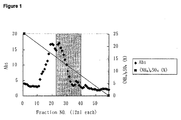
- Figure 1 shows a chromatogram of a first round Butyl-Toyopearl 650M chromatography of a crude enzyme obtained from Escherichia coli transformed with an NAAR-expression vector.
- the left and right handed vertical axes indicate the absorbance at 280 nm and (NH 4 ) 2 SO 4 concentration (%), respectively, and the horizontal axis indicates the fraction numbers.
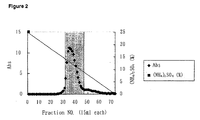
- Figure 2 shows a chromatogram of a second round Butyl-Toyopearl 650M chromatography of the crude enzyme obtained from E. coli transformed with an NAAR-expression vector.
- the left and right handed vertical axes indicate the absorbance at 280 nm and (NH 4 ) 2 SO 4 concentration (%), respectively, and the horizontal axis indicates the fraction numbers.
- Figure 3 shows a photograph indicating results of SDS-PAGE for each step of the purification of the crude enzyme obtained from E. coli transformed with an NAAR-expression vector.
- Lane 1 crude enzyme (supernatant of the cell lysate);
- lane 2 the first round Butyl-Toyopearl 650M chromatography;
- lane 3 the second round Butyl-Toyopearl 650M chromatography;
- lane 4 Superose 12HR chromatography ;
- M molecular weight marker.
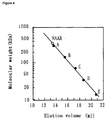
- Figure 4 shows a graph indicating results of molecular weight determination by gel filtration. Molecular weights (kDa) are indicated on the vertical axis, and eluted volume (ml) is indicated on the horizontal axis.
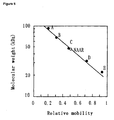
- Figure 5 shows a graph indicating results of molecular weight determination by SDS-PAGE. Molecular weights (kDa) are indicated on the vertical axis, and relative mobility is indicated on the horizontal axis.
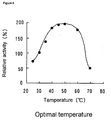
- Figure 6 shows a graph indicating results of analysis of the optimal temperature for NAAR. Relative activity (%) is indicated on the vertical axis, and temperature is indicated on the horizontal axis.
- Figure 7 shows a graph indicating results of analysis of the thermostability of NAAR. Relative activity (%) is indicated on the vertical axis, and temperature is indicated on the horizontal axis.
- Figure 8 shows a graph indicating results of analysis of the optimal pH for NAAR. Relative activity (%) is indicated on the vertical axis, and pH is indicated on the horizontal axis.
- Figure 9 shows a graph indicating result of analysis of the pH stability of NAAR. Relative activity (%) is indicated on the vertical axis, and pH is indicated on the horizontal axis.
- the present invention provides a method for racemizing an N-acylamino acid using an NAAR comprising a polypeptide selected from the group consisting of:
- the NAAR comprising the amino acid sequence of SEQ ID NO: 2 can be isolated from Sebekia benihana.
- S . benihana is available, for example, as a strain of IFO 14309. This strain is recited in the List of Cultures 10th edition (1996) published by Institute of Fermentation Research, Osaka (IFO) and is available from IFO.
- NAAR can be purified from S . benihana cultured by a known method. For example, the bacterial cells are disrupted, and then precipitated with protamine sulfate, followed by centrifugation.
- the supernatant is subjected to salting-out with ammonium sulfate and further purified by any combination of anion-exchange chromatography, hydrophobic chromatography, affinity chromatography, and gel filtration.
- the NAAR purified from S. benihana IFO 14309 has the enzymatic properties of (1) to (6) below:
- the NAAR of the present invention can be a recombinant polypeptide obtained by expressing a polynucleotide encoding the NAAR.
- the NAAR of the present invention may be the polypeptide of (b) or (c) as well as (a) above.
- a polypeptide comprising the amino acid sequence of the NAAR purified from S. benihana IFO 14309 (SEQ ID NO: 2) in which one or more amino acids are substituted, deleted, inserted, and/or added has the enzyme activity similar to that of the NAAR comprising the amino acid sequence of SEQ ID NO: 2 can be determined by comparing the racemase activity of such a polypeptide with that of the above NAAR using the method described later.
- Those skilled in the art can thus readily select NAAR homologues usable in the present invention.
- the number of amino acids that are mutated is not particularly restricted, as long as the NAAR activity is maintained. Normally, it is within 50 amino acids, preferably within 30 amino acids, more preferably within 10 amino acids, and even more preferably within 3 amino acids.
- the site of mutation may be any site, as long as the NAAR activity is maintained.
- amino acid substitution is preferably mutated into different amino acid(s) in which the properties of the amino acid side-chain are conserved.
- a "conservative amino acid substitution” is a replacement of one amino acid residue belonging to one of the following groups having a chemically similar side chain with another amino acid in the same group. Groups of amino acid residues having similar side chains have been defined in the art.
- amino acids with basic side chains e.g., lysine, arginine, histidine
- acidic side chains e.g., aspartic acid, glutamic acid
- uncharged polar side chains e.g., glycine, asparagine, glutamine, serine, threonine, tyrosine, cysteine
- nonpolar side chains e.g., alanine, valine, leucine, isoleucine, proline, phenylalanine, methionine, tryptophan
- beta-branched side chains e.g., threonine, valine, isoleucine
- aromatic side chains e.g., tyrosine, phenylalanine, tryptophan, histidine
- the homologue of the polypeptide comprising the amino acid sequence of SEQ ID NO: 2 includes a polypeptide exhibiting percent identity of at least 70%, preferably at least 80% or 90%, more preferably 95% or more to the amino acid sequence of SEQ ID NO: 2.
- percent identity of two amino acid sequences or of two nucleic acids is determined using the algorithm of Karlin and Altschul (Proc. Natl. Acad. Sci. USA 87: 2264-2268, 1990) modified as in Karlin and Altschul (Proc. Natl. Acad. Sci. USA 90:5873-5877, 1993). Such an algorithm is incorporated into the NBLAST and XBLAST programs of Altschul et al. (J. Mol. Biol.
- polypeptide encoded by a polynucleotide hybridizing to a DNA comprising the nucleotide sequence of SEQ ID NO: 1 under stringent conditions and having the enzymatic properties of (1) and (2) above can be used as an NAAR of the present invention.
- Polypeptides encoded by polynucleotides hybridizing to the DNA encoding the NAAR isolated from S. benihana IFO 14309 under stringent conditions include polypeptides with enzymatic activity similar to that of the above-mentioned NAAR.
- NAAR homologues usable in the present invention from such enzymes by the method described below.
- the homologue of the polynucleotide comprising the nucleotide sequence of SEQ ID NO: 1 includes a DNA encoding a polypeptide exhibiting percent identity of at least 70%, preferably at least 80% or 90%, more preferably 95% or more to the amino acid sequence of SEQ ID NO: 2. Determination of percent identity of two amino acid sequences or of two nucleic acids and homology search can be performed as described above.
- the racemase activity on N-acylamino acids can be measured as follows.
- the reaction solution containing Tris-HCl buffer (pH 7.5, 50 mM), cobalt chloride (1.0 mM), an N-acylamino acid (20 mM), and the enzyme is incubated for 5 minutes at 30°C, and the solution is then heated for 5 minutes at 100°C to stop the reaction.
- 3 U of L-aminoacylase is added and allowed to react for 1 hour at 30°C, and the solution is then heated for 3 minutes at 100°C to stop the reaction.
- the solution is centrifuged at 15,000rpm for 10 minutes at 4°C, and the amino acid produced is assayed by TNBS method.
- 1 U is defined as the amount of enzyme required for racemization of 1 ⁇ mol of an N-acylamino acid in a minute.
- Quantification of polypeptide is carried out by a dye-binding method using the Bio-Rad protein assay kit (Bio-Rad Co.).
- Procedures of TNBS method are as follows: 0.5 ml of 100 mM Na 2 B 4 O 7 is mixed with 0.5 ml of a sample containing the amino acid; then 20 ⁇ l of 110 mM TNBS (trinitrobenzenesulfonic acid) solution is added and stirred immediately; after 5 minutes, 2 ml of 100 mM NaHPO 4 containing 1.5 mM Na 2 SO 3 is added to the mixture to stop the coloring reaction; and then absorbance is measured at a wavelength of 420 nm.
- TNBS trinitrobenzenesulfonic acid
- polynucleotide hybridizing under stringent conditions means a DNA to which a probe DNA hybridizes under the conditions indicated in the protocol provided by the supplier (washing with the primary wash buffer containing 0.5 x SSC at 42°C) using, for example, the ECL direct nucleic acid labeling and detection system (Amersham Pharmacia Biotech Co.).
- DNA to be used as probe DNA can be one or more consecutive sequences consisting of at least 20 residues, preferably at least 30, for example, 40, 60, or 100 nucleotides arbitrarily selected from the nucleotide sequence of SEQ ID NO: 1.
- the nucleotide sequence of SEQ ID NO: 1 is that of the DNA encoding NAAR isolated from S. benihana IFO 14309.
- This DNA can be obtained by PCR using a genomic library or cDNA library of S. benihana as a template.
- the primers required for the PCR can be readily designed by one skilled in the art on the basis of the nucleotide sequence of SEQ ID NO: 1.
- the DNA can be obtained by screening the genomic library or cDNA library using a DNA probe comprising a nucleotide sequence selected from the nucleotide sequence of SEQ ID NO: 1.
- the methods for cloning genes based on PCR and probe hybridization are well known.
- genomic DNA is prepared by culturing a microorganism of the genus Sebekia that is capable of producing N-acylamino-acid racemase, and then by converting its cells into spheroplasts with a cell wall-digesting enzyme, followed by a standard method (for example, J. Biol. Chem. 268, 26212-26219 (1993); Meth. Cell. Biol. 29, 39-44 (1975)).
- S. benihana IFO 14309 can be used as the microorganism.
- the chromosomal DNA thus prepared is completely or partially digested into about 2- to 8-kb DNA fragments with appropriate restriction enzymes (e.g. HindIII, EcoRI, BamHI, Sau3AI, etc.).
- the digested genomic DNA is subjected to Southern hybridization using a probe designed on the basis of the sequence of SEQ ID NO: 1, to form a hybrid between the DNA fragment of interest and the probe. Multiple DNA fragments that hybridized to the probe are recovered and then inserted into an E . coli expression vector.
- E. coli e.g. E. coli strain JM109, etc
- E. coli e.g. E. coli strain JM109, etc
- Plasmids including pUC18 (Takara Shuzo), pKK223-3 (Pharmacia), pET derivatives (Takara Shuzo or others), or pMAL-p2 (NEB) can be used as expression vectors.
- the genomic library is screened for positive colonies by colony hybridization using the same probe as used above. Plasmids are extracted from the positive colonies and then digested with restriction enzymes to recover the insert DNA of interest. With the same probe, Southern hybridization is performed to confirm the gene of interest by forming hybrid between the insert DNA and the probe.
- the nucleotide sequence of the insert is further determined by sequencing and compared with the nucleotide sequence of SEQ ID NO: 1 to confirm whether the gene of interest has been successfully isolated.
- the DNA thus obtained is used to transform a host cell after inserted into an appropriate expression vector to give a strain overexpressing the NAAR encoded by the DNA.
- Such an overexpression strain can be used for manufacturing optically active amino acids in the method of the present invention.
- the NAAR can be purified from the NAAR-overexpressing strain. Specifically, the gene for the enzyme is expressed in the above-mentioned overexpression strain cultured under the conditions that can induce the NAAR expression. The cultured cells are collected and lysed, and the supernatant obtained can be used as a crude enzyme solution for the enzymatic reaction. Alternatively, the NAAR can be purified according to the method as described above.
- the NAAR activity in the crude enzyme solution can be determined as follows. Specifically, the crude enzyme is reacted with N-acetyl-D-methionine as a substrate in the presence of L-amino acylase for 5 to 60 hours at 30°C, and the N-acylamino acid racemase activity is determined by measuring the production of L-methionine. The amount of enzyme required for the production of 1 ⁇ mol of L-methionine in a minute is defined as 1 U. The production of methionine can be verified qualitatively by thin layer chromatography (TLC).
- TLC thin layer chromatography
- Microorganisms having the ability to produce N-acylamino acid racemase and being used as a genetic source in the above-described cloning include any strains belonging to the genus Sebekia and having the ability to produce N-acylamino acid racemase as well as mutants and variants thereof.
- Sebekia benihana is one of the particularly preferable species.
- N-acylamino acid racemase derived from Sebekia can be expressed as a native protein or a fusion protein.
- the present invention provides a method for racemizing N-acylamino acid using the above-mentioned NAAR.
- the desired enzyme reaction can be conducted by contacting the above-mentioned NAAR, a microorganism overexpressing the enzyme, or a processed product of these, with a reaction solution containing N-acylamino acid.
- the reaction can be carried out in water or in a water-insoluble organic solvent, for example, ethyl acetate, butyl acetate, toluene, chloroform, n-hexane, and the like, or in a mixture of an aqueous medium and the organic solvent.
- the racemization method according to the present invention can be carried out using an immobilized enzyme or a membrane reactor.
- the mode of contacting the enzyme with the reaction solution is not limited to these specific examples.
- reaction solution means a solution in which a substrate is dissolved in a solvent that gives a desirable environment for the enzyme to exert its activity.
- a processed product of a microorganism containing NAAR specifically includes microorganisms that are treated by detergent or organic solvent such as toluene to alter the permeability of the cell membrane, as well as a cell-free extract prepared by disrupting the cells with glass beads or by enzyme treatment and partially purified product of the cell-free extract.
- a processed product of NAAR includes NAAR immobilized on an insoluble carrier by a known method.
- the NAAR of the present invention is not limited to purified NAAR, but other forms such as a crude enzyme can also be used.
- N-acylamino acid used for the racemization method of the present invention may be represented by the following formula (1): where X represents a substituted or unsubstituted acyl group derived from a carboxylic acid and R represents a substituted or unsubstituted alkyl group having 1 to 20 carbon atoms.
- the acyl group (X) of the N-acylamino acid may have a substituent (i.e. halogen, alkyl, alkoxy, etc.), including carboxylic acyl groups such as alkanoyl (i.e., formyl, acetyl, chloroacetyl, etc.); benzoyl (i.e., benzoyl, p -chlorobenzoyl, etc.); arylalkanoyl (i.e., phenylacetyl, phenylpropionyl, etc.).
- a substituent i.e. halogen, alkyl, alkoxy, etc.
- carboxylic acyl groups such as alkanoyl (i.e., formyl, acetyl, chloroacetyl, etc.); benzoyl (i.e., benzoyl, p -chlorobenzoyl, etc.); arylalkanoyl (
- the alkyl group represented by R includes a C 1-4 alkyl group that is substituted with linear or branched alkyl, hydroxylalkyl, C 1-3 alkylthio, thiol, phenyl, hydroxyphenyl, or indolyl; and C 1-4 alkyl group that is substituted with amino, carboxyl, guanidyl, or imidazolyl; etc.
- N-acylalanine, N-acylaspartic acid, N-acylleucine, N-acylvaline, and N-acyltryptophan which have particularly high reactivity, are used preferably.
- Racemization reaction of the present invention can be carried out at a reaction temperature of 4 to 60°C, preferably 10 to 40°C; at pH 3 to 11, preferably pH 6 to 9; at a substrate concentration of 0.01 to 90%, preferably 0.1 to 30%.
- the reaction often proceeds in a yield of 50 to 100%.
- the substrate can be added at once at the start of the reaction, but it is preferable to add the substrate successively or discretely to prevent the substrate concentration in the reaction solution from getting too high.
- the present invention relates to a method for producing optically active amino acids by the combined use of the above-mentioned NAAR and L- or D-aminoacylase.
- the above-mentioned NAAR, a microorganism producing this enzyme, or a processed product of these is reacted with N-acylamino acids, with which L- or D-aminoacylase is further reacted, to produce optically active amino acids as the reaction products.
- the reaction can be performed in the presence of both of the NAAR and L- or D-aminoacylase.
- the method for producing optically active amino acids of the present invention can be conducted in water or in a water-insoluble organic solvent, such as ethyl acetate, butyl acetate, toluene, chloroform, n-hexane, etc, or in a mixture of an aqueous medium and the organic solvent.
- a racemization method of the present invention can be carried out using an immobilized enzyme or a membrane reactor.
- the method of the present invention has an industrial advantage of recycling residual material, such as a waste from the production of optically active amino acids using acylase.
- the production method of optically active amino acids of the present invention can be conducted at a reaction temperature of 4 to 60°C, preferably 10 to 40°C; at pH 3 to 11, preferably pH 6 to 9; at a substrate concentration of 0.01 to 90%, preferably 0.1 to 30%.
- the reaction often proceeds in a yield of 50 to 100%.
- the substrate can be added at once at the start of the reaction, but it is preferable to add the substrate successively or discretely to prevent the substrate concentration from getting too high in the reaction solution.
- the optically active amino acids generated can be purified by appropriately combining separation of the bacteria or polypeptides by centrifugation or membrane treatment, solvent extraction, crystallization, etc.
- D-tryptophan can easily be purified by the following procedures.
- the reaction solution containing microorganism cells is centrifuged to remove the microorganism cells.
- polypeptides are removed by ultrafiltration, and the filtrate is dehydrated and concentrated to precipitate the amino acid of interest, which is isolated by filtration.
- N-acylamino acid racemase that has the advantage in the industrial production has been provided.
- the present invention provides a method for efficiently producing optically active amino acids with high optical purity by the combination use of NAAR and D- or L-aminoacylase.
- Optically active amino acids are useful as intermediates for producing pharmaceuticals.
- oligonucleotide probe was prepared based on the nucleotide sequence of the N-acylamino acid racemase gene derived from Amycolatopsis sp. TS-1-60. Southern hybridization was performed using the prepared probe for the chromosomal DNA of Sebekia benihana IFO14309 that was partially digested with five restriction enzymes, revealing that the probe was hybridized to a SmaI fragment of about 5 kbp and an SphI fragment of about 4.5 kbp. The SmaI fragment was then recovered and ligated into the SmaI site of plasmid vector pUC18. DH5á strain of E. coli was transformed with the resulting plasmid to prepare a genomic library.
- the genomic library was screened with the same probe by colony hybridization, and a single colony exhibiting a positive signal was obtained from about 1000 colonies.
- the plasmid was extracted from this colony, and then digested with restriction enzyme SmaI, thereby verifying the presence of the insert DNA of about 5 kbp.
- SmaI restriction enzyme
- the N-acylamino acid racemase gene was specified.
- the entire nucleotide sequence of the about 5-kbp SmaI fragment of the chromosomal DNA was determined by dideoxy-sequencing.
- the genes of Actinomycetes are characterized by its GC content of about 70%, which is extremely high among all the living organisms, and by its GC content of nearly 100% at the third position of codons. Based on this characteristic, open reading frames (ORFs) could be predicted by searching for a region where GC content is nearly 100% at the third position of the codons. As a result of testing for the GC content, three ORFs, namely ORF1, ORF2, and ORF3, were predicted in the fragment.
- ORF2 was found to contain a sequence homologous to the oligonucleotide probe, and was also found to exhibit homology to the N-acylamino acid racemase gene derived from Amycolatopsis sp. TS-1-60.
- ORF2 is 1104 bp in length, encoding 368 amino acids.
- the initiation codon of this ORF is ATG; and a sequence presumed to be the SD sequence is found upstream of the initiation codon.
- ORF2 was amplified by PCR using a pair of primers; one has an NdeI site at the position corresponding to the initiation codon and the other has a BglII site at the position corresponding to a portion downstream of the termination codon.
- the fragment obtained by this PCR amplification was digested with NdeI and BglII, and then ligated into an expression vector, pET-3c, at a position downstream of the T7 promoter; and thus an expression vector, pET-NR, was prepared.
- the transformant was cultured at 28°C, induced with isopropyl ⁇ -D-thiogalactopyranoside (IPTG) with final concentration of 0.01 mM. Cultured cells were collected and lysed, and the supernatant obtained was used as a crude enzyme solution for the enzymatic reaction.
- the enzymatic reaction was performed by reacting the crude enzyme with the substrate, N-acetyl-D-methionine, in the presence of L-aminoacylase for 5 to 60 hours at 30°C.
- NAAR activity was estimated by measuring the amount of L-methionine produced.
- the enzyme activity was defined as 1 U when 1 ⁇ mole of L-methionine was produced in a minute.
- TLC was used only to confirm the production of methionine.
- the amount of the amino acid produced was determined by TNBS method.
- TNBS trinitrobenzenesulfonic acid
- NAAR Molecular weight of NAAR was determined by (1) gel filtration and (2) SDS-polyacrylamide gel electrophoresis (SDS-PAGE).
- N-acylamino acid racemase The activity of N-acylamino acid racemase was measured by the following method.
- reaction solution 50 ⁇ l of enzyme solution was added, and the 500 ⁇ l of the mixture was allowed to react for 5 minutes (or for several ten minutes if the activity was low) at 30°C, followed by heating at 100°C for 3 minutes to stop the reaction. Subsequently, 3 U of L-amino acylase were added to the mixture, and incubated for 1 hour at 30°C. The mixture was then heated at 100°C for 3 minutes to stop the reaction.
- the amount of L-methionine produced was measured by TNBS method after the reaction was stopped.
- the enzyme activity was defined as 1 unit (U) when 1 ⁇ mole of N-acetyl-L-methionine was produced from N-acetyl-D-methionine in a minute.
- the optimal temperature for the reaction was determined by varying the reaction temperature from 25 to 70°C and measuring the amount of L-methionine generated during the reaction in the enzyme activity assay. To determine the thermostability of the enzyme, enzyme solution was heated at given temperature for 30 minutes and then immediately cooled on ice to determine the residual activity of the enzyme according to the enzyme activity assay. The enzyme activities in terms of the optimal temperature and thermostability were represented as relative activities (the activity at 30°C was taken as 100). The results are shown in Figure 6 (optimal temperature) and Figure 7 (thermostability). The optimal temperature of NAAR ranged from 40 to 60°C.
- enzyme activities were assayed using bis-Tris-HCl buffer (pH 5.0 to 7.0) and Tris-HCl buffer (pH 7.0 to 10.0) for 30 minutes at 30°C.
- the enzyme solution was added (20-fold dilution) to the buffers (the same buffer as used in the determination of optimal pH) with given pH, and, after incubated overnight, the enzyme activities were assayed according to the enzyme activity assay. Enzyme activities were represented as relative activities (the activity at pH 7.5 was taken as 100). The results are shown in Figure 8 (optimal pH) and Figure 9 (pH stability).
- the NAAR was stable within the range of pH 7.5 to 10.
- Substrate specificity was determined by measuring enzyme activities_according to the above-mentioned enzyme assay, with varying the substrate in the reaction. Enzyme activities were represented as relative activities (the activity on N-acetyl-D-methionine was taken as 100). Substrate Relative activity (%) N-acetylmethionine :100 N-acetylleucine :78 N-acetylaspartic acid :68 N-acetylvaline :146 N-acetyltryptophan :69 N-acetylphenylalanine :74 N-acetylalanine :86
- the NAAR had the racemizing activity on a wide variety of N-acetyl-amino acids.
- it was shown to have relative activity of at least 50 or higher on each of N-acetyl-amino acids: N-acetylalanine, N-acetylaspartic acid, N-acetylleucine, N-acetylvaline, and N-acetyltryptophan when the activity for N-acetylmethionine is taken as 100.
- An enzymatic reaction system as described below was designed based on this substrate specificity.
- the NAAR activity was inhibited by monoiodoacetic acid, PCMB, and EDTA.
- N-acetyltryptophan produced from either N-acetyl-L-tryptophan or N-acetyl-D-tryptophan by the method of the present invention was a racemate with optical purity of nearly 0% ee at the end of the reaction.
- a reaction solution (100 ml) containing 100 mM potassium phosphate buffer (pH 6.5), 1 U of N-acylamino acid racemase, 1 U of D-aminoacylase, and 15% N-acetyl-DL-tryptophan was incubated at 30°C overnight.
- D-tryptophan produced was saturated in the aqueous phase and precipitated upon oversaturation in the aqueous phase, during which process the reaction was continued.
- the D-tryptophan precipitated in the aqueous phase was separated by filtration, washed with water, and dried (70% recovery).
- the optical purity of D-tryptophan thus produced was determined as follows.
- CHIRALPAK WH (DAICEL CHEMICAL INDUSTRIES, LTD.) was used to measure the purity at room temperature using 0.25 mM cupric sulfate as eluent (flow rate, 1 ml/min; detection wavelength, 254 nm).
- flow rate 1 ml/min; detection wavelength, 254 nm.
- a reaction solution (100 ml) containing 100 mM potassium phosphate buffer (pH 6.5), 1 U of N-acylamino acid racemase, 1 U of L-aminoacylase (Sigma Co.), and 15% N-acetyl-DL-tryptophan was incubated at 30°C overnight.
- L-tryptophan produced was saturated in the aqueous phase and precipitated upon oversaturation in the aqueous phase, during which process the reaction was continued.
- the L-tryptophan precipitated in the aqueous phase was separated by filtration, washed with water, and dried (70% recovery).
- the optical purity of L-tryptophan thus produced was determined as follows.
- CHIRALPAK WH (DAICEL CHEMICAL INDUSTRIES, LTD.) was used to measure the purity at room temperature using 0.25 mM cupric sulfate as eluent (flow rate, 1 ml/min; detection wavelength, 254 nm).
- flow rate 1 ml/min; detection wavelength, 254 nm.
- L-tryptophan with the optical purity of nearly 100% ee was obtained by the method of the present invention.
Landscapes
- Chemical & Material Sciences (AREA)
- Organic Chemistry (AREA)
- Zoology (AREA)
- Life Sciences & Earth Sciences (AREA)
- Engineering & Computer Science (AREA)
- Wood Science & Technology (AREA)
- Biotechnology (AREA)
- Microbiology (AREA)
- General Chemical & Material Sciences (AREA)
- Chemical Kinetics & Catalysis (AREA)
- Health & Medical Sciences (AREA)
- Biochemistry (AREA)
- Bioinformatics & Cheminformatics (AREA)
- General Engineering & Computer Science (AREA)
- General Health & Medical Sciences (AREA)
- Genetics & Genomics (AREA)
- Analytical Chemistry (AREA)
- Enzymes And Modification Thereof (AREA)
- Preparation Of Compounds By Using Micro-Organisms (AREA)
Applications Claiming Priority (2)
| Application Number | Priority Date | Filing Date | Title |
|---|---|---|---|
| JP2000060358 | 2000-03-01 | ||
| JP2000060358 | 2000-03-01 |
Publications (1)
| Publication Number | Publication Date |
|---|---|
| EP1130108A1 true EP1130108A1 (fr) | 2001-09-05 |
Family
ID=18580691
Family Applications (1)
| Application Number | Title | Priority Date | Filing Date |
|---|---|---|---|
| EP01105042A Withdrawn EP1130108A1 (fr) | 2000-03-01 | 2001-03-01 | Procédé pour la racémisation d'acides N-acyl-aminés et pour la préparation d'acides aminés optiquement actifs |
Country Status (2)
| Country | Link |
|---|---|
| US (1) | US6664083B2 (fr) |
| EP (1) | EP1130108A1 (fr) |
Cited By (3)
| Publication number | Priority date | Publication date | Assignee | Title |
|---|---|---|---|---|
| WO2012140507A1 (fr) * | 2011-04-12 | 2012-10-18 | Dr. Reddy's Laboratories (Eu) Limited | Production d'acides aminés purifiés du point de vue des énantiomères |
| CN105368913A (zh) * | 2015-12-22 | 2016-03-02 | 滨海瀚鸿生化有限公司 | 用于工业化生产手性非天然氨基酸的双酶制备法 |
| CN109136298A (zh) * | 2018-08-10 | 2019-01-04 | 浙江正硕生物科技有限公司 | 一种d-氨基酸的制备方法 |
Families Citing this family (2)
| Publication number | Priority date | Publication date | Assignee | Title |
|---|---|---|---|---|
| CN106636294B (zh) * | 2017-02-28 | 2020-08-14 | 滨海瀚鸿生化有限公司 | 一种固定化双酶耦合反应生产非天然氨基酸产品的工艺 |
| CN118291436B (zh) * | 2024-04-16 | 2025-10-24 | 北京科技大学 | 一种n-乙酰氨基酸消旋酶突变体及应用 |
Citations (2)
| Publication number | Priority date | Publication date | Assignee | Title |
|---|---|---|---|---|
| EP0304021A2 (fr) * | 1987-08-21 | 1989-02-22 | Takeda Chemical Industries, Ltd. | Racémase d'un acide aminé acylé, préparation et utilisation |
| EP0474965A2 (fr) * | 1990-09-14 | 1992-03-18 | Takeda Chemical Industries, Ltd. | ADN codant pour le racémase de l'acide aminé acylé et son utilisation |
Family Cites Families (3)
| Publication number | Priority date | Publication date | Assignee | Title |
|---|---|---|---|---|
| US4525454A (en) | 1983-09-01 | 1985-06-25 | Genetics Institute, Inc. | Production of L-4-phenyl-2-aminobutanoic acid by transamination |
| US5525501A (en) | 1990-09-14 | 1996-06-11 | Takeda Chemical Industries, Ltd. | DNA Fragment encoding acylamino acid racemase |
| DE19935268A1 (de) * | 1999-07-27 | 2001-02-08 | Degussa | N-Acetylaminosäureracemase |
-
2001
- 2001-02-27 US US09/794,534 patent/US6664083B2/en not_active Expired - Fee Related
- 2001-03-01 EP EP01105042A patent/EP1130108A1/fr not_active Withdrawn
Patent Citations (2)
| Publication number | Priority date | Publication date | Assignee | Title |
|---|---|---|---|---|
| EP0304021A2 (fr) * | 1987-08-21 | 1989-02-22 | Takeda Chemical Industries, Ltd. | Racémase d'un acide aminé acylé, préparation et utilisation |
| EP0474965A2 (fr) * | 1990-09-14 | 1992-03-18 | Takeda Chemical Industries, Ltd. | ADN codant pour le racémase de l'acide aminé acylé et son utilisation |
Cited By (3)
| Publication number | Priority date | Publication date | Assignee | Title |
|---|---|---|---|---|
| WO2012140507A1 (fr) * | 2011-04-12 | 2012-10-18 | Dr. Reddy's Laboratories (Eu) Limited | Production d'acides aminés purifiés du point de vue des énantiomères |
| CN105368913A (zh) * | 2015-12-22 | 2016-03-02 | 滨海瀚鸿生化有限公司 | 用于工业化生产手性非天然氨基酸的双酶制备法 |
| CN109136298A (zh) * | 2018-08-10 | 2019-01-04 | 浙江正硕生物科技有限公司 | 一种d-氨基酸的制备方法 |
Also Published As
| Publication number | Publication date |
|---|---|
| US6664083B2 (en) | 2003-12-16 |
| US20020102662A1 (en) | 2002-08-01 |
Similar Documents
| Publication | Publication Date | Title |
|---|---|---|
| US5766918A (en) | Enantioselective amidases and uses thereof | |
| JP2008061642A (ja) | D−アミノ酸の製造方法 | |
| Tokuyama et al. | Purification and properties of thermostable N-acylamino acid racemase from Amycolatopsis sp. TS-1-60 | |
| US7425530B2 (en) | Stereoselective preparation of cyclic L-amino acids | |
| JP5516664B2 (ja) | N−アセチル−(R,S)−β−アミノ酸アシラーゼ遺伝子 | |
| JP5903298B2 (ja) | N−サクシニル−dl−アミノ酸に対する向上されたd体選択性を有する改変型d−サクシニラーゼ | |
| US7582454B2 (en) | 5-substituted hydantoin racemase, DNA coding for the racemase, and processes for producing optically active amino acids | |
| US6664083B2 (en) | Methods for racemizing N-acylamino acids and producing optically active amino acids | |
| JP2008307006A (ja) | L−アミノ酸の製造方法 | |
| US20030207436A1 (en) | Dna encoding novel d-aminoacylase and process for producing d-amino acid by using the same | |
| US6780619B2 (en) | D-aminoacylase and gene encoding the same | |
| JP4118687B2 (ja) | Arthrobacter crystallopoietes(アリスロバクテリア クリスタロポイテス)DSM20117株由来のD−カルバモイラーゼ | |
| US9783796B2 (en) | Amidase, gene for the same, vector, transformant, and method for production of optically active carboxylic acid amide and optically active carboxylic acid by using any one of those items | |
| JP4880859B2 (ja) | 新規カルボニル還元酵素、その遺伝子、およびその利用法 | |
| JP4618753B2 (ja) | N−アシル−アミノ酸のラセミ化方法、および光学活性アミノ酸の製造方法 | |
| JP4607061B2 (ja) | 耐熱性n−アシルアミノ酸ラセマーゼ、その製造法およびその用途 | |
| US20040110262A1 (en) | Recombinant L-N-carbamoylase from Arthrobacter aurescens and method of producing L-amino acids therewith | |
| JP4116798B2 (ja) | 新規アミダーゼ及びそれをコードする遺伝子 | |
| JP4652915B2 (ja) | ノルボルナン誘導体の加水分解に関与するdna | |
| JP2004105152A (ja) | (r)−体のアミド結合を選択的に加水分解するアミダーゼ遺伝子及びその利用 | |
| JP4251446B2 (ja) | アルデヒド脱水素酵素をコードする遺伝子 |
Legal Events
| Date | Code | Title | Description |
|---|---|---|---|
| PUAI | Public reference made under article 153(3) epc to a published international application that has entered the european phase |
Free format text: ORIGINAL CODE: 0009012 |
|
| AK | Designated contracting states |
Kind code of ref document: A1 Designated state(s): AT BE CH CY DE DK ES FI FR GB GR IE IT LI LU MC NL PT SE TR Kind code of ref document: A1 Designated state(s): DE FR GB NL |
|
| AX | Request for extension of the european patent |
Free format text: AL;LT;LV;MK;RO;SI |
|
| 17P | Request for examination filed |
Effective date: 20011025 |
|
| AKX | Designation fees paid |
Free format text: DE FR GB NL |
|
| STAA | Information on the status of an ep patent application or granted ep patent |
Free format text: STATUS: THE APPLICATION HAS BEEN WITHDRAWN |
|
| 18W | Application withdrawn |
Effective date: 20051118 |