EP1132006A1 - Method and apparatus for opening fish and removing the intestines of the fish and use of the apparatus for carrying out the method - Google Patents
Method and apparatus for opening fish and removing the intestines of the fish and use of the apparatus for carrying out the method Download PDFInfo
- Publication number
- EP1132006A1 EP1132006A1 EP01610017A EP01610017A EP1132006A1 EP 1132006 A1 EP1132006 A1 EP 1132006A1 EP 01610017 A EP01610017 A EP 01610017A EP 01610017 A EP01610017 A EP 01610017A EP 1132006 A1 EP1132006 A1 EP 1132006A1
- Authority
- EP
- European Patent Office
- Prior art keywords
- fish
- conveyor
- intestines
- opening
- aggregate
- Prior art date
- Legal status (The legal status is an assumption and is not a legal conclusion. Google has not performed a legal analysis and makes no representation as to the accuracy of the status listed.)
- Withdrawn
Links
- 241000251468 Actinopterygii Species 0.000 title claims abstract description 161
- 210000000936 intestine Anatomy 0.000 title claims abstract description 47
- 238000000034 method Methods 0.000 title claims abstract description 29
- 239000000969 carrier Substances 0.000 claims description 9
- 210000004894 snout Anatomy 0.000 claims description 8
- 238000002604 ultrasonography Methods 0.000 claims description 4
- 238000007789 sealing Methods 0.000 claims description 3
- 230000014759 maintenance of location Effects 0.000 claims 1
- 241001417527 Pempheridae Species 0.000 description 4
- 238000005259 measurement Methods 0.000 description 4
- 230000032258 transport Effects 0.000 description 4
- 239000002699 waste material Substances 0.000 description 4
- 230000008569 process Effects 0.000 description 3
- 230000000694 effects Effects 0.000 description 2
- 210000003128 head Anatomy 0.000 description 2
- 241001465754 Metazoa Species 0.000 description 1
- 241000277331 Salmonidae Species 0.000 description 1
- 229910000831 Steel Inorganic materials 0.000 description 1
- -1 acryl Chemical group 0.000 description 1
- 238000004140 cleaning Methods 0.000 description 1
- 230000008878 coupling Effects 0.000 description 1
- 238000010168 coupling process Methods 0.000 description 1
- 238000005859 coupling reaction Methods 0.000 description 1
- 230000001105 regulatory effect Effects 0.000 description 1
- 239000010959 steel Substances 0.000 description 1
- 210000002784 stomach Anatomy 0.000 description 1
Images



Classifications
-
- A—HUMAN NECESSITIES
- A22—BUTCHERING; MEAT TREATMENT; PROCESSING POULTRY OR FISH
- A22C—PROCESSING MEAT, POULTRY, OR FISH
- A22C25/00—Processing fish ; Curing of fish; Stunning of fish by electric current; Investigating fish by optical means
- A22C25/14—Beheading, eviscerating, or cleaning fish
-
- A—HUMAN NECESSITIES
- A22—BUTCHERING; MEAT TREATMENT; PROCESSING POULTRY OR FISH
- A22C—PROCESSING MEAT, POULTRY, OR FISH
- A22C25/00—Processing fish ; Curing of fish; Stunning of fish by electric current; Investigating fish by optical means
- A22C25/14—Beheading, eviscerating, or cleaning fish
- A22C25/145—Eviscerating fish
- A22C25/147—Eviscerating by means of vacuum or suction devices
Definitions
- the invention concerns a method for opening fish and removing the intestines from the fish, said fish being transported individually via a conveyor to an aggregate where the opening of the fish and removal of the intestines from the fish is carried out, and where the length of the fish is determined by the use of first means for the generation of first data, and where the mutual position of the aggregate and the fish is adjusted as a function of the determined length of the fish.
- the invention concerns an apparatus for opening fish and removing the intestines from the fish, comprising a conveyor and an aggregate for opening fish and removing the intestines, where said conveyor transports the fish to and under the aggregate, and where the apparatus comprises first means for the registration of the length of the fish.
- the invention comprises the use of such a method and apparatus.
- the apparatus thus requires great accuracy between the two units in order to avoid unintentional damage to the fish during the cutting-up and the sucking out of the intestines, Moreover, it is also required that the suction station returns to its starting point in order to receive the next fish, and for this reason the fish can not be laid up on the conveyor in a random movement, but thus so that there must be a certain interval in order for the suction and cutting aggregate to be able to reach into position.
- the object of the present invention is thus to provide a method and an apparatus which is not encumbered with the above-mentioned disadvantages, and where there is provided a fully-automatic machine and a method for cleaning and sorting of the fish which can be used out on the fishing boat itself, so that the fish are processed immediately while alive, and have their intestines removed, in that these are collected in the vacuum container or a waste container associated herewith, and where the fish are also sorted into the correct categories.
- the apparatus and the method according to the invention are particularly suitable for use in connection with flat fish, in that the intestines of flat fish are situated substantially in the same side and proportionally at the same distance in relation to the tip of the snout.
- the aggregate comprises a vertical, movable unit with an inlet opening and an outlet opening through which the intestines of the fish are discharged, and in which a knife is placed in association with the inlet opening, said outlet opening of the vertical unit being coupled to a vacuum pump.
- the manner in which the invention functions is such that the apparatus is mounted on the boats, but can also be used on land, and where the fish, after the net has been hauled in, can be laid up on the conveyor in random sequence and order.
- the machine can be fed manually or automatically.
- the conveyor extends at an angle and ensures that the fish slide down into a carrier adapted for the fish, so that the fish are more or less locked in this manner.
- a plate is provided above the conveyor, which for example can be a sheet of transparent acryl or a sheet of steel, where feed brushes are mounted on the underside of the plate, which hereby ensures that the fish cannot flap around too much and, for example, spring out over the conveyor.
- a sensor which registers the snout and the tail of the fish. For example, this can be by means of a point counter or a registration of the time it takes for the fish to pass a light beam, and possibly an ultrasound scanner to determine the thickness.
- This data is then transmitted to a computer, where the length and possibly the thickness of the fish are calculated, and where the distance from the tip of the snout to where the intestines are situated is calculated, in that it has proved that the distance between the tip of the snout and the position of the intestines is directly proportional to the length of the fish.
- the fish are then fed to the actual suction aggregate, in that the suction aggregate and the fish are now adjusted as a function of that size which has now been calculated, and which indicates where the intestines are situated.
- the suction aggregate, to which vacuum is applied, is driven up/down in a vertical movement, and a knife which is disposed along the centre line of the aggregate is brought down with a quick snap movement towards the fish which lies still/fixed, in that the suction aggregate is preferably configured as a cylindrical pipe in which the knife is mounted, the cutting edge of said knife extending transversely to the direction of movement of the conveyor.
- the time at which a vacuum is required is controlled by a vacuum valve. It is only when the suction aggregate and the knife move towards the fish that a vacuum is applied (which sucks out the intestines), after which the vacuum valve is opened and the vacuum is removed from the suction aggregate.
- the cutting edge of the knife is paper-thin and as sharp as a razor blade, and at the moment that a cut is made in the area where the intestines are situated, at the same time that the suction is applied, the intestines are immediately sucked out.
- the sealing elements in the periphery of the cylinder/the suction stub ensure that the necessary under-pressure is provided.
- the suction stub itself can be adjusted to the thickness of the fish, in that it can move upwards/downwards in the vertical direction into the cylinder.
- the fish is transported further and arrives at a sorting unit where, by the use of second means, for example in the form of ultrasound or the like, a measurement of the thickness of the fish is carried out for the generation of a second set of data, which second data is combined with the first data in a computer arranged for the purpose, and which carries out a full calculation of the total size of the fish, and also determines which category the fish belongs to.
- the second means can, however, be placed together with the first means, so that the length and the thickness are determined at the same time.
- the fish will then be transported to the sorting box/sorting class to which it belongs, and where work is preferably carried out with several sorting boxes/classes.
- the fish are brought into a well-defined position in relation to the suction aggregate, and that the fish remain lying in the carriers, which are preferably specially constructed with V-shaped edges/pieces with the apex pointing in the transport direction.
- the invention also concerns an apparatus, such as disclosed in claim 7, and where the above-mentioned advantages are achieved.
- the apparatus is particularly suitable in connection with the method disclosed in claims 1-7.
- the apparatus can expediently be configured as disclosed in claim 8, whereby a positioning of the fish is achieved.
- the apparatus can expediently be configured as disclosed in claim 9, whereby it is achieved that the same cutting edge can be used regardless of the size/thickness of the fish, in that a cut extending at an angle will mean, all other things being equal, that a thick fish will receive a larger opening, in that the vertical movement of the aggregate will be the same.
- the invention also concerns the use of both the method and the apparatus, especially for flat fish, in that the system has proved especially suitable for the handling of precisely this kind of fish due to the position of the intestines, but it can also be used for fish of other kinds.
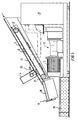
- Fig. 1 shows an apparatus 1 according to the invention, comprising a conveyor 3 which extends in an inclined manner so that the lowest part is disposed nearest to the suction aggregate 4.
- the fish 2, preferably flat fish, are placed on the conveyor 3 with their snout end in contact with carriers 8 arranged for this purpose on the conveyor, said carriers being configured with a V-shaped edge, the apex of which faces in the transport direction of the conveyor.
- carriers 8 arranged for this purpose on the conveyor, said carriers being configured with a V-shaped edge, the apex of which faces in the transport direction of the conveyor.
- the fish are now fed via the conveyor to the suction aggregate 4, which comprises a mainly cylindrical and vertically-movable unit 10, in the centre of which a knife 11 is arranged, the cutting edge of said knife standing at right angles to the transport direction.
- the inlet opening of the cylinder thus contains the knife, and the cylinder outlet opening is coupled to a vacuum pump.
- a vacuum pump By a quick snap movement down towards the fish, an opening is made by means of the knife, and in that the suction aggregate is at the same time coupled to the vacuum pump 12, a sucking-out of the intestines is effected.
- the intestines are expediently collected in a container 15 which at intervals can be emptied out into the sea, or which e.g. can form the basis for animal feeds.
- the vacuum pump is controlled from a computer 14 by means of an electrically-controlled vacuum valve.
- a sorting unit 9 which comprises at least two chutes/ramps 18, where, before the arrival of the fish at the actual suction aggregate 4, a measurement of the length of the fish is carried out by the use of first means 5 which preferably comprise a light detector or pulse meter, and with which, for example, a measurement can be made on the basis of signals which register the time that elapses between the passing of the snout of the fish and the tail of the fish.
- first means 5 which preferably comprise a light detector or pulse meter, and with which, for example, a measurement can be made on the basis of signals which register the time that elapses between the passing of the snout of the fish and the tail of the fish.
- This information is fed to and stored in a computer 14, in which on the basis of the speed a calculation of the length of the fish is made.
- This calculation is sent further to a control unit 16 which hereby ensures that the fish and the aggregate 4 are placed correctly in relation to each other, in that it has proved that there is a direct proportionality between the length of a fish and the distance from the tip of the snout to where the intestines are situated. It is hereby ensured that the knife in the suction aggregate 4 is positioned correctly in relation to the intestines.
- the system/apparatus 1 also comprises second means 5' with which a registration of the thickness of the fish is carried out. This can be carried out at any time and can, for example, be an integrated part of the first means 5 shown in the drawing.
- These second means can, for example, be in the form of an ultrasound scanning, whereby second data are generated and transmitted to the computer 14, where a total calculation of the size and weight of the fish is carried out, which size and weight will place the relevant fish in a category, where work is preferably effected with a total of four categories with several kinds of fish.
- This calculation is sent to the control unit 16, which is also coupled to a sorting arm/sweeper 20 which lies at the chute/ramp 18 itself down which the fish slides.
- a sorting which determines whether the fish shall be placed to the right or left to slide down the right or the left chute, and also whether the fish, when for example it has been swept to the left-hand chute, shall go to the box A or the box B, in that the sweeper arm 20 is controlled in such a manner that this can effect a 90° turn, and such that when it lies parallel with the fish, the fish will slide down the chute and down into that box which stands at the foot of the chute, and when the sweeper arm 20 has turned 90° outwards, the fish will instead slide out over the side of the chute and down into another box.
- Fig. 2 shows the relationships of the conveyor and the sorting unit with, for example, the fish box, and where this shows a conveyor 3 with a plate 17 arranged at a certain distance from the upper surface of the conveyor, in that the plate 17 ensures that the fish have a small space between plate and conveyor in which the fish are held in a given position in co-operation with the carriers 8 discussed earlier.
- the conveyor has an inclination in the order of 20-50°, preferably around 30-35°.
- the conveyor itself is constructed following known principles, and is thus wound around a pair of rollers 21 placed at each end, and which via an electric motor with frequency converter 7 is driven in such a manner that the intestines of the fish come to lie opposite the aggregate.
- the movement pattern of the motor 7 is thus also controlled by the control unit 16 described earlier.
- a positioning cylinder 35 together with the frequency converter, ensures that the aggregate comes to lie opposite the intestines of the fish.
- Fig. 3 shows the apparatus 1 seen from above, comprising the inclined conveyor 3 with the V-shape of the carriers clearly indicated, and where special attention is drawn to the actual sorting unit 9, where the fish are distributed either to the right or left via the above-mentioned chutes/ramps 18, and where as described earlier there are sorting arms/sweepers 20 having a movement interval of 90° on each frame, so that when the sorting arm stands transversely to the chute, the fish will slide out over the edge and down into the box 19,19', and when the sorting arm lies parallel with the edges of the chute, the fish will slide unhindered further down the chute to the box 19",19"', so that four sorting units are provided.
- Fig. 4 shows the suction aggregate seen in detail, which comprises the suction aggregate 4 itself containing a knife 11 with a razor-sharp cutting edge 24, which cutting-edge 24 extends in an inclined manner, and where the knife with its breadth surface is at right-angles to the direction of movement of the conveyor, and since the knife moves the same way regardless of which kind of fish may arrive, the inclination will result in a larger cut when it is a decidedly curved fish, i.e. a thick fish, which is cut, than that made in a flatter fish.
- the knife 11 is arranged so that its axis is parallel with the axis of a surrounding cylinder 10, said cylinder 10 being movable vertically by means of a spring arrangement 23 which is in abutment against the upper edge of the cylinder and presses this down towards the fish, and where the lower cylindrical edge on the vertical unit comprises sealing elements 13 around the whole of its periphery.
- the cylindrical unit 10 will typically have an inclined extent corresponding more or less to the same degree of inclination as the cutting edge of the knife.
- the knife 11 itself and the cylindrical unit 10 are placed in an inner cylinder housing 30 which can be moved vertically up/down - when down the vacuum is established, and when up the vacuum is removed, and which inner cylinder housing 30 is fastened via the fastening means 27 to an outer cylinder housing 25 which is fastened to a slide block 29, which in turn is fastened to an outer protection jacket/cylinder shell 26.
- the slide block 29 slides on the plate 17 over the conveyor 3, and/or is fastened to the frames of the conveyor itself. In this way there is thus only one movable unit, namely the vertical unit and the knife itself.
- the knife and the vertical unit are coupled to a vacuum aggregate 12, so that the intestines are sucked out via this aggregate.
- brushes 22 which ensure that the fish 2 are given less free space than the free space which may exist between the plate 17 and the conveyor 3, and to control the fish in that a fish lies still when a hand is held over it.
- the apparatus according to the method outlined above finds particular application in connection with flat fish due to the position of the intestines of flat fish. However, with an adjustment of the system to other fish, it will also find application in connection with other fish.
Landscapes
- Life Sciences & Earth Sciences (AREA)
- Engineering & Computer Science (AREA)
- Wood Science & Technology (AREA)
- Zoology (AREA)
- Food Science & Technology (AREA)
- Processing Of Meat And Fish (AREA)
Applications Claiming Priority (2)
| Application Number | Priority Date | Filing Date | Title |
|---|---|---|---|
| DK200000364A DK200000364A (da) | 2000-03-07 | 2000-03-07 | Fremgangsmåde og apparatur til åbning af fisk og udtagning af fiskenes indvolde |
| DK200000364 | 2000-03-07 |
Publications (1)
| Publication Number | Publication Date |
|---|---|
| EP1132006A1 true EP1132006A1 (en) | 2001-09-12 |
Family
ID=8159288
Family Applications (1)
| Application Number | Title | Priority Date | Filing Date |
|---|---|---|---|
| EP01610017A Withdrawn EP1132006A1 (en) | 2000-03-07 | 2001-03-05 | Method and apparatus for opening fish and removing the intestines of the fish and use of the apparatus for carrying out the method |
Country Status (2)
| Country | Link |
|---|---|
| EP (1) | EP1132006A1 (da) |
| DK (1) | DK200000364A (da) |
Cited By (1)
| Publication number | Priority date | Publication date | Assignee | Title |
|---|---|---|---|---|
| DK201500480A1 (en) * | 2015-08-18 | 2016-10-17 | Niels Jørgen Olsen | Gutting Device |
Citations (6)
| Publication number | Priority date | Publication date | Assignee | Title |
|---|---|---|---|---|
| US2192838A (en) * | 1939-06-21 | 1940-03-05 | Henry R Mcgrew | Fish entrails extractor |
| DE2832259B1 (de) * | 1978-07-22 | 1979-10-25 | Nordischer Maschb Rud Baader G | Verfahren zum Entweiden von Fischen |
| EP0116782A1 (en) * | 1982-12-28 | 1984-08-29 | Fujitsu Limited | Fish processing apparatus |
| DE3343789A1 (de) | 1983-12-03 | 1985-06-13 | Helmut Müller Fischtechnik GmbH Northeim, 3410 Northeim | Verfahren und vorrichtung zum maschinellen oeffnen auch unterschiedlich grosser fische, insbesondere forellen, und zum entfernen der eingeweide |
| EP0398017A2 (de) * | 1989-05-16 | 1990-11-22 | Nordischer Maschinenbau Rud. Baader Gmbh + Co Kg | Verfahren zum Entweiden von Fischen und Einrichtung zur Durchfürung des Verfahrens |
| WO1995003704A1 (en) | 1993-07-27 | 1995-02-09 | Royal Seafoods, Inc. | A device for processing flat fish |
-
2000
- 2000-03-07 DK DK200000364A patent/DK200000364A/da not_active Application Discontinuation
-
2001
- 2001-03-05 EP EP01610017A patent/EP1132006A1/en not_active Withdrawn
Patent Citations (6)
| Publication number | Priority date | Publication date | Assignee | Title |
|---|---|---|---|---|
| US2192838A (en) * | 1939-06-21 | 1940-03-05 | Henry R Mcgrew | Fish entrails extractor |
| DE2832259B1 (de) * | 1978-07-22 | 1979-10-25 | Nordischer Maschb Rud Baader G | Verfahren zum Entweiden von Fischen |
| EP0116782A1 (en) * | 1982-12-28 | 1984-08-29 | Fujitsu Limited | Fish processing apparatus |
| DE3343789A1 (de) | 1983-12-03 | 1985-06-13 | Helmut Müller Fischtechnik GmbH Northeim, 3410 Northeim | Verfahren und vorrichtung zum maschinellen oeffnen auch unterschiedlich grosser fische, insbesondere forellen, und zum entfernen der eingeweide |
| EP0398017A2 (de) * | 1989-05-16 | 1990-11-22 | Nordischer Maschinenbau Rud. Baader Gmbh + Co Kg | Verfahren zum Entweiden von Fischen und Einrichtung zur Durchfürung des Verfahrens |
| WO1995003704A1 (en) | 1993-07-27 | 1995-02-09 | Royal Seafoods, Inc. | A device for processing flat fish |
Cited By (2)
| Publication number | Priority date | Publication date | Assignee | Title |
|---|---|---|---|---|
| DK201500480A1 (en) * | 2015-08-18 | 2016-10-17 | Niels Jørgen Olsen | Gutting Device |
| WO2017028865A1 (en) * | 2015-08-18 | 2017-02-23 | Niels Jørgen Olsen | Gutting device |
Also Published As
| Publication number | Publication date |
|---|---|
| DK200000364A (da) | 2001-09-08 |
Similar Documents
| Publication | Publication Date | Title |
|---|---|---|
| CN113573587B (zh) | 肋骨初步分割部的分割和修整 | |
| US9192174B2 (en) | Workstation of a food item processing system | |
| EP1450615B1 (en) | Apparatus and method for trimming of fish fillets | |
| US7695354B2 (en) | Fish processing machine with alignment devices and methods for realigning fish during processing | |
| US7285040B2 (en) | Method for de-rinding and trimming a piece of meat or a piece of slaughtered animal | |
| EP1351577B1 (en) | A trim table | |
| US6506991B1 (en) | Method and apparatus for sorting waste paper of different grades and conditions | |
| WO2005004593A1 (en) | Trawl apparatus | |
| US5197263A (en) | Method and apparatus for harvesting aquatic plants | |
| CN109760169B (zh) | 自动化的板材开料系统及其控制方法 | |
| NO180611B (no) | Fremgangsmåte for å detektere fôrspill | |
| CN210386642U (zh) | 一种轨道式医学样本传动模组及分拣系统 | |
| EP1132006A1 (en) | Method and apparatus for opening fish and removing the intestines of the fish and use of the apparatus for carrying out the method | |
| NO20170365A1 (en) | Method and system for automated vaccination and sorting alive fish | |
| JP2018068156A (ja) | 海苔の異物除去装置 | |
| CN115139368A (zh) | 一种用于柔性材料的贴合模切设备及其模切方法 | |
| EA008911B1 (ru) | Система для переворачивания кусков мяса, имеющих неправильную геометрическую форму | |
| GB2155757A (en) | Automatic surface dressing machine | |
| CN220722555U (zh) | 一种跨境电商物流用高效分类设备 | |
| CA1044860A (en) | Trash compactor apparatus | |
| EP1025029B1 (en) | Sorting means for returned printing matters | |
| WO2005039277A2 (en) | Method and device for handling a fishing longline in connection with a fishingboat | |
| JPH059684U (ja) | 果実野菜等の選別コンベア | |
| NO20121221L (no) | Anordning og fremgangsmate for fjerning av uonsket vev av en fiskefilet | |
| JP2001170567A (ja) | 長尺状部材の選別装置 |
Legal Events
| Date | Code | Title | Description |
|---|---|---|---|
| PUAI | Public reference made under article 153(3) epc to a published international application that has entered the european phase |
Free format text: ORIGINAL CODE: 0009012 |
|
| AK | Designated contracting states |
Kind code of ref document: A1 Designated state(s): AT BE CH CY DE DK ES FI FR GB GR IE IT LI LU MC NL PT SE TR |
|
| AX | Request for extension of the european patent |
Free format text: AL;LT;LV;MK;RO;SI |
|
| 17P | Request for examination filed |
Effective date: 20020312 |
|
| AKX | Designation fees paid |
Free format text: AT BE CH CY DE DK ES FI FR GB GR IE IT LI LU MC NL PT SE TR |
|
| RAP1 | Party data changed (applicant data changed or rights of an application transferred) |
Owner name: GOLIATH CONSTRUCTION APS |
|
| 17Q | First examination report despatched |
Effective date: 20040302 |
|
| STAA | Information on the status of an ep patent application or granted ep patent |
Free format text: STATUS: THE APPLICATION IS DEEMED TO BE WITHDRAWN |
|
| 18D | Application deemed to be withdrawn |
Effective date: 20040713 |