EP1132063B1 - Remplacement postéro-stabilisé du genou avec des caractéristiques pour éviter une dislocation - Google Patents
Remplacement postéro-stabilisé du genou avec des caractéristiques pour éviter une dislocation Download PDFInfo
- Publication number
- EP1132063B1 EP1132063B1 EP01105337A EP01105337A EP1132063B1 EP 1132063 B1 EP1132063 B1 EP 1132063B1 EP 01105337 A EP01105337 A EP 01105337A EP 01105337 A EP01105337 A EP 01105337A EP 1132063 B1 EP1132063 B1 EP 1132063B1
- Authority
- EP
- European Patent Office
- Prior art keywords
- bearing
- femoral component
- post
- control arm
- posterior
- Prior art date
- Legal status (The legal status is an assumption and is not a legal conclusion. Google has not performed a legal analysis and makes no representation as to the accuracy of the status listed.)
- Expired - Lifetime
Links
Images



Classifications
-
- A—HUMAN NECESSITIES
- A61—MEDICAL OR VETERINARY SCIENCE; HYGIENE
- A61F—FILTERS IMPLANTABLE INTO BLOOD VESSELS; PROSTHESES; DEVICES PROVIDING PATENCY TO, OR PREVENTING COLLAPSING OF, TUBULAR STRUCTURES OF THE BODY, e.g. STENTS; ORTHOPAEDIC, NURSING OR CONTRACEPTIVE DEVICES; FOMENTATION; TREATMENT OR PROTECTION OF EYES OR EARS; BANDAGES, DRESSINGS OR ABSORBENT PADS; FIRST-AID KITS
- A61F2/00—Filters implantable into blood vessels; Prostheses, i.e. artificial substitutes or replacements for parts of the body; Appliances for connecting them with the body; Devices providing patency to, or preventing collapsing of, tubular structures of the body, e.g. stents
- A61F2/02—Prostheses implantable into the body
- A61F2/30—Joints
- A61F2/38—Joints for elbows or knees
- A61F2/3868—Joints for elbows or knees with sliding tibial bearing
-
- A—HUMAN NECESSITIES
- A61—MEDICAL OR VETERINARY SCIENCE; HYGIENE
- A61F—FILTERS IMPLANTABLE INTO BLOOD VESSELS; PROSTHESES; DEVICES PROVIDING PATENCY TO, OR PREVENTING COLLAPSING OF, TUBULAR STRUCTURES OF THE BODY, e.g. STENTS; ORTHOPAEDIC, NURSING OR CONTRACEPTIVE DEVICES; FOMENTATION; TREATMENT OR PROTECTION OF EYES OR EARS; BANDAGES, DRESSINGS OR ABSORBENT PADS; FIRST-AID KITS
- A61F2/00—Filters implantable into blood vessels; Prostheses, i.e. artificial substitutes or replacements for parts of the body; Appliances for connecting them with the body; Devices providing patency to, or preventing collapsing of, tubular structures of the body, e.g. stents
- A61F2/02—Prostheses implantable into the body
- A61F2/30—Joints
- A61F2/38—Joints for elbows or knees
- A61F2/3886—Joints for elbows or knees for stabilising knees against anterior or lateral dislocations
-
- A—HUMAN NECESSITIES
- A61—MEDICAL OR VETERINARY SCIENCE; HYGIENE
- A61F—FILTERS IMPLANTABLE INTO BLOOD VESSELS; PROSTHESES; DEVICES PROVIDING PATENCY TO, OR PREVENTING COLLAPSING OF, TUBULAR STRUCTURES OF THE BODY, e.g. STENTS; ORTHOPAEDIC, NURSING OR CONTRACEPTIVE DEVICES; FOMENTATION; TREATMENT OR PROTECTION OF EYES OR EARS; BANDAGES, DRESSINGS OR ABSORBENT PADS; FIRST-AID KITS
- A61F2/00—Filters implantable into blood vessels; Prostheses, i.e. artificial substitutes or replacements for parts of the body; Appliances for connecting them with the body; Devices providing patency to, or preventing collapsing of, tubular structures of the body, e.g. stents
- A61F2/02—Prostheses implantable into the body
- A61F2/30—Joints
- A61F2/30767—Special external or bone-contacting surface, e.g. coating for improving bone ingrowth
-
- A—HUMAN NECESSITIES
- A61—MEDICAL OR VETERINARY SCIENCE; HYGIENE
- A61F—FILTERS IMPLANTABLE INTO BLOOD VESSELS; PROSTHESES; DEVICES PROVIDING PATENCY TO, OR PREVENTING COLLAPSING OF, TUBULAR STRUCTURES OF THE BODY, e.g. STENTS; ORTHOPAEDIC, NURSING OR CONTRACEPTIVE DEVICES; FOMENTATION; TREATMENT OR PROTECTION OF EYES OR EARS; BANDAGES, DRESSINGS OR ABSORBENT PADS; FIRST-AID KITS
- A61F2/00—Filters implantable into blood vessels; Prostheses, i.e. artificial substitutes or replacements for parts of the body; Appliances for connecting them with the body; Devices providing patency to, or preventing collapsing of, tubular structures of the body, e.g. stents
- A61F2/02—Prostheses implantable into the body
- A61F2/30—Joints
- A61F2/38—Joints for elbows or knees
- A61F2/3859—Femoral components
-
- A—HUMAN NECESSITIES
- A61—MEDICAL OR VETERINARY SCIENCE; HYGIENE
- A61F—FILTERS IMPLANTABLE INTO BLOOD VESSELS; PROSTHESES; DEVICES PROVIDING PATENCY TO, OR PREVENTING COLLAPSING OF, TUBULAR STRUCTURES OF THE BODY, e.g. STENTS; ORTHOPAEDIC, NURSING OR CONTRACEPTIVE DEVICES; FOMENTATION; TREATMENT OR PROTECTION OF EYES OR EARS; BANDAGES, DRESSINGS OR ABSORBENT PADS; FIRST-AID KITS
- A61F2/00—Filters implantable into blood vessels; Prostheses, i.e. artificial substitutes or replacements for parts of the body; Appliances for connecting them with the body; Devices providing patency to, or preventing collapsing of, tubular structures of the body, e.g. stents
- A61F2/02—Prostheses implantable into the body
- A61F2/30—Joints
- A61F2/38—Joints for elbows or knees
- A61F2/389—Tibial components
-
- A—HUMAN NECESSITIES
- A61—MEDICAL OR VETERINARY SCIENCE; HYGIENE
- A61F—FILTERS IMPLANTABLE INTO BLOOD VESSELS; PROSTHESES; DEVICES PROVIDING PATENCY TO, OR PREVENTING COLLAPSING OF, TUBULAR STRUCTURES OF THE BODY, e.g. STENTS; ORTHOPAEDIC, NURSING OR CONTRACEPTIVE DEVICES; FOMENTATION; TREATMENT OR PROTECTION OF EYES OR EARS; BANDAGES, DRESSINGS OR ABSORBENT PADS; FIRST-AID KITS
- A61F2/00—Filters implantable into blood vessels; Prostheses, i.e. artificial substitutes or replacements for parts of the body; Appliances for connecting them with the body; Devices providing patency to, or preventing collapsing of, tubular structures of the body, e.g. stents
- A61F2/02—Prostheses implantable into the body
- A61F2/30—Joints
- A61F2002/30001—Additional features of subject-matter classified in A61F2/28, A61F2/30 and subgroups thereof
- A61F2002/30316—The prosthesis having different structural features at different locations within the same prosthesis; Connections between prosthetic parts; Special structural features of bone or joint prostheses not otherwise provided for
- A61F2002/30329—Connections or couplings between prosthetic parts, e.g. between modular parts; Connecting elements
- A61F2002/30331—Connections or couplings between prosthetic parts, e.g. between modular parts; Connecting elements made by longitudinally pushing a protrusion into a complementarily-shaped recess, e.g. held by friction fit
- A61F2002/30332—Conically- or frustoconically-shaped protrusion and recess
-
- A—HUMAN NECESSITIES
- A61—MEDICAL OR VETERINARY SCIENCE; HYGIENE
- A61F—FILTERS IMPLANTABLE INTO BLOOD VESSELS; PROSTHESES; DEVICES PROVIDING PATENCY TO, OR PREVENTING COLLAPSING OF, TUBULAR STRUCTURES OF THE BODY, e.g. STENTS; ORTHOPAEDIC, NURSING OR CONTRACEPTIVE DEVICES; FOMENTATION; TREATMENT OR PROTECTION OF EYES OR EARS; BANDAGES, DRESSINGS OR ABSORBENT PADS; FIRST-AID KITS
- A61F2/00—Filters implantable into blood vessels; Prostheses, i.e. artificial substitutes or replacements for parts of the body; Appliances for connecting them with the body; Devices providing patency to, or preventing collapsing of, tubular structures of the body, e.g. stents
- A61F2/02—Prostheses implantable into the body
- A61F2/30—Joints
- A61F2002/30001—Additional features of subject-matter classified in A61F2/28, A61F2/30 and subgroups thereof
- A61F2002/30316—The prosthesis having different structural features at different locations within the same prosthesis; Connections between prosthetic parts; Special structural features of bone or joint prostheses not otherwise provided for
- A61F2002/30329—Connections or couplings between prosthetic parts, e.g. between modular parts; Connecting elements
- A61F2002/30331—Connections or couplings between prosthetic parts, e.g. between modular parts; Connecting elements made by longitudinally pushing a protrusion into a complementarily-shaped recess, e.g. held by friction fit
- A61F2002/30332—Conically- or frustoconically-shaped protrusion and recess
- A61F2002/30339—Double cones, i.e. connecting element having two conical connections, one at each of its opposite ends
-
- A—HUMAN NECESSITIES
- A61—MEDICAL OR VETERINARY SCIENCE; HYGIENE
- A61F—FILTERS IMPLANTABLE INTO BLOOD VESSELS; PROSTHESES; DEVICES PROVIDING PATENCY TO, OR PREVENTING COLLAPSING OF, TUBULAR STRUCTURES OF THE BODY, e.g. STENTS; ORTHOPAEDIC, NURSING OR CONTRACEPTIVE DEVICES; FOMENTATION; TREATMENT OR PROTECTION OF EYES OR EARS; BANDAGES, DRESSINGS OR ABSORBENT PADS; FIRST-AID KITS
- A61F2/00—Filters implantable into blood vessels; Prostheses, i.e. artificial substitutes or replacements for parts of the body; Appliances for connecting them with the body; Devices providing patency to, or preventing collapsing of, tubular structures of the body, e.g. stents
- A61F2/02—Prostheses implantable into the body
- A61F2/30—Joints
- A61F2002/30001—Additional features of subject-matter classified in A61F2/28, A61F2/30 and subgroups thereof
- A61F2002/30316—The prosthesis having different structural features at different locations within the same prosthesis; Connections between prosthetic parts; Special structural features of bone or joint prostheses not otherwise provided for
- A61F2002/30329—Connections or couplings between prosthetic parts, e.g. between modular parts; Connecting elements
- A61F2002/30331—Connections or couplings between prosthetic parts, e.g. between modular parts; Connecting elements made by longitudinally pushing a protrusion into a complementarily-shaped recess, e.g. held by friction fit
- A61F2002/30362—Connections or couplings between prosthetic parts, e.g. between modular parts; Connecting elements made by longitudinally pushing a protrusion into a complementarily-shaped recess, e.g. held by friction fit with possibility of relative movement between the protrusion and the recess
- A61F2002/30364—Rotation about the common longitudinal axis
-
- A—HUMAN NECESSITIES
- A61—MEDICAL OR VETERINARY SCIENCE; HYGIENE
- A61F—FILTERS IMPLANTABLE INTO BLOOD VESSELS; PROSTHESES; DEVICES PROVIDING PATENCY TO, OR PREVENTING COLLAPSING OF, TUBULAR STRUCTURES OF THE BODY, e.g. STENTS; ORTHOPAEDIC, NURSING OR CONTRACEPTIVE DEVICES; FOMENTATION; TREATMENT OR PROTECTION OF EYES OR EARS; BANDAGES, DRESSINGS OR ABSORBENT PADS; FIRST-AID KITS
- A61F2/00—Filters implantable into blood vessels; Prostheses, i.e. artificial substitutes or replacements for parts of the body; Appliances for connecting them with the body; Devices providing patency to, or preventing collapsing of, tubular structures of the body, e.g. stents
- A61F2/02—Prostheses implantable into the body
- A61F2/30—Joints
- A61F2002/30001—Additional features of subject-matter classified in A61F2/28, A61F2/30 and subgroups thereof
- A61F2002/30316—The prosthesis having different structural features at different locations within the same prosthesis; Connections between prosthetic parts; Special structural features of bone or joint prostheses not otherwise provided for
- A61F2002/30329—Connections or couplings between prosthetic parts, e.g. between modular parts; Connecting elements
- A61F2002/30383—Connections or couplings between prosthetic parts, e.g. between modular parts; Connecting elements made by laterally inserting a protrusion, e.g. a rib into a complementarily-shaped groove
- A61F2002/30387—Dovetail connection
-
- A—HUMAN NECESSITIES
- A61—MEDICAL OR VETERINARY SCIENCE; HYGIENE
- A61F—FILTERS IMPLANTABLE INTO BLOOD VESSELS; PROSTHESES; DEVICES PROVIDING PATENCY TO, OR PREVENTING COLLAPSING OF, TUBULAR STRUCTURES OF THE BODY, e.g. STENTS; ORTHOPAEDIC, NURSING OR CONTRACEPTIVE DEVICES; FOMENTATION; TREATMENT OR PROTECTION OF EYES OR EARS; BANDAGES, DRESSINGS OR ABSORBENT PADS; FIRST-AID KITS
- A61F2/00—Filters implantable into blood vessels; Prostheses, i.e. artificial substitutes or replacements for parts of the body; Appliances for connecting them with the body; Devices providing patency to, or preventing collapsing of, tubular structures of the body, e.g. stents
- A61F2/02—Prostheses implantable into the body
- A61F2/30—Joints
- A61F2002/30001—Additional features of subject-matter classified in A61F2/28, A61F2/30 and subgroups thereof
- A61F2002/30316—The prosthesis having different structural features at different locations within the same prosthesis; Connections between prosthetic parts; Special structural features of bone or joint prostheses not otherwise provided for
- A61F2002/30329—Connections or couplings between prosthetic parts, e.g. between modular parts; Connecting elements
- A61F2002/30383—Connections or couplings between prosthetic parts, e.g. between modular parts; Connecting elements made by laterally inserting a protrusion, e.g. a rib into a complementarily-shaped groove
- A61F2002/3039—Connections or couplings between prosthetic parts, e.g. between modular parts; Connecting elements made by laterally inserting a protrusion, e.g. a rib into a complementarily-shaped groove with possibility of relative movement of the rib within the groove
- A61F2002/30398—Sliding
- A61F2002/304—Sliding with additional means for limiting said sliding
-
- A—HUMAN NECESSITIES
- A61—MEDICAL OR VETERINARY SCIENCE; HYGIENE
- A61F—FILTERS IMPLANTABLE INTO BLOOD VESSELS; PROSTHESES; DEVICES PROVIDING PATENCY TO, OR PREVENTING COLLAPSING OF, TUBULAR STRUCTURES OF THE BODY, e.g. STENTS; ORTHOPAEDIC, NURSING OR CONTRACEPTIVE DEVICES; FOMENTATION; TREATMENT OR PROTECTION OF EYES OR EARS; BANDAGES, DRESSINGS OR ABSORBENT PADS; FIRST-AID KITS
- A61F2/00—Filters implantable into blood vessels; Prostheses, i.e. artificial substitutes or replacements for parts of the body; Appliances for connecting them with the body; Devices providing patency to, or preventing collapsing of, tubular structures of the body, e.g. stents
- A61F2/02—Prostheses implantable into the body
- A61F2/30—Joints
- A61F2002/30001—Additional features of subject-matter classified in A61F2/28, A61F2/30 and subgroups thereof
- A61F2002/30316—The prosthesis having different structural features at different locations within the same prosthesis; Connections between prosthetic parts; Special structural features of bone or joint prostheses not otherwise provided for
- A61F2002/30329—Connections or couplings between prosthetic parts, e.g. between modular parts; Connecting elements
- A61F2002/30433—Connections or couplings between prosthetic parts, e.g. between modular parts; Connecting elements using additional screws, bolts, dowels, rivets or washers e.g. connecting screws
-
- A—HUMAN NECESSITIES
- A61—MEDICAL OR VETERINARY SCIENCE; HYGIENE
- A61F—FILTERS IMPLANTABLE INTO BLOOD VESSELS; PROSTHESES; DEVICES PROVIDING PATENCY TO, OR PREVENTING COLLAPSING OF, TUBULAR STRUCTURES OF THE BODY, e.g. STENTS; ORTHOPAEDIC, NURSING OR CONTRACEPTIVE DEVICES; FOMENTATION; TREATMENT OR PROTECTION OF EYES OR EARS; BANDAGES, DRESSINGS OR ABSORBENT PADS; FIRST-AID KITS
- A61F2/00—Filters implantable into blood vessels; Prostheses, i.e. artificial substitutes or replacements for parts of the body; Appliances for connecting them with the body; Devices providing patency to, or preventing collapsing of, tubular structures of the body, e.g. stents
- A61F2/02—Prostheses implantable into the body
- A61F2/30—Joints
- A61F2002/30001—Additional features of subject-matter classified in A61F2/28, A61F2/30 and subgroups thereof
- A61F2002/30316—The prosthesis having different structural features at different locations within the same prosthesis; Connections between prosthetic parts; Special structural features of bone or joint prostheses not otherwise provided for
- A61F2002/30535—Special structural features of bone or joint prostheses not otherwise provided for
- A61F2002/30604—Special structural features of bone or joint prostheses not otherwise provided for modular
-
- A—HUMAN NECESSITIES
- A61—MEDICAL OR VETERINARY SCIENCE; HYGIENE
- A61F—FILTERS IMPLANTABLE INTO BLOOD VESSELS; PROSTHESES; DEVICES PROVIDING PATENCY TO, OR PREVENTING COLLAPSING OF, TUBULAR STRUCTURES OF THE BODY, e.g. STENTS; ORTHOPAEDIC, NURSING OR CONTRACEPTIVE DEVICES; FOMENTATION; TREATMENT OR PROTECTION OF EYES OR EARS; BANDAGES, DRESSINGS OR ABSORBENT PADS; FIRST-AID KITS
- A61F2/00—Filters implantable into blood vessels; Prostheses, i.e. artificial substitutes or replacements for parts of the body; Appliances for connecting them with the body; Devices providing patency to, or preventing collapsing of, tubular structures of the body, e.g. stents
- A61F2/02—Prostheses implantable into the body
- A61F2/30—Joints
- A61F2/30767—Special external or bone-contacting surface, e.g. coating for improving bone ingrowth
- A61F2/30771—Special external or bone-contacting surface, e.g. coating for improving bone ingrowth applied in original prostheses, e.g. holes or grooves
- A61F2002/3082—Grooves
- A61F2002/30823—Grooves having the shape of a reverse dovetail
-
- A—HUMAN NECESSITIES
- A61—MEDICAL OR VETERINARY SCIENCE; HYGIENE
- A61F—FILTERS IMPLANTABLE INTO BLOOD VESSELS; PROSTHESES; DEVICES PROVIDING PATENCY TO, OR PREVENTING COLLAPSING OF, TUBULAR STRUCTURES OF THE BODY, e.g. STENTS; ORTHOPAEDIC, NURSING OR CONTRACEPTIVE DEVICES; FOMENTATION; TREATMENT OR PROTECTION OF EYES OR EARS; BANDAGES, DRESSINGS OR ABSORBENT PADS; FIRST-AID KITS
- A61F2/00—Filters implantable into blood vessels; Prostheses, i.e. artificial substitutes or replacements for parts of the body; Appliances for connecting them with the body; Devices providing patency to, or preventing collapsing of, tubular structures of the body, e.g. stents
- A61F2/02—Prostheses implantable into the body
- A61F2/30—Joints
- A61F2/30767—Special external or bone-contacting surface, e.g. coating for improving bone ingrowth
- A61F2/30771—Special external or bone-contacting surface, e.g. coating for improving bone ingrowth applied in original prostheses, e.g. holes or grooves
- A61F2002/30836—Special external or bone-contacting surface, e.g. coating for improving bone ingrowth applied in original prostheses, e.g. holes or grooves knurled
-
- A—HUMAN NECESSITIES
- A61—MEDICAL OR VETERINARY SCIENCE; HYGIENE
- A61F—FILTERS IMPLANTABLE INTO BLOOD VESSELS; PROSTHESES; DEVICES PROVIDING PATENCY TO, OR PREVENTING COLLAPSING OF, TUBULAR STRUCTURES OF THE BODY, e.g. STENTS; ORTHOPAEDIC, NURSING OR CONTRACEPTIVE DEVICES; FOMENTATION; TREATMENT OR PROTECTION OF EYES OR EARS; BANDAGES, DRESSINGS OR ABSORBENT PADS; FIRST-AID KITS
- A61F2220/00—Fixations or connections for prostheses classified in groups A61F2/00 - A61F2/26 or A61F2/82 or A61F9/00 or A61F11/00 or subgroups thereof
- A61F2220/0025—Connections or couplings between prosthetic parts, e.g. between modular parts; Connecting elements
-
- A—HUMAN NECESSITIES
- A61—MEDICAL OR VETERINARY SCIENCE; HYGIENE
- A61F—FILTERS IMPLANTABLE INTO BLOOD VESSELS; PROSTHESES; DEVICES PROVIDING PATENCY TO, OR PREVENTING COLLAPSING OF, TUBULAR STRUCTURES OF THE BODY, e.g. STENTS; ORTHOPAEDIC, NURSING OR CONTRACEPTIVE DEVICES; FOMENTATION; TREATMENT OR PROTECTION OF EYES OR EARS; BANDAGES, DRESSINGS OR ABSORBENT PADS; FIRST-AID KITS
- A61F2220/00—Fixations or connections for prostheses classified in groups A61F2/00 - A61F2/26 or A61F2/82 or A61F9/00 or A61F11/00 or subgroups thereof
- A61F2220/0025—Connections or couplings between prosthetic parts, e.g. between modular parts; Connecting elements
- A61F2220/0033—Connections or couplings between prosthetic parts, e.g. between modular parts; Connecting elements made by longitudinally pushing a protrusion into a complementary-shaped recess, e.g. held by friction fit
-
- A—HUMAN NECESSITIES
- A61—MEDICAL OR VETERINARY SCIENCE; HYGIENE
- A61F—FILTERS IMPLANTABLE INTO BLOOD VESSELS; PROSTHESES; DEVICES PROVIDING PATENCY TO, OR PREVENTING COLLAPSING OF, TUBULAR STRUCTURES OF THE BODY, e.g. STENTS; ORTHOPAEDIC, NURSING OR CONTRACEPTIVE DEVICES; FOMENTATION; TREATMENT OR PROTECTION OF EYES OR EARS; BANDAGES, DRESSINGS OR ABSORBENT PADS; FIRST-AID KITS
- A61F2220/00—Fixations or connections for prostheses classified in groups A61F2/00 - A61F2/26 or A61F2/82 or A61F9/00 or A61F11/00 or subgroups thereof
- A61F2220/0025—Connections or couplings between prosthetic parts, e.g. between modular parts; Connecting elements
- A61F2220/0041—Connections or couplings between prosthetic parts, e.g. between modular parts; Connecting elements using additional screws, bolts, dowels or rivets, e.g. connecting screws
-
- A—HUMAN NECESSITIES
- A61—MEDICAL OR VETERINARY SCIENCE; HYGIENE
- A61F—FILTERS IMPLANTABLE INTO BLOOD VESSELS; PROSTHESES; DEVICES PROVIDING PATENCY TO, OR PREVENTING COLLAPSING OF, TUBULAR STRUCTURES OF THE BODY, e.g. STENTS; ORTHOPAEDIC, NURSING OR CONTRACEPTIVE DEVICES; FOMENTATION; TREATMENT OR PROTECTION OF EYES OR EARS; BANDAGES, DRESSINGS OR ABSORBENT PADS; FIRST-AID KITS
- A61F2310/00—Prostheses classified in A61F2/28 or A61F2/30 - A61F2/44 being constructed from or coated with a particular material
- A61F2310/00005—The prosthesis being constructed from a particular material
- A61F2310/00011—Metals or alloys
- A61F2310/00023—Titanium or titanium-based alloys, e.g. Ti-Ni alloys
-
- A—HUMAN NECESSITIES
- A61—MEDICAL OR VETERINARY SCIENCE; HYGIENE
- A61F—FILTERS IMPLANTABLE INTO BLOOD VESSELS; PROSTHESES; DEVICES PROVIDING PATENCY TO, OR PREVENTING COLLAPSING OF, TUBULAR STRUCTURES OF THE BODY, e.g. STENTS; ORTHOPAEDIC, NURSING OR CONTRACEPTIVE DEVICES; FOMENTATION; TREATMENT OR PROTECTION OF EYES OR EARS; BANDAGES, DRESSINGS OR ABSORBENT PADS; FIRST-AID KITS
- A61F2310/00—Prostheses classified in A61F2/28 or A61F2/30 - A61F2/44 being constructed from or coated with a particular material
- A61F2310/00389—The prosthesis being coated or covered with a particular material
- A61F2310/00592—Coating or prosthesis-covering structure made of ceramics or of ceramic-like compounds
- A61F2310/00856—Coating or prosthesis-covering structure made of compounds based on metal nitrides
- A61F2310/0088—Coating made of titanium nitride
Definitions
- the subject invention relates to a knee joint prosthesis, and particularly a posterior stabilized replacement knee joint prosthesis.
- a natural knee joint includes the distal end of the femur with articular cartilage, the proximal end of the tibia with articular cartilage and a meniscus between the femur and tibia.
- the femur and the tibia are held in a proper relationship to the bearing by ligaments.
- These stabilizing ligaments include the posterior cruciate ligament, the anterior cruciate ligament and collateral ligaments.
- Flexion of the knee causes the tibia to rotate relative to the femur about an axis that extends generally in a medial-to-lateral direction and simultaneously causes the contact area of the femur to roll back relative to the tibia. Flexion also generates rotation of the tibia about its own axis. The amount of rotation of the tibia during flexion of the knee is controlled and limited by the ligaments.
- the natural knee joint can become damaged or diseased.
- damage or disease to the knee can deteriorate the articular surfaces of the femur or tibia and can damage the articular cartilage between the bones.
- the prior art includes prosthetic knee joints to replace a damaged or diseased natural knee.
- a prosthetic knee joint typically includes a femoral component that is mounted to the distal end of a resected femur, a tibial component mounted to the proximal end of a resected tibia and a bearing between the femoral and tibial components.
- the inferior face of the femoral component of a prosthetic knee joint typically defines a pair of arcuate convex condyles.
- the superior face of the bearing has a corresponding pair of arcuately concave regions for articular bearing engagement with the condyles of the femoral component.
- the superior face of the tibial component may be substantially planar and is disposed in engagement with the inferior face of the bearing.
- Prior art prosthetic knee joints have taken many different forms, depending upon the preferences of the orthopedic surgeon, the condition of the natural knee and the health, age and mobility of the patient.
- Some prior art knee joint prostheses fixedly secure the inferior surface of the bearing to the superior surface of the tibial component.
- Other prior art knee joint prostheses permit rotational movement between the bearing and the tibial component.
- Still other prior art knee joint prosthesis permit a controlled amount of anterior-posterior sliding movement between the bearing and a tibial component. Movement of the bearing relative to the tibial component achieves many functional advantages, as described in the prior art.
- Prior art knee joint prostheses that incorporate certain of the structural and functional features referred to above are disclosed in U.S. Patent No. 4,470,158 and U.S. Patent No. 4,309,778.
- the inferior bearing surface of the femoral component on most prosthetic knee joints comprises a pair of convexly arcuately condyles.
- the condyles of the femoral component are in articular bearing engagement with arcuately concave regions on the superior face of the bearing.
- the superior face of the bearing typically includes a pair of dished regions each of which has a relatively depressed center portion and a relatively elevated peripheral lip.
- flexion tends to move the relative components of the prosthetic knee toward dislocation.
- the degree to which dislocation is possible depends on several factors, most significantly, the presence or absence of ligaments and the mobility and configuration of the bearing.
- the likelihood of dislocation also depends upon the degree of flexion and on the degree of congruency between the inferior articular bearing surface of the femoral component and the superior surface of the bearing. For example, climbing of the femoral component on the bearing is not a significant problem even in fixed bearing knees that have a substantially flat superior surface on the bearing.
- Valgus-varus stability of a knee joint refers to the ability of the joint to resist the lateral forces or rotary forces that would cause rotation of the tibia relative to the femur in the frontal plane. Lateral forces or rotary movements that cause rotation of the tibia relative to the femur in the frontal plane tend to create a dislocation. Such dislocation is particularly likely to occur on either the medial or lateral side of the prosthesis, depending upon the direction of the lateral forces. Such a dislocation in a prior art prosthesis is shown in FIG. 18 hereto.
- the prosthetic knee joint is under a compressive loading during normal activities.
- valgus-varus moments typically are resisted adequately by the articulating surfaces of the prosthetic components and by the ligaments.
- additional valgus-varus stability may be desired, such as those instances where ligaments are deficient.
- Some prior art prosthetic knee joints enhance valgus-varus stability by providing a stabilization post that extends into a posterior region between the femoral condyles. This region would be occupied by the posterior cruciate ligament if that ligament were present. Climbing of the femoral component on the bearing also is a particular problem for prosthetic knee joints that employ a posterior stabilization post. In particular, the climbing of the femoral component on the bearing substantially increases shear forces on the post and can lead to traumatic failure of the prosthesis.
- Roll back refers to a posterior movement of the contact point of the femur relative to the tibia during flexion. Roll back is a potentially desirable feature of a prosthetic knee, as explained below.
- roll back in prior art prostheses often has caused the femoral component to climb on the bearing, and thus has increased the probability of dislocation.
- a prosthetic bearing that can slide posteriorly during flexion reduces impingement between the bearing and anterior soft tissue of the knee.
- a prosthetic knee joint with a bearing capable of anterior-posterior sliding movement can reduce discomfort during deep flexion.
- U.S. Patent No. 5,395,401 which issued to Bahler.
- U.S. Patent No. 5,395,401 shows a prosthetic knee having a tibial component and a bearing slidably disposed on the superior face of the tibial component.
- the inferior surface of the bearing is provided with a dovetailed groove that extends along an anterior-posterior direction at a location between the two concave condyles formed on the superior surface of the bearing.
- U.S. Patent No. 5,395,401 also includes a notch extending into the posterior portion of the bearing at a location between the two concave condyles of the bearing. The notch registers with the dovetailed groove of the bearing.
- the prosthesis of U.S. Patent No. 5,395,401 further includes a control arm formed from a metal alloy and having a pin that is pivotally engaged in a recess formed on the tibial component.
- the control arm includes a dovetailed portion that slidably engages in the dovetailed groove on the inferior surface of the bearing.
- the control arm shown in U.S. Patent No. 5,395,401 also has a stabilizing projection that extends through the notch in the bearing and between the condyles of the femoral component.
- the post is dimensioned for insertion into a box-like structure formed in the femoral component between the two convex condyles of the femoral component.
- the box-like structure has side walls that engage the stabilizing projection. This would appear to require metal-to-metal sliding contact, which is undesirable.
- Other embodiments of U.S. Patent No. 5,395,401 show lateral walls of the bearing that extend into the box-like structure and that lie between the stabilizing projection and the side walls of the box-like structure in the femoral component. This would avoid metal-to-metal sliding contact, but would require a very complex bearing. None in U.S. Patent No. 5,395,401 would prevent dislocation of the femur from the bearing.
- the prior art includes other prosthetic components that have posterior stabilizing posts that extend unitarily from the bearing and into the space between the femoral condyles.
- Prior art prosthetic joints of this type are shown, for example, in U.S. Patent No. 5,658,342; U.S. Patent No. 5,489,311; U.S. Patent No. 5,330,534; U.S. Patent No. 4,950,298; U.S. Patent No. 4,888,021; U.S. Patent No. 4,634,444 and U.S. Patent No. 4,568,348. All of these prior art prostheses are used for joint replacements where the posterior cruciate ligament cannot be retained or is deficient. Additionally, most of these prior art prosthetic components are for use when both collateral ligaments can be retained.
- US-A-5,395,401 relates to a prosthetic device for a joint, having a first prosthetic part which contains an anchoring or attachment portion and at least one rotary joint portion, adapted to be secured to one of the bones, which form the joint, for example the femur, and a second part, which also contains attachment elements or stamps, adapted to be attached to the shin bone or tibia, and formed with a sliding surface, wherein an intermediate part or element is provided, which is rotatable about an axis of rotation and furthermore slidable.
- EP-A-0 916 321 relates to a knee joint prosthesis having a femoral component, a tibial component and a bearing between the femoral and tibial components, wherein the bearing is in rotary and/or sliding bearing engagement with the tibial component and is in articulating bearing engagement with the femoral component, wherein the bearing and the tibial component include means for limiting rotational and/or sliding movement therebetween.
- Still another object of the subject invention is to provide a prosthetic knee joint that provides enhanced dislocation resistance and reduced shear on a posterior stabilization post.
- a posterior stabilized prosthetic device includes a femoral component for mounting to the distal end of a resected femur, a tibial component for mounting to the proximal end of a resected tibia, a bearing disposed between the femoral component and the tibial component and a control arm assembly mounted between at least portions of the bearing and the tibial component.
- the bearing of the subject prosthetic joint includes a superior surface having a pair of concave condyles configured for articular bearing engagement with the femoral component as explained further below.
- the bearing further includes an inferior surface configured for sliding bearing engagement with the superior surface of the tibial component.
- the inferior surface of the bearing is further characterized by a dovetail grove extending in an anterior-posterior direction.
- the posterior extreme of the bearing includes a notch or slot centrally disposed between medial and lateral extremes of the bearing and extending continuously from the superior surface to the inferior surface. The notch is substantially aligned with the dovetail groove in the inferior surface of the bearing.
- the control arm assembly includes a conical bearing configured for rotary bearing engagement in a conical recess formed in the tibial component.
- the control arm further includes a dovetailed guide at the superior large diameter end of the conical bearing.
- the dovetailed guide is dimensioned for sliding movement in the dovetail groove of the bearing and includes opposed anterior and posterior ends that may be spaced from the conical bearing.
- a post projects superiorly from the posterior end of the dovetailed guide.
- the post defines a medial-lateral width that permits slidable engagement of the post in the notch of the bearing.
- Portions of the post spaced from the dovetailed guide include medial and lateral projections.
- the projections preferably have arcuately convex inferior cam surfaces.
- the control arm may be formed from a plurality of separate components and from a plurality of different materials.
- superior portions of the post that have the medial and lateral projections may be formed from plastic.
- This plastic superior portion of the post may be joined non-rotatably to the remainder of the control arm by a separate metallic support pin that extends upwardly from the dovetailed guide through inferior portions of the post and into the superior portion of the post that has the projections formed thereon.
- the dovetailed guide preferably is formed from metal and conical bearing preferably has at least outer surfaces formed from plastic. This multi-part construction avoids metal-to-metal or plastic-to-plastic wear.
- the femoral component has a superior surface configured for secure mounting to the resected inferior end of the femur.
- the femoral component further includes an inferior surface defined by a pair of arcuately convex condyles configured for articular bearing engagement with the superior surface of the bearing.
- a notch or cavity extends into the posterior end of the femoral component.
- a pair of parallel walls on the femoral component define a width for the notch that is substantially equal to the width of the post of the control arm at portions of the post having the projections thereon.
- the notch is further characterized by a pair of flanges extending toward one another adjacent the inferior surface of the femoral component.
- the flanges include a pair of opposed parallel edges that are spaced from one another by a distance slightly greater than the width of the post of the control arm at locations below the projections on the post.
- the flanges further have concave superior cam that engage the inferior cam surfaces of the post during at least certain ranges of flexion.
- the prosthetic device of the subject invention enables the bearing to translate posteriorly in response to flexion and also allows axial rotation of the bearing relative to the tibial component. Additionally, superior portions of the post of the control arm are effectively trapped in the notch or cavity of the femoral component. Consequently, the femoral component cannot be dislocated from the bearing. Still further, the post provides valgus-varus stability that is not present in many prior art knee joint prostheses. Such stability is useful where one or both of the collateral ligaments are compromised.
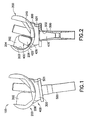
- the dislocation resistant posterior stabilized knee replacement 100 consists of a femoral component 200, a bearing 300, a control arm assembly 400 and a tibial platform 500 as shown in FIGS. 1 and 2.
- the femoral component 200 contains a posterior notch or cavity 201 with medial and lateral cavity sidewalls 202.
- Concave femoral cam surfaces 203 face superiorly on flanges that project toward one another from the respective medial and lateral cavity sidewalls 202.
- the flanges extend posteriorly and superiorly to edges 204 that are in an extreme superior position in a full extension position of the prosthesis as shown in FIGS. 1 and 2.
- the notch 201 is further defined by an anterior wall 205 that extends between the medial and lateral sidewalls 202.
- the femoral component 200 is further defined by inferior convex condyles 206 that are disposed in articular bearing engagement with the bearing 300 as explained further below.
- FIG. 2 shows a lateral view of the femoral component 200 with the one posterior femoral condyle 206 broken away so as to show details of the posterior notch 201.
- the bearing 300 contains a posterior notch or slot 301 and a dovetail guide slot 302.
- the dovetail guide slot 302 is formed into an otherwise substantially planar inferior surface 303 and extends anteriorly from the posterior notch 301.
- the bearing 300 also includes medial and lateral concave articular bearing surfaces 310 which are configured for articular bearing engagement with the condyles 206 of the femoral component 200.
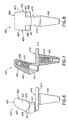
- the control arm assembly 400 comprises a control arm 410, a post 420 and a conical bearing 430.
- the control arm 410 comprises a post support 411, a post support pin 412, a dovetail guide 413 and a conical bearing support 414, all of which are formed from metal.
- the dovetail guide 413 has a dovetail cross-sectional shape that is configured for sliding reception in dovetail guide slot 302 in bearing 300.
- the post support 411 is formed unitarily with the posterior end of the dovetail guide 413 and is dimensioned to extend into the posterior notch 301 in the bearing 300.
- the post support pin 412 may be formed separately from both the post support 411 and the dovetail guide 413 and projects superiorly from the post support 411, as shown most clearly in FIG. 7.
- the exterior surface of the post support pin 412 may be knurled to achieve a secure force fit mounting of the post 420 thereon as explained further below.
- the conical bearing support 414 projects inferiorly from the dovetail guide 413 and also includes a knurled exterior surface.
- the post 420 is formed from plastic and is mounted to the post support pin 412. Inferior portions of the post 420 define medial and lateral surfaces 421 that align respectively with medial and lateral surfaces of the post support 411. Superior portions of the post 420 are characterized by medial and lateral projections 422 that project in medial and lateral directions outwardly from the inferior medial and lateral surfaces 421. The medial and lateral projections 422 have side surfaces 423 that taper slightly toward one another at more superior positions on post 420. The medial and lateral projections 422 further define inferior convex post cam surfaces 426 that will engage the femoral cam surfaces 203 as explained further below. The inferior post cam surfaces 426 extend through an arc from a posterior post surface 427 to an anterior post surface 428.
- Conical bearing 430 of the control arm assembly 400 is unitarily formed from a plastic material and is force fit onto the knurled outer surface of the conical bearing support 414.
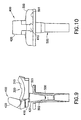
- the tibial platform 500 has a substantially planar superior bearing surface 501 and a conical hole 502 into which the conical bearing 430 of the control arm assembly 400 is placed on implantation.
- the femoral component 200 is similar to that described in U.S. Patent No. 5,702,466 except for the addition of the posterior cavity or notch 201 detail and a modular post for accepting an extension providing enhanced fixation.
- the bearing 300 is similar to that described in U.S. Patent No. 5,824,096 on the hinge knee except for the posterior slot 301 which now breaks through the posterior wall of the bearing 300 and the addition of a dovetailed guide slot 302.
- the tibial platform 500 can be the same as that described in U.S. Patent No. 5,702,466.
- the embodiment shown here is a version used where an extension is added to the distal end of the platform 500 to enhance fixation where needed.
- FIGS. 9 and 10 illustrate the assembly of the bearing 300 onto the control arm assembly 400 and into the tibial platform 500.
- the femoral component 200, the control arm 410 and tibial platform 500 are preferably made of titanium alloy coated with a TiN coating disclosed in U.S. Patent No. 5,702,448 and marketed by Endotec Inc. under the trademark UltraCoat ® .
- the bearing 300, post 420 and conical bearing 430 preferably are made of UHMWPe.
- Implantation is illustrated in FIG. 11.
- the tibial platform 500 is implanted into the tibia 600 in the usual fashion and the bearing 300 with the control arm assembly 400 pre-assembled are mounted onto the tibial platform 500 as shown in FIGS. 9 and 10.
- the knee 700 is flexed to about 120° and the femoral component assembly 900 consisting of the femoral component 200 with an attached extension 800 is inserted onto the femur 1000.
- the superior edges 204 of the femoral cam surfaces 203 clear the inferior post cam surfaces 426 and allow full seating of the femoral component assembly 900 onto the femur 1000 as shown in FIG. 12.
- the posterior distal region 1001 of the femur 1000 must have a relief 1002, as shown in FIG. 12, to clear the posterior post surface 427 and to provide the full flexion needed to implant the femoral component assembly 900.
- the tibia 600 cannot be dislocated posteriorly since the presence of the posterior distal region 1001 inhibits posterior tibial motion by impingement with the posterior post surface 427.
- the anterior wall 205 of the posterior notch 201 in the femoral component 200 and the anterior cam surfaces 428 of the post 420 prevent anterior dislocation of the tibia 600.
- the side surfaces 423 of the medial and lateral projections 422 of the post 420 engage the sidewalls 202 in the posterior cavity 201 of the femoral component 200, thereby preventing medial-lateral dislocation.
- the control arm assembly 400 is trapped in the femoral component 200 and cannot be dislocated from it.
- the post 420 may be subject to small bending loads since joint compression may not occur.
- the post 420 support pin 412 must be strong enough in bending to resist such moments.
- FIGS. 14-17 The cooperative action of the cavity cam surfaces 203 and post cam surfaces 426 are illustrated in FIGS. 14-17.
- the cam surfaces 203, 426 need not be in contact. They act only to prevent A-P dislocation in the absence of load bearing.
- Under load bearing the shape of the femoral articular surface 210 of the femoral condyles 206 pressing against the tibial articular surface 310 provides stability and position.
- the concave superior femoral cam surfaces 203 will engage the convex inferior post cam surfaces 426 and force the femoral component 200 posteriorly.
- the compressive force on the bearing 300 and the concave shape of the articular bearing surfaces 310 will cause the bearing 300 to move with the femoral component 200.
- This posterior movement, or femoral rollback improves quadriceps effectiveness as is well known.
- This rollback is present for any normal load bearing activity likely to be performed by a knee replacement patient requiring a posterior stabilized device.
- This posterior movement may be lost at full flexion, as shown in FIG. 17, but this is unimportant since load bearing does not normally occur in this motion phase, or occurs very infrequently.
- the posterior wall of the bearing 300 may come into contact with the femur 1000 during deep flexion it is desirable to allow the bearing 300 to move anteriorly on the tibial component 500 thereby allowing greater flexion.
- This prosthesis is novel in that it is non-dislocating and it does not produce significant bending of the post from an applied valgus-varus moment during compressive load bearing. Additionally the prosthesis makes use the medial edges of the femoral condyles 206 as cams 203 and inferior surfaces 426 of projections 422 on the post 420 to produce femoral rollback and posterior stability.
- a mobile bearing posterior stabilized knee where primarily the bearing is under compressive load provides A-P stability. Further, the bearing 300 moves with the femoral component 200 during rollback thereby eliminating "climb" and thus maintaining best contact between the femoral and bearing articulating surfaces 206 and 310, and reducing shear forces on the post 420.
Landscapes
- Health & Medical Sciences (AREA)
- Orthopedic Medicine & Surgery (AREA)
- Physical Education & Sports Medicine (AREA)
- Cardiology (AREA)
- Oral & Maxillofacial Surgery (AREA)
- Transplantation (AREA)
- Engineering & Computer Science (AREA)
- Biomedical Technology (AREA)
- Heart & Thoracic Surgery (AREA)
- Vascular Medicine (AREA)
- Life Sciences & Earth Sciences (AREA)
- Animal Behavior & Ethology (AREA)
- General Health & Medical Sciences (AREA)
- Public Health (AREA)
- Veterinary Medicine (AREA)
- Prostheses (AREA)
Claims (9)
- Prothèse d'articulation du genou résistant à la dislocation, comprenant :un composant fémoral (200) ayant une surface de portée articulaire inférieure (210) avec des condyles convexes médial et latéral (206), une encoche postérieure (201) s'étendant dans la direction antérieure dans une face postérieure du composant fémoral ;un composant tibial (500) ;une portée (300) disposée entre les composants fémoral et tibial (200 ; 500), la portée (300) ayant une face de portée supérieure (310) en contact de portée articulaire avec la surface de portée articulaire inférieure (210) du composant fémoral (200), la portée (300) ayant en outre une face de portée inférieure (303) en contact de portée glissant et tournant avec le composant tibial (500), une encoche postérieure (301) s'étendant dans la direction antérieure dans une face postérieure de la portée (300), et une rainure (302) formée dans la face de portée inférieure (303) de la portée (300) et s'étendant dans la direction antérieure à partir de l'encoche postérieure (301) dans la portée (300) ; etun dispositif de bras de commande (400) comprenant un bras de commande (410) engagé de façon coulissante dans la rainure (302) de la portée (300), le bras de commande (410) étant monté de façon pivotante sur le composant tibial (500), une colonnette (420) s'étendant dans une direction vers le haut à partir du bras de commande (410) à travers les encoches postérieures (301, 201) de la portée (300) et du composant fémoral (200) ;dans laquelle la dite encoche (201) du composant fémoral (200) est définie par des ailes médiale et latérale parallèles adjacentes à la surface de portée articulaire inférieure (210) du composant fémoral (200), et dans laquelle la colonnette (420) comporte des saillies de came médiale et latérale (422) en contact avec les surfaces supérieures (203) des ailes du composant fémoral (200) pour engendrer une translation postérieure de la portée (300) pendant la flexion de la prothèse d'articulation de genou et empêcher la dislocation, et
dans laquelle le dispositif de bras de commande (400) comprend un axe métallique (412) de support de colonnette s'étendant à partir du dit bras de commande (410) et dans la dite colonnette en matière plastique (420), le dit axe métallique de support de colonnette (412) résistant aux forces de cisaillement exercées sur la dite colonnette (420) pendant la flexion de la dite prothèse d'articulation du genou. - Prothèse d'articulation du genou selon la revendication 1, dans laquelle les dites ailes du dit composant fémoral (200) ont des surfaces inférieures sensiblement en conformité aux formes définies par les dits condyles convexes (206), les dites surfaces supérieures (203) des ailes étant les faces de portée supérieures à courbure concave.
- Prothèse d'articulation du genou selon les revendications 1 ou 2, dans laquelle les saillies de came médiale et latérale (422) de la colonnette (420) présentent des surfaces de came inférieures à courbure convexe (426) pour contact de portée contre les surfaces supérieures à courbure concave (203) des ailes du composant fémoral (200).
- Prothèse d'articulation du genou selon une quelconque des revendications 1 à 3, dans laquelle le composant fémoral (200) comprend en outre des parois médiale et latérale sensiblement parallèles (202) en saillie vers le haut par rapport à la surface supérieure (203) du composant fémoral (200) à proximité des ailes, les saillies médiale et latérale (422) de la colonnette ayant des surfaces parallèles médiale et latérale (423) disposées en contact glissant avec les parois médiale et latérale (202) du composant fémoral (200).
- Prothèse d'articulation du genou selon une quelconque des revendications 1 à 4, dans laquelle le composant tibial (500) présente une surface de portée supérieure (501) avec un évidement (502), le dispositif de bras de commande (400) comprenant une saillie (430) engagée de façon pivotante dans l'évidement (502) du composant tibial (500) pour réaliser le montage pivotant du dispositif de bras de commande (400) sur le composant tibial (500).
- Prothèse d'articulation du genou selon la revendication 5, dans laquelle l'évidement (502) dans le composant tibial (500) et la saillie (430) du dit dispositif de bras de commande (400) ont des formes coniques complémentaires.
- Prothèse d'articulation du genou selon une quelconque des revendications 1 à 6, dans laquelle la rainure (302) dans la face inférieure (303) de la portée (300) est une rainure en queue d'aronde (302) et dans laquelle le bras de commande (410) a une configuration en queue d'aronde (413) pour engagement coulissant dans la rainure (302) de la portée (300).
- Prothèse d'articulation du genou selon une quelconque des revendications 1 à 7, dans laquelle le composant fémoral (200), le composant tibial (500) et le bras de commande (410) sont en métal, et la portée (300) et la colonnette (420) sont en matière plastique.
- Prothèse d'articulation du genou selon une quelconque des revendications 1 à 8, dans laquelle le composant fémoral (200) comprend en outre une paroi antérieure (205) s'étendant entre les parois médiale et latérale (202) et définissant une partie de l'encoche (201).
Applications Claiming Priority (2)
| Application Number | Priority Date | Filing Date | Title |
|---|---|---|---|
| US18791600P | 2000-03-08 | 2000-03-08 | |
| US187916P | 2000-03-08 |
Publications (3)
| Publication Number | Publication Date |
|---|---|
| EP1132063A2 EP1132063A2 (fr) | 2001-09-12 |
| EP1132063A3 EP1132063A3 (fr) | 2001-09-19 |
| EP1132063B1 true EP1132063B1 (fr) | 2007-05-23 |
Family
ID=22691014
Family Applications (1)
| Application Number | Title | Priority Date | Filing Date |
|---|---|---|---|
| EP01105337A Expired - Lifetime EP1132063B1 (fr) | 2000-03-08 | 2001-03-07 | Remplacement postéro-stabilisé du genou avec des caractéristiques pour éviter une dislocation |
Country Status (5)
| Country | Link |
|---|---|
| US (1) | US6491726B2 (fr) |
| EP (1) | EP1132063B1 (fr) |
| JP (1) | JP4409781B2 (fr) |
| AU (1) | AU774109B2 (fr) |
| DE (1) | DE60128503T2 (fr) |
Families Citing this family (123)
| Publication number | Priority date | Publication date | Assignee | Title |
|---|---|---|---|---|
| US6346074B1 (en) | 1993-02-22 | 2002-02-12 | Heartport, Inc. | Devices for less invasive intracardiac interventions |
| US6695848B2 (en) | 1994-09-02 | 2004-02-24 | Hudson Surgical Design, Inc. | Methods for femoral and tibial resection |
| US8603095B2 (en) | 1994-09-02 | 2013-12-10 | Puget Bio Ventures LLC | Apparatuses for femoral and tibial resection |
| DE19950112A1 (de) * | 1999-10-18 | 2001-04-19 | Plus Endoprothetik Ag Rotkreuz | Kniegelenkendoprothese |
| US7635390B1 (en) | 2000-01-14 | 2009-12-22 | Marctec, Llc | Joint replacement component having a modular articulating surface |
| US7104996B2 (en) | 2000-01-14 | 2006-09-12 | Marctec. Llc | Method of performing surgery |
| US6702821B2 (en) | 2000-01-14 | 2004-03-09 | The Bonutti 2003 Trust A | Instrumentation for minimally invasive joint replacement and methods for using same |
| US6770078B2 (en) | 2000-01-14 | 2004-08-03 | Peter M. Bonutti | Movable knee implant and methods therefor |
| US6475241B2 (en) * | 2000-03-13 | 2002-11-05 | Biomedical Engineering Trust I | Posterior stabilized knee replacement with bearing translation for knees with retained collateral ligaments |
| US6558426B1 (en) | 2000-11-28 | 2003-05-06 | Medidea, Llc | Multiple-cam, posterior-stabilized knee prosthesis |
| US6719800B2 (en) | 2001-01-29 | 2004-04-13 | Zimmer Technology, Inc. | Constrained prosthetic knee with rotating bearing |
| US6485519B2 (en) | 2001-01-29 | 2002-11-26 | Bristol-Myers Squibb Company | Constrained prosthetic knee with rotating bearing |
| US7497874B1 (en) | 2001-02-23 | 2009-03-03 | Biomet Manufacturing Corp. | Knee joint prosthesis |
| US20020120340A1 (en) | 2001-02-23 | 2002-08-29 | Metzger Robert G. | Knee joint prosthesis |
| US8062377B2 (en) | 2001-03-05 | 2011-11-22 | Hudson Surgical Design, Inc. | Methods and apparatus for knee arthroplasty |
| US7708741B1 (en) | 2001-08-28 | 2010-05-04 | Marctec, Llc | Method of preparing bones for knee replacement surgery |
| DE10200263B4 (de) * | 2002-01-07 | 2007-01-25 | Plus Orthopedics Ag | Tibiakomponente einer Kniegelenkendoprothese |
| CA2424732C (fr) | 2002-04-10 | 2009-05-26 | Biomedical Engineering Trust I | Genou prothese avec boulon de butee amovible pour limiter le coulissement anterieur du dispositif d'appui |
| US20040002767A1 (en) * | 2002-06-28 | 2004-01-01 | Joseph Wyss | Modular knee joint prosthesis |
| WO2004037119A2 (fr) | 2002-10-23 | 2004-05-06 | Mako Surgical Corp. | Element femoral modulaire servant a remplacer la totalite de l'articulation du genou par implantation minimalement invasive |
| EP1575456B1 (fr) | 2002-12-20 | 2011-02-09 | Smith & Nephew, Inc. | Protheses du genou a hautes performances |
| US7887542B2 (en) | 2003-01-15 | 2011-02-15 | Biomet Manufacturing Corp. | Method and apparatus for less invasive knee resection |
| US7789885B2 (en) * | 2003-01-15 | 2010-09-07 | Biomet Manufacturing Corp. | Instrumentation for knee resection |
| US8551100B2 (en) | 2003-01-15 | 2013-10-08 | Biomet Manufacturing, Llc | Instrumentation for knee resection |
| US7837690B2 (en) | 2003-01-15 | 2010-11-23 | Biomet Manufacturing Corp. | Method and apparatus for less invasive knee resection |
| US7008454B2 (en) * | 2003-04-09 | 2006-03-07 | Biomedical Engineering Trust I | Prosthetic knee with removable stop pin for limiting anterior sliding movement of bearing |
| FR2854060B1 (fr) * | 2003-04-24 | 2006-02-24 | Aesculap Sa | Prothese postero-stabilisee a plot tibial anti-basculement |
| US7291173B2 (en) * | 2003-05-06 | 2007-11-06 | Aesculap Ii, Inc. | Artificial intervertebral disc |
| US7105024B2 (en) | 2003-05-06 | 2006-09-12 | Aesculap Ii, Inc. | Artificial intervertebral disc |
| DE20308171U1 (de) * | 2003-05-21 | 2003-07-31 | Aesculap AG & Co. KG, 78532 Tuttlingen | Wirbelkörperersatzimplantat |
| DE10347172B4 (de) * | 2003-10-08 | 2005-09-29 | Aesculap Ag & Co. Kg | Zwischenwirbelimplantat |
| WO2005037147A1 (fr) | 2003-10-17 | 2005-04-28 | Smith & Nephew, Inc. | Implant articulaire a flexion elevee |
| US7488324B1 (en) | 2003-12-08 | 2009-02-10 | Biomet Manufacturing Corporation | Femoral guide for implanting a femoral knee prosthesis |
| US7288115B2 (en) | 2004-01-02 | 2007-10-30 | Zimmer Technology, Inc. | Multipart component for an orthopaedic implant |
| US20060015115A1 (en) | 2004-03-08 | 2006-01-19 | Haines Timothy G | Methods and apparatus for pivotable guide surfaces for arthroplasty |
| US20060030854A1 (en) | 2004-02-02 | 2006-02-09 | Haines Timothy G | Methods and apparatus for wireplasty bone resection |
| US8021368B2 (en) | 2004-01-14 | 2011-09-20 | Hudson Surgical Design, Inc. | Methods and apparatus for improved cutting tools for resection |
| US8114083B2 (en) | 2004-01-14 | 2012-02-14 | Hudson Surgical Design, Inc. | Methods and apparatus for improved drilling and milling tools for resection |
| US7753960B2 (en) | 2004-02-26 | 2010-07-13 | Omni Life Science, Inc. | Modular knee prosthesis |
| US20050209693A1 (en) * | 2004-03-02 | 2005-09-22 | Janzen Lo | Spinal implants |
| DE202004009542U1 (de) | 2004-06-16 | 2004-08-12 | Aesculap Ag & Co. Kg | Zwischenwirbelimplantat |
| US20060200162A1 (en) * | 2005-02-21 | 2006-09-07 | Zimmer Technology, Inc. | Total knee arthroplasty instruments |
| US7695479B1 (en) | 2005-04-12 | 2010-04-13 | Biomet Manufacturing Corp. | Femoral sizer |
| US8211181B2 (en) * | 2005-12-14 | 2012-07-03 | New York University | Surface guided knee replacement |
| US7780672B2 (en) | 2006-02-27 | 2010-08-24 | Biomet Manufacturing Corp. | Femoral adjustment device and associated method |
| US8591516B2 (en) | 2006-02-27 | 2013-11-26 | Biomet Manufacturing, Llc | Patient-specific orthopedic instruments |
| US20150335438A1 (en) | 2006-02-27 | 2015-11-26 | Biomet Manufacturing, Llc. | Patient-specific augments |
| US9339278B2 (en) | 2006-02-27 | 2016-05-17 | Biomet Manufacturing, Llc | Patient-specific acetabular guides and associated instruments |
| US8407067B2 (en) | 2007-04-17 | 2013-03-26 | Biomet Manufacturing Corp. | Method and apparatus for manufacturing an implant |
| US8070752B2 (en) | 2006-02-27 | 2011-12-06 | Biomet Manufacturing Corp. | Patient specific alignment guide and inter-operative adjustment |
| US10278711B2 (en) | 2006-02-27 | 2019-05-07 | Biomet Manufacturing, Llc | Patient-specific femoral guide |
| US9113971B2 (en) | 2006-02-27 | 2015-08-25 | Biomet Manufacturing, Llc | Femoral acetabular impingement guide |
| US9345548B2 (en) | 2006-02-27 | 2016-05-24 | Biomet Manufacturing, Llc | Patient-specific pre-operative planning |
| US9918740B2 (en) | 2006-02-27 | 2018-03-20 | Biomet Manufacturing, Llc | Backup surgical instrument system and method |
| US8603180B2 (en) | 2006-02-27 | 2013-12-10 | Biomet Manufacturing, Llc | Patient-specific acetabular alignment guides |
| US9173661B2 (en) | 2006-02-27 | 2015-11-03 | Biomet Manufacturing, Llc | Patient specific alignment guide with cutting surface and laser indicator |
| US9289253B2 (en) | 2006-02-27 | 2016-03-22 | Biomet Manufacturing, Llc | Patient-specific shoulder guide |
| US9907659B2 (en) | 2007-04-17 | 2018-03-06 | Biomet Manufacturing, Llc | Method and apparatus for manufacturing an implant |
| CN101431967A (zh) | 2006-03-21 | 2009-05-13 | 理查德·D·科米斯泰克 | 引入力矩的全关节置换假体 |
| US7695520B2 (en) | 2006-05-31 | 2010-04-13 | Biomet Manufacturing Corp. | Prosthesis and implementation system |
| US9795399B2 (en) | 2006-06-09 | 2017-10-24 | Biomet Manufacturing, Llc | Patient-specific knee alignment guide and associated method |
| CA2930222A1 (fr) | 2006-06-30 | 2008-01-10 | Smith & Nephew, Inc. | Prothese articulee pour un mouvement anatomique |
| US8562616B2 (en) | 2007-10-10 | 2013-10-22 | Biomet Manufacturing, Llc | Knee joint prosthesis system and method for implantation |
| US8328873B2 (en) | 2007-01-10 | 2012-12-11 | Biomet Manufacturing Corp. | Knee joint prosthesis system and method for implantation |
| US8157869B2 (en) | 2007-01-10 | 2012-04-17 | Biomet Manufacturing Corp. | Knee joint prosthesis system and method for implantation |
| US8163028B2 (en) | 2007-01-10 | 2012-04-24 | Biomet Manufacturing Corp. | Knee joint prosthesis system and method for implantation |
| US8187280B2 (en) | 2007-10-10 | 2012-05-29 | Biomet Manufacturing Corp. | Knee joint prosthesis system and method for implantation |
| US9872774B2 (en) | 2007-08-27 | 2018-01-23 | Connor E. Samuelson | Systems and methods for providing a femoral component having a modular stem |
| US10213826B2 (en) | 2007-08-27 | 2019-02-26 | Connor E Samuelson | Systems and methods for providing prosthetic components |
| US8366783B2 (en) | 2007-08-27 | 2013-02-05 | Samuelson Kent M | Systems and methods for providing deeper knee flexion capabilities for knee prosthesis patients |
| US8382846B2 (en) | 2007-08-27 | 2013-02-26 | Kent M. Samuelson | Systems and methods for providing deeper knee flexion capabilities for knee prosthesis patients |
| US9107769B2 (en) | 2007-08-27 | 2015-08-18 | Kent M. Samuelson | Systems and methods for providing a femoral component |
| US8273133B2 (en) * | 2007-08-27 | 2012-09-25 | Samuelson Kent M | Systems and methods for providing deeper knee flexion capabilities for knee prosthesis patients |
| US8265949B2 (en) | 2007-09-27 | 2012-09-11 | Depuy Products, Inc. | Customized patient surgical plan |
| US8357111B2 (en) | 2007-09-30 | 2013-01-22 | Depuy Products, Inc. | Method and system for designing patient-specific orthopaedic surgical instruments |
| US7918893B2 (en) * | 2007-09-30 | 2011-04-05 | Depuy Products, Inc. | Hinged orthopaedic prosthesis |
| EP2957243A1 (fr) | 2007-09-30 | 2015-12-23 | DePuy Products, Inc. | Instrument chirurgical orthopédique personnalisé spécifique d'un patient |
| US7871442B2 (en) * | 2007-11-30 | 2011-01-18 | Howmedica Osteonics Corp. | Knee prosthesis with four degrees freedom |
| US8828086B2 (en) | 2008-06-30 | 2014-09-09 | Depuy (Ireland) | Orthopaedic femoral component having controlled condylar curvature |
| US8192498B2 (en) | 2008-06-30 | 2012-06-05 | Depuy Products, Inc. | Posterior cructiate-retaining orthopaedic knee prosthesis having controlled condylar curvature |
| US8187335B2 (en) | 2008-06-30 | 2012-05-29 | Depuy Products, Inc. | Posterior stabilized orthopaedic knee prosthesis having controlled condylar curvature |
| US9168145B2 (en) | 2008-06-30 | 2015-10-27 | Depuy (Ireland) | Posterior stabilized orthopaedic knee prosthesis having controlled condylar curvature |
| US8236061B2 (en) | 2008-06-30 | 2012-08-07 | Depuy Products, Inc. | Orthopaedic knee prosthesis having controlled condylar curvature |
| US9119723B2 (en) | 2008-06-30 | 2015-09-01 | Depuy (Ireland) | Posterior stabilized orthopaedic prosthesis assembly |
| US8206451B2 (en) | 2008-06-30 | 2012-06-26 | Depuy Products, Inc. | Posterior stabilized orthopaedic prosthesis |
| US7981159B2 (en) * | 2008-07-16 | 2011-07-19 | Depuy Products, Inc. | Antero-posterior placement of axis of rotation for a rotating platform |
| US8202323B2 (en) * | 2008-07-16 | 2012-06-19 | Depuy Products, Inc. | Knee prostheses with enhanced kinematics |
| WO2010085656A1 (fr) * | 2009-01-23 | 2010-07-29 | Zimmer, Inc. | Prothèse totale du genou à stabilisation postérieure |
| US8915965B2 (en) | 2009-05-07 | 2014-12-23 | Depuy (Ireland) | Anterior stabilized knee implant |
| US8900315B2 (en) * | 2009-11-16 | 2014-12-02 | New York Society For The Ruptured And Crippled Maintaining The Hospital For Special Surgery | Constrained condylar knee device |
| EP3158976A1 (fr) * | 2009-11-16 | 2017-04-26 | New York Society for the Ruptured and Crippled Maintaining the Hospital for Special Surgery | Articulations condyliennes prothétique avec surfaces d'appui articulées ayant un point de contact à translation pendant la rotation |
| US9132014B2 (en) | 2010-04-13 | 2015-09-15 | Zimmer, Inc. | Anterior cruciate ligament substituting knee implants |
| WO2012018563A1 (fr) | 2010-07-24 | 2012-02-09 | Zimmer, Inc. | Prothèse tibiale |
| BR112013001673B1 (pt) | 2010-07-24 | 2021-02-09 | Zimmer, Inc | componentes de tíbia assimétrica para uma prótese de joelho |
| EP2603173B1 (fr) | 2010-08-12 | 2016-03-23 | Smith & Nephew, Inc. | Structures servant à fixer un implant orthopédique |
| ES2631181T3 (es) | 2010-09-10 | 2017-08-29 | Zimmer, Inc. | Componentes de tibia que facilitan movimiento para una prótesis de rodilla |
| US9968376B2 (en) | 2010-11-29 | 2018-05-15 | Biomet Manufacturing, Llc | Patient-specific orthopedic instruments |
| US8603101B2 (en) * | 2010-12-17 | 2013-12-10 | Zimmer, Inc. | Provisional tibial prosthesis system |
| US9597090B2 (en) | 2010-12-17 | 2017-03-21 | Zimmer, Inc. | Cut guide attachment for use in tibial prosthesis systems |
| US9241745B2 (en) | 2011-03-07 | 2016-01-26 | Biomet Manufacturing, Llc | Patient-specific femoral version guide |
| US9220611B2 (en) | 2011-07-12 | 2015-12-29 | Zimmer, Inc. | Femoral component instrument |
| CN103648442B (zh) | 2011-07-13 | 2016-03-23 | 捷迈有限责任公司 | 具有扩展外侧髁的股骨膝假体 |
| EP2779950B1 (fr) | 2011-11-18 | 2015-12-16 | Zimmer, Inc. | Élément porteur tibial pour prothèse du genou présentant des caractéristiques articulaires améliorées |
| CN104093380B (zh) | 2011-11-21 | 2016-08-31 | 捷迈有限公司 | 具有不对称设置的固定结构的胫骨基板 |
| CN104203160B (zh) | 2012-01-30 | 2016-05-11 | 捷迈有限公司 | 用于膝关节假体的不对称胫骨件 |
| US20130261759A1 (en) | 2012-03-30 | 2013-10-03 | Zimmer, Inc. | Tibial prosthesis systems, kits, and methods |
| US9744044B2 (en) | 2013-03-15 | 2017-08-29 | Mako Surgical Corp. | Unicondylar tibial knee implant |
| US9925052B2 (en) | 2013-08-30 | 2018-03-27 | Zimmer, Inc. | Method for optimizing implant designs |
| US9592133B2 (en) | 2013-09-23 | 2017-03-14 | Zimmer, Inc. | Spacer block |
| US9907670B2 (en) | 2015-01-21 | 2018-03-06 | Warsaw Orthopedic, Inc. | Unitarily formed expandable spinal implant and method of manufacturing and implanting same |
| US10278827B2 (en) | 2015-09-21 | 2019-05-07 | Zimmer, Inc. | Prosthesis system including tibial bearing component |
| US10179052B2 (en) | 2016-07-28 | 2019-01-15 | Depuy Ireland Unlimited Company | Total knee implant prosthesis assembly and method |
| EP3576655B1 (fr) | 2017-02-01 | 2021-05-05 | Zimmer, Inc. | Impacteur pour un plateau tibial |
| ES3025978T3 (en) | 2017-03-10 | 2025-06-10 | Zimmer Inc | Tibial prosthesis with tibial bearing component securing feature |
| US10722310B2 (en) | 2017-03-13 | 2020-07-28 | Zimmer Biomet CMF and Thoracic, LLC | Virtual surgery planning system and method |
| CN110636818B (zh) | 2017-05-12 | 2021-06-04 | 捷迈有限公司 | 具有尺码增大和尺码缩小能力的股骨假体 |
| US11426282B2 (en) | 2017-11-16 | 2022-08-30 | Zimmer, Inc. | Implants for adding joint inclination to a knee arthroplasty |
| WO2019145965A1 (fr) | 2018-01-25 | 2019-08-01 | Nonferrous Materials Technology Development Centre | Prothèse totale du genou pour fémur distal à rotation tibiale-fémorale à petit angle auto-limitante |
| US10835380B2 (en) | 2018-04-30 | 2020-11-17 | Zimmer, Inc. | Posterior stabilized prosthesis system |
| US10736748B2 (en) | 2018-05-02 | 2020-08-11 | Depuy Ireland Unlimited Company | Orthopaedic prosthetic system for a hinged-knee prosthesis |
| US11051829B2 (en) | 2018-06-26 | 2021-07-06 | DePuy Synthes Products, Inc. | Customized patient-specific orthopaedic surgical instrument |
| US11033396B2 (en) | 2019-02-05 | 2021-06-15 | Depuy Ireland Unlimited Company | Orthopaedic prosthetic system for a rotating hinged-knee prosthesis |
| US11116641B2 (en) | 2019-02-05 | 2021-09-14 | Depuy Ireland Unlimited Company | Orthopaedic prosthetic system for a rotating hinged-knee prosthesis |
Family Cites Families (13)
| Publication number | Priority date | Publication date | Assignee | Title |
|---|---|---|---|---|
| US4216549A (en) * | 1977-06-02 | 1980-08-12 | Purdue Research Foundation | Semi-stable total knee prosthesis |
| US4224697A (en) * | 1978-09-08 | 1980-09-30 | Hexcel Corporation | Constrained prosthetic knee |
| US5011496A (en) * | 1988-02-02 | 1991-04-30 | Joint Medical Products Corporation | Prosthetic joint |
| DE3922294C1 (fr) * | 1989-07-07 | 1991-01-03 | Eska Medical Luebeck Medizintechnik Gmbh & Co, 2400 Luebeck, De | |
| US5370701A (en) * | 1990-09-28 | 1994-12-06 | Arch Development Corporation | Rotating/sliding contrained prosthetic knee |
| DE4038037B4 (de) * | 1990-11-29 | 2010-06-02 | Waldemar Link Gmbh & Co. Kg | Kniegelenkendoprothese |
| US5395401A (en) * | 1991-06-17 | 1995-03-07 | Bahler; Andre | Prosthetic device for a complex joint |
| US5405396A (en) * | 1993-07-01 | 1995-04-11 | Zimmer, Inc. | Tibial prosthesis |
| US6117175A (en) * | 1994-08-22 | 2000-09-12 | Bosredon; Jean | Spherical knee joint prosthesis |
| GB9609609D0 (en) * | 1996-05-08 | 1996-07-10 | Midland International Orthopae | Knee prosthesis |
| US6206926B1 (en) * | 1997-10-06 | 2001-03-27 | Biomedical Engineering Trust I | Prosthetic knee joint with enhanced posterior stabilization and dislocation prevention features |
| EP0913132B1 (fr) * | 1997-10-28 | 2004-02-11 | Centerpulse Orthopedics Ltd. | Prothèse de genou |
| CA2254218C (fr) * | 1997-11-18 | 2003-11-25 | Michael J. Pappas | Prothese d'articulation de genou avec stabilisation posterieure amelioree et caracteristiques de prevention des dislocations |
-
2001
- 2001-02-28 US US09/796,186 patent/US6491726B2/en not_active Expired - Lifetime
- 2001-03-07 DE DE60128503T patent/DE60128503T2/de not_active Expired - Lifetime
- 2001-03-07 AU AU26409/01A patent/AU774109B2/en not_active Ceased
- 2001-03-07 EP EP01105337A patent/EP1132063B1/fr not_active Expired - Lifetime
- 2001-03-08 JP JP2001064733A patent/JP4409781B2/ja not_active Expired - Fee Related
Also Published As
| Publication number | Publication date |
|---|---|
| JP2001286497A (ja) | 2001-10-16 |
| EP1132063A3 (fr) | 2001-09-19 |
| US20010034554A1 (en) | 2001-10-25 |
| AU774109B2 (en) | 2004-06-17 |
| AU2640901A (en) | 2001-09-13 |
| JP4409781B2 (ja) | 2010-02-03 |
| DE60128503T2 (de) | 2008-01-31 |
| EP1132063A2 (fr) | 2001-09-12 |
| DE60128503D1 (de) | 2007-07-05 |
| US6491726B2 (en) | 2002-12-10 |
Similar Documents
| Publication | Publication Date | Title |
|---|---|---|
| US6491726B2 (en) | Posterior stabilized prosthetic knee replacement with bearing translation and dislocation prevention features | |
| EP1133959B1 (fr) | Remplacement postéro-stabilisé du genou pour des genoux avec des ligaments collatérals conservés | |
| US6797005B2 (en) | Deep flexion posterior stabilized knee replacement with bearing translation | |
| US6206926B1 (en) | Prosthetic knee joint with enhanced posterior stabilization and dislocation prevention features | |
| EP1400220B1 (fr) | Prothèse de genou postéro-stabilisée avec de la contrainte en varus-valgus | |
| US5116376A (en) | Knee prosthesis | |
| EP0510178B1 (fr) | Prothese de genou a palier flottant amelioree | |
| EP1604623B1 (fr) | Prothèse de genou postéro-stabilisée à insert mobile | |
| EP1333785B1 (fr) | Prothese d'articulation de genou a support flottant, comprenant une tige tibiale fixe | |
| US5549686A (en) | Knee prosthesis having a tapered cam | |
| EP1591083B1 (fr) | Prothèse de genou | |
| AU710550B2 (en) | Stabilized prosthetic knee | |
| EP2598085B1 (fr) | Prothèse du genou stabilisée | |
| CA2254218C (fr) | Prothese d'articulation de genou avec stabilisation posterieure amelioree et caracteristiques de prevention des dislocations | |
| EP0732091A2 (fr) | Prothèse totale d'articulation à patin mobile | |
| US20250241760A1 (en) | Constrained prosthetic knee | |
| EP0838204A2 (fr) | Prothèse de genou à stabilisation postérieure améliorée |
Legal Events
| Date | Code | Title | Description |
|---|---|---|---|
| PUAI | Public reference made under article 153(3) epc to a published international application that has entered the european phase |
Free format text: ORIGINAL CODE: 0009012 |
|
| PUAL | Search report despatched |
Free format text: ORIGINAL CODE: 0009013 |
|
| AK | Designated contracting states |
Kind code of ref document: A2 Designated state(s): CH DE FR GB IE IT LI Kind code of ref document: A2 Designated state(s): AT BE CH CY DE DK ES FI FR GB GR IE IT LI LU MC NL PT SE TR |
|
| AX | Request for extension of the european patent |
Free format text: AL;LT;LV;MK;RO;SI |
|
| AK | Designated contracting states |
Kind code of ref document: A3 Designated state(s): AT BE CH CY DE DK ES FI FR GB GR IE IT LI LU MC NL PT SE TR |
|
| AX | Request for extension of the european patent |
Free format text: AL;LT;LV;MK;RO;SI |
|
| 17P | Request for examination filed |
Effective date: 20011018 |
|
| AKX | Designation fees paid |
Free format text: CH DE FR GB IE IT LI |
|
| RAP1 | Party data changed (applicant data changed or rights of an application transferred) |
Owner name: BIOMEDICAL ENGINEERING TRUST I |
|
| 17Q | First examination report despatched |
Effective date: 20040303 |
|
| GRAP | Despatch of communication of intention to grant a patent |
Free format text: ORIGINAL CODE: EPIDOSNIGR1 |
|
| GRAS | Grant fee paid |
Free format text: ORIGINAL CODE: EPIDOSNIGR3 |
|
| GRAA | (expected) grant |
Free format text: ORIGINAL CODE: 0009210 |
|
| AK | Designated contracting states |
Kind code of ref document: B1 Designated state(s): CH DE FR GB IE IT LI |
|
| REG | Reference to a national code |
Ref country code: GB Ref legal event code: FG4D |
|
| REG | Reference to a national code |
Ref country code: CH Ref legal event code: EP |
|
| REG | Reference to a national code |
Ref country code: IE Ref legal event code: FG4D |
|
| REF | Corresponds to: |
Ref document number: 60128503 Country of ref document: DE Date of ref document: 20070705 Kind code of ref document: P |
|
| REG | Reference to a national code |
Ref country code: CH Ref legal event code: NV Representative=s name: PATENTANWAELTE SCHAAD, BALASS, MENZL & PARTNER AG |
|
| ET | Fr: translation filed | ||
| PLBE | No opposition filed within time limit |
Free format text: ORIGINAL CODE: 0009261 |
|
| STAA | Information on the status of an ep patent application or granted ep patent |
Free format text: STATUS: NO OPPOSITION FILED WITHIN TIME LIMIT |
|
| 26N | No opposition filed |
Effective date: 20080226 |
|
| PGFP | Annual fee paid to national office [announced via postgrant information from national office to epo] |
Ref country code: IT Payment date: 20110330 Year of fee payment: 11 |
|
| PGFP | Annual fee paid to national office [announced via postgrant information from national office to epo] |
Ref country code: CH Payment date: 20120316 Year of fee payment: 12 Ref country code: IE Payment date: 20120314 Year of fee payment: 12 |
|
| PGFP | Annual fee paid to national office [announced via postgrant information from national office to epo] |
Ref country code: DE Payment date: 20120327 Year of fee payment: 12 |
|
| PGFP | Annual fee paid to national office [announced via postgrant information from national office to epo] |
Ref country code: GB Payment date: 20120322 Year of fee payment: 12 |
|
| PGFP | Annual fee paid to national office [announced via postgrant information from national office to epo] |
Ref country code: FR Payment date: 20120413 Year of fee payment: 12 |
|
| PG25 | Lapsed in a contracting state [announced via postgrant information from national office to epo] |
Ref country code: IT Free format text: LAPSE BECAUSE OF NON-PAYMENT OF DUE FEES Effective date: 20120307 |
|
| REG | Reference to a national code |
Ref country code: CH Ref legal event code: PL |
|
| GBPC | Gb: european patent ceased through non-payment of renewal fee |
Effective date: 20130307 |
|
| REG | Reference to a national code |
Ref country code: FR Ref legal event code: ST Effective date: 20131129 |
|
| REG | Reference to a national code |
Ref country code: IE Ref legal event code: MM4A |
|
| REG | Reference to a national code |
Ref country code: DE Ref legal event code: R119 Ref document number: 60128503 Country of ref document: DE Effective date: 20131001 |
|
| PG25 | Lapsed in a contracting state [announced via postgrant information from national office to epo] |
Ref country code: DE Free format text: LAPSE BECAUSE OF NON-PAYMENT OF DUE FEES Effective date: 20131001 Ref country code: FR Free format text: LAPSE BECAUSE OF NON-PAYMENT OF DUE FEES Effective date: 20130402 Ref country code: LI Free format text: LAPSE BECAUSE OF NON-PAYMENT OF DUE FEES Effective date: 20130331 Ref country code: IE Free format text: LAPSE BECAUSE OF NON-PAYMENT OF DUE FEES Effective date: 20130307 Ref country code: CH Free format text: LAPSE BECAUSE OF NON-PAYMENT OF DUE FEES Effective date: 20130331 Ref country code: GB Free format text: LAPSE BECAUSE OF NON-PAYMENT OF DUE FEES Effective date: 20130307 |