EP1132091A1 - Traitement du diabète - Google Patents
Traitement du diabète Download PDFInfo
- Publication number
- EP1132091A1 EP1132091A1 EP01114131A EP01114131A EP1132091A1 EP 1132091 A1 EP1132091 A1 EP 1132091A1 EP 01114131 A EP01114131 A EP 01114131A EP 01114131 A EP01114131 A EP 01114131A EP 1132091 A1 EP1132091 A1 EP 1132091A1
- Authority
- EP
- European Patent Office
- Prior art keywords
- gastrin
- receptor ligand
- tgfα
- cells
- gene
- Prior art date
- Legal status (The legal status is an assumption and is not a legal conclusion. Google has not performed a legal analysis and makes no representation as to the accuracy of the status listed.)
- Withdrawn
Links
Images

Classifications
-
- A—HUMAN NECESSITIES
- A61—MEDICAL OR VETERINARY SCIENCE; HYGIENE
- A61K—PREPARATIONS FOR MEDICAL, DENTAL OR TOILETRY PURPOSES
- A61K38/00—Medicinal preparations containing peptides
- A61K38/16—Peptides having more than 20 amino acids; Gastrins; Somatostatins; Melanotropins; Derivatives thereof
- A61K38/17—Peptides having more than 20 amino acids; Gastrins; Somatostatins; Melanotropins; Derivatives thereof from animals; from humans
- A61K38/18—Growth factors; Growth regulators
- A61K38/1808—Epidermal growth factor [EGF] urogastrone
-
- A—HUMAN NECESSITIES
- A01—AGRICULTURE; FORESTRY; ANIMAL HUSBANDRY; HUNTING; TRAPPING; FISHING
- A01K—ANIMAL HUSBANDRY; AVICULTURE; APICULTURE; PISCICULTURE; FISHING; REARING OR BREEDING ANIMALS, NOT OTHERWISE PROVIDED FOR; NEW BREEDS OF ANIMALS
- A01K67/00—Rearing or breeding animals, not otherwise provided for; New or modified breeds of animals
- A01K67/027—New or modified breeds of vertebrates
- A01K67/0275—Genetically modified vertebrates, e.g. transgenic
-
- A—HUMAN NECESSITIES
- A61—MEDICAL OR VETERINARY SCIENCE; HYGIENE
- A61K—PREPARATIONS FOR MEDICAL, DENTAL OR TOILETRY PURPOSES
- A61K38/00—Medicinal preparations containing peptides
- A61K38/16—Peptides having more than 20 amino acids; Gastrins; Somatostatins; Melanotropins; Derivatives thereof
- A61K38/17—Peptides having more than 20 amino acids; Gastrins; Somatostatins; Melanotropins; Derivatives thereof from animals; from humans
- A61K38/18—Growth factors; Growth regulators
- A61K38/1841—Transforming growth factor [TGF]
-
- A—HUMAN NECESSITIES
- A61—MEDICAL OR VETERINARY SCIENCE; HYGIENE
- A61K—PREPARATIONS FOR MEDICAL, DENTAL OR TOILETRY PURPOSES
- A61K38/00—Medicinal preparations containing peptides
- A61K38/16—Peptides having more than 20 amino acids; Gastrins; Somatostatins; Melanotropins; Derivatives thereof
- A61K38/17—Peptides having more than 20 amino acids; Gastrins; Somatostatins; Melanotropins; Derivatives thereof from animals; from humans
- A61K38/22—Hormones
- A61K38/2207—Gastrins; Cholecystokinins [CCK]
-
- A—HUMAN NECESSITIES
- A61—MEDICAL OR VETERINARY SCIENCE; HYGIENE
- A61K—PREPARATIONS FOR MEDICAL, DENTAL OR TOILETRY PURPOSES
- A61K48/00—Medicinal preparations containing genetic material which is inserted into cells of the living body to treat genetic diseases; Gene therapy
- A61K48/005—Medicinal preparations containing genetic material which is inserted into cells of the living body to treat genetic diseases; Gene therapy characterised by an aspect of the 'active' part of the composition delivered, i.e. the nucleic acid delivered
-
- A—HUMAN NECESSITIES
- A61—MEDICAL OR VETERINARY SCIENCE; HYGIENE
- A61P—SPECIFIC THERAPEUTIC ACTIVITY OF CHEMICAL COMPOUNDS OR MEDICINAL PREPARATIONS
- A61P3/00—Drugs for disorders of the metabolism
- A61P3/08—Drugs for disorders of the metabolism for glucose homeostasis
- A61P3/10—Drugs for disorders of the metabolism for glucose homeostasis for hyperglycaemia, e.g. antidiabetics
-
- A—HUMAN NECESSITIES
- A61—MEDICAL OR VETERINARY SCIENCE; HYGIENE
- A61P—SPECIFIC THERAPEUTIC ACTIVITY OF CHEMICAL COMPOUNDS OR MEDICINAL PREPARATIONS
- A61P5/00—Drugs for disorders of the endocrine system
- A61P5/48—Drugs for disorders of the endocrine system of the pancreatic hormones
-
- C—CHEMISTRY; METALLURGY
- C12—BIOCHEMISTRY; BEER; SPIRITS; WINE; VINEGAR; MICROBIOLOGY; ENZYMOLOGY; MUTATION OR GENETIC ENGINEERING
- C12N—MICROORGANISMS OR ENZYMES; COMPOSITIONS THEREOF; PROPAGATING, PRESERVING, OR MAINTAINING MICROORGANISMS; MUTATION OR GENETIC ENGINEERING; CULTURE MEDIA
- C12N15/00—Mutation or genetic engineering; DNA or RNA concerning genetic engineering, vectors, e.g. plasmids, or their isolation, preparation or purification; Use of hosts therefor
- C12N15/09—Recombinant DNA-technology
- C12N15/63—Introduction of foreign genetic material using vectors; Vectors; Use of hosts therefor; Regulation of expression
- C12N15/79—Vectors or expression systems specially adapted for eukaryotic hosts
- C12N15/85—Vectors or expression systems specially adapted for eukaryotic hosts for animal cells
- C12N15/8509—Vectors or expression systems specially adapted for eukaryotic hosts for animal cells for producing genetically modified animals, e.g. transgenic
-
- A—HUMAN NECESSITIES
- A01—AGRICULTURE; FORESTRY; ANIMAL HUSBANDRY; HUNTING; TRAPPING; FISHING
- A01K—ANIMAL HUSBANDRY; AVICULTURE; APICULTURE; PISCICULTURE; FISHING; REARING OR BREEDING ANIMALS, NOT OTHERWISE PROVIDED FOR; NEW BREEDS OF ANIMALS
- A01K2217/00—Genetically modified animals
- A01K2217/05—Animals comprising random inserted nucleic acids (transgenic)
-
- A—HUMAN NECESSITIES
- A01—AGRICULTURE; FORESTRY; ANIMAL HUSBANDRY; HUNTING; TRAPPING; FISHING
- A01K—ANIMAL HUSBANDRY; AVICULTURE; APICULTURE; PISCICULTURE; FISHING; REARING OR BREEDING ANIMALS, NOT OTHERWISE PROVIDED FOR; NEW BREEDS OF ANIMALS
- A01K2227/00—Animals characterised by species
- A01K2227/10—Mammal
- A01K2227/105—Murine
-
- A—HUMAN NECESSITIES
- A01—AGRICULTURE; FORESTRY; ANIMAL HUSBANDRY; HUNTING; TRAPPING; FISHING
- A01K—ANIMAL HUSBANDRY; AVICULTURE; APICULTURE; PISCICULTURE; FISHING; REARING OR BREEDING ANIMALS, NOT OTHERWISE PROVIDED FOR; NEW BREEDS OF ANIMALS
- A01K2267/00—Animals characterised by purpose
- A01K2267/03—Animal model, e.g. for test or diseases
- A01K2267/0306—Animal model for genetic diseases
- A01K2267/0325—Animal model for autoimmune diseases
-
- A—HUMAN NECESSITIES
- A61—MEDICAL OR VETERINARY SCIENCE; HYGIENE
- A61K—PREPARATIONS FOR MEDICAL, DENTAL OR TOILETRY PURPOSES
- A61K48/00—Medicinal preparations containing genetic material which is inserted into cells of the living body to treat genetic diseases; Gene therapy
Definitions
- This invention relates to treatment of diabetes mellitus by effecting the differentiation of pancreatic islet precursor cells into mature insulin-producing cells by the combined synergistic stimulation by a gastrin/cholecystokinin (CCK) receptor ligand, particularly gastrin, and an epidermal growth factor (EGF) receptor ligand, particularly transforming growth factor alpha (TGF ⁇ ).
- CCK gastrin/cholecystokinin
- EGF epidermal growth factor
- pancreatic islets develop from endodermal stem cells that lie in the fetal ductular pancreatic endothelium, which also contains pluripotent stem cells that develop into the exocrine pancreas.
- Teitelman, G. and J.K. Lee Developmental Biology, 121: 454-466 (1987); Pictet, R. and W.J. Rutter, Development of the embryonic endocrine pancreas, in Endocrinology, Handbook of Physiology, ed. R.O.Greep and E.B. Astwood (1972), American Physiological Society: Washington D.C., p. 25-66. Islet development proceeds through discrete developmental states during fetal gestation which are punctuated by dramatic transitions.
- the initial period is a protodifferentiated state which is characterized by the commitment of these pluripotent stem cells to the islet cell lineage, as manifested by the expression of insulin and glucagon.
- These protodifferentiated cells comprise a population of committed islet precursor cells which express only low levels of islet specific gene products and lack the cytodifferentiation of mature islet cells. Pictet, R. and W.J. Rutter, supra .
- the protodifferentiated pancreas begins a phase of rapid growth and differentiation characterized by cytodifferentiation of islet cells and a several hundred fold increase in islet specific gene expression.
- islet formation becomes apparent as proliferating islets bud from the pancreatic ducts (nesidioblastosis). Just before birth the rate of islet growth slows, and islet neogenesis and nesidioblastosis becomes much less apparent. Concomitant with this, the islets attain a fully differentiated state with maximal levels of insulin gene expression. Therefore, similar to many organs, the completion of cellular differentiation is associated with reduced regenerative potential.
- pancreatic islets the major site of gastrin expression in the fetus. Brand, S.J. and P.J. Fuller, J. Biol Chem. , 263 :5341-5347 (1988). Expression of gastrin in the pancreatic islets is transient. It is confined to the period when protodifferentiated islet precursors form differentiated islets.
- pancreatic gastrin Although the significance of pancreatic gastrin in islet development is unknown, some clinical observations suggest a role for gastrin in this islet development as follows. For example, hypergastrinemia caused by gastrin-expressing islet cell tumors and atrophic gastritis is associated with nesidioblastosis similar to that seen in differentiating fetal islets. Sacchi, T. B., et al ., Virchows Archiv B, 48:261-276 (1985); and Heitz, P.U., et al ., Diabetes, 26:632-642 (1977). Further, an abnormal persistence of pancreatic gastrin has been documented in a case of infantile nesidioblastosis. Hollande E., et al ., Gastroenterology , 71 :255-262 (1976). However, in neither observation was a causal relationship established between the nesidiobiastosis and gastrin stimulation.
- the invention provides a method for treating diabetes mellitus by administering a composition providing a gastrin/CCK receptor ligand, e.g. gastrin, and an EGF receptor ligand, e.g. TGF ⁇ , in an amount sufficient, to effect differentiation of pancreatic islet precursor cells to mature insulin-secreting cells.
- the composition can be administered systemically or expressed in situ by cells supplemented with a nucleic acid fusion construct in an expression vector.
- the fusion construct includes a preprogastrin peptide precursor coding sequence and can also include a coding sequence for an EGF receptor ligand.
- pancreatic ductal cells into mature insulin-secreting cells
- therapeutic administration of this combination of factors or compositions which provide for their in situ expression within the pancreas has now become a viable clinical option for the treatment of diabetes mellitus, particularly juvenile onset diabetes, by therapeutic administration of this combination of factors or compositions which provide for their in situ expression within the pancreas.
- the invention provides a method for treating diabetes mellitus, preferably juvenile-onset diabetes mellitus, in an individual in need thereof which comprises administering to the individual a composition providing a gastrin/CCK receptor ligand and an EGF receptor ligand in an amount sufficient to effect differentiation of pancreatic islet precursor cells to mature insulin-secreting cells.
- the cells so differentiated may be islet precursor cells in the pancreatic duct.
- the gastin/CCK receptor ligand is preferably a gastrin.
- the EGF receptor ligand is preferably TGF ⁇ .
- the method of the invention may comprise administering gastrin/CCK receptor ligand and EGF receptor ligand to pancreatic islet precursor cells of explanted pancreatic tissue of said mammal and reintroducing the pancreatic tissue so stimulated to the mammal.
- Gastrin /CCK receptor ligand stimulation may be effected by expression of a gastrin/CCK receptor ligand gene, typically a preprogastrin peptide precursor gene, stably introduced into an individual.
- EGF receptor ligand stimulation may be effected by expression of a EGF receptor ligand gene stably introduced into the individual.
- the invention also provides a nucleic acid construct comprising a mammalian insulin promoter 5' to a nucleic acid sequence coding for a mammalian gastrin/CCK receptor ligand.
- the nucleic acid sequence coding for the preprogastrin peptide precursor preferably comprises a polynucleotide sequence containing exons 2 and 3 of the human gastrin gene.
- the invention further provides a composition comprising (i) a mammalian EGF receptor ligand gene and (ii) a mammalian gastrin/CCK receptor ligand gene.
- the mammalian gastrin/CCK receptor ligand gene preferably comprises a preprogastrin peptide precursor coding sequence under control of the insulin promoter.
- the nucleic acid sequence coding for the preprogastrin peptide precursor typically comprises a polynucleotide sequence containing exons 2 and 3 of the human gastrin gene.
- a non-human mammal capable of expressing a stably introduced construct of the invention is also provided.
- Figure 1A is a photoreproduction that shows numerous insulin staining cells in the metaplastic ducts from the TGF ⁇ transgenic pancreas upon immunoperoxidase staining.
- Figure 1B is a photoreproduction that shows that most ductular cells stained less intensely for insulin, while occasional ductular cells did stain with the same intensity of insulin staining as the adjacent islets.
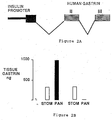
- FIG. 2A schematically shows the structure of the chimeric insulin promoter-gastrin (INSGAS) transgene.
- Figure 2B illustrates that the radioimmunoassay of pancreatic extracts from INSGAS transgenic mice shows high levels of gastrin immunoreactivity that exceed the gastrin content in the gastric antrum expressed from the endogenous murine gene.
- the INSGAS transgenic mice had high expression of gastrin in the postnatal pancreas.
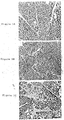
- Figure 3A is a photoreproduction of the pancreatic histology of an INSGAS/TGF ⁇ mouse used in the study reported by Example 3.
- the INSGAS/TGF ⁇ pancreas had some areas of increased ductular complexes and slightly increased interstitial cellularity.
- the field shown here had the most severly abnormal histology in the five animals used.
- Figure 3B is a photoreproduction of the pancreatic histology of a control mouse from Example 3.
- Figure 3C is a photoreproduction of the pancreatic histology of a TGF ⁇ mouse from Example 3. This field of TGE ⁇ pancreas of the study reported in Example 3 was typical and showed the interstitial cellularity and fibrosis combined with florid ductular metaplasia and has been described by Jhappan, et al . supra.
- the present invention is based in part on studies which demonstrate numerous insulin staining cells in the TGF ⁇ -induced metaplastic ductules.
- the low level of exocrine and endocrine gene expression in the metaplastic ductal cells resembles that of protodifferentiated ductal cells seen in the early stage of fetal pancreatic development.
- Formation of islets (neogenesis) results from proliferation and differentiation of these protodifferentiated insulin expressing cells. Histologically this is manifest as islets appearing to bud from the pancreatic ducts (nesidioblastosis).
- the ductular metaplasia is not seen in the immediate post-natal period, but only at 4 weeks of age. This indicates that TGF ⁇ over-expression induces the insulin expression in duct epithelia rather than prolonging the persistence of islet precursors found in fetal pancreatic ducts.
- TGF ⁇ over-expression alone cannot effect transition of these protodifferentiated duct cells into fully differentiated islets. This implies that islet differentiation requires other factors absent from the adult pancreas of TGF ⁇ transgenic mice. Since differentiation of protodifferentiated islet precursors occurs during late fetal development, factors regulating this transition would likely be expressed in islets during this period. Among the factors expressed in the developing islets are the gastrointestinal peptides, the gastrins. Clinical observations have also linked gastrin expression with nesidioblastosis - budding of proliferating islets from fetal pancreatic ducts. See Hollande, et al, Gastroenterology, 71:255-262 (1976) and Sacchi, T.B., et al ., Virchows Archiv B, 48:261-276 (1985).
- the term "gastrin/CCK receptor ligand” encompasses compounds that stimulate the gastrin/CCK receptor such that when EGF receptors in the same or adjacent tissue or in the same individual are also stimulated, neogenesis of insulin-producing pancreatic islet cells is induced.
- gastrin/CCK receptor ligands examples include various forms of gastrin such as gastrin 34 (big gastrin), gastrin 17 (little gastrin), and gastrin 8 (mini gastrin); various forms of cholecystokinin such as CCK 58, CCK 33, CCK 22, CCK 12 and CCK 8; and other gastrin/CCK receptor ligands that demonstrate the same synergistic activity with EGF receptor ligands and have a carboxy terminal peptide Trp-Met-Asp-Phe-amide which can induce differentiation of cells in mature pancreas to form insulin-secreting islet cells, when acting synergistically with an EGF receptor ligand.
- Such ligands also include compounds that increase the secretion of endogenous gastrins, cholecystokinins or similarly active peptides from sites of tissue storage. Examples of these are omeprazole which inhibits gastric acid secretion and soya bean trypsin inhibitor which increases CCK stimulation.
- EGF receptor ligand encompasses compounds that stimulate the EGF receptor such that when gastrin/CCK receptors in the same or adjacent tissue or in the same individual are also stimulated, neogenesis of insulin-producing pancreatic islet cells is induced.
- EGF receptor ligands include EGF1-53 including EGF1-48, EGF1-52, EGF1-49 and fragments and active analogs thereof.
- Other examples include TGF ⁇ receptor ligands (1-50) that includes 1-48, 1-47 and other EGF receptor ligands such as amphiregulin and pox virus growth factor as well as other EGF receptor ligands that demonstrate the same synergistic activity with gastrin/CCK -receptor ligands. These include active analogs, fragments and modifications of the above. For further background, see Carpenter and Wahl, Chapter 4 in Peptide Growth Factors (Eds. Sporn and Roberts), Springer Verlag, 1990.
- a principal aspect of the invention is a method for treating diabetes mellitus in an individual in need thereof by administering to the individual a composition including a gastrin/CCK receptor ligand and an EGF receptor ligand in an amount sufficient to effect differentiation of pancreatic islet precursor cells to mature insulin-secreting cells.
- the cells differentiated are residual latent islet precursor cells in the pancreatic duct.
- the method is principally for treating juvenile-onset diabetes mellitus.
- One embodiment comprises administering, preferably systemically, a differentiation regenerative amount of gastrin and an EGF receptor ligand, preferably TGF ⁇ , to the individual.
- Another embodiment comprises administering a gastrin/CCK receptor ligand and EGF receptor ligand to pancreatic islet precursor cells of explanted pancreatic tissue of the mammal and reintroducing the pancreatic tissue so stimulated to the mammal.
- the gastrin/CCK receptor ligand. is preferably gastrin and the EGF receptor ligand is preferably TFG ⁇ .
- gastrin/CCK receptor ligand stimulation is effected by expression of a chimeric insulin promoter-gastrin fusion gene construct transgenically introduced into such precursor cells.
- EGF receptor ligand stimulation is effected by expression of a EGF receptor ligand gene transgenically introduced into the mammal.
- the EGF receptor ligand is TGF ⁇ and the EGF receptor ligand gene is a TGF ⁇ gene.
- stimulation by gastrin/CCK receptor ligand and EGF receptor ligand is effected by coexpression of (i) a preprogastrin peptide precursor gene and (ii) an EGF receptor ligand gene that have been stably introduced into the mammal.
- the EGF receptor ligand is preferably TGF ⁇ and the EGF receptor ligand gene is preferably a TGF ⁇ gene.
- the invention in another aspect relates to a method for effecting the differentiation of pancreatic islet precursor cells of a mammal by stimulating such cells with a combination of a gastrin/CCK receptor ligand, particularly gastrin, and an EGF receptor ligand, particulary TGF ⁇ .
- gastrin stimulation is effected by expression of a preprogastrin peptide precursor gene stably introduced into the mammal. The expression is under the control of the insulin promoter.
- EGF receptor ligand, e.g. TGF ⁇ stimulation is effected by expression of an EGF receptor ligand gene transgenically introduced into the mammal.
- stimulation by gastrin and TGF ⁇ is preferably effected by co-expression of (i) a preprogastrin peptide precursor gene and (ii) a EGF receptor ligand, e.g. TGF ⁇ , gene that have been stably introduced into the mammal.
- nucleic acid fusion construct includes a nucleic acid sequence coding for the preprogastrin peptide precursor and an insulin transcriptional regulatory sequence, which is 5' to and effective to support transcription of a sequence encoding the preprogastrin peptide precursor.
- the insulin transcriptional regulatory sequence includes at least the insulin promoter.
- nucleic acid sequence coding for the preprogastrin peptide precursor comprises a polynucleotide sequence containing exons 2 and 3 of the human gastrin gene and optionally also including introns 1 and 2.
- Another embodiment of the invention is a composition
- a composition comprising (i) a nucleic acid sequence coding for a mammalian EGF receptor ligand, e.g., TGF ⁇ and a transcriptional regulatory sequence therefor; and (ii) a nucleic acid sequence coding for the preprogastrin peptide precursor and a transcriptional regulatory sequence therefor.
- the transcriptional regulatory sequence for the EGF receptor ligand is a strong non-tissue specific promoter, such as the metallothionene promoter.
- the transcriptional regulatory sequence for the preprogastrin peptide precursor is the insulin promoter.
- a preferred form of this embodiment is one wherein the nucleic acid sequence coding for the preprogastrin peptide precursor comprises a polynucleotide sequence containing introns 1 and 2 and exons 2 and 3 of the human gastrin gene.
- Another aspect of the invention relates to a vector including the fusion gene construct comprising the preprogastrin peptide precursor coding sequence.
- This vector can be a plasmid such as the pGeml or can be a phage which has a transcriptional regulatory sequence including the insulin promoter.
- compositions including one having the nucleic acid sequence coding for a mammalian EGF receptor ligand, e.g., TGF ⁇ , under control of a strong non-tissue specific promoter, e.g., the metallothionene promoter; and (ii) a preprogastrin peptide precursor coding sequence under control of the insulin promoter.
- a mammalian EGF receptor ligand e.g., TGF ⁇
- a strong non-tissue specific promoter e.g., the metallothionene promoter
- a preprogastrin peptide precursor coding sequence under control of the insulin promoter.
- Each vector can be a plasmid, such as plasmid pGeml or a phage in this aspect.
- Another aspect of the invention is a non-human mammal or tissue, including cells, thereof capable of expressing a stably integrated gene which encodes preprogastrin.
- Another embodiment of this aspect is a non-human mammal capable of coexpressing (i) a preprogastrin peptide precursor gene; and (ii) an EGF receptor ligand, e.g. TGF ⁇ , gene that have been stably integrated into the mammal, mammalian tissue or cells.
- Modes of administration include but are not limited to transdermal, intramuscular, intraperitoneal, intravenous, subcutaneous, intranasal, and oral routes.
- the compounds may be administered by any convenient route, for example by infusion or bolus injection by absorption through epithelial or mucocutaneous linings (e.g., oral mucosa, rectal and intestinal mucosa, etc.) and may be administered together with other biologically active agents. Administration is preferably systemic.
- compositions comprise a therapeutically effective amount of a therapeutic, and a pharmaceutically acceptable carrier or excipient.
- a pharmaceutically acceptable carrier includes but is not limited to saline, buffered saline, dextrose, water, glycerol, ethanol, and combinations thereof.
- the formulation should suit the mode of administration.
- the composition can also contain minor amounts of wetting or emulsifying agents, or pH buffering agents.
- the composition can be a liquid solution, suspension, emulsion, tablet, pill, capsule, sustained release formulation, or powder.
- the composition can be formulated as a suppository, with traditional binders and carriers such as triglycerides.
- Oral formulation can include standard carriers such as pharmaceutical grades of mannitol, lactose, starch, magnesium stearate, sodium saccharine, cellulose, magnesium carbonate, etc.
- Various delivery systems are known and can be used to administer a therapeutic of the invention, e.g., encapsulation in liposomes, microparticles, microcapsules and the like.
- the composition is formulated in accordance with routine procedures as a pharmaceutical composition adapted for intravenous administration to human beings.
- compositions for intravenous administration are solutions in sterile isotonic aqueous buffer.
- the composition may also include a solubilizing agent and a local anesthetic to ameliorate any pain at the site of the injection.
- the ingredients are supplied either separately or mixed together in unit dosage form, for example, as a dry lyophilized powder or water free concentrate in a hermetically sealed container such as an ampoule or sachette indicating the quantity of active agent.
- the composition is to be administered by infusion, it can be dispensed with an infusion bottle containing sterile pharmaceutical grade water or saline.
- an ampoule of sterile water for injection or saline can be provided so that the ingredients may be mixed prior to administration.
- the therapeutics of the invention can be formulated as neutral or salt forms.
- Pharmaceutically acceptable salts include those formed with free amino groups such as those derived from hydrochloric, phosphoric, acetic, oxalic, tartaric acids, etc., and those formed with free carboxyl groups such as those derived from sodium, potassium, ammonium, calcium, ferric hydroxides, isopropylamine, triethylamine, 2-ethylamino ethanol, histidine, procaine, etc.
- the amount of the therapeutic of the invention which will be effective in the treatment of a particular disorder or condition will depend on the nature of the disorder or condition, and can be determined by standard clinical techniques.
- the precise dose to be employed in the formulation will also depend on the route of administration, and the seriousness of the disease or disorder, and should be decided according to the judgment of the practitioner and each patient's circumstances.
- suitable dosage ranges for intravenous administration are generally about 20-500 micrograms of active compound per kilogram body weight.
- Suitable dosage ranges for intranasal administration are generally about 0.01 pg/kg body weight to 1 mg/kg body weight.
- Effective doses may be extrapolated from dose-response curves derived from in vitro or animal model test systems.
- Suppositories generally contain active ingredient in the range of 0.5% to 10% by weight; oral formulations preferably contain 10% to 95% active ingredient.
- the invention also provides a pharmaceutical pack or kit comprising one or more containers filled with one or more of the ingredients of the pharmaceutical compositions of the invention.
- a pharmaceutical pack or kit comprising one or more containers filled with one or more of the ingredients of the pharmaceutical compositions of the invention.
- Associated with such container(s) can be a notice in the form prescribed by a governmental agency regulating the manufacture, use or sale of pharmaceuticals or biological products, which notice reflects approval by the agency of manufacture, use or sale for human administration.
- mice were obtained from Taconic Farms, Inc., Germantown, NY.
- a Pvull-Rsal fragment encompassing nucleotides -370 to +38 of the rat insulin I gene was ligated into pGeml (Promega Corp., Madison, WI).
- pGeml Promega Corp., Madison, WI.
- a 4.4 kb Bam Hl-EcoRl fragment containing 1.5 kb introns 1 and 2 and exons 2 and 3 of the human gastrin gene which encodes the preprogastin peptide precursor was isolated and subcloned downstream of the rat insulin I fragment in pGeml (Promega). The fragment is described in Wiborg, O., Proc. Natl. Acad. Sci.
- the insulin promoter-preprogastrin INSGAS transgene construct was excised as a 4.8 kb Xbal-EcoRl fragment.
- mice Surviving embryos were then implanted into the oviducts of CD1 (Charles River Laboratories, Inc., Wilmington, MA) foster mothers according to procedures in Hogan, et al. Transgenic founder mice were identified by DNA blot techniques using DNA isolated from individual mouse tails, and a human gastrin exon 2 probe labelled with 32 dCTP by random priming. Fl mice and their siblings were similarly identified.
- mice containing the MT-TGF ⁇ transgene derived from a CD-1 mouse strain were crossed with heterozygotic INSGAS mice. After weaning, the offspring were placed on acidified 50mM ZnCl 2 as previously described in order to induce the metallothionine promoter (Jhappan, supra).
- Tissues were extracted and assayed for gastrin immunoreactivity by radioimmunoassay as described previously using antibody 2604 which is specific for biologically active C terminally amidated gastrin in a gastrin radioimmunoassay as described in Rehfeld, J.F., Scand. J. Clin. Lab. Invest, 30 :361-368 (1972).
- Tyrosine monoiodinated human gastrin 17 tracer was used in all assays and synthetic human gastrin 17 was used as a standard.
- Tissues were frozen in liquid nitrogen, ground to powder with mortar and pestle, and subjected to acid-ethanol extraction as described in Todaro, G.J., et al Proc. Natl. Acad. Sci. USA, 77 :5258-5262 (1980). Extracts were reconstituted with water, and protein concentrations determined with a Coomassie blue dye binding assay (Bio-Rad Laboratories, Hercules, CA). Aliquots from the pancreata were tested in duplicate in a TGF ⁇ radioimmunoassay, which measured competition with 125 I TGF ⁇ for binding to a solid-phase rabbit antibody raised against the C-terminus of rat TGF ⁇ (kit from BioTope, Seattle, WA).
- pancreas was removed, weighed, similarly oriented in cassettes, fixed in Bouin's solution and embedded in paraffin by conventional procedures.
- pancreatic tissue from adult 17 week old MT-TGF ⁇ (MT-42) transgenic mice were immunostained for insulin to examine the effect of TGF ⁇ over-expression on islet development.
- Insulin positive cells in TGF ⁇ -induced metaplastic ductules using immunoperoxidase staining guinea pig anti-human insulin sera (Linco, Eureka, MO); a pre-immune guinea pig serum was used as a control. Immunohistochemistry was performed on 5u paraffin sections by.
- the relative volume of islets, ducts, or interstitial cells was quantitated using the point-counting method described in Weibel, E.R., Lab Investig., 12 :131-155 (1963). At a magnification of 400x, starting at a random point at one corner of the section, every other field was scored using a 25 point ocular grid. An unbiased but systematic selection of fields was accomplished using the markings of the stage micrometer. Intercepts over blood vessels, fat, ducts, lymph nodes, or interlobular space were subtracted to give the total pancreatic area.
- Immunoperoxidase staining showed numerous insulin staining cells in the metaplastic ducts from the TGF ⁇ transgenic pancreas (Figure 1A), whereas insulin staining cells were virtually absent from the non-transgenic ducts (less than 6.1%).
- insulin staining cells were virtually absent from the non-transgenic ducts (less than 6.1%).
- Occasional ductular cells stained with the same intensity of insulin staining as the adjacent islets, but most had less intense staining (Figure 1B).
- the low level of insulin staining of the ductular cells resembles that of protodifferentiated cells reported in the ducts of the developing pancreas. Pictet, R. and W.J. Rutter, Development of the embryonic endocrine pancreas, in Endocrinology, Handbook of Physiology, ed. R.O. Greep and E.B. Astwood, 1972, American Physiological Society: Washington, D.C. p. 25-66; and Alpert, S., et al . Cell, 53:295-308, 1988.
- the islet mass of the TGF ⁇ transgenic mice was not increased.
- TGF ⁇ over-expression causes proliferation of protodifferentiated precursors but cannot alone effect the transition of these protodifferentiated cells into fully differentiated islets, differentiation being regulated by other factors absent from the adult pancreas.
- transgenic mice were created that express a chimeric insulin promoter-gastrin (INSGAS) transgene in which the insulin promoter directs pancreas specific expression of the gastrin transgene ( Figure 2A).
- INSGAS insulin promoter-gastrin
- Figure 2A insulin gene expression is not switched off after birth.
- the INSGAS transgene results.in a persistence of gastrin expression in the adult pancreas.
- the INSGAS transgene comprised 370 bp of 5'flanking DNA and the first non-coding exon of the rat insulin I gene.
- a 4.8 kb INSGAS fragment was isolated and microinjected into inbred FVB, one cell mouse embryos. Hogan, B. et al ., Manipulating the mouse embryo: A laboratory manual, 1986, NY:Cold Spring Harbor.
- Gastrin immunoreactivity in pancreatic and stomach extracts from transgenic and non-transgenic mice was assayed by radioimmunoassay using antisera 2604 (Rehfeld, J., et al., Scand. J. Clin. Lab. Invest., 30 : 361-368, 1972) specific for the bioactive amidated C-terminus of gastrin.
- Beta cell specific gastrin expression from the INSGAS transgene was observed based on immunostaining of pancreatic tissues with a gastrin monoclonal antibody.
- TGF ⁇ transgenic mice which have metaplastic ducts that contain insulin expressing cells resembling protodifferentiated islet-precursors.
- TGF ⁇ three groups of mice were bred with equivalent FVB/CD1 strain genetic backgrounds: non-transgenic control, TGF ⁇ single transgenic and INSGAS/TGF ⁇ double transgenics. All three groups of mice were placed on 50mM ZnCl 2 at 3 weeks of age. At 17 weeks of age, the animals were sacrificed and the pancreas removed for histological evaluation.
- pancreas from TGF ⁇ and INSGAS/TGF ⁇ mice had similar gross morphological appearances: resilient, firm and compact in contrast to the soft diffuse control pancreas.
- TGF ⁇ expression was equivalent in TGF ⁇ and INSGAS/TGF ⁇ groups when measured:by Northern blot analysis (data not shown) and by radioimmunoassay.
- the pancreatic TGF ⁇ immunoreactive peptide levels were 12.2 +/- 1 and 18.9 +/- 8ng/mg protein (Mean +/- SD) in the TGF ⁇ and INSGAS/TGF ⁇ mice, respectively.
- Mating the homozygous MT-TGF ⁇ (MT-42) mice (TGF ⁇ ) with heterozygotic INSGAS mice gave offspring that were either heterozygotic TGF ⁇ single transgenic or double transgenic containing both INSGAS and TGF ⁇ transgenes (INSGAS/TGF ⁇ ). Since INSGAS were FVB strain and TGF ⁇ were CD1 strain, TGF ⁇ homozygotes and CD1 controls (CON) were both mated with FVB to produce FVB/CD1 strain background for all three groups of mice.
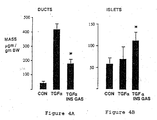
- mice were treated with 50mM ZnCl 2 from 3 weeks until sacrifice at age 17 weeks. Pancreas was removed, weighed, similarly oriented in cassettes, fixed in Bouin's solution and embedded in paraffin. One random section from each animal was used to quantitate the relative volumes of ductules and islets by point-counting morphometrics (Weibel, E.R., Lab Investig., 12 :131-155, 1963). At least 2000 points over tissue were counted as intercepts of a 50 point grid at 170x magnification; the entire section was covered without overlap. Mass of ductules or islet was calculated by multiplying the relative volume and the animal's pancreatic weight. To normalize different mean body weights, the mass was expressed as ug/g body weight. Results are mean and standard errors for 5-6 animals in each group. * P. ⁇ 0.05 (Student's t unpaired data).
Landscapes
- Health & Medical Sciences (AREA)
- Life Sciences & Earth Sciences (AREA)
- Engineering & Computer Science (AREA)
- Veterinary Medicine (AREA)
- Chemical & Material Sciences (AREA)
- General Health & Medical Sciences (AREA)
- Bioinformatics & Cheminformatics (AREA)
- Animal Behavior & Ethology (AREA)
- Zoology (AREA)
- Medicinal Chemistry (AREA)
- Public Health (AREA)
- Pharmacology & Pharmacy (AREA)
- Gastroenterology & Hepatology (AREA)
- Genetics & Genomics (AREA)
- Biotechnology (AREA)
- Epidemiology (AREA)
- Organic Chemistry (AREA)
- Diabetes (AREA)
- Endocrinology (AREA)
- Immunology (AREA)
- Proteomics, Peptides & Aminoacids (AREA)
- Chemical Kinetics & Catalysis (AREA)
- General Chemical & Material Sciences (AREA)
- Nuclear Medicine, Radiotherapy & Molecular Imaging (AREA)
- Wood Science & Technology (AREA)
- Environmental Sciences (AREA)
- Molecular Biology (AREA)
- General Engineering & Computer Science (AREA)
- Biomedical Technology (AREA)
- Animal Husbandry (AREA)
- Biochemistry (AREA)
- Obesity (AREA)
- Biophysics (AREA)
- Hematology (AREA)
- Emergency Medicine (AREA)
- Plant Pathology (AREA)
- Microbiology (AREA)
- Biodiversity & Conservation Biology (AREA)
- Physics & Mathematics (AREA)
- Medicines That Contain Protein Lipid Enzymes And Other Medicines (AREA)
Priority Applications (4)
| Application Number | Priority Date | Filing Date | Title |
|---|---|---|---|
| EP07010051A EP1842552A1 (fr) | 1994-01-24 | 1994-01-24 | Traitement du diabète |
| AT04076250T ATE432709T1 (de) | 1994-01-24 | 1994-01-24 | Behandlung von diabetes |
| EP01114131A EP1132091A1 (fr) | 1994-01-24 | 1994-01-24 | Traitement du diabète |
| EP04076250A EP1466618B1 (fr) | 1994-01-24 | 1994-01-24 | Traitement du diabète |
Applications Claiming Priority (3)
| Application Number | Priority Date | Filing Date | Title |
|---|---|---|---|
| PCT/US1993/012055 WO1995019785A1 (fr) | 1994-01-24 | 1994-01-24 | Traitement du diabete juvenile |
| EP94926459A EP0752882B1 (fr) | 1994-01-24 | 1994-01-24 | Traitement du diabete |
| EP01114131A EP1132091A1 (fr) | 1994-01-24 | 1994-01-24 | Traitement du diabète |
Related Parent Applications (1)
| Application Number | Title | Priority Date | Filing Date |
|---|---|---|---|
| EP94926459A Division EP0752882B1 (fr) | 1994-01-24 | 1994-01-24 | Traitement du diabete |
Related Child Applications (2)
| Application Number | Title | Priority Date | Filing Date |
|---|---|---|---|
| EP07010051A Division EP1842552A1 (fr) | 1994-01-24 | 1994-01-24 | Traitement du diabète |
| EP04076250A Division EP1466618B1 (fr) | 1994-01-24 | 1994-01-24 | Traitement du diabète |
Publications (1)
| Publication Number | Publication Date |
|---|---|
| EP1132091A1 true EP1132091A1 (fr) | 2001-09-12 |
Family
ID=22237287
Family Applications (4)
| Application Number | Title | Priority Date | Filing Date |
|---|---|---|---|
| EP01114131A Withdrawn EP1132091A1 (fr) | 1994-01-24 | 1994-01-24 | Traitement du diabète |
| EP94926459A Expired - Lifetime EP0752882B1 (fr) | 1994-01-24 | 1994-01-24 | Traitement du diabete |
| EP07010051A Withdrawn EP1842552A1 (fr) | 1994-01-24 | 1994-01-24 | Traitement du diabète |
| EP04076250A Expired - Lifetime EP1466618B1 (fr) | 1994-01-24 | 1994-01-24 | Traitement du diabète |
Family Applications After (3)
| Application Number | Title | Priority Date | Filing Date |
|---|---|---|---|
| EP94926459A Expired - Lifetime EP0752882B1 (fr) | 1994-01-24 | 1994-01-24 | Traitement du diabete |
| EP07010051A Withdrawn EP1842552A1 (fr) | 1994-01-24 | 1994-01-24 | Traitement du diabète |
| EP04076250A Expired - Lifetime EP1466618B1 (fr) | 1994-01-24 | 1994-01-24 | Traitement du diabète |
Country Status (8)
| Country | Link |
|---|---|
| EP (4) | EP1132091A1 (fr) |
| JP (1) | JPH09511384A (fr) |
| AT (1) | ATE222503T1 (fr) |
| AU (1) | AU7628794A (fr) |
| CA (1) | CA2182034C (fr) |
| DE (2) | DE69431212T2 (fr) |
| ES (1) | ES2185663T3 (fr) |
| WO (1) | WO1995019785A1 (fr) |
Families Citing this family (15)
| Publication number | Priority date | Publication date | Assignee | Title |
|---|---|---|---|---|
| US6558952B1 (en) | 1992-12-14 | 2003-05-06 | Waratah Pharmaceuticals, Inc. | Treatment for diabetes |
| US5885956A (en) | 1992-12-14 | 1999-03-23 | Research Triangle Pharmaceuticals | Treatment for diabetes using a gastrin/CCK receptor ligand and an EGF receptor ligand |
| US20050272652A1 (en) | 1999-03-29 | 2005-12-08 | Gault Victor A | Peptide analogues of GIP for treatment of diabetes, insulin resistance and obesity |
| AU2005201435A1 (en) * | 1999-04-06 | 2005-04-28 | Genentech, Inc. | Use of ErbB receptor ligands in treating diabetes |
| AU4209300A (en) * | 1999-04-06 | 2000-10-23 | Genentech Inc. | Use of erbb receptor ligands in treating diabetes |
| AU6920800A (en) * | 1999-08-19 | 2001-03-13 | Stem Cell Pharmaceuticals, Inc. | Tgf-alpha polypeptides, functional fragments and methods of use therefor |
| US20020193301A1 (en) | 1999-08-19 | 2002-12-19 | Stem Cell Pharmaceuticals, Inc. | TGF-alpha polypeptides, functional fragments and methods of use therefor |
| CN1486204A (zh) * | 2001-01-12 | 2004-03-31 | ������˹ҩƷ��˾ | 用于胰岛再生的含胃泌素/cck受体配基及egf受体配基的组合物 |
| EP1837031B1 (fr) | 2002-06-07 | 2009-10-14 | Waratah Pharmaceuticals, Inc. | Methodes et compositions pour le traitement du diabete |
| DE60329724D1 (de) | 2002-06-07 | 2009-11-26 | Waratah Pharmaceuticals Inc | Methoden und Kompositionen um Diabetes zu behandeln |
| CN1829528A (zh) * | 2003-05-27 | 2006-09-06 | 瓦拉塔药品公司 | 包含胃泌素化合物的组合物及其在糖尿病中的应用 |
| US8076288B2 (en) | 2004-02-11 | 2011-12-13 | Amylin Pharmaceuticals, Inc. | Hybrid polypeptides having glucose lowering activity |
| US8263545B2 (en) | 2005-02-11 | 2012-09-11 | Amylin Pharmaceuticals, Inc. | GIP analog and hybrid polypeptides with selectable properties |
| KR20070115947A (ko) | 2005-02-11 | 2007-12-06 | 아밀린 파마슈티칼스, 인크. | 선택가능한 특성들을 가지는 gip 유사체 및 하이브리드폴리펩타이드 |
| US8497240B2 (en) | 2006-08-17 | 2013-07-30 | Amylin Pharmaceuticals, Llc | DPP-IV resistant GIP hybrid polypeptides with selectable properties |
Citations (1)
| Publication number | Priority date | Publication date | Assignee | Title |
|---|---|---|---|---|
| EP0161816A2 (fr) | 1984-04-17 | 1985-11-21 | Imperial Chemical Industries Plc | Urogastrone |
-
1994
- 1994-01-24 EP EP01114131A patent/EP1132091A1/fr not_active Withdrawn
- 1994-01-24 DE DE69431212T patent/DE69431212T2/de not_active Expired - Fee Related
- 1994-01-24 JP JP7519519A patent/JPH09511384A/ja not_active Withdrawn
- 1994-01-24 EP EP94926459A patent/EP0752882B1/fr not_active Expired - Lifetime
- 1994-01-24 DE DE69435212T patent/DE69435212D1/de not_active Expired - Fee Related
- 1994-01-24 AT AT94926459T patent/ATE222503T1/de not_active IP Right Cessation
- 1994-01-24 AU AU76287/94A patent/AU7628794A/en not_active Withdrawn
- 1994-01-24 CA CA002182034A patent/CA2182034C/fr not_active Expired - Fee Related
- 1994-01-24 EP EP07010051A patent/EP1842552A1/fr not_active Withdrawn
- 1994-01-24 EP EP04076250A patent/EP1466618B1/fr not_active Expired - Lifetime
- 1994-01-24 ES ES94926459T patent/ES2185663T3/es not_active Expired - Lifetime
- 1994-01-24 WO PCT/US1993/012055 patent/WO1995019785A1/fr not_active Ceased
Patent Citations (1)
| Publication number | Priority date | Publication date | Assignee | Title |
|---|---|---|---|---|
| EP0161816A2 (fr) | 1984-04-17 | 1985-11-21 | Imperial Chemical Industries Plc | Urogastrone |
Non-Patent Citations (29)
| Title |
|---|
| ALPERT, S. ET AL., CELL, vol. 53, 1988, pages 295 - 308 |
| BRAND, S.J.; P.J. FULLER, J. BIOL CHEM., vol. 263, 1988, pages 5341 - 5347 |
| CATHALA ET AL., DNA, vol. 2, 1983, pages 329 - 335 |
| CELL, vol. 18, 1979, pages 533 - 543 |
| CORDELL, B.G. ET AL., CELL, vol. 18, 1979, pages 533 - 543 |
| HEITZ, P.U. ET AL., DIABETES, vol. 26, 1977, pages 632 - 642 |
| HOGAN, B. ET AL.: "Manipulating the mouse embryo: A laboratory manual", 1986, COLD SPRING HARBOR |
| HOLLANDE E. ET AL., GASTROENTEROLOGY, vol. 71, 1976, pages 255 - 262 |
| HOLLANDE ET AL., GASTROENTEROLOGY, vol. 71, 1976, pages 255 - 262 |
| ITO ET AL., PROC. NATL. ACAD. SCI. USA, vol. 81, 1984, pages 4662 - 4666 |
| ITO, R. ET AL., PROC. NATL. ACAD. SCI. (USA, vol. 81, 1984, pages 4662 - 4666 |
| JAPPAN ET AL., CELL, vol. 61, 1990, pages 1137 - 1146 |
| KORC M, THE JOURNAL OF CLINICAL INVESTIGATION, vol. 92, no. 3, 1993, pages 1113 - 1114 |
| LEE, H.C. ET AL., ENDOCRINOLOGY, vol. 124, 1989, pages 1571 - 1575 |
| PICTET, R.; W.J. RUTTER: "Endocrinology", 1972, AMERICAN PHYSIOLOGICAL SOCIETY, article "Development of the embryonic endocrine pancreas", pages: 25 - 66 |
| REHFELD, J. ET AL., SCAND. J. CLIN. LAB. INVEST., vol. 30, 1972, pages 361 - 368 |
| REHFELD, J.F., SCAND. J. CLIN. LAB. INVEST, vol. 30, 1972, pages 361 - 368 |
| SACCHI, T. B. ET AL., VIRCHOWS ARCHIV B, vol. 48, 1985, pages 261 - 276 |
| SACCHI, T.B. ET AL., VIRCHOWS ARCHIV B, vol. 48, 1985, pages 261 - 276 |
| STERNBERGER, L.A.: "Immunocytochemistry", 1979, WILEY, pages: 104 - 170 |
| TEITELMAN, G.; J.K. LEE, DEVELOPMENTAL BIOLOGY, vol. 121, 1987, pages 454 - 466 |
| TODARO, G.J. ET AL., PROC. NATL. ACAD. SCI. USA, vol. 77, 1980, pages 5258 - 5262 |
| WANG ET AL., THE JOURNAL OF CLINICAL INVESTIGATION, vol. 92, no. 3, 1993, pages 1349 - 1356 |
| WANG ET AL.: "Function and Regulation of Gastrin in Transgenic Mice: A Review", THE YALE JOURNAL OF BIOLOGY AND MEDICINE, vol. 65, 1992, pages 705 - 713, XP002093891 * |
| WANG T C ET AL: "PANCREATIC GASTRIN STIMULATES ISLET DIFFERENTIATION OF TRANSFORMING GROWTH FACTOR A-INDUCED DUCTULAR PRUCURSOR CELLS", JOURNAL OF CLINICAL INVESTIGATION,US,NEW YORK, NY, vol. 92, no. 3, September 1993 (1993-09-01), pages 1349 - 1356, XP000907219, ISSN: 0021-9738 * |
| WANG; BRAND, THE YALE JOURNAL OF BIOLOGY AND MEDICINE, vol. 65, 1992, pages 705 - 713 |
| WEIBEL, E.R., LAB INVESTIG., vol. 12, 1963, pages 131 - 155 |
| WIBORG, O. ET AL., PROC. NATL. ACAD. SCI. USA, vol. 81, 1984, pages 1067 - 1069 |
| WIBORG, O., PROC. NATL. ACAD. SCI. USA, vol. 81, 1984, pages 1067 - 1069 |
Also Published As
| Publication number | Publication date |
|---|---|
| AU7628794A (en) | 1995-08-08 |
| ATE222503T1 (de) | 2002-09-15 |
| DE69435212D1 (de) | 2009-07-16 |
| WO1995019785A1 (fr) | 1995-07-27 |
| EP0752882A1 (fr) | 1997-01-15 |
| ES2185663T3 (es) | 2003-05-01 |
| DE69431212T2 (de) | 2003-04-10 |
| EP0752882A4 (fr) | 1999-09-01 |
| CA2182034A1 (fr) | 1995-07-27 |
| EP1842552A1 (fr) | 2007-10-10 |
| EP1466618B1 (fr) | 2009-06-03 |
| DE69431212D1 (de) | 2002-09-26 |
| JPH09511384A (ja) | 1997-11-18 |
| CA2182034C (fr) | 2009-04-21 |
| EP1466618A1 (fr) | 2004-10-13 |
| EP0752882B1 (fr) | 2002-08-21 |
Similar Documents
| Publication | Publication Date | Title |
|---|---|---|
| US5885956A (en) | Treatment for diabetes using a gastrin/CCK receptor ligand and an EGF receptor ligand | |
| US6558952B1 (en) | Treatment for diabetes | |
| Wang et al. | Pancreatic gastrin stimulates islet differentiation of transforming growth factor alpha-induced ductular precursor cells. | |
| EP0752882B1 (fr) | Traitement du diabete | |
| Côté et al. | Progressive neuronopathy in transgenic mice expressing the human neurofilament heavy gene: a mouse model of amyotrophic lateral sclerosis | |
| J. Wells et al. | Human dystrophin expression corrects the myopathic phenotype in transgenic mdx mice | |
| Kato et al. | Transgenic mice overexpressing human vasoactive intestinal peptide (VIP) gene in pancreatic beta cells. Evidence for improved glucose tolerance and enhanced insulin secretion by VIP and PHM-27 in vivo. | |
| US6071697A (en) | Method for testing the differentiation status in pancreatic cells of a mammal | |
| US5824838A (en) | Transgenic mouse model for pituitary disorders associated with LIF overexpression and/or GH underexpression, and its use for testing therapeutic drugs for the conditions | |
| US6677311B1 (en) | Inducible HSV-TK in transformed cell populations | |
| Wang et al. | Function and regulation of gastrin in transgenic mice: a review | |
| AU2008202259A1 (en) | Treatment for diabetes | |
| US5948623A (en) | Method for testing the differentiation status in pancreatic cells of a mammal | |
| AU2001232599A1 (en) | Transgenic animal model for obesity expressing foxc2 | |
| EP1255774A1 (fr) | Modele animal transgenique destine a l'expression du gene foxc2 pour traiter l'obesite | |
| JP2005087209A (ja) | 若年型糖尿病の治療 | |
| JP2008307053A (ja) | 若年型糖尿病の治療 | |
| US20040166061A1 (en) | Animal model | |
| WO1997046669A1 (fr) | Mammiferes transgeniques avec suppression de l'expression de l'amyline | |
| US20050096264A1 (en) | Methods for treating obesity and related conditions with glycoprotein hormone beta family hormones |
Legal Events
| Date | Code | Title | Description |
|---|---|---|---|
| PUAI | Public reference made under article 153(3) epc to a published international application that has entered the european phase |
Free format text: ORIGINAL CODE: 0009012 |
|
| AC | Divisional application: reference to earlier application |
Ref document number: 752882 Country of ref document: EP |
|
| AK | Designated contracting states |
Kind code of ref document: A1 Designated state(s): AT BE CH DE DK ES FR GB GR IE IT LI LU MC NL PT SE |
|
| RIN1 | Information on inventor provided before grant (corrected) |
Inventor name: BRAND, STEPHEN J. Inventor name: NARDI, RONALD V. |
|
| 17P | Request for examination filed |
Effective date: 20020312 |
|
| AKX | Designation fees paid |
Free format text: AT BE CH DE DK ES FR GB GR IE IT LI LU MC NL PT SE |
|
| 17Q | First examination report despatched |
Effective date: 20021121 |
|
| 17Q | First examination report despatched |
Effective date: 20021121 |
|
| STAA | Information on the status of an ep patent application or granted ep patent |
Free format text: STATUS: THE APPLICATION IS DEEMED TO BE WITHDRAWN |
|
| 18D | Application deemed to be withdrawn |
Effective date: 20090730 |