EP1132516A1 - Procédé pour préparation de fibres papetières avec des boucles durables et produits absorbents - Google Patents
Procédé pour préparation de fibres papetières avec des boucles durables et produits absorbents Download PDFInfo
- Publication number
- EP1132516A1 EP1132516A1 EP01302051A EP01302051A EP1132516A1 EP 1132516 A1 EP1132516 A1 EP 1132516A1 EP 01302051 A EP01302051 A EP 01302051A EP 01302051 A EP01302051 A EP 01302051A EP 1132516 A1 EP1132516 A1 EP 1132516A1
- Authority
- EP
- European Patent Office
- Prior art keywords
- fiber
- pulp
- curl
- consistency
- curl index
- Prior art date
- Legal status (The legal status is an assumption and is not a legal conclusion. Google has not performed a legal analysis and makes no representation as to the accuracy of the status listed.)
- Withdrawn
Links
Images






Classifications
-
- D—TEXTILES; PAPER
- D21—PAPER-MAKING; PRODUCTION OF CELLULOSE
- D21C—PRODUCTION OF CELLULOSE BY REMOVING NON-CELLULOSE SUBSTANCES FROM CELLULOSE-CONTAINING MATERIALS; REGENERATION OF PULPING LIQUORS; APPARATUS THEREFOR
- D21C9/00—After-treatment of cellulose pulp, e.g. of wood pulp, or cotton linters ; Treatment of dilute or dewatered pulp or process improvement taking place after obtaining the raw cellulosic material and not provided for elsewhere
- D21C9/001—Modification of pulp properties
- D21C9/007—Modification of pulp properties by mechanical or physical means
-
- D—TEXTILES; PAPER
- D21—PAPER-MAKING; PRODUCTION OF CELLULOSE
- D21H—PULP COMPOSITIONS; PREPARATION THEREOF NOT COVERED BY SUBCLASSES D21C OR D21D; IMPREGNATING OR COATING OF PAPER; TREATMENT OF FINISHED PAPER NOT COVERED BY CLASS B31 OR SUBCLASS D21G; PAPER NOT OTHERWISE PROVIDED FOR
- D21H11/00—Pulp or paper, comprising cellulose or lignocellulose fibres of natural origin only
- D21H11/16—Pulp or paper, comprising cellulose or lignocellulose fibres of natural origin only modified by a particular after-treatment
Definitions
- the present invention relates generally to papermaking fibers and more specifically to an improved method of providing durable curl to fiber by way of high temperature and pressure, low mechanical energy processing.
- United States Patent No. 2,008,892 to Asplund discloses an apparatus for refining wood chips into mechanical pulp provided with a grinding portion including a stationary disk, and a rotating disk.
- United States Patent No. 3,382,140 to Henderson et al. is directed to a process for fibrillating cellulosic fibers.
- Cellulosic high consistency papermaking pulp in the form of a semi-solid, non-flowable and nonpumpable lumping mass composed of defibered fibers is continuously refined by passage through a refining space comprising opposed disk like working surfaces relatively rotatable about a common axis wherein the pulp is continuously maintained packed under high compression to cause defibrillation by interfiber friction along the surfaces of the individual separated fibers without substantially fracturing the fibers.
- fibrous material is defibered and then dewatered to increase his consistency to a level where it forms a semisolid, nonflowable, moist mass adapted for high consistency refining.
- Pulp consistency in the range of between about 10% and about 60% with the fibers in intimate contact; preferably between about 20 and 35% is satisfactory. If the consistency is much below 10% (according to the patent) the amount of water present may act as a lubricant preventing the desired refining by inter-fiber friction. If much greater than 60%, the pulp will be too dry which may be result in burning under the inter fiber friction. Examples of the '140 patent teach mechanical power input of from about 5 to about 40 HP day/ton of pulp produced.
- the fibrous materials are passed to another conditioning tube, such as a digester or a bleach tower where they are further conditioned by liquid chemicals under the same steam pressurized conditions.
- the fibrous materials may thereafter be washed, cooled and/or pressed.
- United States Patent No. 3,873,412 to Charters et al. relates to a method of mechanically refining a mixture of Kraft and semichemical pulp.
- the method is used for producing pulp for use in the manufacture of Kraft type products such as liner board and bag grade paper comprising the steps of steaming small segments of fibrous material, defiberizing the same in a pressurized atmosphere at an elevated temperature and, while the resultant fiber products are still hot, mixing them with hot Kraft pulp and then refining the mixture so obtained.
- United States Patent No. 3,948,449 to Logan et al. is directed to an apparatus for the treatment of lignocellulosic material.
- the '449 patent also relates to the production of a mechanical pulp of improved strength properties.
- the lignocellulosic material is fed into a substantially closed chamber where it is mechanically abraided under a power input of 15 or more HP day/ton. During the abraiding step the material is maintained in an inert gaseous atmosphere at a pressure of 10- 80 psig, preferably 20 - 40 psig.
- the Asplund process is well known in the industry for the manufacture of low grade pulps for employment in the manufacture of roofing and flooring felts.
- the system involves generally presteaming wood chips followed by refining under high pressure. The products are not suitable for high quality or high strength papermaking because of their inherent low strength and other poor papermaking qualities.
- United States Patent No. 4,036,679 to Back et al. is directed to a process for producing convoluted and fiberized cellulose fibers and sheet products.
- the process includes the application of contortive forces to a pulp mass under controlled operating conditions, wherein the feed rate, work space gap and relative rate of movement of the working elements applying the contortive forces are correlated to maintain the work space filled with fibers under sufficient compression.
- Sheets made from these fibers exhibit excellent bulk softness and absorbency properties, even when the formation process is conducted in an aqueous system, and even when the substantial compacting forces are applied to the wet web process. According to Col.
- the minimum net specific energy is at least about 1.0 HPD/ADT and more preferably at least about 1.5 HPD/ADT is maintained.
- Col. 10 of the "679 patent that when making sheet from the pretreated fiber, that the web is introduced to a nonthermal dewatering means which subjects it to compressive forces exerted by at least one dewatering means. See Col. 10, lines 1 to 57.
- United States Patent No. 4,187,141 to Ahrel et al. relates to the production of bleached wood pulp from wood chips using a disk refiner.
- this patent it is disclosed to impregnate wood chips with an alkaline bleaching liquid prior to defibrating the chips in the refiner.
- United States Patent No. 4,409,065 to Kasser discloses a method of making an improved bag from Kraft pulp including a curlation step before web formation.
- the curlation step is preferably carried out promptly before the web is formed.
- United States Patent No. 4,431,479 to Barbe et al. is directed to a method for treating pulp fibers that have already been curled.
- the method includes subjecting the pulp to a heat treatment while the pulp is at a high consistency, thereby rendering the curl permanent to subsequent mechanical action.
- the permanent curl has advantages for paper machine runnability and for increasing the toughness of the finished product.
- most of the curl in both high consistency refined mechanical and high yield sulfite pulp is lost in the subsequent steps of handling at low consistency and high temperatures. See Col. 3, lines 20-29.
- the method of curling takes place at medium to high consistency (15%-35%) and may be a high consistency disk refining action as is generally used in pulp manufacture. Col.
- the method is reported useful for treating high yield or mechanical pulps which have been curled by a high consistency action which method includes subjecting the pulp to a heat treatment at temperature of 100°C - 170°C for a time varying between 60 minutes and two minutes while the pulp is at a high consistency, 15%-35% to render the curl permanent.
- United States Patent No. 4,455,195 to Kinsley is directed to a fibrous filter media and processed for producing it.
- the process involves selection of a lignin containing fiber source having a lignin content of at least about 10% and thermal mechanically pulping the fiber source under temperature/pressure conditions of 300°F - 350°F/ 50 psig - 120 psig and a refiner energy utilization of about 8-35 HPD/ADT.
- the thermal mechanically produced fibers are characterized by a high degree of stiffness and an extremely smooth surface free of fine fibril formation and thus are substantially non-self-bonding.
- United States Patent No. 4,488,932 to Eber et al. discloses a method of making fibrous webs of enhanced bulk. See also European Patent Publication No.
- Webs are produced by subjecting hydrophilic papermaking fibers to mechanical deformation, e.g. hammermilling sufficient to deform the fibers without substantial fiber breakage, dispersing the resulting curled or kinked treated fibers, preferably in admixture with conventional papermaking fibers in an aqueous medium, to form a fiber furnish, and forming a wet laid web from the resulting fiber furnish within a period of time, e.g. within five minutes, such that the deformations of the treated fibers are at least partially retained and impart enhanced bulk and softness to the finished fibrous web.
- mechanical deformation e.g. hammermilling sufficient to deform the fibers without substantial fiber breakage
- dispersing the resulting curled or kinked treated fibers preferably in admixture with conventional papermaking fibers in an aqueous medium, to form a fiber furnish
- forming a wet laid web from the resulting fiber furnish within a period of time, e.g. within five minutes, such that the de
- United States Patent No. 4,548,674 to Hageman et al. is directed to a method of regenerating waste paper. Waste paper containing polymeric contaminants is broken down in the presence of an acidic aqueous solution containing at least one peracid. Particular peracids disclosed include permonosulphuric acid and peracetic acid.
- United States Patent No. 4,734,160 to Moldenius et al. discloses a method of peroxide bleaching lignocellulose-containing material for providing a pulp of both high strength and brightness. Increase in strength is provided in the first stage by hyper-alkaline peroxide bleaching pH of over 12. The desired brightness increase is provided in a subsequent stage with or without intermediate washing of the pulp at a lower initial pH.
- United States Patent No. 4,898,642 to Moore et al . is directed to twisted, chemically stiffened cellulosic fibers and absorbent structures made therefrom.
- curled cellulosic fibers are chemically stiffened with a cross linking agent which is typically a C 2 -C 8 dialdehyde.
- United States Patent No. 4,976,819 to Minton discloses a method for treating pulp prior to forming a web.
- the method includes mechanical treatment of a pulp slurry of up to 50% consistency by dewatering and compacting the pulp.
- the pulp is twisted and kinked such that a web of enhanced softness is provided.
- the preferred device for imparting such twisting and kinking is a plug screw feeder. Pulp that has been so treated exhibits increased drainability in a wet section of a paper machine.
- United States Patent No. 5,211,809 to Naddeo et al. discloses a color removal process for secondary (recycle) fiber. Color from dyes is removed from secondary pulps with non-chlorine based bleaching agents in treating sequences using oxygen with combinations of peroxide, ozone and/or hydrosulfite, at controlled pH conditions (less than 8 or greater than 10). Acid treatment prior to bleaching improves color removal and protects fibers from damage at more severe bleaching conditions
- United States Patent No. 5,296,100 to Devic relates to hydrogen peroxide/alkaline bleaching of wood pulps.
- High-yield ligno-cellulosic wood pulps are bleached by pre-treating the pulp with a complexing agent and washing the pretreated pulp followed by bleaching the pulp with hydrogen peroxide in an alkaline medium.
- a supplementary amount of hydrogen peroxide being equal to or less than the initial amount is added.
- European Publication No. 0 440 472 reports high bulking resilient fibers produced by crosslinking wood pulp fibers with polycarboxylic acids such as citric acid.
- United States Patent Nos. 5,384,011 and 5,384,012 to Hazard et al. disclose a process for preparing individual crosslinked cellulosic fibers wherein curing and drying are carried out in separate stages. The drying and curing steps are carried out in turbulent pressurized superheated steam.
- United States Patent No. 5,501,768 to Hermans et al. is directed to a method of treating papermaking fibers for making tissue.
- the throughdryability of dewatered, but wet, sheets made from papermaking fibers can be significantly increased by subjecting an aqueous suspension of the fibers at high consistency to elevated temperatures with sufficient working of the fibers.
- the temperatures can be about 150°F or greater.
- mechanical treatment with equipment having relatively high volume to working surface areas, such as dispargers are preferred and that disk refiners, for example, are not preferred. See Col. 3, line 65 to Col. 4, line 13. Power inputs are greater than 1 HP day/ton. Note examples 1-11. See, also, United States Patent No. 5,348,620.
- United States Patent No. 5,571,377 to Tibbling et al. describes a process for peroxide bleaching of chemical pulp in a pressurized bleach vessel. Suspension of pulp having a concentration preferably exceeding 8 per cent of cellulose containing fiber material is continuously fed to a bleaching vessel and treated with an acid to adjust the pH value below 7 and is subsequently bleached in a bleaching stage to a brightness exceeding 75 per cent ISO. Peroxide bleaching takes place at elevated temperature and that the pressure in a bleaching vessel which exceeds two bar and where the cross section of the area the bleaching vessels exceeds 3 square meters.
- United States Patent No. 5,755,926 of Hankins et al is directed to an integrating pulping process for recycling waste paper.
- the method and system includes a mild alkaline pulping process with oxygen and hydrogen peroxide followed by rapid decompression of fibers and hot washing.
- United States Patent No. 5,772,845 to Farrington Jr. et al. is directed to a method of making tissue, without the use of a Yankee dryer.
- the typical Yankee functions of building machine direction and cross°direction stretch are replaced by a wet end rush transfer and the throughdrying fabric design, respectively.
- the products are preferably made with chemi-mechanically treated fibers in at least one layer. It is noted in the '845 patent that certain methods can introduce curl, kinks and microcompressions into the fiber which decrease fiber to fiber bonding, decrease sheet tensile strength, and increase sheet bulk, stretch, porosity, and softness. Examples of mechanical treatments include flash drying, dry fiberizing and wet high consistency curling. A preferred method for modifying the fibers is taught to be through the use of a shaft disperser. See Col. 5.
- United States Patent No. 5,834,095 to Dutkiewicz et al. discloses a treatment process for cellulosic fibers.
- the process includes treating cellulosic fibers using high temperatures that are effective to result in modifications to the fiber.
- the fibers are typically heat treated with hot air.
- a cross-linking catalyst to facilitate fiber modification. See Col. 4, lines 1-10.
- United States Patent No. 5,858,021 to Sun et al. discloses a treatment process for cellulosic fibers. The process first prepares the cellulosic fibers in a high consistency mixture with water and then adds an alkaline metal hydroxide. The high consistency process has been found to produce cellulosic fibers that are uniformly treated.
- a high energy disperser such as a twin screw disperser, is utilized. Typical conditions for using the disperser include an energy level of about 6 horsepower-day per ton of cellulosic fiber and a feed rate of cellulosic fiber of about 2000 pounds per hour. See Col. 10, lines 13- 40.
- United States Patent No. 5,997,689 to Bokstrom discloses a method of bleaching secondary fibers.
- a secondary fiber pulp is first slushed and then transferred at a consistency of 20-40 percent to a disperser wherein the pulp is mechanically treated and treated with oxygen.
- the pulp is thereafter conveyed to a bleaching tower wherein it is treated with alkali and hydrogen peroxide.
- United States Statutory Invention Registration No. H1704 of Wallajapet et al. is directed to a modified cellulose fiber having improved curl.
- This statutory invention registration describes an oxidized or sulfonated cellulose fiber having a curled, stable structure.
- the oxidized or sulfonated curled fiber is prepared by a process including treating the fibers in a high energy refiner effective to provide the desired curl properties to the fiber which is used in disposable absorbent products.
- the high energy disperser employed is a twin screw disperser. See Col. 8, lines 10-35.
- a process for producing high bulk cellulosic fiber exhibiting a durable elevated curl index including the steps of: (a) concurrently heat-treating and convolving cellulose fiber pulp at elevated temperature and pressure at high consistency under conditions selected so as to preclude substantial fibrillation and attendant paper strength and fiber bonding development and (b) recovering the pulp wherein the length weighted curl index of the treated fiber is at least about 20% higher than the length weighted curl index of the fiber prior to the heat treatment and convolving thereof, wherein the at least about 20% elevation of the length weighted curl index of the treated fiber persists upon treatment for 30 minutes in a disintegrator at 1% consistency at a temperature of 125°F.
- the laboratory disintegrator is typically operated at 3000 rpm and is of the type described in TAPPI Standard T205 Sp-95.
- a method of making absorbent sheet from cellulosic furnish including the steps of: (a) thickening a pulp process stream to a consistency of from about 20% to about 60%; (b) concurrently heat treating and convolving the fiber of the pulp process stream under conditions selected so as to preclude substantial fibrillation and attendant paper strength and fiber bonding development such that the length weighted curl index of the fiber is at least about 20% higher than the length weighted curl index of the fiber prior to the heat treatment and convolving thereof and the 20% elevation of the curl index persists upon treatment for 30 minutes in a disintegrator at 1% consistency at a temperature of 125°F; (c) combining the treated pulp process stream with a second pulp process stream to provide a papermaking furnish; (d) depositing said papermaking furnish on a foraminous support to form a web; and (e) drying said web to make absorbent sheet.
- a method of making absorbent sheet including: (a) preparing a first cellulosic pulp component exhibiting an elevated durable curl index by way of concurrently heat treating and convolving cellulosic fiber at elevated temperature and pressure under conditions selected so as to preclude substantial fibrillation and attendant paper strength and fiber bonding development wherein the length weighted curl index of the treated fiber is at least about 20% higher than the length weighted curl index of the fiber prior to heat treatment and convolving thereof; the 20% elevation in the curl index persisting upon treatment of the fiber for 30 minutes in a disintegrator at 1% consistency at a temperature of 125°F; (b) combining in admixture the first cellulosic pulp component with a second cellulosic pulp component to make a papermaking furnish, the second cellulosic pulp component having a length weighted curl index lower than a length weighted curl index of the first pulp component; (c) depositing the papermaking furnish on a foraminous support to form
- a first cellulosic may be heat treated and convolved at high consistency and then combined with a second pulp that has been refined at low consistency in order to achieve a balance of properties in the absorbent sheet to be made therefrom.
- Low consistency or traditional refining is well known and is generally carried out at consistencies of less than about 10 percent and typically less than about 5 percent.
- it is possible to refine a pulp at low consistency, thicken the pulp and heat treat and convolve the fiber as will be appreciated from the discussion which follows.
- the present invention is generally directed to a process for producing high bulk cellulosic fiber exhibiting a durable elevated curl index.
- the process is typically carried out in a chamber in the presence of saturated steam.
- the pressure in the chamber is pulsed with respect to time either on a macroscopic level or by way of localized pressure pulsations.
- a disk refiner When using a disk refiner the gap between a rotating disk and an opposing surface is generally from about 0.5 mm to about 10 mm, with from about 1 mm to about 5 mm being more typical.
- the step of concurrently heat treating and convolving the fiber in a process in accordance with the present invention includes applying mechanical shear to the fiber at relatively high consistency.
- pulp which is processed in accordance with the present invention exhibits a drop in CSF (freeness) of at most about 60 ml. Less than about 45 ml is more typical with less than about 30 ml being preferred.
- the pulp exhibits a drop in CSF of at most about 20 ml, preferably at most about 10 ml. More preferably, the pulp exhibits no drop in CSF and optionally exhibits an increase; for example of at least 10 ml.
- CSF increases of 20 ml, 30 ml and more can be attached by way of the inventive process as will be appreciated from the specific embodiments discussed below.
- CSF is determined in accordance with TAPPI Standard T 227 OM-94 (Canadian Standard Method).
- the curl index of the treated fiber is at least about 30% higher than the curl index of the fiber prior to the step of concurrently heat treating and convolving the fiber. It is preferred that the curl index of the treated fiber is durable enough so that it is reduced by at most about 25% by treatment at 1% consistency at 125°F in a disintegrator for 30 minutes. More preferably, the length weighted curl index of the treated fiber is reduced by at most about 15% by treatment at 1% consistency at 125°F in a disintegrator for 30 minutes.
- the curl index of the treated fiber is at least about 40% higher than the curl index of the fiber prior to heat treating and convolving the fiber in accordance with the present invention. Still more preferably the treated fiber has a length weighted curl index of at least about 50% higher than the curl index of the fiber prior to treatment.
- the curl index attained by way of practicing the present invention will to some extent depend upon the curl index of the fiber prior to treatment.
- the treated fiber has a length weighted curl index of at least about 0.12. More preferably the curled fiber has a length weighted curl index of at least about 0.15 with minimum values of at least about 0.2, 0.25 or 0.3 being particularly preferred.
- the length weighed curl index is determined by standard procedure in an Op Test fiber analyzer, model number Code LDA 96 in accordance with the equations set forth hereinafter.
- the heat treatment and convolving of the fiber or pulp in accordance with the present invention is generally carried out at a consistency of from about 20% to about 60% with from about 20% to about 50% being typical and from about 30% to about 40% being preferred.
- the heat treating and convolving of the fiber is carried out with very short residence times in a disk refiner, for example, involving a duration of from about 0.01 to about 20 seconds.
- the step of heat treating and convolving the fiber in a refining type of apparatus has a duration of less than about 10 seconds with less than about 5 seconds, and indeed, less than about 2 seconds being typically suitable. About 1 second or less in the refiner is sufficient in cases.
- Overall heat treatment, or total time contacting the steam is generally that required to heat the fiber to substantially that of the steam which may be in the range of less than 2 to 4 minutes, more preferably, less than 2 minutes; still more preferably less than 1 minute. From about 10 to about 30 seconds is suitable with similar or less time involved in the convolving step.
- Heat treatment and curling of the fiber is generally carried out a temperature of from about 230°F to about 370°F and typically with relatively low power inputs.
- Mechanical power inputs of less than about 2 HP day/ton, more preferably less than about 1 HP day/ton, and even more preferably at mechanical energy inputs less than about 0.5 HPday/ton are suitable. Higher energy inputs may be suitable under some conditions. For example, provided the equipment is suitable and the fiber is not subject to undue degradation one may utilize more than about 5 HP day/ton up to about 10, 15, 20 or even 25 HP day/ton if the material will not develop substantial paper strength and fiber bonding by way of such treatment.
- the process is carried out in saturated steam at a pressure of from about 5 to about 150 psig or higher, with perhaps from about 10 to about 90 psig being more typical.
- the fiber is heat treated and curled in the presence of an alkaline agent, such as sodium hydroxide, and a peroxide bleach.
- an alkaline agent such as sodium hydroxide, and a peroxide bleach.
- the fiber will include secondary (recycled ) fiber.
- the fiber will consist essentially of secondary fiber or may be a mixture of virgin fiber and secondary fiber including from about 5 to about 95% by weight of secondary fiber based on the weight of fiber present in the pulp.
- the fiber in the pulp consists of secondary fiber, that is, 100% of the fiber is recycled fiber.
- the present invention may be applied to any suitable pulp including Kraft hardwood fibers, Kraft softwood fibers, sulfite hardwood fibers, sulfite softwood fibers, and mixtures thereof. So also, the fibers may be mechanically pulped fibers, chemi-mechanically pulped fibers and mixtures thereof.
- a method of making absorbent sheet from cellulosic furnish including: (a) thickening a feed pulp process stream to a consistency of from about 20 to about 60%; (b) concurrently heat treating and convolving the fiber of the pulp process stream under conditions selected so as to preclude substantial fibrillation and attendant paper strength and fiber bonding developments such that the length curl weight index of the fiber is at least about 20% higher than the length weight curl index of the fiber prior to the heat treatment and convolving thereof and the 20% elevation of the curl index persists upon treatment for 30 minutes in a disintegrator at 1% consistency at a temperature of 125°F; (c) combining the treated pulp process stream with a second pulp process stream to provide a paper making furnish; (d) depositing the paper making furnish on a foraminous support to form a web; and (e) drying the web to make absorbent sheet.
- the feed pulp process stream and the second pulp process stream may be subjected to low consistency refining and are generally at a consistency of less than about 6% and more typically at a consistency of less than about 5%. Drying of the web may be carried out by way of a through dryer as is well known in the art as described and shown, for example, in United States Patent No. 5, 607, 551 to Farrington et al ., the disclosure of which is incorporated herein by reference. The present invention is likewise applicable to product made by the foregoing process.
- a method of making absorbent sheet including: (a) preparing a first cellulosic pulp component exhibiting an elevated durable curl index by way of concurrently heat treating convolving cellulosic fiber at elevated temperature and pressure under conditions selected so as to preclude substantial fibrillation and attendant paper strength and fiber bonding development wherein the length weighted curl index of the treated fiber is at least about 20% higher than the length weighted curl index of the fiber prior to heat treatment and convolving thereof, the 20% elevation and curl index persisting upon treatment of the fiber for 30 minutes in a disintegrator at 1% consistency at a temperature of 125°F; (b) combining in admixture the first cellulosic pulp component with a second cellulosic pulp component to make a papermaking furnish wherein the second cellulosic pulp component has a length weighted curl index lower than the length weighted curl index of the first pulp component; (c) depositing the paper making furnish on a foraminous support to form a web
- the first cellulosic pulp component comprises at least about 50% of the fiber present in the absorbent sheet; that is, the absorbent sheet typically includes at least about 50% of the fiber curled in accordance with the present invention. Suitably up to about 75% or 90% or more of the curled fiber may be present in the absorbent sheet.
- the length weighted curl index of the second cellulose pulp component is usually at least 25% lower than the length weighted curl index of the first cellulosic pulp component after the first cellulosic pulp component has been heat treated and convolved.
- the length weighted curl index of the second cellulosic pulp component is at least about 35% or perhaps more typically at least 50% lower than the length weighted curl index of the first cellulosic pulp component after the first cellulosic pulp component has been treated and convolved in accordance with the present invention.
- Processing in accordance with the present invention induces a significant amount of curl and kink to papermaking fibers which results in increased caliper and sheet void volume, with reduced strength; all beneficial to tissue and towel production.
- the process will also increase sheet air porosity, increasing the suitability of the processed fibers for manufacturing paper on a machine employing throughair dyers.
- the fibers can also be incorporated into any paper sheet where increased bulk is beneficial.
- Fibers suitable for treatment by the process include virgin kraft hardwood and softwood, mechanical and chemi-mechanical pulps, and secondary fibers.
- Process steps may, in some exemplary embodiments include (1) thickening a slurry of papermaking fibers to about 35% consistency, (2) feeding the fibers into a sealed pressure vessel tube, (3) heating the fibers to a saturated steam pressure between 5 PSIG and 150 PSIG, (4) feeding the fibers through a disk refiner or similar machine to impart mechanical action to the fibers with a specific energy application of less than 1 to 2 HP day/ton, (5) discharging the fibers from the pressurized system by a blow valve or other discharge device, (6) supplying the fibers to a papermaking process.
- Papermaking fibers from pulping or paper recycling operations are typically supplied to the process thickening device. Such devices include twin wire presses and screw type presses.
- the fiber stream is thickened from an inlet consistency of about 5%, or lower, to 20% to 50% solids. Normally a 35% solids level can be easily achieved with normal or light duty presses.
- a particular advantage of this process is the ability to utilize pulps at a 35% or lower consistency. Increasing the consistency to about 50% requires about 2 to 3 times the pressing energy required at 35% consistency. To achieve consistency much above 50% requires the application of thermal drying energy which greatly increases the operating cost. The utilization of about 35% solids pulp results in both a lower capital cost for the pressing equipment and a lower operating cost compared to other processes requiring higher levels of dryness.
- the pulp discharged from the pressing device is fed into a pressurized heating or steaming chamber or tube. Common devices include positive displacement pumps and plug screw feeders.
- the chamber is pressurized with saturated steam to a pressure of 5 PSIG to 150 PSIG.
- the pulp is fed through the chamber and is heated to saturated temperature by the steam. Alternately the pulp could be heated by other means including non contact steam and electrical heaters
- the pulp is then fed into a high consistency disk refiner.
- the disk refiner plate pattern, plate gap and throughput is adjusted to provide a low specific energy to the pulp, most preferably below 1 to 2 HP day per short ton.
- the refining conditions are selected to minimize refiner plate to fiber impacts of a high energy nature which result in fiber fibrillation and cutting or strength development.
- the fiber is then discharged out of the refiner through several commercially available means including but not limited to a blow valve and cyclone arrangement.
- the steam exiting the cyclone can be recovered for its heat value further reducing the operating cost of the system.
- the curled and kinked discharged pulp can then be held at discharge solids level of about 25% to 50% or can be diluted to 5% or less solids level.
- the pulp can be held in storage tanks for extended periods or be supplied directly to the papermaking process.
- a significant advantage of this process is the resiliency or permanency of the curled nature of the pulp which greatly simplifies the system to deliver the pulp to the paper
- the concurrent heat and mechanical treatment of the present invention is advantageously carried out in a disk refiner apparatus at elevated temperature and pressure wherein the surface patterns of the disk or disks produce localized compressive/decompressive shear conditions in a pulsating manner over time.
- the fibers are heat and mechanically treated to increase curl by mechanically convolving the fibers at elevated temperature and pressure under relatively low mechanical energy input. Conditions are selected so as to preclude substantial fibrillation and attendant strength and bonding development, while also preventing substantial fiber damage or scorching.
- the curl index is increased without unduly reducing the freeness of the pulp.
- a particularly preferred mode of practicing the present invention also involves concurrently heat-treating and convolving the fiber at a temperature of at least about 230°F in a disk refiner at a very low specific energy input.
- the energy input may in fact be less than that required to operate the refiner without pulp or may be from about a finite value to less than about 2 HP day/ton. A finite value up to less than 1 HP day/ton is believed suitable.
- the lower limit of specific energy input required to practice the present invention may be difficult to determine, or may even be a negative value with respect to a reference value.
- Specific energy inputs of from about 0.01 HP day/ton up to about 2 HP day/ton are believed suitable.
- the mechanical energy employed is thus specified as less than an upper limit at which the refiner tends to fibrillate the fiber and to reduce the effectiveness of the process in imparting permanent curl to the treated fiber.
- the duration of the step of convolving and heat-treating the fiber in a disk refiner is calculated as the volume of the refining cavity (that is, the cylindrical cavity between disks) times the reciprocal of the volumetric flow rate of the pulp based on its substantially uncompressed volume after the curling step and before dilution.
- CSF is determined in accordance with TAPPI Standard T 227 OM-94 (Canadian Standard Method).
- the porofil or "void volume”, as referred to hereafter, is determined by saturating a sheet with a nonpolar liquid and measuring the amount of liquid absorbed.
- the volume of liquid absorbed is equivalent to the void volume within the sheet structure.
- Porofil is expressed as grams of liquid absorbed per gram of fiber in the sheet structure. More specifically, for each single-ply sheet sample to be tested, select 8 sheets and cut out a 1 inch by 1 inch square (1 inch in the machine direction and 1 inch in the cross-machine direction). For multi-ply product samples, each ply is measured as a separate entity. Multiple samples should be separated into individual single plies and 8 sheets from each ply position used for testing. Weigh and record the dry weight of each test specimen to the nearest 0.001 gram.
- the porofil or void volume for all eight individual specimens is determined as described above and the average of the eight specimens is the void volume for the sample.
- “Curl Index”, “mean curl” and like terminology as used herein refers to length weighted curl index of the pulp.
- fiber curled in accordance with the present invention is treated in a laboratory disintegrator (of the type specified in TAPPI Standard T205 Sp-95) for 30 minutes at 1 percent consistency.
- a laboratory disintegrator of the type specified in TAPPI Standard T205 Sp-95
- Such equipment is available from Testing Machines Inc., Amityville, N.Y. and is suitably operated at 3,000 rpm and 125° F for the test procedure. Other temperatures and speeds may be used if so desired to test the suitability of the fiber for an application.
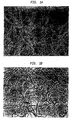
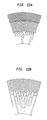
- FIG. 1A a photomicrograph of untreated southern bleached softwood kraft (SBSK) is given at 50X magnification. The sample was the control pulp from a pilot plant trial.
- Figure 1B is a photomicrograph, 50X, of SBSK treated in accordance with the present invention. The curled and kinked structures generated in the process are clearly seen in (b). The distinction is perhaps better appreciated by reference to Figures 2 and 3 .
- Figure 2 shows some examples of two-dimensional fiber structures along with their calculated curl index. Even at a curl index of 0.2 - 0.4 the amount of curl is very significant.
- Figure 3 is a histogram of individual fiber kink index for fibers treated in accordance with the invention.
- N a-b represents the number of kinks in an individual fiber which have a change in fiber direction between a and b degrees.
- a kink index of 2.0 mm -1 would correspond to only one small-angle kink.
- the curling process shifts the distribution toward higher kink index; however, very few fibers have a kink index above about four.
- TAD through air dried
- the curled fibers can be stored under a wide range of conditions and be delivered to the papermaking process in a substantially curled state.
- the process involves utilizing a high consistency, pressurized refiner to provide mechanical forces to papermaking fibers at saturated steam pressures between 5 PSIG and 150 PSIG, consistencies between 20% and 60%, and, most preferably, a power application below 1 to 2 HP day/ton.
- the pressurized treatment results in a substantially permanently curled fiber or durable curled fiber which improves the caliper, void volume, air porosity, and softness while reducing the strength of tissue and towel base sheets.
- the process can be utilized to prepare papermaking fibers for tissue and towel machines and are especially important for through air dried machines.
- a further surprising aspect of the invention is the resiliency of the curl generated.
- a central weakness of much of the prior art is the temporary nature of the curl generated.
- Back in U.S. Patent No. 4,036,679 teaches a process to mechanically curl fibers by a treatment in a disk refiner at 70% to 90% consistency. The fibers treated by the Back process are reported to retain the curled structures for more than 48 hours as long as they are held in the dry state. The fibers must be utilized in forming a paper sheet in a relatively short time after dilution or the curled structures are dissipated or substantially lost. Hermans teaches in U.S. Patent No.
- Hermans has two closely related patents U.S. Patent No. 5,501,768 and 5,348,620.
- the '620 patent has claims concerning the utilization of a minimum 20% secondary fiber.
- the patent details a method of increasing the "throughdryability" of fiber by treating it in shaft type disperger, specifically a Maule or Vivis machine.
- the treatment conditions claimed are 20% or higher consistency, 150°F or higher temperature (limited to about 212°F in the Maule disperger), and a power input of 1 HP day/ton or higher preferably 2 to 3 HP day/ton.
- Hermans teaches in the '620 patent:
- the working of the fibers is not known to be quantifiable in any meaningful way other than by the temperature and power input and the resulting TD index.
- U.S. Patent No. 4,036,679 teaches that cellulose fibers can be convoluted by treatment in a disk refiner at a consistency of 70% to 90% (substantially dry) and controlling the feed rate, disk clearance, and disk rate of rotation.
- Minton U.S Patent No. 4,976,819, teaches curling of pulp by passing the pulp through a plug screw compression device with wringing, de-watering, and compaction resulting in a discharge consistency up to 50%. While Minton teaches that the mechanical treatment results in a curl that is "substantially irreversible” she does recognize the "excessive heat, agitation or shear is preferably minimized before passing the pulp to the head box.”
- Barbe U.S. Patent No. 4,431,479, teaches a method of setting the temporary curl produced during the refining step of producing a high yield mechanical or chemi-mechanical pulps.
- the setting of the curl is accomplished by a heat treatment step directly after the wood chip refining i.e. production step of the mechanical pulping process.
- Barbe teaches treating the high yield pulp at a temperature between 100°C-170°C, a consistency of 15% to 30%, and a time between 2 minutes and 60 minutes.
- fibers are treated as part of a process for making absorbent sheet as will be appreciated by reference to Figure 9 hereof.
- a fiber flow will be split.
- a portion of the fiber stream, up to 100%, is diverted to a thickening device.
- Such devices include twin wire presses and screw type presses.
- the fiber stream is thickened to 20% to 50% solids and fed into a pressurized steaming device.
- the pulp is then pressurized with saturated steam to a gauge pressure of 5 PSI to 50 PSI and a temperature of 230°F to 300°F; the curl induced is a function of temperature.
- the steamed pulp is fed into a high consistency disk refiner.
- the disk refiner plate pattern, plate gap and throughput is adjusted to provide fiber to fiber interaction and to minimize refiner plate to fiber action which commonly results in fiber fibrillation, fiber cutting and strength development.
- the conditions utilized in a 12" Sprout refiner are a plate gap between 0.025 in and 0.100 in, a throughput between 0.5 kg/min and 1.0 kg/min oven dry pulp, and a measured energy input below 2 HP day/ton of pulp.
- the fiber exiting the refiner plates is in the form of small fiber bundles.
- the fiber after a holding time from 1 sec to 600 sec, is then discharged from the pressurized refiner by a plug or blow valve.
- the treated pulp is diluted to consistency suitable for introduction back into the pulp stream feeding the basis weight control for the paper machine headbox. Energy input and holding time between the refiner system discharge and the paper machine headbox should be minimized to maintain the maximum fiber curl.
- the fiber curl induced was measured utilizing the Fiber Quality Analyzer (FQA) as noted above. Length Weighted Mean curls typically between 0.100 and 0.260 have been generated in the process. Mean curls up to 0.300 have been generated.
- FQA Fiber Quality Analyzer
- Table 2 is a summary of process conditions investigated on a 12" refining batch system and a 20" continuous disk refiner, as well as absorbent sheet products made with fiber curled in accordance with the present invention.
- Process Description and Variables Process Step Variable Conditions Evaluated Thickening Consistency 35% (nominal) Steaming Temperature 105 to 160°C Pressure 35 to 600 kPa pressure (5 to 90 PSI) High Consistency Feed Rate 1 to 6 kg/min Refining Plate Gap 0.6 to 4 mm Plate Speed 900 to 1,800 RPM Specific Energy ⁇ 1 to 20 HP day/ton Post Refining Retention Time 1 Sec to 10 minute (batch) Discharge Depressurization Rate Fast and slow Dilution Temperature 120 to 180°F Consistency 1 to 2% Latency or Curl Time, energy, and Stability temperature Paper Machine and Basesheet Pilot PM trial with 9 Sheet Impact Caliper/Bulk 1b/3000ft 2 basesheet Strength Porofil TAD Air TAD Simulation Permeability Handsheets Strength Cali
- the pulp samples were prepared as follows:
- the pulp was spread by hand and metered from a slow moving belt conveyer 10 to a feed bin 12 and thereafter the pulp was conveyed to a plug screw feeder 14 which provides a pressure seal.
- the pulp was then fed by way of feeder 14 to a heating screw 16, wherein steam was injected and the material further conveyed through screw feeder 18 to a 20" single disk refiner 20.
- Refiner 20 was equipped with pressure controls which can be adjusted to vary pulp residence time between the plates and maintain a consistent pulp discharge flow.
- After refining the material was passed through a blow valve indicated at 22 through line 24 to a cyclone 26 which was vented to allow the steam to escape at 28 while the pulp was collected at 30.
- Two types of disks were used, a fine disk as shown in Figure 12A and a coarse disk as shown in Figure 12B. Variables investigated included:
- CSF test TAPPI T227 OM-94 (Canadian Standard Method) was measured as well as the curl index and kink index as noted above. Later trials included some higher feed rates.
- pulp emerging from plug screw feeder 14 comes into contact with steam and remains in contact with steam in heating screw 16 for 8 to 25 seconds (measured), for 10 seconds in many of the trials. Thereafter, pulp is in contact with steam in infeed screw 18 for a short time; estimated to be less than about 3 seconds. Pulp is in contact with steam between refiner plates in disk refiner 20 for typically less than 1 second (duration of convolving step) where it is concurrently heat treated and convolved. After curling the pulp is in contact with steam in the refiner housing outside the plates and in the blow line where the material is decompressed in a confined volume for less than 1 second.
- pulp emerging from the plug may be in contact with the steam for between about 10 and 30 seconds while typically concurrently heat treated and convolved for less than about 1 second in the refiner. What is desired is sufficient time for the pulp to be heated to essentially the temperature of the steam, which will depend on how well the pulp is broken up and contacted with the steam. It is likewise possible to use longer overall times, e.g., 2-4 minutes if desired.
- a batch refining apparatus 40 includes generally a steaming chamber 42, a feed screw 44, a disk refining portion 46, a drive motor 48 and a steam supply 50.
- the apparatus employed was a Sprout -Waldron batch refining system wherein Steaming Chamber 42 included a vertical tube with bolt on cover.
- the chamber is equipped with a mixer rake 54 provided with a shaft 56 and blades 58 to agitate the pulp and help facilitate heating.
- steam is fed into the chamber via a steam supply 50 to heat the pulp and pressurize the system.
- the steam pressure is monitored and controlled by a pressure indicator 74 and an appropriate control loop.
- the pulp was steamed for 5 to 15 minutes for most experiments described hereinafter.
- Variable speed feed screw 52 ⁇ a tube with a internal screw connects the steaming chamber to a refiner portion 46 including a case 70 as well as a stator 64 and a rotor 66 defining a refining gap 68 therebetween.
- the bottom of the steaming chamber opens directly to the screw.
- a variable speed drive indicated generally at 52 connects to screw 44 and is used to move the pulp from the bottom of the steaming chamber into the refiner case. The speed of the screw was adjusted to provide about 5 seconds of residence time in the feed screw.
- Stator 64 has a hole in the center through which feed screw 44 pushes the pulp into refiner plate gap 68.
- rotor 66 Opposite the stator is rotor 66 which is coupled to the drive motor via a shaft 78 and drive belts.
- the rotor assembly can be moved in and out to adjust the gap between the stator and rotor as is indicated schematically at 80.
- Standard 12" diameter, 6 segment refiner plates are bolted onto the rotor and stator.
- the case also has a chemical inlet pipe 60 equipped with a valve 62 to supply chemicals such as bleaching chemicals, discussed hereinafter in more detail, just at the point the pulp enters the hole in the stator.
- the chemical charge was metered into the chemical inlet at a rate and concentration calculated to match the pulp feed rate at the desired chemical application.
- the pulp is mechanically treated between the rotor and stator plates and is thrown out into the refiner case.
- the rotor assembly can be moved in and out to adjust the gap between rotor and stator plates 66 , 64 .
- the bottom of the refiner case is open to a pulp receiver vessel 72 .
- Total residence time of the pulp in the case is estimated to be less than 0.2 seconds.
- the pulp falls out of the refiner case by gravity and into receiver 72 .
- the receiver is a horizontal tank equipped with a bolt on cover.
- a screened tray designed to catch the pulp and to prevent the pulp from plugging a depressurization valve 76 .
- the depressurization valve is normally left slightly open during the experiments to 1) evacuate air in the system (which would prevent sufficient steam flow to heat the pulp), and 2) to drain any steam condensate from the refiner system.
- the valve was also used to depressurize the system at the end of the experiment.
- the main steam supply valve of supply 50 was closed and the vent valve opened 25 to 50%. At this opening the steam pressure was relieved over 1 to 2 minutes.
- Runs 108-117 were performed with hardwood BCTMP, and virgin hardwood and softwood . All of these runs, except one, were performed without chemicals. The curl response of the pulps varied somewhat; the BCTMP pulp having little curl induced while the softwood has a high induced curl.
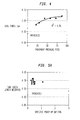
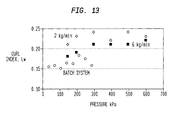
- the batch system data was generally consistent with the continuous system data as can be seen from Figure 13 which is a plot of curl index (LW) vs. operating pressure in kPa.
- LW curl index
- One key difference in the systems is the rate of depressurization. In the continuous system, this occurs rapidly across the blow valve. In the batch system depressurization is not rapid but very slow since there is extended retention at temperature during the run (several minutes) followed by slow depressurization (30 seconds to several minutes).
- the amount of energy transferred to the fiber in a refiner is a function of pulp throughput and plate spacing. Fiber curling is achieved in a refiner using a relatively large plate gap, where energy input is extremely low and there is little or no pulp refining (as indicated by freeness drop). During initial runs with hardwood/softwood blends the plate gap was reduced to the point where a significant amount of energy was put in to the pulp.
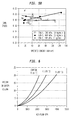
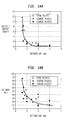
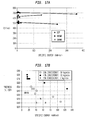
- Figure 14A plots the specific energy input as a function of plate spacing at a nominal production rate of 1.5 kg/min. The equipment is normally operated at much higher loads. The figure shows that no significant energy is transferred to the pulp until the gap is closed to less than 1 mm (around 1 to 2 mm for the higher production rate).
- Figure 14B also shows the corollary result that there is very little change in freeness.
- Some of the more recent data shows a freeness increase achieved by way of the process of the present invention.
- the process may thus be viewed as a balance of curl generation and refining/fibrillation/fines generation; the former increases freeness while the latter decreases freeness.
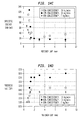
- Figures 14C and 14D are plots of specific energy vs. refiner gap and freeness vs. refiner gap at various consistencies and feed rates for hardwood pulp having an initial freeness of 630 ml after treatment in a disk refiner with coarse plates. As will be appreciated from Figure 14D in particular, the fibers treated at low energy and large plate gaps actually exhibited an increase in CSF.
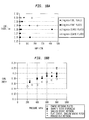
- Figures 17A and 17B provide additional support for the lack of pulp refining (freeness drop) at the relatively low energy inputs investigated.
- freeness is virtually constant.
- Figure 17B there is shown results of treating a hardwood pulp in accordance with the inventive process in a refiner at various specific energy inputs, feed rates and consistencies with coarse plates.
- the hardwood pulp had a pretreatment freeness of 630 ml and in many cases exhibited an increase in freeness especially at high consistencies and low energy inputs.
- Example 86 One significant experiment was performed on batch Example 86.
- the recycled pulp from Example 86 was held at low consistency (about 1%) in warm water (125°F) water and agitated with a lab spinner for 72 hours.
- the measured curl index dropped from 0.156 to 0.138 over the 72 hours of retention - about a 12% reduction.
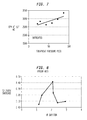
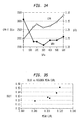
- Pulp having an initial curl index of 0.076 was treated in a refiner with peroxide. Each sample was treated in the refiner (with peroxide bleach) and then washed in a screen box and stored at about 8% consistency in the cooler. Two days were required for the production of the samples. On the third day the samples were removed from storage and blended in a machine chest and re-pulped. The samples were diluted to about 2% consistency and continuously agitated during the papermaking trial. Curl indices were measured during the pulping process and at the machine headbox during the trial. In Figure 22 the curl index of the blended curled pulps is plotted over the 6 hour trial. During this time the tank was continuously agitated. After the initial drop in curl of about 16% the curl leveled off and remained constant through the trial. Contrast this with the essentially identical conditions for the kneader sample plotted in Figure 21.
- Samples tested include the plate gap series (Examples 41 to 44 and pressure series (Examples 49 to 54), and selected hardwood and softwood pulps, plus the corresponding uncurled control pulps.
- DIP secondary fiber handsheets showed a 15% caliper increase, a 19% SAT capacity increase, and a 40% tensile reduction.
- Currently one of the biggest obstacles to increased utilization of low cost recycled fiber is the high strength and corresponding low softness of the fiber. Often on high softness recycled grades a chemical debonder is added to reduce the strength (usually about a 25% reduction is achieved). This data suggests that refiner curling could be used to achieve a similar strength reduction while delivering a bulkier sheet.
- TAD handsheet permeability was used to assess the potential of refiner curl to increase through drying efficiency.
- air permeability test the air flow rate through the handsheet is measured while the induced pressure drop across the sheet is gradually increased.
- Figure 27 shows an example of the data obtained for refiner-curled secondary fiber samples. From the permeability data in Figure 27 and Table 19 an increase in air flow (@ 15" water column) of over 70% was measured for the highest curled fiber.
- Figure 28 summarizes all of the permeability data obtained from trial samples and shows that the permeability is directly related to the degree of fiber curl. Similar results were obtained with virgin hardwood and softwood.
- Figure 29 shows for the DIP samples that as curl index increases the single-sheet caliper also increases. A similar relationship is seen for SAT results plotted in Figure 30.
- DIP based handsheets (the pressure series) and handsheets made with the control pulp were tested for water retention value. All of the pulps tested had an increase in water retention over the control, untreated, pulp.
- WRV water retention value
- the pulp sample is centrifuged under standardized conditions to remove any free water then weighted. The sample is then oven dried and re-weighed. The WRV is calculated from the centrifuged weight and the oven dried weight and has the units of g water per g fiber.
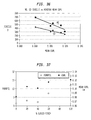
- Results show a correlation with the steam pressure/temperature used to curl the fiber. WRV goes down with pressure, but compared to the control sample all the treated pulps have a higher WRV. Thus, there is a correlation between curl and WRV for the curled samples but the baseline (uncurled) sample does not follow the same correlation. This is shown in Figures 33 and 34 where TAD handsheet permeability is shown as a surrogate for curl.
- a pilot paper machine trial was performed utilizing curled fiber from the batch refiner.
- a sample of the paper which was used in Examples 91-107 was used as the raw material.
- the paper was wetted to 35% consistency and run through the lab pilot pulp breaker and a portion was curled using the batch refiner. Utilizing a bleaching/-curling process five batches of pulp were produced.
- the five batches of pulp were combined in the machine chest, diluted to about 2% consistency and continuously agitated for the trial duration.
- the curl at the machine chest and headbox was monitored for each cell.
- Figure 22 (above) the curl is plotted vs. time in the machine chest demonstrating the resilience of the curl produced.
- For the trial a nominal 9 1b/3000ft 2 dry crepe sheet was produced.
Landscapes
- Engineering & Computer Science (AREA)
- Mechanical Engineering (AREA)
- Life Sciences & Earth Sciences (AREA)
- Wood Science & Technology (AREA)
- Paper (AREA)
Applications Claiming Priority (4)
| Application Number | Priority Date | Filing Date | Title |
|---|---|---|---|
| US187106 | 1988-04-28 | ||
| US18710600P | 2000-03-06 | 2000-03-06 | |
| US793863 | 2001-02-27 | ||
| US09/793,863 US6899790B2 (en) | 2000-03-06 | 2001-02-27 | Method of providing papermaking fibers with durable curl |
Publications (1)
| Publication Number | Publication Date |
|---|---|
| EP1132516A1 true EP1132516A1 (fr) | 2001-09-12 |
Family
ID=26882715
Family Applications (1)
| Application Number | Title | Priority Date | Filing Date |
|---|---|---|---|
| EP01302051A Withdrawn EP1132516A1 (fr) | 2000-03-06 | 2001-03-06 | Procédé pour préparation de fibres papetières avec des boucles durables et produits absorbents |
Country Status (3)
| Country | Link |
|---|---|
| US (2) | US6899790B2 (fr) |
| EP (1) | EP1132516A1 (fr) |
| CA (1) | CA2337160C (fr) |
Cited By (1)
| Publication number | Priority date | Publication date | Assignee | Title |
|---|---|---|---|---|
| WO2015189800A1 (fr) * | 2014-06-13 | 2015-12-17 | Stora Enso Oyj | Procédé de fabrication d'au moins une couche d'un produit de papier ou carton et produit de papier ou carton |
Families Citing this family (37)
| Publication number | Priority date | Publication date | Assignee | Title |
|---|---|---|---|---|
| US6627041B2 (en) * | 2000-03-06 | 2003-09-30 | Georgia-Pacific Corporation | Method of bleaching and providing papermaking fibers with durable curl |
| FI112805B (fi) * | 2001-10-10 | 2004-01-15 | Megatrex Oy | Menetelmä väriaineiden, erityisesti painovärin irrottamiseksi kierrätyskuitumateriaalista |
| AU2003291874A1 (en) * | 2003-06-03 | 2005-01-21 | David Tarasenko | Method for producing pulp and lignin |
| EP1646751A1 (fr) * | 2003-07-23 | 2006-04-19 | Fort James Corporation | Methode de frisage de fibres et feuille absorbante contenant ces fibres |
| DE102005036075A1 (de) * | 2005-08-01 | 2007-02-15 | Voith Patent Gmbh | Verfahren zur Herstellung von Tissuepapier |
| DE102005049502A1 (de) * | 2005-10-13 | 2007-04-19 | Voith Patent Gmbh | Verfahren zur Herstellung von Tissuepapier |
| US20070137807A1 (en) * | 2005-12-15 | 2007-06-21 | Schulz Thomas H | Durable hand towel |
| US7718036B2 (en) | 2006-03-21 | 2010-05-18 | Georgia Pacific Consumer Products Lp | Absorbent sheet having regenerated cellulose microfiber network |
| US8187422B2 (en) | 2006-03-21 | 2012-05-29 | Georgia-Pacific Consumer Products Lp | Disposable cellulosic wiper |
| US8187421B2 (en) | 2006-03-21 | 2012-05-29 | Georgia-Pacific Consumer Products Lp | Absorbent sheet incorporating regenerated cellulose microfiber |
| US8540846B2 (en) | 2009-01-28 | 2013-09-24 | Georgia-Pacific Consumer Products Lp | Belt-creped, variable local basis weight multi-ply sheet with cellulose microfiber prepared with perforated polymeric belt |
| US20080087390A1 (en) * | 2006-10-11 | 2008-04-17 | Fort James Corporation | Multi-step pulp bleaching |
| US8177938B2 (en) | 2007-01-19 | 2012-05-15 | Georgia-Pacific Consumer Products Lp | Method of making regenerated cellulose microfibers and absorbent products incorporating same |
| DE102007036375A1 (de) * | 2007-07-31 | 2009-02-05 | Voith Patent Gmbh | Verfahren zum Herstellen von Feinstoff aus Faserstoff |
| US8620059B2 (en) * | 2007-12-13 | 2013-12-31 | Fpinnovations | Characterizing wood furnish by edge pixelated imaging |
| CA2735867C (fr) | 2008-09-16 | 2017-12-05 | Dixie Consumer Products Llc | Feuille de base d'emballage alimentaire a microfibre de cellulose regeneree |
| AU2010264747A1 (en) * | 2009-06-24 | 2012-02-16 | Basf Se | Method and apparatus for defibrillating cellulose fibres |
| US8741104B2 (en) | 2011-04-29 | 2014-06-03 | Steven L. Edwards | Tissue products incorporating nanoporous cellulose fiber |
| EP3068619A4 (fr) | 2013-11-14 | 2017-07-05 | Georgia-Pacific Consumer Products LP | Feuilles absorbantes douces presentant une absorbance et une epaisseur superieures, et procedes de fabrication de feuilles absorbantes douces |
| AU2014404375A1 (en) * | 2014-08-27 | 2017-03-16 | Kimberly-Clark Worldwide, Inc. | Durable wet-pressed tissue |
| CA2986091C (fr) * | 2015-04-03 | 2023-10-10 | Resolute Fp Us Inc. | Procedes de production d'une fibre cellulosique presentant un indice de frisure eleve et couche d'absorption et de repartition en comprenant |
| US10156042B2 (en) * | 2015-12-29 | 2018-12-18 | International Paper Company | Modified fiber from shredded pulp sheets, methods, and systems |
| CN105672019A (zh) * | 2016-01-27 | 2016-06-15 | 新乡新亚纸业集团股份有限公司 | 一种利用杨木p-rc apmp 生产的高松厚白卡纸及其生产工艺 |
| US10519607B2 (en) | 2016-05-23 | 2019-12-31 | Gpcp Ip Holdings Llc | Dissolved air de-bonding of a tissue sheet |
| US11473245B2 (en) | 2016-08-01 | 2022-10-18 | Domtar Paper Company Llc | Surface enhanced pulp fibers at a substrate surface |
| JP7066684B2 (ja) * | 2016-09-14 | 2022-05-13 | エフピーイノベイションズ | 高濃度パルプ繊維を前分散半乾燥および乾燥繊維性材料へと変換する方法 |
| WO2018075627A1 (fr) | 2016-10-18 | 2018-04-26 | Domtar Paper Company, Llc | Procédé de production de fibres de pâte améliorées à surface chargée par une charge |
| CA3088962A1 (fr) * | 2018-02-05 | 2019-08-08 | Harshad PANDE | Produits de papier et pates ayant des fibres de pate a surface amelioree et une capacite d'absorption accrue, et leurs procedes de fabrication |
| US11939726B2 (en) * | 2018-12-28 | 2024-03-26 | Kimberly-Clark Worldwide, Inc. | Resilient, multi-layered wiping product |
| WO2020223562A1 (fr) | 2019-04-30 | 2020-11-05 | International Paper Company | Modificateur de faible densité pour fibro- ciment |
| WO2021061723A1 (fr) | 2019-09-23 | 2021-04-01 | Domtar Paper Company, Llc | Mouchoirs et serviettes en papier incorporant des fibres de pâte à papier à surface agrandie et leurs procédés de fabrication |
| WO2021061747A1 (fr) | 2019-09-23 | 2021-04-01 | Domtar Paper Company, Llc | Produits en papier comprenant des fibres de pâte à papier exaltées de surface et ayant des résistances à l'état humide et à sec découplées et leurs procédés de fabrication |
| CA3156991A1 (fr) | 2019-10-07 | 2021-04-15 | Domtar Paper Company, Llc | Produits de pate a papier moulee integrant des fibres de pate a papier a surface amelioree et leurs procedes de fabrication |
| US11970819B2 (en) * | 2020-01-30 | 2024-04-30 | Kimberly-Clark Worldwide, Inc. | Tissue products comprising crosslinked fibers |
| JP7585171B2 (ja) * | 2021-09-28 | 2024-11-18 | 日本製紙株式会社 | 紙、及びそれらの製造方法 |
| CN114278920B (zh) * | 2021-12-31 | 2024-01-30 | 珠海格力智能装备有限公司 | 蒸汽加热控制方法 |
| CN114481674A (zh) * | 2022-02-23 | 2022-05-13 | 张凤君 | 一种代塑纸的生产工艺 |
Citations (6)
| Publication number | Priority date | Publication date | Assignee | Title |
|---|---|---|---|---|
| EP0096460A2 (fr) * | 1982-05-11 | 1983-12-21 | Pulp and Paper Research Institute of Canada | Procédé pour maintenir les propriétés d'une pâte |
| US4431479A (en) * | 1982-05-11 | 1984-02-14 | Pulp And Paper Research Institute Of Canada | Process for improving and retaining pulp properties |
| EP0252650A2 (fr) * | 1986-06-27 | 1988-01-13 | The Procter & Gamble Company | Fibres cellulosiques tordues, raides et structures absorbantes fabriquées avec celles-ci |
| US5244541A (en) * | 1988-04-28 | 1993-09-14 | Potlatch Corporation | Pulp treatment methods |
| WO1998027269A1 (fr) * | 1996-12-17 | 1998-06-25 | Kimberly-Clark Worldwide, Inc. | Procede de traitement de fibres cellulosiques |
| WO2000039388A1 (fr) * | 1998-12-30 | 2000-07-06 | Kimberly-Clark Worldwide, Inc. | Materiau fibreux extremement resistant morphologie stable |
Family Cites Families (46)
| Publication number | Priority date | Publication date | Assignee | Title |
|---|---|---|---|---|
| US2008892A (en) | 1932-03-29 | 1935-07-23 | Defibrator Ab | Method of manufacture of pulp |
| US2516384A (en) | 1942-01-15 | 1950-07-25 | Hill Harold Sanford | Mechanically curling cellulose fibers |
| US3023140A (en) | 1958-11-24 | 1962-02-27 | Bauer Bros Co | Pulp bleaching |
| US3507743A (en) | 1965-02-23 | 1970-04-21 | Fmc Corp | Bleaching of wood pulps with reductive bleaching agents and thiourea |
| US3382140A (en) | 1966-12-30 | 1968-05-07 | Crown Zellerbach Corp | Process for fibrillating cellulosic fibers and products thereof |
| US3808090A (en) | 1970-10-01 | 1974-04-30 | F Luhde | Mechanical abrasion of wood particles in the presence of water and in an inert gaseous atmosphere |
| US3773610A (en) | 1970-12-11 | 1973-11-20 | Bauer Bros Co | Pressurized system for pulp refining including pressurized double disk treatment |
| US3948449A (en) | 1972-03-03 | 1976-04-06 | Logan Kenneth C | Apparatus for the treatment of lignocellulosic material |
| US3873412A (en) | 1974-04-01 | 1975-03-25 | Bauer Bros Co | Mechanically refining a mixture of kraft and semichemical pulp |
| US4187141A (en) | 1975-02-24 | 1980-02-05 | Alf Societe Anonyme | Method of producing bleached mechanical pulp |
| US4036679A (en) | 1975-12-29 | 1977-07-19 | Crown Zellerbach Corporation | Process for producing convoluted, fiberized, cellulose fibers and sheet products therefrom |
| CA1075857A (fr) | 1976-02-20 | 1980-04-22 | Price Company Limited (The) | Pretraitement chimique du bois avant production de pate mecanique raffineuse |
| AT354244B (de) | 1977-01-26 | 1979-12-27 | Technopulp A G | Kraftpapier und verfahren zur herstellung des- selben |
| US4455195A (en) | 1982-01-05 | 1984-06-19 | James River Corporation | Fibrous filter media and process for producing same |
| US4455237A (en) | 1982-01-05 | 1984-06-19 | James River Corporation | High bulk pulp, filter media utilizing such pulp, related processes |
| US4488932A (en) | 1982-08-18 | 1984-12-18 | James River-Dixie/Northern, Inc. | Fibrous webs of enhanced bulk and method of manufacturing same |
| US5102501A (en) * | 1982-08-18 | 1992-04-07 | James River-Norwalk, Inc. | Multiple layer fibrous web products of enhanced bulk and method of manufacturing same |
| SE452346C (sv) | 1982-12-17 | 1990-03-26 | Sunds Defibrator | Foerfarande foer peroxidblekning av lignocellulosahaltigt material i tvaa steg |
| FR2550561B1 (fr) | 1983-08-08 | 1986-08-08 | Interox | Procede pour la regeneration des vieux papiers |
| FR2566015B1 (fr) | 1984-06-15 | 1986-08-29 | Centre Tech Ind Papier | Procede de blanchiment de pate mecanique par le peroxyde d'hydrogene |
| US4898642A (en) | 1986-06-27 | 1990-02-06 | The Procter & Gamble Cellulose Company | Twisted, chemically stiffened cellulosic fibers and absorbent structures made therefrom |
| US4746798A (en) * | 1986-08-18 | 1988-05-24 | Werkzeugmaschinenfabrik | Compact optical wavelength discriminator radiometer |
| GB8620222D0 (en) | 1986-08-20 | 1986-10-01 | Abitibi Price Inc | Peroxide bleaching |
| US4976819A (en) | 1988-04-28 | 1990-12-11 | Potlatch Corporation | Pulp treatment methods |
| US4915785A (en) | 1988-12-23 | 1990-04-10 | C-I-L Inc. | Single stage process for bleaching of pulp with an aqueous hydrogen peroxide bleaching composition containing magnesium sulphate and sodium silicate |
| ES2075339T3 (es) | 1990-02-01 | 1995-10-01 | James River Corp | Fibras elasticas de alta voluminosidad mediante reticulacion de fibras de pasta de madera con acidos policarboxilicos. |
| FR2661431B1 (fr) | 1990-04-30 | 1992-07-17 | Atochem | Procede de blanchiment au peroxyde de l'hydrogene de pates a papier a haut rendement. |
| US5211809A (en) | 1991-05-21 | 1993-05-18 | Air Products And Chemicals, Inc,. | Dye removal in oxygen color stripping of secondary fibers |
| CA2082557C (fr) | 1992-02-24 | 1997-03-11 | Charles W. Hankins | Procede de desintegration integre de dechets de papier produisant des fibres de papier de categorie hygienique |
| US5348620A (en) | 1992-04-17 | 1994-09-20 | Kimberly-Clark Corporation | Method of treating papermaking fibers for making tissue |
| US5501768A (en) | 1992-04-17 | 1996-03-26 | Kimberly-Clark Corporation | Method of treating papermaking fibers for making tissue |
| US5384012A (en) | 1993-02-12 | 1995-01-24 | James River Corporation Of Virginia | Process for crosslinking of cellulosic fibers |
| US5384011A (en) | 1993-02-12 | 1995-01-24 | James River Corporation Of Virginia | Process for crosslinking of cellulosic fibers |
| BE1006881A3 (fr) | 1993-03-02 | 1995-01-17 | Solvay Interox | Procede pour la delignification d'une pate a papier chimique. |
| SE9301960L (sv) | 1993-06-08 | 1994-07-25 | Kvaerner Pulping Tech | Blekning av kemisk massa med peroxid vid övertryck |
| US5607551A (en) | 1993-06-24 | 1997-03-04 | Kimberly-Clark Corporation | Soft tissue |
| DE69506695T2 (de) | 1994-03-24 | 1999-09-09 | The Procter & Gamble Co. | Wärmebehandelte fasern mit einem hohen ligningehalt |
| SE9403494L (sv) | 1994-10-13 | 1996-04-14 | Aga Ab | Sätt och anordning vid blekning av returfiber |
| MX9704911A (es) | 1994-12-28 | 1997-10-31 | Minerals Tech Inc | Blanqueo de papel rellenado. |
| FR2747406B1 (fr) | 1996-04-12 | 1998-08-28 | Air Liquide | Procede de delignification a l'oxygene d'une pate a papier |
| US5858021A (en) | 1996-10-31 | 1999-01-12 | Kimberly-Clark Worldwide, Inc. | Treatment process for cellulosic fibers |
| USH1704H (en) | 1996-12-13 | 1998-01-06 | Kimberly-Clark Worldwide, Inc. | Modified cellulose fiber having improved curl |
| US5834095A (en) | 1996-12-17 | 1998-11-10 | Kimberly-Clark Worldwide, Inc. | Treatment process for cellulosic fibers |
| US5893525A (en) | 1997-07-01 | 1999-04-13 | Durametal Corporation | Refiner plate with variable pitch |
| US6413362B1 (en) | 1999-11-24 | 2002-07-02 | Kimberly-Clark Worldwide, Inc. | Method of steam treating low yield papermaking fibers to produce a permanent curl |
| US6627041B2 (en) | 2000-03-06 | 2003-09-30 | Georgia-Pacific Corporation | Method of bleaching and providing papermaking fibers with durable curl |
-
2001
- 2001-02-27 US US09/793,863 patent/US6899790B2/en not_active Expired - Lifetime
- 2001-03-05 CA CA2337160A patent/CA2337160C/fr not_active Expired - Lifetime
- 2001-03-06 EP EP01302051A patent/EP1132516A1/fr not_active Withdrawn
-
2005
- 2005-02-07 US US11/052,419 patent/US8277606B2/en not_active Expired - Fee Related
Patent Citations (6)
| Publication number | Priority date | Publication date | Assignee | Title |
|---|---|---|---|---|
| EP0096460A2 (fr) * | 1982-05-11 | 1983-12-21 | Pulp and Paper Research Institute of Canada | Procédé pour maintenir les propriétés d'une pâte |
| US4431479A (en) * | 1982-05-11 | 1984-02-14 | Pulp And Paper Research Institute Of Canada | Process for improving and retaining pulp properties |
| EP0252650A2 (fr) * | 1986-06-27 | 1988-01-13 | The Procter & Gamble Company | Fibres cellulosiques tordues, raides et structures absorbantes fabriquées avec celles-ci |
| US5244541A (en) * | 1988-04-28 | 1993-09-14 | Potlatch Corporation | Pulp treatment methods |
| WO1998027269A1 (fr) * | 1996-12-17 | 1998-06-25 | Kimberly-Clark Worldwide, Inc. | Procede de traitement de fibres cellulosiques |
| WO2000039388A1 (fr) * | 1998-12-30 | 2000-07-06 | Kimberly-Clark Worldwide, Inc. | Materiau fibreux extremement resistant morphologie stable |
Cited By (3)
| Publication number | Priority date | Publication date | Assignee | Title |
|---|---|---|---|---|
| WO2015189800A1 (fr) * | 2014-06-13 | 2015-12-17 | Stora Enso Oyj | Procédé de fabrication d'au moins une couche d'un produit de papier ou carton et produit de papier ou carton |
| US20170121913A1 (en) * | 2014-06-13 | 2017-05-04 | Stora Enso Oyj | Process for producing at least one ply of a paper or paperboard product and a paper or paperboard product |
| US9988765B2 (en) * | 2014-06-13 | 2018-06-05 | Stora Enso Oyj | Process for producing at least one ply of a paper or paperboard product and a paper or paperboard product |
Also Published As
| Publication number | Publication date |
|---|---|
| US20050145348A1 (en) | 2005-07-07 |
| US20010040015A1 (en) | 2001-11-15 |
| CA2337160A1 (fr) | 2001-09-06 |
| CA2337160C (fr) | 2010-02-16 |
| US6899790B2 (en) | 2005-05-31 |
| US8277606B2 (en) | 2012-10-02 |
Similar Documents
| Publication | Publication Date | Title |
|---|---|---|
| US6899790B2 (en) | Method of providing papermaking fibers with durable curl | |
| US3382140A (en) | Process for fibrillating cellulosic fibers and products thereof | |
| US4488932A (en) | Fibrous webs of enhanced bulk and method of manufacturing same | |
| US7291247B2 (en) | Absorbent sheet made with papermaking fibers with durable curl | |
| US5384012A (en) | Process for crosslinking of cellulosic fibers | |
| US5068009A (en) | Method of producing fluff pulp with improved defibration properties | |
| US4431479A (en) | Process for improving and retaining pulp properties | |
| CA2806600C (fr) | Procede de production d'une pate a indice d'egouttage eleve | |
| NO150399B (no) | Katalysator for homo- eller kopolymerisering av etylen, samt fremgangsmaate for fremstilling av katalysatoren | |
| EP4240900A1 (fr) | Pâte non ligneuse à porosité élevée | |
| AU2021374949A1 (en) | Non-wood pulp having high brightness and low debris | |
| Minor et al. | Strength loss in recycled fibers and methods of restoration | |
| CN1089387C (zh) | 含有预热法木片化学磨木浆的柔软松厚吸湿纸 | |
| US5384011A (en) | Process for crosslinking of cellulosic fibers | |
| GB2382592A (en) | Use of ozone to enhance the wet strength of fibrous cellulosic material | |
| WO2007065969A1 (fr) | Procédé de production de papier et de carton | |
| Walker | Pulp and paper manufacture | |
| CA1320067C (fr) | Methode de fabrication de pate a papier mecanique et semi-mecanique | |
| EP0096460B1 (fr) | Procédé pour maintenir les propriétés d'une pâte | |
| CA1089273A (fr) | Traitement chimique de pate cellulosique delignifiee et depastillee pour ameliorer ses proprietes | |
| WO2025250530A1 (fr) | Pâte non ligneuse séchée |
Legal Events
| Date | Code | Title | Description |
|---|---|---|---|
| PUAI | Public reference made under article 153(3) epc to a published international application that has entered the european phase |
Free format text: ORIGINAL CODE: 0009012 |
|
| AK | Designated contracting states |
Kind code of ref document: A1 Designated state(s): AT BE CH CY DE DK ES FI FR GB GR IE IT LI LU MC NL PT SE TR |
|
| AX | Request for extension of the european patent |
Free format text: AL;LT;LV;MK;RO;SI |
|
| 17P | Request for examination filed |
Effective date: 20020205 |
|
| AKX | Designation fees paid |
Free format text: AT BE CH CY DE DK ES FI FR GB GR IE IT LI LU MC NL PT SE TR |
|
| 17Q | First examination report despatched |
Effective date: 20040608 |
|
| RAP1 | Party data changed (applicant data changed or rights of an application transferred) |
Owner name: GEORGIA-PACIFIC CONSUMER OPERATIONS LLC |
|
| STAA | Information on the status of an ep patent application or granted ep patent |
Free format text: STATUS: EXAMINATION IS IN PROGRESS |
|
| STAA | Information on the status of an ep patent application or granted ep patent |
Free format text: STATUS: THE APPLICATION IS DEEMED TO BE WITHDRAWN |
|
| 18D | Application deemed to be withdrawn |
Effective date: 20161125 |