EP1132801A2 - Zugangsmonitor und Zugangskontrollverfahren - Google Patents
Zugangsmonitor und Zugangskontrollverfahren Download PDFInfo
- Publication number
- EP1132801A2 EP1132801A2 EP01400619A EP01400619A EP1132801A2 EP 1132801 A2 EP1132801 A2 EP 1132801A2 EP 01400619 A EP01400619 A EP 01400619A EP 01400619 A EP01400619 A EP 01400619A EP 1132801 A2 EP1132801 A2 EP 1132801A2
- Authority
- EP
- European Patent Office
- Prior art keywords
- access
- cpu
- program
- memory
- detector
- Prior art date
- Legal status (The legal status is an assumption and is not a legal conclusion. Google has not performed a legal analysis and makes no representation as to the accuracy of the status listed.)
- Withdrawn
Links
Images



Classifications
-
- G—PHYSICS
- G06—COMPUTING OR CALCULATING; COUNTING
- G06F—ELECTRIC DIGITAL DATA PROCESSING
- G06F12/00—Accessing, addressing or allocating within memory systems or architectures
- G06F12/14—Protection against unauthorised use of memory or access to memory
- G06F12/1458—Protection against unauthorised use of memory or access to memory by checking the subject access rights
- G06F12/1483—Protection against unauthorised use of memory or access to memory by checking the subject access rights using an access-table, e.g. matrix or list
-
- G—PHYSICS
- G06—COMPUTING OR CALCULATING; COUNTING
- G06F—ELECTRIC DIGITAL DATA PROCESSING
- G06F21/00—Security arrangements for protecting computers, components thereof, programs or data against unauthorised activity
- G06F21/50—Monitoring users, programs or devices to maintain the integrity of platforms, e.g. of processors, firmware or operating systems
- G06F21/55—Detecting local intrusion or implementing counter-measures
- G06F21/554—Detecting local intrusion or implementing counter-measures involving event detection and direct action
-
- G—PHYSICS
- G06—COMPUTING OR CALCULATING; COUNTING
- G06F—ELECTRIC DIGITAL DATA PROCESSING
- G06F21/00—Security arrangements for protecting computers, components thereof, programs or data against unauthorised activity
- G06F21/70—Protecting specific internal or peripheral components, in which the protection of a component leads to protection of the entire computer
- G06F21/78—Protecting specific internal or peripheral components, in which the protection of a component leads to protection of the entire computer to assure secure storage of data
Definitions
- the present invention relates generally to security of an apparatus having a central processing unit (CPU) for executing a plurality of programs, and more particularly, to an access monitor for monitoring an unjust access between the programs in the apparatus, and an access monitoring method.
- CPU central processing unit
- an electronic dealing apparatus such as an electronic money terminal, an ATM (Automatic Teller Machine), or the like high in security is acquired.
- the electronic dealing apparatus installs a plurality of programs such as OS (Operating System), applications, various drivers, and the like, and an built-in CPU executes them.
- OS Operating System
- applications various drivers, and the like
- an built-in CPU executes them.
- the plurality of applications memorized in a RAM built in the apparatus are isolated from each other.
- the isolation of the applications is to prevent an unjust access to a memory region of another application in the RAM by execution of a certain application.
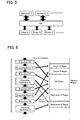
- Fig. 5 is a configuration diagram of a program installed in an apparatus.
- respective programs such as applications A, B, ... , drivers A, B, C, ... , or the like are managed by the OS.
- Fig. 6 is a typical diagram of program execution conditions.
- the plurality of programs to be executed are memorized in a memory (RAM) in the apparatus.
- the CPU accesses to a memory region corresponding to the program to be executed, and reads out the program to be executed.
- RAM memory
- the CPU accesses to a memory region corresponding to the program to be executed, and reads out the program to be executed.
- readout of another program is possible by execution of a certain program by rewriting of the certain program (arrow of a waved line in the drawing).
- an access violation of the program is monitored by the access monitor which is a hardware.
- the access monitor acquires a signal input from the CPU to a memory.
- the access monitor includes an access permission table as information of the memory region to be permitted to each program, and detects the access violation of the signal from the CPU by referring thereto. In this manner, the unjust access is monitored by the hardware, thereby preventing the unjust access by rewriting in software.
- the access monitor according to the present invention for attaining the aforesaid objects is, for example, one for monitoring an access between programs in an apparatus including a CPU and a memory storing each of the plurality of programs to be executed thereby.
- the access monitor comprises a table for storing access permission information including information concerning a region of the memory, which is permitted to access in each program; and a detector for acquiring a signal output from the CPU to the memory and for detecting an unjust access of a program executed by the CPU by monitoring the address included in the signal from the CPU based on the access permission information corresponding to the program executed by the CPU, the access permission information being established by a predetermined managing program in advance.
- the detector when the detector detects the unjust access, the detector causes the CPU to occur an interruption and the CPU executes an interruption processing by the managing program.
- the access monitor comprises a data storing unit, wherein, when the detector detects the unjust access, the detector writes information corresponding to the unjust access into the data storing unit, and the CPU executes the interruption processing corresponding to information written into the data storing unit.
- the program to be executed by the CPU writes an end of such program into the data storing unit, and when the detector detects that the end of the program is written into the data storing unit, the detector causes the CPU an interruption.
- the detector switches the established access permission information to the access permission information corresponding to the managing program in the case of occurring the interruption in the CPU.
- the managing program can access to all regions of the memory, and further the managing program is stored in the memory as rewriting disable, and the other programs other than the managing program are accessible to a storage region of the managing program.
- the access permission information has the information concerning read and/or write permission corresponding to the region of the memory, and when the detector detects the unjust access, the detector cut off a read signal and/or a write signal to be output from the CPU to the memory based on the access permission information.
- the access permission information has information concerning permission of instruction execution and/or data access corresponding to the region of the memory, and when the detector detects an unjust access, the detector cut off an instruction signal and/or data access signal to be output from the CPU to the memory based on the access permission information.
- the access monitoring method for attaining the aforesaid objects is, for example, one for monitoring an access between programs in an apparatus including a CPU and a memory storing each of the plurality of programs to be executed thereby.
- the access monitoring method comprises the steps of: preparing access permission information including information concerning a region of the memory, which is permitted to access in each program; establishing, by a predetermined managing program, the access permission information corresponding to the program to be executed by the CPU; acquiring an access signal to be output from the CPU to the memory; and detecting the unjust access of the program to be executed by the CPU by monitoring the region of the memory corresponding to the access signal from the CPU based on the established access permission information.
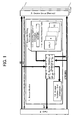
- Fig. 1 is a configuration diagram of an access monitor according to the embodiment of the present invention. According to the present invention, an unjust access to another program memorized in a memory region by execution of a certain program is detected by a hardware, namely an access monitor 1 in Fig. 1, thereby ensuring absolutely an isolation between the respective programs.
- a CPU 2 outputs various signals (an address signal AD, a data signal DT, a strobe signal (a read signal, a write signal, an instruction signal, a data access signal, or the like), STROBES, or the like) to a device group 3 which is accessed by a CPU 2 such as an inner memory, a register, an external device, or the like (hereinafter representatively referred to as a memory).
- the access monitor 1 monitors a signal output from the CPU 2.
- the access monitor 1 contains access monitoring information 11, an access violation detector 12, and access violation/end information 13.
- the access monitoring information 11 and access violation/end information 13 are stored in a register built in the access monitor 1, for example.
- the access monitoring information 11 contains presently executing application information 111, and an information table of an access permission region (hereinafter referred to as an access permission table) 112.
- the presently executing application information 111 contains an identification number for identifying each program, as described later.
- the access permission table 112 contains information of the access permission region corresponding to each application.
- the access violation detector 12 is constituted by a comparator or the like, and as described below, a signal to be output from the CPU 2 (an address signal, a strobe signal, or the like) is monitored based on the access monitoring information 11.
- access violation detector 12 detects an end of each program, or an access violation
- access violation information and program end information are written into the register (data storing unit) as the access violation/end information 13, and also an interruption (INT) is caused to the CPU 2.
- Fig. 2A and 2B are diagrams for explaining a configuration of a program installed in the access monitor according to the embodiment of the present invention.
- the monitor 1 according to the embodiment of the present invention further installs an application manager (managing program) as a program for managing the access monitoring information (the presently executing application information 111 and access permission table 112) 11, and the access violation/end information 13.
- the application manager manages a start and end of each application.
- an identifier of each program is allocated to each program.
- the identification number is defined as shown in Fig. 2B. Namely, OS, the application manager, a driver, a handler, etc. are allocated to the identification number "0".
- the identification number "0" is a special number, and in the program of the identification number "0", an access to all the regions in the inner memory 3 is permitted. Accordingly, in the above access permission table 112, the table corresponding to the identification number "0" is not necessary.
- Fig. 3 is a diagram for explaining a region of an inner memory according to the embodiment of the present invention.
- the region A is a region to which the program of the identification number "0" can access, and the OS, etc. is memorized.
- the region B is a region to which all the applications of the identification numbers "1" to “15” can access, and the application manager is memorized.
- the application manager rewrites the presently executing application information 111 of the access monitoring information 11 from the identification number "0" to an identification number of the application to be activated. At this time, as this rewriting is performed prior to transfer of a processing to the application to be activated, such inconveniences are caused that the rewriting is performed, and simultaneously the processing by the application manager of the identification number "0" is detected as the access violation.
- the application manager is stored in the region B where the programs of all the identification numbers are accessible. Namely, a rewriting routine of the identification number is effected in the region where all programs are accessible. Accordingly, the respective access permission tables 112 corresponding to the application of the identification numbers "1" to "15" have address information of the region B as well as the region (for example, regions D, E of Fig. 3) corresponding to each application. Furthermore, since it is prevented that the application manager is unjustly rewritten, the application manager is written into an inner ROM which is disabled to rewrite.
- the region C is, for example, a use region of a driver, a handler, etc., and the program of the identification number "0" is accessible. Furthermore, the regions D, E are use regions of applications 1, 2, respectively, and the programs of the respective identification numbers and the identification number "0" are accessible.
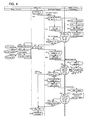
- Fig. 4 is a diagram showing a flowchart of an access control processing according to the embodiment of the present invention.
- a start and end of the application of the identification number "1" (hereinafter merely referred to as application 1) will be explained.
- an "activation request for the application 1" is issued from the OS to the application manager (S20). Then, the application manager rewrites the presently executing application information 111 of the access monitoring information 11 from the identification number "0" to "1" (S30). Thus, the access violation detector 12 selects the access permission table 112 corresponding to the application 1, and monitors various access signals from the CPU 2. When the application manager rewrites the presently executing application information 111, it calls out the application 1 (S31).
- the application 1 is activated (S50) (arrow 1 ⁇ of Fig. 3), and a processing of the application 1 is executed (S51).
- the execution of the application 1 is shown by arrow2 ⁇ of Fig. 3.
- S52 an interruption processing starts as explained next.
- the interruption processing is not limited to the use demand of the demand, but is executed even by an end of application in the case where the application 1 is merely desired to end.
- the application 1 writes interruption information into the access violation/end information 13 of the monitor 1 (S53).
- the interruption information contains an interruption factor (device use demand, application end, access violation, or the like).
- the access violation detector 12 also always monitors the access violation/end information 13. When the access violation detector 12 detects that the interruption information is written, it causes an interruption (INT) for the CPU 2, it further rewrites the presently executing application information 111 of the access monitoring information 11 from the identification number "1" to "0" (S40).
- the CPU 2 executes an interruption routine of an interruption table region in the region A of Fig. 3 (arrow 3 ⁇ of Fig. 3), and transfers the processing to the application manager (arrow 4 ⁇ of Fig. 3).
- the application manager analyzes the interruption information in the access violation/end information 13, and judges the interruption factor (S32).
- the application manager transfers the processing to the OS, the OS calls out the device (device call) (S21).
- the handler corresponding to the device activates (S10), and the access processing to the device is executed (S11).
- the handler is ended (S12)
- the processing is again transferred to the application manager by way of the OS.
- the application manager rewrites the presently executing application information 111 from the identification number "0" to "1" in the same manner as in steps S30 and S31, and calls out the application 1 (S34).
- the processing of the application 1 restarts (S54).
- the access violation detector 12 detects an access violation (unjust access) (S55). When the access violation detector 12 detects the access violation, it writes an access violation factor into the access violation/end information 13 as the interruption information, and also causes the interruption (INT) for the CPU 2.
- the access violation detector 12 includes an access control table in which a plurality of access violation factors are established, and determines the access violation factor corresponding to the access violation detected with reference thereto.
- the access violation detector 12 causes the interruption, and also similar to step S40, it rewrites the presently executing application information 111 of the access monitoring information 11 from the identification number "1" to "0" (S41). Similar to the above, when the interruption occurs, the CPU 2 executes the interruption routine of the interruption table region in the region A of Fig. 3 (arrow 5 ⁇ of Fig. 3), and transfers the processing to the application manager (arrow 4 ⁇ of Fig. 3).
- the application manager analyzes the access violation factor in the access violation/end information 13, and judges the interruption factor (S35). Corresponding to the type of access violation factor, the different processing may be established. For example, the application manager again rewrites the presently executing application information 111 from the identification number "0" to "1" (S36), and calls out the application 1 (S37). At this time, the application manager notifies the application 1 of an error. Thus, the application 1 is ended (S56). At this time, the application 1 writes the interruption information corresponding to the application end into the access violation/end information 13 of the monitor 1 (S57).
- the access violation detector 12 When the access violation detector 12 detects that the interruption information is written, it causes the interruption (INT) for the CPU 2, and further rewrites the presently executing application information 111 of the access monitoring information 11 from the identification number "1" to "0" (S42).
- the application manager analyzes the interruption factor (S38), and in the case where the interruption factor is an application end, as the application has already been ended, the processing returns to the OS (S23).
- the application is not ended during the application 1 corresponding to the interruption factor judged at step S35, but a processing of deleting a task of the application may be performed (KILL processing) (S22).
- the access monitor 1 monitors the access violation of the program in a hardware manner.
- the access monitor 1 includes an access permission table as the information of the memory region permitted in each program, and detects the access violation with reference thereto. Accordingly, it is possible to prevent the unjust access by rewriting of the program, etc.
- the application manager for controlling the access permission table in each program writes into the inner ROM, the rewriting of the application manager is impossible. Accordingly, the unjust access by the rewriting of the access permission table is prevented, and it is realized that the unjust access between the programs is absolutely ensured.
- the program establishing the access permission table is limited to the access to the inner memory, etc. by the access permission table.
- the interruption is automatically occurred in the CPU 2 by the access monitor 1 as a hardware.
- the processing of the CPU 2 is compulsorily transferred to the processing corresponding to the access violation by the application manager.
- the program establishing the access permission table utilizes the interruption for both the end and device use demand (device request).
- predetermined information is written to the register 13 of the access monitor 1, so that the access monitor 1 causes the CPU 2 to occur the interruption.
- the device use demand processing and program end processing by the application manager are executed. This is because, since a change of the presently executing program is recognized to the access monitor 1, it is necessary that the identification number in the presently executing program information 111 in the access monitor 1 is changed by the application manager.
- the region of the register for storing the access monitoring information 11 or access violation/end information 13 is designed to be a region where only the program of the identification number "0" (in particular, application manager) is accessible. This is because it is prevented that the application of another identification number rewrites unjustly its own identification number.
- the access monitor 1 monitors an address signal from the CPU 2 as well as a strobe signal (a read signal, a write signal, an instruction signal, a data access signal, etc.). Access conditions as well as the access permission region are established in the access permission table.
- the access conditions are, for example, a read enable/disable and a write enable/disable with respect to the predetermined memory region, the read and write being both the enable/disable.
- the access conditions are an enable/disable of an instruction execution and an enable/disable of a data access with respect to the predetermined memory region, and the instruction execution and data access are both the enable/disable.
- a gate 4 of a strobe line may be closed, thereby preventing the unjust access .
- the strobe line is cut off physically, and the strobe signal is not reached the inner memory 3, so that it is possible to prevent the unjust access.
- the access monitor 1 causes the CPU 2 to occur the interruption (of course, may cause to occur).
- the driver, handler, or the like is established as the same identification number "0" with the application manager, and OS, but a number excluding the identification number "0" may be imparted in the same manner as in the application.
- a different number from the application is imparted.
- the identification numbers of the application manager and OS are not required to be "0", but have only to differ from the identification number of the application.
- the device (memory, etc.) enables a high-speed data transfer not via the CPU by the DMA transfer. Namely, as the DMA transfer is made outside control of the CPU, in the DMA transfer, a signal from the CPU to the device is not output, and the access monitor according to the present invention cannot monitor the unjust access in the DMA transfer. According to this embodiment, in the case of the DMA transfer, the unjust access is monitored by a DMA control handler (control program) set to be an application level 0.
- a DMA control handler control program
- Fig. 7 shows a flowchart of an access control processing according to another embodiment of the present invention.
- the application manager In the case where the application X is activated, first, a "start request for application X" from the OS to the application manager is issued (S120). Then, the application manager rewrites the presently executing application information 111 of the access monitoring information 11 from the identification number "0" to "X" (S130). Thus, the access violation detector 12 selects the access permission table 112 corresponding to the application X, and monitors various access signals from the CPU 2. After the application manager rewrites the presently executing application information 111, it calls out the application X (S131).
- the application X is activated (S150), and during the processing of the application X, for example, data writing is effected into the access permission region of the application 1 of the memory 3 (S151), and when the DMA demand of the data is occurred (S152), and the interruption processing described in Fig. 4 starts.
- the application X writes into the access violation/end information 13 of the monitor 1 with a DMA request system call corresponding to the DMA demand as the interruption information (S153).
- the DMA request system call has parameters such as a transferor heading address, a transferee heading address, transfer data ranges, and the like.
- the application manager analyzes the interruption information in the access violation/end information 13, and judges the interruption factor (S132). According to this embodiment, as the interruption factor is a DMA demand, the application manager transfers the processing to the OS, and the OS activates the DMA control handler (S121).
- the activated DMA control handler refers to the access permission table 112 of the access violation monitor 1, and judges the unjust access in the parameters included in the DMA request system call (S110).
- the memory region up to the transferor heading address to such heading address + the transfer data ranges is a read permission region of the application X, and further whether or not (2) the memory region up to the transferor heading address to such heading address + the transfer data ranges is a write permission region of the application X.
- the OS receives an unjust access notice (S122), and further, the OS transfers the unjust access notice to the application manager, and transfers the processing to the application manager.
- the application manager rewrites the presently executing application information 111 from the identification number "0" to "X" (S133), and calls out the application X again (S134). At this time, the application manager notifies the application X of an error. Thus, the application X performs an end processing (S154). At this time, the application X writes an EXIT request system call corresponding to the application end into the access violation/end information 13 of the monitor 1, as the interruption information (S155). When the access violation detector 12 detects that the interruption information is written, it causes the interruption (INT) to the CPU 2, and further, rewrites the presently executing application information 111 of the access monitoring information 11 from the identification number "X" to "0" (S141). When the interruption occurs, as described above, the application manager analyzes the interruption factor (S135). According to this embodiment, as the interruption factor is an application end, the OS performs the application EXIT processing (S123), and transfers to a next task processing (S124).
- step S110 in the case where the access is unjust, the DMA control handler issues a DMA instruction (S111), and executes the DMA transfer.
- the OS receives a DMA completion notice (S125). Furthermore, the OS transfers the DMA completion notice to the application manager, and transfers the processing to the application manager.
- the application manager rewrites the presently executing application information 111 from the identification number "0" to "X" (S136), and calls out the application X again (S137). Thus, the processing of the application X is continued (S156).
- the DMA control handler checks the access region with respect to the DMA demand of the activating application, and detects the unjust access.
- the apparatus including the CPU and the plurality of programs to be executed thereby, it is possible to prevent the unjust access between the programs, so that security of the apparatus is enhanced.
Landscapes
- Engineering & Computer Science (AREA)
- Theoretical Computer Science (AREA)
- Computer Security & Cryptography (AREA)
- Physics & Mathematics (AREA)
- General Engineering & Computer Science (AREA)
- General Physics & Mathematics (AREA)
- Computer Hardware Design (AREA)
- Software Systems (AREA)
- Mathematical Physics (AREA)
- Storage Device Security (AREA)
- Debugging And Monitoring (AREA)
Applications Claiming Priority (4)
| Application Number | Priority Date | Filing Date | Title |
|---|---|---|---|
| JP2000066885 | 2000-03-10 | ||
| JP2000066885 | 2000-03-10 | ||
| JP2000196621 | 2000-06-29 | ||
| JP2000196621A JP4522548B2 (ja) | 2000-03-10 | 2000-06-29 | アクセス監視装置及びアクセス監視方法 |
Publications (2)
| Publication Number | Publication Date |
|---|---|
| EP1132801A2 true EP1132801A2 (de) | 2001-09-12 |
| EP1132801A3 EP1132801A3 (de) | 2005-06-29 |
Family
ID=26587205
Family Applications (1)
| Application Number | Title | Priority Date | Filing Date |
|---|---|---|---|
| EP01400619A Withdrawn EP1132801A3 (de) | 2000-03-10 | 2001-03-09 | Zugangsmonitor und Zugangskontrollverfahren |
Country Status (3)
| Country | Link |
|---|---|
| US (1) | US7039779B2 (de) |
| EP (1) | EP1132801A3 (de) |
| JP (1) | JP4522548B2 (de) |
Cited By (10)
| Publication number | Priority date | Publication date | Assignee | Title |
|---|---|---|---|---|
| EP1311134A3 (de) * | 2001-11-08 | 2003-11-05 | Nec Corporation | Programmausführungsverfahren in einem Dienstsystem und Programmausführungsgerät dafür |
| WO2004090731A3 (de) * | 2003-04-04 | 2004-12-23 | Infineon Technologies Ag | Programmgesteuerte einheit |
| FR2897175A1 (fr) * | 2006-02-09 | 2007-08-10 | Atmel Corp | Appareil et procede pour la detection, et la recuperation depuis, un acces inapproprie au bus dans le domaine technique des circuits microcontroleurs |
| EP1764721A3 (de) * | 2005-09-15 | 2007-12-05 | NTT DoCoMo INC. | Vorrichtung und Verfahren zur Zugriffskontrolle auf einen externen Speicher |
| GB2441216A (en) * | 2006-08-21 | 2008-02-27 | Chris J Newburn | Monitoring accesses to a region of memory |
| EP1939753A1 (de) * | 2006-12-20 | 2008-07-02 | St Microelectronics S.A. | Schutz von Speicherbereichen |
| EP1942417A1 (de) * | 2006-12-20 | 2008-07-09 | St Microelectronics S.A. | Schutzschaltung für Speicherbereiche |
| DE10297687B4 (de) * | 2002-03-27 | 2008-11-13 | Advanced Micro Devices, Inc., Sunnyvale | Prozessor mit Eingabe/Ausgabeerlaubnisbitstrukturen für in Bereiche aufgeteilte Sicherheit und Verfahren zum selektiven Ausführen einer Eingabe/Ausgabe-Instruktion |
| WO2009018483A1 (en) * | 2007-07-31 | 2009-02-05 | Viasat, Inc. | Input output access controller |
| EP2851804A1 (de) * | 2013-09-20 | 2015-03-25 | Fujitsu Limited | Arithmetische Verarbeitungsvorrichtung, Informationsverarbeitungsvorrichtung, Steuerverfahren für die Informationsverarbeitungsvorrichtung und Steuerprogramm für die Informationsverarbeitungsvorrichtung |
Families Citing this family (28)
| Publication number | Priority date | Publication date | Assignee | Title |
|---|---|---|---|---|
| KR100525537B1 (ko) * | 2000-12-28 | 2005-11-02 | 엘지전자 주식회사 | 인터럽트를 이용한 응용 프로그램의 에러검출장치 및 방법. |
| US20040064723A1 (en) * | 2001-10-31 | 2004-04-01 | Barnes Brian C. | Method and apparatus for physical address-based security to determine target security |
| US7698522B1 (en) | 2002-01-11 | 2010-04-13 | Global Foundries | Method and apparatus for linear address based page level security scheme to determine current security context |
| US7739498B2 (en) * | 2002-01-15 | 2010-06-15 | GlobalFoundries, Inc. | Method and apparatus for multi-table accessing of input/output devices using target security |
| AU2003901454A0 (en) * | 2003-03-28 | 2003-04-10 | Secure Systems Limited | Security system and method for computer operating systems |
| DE10315727A1 (de) * | 2003-04-04 | 2004-10-28 | Infineon Technologies Ag | Programmgesteuerte Einheit |
| DE10315726A1 (de) * | 2003-04-04 | 2004-11-04 | Infineon Technologies Ag | Programmgesteuerte Einheit |
| DE10315638A1 (de) * | 2003-04-04 | 2004-10-28 | Infineon Technologies Ag | Programmgesteuerte Einheit |
| US20050144408A1 (en) * | 2003-12-24 | 2005-06-30 | Kenji Ejima | Memory protection unit, memory protection method, and computer-readable record medium in which memory protection program is recorded |
| JP4563707B2 (ja) * | 2004-03-25 | 2010-10-13 | ルネサスエレクトロニクス株式会社 | メモリ保護装置 |
| JP4717381B2 (ja) | 2004-06-11 | 2011-07-06 | 株式会社エヌ・ティ・ティ・ドコモ | 移動機、及び、アクセス制御方法 |
| JP5069406B2 (ja) * | 2004-07-23 | 2012-11-07 | テキサス インスツルメンツ インコーポレイテッド | 計算機システム内のセキュリティ侵害を識別して防ぐためのシステムと方法 |
| US7802110B2 (en) * | 2004-08-25 | 2010-09-21 | Microsoft Corporation | System and method for secure execution of program code |
| US7457926B2 (en) | 2005-05-18 | 2008-11-25 | International Business Machines Corporation | Cache line replacement monitoring and profiling |
| JP4698285B2 (ja) | 2005-05-19 | 2011-06-08 | 富士通株式会社 | 情報処理装置、情報処理方法及びコンピュータプログラム |
| US20060294596A1 (en) * | 2005-06-27 | 2006-12-28 | Priya Govindarajan | Methods, systems, and apparatus to detect unauthorized resource accesses |
| EP2120178A4 (de) * | 2007-02-08 | 2010-12-08 | Nec Corp | Zugangskontrollsystem, zugangskontrollverfahren, elektronische anordnung und steuerprogramm |
| JP5460133B2 (ja) * | 2009-06-09 | 2014-04-02 | ラピスセミコンダクタ株式会社 | マイクロコントローラ装置 |
| US8880827B2 (en) * | 2009-10-15 | 2014-11-04 | Fts Computertechnik Gmbh | Method for executing security-relevant and non-security-relevant software components on a hardware platform |
| WO2011111223A1 (ja) * | 2010-03-12 | 2011-09-15 | 三菱電機株式会社 | エレベータ安全制御装置 |
| US8572345B2 (en) * | 2011-09-16 | 2013-10-29 | Freescale Semiconductor, Inc. | Memory management unit (MMU) having region descriptor globalization controls and method of operation |
| JP5975811B2 (ja) * | 2012-09-12 | 2016-08-23 | レノボ・エンタープライズ・ソリューションズ(シンガポール)プライベート・リミテッド | 計測した信号トレースデータのインテグリティ・チェック |
| JP5842833B2 (ja) * | 2013-01-17 | 2016-01-13 | トヨタ自動車株式会社 | 情報処理装置、プログラム |
| US10764129B2 (en) * | 2017-04-18 | 2020-09-01 | Amazon Technologies, Inc. | Logic repository service supporting adaptable host logic |
| KR102120044B1 (ko) * | 2017-11-28 | 2020-06-09 | 현대오트론 주식회사 | 복수의 소프트웨어 레벨을 포함하는 컨트롤러 및 그 동작 방법 |
| JP7050587B2 (ja) * | 2018-06-11 | 2022-04-08 | 三菱電機株式会社 | 違反依存検出装置および違反依存検出プログラム |
| JP2023118375A (ja) * | 2022-02-15 | 2023-08-25 | 日本電気株式会社 | 障害監視装置、情報処理システム、障害監視方法およびプログラム |
| JP7761329B1 (ja) * | 2025-06-26 | 2025-10-28 | Gx株式会社 | 情報処理装置、情報処理方法、及び、プログラム |
Family Cites Families (15)
| Publication number | Priority date | Publication date | Assignee | Title |
|---|---|---|---|---|
| JPS5140772B2 (de) | 1971-07-26 | 1976-11-05 | ||
| US4442484A (en) | 1980-10-14 | 1984-04-10 | Intel Corporation | Microprocessor memory management and protection mechanism |
| US4519032A (en) * | 1982-06-09 | 1985-05-21 | At&T Bell Laboratories | Memory management arrangement for microprocessor systems |
| US4729094A (en) * | 1983-04-18 | 1988-03-01 | Motorola, Inc. | Method and apparatus for coordinating execution of an instruction by a coprocessor |
| US4890223A (en) * | 1986-01-15 | 1989-12-26 | Motorola, Inc. | Paged memory management unit which evaluates access permissions when creating translator |
| JPS63250753A (ja) * | 1987-04-07 | 1988-10-18 | Fujitsu Ltd | メモリアクセスチエツク方式 |
| US4985825A (en) * | 1989-02-03 | 1991-01-15 | Digital Equipment Corporation | System for delaying processing of memory access exceptions until the execution stage of an instruction pipeline of a virtual memory system based digital computer |
| EP0481735A3 (en) * | 1990-10-19 | 1993-01-13 | Array Technology Corporation | Address protection circuit |
| US5557771A (en) * | 1990-12-01 | 1996-09-17 | Hitachi, Ltd. | Data processing system and storage device and auxiliary memory bits for controlling data protection in the storage device |
| DE4115152C2 (de) * | 1991-05-08 | 2003-04-24 | Gao Ges Automation Org | Kartenförmiger Datenträger mit einer datenschützenden Mikroprozessorschaltung |
| FR2683357A1 (fr) | 1991-10-30 | 1993-05-07 | Philips Composants | Microcircuit pour carte a puce a memoire programmable protegee. |
| US5627987A (en) * | 1991-11-29 | 1997-05-06 | Kabushiki Kaisha Toshiba | Memory management and protection system for virtual memory in computer system |
| US6151618A (en) * | 1995-12-04 | 2000-11-21 | Microsoft Corporation | Safe general purpose virtual machine computing system |
| US5987557A (en) | 1997-06-19 | 1999-11-16 | Sun Microsystems, Inc. | Method and apparatus for implementing hardware protection domains in a system with no memory management unit (MMU) |
| JPH11120300A (ja) * | 1997-10-09 | 1999-04-30 | Fujitsu Ltd | 可搬型カード媒体,可搬型カード媒体のメモリ空間管理方法,可搬型カード媒体の発行方法および可搬型カード媒体のプログラムデータ書込方法並びにメモリ空間管理プログラムが記録されたコンピュータ読取可能な記録媒体 |
-
2000
- 2000-06-29 JP JP2000196621A patent/JP4522548B2/ja not_active Expired - Fee Related
- 2000-12-20 US US09/739,885 patent/US7039779B2/en not_active Expired - Fee Related
-
2001
- 2001-03-09 EP EP01400619A patent/EP1132801A3/de not_active Withdrawn
Cited By (18)
| Publication number | Priority date | Publication date | Assignee | Title |
|---|---|---|---|---|
| EP1311134A3 (de) * | 2001-11-08 | 2003-11-05 | Nec Corporation | Programmausführungsverfahren in einem Dienstsystem und Programmausführungsgerät dafür |
| US7228435B2 (en) | 2001-11-08 | 2007-06-05 | Nec Corporation | Program executing method in service system and program executing apparatus for the same |
| DE10297687B4 (de) * | 2002-03-27 | 2008-11-13 | Advanced Micro Devices, Inc., Sunnyvale | Prozessor mit Eingabe/Ausgabeerlaubnisbitstrukturen für in Bereiche aufgeteilte Sicherheit und Verfahren zum selektiven Ausführen einer Eingabe/Ausgabe-Instruktion |
| WO2004090731A3 (de) * | 2003-04-04 | 2004-12-23 | Infineon Technologies Ag | Programmgesteuerte einheit |
| EP1764721A3 (de) * | 2005-09-15 | 2007-12-05 | NTT DoCoMo INC. | Vorrichtung und Verfahren zur Zugriffskontrolle auf einen externen Speicher |
| US8132262B2 (en) | 2005-09-15 | 2012-03-06 | Ntt Docomo, Inc. | External memory management apparatus and external memory management method |
| US8316017B2 (en) | 2006-02-09 | 2012-11-20 | Atmel Corporation | Apparatus and method for the detection of and recovery from inappropriate bus access in microcontroller circuits |
| FR2897175A1 (fr) * | 2006-02-09 | 2007-08-10 | Atmel Corp | Appareil et procede pour la detection, et la recuperation depuis, un acces inapproprie au bus dans le domaine technique des circuits microcontroleurs |
| GB2441216B (en) * | 2006-08-21 | 2009-08-26 | Chris J Newburn | Data processing system for monitoring accesses to memory |
| US7769964B2 (en) | 2006-08-21 | 2010-08-03 | Intel Corporation | Technique to perform memory reference filtering |
| GB2441216A (en) * | 2006-08-21 | 2008-02-27 | Chris J Newburn | Monitoring accesses to a region of memory |
| EP1942417A1 (de) * | 2006-12-20 | 2008-07-09 | St Microelectronics S.A. | Schutzschaltung für Speicherbereiche |
| EP1939753A1 (de) * | 2006-12-20 | 2008-07-02 | St Microelectronics S.A. | Schutz von Speicherbereichen |
| WO2009018483A1 (en) * | 2007-07-31 | 2009-02-05 | Viasat, Inc. | Input output access controller |
| US8312292B2 (en) | 2007-07-31 | 2012-11-13 | Viasat, Inc. | Input output access controller |
| US8392983B2 (en) | 2007-07-31 | 2013-03-05 | Viasat, Inc. | Trusted labeler |
| EP2851804A1 (de) * | 2013-09-20 | 2015-03-25 | Fujitsu Limited | Arithmetische Verarbeitungsvorrichtung, Informationsverarbeitungsvorrichtung, Steuerverfahren für die Informationsverarbeitungsvorrichtung und Steuerprogramm für die Informationsverarbeitungsvorrichtung |
| US9442836B2 (en) | 2013-09-20 | 2016-09-13 | Fujitsu Limited | Arithmetic processing device, information processing device, control method for information processing device, and control program for information processing device |
Also Published As
| Publication number | Publication date |
|---|---|
| EP1132801A3 (de) | 2005-06-29 |
| JP2001325150A (ja) | 2001-11-22 |
| US7039779B2 (en) | 2006-05-02 |
| JP4522548B2 (ja) | 2010-08-11 |
| US20010021966A1 (en) | 2001-09-13 |
Similar Documents
| Publication | Publication Date | Title |
|---|---|---|
| EP1132801A2 (de) | Zugangsmonitor und Zugangskontrollverfahren | |
| US6535976B1 (en) | Initial program load in data processing network | |
| US5748940A (en) | Secure updating of non-volatile memory | |
| US8533845B2 (en) | Method and apparatus for controlling operating system access to configuration settings | |
| KR100316981B1 (ko) | 플래시 메모리를 구비한 마이크로컴퓨터 및 플래시 메모리에 프로그램을 저장하는 방법 | |
| US9946600B2 (en) | Method of detecting power reset of a server, a baseboard management controller, and a server | |
| JP2001256460A (ja) | 1チップマイクロコンピュータ及びそれを用いたicカード | |
| UA55438C2 (uk) | Спосіб контролю приписаного виконання програм | |
| US11150884B1 (en) | Device driver update images | |
| US7281163B2 (en) | Management device configured to perform a data dump | |
| CN114721493B (zh) | 芯片启动方法、计算机设备及可读存储介质 | |
| US7657732B2 (en) | Apparatus and method for securely and conveniently rebooting a computer system | |
| US6697971B1 (en) | System and method for detecting attempts to access data residing outside of allocated memory | |
| JP2010033576A (ja) | バイオスの更新を行う電子機器及び方法 | |
| US7228569B2 (en) | Programmable unit | |
| JP2005316599A (ja) | 割込制御装置 | |
| US10895865B2 (en) | Numerical controller | |
| US7818625B2 (en) | Techniques for performing memory diagnostics | |
| KR101305502B1 (ko) | 컴퓨터 시스템 및 그 제어 방법 | |
| CN120276790B (zh) | 固件切换方法、装置、设备及存储介质 | |
| JP7079558B2 (ja) | Spiフラッシュ用安全装置 | |
| US7478207B2 (en) | Control system with a write filter for protection of data | |
| US7418542B2 (en) | Rewritable, nonvolatile memory, electronic device, method of rewriting rewritable, nonvolatile memory, and storage medium having stored thereon rewrite program | |
| US20050027954A1 (en) | Method and apparatus to support the maintenance and reduction of FLASH utilization as it pertains to unused or infrequently referenced FLASH data | |
| KR100996167B1 (ko) | 전자제어유니트의 메모리 프로그램방법 |
Legal Events
| Date | Code | Title | Description |
|---|---|---|---|
| PUAI | Public reference made under article 153(3) epc to a published international application that has entered the european phase |
Free format text: ORIGINAL CODE: 0009012 |
|
| AK | Designated contracting states |
Kind code of ref document: A2 Designated state(s): AT BE CH CY DE DK ES FI FR GB GR IE IT LI LU MC NL PT SE TR |
|
| AX | Request for extension of the european patent |
Free format text: AL;LT;LV;MK;RO;SI |
|
| PUAL | Search report despatched |
Free format text: ORIGINAL CODE: 0009013 |
|
| AK | Designated contracting states |
Kind code of ref document: A3 Designated state(s): AT BE CH CY DE DK ES FI FR GB GR IE IT LI LU MC NL PT SE TR |
|
| AX | Request for extension of the european patent |
Extension state: AL LT LV MK RO SI |
|
| 17P | Request for examination filed |
Effective date: 20050602 |
|
| AKX | Designation fees paid |
Designated state(s): DE FR GB |
|
| 17Q | First examination report despatched |
Effective date: 20060221 |
|
| GRAP | Despatch of communication of intention to grant a patent |
Free format text: ORIGINAL CODE: EPIDOSNIGR1 |
|
| RIC1 | Information provided on ipc code assigned before grant |
Ipc: G06F 21/02 20060101AFI20090612BHEP |
|
| STAA | Information on the status of an ep patent application or granted ep patent |
Free format text: STATUS: THE APPLICATION IS DEEMED TO BE WITHDRAWN |
|
| 18D | Application deemed to be withdrawn |
Effective date: 20091107 |