EP1133206B1 - Production et enregistrement de rappel pour des utilisateurs mobile - Google Patents
Production et enregistrement de rappel pour des utilisateurs mobile Download PDFInfo
- Publication number
- EP1133206B1 EP1133206B1 EP01301269A EP01301269A EP1133206B1 EP 1133206 B1 EP1133206 B1 EP 1133206B1 EP 01301269 A EP01301269 A EP 01301269A EP 01301269 A EP01301269 A EP 01301269A EP 1133206 B1 EP1133206 B1 EP 1133206B1
- Authority
- EP
- European Patent Office
- Prior art keywords
- reminder
- user
- voice reminder
- data
- Prior art date
- Legal status (The legal status is an assumption and is not a legal conclusion. Google has not performed a legal analysis and makes no representation as to the accuracy of the status listed.)
- Expired - Lifetime
Links
- 238000000034 method Methods 0.000 claims description 25
- 230000003213 activating effect Effects 0.000 claims description 3
- 230000001755 vocal effect Effects 0.000 description 7
- 238000004891 communication Methods 0.000 description 5
- 230000005540 biological transmission Effects 0.000 description 4
- 230000001413 cellular effect Effects 0.000 description 4
- 238000010586 diagram Methods 0.000 description 4
- 238000005516 engineering process Methods 0.000 description 2
- 230000006870 function Effects 0.000 description 2
- 230000001960 triggered effect Effects 0.000 description 2
- 235000006508 Nelumbo nucifera Nutrition 0.000 description 1
- 240000002853 Nelumbo nucifera Species 0.000 description 1
- 235000006510 Nelumbo pentapetala Nutrition 0.000 description 1
- 238000010295 mobile communication Methods 0.000 description 1
- 230000011664 signaling Effects 0.000 description 1
- 230000002459 sustained effect Effects 0.000 description 1
Images


Classifications
-
- H—ELECTRICITY
- H04—ELECTRIC COMMUNICATION TECHNIQUE
- H04W—WIRELESS COMMUNICATION NETWORKS
- H04W88/00—Devices specially adapted for wireless communication networks, e.g. terminals, base stations or access point devices
- H04W88/02—Terminal devices
-
- H—ELECTRICITY
- H04—ELECTRIC COMMUNICATION TECHNIQUE
- H04L—TRANSMISSION OF DIGITAL INFORMATION, e.g. TELEGRAPHIC COMMUNICATION
- H04L51/00—User-to-user messaging in packet-switching networks, transmitted according to store-and-forward or real-time protocols, e.g. e-mail
- H04L51/06—Message adaptation to terminal or network requirements
- H04L51/066—Format adaptation, e.g. format conversion or compression
-
- H—ELECTRICITY
- H04—ELECTRIC COMMUNICATION TECHNIQUE
- H04M—TELEPHONIC COMMUNICATION
- H04M1/00—Substation equipment, e.g. for use by subscribers
- H04M1/72—Mobile telephones; Cordless telephones, i.e. devices for establishing wireless links to base stations without route selection
- H04M1/724—User interfaces specially adapted for cordless or mobile telephones
- H04M1/72403—User interfaces specially adapted for cordless or mobile telephones with means for local support of applications that increase the functionality
- H04M1/7243—User interfaces specially adapted for cordless or mobile telephones with means for local support of applications that increase the functionality with interactive means for internal management of messages
-
- H—ELECTRICITY
- H04—ELECTRIC COMMUNICATION TECHNIQUE
- H04L—TRANSMISSION OF DIGITAL INFORMATION, e.g. TELEGRAPHIC COMMUNICATION
- H04L51/00—User-to-user messaging in packet-switching networks, transmitted according to store-and-forward or real-time protocols, e.g. e-mail
-
- H—ELECTRICITY
- H04—ELECTRIC COMMUNICATION TECHNIQUE
- H04W—WIRELESS COMMUNICATION NETWORKS
- H04W4/00—Services specially adapted for wireless communication networks; Facilities therefor
- H04W4/12—Messaging; Mailboxes; Announcements
Definitions
- the present invention relates to the generation of verbal reminders whilst mobile and, in particular, but not exclusively, to a service system for handling such reminders.
- Figure 1 shows one form of known communication infrastructure for mobile users providing both telephony and data-bearer services.
- a mobile entity 20 provided with a radio subsystem 22 and a phone subsystem 23, communicates with the fixed infrastructure of GSM PLMN (Public Land Mobile Network) 10 to provide basic voice telephony services.
- GSM PLMN Public Land Mobile Network
- the mobile entity 20 includes a data-handling subsystem 25 interworking, via data interface 24, with the radio subsystem 22 for the transmission and reception of data over a data-capable bearer service provided by the PLMN; the data-capable bearer service enables the mobile entity 20 to communicate with a service system 40 connected to the public Internet 39.
- the data handling subsystem 25 supports an operating environment 26 in which applications run, the operating environment including an appropriate communications stack.
- the fixed infrastructure 10 of the GSM PLMN comprises one or more Base Station Subsystems (BSS) 11 and a Network and Switching Subsystem NSS 12.
- BSS 11 comprises a Base Station Controller (BSC) 14 controlling multiple Base Transceiver Stations (BTS) 13 each associated with a respective "cell" of the radio network.
- BSC Base Station Controller
- BTS Base Transceiver Stations
- the radio subsystem 22 of the mobile entity 20 communicates via a radio link with the BTS 13 of the cell in which the mobile entity is currently located.
- the NSS 12 comprises one or more Mobile Switching Centers (MSC) 15 together with other elements such as Visitor Location Registers 32 and Home Location Register 32.
- MSC Mobile Switching Centers
- a traffic circuit for carrying digitised voice is set up through the relevant BSS 11 to the NSS 12 which is then responsible for routing the call to the target phone (whether in the same PLMN or in another network).
- a first data-capable bearer service is available in the form of a Circuit Switched Data (CSD) service; in this case a full traffic circuit is used for carrying data and the MSC 32 routes the circuit to an InterWorking Function IWF 34 the precise nature of which depends on what is connected to the other side of the IWF.
- IWF could be configured to provide direct access to the public Internet 39 (that is, provide functionality similar to an IAP - Internet Access Provider LAP).
- the IWF could simply be a modem connecting to a PSTN; in this case, Internet access can be achieved by connection across the PSTN to a standard IAP.
- a second, low bandwidth, data-capable bearer service is available through use of the Short Message Service that passes data carried in signalling channel slots to an SMS unit which can be arranged to provide connectivity to the public Internet 39.
- a third data-capable bearer service is provided in the form of GPRS (General Packet Radio Service which enables IP (or X.25) packet data to be passed from the data handling system of the mobile entity 20, via the data interface 24, radio subsystem 21 and relevant BSS 11, to a GPRS network 17 of the PLMN 10 (and vice versa).
- the GPRS network 17 includes a SGSN (Serving GPRS Support Node) 18 interfacing BSC 14 with the network 17, and a GGSN (Gateway GPRS Support Node) interfacing the network 17 with an external network (in this example, the public Internet 39). Full details of GPRS can be found in the ETSI (European Telecommunications Standards Institute) GSM 03.60 specification.
- the mobile entity 20 can exchange packet data via the BSS 11 and GPRS network 17 with entities connected to the public Internet 39.
- the data connection between the PLMN 10 and the Internet 39 will generally be through a firewall 35 with proxy and/or gateway functionality.
- a service system 40 is shown connected to the Internet 40, this service system being accessible to the OS/application 26 running in the mobile entity by use of any of the data-capable bearer services described above.
- the data-capable bearer services could equally provide access to a service system that is within the domain of the PLMN operator or is connected to another public or private data network.
- OS/application software 26 running in the data handling subsystem 25 of the mobile entity 20
- the firewall will generally also serve as a WAP proxy and gateway.
- OS/application 26 can comprise other functionality (for example, an e-mail client) instead of, or additional to, the WAP functionality.
- the mobile entity 20 may take many different forms. For example, it could be two separate units such as a mobile phone (providing elements 22-24) and a mobile PC (data-handling system 25) coupled by an appropriate link (wireline, infrared or even short range radio system such as Bluetooth). Alternatively, mobile entity 20 could be a single unit such as a mobile phone with WAP functionality. Of course, if only data transmission/reception is required (and not voice), the phone functionality 24 can be omitted; an example of this is a PDA with built-in GSM data-capable functionality whilst another example is a digital camera (the data-handling subsystem) also with built-in GSM data-capable functionality enabling the upload of digital images from the camera to a storage server.
- Document WO 99/12364 discloses am SMS/e-mail gateway provided, for example, at a Short Message Service centre; to save space in an SMS message, an e-mail address of interest to a user is allocated a virtual subscriber number to which an SMS message can be sent, thereby obviating the need to include the e-mail address in the SMS message itself.
- a method of logging voice reminders from a mobile user using a mobile device that can communicate with a mobile radio infrastructure the method involving carrying out the following steps:
- the user can thus record a verbal reminder and have it sent to their e-mail box along with their other e-mail (and preferably with a subject heading of "Reminder"). Since checking e-mail is regular daily routine for most business users, the reminder is unlikely to get forgotten as could be the case with the prior arrangements for recording reminder messages through a cell phone.
- a service system for handling a voice reminder generated by a user using a telephone device and independently of calling another user comprising:
- a mobile entity 20 in the general form of a cell phone is provided with a reminder control circuit 51 which, when triggered by user operation of an input element (e.g. a button) 50, is effective to cause a voice traffic circuit 60 to be set up through a PLMN 10 (and possibly a connected PSTN) to a service system 40.
- an input element e.g. a button
- the user of mobile entity can now dictate a message which is passed as a voice call to the service system.
- the service system 40 comprises a call answer subsystem 41 with associated temporary store 42, and an e-mail server 43 with a database 44 for translating telephone numbers to e-mail addresses.
- the call answering subsystem 41 is operative to capture details (for example, calling party number) of an incoming call over voice traffic circuit 60 and to record the call in digitised form in store 42.
- the call answer subsystem 41 passes the call details to the e-mail server which forms an e-mail including the recorded voice call retrieved from store 42.
- the destination address of the e-mail is obtained by doing a look-up in database 44 using the calling party number as the search key.
- the e-mail is then sent out over e-mail network 45 and is in due course downloaded by an e-mail client 47, here shown as running in a PC 46.
- a user wishing to use the reminder service first registers with the service and specifies both the number of the user's associated cell phone 20 and the e-mail address to which the user wishes their dictated reminders to be sent. These details are stored in the database 44. Thereafter, the user can at any time record a reminder simply by operating trigger input 50 to set up voice circuit to the service system and then dictating the reminder into the cell phone.
- the service system 40 records the message and forwards it in an e-mail message to the e-mail address specified by the user. The user can then later retrieve his/her reminders from their e-mail box via e-mail client 47.
- the trigger input 50 can take various forms.
- the input can be a hard or soft button provided directly on the cellular phone, on a phone accessory or in a very accessible place for the driver of a car.
- a button can be provided on the steering wheel and connected back to the cellular phone; various methods can be used for connecting the steering wheel button to the phone, for example, an infrared link could be used or the same electrical connection that would be used to connect to a portable PC.
- the input 50 is not limited to being a button and could, for example, be in the form of a voice recognition circuit.
- this can configured simply to provide speed dial functionality for dialing the service system.
- the appropriate dialing sequences can be stored in the main number memory of the phone or in a memory associated with the control 51 itself.
- the service system When the service system answers the call, it can be arranged to play a prompt message to the user.
- the identity of the cell phone is made known to the service system - this can be done by calling party ID as mentioned above, by an in-band data transfer (for example by using DTMF tones), or by an enquiry made by the service system to PLMN 10 via a proprietary or open interface.
- this message can contain in addition to the digitised reminder, further details of the call such as time received, length, etc., as text.
- the subject field of the message can conveniently be used to indicate that this is a reminder.
- the e-mail source address is also clearly coded to identify that it originated with the reminder service system.
- the e-mail destination address may be either the main e-mail address for the user or a special "reminder" address for the user.
- the source and subject fields can be used to identify that this is a reminder.
- the message is then placed in the in-box or a specific mail folder for reminders.
- the reminders can be further manipulated by the e-mail client to make them more obvious, for example placing them onto a task list in a calendar application.
- the user can then listen to these reminder messages from their e-mail in-box or can re-route them to a multimedia to-do list. This can remain in their e-mail system or may be implemented via a personal organiser appliance.
- FIG. 3 shows a second embodiment of the invention in which the mobile entity includes a data-handling subsystem 25 with local data store 52.
- the reminder control 51 in the form of an application run by the subsystem 25
- the reminder control causes the dictated reminder to be digitized and temporarily stored in local store 52.
- the reminder control initiates the set up of a data bearer channel 61 through the PLMN 10 to a data interface 48 of the reminder service system 40.
- a user identifier and other reminder details are then passed over this data channel, together with the digitized reminder, to the service system 40 where the reminder is temporarily held in store 42.
- Service system 40 could then function as already described above in relation to the Figure 2 to generate an e-mail and send it out over e-mail network 45 to be retrieved in due course by e-mail client 47.
- service system 40 whilst this is shown as connected directly to the PLMN 10, it will be appreciated that the service system could be connected to the PLMN via the public Internet (as in Figure 1), to a GPRS network of PLMN 10, or to another fixed data network interfacing directly or indirectly with the network 17 or network 39.
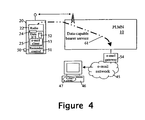
- FIG. 4 A further embodiment is shown in Figure 4.
- the dictated reminder is temporarily stored in mobile entity as for the Figure 3 embodiment.
- the reminder is then formed directly into an e-mail in the mobile entity itself and sent via a data bearer channel 61 through the PLMN 10 to an e-mail gateway 54 on e-mail network 45.
- the e-mail is addressed to the user's e-mailbox, the e-mail address of the latter being stored in the data handling subsystem 25.
- the Figure 4 embodiment avoids the need for a special service system for forwarding on the reminder as an e-mail.
- any store and forward data transfer method can be used in place of e-mail (such as Lotus Notes), and any appropriate mobile communications network can be used (such as IS95).
Landscapes
- Engineering & Computer Science (AREA)
- Computer Networks & Wireless Communication (AREA)
- Signal Processing (AREA)
- Business, Economics & Management (AREA)
- General Business, Economics & Management (AREA)
- Human Computer Interaction (AREA)
- Mobile Radio Communication Systems (AREA)
- Telephonic Communication Services (AREA)
- Information Transfer Between Computers (AREA)
Claims (18)
- Procédé consistant à enregistrer des rappels vocaux provenant d'un utilisateur mobile qui utilise un appareil mobile (20) qui peut communiquer avec une infrastructure radio mobile (10), le procédé impliquant l'exécution des étapes suivantes :a) faire activer par l'utilisateur l'appareil mobile (20) pour recevoir un rappel vocal de manière indépendante d'un appel d'un autre utilisateur et, ensuite, entrer de manière vocale le rappel vocal dans l'appareil ; etb) enregistrer de manière numérique le rappel vocal selon un format audio et générer un courrier électronique incluant le rappel vocal enregistré de manière numérique ; etc) transmettre le courrier électronique sur un réseau de données à une boîte aux lettres associée à l'utilisateur et stocker le message électronique dans la boîte aux lettres pour un accès audio ultérieur au rappel vocal par ledit utilisateur.
- Procédé selon la revendication 1, dans lequel le fait d'activer l'appareil mobile (20) pour recevoir un rappel vocal à l'étape (a) déclenche l'initialisation d'une connexion (60 ; 61) à travers l'infrastructure radio mobile (10) à un système de service (40) sur le réseau de données (45), le rappel vocal étant transmis sur la connexion (60 ; 61) au système de service (40) à l'étape (c) sensiblement à mesure que le rappel vocal est entré de manière vocale ; l'étape (c) impliquant en outre les étapes consistant à :- inclure le rappel vocal dans ledit messages de courrier électronique au système de service (40),- adresser le courrier électronique à la boîte aux lettres associée à l'utilisateur, et- expédier le courrier électronique sur le réseau de données (45) depuis le système de service (40) jusqu'à la boîte aux lettres.
- Procédé selon la revendication 1, dans lequel l'étape (c) est retardée par rapport aux étapes (a) et (b), le rappel vocal étant temporairement stocké dans l'appareil mobile (20) avant que l'étape (c) ne soit effectuée, l'étape (c) impliquant les étapes consistant à :- initialiser une connexion (60 ; 61) à travers l'infrastructure radio mobile (10) à un système de service (40) sur le réseau de données (45),- transmettre le rappel vocal sur la connexion (60 ; 61) au système de service (40),- inclure le rappel vocal dans ledit courrier électronique au système de service (40),- adresser le courrier électronique à la boîte aux lettres associée à l'utilisateur, et- expédier le courrier électronique sur le réseau de données (45) depuis le système de service (40) jusqu'à la boîte aux lettres.
- Procédé selon la revendication 3, dans lequel l'étape (c) est effectuée à un moment où le tarif pour la connexion (60 ; 61) utilisée est relativement bas.
- Procédé selon la revendication 2 ou la revendication 3, dans lequel ladite connexion comprend un circuit vocal (60) à travers l'infrastructure radio mobile (10).
- Procédé selon la revendication 2 ou la revendication 3, dans lequel ladite connexion comprend une connexion de données sur un service capable de données (61) à travers l'infrastructure radio mobile (10).
- Procédé selon la revendication 1, dans lequel ledit courrier électronique est adressé à une boîte de courrier électronique alloué aux rappels pour l'utilisateur.
- Procédé selon la revendication 1, dans lequel le courrier électronique est formé avec un champ de sujet indiquant qu'il est un message de rappel.
- Procédé selon la revendication 2 ou la revendication 3, dans lequel l'initialisation de ladite connexion (60 ; 61) implique la fourniture d'une ID (identification) d'appel au système de service (40) par rapport à l'appareil mobile (20), le système de service (40) utilisant cette ID pour chercher une adresse de destination sur le réseau de données (45) pour le rappel vocal et envoyant le courrier électronique portant le rappel à cette adresse.
- Procédé selon la revendication 1, dans lequel, à l'étape (b), le courrier électronique est généré dans l'appareil (20), l'étape (c) envoyant le courrier électronique sur un service porteur capable de données (61) de l'infrastructure radio mobile (10) au réseau de données (45) et, à travers ce dernier, à la boîte aux lettres.
- Procédé selon la revendication 10, dans lequel l'étape (c) retardée par rapport aux étapes (a) et (b), le courrier électronique étant temporairement stocké dans l'appareil mobile (20) avant que l'étape (c) ne soit effectuée.
- Procédé selon la revendication 11, dans lequel l'étape (c) est effectuée à un moment où le tarif pour le service porteur capable de données (61) utilisé est relativement bas.
- Procédé selon la revendication 10, dans lequel le courrier électronique est formé avec un champ de sujet indiquant qu'il est un message de rappel.
- Système de service (40) pour traiter un rappel vocal généré par un utilisateur qui utilise un appareil de téléphone (20) et de manière indépendante d'un appel d'un autre utilisateur, le système comprenant :- des moyens d'entrée (41 ; 48) pour enregistrer de manière numérique le rappel vocal selon un format audio provenant de l'appareil de téléphone (20) à travers un réseau téléphonique (10) conjointement avec une ID d'utilisateur indicative de l'auteur du rappel ;- des moyens pour convertir l'ID d'utilisateur en une adresse de courrier électronique correspondante sur un réseau de données (45), cette adresse de courrier électronique étant celle de l'auteur du rappel vocal,- des moyens de sortie (43) pour inclure le rappel vocal enregistré de manière numérique dans un courrier électronique ayant, en tant que son adresse de destination, ladite adresse de courrier électronique de l'auteur du rappel vocal,- des moyens (43) pour expédier le courrier électronique porteur du rappel vocal sur ledit réseau de données (45).
- Système selon la revendication 14, dans lequel ladite ID d'utilisateur est un numéro de téléphone.
- Système selon la revendication 14, dans lequel ledit moyen d'entrée comprend une interface de circuit vocal (41).
- Système selon la revendication 14, dans lequel ledit moyen d'entrée comprend une interface de données (48) pour recevoir ledit rappel vocal comme données sur un service porteur capable de données (61) d'une infrastructure de téléphone mobile (10).
- Système selon la revendication 14, incluant des moyens pour prévoir ledit courrier électronique avec un champ de sujet qui indique qu'il est un message de rappel.
Applications Claiming Priority (2)
| Application Number | Priority Date | Filing Date | Title |
|---|---|---|---|
| GB0005026 | 2000-03-03 | ||
| GBGB0005026.0A GB0005026D0 (en) | 2000-03-03 | 2000-03-03 | Generating and logging reminders whilst mobile |
Publications (3)
| Publication Number | Publication Date |
|---|---|
| EP1133206A2 EP1133206A2 (fr) | 2001-09-12 |
| EP1133206A3 EP1133206A3 (fr) | 2002-08-07 |
| EP1133206B1 true EP1133206B1 (fr) | 2006-05-03 |
Family
ID=9886804
Family Applications (1)
| Application Number | Title | Priority Date | Filing Date |
|---|---|---|---|
| EP01301269A Expired - Lifetime EP1133206B1 (fr) | 2000-03-03 | 2001-02-14 | Production et enregistrement de rappel pour des utilisateurs mobile |
Country Status (4)
| Country | Link |
|---|---|
| US (1) | US20010029175A1 (fr) |
| EP (1) | EP1133206B1 (fr) |
| DE (1) | DE60119200T2 (fr) |
| GB (1) | GB0005026D0 (fr) |
Families Citing this family (15)
| Publication number | Priority date | Publication date | Assignee | Title |
|---|---|---|---|---|
| US6993324B1 (en) | 2000-12-22 | 2006-01-31 | Bellsouth Intellectual Property Corporation | Systems and methods for audio reminder messages |
| JP2002261909A (ja) * | 2001-02-28 | 2002-09-13 | Sanyo Electric Co Ltd | 電話機及び通知方法 |
| KR100487229B1 (ko) * | 2001-08-25 | 2005-05-03 | 삼성전자주식회사 | 이동 무선단말기에서 메시지를 송신할 때 그 수신처를지정하는 장치 및 방법 |
| US7418381B2 (en) * | 2001-09-07 | 2008-08-26 | Hewlett-Packard Development Company, L.P. | Device for automatically translating and presenting voice messages as text messages |
| US6950502B1 (en) * | 2002-08-23 | 2005-09-27 | Bellsouth Intellectual Property Corp. | Enhanced scheduled messaging system |
| WO2004093475A1 (fr) * | 2003-04-17 | 2004-10-28 | Nokia Corporation | Gestion d'une fonction aide-memoire |
| US9392428B2 (en) | 2003-04-17 | 2016-07-12 | Nokia Technologies Oy | Reminder handling |
| US7707218B2 (en) * | 2004-04-16 | 2010-04-27 | Mobot, Inc. | Mobile query system and method based on visual cues |
| US7233229B2 (en) * | 2005-03-01 | 2007-06-19 | Microsoft Corporation | Actionable communication reminders |
| CN101427554B (zh) * | 2006-04-26 | 2011-04-13 | 黄金富 | 手机即时接收电邮的系统及方法 |
| US8472589B1 (en) * | 2007-09-28 | 2013-06-25 | Sprint Communications Company L.P. | Locally storing voicemails and communicating them to other wireless mobile devices |
| US8190213B2 (en) * | 2008-12-23 | 2012-05-29 | Motorola Mobility, Inc. | Method and apparatus for one-click reminder creation |
| US10671954B2 (en) | 2015-02-23 | 2020-06-02 | Google Llc | Selective reminders to complete interrupted tasks |
| US9984057B2 (en) | 2015-12-16 | 2018-05-29 | Microsoft Technology Licensing, Llc | Creating notes related to communications |
| US10891959B1 (en) | 2016-07-01 | 2021-01-12 | Google Llc | Voice message capturing system |
Family Cites Families (19)
| Publication number | Priority date | Publication date | Assignee | Title |
|---|---|---|---|---|
| US4697932B1 (en) * | 1985-12-11 | 1999-11-16 | Yosemite Investments Inc | Multi-signal alarm |
| US5559860A (en) * | 1992-06-11 | 1996-09-24 | Sony Corporation | User selectable response to an incoming call at a mobile station |
| US5867793A (en) * | 1995-07-20 | 1999-02-02 | Davis; Eddie | Built-in, cellular telephone message recorder |
| US5790957A (en) * | 1995-09-12 | 1998-08-04 | Nokia Mobile Phones Ltd. | Speech recall in cellular telephone |
| US5946629A (en) * | 1995-11-28 | 1999-08-31 | Telefonaktiebolaget L M Ericsson | Cellular telephone network having short message service interaction with other networks |
| US5724410A (en) * | 1995-12-18 | 1998-03-03 | Sony Corporation | Two-way voice messaging terminal having a speech to text converter |
| JP3140366B2 (ja) * | 1996-04-18 | 2001-03-05 | 松下電送システム株式会社 | ファクシミリ用電子メール変換装置 |
| US8073921B2 (en) * | 1997-07-01 | 2011-12-06 | Advanced Technology Company, LLC | Methods for remote monitoring and control of appliances over a computer network |
| FI108388B (fi) * | 1997-09-01 | 2002-01-15 | Nokia Corp | Sõhk÷postiliikenne matkaviestinjõrjestelmõssõ |
| US5995824A (en) * | 1997-11-14 | 1999-11-30 | Ericsson Inc. | Cellular phone voice recorder |
| US6052563A (en) * | 1997-12-10 | 2000-04-18 | Motorola | Communication device controlled by appointment information stored therein, and method therefor |
| DE19820162A1 (de) * | 1998-05-05 | 1999-11-11 | Klaus Ertmer | Funktelekommunikationssystem und Verfahren zur Informationsspeicherung in einem Telekommunikationssystem |
| US6463463B1 (en) * | 1998-05-29 | 2002-10-08 | Research In Motion Limited | System and method for pushing calendar event messages from a host system to a mobile data communication device |
| US6483899B2 (en) * | 1998-06-19 | 2002-11-19 | At&T Corp | Voice messaging system |
| US6182041B1 (en) * | 1998-10-13 | 2001-01-30 | Nortel Networks Limited | Text-to-speech based reminder system |
| US20030087665A1 (en) * | 1999-12-13 | 2003-05-08 | Tokkonen Timo Tapani | Reminder function for mobile communication device |
| US6404880B1 (en) * | 1999-12-24 | 2002-06-11 | Alcatel Usa Sourcing, L.P. | Method and apparatus for delivering critical information |
| US6373817B1 (en) * | 1999-12-30 | 2002-04-16 | At&T Corp. | Chase me system |
| US7302404B2 (en) * | 2000-02-14 | 2007-11-27 | Auctionkiller | Method and apparatus for a network system designed to actively match buyers and sellers in a buyer-driven environment |
-
2000
- 2000-03-03 GB GBGB0005026.0A patent/GB0005026D0/en not_active Ceased
-
2001
- 2001-02-14 DE DE60119200T patent/DE60119200T2/de not_active Expired - Lifetime
- 2001-02-14 EP EP01301269A patent/EP1133206B1/fr not_active Expired - Lifetime
- 2001-03-02 US US09/796,752 patent/US20010029175A1/en not_active Abandoned
Also Published As
| Publication number | Publication date |
|---|---|
| DE60119200D1 (de) | 2006-06-08 |
| EP1133206A2 (fr) | 2001-09-12 |
| EP1133206A3 (fr) | 2002-08-07 |
| GB0005026D0 (en) | 2000-04-26 |
| US20010029175A1 (en) | 2001-10-11 |
| DE60119200T2 (de) | 2006-09-21 |
Similar Documents
| Publication | Publication Date | Title |
|---|---|---|
| EP1139677B1 (fr) | Transmission de messages audio à une entité mobile | |
| US7113767B2 (en) | Instant video- and voicemail messaging method and means | |
| JP4542299B2 (ja) | 通信網内で情報を交換する方法と装置 | |
| EP1133206B1 (fr) | Production et enregistrement de rappel pour des utilisateurs mobile | |
| US8706088B2 (en) | Systems and methods for audio reminder messages | |
| US20030064711A1 (en) | Telephony call control using a personal digital assistant with a wireless link | |
| AU2004229945B2 (en) | System and method of notifying unpublished subscribers of requests for contact information | |
| GB2403621A (en) | Notifying a caller of a user's availability following a missed call | |
| EP1461968A2 (fr) | Ameliorations apportees a des communications sans fil numeriques | |
| JPWO2002060165A1 (ja) | 所定の言語により通信するシステムに用いられるサーバ、端末、および通信方法 | |
| KR20050091247A (ko) | 이동단말기에서의 음성메시지 송수신장치 및 그 방법과,그 이동단말기를 이용한 음성메시지 전송서비스시스템 및그 방법 | |
| EP1335569A1 (fr) | Syst me fournissant des messages t l phoniques de r ponse | |
| KR20010047655A (ko) | 이동 단말기를 이용한 전자우편 답장 서비스 방법 | |
| JP2002171350A (ja) | 通話録音システム | |
| JP2001177653A (ja) | 携帯電話機の録音サービス装置及び無線情報伝送装置 | |
| JPH09261344A (ja) | 電子メール読みとり方法 | |
| JP2004056429A (ja) | 地名情報通知機能付き交換機及びプログラム | |
| KR20050001071A (ko) | 포토 음성 메일 서비스 방법 및 시스템 | |
| JP2002271491A (ja) | 通信サービス提供システム、端末、通信方法、プログラムおよび記録媒体 |
Legal Events
| Date | Code | Title | Description |
|---|---|---|---|
| PUAI | Public reference made under article 153(3) epc to a published international application that has entered the european phase |
Free format text: ORIGINAL CODE: 0009012 |
|
| AK | Designated contracting states |
Kind code of ref document: A2 Designated state(s): AT BE CH CY DE DK ES FI FR GB GR IE IT LI LU MC NL PT SE TR |
|
| AX | Request for extension of the european patent |
Free format text: AL;LT;LV;MK;RO;SI |
|
| PUAL | Search report despatched |
Free format text: ORIGINAL CODE: 0009013 |
|
| AK | Designated contracting states |
Kind code of ref document: A3 Designated state(s): AT BE CH CY DE DK ES FI FR GB GR IE IT LI LU MC NL PT SE TR |
|
| AX | Request for extension of the european patent |
Free format text: AL;LT;LV;MK;RO;SI |
|
| 17P | Request for examination filed |
Effective date: 20030129 |
|
| 17Q | First examination report despatched |
Effective date: 20030226 |
|
| AKX | Designation fees paid |
Designated state(s): DE FR GB |
|
| GRAP | Despatch of communication of intention to grant a patent |
Free format text: ORIGINAL CODE: EPIDOSNIGR1 |
|
| GRAS | Grant fee paid |
Free format text: ORIGINAL CODE: EPIDOSNIGR3 |
|
| GRAA | (expected) grant |
Free format text: ORIGINAL CODE: 0009210 |
|
| RIN1 | Information on inventor provided before grant (corrected) |
Inventor name: I'ANSON, COLIN Inventor name: SELLEN, ABIGAIL JANE |
|
| AK | Designated contracting states |
Kind code of ref document: B1 Designated state(s): DE FR GB |
|
| REG | Reference to a national code |
Ref country code: GB Ref legal event code: FG4D |
|
| REF | Corresponds to: |
Ref document number: 60119200 Country of ref document: DE Date of ref document: 20060608 Kind code of ref document: P |
|
| PLBE | No opposition filed within time limit |
Free format text: ORIGINAL CODE: 0009261 |
|
| STAA | Information on the status of an ep patent application or granted ep patent |
Free format text: STATUS: NO OPPOSITION FILED WITHIN TIME LIMIT |
|
| 26N | No opposition filed |
Effective date: 20070206 |
|
| EN | Fr: translation not filed | ||
| PG25 | Lapsed in a contracting state [announced via postgrant information from national office to epo] |
Ref country code: FR Free format text: LAPSE BECAUSE OF FAILURE TO SUBMIT A TRANSLATION OF THE DESCRIPTION OR TO PAY THE FEE WITHIN THE PRESCRIBED TIME-LIMIT Effective date: 20070309 |
|
| PG25 | Lapsed in a contracting state [announced via postgrant information from national office to epo] |
Ref country code: FR Free format text: LAPSE BECAUSE OF FAILURE TO SUBMIT A TRANSLATION OF THE DESCRIPTION OR TO PAY THE FEE WITHIN THE PRESCRIBED TIME-LIMIT Effective date: 20060503 |
|
| PGFP | Annual fee paid to national office [announced via postgrant information from national office to epo] |
Ref country code: DE Payment date: 20110225 Year of fee payment: 11 |
|
| PGFP | Annual fee paid to national office [announced via postgrant information from national office to epo] |
Ref country code: GB Payment date: 20110223 Year of fee payment: 11 |
|
| GBPC | Gb: european patent ceased through non-payment of renewal fee |
Effective date: 20120214 |
|
| REG | Reference to a national code |
Ref country code: DE Ref legal event code: R119 Ref document number: 60119200 Country of ref document: DE Effective date: 20120901 |
|
| PG25 | Lapsed in a contracting state [announced via postgrant information from national office to epo] |
Ref country code: GB Free format text: LAPSE BECAUSE OF NON-PAYMENT OF DUE FEES Effective date: 20120214 |
|
| PG25 | Lapsed in a contracting state [announced via postgrant information from national office to epo] |
Ref country code: DE Free format text: LAPSE BECAUSE OF NON-PAYMENT OF DUE FEES Effective date: 20120901 |