EP1133357B1 - Ligands phosphoreux sur supports polymeres destines a la catalyse - Google Patents
Ligands phosphoreux sur supports polymeres destines a la catalyse Download PDFInfo
- Publication number
- EP1133357B1 EP1133357B1 EP99954804A EP99954804A EP1133357B1 EP 1133357 B1 EP1133357 B1 EP 1133357B1 EP 99954804 A EP99954804 A EP 99954804A EP 99954804 A EP99954804 A EP 99954804A EP 1133357 B1 EP1133357 B1 EP 1133357B1
- Authority
- EP
- European Patent Office
- Prior art keywords
- group
- optionally
- substituted
- carbon atoms
- hydrocarbyl
- Prior art date
- Legal status (The legal status is an assumption and is not a legal conclusion. Google has not performed a legal analysis and makes no representation as to the accuracy of the status listed.)
- Expired - Lifetime
Links
- 239000003446 ligand Substances 0.000 title claims abstract description 33
- OAICVXFJPJFONN-UHFFFAOYSA-N Phosphorus Chemical compound [P] OAICVXFJPJFONN-UHFFFAOYSA-N 0.000 title claims description 17
- 229910052698 phosphorus Inorganic materials 0.000 title claims description 17
- 239000011574 phosphorus Substances 0.000 title claims description 15
- 238000006555 catalytic reaction Methods 0.000 title 1
- XYFCBTPGUUZFHI-UHFFFAOYSA-N Phosphine Chemical compound P XYFCBTPGUUZFHI-UHFFFAOYSA-N 0.000 claims abstract description 141
- 229910000073 phosphorus hydride Inorganic materials 0.000 claims abstract description 84
- 150000001875 compounds Chemical class 0.000 claims abstract description 48
- -1 phosphine compound Chemical class 0.000 claims description 182
- 125000001183 hydrocarbyl group Chemical group 0.000 claims description 81
- 125000000999 tert-butyl group Chemical group [H]C([H])([H])C(*)(C([H])([H])[H])C([H])([H])[H] 0.000 claims description 76
- OKTJSMMVPCPJKN-UHFFFAOYSA-N Carbon Chemical class [C] OKTJSMMVPCPJKN-UHFFFAOYSA-N 0.000 claims description 65
- 125000004432 carbon atom Chemical group C* 0.000 claims description 65
- 125000004435 hydrogen atom Chemical class [H]* 0.000 claims description 60
- 229910052739 hydrogen Inorganic materials 0.000 claims description 59
- 239000001257 hydrogen Substances 0.000 claims description 59
- 238000000034 method Methods 0.000 claims description 57
- 125000000217 alkyl group Chemical group 0.000 claims description 53
- 125000003118 aryl group Chemical group 0.000 claims description 50
- 229920000642 polymer Polymers 0.000 claims description 50
- 125000004123 n-propyl group Chemical group [H]C([H])([H])C([H])([H])C([H])([H])* 0.000 claims description 49
- 239000007787 solid Substances 0.000 claims description 37
- 125000000623 heterocyclic group Chemical group 0.000 claims description 34
- 239000004793 Polystyrene Substances 0.000 claims description 32
- 229920002223 polystyrene Polymers 0.000 claims description 32
- 125000001997 phenyl group Chemical group [H]C1=C([H])C([H])=C(*)C([H])=C1[H] 0.000 claims description 28
- 125000003342 alkenyl group Chemical group 0.000 claims description 27
- 125000001449 isopropyl group Chemical group [H]C([H])([H])C([H])(*)C([H])([H])[H] 0.000 claims description 26
- 125000004108 n-butyl group Chemical group [H]C([H])([H])C([H])([H])C([H])([H])C([H])([H])* 0.000 claims description 26
- DJMUYABFXCIYSC-UHFFFAOYSA-N 1H-phosphole Chemical group C=1C=CPC=1 DJMUYABFXCIYSC-UHFFFAOYSA-N 0.000 claims description 24
- 229910052723 transition metal Inorganic materials 0.000 claims description 21
- 150000003624 transition metals Chemical class 0.000 claims description 21
- 125000000743 hydrocarbylene group Chemical group 0.000 claims description 20
- ZYGHJZDHTFUPRJ-UHFFFAOYSA-N coumarin Chemical compound C1=CC=C2OC(=O)C=CC2=C1 ZYGHJZDHTFUPRJ-UHFFFAOYSA-N 0.000 claims description 16
- 229910052736 halogen Chemical class 0.000 claims description 16
- 150000002367 halogens Chemical class 0.000 claims description 16
- SMQUZDBALVYZAC-UHFFFAOYSA-N salicylaldehyde Chemical compound OC1=CC=CC=C1C=O SMQUZDBALVYZAC-UHFFFAOYSA-N 0.000 claims description 13
- 125000005647 linker group Chemical group 0.000 claims description 11
- 125000002524 organometallic group Chemical group 0.000 claims description 10
- 239000010948 rhodium Substances 0.000 claims description 10
- 229960000956 coumarin Drugs 0.000 claims description 8
- 235000001671 coumarin Nutrition 0.000 claims description 8
- 125000001424 substituent group Chemical group 0.000 claims description 8
- 229920001577 copolymer Polymers 0.000 claims description 7
- 150000003003 phosphines Chemical class 0.000 claims description 7
- 229920000058 polyacrylate Polymers 0.000 claims description 7
- 229920000193 polymethacrylate Polymers 0.000 claims description 7
- 229920000098 polyolefin Polymers 0.000 claims description 7
- 125000001931 aliphatic group Chemical group 0.000 claims description 6
- 229910052801 chlorine Inorganic materials 0.000 claims description 6
- 230000000737 periodic effect Effects 0.000 claims description 6
- 125000003545 alkoxy group Chemical group 0.000 claims description 5
- 125000004104 aryloxy group Chemical group 0.000 claims description 5
- 229910052794 bromium Inorganic materials 0.000 claims description 5
- 125000005842 heteroatom Chemical group 0.000 claims description 5
- 229910052740 iodine Inorganic materials 0.000 claims description 5
- NIXOWILDQLNWCW-UHFFFAOYSA-M Acrylate Chemical compound [O-]C(=O)C=C NIXOWILDQLNWCW-UHFFFAOYSA-M 0.000 claims description 4
- 230000003197 catalytic effect Effects 0.000 claims description 3
- XSRWPJFTHDOKTA-UHFFFAOYSA-M [Rh]Cl.C1CC=CCCC=C1 Chemical class [Rh]Cl.C1CC=CCCC=C1 XSRWPJFTHDOKTA-UHFFFAOYSA-M 0.000 claims 1
- 239000003054 catalyst Substances 0.000 abstract description 11
- 238000002360 preparation method Methods 0.000 abstract description 5
- AUONHKJOIZSQGR-UHFFFAOYSA-N oxophosphane Chemical compound P=O AUONHKJOIZSQGR-UHFFFAOYSA-N 0.000 abstract 1
- VLKZOEOYAKHREP-UHFFFAOYSA-N n-Hexane Chemical compound CCCCCC VLKZOEOYAKHREP-UHFFFAOYSA-N 0.000 description 285
- WYURNTSHIVDZCO-UHFFFAOYSA-N Tetrahydrofuran Chemical compound C1CCOC1 WYURNTSHIVDZCO-UHFFFAOYSA-N 0.000 description 230
- 229920005989 resin Polymers 0.000 description 114
- 239000011347 resin Substances 0.000 description 114
- YMWUJEATGCHHMB-UHFFFAOYSA-N Dichloromethane Chemical compound ClCCl YMWUJEATGCHHMB-UHFFFAOYSA-N 0.000 description 91
- HEDRZPFGACZZDS-MICDWDOJSA-N Trichloro(2H)methane Chemical compound [2H]C(Cl)(Cl)Cl HEDRZPFGACZZDS-MICDWDOJSA-N 0.000 description 75
- 238000004679 31P NMR spectroscopy Methods 0.000 description 49
- RTZKZFJDLAIYFH-UHFFFAOYSA-N Diethyl ether Chemical compound CCOCC RTZKZFJDLAIYFH-UHFFFAOYSA-N 0.000 description 45
- 239000000725 suspension Substances 0.000 description 42
- 239000000203 mixture Substances 0.000 description 40
- UHOVQNZJYSORNB-MZWXYZOWSA-N benzene-d6 Chemical compound [2H]C1=C([2H])C([2H])=C([2H])C([2H])=C1[2H] UHOVQNZJYSORNB-MZWXYZOWSA-N 0.000 description 34
- 238000006243 chemical reaction Methods 0.000 description 34
- YLQBMQCUIZJEEH-UHFFFAOYSA-N tetrahydrofuran Natural products C=1C=COC=1 YLQBMQCUIZJEEH-UHFFFAOYSA-N 0.000 description 27
- MYRTYDVEIRVNKP-UHFFFAOYSA-N 1,2-Divinylbenzene Chemical compound C=CC1=CC=CC=C1C=C MYRTYDVEIRVNKP-UHFFFAOYSA-N 0.000 description 23
- 239000002904 solvent Substances 0.000 description 23
- 229910001868 water Inorganic materials 0.000 description 18
- ZMANZCXQSJIPKH-UHFFFAOYSA-N Triethylamine Chemical compound CCN(CC)CC ZMANZCXQSJIPKH-UHFFFAOYSA-N 0.000 description 15
- 238000003786 synthesis reaction Methods 0.000 description 15
- 230000015572 biosynthetic process Effects 0.000 description 14
- 239000000047 product Substances 0.000 description 14
- MZRVEZGGRBJDDB-UHFFFAOYSA-N N-Butyllithium Chemical compound [Li]CCCC MZRVEZGGRBJDDB-UHFFFAOYSA-N 0.000 description 12
- 0 C*1*CCCC1 Chemical compound C*1*CCCC1 0.000 description 11
- 239000011541 reaction mixture Substances 0.000 description 11
- 238000001914 filtration Methods 0.000 description 10
- XEKOWRVHYACXOJ-UHFFFAOYSA-N Ethyl acetate Chemical compound CCOC(C)=O XEKOWRVHYACXOJ-UHFFFAOYSA-N 0.000 description 9
- 229960004132 diethyl ether Drugs 0.000 description 9
- 150000004795 grignard reagents Chemical class 0.000 description 9
- 239000003153 chemical reaction reagent Substances 0.000 description 8
- 229910052751 metal Inorganic materials 0.000 description 8
- 239000002184 metal Substances 0.000 description 8
- HBAHZZVIEFRTEY-UHFFFAOYSA-N 2-heptylcyclohex-2-en-1-one Chemical compound CCCCCCCC1=CCCCC1=O HBAHZZVIEFRTEY-UHFFFAOYSA-N 0.000 description 7
- 229920001367 Merrifield resin Polymers 0.000 description 7
- 238000003756 stirring Methods 0.000 description 7
- IJGRMHOSHXDMSA-UHFFFAOYSA-N Atomic nitrogen Chemical compound N#N IJGRMHOSHXDMSA-UHFFFAOYSA-N 0.000 description 6
- LFQSCWFLJHTTHZ-UHFFFAOYSA-N Ethanol Chemical compound CCO LFQSCWFLJHTTHZ-UHFFFAOYSA-N 0.000 description 6
- YXFVVABEGXRONW-UHFFFAOYSA-N Toluene Chemical compound CC1=CC=CC=C1 YXFVVABEGXRONW-UHFFFAOYSA-N 0.000 description 6
- 125000000113 cyclohexyl group Chemical group [H]C1([H])C([H])([H])C([H])([H])C([H])(*)C([H])([H])C1([H])[H] 0.000 description 6
- HOXDXGRSZJEEKN-UHFFFAOYSA-N cycloocta-1,5-diene;rhodium Chemical compound [Rh].C1CC=CCCC=C1 HOXDXGRSZJEEKN-UHFFFAOYSA-N 0.000 description 6
- 239000000706 filtrate Substances 0.000 description 6
- FAIAAWCVCHQXDN-UHFFFAOYSA-N phosphorus trichloride Chemical compound ClP(Cl)Cl FAIAAWCVCHQXDN-UHFFFAOYSA-N 0.000 description 6
- 239000007818 Grignard reagent Substances 0.000 description 5
- VYPSYNLAJGMNEJ-UHFFFAOYSA-N Silicium dioxide Chemical compound O=[Si]=O VYPSYNLAJGMNEJ-UHFFFAOYSA-N 0.000 description 5
- 229910052799 carbon Inorganic materials 0.000 description 5
- SBWAJHLQMFBNIN-UHFFFAOYSA-N dichloro(2-dichlorophosphanylethyl)phosphane Chemical compound ClP(Cl)CCP(Cl)Cl SBWAJHLQMFBNIN-UHFFFAOYSA-N 0.000 description 5
- 239000000463 material Substances 0.000 description 5
- 229910052757 nitrogen Inorganic materials 0.000 description 5
- MFRIHAYPQRLWNB-UHFFFAOYSA-N sodium tert-butoxide Chemical compound [Na+].CC(C)(C)[O-] MFRIHAYPQRLWNB-UHFFFAOYSA-N 0.000 description 5
- 238000001644 13C nuclear magnetic resonance spectroscopy Methods 0.000 description 4
- OTMSDBZUPAUEDD-UHFFFAOYSA-N Ethane Chemical compound CC OTMSDBZUPAUEDD-UHFFFAOYSA-N 0.000 description 4
- KWYHDKDOAIKMQN-UHFFFAOYSA-N N,N,N',N'-tetramethylethylenediamine Chemical compound CN(C)CCN(C)C KWYHDKDOAIKMQN-UHFFFAOYSA-N 0.000 description 4
- OFBQJSOFQDEBGM-UHFFFAOYSA-N Pentane Chemical compound CCCCC OFBQJSOFQDEBGM-UHFFFAOYSA-N 0.000 description 4
- NBIIXXVUZAFLBC-UHFFFAOYSA-N Phosphoric acid Chemical compound OP(O)(O)=O NBIIXXVUZAFLBC-UHFFFAOYSA-N 0.000 description 4
- TYUDSLULXMFBBC-UHFFFAOYSA-N butyl 4-(2-hydroxyphenyl)-4-oxobutanoate Chemical compound CCCCOC(=O)CCC(=O)C1=CC=CC=C1O TYUDSLULXMFBBC-UHFFFAOYSA-N 0.000 description 4
- 125000004218 chloromethyl group Chemical group [H]C([H])(Cl)* 0.000 description 4
- 238000003776 cleavage reaction Methods 0.000 description 4
- 125000001511 cyclopentyl group Chemical group [H]C1([H])C([H])([H])C([H])([H])C([H])(*)C1([H])[H] 0.000 description 4
- 238000001035 drying Methods 0.000 description 4
- XQNUHMQSOMLVGM-UHFFFAOYSA-M magnesium;1,3-difluorobenzene-5-ide;bromide Chemical compound [Mg+2].[Br-].FC1=C[C-]=CC(F)=C1 XQNUHMQSOMLVGM-UHFFFAOYSA-M 0.000 description 4
- 230000000269 nucleophilic effect Effects 0.000 description 4
- FVZVCSNXTFCBQU-UHFFFAOYSA-N phosphanyl Chemical group [PH2] FVZVCSNXTFCBQU-UHFFFAOYSA-N 0.000 description 4
- 238000000607 proton-decoupled 31P nuclear magnetic resonance spectroscopy Methods 0.000 description 4
- 230000007017 scission Effects 0.000 description 4
- 239000000126 substance Substances 0.000 description 4
- YBRBMKDOPFTVDT-UHFFFAOYSA-N tert-butylamine Chemical compound CC(C)(C)N YBRBMKDOPFTVDT-UHFFFAOYSA-N 0.000 description 4
- XLYOFNOQVPJJNP-UHFFFAOYSA-N water Substances O XLYOFNOQVPJJNP-UHFFFAOYSA-N 0.000 description 4
- 238000005160 1H NMR spectroscopy Methods 0.000 description 3
- 125000002941 2-furyl group Chemical group O1C([*])=C([H])C([H])=C1[H] 0.000 description 3
- 125000000175 2-thienyl group Chemical group S1C([*])=C([H])C([H])=C1[H] 0.000 description 3
- GOLORTLGFDVFDW-UHFFFAOYSA-N 3-(1h-benzimidazol-2-yl)-7-(diethylamino)chromen-2-one Chemical compound C1=CC=C2NC(C3=CC4=CC=C(C=C4OC3=O)N(CC)CC)=NC2=C1 GOLORTLGFDVFDW-UHFFFAOYSA-N 0.000 description 3
- 125000001255 4-fluorophenyl group Chemical group [H]C1=C([H])C(*)=C([H])C([H])=C1F 0.000 description 3
- YFDUWSBGVPBWKF-UHFFFAOYSA-N Butyl salicylate Chemical compound CCCCOC(=O)C1=CC=CC=C1O YFDUWSBGVPBWKF-UHFFFAOYSA-N 0.000 description 3
- 150000001805 chlorine compounds Chemical class 0.000 description 3
- IGYHSFVSIYJSML-UHFFFAOYSA-N dichloro-(2-dichlorophosphanylphenyl)phosphane Chemical compound ClP(Cl)C1=CC=CC=C1P(Cl)Cl IGYHSFVSIYJSML-UHFFFAOYSA-N 0.000 description 3
- ZSWFCLXCOIISFI-UHFFFAOYSA-N endo-cyclopentadiene Natural products C1C=CC=C1 ZSWFCLXCOIISFI-UHFFFAOYSA-N 0.000 description 3
- 229940093499 ethyl acetate Drugs 0.000 description 3
- 235000019439 ethyl acetate Nutrition 0.000 description 3
- XAVQZBGEXVFCJI-UHFFFAOYSA-M lithium;phenoxide Chemical compound [Li+].[O-]C1=CC=CC=C1 XAVQZBGEXVFCJI-UHFFFAOYSA-M 0.000 description 3
- UZKWTJUDCOPSNM-UHFFFAOYSA-N methoxybenzene Substances CCCCOC=C UZKWTJUDCOPSNM-UHFFFAOYSA-N 0.000 description 3
- 125000002496 methyl group Chemical group [H]C([H])([H])* 0.000 description 3
- 125000001037 p-tolyl group Chemical group [H]C1=C([H])C(=C([H])C([H])=C1*)C([H])([H])[H] 0.000 description 3
- 238000005406 washing Methods 0.000 description 3
- YIYBRXKMQFDHSM-UHFFFAOYSA-N 2,2'-Dihydroxybenzophenone Chemical compound OC1=CC=CC=C1C(=O)C1=CC=CC=C1O YIYBRXKMQFDHSM-UHFFFAOYSA-N 0.000 description 2
- 125000004207 3-methoxyphenyl group Chemical group [H]C1=C([H])C(*)=C([H])C(OC([H])([H])[H])=C1[H] 0.000 description 2
- 125000004172 4-methoxyphenyl group Chemical group [H]C1=C([H])C(OC([H])([H])[H])=C([H])C([H])=C1* 0.000 description 2
- XLYOFNOQVPJJNP-ZSJDYOACSA-N Heavy water Chemical compound [2H]O[2H] XLYOFNOQVPJJNP-ZSJDYOACSA-N 0.000 description 2
- JUJWROOIHBZHMG-UHFFFAOYSA-N Pyridine Chemical compound C1=CC=NC=C1 JUJWROOIHBZHMG-UHFFFAOYSA-N 0.000 description 2
- CDBYLPFSWZWCQE-UHFFFAOYSA-L Sodium Carbonate Chemical compound [Na+].[Na+].[O-]C([O-])=O CDBYLPFSWZWCQE-UHFFFAOYSA-L 0.000 description 2
- GWEVSGVZZGPLCZ-UHFFFAOYSA-N Titan oxide Chemical compound O=[Ti]=O GWEVSGVZZGPLCZ-UHFFFAOYSA-N 0.000 description 2
- MCMNRKCIXSYSNV-UHFFFAOYSA-N Zirconium dioxide Chemical compound O=[Zr]=O MCMNRKCIXSYSNV-UHFFFAOYSA-N 0.000 description 2
- 150000001336 alkenes Chemical class 0.000 description 2
- 229910000147 aluminium phosphate Inorganic materials 0.000 description 2
- 150000001412 amines Chemical class 0.000 description 2
- GAKZNFCYARURJX-HJWRWDBZSA-N butyl (z)-3-(2-hydroxyphenyl)prop-2-enoate Chemical compound CCCCOC(=O)\C=C/C1=CC=CC=C1O GAKZNFCYARURJX-HJWRWDBZSA-N 0.000 description 2
- CQEYYJKEWSMYFG-UHFFFAOYSA-N butyl acrylate Chemical compound CCCCOC(=O)C=C CQEYYJKEWSMYFG-UHFFFAOYSA-N 0.000 description 2
- 125000000484 butyl group Chemical group [H]C([*])([H])C([H])([H])C([H])([H])C([H])([H])[H] 0.000 description 2
- 238000001311 chemical methods and process Methods 0.000 description 2
- 125000001309 chloro group Chemical group Cl* 0.000 description 2
- IJOOHPMOJXWVHK-UHFFFAOYSA-N chlorotrimethylsilane Chemical compound C[Si](C)(C)Cl IJOOHPMOJXWVHK-UHFFFAOYSA-N 0.000 description 2
- 238000001816 cooling Methods 0.000 description 2
- UNMQCGHIBZALKM-YCBDHFTFSA-N cyclopenta-1,3-diene;(1r)-1-cyclopenta-2,4-dien-1-yl-n,n-dimethylethanamine;iron(2+) Chemical compound [Fe+2].C=1C=C[CH-]C=1.CN(C)[C@H](C)C1=CC=C[CH-]1 UNMQCGHIBZALKM-YCBDHFTFSA-N 0.000 description 2
- 230000006324 decarbonylation Effects 0.000 description 2
- 238000006606 decarbonylation reaction Methods 0.000 description 2
- VURFVHCLMJOLKN-UHFFFAOYSA-N diphosphane Chemical compound PP VURFVHCLMJOLKN-UHFFFAOYSA-N 0.000 description 2
- 230000008034 disappearance Effects 0.000 description 2
- 238000000921 elemental analysis Methods 0.000 description 2
- 125000001495 ethyl group Chemical group [H]C([H])([H])C([H])([H])* 0.000 description 2
- 125000002534 ethynyl group Chemical class [H]C#C* 0.000 description 2
- 125000000524 functional group Chemical group 0.000 description 2
- 238000002290 gas chromatography-mass spectrometry Methods 0.000 description 2
- 239000011521 glass Substances 0.000 description 2
- 239000002035 hexane extract Substances 0.000 description 2
- 125000004029 hydroxymethyl group Chemical group [H]OC([H])([H])* 0.000 description 2
- 238000003780 insertion Methods 0.000 description 2
- 230000037431 insertion Effects 0.000 description 2
- 125000000959 isobutyl group Chemical group [H]C([H])([H])C([H])(C([H])([H])[H])C([H])([H])* 0.000 description 2
- SNHOZPMHMQQMNI-UHFFFAOYSA-N lithium;2h-thiophen-2-ide Chemical compound [Li+].C=1C=[C-]SC=1 SNHOZPMHMQQMNI-UHFFFAOYSA-N 0.000 description 2
- 238000011068 loading method Methods 0.000 description 2
- 125000000040 m-tolyl group Chemical group [H]C1=C([H])C(*)=C([H])C(=C1[H])C([H])([H])[H] 0.000 description 2
- JOWQNXIISCPKBK-UHFFFAOYSA-M magnesium;1,3,5-trimethylbenzene-6-ide;bromide Chemical compound [Mg+2].[Br-].CC1=CC(C)=[C-]C(C)=C1 JOWQNXIISCPKBK-UHFFFAOYSA-M 0.000 description 2
- BVUQKCCKUOSAEV-UHFFFAOYSA-M magnesium;methylbenzene;bromide Chemical compound [Mg+2].[Br-].CC1=CC=[C-]C=C1 BVUQKCCKUOSAEV-UHFFFAOYSA-M 0.000 description 2
- UGVPKMAWLOMPRS-UHFFFAOYSA-M magnesium;propane;bromide Chemical compound [Mg+2].[Br-].CC[CH2-] UGVPKMAWLOMPRS-UHFFFAOYSA-M 0.000 description 2
- 238000001819 mass spectrum Methods 0.000 description 2
- 229910044991 metal oxide Inorganic materials 0.000 description 2
- 150000004706 metal oxides Chemical class 0.000 description 2
- 150000002739 metals Chemical class 0.000 description 2
- 230000004048 modification Effects 0.000 description 2
- 238000012986 modification Methods 0.000 description 2
- AJUXDFHPVZQOGF-UHFFFAOYSA-N n,n-dimethyl-1-naphthylamine Chemical compound C1=CC=C2C(N(C)C)=CC=CC2=C1 AJUXDFHPVZQOGF-UHFFFAOYSA-N 0.000 description 2
- 125000003136 n-heptyl group Chemical group [H]C([H])([H])C([H])([H])C([H])([H])C([H])([H])C([H])([H])C([H])([H])C([H])([H])* 0.000 description 2
- 125000003261 o-tolyl group Chemical group [H]C1=C([H])C(*)=C(C([H])=C1[H])C([H])([H])[H] 0.000 description 2
- 229920000620 organic polymer Polymers 0.000 description 2
- MPQXHAGKBWFSNV-UHFFFAOYSA-N oxidophosphanium Chemical class [PH3]=O MPQXHAGKBWFSNV-UHFFFAOYSA-N 0.000 description 2
- 229910052760 oxygen Inorganic materials 0.000 description 2
- ANRQGKOBLBYXFM-UHFFFAOYSA-M phenylmagnesium bromide Chemical compound Br[Mg]C1=CC=CC=C1 ANRQGKOBLBYXFM-UHFFFAOYSA-M 0.000 description 2
- 125000004437 phosphorous atom Chemical group 0.000 description 2
- 238000001394 phosphorus-31 nuclear magnetic resonance spectrum Methods 0.000 description 2
- 239000002243 precursor Substances 0.000 description 2
- WGYKZJWCGVVSQN-UHFFFAOYSA-N propylamine Chemical compound CCCN WGYKZJWCGVVSQN-UHFFFAOYSA-N 0.000 description 2
- 239000012429 reaction media Substances 0.000 description 2
- 229910052703 rhodium Inorganic materials 0.000 description 2
- 238000006798 ring closing metathesis reaction Methods 0.000 description 2
- 239000000377 silicon dioxide Substances 0.000 description 2
- 125000003011 styrenyl group Chemical group [H]\C(*)=C(/[H])C1=C([H])C([H])=C([H])C([H])=C1[H] 0.000 description 2
- 238000006467 substitution reaction Methods 0.000 description 2
- 230000009466 transformation Effects 0.000 description 2
- 125000000391 vinyl group Chemical group [H]C([*])=C([H])[H] 0.000 description 2
- 229920002554 vinyl polymer Polymers 0.000 description 2
- CLWRQBVAHLNTMD-UHFFFAOYSA-N 1-chloro-2,3,4,5-tetraethylphosphole Chemical compound CCC=1C(CC)=C(CC)P(Cl)C=1CC CLWRQBVAHLNTMD-UHFFFAOYSA-N 0.000 description 1
- VGCVDEPGVFFEIN-UHFFFAOYSA-N 1-chloro-2,3,4,5-tetramethylphosphole Chemical compound CC=1C(C)=C(C)P(Cl)C=1C VGCVDEPGVFFEIN-UHFFFAOYSA-N 0.000 description 1
- 125000004215 2,4-difluorophenyl group Chemical group [H]C1=C([H])C(*)=C(F)C([H])=C1F 0.000 description 1
- QVWQEXOKIDWOMF-UHFFFAOYSA-N 2-chlorophosphanylethyl-bis(3,5-difluorophenyl)phosphane Chemical compound FC1=CC(F)=CC(P(CCPCl)C=2C=C(F)C=C(F)C=2)=C1 QVWQEXOKIDWOMF-UHFFFAOYSA-N 0.000 description 1
- 125000004204 2-methoxyphenyl group Chemical group [H]C1=C([H])C(*)=C(OC([H])([H])[H])C([H])=C1[H] 0.000 description 1
- 125000001622 2-naphthyl group Chemical group [H]C1=C([H])C([H])=C2C([H])=C(*)C([H])=C([H])C2=C1[H] 0.000 description 1
- 125000003903 2-propenyl group Chemical group [H]C([*])([H])C([H])=C([H])[H] 0.000 description 1
- 125000004211 3,5-difluorophenyl group Chemical group [H]C1=C(F)C([H])=C(*)C([H])=C1F 0.000 description 1
- ROFVEXUMMXZLPA-UHFFFAOYSA-N Bipyridyl Chemical compound N1=CC=CC=C1C1=CC=CC=N1 ROFVEXUMMXZLPA-UHFFFAOYSA-N 0.000 description 1
- BNZLTPCWOLWBNJ-UHFFFAOYSA-M Br[Mg] Chemical compound Br[Mg] BNZLTPCWOLWBNJ-UHFFFAOYSA-M 0.000 description 1
- CPELXLSAUQHCOX-UHFFFAOYSA-M Bromide Chemical compound [Br-] CPELXLSAUQHCOX-UHFFFAOYSA-M 0.000 description 1
- AHQZRFBZJSCKAV-UHFFFAOYSA-N CC1=CCC=C1 Chemical compound CC1=CCC=C1 AHQZRFBZJSCKAV-UHFFFAOYSA-N 0.000 description 1
- NPUHTHQHBKYDKH-UHFFFAOYSA-N C[C]1C([ClH]P(CC2)NC(C)(C)C)=P2C(C)=C1C Chemical compound C[C]1C([ClH]P(CC2)NC(C)(C)C)=P2C(C)=C1C NPUHTHQHBKYDKH-UHFFFAOYSA-N 0.000 description 1
- 239000004215 Carbon black (E152) Substances 0.000 description 1
- UGFAIRIUMAVXCW-UHFFFAOYSA-N Carbon monoxide Chemical compound [O+]#[C-] UGFAIRIUMAVXCW-UHFFFAOYSA-N 0.000 description 1
- SNRUBQQJIBEYMU-UHFFFAOYSA-N Dodecane Natural products CCCCCCCCCCCC SNRUBQQJIBEYMU-UHFFFAOYSA-N 0.000 description 1
- 238000005481 NMR spectroscopy Methods 0.000 description 1
- 229910020667 PBr3 Inorganic materials 0.000 description 1
- 241000556679 Pholis Species 0.000 description 1
- 239000002202 Polyethylene glycol Substances 0.000 description 1
- QCWXUUIWCKQGHC-UHFFFAOYSA-N Zirconium Chemical compound [Zr] QCWXUUIWCKQGHC-UHFFFAOYSA-N 0.000 description 1
- 229910007928 ZrCl2 Inorganic materials 0.000 description 1
- 150000001299 aldehydes Chemical class 0.000 description 1
- 150000004703 alkoxides Chemical group 0.000 description 1
- HSFWRNGVRCDJHI-UHFFFAOYSA-N alpha-acetylene Natural products C#C HSFWRNGVRCDJHI-UHFFFAOYSA-N 0.000 description 1
- PNEYBMLMFCGWSK-UHFFFAOYSA-N aluminium oxide Inorganic materials [O-2].[O-2].[O-2].[Al+3].[Al+3] PNEYBMLMFCGWSK-UHFFFAOYSA-N 0.000 description 1
- 238000004458 analytical method Methods 0.000 description 1
- 238000013459 approach Methods 0.000 description 1
- 239000003125 aqueous solvent Substances 0.000 description 1
- 239000012298 atmosphere Substances 0.000 description 1
- 125000004429 atom Chemical group 0.000 description 1
- QVGXLLKOCUKJST-UHFFFAOYSA-N atomic oxygen Chemical compound [O] QVGXLLKOCUKJST-UHFFFAOYSA-N 0.000 description 1
- 239000011324 bead Substances 0.000 description 1
- 125000001797 benzyl group Chemical group [H]C1=C([H])C([H])=C(C([H])=C1[H])C([H])([H])* 0.000 description 1
- 125000000319 biphenyl-4-yl group Chemical group [H]C1=C([H])C([H])=C([H])C([H])=C1C1=C([H])C([H])=C([*])C([H])=C1[H] 0.000 description 1
- 125000004369 butenyl group Chemical group C(=CCC)* 0.000 description 1
- JZYIMNXWXHGYKE-UHFFFAOYSA-N butyl 3-(2-hydroxyphenyl)-2-methyl-3-oxopropanoate Chemical compound CCCCOC(=O)C(C)C(=O)C1=CC=CC=C1O JZYIMNXWXHGYKE-UHFFFAOYSA-N 0.000 description 1
- 125000000480 butynyl group Chemical group [*]C#CC([H])([H])C([H])([H])[H] 0.000 description 1
- 150000001721 carbon Chemical class 0.000 description 1
- 239000007810 chemical reaction solvent Substances 0.000 description 1
- IKLMWNDVUVNVLU-UHFFFAOYSA-N chloro-[2-(2,3,4,5-tetraethylphosphol-1-yl)ethyl]phosphane Chemical compound CCC=1C(CC)=C(CC)P(CCPCl)C=1CC IKLMWNDVUVNVLU-UHFFFAOYSA-N 0.000 description 1
- 125000004803 chlorobenzyl group Chemical group 0.000 description 1
- 238000004587 chromatography analysis Methods 0.000 description 1
- 229910052681 coesite Inorganic materials 0.000 description 1
- 239000008139 complexing agent Substances 0.000 description 1
- 229910052593 corundum Inorganic materials 0.000 description 1
- 229910052906 cristobalite Inorganic materials 0.000 description 1
- 238000004132 cross linking Methods 0.000 description 1
- 239000012043 crude product Substances 0.000 description 1
- 125000004122 cyclic group Chemical group 0.000 description 1
- 125000001995 cyclobutyl group Chemical group [H]C1([H])C([H])([H])C([H])(*)C1([H])[H] 0.000 description 1
- PFURGBBHAOXLIO-WDSKDSINSA-N cyclohexane-1,2-diol Chemical compound O[C@H]1CCCC[C@@H]1O PFURGBBHAOXLIO-WDSKDSINSA-N 0.000 description 1
- 125000000596 cyclohexenyl group Chemical group C1(=CCCCC1)* 0.000 description 1
- 125000000522 cyclooctenyl group Chemical group C1(=CCCCCCC1)* 0.000 description 1
- 125000000058 cyclopentadienyl group Chemical group C1(=CC=CC1)* 0.000 description 1
- 125000001559 cyclopropyl group Chemical group [H]C1([H])C([H])([H])C1([H])* 0.000 description 1
- 125000002704 decyl group Chemical group [H]C([H])([H])C([H])([H])C([H])([H])C([H])([H])C([H])([H])C([H])([H])C([H])([H])C([H])([H])C([H])([H])C([H])([H])* 0.000 description 1
- 239000002274 desiccant Substances 0.000 description 1
- AASUFOVSZUIILF-UHFFFAOYSA-N diphenylmethanone;sodium Chemical compound [Na].C=1C=CC=CC=1C(=O)C1=CC=CC=C1 AASUFOVSZUIILF-UHFFFAOYSA-N 0.000 description 1
- 125000003438 dodecyl group Chemical group [H]C([H])([H])C([H])([H])C([H])([H])C([H])([H])C([H])([H])C([H])([H])C([H])([H])C([H])([H])C([H])([H])C([H])([H])C([H])([H])C([H])([H])* 0.000 description 1
- 230000009977 dual effect Effects 0.000 description 1
- 238000010828 elution Methods 0.000 description 1
- AJVBXLXLODZUME-UHFFFAOYSA-N ethenyl(diphenyl)phosphane Chemical compound C=1C=CC=CC=1P(C=C)C1=CC=CC=C1 AJVBXLXLODZUME-UHFFFAOYSA-N 0.000 description 1
- 230000007717 exclusion Effects 0.000 description 1
- 239000000284 extract Substances 0.000 description 1
- 125000003784 fluoroethyl group Chemical group [H]C([H])(F)C([H])([H])* 0.000 description 1
- 238000011010 flushing procedure Methods 0.000 description 1
- 239000012634 fragment Substances 0.000 description 1
- 239000007789 gas Substances 0.000 description 1
- 238000004817 gas chromatography Methods 0.000 description 1
- 239000002638 heterogeneous catalyst Substances 0.000 description 1
- 229930195733 hydrocarbon Natural products 0.000 description 1
- 150000002430 hydrocarbons Chemical class 0.000 description 1
- 239000012535 impurity Substances 0.000 description 1
- 229920000592 inorganic polymer Polymers 0.000 description 1
- 229910001867 inorganic solvent Inorganic materials 0.000 description 1
- 239000003049 inorganic solvent Substances 0.000 description 1
- 230000010354 integration Effects 0.000 description 1
- 229910052741 iridium Inorganic materials 0.000 description 1
- 229910052742 iron Inorganic materials 0.000 description 1
- 239000007791 liquid phase Substances 0.000 description 1
- 229910052744 lithium Inorganic materials 0.000 description 1
- 239000011777 magnesium Substances 0.000 description 1
- 229910052749 magnesium Inorganic materials 0.000 description 1
- AJECZOAMLZFBIN-UHFFFAOYSA-M magnesium;2h-pyridin-2-ide;bromide Chemical compound [Mg+2].[Br-].C1=CC=N[C-]=C1 AJECZOAMLZFBIN-UHFFFAOYSA-M 0.000 description 1
- FCPRDUXJWIUVPZ-UHFFFAOYSA-M magnesium;methoxybenzene;bromide Chemical compound [Mg+2].[Br-].COC1=CC=CC=[C-]1 FCPRDUXJWIUVPZ-UHFFFAOYSA-M 0.000 description 1
- 238000003760 magnetic stirring Methods 0.000 description 1
- 239000011159 matrix material Substances 0.000 description 1
- 229910052987 metal hydride Inorganic materials 0.000 description 1
- 150000004681 metal hydrides Chemical class 0.000 description 1
- 229910021645 metal ion Inorganic materials 0.000 description 1
- 150000001455 metallic ions Chemical class 0.000 description 1
- 229910052759 nickel Inorganic materials 0.000 description 1
- 238000000655 nuclear magnetic resonance spectrum Methods 0.000 description 1
- 150000002894 organic compounds Chemical class 0.000 description 1
- 239000003960 organic solvent Substances 0.000 description 1
- 150000002902 organometallic compounds Chemical class 0.000 description 1
- 229910052762 osmium Inorganic materials 0.000 description 1
- WYURNTSHIVDZCO-SVYQBANQSA-N oxolane-d8 Chemical compound [2H]C1([2H])OC([2H])([2H])C([2H])([2H])C1([2H])[2H] WYURNTSHIVDZCO-SVYQBANQSA-N 0.000 description 1
- 239000001301 oxygen Substances 0.000 description 1
- 125000003854 p-chlorophenyl group Chemical group [H]C1=C([H])C(*)=C([H])C([H])=C1Cl 0.000 description 1
- 229910052763 palladium Inorganic materials 0.000 description 1
- 239000008188 pellet Substances 0.000 description 1
- 125000002958 pentadecyl group Chemical group [H]C([*])([H])C([H])([H])C([H])([H])C([H])([H])C([H])([H])C([H])([H])C([H])([H])C([H])([H])C([H])([H])C([H])([H])C([H])([H])C([H])([H])C([H])([H])C([H])([H])C([H])([H])[H] 0.000 description 1
- 239000000825 pharmaceutical preparation Substances 0.000 description 1
- 150000003018 phosphorus compounds Chemical class 0.000 description 1
- IPNPIHIZVLFAFP-UHFFFAOYSA-N phosphorus tribromide Chemical compound BrP(Br)Br IPNPIHIZVLFAFP-UHFFFAOYSA-N 0.000 description 1
- 230000000704 physical effect Effects 0.000 description 1
- 238000000053 physical method Methods 0.000 description 1
- 229910052697 platinum Inorganic materials 0.000 description 1
- 229920002401 polyacrylamide Polymers 0.000 description 1
- 229920001223 polyethylene glycol Polymers 0.000 description 1
- 239000002952 polymeric resin Substances 0.000 description 1
- 125000001436 propyl group Chemical group [H]C([*])([H])C([H])([H])C([H])([H])[H] 0.000 description 1
- 125000002568 propynyl group Chemical group [*]C#CC([H])([H])[H] 0.000 description 1
- 238000000425 proton nuclear magnetic resonance spectrum Methods 0.000 description 1
- UMJSCPRVCHMLSP-UHFFFAOYSA-N pyridine Natural products COC1=CC=CN=C1 UMJSCPRVCHMLSP-UHFFFAOYSA-N 0.000 description 1
- 239000000376 reactant Substances 0.000 description 1
- MHOVAHRLVXNVSD-UHFFFAOYSA-N rhodium atom Chemical compound [Rh] MHOVAHRLVXNVSD-UHFFFAOYSA-N 0.000 description 1
- 229910052707 ruthenium Inorganic materials 0.000 description 1
- 150000003839 salts Chemical class 0.000 description 1
- 125000002914 sec-butyl group Chemical group [H]C([H])([H])C([H])([H])C([H])(*)C([H])([H])[H] 0.000 description 1
- 238000000926 separation method Methods 0.000 description 1
- 239000000741 silica gel Substances 0.000 description 1
- 229910002027 silica gel Inorganic materials 0.000 description 1
- 238000010898 silica gel chromatography Methods 0.000 description 1
- 229910000029 sodium carbonate Inorganic materials 0.000 description 1
- QDRKDTQENPPHOJ-UHFFFAOYSA-N sodium ethoxide Chemical compound [Na+].CC[O-] QDRKDTQENPPHOJ-UHFFFAOYSA-N 0.000 description 1
- 239000011343 solid material Substances 0.000 description 1
- 238000010532 solid phase synthesis reaction Methods 0.000 description 1
- 239000007858 starting material Substances 0.000 description 1
- 229910052682 stishovite Inorganic materials 0.000 description 1
- 239000000758 substrate Substances 0.000 description 1
- 229910052717 sulfur Inorganic materials 0.000 description 1
- 238000010189 synthetic method Methods 0.000 description 1
- 229920003002 synthetic resin Polymers 0.000 description 1
- CZDYPVPMEAXLPK-UHFFFAOYSA-N tetramethylsilane Chemical compound C[Si](C)(C)C CZDYPVPMEAXLPK-UHFFFAOYSA-N 0.000 description 1
- 229910052905 tridymite Inorganic materials 0.000 description 1
- UTODFRQBVUVYOB-UHFFFAOYSA-P wilkinson's catalyst Chemical compound [Cl-].C1=CC=CC=C1P(C=1C=CC=CC=1)(C=1C=CC=CC=1)[Rh+](P(C=1C=CC=CC=1)(C=1C=CC=CC=1)C=1C=CC=CC=1)P(C=1C=CC=CC=1)(C=1C=CC=CC=1)C1=CC=CC=C1 UTODFRQBVUVYOB-UHFFFAOYSA-P 0.000 description 1
- 239000011995 wilkinson's catalyst Substances 0.000 description 1
- 125000005023 xylyl group Chemical group 0.000 description 1
- 229910001845 yogo sapphire Inorganic materials 0.000 description 1
- 239000010457 zeolite Substances 0.000 description 1
- 229910052725 zinc Inorganic materials 0.000 description 1
- ZQJYTTPJYLKTTI-UHFFFAOYSA-M zinc;2h-pyridin-2-ide;bromide Chemical compound Br[Zn+].C1=CC=N[C-]=C1 ZQJYTTPJYLKTTI-UHFFFAOYSA-M 0.000 description 1
- PVURAUIMVICLOH-UHFFFAOYSA-M zinc;cyclohexane;bromide Chemical compound Br[Zn+].C1CC[CH-]CC1 PVURAUIMVICLOH-UHFFFAOYSA-M 0.000 description 1
- LRWSFIRLRHUIFL-UHFFFAOYSA-M zinc;methylsulfanylbenzene;iodide Chemical compound I[Zn+].CSC1=CC=CC=[C-]1 LRWSFIRLRHUIFL-UHFFFAOYSA-M 0.000 description 1
- 229910052726 zirconium Inorganic materials 0.000 description 1
Classifications
-
- B—PERFORMING OPERATIONS; TRANSPORTING
- B01—PHYSICAL OR CHEMICAL PROCESSES OR APPARATUS IN GENERAL
- B01J—CHEMICAL OR PHYSICAL PROCESSES, e.g. CATALYSIS OR COLLOID CHEMISTRY; THEIR RELEVANT APPARATUS
- B01J31/00—Catalysts comprising hydrides, coordination complexes or organic compounds
- B01J31/16—Catalysts comprising hydrides, coordination complexes or organic compounds containing coordination complexes
- B01J31/165—Polymer immobilised coordination complexes, e.g. organometallic complexes
- B01J31/1658—Polymer immobilised coordination complexes, e.g. organometallic complexes immobilised by covalent linkages, i.e. pendant complexes with optional linking groups, e.g. on Wang or Merrifield resins
-
- B—PERFORMING OPERATIONS; TRANSPORTING
- B01—PHYSICAL OR CHEMICAL PROCESSES OR APPARATUS IN GENERAL
- B01J—CHEMICAL OR PHYSICAL PROCESSES, e.g. CATALYSIS OR COLLOID CHEMISTRY; THEIR RELEVANT APPARATUS
- B01J31/00—Catalysts comprising hydrides, coordination complexes or organic compounds
- B01J31/16—Catalysts comprising hydrides, coordination complexes or organic compounds containing coordination complexes
- B01J31/18—Catalysts comprising hydrides, coordination complexes or organic compounds containing coordination complexes containing nitrogen, phosphorus, arsenic or antimony as complexing atoms, e.g. in pyridine ligands, or in resonance therewith, e.g. in isocyanide ligands C=N-R or as complexed central atoms
- B01J31/1845—Catalysts comprising hydrides, coordination complexes or organic compounds containing coordination complexes containing nitrogen, phosphorus, arsenic or antimony as complexing atoms, e.g. in pyridine ligands, or in resonance therewith, e.g. in isocyanide ligands C=N-R or as complexed central atoms the ligands containing phosphorus
- B01J31/1875—Phosphinites (R2P(OR), their isomeric phosphine oxides (R3P=O) and RO-substitution derivatives thereof)
-
- B—PERFORMING OPERATIONS; TRANSPORTING
- B01—PHYSICAL OR CHEMICAL PROCESSES OR APPARATUS IN GENERAL
- B01J—CHEMICAL OR PHYSICAL PROCESSES, e.g. CATALYSIS OR COLLOID CHEMISTRY; THEIR RELEVANT APPARATUS
- B01J31/00—Catalysts comprising hydrides, coordination complexes or organic compounds
- B01J31/16—Catalysts comprising hydrides, coordination complexes or organic compounds containing coordination complexes
- B01J31/24—Phosphines, i.e. phosphorus bonded to only carbon atoms, or to both carbon and hydrogen atoms, including e.g. sp2-hybridised phosphorus compounds such as phosphabenzene, phosphole or anionic phospholide ligands
- B01J31/2404—Cyclic ligands, including e.g. non-condensed polycyclic ligands, the phosphine-P atom being a ring member or a substituent on the ring
- B01J31/2409—Cyclic ligands, including e.g. non-condensed polycyclic ligands, the phosphine-P atom being a ring member or a substituent on the ring with more than one complexing phosphine-P atom
-
- B—PERFORMING OPERATIONS; TRANSPORTING
- B01—PHYSICAL OR CHEMICAL PROCESSES OR APPARATUS IN GENERAL
- B01J—CHEMICAL OR PHYSICAL PROCESSES, e.g. CATALYSIS OR COLLOID CHEMISTRY; THEIR RELEVANT APPARATUS
- B01J31/00—Catalysts comprising hydrides, coordination complexes or organic compounds
- B01J31/16—Catalysts comprising hydrides, coordination complexes or organic compounds containing coordination complexes
- B01J31/24—Phosphines, i.e. phosphorus bonded to only carbon atoms, or to both carbon and hydrogen atoms, including e.g. sp2-hybridised phosphorus compounds such as phosphabenzene, phosphole or anionic phospholide ligands
- B01J31/2495—Ligands comprising a phosphine-P atom and one or more further complexing phosphorus atoms covered by groups B01J31/1845 - B01J31/1885, e.g. phosphine/phosphinate or phospholyl/phosphonate ligands
-
- C—CHEMISTRY; METALLURGY
- C07—ORGANIC CHEMISTRY
- C07F—ACYCLIC, CARBOCYCLIC OR HETEROCYCLIC COMPOUNDS CONTAINING ELEMENTS OTHER THAN CARBON, HYDROGEN, HALOGEN, OXYGEN, NITROGEN, SULFUR, SELENIUM OR TELLURIUM
- C07F15/00—Compounds containing elements of Groups 8, 9, 10 or 18 of the Periodic Table
- C07F15/0006—Compounds containing elements of Groups 8, 9, 10 or 18 of the Periodic Table compounds of the platinum group
- C07F15/0073—Rhodium compounds
-
- C—CHEMISTRY; METALLURGY
- C07—ORGANIC CHEMISTRY
- C07F—ACYCLIC, CARBOCYCLIC OR HETEROCYCLIC COMPOUNDS CONTAINING ELEMENTS OTHER THAN CARBON, HYDROGEN, HALOGEN, OXYGEN, NITROGEN, SULFUR, SELENIUM OR TELLURIUM
- C07F15/00—Compounds containing elements of Groups 8, 9, 10 or 18 of the Periodic Table
- C07F15/0006—Compounds containing elements of Groups 8, 9, 10 or 18 of the Periodic Table compounds of the platinum group
- C07F15/0073—Rhodium compounds
- C07F15/008—Rhodium compounds without a metal-carbon linkage
-
- C—CHEMISTRY; METALLURGY
- C07—ORGANIC CHEMISTRY
- C07F—ACYCLIC, CARBOCYCLIC OR HETEROCYCLIC COMPOUNDS CONTAINING ELEMENTS OTHER THAN CARBON, HYDROGEN, HALOGEN, OXYGEN, NITROGEN, SULFUR, SELENIUM OR TELLURIUM
- C07F9/00—Compounds containing elements of Groups 5 or 15 of the Periodic Table
- C07F9/02—Phosphorus compounds
- C07F9/28—Phosphorus compounds with one or more P—C bonds
- C07F9/46—Phosphinous acids [R2POH], [R2P(= O)H]: Thiophosphinous acids including[R2PSH]; [R2P(=S)H]; Aminophosphines [R2PNH2]; Derivatives thereof
-
- C—CHEMISTRY; METALLURGY
- C07—ORGANIC CHEMISTRY
- C07F—ACYCLIC, CARBOCYCLIC OR HETEROCYCLIC COMPOUNDS CONTAINING ELEMENTS OTHER THAN CARBON, HYDROGEN, HALOGEN, OXYGEN, NITROGEN, SULFUR, SELENIUM OR TELLURIUM
- C07F9/00—Compounds containing elements of Groups 5 or 15 of the Periodic Table
- C07F9/02—Phosphorus compounds
- C07F9/28—Phosphorus compounds with one or more P—C bonds
- C07F9/48—Phosphonous acids [RP(OH)2] including [RHP(=O)(OH)]; Thiophosphonous acids including [RP(SH)2], [RHP(=S)(SH)]; Derivatives thereof
- C07F9/4891—Monohalide derivatives RP (XR') (Hal) (X = O, S, N)
-
- C—CHEMISTRY; METALLURGY
- C07—ORGANIC CHEMISTRY
- C07F—ACYCLIC, CARBOCYCLIC OR HETEROCYCLIC COMPOUNDS CONTAINING ELEMENTS OTHER THAN CARBON, HYDROGEN, HALOGEN, OXYGEN, NITROGEN, SULFUR, SELENIUM OR TELLURIUM
- C07F9/00—Compounds containing elements of Groups 5 or 15 of the Periodic Table
- C07F9/02—Phosphorus compounds
- C07F9/28—Phosphorus compounds with one or more P—C bonds
- C07F9/50—Organo-phosphines
- C07F9/5004—Acyclic saturated phosphines
- C07F9/5009—Acyclic saturated phosphines substituted by B, Si, P or a metal
-
- C—CHEMISTRY; METALLURGY
- C07—ORGANIC CHEMISTRY
- C07F—ACYCLIC, CARBOCYCLIC OR HETEROCYCLIC COMPOUNDS CONTAINING ELEMENTS OTHER THAN CARBON, HYDROGEN, HALOGEN, OXYGEN, NITROGEN, SULFUR, SELENIUM OR TELLURIUM
- C07F9/00—Compounds containing elements of Groups 5 or 15 of the Periodic Table
- C07F9/02—Phosphorus compounds
- C07F9/28—Phosphorus compounds with one or more P—C bonds
- C07F9/50—Organo-phosphines
- C07F9/5027—Polyphosphines
-
- C—CHEMISTRY; METALLURGY
- C07—ORGANIC CHEMISTRY
- C07F—ACYCLIC, CARBOCYCLIC OR HETEROCYCLIC COMPOUNDS CONTAINING ELEMENTS OTHER THAN CARBON, HYDROGEN, HALOGEN, OXYGEN, NITROGEN, SULFUR, SELENIUM OR TELLURIUM
- C07F9/00—Compounds containing elements of Groups 5 or 15 of the Periodic Table
- C07F9/02—Phosphorus compounds
- C07F9/28—Phosphorus compounds with one or more P—C bonds
- C07F9/50—Organo-phosphines
- C07F9/52—Halophosphines
-
- C—CHEMISTRY; METALLURGY
- C07—ORGANIC CHEMISTRY
- C07F—ACYCLIC, CARBOCYCLIC OR HETEROCYCLIC COMPOUNDS CONTAINING ELEMENTS OTHER THAN CARBON, HYDROGEN, HALOGEN, OXYGEN, NITROGEN, SULFUR, SELENIUM OR TELLURIUM
- C07F9/00—Compounds containing elements of Groups 5 or 15 of the Periodic Table
- C07F9/02—Phosphorus compounds
- C07F9/28—Phosphorus compounds with one or more P—C bonds
- C07F9/50—Organo-phosphines
- C07F9/53—Organo-phosphine oxides; Organo-phosphine thioxides
- C07F9/5329—Polyphosphine oxides or thioxides
-
- C—CHEMISTRY; METALLURGY
- C07—ORGANIC CHEMISTRY
- C07F—ACYCLIC, CARBOCYCLIC OR HETEROCYCLIC COMPOUNDS CONTAINING ELEMENTS OTHER THAN CARBON, HYDROGEN, HALOGEN, OXYGEN, NITROGEN, SULFUR, SELENIUM OR TELLURIUM
- C07F9/00—Compounds containing elements of Groups 5 or 15 of the Periodic Table
- C07F9/02—Phosphorus compounds
- C07F9/547—Heterocyclic compounds, e.g. containing phosphorus as a ring hetero atom
- C07F9/6553—Heterocyclic compounds, e.g. containing phosphorus as a ring hetero atom having sulfur atoms, with or without selenium or tellurium atoms, as the only ring hetero atoms
- C07F9/655345—Heterocyclic compounds, e.g. containing phosphorus as a ring hetero atom having sulfur atoms, with or without selenium or tellurium atoms, as the only ring hetero atoms the sulfur atom being part of a five-membered ring
-
- C—CHEMISTRY; METALLURGY
- C07—ORGANIC CHEMISTRY
- C07F—ACYCLIC, CARBOCYCLIC OR HETEROCYCLIC COMPOUNDS CONTAINING ELEMENTS OTHER THAN CARBON, HYDROGEN, HALOGEN, OXYGEN, NITROGEN, SULFUR, SELENIUM OR TELLURIUM
- C07F9/00—Compounds containing elements of Groups 5 or 15 of the Periodic Table
- C07F9/02—Phosphorus compounds
- C07F9/547—Heterocyclic compounds, e.g. containing phosphorus as a ring hetero atom
- C07F9/6564—Heterocyclic compounds, e.g. containing phosphorus as a ring hetero atom having phosphorus atoms, with or without nitrogen, oxygen, sulfur, selenium or tellurium atoms, as ring hetero atoms
- C07F9/6568—Heterocyclic compounds, e.g. containing phosphorus as a ring hetero atom having phosphorus atoms, with or without nitrogen, oxygen, sulfur, selenium or tellurium atoms, as ring hetero atoms having phosphorus atoms as the only ring hetero atoms
-
- C—CHEMISTRY; METALLURGY
- C07—ORGANIC CHEMISTRY
- C07F—ACYCLIC, CARBOCYCLIC OR HETEROCYCLIC COMPOUNDS CONTAINING ELEMENTS OTHER THAN CARBON, HYDROGEN, HALOGEN, OXYGEN, NITROGEN, SULFUR, SELENIUM OR TELLURIUM
- C07F9/00—Compounds containing elements of Groups 5 or 15 of the Periodic Table
- C07F9/02—Phosphorus compounds
- C07F9/547—Heterocyclic compounds, e.g. containing phosphorus as a ring hetero atom
- C07F9/6564—Heterocyclic compounds, e.g. containing phosphorus as a ring hetero atom having phosphorus atoms, with or without nitrogen, oxygen, sulfur, selenium or tellurium atoms, as ring hetero atoms
- C07F9/6571—Heterocyclic compounds, e.g. containing phosphorus as a ring hetero atom having phosphorus atoms, with or without nitrogen, oxygen, sulfur, selenium or tellurium atoms, as ring hetero atoms having phosphorus and oxygen atoms as the only ring hetero atoms
- C07F9/657163—Heterocyclic compounds, e.g. containing phosphorus as a ring hetero atom having phosphorus atoms, with or without nitrogen, oxygen, sulfur, selenium or tellurium atoms, as ring hetero atoms having phosphorus and oxygen atoms as the only ring hetero atoms the ring phosphorus atom being bound to at least one carbon atom
- C07F9/65719—Heterocyclic compounds, e.g. containing phosphorus as a ring hetero atom having phosphorus atoms, with or without nitrogen, oxygen, sulfur, selenium or tellurium atoms, as ring hetero atoms having phosphorus and oxygen atoms as the only ring hetero atoms the ring phosphorus atom being bound to at least one carbon atom the ring phosphorus atom and, at least, one ring oxygen atom being part of a (thio)phosphonous acid derivative
-
- C—CHEMISTRY; METALLURGY
- C08—ORGANIC MACROMOLECULAR COMPOUNDS; THEIR PREPARATION OR CHEMICAL WORKING-UP; COMPOSITIONS BASED THEREON
- C08F—MACROMOLECULAR COMPOUNDS OBTAINED BY REACTIONS ONLY INVOLVING CARBON-TO-CARBON UNSATURATED BONDS
- C08F8/00—Chemical modification by after-treatment
- C08F8/40—Introducing phosphorus atoms or phosphorus-containing groups
-
- B—PERFORMING OPERATIONS; TRANSPORTING
- B01—PHYSICAL OR CHEMICAL PROCESSES OR APPARATUS IN GENERAL
- B01J—CHEMICAL OR PHYSICAL PROCESSES, e.g. CATALYSIS OR COLLOID CHEMISTRY; THEIR RELEVANT APPARATUS
- B01J2219/00—Chemical, physical or physico-chemical processes in general; Their relevant apparatus
- B01J2219/00274—Sequential or parallel reactions; Apparatus and devices for combinatorial chemistry or for making arrays; Chemical library technology
- B01J2219/00718—Type of compounds synthesised
- B01J2219/00745—Inorganic compounds
-
- B—PERFORMING OPERATIONS; TRANSPORTING
- B01—PHYSICAL OR CHEMICAL PROCESSES OR APPARATUS IN GENERAL
- B01J—CHEMICAL OR PHYSICAL PROCESSES, e.g. CATALYSIS OR COLLOID CHEMISTRY; THEIR RELEVANT APPARATUS
- B01J2219/00—Chemical, physical or physico-chemical processes in general; Their relevant apparatus
- B01J2219/00274—Sequential or parallel reactions; Apparatus and devices for combinatorial chemistry or for making arrays; Chemical library technology
- B01J2219/00718—Type of compounds synthesised
- B01J2219/00745—Inorganic compounds
- B01J2219/00747—Catalysts
-
- B—PERFORMING OPERATIONS; TRANSPORTING
- B01—PHYSICAL OR CHEMICAL PROCESSES OR APPARATUS IN GENERAL
- B01J—CHEMICAL OR PHYSICAL PROCESSES, e.g. CATALYSIS OR COLLOID CHEMISTRY; THEIR RELEVANT APPARATUS
- B01J2531/00—Additional information regarding catalytic systems classified in B01J31/00
- B01J2531/80—Complexes comprising metals of Group VIII as the central metal
-
- B—PERFORMING OPERATIONS; TRANSPORTING
- B01—PHYSICAL OR CHEMICAL PROCESSES OR APPARATUS IN GENERAL
- B01J—CHEMICAL OR PHYSICAL PROCESSES, e.g. CATALYSIS OR COLLOID CHEMISTRY; THEIR RELEVANT APPARATUS
- B01J2531/00—Additional information regarding catalytic systems classified in B01J31/00
- B01J2531/80—Complexes comprising metals of Group VIII as the central metal
- B01J2531/82—Metals of the platinum group
- B01J2531/821—Ruthenium
-
- B—PERFORMING OPERATIONS; TRANSPORTING
- B01—PHYSICAL OR CHEMICAL PROCESSES OR APPARATUS IN GENERAL
- B01J—CHEMICAL OR PHYSICAL PROCESSES, e.g. CATALYSIS OR COLLOID CHEMISTRY; THEIR RELEVANT APPARATUS
- B01J2531/00—Additional information regarding catalytic systems classified in B01J31/00
- B01J2531/80—Complexes comprising metals of Group VIII as the central metal
- B01J2531/82—Metals of the platinum group
- B01J2531/822—Rhodium
-
- B—PERFORMING OPERATIONS; TRANSPORTING
- B01—PHYSICAL OR CHEMICAL PROCESSES OR APPARATUS IN GENERAL
- B01J—CHEMICAL OR PHYSICAL PROCESSES, e.g. CATALYSIS OR COLLOID CHEMISTRY; THEIR RELEVANT APPARATUS
- B01J2531/00—Additional information regarding catalytic systems classified in B01J31/00
- B01J2531/80—Complexes comprising metals of Group VIII as the central metal
- B01J2531/82—Metals of the platinum group
- B01J2531/824—Palladium
-
- C—CHEMISTRY; METALLURGY
- C07—ORGANIC CHEMISTRY
- C07B—GENERAL METHODS OF ORGANIC CHEMISTRY; APPARATUS THEREFOR
- C07B2200/00—Indexing scheme relating to specific properties of organic compounds
- C07B2200/11—Compounds covalently bound to a solid support
-
- C—CHEMISTRY; METALLURGY
- C40—COMBINATORIAL TECHNOLOGY
- C40B—COMBINATORIAL CHEMISTRY; LIBRARIES, e.g. CHEMICAL LIBRARIES
- C40B30/00—Methods of screening libraries
- C40B30/08—Methods of screening libraries by measuring catalytic activity
-
- C—CHEMISTRY; METALLURGY
- C40—COMBINATORIAL TECHNOLOGY
- C40B—COMBINATORIAL CHEMISTRY; LIBRARIES, e.g. CHEMICAL LIBRARIES
- C40B40/00—Libraries per se, e.g. arrays, mixtures
- C40B40/18—Libraries containing only inorganic compounds or inorganic materials
Definitions
- This invention relates to the preparation of novel polymer-supported phosphine and phosphine oxide compounds and the corresponding free compounds after cleavage from support. These compounds are useful as ligands in the preparation of metal-containing catalysts.
- chelating phosphine compounds when bound to metal atoms are useful as catalysts.
- phosphorus ligands have been attached to solid supports such as polymers (" Supported Metal Complexes", D. Reidel Publishing, 1985 ; Acta. Polymer. 1996, 47, 1 ; " Chem. Met.-Carbon Bond', Hartley, F. R. (Ed), 1987, vol. 4, pp. 1163-1225 ; Neckers, J. Macromol. Sci., Chem. 1987, A24, 431-48 ).
- Novel processes have been discovered to prepare new compositions of matter that contain chelating phosphine compounds, including compounds of asymmetric diphosphines.
- Hosphine compounds have been shown to be useful when combined with transition metals as catalysts for chemical processes.
- the processes can also be utilized in a combinatorial scheme to produce libraries of phosphine compounds.
- WO 99/06146 discloses supported bis(phosphorus) ligands having the structure (2): wherein: Q is any organic fragment which binds a OPX 2 moiety to the support (Sup); and X is an alkoxide, aryloxide, alkyl, or aryl.
- US 4,325,834 discloses mono- and bi-dentate phosphine ligands of the type: -CH 2 CH(P(C 6 H 5 ) 2 CH 2 )CH 2 P(C 6 H 5 ) 2 , -CH 2 CH(P(C 6 H 5 ) 2 )CH 2 P(C 6 H S ) 2 , -P(C 6 H 5 )CH 2 CH 2 P(C 6 H 5 ) 2 , and -P(C 6 H 5 ) 2 -
- the ligand-substituted carbon is useful as a support for a chelating combination with complexed catalysts of rhodium, such as Wilkinson's catalyst and other Group Vi or VIII metal salts, providing heterogeneous catalysts.
- This invention is directed to compositions and processes to prepare polymer supported phosphine and phosphine oxide compounds and the corresponding free compounds after their cleavage from the polymer support.
- the invention is directed to a process to prepare a supported phosphine compound selected from the group consisting of Formulae 1A, 3A, 4A and 5A wherein: SS is a solid support; A is a divalent group of 1-12 aliphatic or aromatic carbon atoms, linear or branched, optionally containing one or more heteroatoms or organometallic groups; R 1 , R 2 , and R 3 are independently selected from the group consisting of hydrogen, hydrocarbyl, substituted hydrocarbyl, heterocycle, organometallic, Cl, Br, I, SQ 1 , OQ 2 , PQ 3 Q 4 , and NQ 5 Q 6 , where Q 1 , Q 2 , Q 3 , Q 4 , Q 5 , and Q 6 are independently selected from the group consisting of hydrogen, hydrocarbyl, substituted hydrocarbyl, hydrocarbylamino, alkoxy, aryloxy, and heterocycle, R 2 and R 3 together, R 1 , and R 3 together, or R 2 and
- the preferred SS is selected from the group consisting of polyolefins, polyacrylates, polymethacrylates, and copolymers thereof.
- this process to prepare supported phosphine compounds uses the supported phosphine compound of Formula 1A, SS is more preferably polystyrene; L is -CH 2 -; A is selected from the group consisting of an optionally-substituted carbon chain of 1-3 carbon atoms and an optionally-substituted carbon ring of 6-12 carbon atoms; Z is selected from the group consisting of an optionally-substituted carbon chain of 1-10 carbon atoms, -(NR 4 )-, and -O-; R 4 is selected from the group consisting of chloro, cyclohexyl, n-propyl, i-propyl, n-butyl, phenyl, and t-butyl; R 1 , R 2 , and R 3 are independently selected from the group consisting of hydrogen, Cl, alkyl, alkenyl, aryl, SQ 1 , OQ 2 , and PQ 3 Q 4 , where
- a preferred process may use the supported phosphine compound of Formula 3A, where SS is more preferably polystyrene; L is - CH 2 -; A is selected from the group consisting of an optionally-substituted carbon chain of 1-3 carbon atoms and an optionally-substituted carbon ring of 6-12 carbon atoms; Z is selected from the group consisting of an optionally-substituted carbon chain of 1-10 carbon atoms, -(NR 4 )-, and -O-; R 4 is selected from the group consisting of chloro, cyclohexyl, n-propyl, i-propyl, n-butyl, phenyl, and t-butyl; R 1 and R 2 are independently selected from the group consisting of hydrogen, Cl, alkyl, alkenyl, aryl, SQ 1 , OQ 2 , and PQ 3 Q 4 , where Q 1 , Q 2 , Q 3 , and Q
- a preferred process may use the supported phosphine compound of Formula 4A, where SS is more preferably polystyrene; L is -CH 2 -; Z is selected from the group consisting of optionally-substituted carbon chain of 1-10 carbon atoms, -(NR 4 )-, and -O-; R 4 is selected from the group consisting of chloro, cyclohexyl, n-propyl, i-propyl, n-butyl, phenyl, and t-butyl; and R 1 ,R 2 , and R 3 are independently selected from the group consisting of hydrogen, Cl, alkyl, alkenyl, aryl, SQ 1 , OQ 2 , and PQ 3 Q 4 , where Q 1 , Q 2 , Q 3 , and Q 4 are selected from the group consisting of hydrogen, hydrocarbyl, substituted hydrocarbyl, hydrocarbylamino, and heterocycle, and where R 1 and R 2 together
- a preferred process may use the supported phosphine compound of Formula 5A where SS more preferably is polystyrene; L is -CH 2 -; Z is selected from the group consisting of optionally-substituted carbon chain of 1-10 carbon atoms, -(NR 4 )-, and -O-; A is selected from the group consisting of an optionally-substituted carbon chain of 1-3 carbon atoms and an optionally-substituted carbon ring of 6-12 carbon atoms; R 4 is selected from the group consisting of chloro, cyclohexyl, n-propyl, i-propyl, n-butyl, phenyl, and t-butyl; and R 1 , R 2 , and R 3 are independently selected from the group consisting of hydrogen, Cl, alkyl, alkenyl, aryl, SQ 1 , OQ 2, and PQ 3 Q 4 , where Q 1 , Q 2 , Q 3
- This invention is still further directed to a supported phosphine compound selected from the group consisting of Formulae 1A, 3A, 4A and 5A. wherein:
- a preferred supported phosphine compound is Formula 1A. More preferably in this supported phosphine compound the SS is polystyrene; L is -CH 2 -; A is selected from the group consisting of an optionally-substituted carbon chain of 1-3 carbon atoms and an optionally-substituted carbon ring of 6-12 carbon atoms; Z is selected from the group consisting of an optionally-substituted carbon chain of 1-10 carbon atoms, -(NR 4 )-, and -O-; R 4 is selected from the group consisting of chloro, cyclohexyl, n-propyl, i-propyl, n-butyl, phenyl, and t-butyl; R 1 , R 2 , and R 3 are independently selected from the group consisting of hydrogen, Cl, alkyl, alkenyl, aryl, SQ 1 , OQ 2 , and PQ 3 Q 4 , where Q 1 , Q 2
- a preferred supported phosphine compound is Formula 3A. More preferably in this supported phosphine compound the SS is polystyrene; L is -CH 2 -; A is selected from the group consisting of an optionally-substituted carbon chain of 1-3 carbon atoms and an optionally-substituted carbon ring of 6-12 carbon atoms; Z is selected from the group consisting of an optionally-substituted carbon chain of 1-10 carbon atoms, -(NR 4 )-, and -O-; R 4 is selected from the group consisting of chloro, cyclohexyl, n-propyl, i-propyl, n-butyl, phenyl, and t-butyl; R 1 and R 2 are independently selected from the group consisting of hydrogen, Cl, alkyl, alkenyl, aryl, SQ 1 , OQ 2 , and PQ 3 Q 4 , where Q 1 , Q 2 , Q 3 ,
- a preferred supported phosphine compound is Formula 4A. More preferably in the supported phosphine compound of Claim 63 the SS is polystyrene; L is -CH 2 -; Z is selected from the group consisting of optionally-substituted carbon chain of 1-10 carbon atoms, -(NR 4 )-, and -O-; R 4 is selected from the group consisting of chloro, cyclohexyl, n-propyl, i-propyl, n-butyl, phenyl, and t-butyl; and R 1 , R 2 , and R 3 are independently selected from the group consisting of hydrogen, Cl, alkyl, alkenyl, aryl, SQ 1 , OQ 2 , and PQ 3 Q 4 , where Q 1 , Q 2 , Q 3 , and Q 4 are selected from the group consisting of hydrogen, hydrocarbyl, substituted hydrocarbyl, hydrocarbylamino, and heterocycle, and
- a preferred supported phosphine compound is Formula 5A. More preferably in this supported phosphine compound the SS is polystyrene; L is -CH 2 -; Z is selected from the group consisting of optionally-substituted carbon chain of 1-10 carbon atoms, -(NR 4 )-, and -0-; A is selected from the group consisting of an optionally-substituted carbon chain of 1-3 carbon atoms and an optionally-substituted carbon ring of 6-12 carbon atoms; R 4 is selected from the group consisting of chloro, cyclohexyl, n-propyl, i-propyl, n-butyl, phenyl, and t-butyl; and R 1 , R 2 , and R 3 are independently selected from the group consisting of hydrogen, Cl, alkyl, alkenyl, aryl, SQ 1 , OQ 2 , and PQ 3 Q 4 , where Q 1 , Q 2
- This invention is still further directed to a coordination compound comprising one or more transition metal complexed to a ligand selected from the group consisting of Formulae 1A, 3A, 4A, and 5A as defined herein.
- the transition metal is selected from Periodic Group VIII.
- the coordination compound is Formula 1A.
- the SS is polystyrene; L is -CH 2 -; A is selected from the group consisting of an optionally-substituted carbon chain of 1-3 carbon atoms and an optionally-substituted carbon ring of 6-12 carbon atoms; Z is selected from the group consisting of an optionally-substituted carbon chain of 1-10 carbon atoms, -(NR 4 )-, and -O-; R 4 is selected from the group consisting of chloro, cyclohexyl, n-propyl, i-propyl, n-butyl, phenyl, and t-butyl; R 1 , R 2 , and R 3 are independently selected from the group consisting of hydrogen, Cl, alkyl, alkenyl, aryl, SQ 1 , OQ 2 , and PQ 3 Q 4 , where Q 1 , Q 2 , Q 3 , and Q
- the coordination compound is polymer-bound 1-(1,1-di-n-propylphosphino)-2-n-propylphosphinoethane and (1,5-cyclooctadiene)-rhodium (1) chloride dimer.
- This invention is still further directed to a process to prepare coumarin comprising contacting salicylaldehyde with an acrylate of the formula wherein R 10 is an alkyl group of 1-6 carbons.
- the process to prepare coumarin is performed in the presence of a catalytic amount of a coordination compound comprising one or more transition metals complexed to a ligand selected from the group consisting of Formulae 1A, 3A, 4A and 5A, as defined herein.
- the process for pareparing coumarin uses a transition metal selected from Periodic Group VIII.
- the ligand is Formula 1A: wherein:
- the present invention provides for a process to prepare novel, covalently attached phosphine ligands on polymer supports. These phosphine ligands are useful as catalysts when combined with a transition metal precursor. The present invention also allows synthesis of new free phosphine ligands by chemical cleavage from the solid support.
- the invention provides for novel supported phosphine compositions of Formulae 1A, 3A, 4A and 5A; where Z is a divalent attaching group covalently attached to at least one phosphorus in the phosphine, selected from the group consisting of hydrocarbylene, substituted hydrocarbylene, -O-, -S-, and NR 4 -, where R 4 is selected from the group consisting of an optionally-substituted hydrocarbyl and halogen; and L is a divalent linking group covalently attached to Z and to SS, selected from the group consisting of optionally-substituted chains of from 1 to 12 linear, branched, and cyclic carbon atom; wherein SS is a solid support wherein at least one P in each phosphine is attached indirectly or directly to the solid support via one or more covalent bonds; A is a divalent group of 1-12 aliphatic or aromatic carbon atoms, linear or branched, optionally containing one or more heteroatoms or
- hydrocarbyl is meant a straight chain, branched or cyclic arrangement of carbon atoms connected by single, double, or triple carbon to carbon bond and/or by ether linkages, and substituted accordingly with hydrogen atoms.
- Such hydrocarbyl groups may be aliphatic and/or aromatic.
- hydrocarbyl groups include methyl, ethyl, propyl, isopropyl, butyl, isobutyl, t-butyl, cyclopropyl, cyclobutyl, cyclopentyl, methylcyclopentyl, cyclohexyl, methylcyclohexyl, benzyl, phenyl, o-tolyl, m-tolyl, p-tolyl, xylyl, vinyl, allyl, butenyl, cyclohexenyl, cyclooctenyl, cyclooctadienyl, and butynyl.
- substituted hydrocarbyl groups include methoxy, phenoxy, toluyl, chlorobenzyl, fluoroethyl, p-CH 3 -S-C 6 H 5 , 2-methoxy-propyl, and (CH 3 ) 3 SiCH 2 .
- solid support refers to a material having a rigid or semi-rigid surface that contains or can be derivatized to contain functionality, which covalently links a compound to the surface thereof. Other modifications may be made in order to achieve desired physical properties.
- Such materials are well known in the art and include, by way of example, polystyrene supports, polyacrylamide supports, polyethyleneglycol supports, metal oxides such as silica, and the like.
- Such supports will preferably take the form of small beads, pellets, disks, films, or other conventional forms, although other forms may be used.
- a preferred solid support is an organic or inorganic polymer, to which the phosphorus can be covalently attached through a side chain or pendant group of the polymeric backbone.
- the polymer may be crosslinked or modified.
- Suitable preferred polymers useful in the preparation of a supported phosphine compound or a combinatorial library of supported phosphine compounds include polyolefins, polyacrylates, polymethacrylates, and copolymers thereof that meet the general criteria described above.
- a more preferred polymeric support is polystyrene wherein the phosphorus is attached to a pendant phenyl group on the polystyrene backbone. Most preferred is polystyrene, crosslinked with divinylbenzene.
- polystyrenes commonly used for solid phase synthesis have been used. These particular resins are crosslinked with from 1 to 10 wt % divinylbenzene. The styrene moieties are substituted in the para or meta positions. Only a portion of the styrene moieties are substituted, typically resulting in functional group loadings of approximately 0.2 to 2.0 mmole per gram of resin, although this value may be higher or lower.
- Preferred compounds include those where L is -CH 2 -. Also preferred are those where A is selected from the group consisting of an optionally-substituted carbon chain of 1-3 carbon atoms and an optionally-substituted carbon ring of 6-12 carbon atoms; Z is selected from the group consisting of an optionally-substituted carbon chain of 1-10 carbon atoms, -(NR 4 )-, and -O-; R 4 is selected from the group consisting of chloro, cyclohexyl, n-propyl, i-propyl, n-butyl, phenyl and t-butyl; R 1 , R 2 , and R 3 are independently selected from the group consisting of hydrogen, Cl, alkyl, alkenyl, aryl, SQ 1 , OQ 2 , and PQ 3 Q 4 , where Q 1 , Q 2 , Q 3 and Q 4 are selected from the group consisting of hydrogen, hydrocarbyl, substituted hydrocarby
- Any reaction in which the phosphorus is covalently attached to the solid support may be used to prepare the compounds represented by Formula 1A, 3A, 4A and 5A such as those described in Encyclopedia of Inorganic Chemistry, John Wiley & Sons, Vol. 6, pg. 3149-3213 , herein incorporated by reference.
- One embodiment of attaching the P to the solid support is via the reaction of the halogen or hydrogen bonded to the phosphorus in the phosphine with a nucleophilic group that is covalently attached to a solid support.
- nucleophilic group is a term well recognized in the art and refers to chemical moieties having a reactive pair of electrons.
- the ratio of the reagents determines whether the product has one P in each phosphine or both P in each phosphine attached covalently to the solid support.
- the resulting product will have one P in the phosphine covalently bonded to the solid support.
- a supported phosphine compound is of Formula 1A and the process comprises the steps of contacting at least 2 molar equivalents of a phosphine of the Formula XR 3 P-A-PR 1 R 2 with no more than one molar equivalent of Z, resulting in one P in the phosphine being covalently bonded to the Z;
- the supported phosphine compound is of Formula 3A and the process comprises the steps of contacting no more than one molar equivalent of a phosphine of the Formula xR 3 P-A-PR 1 R 2 with at least two molar equivalents of Z, resulting in both of the P in the phosphine being covalently bonded to the Z;
- SS polystyrene
- L is -CH 2 -
- Z is selected from the group consisting of optionally-substituted carbon chain of 1-10 carbon atoms, -(NR 4 )- and -O-
- A is selected from the group consisting of an optionally-substituted carbon chain of 1-3 carbon atoms and an optionally-substituted carbon ring of 6-12 carbon atoms
- R 4 is selected from the group consisting of chloro, cyclohexyl, n-propyl, i-propyl, n-butyl, phenyl, and t-butyl
- R 1 , R 2 , and R 3 are independently selected from the group consisting of hydrogen, CI, alkyl, alkenyl, aryl, SQ 1 , OQ 2 , and PQ 3 Q 4 , where Q 1 , Q 2 , Q 3 , and Q 4 are selected from the group consisting of hydrogen, hydrocarbyl,
- any of the substituents in the above compounds may be replaced by other functional groups using any procedure known in the art.
- One or all of the substituents can be reacted in a single reaction, depending on the choice of reactants and reaction conditions. These reactions can easily be adapted for combinatorial processes. Examples of suitable procedures are shown by but not limited to those depicted in Scheme 2 below, where X, M, and A are as defined above, and R indicates any of R 1 , R 2 , or R 3 , as defined above. Examples of suitable definitions for M include Mg, Li, and Zn.
- Y is any linking group with the proper orientation or with enough flexibility to allow the reaction to proceed. The choice of Y will determine whether the ring is formed between two phosphorus atoms or on one phosphorus atom. Examples of suitable linking groups include hydrocarbylene, substituted hydrocarbylene, and organometallic compounds.
- Another aspect of the instant invention is a coordination compound comprising one or more transition metals complexed to a ligand selected from the group consisting of Formulae 1A, 3A, 4A, and 5A as defined herein.
- Coordination compound refers to a compound formed by the union of a metal ion (usually a transition metal) with a non-metallic ion or molecule called a ligand or complexing agent
- the transition metals are hereby defined as metals of atomic weight 21 through 83.
- the transition metal is from Periodic Group VIII, hereby defined as Fe, Co, Ni, Ru, Rh, Pd, Os, Ir, and Pt. Preferred is Rh.
- the complex can be made by any synthetic method known in the art, either through direct reaction or via the use of a transition metal precursor. Many of these techniques are described in Hartley, ibid.
- a preferred embodiment for the coordination compound is where SS is selected from the group consisting of polyolefins, polyacrylates, polymethacrylates, and copolymers thereof, and wherein the transition metals are selected from Periodic Group VIII.
- Z is a divalent attaching group covalently attached to at least one phosphorus in the phosphine, selected from the group consisting of hydrocarbylene, substituted hydrocarbylene, -O-, -S-, and -NR 4 - where R 4 is selected from the group consisting of an optionally-substituted hydrocarbyl and halogen, and L is a divalent linking group covalently attached to Z and to SS, selected from the group consisting of optionally-substituted chains of from 1 to 12 linear, branched, and cyclic carbon atoms.
- the ligand is Formula 1A where SS is polystyrene, L is -CH 2 -, A is selected from the group consisting of an optionally-substituted carbon chain of 1-3 carbon atoms and an optionally-substituted carbon ring of 6-12 carbon atoms, Z is selected from the group consisting of an optionally-substituted carbon chain of 1-10 carbon atoms, -(NR 4 )-, and -O-, R 4 is selected from the group consisting of chloro, cyclohexyl, n-propyl, i-propyl, n-butyl, phenyl and t-butyl, R 1 , R 2 , and R 3 are independently selected from the group consisting of hydrogen, Cl, alkyl, alkenyl, aryl, SQ 1, OQ 2 , and PQ 3 Q 4 , where Q 1 , Q 2 , Q 3 , and Q 4 are selected from the group consisting of hydrogen
- the ligand is Formula 1A
- L is (CH 2 )
- Z is N(t-butyl)
- A is (CH 2 ) 2
- R 1 is n-propyl
- R 2 is n-propyl
- R 3 is n-propyl
- M is Rh.
- Another aspect of the instant invention is a novel reaction to prepare coumarin, useful as an intermediate in pharmaceutical preparations, by contacting salicylaldehyde with an acrylate of the formula wherein R 10 is an alkyl group of 1-6 carbons. Preferred is where R 10 is n-butyl. Salicyladehyde is converted via decarbonylation and insertion of an acrylate, followed by ring closure, as shown in Scheme 3.
- a preferred process is where the reaction is performed in the presence of a catalytic amount of the novel, phosphine coordination compounds of the instant invention, described above.
- the coordination compounds comprise a ligand selected from the group consisting of Formulae 1A, 3A, 4A and 5A.
- the metal is Rh
- the ligand is of Formula 1A where wherein SS is polystyrene, L is -CH 2 -, A is selected from the group consisting of an optionally-substituted carbon chain of 1-3 carbon atoms and an optionally-substituted carbon ring of 6-12 carbon atoms, Z is selected from the group consisting of an optionally-substituted carbon chain of 1-10 carbon atoms, -(NR 4 )-, and -O-, R 4 is selected from the group consisting of chloro, cyclohexyl, n-propyl, i-propyl, n-butyl, phenyl, and t-butyl, R 1 , R 2 , and R 3 are independently selected from the group consisting of hydrogen, Cl, alkyl, alkenyl, aryl, SQ 1 , OQ 2 , and PQ 3 Q 4 , where Q 1 , Q 2 , Q 3 ,
- Any solvent is suitable for this process provided that it is inert to all reagents and products.
- Optimum temperatures are about -80 to about 200 °C, preferably about -80 to about 150°C.
- the substrates zirconium metallacycles 2,3,4,5-tetramethylphospholylchloride, 2,3,4,5-tetraethyl-phospholyl-chloride, and 1,7-di-tert-butyl-1, 6-bicyclo[3,3]heptadiynyl-phospholylchloride were synthesized via modifications of literature methods ( Fagan et al., J. Am. Chem. Soc. 1988, 110, pp. 2310-2312 ).
- NMR spectra were recorded on either a Nicolet NMC-300 wide-bore (FT, 300 MHz, 1 H; 75 MHz, 13 C, 121 MHz 31 P), or GE QM-300 narrow-bore (FT, 300 MHz, 1 H) instrument. Chemical shifts ( ⁇ ) for 1 H, 13 C are referenced to internal solvent resonances and reported relative to SiMe 4 . 31 P NMR shifts are reported relative to external phosphoric acid.
- Analytical gas chromatography was performed on a Varian Model 3700 gas chromatograph with FID detectors and a Hewlett-Packard 3390A digital recorder/integrator using a 0.125 in. i.d. column with 3.8% w/w SE-30 liquid phase on Chromosorb W support. GC/MS studies were conducted on a VG 70-250 SE instrument with 70 eV electron impact ionization.
- a 500 mL round bottomed flask with a magnetic stirrer was charged with 10.0 g of Cl 2 PCH 2 CH 2 PCl 2 and 100 mL of tetrahydrofuran.
- a 300 mL beaker was mixed 25 g of 1% divinylbenzene cross-linked polystyrene with a loading of hydroxymethyl groups of 0.80 mmol/g (NovaBiochem 01-64-0110), 150 mL of tetrahydrofuran, and 3.00 g of 8.08 g of triethylamine.
- the mixture was added slowly to the flask containing the Cl 2 PCH 2 CH 2 PCl 2 and was stirred for 4.0 h at room temperature.
- Resin II (5 g) was reacted with 2.0 g of bis(cyclopentadienyl)-1,2,3,4-tetramethylbuta-1,4-dienylzirconium(IV) in anhydrous dichloromethane at room temperature.
- the resin was collected by filtration, was washed twice with 100 mL of hexane, and then three times with 100 mL of dichloromethane. It was then dried in vacuo.
- Resin IV 31 P ⁇ 1 H ⁇ NMR (122 MHz, CDCl 3 solvent): ⁇ 14 (broad singlet); 160 (broad singlet).
- Resin IV was reacted with an excess of 1.0 M solution of 2,4,6-trimethylphenylmagnesium bromide in ether.
- the resin was collected by filtration, and was washed twice with 100 mL portions of tetrahydrofuran, twice with 100 mL portions of hexane, twice with 150 mL portions of dichloromethane, once with 5% water/tetrahydrofuran, and finally twice with 100 mL portions of dichloromethane.
- each sample was then dried by flushing with nitrogen.
- the yield of each isolated resin was in the range 1.02-1.110 g. All of the resins had 31 P NMR peaks in the range 50 to -50 ppm relative to external phosphoric acid which indicated the expected products.
- Table 3A indicates the Grignard reagent, molarity used, and volume of reagent.
- Example 9-FF was prepared using the above procedure, except that (2-thiophenyl)Li was used in place of a Grignard reagent.
- TABLE 3A Ex. R g -MgX MOLARITY VOL.
- (mL) 9-A (methyl)MgBr 3 3 9-B (ethyl)MgBr 2 4.5 9-C (n-propyl)MgBr 2 4.5 9-D (isopropyl)MgBr 2 4.5 9-E (butyl)MgBr 2 4.5 9-F (iso-butyl)MgBr 2 4.5 9-G (2-butyl)MgCl 2 4.5 9-H (cyclopentyl)MgBr 2 4.5 9-I (cyclohexyl)MgBr 2 4.5 9-J (dodecyl)MgBr 1 9 9-K (pentadecyl)MgBr 0.5 18 9-L (phenyl
- a resin analogous to Resin II was prepared as follows. To 10 g of 2% divinylbenzene cross-linked chloromethylated polystyrene (1.25 mmol of chloromethyl groups per gram) in 300 mL of tetrahydrofuran was added to a solution of tert -butylamine (14 g, 190 mmol). The reaction mixture was refluxed overnight and the resin was filtered, washed with H 2 O (200 mL), tetrahydrofuran (200 mL), hexane (200 mL), H 2 O (100 mL), and diethyl ether (200 mL). The resulting resin was dried in vacuo overnight.
- the resin was slowly added to a solution of Cl 2 PCH 2 CH 2 PCl 2 (7.4 g, 31.9 mmol) and Et 3 N (6.5 g, 64.2 mmol) in tetrahydrofuran (300 mL) at room temperature, and the resulting mixture was stirred overnight before filtration and washing with tetrahydrofuran (2 x 100 mL), hexane (2 x 100 mL), CH 2 Cl 2 (2 x 100 mL), and hexane (2 x 100 mL).
- the resin was added to tetrahydrofuran (150 mL), and then at room temperature treated with a mixture of tetrahydrofuran (50 mL) and lithium phenoxide (62.0 mmol).
- Method A A suspension of polymer-bound -P(PhO)CH 2 CH 2 P(OPh) 2 (from Example 15, 0.5 g, 1.25 mmol/g, ⁇ 0.62 mmol) in THF (20 mL) was treated dropwise with PCl 3 (0.43 g, 3.1 mmol). The resulting reaction mixture was then stirred overnight before the resin was filtered off and washed with THF (10 mL). The filtrate was dried in vacuo to remove the solvent and excess PCl 3 , the residue was extracted with 3 x 20 mL of hexane.
- Method B A mixture of polymer-bound -P(PhO)CH 2 CH 2 P(OPh) 2 (from Example 15, 0.5 g, 1.25 mmol/g, ⁇ 0.62 mmol) and TMSCl (10 eq., 6.2 mmol) in THF (20 mL) was stirred at room temperature for 4 days before the resin was filtered off, the solvent and excess TMSCl were removed in vacuo. The phosphorus-31 NMR spectrum of the crude filtrate indicated the presence of the title compound (ca. 90%).
- a flask was charged with 0.200 g of the complexed resin of Example 21, 1.00 g of salicylaldehyde, 2.00 g of butylacrylate, 0.122 g of sodium carbonate, and 5 mL of toluene. This was stirred at 100 °C for 48 h.
- the reaction mixture was filtered from the catalyst resin and then divided into two equal portions. The portions were each placed onto a 20 x 20 cm, 2000 micron thick silica gel preparatory chromatography plate, and each plate was eluted with 10% ethyl acetate/hexane solution.
- the product from Band 1 was identified as 2-hydroxybenzoic acid butyl ester with hydrocarbon impurities.
- the product from Band 2 was identified as essentially pure 2-hydroxybenzoic acid butyl ester.
- the product from Band 3 was identified as 3-(2-hydroxyphenyl)-2-methyl-3-oxo-propionic ( ⁇ 90 mol %).
- the product from Band 4 was identified as a mixture of 4-(2-hydroxyphenyl)-4-oxo butyric acid butyl ester and 2,2'-dihydroxybenzophenone in a 1.4:1 mole ratio, respectively.
- the 4-(2-hydroxyphenyl)-4-oxo-butyric acid butyl ester was further purified by elution with 1:1 methylene chloride:hexane on a preparatory silica gel chromatography plate. Two bands were partially separated. The bottom portion of the band was scraped off the plate and extracted with ethylacetate. Removal of solvent in vacuo yielded pure 4-(2-hydroxyphenyl)-4-oxo-butyric acid butyl ester.
- the product from Band 5 was a mixture of coumarin and Z-3-(2-hydroxyphenyl)-acrylic acid butyl ester in a 1:2 mole ratio, respectively.
- the products in Band 6 were a complex mixture of unidentified organic compounds.
- Examples 36-A to 36-M were prepared using the procedure in Examples 34-35 with the amines, phosphines, and Grignard reagents specified in Table 4A, below. Where no Grignard reagent is specified, the procedure was discontinued at addition of the phosphine. TABLE 4A Ex.
- the resin was slowly added to a solution of Cl 2 PCH 2 CH 2 PCl 2 (37.0 g, 159.6 mmol) in THF (800 mL) at room temperature, and the resulting mixture was stirred overnight before filtration and washing with THF (2 X 400 mL), hexane (2 X 400 mL), CH 2 Cl 2 (2 X 400 mL), hexane (2 X 400 mL).
- the resin was added to CH 2 Cl 2 (500 mL), and then at room temperature treated with a mixture of CH 2 Cl 2 (50 mL) and Cp 2 ZrC 4 Et 4 (17.2 g, 45 mmol) generated from the reaction of Cp 2 ZrCl 2 , n- butyllithium , and EtC ⁇ CEt.
Landscapes
- Chemical & Material Sciences (AREA)
- Organic Chemistry (AREA)
- Health & Medical Sciences (AREA)
- Life Sciences & Earth Sciences (AREA)
- Biochemistry (AREA)
- General Health & Medical Sciences (AREA)
- Molecular Biology (AREA)
- Chemical Kinetics & Catalysis (AREA)
- Inorganic Chemistry (AREA)
- Engineering & Computer Science (AREA)
- Materials Engineering (AREA)
- General Chemical & Material Sciences (AREA)
- Medicinal Chemistry (AREA)
- Polymers & Plastics (AREA)
- Addition Polymer Or Copolymer, Post-Treatments, Or Chemical Modifications (AREA)
- Catalysts (AREA)
- Organic Low-Molecular-Weight Compounds And Preparation Thereof (AREA)
- Polymers With Sulfur, Phosphorus Or Metals In The Main Chain (AREA)
- Compositions Of Macromolecular Compounds (AREA)
Claims (20)
- Procédé pour préparer un composé de phosphine supporté choisi dans le groupe constitué des Formules 1A, 3A, 4A et 5A:
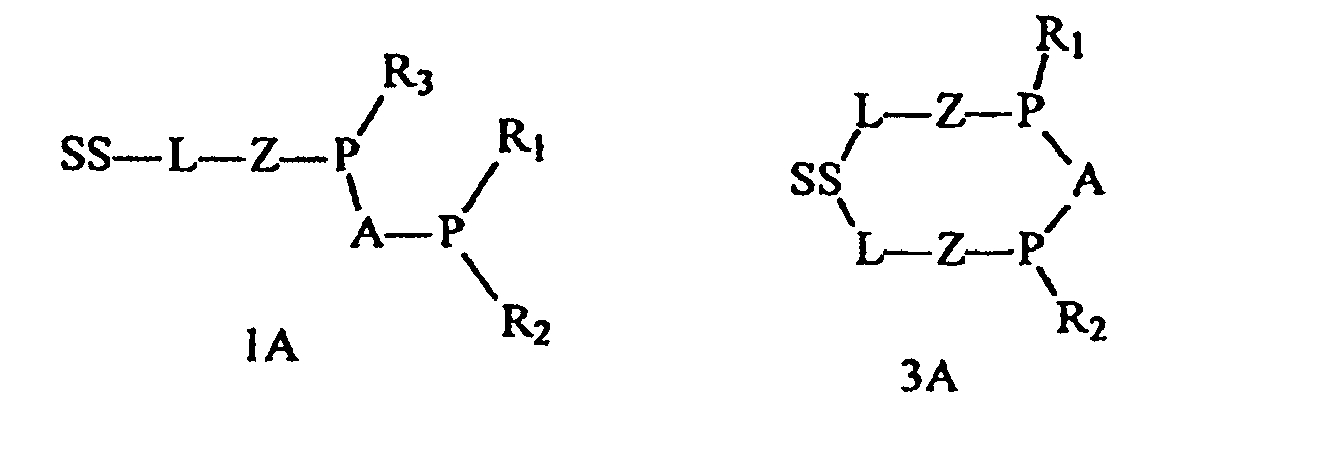
 SS est un support solide;A est un groupe divalent de 1-12 atomes de carbone aliphatiques ou aromatiques, linéaires ou ramifiés, contenant optionnellement un ou plusieurs hétéroatomes ou groupes organométalliques;R1, R2 et R3 sont indépendamment choisis dans le groupe constitué d'hydrogène, de groupes hydrocarbyle, hydrocarbyle substitué, hétérocycle, organométallique, CI, Br, I, SQ1, OQ2, PQ3Q4 et NQ5Q6, où Q1, Q2, Q3, Q4, Q5 et Q6 sont indépendamment choisis dans le groupe constitué d'hydrogène, de groupes hydrocarbyle, hydrocarbyle substitué, hydrocarbylamino, alcoxy, aryloxy et hétérocycle,R2 et R3 ensemble, R1 et R3 ensemble ou R1 et R2 ensemble peuvent optionnellement former un cycle;Z est un groupe d'attache divalent attaché par covalence à au moins un P dans la phosphine, choisi dans le groupe constitué de groupes hydrocarbylène, hydrocarbylène substitué, -O-, -S- et -NR4-, où R4 est choisi dans le groupe constitué d'un groupe hydrocarbyle optionnellement substitué et d'un halogène; etL est un groupe de liaison divalent attaché par covalence à Z et à SS, choisi dans le groupe constitué de chaînes optionnellement substituées de 1 à 12 atomes de carbone linéaires, ramifiés et cycliques;lorsque le composé est de la Formule 1A, le procédé comprenant les étapes:a) de mise en contact (i) d'au moins 2 équivalents molaires d'une phosphine de la Formule XR3P-A-PR1R2, où X est un halogène, avec (ii) pas plus d'un équivalent molaire de Z, conduisant à un P dans la phosphine qui est lié par covalence à Z, etb) optionnellement de remplacement d'un ou de plusieurs substituants du groupe R1, R2 ou R3 avec n'importe quel autre R1, R2 ou R3;lorsque le composé est de la Formule 3A, le procédé comprenant les étapes:a) de mise en contact (i) de pas plus d'un équivalent molaire d'une phosphine de la Formule XR3P-A-PR1R2, où X est un halogène, avec (ii) au moins deux équivalents molaires de Z, conduisant aux deux P dans la phosphine qui sont liés par covalence à Z, etb) optionnellement de remplacement d'un ou de plusieurs de R1 et R2 avec un ou plusieurs quelconques de R1 et R2;lorsque le composé est de la Formule 4A, le procédé comprenant les étapes:a) de mise en contact (i) d'une phosphine de la Formule HP(=O)R3-A-PR1R2 avec (ii) le support solide, conduisant à un P dans la phosphine qui est lié par covalence à Z, etb) optionnellement de remplacement d'un ou de plusieurs de R1, R2 et R3 avec un ou plusieurs quelconques de R1, R2 et R3;lorsque le composé est de la Formule 5A, le procédé comprenant les étapes:a) de mise en contact (i) d'une phosphine de la Formule HP(=O)R1R2 avec (ii) un support solide de la formule:
 b) optionnellement de remplacement d'un ou de plusieurs substituants du groupe R1, R2 et R3 avec un ou plusieurs substituants quelconques du groupe R1, R2 et R3.
 - Procédé suivant la revendication 1, dans lequel SS est choisi dans le groupe constitué de polyoléfines, de polyacrylates, de polyméthacrylates et de copolymères de ceux-ci.
- Procédé suivant la revendication 1, dans lequel le composé est de la Formule 1A, où SS est un polystyrène;
L est -CH2-;
A est choisi dans le groupe constitué d'une chaîne carbonée optionnellement substituée de 1-3 atomes de carbone et d'un cycle carboné optionnellement substitué de 6-12 atomes de carbone;
Z est choisi dans le groupe constitué d'une chaîne carbonée optionnellement substituée de 1-10 atomes de carbone, de -(NR4)- et de -O-;
R4 est choisi dans le groupe constitué de groupes chloro, cyclohexyle, n-propyle, i-propyle, n-butyle, phényle et t-butyle;
R1, R2 et R3 sont indépendamment choisis dans le groupe constitué d'hydrogène, de Cl, de groupes alkyle, alcényle, aryle, SQ1, OQ2 et PQ3Q4, où Q1, Q2, Q3 et Q4 sont choisis dans le groupe constitué d'hydrogène, de groupes hydrocarbyle, hydrocarbyle substitué, hydrocarbylamino et hétérocycle, et où R1 et R2 ensemble avec P forment un cycle phosphole, aryle ou alkyle. - Procédé suivant la revendication 1, dans lequel le composé est de la Formule 3A, où SS est un polystyrène;
L est -CH2-;
A est choisi dans le groupe constitué d'une chaîne carbonée optionnellement substituée de 1-3 atomes de carbone et d'un cycle carboné optionnellement substitué de 6-12 atomes de carbone;
Z est choisi dans le groupe constitué d'une chaîne carbonée optionnellement substituée de 1-10 atomes de carbone, de -(NR4)- et de -O-;
R4 est choisi dans le groupe constitué de groupes chloro, cyclohexyle, n-propyle, i-propyle, n-butyle, phényle et t-butyle;
R1 et R2 sont indépendamment choisis dans le groupe constitué d'hydrogène, de Cl, de groupes alkyle, alcényle, aryle, SQ1, OQ2 et PQ3Q4, où Q1, Q2, Q3 et Q4 sont choisis dans le groupe constitué d'hydrogène, de groupes hydrocarbyle, hydrocarbyle substitué, hydrocarbylamino et hétérocycle, et où R1 et R2 ensemble avec P forment un cycle phosphole, aryle ou alkyle. - Procédé suivant la revendication 1, dans lequel le composé est de la Formule 4A, où SS est un polystyrène;
L est -CH2-;
Z est choisi dans le groupe constitué d'une chaîne carbonée optionnellement substituée de 1-10 atomes de carbone, de -(NR4)- et de -O-;
R4 est choisi dans le groupe constitué de groupes chloro, cyclohexyle, n-propyle, i-propyle, n-butyle, phényle et t-butyle; et
R1, R2 et R3 sont indépendamment choisis dans le groupe constitué d'hydrogène, de Cl, de groupes alkyle, alcényle, aryle, SQ1, OQ2 et PQ3Q4, où Q1, Q2, Q3 et Q4 sont choisis dans le groupe constitué d'hydrogène, de groupes hydrocarbyle, hydrocarbyle substitué, hydrocarbylamino et hétérocycle, et où R1 et R2 ensemble avec P forment un cycle phosphole, aryle ou alkyle. - Procédé suivant la revendication 1, dans lequel le composé est de la Formule 5A, où SS est un polystyrène;
L est -CH2-;
Z est choisi dans le groupe constitué d'une chaîne carbonée optionnellement substituée de 1-10 atomes de carbone, de -(NR4)- et de -O-;
A est choisi dans le groupe constitué d'une chaîne carbonée optionnellement substituée de 1-3 atomes de carbone et d'un cycle carboné optionnellement substitué de 6-12 atomes de carbone;
R4 est choisi dans le groupe constitué de groupes chloro, cyclohexyle, n-propyle, i-propyle, n-butyle, phényle et t-butyle; et
R1, R2 et R3 sont indépendamment choisis dans le groupe constitué d'hydrogène, de Cl, de groupes alkyle, alcényle, aryle, SQ1, OQ2 et PQ3Q4, où Q1, Q2, Q3 et Q4 sont choisis dans le groupe constitué d'hydrogène, de groupes hydrocarbyle, hydrocarbyle substitué, hydrocarbylamino et hétérocycle, et où R1 et R2 ensemble avec P forment un cycle phosphole, aryle ou alkyle. - Composé de phosphine supporté choisi dans le groupe constitué des Formules 1A, 3A, 4A et 5A:

 SS est un support solide, où au moins un P dans chaque phosphine est attaché indirectement ou directement au support solide via une ou plusieurs liaisons covalentes;A est un groupe divalent de 1-12 atomes de carbone aliphatiques ou aromatiques, linéaires ou ramifiés, contenant optionnellement un ou plusieurs hétéroatomes ou groupes organométalliques;R1, R2 et R3 sont indépendamment choisis dans le groupe constitué d'hydrogène, de groupes hydrocarbyle, hydrocarbyle substitué, hétérocycle, organométallique, Cl, Br, I, SQ1, OQ2, PQ3Q4 et NQ5Q6, où Q1, Q2, Q3, Q4, Q5 et Q6 sont indépendamment choisis dans le groupe constitué d'hydrogène, de groupes hydrocarbyle, hydrocarbyle substitué, hydrocarbylamino, alcoxy, aryloxy et hétérocycle,R2 et R3 ensemble, R1 et R3 ensemble ou R1 et R2 ensemble peuvent optionnellement former un cycle;Z est un groupe d'attache divalent attaché par covalence à au moins un phosphore dans la phosphine, choisi dans le groupe constitué de groupes hydrocarbylène, hydrocarbylène substitué, -O-, -S- et -NR4-, où R4 est choisi dans le groupe constitué d'un groupe hydrocarbyle optionnellement substitué et d'un halogène; etL est un groupe de liaison divalent attaché par covalence à Z et à SS, choisi dans le groupe constitué de chaînes optionnellement substituées de 1 à 12 atomes de carbone linéaires, ramifiés et cycliques.
 - Composé de phosphine supporté suivant la revendication 7, dans lequel SS est choisi dans le groupe constitué de polyoléfines, de polyacrylates, de polyméthacrylates et de copolymères de ceux-ci.
- Composé de phosphine supporté suivant la revendication 7, qui est de la Formule 1A, où SS est un polystyrène;
L est -CH2-;
A est choisi dans le groupe constitué d'une chaîne carbonée optionnellement substituée de 1-3 atomes de carbone et d'un cycle carboné optionnellement substitué de 6-12 atomes de carbone;
Z est choisi dans le groupe constitué d'une chaîne carbonée optionnellement substituée de 1-10 atomes de carbone, de -(NR4)- et de -O-;
R4 est choisi dans le groupe constitué de groupes chloro, cyclohexyle, n-propyle, i-propyle, n-butyle, phényle et t-butyle;
R1, R2 et R3 sont indépendamment choisis dans le groupe constitué d'hydrogène, de Cl, de groupes alkyle, alcényle, aryle, SQ1, OQ2 et PQ3Q4, où Q1, Q2, Q3 et Q4 sont choisis dans le groupe constitué d'hydrogène, de groupes hydrocarbyle, hydrocarbyle substitué, hydrocarbylamino et hétérocycle, et où R1 et R2 ensemble avec P forment un cycle phosphole, aryle ou alkyle. - Composé de phosphine supporté suivant la revendication 7, qui est de la Formule 3A, où SS est un polystyrène;
L est -CH2-;
A est choisi dans le groupe constitué d'une chaîne carbonée optionnellement substituée de 1-3 atomes de carbone et d'un cycle carboné optionnellement substitué de 6-12 atomes de carbone;
Z est choisi dans le groupe constitué d'une chaîne carbonée optionnellement substituée de 1-10 atomes de carbone, de -(NR4)- et de -O-;
R4 est choisi dans le groupe constitué de groupes chloro, cyclohexyle, n-propyle, i-propyle, n-butyle, phényle et t-butyle;
R1 et R2 sont indépendamment choisis dans le groupe constitué d'hydrogène, de Cl, de groupes alkyle, alcényle, aryle, SQ1, OQ2 et PQ3Q4, où Q1, Q2, Q3 et Q4 sont choisis dans le groupe constitué d'hydrogène, de groupes hydrocarbyle, hydrocarbyle substitué, hydrocarbylamino et hétérocycle, et où R1 et R2 ensemble avec P forment un cycle phosphole, aryle ou alkyle. - Composé de phosphine supporté suivant la revendication 7, qui est de la Formule 4A, où SS est un polystyrène;
L est -CH2-;
Z est choisi dans le groupe constitué d'une chaîne carbonée optionnellement substituée de 1-10 atomes de carbone, de -(NR4)- et de -O-;
R4 est choisi dans le groupe constitué de groupes chloro, cyclohexyle, n-propyle, i-propyle, n-butyle, phényle et t-butyle; et
R1, R2 et R3 sont indépendamment choisis dans le groupe constitué d'hydrogène, de Cl, de groupes alkyle, alcényle, aryle, SQ1, OQ2 et PQ3Q4, où Q1, Q2, Q3 et Q4 sont choisis dans le groupe constitué d'hydrogène, de groupes hydrocarbyle, hydrocarbyle substitué, hydrocarbylamino et hétérocycle, et où R1 et R2 ensemble avec P forment un cycle phosphole, aryle ou alkyle. - Composé de phosphine supporté suivant la revendication 7, qui est de la Formule 5A, où SS est un polystyrène;
L est -CH2;
Z est choisi dans le groupe constitué d'une chaîne carbonée optionnellement substituée de 1-10 atomes de carbone, de -(NR4)- et de -O-;
A est choisi dans le groupe constitué d'une chaîne carbonée optionnellement substituée de 1-3 atomes de carbone et d'un cycle carboné optionnellement substitué de 6-12 atomes de carbone;
R4 est choisi dans le groupe constitué de groupes chloro, cyclohexyle, n-propyle, i-propyle, n-butyle, phényle et t-butyle; et
R1, R2 et R3 sont indépendamment choisis dans le groupe constitué d'hydrogène, de Cl, de groupes alkyle, alcényle, aryle, SQ1, OQ2 et PQ3Q4, où Q1, Q2, Q3 et Q4 sont choisis dans le groupe constitué d'hydrogène, de groupes hydrocarbyle, hydrocarbyle substitué, hydrocarbylamino et hétérocycle, et où R1 et R2 ensemble avec P forment un cycle phosphole, aryle ou alkyle. - Composé de coordination comprenant un ou plusieurs métaux de transition complexés à un ligand choisi parmi les composés de phosphine supportés suivant la revendication 7.
- Composé de coordination suivant la revendication 13, dans lequel SS est choisi dans le groupe constitué de polyoléfines, de polyacrylates, de polyméthacrylates et de copolymères de ceux-ci, et dans lequel les métaux de transition sont choisis dans le groupe périodique VIII.
- Composé de coordination suivant la revendication 13, qui est de la Formule 1A, où SS est un polystyrène;
L est -CH2-;
A est choisi dans le groupe constitué d'une chaîne carbonée optionnellement substituée de 1-3 atomes de carbone et d'un cycle carboné optionnellement substitué de 6-12 atomes de carbone;
Z est choisi dans le groupe constitué d'une chaîne carbonée optionnellement substituée de 1-10 atomes de carbone, de -(NR4)- et de -O-;
R4 est choisi dans le groupe constitué de groupes chloro, cyclohexyle, n-propyle, i-propyle, n-butyle, phényle et t-butyle;
R1, R2 et R3 sont indépendamment choisis dans le groupe constitué d'hydrogène, de Cl, de groupes alkyle, alcényle, aryle, SQ1, OQ2 et PQ3Q4, où Q1, Q2, Q3 et Q4 sont choisis dans le groupe constitué d'hydrogène, de groupes hydrocarbyle, hydrocarbyle substitué, hydrocarbylamino et hétérocycle, et où R1 et R2 ensemble avec P forment un cycle phosphole, aryle ou alkyle; et
le métal de transition est Rh. - Composé de coordination suivant la revendication 15, qui est préparé à partir de 1-(1,1-di-n-propylphosphino)-2-n-propylphosphinoéthane lié à un polymère et de dimère de chlorure de (1,5-cyclooctadiène)-rhodium(I).
- Procédé pour la préparation de coumarine comprenant la mise en contact de salicylaldéhyde avec un acrylate de la formule:

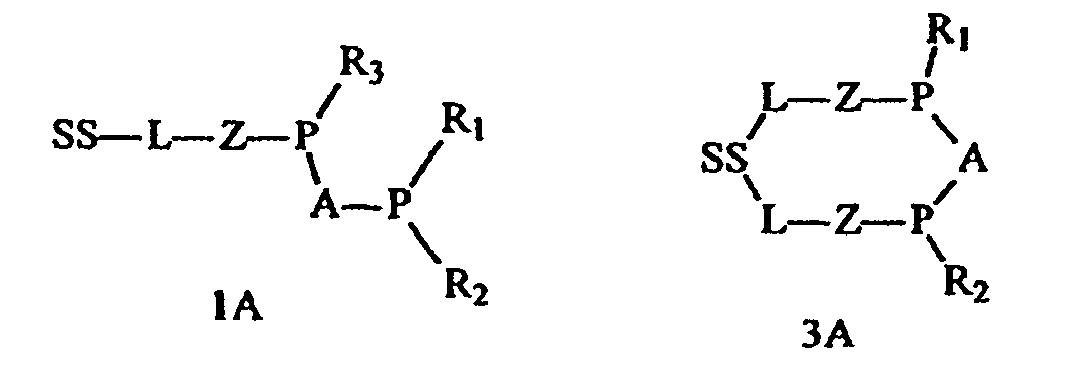
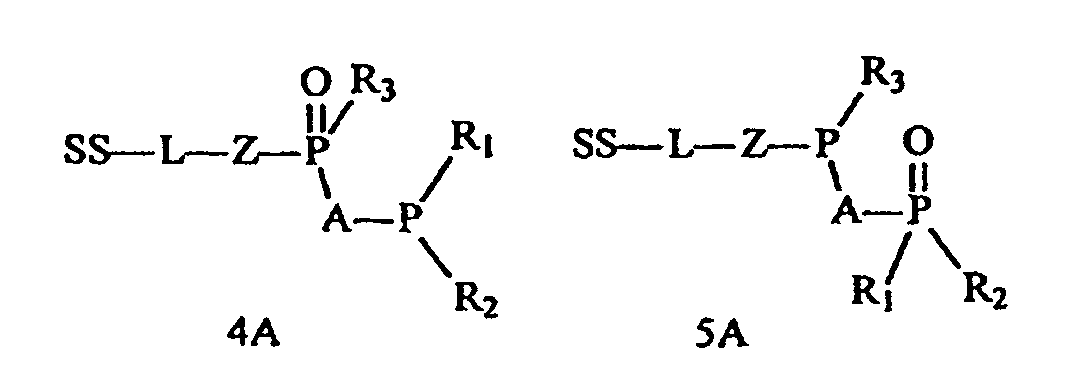 SS est un support solide, où au moins un P dans chaque phosphine est attaché indirectement ou directement au support solide via une ou plusieurs liaisons covalentes;A est un groupe divalent de 1-12 atomes de carbone aliphatiques ou aromatiques, linéaires ou ramifiés, contenant optionnellement un ou plusieurs hétéroatomes ou groupes organométalliques;R1, R2 et R3 sont indépendamment choisis dans le groupe constitué d'hydrogène, de groupes hydrocarbyle, hydrocarbyle substitué, hétérocycle, organométallique, Cl, Br, I, SQ1, OQ2, PQ3Q4 et NQ5Q6, où Q1, Q2, Q3, Q4, Q5 et Q6 sont indépendamment choisis dans le groupe constitué d'hydrogène, de groupes hydrocarbyle, hydrocarbyle substitué, hydrocarbylamino, alcoxy, aryloxy et hétérocycle, etR2 et R3 ensemble, R1 et R3 ensemble ou R1 et R2 ensemble peuvent optionnellement former un cycle;Z est un groupe d'attache divalent attaché par covalence à au moins un P dans la phosphine, choisi dans le groupe constitué de groupes hydrocarbylène, hydrocarbylène substitué, -O-, -S- et -NR4-, où R4 est choisi dans le groupe constitué d'un groupe hydrocarbyle optionnellement substitué et d'un halogène; etL est un groupe de liaison divalent attaché par covalence à Z et à SS, choisi dans le groupe constitué de chaînes optionnellement substituées de 1 à 12 atomes de carbone linéaires, ramifiés et cycliques.
 - Procédé suivant la revendication 17, dans lequel SS est choisi dans le groupe constitué de polyoléfines, de polyacrylates, de polyméthacrylates et de copolymères de ceux-ci, et dans lequel le métal de transition est choisi dans le groupe périodique VIII.
- Procédé suivant la revendication 17, dans lequel le ligand est de la Formule 1 A:
 Z est un groupe d'attache divalent attaché par covalence à au moins un phosphore dans la phosphine, choisi dans le groupe constitué de groupes hydrocarbylène, hydrocarbylène substitué, -O-, -S- et -NR4-, où R4 est choisi dans le groupe constitué d'un groupe hydrocarbyle optionnellement substitué et d'un halogène; etL est un groupe de liaison divalent attaché par covalence à Z et à SS, choisi dans le groupe constitué de chaînes optionnellement substituées de 1 à 12 atomes de carbone linéaires, ramifiés et cycliques.
 - Procédé suivant la revendication 19, dans lequel:L est -CH2-;A est choisi dans le groupe constitué d'une chaîne carbonée optionnellement substituée de 1-3 atomes de carbone et d'un cycle carboné optionnellement substitué de 6-12 atomes de carbone;Z est choisi dans le groupe constitué d'une chaîne carbonée optionnellement substituée de 1-10 atomes de carbone, de -(NR4)- et de -O-;R4 est choisi dans le groupe constitué de groupes chloro, cyclohexyle, n-propyle, i-propyle, n-butyle, phényle et t-butyle;R1, R2 et R3 sont indépendamment choisis dans le groupe constitué d'hydrogène, de Cl, de groupes alkyle, alcényle, aryle, SQ1, OQ2 et PQ3Q4, où Q1, Q2, Q3 et Q4 sont choisis dans le groupe constitué d'hydrogène, de groupes hydrocarbyle, hydrocarbyle substitué, hydrocarbylamino et hétérocycle, et où R1 et R2 ensemble avec P forment un cycle phosphole, aryle ou alkyle; etle métal de transition est Rh.
Priority Applications (4)
| Application Number | Priority Date | Filing Date | Title |
|---|---|---|---|
| EP05075869A EP1593432A3 (fr) | 1998-10-13 | 1999-10-13 | Ligands phosphoreux sur supports polymères destinés à la catalyse |
| EP05075867A EP1593430A3 (fr) | 1998-10-13 | 1999-10-13 | Ligands phosphoreux sur supports polymères destinés à la catalyse |
| EP05075868A EP1593431A3 (fr) | 1998-10-13 | 1999-10-13 | Ligands phosphoreux sur supports polymères destinés à la catalyse |
| EP05075941A EP1604738A3 (fr) | 1998-10-13 | 1999-10-13 | Procédé pour la préparation de coumarine |
Applications Claiming Priority (3)
| Application Number | Priority Date | Filing Date | Title |
|---|---|---|---|
| US10394698P | 1998-10-13 | 1998-10-13 | |
| US103946P | 1998-10-13 | ||
| PCT/US1999/023509 WO2000021663A2 (fr) | 1998-10-13 | 1999-10-13 | Ligands phosphoreux sur supports polymeres destines a la catalyse |
Related Child Applications (4)
| Application Number | Title | Priority Date | Filing Date |
|---|---|---|---|
| EP05075867A Division EP1593430A3 (fr) | 1998-10-13 | 1999-10-13 | Ligands phosphoreux sur supports polymères destinés à la catalyse |
| EP05075869A Division EP1593432A3 (fr) | 1998-10-13 | 1999-10-13 | Ligands phosphoreux sur supports polymères destinés à la catalyse |
| EP05075868A Division EP1593431A3 (fr) | 1998-10-13 | 1999-10-13 | Ligands phosphoreux sur supports polymères destinés à la catalyse |
| EP05075941A Division EP1604738A3 (fr) | 1998-10-13 | 1999-10-13 | Procédé pour la préparation de coumarine |
Publications (2)
| Publication Number | Publication Date |
|---|---|
| EP1133357A2 EP1133357A2 (fr) | 2001-09-19 |
| EP1133357B1 true EP1133357B1 (fr) | 2009-04-15 |
Family
ID=22297844
Family Applications (1)
| Application Number | Title | Priority Date | Filing Date |
|---|---|---|---|
| EP99954804A Expired - Lifetime EP1133357B1 (fr) | 1998-10-13 | 1999-10-13 | Ligands phosphoreux sur supports polymeres destines a la catalyse |
Country Status (7)
| Country | Link |
|---|---|
| US (2) | US6630604B1 (fr) |
| EP (1) | EP1133357B1 (fr) |
| JP (1) | JP2002527413A (fr) |
| AT (1) | ATE428500T1 (fr) |
| CA (1) | CA2345639A1 (fr) |
| DE (1) | DE69940743D1 (fr) |
| WO (1) | WO2000021663A2 (fr) |
Families Citing this family (9)
| Publication number | Priority date | Publication date | Assignee | Title |
|---|---|---|---|---|
| US6420611B1 (en) * | 1999-09-20 | 2002-07-16 | E. I. Du Pont De Nemours And Company | Composition comprising polymeric phosphite |
| US6124462A (en) * | 1999-11-30 | 2000-09-26 | E. I. Du Pont De Nemours And Company | Catalysis using phosphine oxide compounds |
| CA2403512A1 (fr) * | 2000-04-13 | 2001-10-25 | E.I. Du Pont De Nemours And Company | Synthese sur supports polymeres de ligands bidentes heteroatomiques convenant pour la catalyse |
| EP1744598B1 (fr) * | 2004-04-20 | 2017-05-31 | Kyushu Electric Power Co., Inc. | Élément électroluminescent organique et procédé de fabrication de celui-ci, composé organique contenant du phosphore et procédé de fabrication de celui-ci |
| US8075943B2 (en) * | 2005-12-27 | 2011-12-13 | Hitachi Chemical Co., Ltd. | Purification process for organic electronics material |
| EP2027134B1 (fr) | 2006-05-23 | 2014-07-16 | Solvias AG | Ligands chiraux utilisés dans des catalyseurs de métaux de transition pour des réactions d'addition asymétrique, notamment d'hydrogénation |
| US8415488B2 (en) | 2007-11-20 | 2013-04-09 | Solvias Ag | Bidentate secondary phosphine oxide chiral ligands for use in asymmetric addition reactions |
| US9994599B2 (en) | 2013-09-13 | 2018-06-12 | University Of Florida Research Foundation, Inc. | Biaryl ligands |
| WO2023017841A1 (fr) * | 2021-08-11 | 2023-02-16 | 国立研究開発法人科学技術振興機構 | Nouveau procédé de production d'un composé, nouveau composé et catalyseur métallique |
Family Cites Families (9)
| Publication number | Priority date | Publication date | Assignee | Title |
|---|---|---|---|---|
| FR2277103A1 (fr) * | 1974-07-05 | 1976-01-30 | Aquitaine Petrole | Nouveaux coordinats diphosphines polymeres et leurs derives metalles |
| JPS51128205A (en) | 1975-04-30 | 1976-11-09 | Susumu Nojima | Telephone device |
| JPS5353632A (en) | 1976-10-27 | 1978-05-16 | Mitsui Petrochem Ind Ltd | Preparation f aromatic ketones |
| NL8003059A (nl) * | 1980-05-28 | 1982-01-04 | Stamicarbon | Werkwijze en katalysator voor het uitvoeren van hydroformyleringsreacties. |
| US4325834A (en) * | 1980-11-21 | 1982-04-20 | Air Products And Chemicals, Inc. | Heterogeneous catalyst supports |
| US4658041A (en) * | 1982-09-24 | 1987-04-14 | The Dow Chemical Company | Preparation of alkyl carbonates |
| US5312984A (en) * | 1984-12-19 | 1994-05-17 | The B. F. Goodrich Company | Amidation of vinyl chloride with dimethylamine using a supported palladium catalyst |
| DE19505940A1 (de) * | 1995-02-21 | 1996-08-22 | Bayer Ag | Cumarinderivate, Verfahren zur Herstellung und ihre Verwendung als Zwischenprodukte |
| GB9619684D0 (en) | 1996-09-20 | 1996-11-06 | Oxford Asymmetry Ltd | Phosphine ligands |
-
1999
- 1999-10-13 JP JP2000575622A patent/JP2002527413A/ja active Pending
- 1999-10-13 WO PCT/US1999/023509 patent/WO2000021663A2/fr not_active Ceased
- 1999-10-13 US US09/807,279 patent/US6630604B1/en not_active Expired - Fee Related
- 1999-10-13 AT AT99954804T patent/ATE428500T1/de not_active IP Right Cessation
- 1999-10-13 CA CA002345639A patent/CA2345639A1/fr not_active Abandoned
- 1999-10-13 EP EP99954804A patent/EP1133357B1/fr not_active Expired - Lifetime
- 1999-10-13 DE DE69940743T patent/DE69940743D1/de not_active Expired - Fee Related
-
2002
- 2002-07-01 US US10/187,706 patent/US7098261B2/en not_active Expired - Fee Related
Also Published As
| Publication number | Publication date |
|---|---|
| JP2002527413A (ja) | 2002-08-27 |
| EP1133357A2 (fr) | 2001-09-19 |
| US7098261B2 (en) | 2006-08-29 |
| WO2000021663A3 (fr) | 2000-11-23 |
| CA2345639A1 (fr) | 2000-04-20 |
| US6630604B1 (en) | 2003-10-07 |
| DE69940743D1 (de) | 2009-05-28 |
| WO2000021663A2 (fr) | 2000-04-20 |
| US20030104476A1 (en) | 2003-06-05 |
| ATE428500T1 (de) | 2009-05-15 |
Similar Documents
| Publication | Publication Date | Title |
|---|---|---|
| JP2012067121A (ja) | ホスフィンオキサイド化合物を用いた触媒反応 | |
| EP1133357B1 (fr) | Ligands phosphoreux sur supports polymeres destines a la catalyse | |
| Shuchart et al. | Propargyl complexes of ruthenium | |
| US7238841B2 (en) | Polymer-supported phosphorus ligands for catalysts | |
| Lustenberger et al. | Towards Asymmetric Catalysis in the Major Groove of 1, 1′‐Binaphthalenes | |
| Hingst et al. | Nucleophilic Phosphanylation of Fluoroaromatic Compounds with Carboxyl, Carboxymethyl, and Aminomethyl Functionalities− an Efficient Synthetic Route to Amphiphilic Arylphosphanes | |
| Bianchini et al. | Reactivity of the triethylphosphine-carbon disulfide adduct toward metal carbonyls. X-ray structures of the complexes [Cr (CO) 5 (S2CPEt3)] and [Mo (CO) 2 (PEt3)(. mu.-S2CPEt3)] 2 | |
| Keller et al. | One-pot syntheses of sterically shielded phosphorus ligands by selective stepwise nucleophilic substitution at triphenyl phosphite | |
| EP1604738A2 (fr) | Procédé pour la préparation de coumarine | |
| EP1235764B1 (fr) | Catalyse utilisant des composes d'oxyde de phosphine | |
| WO1997039005A1 (fr) | Aryldiphosphines et catalyseurs les contenant | |
| EP1294657B1 (fr) | Catalyse au moyen de composes d'oxyde de phosphine et sulfoxyde | |
| WO2001079213A2 (fr) | Synthese sur supports polymeres de ligands bidentes heteroatomiques convenant pour la catalyse | |
| JP3610371B2 (ja) | (α−及び/又はβ−ホルミルエチル)ホスフィンオキシド化合物、(α−及び/又はβ−ホルミルエチル)ホスホン酸エステル化合物とその製造方法 | |
| Mudalige | Binding and Activation of small molecules by Ruthenium complexes containing a chelated aminophosphine ligand | |
| WO2006079819A2 (fr) | Procede ameliore de preparation d'alcools secondaires enrichis enantiomeriquement par l'addition de reactifs d'organo-aluminium sur des composes carbonyle | |
| Wicht | Synthesis and reactivity of terminal platinum (II) phosphido complexes: Application to the platinum-catalyzed asymmetric hydrophosphination of acrylonitrile | |
| Alayrac et al. | Recent Compounds Advances in Synthesis of P-BH3 | |
| CA2740931A1 (fr) | Catalyse au moyen de composes d'oxyde de phosphine et sulfoxyde | |
| Ionescu | Modular phosphorus-based ligands in rhodium catalyzed hydroformylation & hydrogeneration |
Legal Events
| Date | Code | Title | Description |
|---|---|---|---|
| PUAI | Public reference made under article 153(3) epc to a published international application that has entered the european phase |
Free format text: ORIGINAL CODE: 0009012 |
|
| 17P | Request for examination filed |
Effective date: 20010412 |
|
| AK | Designated contracting states |
Kind code of ref document: A2 Designated state(s): AT BE CH CY DE DK ES FI FR GB GR IE IT LI LU MC NL PT SE |
|
| 17Q | First examination report despatched |
Effective date: 20030221 |
|
| GRAP | Despatch of communication of intention to grant a patent |
Free format text: ORIGINAL CODE: EPIDOSNIGR1 |
|
| GRAS | Grant fee paid |
Free format text: ORIGINAL CODE: EPIDOSNIGR3 |
|
| GRAA | (expected) grant |
Free format text: ORIGINAL CODE: 0009210 |
|
| AK | Designated contracting states |
Kind code of ref document: B1 Designated state(s): AT BE CH CY DE DK ES FI FR GB GR IE IT LI LU MC NL PT SE |
|
| REG | Reference to a national code |
Ref country code: GB Ref legal event code: FG4D Ref country code: CH Ref legal event code: EP |
|
| REG | Reference to a national code |
Ref country code: IE Ref legal event code: FG4D |
|
| REF | Corresponds to: |
Ref document number: 69940743 Country of ref document: DE Date of ref document: 20090528 Kind code of ref document: P |
|
| NLV1 | Nl: lapsed or annulled due to failure to fulfill the requirements of art. 29p and 29m of the patents act | ||
| PG25 | Lapsed in a contracting state [announced via postgrant information from national office to epo] |
Ref country code: PT Free format text: LAPSE BECAUSE OF FAILURE TO SUBMIT A TRANSLATION OF THE DESCRIPTION OR TO PAY THE FEE WITHIN THE PRESCRIBED TIME-LIMIT Effective date: 20090915 Ref country code: FI Free format text: LAPSE BECAUSE OF FAILURE TO SUBMIT A TRANSLATION OF THE DESCRIPTION OR TO PAY THE FEE WITHIN THE PRESCRIBED TIME-LIMIT Effective date: 20090415 Ref country code: ES Free format text: LAPSE BECAUSE OF FAILURE TO SUBMIT A TRANSLATION OF THE DESCRIPTION OR TO PAY THE FEE WITHIN THE PRESCRIBED TIME-LIMIT Effective date: 20090726 Ref country code: AT Free format text: LAPSE BECAUSE OF FAILURE TO SUBMIT A TRANSLATION OF THE DESCRIPTION OR TO PAY THE FEE WITHIN THE PRESCRIBED TIME-LIMIT Effective date: 20090415 |
|
| PG25 | Lapsed in a contracting state [announced via postgrant information from national office to epo] |
Ref country code: SE Free format text: LAPSE BECAUSE OF FAILURE TO SUBMIT A TRANSLATION OF THE DESCRIPTION OR TO PAY THE FEE WITHIN THE PRESCRIBED TIME-LIMIT Effective date: 20090715 Ref country code: NL Free format text: LAPSE BECAUSE OF FAILURE TO SUBMIT A TRANSLATION OF THE DESCRIPTION OR TO PAY THE FEE WITHIN THE PRESCRIBED TIME-LIMIT Effective date: 20090415 |
|
| PG25 | Lapsed in a contracting state [announced via postgrant information from national office to epo] |
Ref country code: DK Free format text: LAPSE BECAUSE OF FAILURE TO SUBMIT A TRANSLATION OF THE DESCRIPTION OR TO PAY THE FEE WITHIN THE PRESCRIBED TIME-LIMIT Effective date: 20090415 |
|
| PLBE | No opposition filed within time limit |
Free format text: ORIGINAL CODE: 0009261 |
|
| STAA | Information on the status of an ep patent application or granted ep patent |
Free format text: STATUS: NO OPPOSITION FILED WITHIN TIME LIMIT |
|
| PG25 | Lapsed in a contracting state [announced via postgrant information from national office to epo] |
Ref country code: BE Free format text: LAPSE BECAUSE OF FAILURE TO SUBMIT A TRANSLATION OF THE DESCRIPTION OR TO PAY THE FEE WITHIN THE PRESCRIBED TIME-LIMIT Effective date: 20090415 |
|
| 26N | No opposition filed |
Effective date: 20100118 |
|
| PG25 | Lapsed in a contracting state [announced via postgrant information from national office to epo] |
Ref country code: MC Free format text: LAPSE BECAUSE OF NON-PAYMENT OF DUE FEES Effective date: 20091031 |
|
| REG | Reference to a national code |
Ref country code: CH Ref legal event code: PL |
|
| REG | Reference to a national code |
Ref country code: IE Ref legal event code: MM4A |
|
| REG | Reference to a national code |
Ref country code: FR Ref legal event code: ST Effective date: 20100630 |
|
| PG25 | Lapsed in a contracting state [announced via postgrant information from national office to epo] |
Ref country code: FR Free format text: LAPSE BECAUSE OF NON-PAYMENT OF DUE FEES Effective date: 20091102 Ref country code: DE Free format text: LAPSE BECAUSE OF NON-PAYMENT OF DUE FEES Effective date: 20100501 |
|
| PG25 | Lapsed in a contracting state [announced via postgrant information from national office to epo] |
Ref country code: LI Free format text: LAPSE BECAUSE OF NON-PAYMENT OF DUE FEES Effective date: 20091031 Ref country code: IE Free format text: LAPSE BECAUSE OF NON-PAYMENT OF DUE FEES Effective date: 20091013 Ref country code: GR Free format text: LAPSE BECAUSE OF FAILURE TO SUBMIT A TRANSLATION OF THE DESCRIPTION OR TO PAY THE FEE WITHIN THE PRESCRIBED TIME-LIMIT Effective date: 20090716 Ref country code: CH Free format text: LAPSE BECAUSE OF NON-PAYMENT OF DUE FEES Effective date: 20091031 |
|
| PG25 | Lapsed in a contracting state [announced via postgrant information from national office to epo] |
Ref country code: GB Free format text: LAPSE BECAUSE OF NON-PAYMENT OF DUE FEES Effective date: 20091013 |
|
| PG25 | Lapsed in a contracting state [announced via postgrant information from national office to epo] |
Ref country code: IT Free format text: LAPSE BECAUSE OF FAILURE TO SUBMIT A TRANSLATION OF THE DESCRIPTION OR TO PAY THE FEE WITHIN THE PRESCRIBED TIME-LIMIT Effective date: 20090415 |
|
| PG25 | Lapsed in a contracting state [announced via postgrant information from national office to epo] |
Ref country code: LU Free format text: LAPSE BECAUSE OF NON-PAYMENT OF DUE FEES Effective date: 20091013 |
|
| PG25 | Lapsed in a contracting state [announced via postgrant information from national office to epo] |
Ref country code: CY Free format text: LAPSE BECAUSE OF FAILURE TO SUBMIT A TRANSLATION OF THE DESCRIPTION OR TO PAY THE FEE WITHIN THE PRESCRIBED TIME-LIMIT Effective date: 20090415 |