EP1133471B1 - Hydrazin-derivate - Google Patents
Hydrazin-derivate Download PDFInfo
- Publication number
- EP1133471B1 EP1133471B1 EP99959293A EP99959293A EP1133471B1 EP 1133471 B1 EP1133471 B1 EP 1133471B1 EP 99959293 A EP99959293 A EP 99959293A EP 99959293 A EP99959293 A EP 99959293A EP 1133471 B1 EP1133471 B1 EP 1133471B1
- Authority
- EP
- European Patent Office
- Prior art keywords
- alkyl
- isobutyl
- aryl
- phenyl
- formula
- Prior art date
- Legal status (The legal status is an assumption and is not a legal conclusion. Google has not performed a legal analysis and makes no representation as to the accuracy of the status listed.)
- Expired - Lifetime
Links
Classifications
-
- C—CHEMISTRY; METALLURGY
- C07—ORGANIC CHEMISTRY
- C07D—HETEROCYCLIC COMPOUNDS
- C07D295/00—Heterocyclic compounds containing polymethylene-imine rings with at least five ring members, 3-azabicyclo [3.2.2] nonane, piperazine, morpholine or thiomorpholine rings, having only hydrogen atoms directly attached to the ring carbon atoms
- C07D295/04—Heterocyclic compounds containing polymethylene-imine rings with at least five ring members, 3-azabicyclo [3.2.2] nonane, piperazine, morpholine or thiomorpholine rings, having only hydrogen atoms directly attached to the ring carbon atoms with substituted hydrocarbon radicals attached to ring nitrogen atoms
- C07D295/08—Heterocyclic compounds containing polymethylene-imine rings with at least five ring members, 3-azabicyclo [3.2.2] nonane, piperazine, morpholine or thiomorpholine rings, having only hydrogen atoms directly attached to the ring carbon atoms with substituted hydrocarbon radicals attached to ring nitrogen atoms substituted by singly bound oxygen or sulfur atoms
- C07D295/084—Heterocyclic compounds containing polymethylene-imine rings with at least five ring members, 3-azabicyclo [3.2.2] nonane, piperazine, morpholine or thiomorpholine rings, having only hydrogen atoms directly attached to the ring carbon atoms with substituted hydrocarbon radicals attached to ring nitrogen atoms substituted by singly bound oxygen or sulfur atoms with the ring nitrogen atoms and the oxygen or sulfur atoms attached to the same carbon chain, which is not interrupted by carbocyclic rings
- C07D295/088—Heterocyclic compounds containing polymethylene-imine rings with at least five ring members, 3-azabicyclo [3.2.2] nonane, piperazine, morpholine or thiomorpholine rings, having only hydrogen atoms directly attached to the ring carbon atoms with substituted hydrocarbon radicals attached to ring nitrogen atoms substituted by singly bound oxygen or sulfur atoms with the ring nitrogen atoms and the oxygen or sulfur atoms attached to the same carbon chain, which is not interrupted by carbocyclic rings to an acyclic saturated chain
-
- A—HUMAN NECESSITIES
- A61—MEDICAL OR VETERINARY SCIENCE; HYGIENE
- A61P—SPECIFIC THERAPEUTIC ACTIVITY OF CHEMICAL COMPOUNDS OR MEDICINAL PREPARATIONS
- A61P1/00—Drugs for disorders of the alimentary tract or the digestive system
-
- A—HUMAN NECESSITIES
- A61—MEDICAL OR VETERINARY SCIENCE; HYGIENE
- A61P—SPECIFIC THERAPEUTIC ACTIVITY OF CHEMICAL COMPOUNDS OR MEDICINAL PREPARATIONS
- A61P11/00—Drugs for disorders of the respiratory system
- A61P11/06—Antiasthmatics
-
- A—HUMAN NECESSITIES
- A61—MEDICAL OR VETERINARY SCIENCE; HYGIENE
- A61P—SPECIFIC THERAPEUTIC ACTIVITY OF CHEMICAL COMPOUNDS OR MEDICINAL PREPARATIONS
- A61P17/00—Drugs for dermatological disorders
- A61P17/06—Antipsoriatics
-
- A—HUMAN NECESSITIES
- A61—MEDICAL OR VETERINARY SCIENCE; HYGIENE
- A61P—SPECIFIC THERAPEUTIC ACTIVITY OF CHEMICAL COMPOUNDS OR MEDICINAL PREPARATIONS
- A61P19/00—Drugs for skeletal disorders
- A61P19/02—Drugs for skeletal disorders for joint disorders, e.g. arthritis, arthrosis
-
- A—HUMAN NECESSITIES
- A61—MEDICAL OR VETERINARY SCIENCE; HYGIENE
- A61P—SPECIFIC THERAPEUTIC ACTIVITY OF CHEMICAL COMPOUNDS OR MEDICINAL PREPARATIONS
- A61P29/00—Non-central analgesic, antipyretic or antiinflammatory agents, e.g. antirheumatic agents; Non-steroidal antiinflammatory drugs [NSAID]
-
- A—HUMAN NECESSITIES
- A61—MEDICAL OR VETERINARY SCIENCE; HYGIENE
- A61P—SPECIFIC THERAPEUTIC ACTIVITY OF CHEMICAL COMPOUNDS OR MEDICINAL PREPARATIONS
- A61P29/00—Non-central analgesic, antipyretic or antiinflammatory agents, e.g. antirheumatic agents; Non-steroidal antiinflammatory drugs [NSAID]
- A61P29/02—Non-central analgesic, antipyretic or antiinflammatory agents, e.g. antirheumatic agents; Non-steroidal antiinflammatory drugs [NSAID] without antiinflammatory effect
-
- A—HUMAN NECESSITIES
- A61—MEDICAL OR VETERINARY SCIENCE; HYGIENE
- A61P—SPECIFIC THERAPEUTIC ACTIVITY OF CHEMICAL COMPOUNDS OR MEDICINAL PREPARATIONS
- A61P35/00—Antineoplastic agents
-
- A—HUMAN NECESSITIES
- A61—MEDICAL OR VETERINARY SCIENCE; HYGIENE
- A61P—SPECIFIC THERAPEUTIC ACTIVITY OF CHEMICAL COMPOUNDS OR MEDICINAL PREPARATIONS
- A61P37/00—Drugs for immunological or allergic disorders
-
- A—HUMAN NECESSITIES
- A61—MEDICAL OR VETERINARY SCIENCE; HYGIENE
- A61P—SPECIFIC THERAPEUTIC ACTIVITY OF CHEMICAL COMPOUNDS OR MEDICINAL PREPARATIONS
- A61P37/00—Drugs for immunological or allergic disorders
- A61P37/02—Immunomodulators
- A61P37/06—Immunosuppressants, e.g. drugs for graft rejection
-
- A—HUMAN NECESSITIES
- A61—MEDICAL OR VETERINARY SCIENCE; HYGIENE
- A61P—SPECIFIC THERAPEUTIC ACTIVITY OF CHEMICAL COMPOUNDS OR MEDICINAL PREPARATIONS
- A61P7/00—Drugs for disorders of the blood or the extracellular fluid
- A61P7/04—Antihaemorrhagics; Procoagulants; Haemostatic agents; Antifibrinolytic agents
-
- A—HUMAN NECESSITIES
- A61—MEDICAL OR VETERINARY SCIENCE; HYGIENE
- A61P—SPECIFIC THERAPEUTIC ACTIVITY OF CHEMICAL COMPOUNDS OR MEDICINAL PREPARATIONS
- A61P9/00—Drugs for disorders of the cardiovascular system
- A61P9/04—Inotropic agents, i.e. stimulants of cardiac contraction; Drugs for heart failure
-
- C—CHEMISTRY; METALLURGY
- C07—ORGANIC CHEMISTRY
- C07C—ACYCLIC OR CARBOCYCLIC COMPOUNDS
- C07C311/00—Amides of sulfonic acids, i.e. compounds having singly-bound oxygen atoms of sulfo groups replaced by nitrogen atoms, not being part of nitro or nitroso groups
- C07C311/48—Amides of sulfonic acids, i.e. compounds having singly-bound oxygen atoms of sulfo groups replaced by nitrogen atoms, not being part of nitro or nitroso groups having nitrogen atoms of sulfonamide groups further bound to another hetero atom
- C07C311/49—Amides of sulfonic acids, i.e. compounds having singly-bound oxygen atoms of sulfo groups replaced by nitrogen atoms, not being part of nitro or nitroso groups having nitrogen atoms of sulfonamide groups further bound to another hetero atom to nitrogen atoms
-
- C—CHEMISTRY; METALLURGY
- C07—ORGANIC CHEMISTRY
- C07D—HETEROCYCLIC COMPOUNDS
- C07D213/00—Heterocyclic compounds containing six-membered rings, not condensed with other rings, with one nitrogen atom as the only ring hetero atom and three or more double bonds between ring members or between ring members and non-ring members
- C07D213/02—Heterocyclic compounds containing six-membered rings, not condensed with other rings, with one nitrogen atom as the only ring hetero atom and three or more double bonds between ring members or between ring members and non-ring members having three double bonds between ring members or between ring members and non-ring members
- C07D213/04—Heterocyclic compounds containing six-membered rings, not condensed with other rings, with one nitrogen atom as the only ring hetero atom and three or more double bonds between ring members or between ring members and non-ring members having three double bonds between ring members or between ring members and non-ring members having no bond between the ring nitrogen atom and a non-ring member or having only hydrogen or carbon atoms directly attached to the ring nitrogen atom
- C07D213/24—Heterocyclic compounds containing six-membered rings, not condensed with other rings, with one nitrogen atom as the only ring hetero atom and three or more double bonds between ring members or between ring members and non-ring members having three double bonds between ring members or between ring members and non-ring members having no bond between the ring nitrogen atom and a non-ring member or having only hydrogen or carbon atoms directly attached to the ring nitrogen atom with substituted hydrocarbon radicals attached to ring carbon atoms
- C07D213/28—Radicals substituted by singly-bound oxygen or sulphur atoms
- C07D213/32—Sulfur atoms
- C07D213/34—Sulfur atoms to which a second hetero atom is attached
Definitions
- the present invention is concerned with novel hydrazine derivatives, a process for their manufacture and pharmaceutical preparations containing these derivatives.
- WO 97/37973 discloses peptidyl compounds having MMP and TNF inhibitory activity.
- novel hydrazine derivatives provided by the present invention are compounds of the general formula wherein
- the present invention is further directed the medicaments comprising a compound as described above or a pharmaceutically acceptable salt thereof and a therapeutically inert carrier material and to methods for making such medicaments.
- the present invention is also directed the novel intermediates useful in the synthesis of the above described compounds.
- the present invention is directed to a process for preparing compounds of formula (I).
- the present invention is directed to the use of a compound of formula (I) or a pharmaceutically acceptable salt thereof in the treatment of illnesses.
- the present invention is directed to the use of a compound of formula (I) or a pharmaceutically acceptable salt thereof in the preparation or a medicament for the treatment of inflammatory and autoimmune diseases, osteoarthritis, respiratory diseases, tumours, cachexia, cardiovascular diseases, fever, haemorrhage and sepsis.
- the hydrazine derivatives provided by the present invention are inhibitors of tumour necrosis factor alpha (TNF- ⁇ ) release from cells. They can be used as medicaments, especially in the treatment of inflammatory and autoimmune diseases (e.g. rheumatoid arthritis, inflammatory bowel disease, multiple sclerosis and psoriasis), osteoarthritis, respiratory diseases (e.g. asthma and chronic obstructive pulmonary disease), tumours, cachexia, cardiovascular diseases (e.g. congestive heart failure), fever, haemorrhage and sepsis.
- inflammatory and autoimmune diseases e.g. rheumatoid arthritis, inflammatory bowel disease, multiple sclerosis and psoriasis
- respiratory diseases e.g. asthma and chronic obstructive pulmonary disease
- tumours e.g. congestive heart failure
- cachexia e.g. congestive heart failure
- cardiovascular diseases e.g. congestive heart failure
- fever haemorr
- the hydrazine derivatives provided by the present invention show only weak inhibitory activity against the matrix metalloproteinase (MMP) family of enzymes, such as collagenases, stromelysins and gelatinases.
- MMP matrix metalloproteinase
- alkyl alone or in combination as in, for example, "halo-alkyl” or “cycloalkyl-alkyl” means a straight-chain or branched-chain alkyl group containing up to 8, preferably up to 4, carbon atoms, e.g. methyl, ethyl, n-propyl, isopropyl, n-butyl, isobutyl, sec.butyl, tert-butyl, n-pentyl and n-hexyl.
- halo-alkyl means a alkyl group as defined earlier which carries one or more halogen atoms.
- Examples of halo-alkyl groups are chloromethyl, trifluoromethyl and 2,2,2-trifluoroethyl.
- alkoxy alone or in combination as in “alkoxycarbonyl”, means a alkyl group as defined above which is bonded via an oxygen atom, e.g. methoxy, ethoxy, n-propoxy, isopropoxy, n-butoxy, isobutoxy and tert-butoxy.
- Methoxycarbonyl, ethoxycarbonyl and the like are examples of lower alkoxycarbonyl groups.
- cycloalkyl alone or in combination as in “cycloalkyl-alkyl”, means a cycloalkyl group containing 3 to 7 carbon atoms, i.e. cyclopropyl, cyclobutyl, cyclopentyl, cyclohexyl and cycloheptyl. Cyclopropylmethyl, 2-cyclobutyl-ethyl and 3-cyclohexyl-propyl are examples of lower cycloalkyl-lower alkyl groups.
- alkenyl means an alkenyl group containing from 2 to 7 carbon atoms, e.g. allyl, vinyl and butenyl.
- alkynyl means an alkynyl group containing from 2 to 7 carbon atoms, e.g. propargyl or butynyl.
- aryl alone or in combination as in “aryl alkyl”, means phenyl or naphthyl optionally substituted by halogen, i.e. fluorine, chlorine, bromine or iodine, alkyl, alkoxy, trifluoromethyl, hydroxy, alkoxycarbonyl, nitro, phenyl or the like, e.g. phenyl, 1-naphthyl, 2-methylphenyl, 4-methoxyphenyl, 2,4-difluorophenyl, 4-nitrophenyl and 4-methoxycarbonylphenyl.
- halogen i.e. fluorine, chlorine, bromine or iodine
- Benzyl, 4-chlorobenzyl, 4-bromobenzyl, 3-hydroxybenzyl, 4-methoxybenzyl, 4-nitrobenzyl, 2-phenylethyl, 3,4-dimethoxy-phenethyl and the like are typical examples of aryl- alkyl groups.
- heterocyclyl alone or in combination as in “heterocyclylalkyl” means a 4-, 5-, 6- or 7-membered saturated or partially unsaturated or 5- or 6-membered aromatic heterocyclic ring which is bonded via a C atom or secondary N atom (i.e. -NH-), which contains one or more hetero atoms selected from nitrogen, sulphur and oxygen and/or a SO or SO 2 group and which is optionally substituted by e.g. halogen, alkyl, alkoxy and/or oxo and/or optionally benz-fused.
- heterocyclyl groups are pyrrolidinyl, pyrrolinyl, pyrazolinyl, piperidinyl, N-methylpiperidinyl, morpholinyl, thiamorpholinyl, thiamorpholinyl S,S-dioxide, hexahydroazepinyl, tetrahydropyranyl, tetrahydrothiopyranyl, furyl, thienyl, thiazolyl, oxazolyl, isoxazolyl, oxetanyl, imidazolidinyl, dioxolanyl, pyrrolyl, pyridyl, pyrimidinyl, benzofuranyl, benzothienyl, benzthiazolyl, indolyl, isoindolyl, e.g. phthalimido, quinolyl and isoquinolyl.
- heterocyclylcarbonyl means a heterocyclyl group as previously defined which is bonded to C(O) via a secondary N atom. Morpholinocarbonyl is a typical example of such a heterocyclylcarbonyl group.
- heteroaryl means an aromatic heterocyclic group within the definition of “heterocyclyl”.
- halo means fluoro, chloro, bromo or iodo unless specifically indicated to the contrary.
- the spacer group denoted by X can be, for example, a group of the formula -(CH 2 ) 1-5 - or -(CH 2 ) 1 -Y-(CH 2 ) m - in which 1 and m each independently stand for 0, 1 or 2 and Y represents arylene, lower cycloalkylene or heterocyclylene.
- arylene means a divalent aryl, cycloalkyl, alkyl and, respectively, heterocyclyl group as hereinbefore defined.
- Compounds of formula I which are acidic form pharmaceutically acceptable salts with bases such as alkali metal hydroxides, e.g. sodium hydroxide and potassium hydroxide, alkaline earth metal hydroxides, e.g. calcium hydroxide, barium hydroxide and magnesium hydroxide, and the like.
- bases such as alkali metal hydroxides, e.g. sodium hydroxide and potassium hydroxide, alkaline earth metal hydroxides, e.g. calcium hydroxide, barium hydroxide and magnesium hydroxide, and the like.
- Those compounds of formula I which are basic can form pharmaceutically acceptable salts with inorganic acids, e.g. with hydrohalic acids such as hydrochloric acid and hydrobromic acid, sulphuric acid, nitric acid and phosphoric acid, and with organic acids, e.g. with acetic acid, tartaric acid, succinic acid, fumaric acid, maleic acid, malic acid, salicylic acid, citric acid methane
- R 1 represents alkyl, especially isobutyl.
- R 2 preferably represents pyridyl, especially 2-pyridyl, or NR 5 R 6 in which R 5 and R 6 each represent a hydrogen atom or each represent a methyl group or an ethyl group or R 5 and R 6 together represent alkylene in which one CH 2 group is replaced by an oxygen atom, especially 3-oxapentamethylene, i.e. R 2 is morpholinyl.
- R 3 preferably represents alkyl, especially isobutyl.
- X preferably represents -(CH 2 ) 1-4 - or -CH 2 -Y in which Y represents arylene, especially phenylene and particularly o-phenylene.
- the protecting group denoted by R 9 in a compound of formula II can be any conventional protecting group, but is preferably tetrahydropyranyl, 4-methoxybenzyl, benzyl, or tri(lower alkyl)silyl, especially tert-butyldimethylsilyl.
- the cleavage of the protecting group denoted by R 9 in a compound of formula II in accordance with embodiment a) of the process is carried out according to methods known per se.
- the tetrahydropyranyl group can be cleaved off by treatment with a sulphonic acid, e.g.methanesulphonic acid or p-toluenesulphonic acid, in a alkanol, e.g. methanol, or by treatment with hydrogen chloride.
- Cleavage of the 4-methoxybenzyl group can be effected, for example, using trifluoroacetic acid. Hydrogenolysis in the presence of a catalyst, e.g.
- a tri(alkyl)silyl group can be cleaved off using water or a medium having a low pH, with this cleavage normally taking place during the working up of the respective compound of formula II from the medium in which it is prepared (i.e. the cleavage takes place in situ).
- the cleavage of the protecting group denoted by R 9 in a compound of formula III in accordance with the first step of embodiment b) of the process is carried out in a manner analogous to the cleavage of the protecting group denoted by R 9 in a compound of formula II described hereinbefore.
- the reduction of a compound of formula IV in accordance with the second step of embodiment b) of the process is carried out in a manner known per se.
- the reduction can be conveniently carried out using hydrogen in the presence of a conventional hydrogenation catalyst, e.g. a palladium catalyst such as palladium-on-carbon, and in an organic solvent which is inert under the hydrogenation conditions, e.g. a alkanol such as methanol, ethanol, etc.
- a conventional hydrogenation catalyst e.g. a palladium catalyst such as palladium-on-carbon
- an organic solvent which is inert under the hydrogenation conditions e.g. a alkanol such as methanol, ethanol, etc.
- the reduction is carried out at about room temperature and under atmospheric pressure. It is convenient to carry out the reduction without isolating the compound of formula IV from the medium in which it is prepared.
- the compounds of formula II used as starting materials in embodiment a) of the foregoing process are novel and form a further object of the present invention. They can be prepared, for example, as illustrated in Reaction Scheme A in which R 1 , R 3 , R 4 and R 9 have the significances given earlier, R 20 has any of the values accorded to R 2 hereinbefore, provided that a primary amino group denoted by NR 5 R 6 is protected, preferably as phthalimido, P represents a protecting group, tBu represents tert-butyl and TFA represents trifluoroacetic acid.
- the first step comprises the condensation of a compound of formula V with a compound of formula VI or an acid addition salt thereof, to give a hydrazide of formula VII.
- This condensation is carried out under the known conditions of a peptide coupling reaction and using the coupling reagents known per se for such couplings, e.g. 1-hydroxybenzotriazole in the presence of 1-ethyl-3-(3-dimethylaminopropyl)carbodiimide hydrochloride.
- a hydrazide of formula VII is then N-protected in a known manner to give a compound of formula VIII.
- This protection can be by means of any conventional amino protecting group. It is, however, convenient to use trifluoroacetyl as the protecting group and to introduce this group by reacting a hydrazide of formula VII with trifluoroacetic anhydride, conveniently in an organic solvent which is inert under the reaction conditions, e.g. a halogenated hydrocarbon such as dichloromethane, and in the presence of an organic base, e.g. pyridine, at about room temperature.
- an organic base e.g. pyridine
- a compound of formula VIII is deprotected with trifluoroacetic acid to give a carboxylic acid of formula IX.
- This deprotection is carried out in a manner known per se, e.g. in an organic solvent which is inert under the conditions of the reaction, such as a halogenated hydrocarbon, e.g. dichloromethane, at about room temperature.
- a carboxylic acid of formula IX is converted into a compound of formula XI by condensation with an O-protected hydroxylamine of formula X.
- the condensation is carried out in a manner known per se for peptide coupling reactions and using conventional coupling reagents, e.g. 1-hydroxybenzotriazole in the presence of 1-ethyl-3-(3-dimethylaminopropyl)carbodiimide hydrochloride.
- a compound of formula XI is then N-deprotected to give a compound of formula XII.
- the deprotection can be carried out in a manner known per se depending on the nature of the N-protecting group present. For example, when the N-protecting group is trifluoroacetyl, deprotection can be carried out using an aqueous alkali metal carbonate solution such as aqueous potassium carbonate solution.
- a compound of formula XII is converted into a compound of formula II by reaction with a compound of formula XIII followed, where required, by deprotection at R 20 .
- the reaction of a compound of formula XII with a compound of formula XIII is carried out in a conventional manner, conveniently in an organic solvent which is inert under the reaction conditions and in the presence of an organic base at about 0°C to about room temperature. Suitable solvents include halogenated hydrocarbons, e.g. dichloromethane. Pyridine can be mentioned as an example of a suitable organic base which can be used.
- Any deprotection at R 20 which is required after the reaction can be carried out in a known manner depending on the nature of the protecting group present. For example, phthalimido can be converted into amino by treatment with hydrazine hydrate.
- a compound of formula XII is firstly reacted with a compound of the formula Cl-(CH 2 ) 1-5 -SO 2 Cl, conveniently in an organic solvent which is inert under the reaction conditions, e.g. a halogenated hydrocarbon such as dichloromethane, and in the presence of an organic amine, e.g. pyridine.
- an organic solvent which is inert under the reaction conditions, e.g. a halogenated hydrocarbon such as dichloromethane, and in the presence of an organic amine, e.g. pyridine.
- reaction product obtained a compound corresponding to formula II in which X represents -(CH 2 ) 1-5 - and R 2 represents chlorine
- a di(lower alkyl)amine e.g. diethylamine
- sodium iodide e.g. sodium iodide
- a solvent which is inert under the reaction conditions e.g. a ketone such as methyl ethyl ketone
- a solvent which is inert under the reaction conditions e.g. a ketone such as methyl ethyl ketone
- a halogenated hydrocarbon such as dichloromethane
- a compound of formula VII in which R 3 represents hydrogen can be converted into a corresponding compound of formula VII in which R 3 represents alkyl, alkenyl, alkynyl, cycloalkyl or aryl alkyl in a manner known per se.
- a compound of formula VII in which R 3 represents hydrogen can be condensed with an aldehyde of the general formula R 30 -CHO, wherein R 30 represents alkyl, alkenyl, alkynyl, cycloalkyl or aryl alkyl, e.g. in the presence of p-toluenesulphonic acid and molecular sieves, and the resulting substituted imine can be reduced, preferably in situ, using an alkali metal cyanoborohydride, especially sodium cyanoborohydride.
- a compound of II in which R 3 represents hydrogen can be converted into a corresponding compound of formula II in which R 3 represents alkyl, alkenyl, alkynyl, cycloalkyl or aryl-alkyl by reaction with a halide of the general formula R 30 -X, wherein R 30 has the significance given earlier and X represents halogen, conveniently in the presence of a base, e.g. an alkali metal carbonate such as sodium carbonate or potassium carbonate, and in an organic solvent which is inert under the conditions of the reaction, e.g. dimethylformamide.
- a base e.g. an alkali metal carbonate such as sodium carbonate or potassium carbonate
- the compounds of formula III used as starting materials in embodiment b) of the foregoing process and the compounds of formula IV, which occur as intermediates, are novel and form further objects of the present invention.
- the compounds of formula III can be prepared, for example, by reacting a compound of formula XII hereinbefore with a nitro compound of the formula O 2 N-X 1 -SO 2 Cl, wherein X 1 has the significance given earlier. The reaction is carried out in an analogous manner to that described earlier in connection with the reaction of a compound of formula XII with a compound of formula XIII.
- the compounds of formula V can be prepared by methods disclosed in published patent applications EP-497192-A and EP-574758-A and also using the methods of Beckett et al, Synlett 1993, 137 and Pratt et al, Synlett 1998, 531.
- the compounds of formula VI can be obtained from commercial suppliers (e.g. methyl hydrazine, Aldrich cat. no. M5,000-1; benzyl hydrazine diHCl, Aldrich cat. no. B2,285-2; phenelzine HCl, Sigma cat. no. P6,777; N-propyl hydrazine HCl, Ubichem cat. no. 002665), or be prepared by the method of Zwierzak, Synthesis 1987, 485.
- commercial suppliers e.g. methyl hydrazine, Aldrich cat. no. M5,000-1; benzyl hydrazine diHCl, Aldrich cat. no. B2,285-2; phenelzine HCl, Sigma cat. no. P6,777; N-propyl hydrazine HCl, Ubichem cat. no. 002665
- the compounds of formula X can be obtained from commercial suppliers (e.g. O-benzylhydroxylamine HCl, Aldrich cat. no. B2,298-4; O-(tetrahydro-2H-pyran-2-yl)hydroxylamine, Aldrich cat. no. 48,089-4; O-(trimethylsilyl)-hydroxylamine, Aldrich cat. no. 44,044-2), or be prepared by the method of Teodozyl et al, Rocz. Chem. 1976, 50(2), 367 (CAN 85:62908).
- the compounds of formula XIII can be obtained from commercial suppliers (e.g. 2-phthalimidoethanesulfonyl chloride, Asta Tech, Inc. cat. no. N88865), or be prepared from commercially available sulfonic acids (e.g. 2-(2-pyridyl)ethane-sulfonic acid, Aldrich cat. no. 30,392-5; N-(morpholinyl)ethanesulfonic acid, Sigma cat. no. M3023) by methods well known in the art such as treatment with PC15, or by adaptation of the methods provided by Atwell G.J., Cain B.F. and Denny W.A., J.Med.Chem. 1977,20, 128-134; and Kricheldorf H.R. and Schultz J., Synthesis 1976,11, 739-741.
- sulfonic acids e.g. 2-(2-pyridyl)ethane-sulfonic acid, Aldrich cat. no. 30,392-5; N-
- the compounds of formula R 30 -CHO can be obtained from commercial suppliers (e.g. benzaldehyde, Aldrich cat. no. B133-4; isobutryaldehyde, Aldrich cat. no. 32,035-8), or be prepared by methods well known in the art, see Organic Chemistry 3 rd Edition by Fieser and Fieser, Reinhold Publishing, New York, preparation of aldehydes p193-198 and 675-684; Compendium of Organic Synthetic Methods Volume 1 by Harrison and Harrison, Wiley-Interscience, Chapter 4, Preparation of Aldehydes.
- the compounds of formula R 30 -X can be obtained from commercial suppliers (e.g. benzyl bromide, Aldrich cat. no. B1,790-5; 1-bromo-2-methylpropane, Aldrich 15,658-2), or be prepared by methods well known in the art, see Organic Chemistry 3 rd Edition by Fieser and Fieser, Reinhold Publishing, New York, preparation of alkyl halides p61-63 and 145-146; Compendium of Organic Synthetic Methods Volume 1 by Harrison and Harrison, Wiley-Interscience, Chapter 10, Preparation of Halides and Sulfonates.
- the compounds of formula O 2 N-X 1 -SO 2 Cl can be obtained from commercial suppliers (e.g. 2-nitro-alpha- toluenesufonyl chloride, Aldrich cat. no.37,582-9), or be prepared from commercially available benzyl halides by the methods described in US Patent No. 3,471,474 and EP 0 514 66 A2.
- the hydrazine derivatives provided by the present invention inhibit the release of TNF- ⁇ from mammalian cells. This can be demonstrated using the in vitro test procedure described hereinafter:
- THP1 cells were cultivated in RPMI 1640 medium supplemented with antibiotics and 10% foetal calf serum, harvested by centrifugation and diluted to 5 x 10 5 cells/ml in the above medium supplemented with 20 mM HEPES buffer. Aliquots (200 ⁇ l) of the cell suspension were plated out on 96 well culture plates and incubated for 0.5 hour at 37°C prior to the addition of the test compounds. The latter were dissolved in dimethyl sulphoxide (DMSO) to a stock concentration of 1.2 mM which was diluted with phosphate buffered saline/10% DMSO solution to provide test compounds in final concentrations of 10 -9 to 10 -5 M, with each concentration being tested in duplicate.
- DMSO dimethyl sulphoxide
- the cells were incubated with the test compounds for 0.5 hour at 37°C, LPS (bacterial lipopolysaccharide) was then added to a concentration of 2 mg/ml and incubation was continued for 3 hours at 37°C in an atmosphere containing 5% CO 2 and at 95% relative humidity. After centrifugation at 260 g for 10 minutes an aliquot of each supernatant was removed and the amount of TNF- ⁇ was estimated by ELISA (R & D Systems Europe Ltd., Abingdon, England). The concentration of test compound which brings about 50% inhibition of LPS-induced TNF- ⁇ release (IC 50 ) was computed from the dose-response curve.
- LPS bacterial lipopolysaccharide
- the hydrazine derivatives provided by the present invention can be used as medicaments, for example in the form of pharmaceutical preparations.
- the pharmaceutical preparations can be administered orally, e.g. in the form of tablets, coated tablets, dragées, hard and soft gelatine capsules, solutions, emulsions or suspensions. However, they can also be administered rectally, e.g. in the form of suppositories, or parenterally, e.g. in the form of injection solutions.
- the hydrazine derivatives can be formulated with therapeutically inert, inorganic or organic carriers.
- Lactose, corn starch or derivatives thereof, talc, stearic acid or its salts can be used, for example, as such carriers for tablets, coated tablets, dragées and hard gelatine capsules.
- Suitable carriers for soft gelatine capsules are, for example, vegetable oils, waxes, fats, semi-solid and liquid polyols and the like. Depending on the nature of the active ingredient no carriers are, however, generally required in the case of soft gelatine capsules.
- Suitable carriers for the manufacture of solutions and syrups are, for example, water, polyols, saccharose, invert sugar, glucose and the like.
- Suitable carriers for the manufacture of injection solutions are, for example, water, alcohols, polyols, glycerine, vegetable oils and the like. Natural and hardened oils, waxes, fats, semi-liquid polyols and the like are suitable carriers for the manufacture of suppositories.
- the pharmaceutical preparations can also contain preservatives, stabilizers, wetting agents, emulsifiers, sweeteners, colorants, flavorants, salts for adjustment of the osmotic pressure, buffers, masking agents or antioxidants. They may also contain other therapeutically active substances.
- Medicaments containing an aforementioned hydrazine derivative and a therapeutically acceptable carrier as well as a process for the manufacture of such medicaments are also objects of the present invention.
- This process comprises bringing a compound of formula I or a pharmaceutically acceptable salt thereof into a galenical administration form together with a therapeutically inert carrier material and, if desired, one or more additional therapeutically active substances.
- the compounds of formula (I) and the pharmaceutically acceptable salts thereof are all inhibitors of TNF- ⁇ release. Therefore, the compounds of the invention are anti-inflammatory agents which can be used in combating the inflammatory condition which occur in various diseases caused by an excess of TNF- ⁇ .
- a further object of the invention comprises the use of the hydrazine derivatives provided by the invention in the treatment of inflammatory and autoimmune diseases (e.g. rheumatoid arthritis, inflammatory bowel disease, multiple sclerosis and psoriasis), osteoarthritis, respiratory diseases (e.g. asthma and chronic obstructive pulmonary disease), tumours, cachexia, cardiovascular diseases (e.g. congestive heart failure), fever, haemorrhage and sepsis.
- inflammatory and autoimmune diseases e.g. rheumatoid arthritis, inflammatory bowel disease, multiple sclerosis and psoriasis
- respiratory diseases e.g. asthma and chronic obstructive pulmonary disease
- tumours e.g. congestive heart failure
- cardiovascular diseases e.g. congestive heart failure
- fever haemorrhage and sepsis.
- sepsis e.g. congestive heart failure
- the daily dosage can be administered as a single dosage or in divided dosages.
Landscapes
- Health & Medical Sciences (AREA)
- Chemical & Material Sciences (AREA)
- Organic Chemistry (AREA)
- Veterinary Medicine (AREA)
- Life Sciences & Earth Sciences (AREA)
- Public Health (AREA)
- Chemical Kinetics & Catalysis (AREA)
- General Chemical & Material Sciences (AREA)
- Medicinal Chemistry (AREA)
- Nuclear Medicine, Radiotherapy & Molecular Imaging (AREA)
- General Health & Medical Sciences (AREA)
- Pharmacology & Pharmacy (AREA)
- Animal Behavior & Ethology (AREA)
- Bioinformatics & Cheminformatics (AREA)
- Engineering & Computer Science (AREA)
- Immunology (AREA)
- Rheumatology (AREA)
- Pain & Pain Management (AREA)
- Pulmonology (AREA)
- Cardiology (AREA)
- Heart & Thoracic Surgery (AREA)
- Hospice & Palliative Care (AREA)
- Diabetes (AREA)
- Hematology (AREA)
- Dermatology (AREA)
- Orthopedic Medicine & Surgery (AREA)
- Physical Education & Sports Medicine (AREA)
- Transplantation (AREA)
- Pharmaceuticals Containing Other Organic And Inorganic Compounds (AREA)
- Organic Low-Molecular-Weight Compounds And Preparation Thereof (AREA)
- Pyridine Compounds (AREA)
- Acyclic And Carbocyclic Compounds In Medicinal Compositions (AREA)
- Heterocyclic Carbon Compounds Containing A Hetero Ring Having Nitrogen And Oxygen As The Only Ring Hetero Atoms (AREA)
- Low-Molecular Organic Synthesis Reactions Using Catalysts (AREA)
Claims (25)
- Verbindungen der allgemeinen Formelwobei
 und pharmazeutisch verträgliche Salze davon.R1 C1-8-Alkyl, C2-7-Alkenyl, C3-7-Cycloalkyl, C3-7-Cycloalkyl-C1-8-alkyl, Aryl oder Aryl-C1-8-alkyl darstellt;R2 Heterocyclyl oder NR5R6 darstellt;R3 ein Wasserstoffatom, C1-8-Alkyl, Halogen-C1-8-alkyl, Cyano-C1-8-alkyl, Hydroxy-C1-8-alkyl, Amino-C1-8-alkyl, C1-8-Alkoxy-C1-8-alkyl, C1-8-Alkoxycarbonyl-C1-8-alkyl, C3-7-Cycloalkyl-C1-8-alkyl, Aryl-C1-8-alkyl, Heterocyclyl-C1-8-alkyl, Heterocyclylcarbonyl-C1-8-alkyl, C2-7-Alkenyl, C2-7-Alkinyl, C3-7-Cycloalkyl, Aryl, Heteroaryl oder Aryl-C1-8-alkyl darstellt;R4 C1-8-Alkyl, C2-7-Alkenyl, C3-7-Cycloalkyl, C3-7-Cycloalkyl-C1-8-alkyl oder eine Gruppierung der Formel -Z-Aryl, -Z-Heterocyclyl oder -(CH2)n-CH=CR7R8 darstellt;R5 und R6 jeweils unabhängig voneinander ein Wasserstoffatom oder C1-8-Alkyl darstellen;R7 und R8 jeweils unabhängig voneinander ein Wasserstoffatom oder C1-8-Alkyl darstellen oder R7 und R8 zusammen C1-8-Alkylen darstellen, wobei eine CH2-Gruppe gegebenenfalls durch ein Heteroatom ersetzt ist;X und Z jeweils eine Spacergruppe darstellen; undn für 0, 1 oder 2 steht;
 - Verbindungen nach Anspruch 1, wobei X einen Rest der Formel -(CH2)1-5- oder -(CH2)1-Y-(CH2)m- darstellt, in dem 1 und m jeweils unabhängig voneinander für 0, 1 oder 2 stehen und Y Arylen, C3-7-Cycloalkylen oder Heterocyclylen darstellt.
- Verbindungen nach Anspruch 1 oder Anspruch 2, wobei Z einen Rest der Formel -(CH2)p-W-(CH2)q- darstellt, in dem p und q jeweils unabhängig voneinander für 0, 1, 2 oder 3 stehen und W abwesend ist oder -CH=CH-, -C≡C-, -S-, -O-, -NH-. -NHCO-, -CONH-, -SO2-, -NHSO2-, -SO2NH-, -NHCONH- oder -NHSO2NH- darstellt.
- Verbindungen nach einem der Ansprüche 1 bis 3, wobei R1 C1-8-Alkyl darstellt.
- Verbindungen nach Anspruch 4, wobei R1 Isobutyl darstellt.
- Verbindungen nach einem der Ansprüche 1 bis 5, wobei R2 Pyridyl darstellt.
- Verbindungen nach Anspruch 6, wobei R2 2-Pyridyl darstellt.
- Verbindungen nach einem der Ansprüche 1 bis 5, wobei R2 NR5R6 darstellt, wobei R5 und R6 jeweils ein Wasserstoffatom darstellen oder jeweils eine Methylgruppe oder eine Ethylgruppe darstellen.
- Verbindungen nach einem der Ansprüche 1 bis 5, wobei R2 Morpholinyl ist.
- Verbindungen nach einem der Ansprüche 1 bis 9, wobei R3 C1-8-Alkyl darstellt.
- Verbindungen nach Anspruch 10, wobei R3 Isobutyl darstellt.
- Verbindungen nach einem der Ansprüche 1 bis 11, wobei R4 einen Rest der Formel -Z-Aryl darstellt.
- Verbindungen nach Anspruch 12, wobei Z -(CH2)2- oder -CH2CH=CH- darstellt und Aryl Phenyl darstellt.
- Verbindungen nach einem der Ansprüche 1 bis 13, wobei X -(CH2)1-4- oder -CH2-Ydarstellt, wobei Y Arylen darstellt.
- Verbindungen nach Anspruch 14, wobei Y Phenylen darstellt.
- Verbindungen nach Anspruch 15, wobei Y o-Phenylen darstellt.
- Verbindung nach Anspruch 1, ausgewählt aus:(E)-2'-(2-Aminoethansulfonyl)-2(R)-[1(S)-(hydroxycarbamoyl)-4-phenyl-3-butenyl]-2'-isobutyl-4-methylvalerohydrazid;2'-(2-Aminobenzolsulfonyl)-2(R)-[1(S)-(hydroxycarbamoyl)-4-phenylbutyl]-2'-isobutyl-4-methylvalerohydrazid;(E)-2'-[3-(Diethylamino)propylsulfonyl]-2(R)-[1(S)-(hydroxycarbamoyl)-4-phenyl-3-butenyl]-2'-isobutyl-4-methylvalerohydrazid;(E)-2'-(3-Aminopropansulfonyl)-2(R)-[1(S)-(hydroxycarbamoyl)-4-phenyl-3-butenyl]-2'isobutyl-4-methylvalerohydrazid;(E)-2(R)-[1(S)-(Hydroxycarbamoyl)-4-phenyl-3-butenyl]-2'-isobutyl-4-methyl-2'-[2-(2-pyridyl)ethansulfonyl]valerohydrazid;(E)-2(R)-[1(S)-(Hydroxycarbamoyl)-4-phenyl-3-butenyl]-2'-isobutyl-4-methyl-2'-(3-morpholinopropylsulfonyl)valerohydrazid;(E)-2(R)-[1(S)-(Hydroxycarbamoyl)-4-phenyl-3-butenyl]-2'-isobutyl-4-methyl-2'-[3-(dimethylamino)propylsulfonyl]valerohydrazid; und(E)-2'-(4-Aminobutansulfonyl)-2(R)-[1(S)-(hydroxycarbamoyl)-4-phenyl-3-butenyl]-2'-isobutyl-4-methylvalerohydrazid.
- Verbindungen nach einem der Ansprüche 1 bis 17 und ihre pharmazeutisch verträglichen Salze zur Verwendung als therapeutische Wirkstoffe, im Besonderen als therapeutische Wirkstoffe zur Behandlung von entzündlichen und Autoimmunerkrankungen, Osteoarthritis, Tumoren, Cachexia, Herz-Kreislauf-Erkrankungen, Fieber, Blutung und Sepsis.
- Verfahren zur Herstellung der in einem der Ansprüche 1 bis 17 beanspruchten Verbindungen und ihrer pharmazeutisch verträglichen Salze, wobei das Verfahren umfassta) Abspalten der als R9 bezeichneten Schutzgruppe von einer Verbindung der allgemeinen Formelwobei R1, R2, R3, R4 und X die ihnen oben gegebene Bedeutung haben und R9 eine Schutzgruppe darstellt,

oderb) zur Herstellung einer Verbindung der Formel I, wobei R4 -CH2CH2CH2-Aryl darstellt, X -CH2-Arylen darstellt und R2 Amino darstellt, Abspalten der als R9 bezeichneten Schutzgruppe von einer Verbindung der allgemeinen Formelwobei R1 und R3 die ihnen oben gegebene Bedeutung haben, R4a -CH2CH=CH-Aryl darstellt, X1 -CH2-Arylen darstellt, R2a Nitro darstellt und R9 eine Schutzgruppe darstellt,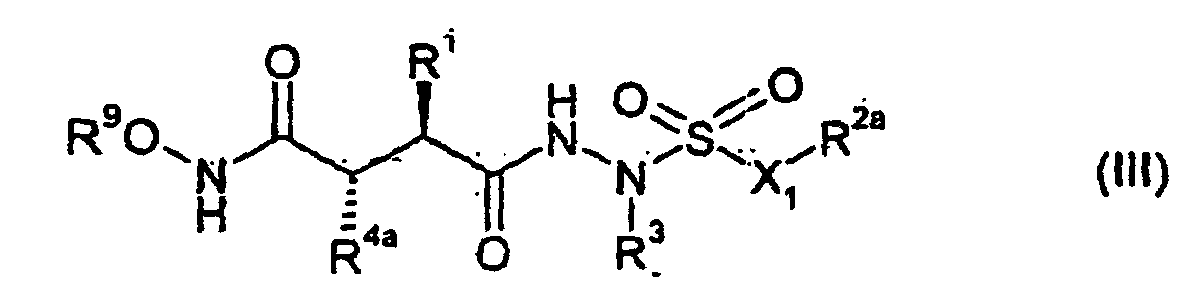
und Reduzieren der sich ergebenden Verbindung der allgemeinen Formelwobei R1, R2a, R3 und X1 die ihnen oben gegebene Bedeutung haben und R4b -CH2CH2CH2-Aryl darstellt,
undc) falls erwünscht, Umwandeln der erhaltenen Verbindung der Formel I in ein pharmazeutisch verträgliches Salz. - Verbindungen der Formeln II, III und IV wie in Anspruch 19 angegeben.
- Medikament, das eine Verbindung nach einem der Ansprüche 1 bis 17 oder ein pharmazeutisch verträgliches Salz davon und ein therapeutisch inertes Trägermaterial enthält.
- Medikament zur Behandlung von entzündlichen und Autoimmunerkrankungen, Osteoarthritis, Atemwegserkrankungen, Tumoren, Cachexia, Herz-Kreislauf-Erkrankungen, Fieber, Blutung und Sepsis, das eine Verbindung nach einem der Ansprüche 1 bis 17 oder ein pharmazeutisch verträgliches Salz davon und ein therapeutisch inertes Trägermaterial enthält.
- Verfahren zur Herstellung eines Medikaments, umfassend die Verarbeitung einer Verbindung nach einem der Ansprüche 1 bis 17 oder eines pharmazeutisch verträglichen Salzes derselben in eine galenische Verabreichungsform zusammen mit einem therapeutisch inerten Trägermaterial und, falls erwünscht, einem oder mehreren zusätzlichen therapeutischen Wirkstoffen.
- Verwendung einer Verbindung nach einem der Ansprüche 1 bis 17 zur Herstellung eines Medikaments zur Behandlung von entzündlichen und Autoimmunerkrankungen, Osteoarthritis, Atemwegserkrankungen, Tumoren, Cachexia, Herz-Kreislauf-Erkrankungen, Fieber, Blutung und Sepsis.
- Verbindungen nach einem der Ansprüche 1 bis 17 und deren pharmazeutisch verträgliche Salze, wenn sie nach dem in Anspruch 19 beanspruchten Verfahren hergestellt wurden.
Applications Claiming Priority (3)
| Application Number | Priority Date | Filing Date | Title |
|---|---|---|---|
| GB9826153 | 1998-11-27 | ||
| GBGB9826153.0A GB9826153D0 (en) | 1998-11-27 | 1998-11-27 | Hydrazine derivatives |
| PCT/EP1999/008970 WO2000032570A1 (en) | 1998-11-27 | 1999-11-20 | Hydrazine derivatives |
Publications (2)
| Publication Number | Publication Date |
|---|---|
| EP1133471A1 EP1133471A1 (de) | 2001-09-19 |
| EP1133471B1 true EP1133471B1 (de) | 2003-09-17 |
Family
ID=10843268
Family Applications (1)
| Application Number | Title | Priority Date | Filing Date |
|---|---|---|---|
| EP99959293A Expired - Lifetime EP1133471B1 (de) | 1998-11-27 | 1999-11-20 | Hydrazin-derivate |
Country Status (21)
| Country | Link |
|---|---|
| US (1) | US6265446B1 (de) |
| EP (1) | EP1133471B1 (de) |
| JP (1) | JP3683180B2 (de) |
| KR (1) | KR100449793B1 (de) |
| CN (1) | CN1209352C (de) |
| AR (1) | AR024521A1 (de) |
| AT (1) | ATE250025T1 (de) |
| AU (1) | AU760497B2 (de) |
| BR (1) | BR9915752A (de) |
| CA (1) | CA2351321A1 (de) |
| CO (1) | CO5150177A1 (de) |
| DE (1) | DE69911455T2 (de) |
| DK (1) | DK1133471T3 (de) |
| ES (1) | ES2205913T3 (de) |
| GB (1) | GB9826153D0 (de) |
| PE (1) | PE20001300A1 (de) |
| PT (1) | PT1133471E (de) |
| TR (1) | TR200101495T2 (de) |
| UY (1) | UY25820A1 (de) |
| WO (1) | WO2000032570A1 (de) |
| ZA (1) | ZA200104276B (de) |
Families Citing this family (3)
| Publication number | Priority date | Publication date | Assignee | Title |
|---|---|---|---|---|
| CN100366528C (zh) * | 1999-10-27 | 2008-02-06 | 威廉马歇莱思大学 | 碳质毫微管的宏观有序集合体 |
| PE20030701A1 (es) | 2001-12-20 | 2003-08-21 | Schering Corp | Compuestos para el tratamiento de trastornos inflamatorios |
| US7199155B2 (en) | 2002-12-23 | 2007-04-03 | Wyeth Holdings Corporation | Acetylenic aryl sulfonate hydroxamic acid TACE and matrix metalloproteinase inhibitors |
Family Cites Families (7)
| Publication number | Priority date | Publication date | Assignee | Title |
|---|---|---|---|---|
| CA2058797A1 (en) | 1991-02-01 | 1992-08-02 | Michael John Broadhurst | Amino acid derivatives |
| US5399589A (en) | 1992-12-17 | 1995-03-21 | Basf Aktiengesellschaft | Oxalyl hydrazide-hydroxamic acid derivatives, their preparation and their use as fungicides |
| GB9607119D0 (en) * | 1996-04-04 | 1996-06-12 | Chiroscience Ltd | Compounds |
| IL128337A0 (en) * | 1996-09-10 | 2000-01-31 | British Biotech Pharm | Cytostatic hydroxamic acid derivatives |
| US6235787B1 (en) * | 1997-06-30 | 2001-05-22 | Hoffmann-La Roche Inc. | Hydrazine derivatives |
| AU2298399A (en) | 1998-02-06 | 1999-08-23 | Yoshitomi Pharmaceutical Industries, Ltd. | Novel azapeptide type hydroxamic acid derivatives |
| US6239151B1 (en) | 1998-06-26 | 2001-05-29 | Hoffmann-La Roche Inc. | Compounds as inhibitor of tumor necrosis factor alpha release |
-
1998
- 1998-11-27 GB GBGB9826153.0A patent/GB9826153D0/en not_active Ceased
-
1999
- 1999-11-20 KR KR10-2001-7006487A patent/KR100449793B1/ko not_active Expired - Fee Related
- 1999-11-20 PT PT99959293T patent/PT1133471E/pt unknown
- 1999-11-20 WO PCT/EP1999/008970 patent/WO2000032570A1/en not_active Ceased
- 1999-11-20 DK DK99959293T patent/DK1133471T3/da active
- 1999-11-20 ES ES99959293T patent/ES2205913T3/es not_active Expired - Lifetime
- 1999-11-20 CA CA002351321A patent/CA2351321A1/en not_active Abandoned
- 1999-11-20 EP EP99959293A patent/EP1133471B1/de not_active Expired - Lifetime
- 1999-11-20 TR TR2001/01495T patent/TR200101495T2/xx unknown
- 1999-11-20 BR BR9915752-7A patent/BR9915752A/pt not_active Application Discontinuation
- 1999-11-20 AU AU16524/00A patent/AU760497B2/en not_active Ceased
- 1999-11-20 JP JP2000585212A patent/JP3683180B2/ja not_active Expired - Fee Related
- 1999-11-20 AT AT99959293T patent/ATE250025T1/de not_active IP Right Cessation
- 1999-11-20 DE DE69911455T patent/DE69911455T2/de not_active Expired - Fee Related
- 1999-11-20 CN CNB998136131A patent/CN1209352C/zh not_active Expired - Fee Related
- 1999-11-22 US US09/444,861 patent/US6265446B1/en not_active Expired - Fee Related
- 1999-11-23 PE PE1999001179A patent/PE20001300A1/es not_active Application Discontinuation
- 1999-11-25 CO CO99074402A patent/CO5150177A1/es unknown
- 1999-11-25 AR ARP990106005A patent/AR024521A1/es unknown
- 1999-11-26 UY UY25820A patent/UY25820A1/es unknown
-
2001
- 2001-05-24 ZA ZA200104276A patent/ZA200104276B/en unknown
Also Published As
| Publication number | Publication date |
|---|---|
| DE69911455D1 (de) | 2003-10-23 |
| PT1133471E (pt) | 2004-02-27 |
| CN1209352C (zh) | 2005-07-06 |
| UY25820A1 (es) | 2001-07-31 |
| EP1133471A1 (de) | 2001-09-19 |
| AU1652400A (en) | 2000-06-19 |
| KR100449793B1 (ko) | 2004-09-22 |
| US6265446B1 (en) | 2001-07-24 |
| WO2000032570A1 (en) | 2000-06-08 |
| TR200101495T2 (tr) | 2001-10-22 |
| AR024521A1 (es) | 2002-10-16 |
| JP2002531438A (ja) | 2002-09-24 |
| DK1133471T3 (da) | 2004-01-26 |
| ATE250025T1 (de) | 2003-10-15 |
| PE20001300A1 (es) | 2000-12-01 |
| ZA200104276B (en) | 2002-08-26 |
| GB9826153D0 (en) | 1999-01-20 |
| JP3683180B2 (ja) | 2005-08-17 |
| ES2205913T3 (es) | 2004-05-01 |
| AU760497B2 (en) | 2003-05-15 |
| CN1328545A (zh) | 2001-12-26 |
| CA2351321A1 (en) | 2000-06-08 |
| DE69911455T2 (de) | 2004-07-08 |
| CO5150177A1 (es) | 2002-04-29 |
| KR20010080553A (ko) | 2001-08-22 |
| BR9915752A (pt) | 2001-08-28 |
Similar Documents
| Publication | Publication Date | Title |
|---|---|---|
| US6235787B1 (en) | Hydrazine derivatives | |
| DE19719621A1 (de) | Sulfonylaminocarbonsäuren | |
| EP1089964B1 (de) | Hydrazin derivate | |
| EP0973733A1 (de) | Bis-sulfonamid-hydroxamsäuren als mmp-inhibitoren | |
| JPH11116549A (ja) | アリールスルホニルアミノヒドロキサム酸誘導体 | |
| US3691178A (en) | Substituted imidazoles | |
| DE19719817A1 (de) | Substituierte 6- und 7-Aminotetrahydroisochinolincarbonsäuren | |
| DE19851184A1 (de) | N-Arylsulfonyl-aminosäure-omega-amide | |
| EP1133471B1 (de) | Hydrazin-derivate | |
| EP0252727A1 (de) | Aminosäure-Derivate | |
| EP1137640B1 (de) | Zyklische hydrazinderivate als tnf-alpha inhibitoren | |
| FI93953C (fi) | Menetelmä uusien terapeuttisesti käyttökelpoisten sykloalkyylitiatsolijohdannaisten valmistamiseksi | |
| EP1348710A1 (de) | Sulfonamid-Derivative 3-substituierter imidazo[1,2-d]-1,2,4-thiadiazole und 3-substituierter [1,2,4]thiadiazolo[4,5-a]benzimidazole als Fibrinvernetzungs- und Transglutaminase-Inhibitoren | |
| MXPA01005299A (en) | Hydrazine derivatives | |
| WO2000027378A2 (en) | Cystine derivatives as therapeutic agents for matrix metalloprotease related diseases | |
| WO1992006080A1 (en) | Antiarrhythmic agents | |
| US3951957A (en) | Chloromethyl ester of penicillins | |
| JPH0987237A (ja) | 芳香族誘導体 | |
| CZ462399A3 (cs) | Derivát hydrazinu, způsob jeho přípravy, jeho pOužitrafarmaceutický-prostředekykterý-ho---- obsahuje | |
| SI9200269A (sl) | Derivati amino kislin | |
| CA2274889A1 (en) | Bis-sulfonomides hydroxamic acids as mmp inhibitors | |
| HRP980366A2 (en) | Hydrazine derivatives |
Legal Events
| Date | Code | Title | Description |
|---|---|---|---|
| PUAI | Public reference made under article 153(3) epc to a published international application that has entered the european phase |
Free format text: ORIGINAL CODE: 0009012 |
|
| 17P | Request for examination filed |
Effective date: 20010627 |
|
| AK | Designated contracting states |
Kind code of ref document: A1 Designated state(s): AT BE CH CY DE DK ES FI FR GB GR IE IT LI LU MC NL PT SE |
|
| 17Q | First examination report despatched |
Effective date: 20021017 |
|
| GRAH | Despatch of communication of intention to grant a patent |
Free format text: ORIGINAL CODE: EPIDOS IGRA |
|
| GRAS | Grant fee paid |
Free format text: ORIGINAL CODE: EPIDOSNIGR3 |
|
| GRAA | (expected) grant |
Free format text: ORIGINAL CODE: 0009210 |
|
| AK | Designated contracting states |
Kind code of ref document: B1 Designated state(s): AT BE CH CY DE DK ES FI FR GB GR IE IT LI LU MC NL PT SE |
|
| REG | Reference to a national code |
Ref country code: GB Ref legal event code: FG4D |
|
| REG | Reference to a national code |
Ref country code: CH Ref legal event code: EP |
|
| REF | Corresponds to: |
Ref document number: 69911455 Country of ref document: DE Date of ref document: 20031023 Kind code of ref document: P |
|
| REG | Reference to a national code |
Ref country code: IE Ref legal event code: FG4D |
|
| PG25 | Lapsed in a contracting state [announced via postgrant information from national office to epo] |
Ref country code: CY Free format text: LAPSE BECAUSE OF FAILURE TO SUBMIT A TRANSLATION OF THE DESCRIPTION OR TO PAY THE FEE WITHIN THE PRESCRIBED TIME-LIMIT Effective date: 20031120 |
|
| PG25 | Lapsed in a contracting state [announced via postgrant information from national office to epo] |
Ref country code: MC Free format text: LAPSE BECAUSE OF NON-PAYMENT OF DUE FEES Effective date: 20031130 |
|
| REG | Reference to a national code |
Ref country code: SE Ref legal event code: TRGR |
|
| REG | Reference to a national code |
Ref country code: DK Ref legal event code: T3 |
|
| REG | Reference to a national code |
Ref country code: GR Ref legal event code: EP Ref document number: 20030405190 Country of ref document: GR |
|
| REG | Reference to a national code |
Ref country code: ES Ref legal event code: FG2A Ref document number: 2205913 Country of ref document: ES Kind code of ref document: T3 |
|
| ET | Fr: translation filed | ||
| PLBE | No opposition filed within time limit |
Free format text: ORIGINAL CODE: 0009261 |
|
| STAA | Information on the status of an ep patent application or granted ep patent |
Free format text: STATUS: NO OPPOSITION FILED WITHIN TIME LIMIT |
|
| 26N | No opposition filed |
Effective date: 20040618 |
|
| PGFP | Annual fee paid to national office [announced via postgrant information from national office to epo] |
Ref country code: LU Payment date: 20060927 Year of fee payment: 8 |
|
| PGFP | Annual fee paid to national office [announced via postgrant information from national office to epo] |
Ref country code: PT Payment date: 20061003 Year of fee payment: 8 |
|
| PGFP | Annual fee paid to national office [announced via postgrant information from national office to epo] |
Ref country code: AT Payment date: 20061005 Year of fee payment: 8 |
|
| PGFP | Annual fee paid to national office [announced via postgrant information from national office to epo] |
Ref country code: NL Payment date: 20061006 Year of fee payment: 8 Ref country code: DK Payment date: 20061006 Year of fee payment: 8 |
|
| PGFP | Annual fee paid to national office [announced via postgrant information from national office to epo] |
Ref country code: IE Payment date: 20061011 Year of fee payment: 8 |
|
| PGFP | Annual fee paid to national office [announced via postgrant information from national office to epo] |
Ref country code: GR Payment date: 20061016 Year of fee payment: 8 |
|
| PGFP | Annual fee paid to national office [announced via postgrant information from national office to epo] |
Ref country code: SE Payment date: 20061108 Year of fee payment: 8 |
|
| PGFP | Annual fee paid to national office [announced via postgrant information from national office to epo] |
Ref country code: FI Payment date: 20061115 Year of fee payment: 8 |
|
| PGFP | Annual fee paid to national office [announced via postgrant information from national office to epo] |
Ref country code: BE Payment date: 20061128 Year of fee payment: 8 |
|
| BERE | Be: lapsed |
Owner name: F. *HOFFMANN-LA ROCHE A.G. Effective date: 20071130 |
|
| REG | Reference to a national code |
Ref country code: PT Ref legal event code: MM4A Free format text: LAPSE DUE TO NON-PAYMENT OF FEES Effective date: 20080520 |
|
| REG | Reference to a national code |
Ref country code: DK Ref legal event code: EBP |
|
| EUG | Se: european patent has lapsed | ||
| PG25 | Lapsed in a contracting state [announced via postgrant information from national office to epo] |
Ref country code: FI Free format text: LAPSE BECAUSE OF NON-PAYMENT OF DUE FEES Effective date: 20071120 |
|
| NLV4 | Nl: lapsed or anulled due to non-payment of the annual fee |
Effective date: 20080601 |
|
| REG | Reference to a national code |
Ref country code: IE Ref legal event code: MM4A |
|
| PG25 | Lapsed in a contracting state [announced via postgrant information from national office to epo] |
Ref country code: AT Free format text: LAPSE BECAUSE OF NON-PAYMENT OF DUE FEES Effective date: 20071120 |
|
| PG25 | Lapsed in a contracting state [announced via postgrant information from national office to epo] |
Ref country code: PT Free format text: LAPSE BECAUSE OF NON-PAYMENT OF DUE FEES Effective date: 20080520 Ref country code: BE Free format text: LAPSE BECAUSE OF NON-PAYMENT OF DUE FEES Effective date: 20071130 |
|
| PG25 | Lapsed in a contracting state [announced via postgrant information from national office to epo] |
Ref country code: SE Free format text: LAPSE BECAUSE OF NON-PAYMENT OF DUE FEES Effective date: 20071121 Ref country code: NL Free format text: LAPSE BECAUSE OF NON-PAYMENT OF DUE FEES Effective date: 20080601 Ref country code: IE Free format text: LAPSE BECAUSE OF NON-PAYMENT OF DUE FEES Effective date: 20071120 Ref country code: DK Free format text: LAPSE BECAUSE OF NON-PAYMENT OF DUE FEES Effective date: 20071130 |
|
| PGFP | Annual fee paid to national office [announced via postgrant information from national office to epo] |
Ref country code: CH Payment date: 20081028 Year of fee payment: 10 |
|
| PGFP | Annual fee paid to national office [announced via postgrant information from national office to epo] |
Ref country code: ES Payment date: 20081117 Year of fee payment: 10 |
|
| PGFP | Annual fee paid to national office [announced via postgrant information from national office to epo] |
Ref country code: IT Payment date: 20081124 Year of fee payment: 10 |
|
| PGFP | Annual fee paid to national office [announced via postgrant information from national office to epo] |
Ref country code: FR Payment date: 20081106 Year of fee payment: 10 |
|
| PG25 | Lapsed in a contracting state [announced via postgrant information from national office to epo] |
Ref country code: GR Free format text: LAPSE BECAUSE OF NON-PAYMENT OF DUE FEES Effective date: 20080605 |
|
| PGFP | Annual fee paid to national office [announced via postgrant information from national office to epo] |
Ref country code: DE Payment date: 20081128 Year of fee payment: 10 |
|
| PGFP | Annual fee paid to national office [announced via postgrant information from national office to epo] |
Ref country code: GB Payment date: 20081008 Year of fee payment: 10 |
|
| PG25 | Lapsed in a contracting state [announced via postgrant information from national office to epo] |
Ref country code: LU Free format text: LAPSE BECAUSE OF NON-PAYMENT OF DUE FEES Effective date: 20071120 |
|
| REG | Reference to a national code |
Ref country code: CH Ref legal event code: PL |
|
| GBPC | Gb: european patent ceased through non-payment of renewal fee |
Effective date: 20091120 |
|
| REG | Reference to a national code |
Ref country code: FR Ref legal event code: ST Effective date: 20100730 |
|
| PG25 | Lapsed in a contracting state [announced via postgrant information from national office to epo] |
Ref country code: LI Free format text: LAPSE BECAUSE OF NON-PAYMENT OF DUE FEES Effective date: 20091130 Ref country code: FR Free format text: LAPSE BECAUSE OF NON-PAYMENT OF DUE FEES Effective date: 20091130 Ref country code: CH Free format text: LAPSE BECAUSE OF NON-PAYMENT OF DUE FEES Effective date: 20091130 |
|
| PG25 | Lapsed in a contracting state [announced via postgrant information from national office to epo] |
Ref country code: DE Free format text: LAPSE BECAUSE OF NON-PAYMENT OF DUE FEES Effective date: 20100601 |
|
| PG25 | Lapsed in a contracting state [announced via postgrant information from national office to epo] |
Ref country code: GB Free format text: LAPSE BECAUSE OF NON-PAYMENT OF DUE FEES Effective date: 20091120 |
|
| REG | Reference to a national code |
Ref country code: ES Ref legal event code: FD2A Effective date: 20110324 |
|
| PG25 | Lapsed in a contracting state [announced via postgrant information from national office to epo] |
Ref country code: IT Free format text: LAPSE BECAUSE OF NON-PAYMENT OF DUE FEES Effective date: 20091120 |
|
| PG25 | Lapsed in a contracting state [announced via postgrant information from national office to epo] |
Ref country code: ES Free format text: LAPSE BECAUSE OF NON-PAYMENT OF DUE FEES Effective date: 20110310 |
|
| PG25 | Lapsed in a contracting state [announced via postgrant information from national office to epo] |
Ref country code: ES Free format text: LAPSE BECAUSE OF NON-PAYMENT OF DUE FEES Effective date: 20091121 |