EP1134691B1 - Appareil de traitement d'images et procédé d'extraction de caractéristiques de visages - Google Patents
Appareil de traitement d'images et procédé d'extraction de caractéristiques de visages Download PDFInfo
- Publication number
- EP1134691B1 EP1134691B1 EP01105113A EP01105113A EP1134691B1 EP 1134691 B1 EP1134691 B1 EP 1134691B1 EP 01105113 A EP01105113 A EP 01105113A EP 01105113 A EP01105113 A EP 01105113A EP 1134691 B1 EP1134691 B1 EP 1134691B1
- Authority
- EP
- European Patent Office
- Prior art keywords
- feature
- facial image
- sensed
- facial
- points
- Prior art date
- Legal status (The legal status is an assumption and is not a legal conclusion. Google has not performed a legal analysis and makes no representation as to the accuracy of the status listed.)
- Expired - Lifetime
Links
Images



Classifications
-
- G—PHYSICS
- G07—CHECKING-DEVICES
- G07C—TIME OR ATTENDANCE REGISTERS; REGISTERING OR INDICATING THE WORKING OF MACHINES; GENERATING RANDOM NUMBERS; VOTING OR LOTTERY APPARATUS; ARRANGEMENTS, SYSTEMS OR APPARATUS FOR CHECKING NOT PROVIDED FOR ELSEWHERE
- G07C9/00—Individual registration on entry or exit
- G07C9/30—Individual registration on entry or exit not involving the use of a pass
- G07C9/32—Individual registration on entry or exit not involving the use of a pass in combination with an identity check
- G07C9/37—Individual registration on entry or exit not involving the use of a pass in combination with an identity check using biometric data, e.g. fingerprints, iris scans or voice recognition
-
- G—PHYSICS
- G06—COMPUTING OR CALCULATING; COUNTING
- G06F—ELECTRIC DIGITAL DATA PROCESSING
- G06F18/00—Pattern recognition
- G06F18/20—Analysing
- G06F18/25—Fusion techniques
- G06F18/254—Fusion techniques of classification results, e.g. of results related to same input data
- G06F18/256—Fusion techniques of classification results, e.g. of results related to same input data of results relating to different input data, e.g. multimodal recognition
-
- G—PHYSICS
- G06—COMPUTING OR CALCULATING; COUNTING
- G06V—IMAGE OR VIDEO RECOGNITION OR UNDERSTANDING
- G06V10/00—Arrangements for image or video recognition or understanding
- G06V10/70—Arrangements for image or video recognition or understanding using pattern recognition or machine learning
- G06V10/77—Processing image or video features in feature spaces; using data integration or data reduction, e.g. principal component analysis [PCA] or independent component analysis [ICA] or self-organising maps [SOM]; Blind source separation
- G06V10/80—Fusion, i.e. combining data from various sources at the sensor level, preprocessing level, feature extraction level or classification level
- G06V10/809—Fusion, i.e. combining data from various sources at the sensor level, preprocessing level, feature extraction level or classification level of classification results, e.g. where the classifiers operate on the same input data
- G06V10/811—Fusion, i.e. combining data from various sources at the sensor level, preprocessing level, feature extraction level or classification level of classification results, e.g. where the classifiers operate on the same input data the classifiers operating on different input data, e.g. multi-modal recognition
-
- G—PHYSICS
- G06—COMPUTING OR CALCULATING; COUNTING
- G06V—IMAGE OR VIDEO RECOGNITION OR UNDERSTANDING
- G06V40/00—Recognition of biometric, human-related or animal-related patterns in image or video data
- G06V40/10—Human or animal bodies, e.g. vehicle occupants or pedestrians; Body parts, e.g. hands
- G06V40/16—Human faces, e.g. facial parts, sketches or expressions
-
- G—PHYSICS
- G06—COMPUTING OR CALCULATING; COUNTING
- G06V—IMAGE OR VIDEO RECOGNITION OR UNDERSTANDING
- G06V40/00—Recognition of biometric, human-related or animal-related patterns in image or video data
- G06V40/10—Human or animal bodies, e.g. vehicle occupants or pedestrians; Body parts, e.g. hands
- G06V40/16—Human faces, e.g. facial parts, sketches or expressions
- G06V40/168—Feature extraction; Face representation
Definitions
- the present invention relates to an image processing apparatus and method, which are preferably applied to entrance/exit management of an important facility, or access management of a computer (terminal device) and are suitably applied to a personal authentication apparatus for authenticating a person on the basis of vital information (biometrics), i.e. a facial image.
- vital information biometrics
- biometrics As biometrics, fingerprints, palmprints, voiceprints, and signature verifications, retina and iris scans, and the like are put into practical use. These schemes are categorized into “contact type”, i.e. a person must directly touch a device, and “non-contact type”, i.e. a person need not touch it.
- biometrics fingerprints, palmprints, and signature verifications belong to "contact type".
- category of signature verifications is slightly different from that of fingerprint verification and the like since a signature verification requires a person to take an action, i.e., to sign.
- Biometric that similarly requires person's action is voiceprint (speech) verification, but it belongs to "non-contact type".
- Retina and iris scans belong to "non-contact type” since a camera captures an image of a desired portion and the captured image is processed.
- a retina is located at the bottom of an eyeball and must be scanned while the eye nearly contacts a lens, its category is close to "contact type”.
- the iris is present on the surface of the eyeball, and can be scanned by a camera at a separate position.
- a micropattern must be scanned, the maximum distance between the eye and camera is naturally limited.
- facial image verification as non-contact biometric has received a lot of attention recently, and various techniques using this have been developed.
- a facial pattern has a larger scale than the aforementioned iris pattern.
- one monitor camera is set at an appropriate position to capture a facial image of a full-face or nearly full-face pose, and the captured image undergoes pattern verification with facial image data registered in advance under similar conditions.
- Jpn. Pat. Appln. KOKAI Publication No. 11-196398 discloses a technique that pertains to an image processing apparatus in which video cameras are laid out to make a given angle, a facial image of a full-face pose is stored in a full-face template memory, a facial image of a left-half-face pose is stored in a half-face template memory, and the correlation between images output from the video cameras and data stored in the memories is computed to determine the facial motion of a person (to be referred to as prior art 1 hereinafter).
- Fukui and Yamaguchi "Facial Feature Point Extraction by Combining Shape Extraction and Pattern Verification", Journal of IEICE (D-II), Vol. j-80-D-II, No. 8, August 1997 , proposes a method of extracting facial feature points of a pupil, nasal cavity, mouth edge, and the like from a moving image at high speed and high precision for facial recognition (to be referred to as prior art 2 hereinafter).
- Yamaguchi, Fukui, and Maeda "Facial Recognition System Using Moving Image", IEICE Transactions PRMU97-50, June 1997 , proposes a personal identification method for facial recognition using a moving image (time-series images) in place of a single image (to be referred to as prior art 3 hereinafter).
- U.S. Patent No. 4,975,969 discloses a method and apparatus for uniquely identifying individuals by measuring distances between certain facial features and calculating ratios based upon the measured distances.
- FIG. 1 shows the arrangement of an image processing apparatus according to the first embodiment.
- a plurality of video cameras (to be simply referred to as cameras hereinafter) 1-1, 1-2,..., 1-N as image sensing means for sensing an object image line up vertically to have a given spacing.
- This embodiment uses video cameras that can sense monochrome images.
- the outputs from the cameras 1-1, 1-2,..., 1-N are respectively connected to capture boards 2-1, 2-2,..., 2-N.
- a video signal (analog data) 1 from the camera 1-1 is converted into digital data by an A/D converter 2-1a, and the digital data is temporarily stored in an image memory 2-1b.
- the capture boards 2-2,..., 2-N similarly comprise A/D converters and image memories (not shown for the sake of simplicity), and video signals 2 to N undergo similar processes in the capture boards 2-2,..., 2-N.
- USB Universal Serial Bus
- a USB interface is added in place of the A/D converter 2-1a.
- the camera comprises a digital I/O interface such as IEEE1394 other than USB.
- the capture boards 2-1, 2-2,..., 2-N, a processor 4, a work memory 5, a display board 6, and a dictionary 7 are connected to each other via a system bus 3 so as to be able to communicate with each other. Furthermore, a display 8 is connected to the display board 6.
- the dictionary 7 is a registration means in which a plurality of dictionary data (reference feature patterns) are registered (stored). The display 8 outputs, e.g., a verification result.
- the processor 4 sends a control signal for taking synchronization to the cameras 1-1, 1-2,..., 1-N, receives digital data that pertain to facial images sent from the cameras 1-1, 1-2,..., 1-N, and executes facial image registration, verification, and determination processes (to be described later) of the received data using the work memory 5 and dictionary 7.
- processors exclusively used to process images sensed by the cameras 1-1, 1-2,..., 1-N may be parallelly arranged to achieve high-speed processing.
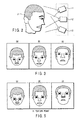
- FIG. 2 shows details of an example of the layout of the cameras 1-1, 1-2,..., 1-N
- FIG. 3 show examples of facial images sensed by the cameras 1-1, 1-2,..., 1-N.
- three cameras 1-1, 1-2, and 1-3 line up vertically to have an appropriate spacing, and an object (face) F is located in front of these cameras 1-1, 1-2, and 1-3.
- the cameras 1-1, 1-2, and 1-3 respectively sense and capture a looked-down facial image (see (a) of FIG. 3 ), a frontal facial image (see (b) of FIG. 3 ), and a looked-up facial image (see (c) of FIG. 3 ).
- the cameras 1-1, 1-2, and 1-3 are illustrated as independent input devices. Alternatively, the cameras 1-1, 1-2, and 1-3 may be stored in a single housing, so that they appear as a single input device for the user.
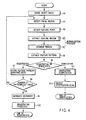
- FIG. 4 shows processes to be individually done for facial images captured by the cameras 1-1, 1-2, and 1-3.
- the cameras 1-1, 1-2, and 1-3 sense an object image from different directions (S0).
- the processor 4 seeks a facial image region from the entire input image (S1). Pupil and nasal cavity regions, which are regarded as substantially circular regions, are detected, and the central positions of these regions are detected as feature points of the facial image (S2). Note that the processes in steps S1 and S2 can adopt the conventional method described in, e.g., prior art 2.
- the detection results of the feature points are as shown in (a), (b), and (c) of FIG. 5 , and "x" marks in these figures indicate the detected feature points. Note that (a) of FIG. 5 corresponds to the facial image captured by the camera 1-1, (b) of FIG. 5 corresponds to the facial image captured by the camera 1-2, and (c) of FIG. 5 corresponds to the facial image captured by the camera 1-3.
- a normalization process including extraction of a feature region (S3) and segmentation of the region (S4) is executed.
- the normalization process in steps S3 and S4 is a core of the facial image registration and verification processes in this embodiment.
- the normalization process will be described in detail below with reference to FIGS. 6 and 7 .
- the normalization process takes different procedures depending on the number of obtained feature points (two or four points). If the number of obtained feature points is other than 2 or 4, the normalization process is skipped.
- a feature region is defined as a rectangle obtained by enlarging a rectangle specified by a plurality of feature points at a magnification set for each camera. More specifically, when two feature points are obtained, as shown in, e.g., (a) of FIG. 6 , a rectangular region (p1, p2, p3, p4) obtained by further enlarging a rectangle formed by giving a predetermined width to a line segment f1f2 at a predetermined magnification is defined as a feature region, as shown in (b) of FIG. 6 . In this example, the obtained feature region is broken up into 10 x 5 small rectangular regions, as shown in (c) of FIG. 6 .
- a rectangular region (q1, q2, q3, q4) obtained by further enlarging a rectangle formed by giving a predetermined width to line segments f1f2 and f3f4 at a predetermined magnification is defined as a feature region, as shown in (b) of FIG. 7 .
- the obtained feature region is broken up into 15 x 15 small rectangular regions, as shown in (c) of FIG. 7 .
- a rectangular feature region is used.
- the present invention is not limited to this as long as a region can be uniquely computed from two or four feature points.
- the feature region is broken up by equally segmenting the respective sides of the rectangle.
- the segmented small areas may have variable sizes, i.e., areas, in consideration of feature strength.
- the number of equally segmented areas is not limited to the aforementioned values.
- parameters of the normalization process can be optimized in units of cameras.
- a feature pattern for registration and verification is computed (extracted) (S5).
- the average values of brightness levels are computed in units of partial regions broken up in step S4, and are arranged in an order (raster scan order) shown in FIG. 8 to express facial feature pattern data (to be simply referred to as a feature vector hereinafter):
- step S5 pixels in the feature region undergo density correction prior to the average value computation to normalize the density range.
- a feature emphasis filter process such as a differential process may be executed.
- other density or graphic feature amounts such as most frequent values (mode values), principal directions of edges (extracted by the differential process), and the like may be used in place of the average values as feature amounts in segmented small areas.
- a single input facial image (still image) is to be processed.
- a plurality of successive facial images (moving image) may be captured at a given time interval, and may be buffered on the image memory 2-1b of the capture board 2-1 shown in FIG. 1 .
- the method of making verification computation using a moving image is described in detail in prior art 3 (mutual partial space method).
- steps S1 to S4 can be the same as those in the flow chart in FIG. 4 , and the contents of only steps S9 and S10 need only be changed. That is, after a predetermined number of feature patterns are stored as in registration, a statistical process such as main component analysis or the like is done based on these plurality of feature vectors, and a pattern verification process is then executed.
- a characteristic feature of the first embodiment mentioned above lies in integrated control of processes of facial images from the cameras 1-1, 1-2, and 1-3.
- the processor 4 executes the following control.
- the cameras 1-1 and 1-2 detect the central positions of the eyes as two (right and left) feature points, and the camera 1-3 detects the two central points of the nasal cavities, thus obtaining a total of four feature points.
- a person corresponding to a maximum average value of verification levels i.e., M ⁇ 1 + M ⁇ 2 + M ⁇ 3 / 3 is finally determined to be a match.
- the basic arrangement of an image processing apparatus according to the second embodiment is substantially the same as that in FIG. 1 (first embodiment), except that the cameras 1-1, 1-2, and 1-3 line up horizontally.
- the layout of these cameras 1-1, 1-2, and 1-3 is as shown in FIG. 9 . That is, as shown in FIG. 9 , the cameras 1-1, 1-2, and 1-3 line up horizontally at an appropriate spacing so as to be angled slightly upward. With this layout, the cameras 1-1, 1-2, and 1-3 respectively sense and capture a facial image of a left half-face pose, a looked-up facial image of a full-face pose, and a facial image of a right half-face pose.
- Examples of facial images input from the cameras 1-1, 1-2, and 1-3 and feature points extracted therefrom are as shown in (a), (b), and (c) of FIG. 10 , and "x" marks in these figures indicate the detected feature points. Note that (a) of FIG. 10 corresponds to the camera 1-1, (b) of FIG. 10 corresponds to the camera 1-2, and (c) of FIG. 10 corresponds to the camera 1-3.
- the process executed by the processor 4 is substantially the same as that in the first embodiment, except that the process executed upon obtaining two feature points in the first embodiment is replaced by that executed upon obtaining three feature points, as will be described in detail below.
- a rectangular region (p1, p2, p3, p4) based on a triangle (f1, f2, f3) is defined to be a feature region, as shown in (b) of FIG. 11 .
- this feature region is broken up into 10 x 15 small rectangular regions, as shown in (c) of FIG. 11 .
- a rectangular region (q1, q2, q3, q4) based on a triangle (f1, f2, f3) is defined to be a feature region, as shown in (b) of FIG. 12 .
- this feature region is broken up into 10 x 15 small rectangular regions, as shown in (c) of FIG. 12 .
- a line which is parallel to a line segment f1f2 and passes through f3 is drawn, two points separated a given width from f3 are set on the line on the two sides of f3, a rectangle having as vertices a total of four points including these two points, and f1 and f2 can be enlarged at a predetermined magnification.
- the magnification is set in advance for each camera.
- the present invention is not limited to this method, and a feature region need only be defined in advance so that it can be uniquely determined.
- the basic arrangement of an image processing apparatus according to the third embodiment is substantially the same as that in FIG. 1 (first embodiment), except that nine cameras 1-1, 1-2,..., 1-9 are set two-dimensionally.
- the layout of these cameras 1-1, 1-2,..., 1-9 is as shown in FIG. 13 . That is, as shown in FIG. 13 , the cameras 1-1, 1-2, and 1-3 respectively capture slightly looked-down facial images of a left half-face pose, full-face pose, and right half-face pose.
- the cameras 1-4, 1-5, and 1-6 respectively capture facial images of a left half-face pose, full-face pose, and right half-face pose.
- the cameras 1-7, 1-8, and 1-9 respectively capture slightly looked-up facial images of a left half-face pose, full-face pose, and right half-face pose.
- the basic arrangement of an image processing apparatus according to the fourth embodiment is substantially the same as that in FIG. 1 (first embodiment). Also, the camera layout is the same as that in one of the first to third embodiments.
- the process executed by the processor 4 according to the fourth embodiment can be realized by adding a feature vector extraction process to that explained in the first to third embodiments. That is, an integration process of feature vectors extracted from a plurality of facial images is added.
- the basic arrangement of an image processing apparatus according to the fifth embodiment is substantially the same as that in FIG. 1 (first embodiment). Also, the camera layout is the same as that in one of the first to third embodiments.
- the process executed by the processor 4 according to the fifth embodiment can be realized by adding a feature vector extraction process to that explained in the first to third embodiments.
- input facial images are time-serially captured at given time intervals, and a process to be added for the purpose of improving the verification precision is an integration process of feature vectors on the time series, as will be described below.
- the method of prior art 2 can be used as in case of a single camera.
- the method of prior art 3 may be applied without executing such process for obtaining the average feature vector.
- a plurality of cameras are set within a range in which they satisfy a given condition so as to simultaneously capture facial images of an identical person, and a correction process is done on the basis of a total of four pieces of feature point position information of pupils and nasal cavities, thus improving the verification precision while maintaining the load on the user light as in the prior art.
- the basic arrangement of an image processing apparatus is substantially the same as that in FIG. 1 (first embodiment), except for the layout and use method of cameras 1-1, 1-2,..., 1-N, and a corresponding integration process.
- FIG. 14 shows an example wherein two cameras 1-1 and 1-2 are laid out vertically. As shown in FIG. 14 , the cameras 1-1 and 1-2 line up vertically at an appropriate spacing to be angled slightly upward. An object F is located in front of these cameras 1-1 and 1-2. With this layout, the cameras 1-1 and 1-2 sense slightly looked-up facial images of a full-face pose.
- reference numeral 9-1 denotes an illumination lamp arranged above the camera 1-1; and 9-2, an illumination lamp arranged below the camera 1-2.
- the camera 1-1 is set at a level that assumes the average height of an adult
- the camera 1-2 is set at a level that assumes the height of an adult equal to or lower than the average height or a child.
- the camera 1-2 can be used for a handicapped person in a wheelchair.
- the integration process is executed by the processor 4 according to the sixth embodiment as follows. That is, in the first embodiment, when feature point detection based on at least one of facial images from a plurality of cameras fails, it is determined that the process at that time is not successful, and the process is interrupted immediately. Then, the process is retried or an error message is displayed for the user. In the sixth embodiment, verification is done for a facial image from which feature points can be successfully detected, and if verification of at least one facial image is successful, it is determined that "the person is identified".
- two cameras are used. However, three or more cameras may be used.
- a camera used to obtain a facial image is determined in the registration and verification processes by the processor 4 in the sixth embodiment. That is, upon registration, a camera used to obtain a facial image is determined, and a facial image is registered together with the camera number. More specifically, as shown in FIG. 15 , a registrant determines one of the cameras 1-1 and 1-2 which he or she would like to use depending on his or her physical construction and height, and selects that camera (S41). Also, the registrant inputs an ID code via a keyboard, card, or the like as his or her own identification information.
- a facial image input by the selected camera undergoes the aforementioned image process to extract a feature pattern (S1 to S5), and the extracted feature pattern is registered in the dictionary 7 together with the input ID code of the registrant, and the camera number as the position information of the selected camera (i.e., position information indicating the image sensing position of an object image) (S7 to S10).
- the camera to be used may be determined by the registrant himself or herself, but a camera that can obtain a facial image from which feature points corresponding to two pupils and two nasal cavities are extracted, and the central portion of which is closest to these positions may be automatically determined.
- information indicating a camera to be used (camera number as camera position information) can also be used as personal information, thus setting higher security level.
- a verification process is done for only a facial image obtained from a camera corresponding to the registered camera number. More specifically, as shown in, e.g., FIG. 16 , a person to be verified inputs his or her own ID code via a keyboard, card, or the like, and the dictionary 7 is searched for the camera number and feature pattern registered in correspondence with that ID code (S42).
- a camera corresponding to the camera number retrieved from the dictionary 7 is selected (S43), and a facial image input by the selected camera undergoes the aforementioned image process to extract a feature pattern (S1 to S5).
- the extracted feature pattern is verified with the feature pattern retrieved from the dictionary 7 to determine if the person to be verified is the person himself or herself (S11, S12).
- two cameras are used.
- three or more cameras may be used.
- a required number of cameras are set in advance.
- a camera moving mechanism is arranged, and moves a single camera to a predetermined position so as to execute the aforementioned process.
- an image capture time is slightly prolonged, but only one camera is required, resulting in simple setting.
- FIG. 17 shows an example wherein one camera 1 is set. More specifically, as shown in FIG. 17 , the camera 1 is fixed to a vertical guide rail 10 to be slidable vertically, and is moved by a camera moving mechanism (not shown) to a first position P1 (corresponding to the position of the camera 1-1 in FIG. 14 ) or a second position P2 (corresponding to the position of the camera 1-2 in FIG. 14 ). The camera 1 is set to be angled slightly upward.
- the basic arrangement of an image processing apparatus is substantially the same as that in FIG. 1 (first embodiment), except that the number of sets of cameras and capture boards is reduced to one, and a camera position controller 12 for controlling a camera moving mechanism 11 that moves the camera 1, and a communication board 13 for connecting the camera position controller 12 to the system bus 3 are added, as shown in FIG. 18 .
- the process executed by the processor 4 according to the eighth embodiment is basically the same as that in FIG. 4 (first embodiment), except for the contents of the verification computation process in step S11.
- the verification computation process in step 11 will be described in detail below with reference to the flow chart shown in FIG. 19 .
- the operation varies depending on whether 1 : 1 or 1 : N verification is done (S21).
- 1 : 1 verification is a verification process executed when a person to be verified inputs his or her own ID code to designate registered data to be verified
- 1 : N verification is a verification process executed when a person to be verified does not input any ID code to select all registered data as data to be verified.
- the ID code input by the person to be verified is read (S22).
- Registered data (partial space) corresponding to the read ID code is read from the dictionary 7 (S23).
- a verification level between the spatial space of the registered data and an input partial space is computed to verify using, e.g., the partial space method (S24).
- the verification level is compared with a predetermined threshold value (S25, S26) to output a 1 : 1 verification result (S27).
- the maximum verification level may undergo a threshold value process like in step S31 bounded by the broken line in FIG. 19 , it can be checked if the verification result is correct (S33). For example, if the verification level is too low, it is determined that no match is found.
- N verification is a verification process executed when a person to be verified does not input any ID code to select all registered data as data to be verified, and corresponds to the verification process in the first to sixth embodiments described above.
- only one camera is used, but two or more cameras may be used. Furthermore, only one camera is moved. However, when two or more cameras are used, these cameras may be moved.
- a camera of a normal visible wavelength range is used.
- an infrared ray camera of an infrared range may be used, or a rangefinder that can obtain distance information (depth information) may be used.
- image input devices of different types may be mixed.
- an image processing apparatus and method which can reduce the load on the user upon registration and verification, can greatly improve verification performance, and can minimize increases in complicated computation and processing cost without largely changing a pattern verification process algorithm from a single direction can be provided.
- the technique of prior art 1 independently processes images although it uses a plurality of cameras, and a function is limited to detection of the face direction.
- the techniques of prior arts 2 and 3 since the countenance of a person has three-dimensional shape information, two-dimensional facial image information captured from only one direction alone limits personal identification performance, and practical verification performance cannot become so high compared to fingerprint verification, retina and iris scans, and the like.
Landscapes
- Engineering & Computer Science (AREA)
- Theoretical Computer Science (AREA)
- General Physics & Mathematics (AREA)
- Physics & Mathematics (AREA)
- Computer Vision & Pattern Recognition (AREA)
- Health & Medical Sciences (AREA)
- Oral & Maxillofacial Surgery (AREA)
- Human Computer Interaction (AREA)
- Multimedia (AREA)
- General Health & Medical Sciences (AREA)
- Evolutionary Computation (AREA)
- Data Mining & Analysis (AREA)
- Artificial Intelligence (AREA)
- General Engineering & Computer Science (AREA)
- Computing Systems (AREA)
- Life Sciences & Earth Sciences (AREA)
- Bioinformatics & Cheminformatics (AREA)
- Bioinformatics & Computational Biology (AREA)
- Evolutionary Biology (AREA)
- Software Systems (AREA)
- Databases & Information Systems (AREA)
- Medical Informatics (AREA)
- Collating Specific Patterns (AREA)
- Image Analysis (AREA)
- Image Processing (AREA)
- Image Input (AREA)
- Measurement Of The Respiration, Hearing Ability, Form, And Blood Characteristics Of Living Organisms (AREA)
Claims (16)
- Appareil de traitement d'image de visage, comprenant :un premier moyen de détection d'image de visage (1-1) placé en une première position pour détecter une première image de visage (F) depuis une première direction afin d'extraire un nombre X1 (f1, f2 ; f1-f3) de points de caractéristique à partir de la première image de visage et pour entrer la première image de visage détectée à la première position en utilisant ledit premier moyen de détection d'image de visage ;un second moyen de détection d'image de visage (1-2) placé en une seconde position qui est différente de la première position, pour détecter une seconde image de visage (F) depuis une seconde direction afin d'extraire un nombre X2 (f1-f4) de points de caractéristique à partir de la seconde image de visage et pour entrer la seconde image de visage détectée à la seconde position en utilisant ledit second moyen de détection d'image de visage,les points de caractéristique étant des localisations de visage spécifiques telles que des pupilles ou des cavités nasales ; etun processeur (4) pour extraire une pluralité desdits points de caractéristique (f1, f2 ; f1-f3 ; f1-f4) à partir de chacune des première et seconde images de visage détectées par lesdits premier et second moyens de détection d'image de visage, de façon respective,caractérisé en ce que :le processeur (4) est en outre adapté pour :vérifier si oui ou non le nombre de points de caractéristique qui sont extraits à partir de la première image de visage (F) correspond au nombre X1 préétabli ;vérifier si oui ou non le nombre de points de caractéristique qui sont extraits à partir de la seconde image de visage (F) correspond au nombre X2 préétabli, et seulement si les deux vérifications sont couronnées de succès, pour procéder afin de :établir une première région de caractéristique (p1-p4) de la première image de visage définie par le nombre X1 de points de caractéristique extraits ;établir une seconde région de caractéristique (q1-q4) de la seconde image de visage détectée définie par le nombre X2 de points de caractéristique extraits ;segmenter la première région de caractéristique établie pour la première image de visage détectée selon une pluralité de régions d'aires plus petites (v11-vnm) ;calculer une première information dans chaque région segmentée pour la première image de visage détectée ; etcalculer un premier motif de caractéristique pour la première image de visage détectée sur la base de la première information calculée ;segmenter la seconde région de caractéristique établie pour la seconde image de visage détectée selon une pluralité de régions d'aires plus petites (v11-vnm) ;calculer une seconde information dans chaque région segmentée pour la seconde image de visage détectée ; etcalculer un second motif de caractéristique pour la seconde image de visage détectée sur la base de la seconde information calculée.
- Appareil selon la revendication 1, dans lequel :la première information calculée dans chaque région segmentée pour la première image de visage détectée est une première valeur moyenne de niveaux de luminosité dans chaque région segmentée pour la première image de visage détectée et la seconde information calculée dans chaque région segmentée pour la seconde image de visage détectée est une seconde valeur moyenne de niveaux de luminosité dans chaque région segmentée pour la seconde image de visage détectée; etl'appareil comprend en outre :un moyen d'enregistrement (4, 7) pour enregistrer les premier et second motifs de caractéristique calculés par ledit processeur (4) en tant que motifs de caractéristique associés à un visage prédéterminé ; etun moyen de vérification (4, 7) pour spécifier un visage associé aux première et seconde images de visage (F) en comparant les premier et second motifs de caractéristique calculés avec les premier et second motifs de caractéristique enregistrés dans ledit moyen d'enregistrement.
- Appareil selon la revendication 2, dans lequel :lesdits premier et second moyens de détection d'image de visage (1-1, 1-2) sont alignés verticalement ; etledit processeur (4) est adapté pour calculer le second motif de caractéristique en utilisant un groupe de points de caractéristique incluant des points centraux (f1, f2) de pupilles droite et gauche et des points centraux (f3, f4) de cavités nasales droite et gauche de la seconde image de visage (F) et pour calculer le premier motif de caractéristique en utilisant un groupe de points de caractéristique incluant des points centraux (f1, f2) de pupilles droite et gauche de la première image de visage (F).
- Appareil selon la revendication 2, dans lequel :lesdits premier et second moyens de détection d'image de visage (1-1, 1-2) sont alignés horizontalement ; etledit processeur (4) est adapté pour calculer le second motif de caractéristique en utilisant un groupe de points de caractéristique incluant des points centraux (f1, f2) de pupilles droite et gauche et des points centraux (f3, f4) de cavités nasales droite et gauche de la seconde image de visage (F) et pour calculer le premier motif de caractéristique en utilisant un groupe de points de caractéristique incluant des points centraux (f1, f2) de pupilles droite et gauche et un point central (f3) d'une cavité nasale gauche de la première image de visage (F).
- Appareil selon la revendication 2, dans lequel ledit processeur (4) est adapté pour extraire des vecteurs de caractéristique de différentes dimensions à partir des première et seconde images de visage (F) détectées par lesdits premier et second moyens de détection d'image de visage (1-1, 1-2), de façon respective, et pour agencer les vecteurs de caractéristique extraits de différentes dimensions tour à tour afin de les intégrer en tant que motif de caractéristique multidimensionnel.
- Appareil selon la revendication 2, dans lequel ledit processeur (4) est adapté pour capturer les première et seconde images de visage (F) détectées par lesdits premier et second moyens de détection d'image de visage (1-1, 1-2), de façon respective, selon des intervalles temporels prédéterminés, pour calculer les premier et second motifs de caractéristique des première et seconde images de visage, de façon respective, de temps identiques et pour agencer les premier et second motifs de caractéristique de temps différents tour à tour afin de les intégrer en tant que motif de caractéristique en série temporelle.
- Appareil selon la revendication 1, comprenant en outre :un moyen de vérification (4, 7) pour vérifier les premier et second motifs de caractéristique extraits par ledit processeur (4) en relation avec un motif de caractéristique de référence qui est enregistré à l'avance ; etun moyen de discrimination (4) pour, lorsqu'au moins l'un des premier et second motifs de caractéristique extraits correspond au motif de caractéristique de référence enregistré au préalable en tant que résultat de la vérification réalisée par ledit moyen de vérification, déterminer que le visage associé aux première et seconde images de visage (F) est une personne elle-même.
- Appareil selon la revendication 7, comprenant en outre :un moyen d'extraction de motif de caractéristique (4) pour calculer des valeurs de luminosité moyennes dans les régions d'aires plus petites segmentées (V11-Vnm) et pour extraire les premier et seconds motifs de caractéristique qui représentent des caractéristiques du visage (F) sur la base des valeurs de luminosité moyennes.
- Procédé de traitement d'image, comprenant :la détection (S0) d'une première image de visage (F) depuis une première direction afin d'extraire un nombre X1 (f1, f2 ; f1-f3) de points de caractéristique à partir de la première image de visage en utilisant un premier moyen de détection d'image de visage (1-1) qui est placé en une première position ;la détection (S0) d'une seconde image de visage (F) depuis une seconde direction qui est différente de la première direction afin d'extraire un nombre X2 (f1-f4) de points de caractéristique à partir de la seconde image de visage en utilisant un second moyen de détection d'image de visage (1-2) qui est placé en une seconde position ;les points de caractéristique étant des localisations de visage spécifiques telles que des pupilles et des cavités nasales ;l'extraction (S2) d'une pluralité desdits points de caractéristique à partir de la première image de visage détectée dans la première direction ;l'extraction (S2) d'une pluralité desdits points de caractéristique à partir de la seconde image de visage détectée dans la seconde direction ;caractérisé par :la vérification de si oui ou non le nombre de points de caractéristique qui sont extraits à partir de la première image de visage (F) correspond au nombre X1 préétabli ;la vérification de si oui ou non le nombre de points de caractéristique qui sont extraits à partir de la seconde image de visage (F) correspond au nombre X2 préétabli et seulement si les deux vérifications sont couronnées de succès :l'établissement d'une première région de caractéristique (p1-p4) de la première image de visage détectée qui est définie au moyen du nombre X1 de points de caractéristique extraits ;l'établissement d'une seconde région de caractéristique (q1-q4) de la seconde image de visage détectée qui est définie au moyen du nombre X2 de points de caractéristique extraits ;la segmentation (S4) de la première région de caractéristique établie pour la première image de visage détectée selon une pluralité de régions d'aires plus petites (V11-Vnm) ;la segmentation (S4) de la seconde région de caractéristique établie pour la seconde image de visage détectée selon une pluralité de régions d'aires plus petites (v11-vnm) ;le calcul (S5) d'une première information dans chaque région segmentée pour la première image de visage détectée ;le calcul (S5) d'une seconde information dans chaque région segmentée pour la seconde image de visage détectée ;le calcul (S5) d'un premier motif de caractéristique pour la première image de visage détectée sur la base de la première information calculée ; etle calcul (S5) d'un second motif de caractéristique pour la seconde image de visage détectée sur la base de la seconde information calculée.
- Procédé selon la revendication 9, dans lequel :l'étape de calcul (S5) d'une première information dans chaque région d'aire plus petite segmentée (v11-vnm) comprend le calcul d'une valeur moyenne de niveaux de luminosité dans chaque région segmentée de la première image de visage détectée (F) et l'étape de calcul (S5) d'une seconde information dans chaque région d'aire plus petite segmentée (v11-vnm) comprend le calcul d'une valeur moyenne de niveaux de luminosité dans chaque région segmentée de la seconde image de visage détectée (F) ; etle procédé comprend en outre :l'enregistrement (S7) des premier et second motifs de caractéristique calculés en tant que motifs de caractéristique associés à un visage prédéterminé ; etla spécification (S11, S12) d'un visage associé aux première et seconde images de visage (F) en comparant les premier et second motifs de caractéristique calculés avec les premier et second motifs de caractéristique enregistrés.
- Procédé selon la revendication 10, dans lequel :les première et seconde images de visage (F) sont détectées à partir des première et seconde directions qui sont alignées verticalement ; etle second motif de caractéristique est calculé en utilisant un groupe de points de caractéristique incluant des points centraux (f1, f2) de pupilles droite et gauche et des points centraux (f3, f4) de cavités nasales droite et gauche de la seconde image de visage et le premier motif de caractéristique est calculé en utilisant un groupe de points de caractéristique incluant des points centraux (f1, f2) de pupilles droite et gauche de la première image de visage.
- Procédé selon la revendication 10, dans lequel :les première et seconde images de visage (F) sont détectées à partir des première et seconde directions qui sont alignées horizontalement ; etle second motif de caractéristique est calculé en utilisant un groupe de points de caractéristique incluant des points centraux (f1, f2) de pupilles droite et gauche et des points centraux (f3, f4) de cavités nasales droite et gauche de la seconde image de visage et le premier motif de caractéristique est calculé en utilisant un groupe de points de caractéristique incluant des points centraux (f1, f2) de pupilles droite et gauche et un point central (f3) d'une cavité nasale gauche de la première image de visage.
- Procédé selon la revendication 9, comprenant en outre :l'extraction de vecteurs de caractéristique de différentes dimensions à partir des première et seconde images de visage (F) ; etl'agencement des vecteurs de caractéristique extraits de différentes dimensions tour à tour afin de les intégrer en tant que motif de caractéristique multidimensionnel.
- Procédé selon la revendication 9, comprenant en outre :la capture des première et seconde images de visage (F) selon des intervalles temporels prédéterminés ;le calcul des premier et second motifs de caractéristique des première et seconde images de visage de temps identiques ; etl'agencement des premier et second motifs de caractéristique de temps différents tour à tour afin de les intégrer en tant que motif de caractéristique en série temporelle.
- Procédé selon la revendication 9, comprenant en outre :la vérification (S11) des premier et second motifs de caractéristique extraits en relation avec un motif de caractéristique de référence qui est enregistré à l'avance ; etla détermination (S12), lorsqu'au moins l'un des premier et second motifs de caractéristique extraits correspond au motif de caractéristique de référence enregistré au préalable en tant que résultat de l'étape de vérification, du fait qu'un visage associé aux première et seconde images de visage (F) est une personne elle-même.
- Procédé selon la revendication 9, dans lequel l'étape de calcul (S5) des première et seconde informations dans chaque région d'aire plus petite segmentée (V11-Vnm) comprend le calcul de valeurs de luminosité moyennes dans les régions d'aires plus petites segmentées, et le procédé comprend en outre :l'extraction des premier et second motifs de caractéristique qui représentent une caractéristique du visage sur la base des valeurs de luminosité moyennes.
Applications Claiming Priority (4)
| Application Number | Priority Date | Filing Date | Title |
|---|---|---|---|
| JP2000074489 | 2000-03-16 | ||
| JP2000074489 | 2000-03-16 | ||
| JP2000347043A JP2001331799A (ja) | 2000-03-16 | 2000-11-14 | 画像処理装置および画像処理方法 |
| JP2000347043 | 2000-11-14 |
Publications (3)
| Publication Number | Publication Date |
|---|---|
| EP1134691A2 EP1134691A2 (fr) | 2001-09-19 |
| EP1134691A3 EP1134691A3 (fr) | 2004-11-24 |
| EP1134691B1 true EP1134691B1 (fr) | 2008-04-30 |
Family
ID=26587705
Family Applications (1)
| Application Number | Title | Priority Date | Filing Date |
|---|---|---|---|
| EP01105113A Expired - Lifetime EP1134691B1 (fr) | 2000-03-16 | 2001-03-02 | Appareil de traitement d'images et procédé d'extraction de caractéristiques de visages |
Country Status (4)
| Country | Link |
|---|---|
| US (1) | US6873713B2 (fr) |
| EP (1) | EP1134691B1 (fr) |
| JP (1) | JP2001331799A (fr) |
| DE (1) | DE60133788T2 (fr) |
Cited By (1)
| Publication number | Priority date | Publication date | Assignee | Title |
|---|---|---|---|---|
| TWI410893B (zh) * | 2010-11-22 | 2013-10-01 | Univ Chang Gung | 影像對位系統及其方法 |
Families Citing this family (72)
| Publication number | Priority date | Publication date | Assignee | Title |
|---|---|---|---|---|
| EP1136937B1 (fr) * | 2000-03-22 | 2006-05-10 | Kabushiki Kaisha Toshiba | Appareil de reconnaissance avec saisie d'images de visages et appareil de contrôle de passeports |
| GB0107780D0 (en) * | 2001-03-28 | 2001-05-16 | Hewlett Packard Co | Improvements relating to data delivery |
| US9400921B2 (en) * | 2001-05-09 | 2016-07-26 | Intel Corporation | Method and system using a data-driven model for monocular face tracking |
| JP4177598B2 (ja) * | 2001-05-25 | 2008-11-05 | 株式会社東芝 | 顔画像記録装置、情報管理システム、顔画像記録方法、及び情報管理方法 |
| CA2359269A1 (fr) * | 2001-10-17 | 2003-04-17 | Biodentity Systems Corporation | Systeme d'imagerie utilise pour l'enregistrement d'images faciales et l'identification automatique |
| US7155035B2 (en) * | 2002-02-05 | 2006-12-26 | Matsushita Electric Industrial Co., Ltd. | Personal authentication method, personal authentication apparatus and image capturing device |
| JP3829729B2 (ja) * | 2002-02-14 | 2006-10-04 | オムロン株式会社 | 個人認証装置 |
| JP2003242486A (ja) * | 2002-02-21 | 2003-08-29 | Japan Science & Technology Corp | 人物属性推定装置 |
| JP3910893B2 (ja) * | 2002-08-30 | 2007-04-25 | 富士通株式会社 | 画像抽出方法及び認証装置 |
| CN100337248C (zh) * | 2002-11-07 | 2007-09-12 | 松下电器产业株式会社 | 个人认证方法和认证程序、虹膜登录装置和认证装置 |
| JP4486594B2 (ja) * | 2002-11-07 | 2010-06-23 | 本田技研工業株式会社 | 確率的外観集合体を使用するビデオに基づく顔認識 |
| DE10257963A1 (de) * | 2002-12-12 | 2004-07-08 | Daimlerchrysler Ag | Verfahren und Vorrichtung zur Bestimmung der 3D-Position von PKW-Insassen |
| JP3954484B2 (ja) | 2002-12-12 | 2007-08-08 | 株式会社東芝 | 画像処理装置およびプログラム |
| US7194110B2 (en) * | 2002-12-18 | 2007-03-20 | Intel Corporation | Method and apparatus for tracking features in a video sequence |
| JP4397212B2 (ja) | 2003-02-05 | 2010-01-13 | 富士フイルム株式会社 | 本人認証装置 |
| JP3982817B2 (ja) | 2003-03-07 | 2007-09-26 | 株式会社東芝 | 画像処理装置および画像処理方法 |
| US7421097B2 (en) | 2003-05-27 | 2008-09-02 | Honeywell International Inc. | Face identification verification using 3 dimensional modeling |
| US7596247B2 (en) * | 2003-11-14 | 2009-09-29 | Fujifilm Corporation | Method and apparatus for object recognition using probability models |
| ATE499665T1 (de) * | 2003-12-11 | 2011-03-15 | Koninkl Philips Electronics Nv | Elastische bildregistration |
| JP2005258860A (ja) * | 2004-03-12 | 2005-09-22 | Matsushita Electric Ind Co Ltd | 複数認証方法及びその装置 |
| JP4765008B2 (ja) * | 2004-03-16 | 2011-09-07 | 国立大学法人静岡大学 | 瞳孔と鼻孔を用いた頭部の方向を検出する方法 |
| US7693308B2 (en) * | 2004-03-24 | 2010-04-06 | Fujifilm Corporation | Authentication system, authentication method, machine readable medium storing thereon authentication program, certificate photograph taking apparatus, and certificate photograph taking method |
| AT501370B1 (de) * | 2004-06-03 | 2007-03-15 | X Pin Com Gmbh | Vorrichtung zur biometrischen steuerung von anlagen |
| US20060056667A1 (en) * | 2004-09-16 | 2006-03-16 | Waters Richard C | Identifying faces from multiple images acquired from widely separated viewpoints |
| US7469060B2 (en) * | 2004-11-12 | 2008-12-23 | Honeywell International Inc. | Infrared face detection and recognition system |
| US20060165264A1 (en) * | 2005-01-26 | 2006-07-27 | Hirofumi Saitoh | Method and apparatus for acquiring images, and verification method and verification apparatus |
| JP2006236244A (ja) * | 2005-02-28 | 2006-09-07 | Toshiba Corp | 顔認証装置および入退場管理装置 |
| JP4696778B2 (ja) * | 2005-08-23 | 2011-06-08 | コニカミノルタホールディングス株式会社 | 認証装置、認証方法及びプログラム |
| JP2007101573A (ja) * | 2005-09-30 | 2007-04-19 | Fujifilm Corp | プリント注文受付装置 |
| EP1990770B1 (fr) * | 2006-03-01 | 2012-08-08 | NEC Corporation | Dispositif et procede d'authentification de visage et programme correspondant |
| US9042606B2 (en) * | 2006-06-16 | 2015-05-26 | Board Of Regents Of The Nevada System Of Higher Education | Hand-based biometric analysis |
| JP4862518B2 (ja) * | 2006-06-29 | 2012-01-25 | パナソニック株式会社 | 顔登録装置、顔認証装置および顔登録方法 |
| US7925049B2 (en) * | 2006-08-15 | 2011-04-12 | Sri International | Stereo-based visual odometry method and system |
| WO2008063143A2 (fr) * | 2006-11-23 | 2008-05-29 | Manas Yatirim Holding Anonim Sirketi | Mécanisme de détermination du nombre de spectateurs dans les salles de cinéma |
| JP2008310463A (ja) * | 2007-06-13 | 2008-12-25 | Panasonic Corp | 生体認証装置 |
| WO2009004916A1 (fr) * | 2007-06-29 | 2009-01-08 | Nec Corporation | Système de détection de mascarade, procédé de détection de mascarade et programme de détection de mascarade |
| JP4544282B2 (ja) | 2007-09-14 | 2010-09-15 | ソニー株式会社 | データ処理装置、およびデータ処理方法、並びにプログラム |
| JP5169139B2 (ja) * | 2007-10-25 | 2013-03-27 | 株式会社ニコン | カメラ、および画像記録プログラム |
| JP4541427B2 (ja) * | 2008-03-25 | 2010-09-08 | 富士通株式会社 | 生体認証装置、生体情報登録装置および生体認証方法 |
| GB0818115D0 (en) * | 2008-10-03 | 2008-11-05 | Hyde John | Extended image height camera |
| TWI405145B (zh) * | 2008-11-20 | 2013-08-11 | Ind Tech Res Inst | 以圖素之區域特徵為基礎的影像分割標記方法與系統,及其電腦可記錄媒體 |
| US8502644B1 (en) | 2009-01-29 | 2013-08-06 | Bank Of American Corporation | Physical item security: tracking device activation |
| US8749347B1 (en) * | 2009-01-29 | 2014-06-10 | Bank Of America Corporation | Authorized custodian verification |
| US8325981B2 (en) * | 2009-04-21 | 2012-12-04 | Nec Soft, Ltd. | Human tracking apparatus, human tracking method, and human tracking processing program |
| US8655084B2 (en) * | 2009-06-23 | 2014-02-18 | Board Of Regents Of The Nevada System Of Higher Education, On Behalf Of The University Of Nevada, Reno | Hand-based gender classification |
| US8384514B2 (en) * | 2009-08-07 | 2013-02-26 | At&T Intellectual Property I, L.P. | Enhanced biometric authentication |
| KR101083367B1 (ko) * | 2010-01-26 | 2011-11-14 | 한남대학교 산학협력단 | 영상을 이용한 사용자 인증 방법 및 장치 |
| JP5564414B2 (ja) * | 2010-12-22 | 2014-07-30 | 日立オムロンターミナルソリューションズ株式会社 | 生体認証システム及び生体認証方法 |
| JP5777367B2 (ja) * | 2011-03-29 | 2015-09-09 | キヤノン株式会社 | パターン識別装置、パターン識別方法及びプログラム |
| JP5720380B2 (ja) * | 2011-04-01 | 2015-05-20 | 日本電気株式会社 | 物体検出方法、物体検出装置および物体検出プログラム |
| US9013489B2 (en) * | 2011-06-06 | 2015-04-21 | Microsoft Technology Licensing, Llc | Generation of avatar reflecting player appearance |
| KR20130119759A (ko) * | 2012-04-24 | 2013-11-01 | 삼성전자주식회사 | 3차원 물체 인식 방법 및 장치 |
| CN102915539A (zh) * | 2012-09-26 | 2013-02-06 | 北京理工大学 | 一种基于目标特征构型的位姿测量特征点提取方法 |
| FR2997211B1 (fr) * | 2012-10-18 | 2021-01-01 | Morpho | Procede d'authentification d'une capture d'image d'une entite tridimensionnelle |
| TWI508057B (zh) * | 2013-07-15 | 2015-11-11 | Chunghwa Picture Tubes Ltd | 語音辨識系統以及方法 |
| JP6448223B2 (ja) * | 2014-06-12 | 2019-01-09 | キヤノン株式会社 | 画像認識システム、画像認識装置、画像認識方法、およびコンピュータプログラム |
| US9986289B2 (en) | 2015-03-02 | 2018-05-29 | The Nielsen Company (Us), Llc | Methods and apparatus to count people |
| CA3002134C (fr) * | 2015-10-15 | 2021-11-02 | Ilan Paz | Distributeurs de forme de dosage bases sur la reconnaissance d'image |
| CN106874921B (zh) * | 2015-12-11 | 2020-12-04 | 清华大学 | 图像分类方法和装置 |
| US10437884B2 (en) | 2017-01-18 | 2019-10-08 | Microsoft Technology Licensing, Llc | Navigation of computer-navigable physical feature graph |
| US10679669B2 (en) | 2017-01-18 | 2020-06-09 | Microsoft Technology Licensing, Llc | Automatic narration of signal segment |
| US10637814B2 (en) | 2017-01-18 | 2020-04-28 | Microsoft Technology Licensing, Llc | Communication routing based on physical status |
| US10635981B2 (en) | 2017-01-18 | 2020-04-28 | Microsoft Technology Licensing, Llc | Automated movement orchestration |
| US10606814B2 (en) | 2017-01-18 | 2020-03-31 | Microsoft Technology Licensing, Llc | Computer-aided tracking of physical entities |
| US11094212B2 (en) * | 2017-01-18 | 2021-08-17 | Microsoft Technology Licensing, Llc | Sharing signal segments of physical graph |
| US10482900B2 (en) | 2017-01-18 | 2019-11-19 | Microsoft Technology Licensing, Llc | Organization of signal segments supporting sensed features |
| AU2017272325A1 (en) * | 2017-12-08 | 2019-06-27 | Canon Kabushiki Kaisha | System and method of generating a composite frame |
| CN109087411A (zh) * | 2018-06-04 | 2018-12-25 | 上海灵纽智能科技有限公司 | 一种基于分布式摄像头阵列的人脸识别锁 |
| CN108920639B (zh) * | 2018-07-02 | 2022-01-18 | 北京百度网讯科技有限公司 | 基于语音交互的上下文获取方法及设备 |
| DE102018121254A1 (de) * | 2018-08-30 | 2020-03-05 | Bundesdruckerei Gmbh | Zugangskontrollsystem zum Erfassen eines Gesichtsbildes einer Person |
| JP2021170176A (ja) * | 2020-04-14 | 2021-10-28 | 株式会社日立製作所 | 個人識別システム及び個人識別プログラム |
| FR3113743B1 (fr) * | 2020-09-03 | 2026-03-06 | Photo Me Ltd | Procede d’acquisition d’un portrait photographique d’un individu et installation mettant en œuvre ce procede |
Family Cites Families (6)
| Publication number | Priority date | Publication date | Assignee | Title |
|---|---|---|---|---|
| US4641349A (en) * | 1985-02-20 | 1987-02-03 | Leonard Flom | Iris recognition system |
| US4975969A (en) * | 1987-10-22 | 1990-12-04 | Peter Tal | Method and apparatus for uniquely identifying individuals by particular physical characteristics and security system utilizing the same |
| US5230025A (en) * | 1990-08-31 | 1993-07-20 | Digital Biometrics, Inc. | Method and apparatus for capturing skin print images |
| KR0158038B1 (ko) * | 1993-03-29 | 1998-12-15 | 모리시다 요오이찌 | 개인식별장치 |
| US6119096A (en) * | 1997-07-31 | 2000-09-12 | Eyeticket Corporation | System and method for aircraft passenger check-in and boarding using iris recognition |
| JPH11196398A (ja) | 1997-12-26 | 1999-07-21 | Sony Corp | 画像処理装置 |
-
2000
- 2000-11-14 JP JP2000347043A patent/JP2001331799A/ja active Pending
-
2001
- 2001-03-02 DE DE60133788T patent/DE60133788T2/de not_active Expired - Fee Related
- 2001-03-02 EP EP01105113A patent/EP1134691B1/fr not_active Expired - Lifetime
- 2001-03-16 US US09/808,939 patent/US6873713B2/en not_active Expired - Fee Related
Cited By (1)
| Publication number | Priority date | Publication date | Assignee | Title |
|---|---|---|---|---|
| TWI410893B (zh) * | 2010-11-22 | 2013-10-01 | Univ Chang Gung | 影像對位系統及其方法 |
Also Published As
| Publication number | Publication date |
|---|---|
| EP1134691A3 (fr) | 2004-11-24 |
| EP1134691A2 (fr) | 2001-09-19 |
| DE60133788D1 (de) | 2008-06-12 |
| US6873713B2 (en) | 2005-03-29 |
| JP2001331799A (ja) | 2001-11-30 |
| DE60133788T2 (de) | 2009-06-25 |
| US20030206645A1 (en) | 2003-11-06 |
Similar Documents
| Publication | Publication Date | Title |
|---|---|---|
| US6873713B2 (en) | Image processing apparatus and method for extracting feature of object | |
| Huang et al. | Face detection and precise eyes location | |
| JP4027118B2 (ja) | 本人認証方法、プログラム及び装置 | |
| Burge et al. | Ear biometrics | |
| KR100456619B1 (ko) | 에스.브이.엠(svm)을 이용한 얼굴 등록/인증 시스템 및방법 | |
| KR100918286B1 (ko) | 생체 인증 장치의 생체 유도 제어 방법 및 생체 인증 장치 | |
| US7127086B2 (en) | Image processing apparatus and method | |
| JP3975248B2 (ja) | ニューラルネットワーク分類を使用する生物測定認識 | |
| US8265347B2 (en) | Method and system for personal identification using 3D palmprint imaging | |
| EP2528018B1 (fr) | Dispositif d'authentification biométrique et procédé d'authentification biométrique | |
| JP3469031B2 (ja) | 顔画像登録装置及びその方法 | |
| US6882741B2 (en) | Facial image recognition apparatus | |
| US20040062423A1 (en) | Personal authentication apparatus and personal authentication method | |
| JP5796523B2 (ja) | 生体情報取得装置、生体情報取得方法、生体情報取得制御プログラム | |
| JP2003317101A (ja) | データベース自動更新方法を用いた顔検証方法及びそのシステム | |
| JP2013030099A (ja) | 生体認証装置及び生体認証装置における利用者の手の位置の調整方法 | |
| JP2002183734A (ja) | 顔認証装置および顔認証方法 | |
| EP2781185B1 (fr) | Appareil d'entrée d'informations biométriques et programme d'entrée d'informations biométriques et procédé d'entrée d'informations biométriques | |
| CN110796101A (zh) | 一种嵌入式平台的人脸识别方法及系统 | |
| JP4206053B2 (ja) | ユーザインタフェース装置およびユーザインタフェースプログラム | |
| KR20020022295A (ko) | 3차원 정보를 이용한 얼굴 인식 장치 및 방법 | |
| KR20160009972A (ko) | 허위 안면 이미지 분류가 가능한 홍채 인식 장치 | |
| EP2854097A1 (fr) | Dispositif traitement de bio-informations, procédé de traitement de bio-informations, et programme | |
| JP2007004321A (ja) | 画像処理装置及び入退室管理システム | |
| KR102089618B1 (ko) | 생체정보를 이용한 대중교통 무임승차 작동 방법 및 그의 처리 시스템 |
Legal Events
| Date | Code | Title | Description |
|---|---|---|---|
| PUAI | Public reference made under article 153(3) epc to a published international application that has entered the european phase |
Free format text: ORIGINAL CODE: 0009012 |
|
| 17P | Request for examination filed |
Effective date: 20010302 |
|
| AK | Designated contracting states |
Kind code of ref document: A2 Designated state(s): AT BE CH CY DE DK ES FI FR GB GR IE IT LI LU MC NL PT SE TR |
|
| AX | Request for extension of the european patent |
Free format text: AL;LT;LV;MK;RO;SI |
|
| PUAL | Search report despatched |
Free format text: ORIGINAL CODE: 0009013 |
|
| AK | Designated contracting states |
Kind code of ref document: A3 Designated state(s): AT BE CH CY DE DK ES FI FR GB GR IE IT LI LU MC NL PT SE TR |
|
| AX | Request for extension of the european patent |
Extension state: AL LT LV MK RO SI |
|
| 17Q | First examination report despatched |
Effective date: 20050603 |
|
| AKX | Designation fees paid |
Designated state(s): DE FR GB IT |
|
| 17Q | First examination report despatched |
Effective date: 20050603 |
|
| GRAP | Despatch of communication of intention to grant a patent |
Free format text: ORIGINAL CODE: EPIDOSNIGR1 |
|
| RTI1 | Title (correction) |
Free format text: IMAGE PROCESSING APPARATUS AND METHOD FOR EXTRACTING FEATURE OF FACES |
|
| GRAS | Grant fee paid |
Free format text: ORIGINAL CODE: EPIDOSNIGR3 |
|
| GRAA | (expected) grant |
Free format text: ORIGINAL CODE: 0009210 |
|
| AK | Designated contracting states |
Kind code of ref document: B1 Designated state(s): DE FR GB IT |
|
| REG | Reference to a national code |
Ref country code: GB Ref legal event code: FG4D |
|
| REF | Corresponds to: |
Ref document number: 60133788 Country of ref document: DE Date of ref document: 20080612 Kind code of ref document: P |
|
| ET | Fr: translation filed | ||
| PLBE | No opposition filed within time limit |
Free format text: ORIGINAL CODE: 0009261 |
|
| STAA | Information on the status of an ep patent application or granted ep patent |
Free format text: STATUS: NO OPPOSITION FILED WITHIN TIME LIMIT |
|
| 26N | No opposition filed |
Effective date: 20090202 |
|
| PG25 | Lapsed in a contracting state [announced via postgrant information from national office to epo] |
Ref country code: IT Free format text: LAPSE BECAUSE OF FAILURE TO SUBMIT A TRANSLATION OF THE DESCRIPTION OR TO PAY THE FEE WITHIN THE PRESCRIBED TIME-LIMIT Effective date: 20080430 |
|
| GBPC | Gb: european patent ceased through non-payment of renewal fee |
Effective date: 20090302 |
|
| REG | Reference to a national code |
Ref country code: FR Ref legal event code: ST Effective date: 20091130 |
|
| PG25 | Lapsed in a contracting state [announced via postgrant information from national office to epo] |
Ref country code: DE Free format text: LAPSE BECAUSE OF NON-PAYMENT OF DUE FEES Effective date: 20091001 |
|
| PG25 | Lapsed in a contracting state [announced via postgrant information from national office to epo] |
Ref country code: GB Free format text: LAPSE BECAUSE OF NON-PAYMENT OF DUE FEES Effective date: 20090302 Ref country code: FR Free format text: LAPSE BECAUSE OF NON-PAYMENT OF DUE FEES Effective date: 20091123 |