EP1134701A2 - Client-server system for three-dimensional face make-up simulation - Google Patents
Client-server system for three-dimensional face make-up simulation Download PDFInfo
- Publication number
- EP1134701A2 EP1134701A2 EP01302391A EP01302391A EP1134701A2 EP 1134701 A2 EP1134701 A2 EP 1134701A2 EP 01302391 A EP01302391 A EP 01302391A EP 01302391 A EP01302391 A EP 01302391A EP 1134701 A2 EP1134701 A2 EP 1134701A2
- Authority
- EP
- European Patent Office
- Prior art keywords
- unit
- images
- user
- image
- simulation
- Prior art date
- Legal status (The legal status is an assumption and is not a legal conclusion. Google has not performed a legal analysis and makes no representation as to the accuracy of the status listed.)
- Withdrawn
Links
Images






Classifications
-
- G—PHYSICS
- G06—COMPUTING OR CALCULATING; COUNTING
- G06Q—INFORMATION AND COMMUNICATION TECHNOLOGY [ICT] SPECIALLY ADAPTED FOR ADMINISTRATIVE, COMMERCIAL, FINANCIAL, MANAGERIAL OR SUPERVISORY PURPOSES; SYSTEMS OR METHODS SPECIALLY ADAPTED FOR ADMINISTRATIVE, COMMERCIAL, FINANCIAL, MANAGERIAL OR SUPERVISORY PURPOSES, NOT OTHERWISE PROVIDED FOR
- G06Q10/00—Administration; Management
- G06Q10/08—Logistics, e.g. warehousing, loading or distribution; Inventory or stock management
- G06Q10/087—Inventory or stock management, e.g. order filling, procurement or balancing against orders
-
- G—PHYSICS
- G06—COMPUTING OR CALCULATING; COUNTING
- G06T—IMAGE DATA PROCESSING OR GENERATION, IN GENERAL
- G06T15/00—Three-dimensional [3D] image rendering
- G06T15/10—Geometric effects
- G06T15/20—Perspective computation
-
- G—PHYSICS
- G06—COMPUTING OR CALCULATING; COUNTING
- G06T—IMAGE DATA PROCESSING OR GENERATION, IN GENERAL
- G06T17/00—Three-dimensional [3D] modelling for computer graphics
-
- G—PHYSICS
- G06—COMPUTING OR CALCULATING; COUNTING
- G06T—IMAGE DATA PROCESSING OR GENERATION, IN GENERAL
- G06T19/00—Manipulating three-dimensional [3D] models or images for computer graphics
- G06T19/20—Editing of three-dimensional [3D] images, e.g. changing shapes or colours, aligning objects or positioning parts
-
- G—PHYSICS
- G06—COMPUTING OR CALCULATING; COUNTING
- G06T—IMAGE DATA PROCESSING OR GENERATION, IN GENERAL
- G06T7/00—Image analysis
- G06T7/50—Depth or shape recovery
- G06T7/55—Depth or shape recovery from multiple images
- G06T7/593—Depth or shape recovery from multiple images from stereo images
- G06T7/596—Depth or shape recovery from multiple images from stereo images from three or more stereo images
-
- G—PHYSICS
- G16—INFORMATION AND COMMUNICATION TECHNOLOGY [ICT] SPECIALLY ADAPTED FOR SPECIFIC APPLICATION FIELDS
- G16H—HEALTHCARE INFORMATICS, i.e. INFORMATION AND COMMUNICATION TECHNOLOGY [ICT] SPECIALLY ADAPTED FOR THE HANDLING OR PROCESSING OF MEDICAL OR HEALTHCARE DATA
- G16H30/00—ICT specially adapted for the handling or processing of medical images
- G16H30/40—ICT specially adapted for the handling or processing of medical images for processing medical images, e.g. editing
-
- G—PHYSICS
- G06—COMPUTING OR CALCULATING; COUNTING
- G06T—IMAGE DATA PROCESSING OR GENERATION, IN GENERAL
- G06T2207/00—Indexing scheme for image analysis or image enhancement
- G06T2207/30—Subject of image; Context of image processing
- G06T2207/30196—Human being; Person
- G06T2207/30201—Face
-
- G—PHYSICS
- G06—COMPUTING OR CALCULATING; COUNTING
- G06T—IMAGE DATA PROCESSING OR GENERATION, IN GENERAL
- G06T2219/00—Indexing scheme for manipulating 3D models or images for computer graphics
- G06T2219/20—Indexing scheme for editing of 3D models
- G06T2219/2012—Colour editing, changing, or manipulating; Use of colour codes
Definitions
- the present invention relates to a three-dimensional beauty simulation client-server system to carry out beauty simulations based on a user's face model data.
- the invention described in Japanese Patent Laid-Open No. H6-319613 comprises a conventional beauty simulation apparatus.
- This invention discloses a face makeup support apparatus using which makeup may be applied to a displayed face by simulating lipstick application, face powdering and eyebrow shaping on the image of a face displayed in an image display apparatus.
- the conventional beauty simulation apparatus entails the problem that it can only carry out flat image processing, and does not appear realistic. Furthermore, it cannot be used over a computer network.
- the present invention was created in order to resolve these problems, and an object thereof is to provide a three-dimensional beauty simulation client-server system that can display a user's face in a three-dimensional fashion and provide a more realistic beauty simulation.
- the three-dimensional beauty simulation client-server system pertaining to the present invention includes a shop-based client that obtains and transmits three-dimensional user data, a makeup simulation unit that receives and stores the three-dimensional shape data from the shop-based client and carries out makeup simulation based on the three-dimensional shape data in response to requests from the user, and a server that includes a data control unit that analyzes the user's operation record and generates administrative information.
- the shop-based client include a plurality of cameras by which to obtain images of the user from a plurality of viewpoints, a corresponding point search unit that receives each item of image data obtained from the plurality of cameras, analyzes the plurality of images, and searches for corresponding points that match each other, a three-dimensional shape recognition unit that analyzes the searched corresponding points and recognizes the three-dimensional shape of the object, a geometric calculation unit that sets a line of sight based on the recognition results from the three-dimensional shape recognition unit and generates an image from the prescribed line of sight through geometric conversion of the data based on the set line of sight, a display unit that displays the image generated by the geometric calculation unit, and a communication means that transmits the image data generated by the geometric calculation unit to the server.
- the makeup simulation unit of the server include a receiving unit that receives the three-dimensional shape data, a database that stores the received three-dimensional shape data, and a makeup simulation providing unit that provides a makeup simulation in response to requests for such simulation
- the data control unit of the server include a user information analyzer that receives the operation history of the user and analyzes the trends therein, a control database that stores the analyzed data, an information processing unit that reads out data from the control database in response to external requests and processes the data in accordance with the requests, and a transmitting/receiving unit that transmits the output of the information processing unit to the requesting source and receives requests from the requesting source.
- 3D face model data (which includes not only the face but the overall body data) of the consumer is obtained by the apparatus located in the shop, and is stored in the server of the 'total beauty site'.
- a prescribed fee is paid by the shop to the operator of the site to cover such charges as a fee for use of the technology of the apparatus and the data, a franchise fee, the sales margin, and a consulting fee.
- the site operator provides to manufacturers, magazine publishers and the like (1) consumer preference information derived from the number of click-throughs and (2) additional information classified by age, etc. Conversely, manufacturers, magazine publishers and the like pay the site operator consulting fees and data fees.
- a server 10 to operate the 'total beauty site', a shop-based client 12 to obtain 3D face model data, a shop-based client 13 to perform simulation, a client 14 by which a consumer can carry out a simulation at the consumer's home, and an Internet cellular telephone 15 having a camera 15a to obtain a 3D face model.
- a computer 16 belonging to a manufacturer, magazine publisher, etc. may be connected to the server 10.
- the shop-based clients 12 and 13 may be connected to the server 10 through a method other than the Internet 11.
- the consumer obtains her own 3D face model data in a beauty shop using the 3D image capturing apparatus 12a and the 3D image processing apparatus 12b connected to the shop-based client 12.
- the shop-based client 12 sends the obtained 3D face model data to the server 10.
- the server 10 stores the received data. Once the data is stored in the server, the consumer can access the 'total beauty site' on the server 10 and carry out a makeup simulation from the shop-based client 12, the shop-based client 13 that has no image capturing apparatus, the home-based personal computer 14 or the Internet cellular phone 15. The details of the makeup simulation will be described below.
- the behavior of the consumer while she is accessing the 'total beauty site' is analyzed by the data control unit 10c and accumulated in a database. Because this data comprises information important in understanding the consumer's preferences, it is provided by the server 10 to manufacturers, magazine publishers, etc. 16. Where the consumer has a camera-equipped computer or Internet cellular phone, a plurality of images obtained therefrom may sent to the server, enabling the server 10 to constructs 3D face model data.
- the makeup simulation is carried out by the server 10. Because the simulation processing comprises advanced processing including three-dimensional processing, by having it carried out by a server 10 capable of advanced processing, the burden on the consumer-side personal computer may be reduced. It is acceptable if the makeup simulation is carried out by the shop-based client 12.
- Fig. 2 shows the basic construction of the server 10.
- the member registration unit 10a shown in Fig. 1 includes the member registration unit 100 and member database 101 shown in Fig. 2.
- the makeup simulation unit 10b shown in Fig. 1 includes the 3D face model data receiving unit 102, the 3D face model database 103 and the makeup simulation providing unit 104 shown in Fig. 2.
- the data control unit 10c shown in Fig. 1 includes the user information analyzer 105, the control database 106, the information processing unit 107 and the transmitting/receiving unit 108 shown in Fig. 2.
- member registration When makeup simulation is carried out, member registration must first be performed. A member registration request is sent by the shop-based client 12 or the home-based computer 14 to the server 10. When the member registration request is received, the member registration unit 100 writes member information into the member database 101.
- the 3D model face data sent by the shop-based client 12 is received by the receiving unit 102 and stored in the 3D face model database 103.
- the makeup simulation providing unit 104 determines whether or not the request is from a member, and if the request is from a member, it analyzes the contents of the request, reads out the member data from the database 103, carries out simulation in accordance with the request, and provides the simulation to the requesting party.
- the actions taken by the consumer while at the 'total beauty site' are analyzed by the user information analyzer 105 and are organized and stored in the control database 106 as consumer preference information.
- the information processing unit 107 reads out prescribed data from the control database 106, subjects it to processing in accordance with the contents of the request, and then sends it to the requesting source. The details of the operation of the user information analyzer 105 and the information processing unit 107 are explained below.
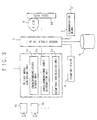
- Fig. 3 shows the construction of the shop-based client 12.
- the shop-based client 12 includes a plurality of cameras 1a, 1b, etc., a 3D face model generating unit 2, a makeup simulation unit 3, a display unit 4, a touch panel 4a located on the display unit, a database 5 that stores 3D face model data, a pointing device 6 such as a mouse, and a communication means 7 that connects to the server 10 or the Internet 11.
- the 3D face model generating unit 2 includes a corresponding point search unit 2a, a three-dimensional shape recognition unit 2b and a geometric calculation unit 2c. Detailed actions of these units will be described later.
- Fig. 4 shows the display apparatus 4.
- the three-dimensional image of the consumer is displayed in the area indicated by 4b, and color or pattern palette is shown in the touch panel 4a. Because a three-dimensional image is displayed in the display apparatus 4, a realistic makeup simulation may be experienced.
- any type of makeup may be made through a one-touch operation of the touch panel 4a.
- a makeup style corresponding to various types of situations may be prepared in advance, such as party makeup, work makeup, etc., and the consumer's face may be reproduced with the new makeup style based on a single touch of the touch panel.
- a makeup simulation may be executed manually. Once 3D face model data is sent to the server 10, these simulations may be carried out on a personal computer at home.
- simulations of makeup, cosmetic surgery, clothing, perfume, accessories, hair style, etc. may be provided based on 3D information.
- information to enable one to resemble one's favorite model may be obtained. For example, intermediate images resembling a cross between oneself and one's favorite model may be created through morphing technology, and the desired image may be selected. The user can learn what percentage of the image comprises her own features and what percentage comprises the model's features. Simulation of not only one's face (the head area) but also one's entire body is possible as well.
- the degree of one's beauty and apparent age can be objectively evaluated, identification of individual faces can be made, and the facial expression that best indicates and quantifies the person's emotional state can be objectively evaluated to a significant extent.
- Each individual's face has its own particular light and dark areas and areas comprising a mixture thereof. This means that each individual's face may be recognized based on these light, dark and mixed areas. Furthermore, depending on how one observes the face, one can observe changes in the shape of a person's light and dark areas that occur with changes in a person's facial expression. In other words, one's facial expression changes with the contraction and relaxation of facial muscles, and such changes entail changes in the indentations and protrusions on one's face, i.e., in the light and dark areas of the face. Therefore, by observing these changes, even such an imprecise concept as a person's 'expression' can be quantified and objectively evaluated.
- an evaluation facial image which comprises a facial image that has undergone light/dark processing.
- an image of the subject's face must be captured and a facial image obtained.
- image enhancement processing of this facial image particularly image enhancement processing regarding the brightness of the image, an evaluation facial image comprising a plurality of areas having different levels of brightness is created.
- the face may be evaluated for various purposes, such as the degree of beauty or of aging in the face, based on the contours of the light and dark areas in the evaluation image, or on the borders between these areas.
- a determination of the degree of aging may be carried out.
- a desired face is chosen, images of a plurality of corrected candidate faces having varying degrees of resemblance to the desired face are created by alternating the original facial image using image processing such that the original facial image resembles the desired face image, and a corrected facial image is obtained by selecting from among these a plurality of corrected candidate facial images.
- a model face may be used to choose the desired face.
- a favorite television personality or actress may be used.
- the desired face is selected.
- the desired face is chosen through the makeup instructor asking the prospective makeup wearer about her preferences.
- the desired face may be chosen using a model face.
- the prospective makeup wearer can use the face of a favorite television personality or actress.
- virtual makeup faces based on the desired face i.e., images of virtual faces having the desired makeup style
- image processing such as the fusing of the desired face with the image of the face of the prospective makeup wearer
- the faces of the prospective makeup wearer and of the desired face may be combined, bringing the prospective makeup wearer's face closer in appearance to that of the desired face. From these virtual makeup faces, the ideal makeup face that is most desired by the prospective makeup wearer is determined.
- the preferred face can be chosen from among these faces as a desired virtual makeup face within the range of resemblance levels that may be obtained through the application of makeup.
- the ideal makeup face that is anticipated to be ultimately obtained may be provided beforehand.
- the prospective makeup wearer can learn the final made-up look in a short amount of time.
- a makeup technique is deduced from the ideal makeup face.
- a series of makeup pointers by which to obtain the desired look such as the areas where the eyebrows should be plucked or darkened, lines and areas where eye liner and eye shadow should be applied, eye shadow colors, areas where lipstick should be applied, and techniques for the application of foundation, are determined based on a preset makeup program.
- Makeup is then applied to the prospective makeup wearer's face based on these makeup pointers.
- the ideal makeup face i.e., the look that was accepted beforehand by the prospective makeup wearer, may be accurately reproduced on the face of the prospective makeup wearer.
- any makeup desired by the prospective makeup wearer can be applied on her face in a short period of time.
- the makeup method of the present invention is characterized in that an ideal face based on a desired face, i.e., a model face, is created through image processing, and an important aspect of this method is that the current face of the prospective makeup wearer and the model face are incrementally combined and brought closer together through image processing.
- Makeup simulation drawing software uses a method in which the face as a whole is made up by applying makeup to individual parts of the face.
- the sought makeup style is pasted on.
- a method is used in which a given eyebrow shape is chosen and pasted onto the existing eyebrow after it is matched to the size of the eyebrow on the facial image.
- a method is used in which a pre-existing form is pasted on to an image.
- the processing to apply the makeup of the selected model to the facial image of the user is carried out according to the following procedure.
- the facial image of the user is loaded into a computer using a digital camera, etc., and the facial image is defined to match the image set for the model.
- the same attribute values used for the model's makeup are loaded in and applied to the defined facial image of the user. While the makeup is different for each facial component, the same materials are used for the user's eyebrows, lipstick and colored contact lenses that were used for the model, and images are drawn in the user's facial image using the same methods that were used for the drawing of the model face.
- the correspondences of the respective pixels of the facial images of the model and the user are obtained, and makeup is applied to the facial image of the user.
- the correspondence of the respective pixels of the model facial image and the user's facial image is calculated, and the same powder that was present in a given pixel of the model image is used for the pixel of the user's skin having the same skin attribute at the same pixel of the model image.
- the eyebrows, lipstick, and colored contact lenses are automatically applied using the methods explained with regard to the model makeup.
- powder is applied using morphing technology. Two techniques are used in morphing; warp and dissolve. The first involves a method by which, when changing from one shape to another, the corresponding points are sought and the original shape is transformed, while the second involves transformation of the image by mixing the pre-change color and the post-change color in accordance with a defined ratio.
- the image drawing carried out for powdering in the present invention uses warp.
- the makeup style used by the model can be applied to the user's facial image simply through the selection of a particular model, and therefore makeup styles that the user likes, or model makeup styles that might be applied to one's face, can be selected, and many different makeup styles may be 'tried on'.
- simulation may be performed by changing the model an unlimited number of times.
- the skin color, the condition of the lips, or the quality of the face itself can change between a facial image taken in summer and a facial image taken in winter.
- the effect of the makeup at different times may be checked and confirmed even if the same makeup is applied (i.e., the same model is selected) to the face of the same person.
- the method of the present invention by which lipstick is drawn on the lips preserves the lines and shading of the lips even after the application of lipstick, one can clearly see the difference in the effect of the lipstick between when it is applied on rough lips during winter and when it is applied on fresh lips during summer.
- the effect of makeup varies depending on the type of powder used.
- the differences in the effect of makeup based on the condition of the user's face may be directly confirmed on a screen as described above. Therefore, if facial images taken in the four different seasons are used, the best makeup style may be found in a short amount of time by applying the makeup styles of various different models on one's facial image for the current season.
- the user information analyzer 105 extracts, organizes and supplies data by which to understand the overall user information based on the contents of the member database 101. It performs classification of all of the registered users, and outputs basic user characteristic data such as the total number of registered users, the ratio of men to women, the distribution of users by age and location of residence, etc. From the user behavior history, which includes information on the degree of cooperation of each user with questionnaire surveys and on the frequency with which the user purchased products through the Internet home page, the class of users that would be best selected as target users may be learned.
- an effective business may be developed by matching with the preferences of the target user class such basic elements as the contents of the 'total beauty site', the style of writing, and the merchandise offered.
- problems may become more clearly defined. An example of such a problem might be that although women were originally targeted, there are fewer female registered users than expected. In such a case, responsive actions such as the posting of banner ads in information portals or sites accessed by a large number of women may be taken.
- the user information analyzer 105 performs access analysis.
- 'Access analysis' is the most basic analysis that measures the number of people that visit a particular site. If a site is equated to a shop, this number is equivalent to the number of customers visiting the shop. Analysis from various viewpoints may be carried out. For example, trends may be obtained regarding the number of customers visiting on each day of the week or during each time period of the day, the number of customers who enter but leave without purchasing, and the number of customers visiting each area of the site.
- Access analysis is performed using the three indices of number of hits, PV (page view), and number of visitors.
- the number of hits is a value that indicates the number of 'data sets' that were requested to be sent from a particular site.
- the unit of measurement for 'data sets' here is the number of data files in a computer. If the data set is a home page and the home page includes a large amount of graphic data, the number of hits increases accordingly. Conversely, even if a large amount of information is contained in one page, if that data consists of one text file, it is counted as '1' hit.
- PV page view
- a cookie not only enables behavior analysis, but is also effective for one-to-one marketing.
- the use of a cookie allows the behavior of a particular person (or more accurately, the behavior of a Web browser) within the site to be tracked.
- cookie information may be provided in a customized fashion that matches each user's behavior and preferences.
- the site In order to implement this feature, the site must have cookie issuance and database functions.
- the address, telephone number, e-mail address and name are registered beforehand, and an ID and password used exclusively by the 'total beauty site' are issued.
- a member accessing a site enters a member-only page when she inputs her ID and password.
- a page dedicated to the user may be displayed after login.
- the individual's preferences may be derived and information matching these preferences may be displayed.
- the three-dimensional face model generating unit 2 will now be explained.
- Morphing is a computer graphics (CG) technology developed in Hollywood, U.S.A. According to this method, two different images are used, for example, images of the faces of two persons, and one of the images is gradually changed on the screen to the other image, thereby providing a series of images showing such change.
- CG computer graphics
- the morphing technology it is possible to create a series of images in which, for example, a white tiger turns into a young woman.
- the morphing process is roughly as follows. First, the corresponding feature points between image A and image B are obtained (e.g., eye and eye, nose and nose). This process is normally performed by an operator. When the correspondences are found, feature point p of image A is gradually changed in a time-consuming process to feature point q of image B, resulting in the image series as described above,
- CG In CG, an image is generally made of a large number of triangular elements. Therefore, morphing is performed by changing the triangle of feature point p in image A to the triangle of feature point q in image B while maintaining the correspondence between them. This will be described further with reference to Fig. 15.
- triangle A is part of image A
- triangle B is part of image B.
- the apexes p1, p2, p3 of triangle A each correspond to apexes q1, q2 and q3 of triangle B.
- triangle A In order to convert triangle A to triangle B, the differences between p1 and q1, p2 and q2, and p3 and q3 are calculated, and then respectively added to each of the apexes p1, p2, p3 of triangle A. By adding all (100%) of these differences, triangle A is converted to triangle B. It is also possible to add portions of these differences instead of the whole differences, e.g., 30% or 60% thereof. In such case, the intermediate figures between triangle A and triangle B can be obtained. For example, in Fig. 15, triangle A' is a model example of an addition of 30% of the difference, and triangle B' is a model example of an addition of 60% of the difference.
- Fig. 5 is a flowchart showing an outline of the processing of the apparatus/method according to an embodiment of the present invention.
- the image data (signals) obtained from a plurality of cameras 1a, 1b, in Fig.3. are input into a front view image generating unit 2.
- a corresponding point searching unit 2a searches the mutually corresponding points by analyzing the plurality of images. These corresponding points are analyzed by a three-dimensional shape identifying unit 2b, and the three-dimensional shape of the object is identified. Based on the identified results, the viewing rays are set, and the data is geometrically converted or varied based on the set viewing rays, thereby generating a front view image that would be gained by looking into a mirror.
- camera 1 need only be a plurality of cameras, regardless of whether 2, 3, 4 or more. Two or three are desirable from the practical aspect.
- Fig. 6 is a model view of a digital mirror comprising cameras 1 at the left and right upper ends and the lower center of a plate-shaped liquid crystal display apparatus (LCD) 4.
- An object 100 is placed on the normal vector intersecting substantially the center of LCD 4. Normally, the face of the user is located at this position, but for convenience of explanation, a quadrangular pyramid is used as an example.
- quadrangular pyramid 100 is shot by cameras 1a, 1b, and 1c, images 100a, 100b, and 100c are obtained.
- Image 100a is shot by camera la, and viewed from LCD 4, this image is a view of pyramid 100 from the left side.
- Image 100b is shot by camera 1b, and is a view of pyramid 100 from the right side.
- Image 100c is shot by camera 1c, and is a view of pyramid 100 from the bottom. If there are at least two images seen from different viewpoints located relatively adjacent to each other, then it is possible to identify a unique three-dimensional shape from a plurality of two-dimensional images through a geometrical calculation processing similar to the stereoscopic view processing. In order to perform this processing by a computer, it is necessary to specify the feature points. In the present example, the apexes of quadrangular pyramid 100 are selected. When the feature points have been specified for all images, the correspondence between these feature points is calculated. In this way, it is analyzed at which position in each image the same portion of pyramid 100 is located.
- the three-dimensional shape of pyramid 100 is identified.
- image 100a the apex is on the left side, so it is clear that pyramid 100 is at the left of cameral la.
- the viewpoint is set for example substantially in the center of LCD 4, and based on this viewpoint, an image of pyramid 100 is generated. For example, image 100 as shown in Fig. 7 is obtained.
- signal processing unit 3 receives the front view image processed as above from front view image generating unit 2, and performs various processing such as displaying the object or a reflection of the object such as gained by conventional mirror reflection, etc. Examples are the zoom and wide angle processes. A certain portion of the whole image reflected in a mirror is instantaneously enlarged or reduced. The selection of the portion to be enlarged or reduced and the processing to be performed is designated by a pointing device 6 such as a mouse. If the surface of LCD 4 is a touch panel, it is possible to touch an arbitrary portion of the image to enlarge or reduce such portion instantaneously.
- Fig. 8 is a variation of the apparatus in Fig. 3.
- Three CCD cameras 1a, 1b and 1c are provided around LCD 4.
- a computer is provided which functions as front view image generating unit 2 and signal processing unit 3. These are all stored in one case.
- Feature points may be edges, corners, texture, etc.
- the difference between corresponding feature points in image A and image B is calculated (S3).
- the present embodiment is also a drawing apparatus and method for performing morphing of images of three-dimensional objects.
- the position of the object within a space must be determined, and, according to the present drawing apparatus and method, it is possible to draw images of three-dimensional objects without directly requiring the three-dimensional position.
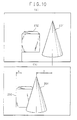
- a cone 201 and a cube 202 are arranged within a certain space and shot by two cameras la and 1b. As the viewpoints of cameras 1a, 1b differ, the obtained images are also different. The images obtained by cameras la, 1b are as shown in Figs. 10(a) and (b). Comparing these two images, it is clear that the positions of cone 201 and cube 202 are different. Assuming that the amount of change in the relative position of cone 201 is y, and that of cube 202 is x, then Fig. 10 shows that x ⁇ y. This is due to the distance between the object and the cameras.
- the feature points are sorted according to the differences (S4), and the images are written in order from that with the smallest difference (meaning the image shot by the camera farthest to the object) to the largest difference (S5). Portions near the camera are overwritten and displayed, but portions far from the camera (hidden portions) are deleted through the overwriting. In this way, it is possible to adequately reproduce an image in three-dimensional space without using depth information.
- the apparatus shown in Figs. 5 to 8 is able to display an image shown from a different viewpoint than camera 1 by processing the image obtained from camera 1 as shown in Fig. 5.
- by applying morphing processing to the face seen from the right and the left it is possible to display the face from various angles, as if the camera viewpoint had continuously moved.
- the apparatus in Figs. 5 to 8 can be used quasi as a digital form mirror (hereinafter the "digital mirror").
- Figs. 3 to 5 show a digital window simulating an actual window.
- the present invention provides a display apparatus for the window to be used in substitution of the actual window.
- Conventional display apparatuses merely displayed images, e.g. scenery, seen from a fixed viewpoint, being unable to express small changes in scenery occurring from changes in the viewpoint position at the actual window.
- Fig. 11 shows a liquid crystal apparatus ("digital window") W and a person standing before it.
- a cone and cube are arranged within a virtual space, and this situation is displayed on liquid crystal apparatus W. If the person is at position b, the image shown in Fig. 11(b) will be displayed on liquid crystal apparatus w, and if the person is at position c, then the image shown in Fig. 11(c) will be displayed. In this way, by displaying an adequate screen according to the viewpoint position, the user will feel as if he were turning his head at an actual window.
- the digital mirror and digital window processing methods above are common in that they include a processing of determining the position of an object within a three-dimensional space by calculating the correspondence of feature points between a plurality of images.
- the position measurement precision is desirably high, as the measurement precision of the three-dimensional position directly affects the image precision.
- the digital window does not require as high a measurement precision of the position as the digital mirror.
- a processing apparatus/method for the digital mirror will be hereinafter referred to as the facial image generator and a processing apparatus/method for the digital window the scenery image generator. Both will be now described in further detail.
- the facial image generator conducts its processing using three cameras and a trifocal tensor suited as constraint.
- the scenery generator conducts its processing using two cameras and the epipolar geometry as constraint. Conventionally, it was difficult to find correspondences only by comparing the three images of the three cameras, but by using the space constraints of the three cameras, the correspondence search can be performed automatically.
- Feature point detection units 10a to 10c outputs a list of feature points also called points of interest. If the object has a geometrical shape such as triangles or squares, the apexes thereof are the features points. In normal photograph images, points of interest are naturally good candidates for feature points as points of interest are by their very definition image points that have the highest textureness.
- Correlation units lla and llb and a robust matching unit 12 make a seed finding unit.
- This unit functions to find an aggregate of initial trinocular matches (constraint of the positions of three cameras) that are highly reliable. Three lists of points of interest are input into this unit, and the unit outputs a list of trinocular matches of the points of interest called seed matches.
- Correlation units lla and 11b establish a list of tentative trinocular matches.
- Robust matching unit finalizes a list of reliable seed matches using robust methods applied to three view geometric constraints.
- camera orientation auto-determination unit 13 determines the camera orientation in order to constrain the match propagation. In other words, camera orientation auto-determination unit 13 receives input of a list of seed matches from robust matching unit 12 and outputs the orientation of the camera system.
- the three-view constraints t 1 ,..., t 12 are optimally re-computed by using all trinocular inlier matches.
- the extraction of camera orientations directly from the three-view constraints for later usage is based on an original observation that the problem of affine cameras is converted into a nice problem of 1D projective cameras.
- the procedure of determining the camera orientations according to the present embodiment is as follows.
- This unit 14 receives input of a list of seed matches and camera orientation parameters from camera orientation auto-determination unit 13 and outputs dense matching in three images.
- match propagation from the initial seed matches After obtaining the initial seed matches, it comes the central idea of match propagation from the initial seed matches.
- the idea is similar to the classic region growing method for image segmentation based on the pixel homogeneity.
- the present embodiment adopts region growing to match growing. Instead of using the homogeneity property, a similarity measure based on the correlation score is used. This propagation strategy could also be justified as the seed matches are the points of interest that are the local maxima of the textureness, so the matches could be extended to its neighbors which have still strong textureness though not a local maxima.
- All initial seed matches are starting points of concurrent propagations.
- a match (a, A) with the best ZNCC score is removed from the current set of seed matches (S21 in Fig. 14).
- new matches are searched in its 'match neighborhood' and all new matches are simultaneously added to the current set of seeds and to the set of accepted matches-under construction (S22).
- the neighbors pixels a and A are taken to be all pixels within the 5 x window centered at a and A to ensure the continuity constraint of the matching results.
- For each neighboring pixel in the first image we construct a list of tentative match candidates consisting of all pixels of a 3 x 3 window in the neighborhood of its corresponding location in the second image. Thus the displacement gradient limit should not exceed 1 pixel.
- This propagation procedure is carried out simultaneously from the first to the second and the first to the third image, and the propagation is constrained by the camera orientation between each pair of images. Only those that satisfy the geometric constraints of the camera system are propagated. Further, these two concurrent propagations are constrained by the three-view geometry of the camera system. Only those that satisfy the three-view geometry of the camera system are retained.
- the unicity constraint of the matching and the termination of the process are guaranteed by choosing only new matches not yet accepted. Since the search space is reduced for each pixel, small 5 x 5 windows are used for ZNCC, therefore minor geometric changes are allowed.
- Re-sampling unit 15 receives input of the dense matching in three images from constraint match propagation unit 14 and outputs a list of re-sampled trinocular matches.
- the first image is initially subdivided into square patches by a regular grid of two different scales 8 x 8 and 16 x 16. For each square patch, we obtain all matched points of the square from the dense matching.
- a plane homography H is tentatively fitted to these matched points u i ⁇ u' i of the square to look for potential planar patches.
- the putative homography for a patch cannot be estimated by standard least squares estimators. Robust methods have to be adopted, which provide a reliable estimate of the homography even if some of the matched points of the square patch are not actually lying on the common plane on which the majority lies. If the consensus for the homography reaches 75%, the square patch is considered as planar.
- the delimitation of the corresponding planar patch in the second and the third image is defined by mapping the four corners of the square patch in the first image with the estimated homography H. Thus, a corresponding planar patches in three images is obtained.
- This process of fitting the square patch to a homography is first repeated for all square patches of the first image from the larger to the smaller scale, it turns out all matched planar patches at the end.
- the image interpolation relies exclusively on image content without any depth information and is sensitive to visibility changes and occlusions.
- the three view joint triangulation is designed essentially for handling the visibility issue.
- Three-view joint triangulation unit 16 receives input of the re-sampled trinocular matches and outputs joint three-view triangulation.
- the triangulation in each image will be Delaunay because of its minimal roughness properties.
- the Delaunay triangulation will be necessarily constrained as we want to separate the matched regions from the unmatched ones.
- the boundaries of the connected components of the matched planar patches of the image must appear in all images, and therefore are the constraints for each Delaunay triangulation.
- the joint three-view triangulation is defined as fulfilling the following conditions.
- view interpolation unit 17 any number of in-between new images can be generated, for example, images seen from positions between a first and a second camera. These in-between images can be generated from the original three images.
- the view interpolation processing is performed according to the following procedures.
- facial image generation from 3 images could be extended to either 2 or N images with reasonable modification of the processing units.
- Other objects than face images could also be processed in a very similar manner.
- means is not limited to physical means but includes cases where the functions of such means are realized through software. Furthermore, the functions of one means may be realized through two or more physical means, and the functions of two or more means may be realized through one physical means.
Landscapes
- Engineering & Computer Science (AREA)
- Physics & Mathematics (AREA)
- Theoretical Computer Science (AREA)
- General Physics & Mathematics (AREA)
- Business, Economics & Management (AREA)
- Computer Graphics (AREA)
- Software Systems (AREA)
- Geometry (AREA)
- Economics (AREA)
- Health & Medical Sciences (AREA)
- Radiology & Medical Imaging (AREA)
- Quality & Reliability (AREA)
- General Health & Medical Sciences (AREA)
- Medical Informatics (AREA)
- Primary Health Care (AREA)
- Public Health (AREA)
- Nuclear Medicine, Radiotherapy & Molecular Imaging (AREA)
- Accounting & Taxation (AREA)
- Finance (AREA)
- Development Economics (AREA)
- Computer Vision & Pattern Recognition (AREA)
- Entrepreneurship & Innovation (AREA)
- Human Resources & Organizations (AREA)
- Marketing (AREA)
- Operations Research (AREA)
- Epidemiology (AREA)
- Strategic Management (AREA)
- Tourism & Hospitality (AREA)
- General Business, Economics & Management (AREA)
- Computing Systems (AREA)
- Architecture (AREA)
- Computer Hardware Design (AREA)
- General Engineering & Computer Science (AREA)
- Processing Or Creating Images (AREA)
- Image Processing (AREA)
- Two-Way Televisions, Distribution Of Moving Picture Or The Like (AREA)
- Management, Administration, Business Operations System, And Electronic Commerce (AREA)
- Image Generation (AREA)
- Testing, Inspecting, Measuring Of Stereoscopic Televisions And Televisions (AREA)
- Image Analysis (AREA)
Abstract
Description
- Eyebrows: The eyebrow area is defined, the eyebrow in the original eyebrow area is shaved off, and the color of the surrounding skin is drawn in. An eyebrow shape is chosen, and that shape is drawn in the eyebrow area. When this is done, processing is performed on a pixel-by-pixel basis in the eyebrow area, and the eyebrow is drawn in accordance with a defined calculation formula.
- Lipstick: The lip area onto which lipstick is to be applied is defined, and the chosen lipstick color is applied to the lip area. Here, image processing is carried out using the three elements of the hue, brightness and saturation. An image of the lip area is drawn by replacing the lip with the hue of the lipstick color, and converting the brightness and saturation of the original lips to the brightness and saturation of the lipstick. When this is done, operations such as glossing are also performed. Furthermore, the areas around the border between the lips and the skin are drawn such that the border between the lips and skin is a continuous color.
- Powdering of the skin: An image is drawn in which the skin color value and the powder color value are mixed according to a specified ratio. Here, powdering includes the application of makeup such as foundation, eye shadow and blush.
- Colored contact lenses: After the positions at which colored contact lenses are to be placed in the image (the positions at which the colored parts of the contacts are to be drawn) are defined, the color values of the colored contact lenses and of the iris are mixed according to a defined ratio in the display.
- Eyebrows - eyebrow shape, eyebrow color (color value), position and size relative to the face
- Lipstick - lipstick color value, degree of gloss
- Powder - powder color value and density of application on a pixel-by-pixel basis
- Colored contact lenses - color value of colored contact lenses
- Facial image definition points
Using tensor-vector mapping defined by 4(a - 1) + 2(b - 1) +
The 1D camera epipoles can be extracted from the tensor by solving, for instance, |T.jke2| = 0 for the epipoles e2 and e3 in the first image. The other epipoles can be similarly obtained by factorizing the matrix Ti·ke'1 for e'1 and e' 3 and T.jke''1 for e"1 and e"2.
It is first straightforward that h = e'1 and h' = e"1. The homographic parts of the camera matrices are determined from Tijk = Hi jhk - h'jH'i k. Then, the camera centers and the 2D projective reconstruction can be determined from the camera matrices as their kernels.
The known aspect ratio for the affine camera is equivalent to the knowledge of the circular points on the affine image plane. The dual of the absolute conic on the plane at infinity could be determined by observing that the viewing rays of the circular points of each affine image plane are tangent to the absolute conic through the camera center.
Transforming the absolute conic to its canonical position therefore converts all projective quantities into their true Euclidean counterparts. Euclidean camera centers give the orientation of the affine cameras and the affine epipolar geometry is deduced from the epipoles.
- There is one-to-one vertex correspondence in three images.
- The constraint edges are the boundary edge of the connected components of the matched regions in three images.
- There is one-to-one constraint edge correspondence in three images.
- In each image, the triangulation is a constraint Delaunay triangulation by the constraint edges.
Claims (17)
- A three-dimensional beauty simulation client-server system comprising:a shop-based client that obtains and transmits three-dimensional shape data regarding a user; anda server that comprises a makeup simulation unit that receives and stores said three-dimensional shape data from said shop-based client and carries out makeup simulation based on said three-dimensional shape data in response to the user's requests, and a data control unit that analyzes the user's operation record and generates administrative information.
- The three-dimensional beauty simulation client-server system according to claim 1, further comprising a client that can access said server, wherein said server provides a makeup simulation in response to requests from said client.
- The three-dimensional beauty simulation client-server system according to claim 1, further comprising a cellular telephone that has a data transmission function and can access said server, wherein said server provides a makeup simulation in response to requests from said cellular telephone.
- The three-dimensional beauty simulation client-server system according to claim 1, wherein said server further comprises a member registration unit that stores member registration information, and wherein said server provides makeup simulations to users registered beforehand in said member registration unit.
- The three-dimensional beauty simulation client-server system according to claim 1, wherein said server transmits the operation record and/or administrative information regarding said users via a computer network.
- The three-dimensional beauty simulation client-server system according to claim 1, wherein said shop-based client comprises:a plurality of cameras to obtain images of the user as seen from a plurality of viewpoints;a corresponding point search unit that receives each item of image data obtained from the plurality of cameras, analyzes the plurality of images, and searches for corresponding points that correspond to each other;a three-dimensional shape recognition unit that analyzes the searched corresponding points and recognizes the three-dimensional shape of the target object;a geometric calculation unit that sets a line of sight based on the recognition results from said three-dimensional shape recognition unit, and generates an image from a prescribed line of sight through geometric conversion of the data based on the set line of sight;a display unit that displays the image generated by said geometric calculation unit; andcommunication means that transmits the image data generated by said geometric calculation unit to said server.
- The three-dimensional beauty simulation client-server system according to claim 6, wherein said corresponding point search unit and said geometric calculation unit comprises:a feature point extraction unit that extracts feature points from each of said plurality of images;a correlation calculating unit that seeks correlation among the feature points of said plurality of images and seeks combinations of said feature points;a matching unit that discards combinations having a low feasibility from among said combinations of feature points based on the condition that the images were seen from said plurality of viewpoints;a camera orientations determining unit that seeks the positions of said plurality of viewpoints and the directions of the lines of sight; anda match propagation unit that, under the conditions imposed by the positions of said plurality of viewpoints and the direction of said lines of sight obtained by said camera orientations determining unit, selects combinations of feature points starting with those having superior geometric and statistical reliability and adjusts the analysis range of the images of said target object.
- The three-dimensional beauty simulation client-server system according to claim 6, wherein said corresponding point search unit and said geometric calculation unit comprises:a feature point extraction unit that extracts feature points from each of said plurality of images;a correlation calculating unit that seeks correlation among the feature points of said plurality of images and seeks combinations of said feature points;a matching unit that discards combinations having a low feasibility from among said combinations of feature points based on the condition that the images were seen from said plurality of viewpoints;a camera orientations determining unit that seeks the positions of said plurality of viewpoints and the directions of the lines of sight;a match propagation unit that, under the conditions imposed by the positions of said plurality of viewpoints and the direction of said lines of sight obtained by said camera orientations determining unit, selects combinations of feature points starting with those having superior geometric and statistical reliability and adjusts the analysis range of the images of said target object;a resampling unit that normalizes the matching map obtained by said match propagation unit;a three-dimensional position measurement unit that determines the position of said target object in a three-dimensional space based on the normalized matching map; anda view interpolation unit that generates images seen from viewpoints different from said plurality of viewpoints based on the determined three-dimensional position of said target object.
- The three-dimensional beauty simulation client-server system according to claim 6, wherein said corresponding point search unit and said geometric calculation unit comprises:a feature point extraction unit that extracts feature points from each of said plurality of images;a correlation calculating unit that seeks correlation among the feature points of said plurality of images and seeks combinations of said feature points;a matching unit that discards combinations having a low feasibility from among said combinations of feature points based on the condition that the images were seen from said plurality of viewpoints; anda match propagation unit that, under the geometric constraints imposed by the lines of sight, selects combinations of feature points starting with those having superior geometric and statistical reliability and adjusts the analysis range of the images of said target object.
- The three-dimensional beauty simulation client-server system according to claim 6, wherein said corresponding point search unit and said geometric calculation unit comprises:a feature point extraction unit that extracts feature points from each of said plurality of images;a correlation calculating unit that seeks correlation among the feature points of said plurality of images and seeks combinations of said feature points;a matching unit that discards combinations having a low feasibility from among said combinations of feature points based on the condition that the images were seen from said plurality of viewpoints;a match propagation unit that, under the geometric constraints imposed by the lines of sight, selects combinations of feature points starting with those having superior geometric and statistical reliability and adjusts the analysis range of the images of said target object;a resampling unit that normalizes the matching map obtained by said match propagation unit;a three-dimensional position measurement unit that determines the position of said target object in a three-dimensional space based on the normalized matching map; anda view interpolation unit that generates images seen from viewpoints different from said plurality of viewpoints based on the determined three-dimensional position of said target object.
- A three-dimensional beauty simulation server comprising a makeup simulation unit that receives and stores three-dimensional shape data of a user from a shop-based client and carries out makeup simulation based on the three-dimensional shape data in response to requests from the user, and a data control unit that analyzes the operation record for said user and generates administrative information,wherein said makeup simulation unit comprises a receiving unit that receives said three-dimensional shape data, a database that stores the received three-dimensional shape data, and a makeup simulation providing unit that provides a makeup simulation in response to requests for such simulation; andwherein said data control unit of said server comprises a user information analyzer that receives the operation history of the user and analyzes the trends therein, a control database that stores the analyzed data, an information processing unit that reads out data from the control database in response to external requests and processes the data in accordance with said requests, and a transmitting/receiving unit that transmits the output of said information processing unit to the requesting source and receives requests from the requesting source.
- The three-dimensional beauty simulation server according to claim 11, wherein said makeup simulation providing unit analyzes the condition of the user's facial skin and the light and dark areas that indicate the protrusions and indentations thereon, and evaluates the user's facial expression based on the results of such analysis.
- The three-dimensional beauty simulation server according to claim 11, wherein said makeup simulation providing unit obtains a facial image of the user, displays for the user a plurality of target facial images stored beforehand for allowing the user to select one of these images, combines said user facial image and said target facial image in a plurality of predetermined ratios, and supplies a plurality of combined facial images to the user.
- The three-dimensional beauty simulation server according to claim 11, wherein said makeup simulation providing unit supplies facial images seen from freely chosen viewpoints.
- A system comprising means for deriving a 3-D image of a user, means storing information regarding user preferences regarding certain predetermined criteria, and means for generating an image of the user modified in accordance with said stored information.
- A method of producing a modified image of a user, the method comprising determining information relating to user preferences regarding certain predetermined criteria, deriving a 3-D image of a user, and modifying the image of the user in accordance with said information.
- A method as claimed in claim 16 wherein the user's behaviour is monitored to determine said information relating to user preferences.
Applications Claiming Priority (2)
| Application Number | Priority Date | Filing Date | Title |
|---|---|---|---|
| JP2000072088 | 2000-03-15 | ||
| JP2000072088A JP2001268594A (en) | 2000-03-15 | 2000-03-15 | Client server system for 3D beauty simulation |
Publications (2)
| Publication Number | Publication Date |
|---|---|
| EP1134701A2 true EP1134701A2 (en) | 2001-09-19 |
| EP1134701A3 EP1134701A3 (en) | 2003-07-02 |
Family
ID=18590559
Family Applications (1)
| Application Number | Title | Priority Date | Filing Date |
|---|---|---|---|
| EP01302391A Withdrawn EP1134701A3 (en) | 2000-03-15 | 2001-03-15 | Client-server system for three-dimensional face make-up simulation |
Country Status (3)
| Country | Link |
|---|---|
| US (1) | US20010037191A1 (en) |
| EP (1) | EP1134701A3 (en) |
| JP (1) | JP2001268594A (en) |
Cited By (15)
| Publication number | Priority date | Publication date | Assignee | Title |
|---|---|---|---|---|
| FR2831014A1 (en) * | 2001-10-16 | 2003-04-18 | Oreal | METHOD AND DEVICE FOR DETERMINING THE DESIRED AND / OR EFFECTIVE DEGREE OF AT LEAST ONE CHARACTERISTIC OF A PRODUCT |
| US6761697B2 (en) | 2001-10-01 | 2004-07-13 | L'oreal Sa | Methods and systems for predicting and/or tracking changes in external body conditions |
| EP1298597A3 (en) * | 2001-10-01 | 2005-01-12 | L'oreal | Simulation of effects of cosmetic products using a three-dimensional facial image |
| US7006657B2 (en) | 2000-12-21 | 2006-02-28 | L'oreal S.A. | Methods for enabling evaluation of typological characteristics of external body portion, and related devices |
| FR2875044A1 (en) * | 2004-09-07 | 2006-03-10 | Oreal | METHOD AND APPARATUS FOR GENERATING A SYNTHESIS IMAGE OF AT LEAST ONE CILN FRA |
| US7039222B2 (en) | 2003-02-28 | 2006-05-02 | Eastman Kodak Company | Method and system for enhancing portrait images that are processed in a batch mode |
| US7082211B2 (en) | 2002-05-31 | 2006-07-25 | Eastman Kodak Company | Method and system for enhancing portrait images |
| US7324668B2 (en) | 2001-10-01 | 2008-01-29 | L'oreal S.A. | Feature extraction in beauty analysis |
| US7437344B2 (en) | 2001-10-01 | 2008-10-14 | L'oreal S.A. | Use of artificial intelligence in providing beauty advice |
| US7773091B2 (en) | 2004-09-07 | 2010-08-10 | L'oreal | Method and device for generating a synthesized image of at least one fringe of lashes |
| WO2010095088A1 (en) * | 2009-02-23 | 2010-08-26 | Koninklijke Philips Electronics N.V. | Mirror device |
| EP1975870A4 (en) * | 2006-01-17 | 2011-05-25 | Shiseido Co Ltd | MAKE-UP SIMULATION SYSTEM, MAKE-UP SIMULATION DEVICE, MAKE-UP SIMULATION METHOD, AND MAKE-UP SIMULATION PROGRAM |
| WO2018005884A1 (en) * | 2016-06-29 | 2018-01-04 | EyesMatch Ltd. | System and method for digital makeup mirror |
| EP3524089A1 (en) * | 2018-02-09 | 2019-08-14 | Perfect Corp. | Systems and methods for virtual application of cosmetic effects to a remote user |
| US12444110B2 (en) | 2016-06-29 | 2025-10-14 | EyesMatch Ltd. | System and method for digital makeup mirror |
Families Citing this family (83)
| Publication number | Priority date | Publication date | Assignee | Title |
|---|---|---|---|---|
| US7079158B2 (en) * | 2000-08-31 | 2006-07-18 | Beautyriot.Com, Inc. | Virtual makeover system and method |
| US6746120B2 (en) * | 2000-10-30 | 2004-06-08 | Novartis Ag | Method and system for ordering customized cosmetic contact lenses |
| US20030063102A1 (en) * | 2001-10-01 | 2003-04-03 | Gilles Rubinstenn | Body image enhancement |
| US20030065255A1 (en) * | 2001-10-01 | 2003-04-03 | Daniela Giacchetti | Simulation of an aesthetic feature on a facial image |
| US7466992B1 (en) | 2001-10-18 | 2008-12-16 | Iwao Fujisaki | Communication device |
| US7127271B1 (en) | 2001-10-18 | 2006-10-24 | Iwao Fujisaki | Communication device |
| US7107081B1 (en) | 2001-10-18 | 2006-09-12 | Iwao Fujisaki | Communication device |
| US20040110113A1 (en) * | 2002-12-10 | 2004-06-10 | Alice Huang | Tool and method of making a tool for use in applying a cosmetic |
| US8229512B1 (en) | 2003-02-08 | 2012-07-24 | Iwao Fujisaki | Communication device |
| US8241128B1 (en) | 2003-04-03 | 2012-08-14 | Iwao Fujisaki | Communication device |
| US8090402B1 (en) | 2003-09-26 | 2012-01-03 | Iwao Fujisaki | Communication device |
| US8229799B2 (en) * | 2003-09-27 | 2012-07-24 | Tara Chand Singhal | System and method for simulating apparel fit while maintaining customer privacy on a global computer network |
| US7917167B1 (en) | 2003-11-22 | 2011-03-29 | Iwao Fujisaki | Communication device |
| US8041348B1 (en) | 2004-03-23 | 2011-10-18 | Iwao Fujisaki | Communication device |
| JP2005321986A (en) * | 2004-05-07 | 2005-11-17 | Pioneer Electronic Corp | Hairstyle proposal system, hairstyle proposal method and computer program |
| US7679581B2 (en) * | 2004-08-02 | 2010-03-16 | Searete Llc | Medical overlay mirror |
| US7876289B2 (en) | 2004-08-02 | 2011-01-25 | The Invention Science Fund I, Llc | Medical overlay mirror |
| US7705800B2 (en) * | 2004-09-15 | 2010-04-27 | Searete Llc | Multi-angle mirror |
| US7671823B2 (en) * | 2004-08-02 | 2010-03-02 | Searete Llc | Multi-angle mirror |
| US7679580B2 (en) * | 2004-08-02 | 2010-03-16 | Searete Llc | Time-lapsing mirror |
| US7688283B2 (en) * | 2004-08-02 | 2010-03-30 | Searete Llc | Multi-angle mirror |
| US7663571B2 (en) * | 2004-08-02 | 2010-02-16 | Searete Llc | Time-lapsing mirror |
| US7657125B2 (en) * | 2004-08-02 | 2010-02-02 | Searete Llc | Time-lapsing data methods and systems |
| US7283106B2 (en) | 2004-08-02 | 2007-10-16 | Searete, Llc | Time-lapsing mirror |
| US7133003B2 (en) * | 2004-08-05 | 2006-11-07 | Searete Llc | Cosmetic enhancement mirror |
| US20080001851A1 (en) * | 2006-06-28 | 2008-01-03 | Searete Llc | Cosmetic enhancement mirror |
| US7259731B2 (en) * | 2004-09-27 | 2007-08-21 | Searete Llc | Medical overlay mirror |
| US7714804B2 (en) * | 2004-09-15 | 2010-05-11 | Searete Llc | Multi-angle mirror |
| US7683858B2 (en) * | 2004-08-02 | 2010-03-23 | Searete Llc | Cosmetic enhancement mirror |
| US9155373B2 (en) | 2004-08-02 | 2015-10-13 | Invention Science Fund I, Llc | Medical overlay mirror |
| US7636072B2 (en) | 2004-08-02 | 2009-12-22 | Searete Llc | Cosmetic enhancement mirror |
| US7950925B2 (en) * | 2004-12-30 | 2011-05-31 | Kimberly-Clark Worldwide, Inc. | Interacting with consumers to inform, educate, consult, and assist with the purchase and use of personal care products |
| JP4230525B2 (en) * | 2005-05-12 | 2009-02-25 | 有限会社テクノドリーム二十一 | Three-dimensional shape measuring method and apparatus |
| US7612794B2 (en) * | 2005-05-25 | 2009-11-03 | Microsoft Corp. | System and method for applying digital make-up in video conferencing |
| US20070047761A1 (en) * | 2005-06-10 | 2007-03-01 | Wasilunas Elizabeth A | Methods Of Analyzing Human Facial Symmetry And Balance To Provide Beauty Advice |
| KR101249988B1 (en) * | 2006-01-27 | 2013-04-01 | 삼성전자주식회사 | Apparatus and method for displaying image according to the position of user |
| US7783075B2 (en) * | 2006-06-07 | 2010-08-24 | Microsoft Corp. | Background blurring for video conferencing |
| US7890089B1 (en) | 2007-05-03 | 2011-02-15 | Iwao Fujisaki | Communication device |
| JP2009064423A (en) * | 2007-08-10 | 2009-03-26 | Shiseido Co Ltd | Makeup simulation system, makeup simulation apparatus, makeup simulation method, and makeup simulation program |
| US8676273B1 (en) | 2007-08-24 | 2014-03-18 | Iwao Fujisaki | Communication device |
| US8639214B1 (en) | 2007-10-26 | 2014-01-28 | Iwao Fujisaki | Communication device |
| US20090231356A1 (en) * | 2008-03-17 | 2009-09-17 | Photometria, Inc. | Graphical user interface for selection of options from option groups and methods relating to same |
| US8543157B1 (en) | 2008-05-09 | 2013-09-24 | Iwao Fujisaki | Communication device which notifies its pin-point location or geographic area in accordance with user selection |
| US8340726B1 (en) | 2008-06-30 | 2012-12-25 | Iwao Fujisaki | Communication device |
| US8452307B1 (en) | 2008-07-02 | 2013-05-28 | Iwao Fujisaki | Communication device |
| JP5097636B2 (en) * | 2008-07-25 | 2012-12-12 | 株式会社ソニー・コンピュータエンタテインメント | Image processing apparatus, image processing method, and program |
| US20100142755A1 (en) * | 2008-11-26 | 2010-06-10 | Perfect Shape Cosmetics, Inc. | Method, System, and Computer Program Product for Providing Cosmetic Application Instructions Using Arc Lines |
| US20100145886A1 (en) * | 2008-12-08 | 2010-06-10 | Conopco, Inc., D/B/A Unilever | Evaluation and Selection Process for Consumer Products |
| JP2011070579A (en) * | 2009-09-28 | 2011-04-07 | Dainippon Printing Co Ltd | Captured image display device |
| WO2011067162A1 (en) * | 2009-12-02 | 2011-06-09 | Unilever Plc | Apparatus for and method of measuring skin age |
| US8523570B2 (en) * | 2010-05-21 | 2013-09-03 | Photometria, Inc | System and method for providing a face chart |
| US8550818B2 (en) * | 2010-05-21 | 2013-10-08 | Photometria, Inc. | System and method for providing and modifying a personalized face chart |
| TWI426450B (en) * | 2010-10-27 | 2014-02-11 | Hon Hai Prec Ind Co Ltd | Electronic cosmetic case |
| EP2538388B1 (en) * | 2011-06-20 | 2015-04-01 | Alcatel Lucent | Method and arrangement for image model construction |
| US8693768B1 (en) | 2012-07-10 | 2014-04-08 | Lisa LaForgia | Cosmetic base matching system |
| US9792836B2 (en) | 2012-10-30 | 2017-10-17 | Truinject Corp. | Injection training apparatus using 3D position sensor |
| EP2915157B1 (en) | 2012-10-30 | 2019-05-08 | Truinject Corp. | System for injection training |
| KR101404640B1 (en) | 2012-12-11 | 2014-06-20 | 한국항공우주연구원 | Method and system for image registration |
| US9092697B2 (en) * | 2013-02-07 | 2015-07-28 | Raytheon Company | Image recognition system and method for identifying similarities in different images |
| JP6288404B2 (en) * | 2013-02-28 | 2018-03-07 | パナソニックIpマネジメント株式会社 | Makeup support device, makeup support method, and makeup support program |
| US10002498B2 (en) | 2013-06-17 | 2018-06-19 | Jason Sylvester | Method and apparatus for improved sales program and user interface |
| US9699123B2 (en) | 2014-04-01 | 2017-07-04 | Ditto Technologies, Inc. | Methods, systems, and non-transitory machine-readable medium for incorporating a series of images resident on a user device into an existing web browser session |
| US9827714B1 (en) | 2014-05-16 | 2017-11-28 | Google Llc | Method and system for 3-D printing of 3-D object models in interactive content items |
| JP6583660B2 (en) * | 2015-03-26 | 2019-10-02 | パナソニックIpマネジメント株式会社 | Image composition apparatus and image composition method |
| JP6675384B2 (en) * | 2015-03-27 | 2020-04-01 | 株式会社メガチップス | Makeup support system, measuring device, portable terminal device and program |
| JP6275086B2 (en) * | 2015-07-25 | 2018-02-07 | 株式会社オプティム | Server, data providing method, and server program |
| WO2017070391A2 (en) | 2015-10-20 | 2017-04-27 | Truinject Medical Corp. | Injection system |
| US9984282B2 (en) * | 2015-12-10 | 2018-05-29 | Perfect Corp. | Systems and methods for distinguishing facial features for cosmetic application |
| US10849688B2 (en) | 2016-03-02 | 2020-12-01 | Truinject Corp. | Sensory enhanced environments for injection aid and social training |
| CA3015492C (en) | 2016-03-21 | 2021-11-23 | The Procter & Gamble Company | Systems and methods for providing customized product recommendations |
| US10607372B2 (en) * | 2016-07-08 | 2020-03-31 | Optim Corporation | Cosmetic information providing system, cosmetic information providing apparatus, cosmetic information providing method, and program |
| US10354546B2 (en) * | 2016-11-25 | 2019-07-16 | Naomi Belhassen | Semi-permanent makeup system and method |
| EP3596721B1 (en) | 2017-01-23 | 2023-09-06 | Truinject Corp. | Syringe dose and position measuring apparatus |
| US10621771B2 (en) | 2017-03-21 | 2020-04-14 | The Procter & Gamble Company | Methods for age appearance simulation |
| US10614623B2 (en) | 2017-03-21 | 2020-04-07 | Canfield Scientific, Incorporated | Methods and apparatuses for age appearance simulation |
| KR102297301B1 (en) | 2017-05-31 | 2021-09-06 | 더 프록터 앤드 갬블 캄파니 | Systems and methods for determining apparent skin age |
| JP6849824B2 (en) | 2017-05-31 | 2021-03-31 | ザ プロクター アンド ギャンブル カンパニーThe Procter & Gamble Company | Systems and methods for guiding users to take selfies |
| US20180350155A1 (en) * | 2017-05-31 | 2018-12-06 | L'oreal | System for manipulating a 3d simulation of a person by adjusting physical characteristics |
| US20190130792A1 (en) * | 2017-08-30 | 2019-05-02 | Truinject Corp. | Systems, platforms, and methods of injection training |
| CN108280883B (en) * | 2018-02-07 | 2021-05-04 | 北京市商汤科技开发有限公司 | Method and device for generating special-effect-of-deformation program file package and method and device for generating special effect of deformation |
| US11003939B2 (en) * | 2018-07-06 | 2021-05-11 | Canon Kabushiki Kaisha | Information processing apparatus, information processing method, and storage medium |
| JP2020197844A (en) * | 2019-05-31 | 2020-12-10 | 大日本印刷株式会社 | Face image determination system |
| EP3799061B1 (en) * | 2019-09-26 | 2023-11-22 | Siemens Healthcare GmbH | Method for providing at least one image dataset, storage medium, computer program product, data server, imaging device and telemedicine system |
Family Cites Families (19)
| Publication number | Priority date | Publication date | Assignee | Title |
|---|---|---|---|---|
| US3510210A (en) * | 1967-12-15 | 1970-05-05 | Xerox Corp | Computer process character animation |
| US4539585A (en) * | 1981-07-10 | 1985-09-03 | Spackova Daniela S | Previewer |
| US4731743A (en) * | 1985-11-12 | 1988-03-15 | Combputer Images, Inc. | Method and apparatus for displaying hairstyles |
| US5060171A (en) * | 1989-07-27 | 1991-10-22 | Clearpoint Research Corporation | A system and method for superimposing images |
| US5495568A (en) * | 1990-07-09 | 1996-02-27 | Beavin; William C. | Computerized clothing designer |
| JPH0696100A (en) * | 1992-09-09 | 1994-04-08 | Mitsubishi Electric Corp | Remote trading system |
| AU1333895A (en) * | 1993-11-30 | 1995-06-19 | Raymond R. Burke | Computer system for allowing a consumer to purchase packaged goods at home |
| US5680528A (en) * | 1994-05-24 | 1997-10-21 | Korszun; Henry A. | Digital dressing room |
| US5732398A (en) * | 1995-11-09 | 1998-03-24 | Keyosk Corp. | Self-service system for selling travel-related services or products |
| JPH09327329A (en) * | 1996-06-07 | 1997-12-22 | Tetsuaki Mizushima | Simulation system for hair styling |
| JP3912834B2 (en) * | 1997-03-06 | 2007-05-09 | 有限会社開発顧問室 | Face image correction method, makeup simulation method, makeup method, makeup support apparatus, and foundation transfer film |
| US5983201A (en) * | 1997-03-28 | 1999-11-09 | Fay; Pierre N. | System and method enabling shopping from home for fitted eyeglass frames |
| EP0901105A1 (en) * | 1997-08-05 | 1999-03-10 | Canon Kabushiki Kaisha | Image processing apparatus |
| CA2312315A1 (en) * | 1997-12-01 | 1999-06-10 | Arsev H. Eraslan | Three-dimensional face identification system |
| US6043827A (en) * | 1998-02-06 | 2000-03-28 | Digital Equipment Corporation | Technique for acknowledging multiple objects using a computer generated face |
| US6144388A (en) * | 1998-03-06 | 2000-11-07 | Bornstein; Raanan | Process for displaying articles of clothing on an image of a person |
| US6095650A (en) * | 1998-09-22 | 2000-08-01 | Virtual Visual Devices, Llc | Interactive eyewear selection system |
| US6293284B1 (en) * | 1999-07-07 | 2001-09-25 | Division Of Conopco, Inc. | Virtual makeover |
| US6377257B1 (en) * | 1999-10-04 | 2002-04-23 | International Business Machines Corporation | Methods and apparatus for delivering 3D graphics in a networked environment |
-
2000
- 2000-03-15 JP JP2000072088A patent/JP2001268594A/en active Pending
-
2001
- 2001-03-15 US US09/808,207 patent/US20010037191A1/en not_active Abandoned
- 2001-03-15 EP EP01302391A patent/EP1134701A3/en not_active Withdrawn
Cited By (26)
| Publication number | Priority date | Publication date | Assignee | Title |
|---|---|---|---|---|
| US7006657B2 (en) | 2000-12-21 | 2006-02-28 | L'oreal S.A. | Methods for enabling evaluation of typological characteristics of external body portion, and related devices |
| US7634103B2 (en) | 2001-10-01 | 2009-12-15 | L'oreal S.A. | Analysis using a three-dimensional facial image |
| US7437344B2 (en) | 2001-10-01 | 2008-10-14 | L'oreal S.A. | Use of artificial intelligence in providing beauty advice |
| US6761697B2 (en) | 2001-10-01 | 2004-07-13 | L'oreal Sa | Methods and systems for predicting and/or tracking changes in external body conditions |
| EP1298597A3 (en) * | 2001-10-01 | 2005-01-12 | L'oreal | Simulation of effects of cosmetic products using a three-dimensional facial image |
| US7324668B2 (en) | 2001-10-01 | 2008-01-29 | L'oreal S.A. | Feature extraction in beauty analysis |
| FR2831014A1 (en) * | 2001-10-16 | 2003-04-18 | Oreal | METHOD AND DEVICE FOR DETERMINING THE DESIRED AND / OR EFFECTIVE DEGREE OF AT LEAST ONE CHARACTERISTIC OF A PRODUCT |
| EP1306812A1 (en) * | 2001-10-16 | 2003-05-02 | L'oreal | Method and device for evaluating at least one characteristic of a product |
| US7082211B2 (en) | 2002-05-31 | 2006-07-25 | Eastman Kodak Company | Method and system for enhancing portrait images |
| US7039222B2 (en) | 2003-02-28 | 2006-05-02 | Eastman Kodak Company | Method and system for enhancing portrait images that are processed in a batch mode |
| US7184578B2 (en) | 2003-02-28 | 2007-02-27 | Eastman Kodak Company | Method and system for enhancing portrait images that are processed in a batch mode |
| US7187788B2 (en) | 2003-02-28 | 2007-03-06 | Eastman Kodak Company | Method and system for enhancing portrait images that are processed in a batch mode |
| US7212657B2 (en) | 2003-02-28 | 2007-05-01 | Eastman Kodak Company | Method and system for enhancing portrait image that are processed in a batch mode |
| US7636485B2 (en) | 2003-02-28 | 2009-12-22 | Eastman Kodak Company | Method and system for enhancing portrait images that are processed in a batch mode |
| US7602949B2 (en) | 2003-02-28 | 2009-10-13 | Eastman Kodak Company | Method and system for enhancing portrait images that are processed in a batch mode |
| EP1635298A1 (en) * | 2004-09-07 | 2006-03-15 | L'oreal | Method and apparatus to generate a synthesized image of at least a fringe of lashes |
| FR2875044A1 (en) * | 2004-09-07 | 2006-03-10 | Oreal | METHOD AND APPARATUS FOR GENERATING A SYNTHESIS IMAGE OF AT LEAST ONE CILN FRA |
| US7773091B2 (en) | 2004-09-07 | 2010-08-10 | L'oreal | Method and device for generating a synthesized image of at least one fringe of lashes |
| EP1975870A4 (en) * | 2006-01-17 | 2011-05-25 | Shiseido Co Ltd | MAKE-UP SIMULATION SYSTEM, MAKE-UP SIMULATION DEVICE, MAKE-UP SIMULATION METHOD, AND MAKE-UP SIMULATION PROGRAM |
| US8107672B2 (en) | 2006-01-17 | 2012-01-31 | Shiseido Company, Ltd. | Makeup simulation system, makeup simulator, makeup simulation method, and makeup simulation program |
| WO2010095088A1 (en) * | 2009-02-23 | 2010-08-26 | Koninklijke Philips Electronics N.V. | Mirror device |
| CN102326184A (en) * | 2009-02-23 | 2012-01-18 | 皇家飞利浦电子股份有限公司 | mirror device |
| WO2018005884A1 (en) * | 2016-06-29 | 2018-01-04 | EyesMatch Ltd. | System and method for digital makeup mirror |
| US12444110B2 (en) | 2016-06-29 | 2025-10-14 | EyesMatch Ltd. | System and method for digital makeup mirror |
| EP3524089A1 (en) * | 2018-02-09 | 2019-08-14 | Perfect Corp. | Systems and methods for virtual application of cosmetic effects to a remote user |
| US10431010B2 (en) | 2018-02-09 | 2019-10-01 | Perfect Corp. | Systems and methods for virtual application of cosmetic effects to a remote user |
Also Published As
| Publication number | Publication date |
|---|---|
| JP2001268594A (en) | 2001-09-28 |
| EP1134701A3 (en) | 2003-07-02 |
| US20010037191A1 (en) | 2001-11-01 |
Similar Documents
| Publication | Publication Date | Title |
|---|---|---|
| EP1134701A2 (en) | Client-server system for three-dimensional face make-up simulation | |
| EP1170699A2 (en) | System and method for providing three-dimensional images, and system and method for providing morphing images | |
| US12118602B2 (en) | Recommendation system, method and computer program product based on a user's physical features | |
| US10546417B2 (en) | Method and apparatus for estimating body shape | |
| US10475103B2 (en) | Method, medium, and system for product recommendations based on augmented reality viewpoints | |
| KR100523742B1 (en) | System and Method for 3-Dimension Simulation of Glasses | |
| GB2564745B (en) | Methods for generating a 3D garment image, and related devices, systems and computer program products | |
| US11126845B1 (en) | Comparative information visualization in augmented reality | |
| US10783528B2 (en) | Targeted marketing system and method | |
| KR102346137B1 (en) | System for providing local cultural resources guidnace service using global positioning system based augmented reality contents | |
| WO2013191689A1 (en) | Presenting realistic designs of spaces and objects | |
| AU2019240635A1 (en) | Targeted marketing system and method | |
| JP7566075B2 (en) | Computer device, method, and program for providing virtual try-on images | |
| WO2002093493A1 (en) | Method for acquiring a 3d face digital data froom 2d photograph aand a system performing the same | |
| Palma et al. | Enhanced visualization of detected 3d geometric differences | |
| CN112991003A (en) | Private customization method and system | |
| Wei et al. | The application of image analysis technology in the extraction of human body feature parameters | |
| Jain et al. | Snap and match: a case study of virtual color cosmetics consultation | |
| Sinlapanurak et al. | Hair transplant assessment in Asian men with receding hairlines using images and computer vision techniques | |
| Shinde et al. | E-Commerce Website for Virtual Try-On Clothes Using Deep Learning | |
| Alvi | Facial reconstruction and animation in tele-immersive environment | |
| Shim | Relighting objects from images: From many to few |
Legal Events
| Date | Code | Title | Description |
|---|---|---|---|
| PUAI | Public reference made under article 153(3) epc to a published international application that has entered the european phase |
Free format text: ORIGINAL CODE: 0009012 |
|
| AK | Designated contracting states |
Kind code of ref document: A2 Designated state(s): AT BE CH CY DE DK ES FI FR GB GR IE IT LI LU MC NL PT SE TR |
|
| AX | Request for extension of the european patent |
Free format text: AL;LT;LV;MK;RO;SI |
|
| PUAL | Search report despatched |
Free format text: ORIGINAL CODE: 0009013 |
|
| AK | Designated contracting states |
Designated state(s): AT BE CH CY DE DK ES FI FR GB GR IE IT LI LU MC NL PT SE TR |
|
| AX | Request for extension of the european patent |
Extension state: AL LT LV MK RO SI |
|
| AKX | Designation fees paid | ||
| STAA | Information on the status of an ep patent application or granted ep patent |
Free format text: STATUS: THE APPLICATION IS DEEMED TO BE WITHDRAWN |
|
| REG | Reference to a national code |
Ref country code: DE Ref legal event code: 8566 |
|
| 18D | Application deemed to be withdrawn |
Effective date: 20031001 |